By Patrick Lawrence
Source: Scheerpost
I tell you, serving as a New York Times correspondent these days cannot be easy. You have to convey utter nonsense to your readers while maintaining a straight face and a serious demeanor. You have to suggest the Russians may have exploded a drone over the Kremlin, that they may have blown up their own gas pipeline, that their president is an out-of-touch psychotic, that their soldiers in Ukraine are drunkards using faulty equipment, that they attack with “human hordes” (Orientalism, anyone?) and on and on—all the while affecting the gravitas once associated with the traditional “Timesman.” You try it sometime.
I am reminded of that pithy passage in Daniel Boorstin’s regrettably overlooked book, The Image. “The reporter’s task,” Boorstin wrote in 1962, “is to find a way of weaving these threads of unreality into a fabric that the reader will not recognize as entirely unreal.”
Boorstin reflected on America’s resort to imagery, illusion, and distortion as Washington geared up its gruesome follies in Vietnam. The reporter’s task is a whole lot harder now, given how much farther we have wandered into illusion and distortion since Boorstin’s day.
And now we have the case of Thomas Gibbons–Neff, a square-jawed former Marine covering the Ukraine war for The Times—strictly to the extent the Kyiv regime permits him to do so, as he explains with admirable honesty. This guy is serious times 10, he and his newspaper want us to know.
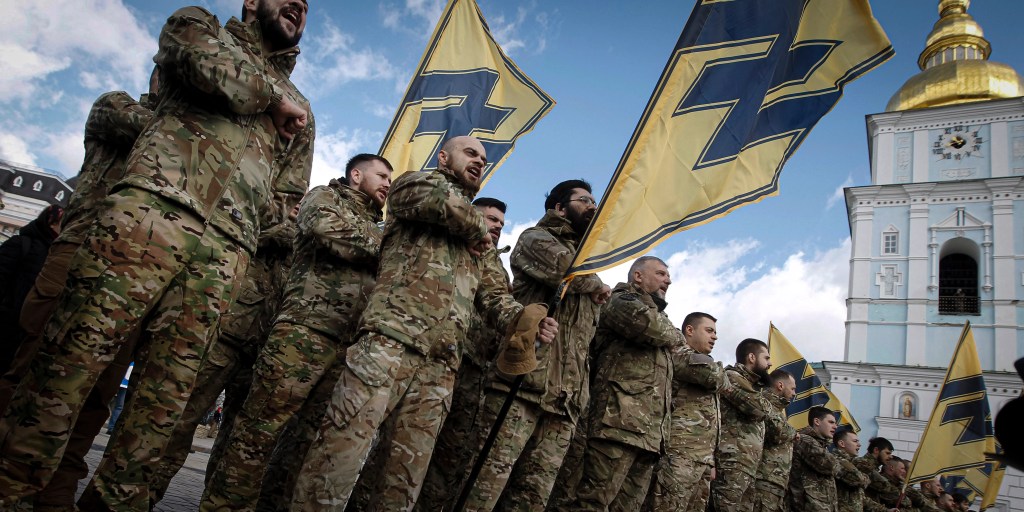
Tom’s job this week is to persuade us that all those Ukrainian soldiers wearing Nazi insignia, idolizing Jew-murdering, Russophobic collaborators with the Third Reich, gathering ritually in Nazi-inspired cabals, marching through Kyiv in Klan-like torch parades are not what you think. Nah, our Tom tells us. They look like neo–Nazis, they act like neo–Nazis, they dress like neo–Nazis, they profess Fascist and neo–Nazi ideologies, they wage this war with the Wehrmacht’s visceral hatred of Russians—O.K., but whyever would you think they are neo–Nazis?
They are just regular guys. They wear the Wolfsangel, the Schwarze sonne, the black sun, the Totenkopf, or Death’s Head—all Nazi symbols—because they are proud of themselves, and these are the kinds of things proud people wear. I was just wearing mine the other day.
The slipping and sliding starts early in “Nazi Symbols on Ukraine’s Front Lines Highlight Thorny Issues of History,” the piece Gibbons–Neff published in Monday’s editions. He begins with three photographs of neo–Nazi Ukrainian soldiers, SS insignia plainly visible, that the Kyiv regime has posted on social media, “then quietly deleted,” since the Russian intervention began last year. “The photographs, and their deletions,” Gibbons–Neff writes, “highlight the Ukrainian military’s complicated relationship with Nazi imagery, a relationship forged under both Soviet and German occupation during World War II.”
Complicated relationship with Nazi imagery? Stop right there, Mr. Semper fi. Ukraine’s neo–Nazi problem is not about a few indiscreetly displayed images. Sorry. The Ukrainian army’s “complicated relationship” is with a century of ultra-right ideology drawn from Mussolini’s Fascism and then the German Reich. As is well-known and documented, the neo–Nazis who infest the Armed Forces of Ukraine, the AFU—among many other national institutions—have made idols of such figures as Stepan Bandera, the freakishly murderous nationalist who allied with the Nazi regime during the war.
■
This history is a matter of record, as briefly outlined here, but Gibbons–Neff alludes to none of it. It’s merely a matter of poor image-making, you see. In support of this offensive whitewash, Gibbons–Neff has the nerve to quote a source from none other than Bellingcat, which was long, long back exposed as a CIA and MI6 cutout and which is now supported by the Atlantic Council, the NATO–funded, spook-infested think tank based in Washington.
“What worries me, in the Ukrainian context, is that people in Ukraine who are in leadership positions, either they don’t or they’re not willing to acknowledge and understand how these symbols are viewed outside of Ukraine,” a Bellingcat “researcher” named Michael Colborne tells Gibbons–Neff. “I think Ukrainians need to increasingly realize that these images undermine support for the country.”
Think about that. The presence of Nazi elements in the AFU is not a worry. The worry is merely whether clear signs of Nazi sympathies might cause some members of the Western alliance to decide they no longer want to support Nazi elements in the AFU. I am reminded of that Public Broadcasting news segment last year, wherein a provincial governor is featured with a portrait of Bandera behind him. PBS simply blurred the photograph and ran the interview with another of the courageous, admirable Ukrainians to which we are regularly treated.
I hardly need remind paying-attention readers that the neo–Nazis-who-are-not-neo–Nazis were for years well-reported as simply neo–Nazis in the years after the U.S.–cultivated coup in 2014. The Times, The Washington Post, PBS, CNN—the whole sorry lot—ran pieces on neo–Nazi elements in the AFU and elsewhere. In March 2018, Reuters published a commentary by Jeff Cohen under the headline “Ukraine’s Neo–Nazi Problem.” Three months later The Atlantic Council, for heaven’s sake, published a paper, also written by Cohen, titled, “Ukraine’s Got a Real Problem with Far–Right Violence (And no, RT Didn’t Write This Headline).” I recall, because it was so surprising coming from the council, that the original head on that paper was “Ukraine’s Got a Neo–Nazi Problem,” but that version now seems lost to the blur of stealth editing.
Then came the Russian intervention, and Poof! There are no more neo–Nazis in Ukraine. There are only these errant images that are of no special account. And to assert there are neo–Nazis in Ukraine—to have some semblance of memory and a capacity to judge what is before one’s eyes—“plays into Russian propaganda,” Gibbons–Neff warns us. It is to “give fuel to his”—Vladimir Putin’s—“false claims that Ukraine must be de–Nazified.” For good measure Gibbons–Neff gets out the old Volodymyr-Zelensky-is-Jewish chestnut, as if this is proof of… of something or other.
My mind goes to that lovely Donovan lyric from the Scottish singer’s Zen enlightenment phase. Remember “There Is a Mountain?” The famous lines went, “First there is a mountain/ Then there is no mountain/ Then there is.” There were neo–Nazis in Ukraine, then there were no neo–Nazis, and now there are neo–Nazis but they aren’t neo–Nazis after all.
■
There are a few things to think about as we consider Thomas Gibbons–Neff’s story, other than the fact that it is horse-droppings as a piece of journalism. For one thing, nowhere in it does he quote or reference any member of the AFU—no one wearing a uniform, no one sporting one of these troubling insignia. Various image-managing officials speak to him about the neo–Nazis who-are-not-neo–Nazis, but we never hear from any neo–Nazi-who-is-not-a-neo–Nazi to explain things as a primary source, so to say. I wager Gibbons–Neff never got within 20 miles of one: He wouldn’t dare, for then he would have to quote one of these insignia-sporting people saying that of course he was a neo–Nazi. Can’t you read, son?
For another, Gibbons–Neff resolutely avoids dilating his lens such that the larger phenomenon comes into view. It all comes down to those three unfortunate insignia in those three deleted photographs. The parades, the corridors of neo–Nazi flags, the ever-present swastikas, the reenactments of all-night SS rituals, the glorification of Nazis and Nazi collaborators, the Russophobic blood lust: Sure, it can all be explained, except that our Timesman does not go anywhere near any of this.
Gibbons–Neff’s story follows by 10 days an even more contorted piece of pretzel-like rubbish published in The Kyiv Independent, a not-independent daily that has been supported by various Western governments. This is by one Illia Ponomarenko, a reporter much-lionized in the West, and appeared under the headline, “Why some Ukrainian soldiers use Nazi-related insignia.”
This is the kind of piece that is so bad it tips into fun. “No, Ukraine does not have ‘a Nazi problem,’” Ponomarenko states flatly, and this is the last flat sentence we get in this piece. “Just like in many places around the world, people with far-right and neo–Nazi views, driven by their ideology, are prone to joining the military and participating in conflicts,” he writes. And then this doozy, where begins a riot of irrationality:
It is, of course, true that, for instance, the Azov Battalion was originally founded by neo–Nazi and far-right groups (as well as many soccer ultra-fans), which brought along with it the typical aesthetics—not only neo–Nazi insignia but also things like Pagan rituals or names like “The Black Corps,” the official newspaper of Nazi Germany’s major paramilitary organization Schutzstaffel (SS).
But worry not, readers. It is merely an aesthetic, part of a harmless, misunderstood “subculture”:
In the oversimplified memory of some around the world, particularly within various militaristic subcultures, symbols representing the Wehrmacht, Nazi Germany’s Armed Forces, and the SS are seen to reflect a super-effective war machine, not the perpetrators of one of the greatest crimes against humanity in human history.
But of course. SS insignia, Wehrmacht iconography: Seen it everywhere people admire super-effective war machines. Remember this logic next time some liberal flamer proposes to persecute a MAGA supporter who partakes of this “subculture.”
Has Tom Gibbons–Neff given us a rewrite job? Having been around the block for a good long time, I have seen this kind of thing often enough—correspondents scoring off the local dailies to look deep and penetrating back on the foreign desk. It is also possible, assuming for a moment Gibbons–Neff’s editors still read other newspapers, that they asked him for just such a piece after seeing Ponomarenko’s. Either way, we get this in Ponomarenko’s recognizably illogical style:
Questions over how to interpret such symbols are as divisive as they are persistent, and not just in Ukraine. In the American South, some have insisted that today, the Confederate flag symbolizes pride, not its history of racism and secession. The swastika was an important Hindu symbol before it was co-opted by the Nazis.
If you are going to reach, Tom, may as well reach for the stars.
We have a New York Times correspondent quoting Ukraine’s Defense Ministry and Bellingcat, an intel cutout that is part of a NATO think tank, and then rather too closely, I would say, aping a Western-supported newspaper in Kyiv. Yes, Virginia, I believe we all got ourselves one of them there echo chambers, just the way the Deep State likes ’em.
Last March, Gibbons–Neff was interviewed by The New York Times. Yes, they do this sort of thing down there on Eighth Avenue, where they simply cannot get enough of themselves. It is enlightening. The unfortunate Times reporter assigned as the straight man asked, as our intrepid correspondent self-aggrandized, “What have been the biggest challenges in covering the war?” Gibbons–Neff’s reply is pricelessly revealing.
“Wrestling with access and being allowed to go certain places to see things that you need the press officer for, or permission from the military unit,” the fearless ex–Marine explains. “Ukrainians know how to manage the press fairly well. So navigating those parameters and not rubbing anyone the wrong way has always been tough.”
Forget about bombs, missiles, gore, the fog of war, courageous sergeants, trench stench, grenades, or any of the other horrors of battle. Gibbons–Neff’s big problems as he pretends to cover the Ukraine war are maintaining access, getting the Kyiv gatekeepers’ permission to go someplace, and avoiding annoying the regime’s authorities.
Does this tell you everything you want to know about our Timesman or what?
It is always interesting to ask why a piece such as this appears when it does. Dead silence for months on the neo–Nazi question, and then suddenly a long explainer that does its best to avoid explaining anything. Always interesting to ask, never easy to answer.
It could be that a lot of stuff on these awful people is sifting out from under the carpet. Or maybe something big is on the way and this piece is preemptive. Or maybe either Gibbons–Neff or his editors saw the Ponomarenko piece as an opportunity to dispose of one of the Kyiv regime’s most embarrassing features.
Or maybe the larger context counts here. As mentioned in this space last week, The Times’s Steve Erlanger recently suggested from Brussels that NATO might do a postwar Germany job with Ukraine: Welcome the west of the country to the alliance and let the eastern provinces go for an indefinite period, unification the long-term objective. Late last week Foreign Affairs ran a fantastical piece by Andriy Zagorodnyuk, formerly a Ukrainian defense minister and now, yes indeedy, a distinguished fellow at the Atlantic Council. It appeared under the headline, “To Protect Europe, Let Ukraine Join NATO—Right Now.”
Zagorodnyuk’s argument is as loopy as his subhead, “No Country Is Better at Stopping Russia.” But these kinds of assertions, dreamily hyperbolic as they may be, have a purpose. They serve to enlarge the field of acceptable discourse. They inch us closer to normalizing the thought that Ukraine must be accepted in the North Atlantic alliance for our sake, the sake of the West, no matter how provocative such a move will prove.
This suggest that Gibbons–Neff’s piece, along with the one he followed in the Kyiv paper, are by way of a cleanup job. The Western press, working closely with intelligence agencies, did its best to prettify the savage jihadists attempting to bring down the Assad government in Damascus, you will recall. Remember the “moderate rebels?” Maybe Gibbons–Neff is on an equally dishonorable errand.
Semper fi, huh? Always faithful to what?


 After the Crash