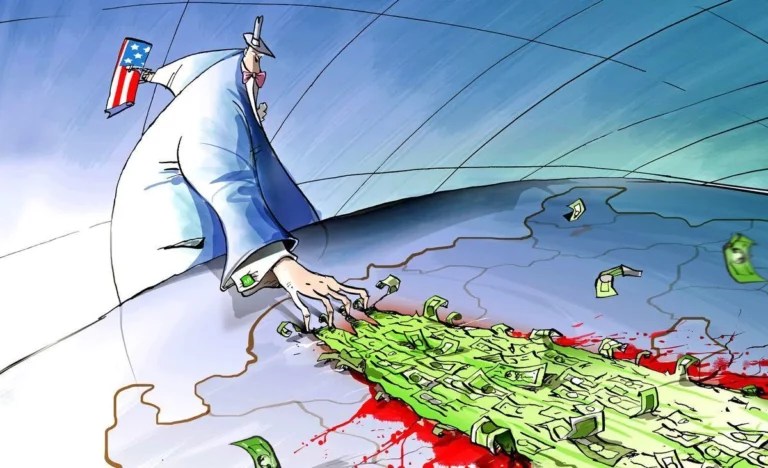
The Magnitude of Western defeat in Ukraine is higher than expected

By Salman Rafi Sheikh

Source: New Eastern Outlook

Europe is in a state of desperation; the continent is losing in Ukraine despite the ‘mighty’ strength of NATO; and European leaders are now vowing for a ‘stronger’ response, including via sending their own forces to combat Russian military forces in Ukraine. Will this decision, if it is ultimately taken, bring any meaningful change to Ukraine’s slow fall is, however, a moot question. What makes it a moot question is the scale of Ukraine’s fall and the depletion of Western stockpiles of weapons and ammunition that it is already finding hard to refill. Russia, on the other hand, is already outpacing its rivals in the West as far as the production of more – and better – weapon systems is concerned. A report in The Guardian noted that “Russian arms production worries Europe’s war planners” primarily because they cannot match this level of military preparedness and the sheer ability to sustain the fighting for two to three years.

The EU’s leader, Josep Borrell, recently noted after two years of high-intensity supply of weapons from EU allies, mainly from existing stocks, European states’ existing stocks are now depleted and “the conflict has evolved from a war of stocks to a war of production”, which, as the said report shows, Russia is clearly winning.

This information is now public, reinforcing, alongside some recently leaked Pentagon documents, the reality of Russian dominance in Ukraine. Propaganda notwithstanding, these leaked documents show that the Pentagon believes that Russian losses in Ukraine have been far less than losses publicly stated by US officials. For example, as opposed to various publicly stated estimates, Russia is said to have lost around 200,000 troops. But the Pentagon documents from February and March 2024 put the figure at around 17,000 only. Such is the scale of propaganda and the magnitude of the fear surrounding the collapse of the NATO expansion agenda that the West is now taking steps to hand over seized Russian assets to Ukraine to fund their war on Russia. They’re probably running out of enough money too!

The situation, according to a French newspaper’s investigation – which also claims to have consulted many official reports – is “critical”, with many French military officials ridiculing the idea of sending French troops to Ukraine, where the French army of “cheerleaders” can hardly fight a battle handed Russian military. But France is not an exception here. Most European military forces share this state of affairs, with very little active hardware or few troops to offer. Surely, Europe cannot send in everything, since it will leave the continent itself unprotected.

But it is highly unlikely that Russia will attack Europe, although a European provocation might change this scenario. However considering the fact that Russian military operation in Ukraine were/are driven by the Western imperative of expanding NATO, Russian success in preventing this expansion serves the purpose. For the West, however, a Russian victory in Ukraine is fretful for different purposes. They publicly talk of a Russian victory leading to a wider war in Europe, but the reality is that a Russian victory will stamp the end of western hegemony in global politics since the end of the Second World War. The West will no longer be an all-powerful ‘centre’ of the world.

Geopolitically, the West will be unable to dictate global politics, as it has been able to in the past several decades. Economically, the US dollar might lose its financial hegemony, primarily because a Russian victory in Ukraine will also indicate Russia’s ability to bypass the Western-dominated financial system. If the West can no longer control the global financial system, it automatically creates the space for alternative systems to flourish and acquire central significance. Such a scenario bodes very well for the imperatives of a new, alternative international order.

For the West – especially, the US, the self-declared leader of the ‘free world’ – this is a deeply troubling situation. Washington’s 2024 Annual Threat Assessment shows this anxiety reaching critical levels. It says: “Moscow will continue to employ all applicable sources of national power to advance its interests and try to undermine the United States and its allies … [challenging] the US primacy within” the global system. Making other admissions of failure, the report also says that the Russian economy continues to grow and that, despite western sanctions, Moscow’s oil trade is far from diminished. The report accepts that “Moscow has successfully diverted most of its seaborne oil exports and probably is selling significant volumes above the G-7–led crude oil and refined product price caps, which came into effect in December 2022 and February 2023, respectively—in part because Russia is increasing its use of non-Western options to facilitate diversion of most of its seaborne oil exports and because global oil prices increased last year”.

Because Russia is able to maintain its “energy leverage”, according to 2024 Assessment, it means it is not facing any problems vis-à-vis financing its military operations in Ukraine. In fact, the report also accepts Russia’s ability to increase public spending despite the ongoing conflict.

This is the Western assessment after financing the war on Russia for two consecutive years. Logically, such assessments infuse a sense of fear and desperation, which has led some leaders in Europe to push for sending NATO troops to Ukraine. While it may only be a threat, it does show an extremely heightened sense of defeat and a clear sense of the beginning of the end of the “Western century”.

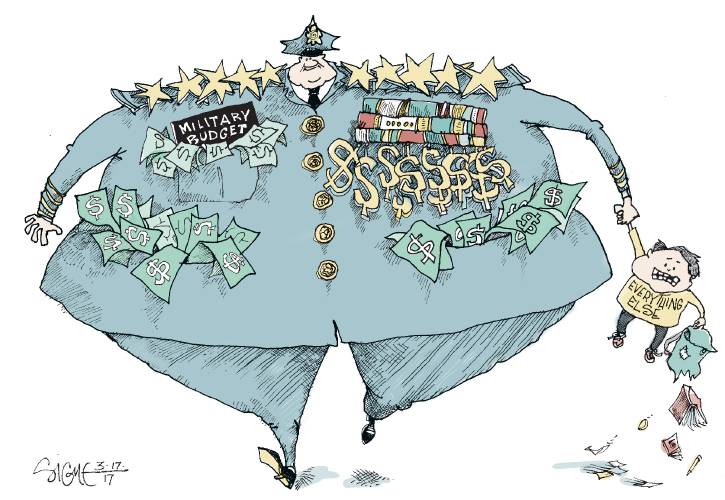
Our Real National Security Budget

$2 Trillion, Here We Come.

Signe’s second toon du jour SIGN17e Military

By Andrew Cockburn

Source: Spoils of War

The Biden Administration has just published its proposed budget, generating copious commentary, much of it displaying a commensurate degree of misunderstanding, especially regarding our gargantuan national security spending. To get at the truth of the matter, I consulted my friend Winslow Wheeler, who has been observing the insalubrious intricacies of the budget process over the past fifty years as a senior aide to Senators from both parties as well as a senior analyst for the General Accounting Office and directing the Center for Defense Information.

The defense budget has just been posted by the administration is being described as approaching a trillion dollars. Is that accurate?  :

No. It’s actually a lot more than that. In fact it’s beginning to inch up on $2 trillion. 

How so?

The problem is that when most people look at the defense budget, they don’t count everything that we spend even for the Pentagon. But in addition to that, there are hundreds of billions of dollars outside of the Pentagon’s budget that we spend for national security. Things like the nuclear weapons activities in the Department of Energy; that’s $37 billion$26 billion for retired military pensions and healthcare and $12 billion for the Selective Service, the National Defense Stockpile, and a strange and suspicious looking category for the international activities of the FBI in something called “Defense Related Activities.”

Do we have any idea what that last one is for?

It has always been classified. In the 50 years I’ve been watching the defense budget, it’s never been explained other than some occasional hints. One year they admitted to a lot of money being spent by the FBI in, wait for it, Taiwan, and so it’s very unclear exactly what this is, but it’s always counted as part of so-called defense related activities.  

The expenses that I have just been describing come to $970 billion, but that leaves out a lot.. Add in about $800 billion for the Department of Veterans Affairs, the State Department and its associated agencies, the Department of Homeland Security. And we know now from our Republican friends that border protection is a dire national security issue. Add all that together. Then you can calculate the share for the interest on the debt that we pay each year. All those activities I’ve just described come to 21% of all federal spending. Calculating in that percentage as a the amount it contributes to the debt burden gives you $254 billion.. And so you add all of that up together and you get $1.767 trillion.

Jesus Christ.  What about CIA and other intelligence spending?

All the intelligence agencies are in the Pentagon budget except for the intelligence agencies for the State Department, Coast Guard and  the Department of Homeland Security. Those are the few other things that are not in the Pentagon budget that are distributed in the other agencies that I’ve described.  When they last published the total amount for the intel budget it was over $120 billion, but it’s all embedded in these various agencies.

Since the budget was published, there’s been some wailing and lamentation that because of irksome spending restraints, this budget  actually represents a cut or at least restraint on defense spending. What’s your view on that?

Well, last yea the budget deal that then-Speaker Kevin McCarthy negotiated with the Democrats for the Pentagon allowed only a 1% increase in defense spending. But because of the screwy way that we actually calculate things, if you put together everything we spent just for the Pentagon without all those other items I mentioned, last year, it looks like we will have spent $968 billion, while for 2025, Biden’s requesting $921 billion. So yes, that’s a cut. But that doesn’t include the supplementals that Biden will request later this year for the Pentagon, for Ukraine, Israel, God knows what, that will get us back into competition with 2024. The reason why 2024 is higher than the Biden request is because it had 60 billion worth of emergency supplementals that Congress is about to approve and that money is counted in my total. But because of the broken accounting rules that we use for the budget, that money’s not counted when you calculate the deal that McCarthy made with the Democrats, and that’s emergency money that doesn’t count on budget cap.

For years we had the Overseas Contingency Operations defense spending, the so called war budget, which was the extra money the military got for actually fighting wars in Afghanistan and elsewhere. Are we getting back to that?

Yes.  The politically-derived budget caps don’t apply to that money.  And it’s a lot more than just for the wars; lots of billions for goodies for everybody added each year thereIt’s all part of the hocus pocus ways that Congress allows itself to appropriate money so it can pretend that it’s using restraint, but actually is exploiting all kinds of loopholes to increase whatever cap or restraint they pretend that they’ve added to the defense budget.

What’s the next budgetary legislative stage that we’re going to endure?

:We haven’t finished with 2024 yet, because Congress  has gotten into this habit of never passing budgets on time. And it also helps the Speaker of the House and the Majority Leader of the Senate discipline members so they don’t get out of the line on things. We do these things called continuing resolutions that keep the money flowing but only at the level approved in the previous year. And we’re in that situation for the Defense Department for 2024. Next week or the week after, they’re going to resolve that and pick a final total for 2024, which will include most, but probably not all of the emergency supplemental that Biden requested for Ukraine, Israel, Taiwan, and defense industrial base spending. So that number will become final in two or three weeks. We have barely begun on the 2025 consideration in Congress that will take the next three, four months and we’ll have another continuing resolution because they won’t pass things in time for the beginning of the fiscal year on October 1st, and we’ll go through this charade once again. And because this is an election year, it’ll be all that more sloppy, painful, and unappealing to observe.

Then when they do it, Chuck Schumer and whoever is the Speaker of the House will pat themselves on the back and say, ‘well, we’ve done a great job. Who says we can’t do anything. We just got the budget finally passed.’ But that will be months late yet again.

Are there items tacked onto the defense bills that have nothing to do with defense? 

Yes. There’s two bills. One is the National Defense Authorization Act, which is the bill that goes to the House and Senate Armed Services Committees. That’s a policy bill. It doesn’t make money actually available to be spent, but it pretends it does. It has lots of numbers in it; it’s a tar baby for all kinds of crazy stuff or politically driven stuff because the legislative process is so broken.  Members don’t have an opportunity to do stuff on the floor of the House and Senate and especially in the Senate because the Majority Leader exploits the rules to make amendments impossible. The National Defense Authorization Act is one of those bills where they actually get a chance to do amendments and they do all kinds of crazy stuff, lots of stuff that has absolutely nothing to do with national defense.  Last year they had 600 amendments for that bill.

Whew.

But they don’t really get debated. This is yet another way that the Majority Leader, Chuck Schumer, controls things. If you’re a Senator, you have to supplicate Schumer to get him to accept your amendment. That will then will get into a package that he’s blessed and it’ll be adopted wholesale by the Senate with perfunctory debate and members giving staff-written speeches about ‘this is a wonderful bill. It includes my important amendment to increase ice block cutting in Minnesota’ and all kinds of other crazy stuff. Every one of these will have been approved by Schumer or his agents as politically acceptable. If you are a dissenter and have a problem with how things are done in the Pentagon or anywhere else, you will not get Schumer’s blessing and your amendment will not be added to his package to be dumped into the National Defense Authorization Act, and you’ll be out in the cold. We go through essentially the same process with the appropriations bill, which is the one that actually makes the money available to all these agencies. Yet again, Schumer controls the process where if he likes the smell of your amendments and it’s okay with the prevailing political dogma that week or that month or for the last decade, it’ll get included. And if you have something that that Chuck Schumer doesn’t like, your amendment will be out in the cold.

Was it always like this?

When the Senate described itself as the world’s greatest deliberative body back in the 1970s and eighties, it would have a process where a bill would come up on the floor in the Senate, and the Senate took great pride in the fact that it had unlimited amendments, and you could offer an amendment on anything you wanted to all of these bills, whether it’s the National Defense Authorization Act or the FAA Authorization Act, and there would be a proper debate, and then the Senate would vote and the majority of those senators present in voting would prevail.

Today it’s a fundamentally broken process because of the automatic filibuster, which allows the party leaders to totally control things. Unless a Senator can somehow put together sixty votes to override a filibuster, Schumer and McConnell can simply prevent your amendment from even coming to the floor, let alone get debated. It’s also a corrupt process because if you legislate in ways that Chuck Schumer, or whoever is the leader, doesn’t like or your idea is a pain in the ass for the Democratic, or Republican, caucus, you will be on the outs.  Furthermore, Schumer, and McConnell control a large portion of the money that you need for your reelection campaign. And if you don’t behave yourself, you’ll be on the outs, not just on getting your amendment adopted, but you’ll be on the outs so far as getting any of his money is concerned. And for the money that he doesn’t directly control, he’ll be sending the message to the big political donors, ‘don’t give anything to Senator So and So. He’s not one of us; he’s not a good boy.’  That’s the way we do business these days.

Getting back to the defense bill, I saw an item this morning that the Navy is saying they all have to cut back Virginia class submarine production from two to one next year because of their terrible financially straitened circumstances. How do we read that?

There’s two things going on there. One is that the Navy has requested a gigantic ship-building budget, something like $45 billion. The problem is that navy ships are so expensive these days that you can’t fit much dirt into that bag. Those submarines are about $3 billion apiece. Aircraft carriers, and we’re paying for two more, are about $13 billion apiece. They have a brand new ‘low cost’ frigate that’s getting into production this year. Those come in at $1 billion apiece. When you have ships that cost these amounts, even with a gigantic budget, like $45 billion, you can’t buy many of them. The second thing that’s going on is the Navy is tickling the system. They’re saying, ‘Oh dear, we can only afford one sub this year because we’re so stretched running. And isn’t that just terrible?’ So they’re tickling Congress where it feels good, and they’re saying, ‘okay, when you add money, add money for another submarine.’

So does that mean the budget will grow beyond what the President has asked for?

The Biden request is a floor, not a ceiling.

And the other game that goes on is they are actually limited in a relative sense in the billions of dollars that they can add on each year. So the staff on the appropriations committee and the two armed services committees, they go looking for things to cut in the accounts in the Pentagon budget where nobody’s paying much attention. So they can then plow that money back into the stuff that the Navy wants for these submarines, or that Senator X, Y, or Z wants for a research and development program that just happens to be performed in his, or her, state and just happens to be from that company that gave him a healthy political contribution last year.  One of the things the staffs love to cut is training money for the Air Force and others,  because they’ll declare the request to have been excessive. They’ll add that few hundred million dollars to the pot for goodies that members of Congress want. An added problem, of course, is that the Air Force is already way, way behind on trending hours for pilots, and that account needs more money, not less money. There are all kinds of other games that the staff at these committees play to pretend they’re taking out unuseful money, and paying for the oh, so wonderful ideas that members of Congress want for their special requests.

Thank you. At least we’ve been warned.

Washington’s Wars Eroding its Global Clout

By Salman Rafi Sheikh

Source: New Eastern Outlook

If war is politics by other means, Washington’s ongoing wars in the Middle East and Eastern Europe are meant to buttress its global influence on the one hand and undermine its competitors on the other. But the question is: how is this politics by other means working out for Washington? Not so good. Russia’s recent military victories in Ukraine and China’s expansive inroads into the Middle East alongside the growing anti-Americanism in the region (due to Washington’s support for Israel and its inability to prevent a genocide of the Palestinians) indicate an overall American inability to shape global geopolitics in unilateral ways to the exclusive advantage of Washington and its allies in Europe and elsewhere.

Russia’s recent military gains in Ukraine, for example, have very clearly established its military credentials as a power that has been able to withstand the combined military strength of the US and its European allies assembled in the North Atlantic Treaty Organization (NATO). What does this mean for Washington’s policies in Central Asia? Most certainly, Washington cannot simply present Russia as a ‘weak’ military power that can be simply ‘isolated’. But more than that, Russia is utilising its victories over NATO in various ways.

For instance, when the NATO-backed Russia-Ukraine military conflict began, most reports in the mainstream US media began to spread false messaging about Central Asia potentially moving itself out of the so-called ‘Russian clout’. The US saw in it an opportunity to push itself into the region. But this has turned out to be a fiasco. When the US imposed sanctions on Russia, many Russian companies began to relocate their businesses to Central Asia, directly contributing to Central Asia’s impressive 4.8 percent growth rate in 2023. According to the findings of the European Bank for Reconstruction and Development, the region is forecast to register an even more impressive level of growth at almost 5.7 percent in 2024-25.

In other words, thanks to Washington’s sanctions, the Russian political economy is now more deeply connected with Central Asia than it was before February 2021, which is also strengthening the Eurasian Economic Union. Now that this integration is working for the advantage of Central Asia means that the latter have little to no incentive to pay too much attention to Washington and/or the imperatives of moving decisively to Washington. It means that not only has the Biden administration’s policy of NATO expansion via Ukraine failed so far in Ukraine itself, but the ‘new’ Central Asia policy it inaugurated in the wake of the Russia-Ukraine conflict has also failed to make any impact on the ground. Russia defeated US design also by approaching relations with the Central Asian States in ways that gave them enough space to stay neutral in the conflict. While the West saw this neutrality as a sign of Russian weakness in the region and the Central Asian States’ growing assertiveness, it failed to read how this was part of Russia’s strategy to cultivate its ties in a more balanced way. This balance is also pretty evident in the ways Russia has not objected to, or even resisted, China’s growing footprint in the region, although reports in the Western media often see China’s role in Central Asia at the expense of Russia. But the West seems to have been misreading this region.

As far as Washington’s war in the Middle East is concerned, its military support for Israel plus its inability to stop genocide has eroded its credibility. Suppose Washington has been supporting Israel to maintain its dominance in the Middle East. In that case, Washington’s excessive support is now derailing its objectives, since the Middle East is now exercising a lot more strategic autonomy vis-à-vis Washington than was the case until a few years ago.

In the past few months, a flurry of Chinese activity indicates it much more clearly than anything else. China has convened leadership summits, met with Arab delegates, supported their stance vis-à-vis Israel, and held joint military exercises with one of the US’ most important allies in the region (Saudi Arabia). The UAE, otherwise a close US ally and one of the first states to sign the Abraham Accords to recognise Israel and establish diplomatic ties with it, actually withdrew from the US-led naval task force in May 2023, indicating policy and interest-based differences.

The UAE is also a country in the Middle East that has over 100,000 Chinese living there and involved in many businesses. But when it comes to the Middle East itself, and the fact that many countries in the region are involved in China’s Belt & Road Initiative (BRI), we see the region’s trade with China registering an overall growth of almost 45 percent in 2021 and 27 percent in 2022.

Given the economic integration, the Middle East is turning out to be a region where Washington’s clout is receding fast, without any signs of recovery in the immediate future at least. Although US strikes in the Red Sea on the Houthis are meant to indicate Washington’s willingness to offer a security umbrella to the Gulf states (against Iran-backed groups), the region appears to be past the point where it must have the US on its side to ensure security. Gulf states’ perceptions of Iran as an enemy are changing, thanks to Beijing’s mediation.

As far as Washington’s support for Israel is concerned and as far as the threat of a wider war in the region it is posing, Gulf states are on the edge of a conflict that might directly undermine their modernization programmes – development projects that mainly involve China in various capacities.

Therefore, if Washington’s involvement in the Israel war was meant to bring back the era of US dominance, the exact opposite is happening, both in the Middle East and Central Asia, which happen to be two of the world’s most energy-rich regions.

A Low-Trust Society Is an Impoverished Society

By Charles Hugh Smith

Source: Of Two Minds

The sole remaining reservoirs of trust in American life are personal networks, local enterprises and local institutions.

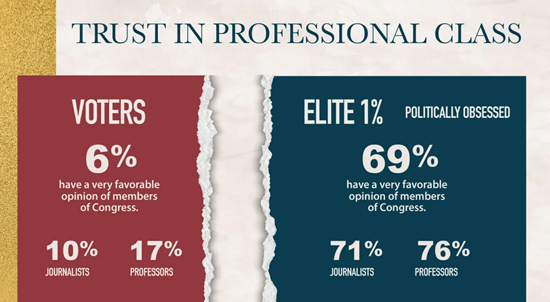
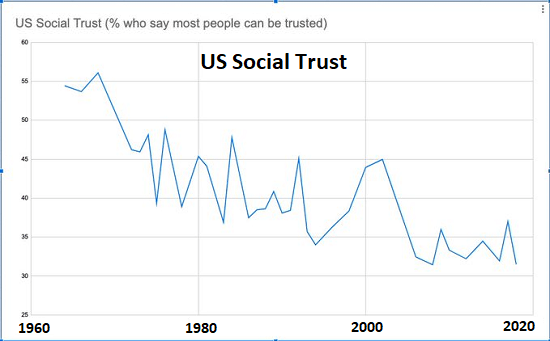
It’s not exactly news that social trust has declined significantly in the United States. Surveys find that public trust in institutions and the professional classes that dominate those institutions has cratered. (see chart below) Social trust–our confidence that other people are trustworthy–has also fallen to multi-decade lows.

This was not the case in decades past. Americans maintained high levels of trust in their institutions, government and fellow citizens. The decline in social trust is across the entire spectrum: our trust in institutions, professional elites and our fellow Americans has declined precipitously.

The causes of this decay of social trust can be debated endlessly, but several factors are obvious:

1. Institutions forfeited the trust of the citizenry by withholding / editing realities to serve the interests of hidden agendas and insiders’ careers. The Vietnam War was pursued on fabrications, as was the second Gulf War to topple Saddam. Watergate eroded trust on multiple levels, as did the Church Committee’s investigation of America’s security agencies’ domestic spying / over-reach.

2. The managerial / professional elites at the top of the nation’s institutions no longer put the citizenry’s interests above their own. The public’s trust has eroded as institutions are primarily viewed as vehicles for self-enrichment and career advancement: healthcare CEOs pay themselves millions, higher education is bloated with layers of non-teaching administration, defense contractors and the Pentagon have greased the revolving door to the benefit of incumbents and insiders, and so on, in an endless parade of self-serving cloaked with smirking PR claims of “serving the public.”

The shift from a high-trust society to a low-trust society is consequential economically, politically and socially. Low-trust societies have stagnant economies, as nobody trusts anyone they don’t know personally or through personally trusted networks, and nobody trust institutions to function effectively or fulfill their stated mission to serve the public good.

Faced with incompetent, unaccountable, corrupt bureaucracies and a culture overflowing with scams, frauds, imposters and get-rich-quick schemes, people give up and drop out. Rather than start a business and accept all the risks just to get dumped on or ripped off, they don’t even try to start a business. Given the financial insecurity that is now the norm, they decide not to get married or have children.

The vast trading networks of the Roman Empire were based on personal trusted networks and trust in Rome’s functionaries / institutions. The owners of trading ships dealt with trusted captains and merchants, who then paid duties to Roman functionaries in Alexandria and other major trading ports.

In other words, tightly bound personal trusted networks work well as long as the state institutions that bind the entire economy are trusted as fair and reliable–not perfect, of course, but efficient and “good enough.”

But when public institutions are viewed as unfair, unreliable, corrupt or incompetent, the entire economy decays. Even personal trusted networks cannot survive in an economy of unfair, unreliable, corrupt or incompetent state bureaucracies and private institutions.

The American economy is now dominated by enormous privately owned and managed monopolies and cartels that are the private-sector equivalent of self-serving state bureaucracies. Big Tech, Big Pharma, Big Healthcare, Big Ag, Big Finance, etc., are even worse than state bureaucracies because there are no legal requirements for transparency or recourse. Try getting a response from a Big Tech corporation when you’ve been shadow-banned or sent to Digital Siberia.

The sole remaining reservoirs of trust in American life are personal networks, local enterprises and local institutions. These are not guaranteed, of course; in many locales, even these reservoirs have been drained. But in other locales, enterprises and institutions such as the county water utility, the local newspaper, the local community college, etc. continue to earn the trust of the public by performing the services they exist to provide effectively and at a reasonable cost.

The larger the institution and the greater its wealth and power, the lower the social trust–for good reasons. The greater the influence of the managerial elites, the greater the disconnect from the everyday experiences of the citizenry and customers, and the more extreme the self-serving PR.

Sure, I trust Big Tech, Big Pharma, Big Healthcare, Big Finance–to rip me off, profiteer, send me obfuscating bills, jack up junk fees, make it impossible to contact them, and send me to Digital Siberia if I complain.

The divide between the elites and the commoners should prompt us to examine the low-trust path we’re sliding down:

In a society in which everything is phony, low quality or fraudulent, you’re taking a chance trusting anyone you don’t know personally–and even that can be risky now that self-aggrandizing flim-flam is the last remaining path to financial security for non-elites.

A low-trust society is an impoverished society, economically stagnant and socially threadbare. That’s where we are now, and the more fragmented, greedy, self-serving, desperate and deranged we become, the lower the odds that we’ll find the means to rebuild trust.

Sadly, we already know that anyone claiming to “rebuild trust” is spouting PR designed to mask self-enrichment. We also know that the vast army of well-paid flacks, factotums, enforcers, happy-story apologists, lackeys, toadies and sell-out minions are declaring “everything’s great!”

Just mumble, “Uh, sure” and continue to Tune in (to degrowth), drop out (of hyper-consumerism and debt-serfdom) and turn on (to self-reliance and relocalizing capital and agency).

Rule by Criminals: When Dissidents Become Enemies of the State

By John & Nisha Whitehead

Source: The Rutherford Institute

In these days of worldwide confusion, there is a dire need for men and women who will courageously do battle for truth.”— Martin Luther King Jr.

When exposing a crime is treated as committing a crime, you are being ruled by criminals.

In the current governmental climate, obeying one’s conscience and speaking truth to the power of the police state can easily render you an “enemy of the state.”

The government’s list of so-called “enemies of the state” is growing by the day.

Wikileaks founder Julian Assange is merely one of the most visible victims of the police state’s war on dissidents and whistleblowers.

Five years ago, on April 11, 2019, police arrested Assange for daring to access and disclose military documents that portray the U.S. government and its endless wars abroad as reckless, irresponsible, immoral and responsible for thousands of civilian deaths.

Included among the leaked materials was gunsight video footage from two U.S. AH-64 Apache helicopters engaged in a series of air-to-ground attacks while American air crew laughed at some of the casualties. Among the casualties were two Reuters correspondents who were gunned down after their cameras were mistaken for weapons and a driver who stopped to help one of the journalists. The driver’s two children, who happened to be in the van at the time it was fired upon by U.S. forces, suffered serious injuries.

There is nothing defensible about crimes such as these perpetrated by the government.

When any government becomes almost indistinguishable from the evil it claims to be fighting—whether that evil takes the form of war, terrorism, torture, drug trafficking, sex trafficking, murder, violence, theft, pornography, scientific experimentations or some other diabolical means of inflicting pain, suffering and servitude on humanity—that government has lost its claim to legitimacy.

These are hard words, but hard times require straight-talking.

It is easy to remain silent in the face of evil.

What is harder—what we lack today and so desperately need—are those with moral courage who will risk their freedoms and lives in order to speak out against evil in its many forms.

Throughout history, individuals or groups of individuals have risen up to challenge the injustices of their age. Nazi Germany had its Dietrich Bonhoeffer. The gulags of the Soviet Union were challenged by Aleksandr Solzhenitsyn. America had its color-coded system of racial segregation and warmongering called out for what it was, blatant discrimination and profiteering, by Martin Luther King Jr.

And then there was Jesus Christ, an itinerant preacher and revolutionary activist, who not only died challenging the police state of his day—namely, the Roman Empire—but provided a blueprint for civil disobedience that would be followed by those, religious and otherwise, who came after him.

Indeed, it is fitting that we remember that Jesus Christ—the religious figure worshipped by Christians for his death on the cross and subsequent resurrection—paid the ultimate price for speaking out against the police state of his day.

A radical nonconformist who challenged authority at every turn, Jesus was a far cry from the watered-down, corporatized, simplified, gentrified, sissified vision of a meek creature holding a lamb that most modern churches peddle. In fact, he spent his adult life speaking truth to power, challenging the status quo of his day, and pushing back against the abuses of the Roman Empire.

Much like the American Empire today, the Roman Empire of Jesus’ day had all of the characteristics of a police state: secrecy, surveillance, a widespread police presence, a citizenry treated like suspects with little recourse against the police state, perpetual wars, a military empire, martial law, and political retribution against those who dared to challenge the power of the state.

For all the accolades poured out upon Jesus, little is said about the harsh realities of the police state in which he lived and its similarities to modern-day America, and yet they are striking.

Secrecy, surveillance and rule by the elite. As the chasm between the wealthy and poor grew wider in the Roman Empire, the ruling class and the wealthy class became synonymous, while the lower classes, increasingly deprived of their political freedoms, grew disinterested in the government and easily distracted by “bread and circuses.” Much like America today, with its lack of government transparency, overt domestic surveillance, and rule by the rich, the inner workings of the Roman Empire were shrouded in secrecy, while its leaders were constantly on the watch for any potential threats to its power. The resulting state-wide surveillance was primarily carried out by the military, which acted as investigators, enforcers, torturers, policemen, executioners and jailers. Today that role is fulfilled by the NSA, the FBI, the Department of Homeland Security and the increasingly militarized police forces across the country.

Widespread police presence. The Roman Empire used its military forces to maintain the “peace,” thereby establishing a police state that reached into all aspects of a citizen’s life. In this way, these military officers, used to address a broad range of routine problems and conflicts, enforced the will of the state. Today SWAT teams, comprised of local police and federal agents, are employed to carry out routine search warrants for minor crimes such as marijuana possession and credit card fraud.

Citizenry with little recourse against the police state. As the Roman Empire expanded, personal freedom and independence nearly vanished, as did any real sense of local governance and national consciousness. Similarly, in America today, citizens largely feel powerless, voiceless and unrepresented in the face of a power-hungry federal government. As states and localities are brought under direct control by federal agencies and regulations, a sense of learned helplessness grips the nation.

Perpetual wars and a military empire. Much like America today with its practice of policing the world, war and an over-arching militarist ethos provided the framework for the Roman Empire, which extended from the Italian peninsula to all over Southern, Western, and Eastern Europe, extending into North Africa and Western Asia as well. In addition to significant foreign threats, wars were waged against inchoate, unstructured and socially inferior foes.

Martial law. Eventually, Rome established a permanent military dictatorship that left the citizens at the mercy of an unreachable and oppressive totalitarian regime. In the absence of resources to establish civic police forces, the Romans relied increasingly on the military to intervene in all matters of conflict or upheaval in provinces, from small-scale scuffles to large-scale revolts. Not unlike police forces today, with their martial law training drills on American soil, militarized weapons and “shoot first, ask questions later” mindset, the Roman soldier had “the exercise of lethal force at his fingertips” with the potential of wreaking havoc on normal citizens’ lives.

A nation of suspects. Just as the American Empire looks upon its citizens as suspects to be tracked, surveilled and controlled, the Roman Empire looked upon all potential insubordinates, from the common thief to a full-fledged insurrectionist, as threats to its power. The insurrectionist was seen as directly challenging the Emperor.  A “bandit,” or revolutionist, was seen as capable of overturning the empire, was always considered guilty and deserving of the most savage penalties, including capital punishment. Bandits were usually punished publicly and cruelly as a means of deterring others from challenging the power of the state.  Jesus’ execution was one such public punishment.

Acts of civil disobedience by insurrectionists. Much like the Roman Empire, the American Empire has exhibited zero tolerance for dissidents such as Julian Assange, Edward Snowden and Chelsea Manning who exposed the police state’s seedy underbelly. Jesus was also branded a political revolutionary starting with his attack on the money chargers and traders at the Jewish temple, an act of civil disobedience at the site of the administrative headquarters of the Sanhedrin, the supreme Jewish council.

Military-style arrests in the dead of night. Jesus’ arrest account testifies to the fact that the Romans perceived Him as a revolutionary. Eerily similar to today’s SWAT team raids, Jesus was arrested in the middle of the night, in secret, by a large, heavily armed fleet of soldiers.  Rather than merely asking for Jesus when they came to arrest him, his pursuers collaborated beforehand with Judas. Acting as a government informant, Judas concocted a kiss as a secret identification marker, hinting that a level of deception and trickery must be used to obtain this seemingly “dangerous revolutionist’s” cooperation. 

Torture and capital punishment. In Jesus’ day, religious preachers, self-proclaimed prophets and nonviolent protesters were not summarily arrested and executed. Indeed, the high priests and Roman governors normally allowed a protest, particularly a small-scale one, to run its course. However, government authorities were quick to dispose of leaders and movements that appeared to threaten the Roman Empire. The charges leveled against Jesus—that he was a threat to the stability of the nation, opposed paying Roman taxes and claimed to be the rightful King—were purely political, not religious. To the Romans, any one of these charges was enough to merit death by crucifixion, which was usually reserved for slaves, non-Romans, radicals, revolutionaries and the worst criminals.

Jesus was presented to Pontius Pilate “as a disturber of the political peace,” a leader of a rebellion, a political threat, and most gravely—a claimant to kingship, a “king of the revolutionary type.” After Jesus is formally condemned by Pilate, he is sentenced to death by crucifixion, “the Roman means of executing criminals convicted of high treason.”  The purpose of crucifixion was not so much to kill the criminal, as it was an immensely public statement intended to visually warn all those who would challenge the power of the Roman Empire. Hence, it was reserved solely for the most extreme political crimes: treason, rebellion, sedition, and banditry. After being ruthlessly whipped and mocked, Jesus was nailed to a cross.

Jesus—the revolutionary, the political dissident, and the nonviolent activist—lived and died in a police state. Any reflection on Jesus’ life and death within a police state must take into account several factors: Jesus spoke out strongly against such things as empires, controlling people, state violence and power politics. Jesus challenged the political and religious belief systems of his day. And worldly powers feared Jesus, not because he challenged them for control of thrones or government but because he undercut their claims of supremacy, and he dared to speak truth to power in a time when doing so could—and often did—cost a person his life.

Unfortunately, the radical Jesus, the political dissident who took aim at injustice and oppression, has been largely forgotten today, replaced by a congenial, smiling Jesus trotted out for religious holidays but otherwise rendered mute when it comes to matters of war, power and politics.

Yet for those who truly study the life and teachings of Jesus, the resounding theme is one of outright resistance to war, materialism and empire.

What a marked contrast to the advice being given to Americans by church leaders to “submit to your leaders and those in authority,” which in the American police state translates to complying, conforming, submitting, obeying orders, deferring to authority and generally doing whatever a government official tells you to do.

Telling Americans to blindly obey the government or put their faith in politics and vote for a political savior flies in the face of everything for which Jesus lived and died.

Will we follow the path of least resistance—turning a blind eye to the evils of our age and marching in lockstep with the police state—or will we be transformed nonconformists “dedicated to justice, peace, and brotherhood”?

As Martin Luther King Jr. reminds us in a powerful sermon delivered 70 years ago, “This command not to conform comes … [from] Jesus Christ, the world’s most dedicated nonconformist, whose ethical nonconformity still challenges the conscience of mankind.”

Ultimately, as I make clear in my book Battlefield America: The War on the American People and in its fictional counterpart The Erik Blair Diaries, this is the contradiction that must be resolved if the radical Jesus—the one who stood up to the Roman Empire and was crucified as a warning to others not to challenge the powers-that-be—is to be an example for our modern age.

The American Explanation for the Moscow Terror Attack Doesn’t Add Up

By Dmitry Trenin

Source: Covert Geopolitics

Russian foreign policy could change significantly, depending on the results of the investigation into the atrocity.

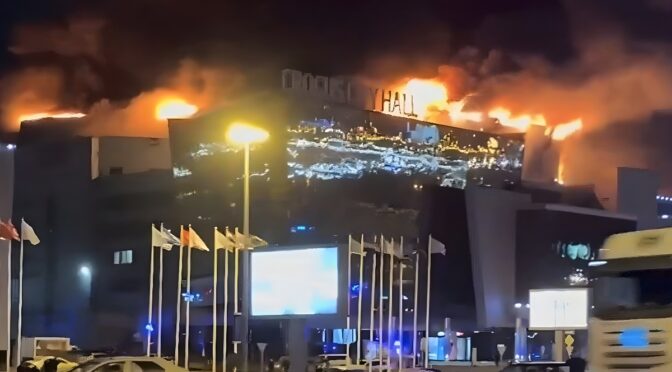
The heinous act of terrorism at the Crocus City Hall concert venue just outside Moscow on Friday night – which is confirmed to have killed more than 130 people at the time of writing – has perhaps shaken Russia more than anything since a similar attack on a theater in the capital in 2002.

This latest atrocity will certainly have a major impact on the Russian people’s consciousness and the nation’s public security. It could also lead to serious changes in Moscow’s foreign policy, depending on the results of the investigation into the source of the attack and its masterminds. Considering the enormously high stakes involved in its findings and conclusions, there is no doubt that the investigation will have to be incredibly thorough.

The US government’s version of an Islamic State connection to the attack has been met with skepticism by Russian officials and commentators. Firstly, they were surprised by how quickly – virtually within minutes – Washington pointed the finger at the group. What also drew the attention of Russian observers was the US reference to an IS-linked news site which had claimed responsibility for the crime.

Normally, all such sources are subjected to thorough checks. But not this time. Figures in Russia have also noted that American spokesmen immediately, and without prompting, declared that Ukraine was in no way linked to the act of terror.

Other criticisms of the American version include the style of the attack (no political statements or demands were made); the admission by one of the captured attackers that he had shot innocent people for money; and the fact that this was not planned as a suicide operation. Many experts have pointed out that IS is far from its prime, and that Russian forces defeated its core elements in Syria years ago. This has allowed speculation to grow about a false flag attack.

Ukraine, true to form, and alone among the nations of the world, has suggested that the Crocus City atrocity was an operation carried out by Russia’s own secret services, launched to facilitate a further tightening of the political regime and a new wave of mobilization. Clearly nonsensical, this interpretation invoked in many Russian minds the old proverb, “liar, liar, pants on fire.”

Russian President Vladimir Putin, in his five-minute address to the nation on Saturday, refrained from rolling out the Kremlin’s own version. His words and his demeanor were calm, but the style of his remarks was stern. Those behind the attack “will be punished whoever they are and wherever they may be,” the president declared.

The direction of Putin’s thinking was revealed by the two facts – not conjectures – he raised: that the terrorists, having fled the scene of the assault, had been apprehended not far (100km or so) from the Ukrainian border, and that “information” had been obtained that they intended to cross the border into Ukraine, where “they had contacts.”

At this point, nothing is firmly established. The results of the Russian investigation will be enormously important. If Moscow concludes that the attack was conceived, planned, and organized by the Ukrainians – say, the military intelligence agency GUR – Putin’s public warning would logically mean that the agency’s leaders will not just be “legitimate” targets, but priority ones for Russia.

Since an attack of such gravity would almost certainly have required the approval of Ukrainian President Vladimir Zelensky, the “guarantee” that Putin informally gave to foreign leaders (including Israel’s then-Prime Minister Naftali Bennett) that Russia would not target Zelensky personally, would presumably be lifted. If so, Moscow would be removing one of its most important self-imposed constraints – not to touch Kiev’s senior leadership.

The Crocus City terrorist attack seemingly fits into a pattern. It has come against the background of Ukraine’s intensification of artillery and drone strikes against the civilian population in Russian regions on the shared border, as well as attempts (all thwarted, thus far) to raid Russian villages.

As a result, scores of Russian civilians have been killed or wounded, and thousands of children evacuated to safety. The conclusion reached by many analysts is that Ukraine, by focusing on “soft” civilian targets, had been seeking to undermine the Russian population’s morale in the run-up to the presidential elections in mid-March, and to strain the country’s internal stability after them.

Regarding the concert hall massacre, there is another aspect at play: the US version of IS complicity and the use of Tajik citizens to carry out the attack may be intended to stoke inter-ethnic tensions within Russia between the Slavic majority and the Muslim minority population, both local and immigrant. 

Taken together, all of this strengthens the argument of those inside Russia who have long insisted that Ukraine – under its present ultranationalist leadership – is a terrorist state, and that Russia simply cannot tolerate such a regime on its borders. They believe that any talk of a ceasefire or negotiations should stop.

Russia must achieve a complete victory – otherwise it will constantly bleed at the hands of the terrorists in power next door, supported and protected by the country’s adversaries in the West. If the results of the investigation confirm that Ukraine was behind the Crocus City massacre, Russia’s war aims will need to be greatly expanded, and the conflict will significantly grow in intensity.

One thing that’s important to note” The war in Ukraine is not considered by Russians to be a war against Ukraine.

Rather, it is seen as a fight against the US-led West, which is using Ukraine as a battering ram to inflict a “strategic defeat” on Russia. It is interesting that Kremlin spokesman Dmitry Peskov just last week publicly admitted for the first time that the “special military operation” was in fact now a war. It became so, he said, as a result of the West’s involvement in the conflict.

Thus, if Ukraine’s complicity in Friday’s terrorist attack is indeed established, it would also suggest, at a minimum, US knowledge and de facto approval of it. In this respect, various people have already highlighted the recent warnings by the GUR chief, Kirill Budanov, and outgoing US Undersecretary of State Victoria Nuland about “unpleasant surprises” awaiting Russia in the near future.    

Thus, Russia’s own warnings about striking airfields in NATO countries if they are used by the Ukrainian Air Force, and about wiping out French (or any other NATO) troop contingents if they are sent into Ukraine, are acquiring more credibility. Escalation of the conflict, which heretofore has mostly been driven by Western actions, each time raising the stakes a notch, and Russia (in)famously “exercising restraint,” will potentially lead to a head-on collision.

Unless, of course, Washington decides at some point that enough is enough, that what’s happening is too dangerous, and that, unlike for Russia, the battle in Ukraine is not existential for the US itself – or even for its dominant position in Europe.  

The fundamental crisis of the West

By Veniamin Popov

Source: New Eastern Outlook

A growing number of media outlets in America and in Europe have recently reached the conclusion that “rules-based international order” long espoused by the West has failed.

In essence, this means that the position of the Western powers in the world has weakened: they have failed to destroy the Russian economy by imposing sanctions, and the war in Gaza has demonstrated that the US and the Western European countries are far from all-powerful.

The media frequently claim that Russia’s special military operation in Ukraine has changed the international situation, in that it has made clear the limited capabilities of the West and deepened the rift between the West and the Global South.

The Ukrainian conflict and the war in Gaza have demonstrated to the whole world, and above all to ordinary people in the West, that their ruling elites are unable to grasp this reality, lack strategic vision and are generally guided by their own personal interests.

The ruling elites in the West have demonized Russia in every possible way and have come to believe the myth that Russia can be strategically defeated. This is a huge miscalculation and this conclusion will become obvious to all in the very near future. The present author is reminded of the junker Grushnitsky, in Lermontov’s “A Hero of Our Time,” a fantasist who plays the role of an unworldly romantic for so long that he begins to believe it himself.

As Vladimir Putin has aptly put it, “Russophobia, like any other ideology based on racism, national superiority and exclusivity, blinds the person who subscribes to it and deprives them of reason.”

The state of the “rules-based international order” is becoming increasingly alarming for many Western powers. According to an article published in the weekly journal the Economist on February 15, so-called national conservatives, who “suspect free markets of being rigged by the elites,” are gaining in influence in the US and Europe. They are also hostile to migration, despise pluralism, especially multiculturalism, and are obsessed with dismantling institutions they see as tainted by globalism.

Despite their differences, these national conservatives are united by their hostility to shared enemies, including migrants, especially Muslims, globalists and all their perceived enablers. Donald Trump is leading in the polls in America. The far right is expected to make gains in the European Parliament elections in June. In Germany last December, support for the far-right Alternative for Germany party (AFD) reached a record high of 23 percent, according to polls. Anticipating Rishi Sunak’s loss in the elections, the right wing of Britain’s Conservative Party are hoping to grab power in the party. In 2027, Marine Le Pen may well become president of France.

According to the Economist, the current authorities need to take people’s legitimate concerns seriously: the public in many Western countries see illegal migration as a source of unrest and a drain on the public purse. They worry that their children will grow up poorer than they are. They are concerned about losing their jobs to new technologies. They believe that institutions such as universities and the press have been hijacked by hostile, illiberal, left-wing elites. They view the globalists who have flourished over the last few decades as members of a self-serving, arrogant caste.

These complaints have real merit and mocking them only confirms how detached from reality the elites have become.

The position of Washington and its hangers-on in Europe in relation to Israel’s war crimes against the Palestinians in Gaza has added significantly to the public’s distrust of the West’s ruling elites. By openly supporting the actions of the Netanyahu government, the governments of the Western powers are convincing everyone, including their own populations, of their own policy of double standards: only the lives of Israelis are valued and massacres of Arabs are allowed.

As the Saudi newspaper Arab News reports, Arab and Muslim Americans, and 60 percent of all other Americans, have for months wanted President Joe Biden to pressure Israel into agreeing to an immediate ceasefire in Gaza. The White House has, in effect, ignored these pleas.

In response to this stance, Muslim Americans in nine potentially wavering states met in Dearborn, Michigan, in December 2023 under the slogan “Abandon Biden, Truce Now.” They have vowed not to vote for Biden in the presidential election unless he changes the policies that are enabling Israel’s genocide in the Gaza Strip possible.

The US journal Foreign Affairs, in an article entitled “Gaza and the End of the Rules-Based Order” quotes one G7 diplomat: “We have definitely lost the battle in the Global South. All the work we did with the Global South (around Ukraine) was lost. … Forget the rules, forget the world order. They will never listen to us again.”

The economic recession, which has become a permanent situation for many European states, also provides little room for optimism. In the US, the high inflation and huge government debt are expected to worsen this spring and summer, according to some analysts. The most closely watched indicator of opinions about the economy, a monthly poll conducted by the University of Michigan, has reported that public confidence is at an exceptionally low ebb, about the same level as during the 2007-2009 global financial crisis.

With the presidential election just nine months away, this gloomy mood has become a serious problem for the Democrats. President Joe Biden is already facing a host of challenges to his bid for a second term, starting with concerns about his fitness for office as an 80-year-old man. Another major obstacle to his election bid is the opinion polls that give him low marks for his management of the economy.

The current economic problems are exacerbated by growing inequality, the worsening drug crisis and the proliferation of firearms. The promotion of non-traditional sexual orientation and the encouragement of same-sex couples have cause legitimate outrage to many conservative religious people.

In the European Union between June 6 and 9, more than 400 million voters in 27 countries will elect 720 MEPs to represent them for the next five years. Observers predict an increase in the influence of right-wing conservative parties. One major reason for the heightened interest in the upcoming election is the unprecedented corruption scandal that erupted in the European Parliament in December 2022, when the vice president and several other officials, including three MEPs, were accused of taking bribes. The investigation is ongoing, but it has already revealed instances of illegal activities and immoral behavior on the part of MEPs. Conservatives accuse the EU of being an opaque bureaucracy with vastly overpaid staff, which is disconnected from the reality experienced by ordinary residents of the EU member states, and which spends its vast budgets – totaling hundreds of trillions of euros – not for the common good but for the personal whims and fantasies of its leaders. Inflation and the cost of living are still rising in many European nations, while many blame EU bureaucrats in Brussels for policies such as the Green Deal that have made life more expensive for Europeans by raising the prices of fuel, food and most other essentials. In addition, anti-Russian sanctions, which have led to the rejection of cheap energy from Russia by a number of European countries, have had a negative impact on the well-being of ordinary citizens.

Over the past few weeks, thousands of farmers from across Europe, particularly from Germany, France, Poland, Spain, and Belgium, have taken to the streets to protest against additional spending on Ukraine and against new EU environmental policies that make farming unviable.

The short-sighted policy of the Western elites with regard to the crises in Ukraine and the Gaza Strip is leading to a loss of confidence in the ruling authorities on the part of ordinary citizens. It is easy to imagine their reaction in the event of any further military setbacks by Ukraine or any worsening of the situation within the country.

The position taken by many developing nations with regard to the current international processes is highly symptomatic. In an editorial for the Arabic international newspaper Asharq Al-Awsat, Editor-in-Chief Grhassan Charbel writes: “Zelensky’s position reminded me of remarks by the late Egyptian President Hosni Mubarak to former Iraqi Foreign Minister Hoshyar Zebari, that ‘the one who is covered by the Americans is naked.’ The same phrase could be said by Putin to Zelensky.

Putin has the right to be sarcastic. The leaders of the West did not accept that he could not lose… That he went to Ukraine to punish the entire West and to launch a major coup against a world that was born from the collapse of the (Berlin) Wall and the disappearance of the Soviet Union.”

It is no coincidence that the ruling circles of Western Europe are currently not hiding their anxiety about what they refer to as the “threat posed by Trump and Russia.”

In fact, everything we see happening testifies to the inadequacy of the current ruling elites in the West, who are unable to reasonably and rationally assess the emerging situation, guided as they are solely by short-term personal interests.

It is very possible that they will be swept away by a wave of new unexpected events, and new leaders will come to power.

It is therefore highly likely that 2024 will be a turning point in many respects.

China’s unexpected gains from the Red Sea crisis

Despite Beijing’s maritime security priority, Yemen’s Red Sea ban on Israeli-linked shipping has boosted China’s regional standing while miring its US adversary in an unwinnable crisis.

By Giorgio Cafiero

Source: The Cradle

The Gaza war’s expansion into the Red Sea has created an international maritime crisis involving a host of countries. Despite a US-led bombing campaign aimed at deterring Yemen’s Ansarallah-aligned navy from carrying out missile and drone strikes in the Red Sea, the armed forces continue to ramp up attacks and now are using “submarine weapons.” 

As these clashes escalate dangerously, one of the world’s busiest bodies of water is rapidly militarizing. This includes the recent arrival to the Gulf of Aden of a Chinese fleet, including the guided-missile destroyer Jiaozuo, the missile frigate Xuchang, a replenishment vessel, and more than 700 troops – including dozens of special forces personnel – as part of a counter-piracy mission. 

Beijing has voiced its determination to help restore stability to the Red Sea. “We should jointly uphold the security on the sea lanes of the Red Sea in accordance with the law and also respect the sovereignty and territorial integrity of the countries along the Red Sea coast, including Yemen,” Chinese Foreign Minister Wang Yi emphasized last month.

As the largest trading nation in the world, China depends on the Red Sea as its “maritime lifeline.” Most of the Asian giant’s exports to Europe go through the strategic waterway, and large quantities of oil and minerals that come to Chinese ports transit the body of water. 

The Chinese have also invested in industrial parks along Egypt and Saudi Arabia’s Red Sea coasts, including the TEDA–Suez Zone in Ain Sokhna and the Chinese Industrial Park in Saudi Arabia’s Jizan City for Primary and Downstream Industries. 

Chinese neutrality in West Asia

Prior to the sending of the 46th fleet of the Chinese People’s Liberation Army Navy, Beijing’s response to Ansarallah’s maritime attacks had been relatively muted. China has since condemned the US–UK airstrikes against Ansarallah’s military capabilities in Yemen, and refused to join the western-led naval coalition, Operation Prosperity Guardian (OPG).

China’s response to mounting tension and insecurity in the Red Sea is consistent with Beijing’s grander set of foreign policy strategies, which include respect for the sovereignty of nation-states and a doctrine of “non-interference.” 

In the Persian Gulf, China has pursued a balanced and geopolitically neutral agenda resting on a three-pronged approach: enemies of no one, allies of no one, and friends of everyone. 

China’s position vis-à-vis all Persian Gulf countries was best exemplified almost a year ago when Beijing brokered a surprise reconciliation agreement between Iran and Saudi Arabia, in which it played the role of guarantor. 

In Yemen, although China aligns with the international community’s non-recognition of the Ansarallah-led government in Sanaa, Beijing has nonetheless initiated dialogues with those officials and maintained a non-hostile stance – unlike many Arab and western states.

Understanding Beijing’s regional role 

Overall, China tries to leverage its influence in West Asian countries to mitigate regional tensions and advance stabilizing initiatives. Its main goal is ultimately to ensure the long-term success of President Xi Jinping’s multi-trillion dollar Belt and Road Initiative (BRI) and keep trade routes free of conflict. 

Often labeled by the west as a “free rider,” China is accused of opportunistically benefiting from US- and European-led security efforts in the Persian Gulf and the northwestern Indian Ocean without contributing to them. 

But given China’s anti-piracy task force in the Gulf of Aden and its military base in Djibouti, this accusation isn’t entirely justified.

Beijing’s motivations for staying out of OPG were easy to understand: first, China has no interest in bolstering US hegemony; second, joining the naval military coalition could upset its multi-vector diplomacy vis-à-vis Ansarallah and Iran; and third, the wider Arab–Islamic world and the rest of the Global South would interpret it as Chinese support for Israel’s war on Gaza. 

Rejecting the OPG mission has instead bolstered China’s regional image as a defender of the Palestinian cause.

Speaking to The Cradle, Javad Heiran-Nia, director of the Persian Gulf Studies Group at the Center for Scientific Research and Middle East Strategic Studies in Iran, said: 

[Beijing’s] cooperation with the West in securing the Red Sea will not be good for China’s relations with the Arabs and Iran. Therefore, China has adopted political and military restraint to avoid jeopardizing its economic and diplomatic interests in the region.

Dropping the blame on Washington’s doorstep

Beijing recognizes the Red Sea security crisis to be a direct “spillover” from Gaza, where China has called for an immediate ceasefire.

As Yun Sun, co-director of the China Program at the Washington-based Stimson Center, informed The Cradle:

The Chinese do see the crisis in the Red Sea as a challenge to regional peace and stability but see the Gaza crisis as the fundamental origin of the crisis. Therefore, the solution to the crisis in the Chinese view will have to be based on ceasefire, easing of the tension and returning to the two-state solution.

Jean-Loup Samaan, a senior research fellow at the National University of Singapore’s Middle East Institute, agrees, telling The Cradle:

Chinese diplomats have been carefully commenting on the events, but in Beijing’s narrative, the rise of attacks is a consequence of Israel’s war in Gaza – and perhaps more importantly the US policy in support [of] the Netanyahu government.

But in January, after the US and UK began their bombing campaign of Ansarallah targets in Yemen, China began to weigh in with serious concerns about the Red Sea crisis. Beijing noted that neither Washington nor London had received authorization for the use of force from the UN Security Council, and, therefore, as Sun explained it, the US–UK strikes “lack legitimacy in the Chinese view.”  

How the Red Sea Crisis benefits Beijing

China has capitalized on intensifying anger directed against the US from all over the Islamic world and Global South. The Gaza war and its spread into the Red Sea have delivered Beijing some easy soft-power gains and reinforced to Arab audiences the vital importance of multipolarity.
This point was drummed home by Victor Gao, vice president of the Center for China and Globalization, when he told the 2023 Doha Forum: 

The fact that there is only one single country which [on 8 December, 2023] vetoed the United Nations Security Council Resolution calling for ceasefire in the Israel-Palestine War should convince all of us that we should be very lucky living not in the unipolar World.

Certainly, China has experienced some economic repercussions from the Red Sea crisis, although the extent of this is difficult to calculate. Yet Beijing’s political gains appear to trump any associated financial losses. As Sun explained to The Cradle, “The crisis does affect China, but the loss has been mostly economic and minor, while the gains are primarily political as China stands with the Arab countries on Gaza.”

In some ways, China has actually gained economically from the Red Sea crisis. With Ansarallah making a point of only targeting Israel-linked vessels, there is a widespread view that Chinese ships operating in the area are immune from Yemeni attacks. 

After many international container shipping lines decided to reroute around South Africa to avoid Ansarallah’s missiles and drones, two ships operating under the Chinese flag – the Zhong Gu Ji Lin and Zhong Gu Shan Dong – continued transiting the Red Sea. 
As Bloomberg reported early this month:

Chinese-owned merchant ships are getting hefty discounts on their insurance when sailing through the Red Sea, another sign of how Houthi attacks in the area are punishing the commercial interests of vessels with ties to the West.

US officials have since implored Beijing to pressure Iran into ordering the de-facto Yemeni government to halt maritime attacks. Those entreaties have failed, however, largely because Washington incorrectly assumes that Beijing holds influence over Tehran and that Iran can make demands of Ansarallah. Regardless, the fact that the US would turn to China for such help amid escalating tensions in the Red Sea is a boost to Beijing’s status as a go-to power amid global security crises.

China also has much to gain from the White House’s disproportionate focus on Gaza and the Red Sea. Since October–November 2023, the US has had significantly less bandwidth for its South China Sea and Taiwan files. In turn, this frees Beijing to act more confidently in West Asia while the US remains distracted. According to Heiran-Nia:

The developments in the Red Sea will keep America’s focus on the region and not open America’s hand to expand its presence in the Indo–Pacific region, [where] America’s main priority is to contain China. The war in Ukraine has the same advantage for China. While the connectivity of the Euro–Atlantic region with the Indo–Pacific region is expanding to contain China and increase NATO cooperation with the Indo–Pacific, the tensions in [West Asia] and Ukraine will be a boon for China.

Ultimately, the Red Sea crisis and Washington’s failure to deter Ansarallah signal yet another blow to US hegemony. From the Chinese perspective, the growing Red Sea conflict serves to further isolate the US and highlight its limitations as a security guarantor – particularly in light of its unconditional support for Israel’s brutal military assault on Gaza.

It is reasonable to call China a winner in the Red Sea crisis.