What’s Changed and What Hasn’t in a Tumultuous Year

By Charles Hugh Smith

Source: Of Two Minds

Inequality is America’s Monster Id, and we’re continuing to fuel its future rampage daily.

What’s changed and what hasn’t in the past year? What hasn’t changed is easy:

1. Wealth / income inequality is still increasing. (see chart #1 below)

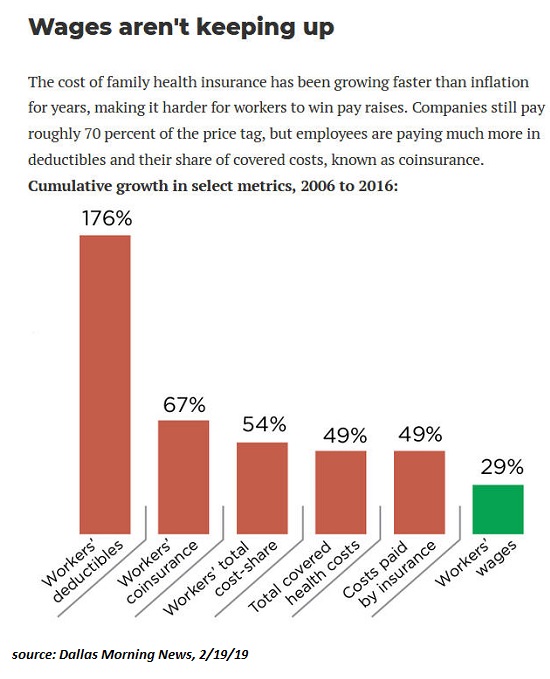
2. Wages / labor’s share of the economy is still plummeting as financial speculation’s share has soared. (see chart #2 below)

What’s changed is also obvious:

1. Money velocity has cratered. (see chart #3 below)

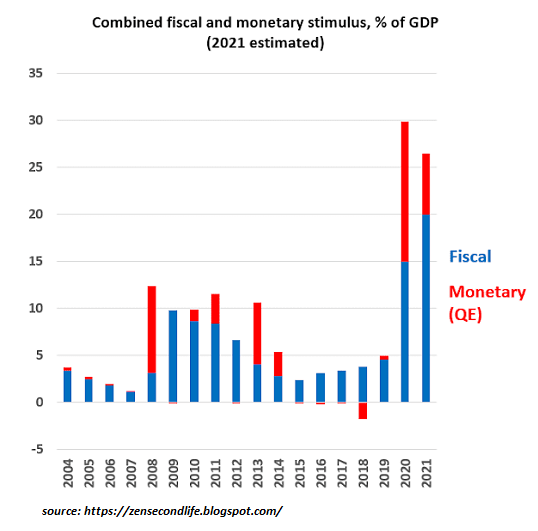
2. Federal borrowing / spending has skyrocketed, pushing federal debt to unprecedented levels. (see chart #4 below)

3. Speculation has reached the society-wide mania level. This is evidenced by record margin debt levels, record levels of financial assets compared to GDP and many other indicators. (see chart #5 below)

Interestingly, every one of historian Peter Turchin’s 3-point Political Stress Index is now checked. Recall that these are core drivers of consequential social disorder, the kind that leads to empires collapsing, the overthrow of ruling elites, social revolutions, etc.

1. Stagnating real wages (i.e. adjusted for real-world inflation): check

2. Overproduction of parasitic elites: double-triple check

3. Deterioration of central state finances: check

But what about social changes? This is an interesting topic because social changes are less easily tracked (few even ask relevant questions and compile the data). Social trends are often more difficult to discern, as surveys may not track actual changes in behavior: people may give answers they reckon are expected or acceptable.

Here are four long-term trends that may have been accelerated by the pandemic:

1. The residents of overcrowded tourist destinations are sick of tourists and are demanding limits that protect increasingly fragile environments and resident quality of life.

Here’s a typical observation of a resident in Hawaii now that tourists are coming back:

Sunday I saw a group of 30 spring break tourists littering the beach with red cups and bottles of alcohol and trash. They had a table full of booze on the beach and were happily leaving their trash everywhere. No masks and no cares for Hawaii. When they left, instead of using the beach access they all climbed over the fence into someone’s yard because it saved them a minute of walking.

No I don’t miss tourists.

This is a global phenomenon. The absence of tourists has awakened a powerful sense that the profits (which flow into elite hands, not local economies) have taken precedence over the protection of what makes the destination worth visiting.

2. Work from home is here to stay. The benefits are too personal and powerful. Corporations demanding a return to long commutes and central offices will find their most productive employees are giving them “take this job and shove it” notices as they find positions with companies that understand that you can’t turn back the clock or ignore the benefits of flexible schedules.

3. Consumer behaviors have changed and are continuing to change. This is not just an expansion of home delivery; it’s a re-appraisal of big-ticket spending on concerts, entertainment, sports events and many other sectors that depend solely on free-spending consumers who ignore the recent doubling or tripling of prices.

4. Perceptions of the wealthy are changing. I touched on this topic in The Coming War on Wealth and the Wealthy (1/5/21) and The Coming Revolt of the Middle Class (1/27/21). Inequality is America’s Monster Id, and we’re continuing to fuel its future rampage daily.

Is the American Dream Still Alive? (Infographic)

Source: Strategic Culture Foundation

The post-WWII United States was at the peak of its soft power. One of its pillars was the American Dream. Every American could expect that his children would be better off – better off in every respect: healthier, longer-lived, better educated, happier, richer – than he was. Seventy years later, this dream seems to be blown to bits.

Re-Opening the Economy Won’t Fix What’s Broken


By Charles Hugh Smith

Source: Of Two Minds

Re-opening a fragile, brittle, bankrupt, hopelessly perverse and corrupt “normal” won’t fix what’s broken.

The stock market is in a frenzy of euphoria at the re-opening of the economy. Too bad the re-opening won’t fix what’s broken. As I’ve been noting recently, the real problem is the systemic fragility of the U.S. economy, which has lurched from one new extreme to the next to maintain a thin, brittle veneer of normalcy.

Fragile economies cannot survive any impact with reality that disrupts the distortions that are keeping the illusion of “growth” from shattering. For the past two decades, every collision with reality cracked the illusion, and the “fix” was to duct-tape the pieces together with new extremes of money-creation, debt, risk and speculative excess.

While the stock market has soared, the real world falls apart. If your region needs a new bridge built, count on about 20 years to get all the “stakeholders” to agree and get the thing actually built. Count on the cost quintupling from $500 million to $2.5 billion. Count on corners being cut as costs skyrocket, so those cheap steel bolts from China that are already rusting before the bridge is even finished? Oops. Replacing them will add millions to the already bloated budget.

Want to add a passenger stop on an existing railroad line? Count on 20 years to get it done. The complexity thicket of every regulatory agency with the power to say “no” basically guarantees the project will never get approved, because every one of these bureaucracies justifies its existence by saying “no.” Sorry, you need another study, another environmental review, and so on.

Need a new landfill? I hope you started the process 15 years ago, so you’ll get approval in only five more years. Every agency with the power to say “no” will stretch out the approval, so they have guaranteed “work” for another decade or two.

Did your subway fares double? Was the excuse repairing a crumbling system? Did the work get done on budget and on time? You must be joking, right? All the fare increase did was cover the costs of skyrocketing salaries, pensions and administrative costs. Repairs to the tracks and cars– that’s extra. Let’s float a $1 billion bond so nobody have to tighten their belts, and have riders pay for it indirectly, through higher taxes to pay the exorbitant costs of 20 years of interest on the bond.

Have you been thrown off your bicycle by the giant potholes in the city’s “bike lanes”? The city reluctantly admits that these streets that haven’t been maintained for decades–yes, decades. The city once paid for street maintenance out of its general budget, but alas, that’s been eaten up by skyrocketing salaries, pensions and administrative costs, so now we need to float $100 million bond to fund filling potholes. If all goes according to plan (ha-ha), we should be able to re-pave the streets that have been crumbling for 20 years in… the next 20 years.

These real-world examples are just four of thousands of manifestations of a broken system. Rather than make tough choices that drain power and wealth from vested interests, we simply borrow more money, in ever increasing amounts, to keep the entrenched interests and elites happy.

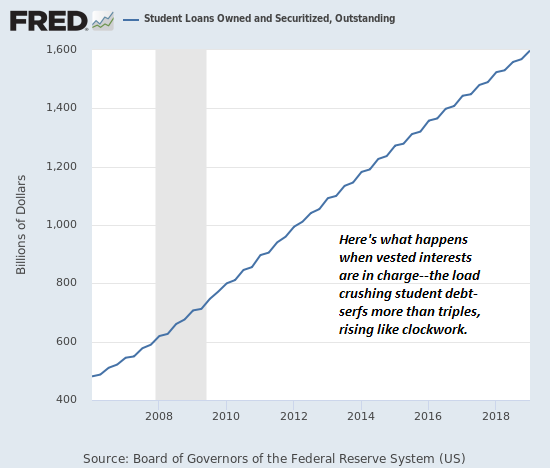
There are two “solutions” in the status quo: dump the debt on taxpayers or on powerless debt-serfs–for example, college students. (See chart below of the $1.6 trillion that’s stripmining student debt-serfs.) Who benefits from selling all the municipal bonds, bundled student loans, etc. to investors starving for a yield above 0.1%? Wall Street, of course.

The problem is that while debt has soared, productivity and earned income have stagnated. The statistical narrative has been ruthlessly gamed to hide the erosion of living standards, but even with the bogus “low inflation” of official statistics, wages for the bottom 95% have stagnated for decades.

Measures of productivity have also been gamed to mask the ugly reality that the vast majority of the U.S. economy is stagnating under the weight of interest payments on debt, mal-investments in speculative gambles, higher junk fees and taxes, crushing regulatory compliance, high costs imposed by monopolies and cartels and a well-cloaked decline in the quality of just about everything the bottom 95% uses or owns.

What little productivity gains have been made have been skimmed by the top 5%. Coupled with the Federal Reserve’s single-minded goosing of the one signaling device it controls, the stock market, the top 0.1% in America own more wealth than the bottom 80%.

If productivity stagnates and winners take all, the wages of the bottom 95% cannot rise. Real wealth is only created by increases in the productivity of labor and capital; everything else is phantom wealth.

The only way stagnant incomes can support more debt is if interest rates decline. Presto, the Fed dropped interest rates to near-zero a decade ago. Of course you and I can’t actually borrow millions for 0.1%; that privilege is reserved for financiers and other financial parasites and predators.

Debt-serfs were able to refinance their crushing mortgages to save a few bucks, and so they can afford to 1) take on more debt and 2) pay higher taxes to fund the ballooning public debt.

Every one of these extremes has increased the systemic fragility of the American economy. This fragility is reflected in the impoverishment of the bottom 95%, the thin line between solvency and bankruptcy, the decay of public trust in institutions run for the benefit of entrenched interests, and the quickening erosion of America’s social contract.

Re-opening a fragile, brittle, bankrupt, hopelessly perverse and corrupt “normal” won’t fix what’s broken.


No, This Is Not Another 1929, 1973, 1987, 2000, or 2008

By Charles Hugh Smith

Source: Of Two Minds

Basing one’s decisions on analogs from the past is entering a fool’s paradise of folly.

Like addicts who cannot control their cravings, financial analysts cannot stop themselves from seeking some analog situation in the past which will clarify the swirling chaos in their crystal balls. So we’ve been swamped with charts overlaying recent stock market action over 1929, 1987,2000 and 2008–though the closest analogy is actually the Oil Shock of 1973, an exogenous shock to a weakening, fragile economy.

But the reality is there is no analogous situation in the past to the present, and so all the predictions based on past performance will be misleading. The chartists and analysts claim that all markets act on the same patterns, which are reflections of human nature, and so seeking correlations of volatility and valuation that “worked” in the past will work in 2020.

Does anyone really believe the correlations of the past decade or two are high-probability predictors of the future as the entire brittle construct of fictional capital and extremes of globalization and financialization all unravel at once?

Here are a few of the many consequential differences between all previous recessions and the current situation:

1. Households have never been so dependent on debt as a substitute for stagnating wages.

2. Real earnings (adjusted for inflation) have never been so stagnant for the bottom 90% for so long.

3. Corporations have never been so dependent on debt (selling bonds or taking on loans) to fund money-losing operations (see Netflix) or stock buybacks designed to saddle the company with debt service expenses to enrich insiders.

4. The stock market has never been so dependent on what amounts to fraud–stock buybacks–to push valuations higher.

5. The economy has never been so dependent on absurdly overvalued stock valuations to prop up pension funds and the spending of the top 10% who own 85% of all stocks, i.e. “the wealth effect.”

6. The economy and the stock market have never been so dependent on central bank free money for financiers and corporations, money creation for the few at the expense of the many, what amounts to an embezzlement scheme.

7. Federal statistics have never been so gamed, rigged or distorted to support a neofeudal agenda of claiming a level of wide-spread prosperity that is entirely fictitious.

8. Major sectors of the economy have never been such rackets, i.e. cartels and quasi-monopolies that use obscure pricing and manipulation of government mandates to maximize profits while the quality and quantity of the goods and services they produce declines.

9. The economy has never been in such thrall to sociopaths who have mastered the exploitation of the letter of the law while completely overturning the spirit of the law.

10. Households and companies have never been so dependent on “free money” gained from asset appreciation based on speculation, not an actual increase in productivity or value.

11. The ascendancy of self-interest as the one organizing directive in politics and finance has never been so complete, and the resulting moral rot never more pervasive.

12. The dependence on fictitious capital masquerading as “wealth” has never been greater.

13. The dependence on simulacra, simulations and false fronts to hide the decay of trust, credibility, transparency and accountability has never been so pervasive and complete.

14. The corrupt linkage of political power, media ownership, “national security” agencies and corporate power has never been so widely accepted as “normal” and “unavoidable.”

15. Primary institutions such as higher education, healthcare and national defense have never been so dysfunctional, ineffective, sclerotic, resistant to reform or costly.

16. The economy has never been so dependent on constant central bank manipulation of the stock and housing markets.

17. The economy has never been so fragile or brittle, and so dependent on convenient fictions to stave off a crash in asset valuations.

18. Never before in U.S. history have the most valuable corporations all been engaged in selling goods and services that actively reduce productivity and human happiness.

This is only a selection of a much longer list, but you get the idea. Basing one’s decisions on analogs from the past is entering a fool’s paradise of folly.

Neoliberal Economics Destroyed the Economy and the Middle Class

By Paul Craig Roberts

Source: PaulCraigRoberts.com

According to official US government economic data, the US economy has been growing for 10.5 years since June of 2009. The reason that the US government can produce this false conclusion is that costs that are subtrahends from GDP are not included in the measure. Instead, many costs are counted not as subtractions from growth but as additions to growth. For example, the penalty interest on a person’s credit card balance that results when a person falls behind his payments is counted as an increase in “financial services” and as an increase in Gross Domestic Product. The economic world is stood on its head.

It is aggregate demand that drives the economy. Payments made on a rise in interest rates on credit card balances from 19% to a 29% penalty rate reduce consumers’ ability to contribute to aggregate demand by purchasing goods and the services of doctors, lawyers, plumbers, electricians, and carpenters. Contrary to logic, the fee is magically counted in the “financial services” category as a contributor to GDP growth. The extortion of a fee that reduces aggregate demand lowers GDP, but builds paper wealth in the financial services sector.

GDP growth is also artificially inflated by counting as GDP abstract concepts that do not produce income streams. For example, for homeowners the US Department of Commerce estimates the rental values of owner-occupied housing, that is, the amount owners would be paying if they rented instead of owned their homes, and counts this imputed rent as GDP.

These and other absurdities have caused economist Michael Hudson to conclude correctly that the “financial reality of how the U.S. economy works is no longer captured in GDP statistics.”
https://michael-hudson.com/2019/10/asset-price-inflation-and-rent-seeking/

Today we have two economies. One is the real economy of production and consumption. The other is the financialized economy of paper wealth. The former is doing poorly, and the latter is doing well. The financialized economy is growing much faster than the real economy. Indeed, the real economy might not be growing at all.

Michael Hudson describes the difference. The stock market is at all time highs that have created massive wealth in financial assets for stock and bond owners. In the real economy the situation is totally different: “The Federal Reserve’s Report on the Economic Well-Being of U.S. Households in 2018 reports that 39% of Americans do not have $400 cash available for a medical or other emergency, and that a quarter of adults skipped medical care in 2018 because they could not afford it ( https://www.federalreserve.gov/publications/files/2018-report-economic-well-being-us-households-201905.pdf ). The latest estimates by the U.S. Government Accountability Office (GAO) report that nearly half (48 percent) of households headed by someone 55 and older lack any retirement savings or pension benefits ( https://www.aarp.org/retirement/retirement-savings/info-2019/no-retirement-money-saved.html ). Even in what the press calls an economic boom, most Americans feel stressed and many are chronically angry and worried. According to a 2015 survey by the American Psychological Association, financial worry is the “number one cause of stress in America today” ( https://www.apa.org/news/press/releases/2015/02/money-stress ).

The data is completely clear. The rich are becoming much richer, and the rest are becoming poorer. Michael Hudson explains:

“The creation and trading of property and financial assets at rising prices has been fueled by rising debt levels owed to the financial sector. This sector’s returns therefore are best seen not as real wealth on the asset side of the balance sheet, but as overhead on the liabilities side. And the process is multi-layered: income accruing to the financial wealth owned by the top 10 Percent is paid mainly by the bottom 90 percent in the form of rising debt service and other returns to financial and other property.

“In the textbook models of industrial capitalism’s mass production and consumption, an asset’s price is determined by its cost of production. If the price rises above this level, competitors will offer it cheaper. But in the financialized economy an asset’s price is determined by how much credit buyers can borrow to buy it, not by its cost of production. A home is worth as much as a bank will lend to a bidder.

“The engine of industrial capitalism and its consumer society is a positive feedback loop in which widely shared income growth, expanding consumption and markets generated yet more investment and growth. By contrast, the feedback loop of financial capitalism is an exponential growth of credit-driven debt, driving up asset prices and hence requiring yet more borrowing to buy homes, retirement income and other assets. Corporate management and investment today is mainly about obtaining capital gains for real estate, stocks and bonds than about earning income.

“We illustrate this by charting the flow of income and capital gains in the real estate sector to show the dominance of asset-price gains over net rental income – and how rental income is used up paying interest in our financialized economy. Likewise, corporate income is spent (and new debt taken on) largely for stock buybacks to raise share prices. The resulting dynamic is exponential and destabilizing.”

This dynamic is destabilizing, because as more of consumers’ discretionary income is drawn off to service mortgage, credit card, automobile and student debt and for compulsory health insurance, less is left to purchase the goods and services in the real economy. Consequently, credit-driven debt grows faster than the income that services it, and this impoverishes the 90%. However, for the 10%, money creation by the Federal Reserve in order to protect the balance sheets of the “banks too big to fail or jail” drives up the values of financial assets. As a result the distribution of income and wealth becomes hightly polarized.

Think about the many Americans who meet their living expenses by making only the minimum payment on their credit card balance. At 19% interest their debt grows monthly. Eventually they hit a credit card debt cap and can no longer use the card to cover their living expenses. But they have the burden of a large debt balance to service without an income stream capable of servicing it.

Think about the corporation that decapitalizes itself in order to produce short to intermediate term capital gains for shareholders and executives by indebting the firm in order to buy back the firm’s shares. The end result is that all income goes for debt service.

In a financialized economy, the only possible outcomes are debt forgiveness or collapse.

As Michael Hudson makes clear, the combination of nonsensical categories in the National Income and Product Accounts and a financialized economy means we have no accurate picture of the economy’s condition. Michael Hudson has a proposal for correcting these problems and making GDP accounting more accurate, but as ecological economists such as Herman Daly have made clear, GDP measurement also omits the external costs of production. This means that we do not know whether GDP is growing or declining. It is entirely possible that the ecological and social costs of an increase in GDP (as currently measured) are greater than the value of the increased output. (See Paul Craig Roberts, The Failure of Laissez-Faire Capitalism, https://www.amazon.com/Failure-Laissez-Faire-Capitalism/dp/0986036250/ref=sr_1_2?crid=16NHZEQ9G3JRW&keywords=paul+craig+roberts+books&qid=1576440032&s=books&sprefix=Paul+Craig%2Caps%2C173&sr=1-2 )

Perhaps the major way in which GDP is overstated is the exclusion of external or social costs. External or social costs are costs of producing a product that the producer does not incur but imposes on third parties or on the environment. For example, untreated sewage dumped into a stream imposes costs on people downstream. Runoff of chemical fertilizers from commercial farming produces dead zones in the Gulf of Mexico and toxic algal blooms such as Red Tide that result in massive fish kills, make seafood unsafe, cause human ailments and adversely impact the tourist trade of beach areas. The result is lost incomes, ruined vacations, health expenses, and none of these costs are born by the commercial farmers.

Real estate development produces massive external costs. Scenic views from existing properties are blocked, thus reducing their values. Construction noise and congestion impose costs on existing residents and reduces the quality of their lives. Water runoff problems are often created. Infrastructure has to be provided, such as larger highways to provide evacuation from hurricane-impacted areas, usually financed by taxpayers. If the global warming case is correct, the external cost of human economic activity can be the life of the planet.

Lakshmi Sarah in the May/June, 2019, issue of the Sierra Club magazine provides an excellent detailed account of the external costs of coal-fired power plants being built in India by the Indian conglomerate Tata with a loan from the International Finance Corporation, a branch of the World Bank. The ground water in the area has been ruined and is no longer drinkable. Farmers are no longer able to grow crops on half of the area farmland. Heated wastewater that is dumped into the Gulf of Kutch is destroying fishing. The ecology and the livelihoods of the population are essentially destroyed. None of these costs are born by the private power companies.

Tired of being doormats for capitalists and the World Bank, the residents of the affected provinces rebelled. They have succeeded in getting their case before the US Supreme Court. It seems that the International Finance Corporation is so accustomed to financing projects that produce large external costs that it overlooked its obligation to examine the environmental impact of the projects it finances. This oversight resulted in Indian farmers and fishermen getting their case before the US Supreme Court. The International Finance Corporation’s lawyers argued that the World Bank lending agency had “absolute immunity.” The Supreme Court said no and remanded the case to the circuit court to rule on the damages.

Perhaps the most surprising thing about this apparent victory for ordinary faraway little people in an American court against the World Bank, a principle instrument of American imperialism, is that the Trump administration appeared in court as a friend of the Indian farmers and fishermen. The US Solicitor General, represented by Jonathan Ellis, rejected the notion that international orgnizations have absolute immunity. The Establishment exists on its immunity. Here we see the ultimate reason that the ruling Establishment wants rid of Trump.

Already the senior staff of the International Finance Corporation have come to the realization that they have other responsibilities than just to shuffle money out the lending shute. If the Indian farmers and fishermen succeed in protecting themselves from ruination by external costs, perhaps Americans who suffer external costs will follow their lead.

Perhaps economists will also come to the realization that they owe us accurate GDP accounting and not fanciful accounts that serve elite wealth in the financialized economy.

Costs Are Spiraling Out of Control

By Charles Hugh Smith

Source: Of Two Minds

And how do we pay for these spiraling out of control costs? By borrowing more, of course.

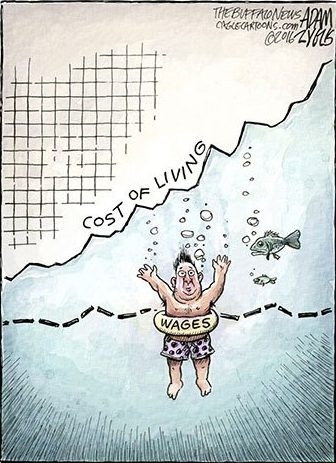
If we had to choose one “big picture” reason why the vast majority of households are losing ground, it would be: the costs of essentials are spiraling out of control. I’ve often covered the dynamics of stagnating income for the bottom 90%, and real-world inflation, i.e. a decline in purchasing power.

But neither of these dynamics fully describes the relentless upward spiral of the cost basis of our economy, that is, the cost of big-ticket essentials: housing, education and healthcare.

The costs of education are spiraling out of control, stripping households of income as an entire generation is transformed into debt-serfs by student loan debt. The soaring costs of healthcare are a core driver of higher costs in the education complex (and government in general), and to cover these higher costs, counties raise property taxes, which add additional cost burdens to households and enterprises as rents rise.

Rising rents push the cost structure of almost every enterprise and agency higher.

Then there’s the asset inflation created by central bank ZIRP (zero interest rate policy) which has inflated a second echo-bubble in housing that has pushed home ownership out of reach of many, adding demand for rental housing that has pushed rents into the stratosphere in Left and Right Coast cities.

The increasing dominance of monopolies and cartels has eliminated competition in sector after sector. Monopolies and cartels skim immense profits even as the value, quality and quantity of their products and services decline: The U.S. Only Pretends to Have Free Markets From plane tickets to cellphone bills, monopoly power costs American consumers billions of dollars a year.

Thanks to their political influence, monopolies and cartels have legalized looting, raising prices and evading anti-trust regulations because they can pay whatever it takes in our pay-to-play political system.

Let’s look at a few charts that illustrate the relentless rise in costs:

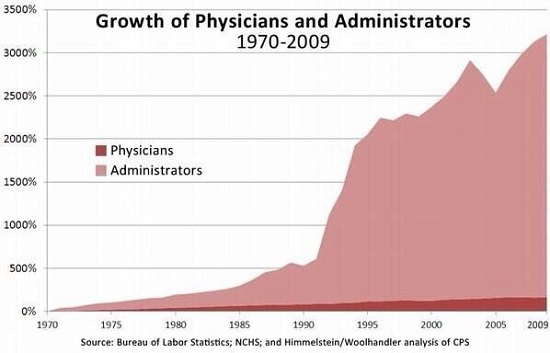
Do you reckon these two charts are connected–soaring costs and ballooning administrative payrolls?

Student loan debt is soaring above $1.5 trillion, guaranteeing profits to lenders and debt-serfdom to the students exiting with degrees that are in over-supply, i.e. possessing little scarcity value in an over-credentialed economy:

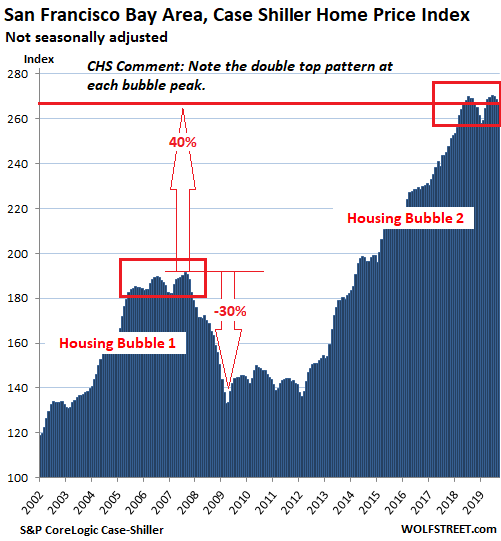
The echo housing bubbles in many locales exceed the nosebleed valuations of the previous bubble:

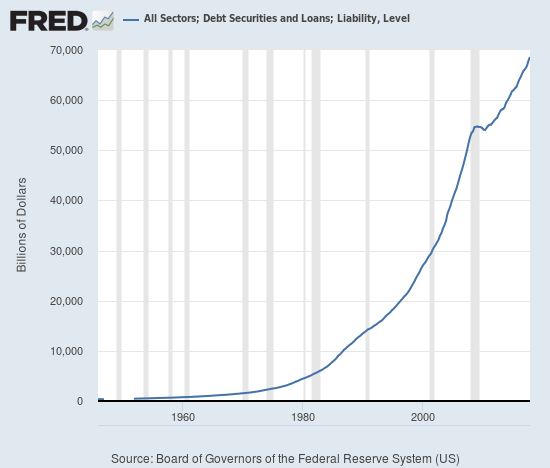
And how do we pay for these spiraling out of control costs? By borrowing more, of course:

Even at low rates of interest, the cost of servicing skyrocketing debt increases, leaving less net income to support additional borrowing.

What will it take to radically reduce the cost basis of our economy? A fundamental re-ordering that breaks up all the cartels and monopolies that push prices higher even as they deliver lower quality goods and services would be a good start.

1% Politics and the New Gilded Age

By Rajan Menon

Source: Intrepid Report

Despair about the state of our politics pervades the political spectrum, from left to right. One source of it, the narrative of fairness offered in basic civics textbooks — we all have an equal opportunity to succeed if we work hard and play by the rules; citizens can truly shape our politics — no longer rings true to most Americans. Recent surveys indicate that substantial numbers of them believe that the economy and political system are both rigged. They also think that money has an outsized influence on politics. Ninety percent of Democrats hold this view, but so do 80 percent of Republicans. And careful studies confirm what the public believes.

None of this should be surprising given the stark economic inequality that now marks our society. The richest 1 percent of American households currently account for 40 percent of the country’s wealth, more than the bottom 90 percent of families possess. Worse yet, the top 0.1 percent has cornered about 20percent of it, up from 7 percent in the mid-1970s. By contrast, the share of the bottom 90 percent has since then fallen from 35 percent to 25 percent. To put such figures in a personal light, in 2017, three men — Jeff Bezos, Warren Buffett, and Bill Gates — possessed more wealth ($248.5 billion) than the bottom 50 percent of Americans.

Over the last four decades, economic disparities in the U.S. increased substantially and are now greater than those in other wealthy democracies. The political consequence has been that a tiny minority of extremely wealthy Americans wields disproportionate influence, leaving so many others feeling disempowered.

What Money Sounds Like

Two recent headline-producing scandals highlight money’s power in society and politics.

The first involved super-affluent parents who used their wealth to get their manifestly unqualified children into highly selective colleges and universities that previously had reputations (whatever the reality) for weighing the merits of applicants above their parents’ wealth or influence.

The second concerned Texas Senator Ted Cruz’s reported failure to reveal, as election laws require, more than $1 million in low-interest loans that he received for his 2012 Senate campaign. (For that lapse, the Federal Election Commission (FEC) fined Senator Cruz a modest $35,000.) The funds came from Citibank and Goldman Sachs, the latter his wife’s longtime employer. News of those undisclosed loans, which also cast doubt on Cruz’s claim that he had funded his campaign in part by liquidating the couple’s assets, only added to the sense that favoritism now suffuses the politics of a country that once prided itself on being the world’s model democracy. (Journalists covering the story couldn’t resist pointing out that the senator had often lambasted Wall Street’s “crony capitalism” and excessive political influence.)

The Cruz controversy is just one reflection of the coming of 1 percent politics and 1 percent elections to America at a moment when the first billionaire has been ensconced in the Oval Office for more than two years, posing as a populist no less.

Since the Supreme Court’s 2010 ruling in Citizens United v. Federal Election Commission, money has poured into politics as never before. That’s because the Court ruled that no limits could be placed on corporate and union spending aimed at boosting or attacking candidates running for political office. Doing so, the justices determined in a 5-4 vote, would be tantamount to restricting individuals’ right to free speech, protected by the First Amendment. Then came the Court’s 2014 McCutcheon v. Federal Election Commission decision (again 5-4), which only increased money’s influence in politics by removing the aggregate limit on an individual’s contribution to candidates and to national party committees.

In an age when money drives politics, even ex-presidents are cashing in. Fifteen years after Bill Clinton departed the White House, he and Hillary had amassed a net worth of $75 million — a 6,150percent increase in their wealth. Barack and Michelle Obama’s similarly soared from $1.3 million in 2000 to $40 million last year — and they’re just warming up. Key sources of these staggering increases include sky-high speaking fees (often paid by large corporations), including $153 million for the Clintons between February 2001 and May 2016. George W. Bush also made tens of millions of dollars in this fashion and, in 2017, Obama received $400,000 for a single speech to a Wall Street firm.

No wonder average Americans believe that the political class is disconnected from their day-to-day lives and that ours is, in practice, a democracy of the rich in which money counts (and counts and counts).

Cash for College

Now let’s turn to what those two recent scandals tell us about the nexus between wealth and power in America.

First, the school scam. Parents have long hired pricey tutors to coach their children for the college admissions tests, sometimes paying them hundreds of dollars an hour, even $1,500 for 90 minutes of high-class prep. They’ve also long tapped their exclusive social and political connections to gin up razzle-dazzle internships to embellish those college applications. Anyone who has spent as much time in academia as I have knows that this sort of thing has been going on for a long time. So has the practice of“legacy admissions” — access to elite schools especially for the kids of alumni of substantial means who are, or might prove to be, donors. The same is true of privileged access to elite schools for the kids of mega-donors. Consider, for instance, that $2.5 million donation Charles Kushner made to Harvard in 1998, not long before his son Jared applied. Some of the folks who ran Jared’s high school noted that he wasn’t exactly a whiz-bang student or someone with sky-high SAT scores, but — surprise! — he was accepted anyway.

What’s new about the recent revelations is that they show the extent to which today’s deep-pocketed helicopter parents have gone into overdrive, using brazen schemes to corrupt the college admissions process yet more. One unnamed parent spent a cool $6.5 million to ensure the right college admitted his or her child. Others paid hefty amounts to get their kids’ college admissions test scores falsified or even hired proxies to take the tests for them. Famous actors and financial titans made huge payments to university sports coaches, who then lied to admissions officers, claiming that the young applicants were champions they had recruited in sports like water polo, crew, or tennis. (The kids may have known how to swim, row, or play tennis, but star athletes they were not.)

Of course, as figures on the growing economic inequality in this country since the 1970s indicate, the overwhelming majority of Americans lack the connections or the cash to stack the deck in such ways, even assuming they would do so. Hence, the public outrage, even though parents generally understand that not every aspirant can get into a top school — there aren’t enough spots — just as many know that their children’s future happiness and sense of fulfillment won’t depend on whether they attend a prestigious college or university.

Still, the unfairness and chicanery highlighted by the admissions scandal proved galling, the more so as the growing crew of fat cats corrupting the admissions process doubtless also preach the gospel of American meritocracy. Worse, most of their kids will undoubtedly present their fancy degrees as proof that quality wins out in our society, never mind that their starting blocks were placed so far ahead of the competition.

To add insult to injury, the same parents and children may even portray admissions policies designed to help students who lack wealth or come from underrepresented communities as violations of the principles of equal opportunity and fairness, democracy’s bedrock. In reality, students from low-income families, or even those of modest means, are startlingly less likely to be admitted to top private universities than those from households in the top 10 percent. In fact, applicants from families in the top 1 percent are now 77 times more likely than in the bottom 20 percent to land in an elite college, and 38 of those schools admit more kids from families in that top percentage than from the bottom 60 percent.

Buying Politics (and Politicians), American-Style

Now, let’s return to the political version of the same — the world in which Ted Cruz swims so comfortably. There, too, money talks, which means that those wealthy enough to gain access to, and the attention of, lawmakers have huge advantages over others. If you want political influence, whether as a person or a corporation, having the wealth needed to make big campaign contributions — to individuals or groups — and to hire top-drawer lobbyists makes a world of difference.

Official data on the distribution of family income in the United States show that the overwhelming majority of Americans can’t play that game, which remains the preserve of a tiny super-rich minority. In 2015, even with taxes and government-provided benefits included, households in the lowest 20 percent accounted for only about 5 percent of total income. Their average income — not counting taxes and government-provided assistance — was only $20,000. The share of the bottom 50 percent — families making $61,372 or less — dropped from 20 percent to 12 percent between 1978 and 2015.  By contrast, families in the top 1 percent earned nearly 50 percent of total income, averaging $215,000 a year — and that’s only income, not wealth. The super-rich have plenty of the latter, those in the bottom 20 percent next to none.

Before we proceed, a couple of caveats about money and political clout. Money doesn’t always prevail. Candidates with more campaign funds aren’t guaranteed victory, though the time politicians spend raising cash leaves no doubt that they believe it makes a striking difference. In addition, money in politics doesn’t operate the way simple bribery does. The use of it in pursuit of political influence works more subtly, and often — in the new era opened by the Supreme Court — without the slightest need to violate the law.

Still, in Donald Trump’s America, who would claim that money doesn’t talk? If nothing else, from inaugural events — for Trump’s inaugural $107 million was raised from a host of wealthy donors with no limits on individual payments, 30 of which totaled $1 million or more — to gala fundraisers, big donors get numerous opportunities to schmooze with those whose campaigns they’ve helped bankroll. Yes, there’s a limit — currently $5,600 — on how much any individual can officially give to a single election campaign, but the ultra-wealthy can simply put their money into organizations formed solely to influence elections as well as into various party committees.

Individuals, companies, and organizations can, for instance, give money to political action committees (PACs) and Super PACs. Though bound by rules, both entities still have lots of leeway. PACs face no monetary limits on their independent efforts to shape elections, though they can’t accept corporate or union money or take more than $5,000 from individuals. They can provide up to $5,000 to individual election campaigns and $15,000 per party committee, but there’s no limit on what they can contribute in the aggregate. Super PACs have far more running room. They can rake in unlimited amounts from a variety of sources (as long as they’re not foreign) and, like PACs, can spend limitless sums to shape elections, providing they don’t give money directly to candidates’ campaigns.

Then there are the dark money groups, which can receive financial contributions from any source, American or foreign. Though their primary purpose is to push policies, not individual campaigns, they can engage in election-related work, provided that no more than half their funds are devoted to it. Though barred from donating to individual campaigns, they can pour unlimited money into Super PACs and, unlike PACs and Super PACs, don’t have to disclose who gave them the money or how much. Between 2008 and 2018, dark money groups spent $1 billion to influence elections.

In 2018, 2,395 Super PACs were working their magic in this country. They raised $1.6 billion and spent nearly $809 million. Nearly 78 percent of the money they received came from 100 donors. They, in turn, belonged to the wealthiest 1 percent, who provided 95 percent of what those Super PACs took in.

As the 2018 congressional elections kicked off, the four wealthiest Super PACs alone had $113.4 million on hand to support candidates they favored, thanks in substantial measure to business world donors. In that election cycle, 31 individuals ponied up more than $5 million apiece, while contributions from the top four among them ranged from almost $40 million to $123 million.

The upshot: if you’re running for office and advocate policies disliked by wealthy individuals or by companies and organizations with lots of cash to drop into politics, you know from the get-go that you now have a problem.

Wealth also influences political outcomes through the lobbying industry. Here again, there are rules, but even so, vast numbers of lobbyists and eye-popping amounts of lobbying money now are at the heart of the American political system. In 2018 alone, the 50 biggest lobbying outfits, largely representing big companies, business associations, and banks, spent $540 million, and the grand total for lobbying that year alone was $3.4 billion.

Nearly 350 of those lobbyists were former legislators from Congress. Officials departing from senior positions in the executive branch have also found artful ways to circumvent presidential directives that prohibit them from working as lobbyists for a certain number of years.

Do unions and public interest groups also lobby? Sure, but there’s no contest between them and corporations. Lee Drutman of the New America think tank notes that, for every dollar the former spent in 2015, corporate donors spent $34. Unsurprisingly, only one of the top 20 spenders on lobbying last year was a union or a public-interest organization.

The sums spent by individual companies to gain political influence can be breathtaking. Take now-embattled Boeing. It devoted $15 million to lobbying in 2018 — and that’s not counting its campaign contributions, using various channels. Those added another $8.4 million in the last two-and-a-half years. Yet Boeing only placed 11th among the top 20 corporate spenders on lobbying last year. Leading the pack: the U.S. Chamber of Commerce at $94.8 million.

Defenders of the status quo will warn that substantially reducing money’s role in American politics is sure to threaten democracy and civil liberties by ceding undue power to the state and, horror of horrors, putting us on the road to “socialism,” the right wing’s bogeyman du jour. This is ludicrous. Other democracies have taken strong steps to prevent economic inequality from subverting their politics and haven’t become less free as a result. Even those democracies that don’t limit political contributions have adopted measures to curb the power of money, including bans on television ads (a huge expense for candidates in American elections: $3 billion in 2018 alone just for access to local stations), free airtime to allow competitors to disseminate their messages, and public funds to ease the financial burden of election campaigns. Compared to other democracies, the United States appears to be in a league of its own when it comes to money’s prominence in politics.

Those who favor continuing business as usual like to point out that federal “matching funds” exist to help presidential candidates not be steamrolled by competitors who’ve raised mounds of money. Those funds, however, do no such thing because they come with stringent limits on total spending. Candidates who accept matching funds for a general election cannot accept contributions from individuals. Moreover, matching funds are capped at $20 million, which is a joke considering that Barack Obama and Mitt Romney spent a combined $1.2 billion in individual contributions alone during the 2012 presidential election. (Super PACs spent another $350 million to help Romney and $100 million to back Obama.)

A New American Tradition?

Rising income inequalitywage stagnation, and slowing social mobility hurt ordinary Americans economically, even as they confer massive social and political advantages on the mega-rich — and not just when it comes to college admissions and politics either.

Even the Economist, a publication that can’t be charged with sympathy for left-wing ideas, warned recently of the threat economic inequality poses to the political agency of American citizens. The magazine cited studies showing that, despite everything you’ve heard about the power of small donations in recent political campaigns, 1 percent of the population actually provides a quarter of all the money spent on politics by individuals and 80 percent of what the two major political parties raise. Thanks to their wealth, a minuscule economic elite as well as big corporations now shape policies, notably on taxation and expenditure, to their advantage on an unprecedented scale. Polls show that an overwhelming majority of Americans support stricter laws to prevent wealth from hijacking politics and want the Citizens United ruling overturned. But then just how much does the voice of the majority matter? Judging from the many failed efforts to pass such laws, not much.

The Erosion of the Middle Class — Why Americans Are Working Harder and Earning Less

By John Liberty

Source: The Mind Unleashed

“I don’t have to tell you things are bad. Everybody knows things are bad. It’s a depression. Everybody’s out of work or scared of losing their job. The dollar buys a nickel’s worth, banks are going bust, shopkeepers keep a gun under the counter. Punks are running wild in the street and there’s nobody anywhere who seems to know what to do, and there’s no end to it.” — Howard Beale

Howard Beale, the main character in the 1976 film Network, became a part of cinematic history when he uttered the line “I’m mad as hell and I’m not gonna take it anymore.” That one line expressed a growing rage among America’s shrinking middle class at a time when Americans were reeling from years of war, political scandals and economic downturn.

In the four decades that have followed, little has improved for the average American. We’re still ‘mad as hell’ and the middle class is being eroded right in front of our eyes. When adjusted for inflation, many Americans are working longer hours and earning less than they did in 1976. So, how have we gone from vibrant middle class to the working poor in a matter of decades?

Median Incomes Are Stagnant

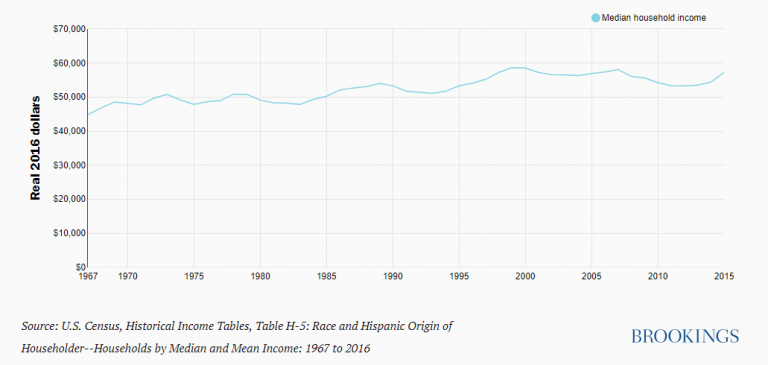
Despite increases in the national income over the past fifty years, middle class families have experienced little income growth over the past few decades. According to U.S. Census datamiddle class incomes have grown by only 28 percent from 1979 – 2014. Meanwhile, a report from the Congressional Budget Office (CBO) shows that the top 20 percent of earners has seen their incomes rise by 95 percent over that same period of time.

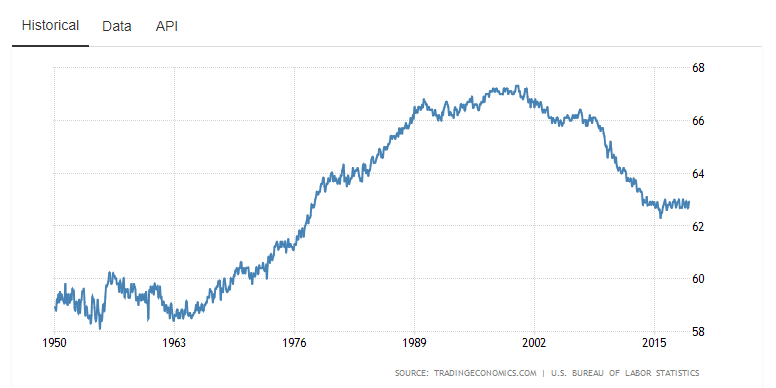
Contributing to the stagnation of wages is a notable decrease in the workforce participation rate. According to the Brookings institute, “One reason for these declines in employment and labor force participation is that work is less rewarding. Wages for those at the bottom and middle of the skill and wage distribution have declined or stagnated.” Historical data from the Bureau of Labor Statistics backs up these findings, showing a steady decrease in workforce participation over the last two decades.

The Erosion of the Minimum Wage & America’s Purchasing Power

Anyone who has read a comment thread on the internet about minimum wage laws knows the debate is currently one of the most highly contentious political topics in America. In the halls of Congress, the debate has turned into a nearly decade long impasse. As a result, workers at the low end of the wage scale have watched the purchasing power of their wages decrease from $7.25 in 2009, to $6.19 in 2018 due to inflation. In 2018, you need to perform 47 hours of minimum wage work to achieve the same amount of purchasing power as 40 hours of work in 2009.

The inflation-adjusted minimum wage value has been in steady decline since 1968, when the $1.60 minimum wage was equal to $11.39 (in 2018 dollars). Since then, lawmakers have reduced minimum wage increases relative to the rate of inflation. As Christopher Ingraham reports:

“Recent research shows that the reason politicians — Democrats and Republicans alike — are dragging their feet on popular policies such as the minimum wage is that they pay a lot more attention to the needs and desires of deep-pocketed business groups than they do to regular voters. Those groups tend to oppose minimum wage increases for the simple reason that they eat into their profit margins.”

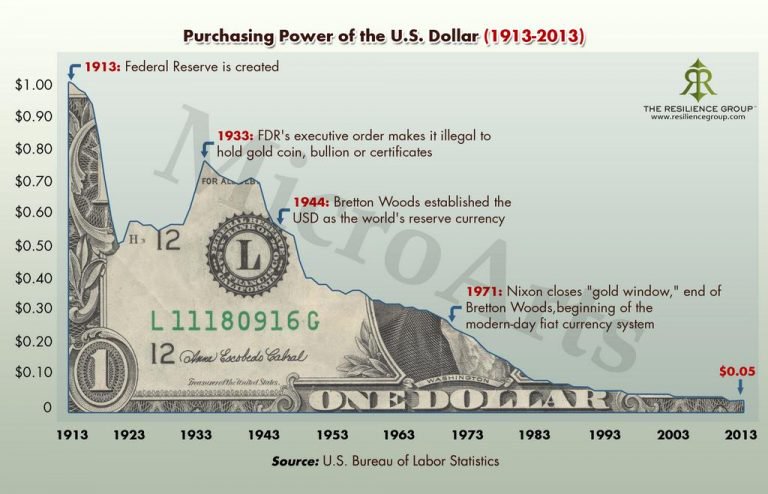
To be clear, the erosion of the purchasing power of everyday Americans is hardly a new phenomenon. According to data from the U.S. Bureau of Labor Statistics, the purchasing power of the U.S. Dollar has plummeted by over 95 percent since 1913, the year the Federal Reserve was created. The Bureau’s Consumer Price Index indicates that prices in 2018 are 2,436.33% higher than prices in 1913 and that the dollar has experienced an average inflation rate of 3.13% per year during this period.

The Rich Get Richer

While the outlook may be grim for low-wage workers, this is fantastic news for large corporations. Data from the U.S. Bureau of Economics shows that corporate profits are approaching all-time highs. But it’s not just workers who are feeling the effect of growing income inequality. The contrast is also being felt on Main Street. An analysis of the S & P 500 and the Russell 1,000 & 2,000 indexes by Bloomberg revealed a growing gap between America’s largest employers and smaller businesses.

A report from the Institute for Policy Studies entitled Billionaire Bonanza: The Forbes 400 and the Rest of Us echoed these findings when it revealed that America’s 20 wealthiest people — a group that could fit comfortably in one single Gulfstream G650 luxury jet –­ now own more wealth than the bottom half of the American population combined.

Although the Trump administration continues to tout stock market and labor force increases as signs of economic prosperity, numbers show that the wealthiest 10 percent of Americans own 84 percent of all stock. A study conducted by the Economic Policy Institute found that wage growth remains too weak to consider the economy at full employment and that stagnant wage growth has contributed to the growing level of income inequality in America. The study noted that while wages have recovered from the 2008 recession, the gap between those at the top and those at the middle and bottom has continued to increase since 2000. As the study’s author, Elise Gould writes:

“We’re looking at nominal wage growth that is still slower than you would expect in a full employment economy, slower than you would expect if you thought there were any sort of inflation pressures from wage growth.”

The Decimation of the American Dream

Comedian George Carlin once said, “The reason they call it the American Dream is because you have to be asleep to believe it.” For millions of middle class Americans Carlin’s statement has proven eerily accurate. Stagnant wages and decreased purchasing power has put the prospects for middle class children in a tailspin as upward mobility trends have reportedly fallen by over 40 percent since 1950.

A poll conducted by the Pew Research Institute corroborates this claim. According to Pew, only 37 percent of Americans believe that today’s children will grow up to be better off financially than their parents. That means more Americans think that today’s children will be financially worse off than their parents than those who believe they will be better off.

The sentiments expressed by millions of middle class Americans appear to be wholly justified due to the fact that middle class families are becoming more fragile and dependent on two incomes. A report from the Council of Economic Advisors found the majority of the income gains made by the middle class from 1979 to 2013 were a result of increased participation in the workplace by women. The report also noted the fragility of two income families amidst a decline in marriage and a drastic rise in single parent homes in recent years.

As a result of the slow growth in wages, over half of Americans now receive more in Government transfer payments (Medicare, Medicaid, food stamps, Social Security) than they pay in federal taxes. An analysis of all 50 states also found that in 42 states the cost of living is higher than the median income.

The rising cost of healthcare is also putting the pinch on the wallets of many Americans. As Jeffrey Pfeffer noted in his book Dying for a Paycheck, healthcare spending—per capita—has increased 29 fold over the past 40 years, outpacing the growth of the American economy.

While many Americans continue to look to the government to fix problems like wage stagnation, income inequality and rising healthcare costs, the sad truth is that we live in a time when 1 in 3 households has trouble paying energy bills and 40 percent of Americans face poverty in retirement at the exact same time the Federal Government has admitted that they lost $21 trillion. Not only did they lose $21 trillion (yes that’s TRILLION with a T), but the Department of Defense indicated in a press conference that they “never expected to pass” the audit to locate the missing taxpayer money.

John Emerich Edward Dalberg Acton famously proclaimed in 1887:

“Power tends to corrupt, and absolute power corrupts absolutely. Great men are almost always bad men.”

Perhaps it’s time for the millions of Americans who are quietly ‘mad as hell’ to start expressing their rage at the corrupt institutions of power that are decimating their livelihoods rather than expecting those very same institutions to fix the problems they created.