The real reason for the democratically elected leader of the largest country in South America being ‘impeached’ was not alleged corruption by its socialist president Dilma Rousseff, but more about Brazil’s elite power class and their media oligarchs who have failed time and time again to be democratically elected.
This by David Miranda from Brazil, The Guardian – “Slowly, the outside world has begun to see past the pleasing, two-dimensional caricature manufactured by its domestic press, and to recognise who will be empowered once Rousseff is removed. It has now become clear that corruption is not the cause of the effort to oust Brazil’s twice-elected president; rather, corruption is merely the pretext.
The story of Brazil’s political crisis, and the rapidly changing global perception of it, begins with its national media. The country’s dominant broadcast and print outlets are owned by a tiny handful of Brazil’s richest families, and are steadfastly conservative. For decades, those media outlets have been used to agitate for the Brazilian rich, ensuring that severe wealth inequality (and the political inequality that results) remains firmly in place.
But what most outside Brazil did not see was that the country’s plutocratic media had spent months inciting protests (while pretending merely to “cover” them). The protesters were not remotely representative of Brazil’s population. They were, instead, disproportionately white and wealthy: the very same people who have opposed the PT and its anti-poverty programmes for two decades.”
A New York Times article last week reported that “60% of the 594 members of Brazil’s Congress” – the ones voting to impeach Rousseff – “face serious charges like bribery, electoral fraud, illegal deforestation, kidnapping and homicide”. By contrast, said the article, Rousseff “is something of a rarity among Brazil’s major political figures: she has not been accused of stealing for herself”.
And from TruePublica columnist Stephen Lendman“President Dilma Rousseff’s ouster was orchestrated in Washington, complicit with corrupted Brazilian fascists – usurping power by removing her. Her impeachment was certain once the nation’s corruption-ridden Senate suspended her in May on trumped up budget-manipulation charges.
On August 31, it became official. Tyranny replaced Brazilian democracy. Telesur reported 49 senators voting for Rousseff’s impeachment “are themselves targets of criminal inquiries.” She committed no crimes. Nothing justified her removal. Allegations against her were fabricated.
Wednesday’s vote combined tragedy and farce – annulling 54 million votes electing her, returning the country to fascist rule, a sad moment for millions of Brazilians deserving better.”
Just 10 days after taking office, the planning minister, Romero Jucá, announced that he would “go on leave” following the release of a secretly taped telephone conversation in which he said Rousseff needed to be removed to quash a vast corruption investigation that implicated him and other members of the country’s political elite.”
A plot was hatched to put into power one Michel Temer. He has since been implicated by corruption allegations himself following the release of a plea-bargain testimony implicating him in an enormous scandal centered on the country’s state oil company that included funds being illegally diverted to his party.
Perhaps it should be of no surprise then that as The Wall Street Journal said “It was the first time Mr. Temer has been directly implicated in the blockbuster corruption investigation known as Operation Car Wash, which has ensnared dozens of high-profile business and political figures, including leading members of Mr. Temer’s Brazilian Democratic Movement Party, or PMDB.”
At the time of the WSJ report in June this year, Mr. Temer was leading a government with an 11.3% approval rating – woeful by any estimation. Even George W. Bush had an approval rating of 22% at the end of his disastrous tenure as President of the USA.
And ZeroHedge was clearly taking no prisoners with its headline Another US-Sponsored Coup? Brazil’s New President Was An Embassy Informant For US Intelligence – “the Temer presidency may be nothing more than the latest manifestation of the US state department’s implementation of yet another puppet government. We know this because earlier today, Wikileaks released evidence via a declassified cable that Brazil’s new interim president was an embassy informant for US intelligence and military.”
The ousting of Brazil’s democratically elected President is yet more evidence that money and power leads to corruption on a grand scale. A propaganda war was waged against the electorate by a tiny elite who own the media and are a part of what is now a plutocratic regime. Yet again, we see another ‘scalp’ for America’s neocon lust and blood campaign for global domination as the evidence suggests CIA involvement and government support.
Despite the lack of evidence linking Orlando mass murderer Omar Mateen to Daesh (ISIS) in any operational (direct) sense, the first inclination of U.S. Presidential hopeful Hillary Clinton was to renew American bombing of Syria, Iraq and Libya— the very nations that were destroyed by U.S. bombs directed by Mrs. Clinton and from whence Daesh arose. In so doing Mrs. Clinton made it evident that she is an unrepentant militarist whose bloodlust, combined with her longstanding interest in promoting American business interests, ties her to the U.S. imperial project of the last century and one-half. The precise moral difference between mass murders for personal and state reasons depends on a theory of the state at odds with this imperial project.
The company that employed Omar Mateen, G4S, is a British-based ‘security’ company that operates in 120 countries and as a ‘private’ supplier of public services to the Department of Homeland Security, the U.S. Army and to the very same State Department that Mrs. Clinton led as Secretary of State. The company advertises itself capable of ‘mitigating liability’ for the U.S. government— the ruse used by the CIA and other clandestine and quasi-clandestine government agencies to circumvent civil prohibitions on their activities by employing ‘private’ companies to carry them out. The NSA’s domestic surveillance programs tie to those of the FBI, DEA and CIA through this legalistic dodge. And ‘private contractors’ were behind some of the more grotesque slaughters in recent American wars.
The classical liberal separation of economic from political interests used to legitimate state violence is one that the Clintons have spent their ‘public’ careers undermining. As leading proponents of neoliberalism, the Clintons have spent three decades conflating ‘private’ interests with the public interest. In history this tie of U.S. business interests to U.S. military incursions runs from residual European imperialism, including genocide against the indigenous population and slavery, to direct wars, proxy wars, coups, assassinations, murders and particularly odious ‘wars of attrition.’ What is corruption in the liberal worldview is the nature of the capitalist-state acting in / on imperial interests in a Marxian frame. If this corruption is ‘solvable,’ such has yet to be demonstrated in the U.S.
Hillary Clinton’s use of the horrific crime in Orlando to instigate further crimes against untold innocents abroad is hidden behind manufactured fears of a lunatic and craven enemy (ISIS) that is in fact both a product of earlier U.S. atrocities across the Middle East and but a pale ghost of the savagery of combined U.S. actions in the region. The American leadership’s practice of creating crises that it must then ‘respond’ to led the way to the sequential slaughters, disruptions and dislocations that now finds substantial portions of the Middle East in ruins and millions of refugees flooding an increasingly xenophobic Europe. That this leadership never seems to learn from its ‘mistakes’ suggests motivations at work other than those presented at press conferences.
Where G4S, Omar Mateen’s employer, fits in is that Mr. Mateen was in many respects the perfect mercenary— ‘our psychopath’ if we were paying for his services. Murdering 49 people and wounding 50 more is, in addition to being an atrocity, a crime and a moral calamity, a complicated logistical feat. In 2004 U.S. Colonel James Steele was brought to Iraq, in a war that Bill Clinton publicly supported and Hillary Clinton voted for, to engineer like atrocities. Mr. Mateen’s crimes would have been business-as-usual in U.S. led slaughters of innocent civilians in Nicaragua and El Salvador in the 1980s and in Iraq in the 2000s. And G4S is precisely the type of ‘public-private partnership’ favored by the Clintons to ‘mitigate liability’ behind a veil of ‘private’ actions.
This isn’t to suggest that Hillary Clinton had any part in the murders carried out by Mr. Mateen. It is to suggest that in any human and / or moral sense she is congenitally unfit for public office. The most generous explanation of her support for George W. Bush’s criminal slaughter in Iraq is that she was misled by the manufactured evidence proffered by the Bush administration. That the war tied through history to the Clinton’s own sanctions against Iraq that resulted in half a million innocents dying from privation and to eight years of bombing that left much of the country in ruins suggests that Mrs. Clinton probably well understood that Iraq posed no threat to the U.S. in 2001. That the war was coincidentally a boon to Western business interests was / is as grotesque as it was predictable.
If conceptual clarity around these issues seems wanting here— that is the point. Neoliberalism as some unified theory of political economy ties through history to the Washington Consensus that in turn ties to American imperial history. Western imperialism— state-corporatism as division of the global economic spoils through insertion / assertion of ‘national’ interests, has five centuries of reasonably well defined history behind it. In this regard Donald Trump’s relative rhetorical reticence to use military force as a first choice is a threat to this imperial order whereas Hillary Clinton’s willingness to destroy an entire region of the world on a whim to benefit Exxon Mobil and Goldman Sachs makes her the ‘safe’ choice from the institutional perspective.
Washington Consensus precepts are:
*Fiscal discipline
*A redirection of public expenditure priorities toward fields offering both high economic returns and the potential to improve income distribution, such as primary health care, primary education, and infrastructure
*Tax reform (to lower marginal rates and broaden the tax base)
*Interest rate liberalization
*A competitive exchange rate
*Trade liberalization
*Liberalization of inflows of foreign direct investment
*Privatization
*Deregulation (to abolish barriers to entry and exit)
*Secure property rights
Against this imperial history the U.S. view that national elections are an internal matter places U.S. voters as the nominal ‘choosers’ of political economy for much of the world. In political terms, the 800+ military bases that the U.S. keeps around the globe serve as quasi-private security forces to assure repatriation of ‘profits’ for multi-national corporations in the form of resources, plentiful, cheap labor and the broader economy of imperial conquest. In fact, as opposed to theory, these profits are the reciprocal of the death, misery, subjugation and immiseration inevitably put forward by Western economists and politicians as the result of ‘free-choice’ by those on the losing end of American imperial fortune. That increasing numbers of Americans are on this losing end helps explain current (and heretofore slight) political unrest and its reciprocal in establishment support for Mrs. Clinton.
Hillary Clinton’s toxic jargon that “America never stopped being great” poses a seeming conundrum for her supporters who aren’t dedicated sociopaths. If U.S. wars in Southeast Asia, Central America, the Middle East and Northern Africa are evidence of this greatness, then what are the moral and political bases of such a judgment? Mrs. Clinton’s nostalgia for the days of alleged national unity following the attacks of September 11, 2001 is apparently for the erasure of the history that led to the attacks and not for unity per se. Conversely, given the absence of any operational link to Daesh, Omar Mateen could just as well have claimed that his crimes were motivated by Napoleon Bonaparte or Jesus Christ were ISIS not such a well-implanted foe.
Externally, and in contradiction of to the exceptionalists, the democratists and Western neoliberals, the U.S. is broadly considered the greatest threat to world peace on the planet. Brought to the fore in the current Presidential election cycle is that Western elites— inherited wealth, bailout-dependent bankers, the corporate lootocracy dependent on wildly goosed (by the Federal Reserve) asset prices and various and sundry agents, functionaries and court pleaders, are now well-understood to have interests diametrically opposed to those of the vast majority of Americans. The conceptual leap not yet taken by the American electorate is the international nature of this class divide.
Chart: the bi-Party system of electoral control in the U.S. is put forward as representing majority political views when combined it represents less than one-third of voting-age political affiliation. In terms of global political reach, the American political leadership represents such a small minority’s interests that even relatively minor rebellions could quickly overwhelm it. Source: Gallup, Pew Research.
This international ‘footprint’ is fact regardless of whether or not Americans consider it when voting. Internal economic dislocations, such as jobs lost and stagnant wages from trade agreements, find their reciprocals in indigenous economies destroyed, in ‘developing market’ industries shut out through subsidized ‘competition,’ in IMF ‘workouts’ that place ownership of developing industries in Western hands and through commodification and expropriation of millennia of accumulated knowledge to be put back as alien product against the peoples and cultures that developed it. In this respect, the ‘Clinton model’ of sweatshop labor as economic development joins the ‘Obama model’ of subverting civil law in the interests of corporate-state plutocrats.
Calls to unify behind Hillary Clinton in her bid to become President pose the heavily engineered outcome of the Democratic primaries as the popular will. In this sense they are roughly analogous to the calls to unite behind George W. Bush following the Bush v. Gore Supreme Court decision in 2000. The Clintons paved the way for Mr. Bush’s brutal militarism much as Barack Obama maintained the institutional infrastructure of the ‘unitary Presidency’ and the capacity for launching criminal wars of opportunity. Between Hillary Clinton and Donald Trump, it is Mrs. Clinton who has the proven record as guardian of empire and imperial prerogative. Her unbridled militarism is an expression of this prerogative.
The question for Democrats is how evil can someone be to still be worthy of voting for? Alleged stark differences between Hillary Clinton and George W. Bush find very high degrees of synchronicity between their actual policies (and those of Barack Obama). And lest this be unclear, it is the Democratic establishment that chose Mrs. Clinton as its candidate (chart above), and not the politically and economically dispossessed electorate. The grift that American elections reflect the popular will, and therefore confer political legitimacy, contrasts with the facts that the dominant Parties are largely and increasingly unpopular and that the popular will bears no relation to the policies decided upon and enacted by the American political establishment.
Rob Urie is an artist and political economist. His book Zen Economics is published by CounterPunch Books.
For centuries hereditary monarchy was the dominant way to select national leaders, evolving into an intricate system that sustained itself through power and propaganda even as its ideological roots shriveled amid the Age of Reason. Yet, as monarchy became a dead idea, it still killed millions in its death throes.
Today, the dangerous “dead ideas” are neoconservatism and its close ally, neoliberalism. These are concepts that have organized American foreign policy and economics, respectively, over the past several decades – and they have failed miserably, at least from the perspective of average Americans and people of the nations on the receiving end of these ideologies.
Neither approach has benefited mankind; both have led to untold death and destruction; yet the twin “neos” have built such a powerful propaganda and political apparatus, especially in Official Washington, that they will surely continue to wreak havoc for years to come. They are zombie ideas and they kill.
Yet, the Democratic Party is poised to nominate an adherent to both “neos” in the person of Hillary Clinton. Rather than move forward from President Barack Obama’s unease with what he calls the Washington “playbook,” the Democrats are retreating into its perceived safety.
After all, the Washington Establishment remains enthralled to both “neos,” favoring the “regime change” interventionism of neoconservatism and the “free trade” globalism of neoliberalism. So, Clinton has emerged as the clear favorite of the elites, at least since the field of alternatives has narrowed to populist billionaire Donald Trump and democratic socialist Bernie Sanders.
Democratic Party insiders appear to be counting on the mainstream news media and prominent opinion-leaders to marginalize Trump, the presumptive Republican nominee, and to finish off Sanders, who faces long odds against Clinton’s delegate lead for the Democratic nomination, especially among the party regulars known as “super-delegates.”
But the Democratic hierarchy is placing this bet on Clinton in a year when much of the American electorate has risen up against the twin “neos,” exhausted by the perpetual wars demanded by the neoconservatives and impoverished by the export of decent-paying manufacturing jobs driven by the neoliberals.
Though much of the popular resistance to the “neos” remains poorly defined in the minds of rebellious voters, the common denominator of the contrasting appeals of Trump and Sanders is that millions of Americans are rejecting the “neos” and repudiating the establishment institutions that insist on sustaining these ideologies.
The Pressing Question
Thus, the pressing question for Campaign 2016 is whether America will escape from the zombies of the twin “neos” or spend the next four years surrounded by these undead ideas as the world lurches closer to an existential crisis.
The main thing that the zombie “neos” have going for them is that the vast majority of Very Important People in Official Washington have embraced these concepts and have achieved money and fame as a result. These VIPs are no more likely to renounce their fat salaries and overblown influence than the favored courtiers of a King or Queen would side with the unwashed rabble.
The “neo” adherents are also very skilled at framing issues to their benefit, made easier by the fact that they face almost no opposition or resistance from the mainstream media or the major think tanks.
The neoconservatives have become Washington’s foreign policy establishment, driving the old-time “realists” who favored more judicious use of American power to the sidelines.
Meanwhile, the neoliberals dominate economic policy debates, treating the “markets” as some new-age god and “privatization” of public assets as scripture. They have pushed aside the old New Dealers who called for a robust government role to protect the people from the excesses of capitalism and to build public infrastructure to benefit the nation as a whole.
The absence of any strong resistance to the now dominant “neo” ideologies is why we saw the catastrophic “group think” over Iraq’s WMD in 2003 and why for many years no one of great significance dared question the benefits of “free trade.”
After all, both strategies benefited the elites. Neoconservative warmongering diverted trillions of dollars into the Military-Industrial Complex and neoliberal job outsourcing has made billions of dollars for individual corporate executives and stock investors on Wall Street.
Those interests have, in turn, kicked back a share of the proceeds to fund Washington think tanks, to finance news outlets, and to lavish campaign donations and speaking fees on friendly politicians. So, for the insiders, this game has been a case of win-win.
The Losers
Not so much for the “losers,” those average citizens who have seen the Great American Middle Class hollowed out over the past few decades, watched America’s public infrastructure decay, and worried about their sons and daughters being sent off to fight unnecessary, perpetual and futile wars.
But inundated with clever propaganda – and scrambling to make ends meet – most Americans see the reality as if through a glass darkly. Many of them, as Barack Obama indelicately said during the 2008 campaign, “cling to guns or religion.” They have little else – and many are killing themselves with opiates that dull their pain or with those guns that they see as their last link to “freedom.”
What is clear, however, is that large numbers don’t trust – and don’t want – Hillary Clinton, who had a net 24-point unfavorable rating in one recent poll. It turns out that another indelicate Obama comment from Campaign 2008 may not have been true, when he vouched that “you’re likable enough, Hillary.” For many Americans, that’s not the case (although Trump trumped Clinton with a 41-point net negative).
If the Democrats do nominate Hillary Clinton, they will be hoping that the neocon/neolib establishment can so demonize Donald Trump that a plurality of Americans will vote for the former Secretary of State out of abject fear over what crazy things the narcissistic billionaire might do in the White House.
Trump’s policy prescriptions have been all over the place – and it is hard to know what reflects his actual thinking (or his genuine ignorance) as opposed to what constitutes his skillful showmanship that made him the “survivor” in the real-life reality TV competition for the Republican nomination.
Does Trump really believe that global warming is a hoax or is he just pandering to the know-nothing element of the Republican Party? Does he actually consider Obama’s Iran nuclear deal to be a disaster or is he just playing to the hate-Obama crowd on the Right?
Opposing the ‘Neos’
But Trump is not a fan of the “neos.” He forthrightly takes on the neocons over the Iraq War and excoriates ex-Secretary of State Clinton for her key role in another “regime change” disaster in Libya. Further, Trump calls for cooperation with Russia and China rather than the neocon-preferred escalation of tensions.
In his April 27 foreign policy speech, Trump called for “a new foreign policy direction for our country – one that replaces randomness with purpose, ideology with strategy, and chaos with peace. …It’s time to invite new voices and new visions into the fold. …
“My foreign policy will always put the interests of the American people, and American security, above all else. That will be the foundation of every decision that I will make. America First will be the major and overriding theme of my administration.”
Such comments – suggesting that “new voices” are needed and that “ideology” should be cast aside – were fighting words for the neocons, since it is their voices that have drowned out all others and their ideology that has dominated U.S. foreign policy in recent years.
To make matters worse, Trump outlined an “America First” strategy in contrast to neocon demands that the U.S. military be dispatched abroad to advance the interests of Israel and other “allies.” Trump is not interested in staging “regime changes” to eliminate leaders who are deemed troublesome to Israel.
The real estate tycoon also has made criticism of “free trade” deals a centerpiece of his campaign, arguing that those agreements have sold out American workers by forcing them to compete with foreign workers receiving a fraction of the pay.
Sen. Sanders has struck similar themes in his insurgent Democratic campaign, criticizing Hillary Clinton’s longtime support for “free trade” and her enthusiasm for “regime change” wars, such as those in Iraq and Libya.
Examining her long record in public life, there can be little doubt that Clinton is a neocon on foreign policy and a neolib on economic strategies. She stands firmly with the consensus of Official Washington’s establishment, which is why she has enjoyed its warm embrace.
She has followed Wall Street’s beloved neoliberal attitude toward “free trade,” which has been very good for multinational corporations as they shipped millions of U.S. manufacturing jobs to low-wage countries. (She has only cooled her ardor for trade deals to stanch the flow of Democratic voters to Bernie Sanders.)
Wars and More Wars
On foreign policy, Clinton has consistently supported neoconservative wars, although she might shy from the neocon label per se, preferring its less noxious synonym “liberal interventionist.”
But as arch-neocon Robert Kagan, who has recast himself as a “liberal interventionist,” told The New York Times in 2014, “I feel comfortable with her on foreign policy. If she pursues a policy which we think she will pursue it’s something that might have been called neocon, but clearly her supporters are not going to call it that; they are going to call it something else.”
Summing up the feeling of thinkers like Kagan, the Times reported that Clinton “remains the vessel into which many interventionists are pouring their hopes.”
In February 2016, distraught over the rise of Trump, Kagan, whose Project for the New American Century wrote the blueprint for George W. Bush’s Iraq War, openly threw his support to Clinton, announcing his decision in a Washington Post op-ed.
And Kagan is not mistaken when he views Hillary Clinton as a fellow-traveler. She has often marched in lock step with the neocons as they have implemented their aggressive “regime change” schemes against governments and political movements that don’t toe Washington’s line or that deviate from Israel’s goals in the Middle East.
She has backed coups, such as in Honduras (2009) and Ukraine (2014); invasions, such as Iraq (2003) and Libya (2011); and subversions such as Syria (from 2011 to the present) all with various degrees of disastrous results. [For more details, see Consortiumnews.com’s “Yes, Hillary Clinton Is a Neocon” and “Would a Clinton Win Mean More Wars?”]
Seeking ‘Coercion’
A glimpse of what a Clinton-45 presidency might do could be seen in a recent Politico commentary by Dennis Ross, a former special adviser to Secretary of State Clinton now working at the staunchly pro-Israel Washington Institute for Near East Policy.
In the article, Ross painted a surreal world in which the problems of the Middle East have been caused by President Obama’s hesitancy to engage militarily more aggressively across the region, not by the neocon-driven decision to invade Iraq in 2003 and the similar schemes to overthrow secular governments in Libya and Syria in 2011, leaving those two countries in ruin.
Channeling the desires of right-wing Israeli Prime Minister Benjamin Netanyahu, Ross called for the United States to yoke itself to the regional interests of Israel, Saudi Arabia and other members of the Gulf Cooperation Council (GCC) in their rivalry against Shiite-led Iran.
Ross wrote: “Obama believes in the use of force only in circumstances where our security and homeland might be directly threatened. His mindset justifies pre-emptive action against terrorists and doing more to fight the Islamic State. But it frames U.S. interests and the use of force to support them in very narrow terms. …
“The Saudis acted in [invading] Yemen in no small part because they feared the United States would impose no limits on Iranian expansion in the area, and they felt the need to draw their own lines.”
To counter Obama’s hesitancy to apply military force, Ross calls for a reassertion of a muscular U.S. policy in the Middle East, much along the lines that the neocon establishment and Hillary Clinton also favor, including:
–Threatening Iran with “blunt, explicit language on employing force, not sanctions” if Iran deviates from the Obama-negotiated agreement to constrain its nuclear program (the bomb-bomb-bomb-Iran zombie lives!);
–“Contingency planning with GCC states and Israel … to generate specific options for countering Iran’s growing use of Shiite militias to undermine regimes in the region”;
–A readiness to arm Sunni tribes in Iraq if Iraq’s prime minister doesn’t;
–Establish “safe havens with no-fly zones” inside Syria if Russian President Vladimir Putin does not force Syrian President Bashar al-Assad to step down.
Employing the classic tough talk of the neocons, Ross concludes, “Putin and Middle Eastern leaders understand the logic of coercion. It is time for us to reapply it.”
One might note the many logical inconsistencies of Ross’s arguments, including his failure to note that much of Iran’s supposed meddling in the Middle East has involved aiding the Syrian and Iraqi governments in their battle against the Islamic State and Al Qaeda. Or that Russia’s intervention in Syria also has been to support the internationally recognized government in its fight against Sunni extremists and terrorists.
But the significance of Ross’s prescription to “reapply” U.S. “coercion” across the region is that he is outlining what the world can expect from a Clinton-45 presidency.
Clinton made many of the same points in her speech before the American Israel Public Affairs Committee and in debates with Bernie Sanders. If she stays on that track as president, there would be at least a partial U.S. military invasion of Syria, a very strong likelihood of war with Iran, and an escalation of tensions (and possible war) with nuclear-armed Russia.
The logic of how all that is supposed to improve matters is lost amid the classic neocon growling about showing toughness or reapplying “coercion.”
So, the Democratic Party seems to be betting that Hillary Clinton’s flood of ugly TV ads against Trump can frighten the American people enough to give the neocons and the neolibs one more lease on the White House – and four more years to wreak their zombie havoc on the world.
Investigative reporter Robert Parry broke many of the Iran-Contra stories for The Associated Press and Newsweek in the 1980s. You can buy his latest book, America’s Stolen Narrative, either in print here or as an e-book (from Amazon and barnesandnoble.com).
There are numerous tactics available to those who aim to make problems worse while pretending to solve them, but misdirection is always a favorite. The reason to want to make problems worse is that problems are profitable—for someone. And the reason to pretend to be solving them is that causing problems, then making them worse, makes those who profit from them look bad.
In the international arena, this type of misdirection tends to take on a farcical aspect. The ones profiting from the world’s problems are the members of the US foreign policy and military establishments, the defense contractors and the politicians around the world, and especially in the EU, who have been bought off by them. Their tactic of misdirection is conditioned by a certain quirk of the American public, which is that it doesn’t concern itself too much with the rest of the world. The average member of the American public has no idea where various countries are, can’t tell Sweden from Switzerland, thinks that Iran is full of Arabs and can’t distinguish any of the countries that end in -stan. And so a handy trick has evolved, which amounts to the following dictum: “Always attack the wrong country.”
Need some examples? After 9/11, which, according to the official story (which is probably nonsense) was carried out by “suicide bombers” (some of them, amusingly, still alive today) who were mostly from Saudi Arabia, the US chose to retaliate by attacking Saudi ArabiaAfghanistan and Iraq.
When Arab Spring erupted (because a heat wave in Russia drove up wheat prices) the obvious place to concentrate efforts, to avoid a seriously bad outcome for the region, was Egypt—the most populous Arab country and an anchor for the entire region. And so the US and NATO decided to attack EgyptLibya.
When things went south in the Ukraine, whose vacillating government couldn’t make up its mind whether it wanted to remain within the Customs Union with Russia, its traditional trading partner, or to gamble on signing an agreement with the EU based on vague (and since then broken) promises of economic cooperation, the obvious place to go and try to fix things was the Ukraine. And so the US and the EU decided fix the UkraineRussia, even though Russia is not particularly broken. Russia was not amused; nor is it a country to be trifled with, and so in response the Russians inflicted some serious pain on the Washington establishmentfarmers within the EU.
Who was at fault exceedingly clear once the Ukrainians that managed to get into power (including some very nasty neo-Nazis) started to violate the rights of Ukraine’s Russian-speaking majority, including staging some massacres, in turn causing a large chunk of it to hold referendums and vote to secede. (Perhaps you didn’t know this, but the majority of the people in the Ukraine are Russian-speakers, and there is just one city of any size—Lvov—that is mostly Ukrainian-speaking. Mind you, I find Ukrainian to be very cute and it makes me smile whenever I hear it. I don’t bother speaking it, though, because any Ukrainian with an IQ above bathwater temperature understands Russian.) And so the US and the EU decided to fix things by continuing to put pressure on the UkraineRussia.
When Russia started insisting on a political rather than a military resolution to the crisis in the Ukraine, and helped negotiate the Minsk agreements together with the Ukraine, France and Germany, a similar thing happened. These agreements obligated the Ukrainian government to pass constitutional reforms to grant autonomy to its Russian regions in the east. The Ukrainian government refused to abide by these agreements. As a result, the US and the EU decided to put pressure on the UkrainianRussian government.
When a nasty terrorist group calling itself ISIS and composed of Islamic Salafi/Takfiri extremists started to seize power in large parts of Iraq, and then spread to Syria, something had to be done about it. These extremists were being financed by Turkey (which is still buying oil from them and sheltering them on its territory) and Saudi Arabia. And so the US and NATO decided to put some pressure on Turkey and Saudi ArabiaSyria.
In response to all this foolishness, Russia up and decided to actually go and fix something that was broken: Syria. And now Syria is on the mend, and members the misdirectorate in Washington are left scratching their heads.
So far so good. But this method of pretending to be solving problems by making them worse has some definite downsides.
For one thing, eventually even the dimmest, most geographically challenged bulbs in the general population start to get a clue, and then they start refusing to vote for the establishment candidates. Then it becomes hard to continue with the misdirecting because the people doing the misdirecting are voted out, and (horror of horrors!) somebody who might actually try to fix a problem or two might get voted in.
For another, continually making problems worse by attacking the wrong country tends to eventually make the sheer number problems get completely out of hand. Take the recent massive terror attack in Brussels, down the road from NATO headquarters, for which ISIS took credit. Recently, Europe has been experiencing a large-scale influx of people from the Middle East and North Africa, who have been forced to flee their native lands because of all the previous acts of misdirection, and a fair number of these people are ISIS terrorists. And so, to protect itself, NATO is planning to fight ISIS in EuropeSyria. Also, it is well known that the influx into Europe has been orchestrated by Turkey. In response, the EU has decided to put pressure ongive billions of euros to Turkey and tell Turkey that it is welcome to join the EU.
Lastly, this pattern has an overall momentum that, over time, becomes harder and harder to break. It starts out as just one group of plutocrats doing incredibly vile, underhanded but profitable things; later on, an even bigger group of plutocrats is doing equally vile but now completely idiotic, self-defeating, embarrassing things; and right near the end a really huge group of plutocrats is doing things that are absolutely suicidal—but they can’t stop themselves. You should be able to decide for yourselves when that point in time arrives, but I doubt that it is too far in the future.
Hillary Clinton has a dark history in foreign policy. Indeed, if the Nuremberg principles were applied evenly, her name would certainly be on the docket, along with her former boss in the White House, who is actually less of a hawk than she. When Donald Trump publicly expressed a willingness to negotiate with Russia over international conflicts, she referred to such an idea as putting “Christmas in the Kremlin.” She’s red-baited Bernie Sanders for his support for the Cuban and Nicaraguan revolutions back in the 1980s. Clinton basically backs not “political realism,” but the more imperial tradition of neoconservative “American exceptionalism,” a chauvinist mindset by which the US sets the political, economic, and military priorities of the world and the places and times of its interventions, sometimes with allied support, sometimes without, at its own discretion.
Hillary is a product of her husband’s alignment with Democratic Leadership Council (DLC) and the right wing shift of the party, which moved the Democrats away from its moorings in organized labor, the New Deal, civil rights, and the Great Society. Bill Clinton’s successful election undoubtedly inspired the formation of “New” Labour in Britain, which likewise broke with its party history in the labor movement. In the 1990s, then MP Tony Blair, his shadow government chancellor of the exchequer Gordon Brown, and his chief pollster Philip Gould came to America as apprentices of the Clinton presidential campaigns to study their public relations and other electioneering tactics. This became part of New Labour’s successful “Third Way” victorious strategy in 1997. Back then, Anthony Howard, writing in the Times of London, said that Clinton’s New Democrats “lighted the path” for Blair’s New Labour. Blair partnered with Clinton and the DLC in taking a more militarist stance toward Saddam Hussein, which paved the way for Bush’s and Blair’s 2003 invasion of Iraq.
Bill Clinton’s and the DLC’s legacy candidate is Hillary. And what better way to prove her cojones, in case anyone thought a woman president might turn out to be a negotiator and peacenik, than to pick on Russia and reignite the Cold War. Despite the Russians’ brilliant mix of negotiation – warding off a US invasion of Iran, getting the US off Assad’s back with the disposal of his chemical weapons stash – and their effective military intervention against ISIS, Obama, Clinton, and now Kerry will not relent in their hostility. The US neocon inner circle cannot countenance a balance of power arrangement with the Kremlin, disregarding Russia’s status as the second most militarily powerful country in the world. Clinton has called Putin a dictator, the favorite term of disgrace in American ruling circles, except when it comes to America’s allies in the Gulf states, Erdogan, and the long list of authoritarian friends the US has backed over the entire course of the postwar era. Indeed, Putin may be a strongman of sorts, and an extremely popular one in his own country, but is far less of an authoritarian than his predecessor, ” Boris Yeltsin, who ruled by decree and whom Hillary’s husband lauded and financed as a genuine, if quite inebriated, democrat.
Was Hillary in on Bill’s political choices? Recently speaking to Amy Goodman on Democracy Now, Clinton’s secretary of labor Robert Reich said that Bill never made an important decision without consulting the first lady. What are the programs to which Hillary can claim advisory credit during her husband tenure? NAFTA, welfare reform (“ending welfare as we know it,” said Bill), balancing the budget (inflicting austerity measures), the 1994 crime bill (“three strikes and you’re out”), bank deregulation (a sonata for the Great Recession). All of these projects, says author Thomas Frank, were for working Americans and people of color absolute disasters. And one might add to his list the expansion of NATO and the assault on Yugoslavia.
As secretary of state, Hillary backed CIA director Petraeus’ plan to overthrow the Assad government in Syria, from which Obama eventually backed away, thanks to Russia’s intervention and defense of Syria’s sovereignty. As a good neocon soldier for American exceptionalism, Clinton aligns herself with whatever appears at the moment to be the “national interest” center of political gravity (promoting the oil industry, arms sales, the pro-Zionist alliance, divide and rule aid to opponents of secular nationalism, right-to-protect military and economic interventions). The distraction over her emailgate and the Benghazi investigation hides the real crimes of her active support for the bombing of Libya, the overthrow of the government, and the resulting chaos and ISIS organizing in the country, not to mention her backing for the Honduran coup d’etat. Former secretary of defense Robert Gates says that it was Hillary who pushed Obama into the decision on Libya, for which the president now publicly expresses regret, calling the present condition of the country (his words) “a shit show.”
Her champions who cheer her work with women and children ignore the thousands of women and children in Libya and elsewhere in the Middle East, who were slaughtered under her leadership in the State Department. Speaking on regime change, even a right-wing former Pentagon analyst, Michael Maloof, didn’t believe it was appropriate to attack Iraq. “Now with Libya,” he says, “it’s the same. And Hillary Clinton was very much responsible for that.”
If she becomes president, what can be expected of her on domestic policy? She’ll be a good team player – that is, the neocon team – and may even get something accomplished, such as privatizing part of social security and medicare, which was always part of the DLC agenda, and working more closely with the oil companies. Among her other achievements during her years in the State Department, according to investigative journalist, Lee Fang, was her creation of a separate bureau, with more than 60 staff, whose focus was on energy resources. Traveling the world, Clinton used her position, partnered with Chevron, to promote the practice of fracking in developing countries.
With the power couple in the White House, their assets already worth well over $100 million, and with a Congress being mostly a millionaires’ club, no serious tax increase on the rich can be expected. Indeed, the White House will be more of a revolving door for government officials and staff moving back and forth between the corporate world and “public service.” Open Secrets.org found 84 revolving door personnel working for Hillary, more than on any other politician’s staff: “the greatest number of staffers who either came to Capitol Hill after representing private interests or left the member’s staff for a lobbying position.”
Her march to the White House relies on over 400 superdelegates pledged to her – a number of them also wearing the hat of corporate lobbyist – rather than to the democratic voice of the people, Even if nominated and then elected, Hillary, lacking credibility about her authenticity, will not be a popular president. Nearly half of Democrats don’t trust her (56% express trust vs. 81% for Bernie). And a new AP-GfK poll reveals that 55% of all Americans hold a negative opinion of her. Under her presidency, and with the return of the first man, American politics will continue to be business as usual.
Gerald Sussman is a Professor in the Toulan School of Urban Studies and Planning at Portland State University
If there were any doubts that Hillary Clinton favors a neoconservative foreign policy, her performance at Thursday’s debate should have laid them to rest. In every meaningful sense, she is a neocon and – if she becomes President – Americans should expect more global tensions and conflicts in pursuit of the neocons’ signature goal of “regime change” in countries that get in their way.
Beyond sharing this neocon “regime change” obsession, former Secretary of State Clinton also talks like a neocon. One of their trademark skills is to use propaganda or “perception management” to demonize their targets and to romanticize their allies, what is called “gluing white hats” on their side and “gluing black hats” on the other.
So, in defending her role in the Libyan “regime change,” Clinton called the slain Libyan leader Muammar Gaddafi “genocidal” though that is a gross exaggeration of Gaddafi’s efforts to beat back Islamic militants in 2011. But her approach fits with what the neocons do. They realize that almost no one will dare challenge such a characterization because to do so opens you to accusations of being a “Gaddafi apologist.”
Similarly, before the Iraq War, the neocons knew that they could level pretty much any charge against Saddam Hussein no matter how false or absurd, knowing that it would go uncontested in mainstream political and media circles. No one wanted to be a “Saddam apologist.”
Clinton, like the neocons, also shows selective humanitarian outrage. For instance, she laments the suffering of Israelis under crude (almost never lethal) rocket fire from Gaza but shows next to no sympathy for Palestinians being slaughtered by sophisticated (highly lethal) Israeli missiles and bombs.
She talks about the need for “safe zones” or “no-fly zones” for Syrians opposed to another demonized enemy, Syria’s President Bashar al-Assad, but not for the people of Gaza who face the wrath of Israeli Prime Minister Benjamin Netanyahu.
“Yes, I do still support a no-fly zone [in Syria] because I think we need to put in safe havens for those poor Syrians who are fleeing both Assad and ISIS and have some place that they can be safe,” Clinton said. But she showed no such empathy for Palestinians defenseless against Israel’s “mowing the grass” operations against men, women and children trapped in Gaza.
In Clinton’s (and the neocons’) worldview, the Israelis are the aggrieved victims and the Palestinians the heartless aggressors. Referring to the Gaza rocket fire, she said: “I can tell you right now I have been there with Israeli officials going back more than 25 years that they do not seek this kind of attacks. They do not invite the rockets raining down on their towns and villages. They do not believe that there should be a constant incitement by Hamas aided and abetted by Iran against Israel. …
“So, I don’t know how you run a country when you are under constant threat, terrorist attack, rockets coming at you. You have a right to defend yourself.”
Ignoring History
Clinton ignored the history of the Israeli-Palestinian conflict, which dates back to the 1940s when Israeli terrorist organizations engaged in massacres to drive Palestinians from their ancestral lands and murdered British officials who were responsible for governing the territory. Israeli encroachment on Palestinian lands has continued to the present day.
But Clinton framed the conflict entirely along the propaganda lines of the Israeli government: “Remember, Israel left Gaza. They took out all the Israelis. They turned the keys over to the Palestinian people. And what happened? Hamas took over Gaza. So instead of having a thriving economy with the kind of opportunities that the children of the Palestinians deserve, we have a terrorist haven that is getting more and more rockets shipped in from Iran and elsewhere.”
So, Clinton made clear – both at the debate and in her recent AIPAC speech – that she is fully in line with the neocon reverence for Israel and eager to take out any government or group that Israel puts on its enemies list. While waxing rhapsodic about the U.S.-Israeli relationship – promising to take it “to the next level” – Clinton vows to challenge Syria, Iran, Russia and other countries that have resisted or obstructed the neocon/Israeli “wish list” for “regime change.”
In response to Clinton’s Israel-pandering, Sen. Bernie Sanders, who once worked on an Israeli kibbutz as a young man, did the unthinkable in American politics. He called out Clinton for her double standards on Israel-Palestine and suggested that Netanyahu may not be the greatest man on earth.
“You gave a major speech to AIPAC,” Sanders said, “and you barely mentioned the Palestinians. … All that I am saying is we cannot continue to be one-sided. There are two sides to the issue. … There comes a time when if we pursue justice and peace, we are going to have to say that Netanyahu is not right all of the time.”
But in Hillary Clinton’s mind, the Israeli-Palestinian dispute is essentially one-sided. During her speech to the American Israel Public Affairs Committee last month, she depicted Israel as entirely an innocent victim in the Mideast conflicts.
“As we gather here, three evolving threats — Iran’s continued aggression, a rising tide of extremism across a wide arc of instability, and the growing effort to de-legitimize Israel on the world stage — are converging to make the U.S.-Israel alliance more indispensable than ever,” she declared.
“The United States and Israel must be closer than ever, stronger than ever and more determined than ever to prevail against our common adversaries and to advance our shared values. … This is especially true at a time when Israel faces brutal terrorist stabbings, shootings and vehicle attacks at home. Parents worry about letting their children walk down the street. Families live in fear.”
Yet, Clinton made no reference to Palestinian parents who worry about their children walking down the street or playing on a beach and facing the possibility of sudden death from an Israeli drone or warplane. Instead, she scolded Palestinian adults. “Palestinian leaders need to stop inciting violence, stop celebrating terrorists as martyrs and stop paying rewards to their families,” she said.
Then, Clinton promised to put her future administration at the service of the Israeli government. Clinton said, “One of the first things I’ll do in office is invite the Israeli prime minister to visit the White House. And I will send a delegation from the Pentagon and the Joint Chiefs to Israel for early consultations. Let’s also expand our collaboration beyond security.”
Pleasing Phrases
In selling her neocon policies to the American public, Clinton puts the military aspects in pleasing phrases, like “safe zones” and “no-fly zones.” Yet, what she means by that is that as President she will invade Syria and push “regime change,” following much the same course that she used to persuade a reluctant President Obama to invade Libya in 2011.
The Libyan operation was sold as a “humanitarian” mission to protect innocent civilians though Gaddafi was targeting Islamic militants much as he claimed at the time and was not engaging in any mass slaughter of civilians. Clinton also knew that the European allies, such as France, had less than noble motives in wanting to take out Gaddafi.
As Clinton confidant Sidney Blumenthal explained to her, the French were concerned that Gaddafi was working to develop a pan-African currency which would have given Francophone African countries greater freedom from their former colonial master and would undermine French economic dominance of those ex-colonies.
In an April 2, 2011 email, Blumenthal informed Clinton that sources close to one of Gaddafi sons reported that Gaddafi’s government had accumulated 143 tons of gold and a similar amount of silver that “was intended to be used to establish a pan-African currency” that would be an alternative to the French franc.
Blumenthal added that “this was one of the factors that influenced President Nicolas Sarkozy’s decision to commit France to the attack on Libya.” Sarkozy also wanted a greater share of Libya’s oil production and to increase French influence in North Africa, Blumenthal wrote.
But few Americans would rally to a war fought to keep North Africa under France’s thumb. So, the winning approach was to demonize Gaddafi with salacious rumors about him giving Viagra to his troops so they could rape more, a ludicrous allegation that was raised by then-U.S. Ambassador to the United Nations Susan Rice, who also claimed that Gaddafi’s snipers were intentionally shooting children.
With Americans fed a steady diet of such crude propaganda, there was little serious debate about the wisdom of Clinton’s Libyan “regime change.” Meanwhile, other emails show that Clinton’s advisers were contemplating how to exploit Gaddafi’s overthrow as the dramatic moment to declare a “Clinton Doctrine” built on using “smart power.”
On Oct. 20, 2011, when U.S.-backed rebels captured Gaddafi, sodomized him with a knife and then murdered him, Secretary of State Clinton couldn’t contain her glee. Paraphrasing a famous Julius Caesar quote, she declared about Gaddafi, “we came, we saw, he died.”
But this U.S.-organized “regime change” quickly turned sour as old tribal rivalries, which Gaddafi had contained, were unleashed. Plus, it turned out that Gaddafi’s warnings that many of the rebels were Islamic militants turned out to be true. On Sept. 11, 2012, one extremist militia overran the U.S. consulate in Benghazi killing U.S. Ambassador Christopher Stevens and three other Americans.
Soon, Libya slid into anarchy and Western nations abandoned their embassies in Tripoli. President Obama now terms the Libyan fiasco the biggest mistake of his presidency. But Clinton refuses to be chastened by the debacle, much as she appeared to learn nothing from her support for the Iraq invasion in 2003.
The Libyan Mirage
During Thursday’s debate – instead of joining Obama in recognition of the Libyan failure – Clinton acted as if she had overseen some glowing success: “Well, let me say I think we did a great deal to help the Libyan people after Gaddafi’s demise. … We helped them hold two successful elections, something that is not easy, which they did very well because they had a pent-up desire to try to chart their own future after 42 years of dictatorship. I was very proud of that. …
“We also worked to help them set up their government. We sent a lot of American experts there. We offered to help them secure their borders, to train a new military. They, at the end, when it came to security issues, … did not want troops from any other country, not just us, European or other countries, in Libya.
“And so we were caught in a very difficult position. They could not provide security on their own, which we could see and we told them that, but they didn’t want to have others helping to provide that security. And the result has been a clash between different parts of the country, terrorists taking up some locations in the country.”
But that is exactly the point. Like the earlier neocon-driven “regime change” in Iraq, the “regime change” obsession blinds the neocons from recognizing that not only are these operations violations of basic international law regarding sovereignty of other nations but the invasions unleash powerful internal rivalries that neocons, who know little about the inner workings of these countries, soon find they can’t control.
Yet, America’s neocons are so arrogant and so influential that they simply move from one catastrophe to the next like a swarm of locust spreading chaos and death around the globe. They also adapt readily to changes in the political climate.
That’s why some savvy neocons, such as the Brookings Institution’s Robert Kagan, have endorsed Clinton, who The New York Times reported has become “the vessel into which many interventionists are pouring their hopes.”
Kagan told the Times, “I feel comfortable with her on foreign policy. If she pursues a policy which we think she will pursue it’s something that might have been called neocon, but clearly her supporters are not going to call it that; they are going to call it something else.”
Now with Clinton’s election seemingly within reach, the neocons are even more excited about how they can get back to work achieving Syrian “regime change,” overturning Obama’s nuclear deal with Iran, and – what is becoming their ultimate goal – destabilizing nuclear-armed Russia and seeking “regime change” in Moscow.
After all, by helping Assad bring some stability to Syria and assisting Obama in securing the Iranian nuclear deal, Russian President Vladimir Putin has become what the neocons view as the linchpin of resistance to their “regime change” goals. Pull Putin down, the thinking goes, and the neocons can resume checking off their to-do list of Israel’s adversaries: Syria, Iran, Hezbollah, Hamas, etc.
And what could possibly go wrong by destabilizing nuclear-armed Russia and forcing some disruptive “regime change”?
By making Russia’s economy scream and instigating a Maidan-style revolt in Moscow’s Red Square, the neocons see their geopolitical path being cleared, but what they don’t take into account is that the likely successor to Putin would not be some malleable drunk like the late Russian President Boris Yeltsin but, far more likely, a hardline nationalist who might be a lot more careless with the nuclear codes than Putin.
But, hey, when has a neocon “regime change” scheme veered off into a dangerous and unanticipated direction?
A Neocon True-Believer
In Thursday’s debate, Hillary Clinton showed how much she has become a neocon true-believer. Despite the catastrophic “regime changes” in Iraq and Libya, she vowed to invade Syria, although she dresses up that reality in pretty phrases like “safe zones” and “no-fly zones.” She also revived the idea of increasing the flow of weapons to “moderate” rebels although they, in reality, mostly fight under the command umbrella of Al Qaeda’s Nusra Front.
Clinton also suggested that the Syria mess can be blamed on President Obama’s rejection of her recommendations in 2011 to authorize a more direct U.S. military intervention. “Nobody stood up to Assad and removed him,” Clinton said, “and we have had a far greater disaster in Syria than we are currently dealing with right now in Libya.”
In other words, Clinton still harbors the “regime change” goal in Syria. But the problem always was that the anti-Assad forces were penetrated by Al Qaeda and what is now called the Islamic State. The more likely result from Clinton’s goal of removing Assad would be the collapse of the Syrian security forces and a victory for Al Qaeda’s Nusra Front and/or the Islamic State.
If that were to happen, the horrific situation in Syria would become cataclysmic. Millions of Syrians – Alawites, Shiites, Christians, secularists and other “infidels” – would have to flee the beheading swords of these terror groups. That might well force a full-scale U.S. and European invasion of Syria with the bloody outcome probably similar to the disastrous Iraq War.
The only reasonable hope for Syria is for the Assad regime and the less radical Sunni oppositionists to work out some power-sharing agreement, stabilize most of the country, neutralize to some degree the jihadists, and then hold elections, letting the Syrian people decide whether “Assad must go!” – not the U.S. government. But that’s not what Clinton wants.
Perhaps even more dangerous, Clinton’s bellicose rhetoric suggests that she would eagerly move into a dangerous Cold War confrontation with Russia under the upside-down propaganda theme blaming tensions in Eastern Europe on “Russian aggression,” not NATO’s expansion up to Russia’s borders and the U.S.-backed coup in Ukraine in 2014 which ousted an elected president and touched off a civil war.
That coup, which followed neocon fury at Putin for his helping Obama avert U.S. bombing campaigns against Syria and Iran, was largely orchestrated by neocons associated with the U.S. government, including Assistant Secretary of State for European Affairs Victoria Nuland (Robert Kagan’s wife), Sen. John McCain and National Endowment for Democracy President Carl Gershman.
After the violent coup, when the people of Crimea voted by 96 percent to secede from Ukraine and rejoin Russia, the U.S. government and Western media deemed that a “Russian invasion” and when ethnic Russians in eastern Ukraine rose up in resistance to the new authorities in Kiev that became “Russian aggression.”
NATO on the Move
Though President Obama should know better – and I’m told that he does know better – he has succumbed this time to pressure to go along with what he calls the Washington “playbook” of saber-rattling and militarism. NATO is moving more and more combat troops up to the Russian border while Washington has organized punishing economic sanctions aimed at disrupting the Russian economy.
Hillary Clinton appears fully onboard with the neocon goal of grabbing the Big Enchilada, “regime change” in Moscow. Rather than seeing the world as it is, she continues to look through the wrong end of the telescope in line with all the anti-Russian propaganda and the demonization of Putin, whom Clinton has compared to Hitler.
Supporting NATO’s military buildup on Russia’s border, Clinton said, “With Russia being more aggressive, making all kinds of intimidating moves toward the Baltic countries, we’ve seen what they’ve done in eastern Ukraine, we know how they want to rewrite the map of Europe, it is not in our interests [to reduce U.S. support for NATO]. Think of how much it would cost if Russia’s aggression were not deterred because NATO was there on the front lines making it clear they could not move forward.”
Though Clinton’s anti-Russian delusions are shared by many powerful people in Official Washington, they are no more accurate than the other claims about Iraq’s WMD, Gaddafi passing out Viagra to his troops, the humanitarian need to invade Syria, the craziness about Iran being the principal source of terrorism (when it is the Saudis, the Qataris, the Turks and other Sunni powers that have bred Al Qaeda and the Islamic State), and the notion that the Palestinians are the ones picking on the Israelis, not the other way around.
However, Clinton’s buying into the neocon propaganda about Russia may be the most dangerous – arguably existential – threat that a Clinton presidency would present to the world. Yes, she may launch U.S. military strikes against the Syrian government (which could open the gates of Damascus to Al Qaeda and the Islamic State); yes, she might push Iran into renouncing the nuclear agreement (and putting the Israeli/neocon goal to bomb-bomb-bomb-Iran back on the table); yes, she might make Obama’s progressive critics long for his more temperate presidency.
But Clinton’s potential escalation of the new Cold War with Russia could be both the most costly and conceivably the most suicidal feature of a Clinton-45 presidency. Unlike her times as Secretary of State, when Obama could block her militaristic schemes, there will be no one to stop her if she is elected President, surrounded by likeminded neocon advisers.
Investigative reporter Robert Parry broke many of the Iran-Contra stories for The Associated Press and Newsweek in the 1980s. You can buy his latest book, America’s Stolen Narrative, either in print here or as an e-book (from Amazon and barnesandnoble.com).
If you want to see how inhumane people can be, just watch those who make and execute foreign policy. We could spend all day discussing the cruelties that politicians and bureaucrats commit against people who live inside the United States. Think how many are caged like wild animals because they manufacture, sell, or consume disapproved substances; gamble where government has forbade it; traded sexual services for money; possessed a gun they weren’t “supposed” to possess; etc. ad infinitum. Naturally, America leads the world in locking up people.
But at least the policy of mass imprisonment gets increasing attention. Subject to far less scrutiny is how America’s (mis)leaders, (mis)representatives and public (self-)servants treat foreigners, especially those with dark skins and a still-unfamiliar religion. When we talk about foreign policy, how easy it is to get wrapped up in abstractions like empire,intervention, nonintervention, and kinetic military action. These are important concepts to understand, of course, but foreign-policy conversations often become sterile examinations of “policy,” when what we need is a full awareness of the harm to individual human beings, the destruction of their families, homes, communities, and societies. These persons are the victims of our rulers’ geopolitical stratagems, which seemly outrank all other considerations. Yet each victim has a story embodying unique relationships and aspirations, a story that is permanently changed by an American cluster bomb, drone-launched missile, or special-ops mission.
The best that can be said of the perpetrators of this carnage and social devastation is that they are guilty of gross negligence. Many of their acts, however, cross into the territory of premeditated murder and the infliction of mayhem with malice aforethought.
One need not look hard for the most egregious examples taking place right at this moment. In Yemen the Obama administration gives indispensable material support to Saudi Arabia’s barbaric war — war ought not to require a qualifier like barbaric, but it seems necessary these days — on the poorest population in the region. The U.S.-facilitated starvation blockade and cluster-bombing take an untold number of Yemeni lives while devastating the social order. Policymakers — a euphemism for the architects of devastation — can rationalize this cruelty in geopolitical terms — the Houthis, who incidentally are fighting al-Qaeda-affiliated jihadis, are (falsely) said to be instruments of Iran — but the fact remains that individual persons who did no harm to anyone are being slaughtered and starved with the help of American politicians and military bureaucrats.
Or how about Syria? U.S. conduct carries out a seemingly incoherent policy of simultaneously targeting the regime of President Bashar al-Assad and one of his chief adversaries, the Islamic State, while helping another Islamist group, al-Nusra Front, that has pledged allegiance to Ayman al-Zawahiri, Osama bin Laden’s successor as head of al-Qaeda, perpetrators of the 9/11 attacks. Estimates of the death total in Syria’s civil war reach as high as 340,000, a number that represents the toll at the hands of both government and rebel forces. (The total is sometimes invidiously attributed to Assad’s military alone.) The injured and refugees are probably uncountable.
What must be understood is that most of these deaths, injuries, and dispossessionswould probably not have occurred had the Obama administration — most especially Secretary of State Hillary Clinton — not early on intensified the civil war by declaring Assad’s regime “illegitimate,” demanding that he “go” (i.e., die), and overseeing the transfer weapons and jihadi fighters from Benghazi, Libya. While doing all this, the Obama administration was thwarting promising efforts toward a negotiated settlement, which might have stopped or at least reduced the killing of innocent persons. For details see thesethreearticles by the excellent investigate journalist Jonathan Marshall.
And then there’s Libya itself, which Clinton boasts is an example of “smart power at its best.” In 2011 she had egg on her face because she was on the wrong side of the Arab Spring, having defended Egypt’s military dictator, Hosni Mubarak, as a family friend and trusted world leader to the bitter end while throngs of aggrieved Egyptians were in the streets demanding his exit. Needing to clean up her image (perhaps in preparation for her quest for the presidency), she along with administration national-security VIPs Samantha Power and Susan Rice persuaded a reluctant Obama that the residents of Benghazi had to be saved from Col. Muammar Gaddafi’s alleged genocidal designs. The only problem was that Gaddafi had no genocidal designs. (Also see this and this.) And in a classic exhibition of mission-creep, the U.S.-led NATO air campaign went from protecting Benghazi to changing the regime in Tripoli, prompting Clinton to gloated, “We came. We saw. He died.” (Gaddafi was killed extrajudicially, reportedly in a most gruesome manner.)
Since the U.S. intervention, Libya has been wracked by sectarian civil war — even the Islamic State now holds territory there — prompting many Libyans to flee to Europe, which now has to contend with a growing refugee crisis. As noted, the Libyan power vacuum, featuring the unlocking of Gaddafi’s arsenal of heavy weapons, helped to boost the Islamist rebel militias in Syria, to the delight of U.S. allies Turkey (which fears the Kurds) and Saudi Arabia (which fears Iran and the Shi’ites). After the nightmare in Iraq, one has to wonder what Clinton was thinking. The closest thing we have to an answer is from then-Secretary of War Robert Gates, an opponent of the intervention, who said, “We were playing it by ear.” (And let’s not forget: destabilization itself can be an objective.)
Of course we could point to Iraq, George W. Bush’s invasion of which in 2003 set most of the aforementioned mayhem in motion, and Afghanistan, but the story is largely the same: innocent lives are sacrificed to the politicians’ grand agenda. Little people living small lives can’t be allowed to stand in the way.
Let’s begin with the $12 billion in shrink-wrapped $100 bills, Iraqi oil money held in the U.S. The Bush administration began flying it into Baghdad on C-130s soon after U.S. troops entered that city in April 2003. Essentially dumped into the void that had once been the Iraqi state, at least $1.2 to $1.6 billion of it was stolen and ended up years later in a mysterious bunker in Lebanon. And that’s just what happened as the starting gun went off.
It’s never ended. In 2011, the final report of the congressionally mandated Commission on Wartime Contracting estimated that somewhere between $31 billion and $60 billion taxpayer dollars had been lost to fraud and waste in the American “reconstruction” of Iraq and Afghanistan. In Iraq, for instance, there was that $75 million police academy, initially hailed “as crucial to U.S. efforts to prepare Iraqis to take control of the country’s security.” It was, however, so poorly constructed that it proved a health hazard. In 2006, “feces and urine rained from the ceilings in [its] student barracks” and that was only the beginning of its problems.
When the bad press started, Parsons Corporation, the private contractor that built it, agreed to fix it for nothing more than the princely sum already paid. A year later, a New York Timesreporter visited and found that “the ceilings are still stained with excrement, parts of the structures are crumbling, and sections of the buildings are unusable because the toilets are filthy and nonfunctioning.” This seems to have been par for the course. Typically enough, the Khan Bani Saad Correctional Facility, a $40 million prison Parsons also contracted to build, was never even finished.
And these were hardly isolated cases or problems specific to Iraq. Consider, for instance, those police stations in Afghanistan believed to be crucial to “standing up” a new security force in that country. Despite the money poured into them and endless cost overruns, many were either never completed or never built, leaving new Afghan police recruits camping out. And the police were hardly alone. Take the $3.4 million unfinished teacher-training center in Sheberghan, Afghanistan, that an Iraqi company was contracted to build (using, of course, American dollars) and from which it walked away, money in hand.
And why stick to buildings, when there were those Iraqi roads to nowhere paid for by American dollars? At least one of them did at least prove useful to insurgent groups moving their guerrillas around (like the $37 million bridge the U.S. Army Corps of Engineers built between Afghanistan and Tajikistan that helped facilitate the region’s booming drug trade in opium and heroin). In Afghanistan, Highway 1 between the capital Kabul and the southern city of Kandahar, unofficially dubbed the “highway to nowhere,” was so poorly constructed that it began crumbling in its first Afghan winter.
And don’t think that this was an aberration. The U.S. Agency for International Development (USAID) hired an American nonprofit, International Relief and Development (IRD), to oversee an ambitious road-building program meant to gain the support of rural villagers. Almost $300 million later, it could point to “less than 100 miles of gravel road completed.”Each mile of road had, by then, cost U.S. taxpayers $2.8 million, instead of the expected $290,000, while a quarter of the road-building funds reportedly went directly to IRD for administrative and staff costs. Needless to say, as the road program failed, USAID hired IRD to oversee other non-transportation projects.
In these years, the cost of reconstruction never stopped growing. In 2011, McClatchy Newsreported that “U.S. government funding for at least 15 large-scale programs and projects grew from just over $1 billion to nearly $3 billion despite the government’s questions about their effectiveness or cost.”
The Gas Station to Nowhere
So much construction and reconstruction — and so many failures. There was the chicken-processing plant built in Iraq for $2.58 million that, except in a few Potemkin-Village-like moments, never plucked a chicken and sent it to market. There was the sparkling new, 64,000-square-foot, state-of-the-art, $25 million headquarters for the U.S. military in Helmand Province, Afghanistan, that doubled in cost as it was being built and that three generals tried to stop. They were overruled because Congress had already allotted the money for it, so why not spend it, even though it would never be used? And don’t forget the $20 million that went into constructing roads and utilities for the base that was to hold it, or the$8.4 billion that went into Afghan opium-poppy-suppression and anti-drug programs and resulted in… bumper poppy crops and record opium yields, or the aid funds that somehow made their way directly into the hands of the Taliban (reputedly its second-largest funding source after those poppies).
There were the billions of dollars in aid that no one could account for, and a significant percentage of the 465,000 small arms (rifles, machine guns, grenade launchers, and the like) that the U.S. shipped to Afghanistan and simply lost track of. Most recently, there was the Task Force for Business Stability Operations, an $800-million Pentagon project to help jump-start the Afghan economy. It was shut down only six months ago and yet, in response to requests from the Special Inspector General for Afghanistan Reconstruction, the Pentagon swears that there are “no Defense Department personnel who can answer questions about” what the task force did with its money. As ProPublica’s Megan McCloskey writes, “The Pentagon’s claims are particularly surprising since Joseph Catalino, the former acting director of the task force who was with the program for two years, is still employed by the Pentagon as Senior Advisor for Special Operations and Combating Terrorism.”
Still, from that pile of unaccountable taxpayer dollars, one nearly $43 million chunk did prove traceable to a single project: the building of a compressed natural gas station. (The cost of constructing a similar gas station in neighboring Pakistan: $300,000.) Located in an area that seems to have had no infrastructure for delivering natural gas and no cars converted for the use of such fuel, it represented the only example on record in those years of a gas station to nowhere.
All of this just scratches the surface when it comes to the piles of money that were poured into an increasingly privatized version of the American way of war and, in the form ofovercharges and abuses of every sort, often simply disappeared into the pockets of the warrior corporations that entered America’s war zones. In a sense, a surprising amount of the money that the Pentagon and U.S. civilian agencies “invested” in Iraq and Afghanistan never left the United States, since it went directly into the coffers of those companies.
Clearly, Washington had gone to war like a drunk on a bender, while the domestic infrastructure began to fray. At $109 billion by 2014, the American reconstruction program in Afghanistan was already, in today’s dollars, larger than the Marshall Plan (which helped put all of devastated Western Europe back on its feet after World War II) and still the country was a shambles. In Iraq, a mere $60 billion was squandered on the failed rebuilding of the country. Keep in mind that none of this takes into account the staggering billions spent by the Pentagon in both countries to build strings of bases, ranging in size from American towns (with all the amenities of home) to tiny outposts. There would be 505 of them in Iraq and at least 550 in Afghanistan. Most were, in the end, abandoned, dismantled, or sometimes simply looted. And don’t forget the vast quantities of fuel imported into Afghanistan to run the U.S. military machine in those years, some of which was siphoned off by American soldiers, to the tune of at least $15 million, and sold to local Afghans on the sly.
In other words, in the post-9/11 years, “reconstruction” and “war” have really been euphemisms for what, in other countries, we would recognize as a massive system of corruption.
And let’s not forget another kind of “reconstruction” then underway. In both countries, the U.S. was creating enormous militaries and police forces essentially from scratch to the tune of at least $25 billion in Iraq and $65 billion in Afghanistan. What’s striking about both of these security forces, once constructed, is how similar they turned out to be to those police academies, the unfinished schools, and that natural gas station. It can’t be purely coincidental that both of the forces Americans proudly “stood up” have turned out to be the definition of corrupt: that is, they were filled not just with genuine recruits but with serried ranks of “ghost personnel.”
In June 2014, after whole divisions of the Iraqi army collapsed and fled before modest numbers of Islamic State militants, abandoning much of their weaponry and equipment, it became clear that they had been significantly smaller in reality than on paper. And no wonder, as that army had enlisted 50,000 “ghost soldiers” (who existed only on paper and whose salaries were lining the pockets of commanders and others). In Afghanistan, the U.S. is still evidently helping to pay for similarly stunning numbers of phantom personnel, though no specific figures are available. (In 2009, an estimated more than 25% of the police force consisted of such ghosts.) As John Sopko, the U.S. inspector general for Afghanistan,warned last June: “We are paying a lot of money for ghosts in Afghanistan… whether they are ghost teachers, ghost doctors or ghost policeman or ghost soldiers.”
And lest you imagine that the U.S. military has learned its lesson, rest assured that it’s still quite capable of producing nonexistent proxy forces. Take the Pentagon-CIA program to train thousands of carefully vetted “moderate” Syrian rebels, equip them, arm them, and put them in the field to fight the Islamic State. Congress ponied up $500 million for it, $384 million of which was spent before that project was shut down as an abject failure. By then, less than 200 American-backed rebels had been trained and even less put into the field in Syria — and they were almost instantly kidnapped or killed, or they simply handed over their equipment to the al-Qaeda-linked al-Nusra Front. At one point, according to the congressional testimony of the top American commander in the Middle East, only four or five American-produced rebels were left “in the field.” The cost-per-rebel sent into Syria, by the way, is now estimated at approximately $2 million.
A final footnote: the general who oversaw this program is, according to the New York Times, still a “rising star” in the Pentagon and in line for a promotion.
Profli-gate
You’ve just revisited the privatized, twenty-first-century version of the American way of war, which proved to be a smorgasbord of scandal, mismanagement, and corruption as far as the eye could see. In the tradition of Watergate, perhaps the whole system could be dubbed Profli-gate, since American war making across the Greater Middle East has represented perhaps the most profligate and least effective use of funds in the history of modern warfare. In fact, here’s a word not usually associated with the U.S. military: the war system of this era seems to function remarkably like a monumental scam, a swindle, a fraud.
The evidence is in: the U.S. military can win battles, but not a war, not even against minimally armed minority insurgencies; it can “stand up” foreign militaries, but only if they are filled with phantom feet and if the forces themselves are as hollow as tombs; it can pour funds into the reconstruction of countries, a process guaranteed to leave them more prostrate than before; it can bomb, missile, and drone-kill significant numbers of terrorists and other enemies, even as their terror outfits and insurgent movements continue to grow stronger under the shadow of American air power. Fourteen years and five failed states later in the Greater Middle East, all of that seems irrefutable.
And here’s something else irrefutable: amid the defeats, corruption, and disappointments, there lurks a kind of success. After all, every disaster in which the U.S. military takes part only brings more bounty to the Pentagon. Domestically, every failure results in calls for yet more military interventions around the world. As a result, the military is so much bigger and better funded than it was on September 10, 2001. The commanders who led our forces into such failures have repeatedly been rewarded and much of the top brass, civilian and military, though they should have retired in shame, have taken ever more golden parachutes into the lucrative worlds of defense contractors, lobbyists, and consultancies.
All of this couldn’t be more obvious, though it’s seldom said. In short, there turns out to be much good fortune in the disaster business, a fact which gives the whole process the look of a classic swindle in which the patsies lose their shirts but the scam artists make out like bandits.
Add in one more thing: these days, the only part of the state held in great esteem by conservatives and the present batch of Republican presidential candidates is the U.S. military. All of them, with the exception of Rand Paul, swear that on entering the Oval Office they will let that military loose, sending in more troops, or special ops forces, or air power, and funding the various services even more lavishly; all of this despite overwhelming evidence that the U.S. military is incapable of spending a dollar responsibly or effectively monitoring what it’s done with the taxpayer funds in its possession. (If you don’t believe me, forget everything in this piece and just check out the finances of the most expensive weapons system in history, the F-35 Lightning II, which should really be redubbed the F-35 Overrun for its madly spiraling costs.)
But no matter. If a system works (particularly for those in it), why change it? And by the way, in case you’re looking for a genuine steal, I have a fabulous gas station in Afghanistan to sell you…




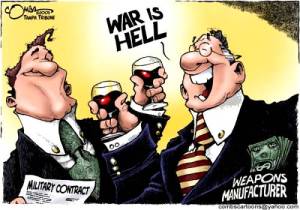
 After the Crash