Ukraine and the great revival of American empire

By Andrew J. Bacevich

Source: Information Clearing House

Amidst the dross that clutters the New York Times op-ed page on most days, glimmers of enlightenment occasionally appear. A recent guest column by Grey Anderson and Thomas Meaney offers a case in point.

“NATO Isn’t What It Says It Is,” declares the headline. Contrary to the claims of its architects and defenders, Anderson and Meaney argue persuasively that the central purpose of the alliance from its founding was not to deter aggression from the East and certainly not to promote democracy, but to “bind Western Europe to a far vaster project of a U.S.-led world order.” In return for Cold War-era security guarantees, America’s European allies offered deference and concessions on issues like trade and monetary policy. “In that mission,” they write, NATO “has proved remarkably successful.” A plot of real estate especially valued by members of the American elite, Europe thereby became the centerpiece of the postwar American imperium.

The end of the Cold War called these arrangements into question. Desperate to preserve NATO’s viability, proponents claimed that the alliance needed to go “out of area or out of business.” NATO embraced an activist posture, leading to reckless state building interventions in Libya and Afghanistan. The results were not favorable. Acceding to U.S. pressure to venture out of area proved to be costly and served chiefly to undermine NATO’s credibility as a militarily capable enterprise.

Enter Vladimir Putin to save the day. Just as Russia’s invasion of Ukraine provided the U.S. with an excuse to forget its own post-9/11 military failures, so too it has enabled NATO to once more constitute itself as the chief instrument for defending the West—and, crucially, to do so without actually exacting a blood sacrifice from either Americans or Europeans.

In this context, the actual fate of Ukraine itself figures as something of an afterthought. The real issue centers on reviving damaged aspirations of American global primacy. With something like unanimity, the U.S. national security establishment is devoted to the proposition that the United States must remain the world’s sole superpower, even if this requires ignoring a vast accumulation of contrary evidence suggesting the emergence of a multipolar order. On that score, Putin’s recklessness came as an impeccably timed gift.

There is an element of genius at work here. Defeating Russia without having to do any actual fighting becomes the means to restore the image of American indispensability squandered during the decades that followed the fall of the Berlin Wall. For Washington, as Anderson and Meaney appreciate, the true stakes in Ukraine go far beyond the question of whose flag flies over Crimea. If Ukraine “wins” its war with Russia—however “winning” is defined and however great the price Ukrainians must pay—NATO itself (and the NATO lobby in Washington) will claim vindication.

Rest assured that major European nations will then quietly renege on promises to boost their military spending, with actual responsibility for European security once more falling to the United States. With the centennial of World War II now within hailing distance, U.S. troops will remain permanently garrisoned in Europe. This will serve as cause for celebration throughout the U.S. military industrial complex, which will prosper.

Flexing its muscles, the United States will inevitably prod a greatly expanded NATO into turning its attention to enforcing the “rules-based international order” in the Asia-Pacific, with China as the chosen adversary. Ukraine will thereby serve as a template of sorts as the U.S. and its allies throw their weight around many thousands of miles from Europe proper.

The U.S. global military footprint will expand. U.S. efforts to put its house in order domestically will founder. Pressing global problems like the climate crisis will be treated as afterthoughts. But the empire that has no name will persist, which ultimately is the purpose of the game.

President Biden is fond of saying that the world has arrived at an “inflection point,” implying the need to change directions. Yet the overarching theme of his approach to foreign policy is stasis. He clings to the geopolitical logic that prompted NATO’s founding in 1949.

Back then, when Europe was weak and Stalin ruled the Soviet Union, that logic may have possessed some merit. But today the importance attributed to NATO testifies chiefly to the bankruptcy of American strategic thought and an inability to prioritize actually existing U.S. national interests, both foreign and domestic.

A sound revision of U.S. national security strategy would begin with announcing a timeline for withdrawing from NATO, converting it into an arrangement wholly owned and operated by Europe. The near impossibility of even imagining such an action by the United States testifies to the dearth of imagination that prevails in Washington.

Geopolitical Chessboard Shifts Against US Empire

By Pepe Escobar

Source: The Unz Review

The geopolitical chessboard is in perpetual shift – and never more than in our current incandescent juncture.

A fascinating consensus in discussions among Chinese scholars – including those part of the Asian and American diasporas – is that not only Germany/EU lost Russia, perhaps irretrievably, but China gained Russia, with an economy highly complementary to China’s own and with solid ties with the Global South/Global Majority that can benefit and aid Beijing.

Meanwhile, a smatter of Atlanticist foreign policy analysts are now busy trying to change the narrative on NATO vs. Russia, applying the rudiments of realpolitik.

The new spin is that it’s “strategic insanity” for Washington to expect to defeat Moscow, and that NATO is experiencing “donor fatigue” as the sweatshirt warmonger in Kiev “loses credibility”.

Translation: it’s NATO as a whole that is completely losing credibility, as its humiliation in the Ukraine battlefield is now painfully graphic for all the Global Majority to see.

Additionally, “donor fatigue” means losing a major war, badly. As military analyst Andrei Martyanov has relentlessly stressed, “NATO ‘planning’ is a joke. And they are envious, painfully envious and jealous.”

A credible path ahead is that Moscow will not negotiate with NATO – a mere Pentagon add-on – but offer individual European nations a security pact with Russia that would make their need to belong to NATO redundant. That would assure security for any participating nation and relieve pressure on it from Washington.

Bets could be made that the most relevant European powers might accept it, but certainly not Poland – the hyena of Europe – and the Baltic chihuahuas.

In parallel, China could offer peace treaties to Japan, South Korea and the Philippines, and subsequently a significant part of the US Empire of Bases might vanish.

The problem, once again, is that vassal states don’t have the authority or power to comply with any agreement ensuring peace. German businessmen, off the record, are sure that sooner or later Berlin may defy Washington and do business with the Russia-China strategic partnership because it benefits Germany.

Yet the golden rule still has not been met: if a vassal state wants to be treated as a sovereign state, the first thing to do is to shut down key branches of the Empire of Bases and expel US troops.

Iraq is trying to do it for years now, with no success. One third of Syria remains US-occupied – even as the US lost its proxy war against Damascus due to Russian intervention.

The Ukraine Project as an existential conflict

Russia has been forced to fight against a neighbor and kin that it simply can’t afford to lose; and as a nuclear and hypersonic power, it won’t.

Even if Moscow will be somewhat strategically weakened, whatever the outcome, it’s the US – in the view of Chinese scholars – that may have committed its greatest strategic blunder since the establishment of the Empire: turning the Ukraine Project into an existential conflict, and committing the entire Empire and all its vassals to a Total War against Russia.

That’s why we have no peace negotiations, and the refusal even of a cease fire; the only possible outcome devised by the Straussian neocon psychos who run US foreign policy is unconditional Russian surrender.

In the recent past, Washington could afford to lose its wars of choice against Vietnam and Afghanistan. But it simply can’t afford to lose the war on Russia. When that happens, and it’s already on the horizon, the Revolt of the Vassals will be far reaching.

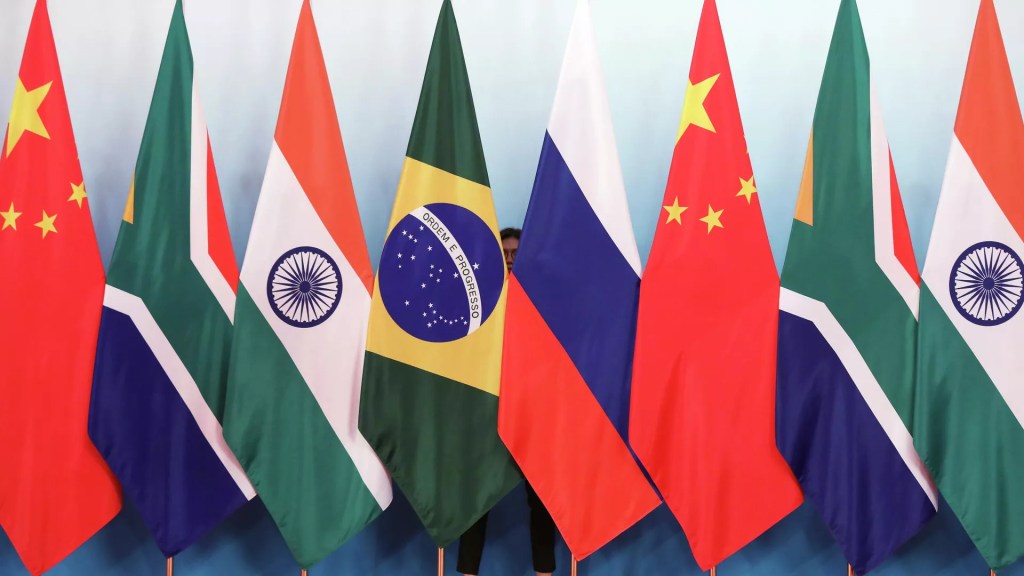
It’s quite clear that from now on China and BRICS+ – with expansion starting at the summit in South Africa next month – will turbo-charge the undermining of the US dollar. With or without India.

There will be no imminent BRICS currency – as noted by some excellent points in this discussion. The scope is huge, sherpas are only in the initial debating stages, and the broad outlines have not been defined yet.

The BRICS+ approach will evolve from improved cross border settlement mechanisms – something everyone from Putin to Central Bank head Elvira Nabiullina have stressed – to eventually a new currency way further down the road.

This would probably be a trade instrument rather than a sovereign currency like the euro. It will be designed to compete against the US dollar in trade, initially among BRICS+ nations, and capable of circumventing the hegemonic US dollar ecosystem.

The key question is how long the Empire’s fake economy – clinically deconstructed by Michael Hudson – can hold out in this wide spectrum geoeconomic war.

Everything is a ‘national security threat’

On the electronic technology front, the Empire has gone no holds barred to impose global economic dependency, monopolizing intellectual property rights and as Michael Hudson notes, “extracting economic rent from charging high prices for high-technology computer chips, communications, and arms production.”

In practice, not much is happening other than the prohibition for Taiwan to supply valuable chips to China, and asking TSMC to build, as soon as possible, a chip manufacturing complex in Arizona.

However, TSMC chairman Mark Liu has remarked that the plant faced a shortage of workers with the “specialized expertise required for equipment installation in a semiconductor-grade facility.” So the much lauded TSMC chip plant in Arizona won’t start production before 2025.

The top Empire/vassal NATO demand is that Germany and the EU must impose a Trade Iron Curtain against the Russia-China strategic partnership and their allies, thus ensuring “de-risk” trade.

Predictably, US Think Tankland has gone bonkers, with American Enterprise Institute hacks rabidly stating that even economic de-risking is not enough: what the US needs is a hard break with China.

In fact that dovetails with Washington smashing international free trade rules and international law, and treating any form of trade and SWIFT and financial exchanges as “national security threats” to US economic and military control.

So the pattern ahead is not China imposing trade sanctions on the EU – which remains a top trade partner for Beijing; it’s Washington imposing a tsunami of sanctions on nations daring to break the US-led trade boycott.

Russia-DPRK meets Russia-Africa

Only this week, the chessboard went through two game-changing moves: the high-profile visit by Russian Defense Minister Sergei Shoigu to the DPRK, and the Russia-Africa summit in St. Petersburg.

Shoigu was received in Pyongyang as a rock star. He had a personal meeting with Kim Jong-Un. The mutual goodwill leads to the strong possibility of North Korea eventually joining one of the multilateral organizations carving the path towards multipolarity.

That would be, arguably, an extended Eurasian Economic Union (EAEU). It could start with an EAEU-DPRK free trade agreement, such as the ones struck with Vietnam and Cuba.

Russia is the top power in the EAEU and it can ignore sanctions on the DPRK, while BRICS+, SCO or ASEAN have too many second thoughts. A key priority for Moscow is the development of the Far East, more integration with both Koreas, and the Northern Sea Route, or Arctic Silk Road. The DPRK is then a natural partner.

Getting the DPRK into the EAEU will do wonders for BRI investment: a sort of cover which Beijing does not enjoy for the moment when it invests in the DPRK. That could become a classic case of deeper BRI-EAEU integration.

Russian diplomacy at the highest levels is going all out to relieve the pressure over the DPRK. Strategically, that’s a real game-changer; imagine the huge and quite sophisticated North Korean industrial-military complex added to the Russia-China strategic partnership and turning the whole Asia-Pacific paradigm upside down.

The Russia-Africa summit in St. Petersburg, in itself, was another game-changer that left collective West mainstream media apoplectic. That was nothing less than Russia publicly announcing, in words and deeds, a comprehensive strategic partnership with the whole of Africa even as a hostile collective West wages Hybrid War – and otherwise – against Afro-Eurasia.

Putin showed how Russia holds a 20% share of the global wheat market. In the first 6 months of 2023, it had already exported 10 million tons of grain to Africa. Now Russia will be providing Zimbabwe, Burkina Faso, Somalia and Eritrea with 25-50 thousand tons of grain each in the next 3-4 months, for free.

Putin detailed everything from approximately 30 energy projects across Africa to the expansion of oil and gas exports and “unique non-energy applications of nuclear technology, including in medicine”; the launching of a Russian industrial zone near the Suez Canal with products to be exported throughout Africa; and the development of Africa’s financial infrastructure, including connection to the Russian payment system.

Crucially, he also extolled closer ties between the EAEU and Africa. A forum panel, “EAEU-Africa: Horizons of Cooperation”, examined the possibilities, which include closer continental connection with both the BRICS and Asia. A torrent of free trade agreements may be in the pipeline.

The scope of the forum was quite impressive. There were “de-neocolonialization” panels, such as “Achieving Technological Sovereignty Through Industrial Cooperation” or “New World Order: from the Legacy of Colonialism to Sovereignty and Development.”

And of course the International North South Transportation Corridor (INSTC) was also discussed, with major players Russia, Iran and India set to promote its crucial extension to Africa, escaping NATO littorals.

Separate from the frantic action in St. Petersburg, Niger went through a military coup. Although the end-result remains to be seen, Niger is likely to join neighboring Mali in reasserting its foreign policy independence from Paris. French influence is also being at least “reset” in the Central African Republic (CAR) and Burkina Faso. Translation: France and the West are being evicted all across the Sahel, one-step at a time, in an irreversible process of decolonization.

Beware the Pale Horses of Destruction

These movements across the chessboard, from the DPRK to Africa and the chip war against China, are as crucial as the coming, shattering humiliation of NATO in Ukraine. Yet not only the Russia-China strategic partnership but also key players across the Global South/Global Majority are fully aware that Washington views Russia as a tactical enemy in preparation for the overriding Total War against China.

As it stands, the still unresolved tragedy in Donbass as it keeps the Empire busy, and away from Asia-Pacific. Yet Washington under the Straussian neocon psychos is increasingly mired in Desperation Row, making it even more dangerous.

All that while the BRICS+ “jungle” turbo-charges the necessary mechanisms capable of sidelining the unipolar Western “garden”, as a helpless Europe is being driven to an abyss, forced to split itself from China, BRICS+ and the de facto Global Majority.

It doesn’t take a seasoned weatherman to see which way the steppe wind blows – as the Pale Horses of Destruction plot the trampling of the chessboard, and the wind begins to howl.

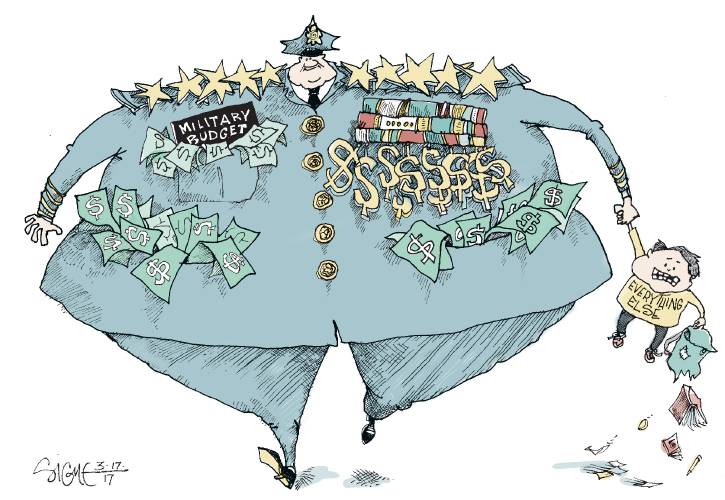
$850 Billion Chicken Comes Home to Roost.

War Reveals U.S. Military’s Longtime Disinterest in War.

Signe’s second toon du jour SIGN17e Military

By Andrew Cockburn

Source: Spoils of War

Watching a recent video of Ukrainian troops scrambling out of a U.S.-supplied Bradley armored fighting vehicle just after it hit a mine, I remembered how hard the U.S. Army bureaucrats and contractors who developed the weapon had fought to keep this vehicle a death trap for anyone riding inside. As originally designed, Bradleys promptly burst into flame when hit with anything much more powerful than a BB pellet, incinerating anyone riding inside. The armor bureaucrats were well aware of this defect, but pausing development for a redesign might have hurt their budget, so they delayed and cheated on tests to keep the program on track. Prior to one test, they covertly substituted water-tanks for the ammunition that would otherwise explode. Only when Jim Burton, a courageous air force lieutenant colonel from the Pentagon’s testing office, enlisted Congress to mandate a proper live fire test were the army’s malign subterfuges exposed and corrected. His principled stand cost him his career, but the Bradley was redesigned, rendering it less potentially lethal for passengers. Hence, forty years on, the survival of those lucky Ukrainians.

This largely forgotten episode serves as a vivid example of an essential truth about our military machine: it is not interested in war.

How else to understand the lack of concern for the lives of troops, or producing a functioning weapon system? As Burton observed in his instructive 1993 memoir Pentagon Wars, the U.S. defense system is “a corrupt business — ethically and morally corrupt from top to bottom.”

Nothing has happened in the intervening years to contradict this assessment, with potentially grim consequences for men and women on the front line. Today, for example, the U.S. Air Force is abandoning its traditional role of protecting and coordinating with troops on the ground, otherwise known as Close Air Support, or CAS. Given its time-honored record of bombing campaigns that had little or no effect on the course of wars, CAS has probably been the only useful function (grudgingly) performed by the service.

The Air Force has always resented the close support mission, accepting the role only because handing it to the Army would entail losing budget share. Thus the A-10 “Warthog” aircraft, specifically dedicated to CAS, was developed by the air force only to ward off a threat from the Army to steal the mission with a new helicopter. As it turned out, the A-10, thanks to the dedicated genius of its creators, notably the late Pierre Sprey, was supremely suited to the mission. But its successful record cuts no ice with the air force, which has worked with might and main to get rid of the A-10 ever since the threat of an army competitor in the eternal battle for budget share had been eliminated.

That campaign is now entering its final stages. The air force is not only getting rid of its remaining fleet of A-10s, it is also eliminating the capability to perform the close air support mission by phasing out the training for pilots and ground controllers essential for this highly specialized task. True, the service claims that the infamously deficient F-35 “fighter” can and will undertake the mission, but that is a laughable notion for many reasons, including the fact that the plane’s 25 mm cannon cannot shoot straight. The consequences for American troops on the ground in future wars will be dire, but their fate apparently carries little weight when set against the unquenchable urge of the air force to assert its independence from the messy realities of ground combat, where wars are won or lost. Thus its hopes and budget plans are focussed on costly systems of dubious relevance to warfare such as the new B-21 bomber, the new Sentinel ICBM, and the Next Generation Air Dominance fighter, none of which will fly for years to come, except in the form of cash out of our pockets.

Pentagon spending this year is projected to nudge $850 billion. (The total national security bill is already way past a trillion, but that’s another story.) Yet, even when endowed with such a gigantic pile of cash, the system is apparently incapable of furnishing the wherewithal for even a limited war, such as the one currently underway in Ukraine. The conflict has been marked by successive announcements that progressively more potent weapon systems are being shipped to the Ukrainians -Javelins anti-tank missiles, 155 mm Howitzers, HIMARS precision long range missiles, Patriots air defense missiles, Abrams tanks, with F-16 fighters in the offing. A U.S. military intelligence officer pointed out to me recently the actual basis on which these systems are selected: “when we run out of the last system we were sending.”

Now Biden has generated global outrage by promising to send cluster bombs, known for their ability to kill and maim children fifty years after the relevant war has ended, as any Laotian farmer could tell you. The military rationale for their use is their supposed utility against “soft” targets such as dismounted infantry, radars, and wheeled vehicles. However, a former armor officer and veteran of the 1991 Gulf war recalled to me that “we disliked them intensely and pleaded with the artillery and Air Force not to employ them. They simply damaged support elements and wheels that followed us into action. After the war we treated numerous people wounded by them including our own soldiers, as well as civilians (children).”

Biden has admitted that these devices are being sent only because the U.S. is running out of the artillery ammunition that the Ukrainians actually require. “This is a war relating to munitions. And they’re running out of that ammunition, and we’re low on it,” he told a TV interviewer. So off go the cluster bombs, their passage lubricated by crocodile tears from administration officials: “I’m not going to stand up here and say it was easy…It’s a decision that required a real hard look at the potential harm to civilians” National Security Adviser Jake Sullivan told reporters. (Back when it was reported that the Russians were using cluster bombs in Ukraine, then-White House Press Secretary Jen Psaki denounced such action as “a war crime.”)

So, the richest war machine in history, having scraped its cupboard bare, is now reduced to fielding a device of dubious military utility deemed illegal by over a hundred countries. That’s what we get for our $850 billion.

Why the political West still doesn’t want Ukraine to join NATO

By Drago Bosnic

Source: InfoBrics.org

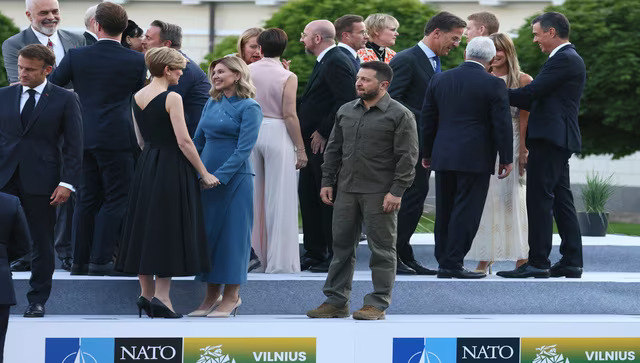
For approximately 20-25 years, the political West has been flirting with the idea of Ukraine joining NATO. And yet, Kiev is as far from joining the belligerent alliance as it was a few decades ago, as evidenced by Zelensky’s unconcealed, almost painful frustration at the latest NATO summit in Lithuania’s Vilnius. The very idea that Ukraine might join the aggressive alliance is hardly a new concept. The CIA had plans for such a scenario long before the Soviet Union’s dismantling during the late 1980s and early 1990s. And yet, the country never became part of NATO, not even after approximately two decades of close cooperation, including the Ukrainian military’s direct participation in illegal US invasions of Iraq and Afghanistan.

So, why is the political West sending so many mixed messages about “Ukraine’s future in NATO”, but then demands Kiev to defeat a military superpower next door as a prerequisite for potential future membership? The only logical conclusion is that the belligerent alliance simply doesn’t want Ukraine to become a member yet. The primary reason for this is that Moscow is just too strong for that to become a reality, meaning that the political West wants Russia to be weakened to the point where it will not be able to resist NATO’s crawling aggression. For that purpose, the political West needs what experts have rightfully called “a crash test dummy“. Unfortunately for Ukrainians, they’ve been given that exceedingly unflattering role.

And indeed, during the Vilnius summit, NATO offered Ukraine “an alternative to full membership” that can only be called TTLU (To the last Ukrainian). The belligerent alliance simply cannot offer any sort of security guarantees to a country with so many territorial issues, to say nothing of its ongoing direct confrontation with Russia, a military superpower with a thermonuclear arsenal exceeding the combined power of NATO’s entire strategic might. The TTLU concept allows NATO to keep providing weapons, funds, logistics, ISR (intelligence, surveillance, reconnaissance), etc. while not having to send its own troops. For the political West, this is seen as a win-win, as Ukrainians (seen as “former” Russians) are fighting (other) Russians for the sake of NATO.

This war by proxy is the belligerent alliance’s best bet to conduct its crawling “Barbarossa 2.0” against Russia while avoiding complete destruction by Moscow’s second-to-none ICBMs (intercontinental ballistic missiles). And it’s most definitely not even the first time the political West has been probing the Kremlin in this way. Back in 2008, Georgia was the first “crash test dummy” and a litmus test of Russia’s reaction. Tbilisi was promised full membership, but all it got was a loss of approximately 20% of its former territory, as well as the long-term loss of centuries-old virtually brotherly relations with its northern neighbor. The leading Georgian political “crash test dummy” Mikheil Saakashvili served his purpose and was then “recycled” in Ukraine only to later be cast away as a useless burden.

Saakashvili’s fate can serve as a stark reminder to the Kiev regime frontman Volodymyr Zelensky, which perfectly explains his perpetually depressed bearing. He understands that the political West wants the war to last for as long as possible and that’s certainly not an appealing prospect for someone who will eventually have to take all the blame for Ukraine’s unrelenting collapse. NATO’s mixed messages are designed for this exact purpose. The belligerent alliance has openly stated that it will not accept Kiev regime’s membership until hostilities cease, meaning that Moscow will simply have no incentive to stop its counteroffensive against NATO aggression until most or all of Ukraine is under its control.

The fact that the political West has prevented a peaceful settlement speaks volumes about how it sees Ukraine and its people. Zelensky and his clique are there just to execute commands, regardless of the cost for the Ukrainians or even the Neo-Nazi junta itself. In his op-ed for Politico, Wolfgang Ischinger, one of Germany’s most prominent diplomats, recently suggested that the Kiev regime might be given all aspects of membership, only without actual membership. According to Ischinger, “[NATO] could grant Ukraine all the practical and concrete options and opportunities that NATO membership includes, but without official treaty membership”. In other words, Kiev would effectively have all the commitments of a member, but no benefits. Hence – TTLU.

It should also be noted that the US-led political West is certainly not shying away from (ab)using Ukrainians for whatever purpose it finds profitable and/or useful for itself. Whether it’s the easier recruitment of spies, less stringent control of sex trafficking (including of underage children) or the immense profit for NATO’s Military Industrial Complex (MIC), it’s all up for sale and war drives down the prices. In such a scenario, why would the political West ever want to have any legal commitments that would require it to enter a direct confrontation with Russia, a country that’s still the world’s only true near-peer military rival to NATO? Thus, it’s up to the Ukrainian people to finally reject such suicidal servitude that has resulted in nothing but misery for their country and has effectively robbed them of their future.

A Bonfire of the Vanities

By Alastair Crooke

Source: Strategic Culture Foundation

Hubris consists in believing that a contrived narrative can, in and of itself, bring victory. It is a fantasy that has swept through the West – most emphatically since the 17th century. Recently, the Daily Telegraph published a ridiculous nine minute video purporting to show that ‘narratives win wars’, and that set-backs in the battlespace are incidentals: What matters is to have a thread of unitary narrative articulated, both vertically and horizontally, throughout the spectrum – from the special forces’ soldier in the field through to the pinnacle of the political apex.

The gist of it is that ‘we’ (the West) have compelling a narrative, whilst Russia’s is ‘clunky’ – ‘Us winning therefore, is inevitable’.

It is easy to scoff, but nonetheless we can recognise in it a certain substance (even if that substance is an invention). Narrative is now how western élites imagine the world. Whether it is the pandemic emergency, the climate or Ukraine ‘emergencies’ – all are re-defined as ‘wars’. All are ‘wars’ that are to be fought with a unitary imposed narrative of ‘winning’, against which all contrarian opinion is forbidden.

The obvious flaw to this hubris is that it requires you to be at war with reality. At first, the public are confused, but as the lies proliferate, and lie is layered upon lie, the narrative separates further and further from touched reality, even as mists of dishonesty continue to swathe themselves loosely around it. Public scepticism sets in. Narratives about the ‘why’ of inflation; whether the economy be healthy or not; or why we must go to war with Russia, begin to fray.

Western élites have ‘bet their shirts’ on maximum control of ‘media platforms’, absolute messaging conformity and ruthless repression of protest as their blueprint for a continued hold in power.

Yet, against the odds, the MSM is losing its hold over the U.S. audience. Polls show growing distrust of the U.S. MSM. When Tucker Carlson’s first ‘anti-message’ Twitter show appeared, the noise of tectonic plates grinding against each other was unmissable, as more than 100 million (one in three) Americans listened to iconoclasm.

The weakness to this new ‘liberal’ authoritarianism is that its key narrative myths can get busted. One just has; slowly, people begin to speak reality.

Ukraine: How do you win an unwinnable war? Well, the élite answer has been through narrative. By insisting against reality that Ukraine is winning, and Russia is ‘cracking’. But such hubris eventually is busted by facts on the ground. Even the western ruling classes can see their demand for a successful Ukrainian offensive has flopped. At the end, military facts are more powerful than political waffle: One side is destroyed, its many dead become the tragic ‘agency’ to upending dogma.

“We will be in a position to extend an invitation to Ukraine to join the Alliance when Allies agree and conditions are met … [however] unless Ukraine wins this war, there’s no membership issue to be discussed at all” – Jens Stoltenberg’s statement at Vilnius. Thus, after urging Kiev to throw more (hundreds of thousands) of its men into the jaws of death to justify NATO membership, the latter turns its back on its protégé. It was, after all, an unwinnable war from the beginning.

The hubris, at one level, lay in NATO’s pitting of its alleged ‘superior’ military doctrine and weapons versus that of a deprecated, Soviet-style, hide-bound, Russian military rigidity – and ‘incompetence’.

But military facts on the ground have exposed the western doctrine as hubris – with Ukrainian forces decimated, and its NATO weaponry lying in smoking ruins. It was NATO that insisted on re-enacting the Battle of 73 Easting (from the Iraqi desert, but now translated into Ukraine).

In Iraq, the ‘armoured fist’ punched easily into Iraqi tank formations: It was indeed a thrusting ‘fist’ that knocked the Iraqi opposition ‘for six’. But, as the U.S. commander at that tank battle (Colonel Macgregor), frankly admits, its outcome against a de-motivated opposition largely was fortuitous.

Nonetheless ‘73 Easting’ is a NATO myth, turned into the general doctrine for the Ukrainian forces – a doctrine structured around Iraq’s unique circumstance.

The hubris – in line with the Daily Telegraph video – however, ascends vertically to impose the unitary narrative of a coming western ‘win’ onto the Russian political sphere too. It is an old, old story that Russia is military weak, politically fragile, and prone to fissure. Conor Gallagher has shown with ample quotes that it was exactly the same story in World War 2, reflecting a similar western underestimation of Russia – combined with a gross overestimation of their own capabilities.

The fundamental problem with ‘delusion’ is that the exit from it (if it occurs at all) moves at a much slower pace than events. The mismatch can define future outcomes.

It may be in the Team Biden interest now to oversee an orderly NATO withdrawal from Ukraine – such that it avoids becoming another Kabul debacle.

For that to happen, Team Biden needs Russia to accept a ceasefire. And here lies the (the largely overlooked) flaw to that strategy: It simply is not in the Russian interest to ‘freeze’ the situation. Again, the assumption that Putin would ‘jump’ at the western offer of a ceasefire is hubristic thinking: The two adversaries are not frozen in the basic meaning of the term – as in a conflict in which neither side has been able to prevail over the other, and are stuck.

Put simply, whereas Ukraine structurally hovers at the brink of implosion, Russia, by contrast, is fully plenipotent: It has large, fresh forces; it dominates the airspace; and has near domination of the electromagnetic airspace. But the more fundamental objection to a ceasefire is that Moscow wants the present Kiev collective gone, and NATO’s weapons off the battle field.

So, here is the rub: Biden has an election, and so it would suit the Democratic campaign needs to have an ‘orderly wind-down’. The Ukraine war has exposed too many wider American logistic deficiencies. But Russia has its’ interests, too.

Europe is the party most trapped by ‘delusion’ – starting from the point at which they threw themselves unreservedly into the Biden ‘camp’. The Ukraine narrative broke at Vilnius. But the amour propre of certain EU leaders puts them at war with reality. They want to continue to feed Ukraine into the grinder – to persist in the fantasy of ‘total win’: “There is no other way than a total win – and to get rid of Putin … We have to take all risks for that. No compromise is possible, no compromise”.

The EU Political Class have made so many disastrous decisions in deference to U.S. strategy – decisions that go directly against Europeans’ own economic and security interests – that they are very afraid.

If the reaction of some of these leaders seems disproportionate and unrealistic (“There is no other way than a total win – and to get rid of Putin”) – it is because this ‘war’ touches on a deeper motivations. It reflects existential fears of an unravelling of the western meta-narrative that will take down both its hegemony, and the western financial structure with it.

The western meta-narrative “from Plato to NATO, is one of superior ideas and practices whose origins lie in ancient Greece, and have since been refined, extended, and transmitted down the ages (through the Renaissance, the scientific revolution and other supposedly uniquely western developments), so that we in the west today are the lucky inheritors of a superior cultural DNA”.

This is what the narrators of the Daily Telegraph video probably had at the back of their minds when they insist that ‘Our narrative wins wars’. Their hubris resides in the implicit presumption: that the West somehow always wins – is destined to prevail – because it is the recipient of this privileged genealogy.

Of course, outside of general understanding, it is accepted that notions of ‘a coherent West’ has been invented, repurposed and put to use in different times and places. In her new book, The West, classical archaeologist Naoíse Mac Sweeney takes issue with the ‘master myth’ by pointing out that it was only “with the expansion of European overseas imperialism over the seventeenth century, that a more coherent idea of the West began to emerge – one being deployed as a conceptual tool to draw the distinction between the type of people who could legitimately be colonised, and those who could legitimately be colonizers”.

With the invention of the West came the invention of Western history – an elevated and exclusive lineage that provided an historical justification for the Western domination. According to the English jurist and philosopher Francis Bacon, there were only three periods of learning and civilization in human history: “one among the Greeks, the second among the Romans, and the last among us, that is to say, the nations of Western Europe”.

The deeper fear of western political leaders therefore – complicit in the knowledge that the ‘Narrative’ is a fiction that we tell ourselves, despite knowing that it is factually false – is that our era has been made increasingly and dangerously contingent on this meta-myth.

They quake, not just at a ‘Russia empowered’, but rather at the prospect the new multi-polar order led by Putin and Xi that is sweeping the globe will tear down the myth of Western Civilisation.

Is Sleepy Joe Biden Trying to Outdo Hitler and History?

By Phil Butler

Source: New Eastern Outlook

History is the most interesting subject for many reasons. Not the least of which is the fact it tends to repeat itself. And the fact that some are doomed by ignorance of this is an important lesson for today. Take German tanks, for instance. First, let’s rehash a little history about the steppes of Russia and Eastern Ukraine and unlearned lessons.

From the 5th of July 1943 until the 23rd of August 1943, the largest tank battle in history took place in what became known as the “Kursk Salient,” an area that stretched from the tiny town of Kirov on the Bolva River in the north, through Belgorod in Russia, Kharkiv, which Ukraine currently controls. The line reached deep into the Donbas region, the focal point of Ukraine’s Nazi hostilities since 2014.

Hitler’s Operation Zitadelle (“Citadel”) was carried out over a 700-mile-long front, where the best Germans tried to outgun and outmaneuver the advancing Soviet forces. It became the largest tank battle in history, pitting the most advanced weaponry Nazi Germany had against prepared and dug-in, superior Soviet resistance. The reader will find it interesting that the German high command chose Belgorod as one of the first key objectives.

Numerous parallels exist between the battle of Kursk and the current proxy war in Ukraine. First, I’d like to deal with tanks. In 1943, Germany manufactured what can be argued as the finest medium and heavy armor of World War II. Though not numerous at Kursk, the deadly Tiger played a big role. The all-new Panther and the giant Ferdinand tank destroyer were supposed to blast the Soviets off the battlefield.

Ironically, many of their burning hulks littered the countryside once the battle ended. The battle raged for months, with neither side gaining a clear advantage. The Soviets, not unlike their modern-day counterparts on the Russian lines, created massive defensive works to sap the German offensive until a counterattack would gain a decisive effect.

When I read the other day about almost all of the highly touted German Leopards sent to Zelensky having been destroyed, this seemed like Deja Vu as a student of history. An article in the Berliner Zeitung cited Alexander Sosnowski, who used data from pro-Ukraine media channels to determine that 41 Leopard-2s, 49 T72 tanks, 31 Bradlys, 7 German Marders, 23 howitzers, and 40 MRAP infantry fighting vehicles have already been turned to scrap by the Russians. In 1943, the great Nazi war machine faced similar despair.

But what other parallels can we draw? What is going to happen next? If you ask most experts, Europe is out of ammo, tanks, and guts. The Germans cannot even crank up and run half their remaining Leopard 2s for lack of repair, Paris is on fire, Germans are ready for any Chancellor but Scholz, Hungary seems about ready to leave the NATO alliance, the dollar may crumble toon, and even Americans grow weary of cheering a losing team.

We can understand how idiotic Joe Biden’s war on Russia will end if we recollect what happened after the Kursk failure. The Germans had been progressing in fighting through the defensive layers the Soviets had built. The northern front of the pincer bogged down, and the southern one was halted by bitter Soviet resistance. Hitler, who the legendary Heinz Guderian had warned against Operation Citadel, lost heart when decisive victory was not at hand and focused elsewhere. Meanwhile, the Soviets had gained momentum in the ground war and never relinquished it after Kursk.

As we know, once the Axis began its retreat from Kursk, the Soviets, and their allies from the West marched into the heart of Europe, taking Berlin and destroying the dream of Leibensraum, at least for the moment. Today, we find Germany’s best tanks strewn all over the battle lines in the regions reclaimed by Russia. Of course, they are not the Tigers or Panthers of legend. Four Tiger tanks held off tank brigades at Kursk. Now a lightweight drone seemed capable of knocking one out. The same seems true for NATO, a military alliance that has never shown it could beat its way out of a wet paper bag, let alone conquer Russia.

Whoever devised this genius plan to create Operation Barbarossa 2 is not even as clever as a drugged Hitler on his worst day. All that has happened is that the Russians are preparing again. Factories are shifting to creating T-14 Armata tanks instead of luxury Lada 4x4s. Far from the front, the Russians ramp up their military complex as before. For Westerners, we can only hope they do so for defensive rather than offensive operations. For certain, as the fires of discontent burning in Paris, there is nothing behind the Donetsk River to stop the Russians if they choose to widen their breathing space.

Funny, isn’t it, how history repeats itself and does so in the same places with the same idiotic mistakes being made?

House Passes $886 Billion National Defense Authorization Act

The bill narrowly passed in a vote of 219-210 due to a partisan divide over amendments included by Republicans

By Dave DeCamp

Source: AntiWar.com

The House on Friday passed its version 2024 National Defense Authorization Act in a vote of 219-210, which largely fell along partisan lines due to amendments added by Republicans relating to social policies in the military.

The Republican amendments covered abortion, transgender surgery, and diversity initiatives. Only four Democrats voted in favor of the bill, and four Republicans voted against it. The four Republicans who opposed the NDAA are Reps. Thomas Massie (KY), Eli Crane (AZ), Andy Biggs (AZ), and Ken Buck (CO).

The Senate still needs to pass its version of the NDAA, then the two chambers will negotiate the final version that will go to President Biden’s desk. The Republican amendments packed into the House version will set up a fight between the two chambers as Senate Majority Leader Chuck Schumer (D-NY) and other Democrats will reject them.

The 2024 NDAA is for a record $886 billion, the same amount President Biden requested. The debt ceiling deal reached between House Republicans in the White House did not limit military spending and put no caps on emergency supplemental funds, which is how the US has been spending on the war in Ukraine.

As the House was debating the NDAA, several amendments introduced by Republicans looking to rein in US support for Ukraine were voted down. One amendment sponsored by Rep. Warren Davidson (R-OH) would have required the Biden administration to develop a strategy for the war in Ukraine. It was rejected in a vote of 129-301, with only Republicans supporting it.

One amendment introduced by Rep. Marjorie Taylor Greene would have cut $300 million in military aid for Ukraine that’s packed into the NDAA, but it failed in a vote of 89-341. Rep. Matt Gaetz (R-FL) put forward an amendment to cut off all military assistance for Ukraine, which failed in a vote of 70-358. Only Republicans supported the two amendments.

Greene sponsored another amendment that would have prohibited the transfer of cluster munitions to Ukraine, although US cluster bombs have already arrived in the country. The effort failed in a vote of 147-276. It received support from 98 Republicans and 49 Democrats.

Gee, Thanks America! U.S. Sanctions Make Russian Economy Stronger and Precipitate Multipolar World

By SCF Editorial

Source: Strategic Culture Foundation

The paradoxical thing is that U.S. and European sanctions against Russia while intended to cripple the Russian economy have made the stronger.

Russia’s economy is performing strongly, according to recent forecasts from the World Bank and International Monetary Fund. The outcome defies earlier predictions by the United States and its European allies which held that Western sanctions would bring the Russian economy to its knees and force it to submissively “Cry Uncle”.

When the conflict in Ukraine escalated 16 months ago (after eight years of NATO-sponsored aggression using the Kiev Neo-Nazi regime), various Western politicians and pundits were relishing the prospect of the Russian economy collapsing from “Total War” launched against its international banking and trade.

Well, it didn’t turn out like that. Far from it. As the World Bank noted above, the Western sanctions have simply helped Russia boost alternative markets in China, India, and elsewhere around the globe. A principal earner for Russia is energy exports of oil and gas. Increased sales to Asia have maintained revenues despite the loss of European markets due to Western sanctions.

The paradoxical thing is that U.S. and European sanctions against Russia while intended to cripple the Russian economy have actually made the latter stronger.

Michael Hudson, an American global economics analyst, points out: “The sanctions have obliged Russia to become self-sufficient in food production, manufacturing production and consumer goods.”

Hudson also notes that the U.S. geopolitical strategy is to use sanctions in order to make its supposed European allies more dependent and subservient to Washington.

Another respected commentator, Glenn Diesen, a Norwegian geoeconomics professor, likened the use of Western sanctions to the self-destructive behavior of “self-harm”. The United States and European Union, he says, have “handed over a huge market to the rest of the world”.

Diesen also observes that 85 percent of the world’s population lives in countries that do not comply with Western sanctions against Russia. This global majority is more than ever creating new forms of trade and finance that obviate Western control. A major impetus for this positive development is the necessity bequeathed by Washington’s systematic abuse of power and privilege.

The repercussions are more far-reaching and profound than the inadvertent benefits accruing to Russia’s national economy. What the Western sanctions are also doing is accelerating the development of a multipolar world and the demise of the U.S. dollar as a global reserve currency. The upshot of those two trends is the historic dwindling of American imperial power – albeit with outbursts of militarism and warmongering along the way down.

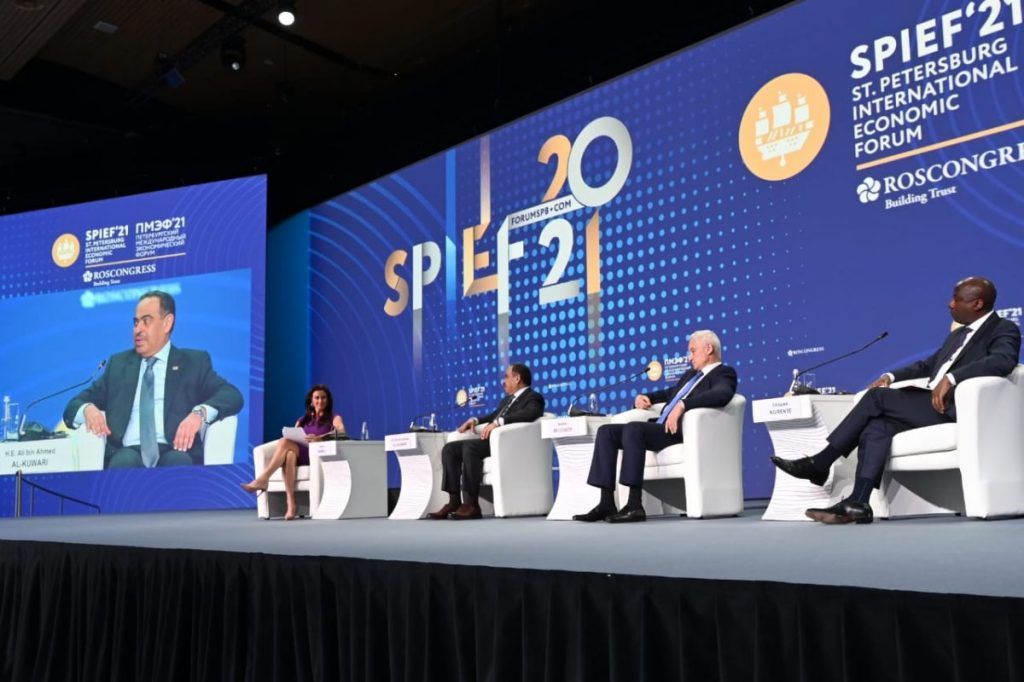
A significant illustration of the times a-changing was seen this week at the 25th summit of the St Petersburg International Economic Forum (SPIEF). Attending the four-day event were 17,000 delegates from some 130 nations. This year’s convocation witnessed large representations from Asia, Latin America and Africa.

The bustling event not only reflected Russia’s own economic strength but the fact that – far from being “isolated” and downtrodden – Russia is viewed by the rest of the world as an engine for growth and more prosperous multipolar relations.

Indeed, from the perspective of most nations, it looks like the United States and its Western allies are the ones who are isolated and anachronistic.

One of the attendees at SPIEF was American industrial analyst Douglas Andrew Littleton who commented: “Western sanctions against Russia have backfired.” And he added: “I’m happy that Russia has been able to bypass and skirt the sanctions in so many ways with their friends and allies.”

What’s going on here is not just merely the emergence of an alternative system, but an epochal political and perhaps moral paradigm shift. The globe wants more peaceful and mutual relations of cooperation and development. Most people on this Earth want endless warmongering, militarism and unilateral bullying by self-ordained powers to be put to an end. The planet is crying out for a world based on justice and peace.

What the world is realizing more than ever is that the unilateral use of economic sanctions by Washington is nothing but warfare and state terrorism by another, more palatable name. For decades, the U.S. has tried to use economic weapons to strangle and kill other nations. North Korea, Cuba, Iran, Iraq and many other countries come to mind where U.S. imperialism has imposed conditions of economic genocide.

The world is well aware of this fiendish legacy and has had enough of American barbarism wielded with the help of its Western lackeys in NATO and the European Union.

We should here make special mention of Syria, the Arab nation struggling to recover from 12 years of war that was inflicted upon it by Washington and its NATO partners for “regime change”. Today, Syria’s recovery is cruelly hampered by economic sanctions imposed by the U.S. and EU. How despicable is that?

There is an unerring historical sense, however, that Washington, has finally met its nemesis. By racking up sanctions against Russia and dragooning its EU lackeys to follow suit, the United States has now unleashed a historic dynamic process of its own imperial collapse.

For decades, U.S. sanctions worked to a nefarious degree on isolated, smaller nations to indeed enforce vengeful hardship.

Not anymore. Russia’s vast natural wealth and economy are too big to contain. Militarily, too, Russia will not be pushed around. Indeed, it has pushed back in Ukraine against the West’s deceptive and pernicious proxy war.

Organically and consciously, the world economy and international relations have been transformed in recent years, especially with the rise of China and Eurasia generally.

Another key development is that the Western imperialist media monopoly has also been broken. Washington and its minions in the European political class are held in contempt as liars and charlatans, even by their own populations.

By unwisely attempting to trap the Russian bear, the West has only created a scenario of revolt by the rest of the world from the West’s exploitative control. Five centuries of European and American Western parasitism have run their course.

Russia’s economic strength is galvanizing the rest of the world to shake off the chains of Western domination and subjugation. The process of dumping the dollar is gathering momentum which self-harming sanctions are precipitating. Pillars and facades are crumbling in real time.

The theme for the SPIEF event this year was “Sovereign Development – the Basis for a Just World”.

As with many other empires in the annals of history that have collapsed, arrogance and hubris often precede the fall. The American and Western elite thought they had an eternal license to wreak havoc for their own selfish gain. Their economic plunder and weaponry are now turning on their own heads. And it’s long overdue.