Saturday Matinee: Ukraine on Fire – The Real Story

[Originally posted on 2/24/18]

https://vimeo.com/332524840

A Documentary You’ll Likely Never See

By James DiEugenio

Source: Consortium News

It is not very often that a documentary film can set a new paradigm about a recent event, let alone, one that is still in progress. But the new film Ukraine on Fire has the potential to do so – assuming that many people get to see it.

Usually, documentaries — even good ones — repackage familiar information in a different aesthetic form. If that form is skillfully done, then the information can move us in a different way than just reading about it.

A good example of this would be Peter Davis’s powerful documentary about U.S. involvement in Vietnam, Hearts and Minds. By 1974, most Americans understood just how bad the Vietnam War was, but through the combination of sounds and images, which could only have been done through film, that documentary created a sensation, which removed the last obstacles to America leaving Indochina.

Ukraine on Fire has the same potential and could make a contribution that even goes beyond what the Davis film did because there was very little new information in Hearts and Minds. Especially for American and Western European audiences, Ukraine on Fire could be revelatory in that it offers a historical explanation for the deep divisions within Ukraine and presents information about the current crisis that challenges the mainstream media’s paradigm, which blames the conflict almost exclusively on Russia.

Key people in the film’s production are director Igor Lopatonok, editor Alex Chavez, and writer Vanessa Dean, whose screenplay contains a large amount of historical as well as current material exploring how Ukraine became such a cauldron of violence and hate. Oliver Stone served as executive producer and conducted some high-profile interviews with Russian President Vladimir Putin and ousted Ukrainian President Viktor Yanukovych.

The film begins with gripping images of the violence that ripped through the capital city of Kiev during both the 2004 Orange Revolution and the 2014 removal of Yanukovich. It then travels back in time to provide a perspective that has been missing from mainstream versions of these events and even in many alternative media renditions.

A Longtime Pawn

Historically, Ukraine has been treated as a pawn since the late Seventeenth Century. In 1918, Ukraine was made a German protectorate by the Treaty of Brest Litovsk. Ukraine was also a part of the Molotov-Ribbentrop Pact of 1939 signed between Germany and Russia, but violated by Adolf Hitler when the Nazis invaded the Soviet Union in the summer of 1941.

The reaction of many in Ukraine to Hitler’s aggression was not the same as it was in the rest of the Soviet Union. Some Ukrainians welcomed the Nazis. The most significant Ukrainian nationalist group, Organization of Ukrainian Nationalists (OUN), had been established in 1929. Many of its members cooperated with the Nazis, some even enlisted in the Waffen SS and Ukrainian nationalists participated in the massacre of more than 33,000 Jews at Babi Yar ravine in Kiev in September 1941. According to scholar Pers Anders Rudling, the number of Ukrainian nationalists involved in the slaughter outnumbered the Germans by a factor of 4 to 1.

But it wasn’t just the Jews that the Ukrainian nationalists slaughtered. They also participated in massacres of Poles in the western Ukrainian region of Galicia from March 1943 until the end of 1944. Again, the main perpetrators were not Germans, but Ukrainians.

According to author Ryazard Szawlowksi, the Ukrainian nationalists first lulled the Poles into thinking they were their friends, then turned on them with a barbarity and ferocity that not even the Nazis could match, torturing their victims with saws and axes. The documentary places the number of dead at 36,750, but Szawlowski estimates it may be two or three times higher.

OUN members participated in these slaughters for the purpose of ethnic cleansing, wanting Ukraine to be preserved for what OUN regarded as native Ukrainians. They also expected Ukraine to be independent by the end of the war, free from both German and Russian domination. The two main leaders in OUN who participated in the Nazi collaboration were Stepan Bandera and Mykola Lebed. Bandera was a virulent anti-Semite, and Lebed was rabidly against the Poles, participating in their slaughter.

After the war, both Bandera and Lebed were protected by American intelligence, which spared them from the Nuremburg tribunals. The immediate antecedent of the CIA, Central Intelligence Group, wanted to use both men for information gathering and operations against the Soviet Union. England’s MI6 used Bandera even more than the CIA did, but the KGB eventually hunted down Bandera and assassinated him in Munich in 1959. Lebed was brought to America and addressed anti-communist Ukrainian organizations in the U.S. and Canada. The CIA protected him from immigration authorities who might otherwise have deported him as a war criminal.

The history of the Cold War was never too far in the background of Ukrainian politics, including within the diaspora that fled to the West after the Red Army defeated the Nazis and many of their Ukrainian collaborators emigrated to the United States and Canada. In the West, they formed a fierce anti-communist lobby that gained greater influence after Ronald Reagan was elected in 1980.

Important History

This history is an important part of Dean’s prologue to the main body of Ukraine on Fire and is essential for anyone trying to understand what has happened there since the collapse of the Soviet Union in 1991. For instance, the U.S.-backed candidate for president of Ukraine in 2004 — Viktor Yushchenko — decreed both Bandera and his military assistant Roman Shukhevych, who was also involved in atrocitites, were both named national heroes by Yushchenko.

Bandera, in particular, has become an icon for post-World War II Ukrainian nationalists. One of his followers was Dmytro Dontsov, who called for the birth of a “new man” who would mercilessly destroy Ukraine’s ethnic enemies.

Bandera’s movement was also kept alive by Yaroslav Stetsko, Bandera’s premier in exile. Stetsko fully endorsed Bandera’s anti-Semitism and also the Nazi attempt to exterminate the Jews of Europe. Stetsko, too, was used by the CIA during the Cold War and was honored by Yushchenko, who placed a plaque in his honor at the home where he died in Munich in 1986. Stetsko’s wife, Slava, returned to Ukraine in 1991 and ran for parliament in 2002 on the slate of Yushchenko’s Our Ukraine party.

Stetsko’s book, entitled Two Revolutions, has become the ideological cornerstone for the modern Ukrainian political party Svoboda, founded by Oleh Tyahnybok, who is pictured in the film calling Jews “kikes” in public, which is one reason the Simon Wiesenthal Center has ranked him as one of the most dangerous anti-Semites in the world.

Another follower of Bandera is Dymytro Yarosh, who reputedly leads the paramilitary arm of an even more powerful political organization in Ukraine called Right Sektor. Yarosh once said he controls a paramilitary force of about 7,000 men who were reportedly used in both the overthrow of Yanukovych in Kiev in February 2014 and the suppression of the rebellion in Odessa a few months later, which are both fully depicted in the film.

This historical prelude and its merging with the current civil war is eye-opening background that has been largely hidden by the mainstream Western media, which has downplayed or ignored the troubling links between these racist Ukrainian nationalists and the U.S.-backed political forces that vied for power after Ukraine became independent in 1991.

The Rise of a Violent Right

That same year, Tyahnybok formed Svoboda. Three years later, Yarosh founded Trident, an offshoot of Svoboda that eventually evolved into Right Sektor. In other words, the followers of Bandera and Lebed began organizing themselves immediately after the Soviet collapse.

In this time period, Ukraine had two Russian-oriented leaders who were elected in 1991 and 1994, Leonid Kravchuk, and Leonid Kuchma. But the hasty transition to a “free-market” economy didn’t go well for most Ukrainians or Russians as well-connected oligarchs seized much of the wealth and came to dominate the political process through massive corruption and purchase of news media outlets. However, for average citizens, living standards went down drastically, opening the door for the far-right parties and for foreign meddling.

In 2004, Viktor Yanukovych, whose political base was strongest among ethnic Russians in the east and south, won the presidential election by three percentage points over the U.S.-favored Viktor Yushchenko, whose base was asmostly in the country’s west where the Ukrainian nationalists are strongest.

Immediately, Yushchenko’s backers claimed fraud citing exit polls that had been organized by a group of eight Western nations and four non-governmental organizations or NGOs, including the Renaissance Foundation founded by billionaire financial speculator George Soros. Dick Morris, former President Bill Clinton’s political adviser, clandestinely met with Yushchenko’s team and advised them that the exit polls would not just help in accusations of fraud, but would bring protesters out into the streets. (Cambridge Review of International Affairs, Vol. 19, Number 1, p. 26)

Freedom House, another prominent NGO that receives substantial financing from the U.S.-government-funded National Endowment for Democracy (NED), provided training to young activists who then rallied protesters in what became known as the Orange Revolution, one of the so-called “color revolutions” that the West’s mainstream media fell in love with. It forced an election rerun that Yushchenko won.

But Yushchenko’s presidency failed to do much to improve the lot of the Ukrainian people and he grew increasingly unpopular. In 2010, Yushchenko failed to make it out of the first round of balloting and his rival Yanukovych was elected president in balloting that outside observers judged free and fair.

Big-Power Games

If this all had occurred due to indigenous factors within Ukraine, it could have been glossed over as a young nation going through some painful growing pains. But as the film points out, this was not the case. Ukraine continued to be a pawn in big-power games with many Western officials hoping to draw the country away from Russian influence and into the orbit of NATO and the European Union.

In one of the interviews in Ukraine on Fire, journalist and author Robert Parry explains how the National Endowment for Democracy and many subsidized political NGOs emerged in the 1980s to replace or supplement what the CIA had traditionally done in terms of influencing the direction of targeted countries.

During the investigations of the Church Committee in the 1970s, the CIA’s “political action” apparatus for removing foreign leaders was exposed. So, to disguise these efforts, CIA Director William Casey, Reagan’s White House and allies in Congress created the NED to finance an array of political and media NGOs.

As Parry noted in the documentary, many traditional NGOs do valuable work in helping impoverished and developing countries, but this activist/propaganda breed of NGOs promoted U.S. geopolitical objectives abroad – and NED funded scores of such projects inside Ukraine in the run-up to the 2014 crisis.

Ukraine on Fire goes into high gear when it chronicles the events that occurred in 2014, resulting in the violent overthrow of President Yanukovych and sparking the civil war that still rages. In the 2010 election, when Yushchenko couldn’t even tally in the double-digits, Yanukovych faced off against and defeated Yulia Tymoshenko, a wealthy oligarch who had served as Yushchenko’s prime minister.

After his election, Yanukovych repealed Bandera’s title as a national hero. However, because of festering economic problems, the new president began to search for an economic partner who could provide a large loan. He first negotiated with the European Union, but these negotiations bogged down due to the usual draconian demands made by the International Monetary Fund.

So, in November 2013, Yanukovych began to negotiate with Russian President Putin who offered more generous terms. But Yanukovych’s decision to delay the association agreement with the E.U. provoked street protests in Kiev especially from the people of western Ukraine.

As Ukraine on Fire points out, other unusual occurrences also occurred, including the emergence of three new TV channels – Spilno TV, Espreso TV, and Hromadske TV – going on the air between Nov. 21 and 24, with partial funding from the U.S. Embassy and George Soros.

Pro-E.U. protests in the Maidan square in central Kiev also grew more violent as ultra-nationalist street fighters from Lviv and other western areas began to pour in and engage in provocations, many of which were sponsored by Yarosh’s Right Sektor. The attacks escalated from torch marches similar to Nazi days to hurling Molotov cocktails at police to driving large tractors into police lines – all visually depicted in the film. As Yanukovich tells Stone, when this escalation happened, it made it impossible for him to negotiate with the Maidan crowd.

One of the film’s most interesting interviews is with Vitaliy Zakharchenko, who was Minister of the Interior at the time responsible for law enforcement and the conduct of the police. He traces the escalation of the attacks from Nov. 24 to 30, culminating with a clash between police and protesters over the transport of a giant Christmas tree into the Maidan. Zakharchenko said he now believes this confrontation was secretly approved by Serhiy Lyovochkin, a close friend of U.S. Ambassador Geoffrey Pyatt, as a pretext to escalate the violence.

At this point, the film addresses the direct involvement of U.S. politicians and diplomats. Throughout the crisis, American politicians visited Maidan, as both Republicans and Democrats, such as Senators John McCain, R-Arizona, and Chris Murphy, D-Connecticut. stirred up the crowds. Yanukovych also said he was in phone contact with Vice President Joe Biden, who he claims was misleading him about how to handle the crisis.

The film points out that the real center of American influence in the Kiev demonstrations was with Ambassador Pyatt and Assistant Secretary of State for European Affairs Victoria Nuland. As Parry points out, although Nuland was serving under President Obama, her allegiances were really with the neoconservative movement, most associated with the Republican Party.

Her husband is Robert Kagan, who worked as a State Department propagandist on the Central American wars in the 1980s and was the co-founder of the Project for the New American Century in the 1990s, the group that organized political and media pressure for the U.S. invasion of Iraq in 2003. Kagan also was McCain’s foreign policy adviser in the 2008 presidential election (although he threw his support behind Hillary Clinton in the 2016 race).

Adept Manipulators

As Parry explained, the neoconservatives have become quite adept at disguising their true aims and have powerful allies in the mainstream press. This combination has allowed them to push the foreign policy debate to such extremes that, when anyone objects, they can be branded a Putin or Yanukovych “apologist.”

Thus, Pyatt’s frequent meetings with the demonstrators in the embassy and Nuland’s handing out cookies to protesters in the Maidan were not criticized as American interference in a sovereign state, but were praised as “promoting democracy” abroad. However, as the Maidan crisis escalated, Ukrainian ultra-nationalists moved to the front, intensifying their attacks on police. Many of these extremists were disciples of Bandera and Lebed. By February 2014, they were armed with shotguns and rapid-fire handguns.

On Feb. 20, 2014, a mysterious sniper, apparently firing from a building controlled by the Right Sektor, shot both police and protesters, touching off a day of violence that left about 14 police and some 70 protesters dead.

With Kiev slipping out of control, Yanukovich was forced to negotiate with representatives from France, Poland and Germany. On Feb. 21, he agreed to schedule early elections and to accept reduced powers. At the urging of Vice President Biden, Yanukovych also pulled back the police.

But the agreement – though guaranteed by the European nations – was quickly negated by renewed attacks from the Right Sektor and its street fighters who seized government buildings. Russian intelligence services got word that an assassination plot was in the works against Yanukovych, who fled for his life.

On Feb. 24, Yanukovych asked permission to enter Russia for his safety and the Ukrainian parliament (or Rada), effectively under the control of the armed extremists, voted to remove Yanukovych from office in an unconstitutional manner because the courts were not involved and the vote to impeach him did not reach the mandatory threshold. Despite these irregularities, the U.S. and its European allies quickly recognized the new government as “legitimate.”

Calling a Coup a Coup

But the ouster of Yanukovych had all the earmarks of a coup. An intercepted phone call, apparently in early February, between Nuland and Pyatt revealed that they were directly involved in displacing Yanukovych and choosing his successor. The pair reviewed the field of candidates with Nuland favoring Arseniy Yatsenyuk, declaring “Yats is the guy” and discussing with Pyatt how to “glue this thing.” Pyatt wondered about how to “midwife this thing.” They sounded like Gilded Age millionaires in New York deciding who should become the next U.S. president. On Feb. 27, Yatsenyuk became Prime Minister of Ukraine.

Not everyone in Ukraine agreed with the new regime, however. Crimea, which had voted heavily for Yanukovych, decided to hold a referendum on whether to split from Ukraine and become a part of Russia. The results of the referendum were overwhelming. Some 96 percent of Crimeans voted to unite with Russia. Russian troops – previously stationed in Crimea under the Sevastopol naval base agreement – provided security against Right Sektor and other Ukrainian forces moving against the Crimean secession, but there was no evidence of Russian troops intimidating voters or controlling the elections. The Russian government then accepted the reunification with Crimea, which had historically been part of Russia dating back hundreds of years.

Two eastern provinces, Donetsk and Lugansk, also wanted to split off from Ukraine and also conducted a referendum in support of that move. But Putin would not agree to the request from the two provinces, which instead declared their own independence, a move that the new government in Kiev denounced as illegal. The Kiev regime also deemed the insurgents “terrorists” and launched an “anti-terrorism operation” to crush the resistance. Ultra-nationalist and even neo-Nazi militias, such as the Azov Battalion, took the lead in the bloody fighting.

Anti-coup demonstrations also broke out in the city of Odessa to the south. Ukrainian nationalist leader Andrei Parubiy went to Odessa, and two days later, on May 2, 2014, his street fighters attacked the demonstrators, driving them into the Trade Union building, which was then set on fire. Forty-two people were killed, some of whom jumped to their deaths.

‘Other Side of the Story’

If the film just got across this “other side of the story,” it would provide a valuable contribution since most of this information has been ignored or distorted by the West’s mainstream media, which simply blames the Ukraine crisis on Vladimir Putin. But in addition to the fine work by scenarist Vanessa Dean, the direction by Igor Lopatonok and the editing by Alexis Chavez are extraordinarily skillful and supple.

The 15-minute prologue, where the information about the Nazi collaboration by Bandera and Lebed is introduced, is an exceptional piece of filmmaking. It moves at a quick pace, utilizing rapid cutting and also split screens to depict photographs and statistics simultaneously. Lopatonok also uses interactive graphics throughout to transmit information in a visual and demonstrative manner.

Stone’s interviews with Putin and Yanukovych are also quite newsworthy, presenting a side of these demonized foreign leaders that has been absent in the propagandistic Western media.

Though about two hours long, the picture has a headlong tempo to it. If anything, it needed to slow down at points since such a large amount of information is being communicated. On the other hand, it’s a pleasure to watch a documentary that is so intelligently written, and yet so remarkably well made.

When the film ends, the enduring message is similar to those posed by the American interventions in Vietnam and Iraq. How could the State Department know so little about what it was about to unleash, given Ukraine’s deep historical divisions and the risk of an escalating conflict with nuclear-armed Russia?

In Vietnam, Americans knew little about the country’s decades-long struggle of the peasantry to be free from French and Japanese colonialism. Somehow, America was going to win their hearts and minds and create a Western-style “democracy” when many Vietnamese simply saw the extension of foreign imperialism.

In Iraq, President George W. Bush and his coterie of neocons was going to oust Saddam Hussein and create a Western-style democracy in the Middle East, except that Bush didn’t know the difference between Sunni and Shiite Moslems and how Iraq was likely to split over sectarian rivalries and screw up his expectations.

Similarly, the message of Ukraine on Fire is that short-sighted, ambitious and ideological officials – unchecked by their superiors – created something even worse than what existed. While high-level corruption persists today in Ukraine and may be even worse than before, the conditions of average Ukrainians have deteriorated.

And, the Ukraine conflict has reignited the Cold War by moving Western geopolitical forces onto Russia’s most sensitive frontier, which, as scholar Joshua Shifrinson has noted, violates a pledge made by Secretary of State James Baker in February 1990 as the Soviet Union peacefully accepted the collapse of its military influence in East Germany and eastern Europe. (Los Angeles Times, 5/30/ 2016)

This film also reminds us that what happened in Ukraine was a bipartisan effort. It was begun under George W. Bush and completed under Barack Obama. As Oliver Stone noted in the discussion that followed the film’s premiere in Los Angeles, the U.S. painfully needs some new leadership reminiscent of Franklin Roosevelt and John Kennedy, people who understand how America’s geopolitical ambitions must be tempered by on-the-ground realities and the broader needs of humanity to be freed from the dangers of all-out war.

James DiEugenio is a researcher and writer on the assassination of President John F. Kennedy and other mysteries of that era. His most recent book is Reclaiming Parkland.

Imperial Overstretch Arrives: Americans Do Not Need the American Empire

By Philip Giraldi

Source: Strategic Culture Foundation

This piece is being written as voters are going to the polls on election day in the United States. While it has been useful to consider how things might change, possibly for the worse, one must also recognize that much of what happens in the U.S. and in its far-flung empire operates by virtue of its own internal dynamics and rules, something that is often referred to as the “Deep State” or perhaps more accurately as the Establishment.

Witness for example the occasional possibly sincere but unsuccessful White House attempts over the past four years to withdraw or reduce the numbers of U.S. troops embroiled in various armed conflicts worldwide. All of those initiatives have been frustrated or redirected in one way or another and it is not simply a question of bungling by a politically insensitive Donald Trump versus the result that might have been obtained by a more experienced and responsible Democrat. What drives the empire’s engine is essentially bipartisan, even in its own way, apolitical, existing as it does as a form of leaderless shadow government that functions as a community-of-interest rather than a bureaucracy. It is inclusive and reflective of the real centers of power in the country, namely the national security state and Wall Street.

In a recent article Pepe Escobar dispels any expectation that a kinder, gentler foreign policy might emerge from the election. He describes with some alarm how victory by Biden will mean that the national security “Blob” team that wrecked Syria, Yemen, Ukraine and Libya while also assassinating Americans overseas under President Barack Obama will be back. He cites former CIA presidential briefer Ray McGovern who persuasively describes the “Blob” as the MICIMATT (the Military-Industrial-Congressional-Intelligence-Media-Academia-Think-Tank complex). One might well add the Federal Reserve Bank to that list.

So, the engine keeps chugging on, driven my its own self-interests and completely oblivious to what is going on around it. The irony is that the crisis in confidence that simultaneously is besetting the United States in part reflects a very real, largely self-inflicted decline in America’s place in the world due to insistence that it maintain global hegemony. It comes at a time when the empire is entering into a phase of increasing irrelevancy which many of the key players involved are either unable or unwilling to recognize, no matter what their political affiliation might be. That means that the United States is locked into a pattern of behavior that it is incapable of changing. It is a nation that has become addicted to war for no good reason, and that addiction has brought neither security nor prosperity.

The signs are everywhere. The costs of empire continue to rise while real benefits to be derived from it are elusive. The United States government spends far more on a bloated defense budget than it can afford, adding to an unsustainable national debt that currently exceeds $27 trillion, which is 128% of the country’s entire gross domestic product. The debt will likely increase dramatically if there are any more coronavirus stimulus packages. The nation is becoming hollowed out as a result.

America’s “allies” have inevitably rightly become increasingly disengaged from Washington, reluctant to comply with Washington’s directions and demands, while the developing transition from the dollar as the world’s reserve currency is proceeding and will have catastrophic consequences. When the U.S. Treasury stops being able to print money at will, there will be national insolvency.

In terms of the United States’ interaction with the world, a country that not so long ago was widely respected is now regarded as the principal source of international instability, disliked everywhere but Israel, another rogue nation. And the internal damage inside the U.S. to core values and expectations is also evident, to include increasingly dysfunctional schools that focus on political correctness rather than education, crumbling infrastructure, a broken health care system, and a dying industrial and manufacturing base. Unique among all developed countries, life expectancy among working class Americans is declining.

At the root of it all is what Yale professor Paul Kennedy once described as “imperial overstretch,” which means projection of power in support of global commitments that are not essential to national well-being and bankrupting oneself in the process. The reality is that unless an “imperial” acquisition is done purely for exploitative reasons, as Belgium did in the Congo, having an empire operates at a considerable loss. Napoleon “overstretched” when he invaded Russia and both Russia and Austria-Hungary collapsed as a result of the First World War because the stress of external conflict made their obligations far exceed their resources. Great Britain’s Empire likewise became expendable after World War Two when the costs of maintaining outposts “east of Suez” became much larger than the benefits.

So, there are many good reasons for the United States to retrench and again become a “normal” nation, if that is at all possible, but the fact that no candidate but Tulsi Gabbard and Bernie Sanders even suggested that America’s global interventionism might be reconsidered or even reversed is telling. Both were eliminated by the Democratic party establishment. In the case of Gabbard, the executioner was no less than Hillary Clinton. Whoever is the new president, he will inherit the awful conceit that he is the “leader of the free world.” It is past time for a serious discussion of America’s proper place in the world, but that will require completely overturning the country’s Establishment and challenging the “exceptionalism” view that the U.S. must dominate as a “force for good.” Unfortunately, there is no politician anywhere on the horizon who is able and willing to take the lead on such an endeavor.

Decriminalizing the Drug War?

Calculating the Damage from a Century of Drug Prohibition

By Alfred W. McCoy

Source: TomDispatch.com

We live in a time of change, when people are questioning old assumptions and seeking new directions. In the ongoing debate over health care, social justice, and border security, there is, however, one overlooked issue that should be at the top of everyone’s agenda, from Democratic Socialists to libertarian Republicans: America’s longest war. No, not the one in Afghanistan. I mean the drug war.

For more than a century, the U.S. has worked through the U.N. (and its predecessor, the League of Nations) to build a harsh global drug prohibition regime — grounded in draconian laws, enforced by pervasive policing, and punished with mass incarceration. For the past half-century, the U.S. has also waged its own “war on drugs” that has complicated its foreign policy, compromised its electoral democracy, and contributed to social inequality. Perhaps the time has finally come to assess the damage that drug war has caused and consider alternatives.

Even though I first made my mark with a 1972 book that the CIA tried to suppress on the heroin trade in Southeast Asia, it’s taken me most of my life to grasp all the complex ways this country’s drug war, from Afghanistan to Colombia, the Mexican border to inner-city Chicago, has shaped American society. Last summer, a French director doing a documentary interviewed me for seven hours about the history of illicit narcotics. As we moved from the seventeenth century to the present and from Asia to America, I found myself trying to answer the same relentless question: What had 50 years of observation actually drilled into me, beyond some random facts, about the character of the illicit traffic in drugs?

At the broadest level, the past half-century turns out to have taught me that drugs aren’t just drugs, drug dealers aren’t just “pushers,” and drug users aren’t just “junkies” (that is, outcasts of no consequence). Illicit drugs are major global commodities that continue to influence U.S. politics, both national and international. And our drug wars create profitable covert netherworlds in which those very drugs flourish and become even more profitable. Indeed, the U.N. once estimated that the transnational traffic, which supplied drugs to 4.2% of the world’s adult population, was a $400 billion industry, the equivalent of 8% of global trade.

In ways that few seem to understand, illicit drugs have had a profound influence on modern America, shaping our international politics, national elections, and domestic social relations. Yet a feeling that illicit drugs belong to a marginalized demimonde has made U.S. drug policy the sole property of law enforcement and not health care, education, or urban development.

During this process of reflection, I’ve returned to three conversations I had back in 1971 when I was a 26-year-old graduate student researching that first book of mine, The Politics of Heroin: CIA Complicity in the Global Drug Trade. In the course of an 18-month odyssey around the globe, I met three men, deeply involved in the drug wars, whose words I was then too young to fully absorb.

The first was Lucien Conein, a “legendary” CIA operative whose covert career ranged from parachuting into North Vietnam in 1945 to train communist guerrillas with Ho Chi Minh to organizing the CIA coup that killed South Vietnamese President Ngo Dinh Diem in 1963. In the course of our interview at his modest home near CIA headquarters in Langley, Virginia, he laid out just how the Agency’s operatives, like so many Corsican gangsters, practiced the “clandestine arts” of conducting complex operations beyond the bounds of civil society and how such “arts” were, in fact, the heart and soul of both covert operations and the drug trade.

Second came Colonel Roger Trinquier, whose life in a French drug netherworld extended from commanding paratroopers in the opium-growing highlands of Vietnam during the First Indochina War of the early 1950s to serving as deputy to General Jacques Massu in his campaign of murder and torture in the Battle of Algiers in 1957. During an interview in his elegant Paris apartment, Trinquier explained how he helped fund his own paratroop operations through Indochina’s illicit opium traffic. Emerging from that interview, I felt almost overwhelmed by the aura of Nietzschean omnipotence that Trinquier had clearly gained from his many years in this shadowy realm of drugs and death.

My last mentor on the subject of drugs was Tom Tripodi, a covert operativewho had trained Cuban exiles in Florida for the CIA’s 1961 Bay of Pigs invasion and then, in the late 1970s, penetrated mafia networks in Sicily for the U.S. Drug Enforcement Administration. In 1971, he appeared at my front door in New Haven, Connecticut, identified himself as a senior agent for the Treasury Department’s Bureau of Narcotics, and insisted that the Bureau was worried about my future book. Rather tentatively, I showed him just a few draft pages of my manuscript for The Politics of Heroin and he promptly offered to help me make it as accurate as possible. During later visits, I would hand him chapters and he would sit in a rocking chair, shirt sleeves rolled up, revolver in his shoulder holster, scribbling corrections and telling remarkable stories about the drug trade — like the time his Bureau found that French intelligence was protecting the Corsican syndicates smuggling heroin into New York City. Far more important, though, through him I grasped how ad hoc alliances between criminal traffickers and the CIA regularly helped both the Agency and the drug trade prosper.

Looking back, I can now see how those veteran operatives were each describing to me a clandestine political domain, a covert netherworld in which government agents, military men, and drug traders were freed from the shackles of civil society and empowered to form secret armies, overthrow governments, and even, perhaps, kill a foreign president.

At its core, this netherworld was then and remains today an invisible political realm inhabited by criminal actors and practitioners of Conein’s “clandestine arts.” Offering some sense of the scale of this social milieu, in 1997 the United Nations reported that transnational crime syndicates had 3.3 million members worldwide who trafficked in drugs, arms, humans, and endangered species. Meanwhile, during the Cold War, all the major powers — Britain, France, the Soviet Union, and the United States — deployed expanded clandestine services worldwide, making covert operations a central facet of geopolitical power. The end of the Cold War has in no way changed this reality.

For over a century now, states and empires have used their expanding powers for moral prohibition campaigns that have periodically transformed alcohol, gambling, tobacco, and, above all, drugs into an illicit commerce that generates sufficient cash to sustain covert netherworlds.

Drugs and U.S. Foreign Policy

The influence of illicit drugs on U.S. foreign policy was evident between 1979 and 2019 in the abysmal failure of its never-ending wars in Afghanistan. Over a period of 40 years, two U.S. interventions there fostered all the conditions for just such a covert netherworld. While mobilizing Islamic fundamentalists to fight the Soviet occupation of that country in the 1980s, the CIA tolerated opium trafficking by its Afghan mujahedeen allies, while arming them for a guerrilla war that would ravage the countryside, destroying conventional agriculture and herding.

In the decade after superpower intervention ended in 1989, a devastating civil war and then Taliban rule only increased the country’s dependence upon drugs, raising opium production from 250 tons in 1979 to 4,600 tons by 1999. This 20-fold increase transformed Afghanistan from a diverse agricultural economy into a country with the world’s first opium monocrop — that is, a land thoroughly dependent on illicit drugs for exports, employment, and taxes. Demonstrating that dependence, in 2000 when the Taliban banned opium in a bid for diplomatic recognition and cut production to just 185 tons, the rural economy imploded and their regime collapsed as the first U.S. bombs fell in October 2001.

To say the least, the U.S. invasion and occupation of 2001-2002 failed to effectively deal with the drug situation in the country. As a start, to capture the Taliban-controlled capital, Kabul, the CIA had mobilized Northern Alliance leaders who had long dominated the drug trade in northeast Afghanistan, as well as Pashtun warlords active as drug smugglers in the southeastern part of the country. In the process, they created a post-war politics ideal for the expansion of opium cultivation.

Even though output surged in the first three years of the U.S. occupation, Washington remained uninterested, resisting anything that might weaken military operations against the Taliban guerrillas. Testifying to this policy’s failure, the U.N.’s Afghanistan Opium Survey 2007 reported that the harvest that year reached a record 8,200 tons, generating 53% of the country’s gross domestic product, while accounting for 93% of the world’s illicit narcotics supply.

When a single commodity represents over half of a nation’s economy, everyone — officials, rebels, merchants, and traffickers — is directly or indirectly implicated. In 2016, the New York Times reported that both Taliban rebels and provincial officials opposing them were locked in a struggle for control of the lucrative drug traffic in Helmand Province, the source of nearly half the country’s opium. A year later, the harvest reached a record 9,000 tons, which, according to the U.S. command, provided 60% of the Taliban’s funding. Desperate to cut that funding, American commanders dispatched F-22 fighters and B-52 bombers to destroy the insurgency’s heroin laboratories in Helmand — doing inconsequential damage to a handful of crude labs and revealing the impotence of even the most powerful weaponry against the social power of the covert drug netherworld.

With unchecked opium production sustaining Taliban resistance for the past 17 years and capable of doing so for another 17, the only U.S. exit strategy now seems to be restoring those rebels to power in a coalition government — a policy tantamount to conceding defeat in its longest military intervention and least successful drug war.

High Priests of Prohibition

For the past half-century, the ever-failing U.S. drug war has found a compliant handmaiden at the U.N., whose dubious role when it comes to drug policy stands in stark contrast to its positive work on issues like climate change and peace-keeping.

In 1997, the director of U.N. drug control, Dr. Pino Arlacchi, proclaimed a 10-year program to eradicate all illicit opium and coca cultivation from the face of the planet, starting in Afghanistan. A decade later, his successor, Antonio Maria Costa, glossing over that failure, announced in the U.N.’s World Drug Report 2007 that “drug control is working and the world drug problem is being contained.” While U.N. leaders were making such grandiloquent promises about drug prohibition, the world’s illicit opium production was, in fact, rising 10-fold from just 1,200 tons in 1971, the year the U.S. drug war officially started, to a record 10,500 tons by 2017.

This gap between triumphal rhetoric and dismal reality cries out for an explanation. That 10-fold increase in illicit opium supply is the result of a market dynamic I’ve termed “the stimulus of prohibition.” At the most basic level, prohibition is the necessary precondition for the global narcotics trade, creating both local drug lords and transnational syndicates that control this vast commerce. Prohibition, of course, guarantees the existence and well-being of such criminal syndicates which, to evade interdiction, constantly shift and build up their smuggling routes, hierarchies, and mechanisms, encouraging a worldwide proliferation of trafficking and consumption, while ensuring that the drug netherworld will only grow.

In seeking to prohibit addictive drugs, U.S. and U.N. drug warriors act as if mobilizing for forceful repression could actually reduce drug trafficking, thanks to the imagined inelasticity of, or limits on, the global narcotics supply. In practice, however, when suppression reduces the opium supply from one area (Burma or Thailand), the global price just rises, spurring traders and growers to sell off stocks, old growers to plant more, and new areas (Colombia) to enter production. In addition, such repression usually only increases consumption. If drug seizures, for instance, raise the street price, then addicted consumers will maintain their habit by cutting other expenses (food, rent) or raising their income by dealing drugs to new users and so expanding the trade.

Instead of reducing the traffic, the drug war has actually helped stimulate that 10-fold increase in global opium production and a parallel surge in U.S. heroin users from just 68,000 in 1970 to 886,000 in 2017.

By attacking supply and failing to treat demand, the U.N.-U.S. drug war has been pursuing a “solution” to drugs that defies the immutable law of supply and demand. As a result, Washington’s drug war has, in the past 50 years, gone from defeat to debacle.

The Domestic Influence of Illicit Drugs

That drug war has, however, incredible staying power. It has persisted despite decades of failure because of an underlying partisan logic. In 1973, while President Richard Nixon was still fighting his drug war in Turkey and Thailand, New York’s Republican governor, Nelson Rockefeller, enacted the notorious “Rockefeller Drug Laws.” Those included mandatory penalties of 15 years to life for the possession of just four ounces of narcotics.

As the police swept inner-city streets for low-level offenders, annual prison sentences in New York State for drug crimes surged from only 470 in 1970 to a peak of 8,500 in 1999, with African-Americans representing 90% of those incarcerated. By then, New York’s state prisons held a previously unimaginable 73,000 people. During the 1980s, President Ronald Reagan, a conservative Republican, dusted off Rockefeller’s anti-drug campaign for intensified domestic enforcement, calling for a “national crusade” against drugs and winning draconian federal penalties for personal drug use and small-scale dealing.

For the previous 50 years, the U.S. prison population had remained remarkably stable at just 110 prisoners per 100,000 people. The new drug war, however, doubled those prisoners from 370,000 in 1981 to 713,000 in 1989. Driven by Reagan-era drug laws and parallel state legislation, prison inmates soared to 2.3 million by 2008, raising the country’s incarceration rate to an extraordinary 751 prisoners per 100,000 population. And 51% of those in federal penitentiaries were there for drug offenses.

Such mass incarceration has led as well to significant disenfranchisement, starting a trend that would, by 2012, deny the vote to nearly six million people, including 8% of all African-American voting-age adults, a liberal constituency that had gone overwhelmingly Democratic for more than half a century. In addition, this carceral regime concentrated its prison populations, including guards and other prison workers, in conservative rural districts of the country, creating something akin to latter-day “rotten boroughs” for the Republican Party.

Take, for example, New York’s 21st Congressional District, which covers the Adirondacks and the state’s heavily forested northern panhandle. It’s home to 14 state prisons, including some 16,000 inmates, 5,000 employees, and their 8,000 family members — making them collectively the district’s largest employer and a defining political presence. Add in the 13,000 or so troops in nearby Fort Drum and you have a reliably conservative bloc of 26,000 voters (and 16,000 non-voters), or the largest political force in a district where only 240,000 residents actually vote. Not surprisingly, the incumbent Republican congresswoman survived the 2018 blue wave to win handily with 56% of the vote. (So never say that the drug war had no effect.)

So successful were Reagan Republicans in framing this partisan drug policy as a moral imperative that two of his liberal Democratic successors, Bill Clinton and Barack Obama, avoided any serious reform of it. Instead of systemic change, Obama offered clemency to about 1,700 convicts, an insignificant handful among the hundreds of thousands still locked up for non-violent drug offenses.

While partisan paralysis at the federal level has blocked change, the separate states, forced to bear the rising costs of incarceration, have slowly begun reducing prison populations. In a November 2018 ballot measure, for instance, Florida — where the 2000 presidential election was decided by just 537 ballots — voted to restore electoral rights to the state’s 1.4 million felons, including 400,000 African-Americans. No sooner did that plebiscite pass, however, than Florida’s Republican legislators desperately tried to claw backthat defeat by requiring that the same felons pay fines and court costs before returning to the electoral rolls.

Not only does the drug war influence U.S. politics in all sorts of negative ways but it has reshaped American society — and not for the better, either. The surprising role of illicit drug distribution in ordering life inside some of the country’s major cities has been illuminated in a careful study by a University of Chicago researcher who gained access to the financial records of a drug gang inside Chicago’s impoverished Southside housing projects.  He found that, in 2005, the Black Gangster Disciple Nation, known as GD, had about 120 bosses who employed 5,300 young men, largely as street dealers, and had another 20,000 members aspiring to those very jobs. While the boss of each of the gang’s hundred crews earned about $100,000 annually, his three officers made just $7.00 an hour, his 50 street dealers only $3.30 an hour, and their hundreds of other members served as unpaid apprentices, vying for entry-level slots when street dealers were killed, a fate which one in four regularly suffered.

So what does all this mean? In an impoverished inner city with very limited job opportunities, this drug gang provided high-mortality employment on a par with the minimum wage (then $5.15 a hour) that their peers in more affluent neighborhoods earned from much safer work at McDonald’s. Moreover, with some 25,000 members in Southside Chicago, GD was providing social order for young men in the volatile 16-to-30 age cohort — minimizing random violence, reducing petty crime, and helping Chicago maintain its gloss as a world-class business center. Until there is sufficient education and employment in the nation’s cities, the illicit drug market will continue to fill the void with work that carries a high cost in violence, addiction, imprisonment, and more generally blighted lives.

The End of Drug Prohibition

As the global prohibition effort enters its second century, we are witnessing two countervailing trends. The very idea of a prohibition regime has reached a crescendo of dead-end violence not just in Afghanistan but recently in Southeast Asia, demonstrating the failure of the drug war’s repression strategy. In 2003, Thai Prime Minister Thaksin Shinawatra launched a campaign against methamphetamine abuse that prompted his police to carry out 2,275 extrajudicial killings in just three months. Carrying that coercive logic to its ultimate conclusion, on his first day as Philippine president in 2016, Rodrigo Duterte ordered an attack on drug trafficking that has since yielded 1.3 million surrenders by dealers and users, 86,000 arrests, and some 20,000 bodies dumped on city streets across the country. Yet drug use remains deeply rooted in the slums of both Bangkok and Manila.

On the other side of history’s ledger, the harm-reduction movement led by medical practitioners and community activists worldwide is slowly working to unravel the global prohibition regime. With a 1996 ballot measure, California voters, for instance, started a trend by legalizing medical marijuana sales. By 2018, Oklahoma had become the 30th state to legalize medical cannabis. Following initiatives by Colorado and Washington in 2012, eight more states to date have decriminalized the recreational use of cannabis, long the most widespread of all illicit drugs.

Hit by a surge of heroin abuse during the 1980s, Portugal’s government first reacted with repression that, as everywhere else on the planet, did little to stanch rising drug abuse, crime, and infection. Gradually, a network of medical professionals across the country adopted harm-reduction measures that would provide a striking record of proven success. After two decades of this ad hoc trial, in 2001 Portugal decriminalized the possession of all illegal drugs, replacing incarceration with counseling and producing a sustained drop in HIV and hepatitis infections.

Projecting this experience into the future, it seems likely that harm-reduction measures will be adopted progressively at local and national levels around the globe, while various endless and unsuccessful wars on drugs are curtailed or abandoned. Perhaps someday a caucus of Republican legislators in some oak-paneled Washington conference room and a choir of U.N. bureaucrats in their glass-towered Vienna headquarters will remain the only apostles preaching the discredited gospel of drug prohibition.

Facebook is Filtering Out News That Doesn’t Bolster US Foreign Policy

Facebook has shed any pretense of neutrality in handling political information concerning the foreign affairs of the U.S. government.

By WT Whitney

Source: Mint Press News

Facebook has its admirers. Shareholders are enamored of its profits – $15.9 billion in 2017 – and hordes of the world’s population – 1.47 billion people – look at Facebook every day.  Individually on their Facebook pages they are communicating with, on average, 338 so-called “friends.” Editors, the media, and political commentators are similarly entranced. One unpretentious website receiving the present writer’s contributions claims 89,834 Facebook friends and another, 125,060 of them.

But now anyone dealing with political news and analyses of a progressive nature has reason to re-evaluate, even to draw back. Facebook apparently is now primed to censor that kind of information and discussion.

Facebook, for example, has its sights on Venezuela.  Revolutionary currents there have rankled the U.S. government and dominant U.S. media. The latter has frequently referred to the failed violent anti-government coup of August 4 as an “apparent” or “alleged” coup while identifying it as a future pretext for repression by Venezuela’s government.

Venezuelanalysis.com, almost alone, has provided English-language news and views that “challenge the corporate mainstream media narrative on Venezuela” Recently that platform has reported on “the growing international campaign to End US and Canadian Sanctions against Venezuela.” On August 9 Facebook removed the website’s account from its rolls; it was restored two days later. There were no explanations.

In 2005, the government of former Venezuelan president Hugo Chavez, vilified by the U.S. government, took the lead in forming TeleSUR news service which has provided information on resistance and integration movements throughout Latin America and the Caribbean. TeleSUR’s English-language page briefly disappeared from Facebook in January, 2018 and again on August 13 – for two days on that occasion.

These disruptions of two Facebook accounts are, by themselves, of no great moment.  But in Facebook’s hands, the flow of English-language political information on Latin America now seems generally precarious, the more so when it deviates from U.S. official doctrine.

At a press briefing July 31, Facebook’s chief operating officer, Sheryl Sandberg, indicated that “32 pages and accounts from Facebook and Instagram” had been removed because they “involve and coordinate inauthentic behavior.” TeleSUR English and the Venezuelanalysis may have been among the offenders.

The social media giant on May 17 announced that, “We’re doubling the number of people who work on safety and security and using technology like artificial intelligence to more effectively block fake accounts. [Additionally] we’re more actively working with outside experts, governments and other companies because we know that we can’t solve these challenges on our own … Today, we’re excited to launch a new partnership with the Atlantic Council.”

The new alliance bolsters suspicions that Facebook has shed any pretense of neutrality in handling political information concerning the foreign affairs of the U.S. government.

The context is a Facebook damage-control mission undertaken presumably to shore up profitability.  The social media giant came under criticism in Washington for allowing private information to fall into the hands of Cambridge Analytica. That British firm used it to provide data to Donald Trump’s 2016 presidential campaign viewed as injurious to contender Hillary Clinton.

Testifying April 10 before the Senate commerce and judiciary committees, Facebook CEO and founder Mark Zuckerberg declared, “It was my mistake.” He apologized for Facebook’s tolerance of “fake news, foreign interference in elections, and hate speech.” The office of influential Republican Sen. Mark Warner in July issued a draft white paper titled, in part, “Proposals for Regulation of Social Media.”

Facebook outlined a plan to “outsource many of the most sensitive political decisions” and henceforth to rely upon the Atlantic Council and its Digital Forensic Research Lab. According to Reutersthe Lab uses “its own software and other tools [and] sorts through social media postings for patterns.” Facebook’s recent donation to the Lab, Reuters said, was substantial enough, “to vault the company to the top of the Atlantic Council’s donor list, alongside the British government.”

The Washington-based Atlantic Council, founded in 1961, takes in $21million in revenue annually. By means of “galvanizing its uniquely influential network of global leaders,” the Council claims to foster “co­op­er­a­tion be­tween North Amer­ica and Europe that be­gan af­ter World War II.” Drawing together “political leaders, academics, military officials, journalists and diplomats in an effort to further the values set forth in the North Atlantic Treaty,” the Council is supposedly  a “network facilitator” that, according to the New York Times, offers “access to United States and foreign government officials in exchange for contributions.”

Contributors include NATO member governments, defense contractors, oil companies, aerospace companies, U.S. military services, the State Department, and multiple banks and fi­nan­cial or­ga­ni­za­tions. High U.S. military, intelligence, and diplomatic officials, both retired and on their way to top jobs, serve the Atlantic Council as leaders.

For one critic, the Council is “a leading geopolitical strategy think-tank seen as a de facto PR agency for the U.S. government and NATO military alliance.” Another, writing for alternet.org, is blunt: journalist Max Blumenthal characterizes the Council “as a pro-regime change think tank that is funded by Western governments and their allies.”

The Atlantic Council is most certainly aligned with the objectives of U.S foreign policies. Now Facebook is using the Council as authenticator-in-chief of international news and views flowing through its portals.  On both accounts, therefore, Facebook may have already lost any claim to promoting the free flow of political information.

Nicaragua Defeats The Not-So-Soft Coup

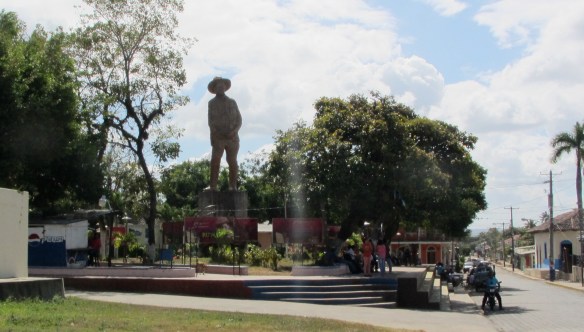
Statue of national hero Augusto Sandino at the central park of his hometown, Niquinohomo.

By Stephen Sefton

Source: Popular Resistance

The author, Stephen Sefton, is a writer from the Tortilla Con Sal Collective in Nicaragua. Sefton was the guest on Clearing The FOG Radio this week where we discussed What’s Really Happening In Nicaragua. The show examined the groups behind the violent coup that is occurring, and according to the report below, failing in Nicaragua. It also examines some of the many false stories about what is going on in Nicaragua, e.g. that the coup is nonviolent, that it is student-led, that Ortega is in league with the capitalist class, that the US is not behind the coup attempt. Sefton describes how reality has been turned on its head and reports in the US corporate media and the Nicaraguan media which is controlled by oligarchs and funded by the US National Endowment for Democracy. We hope Sefton is right that the coup is being defeated in time for the July 19th celebration of the 39th anniversary of their historic 1979 defeat of the Somoza dictatorship. KZ and MF

July 19 will be a massive celebration of the coup’s defeat and a categorical vindication of President Daniel Ortega’s Sandinista government’s efforts for peace in Nicaragua.

On July 19, hundreds of thousands of people from across Nicaragua will converge on the capital Managua to celebrate the 39th anniversary of their historic 1979 defeat of the Somoza dictatorship. The event takes place as the authorities continue to liberate communities blockaded by roadblocks operated by armed opposition activists whose not-so-soft coup attempt against the Sandinista government, begun on April 18, has failed. Ever since April 21, when President Daniel Ortega called for a process of National Dialogue to peacefully resolve opposition demands, Nicaragua’s political opposition and their allies have worked to sabotage talks for a negotiated solution. They have regularly staged extremely violent provocations falsely seeking to portray the government as being wholly responsible for the crisis and demanding President Ortega’s resignation.

Early in July, the opposition reneged on an agreement to dismantle the roadblocks their armed supporters have used since late April to try to destroy the country’s economy and intimidate the general population. On July 9, the government declared it would no longer permit the opposition to abuse the population’s basic rights to peace and security, stating: “Faced with the daily suffering imposed on Nicaragua’s families, who since April 18 have suffered violence from terrorists who have murdered, tortured and kidnapped hundreds of citizens, the same terrorists that have burned and destroyed hundreds of families’ homes, public buildings, small- and medium-sized businesses, such that the state is bound to act in accordance with the law to guarantee the right of its citizens to live in peace, with security and respect for the human rights enshrined in our political constitution, in the charters of international organizations and in human rights conventions.”

Opposition Violence

Subsequently, Nicaragua’s national police have worked with local communities around the country to clear the opposition roadblocks. In Jinotepe, they set free hundreds of trucks and their drivers held hostage by opposition gangs for over a month. In many places, it has been possible to negotiate agreements to remove the roadblocks peacefully. Elsewhere, the process has involved violence and casualties provoked by very well-armed activists and associated paid criminals resisting the authorities’ efforts to restore freedom of movement. On July 13 in Managua, two opposition activists were killed during the clearance of blockades in and around the National Autonomous University.

Elsewhere, on July 12, opposition activists from roadblocks operated by Francisca Ramirez and Medardo Mairena’s anti-Canal movement infiltrated an opposition peace march in the town of Morrito, on the eastern shore of Lake Nicaragua, on the highway to the Rio San Juan. They attacked a police post and the local municipal office, murdering four police officers and a primary school teacher, wounding four municipal workers and kidnapping nine police officers. Subsequently, that evening the police officers were set free, six of them with injuries.

Tortured & Murdered

In Masaya, opposition activists tortured, murdered and burned police officer Gabriel Vado Ruiz and would have done the same to another police officer, Rodrigo Barrios Flores, had he not escaped from his captors after enduring two days of torture and abuse. Although the extreme violence of the armed opposition activists has been responsible directly and indirectly for almost all the loss of life and injuries during the crisis, international news media and human rights organizations continue to falsely blame the government for virtually all the deaths and people injured. Amnesty International and fellow coup apologists such as Bianca Jagger and SOS Nicaragua, along with their allies in corporate media such as the Guardian, Telegraph, Washington Post, New York Times, Al Jazeera, CNN,  BBC, all cover up very serious human rights violations by the opposition activists during the failed attempted coup against Nicaragua’s legitimate government.

However, abundant audiovisual and photographic material exists providing irrefutable evidence of systematic human rights violations practiced by Nicaragua’s political opposition. From the the start, on April 18, the armed opposition offensive has manipulated legitimate peaceful protest so as to give cover to a very deliberate campaign of violence and deceit, promoting a climate of fear and casting blame on the government so as to create a psychosis of hatred, polarizing Nicaraguan society. The campaign’s objective is to make impossible a negotiated solution to the crisis provoked by the political opposition. Over the weekend of July 13-15, events in Nicaragua showed how refined the techniques of psychological warfare have become.

Misrepresenting & Exaggerating

The political opposition have used social media to misrepresent and exaggerate events, create incidents that never happened and obliterate their own criminal terrorist attacks. For example, the crisis in Nicaragua began with a fake ‘student massacre’ that never took place. Now Nicaragua’s opposition have faked attacks on a church in Managua, exaggerated casualties during the clearance of opposition thugs from the national university and covered up their own deliberate murders of police in Morrito and Masaya, as well as their gratuitous attacks on peaceful Sandinista demonstrators. In the national university, the opposition gangs also set fire to a classroom module and destroyed a preschool facility on the university campus.

Right from the start of the crisis, the opposition have expertly staged phony scenes of students taking cover from gunfire and used those images to justify their own savage attacks, like those in which they burned down pro-government Nuevo Radio Ya and CARUNA, the rural cooperatives’ savings and loan institution. Photographs show opposition journalists and photographers filming opposition activists pretending to be attacked, but despite the obvious fakery, those false stories get published uncritically in international corporate and alternative media. Nicaragua provides a textbook case study bearing out the work of analysts such as Cuba’s Randy Falcon, who has emphasized how new technologies exponentially multiply the digital reproduction of longstanding conventional propaganda motifs.

Propaganda Ploys

In Nicaragua, the government has in several cases negotiated agreements to clear armed opposition roadblocks, only to find that the opposition refuse to honor the agreements. The extremist political opposition are desperate to keep up their violence so as to sabotage efforts at National Dialogue and project the false image of a repressive government without popular support. Large demonstrations across the country supporting the government’s efforts for peace show exactly the reverse is true. Majority national opinion in Nicaragua is well aware of the opposition’s propaganda ploys and false claims.

Within Nicaragua, the opposition hardly bother to conceal their invention and artifice because their false political theater is staged almost entirely to impress overseas opinion. Their sinister cynical theater aims to set the scene for the Organization of American States to change its previously moderate position on Nicaragua and give the U.S. government an institutional pretext on which to intensify sanctions against Nicaragua’s government and its people. Even so, despite probable opposition attempts to sabotage it, July 19 will be a massive celebration of the coup’s defeat and a categorical vindication of President Daniel Ortega’s Sandinista government’s efforts for peace in Nicaragua.

The World Will Not Mourn the Decline of U.S. Hegemony

By Paul Street

Source: Consortium News

There are good reasons to bemoan the presence of the childish, racist, sexist and ecocidal, right-wing plutocrat Donald Trump in the White House. One complaint about Trump that should be held at arm’s-length by anyone on the left, however, is the charge that Trump is contributing to the decline of U.S. global power—to the erosion of the United States’ superpower status and the emergence of a more multipolar world.

This criticism of Trump comes from different elite corners. Last October, the leading neoconservative foreign policy intellectual and former George W. Bush administration adviser Eliot Cohen wrote an Atlantic magazine essay titled “How Trump Is Ending the American Era.” Cohen recounted numerous ways in which Trump had reduced “America’s standing and ability to influence global affairs.” He worried that Trump’s presidency would leave “America’s position in the world stunted” and an “America lacking confidence” on the global stage.

But it isn’t just the right wing that writes and speaks in such terms about how Trump is contributing to the decline of U.S. hegemony. A recent Time magazine reflection by the liberal commentator Karl Vick (who wrote in strongly supportive terms about the giant January 2017 Women’s March against Trump) frets that that Trump’s “America First” and authoritarian views have the world “looking for leadership elsewhere.”

“Could this be it?” Vick asks. “Might the American Century actually clock out at just 72 years, from 1945 to 2017? No longer than Louis XIV ruled France? Only 36 months more than the Soviet Union lasted, after all that bother?”

I recently reviewed a manuscript on the rise of Trump written by a left-liberal American sociologist. Near the end of this forthcoming and mostly excellent and instructive volume, the author finds it “worrisome” that other nations see the U.S. “abdicating its role as the world’s leading policeman” under Trump—and that, “given what we have seen so far from the [Trump] administration, U.S. hegemony appears to be on shakier ground than it has been in a long time.”

I’ll leave aside the matter of whether Trump is, in fact, speeding the decline of U.S. global power (he undoubtedly is) and how he’s doing that, to focus instead on a very different question: What would be so awful about the end of “the American Era”—the seven-plus decades of U.S. global economic and related military supremacy between 1945 and the present? Why should the world mourn the “premature” end of the “American Century”?

What Would the Rest of the World Say?

It would be interesting to see a reliable opinion poll on how the politically cognizant portion of the 94 percent of humanity that lives outside the U.S. would feel about the end of U.S. global dominance. My guess is that Uncle Sam’s weakening would be just fine with most Earth residents who pay attention to world events.

According to a global survey of 66,000 people conducted across 68 countries by the Worldwide Independent Network of Market Research (WINMR) and Gallup International at the end of 2013, Earth’s people see the United States as the leading threat to peace on the planet. The U.S. was voted top threat by a wide margin.

There is nothing surprising about that vote for anyone who honestly examines the history of “U.S. foreign affairs,” to use a common elite euphemism for American imperialism. Still, by far and away world history’s most extensive empire, the U.S. has at least 800 military bases spread across more than 80 foreign countries and “troops or other military personnel in about 160

foreign countries and territories.” The U.S. accounts for more than 40 percent of the planet’s military spending and has more than 5,500 strategic nuclear weapons, enough to blow the world up 5 to 50 times over. Last year it increased its “defense” (military empire) spending, which was already three times higher than China’s, and nine times higher than Russia’s.

Think it’s all in place to ensure peace and democracy the world over, in accord with the standard boilerplate rhetoric of U.S. presidents, diplomats and senators?

Do you know any other good jokes?

Pentagon study released last summer laments the emergence of a planet on which the U.S. no longer controls events. Titled “At Our Own Peril: DoD Risk Assessment in a Post-Primary World,” the study warns that competing powers “seek a new distribution of power and authority commensurate with their emergence as legitimate rivals to U.S. dominance” in an increasingly multipolar world. China, Russia and smaller players like Iran and North Korea have dared to “engage,” the Pentagon study reports, “in a deliberate program to demonstrate the limits of U.S. authority, reach influence and impact.” What chutzpah! This is a problem, the report argues, because the endangered U.S.-managed world order was “favorable” to the interests of U.S. and allied U.S. states and U.S.-based transnational corporations.

Any serious efforts to redesign the international status quo so that it favors any other states or people is portrayed in the report as a threat to U.S. interests. To prevent any terrible drifts of the world system away from U.S. control, the report argues, the U.S. and its imperial partners (chiefly its European NATO partners) must maintain and expand “unimpeded access to the air, sea, space, cyberspace, and the electromagnetic spectrum in order to underwrite their security and prosperity.” The report recommends a significant expansion of U.S. military power. The U.S. must maintain “military advantage” over all other states and actors to “preserve maximum freedom of action” and thereby “allow U.S. decision-makers the opportunity to dictate or hold significant sway over outcomes in international disputes,” with the “implied promise of unacceptable consequences” for those who defy U.S. wishes.

“America First” is an understatement here. The underlying premise is that Uncle Sam owns the world and reserves the right to bomb the hell out of anyone who doesn’t agree with that (to quote President George H.W. Bush after the first Gulf War in 1991: “What we say goes.”

Investment Not Democracy

It’s nothing new. From the start, the “American Century” had nothing to do with advancing democracy. As numerous key U.S. planning documents reveal over and over, the goal of that policy was to maintain and, if necessary, install governments that “favor[ed] private investment of domestic and foreign capital, production for export, and the right to bring profits out of the country,” according to Noam Chomsky. Given the United States’ remarkable possession of half the world’s capital after World War II, Washington elites had no doubt that U.S. investors and corporations would profit the most. Internally, the basic selfish national and imperial objectives were openly and candidly discussed. As the “liberal” and “dovish” imperialist, top State Department planner, and key Cold War architect George F. Kennan explained in “Policy Planning Study 23,” a critical 1948 document:

We have about 50% of the world’s wealth, but only 6.3% of its population. … In this situation, we cannot fail to be the object of envy and resentment. Our real task in the coming period is to devise a pattern of relationships which will permit us to maintain this position of disparity. … To do so, we will have to dispense with all sentimentality and day-dreaming; and our attention will have to be concentrated everywhere on our immediate national objectives. … We should cease to talk about vague and … unreal objectives such as human rights, the raising of the living standards, and democratization. The day is not far off when we are going to have to deal in straight power concepts. The less we are then hampered by idealistic slogans, the better.

The harsh necessity of abandoning “human rights” and other “sentimental” and “unreal objectives” was especially pressing in the global South, what used to be known as the Third World. Washington assigned the vast “undeveloped” periphery of the world capitalist system—Africa, Latin America, Southeast Asia and the energy-rich and thus strategically hyper-significant Middle East—a less than flattering role. It was to “fulfill its major function as a source of raw materials and a market” (actual State Department language) for the great industrial (capitalist) nations (excluding socialist Russia and its satellites, and notwithstanding the recent epic racist-fascist rampages of industrial Germany and Japan). It was to be exploited both for the benefit of U.S. corporations/investors and for the reconstruction of Europe and Japan as prosperous U.S. trading and investment partners organized on capitalist principles and hostile to the Soviet bloc.

“Democracy” was fine as a slogan and benevolent, idealistic-sounding mission statement when it came to marketing this imperialist U.S. policy at home and abroad. Since most people in the “third” or “developing” world had no interest in neocolonial subordination to the rich nations and subscribed to what U.S. intelligence officials considered the heretical “idea that government has direct responsibility for the welfare of its people” (what U.S. planners called “communism”), Washington’s real-life commitment to popular governance abroad was strictly qualified, to say the least.

“Democracy” was suitable to the U.S. as long as its outcomes comported with the interests of U.S. investors/corporations and related U.S. geopolitical objectives. Democracy had to be abandoned, undermined and/or crushed when it threatened those investors/corporations and the broader imperatives of business rule to any significant degree. As President Richard Nixon’s coldblooded national security adviser Henry Kissinger explained in June 1970, three years before the U.S. sponsored a bloody fascist coup that overthrew Chile’s democratically elected socialist president, Salvador Allende: “I don’t see why we need to stand by and watch a country go Communist because of the irresponsibility of its own people.”

The U.S.-sponsored coup government that murdered Allende would kill tens of thousands of real and alleged leftists with Washington’s approval. The Yankee superpower sent some of its leading neoliberal economists and policy advisers to help the blood-soaked Pinochet regime turn Chile into a “free market” model and to help Chile write capitalist oligarchy into its national constitution.

“Since 1945, by deed and by example,” the great Australian author, commentator and filmmaker John Pilger wrote nearly nine years ago, “the U.S. has overthrown 50 governments, including democracies, crushed some 30 liberation movements and supported tyrannies from Egypt to Guatemala (see William Blum’s histories). Bombing is apple pie.” Along the way, Washington has crassly interfered in elections in dozens of “sovereign” nations, something curious to note in light of current liberal U.S. outrage over real or alleged Russian interference in “our” supposedly democratic electoral process in 2016. Uncle Sam also has bombed civilians in 30 countries, attempted to assassinate foreign leaders and deployed chemical and biological weapons.

If we “consider only Latin America since the 1950s,” writes the sociologist Howard Waitzkin:

[T]he United States has used direct military invasion or has supported military coups to overthrow elected governments in Guatemala, the Dominican Republic, Chile, Haiti, Grenada, and Panama. In addition, the United States has intervened with military action to suppress revolutionary movements in El Salvador, Nicaragua, and Bolivia. More recently … the United States has spent tax dollars to finance and help organize opposition groups and media in Honduras, Paraguay, and Brazil, leading to congressional impeachments of democratically elected presidents. Hillary Clinton presided over these efforts as Secretary of State in the Obama administration, which pursued the same pattern of destabilization in Venezuela, Ecuador, Argentina, Chile, and Bolivia.

Death Count: In the Millions

The death count resulting from “American Era” U.S. foreign policy runs well into the many millions, including possibly as many as 5 million Indochinese killed by Uncle Sam and his agents and allies between 1962 and 1975. The flat-out barbarism of the American war on Vietnam is widely documented on record. The infamous My Lai massacre of March 16, 1968, when U.S. Army soldiers slaughtered more than 350 unarmed civilians—including terrified women holding babies in their arms—in South Vietnam was no isolated incident in the U.S. “crucifixion of Southeast Asia” (Noam Chomsky’s phrase at the time). U.S. Army Col. Oran Henderson, who was charged with covering up the massacre, candidly told reporters that “every unit of brigade size has its My Lai hidden somewhere.”

It is difficult, sometimes, to wrap one’s mind around the extent of the savagery the U.S. has unleashed on the world to advance and maintain its global supremacy. In the early 1950s, the Harry Truman administration responded to an early challenge to U.S. power in Northern Korea with a practically genocidal three-year bombing campaign that was described in soul-numbing terms by the Washington Post years ago:

The bombing was long, leisurely and merciless, even by the assessment of America’s own leaders. ‘Over a period of three years or so, we killed off—what—20 percent of the population,’ Air Force Gen. Curtis LeMay, head of the Strategic Air Command during the Korean War, told the Office of Air Force History in 1984. Dean Rusk, a supporter of the war and later Secretary of State, said the United States bombed ‘everything that moved in North Korea, every brick standing on top of another.’ After running low on urban targets, U.S. bombers destroyed hydroelectric and irrigation dams in the later stages of the war, flooding farmland and destroying crops … [T]he U.S. dropped 635,000 tons of explosives on North Korea, including 32,557 tons of napalm, an incendiary liquid that can clear forested areas and cause devastating burns to human skin.

Gee, why does North Korea fear and hate us?

This ferocious bombardment, which killed 2 million or more civilians, began five years after Truman arch-criminally and unnecessarily ordered the atom bombing of hundreds of thousands pf civilians in Hiroshima and Nagasaki to warn the Soviet Union to stay out of Japan and Western Europe.

Some benevolent “world policeman.”

The ferocity of U.S. foreign policy in the “America Era” did not always require direct U.S. military intervention. Take Indonesia and Chile, for two examples from the “Golden Age” height of the “American Century.” In Indonesia, the U.S.-backed dictator Suharto killed millions of his subjects, targeting communist sympathizers, ethnic Chinese and alleged leftists. A senior CIA operations officer in the 1960s later described Suharto’s 1965-66 U.S.-assisted coup as s “the model operation” for the U.S.-backed coup that eliminated the democratically elected president of Chile, Salvador Allende, seven years later. “The CIA forged a document purporting to reveal a leftist plot to murder Chilean military leaders,” the officer wrote, “[just like] what happened in Indonesia in 1965.”

As Pilger noted 10 years ago, “the U.S. embassy in Jakarta supplied Suharto with a ‘zap list’ of Indonesian Communist party members and crossed off the names when they were killed or captured. … The deal was that Indonesia under Suharto would offer up what Richard Nixon had called ‘the richest hoard of natural resources, the greatest prize in south-east Asia.’ ”

“No single American action in the period after 1945,” wrote the historian Gabriel Kolko, “was as bloodthirsty as its role in Indonesia, for it tried to initiate [Suharto’s] massacre.”

Two years and three months after the Chilean coup, Suharto received a green light from Kissinger and the Gerald Ford White House to invade the small island nation of East Timor. With Washington’s approval and backing, Indonesia carried out genocidal massacres and mass rapes and killed at least 100,000 of the island’s residents.

Mideast Savagery

Among the countless episodes of mass-murderous U.S. savagery in the oil-rich Middle East over the last generation, few can match for the barbarous ferocity of the “Highway of Death,” where the “global policeman’s” forces massacred tens of thousands of surrendered Iraqi troops retreating from Kuwait on Feb. 26 and 27, 1991. Journalist Joyce Chediac testified that:

U.S. planes trapped the long convoys by disabling vehicles in the front, and at the rear, and then pounded the resulting traffic jams for hours. ‘It was like shooting fish in a barrel,’ said one U.S. pilot. On the sixty miles of coastal highway, Iraqi military units sit in gruesome repose, scorched skeletons of vehicles and men alike, black and awful under the sun … for 60 miles every vehicle was strafed or bombed, every windshield is shattered, every tank is burned, every truck is riddled with shell fragments. No survivors are known or likely. … ‘Even in Vietnam I didn’t see anything like this. It’s pathetic,’ said Major Bob Nugent, an Army intelligence officer. … U.S. pilots took whatever bombs happened to be close to the flight deck, from cluster bombs to 500-pound bombs. … U.S. forces continued to drop bombs on the convoys until all humans were killed. So many jets swarmed over the inland road that it created an aerial traffic jam, and combat air controllers feared midair collisions. … The victims were not offering resistance. … [I]t was simply a one-sided massacre of tens of thousands of people who had no ability to fight back or defend.

The victims’ crime was having been conscripted into an army controlled by a dictator perceived as a threat to U.S. control of Middle Eastern oil. President George H.W. Bush welcomed the so-called Persian Gulf War as an opportunity to demonstrate America’s unrivaled power and new freedom of action in the post-Cold War world, where the Soviet Union could no longer deter Washington. Bush also heralded the “war” (really a one-sided imperial assault) as marking the end of the “Vietnam Syndrome,” the reigning political culture’s curious term for U.S. citizens’ reluctance to commit U.S. troops to murderous imperial mayhem.

As Chomsky observed in 1992, reflecting on U.S. efforts to maximize suffering in Vietnam by blocking economic and humanitarian assistance to the nation it had devastated: “No degree of cruelty is too great for Washington sadists.”

But Uncle Sam was only getting warmed up building his Iraqi body count in early 1991. Five years later, Bill Clinton’s U.S. Secretary of State Madeline Albright told CBS News’ Leslie Stahl that the death of 500,000 Iraqi children due to U.S.-led economic sanctions imposed after the first “Persian Gulf War” (a curious term for a one-sided U.S. assault) was a “price … worth paying” for the advancement of inherently noble U.S. goals.

“The United States,” Secretary Albright explained three years later, “is good. We try to do our best everywhere.”

In the years following the collapse of the counter-hegemonic Soviet empire, however, American neoliberal intellectuals like Thomas Friedman—an advocate of the criminal U.S. bombing of Serbia—felt free to openly state that the real purpose of U.S. foreign policy was to underwrite the profits of U.S.-centered global capitalism. “The hidden hand of the market,” Friedman famously wrote in The New York Times Magazine in March 1999, as U.S. bombs and missiles exploded in Serbia, “will never work without a hidden fist. McDonald’s cannot flourish without McDonnell Douglas, the designer of the F-15. And the hidden fist that keeps the world safe for Silicon Valley’s technologies to flourish is called the U.S. Army, Air Force, Navy and Marine Corps.”

In a foreign policy speech Sen. Barack Obama gave to the Chicago Council of Global Affairs on the eve of announcing his candidacy for the U.S. presidency in the fall of 2006, Obama had the audacity to say the following in support of his claim that U.S. citizens supported “victory” in Iraq: “The American people have been extraordinarily resolved. They have seen their sons and daughters killed or wounded in the streets of Fallujah.”

It was a spine-chilling selection of locales. In 2004, the ill-fated city was the site of colossal U.S. war atrocities, crimes including the indiscriminate murder of thousands of civilians, the targeting even of ambulances and hospitals, and the practical leveling of an entire city by the U.S. military in April and November. By one account, “Incoherent Empire,” Michael Mann wrote:

The U.S. launched two bursts of ferocious assault on the city, in April and November of 2004 … [using] devastating firepower from a distance which minimizes U.S. casualties. In April … military commanders claimed to have precisely targeted … insurgent forces, yet the local hospitals reported that many or most of the casualties were civilians, often women, children, and the elderly… [reflecting an] intention to kill civilians generally. … In November … [U.S.] aerial assault destroyed the only hospital in insurgent territory to ensure that this time no one would be able to document civilian casualties. U.S. forces then went through the city, virtually destroying it. Afterwards, Fallujah looked like the city of Grozny in Chechnya after Putin’s Russian troops had razed it to the ground.

The “global policeman’s” deployment of radioactive ordnance (depleted uranium) in Fallujah created an epidemic of infant mortality, birth defects, leukemia and cancer there.

‘Bug-Splat’

Fallujah was just one especially graphic episode in a broader arch-criminal invasion that led to the premature deaths of at least 1 million Iraqi civilians and left Iraq as what Tom Engelhardt called “a disaster zone on a catastrophic scale hard to match in recent memory.” It reflected the same callous mindset behind the Pentagon’s early computer program name for ordinary Iraqis certain to be killed in the 2003 invasion: “bug-splat.” America’s petro-imperial occupation led to the death of as many as one million Iraqi “bugs” (human beings). According to the respected journalist Nir Rosen in December 2007, “Iraq has been killed. … [T]he American occupation has been more disastrous than that of the Mongols who sacked Baghdad in the thirteenth century.”

As the Senate is poised to confirm an alleged torturer as CIA director it is important to remember that along with death in Iraq came ruthless and racist torture. In an essay titled “I Helped Create ISIS,” Vincent Emanuele, a former U.S. Marine, recalled his enlistment in an operation that gave him nightmares more than a decade later:

I think about the hundreds of prisoners we took captive and tortured in makeshift detention facilities. … I vividly remember the marines telling me about punching, slapping, kicking, elbowing, kneeing and head-butting Iraqis. I remember the tales of sexual torture: forcing Iraqi men to perform sexual acts on each other while marines held knives against their testicles, sometimes sodomizing them with batons. … [T]hose of us in infantry units … round[ed] up Iraqis during night raids, zip-tying their hands, black-bagging their heads and throwing them in the back of HUMVEEs and trucks while their wives and kids collapsed to their knees and wailed. … Some of them would hold hands while marines would butt-stroke the prisoners in the face. … [W]hen they were released, we would drive them from the FOB (Forward Operating Base) to the middle of the desert and release them several miles from their homes. … After we cut their zip-ties and took the black bags off their heads, several of our more deranged marines would fire rounds from their AR-15s into their air or ground, scaring the recently released captives. Always for laughs. Most Iraqis would run, still crying from their long ordeal.

The award-winning journalist Seymour Hersh told the ACLU about the existence of classified Pentagon evidence files containing films of U.S-“global policeman” soldiers sodomizing Iraqi boys in front of their mothers behind the walls of the notorious Abu Ghraib prison. “You haven’t begun to see [all the] … evil, horrible things done [by U.S. soldiers] to children of women prisoners, as the cameras run,” Hersh told an audience in Chicago in the summer of 2014.

It isn’t just Iraq where Washington has wreaked sheer mass murderous havoc in the Middle East, always a region of prime strategic significance to the U.S. thanks to its massive petroleum resources. In a recent Truthdig reflection on Syria, historian Dan Lazare reminds us that:

[Syrian President Assad’s] Baathist crimes pale in comparison to those of the U.S., which since the 1970s has invested trillions in militarizing the Persian Gulf and arming the ultra-reactionary petro-monarchies that are now tearing the region apart. The U.S. has provided Saudi Arabia with crucial assistance in its war on Yemen, it has cheered on the Saudi blockade of Qatar, and it has stood by while the Saudis and United Arab Emirates send in troops to crush democratic protests in neighboring Bahrain. In Syria, Washington has worked hand in glove with Riyadh to organize and finance a Wahhabist holy war that has reduced a once thriving country to ruin.

Chomsky has called Barack Obama’s targeted drone assassination program “the most extensive global terrorism campaign the world has yet seen.” The program “officially is aimed at killing people who the administration believes might someday intend to harm the U.S. and killing anyone else who happens to be nearby.” As Chomsky adds, “It is also a terrorism generating campaign—that is well understood by people in high places. When you murder somebody in a Yemen village, and maybe a couple of other people who are standing there, the chances are pretty high that others will want to take revenge.”

The Last, Best Hope

“We lead the world,” presidential candidate Obama explained, “in battling immediate evils and promoting the ultimate good. … America is the last, best hope of earth.”

Obama elaborated in his first inaugural address. “Our security,” the president said, “emanates from the justness of our cause; the force of our example; the tempering qualities of humility and restraint”—a fascinating commentary on Fallujah, Hiroshima, the U.S. crucifixion of Southeast Asia, the “Highway of Death” and more.

Within less than half a year of his inauguration and his lauded Cairo speech, Obama’s rapidly accumulating record of atrocities in the Muslim world would include the bombing of the Afghan village of Bola Boluk. Ninety-three of the dead villagers torn apart by U.S. explosives in Bola Boluk were children. “In a phone call played on a loudspeaker on Wednesday to outraged members of the Afghan Parliament,” The New York Times reported, “the governor of Farah Province … said that as many as 130 civilians had been killed.” According to one Afghan legislator and eyewitness, “the villagers bought two tractor trailers full of pieces of human bodies to his office to prove the casualties that had occurred. Everyone at the governor’s cried, watching that shocking scene.” The administration refused to issue an apology or to acknowledge the “global policeman’s” responsibility.

By telling and sickening contrast, Obama had just offered a full apology and fired a White House official because that official had scared New Yorkers with an ill-advised Air Force One photo-shoot flyover of Manhattan that reminded people of 9/11. The disparity was extraordinary: Frightening New Yorkers led to a full presidential apology and the discharge of a White House staffer. Killing more than 100 Afghan civilians did not require any apology.

Reflecting on such atrocities the following December, an Afghan villager was moved to comment as follows: “Peace prize? He’s a killer. … Obama has only brought war to our country.” The man spoke from the village of Armal, where a crowd of 100 gathered around the bodies of 12 people, one family from a single home. The 12 were killed, witnesses reported, by U.S. Special Forces during a late-night raid.

Obama was only warming up his “killer” powers. He would join with France and other NATO powers in the imperial decimation of Libya, which killed more than 25,000 civilians and unleashed mass carnage in North Africa. The U.S.-led assault on Libya was a disaster for black Africans and sparked the biggest refugee crisis since World War II.

Two years before the war on Libya, the Obama administration helped install a murderous right-wing coup regime in Honduras. Thousands of civilians and activists have been murdered by that regime.

The clumsy and stupid Trump has taken the imperial baton from the elegant and silver-tongued “imperial grandmaster” Obama, keeping the superpower’s vast global military machine set on kill. As Newsweek reported last fall, in a news item that went far below the national news radar screen in the age of the endless insane Trump clown show:

According to research from the nonprofit monitoring group Airwars … through the first seven months of the Trump administration, coalition air strikes have killed between 2,800 and 4,500 civilians. … Researchers also point to another stunning trend—the ‘frequent killing of entire families in likely coalition airstrikes.’ In May, for example, such actions led to the deaths of at least 57 women and 52 children in Iraq and Syria. … In Afghanistan, the U.N. reports a 67 percent increase in civilian deaths from U.S. airstrikes in the first six months of 2017 compared to the first half of 2016.

That Trump murders with less sophistication, outward moral restraint and credible claim to embody enlightened Western values and multilateral commitment than Obama did is perhaps preferable to some degree. It is better for empire to be exposed in its full and ugly nakedness, to speed its overdue demise.

The U.S. is not just the top menace only to peace on Earth. It is also the leading threat to personal privacy (as was made clearer than ever by the Edward Snowden revelations), to democracy (the U.S. funds and equips repressive regimes around the world) and to a livable global natural environment (thanks in no small part to its role as headquarters of global greenhouse gassing and petro-capitalist climate denial).

The world can be forgiven, perhaps, if it does not join Eliot Cohen and Karl Vick in bemoaning the end of the “American Era,” whatever Trump’s contribution to that decline, which was well underway before he entered the Oval Office.

Ordinary Americans, too, can find reasons to welcome the decline of the American empire. As Chomsky noted in the late 1960s: “The costs of empire are in general distributed over the society as a whole, while its profits revert to a few within.”

The Pentagon system functions as a great form of domestic corporate welfare for high-tech “defense” (empire) firms like Lockheed Martin, Boeing and Raytheon—this while it steals trillions of dollars that might otherwise meet social and environmental needs at home and abroad. It is a significant mode of upward wealth distribution within “the homeland.”

The biggest costs have fallen on the many millions killed and maimed by the U.S. military and allied and proxy forces in the last seven decades and before. The victims include the many U.S. military veterans who have killed themselves, many of them haunted by their own participation in sadistic attacks and torture on defenseless people at the distant command of sociopathic imperial masters determined to enforce U.S. hegemony by any and all means deemed necessary.

The Skripal Poisonings and the Ongoing Vilification of Putin

By Gary Leupp

Source: CounterPunch

Sergei Skripal and his daughter were poisoned by a nerve agent on March 4 on a park bench in Salisbury, England.

Skripal had been a Russian double agent, a spy who turned over 300 names of Russian spies to British intelligence from 1995 to 2004. He was (not so surprisingly) arrested in Russia in 2004 and sentenced to thirteen years in prison. He was released in a spy-swap in 2010, settled in the UK and became a British citizen.

I see no reason to judge his moral character, although some might reflect that in Kantian general terms what he did was rather bad. (In precisely the same sense that it would be bad for a British citizen to become a double agent for Russia.) Double agents are often punished harshly; this is the way of the world.

Skripal posed no further threat to the Russian state. There is at least one report that he sought to return to Russia recently. It’s hard to comprehend why at this time Moscow would poison him and his young daughter visiting from Russia with a nerve agent (Novichok) created in the USSR from the 1970s but subsequently banned and destroyed under international supervision. Cui bono? Who profits from these poisonings?

In all the outrage, expressed in Britain and elsewhere, about this attack, there is precious little analysis. The Russian foreign minister Sergey Lavrov has said, “This is nonsense. This has nothing to do with us.” The group of military-grade nerve agents called Novichok have been described in academic literature such that many different actors could produce Novichok. The Russians say they have long since destroyed their stocks and suggest the Czech Republic could be the source of the substance used.

But this attack on Skripal and his 33-year-old daughter (by somebody) is highly useful to those who want to vilify Vladimir Putin, just as the use of chemical weapons in Syria last April (by somebody) was useful for those wanting to further vilify Bashar Assad and justify a U.S. missile strike. Have you noticed that we live in an age of constant disinformation, misinformation and “fake news”?

The most annoying thing is, once these unproven causal relations are posited, embraced by cable news directors, such that they become Truth, discussion centers solely on how the U.S. and allies should respond. Why, pundits ask, didn’t Trump raise the issue in his last chat with Putin? Why is Britain’s Labour Party leader Jeremy Corbyn skeptical about the Russia link, suggesting the Novichok could have been possessed by East European mafia? Why isn’t everyone on board the obvious conclusion that Russia did it?

Which would mean: Putin—facing no threat from this traded ex-spy or his innocent daughter—ordered their killing, not because they threatened him, but rather to manifest his deep cruelty and evil to the world and his willingness to invite more and more sanctions against Russia. It doesn’t make much sense.

Putin is ex-KGB. Very rational and calm. He knows all about agents and double agents. I doubt that he is morally judgmental; he understands why people do what Skripal did. He made a deal for the man’s release eight years ago. His only motive to kill him at this point would be to punish Skripal for past sins and warn others not to ever sell secrets. But why would such a rational person incur global outrage by using a banned agent to attempt to murder a British citizen and his Russian daughter, for no compelling reason?

There are international legal processes for investigating charges of use of chemical weapons. Russia has asked Britain to observe them, providing evidence, samples, details. It urges adherence to rules established by the Organization for the Prohibition of Chemical Weapons (OPCW) to establish the facts. But London has merely announced it knows Putin was responsible for the state of these two on that park bench.

So the grand narrative now includes: Russian invasions of Georgia in 2008 and Ukraine in 2014 (somehow becoming in the process “adversaries” of the U.S.); alleged “threats” against the Baltic states; multiple political assassinations; dictatorial control of the Russian polity, economy and media; the accumulation of billions in illicit wealth. To say nothing of his brash exposure of his naked chest to his fandom, his judo, his hunting, his annoyingly high approval ratings.

I don’t know who attacked these two who now struggle for their lives in hospital. But I know that the response means nothing good for Russia, or the world. It is just another short chapter in the new Cold War, and like the old war, basically irrational. What is Putin’s motive? Fareed Zakaria says he’s trying to “undermine democracies” although why anyone would want to do that in principle puzzles me. Putin is not the Heath Ledger’s Joker in the Dark Knight Batman film, just spreading chaos for its own sake.

Putin is not interested in heading a European movement towards isolationist nationalisms but rather in thwarting NATO expansion plans, which any rational Russian leader would want to do. To use the strange Skripal incident as a rationale for further Cold War-type confrontation is more than sad.  Yet in a supposed display of solidarity with Britain, which has kicked out Russian diplomats in response, the U.S. has suddenly expelled 60 Russian diplomats and closed down the Russian consulate in Seattle. Trump, under constant criticism for not criticizing Putin, and not bringing up election meddling or the Skripal affair in his recent phone call, has approved the move without commenting on it.

If Trump planned for better relations with Russia to be a hallmark of his presidency, he has been stymied by his foes’ insistence that he express the traditional knee-jerk hostility. Why, they keep asking, when he criticizes his own cabinet members, does he never say anything bad about Putin? And from there, they proceed to the conclusion that the Russians have stuff on Trump and are blackmailing him…into not being default-mode hostile.

Trump is an ignorant man, uninterested in the world intellectually, unable to invest time in reading, clueless about the historical context of current crises. Part of his candidate persona was opposition to recent U.S. wars (not so much because they’ve killed hundreds of thousands of people, but because they have been expensive and not resulted in the U.S. taking the oil). But he loves men in uniform, surrounds himself with them, relies on them. These are men who grew up during the Cold War and can’t kick it from their minds. Baby-sitting what they surely see (with McMaster) as a “moron,” “idiot,” “dope,” “kindergartner” they see their minimal task the responsibility to remind him that Russia is an adversary.

And so without even ascertaining the facts of the Skripal incident, Washington expels all these diplomats. TV pundits applaud: “absolutely the right thing to do, to defend western values” etc. , the system succeeds in maintaining, even strengthening, Cold War Russophobic mentality. The Skripal incident was a blessing to Trump’s critics, who want him with his child-mind to embrace this mentality. We have to support Theresa May in Britain, they told him. This was the first offensive use of  a nerve agent in Europe since World War II, they told him; very, very serious. A Russian attack on the UK.

Whoever administered that agent triggered a wave of sanctions on Russia, adding to those earlier imposed after the 2014 coup in Ukraine and the Russian response. Russia will respond proportionately. Whoever did this forces Trump to harden a political line against Russia. As his presidency teeters in the winds of scandal, he is prone to more crazy moves like the appointment of John Bolton. Trump’s sole saving grace in his campaign was his advocacy of better ties with Russia. This immediately upon his election became his chief fault. Pundits  demand that he  abandon any hope for cordial relations with Putin’s Russia and properly denounce him for multiple crimes.

Maybe that’s what’s in store. Trump’s unpredictable. He agrees to meet Kim Jong Un then appoints Bolton (advocate of war with North Korea, removed from negotiations with the DPRK  after Pyongyang called him “human scum”) as national security advisor. And why follow up that cordial call to Putin with the expulsion of so many diplomats? What the hell. Doesn’t make sense.

Had Hillary won, I would probably have found some logic and predictability in her evil. With Trump the evil unfolds erratically. He drops a MOAB on Afghanistan (or his generals do, without necessarily consulting). He attacks a Syrian army base in response to an unproven sarin attack. His cabinet members contradict him, espousing the gospel truth that Russia and its allies such as Syria are threats to U.S. national security, whatever that is. One feels that as his personal situation deteriorates, the president will be more prone to lean on his generals, and listen to their advice while also heeding the horrific Bolton. This is a very bad situation.

4/05 Update:
Double miracle as BOTH Skripals are now said to be recovering from deadly nerve agent attack. How?

Enough Is Enough: If You Really Want to Save Lives, Take Aim at Government Violence

By John W. Whitehead

Source: The Rutherford Institute

“It is often the case that police shootings, incidents where law enforcement officers pull the trigger on civilians, are left out of the conversation on gun violence. But a police officer shooting a civilian counts as gun violence. Every time an officer uses a gun against an innocent or an unarmed person contributes to the culture of gun violence in this country.”—Journalist Celisa Calacal

Enough is enough.

That was the refrain chanted over and over by the thousands of demonstrators who gathered to protest gun violence in America.

Enough is enough.

We need to do something about the violence that is plaguing our nation and our world.

Enough is enough.

The world would be a better place if there were fewer weapons that could kill, maim, destroy and debilitate.

Enough is enough.

On March 24, 2018, more than 200,000 young people took the time to march on Washington DC and other cities across the country to demand that their concerns about gun violence be heard.

More power to them.

I’m all for activism, especially if it motivates people who have been sitting silently on the sidelines for too long to get up and try to reclaim control over a runaway government.

Curiously, however, although these young activists were vocal in calling for gun control legislation that requires stricter background checks and limits the kinds of weapons being bought and sold by members of the public, they were remarkably silent about the gun violence perpetrated by their own government.

Enough is enough.

Why is no one taking aim at the U.S. government as the greatest purveyor of violence in American society and around the world?

The systemic violence being perpetrated by agents of the government has done more collective harm to the American people and our liberties than any single act of terror or mass shooting.

Violence has become our government’s calling card, starting at the top and trickling down, from the more than 80,000 SWAT team raids carried out every year on unsuspecting Americans by heavily armed, black-garbed commandos and the increasingly rapid militarization of local police forces across the country to the drone killings used to target insurgents.

Enough is enough.

The government even exports violence worldwide, with weapons being America’s most profitable export.

Indeed, the day before thousands of demonstrators descended on Washington DC to protest mass shootings such as the one that took place at Stoneman Douglas High School, President Trump signed into law a colossal $1.3 trillion spending bill that gives the military the biggest boost in spending in more than a decade.

Ironic, isn’t it?

Here we have thousands of passionate protesters raging, crying and shouting about the need to restrict average Americans from being able to purchase and own military-style weapons, all the while the U.S. government—the same government under Trump, Obama, Bush, Clinton and beyond that continues to act as a shill and a shield for the military industrial complex—embarks on a taxpayer-funded death march that will put even more guns into circulation, and no one says a thing about it.

Why is that?

Why does the government get a free pass?

With more than $700 billion earmarked for the military, including $144.3 billion for new military equipment, you can expect a whole lot more endless wars, drone strikes, bombing campaigns, civilian deaths, costly military installations, and fat paychecks for private military contractors who know exactly how to inflate invoices and take the American taxpayers for a ride.

Enough is enough.

You can be sure this financial windfall for America’s military empire will be used to expand the police state here at home, putting more militarized guns and weapons into the hands of local police and government bureaucrats who have been trained to shoot first and ask questions later.

There are now reportedly more bureaucratic (non-military) government civilians armed with high-tech, deadly weapons than U.S. Marines.

While Americans have to jump through an increasing number of hoops in order to own a gun, the government is arming its own civilian employees to the hilt with guns, ammunition and military-style equipment, authorizing them to make arrests, and training them in military tactics.

Among the agencies being supplied with night-vision equipment, body armor, hollow-point bullets, shotguns, drones, assault rifles and LP gas cannons are the Smithsonian, U.S. Mint, Health and Human Services, IRS, FDA, Small Business Administration, Social Security Administration, National Oceanic and Atmospheric Administration, Education Department, Energy Department, Bureau of Engraving and Printing and an assortment of public universities.

Seriously, why do IRS agents need AR-15 rifles?

Enough is enough.

Remember, it was just a few months ago that President Trump, aided and abetted by his trusty Department of Justice henchman Jeff Sessions, rolled back restrictions on the government’s military recycling program to the delight of the nation’s powerful police unions.

Under the auspices of this military “recycling” program, which was instituted decades ago and allows local police agencies to acquire military-grade weaponry and equipment, more than $4.2 billion worth of equipment has been transferred from the Defense Department to domestic police agencies since 1990.

Ironically, while gun critics continue to clamor for bans on military-style assault weapons, high-capacity magazines and armor-piercing bullets, expanded background checks, and tougher gun-trafficking laws, the U.S. military boasts all of these and more, including some weapons the rest of the world doesn’t have.

In the hands of government agents, whether they are members of the military, law enforcement or some other government agency, these weapons have become routine parts of America’s day-to-day life, a byproduct of the rapid militarization of law enforcement over the past several decades.

Over the course of 30 years, police officers in jack boots holding assault rifles have become fairly common in small town communities across the country. As investigative journalists Andrew Becker and G.W. Schulz reveal, “Many police, including beat cops, now routinely carry assault rifles. Combined with body armor and other apparel, many officers look more and more like combat troops serving in Iraq and Afghanistan.”

Although these federal programs that allow the military to “gift” battlefield-appropriate weapons, vehicles and equipment to domestic police departments at taxpayer expense are being sold to communities as a benefit, the real purpose is to keep the defense industry churning out profits, bring police departments in line with the military, and establish a standing army.

It’s a militarized approach to make-work programs, except in this case, instead of unnecessary busy work to keep people employed, communities across America are being inundated with unnecessary drones, tanks, grenade launchers and other military equipment better suited to the battlefield in order to fatten the bank accounts of the military industrial complex.

Thanks to Trump, this transformation of America into a battlefield is only going to get worse.

Get ready for more militarized police.

More police shootings.

More SWAT team raids.

More violence in a culture already drenched with violence.

Enough is enough.

You want to talk about gun violence?

According to the Washington Post, “1 in 13 people killed by guns are killed by police.”

While it still technically remains legal for the average citizen to own a firearm in America, possessing one can now get you pulled over, searched, arrested, subjected to all manner of surveillance, treated as a suspect without ever having committed a crime, shot at and killed by police.

You don’t even have to have a gun or a look-alike gun, such as a BB gun, in your possession to be singled out and killed by police.

There are countless incidents that happen every day in which Americans are shot, stripped, searched, choked, beaten and tasered by police for little more than daring to frown, smile, question, or challenge an order.

Growing numbers of unarmed people are being shot and killed for just standing a certain way, or moving a certain way, or holding something—anything—that police could misinterpret to be a gun, or igniting some trigger-centric fear in a police officer’s mind that has nothing to do with an actual threat to their safety.

Enough is enough.

With alarming regularity, unarmed men, women, children and even pets are being gunned down by twitchy, hyper-sensitive, easily-spooked police officers who shoot first and ask questions later, and all the government does is shrug and promise to do better.

Killed for standing in a “shooting stance.” In California, police opened fire on and killed a mentally challenged—unarmed—black man within minutes of arriving on the scene, allegedly because he removed a vape smoking device from his pocket and took a “shooting stance.”

Killed for holding a cell phone. Police in Arizona shot a man who was running away from U.S. Marshals after he refused to drop an object that turned out to be a cellphone. Similarly, police in Sacramento fired 20 shots at an unarmed, 22-year-old black man who was standing in his grandparents’ backyard after mistaking his cellphone for a gun.

Killed for carrying a baseball bat. Responding to a domestic disturbance call, Chicago police shot and killed 19-year-old college student Quintonio LeGrier who had reportedly been experiencing mental health problems and was carrying a baseball bat around the apartment where he and his father lived.

Killed for opening the front door. Bettie Jones, who lived on the floor below LeGrier, was also fatally shot—this time, accidentally—when she attempted to open the front door for police.

Killed for running towards police with a metal spoon. In Alabama, police shot and killed a 50-year-old man who reportedly charged a police officer while holding “a large metal spoon in a threatening manner.”

Killed for running while holding a tree branch. Georgia police shot and killed a 47-year-old man wearing only shorts and tennis shoes who, when first encountered, was sitting in the woods against a tree, only to start running towards police holding a stick in an “aggressive manner.

Killed for crawling around naked. Atlanta police shot and killed an unarmed man who was reported to have been “acting deranged, knocking on doors, crawling around on the ground naked.” Police fired two shots at the man after he reportedly started running towards them.

Killed for wearing dark pants and a basketball jersey. Donnell Thompson, a mentally disabled 27-year-old described as gentle and shy, was shot and killed after police—searching for a carjacking suspect reportedly wearing similar clothing—encountered him lying motionless in a neighborhood yard. Police “only” opened fire with an M4 rifle after Thompson first failed to respond to their flash bang grenades and then started running after being hit by foam bullets.

Killed for driving while deaf. In North Carolina, a state trooper shot and killed 29-year-old Daniel K. Harris—who was deaf—after Harris initially failed to pull over during a traffic stop.

Killed for being homeless. Los Angeles police shot an unarmed homeless man after he failed to stop riding his bicycle and then proceeded to run from police.

Killed for brandishing a shoehorn. John Wrana, a 95-year-old World War II veteran, lived in an assisted living center, used a walker to get around, and was shot and killed by police who mistook the shoehorn in his hand for a 2-foot-long machete and fired multiple beanbag rounds from a shotgun at close range.

Killed for having your car break down on the road. Terence Crutcher, unarmed and black, was shot and killed by Oklahoma police after his car broke down on the side of the road. Crutcher was shot in the back while walking towards his car with his hands up.

Killed for holding a garden hose. California police were ordered to pay $6.5 million after they opened fire on a man holding a garden hose, believing it to be a gun. Douglas Zerby was shot 12 times and pronounced dead on the scene.

Killed for calling 911. Justine Damond, a 40-year-old yoga instructor, was shot and killed by Minneapolis police, allegedly because they were startled by a loud noise in the vicinity just as she approached their patrol car. Damond, clad in pajamas, had called 911 to report a possible assault in her neighborhood.

Killed for looking for a parking spot. Richard Ferretti, a 52-year-old chef, was shot and killed by Philadelphia police who had been alerted to investigate a purple Dodge Caravan that was driving “suspiciously” through the neighborhood.

Shot seven times for peeing outdoors. Eighteen-year- old Keivon Young was shot seven times by police from behind while urinating outdoors. Young was just zipping up his pants when he heard a commotion behind him and then found himself struck by a hail of bullets from two undercover cops. Allegedly officers mistook Young—5’4,” 135 lbs., and guilty of nothing more than taking a leak outdoors—for a 6’ tall, 200 lb. murder suspect whom they later apprehended. Young was charged with felony resisting arrest and two counts of assaulting a peace officer.

This is what passes for policing in America today, folks, and it’s only getting worse.

In every one of these scenarios, police could have resorted to less lethal tactics.

They could have acted with reason and calculation instead of reacting with a killer instinct.

They could have attempted to de-escalate and defuse whatever perceived “threat” caused them to fear for their lives enough to react with lethal force.

That police instead chose to fatally resolve these encounters by using their guns on fellow citizens speaks volumes about what is wrong with policing in America today, where police officers are being dressed in the trappings of war, drilled in the deadly art of combat, and trained to look upon “every individual they interact with as an armed threat and every situation as a deadly force encounter in the making.”

Remember, to a hammer, all the world looks like a nail.

We’re not just getting hammered, however.

We’re getting killed, execution-style.

Enough is enough.

When you train police to shoot first and ask questions later—whether it’s a family pet, a child with a toy gun, or an old man with a cane—they’re going to shoot to kill.

This is the fallout from teaching police to assume the worst-case scenario and react with fear to anything that poses the slightest threat (imagined or real).

This is what comes from teaching police to view themselves as soldiers on a battlefield and those they’re supposed to serve as enemy combatants.

This is the end result of a lopsided criminal justice system that fails to hold the government and its agents accountable for misconduct.

You want to save lives?

Start by doing something to save the lives of your fellow citizens who are being gunned down every day by police who are trained to shoot first and ask questions later.

You want to cry about the lives lost during mass shootings?

Cry about the lives lost as a result of the violence being perpetrated by the U.S. government here at home and abroad.

If gun control activists really want the country to reconsider its relationship with guns and violence, then it needs to start with a serious discussion about the role our government has played and continues to play in contributing to the culture of violence.

If the American people are being called on to scale back on their weapons, then as I make clear in my book Battlefield America: The War on the American People, the government and its cohorts—the police, the various government agencies that are now armed to the hilt, the military, the defense contractors, etc.—need to do the same.

It’s time to put an end to the government’s reign of terror.

Enough is enough.