
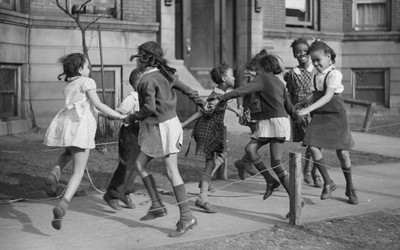
The end of childhood play

By Brian Kaller

Source: resilience

Recorded history is the history of adults–generals, statesmen, explorers and scientists–but all of those adults began their path as children. And running beneath this official history is the unofficial history of childhood games and rituals, many of which were passed down for generations; children inhabited a separate universe of traditions, contests, solemn rituals and codes of honour, like a Viking horde living in your house unnoticed. It was in this world that every future general first learned to lead, every future scientist first turned over logs to delight in the tiny nightmares underneath, and every future explorer first plucked up the courage to enter the haunted woods. Elderly people here in Ireland, who grew up without electricity or many cars, still remember the feral exploration and creative play that was once the birthright of every child.

“Children today don’t have to think much about games given to them – we made up our own,” said one elder. “We played spin the top, marbles, hoop the hoop, hop scotch, conkers, kick the can, scut the whip, jackstones, and box the fox. Hop scotch has survived to some extent, but only among girls … Even when the dark evenings closed in we played ‘Battle In, Battle Out,’ and ‘Jack jack show the light.’”

The games varied widely from person to person; villages only a few miles away could apparently have very different game-traditions. City streets, perhaps because they drew families from so many rural villages, seem to have been a vast melting pot of such games; when British novelist Norman Douglas published his whimsical overview of the children’s games of London in 1916, he spent dozens of pages–most of the book–just listing games. Not dozens of games, mind you–dozens of pages of lists of games, any of which could be as complex as any video game today and most of which were known to most children.

The games, rhymes, and rituals children invented were so ubiquitous, and so often out of sight of adults, that they were little remarked upon or recorded, and only now, when they have almost disappeared, can we look back and see how remarkable they were. In the 1950s the husband-and-wife team of Peter and Iona Opie interviewed children on playgrounds around the UK and found that, instead of being silly and spontaneous, children’s rhymes and stories actually preserved historical traditions their parents had lost.

“Boys continue to crack jokes that Swift collected from his friends in Queen Anne’s time,” Opie wrote. “They ask riddles which were posed when Henry VIII was a boy. . . . They learn to cure warts . . . after the manner which Francis Bacon learned when he was young. . . . They rebuke one of their number who seeks back a gift with a couplet known in Shakespeare’s day. . . . and they are [perpetuating stories] which were gossip in Elizabethan times.” They re-discovered the observation of Queen Anne’s physician John Arbuthnot, who said that “nowhere was tradition preserved pure and uncorrupt but amongst school-boys, whose games and plays are delivered down invariably from one generation to another.”

This is especially remarkable since most of these rituals were not taught by parents or grandparents, who might have learned them decades earlier, but by other children who could only have known them for a few years. Since they were re-transmitted over years rather than decades, their transmission signal should have decayed more quickly. Instead, the children proved stronger at retaining historical knowledge than most adults–not in the sense of reciting facts, but in treasuring their past.

Some of their superstitions, like a blister as proof of lying, date back at least to the 1500s, and they chanted a rhyme that apparently dates back to the era of France’s Henry IV in 1610. Most interestingly, country children still wore oak leaves or an acorn in their button-holes on 29 May to remember the return of Charles II in 1651–and could explain why they did so–at a time when few adults remembered the date.

Keep in mind, also, that few people were writing in the 1500s, most writing was not about children’s games, and much of what was written then has been lost–so if a ritual was first recorded in the 1500s, it could well be much older. Oral traditions can endure for thousands or even tens of thousands of years; Australian Aborigines have traditions about the sea level changing that seem to date from the last Ice Age. No one knows if any children’s rhymes and games date back so far, but Douglas believed that one chant stretched back to the time of Nero, and the Opies seemed to agree.

Their games and rituals were still very local, even in the 1950s when mass media was already washing away the local cultures of villages and neighbourhoods. “While some children roll eggs at Easter,” the Opies wrote, “or nettle the legs of classmates on the 29th of May, or leave little gifts on people’s doorsteps on St. Valentine’s Day, or act under the delusion that they are above the law on a night in November, other children, sometimes living only the other side of a hill, will have no knowledge of these activities.”

Here, too, Ireland held onto this heritage later than most countries, and a radio documentary of children playing in a Dublin school-yard in 1977 showed them using their own complicated musical chants. They weren’t all local traditions–one chant cited Shirley Temple, “the girl with the curly hair”–but even that showed the staying power of these songs, as this was two generations after she had been famous.

The Opies also noted that children spontaneously adopted a “code of oral legislation”–cultural institutions for testing truthfulness, swearing affirmation, making bets and bargains, and determining the ownership of property–the adult legal code in miniature. These codes universally included a practice absent from adult law, however–that of asking for respite, what we recognize as “calling time out,” and what today’s children reportedly call “pause,” a usage imported from video games.

“Throughout history, bands of children gathered and roamed city streets and countrysides, forming their own societies each with its own customs, legal rules and procedures, parodies, politics, beliefs, and art,” the blog Carcinisation pointed out. “With their rhymes, songs, and symbols, they created and elaborated the meaning of their local landscape and culture, practicing for the adult work of the same nature. We are left with only remnants and echoes of a once-magnificent network of children’s cultures, capable of impressive feats of coordination.”

This seems to have been true of all human cultures–anthropologists report it in hunter-gather tribes, and Zechariah 8:5 said that “the streets of the city shall be full of boys and girls playing.” Certainly it was true among people I knew in Ireland or the USA in living memory. To see how recently outdoor play was assumed, look at a map of most American cities; anything built before World War II is typically a grid for easy transport, but post-war suburban streets curl like tossed spaghetti and end in cul-de-sacs in order to do the opposite, to slow and discourage traffic to be “safe for families.” The sprawl that covers much of America looks the way it does because it was made to be safe for children to play in the street–which in 1945 was exactly what they would be doing.

If the returning GIs who first moved into these homes could be transported to the present day, however, they would be puzzled. Aside from the fact that the future never happened–no flying cars or robot butlers–the most glaring difference would be the absence of any children. To a time traveler it would seem like the beginning of a Twilight Zone episode, and they’d would demand to know what happened–was there a plague? An alien invasion? Are the children grown from pods now? Are they marched to an altar and sacrificed to a dark god? Or is this some horrific science-fiction future where children grow up staring at glowing rectangles, and are drugged when they get restless?

“Even the idea of a children’s game seems to be slipping from our grasp,” Neil Postman wrote in 1982. “A children’s game, as we used to think of it, requires no instructors or umpires or spectators; it uses whatever space and equipment are at hand; it is played for no other reason than pleasure. . . . Who has seen anyone over the age of nine playing Jacks, Johnny on the Pony, Blindman’s Buff, or ball-bouncing rhymes? . . . Even Hide-and-Seek, which was played in Periclean Athens more than two thousand years ago, has now almost completely disappeared from the repertoire of self-organized children’s amusements. Children’s games, in a phrase, are an endangered species.”

The decline began a few generations ago, when television steamrolled over children’s cultural traditions, and that screen has now multiplied into a billion hand-held ones. When children everywhere carry all the world’s pornography in their pocket, as well as electronic games psychologically designed to addict people as powerfully as heroin, few future leaders will organise their mates, and few budding scientists will turn over any logs. Moreover, children today grow up under effective house arrest, as local ordinances, paranoid neighbours and police conspire to prohibit children from venturing far outside. They grow up learning no lessons, organising no peers, and exploring no territory, unless it be shifting electrons around a screen, and the screen becomes their world.

This unnatural state takes all the power of modern society to maintain, and it does not have to be inevitable or permanent; even now some parents keep their children unplugged and gather with other parents who do the same. If they don’t live near the country themselves, they might visit family who do. They teach small children some games from old books, and let the children take it from there. How this guerrilla action proceeds will depend on the situation, but it needs to be done. Otherwise, today’s children will live in a country filled with the most dependent and least self-sufficient humans who ever lived, polarised and paralysed by their screens, and facing a difficult future. We will need a new generation of people who can strategise, negotiate, and work together again, and to do that we need children to experience childhood once more.

The Santa Claus Syndrome

origins-of-santa-claus-01By Ethan Indigo Smith

Source: ZenGardner.com

The Santa Clause: Lying is OK, so long as everyone else is doing it.

The Santa Claus Syndrome is the effect of societal complicity in, and/or complacency to, lies and the belief that’s ok.

Take a moment to imagine yourself an outsider and visitor to a new culture. Imagine if you will an annual global celebration so fantastic that people excitedly await it all year long. Imagine the celebration correlates the winter solstice. Imagine the celebration is so spectacular and grandiose that it spurs the sales of products worldwide and some businesses exist solely because of it. Imagine that nearly all businesses profit from it and promote it. Imagine that the main part of the celebration, for most people, aside from sparkling decorations and elaborate gift giving, is openly lying to young children!

Most everyone celebrates the holiday, but those who do not celebrate it are expected to go along with the tradition of broadly lying to children and accepting the excessive materialism out of consideration for cultural tradition.

Conjuring, Consumerism and Conditioning

Although some call Christmas today a ‘Pagan’ holiday, in reality it is nothing of the kind. The pagans I know want nothing to do with it.
Christmas is a children’s consumption holiday. They look forward to it the most. Well, children and the profiting corporations, of course. Children receive countless presents, rewarded for accepting as truth impossible fictions about a fat man from the North Pole, an omnipotence external being who “sees you when you’re sleeping”, who judges children, and who withholds or grants material incentives accordingly.

It is better to give than to receive, they are told.

Celebration and happiness is in the receiving, they observe.

Reward is earned by modelling behavior and suspending critical thinking, they learn.

Generally speaking, telling children fiction as fact is counter-productive to their developing minds. But children do of course eventually inquire of their parents and strangers alike about the phenomenon of the holiday and the fat man. For a period of time after that first enquiry, many children are lied to further – to prolong the “magic”. Finally, they get their answer and find that majority of adults are in on the lie. Even institutions like schools lie, and local and national news. And now they will lie, too. And it’s all okay… so long as everyone else is doing it.

And that, kids, is the magic of Christmas!

Other celebration rituals involve cutting down young trees for indoor decorations, wrapping gifts in paper from other trees and putting them under the dying, decorated tree on the last night of the celebration and saying the fat man did it. The children are told the fat man traverses the world on an inadequately sized sled powered by flying reindeer (the lead one featuring an inexplicable glowing nose) and stops by the homes of children, entering through chimneys yet staying crispy clean, having cookies at each house as he drops off plastic weapons and impossibly thin dolls.

And the fat man, old Santa Claus, he isn’t just generous, he’s mysterious. He doesn’t simply give because it’s better than receiving. He and his elf workers in the North Pole watch all the children of Earth all year long. He decides which children receive the promise of abundance based on who’s been naughty and nice.

Sounds a bit like the other Big Guy, who decides who receives the promise of abundance in the ‘afterlife’, based on who’s been naughty and nice.

First Lies

The Santa Claus story is an unnecessary social conjuration of a blatantly un-sacred holiday. Those of us who grew up in in ‘Christmas’ homes were all influenced by it in one way or another; even the ‘not Christmas’ kids were openly encouraged to withhold the truth from the ‘Christmas’ kids – to prolong the magic.
Abstract and nuanced, it is the first load of garbage young humans in Christian-influenced societies have to mentally digest. For many kids, it is the first time they come to doubt their parents on a point of truth, and the first time they are knowingly lied to if their suspicions are deflected. Then, once entrusted with continuing the Santa Claus myth with younger children, it is the first time they learn that the caveat to the long held ‘no lying’ rule is … ‘so long as everyone else is doing it’.

Just play along kids, and you’ll still get the gifts.

Amid all the Christmas hoopla, which starts to build in stores as early as October, children are normally so occupied with shiny lights and the prospect of gifts that there really is no impetus to question it. Eventually, despite the enticements on offer, the lie is realized of course, for some kids much sooner than others, and the specifics and nuances come undone as a natural function of their maturing minds.

Tradition or Parody?

Regardless of any magical intention, the blunt reality is that parents, teachers, strangers, radio hosts, and local weathermen are deceiving children in perfect synchronization, steering them into immense emotional and material attachment to a collective (unnecessary) illusory figure that withholds from the ‘naughty’ and rewards the ‘nice’.

The holiday in its current formation gives us all practice at complicity, passing on cultural fictions because they were passed onto us, and because that’s what adults do. It is effectively a child-friendly celebration of the doctrines — It’s better to receive than to give, and you’re expected to lie so long as everyone else is doing it — proudly brought to you by your favorite sugary drink, Coca-Cola.

The worst part of the celebration of this vile conjuration is not the lie itself, but the results of it. Lying to kids in this way creates a parody of genuine human tradition, substituting meaningful ritual with an illusory commercial mockery. But that’s only stage one of the Santa Claus Syndrome…

Learning the Santa Clause is the the first test of adulthood. Left unresolved, the experience can manifest to varying degrees, in a number of ways.

The Santa Claus Syndrome

The Santa Clause: Lying is OK, so long as everyone else is doing it.

If you don’t question what you’ve been told, accept incomplete information, and don’t proceed with your natural impulse, you quite likely have the Santa Claus Syndrome to some degree. Quite simply, it makes people ignore serious issues.

The Santa Claus Syndrome manifests in a number of stages:

Stage One:
It manifests as insistence on celebrating lies posing as tradition, elaborate intent on the deception of youth including distraction with sparkling decoration and gifts, and instilling ‘the Santa Clause’ in children.

Beyond that, ;the Santa Clause’ teaches us to conform to widely-accepted untruths.

Stage Two:
Stage two is the acceptance of adult lies, servitude to authority and unquestioning belief in whatever the ‘proper authority’ states. The childhood belief in Santa Claus and trust of authority leads to an adulthood belief that the government, corporate and religious institutions they trust do not lie.

Just like a kid sees the local weather reporter tracking Santa’s flight path, an adult with stage two Santa Claus Syndrome will see as real other fictions in the news and media (such as chemically treated food is just as healthy as organic, or nuclear is a safe energy system).

Stage Three:
Telling adult lies. Stage Three Santa Claus Syndrome is also indicated by people who continue adult likes, such as nuclear is safe… or cannabis has no medicinal value… or insert any number of lies here _____ that many people perpetuate on behalf of our corrupted institutions.

Stage Four:
In Stage Four, one has all the symptoms of stages One through Three. Further, those in Stage Four are likely to lash out at those who question the status quo or expose lies (and forcing change) in anyway. Stage Four can involved the conjuration of adult lies, instituting great and broad fictions for trifle and temporary gains, often as a way to psychologically rationalize not just with others but themselves, to believe what they are doing – and who they are – is ok.

Trading why for what

It is no coincidence that around the time when young children begin to ask the eternal why, a series of ‘whys’ in regard to every subject, they are taught ‘the Santa Clause’, which teaches them, teaches us, to replace the endless series of why into an endless series of what. Where the Santa Claus fiction is concerned, knowing is less important than obtaining. It is the first true test of our ‘adulthood’; once you are entrusted with the truth of the lie, adults check that you repeat the lie to those younger than you; those who aren’t to know.

Then in adulthood, we are exposed to big and sometimes seriously dark and disturbing lies. And adult lies – lies told by authorities – are often backed up by the local news reporters and retailers, just like Santa Claus. And just like the children we were, and the children we raise, we adults too stop asking why in exchange for what.

The materialistic enticement of ‘the Santa Clause’ has contributed to a culture where understanding is inhibited, and truth undervalued. We teach our children not to tell the truth so as not to make the babies cry. We reward materialistic impulses, confusing gratification with what is right and wrong. But worst of all, we teach little people to accept that we are lied to, and to contribute to broadly accepted lies — as long as we have bright shiny things.

Evidence of the Santa Clause Syndrome is everywhere in our society. Many personal and societal problems can be theoretically traced to it, but also many institutions can be rationally broken down as disturbingly negative or outright useless when considering it. Most evidently, Santa Claus Syndrome does not promote individuation, but conformity – at a very impressionable stage of childhood development.

Santa Claus is Dead

Christmas today doesn’t celebrate the humanity nor the amazing world around us – in other words, anything real – and that is a direct reflection of our sick society. Although I risk being accused of some ridiculous thinking here, I believe we need to heal and re-create our culture through sacred, nutritious traditions grounded in love, simplicity and gratitude.

In contrast, the fiction of Santa doesn’t encourage a sense of gratitude in children. Children “earn” gifts from Santa Claus by adhering to social norms – naughty or nice – and any innate sense of gratitude a child may feel for this annual abundance is intentionally misdirected at a magical, fictional patriarch, until a comprehensive deception is finally realized. Sadly, that realization is where, for most kids, their broader sense of magic is hindered a learned distrust of their developing senses.

Arguably the most underestimated and psychologically disturbing rites of passage for children in Christian-based cultures today, ‘the Santa Clause’ is another failing institutionalization, much like the religions that spawned it. And so, many of us are now facing the decision to keep perpetuating ‘the Santa Clause’ within our family circles, or begin the process of transforming this ritualized nonsense into a genuinely sacred, annual celebration of peace, renewal and gratitude.

This year Santa is dead to me. There will be no false idol. This year, children will learn the truth if they come around here. And with that, healing from the Santa Clause Syndrome can begin.

This holiday season, be sure to not tell your kids a pack of lies and cater only to their material desires – no matter the tradition.

Let’s create a new holiday.

Peace on Earth… only for real.

Merry Christmas!