Why Russia is Serious About Fighting Terrorism and the US Isn’t

obama_on_isis_10-1-2015_8-50-53_am

By Maram Susli

Source: New Eastern Outlook

Russia in the few days it has been of fighting terrorism in Syria has achieved far more than the US coalition. According to the New York Times, Russia’s fighter jets are conducting nearly as many strikes in a typical day as the American-led coalition has been carrying out each month this year, a number which includes strikes conducted in Iraq – not just Syria.

Whilst the US has been bombing ISIS for over a year, ISIS has only grown and gained more ground in Syria. A few months ago ISIS took over the ancient city of Palmyra in Syria, a UNESCO world heritage-listed site.

In spite of the fact that the US government acknowledged ISIS cannot be defeated without ground troops, they have refused to work with the Syrian military, the only force on the ground commanded by the only UN-recognized government in the country, and the only force capable and willing to fight ISIS.

On the other hand Russia is coordinating with the Syrian military on the ground, assisting Syrian troops in gaining ground against terrorism. The discrepancy shows a lack of honesty on the part of the US when it comes to its real agenda in Syria vs its proclaimed goal of fighting terrorism. The US is capable of more, the US military is the most powerful and technologically advanced force in the world. It is logical to conclude that they are willfully throwing the fight against terrorism in Syria and the reasons for that should be examined.

ISIS Serves US Geopolitical Interests, Threatens Russia’s

It has become clear that the US’s main objectives in Syria is not their expressed goal of ‘fighting ISIS’, but regime change, isolating Russian influence, the Balkanization and the creation of failed states. US presidential candidate and former Secretary of State Hillary Clinton herself stated that ‘removing Assad is the top priority”.

The US sees the Syrian state as one of the last spheres of Russian influence beyond the borders of the former Soviet Union, and a threat to its Israeli ally in the region. The presence of ISIS and other terrorists groups serves these interests. The US has a history of using terrorism to topple governments friendly to Russia. Al Qaeda itself was borne of the US objective to topple the Soviet friendly government of Afghanistan. The dismemberment of Russian-friendly Serbia and the creation of Kosovo was done via the same means.

More recently ISIS was a direct result of the US’s intervention in Iraq, and have only arrived in Libya and Syria in the wake of overt US-backed regime change efforts there. Although Libya and Iraq did not have relations with Russia as strong as Syria’s, Russia was still their main weapons supplier. It is therefore not surprising that since Russia entered the war in Syria, Saudi clerics and the Muslim Brotherhood – both US state assets – declared ‘jihad’ on Russia.

The former Defence Intelligence Agency (DIA) Chief Michael Flynn said in an interview that he believed the US had made a willful decision to allow ISIS to grow in Syria. A 2012 declassified DIA report, wrote if the US and its allies continued to destabilize Syria by arming extremist insurgents “there is the possibility of establishing a declared or undeclared Salafist principality in eastern Syria… and this is exactly what the supporting powers to the opposition want, in order to isolate the Syrian regime.”

The CIA had trained thousand of ‘rebels’, not to fight ISIS, but admittedly to fight the Assad government and Syrian military – showing once again that the real objective behind the US’ involvement is regime change. Media across the West has even admited this, including the Washington Post which would report:

…the CIA has since 2013 trained some 10,000 rebels to fight Assad’s forces. Those groups have made significant progress against strongholds of the Alawites, Assad’s sect.

Russia Has More to Gain by Truly Fighting Terrorism 

On the other hand Russia has clear geopolitical interests behind defending the Syrian state against terrorism. Syria has been an ally of Russia for decades, and it hosts Russia’s only Mediterranean naval base. Russian Foreign Minister Lavrov stated that Russia is entering Syria to prevent ‘another Libyan scenario,’ or in other words – to prevent it from turning into a failed state as the US had done to Libya.

Furthermore Russian interests in fighting terrorism are tied directly to Russia’s own national security. Russia has had problems in the past with terrorism within their own borders and in particular, Chechnya. Chechen fighters who have joined ISIS in Syria, have now threatened to take the fight to Moscow. Jabhat Al Nusra, Syria’s Al Qaeda faction, have also called for terror attacks in Russia. In an interview with 60 minutes, Russia’s President Vladimir Putin stated that it is better to fight terrorists in Syria than wait until they return to Russia.

Terrorism poses far greater risks to Russia’s national security than it does to the US. Not only is their proximity closer, but terrorists in Russia have the potential to cleave off part of the state and overrun entire Russian towns. This is not the case for the US, whose only risk to national security would be civilian deaths due to bombings, and that is not necessarily something that the US government would find a real ‘problem,’ and in fact, might even see as a possible opportunity.

The US Seeks Only to Contain ISIS

The US only wants to contain ISIS within Syria and Iraq’s borders indefinitely – not to defeat them. This was admitted to by a member of the current US government and party, Democratic Rep. Adam Smith to CNN who stated:

…we need to find partners that we can work with in Syria to help us contain ISIS. So it is a difficult problem to figure out the best strategy. I agree, they have safe haven there in parts of Syria and that will have to be part of the strategy for containing ISIS. 

Chairman of the U.S. House Intelligence Committee, Rep. Devin Nunes told CBS news:

 I think we are containing ISIS within the borders of Iraq and Syria. Outside of that we’re not doing much.

US President Barack Obama himself stated that he would like to like to:

…continue to shrink ISIL’s sphere of influence, its effectiveness, its financing, its military capabilities to the point where it is a manageable problem.

This suggests that President Obama wants to maintain ISIS sphere power to a contained manageable circle, like a diseases that is treated but never cured. Obama perhaps got his policies on the advice of the Brooking Institute think-tank, which stated:

Should we defeat ISIS? Rather than defeat, containing their activities within failed or near-failing states is the best option for the foreseeable future.

The US is Not Actually Bombing ISIS

The US bombing of ISIS has been mostly nominal, an exercise in perception management. Although the US Defense Intelligence Agency makes regular claims to have bombed specific targets, rarely is video evidence of the bombing strikes published. On the other hand the Russian military regularly releases video of most of the strikes on Russia Today. It was also leaked that the US had forbade its fighter jets from targeting a long list of ISIS training camps, which turn out thousands of fighters a month.

Award winning journalist Robert Fisk told the Australian program Lateline that the US could have bombed a convoy of ISIS militants who were taking over Palmyra, but instead allowed them to take over a Syrian military post as well as the ancient City which they have now begun to destroy. When the US has dropped bombs on ISIS run territory they have used the opportunity to primarily destroy Syria’s oil infrastructure. Likewise the US has largely avoided bombing ISIS and Al Qaeda targets in the Syrian district of North Hama in an attempt to prevent Syrian troops from gaining ground.Russia is now striking these targets long the benefactors of US-granted impunity.

The US Has ‘Forgotten’ its War with al Qaeda, Now Protects It

Perhaps the most ironic development of Russia’s involvement in Syria’s fight against terror, is the anger expressed by the US government and its media at Russia’s bombing of Al Qaeda (Jabhat Al Nusra) targets.

Former US National Security Adviser Zbigniew Brzezinski, the man largely responsible for the creation of Al Qaeda, expressed his frustration with the fact that Russia was targeting Al Qaeda as well as ISIS through his twitter account. Pro-NATO media has all but forgotten its war with Al Qaeda, and avoids any mention of its existence preferring to concentrate on ISIS instead. They have especially tried to avoid bringing to light the fact that Russia is bombing Al Qaeda in Syria where the US has largely avoided doing so including Homs, Hama, Idlib, and around Aleppo.

In the same CNN article which accuses Russia of not targeting ISIS but rather‘Syrian rebels”, two maps displayed from the Institute for the Study of War shows a very telling story. The first shows the areas in which Jabhat al Nusra controls or jointly controls with its allies – the so called moderate rebels receiving US-backing – but on a map showing locations of Russian strikes, Jabhat al Nusra territory can scarcely be seen, obstructed by highly concentrated Russian strikes – in other words – it is finally being wiped out of these areas.

The US is Continuing to Fund and Arm Terrorists

The map further illustrates how US-backed ‘moderate rebels’ working alongside Al Qaeda has become such common knowledge. In the past, commanders of rebel groups labeled ‘moderate’ by the US government have fought alongside ISIS, and reiterated their support of ISIS in satellite news interviews.

Recently “moderate rebels” from the so-called “Free Syrian Army” Division 16 joined Al Nusra in their attacks against the Kurdish city of Sheikh Maqsud in Aleppo. Pro-NATO media has even been reduced to calling the rebels ‘relatively moderate’. Relative to Al Qaeda and ISIS?

In any case, ‘moderate’ has always been a relative term, unlike the word secular which is the US run media dares not use to describe the US backed insurgency. Last week the US abandoned a Pentagon program to train rebels to fight ISIS, after all but five defected to Al Qaeda taking their weapons and training with them. Past attempts by the US to arm ‘vetted rebels’ has resulted in TOW anti-tank missiles ending up in the hands of Al Qaeda. But instead of admitting to the fact that ‘moderate rebels’ do not exist and ceasing the illegal armament of extremist insurgents, the US government has instead chosen to openly back “established rebel groups” who have close ties to Al Qaeda. The US is now sending yet another shipment of TOW missiles to these extremist groups through its ally Saudi Arabia.

Al Qaeda is not the only terrorist group the US has been accused of arming. This month, footage filmed by the Iraqi military of an oil refinery that had been captured by ISIS, shows US supply crates full of food and weapons having been delivered to Islamic State militants by parachute. In 2014, footage of another US supply drop to ISIS in Kobane Syria also emerged online. Only a few days ago the US airdropped 50 tons of ammunition into Hasake region of Syria, where there has been a lot of ISIS activity. Most of the weaponry used by ISIS is US made. In January this year, an Iraqi MP Majid al-Ghraoui publically accused the US of supplying ISIS with weapons through airdrops.

Iraq Trusts Russia More Than the US in a Real Fight Against Terrorism

The Iraqi government has become increasingly suspicious of the US’ lack of real commitment in fighting ISIS. On the other hand, Russian strikes have thus far been so effective against ISIS that the Iraqi government has asked Russia to take on a bigger role against ISIS than the US.

Russia has in turn signaled that it may start bombing ISIS in Iraq as well as Syria, with the permission of the Iraqi government. Unlike the US, Russia has not broken international law and has sought permission to enter Iraq and Syria from each respective state’s legitimate government.

With these actions Russia has called the US’ bluff on fighting ISIS, and is effectively forcing the US to do a better job of convincing the Iraqi government that it is truly fighting ISIS. If Russia does enter Iraqi airspace, it will more easily cross into Syrian airspace to provide supplies to the Syrian government, since the US has bullied many countries in the region to close their airspace to Russian aircraft. Furthermore, if Iraq asks Russia to enter, it is a scenario that would reverse any of the influence the US had gained in Iraq throughout its lengthy occupation of the country since 2003.

The US has been backed into a corner, and in doing so, has exposed itself and its allies as the source of terrorism, not champions truly fighting it. Terrorism has always been a means by which the US has sought to deconstruct Russian spheres of influences. Ironically over the last decade it has also simultaneously perpetuated the myth that it is actually fighting a war against terror. However as its allied states grow increasingly tired of this game, how long can the US continue to juggle this duplicity, before the entire deck of cards crumbles?

Maram Susli also known as “Syrian Girl,” is an activist-journalist and social commentator covering Syria and the wider topic of geopolitics. especially for the online magazineNew Eastern Outlook”.


The Nature of American Denial

409004_2544867183443_1306665339_32089606_585965628_n

By SARTRE

Source: Waking Times

At the core of self delusion is the inability and/or the unwillingness of facing reality. While psychological disorders can often explain abnormal behavior in individuals, the exegesis for deviant social attitudes and accompanying conduct is reserved for society. Or so we are told! But does this make sense to you? As long as you accept that reality does exist and that it can be understood, it follows that we have the right, the ability and the obligation to comprehend it and adjust our actions accordingly.

Most Americans view, of their own personal identity, is inculcated by the political culture. Delmar England, in his provocative work – Mind and Matters, The World in a Mirror – offers this valuable insights into our mutual and shared condition: “In human affairs, as surely as effect is preceded by action, action is preceded by belief, and belief is preceded by thought and conclusions.”

Applying this standard to politics Mr England depicts government is this fashion:

“For all the sidestepping, dance arounds, word games, and confused rhetoric, the term government is easily defined; not by subjective agreement, but by reference to objective reality and the actual entities involved. First, we know that there is no such thing as an infinite entity and that the term, government, necessarily denotes a relationship. The actual entities involved are human individuals. The base options of relationships between individuals are non-initiation of force and non-coercion, or initiation of force and coercion. It makes no difference how many different subjective labels are put upon the situation, the objective fact remains that at the root of it all, these are the only two options. The former is in recognition of the individual as a self-owned entity. The latter is based on the idea of an individual being the property of an “infinite entity”; which is the “justification” for rule by the individuals who hide behind the abstracts and exercise their will to dominate and control all others.”

“The subjective and arbitrary labels arbitrarily associated with government such as democracy, socialism, communism, etc. are purely for the purpose of self-delusion. Although form of implementation may vary and some versions start closer to ultimate self-destruction than other versions, the common and identifying objective content of each and every one is initiation of force and coercion. Millions may volunteer for such an anti-social system and play self-deluding word games for the sake of preferred self-image, but all the pretense in the world and “definitions by agreement” will not erase the truth about government, nor prevent the certain violent consequences of initiation of force and coercion.”

No doubt, this is a correct assessment. Virtually every society and country operates with the implied and universal acceptance that government is natural and ordained. The individual accepts force and coercion as a substitute for avoiding the risk and responsibility of personal Freedom. MindMatters concludes with this point:

“Rather than freedom being the highest value sought by most, it is their deepest and most abiding fear. So much so that they can’t even envision it.”

American denial has caused an epidemic dysfunctional confusion. The delusion that our own self identify is equivalent with the “collective will” of society; which, in turn is synonymous with the government and its policies, is a sociopathic sickness. The antisocial behavior of the STATE demonstrates all the characteristics of a profile of a sociopath. Apply the top five to the demeanor of government: Glibness/Superficial Charm – Manipulative and Conning – Grandiose Sense of SelfPathological Lying – Lack of Remorse, Shame or Guilt. We are all taught what we should believe about government; but only the fool, the liar or the delusional accepts that our – self-owned entity – benefits from the force and coercion that the State demands upon us.

Robert L. Kocher has compiled a body of works far too numerous, on this topic to cite sufficiently. We urge you to review and absorb the wisdom in his insights. Most of the lessons detail the last administration, but are completely relevant to the current regime. One essay, especially compliments the Delmar England conclusion. Mr Kocher writes in American Mental Health and Politics:

“If some of us are appalled, frightened, and even driven half crazy by the maddeningly and complacently silly or psychotic levels of denial, by the superficiality, by the abysmal immaturity, by the primitive level of personality structure, by the too-easily employed distorted rationalizations, by the lack of contact with basic reality that we deal with in our daily lives, hear in our college faculties, and see on TV and in high political office, we can nevertheless know that the reality of our perceptions is validated by mental health figures as well as those patients being seen in therapist’s offices.”

Currently, the national mood is absorbed in the illusion that Americans are at risk and that they are in danger from terrorists abroad. While reality demonstrates that enemies of America are plentiful, the disconnect that their veridical hatred is focused upon the U.S. Government and its policies, is concealed. Vast numbers of Americans feed their denial that they are the target of madmen; while they seek comfort in the fallacy that support for the WAR Party will make them safe. The force and coercion that the government imposes upon you, under the pretext that it is necessary and protective, diminishes your safety as it destroys your Liberty. The utter fraud of national security policy, seeks only to preserve the government, no matter how much harm it inflicts upon citizens.

So why do so many misguided flag-waving zealots rally to a jingoistic cause? Kocher provides the answer: “We now live in a society where many people no longer want or value freedom. Personal freedom and the responsibility that goes with it are abrasive intrusions or demands upon a crippled self-absorbed internal state.”

“American Denial” prevents the admission that U.S. policies only benefit the government. Their own personal delusional perceptions are interchangeable with a phony litmus test, judged by their support for State illusions. The thought of exercising the Freedom to think, criticize, condemn and resist is far too disconcerting to the sheeple. They view their own self worth as an adjunct of an abstract deception; while, the true motives of the government are to control society and all individuals, using force and coercion. Both England and Kocher have it right. The association between an individual and an infinite entity denotes a relationship; and the reluctance or unwillingness to exercise freedom and responsibility, allows the government to implement force and coercion.

“Eternal Vigilance” is no longer enough to preserve Liberty. Sound mental health, appreciation for your own self worth, trust in the integrity of reality and the courage to do battle with the forces that seek to delude your own dignity are all necessary to win this struggle. America is NOT the Government. When policies are dishonest they must be opposed. When officials are depraved they need to be removed. And when your neighbor demands your allegiance to a corrupt government, it is your duty to confront his delusion.

We can no longer afford to be silent in the face of “American Denial”.


About the Author

SARTRE is the mind behind BATR. org (Breaking All The Rules), which documents the steady decline of American exceptionalism.

The Superpower Conundrum

The Rise and Fall of Just About Everything

By Tom Engelhardt

Source: TomDispatch.com

The rise and fall of great powers and their imperial domains has been a central fact of history for centuries.  It’s been a sensible, repeatedly validated framework for thinking about the fate of the planet.  So it’s hardly surprising, when faced with a country once regularly labeled the “sole superpower,” “the last superpower,” or even the global “hyperpower” and now, curiously, called nothing whatsoever, that the “decline” question should come up.  Is the U.S. or isn’t it?  Might it or might it not now be on the downhill side of imperial greatness?

Take a slow train — that is, any train — anywhere in America, as I did recently in the northeast, and then take a high-speed train anywhere else on Earth, as I also did recently, and it’s not hard to imagine the U.S. in decline.  The greatest power in history, the “unipolar power,” can’t build a single mile of high-speed rail?  Really?  And its Congress is now mired in an argument about whether funds can even be raised to keep America’s highways more or less pothole-free.

Sometimes, I imagine myself talking to my long-dead parents because I know how such things would have astonished two people who lived through the Great Depression, World War II, and a can-do post-war era in which the staggering wealth and power of this country were indisputable.  What if I could tell them how the crucial infrastructure of such a still-wealthy nation — bridges, pipelines, roads, and the like — is now grossly underfunded, in an increasing state of disrepair, and beginning to crumble?  That would definitely shock them.

And what would they think upon learning that, with the Soviet Union a quarter-century in the trash bin of history, the U.S., alone in triumph, has been incapable of applying its overwhelming military and economic power effectively?  I’m sure they would be dumbstruck to discover that, since the moment the Soviet Union imploded, the U.S. has been at war continuously with another country (three conflicts and endless strife); that I was talking about, of all places, Iraq; and that the mission there was never faintly accomplished.  How improbable is that?  And what would they think if I mentioned that the other great conflicts of the post-Cold-War era were with Afghanistan (two wars with a decade off in-between) and the relatively small groups of non-state actors we now call terrorists?  And how would they react on discovering that the results were: failure in Iraq, failure in Afghanistan, and the proliferation of terror groups across much of the Greater Middle East (including the establishment of an actual terror caliphate) and increasing parts of Africa?

They would, I think, conclude that the U.S. was over the hill and set on the sort of decline that, sooner or later, has been the fate of every great power. And what if I told them that, in this new century, not a single action of the military that U.S. presidents now call “the finest fighting force the world has ever known” has, in the end, been anything but a dismal failure?  Or that presidents, presidential candidates, and politicians in Washington are required to insist on something no one would have had to say in their day: that the United States is both an “exceptional” and an “indispensible” nation? Or that they would also have to endlessly thank our troops (as would the citizenry) for… well… never success, but just being there and getting maimed, physically or mentally, or dying while we went about our lives? Or that those soldiers must always be referred to as “heroes.”

In their day, when the obligation to serve in a citizens’ army was a given, none of this would have made much sense, while the endless defensive insistence on American greatness would have stood out like a sore thumb. Today, its repetitive presence marks the moment of doubt. Are we really so “exceptional”? Is this country truly “indispensible” to the rest of the planet and if so, in what way exactly? Are those troops genuinely our heroes and if so, just what was it they did that we’re so darn proud of?

Return my amazed parents to their graves, put all of this together, and you have the beginnings of a description of a uniquely great power in decline. It’s a classic vision, but one with a problem.

A God-Like Power to Destroy

Who today recalls the ads from my 1950s childhood for, if I remember correctly, drawing lessons, which always had a tagline that went something like: What’s wrong with this picture?  (You were supposed to notice the five-legged cows floating through the clouds.)  So what’s wrong with this picture of the obvious signs of decline: the greatest power in history, with hundreds of garrisons scattered across the planet, can’t seem to apply its power effectively no matter where it sends its military or bring countries like Iran or a weakened post-Soviet Russia to heel by a full range of threats, sanctions, and the like, or suppress a modestly armed terror-movement-cum-state in the Middle East?

For one thing, look around and tell me that the United States doesn’t still seem like a unipolar power.  I mean, where exactly are its rivals?  Since the fifteenth or sixteenth centuries, when the first wooden ships mounted with cannons broke out of their European backwater and began to gobble up the globe, there have always been rival great powers — three, four, five, or more.  And what of today?  The other three candidates of the moment would assumedly be the European Union (EU), Russia, and China.

Economically, the EU is indeed a powerhouse, but in any other way it’s a second-rate conglomeration of states that still slavishly follow the U.S. and an entity threatening to come apart at the seams.  Russia looms ever larger in Washington these days, but remains a rickety power in search of greatness in its former imperial borderlands.  It’s a country almost as dependent on its energy industry as Saudi Arabia and nothing like a potential future superpower.  As for China, it’s obviously the rising power of the moment and now officially has the number one economy on Planet Earth.  Still, it remains in many ways a poor country whose leaders fear any kind of future economic implosion (which could happen).  Like the Russians, like any aspiring great power, it wants to make its weight felt in its neighborhood — at the moment the East and South China Seas.  And like Vladimir Putin’s Russia, the Chinese leadership is indeed upgrading its military.  But the urge in both cases is to emerge as a regional power to contend with, not a superpower or a genuine rival of the U.S.

Whatever may be happening to American power, there really are no potential rivals to shoulder the blame.  Yet, uniquely unrivaled, the U.S. has proven curiously incapable of translating its unipolar power and a military that, on paper, trumps every other one on the planet into its desires.  This was not the normal experience of past reigning great powers.  Or put another way, whether or not the U.S. is in decline, the rise-and-fall narrative seems, half-a-millennium later, to have reached some kind of largely uncommented upon and unexamined dead end.

In looking for an explanation, consider a related narrative involving military power.  Why, in this new century, does the U.S. seem so incapable of achieving victory or transforming crucial regions into places that can at least be controlled?  Military power is by definition destructive, but in the past such force often cleared the ground for the building of local, regional, or even global structures, however grim or oppressive they might have been.  If force always was meant to break things, it sometimes achieved other ends as well.  Now, it seems as if breaking is all it can do, or how to explain the fact that, in this century, the planet’s sole superpower has specialized — see Iraq, Yemen, Libya, Afghanistan, and elsewhere — in fracturing, not building nations.

Empires may have risen and fallen in those 500 years, but weaponry only rose. Over those centuries in which so many rivals engaged each other, carved out their imperial domains, fought their wars, and sooner or later fell, the destructive power of the weaponry they were wielding only ratcheted up exponentially: from the crossbow to the musket, the cannon, the Colt revolver, the repeating rifle, the Gatling gun, the machine gun, the dreadnaught, modern artillery, the tank, poison gas, the zeppelin, the plane, the bomb, the aircraft carrier, the missile, and at the end of the line, the “victory weapon” of World War II, the nuclear bomb that would turn the rulers of the greatest powers, and later even lesser powers, into the equivalent of gods.

For the first time, representatives of humanity had in their hands the power to destroy anything on the planet in a fashion once imagined possible only by some deity or set of deities.  It was now possible to create our own end times.  And yet here was the odd thing: the weaponry that brought the power of the gods down to Earth somehow offered no practical power at all to national leaders.  In the post-Hiroshima-Nagasaki world, those nuclear weapons would prove unusable.  Once they were loosed on the planet, there would be no more rises, no more falls.  (Today, we know that even a limited nuclear exchange among lesser powers could, thanks to the nuclear-winter effect, devastate the planet.)

Weapons Development in an Era of Limited War

In a sense, World War II could be considered the ultimate moment for both the narratives of empire and the weapon.  It would be the last “great” war in which major powers could bring all the weaponry available to them to bear in search of ultimate victory and the ultimate shaping of the globe.  It resulted in unprecedented destruction across vast swathes of the planet, the killing of tens of millions, the turning of great cities into rubble and of countless people into refugees, the creation of an industrial structure for genocide, and finally the building of those weapons of ultimate destruction and of the first missiles that would someday be their crucial delivery systems.  And out of that war came the final rivals of the modern age — and then there were two — the “superpowers.”

That very word, superpower, had much of the end of the story embedded in it.  Think of it as a marker for a new age, for the fact that the world of the “great powers” had been left for something almost inexpressible.  Everyone sensed it.  We were now in the realm of “great” squared or force raised in some exponential fashion, of “super” (as in, say, “superhuman”) power.  What made those powers truly super was obvious enough: the nuclear arsenals of the United States and the Soviet Union — their potential ability, that is, to destroy in a fashion that had no precedent and from which there might be no coming back.  It wasn’t a happenstance that the scientists creating the H-bomb sometimes referred to it in awestruck terms as a “super bomb,” or simply “the super.”

The unimaginable had happened.  It turned out that there was such a thing as too much power.  What in World War II came to be called “total war,” the full application of the power of a great state to the destruction of others, was no longer conceivable.  The Cold War gained its name for a reason.  A hot war between the U.S. and the USSR could not be fought, nor could another global war, a reality driven home by the Cuban missile crisis.  Their power could only be expressed “in the shadows” or in localized conflicts on the “peripheries.”  Power now found itself unexpectedly bound hand and foot.

This would soon be reflected in the terminology of American warfare.  In the wake of the frustrating stalemate that was Korea (1950-1953), a war in which the U.S. found itself unable to use its greatest weapon, Washington took a new language into Vietnam. The conflict there was to be a “limited war.”  And that meant one thing: nuclear power would be taken off the table.

For the first time, it seemed, the world was facing some kind of power glut.  It’s at least reasonable to assume that, in the years after the Cold War standoff ended, that reality somehow seeped from the nuclear arena into the rest of warfare.  In the process, great power war would be limited in new ways, while somehow being reduced only to its destructive aspect and nothing more.  It suddenly seemed to hold no other possibilities within it — or so the evidence of the sole superpower in these years suggests.

War and conflict are hardly at an end in the twenty-first century, but something has removed war’s normal efficacy.  Weapons development has hardly ceased either, but the newest highest-tech weapons of our age are proving strangely ineffective as well.  In this context, the urge in our time to produce “precision weaponry” — no longer the carpet-bombing of the B-52, but the “surgical” strike capacity of a joint direct attack munition, or JDAM — should be thought of as the arrival of “limited war” in the world of weapons development.

The drone, one of those precision weapons, is a striking example.  Despite its penchant for producing “collateral damage,” it is not a World War II-style weapon of indiscriminate slaughter.  It has, in fact, been used relatively effectively to play whack-a-mole with the leadership of terrorist groups, killing off one leader or lieutenant after another.  And yet all of the movements it has been directed against have only proliferated, gaining strength (and brutality) in these same years.  It has, in other words, proven an effective weapon of bloodlust and revenge, but not of policy.  If war is, in fact, politics by other means (as Carl von Clausewitz claimed), revenge is not.  No one should then be surprised that the drone has produced not an effective war on terror, but a war that seems to promote terror.

One other factor should be added in here: that global power glut has grown exponentially in another fashion as well.  In these years, the destructive power of the gods has descended on humanity a second time as well — via the seemingly most peaceable of activities, the burning of fossil fuels.  Climate change now promises a slow-motion version of nuclear Armageddon, increasing both the pressure on and the fragmentation of societies, while introducing a new form of destruction to our lives.

Can I make sense of all this?  Hardly.  I’m just doing my best to report on the obvious: that military power no longer seems to act as it once did on Planet Earth.  Under distinctly apocalyptic pressures, something seems to be breaking down, something seems to be fragmenting, and with that the familiar stories, familiar frameworks, for thinking about how our world works are losing their efficacy.

Decline may be in the American future, but on a planet pushed to extremes, don’t count on it taking place within the usual tale of the rise and fall of great powers or even superpowers. Something else is happening on Planet Earth. Be prepared.

Tom Engelhardt is a co-founder of the American Empire Project and the author of The United States of Fear as well as a history of the Cold War, The End of Victory Culture. He is a fellow of the Nation Institute and runs TomDispatch.com. His latest book is Shadow Government: Surveillance, Secret Wars, and a Global Security State in a Single-Superpower World.


“Good al-Qaeda’s” Air Force: The United States Is At War With Syria

nusra-front-us-weapons-tow

By Jim Kavanagh

Source: The Polemecist

“The President does not have power under the Constitution to unilaterally authorize a military attack in a situation that does not involve stopping an actual or imminent threat to the nation”
candidate Barack Obama, December, 2007

The United States has decided to allow airstrikes to defend Syrian rebels trained by the U.S. military from any attackers, even if the enemies hail from forces loyal to Syrian President Bashar al-Assad, U.S. officials said on Sunday.
—  “U.S. to defend Syrian rebels with airpower, including from Assad,” Reuters, August 3, 2105

The United States just went to war with Syria. With the confirmation today that American planes will shoot down Syrian planes attacking USDA-approved “rebels,” the United States is now overtly engaged in another criminal attack on a sovereign country that poses no conceivable, let alone actual or imminent, threat to the nation. This is an act of war.

Please don’t try any not-really-war “no-fly zone” or “safe zone” bullshit. As the Commander of NATO says, a no-fly zone is “quite frankly an act of war and it is not a trivial matter….[I]t’s basically to start a war with that country because you are going to have to go in and kinetically take out their air defense capability.” Or as Shamus Cooke puts it: “In a war zone an area is made ‘safe’ by destroying anything in it or around that appears threatening.”  Inevitably, “U.S. and Turkish fighter jets will engage with Syrian aircraft, broadening and deepening the war until the intended aim of regime change has been accomplished.”1

Does anybody doubt that this is exactly what’s intended? Perhaps Obama will soothe the discomfort of his purportedly peace-loving progressive fans with some assurance like: “broadening our military mission to include regime change would be a mistake.” He’ll be lying, as he was four years ago when he said that about Libya.

As an aggressive, unprovoked war, this is totally illegal under international law, and all the political and military authorities undertaking it are war criminals, who would be prosecuted as such, if there were an international legal regime that had not already been undermined by the United States.

As an act of war, to be constitutional, it also demands a congressional act of war, and, at the very least, congressional authorization under the War Powers Act. Will Obama ask for this? Will any Democratic or Republican congresscritter demand it? Is the Pope a Hindu?

Would it make any difference? Don’t forget that Obama completely ignored the War Powers Act, the Constitution, Congress, and his own Attorney General and legal advisers,2 and went right ahead with a war on Libya, under the theory that, if we pretend no American troops are on the ground (everybody knows there were, and must be3), it isn’t really a war or “hostilities” at all. So, I guess if the Chinese Air Force starts shooting down American planes in American airspace in defense of the Occupy Wall Street movement’s assault on the White House, China wouldn’t really be engaging in an act of war.

Please don’t complain that the last sentence makes no sense. The U.S. is now officially acting as al-Qaeda’s air force, trying to force a regime change that everybody knows will result in turning Syria into another jihadi playground, Libya 2.0. This makes sense?

Obama is, in fact, now building on the imperial executive arrogance he demonstrated in the Libyan intervention — as Bruce Ackerman said, “betraying the electoral majorities who twice voted him into office on his promise to end Bush-era abuses of executive authority…and the Constitution he swore to uphold,” and asserting the president’s unilateral authority to make war. Per Ackerman: “Nothing attempted by his predecessor, George W. Bush, remotely compares in imperial hubris.”4

It’s impossible to overstate the danger in these executive war-making prerogatives that Obama has now normalized — with the irresponsible connivance of his sometimes-progressive groupies, who pretend not to know where this leads: “I don’t believe at this stage, therefore, if I’m president that we need to have a war powers approval or special authorization for military force. The president has that capacity now,” said Mitt Romney in 2012, and every Republican thereafter.5

It’s also quite clear now, that the War on ISIS is a sham, that ISIS was always just a pretext to get the American military directly involved in attacking the Syrian army and destroying the coherence of the Syrian state. Jihadi horror-show “ISIS” replaced the WMD horror-show “chemical weapons” pretext that Putin so adroitly took off the table in 2013, removing the excuse for the war on Syria Obama was itching to launch then (and earning the lasting enmity of the deep-state neocon cabal). If the U.S. and Turkey wanted to defeat ISIS, they would, besides not sending ISIS arms and fighters, be coordinating their actions with, and not against, the forces who have been most effectively fighting it: the Syrian Arab Army, the Kurds, Iran, and Hezbollah.

Turns out that ISIS and the U.S. have the same enemies. Go figure. Must be some kind of bizarre accident. Doesn’t mean a thing. The U.S. is now even supporting Turkey’s attacks on the Kurds, who have recently won some major victories against ISIS — which is why (Can’t let those Kurds get too uppity.) the Turks are attacking the Kurds!  But really, we’re attacking all of ISIS’s worst enemies in order to defeat ISIS. That the American media pretend there is some credibility to this story reveals… well, at least their utter credulity.

By the way, did you know there’s now a “good Al-Qaeda”? The Wild Ones in the picture above. (They just look like the “bad Al-Qaeda.”) They’re the jihadis our Air Force will be fighting for defending. As Daniel Lazare points out: “After years of hemming and hawing, the Obama administration has finally come clean about its goals in Syria.  In the battle to overthrow Bashar al-Assad, it is siding with Al Qaeda.” And that’s A-OK with the Serious People in Washington: “[R]ather than protesting what is in fact a joint U.S.-Al Qaeda assault, the Beltway crowd is either maintaining a discreet silence or loudly hailing Al Nusra’s advance as ‘the best thing that could happen in a Middle East in crisis.’” Al-Nusra is the official affiliate of Al-Qaeda in Syria. As Lazare says:It is as if 9/11 never happened.” Kiss and make up. New fish to fry, don’t you know.6
The best thing that could happen. You read that right.
As anyone with one eye and half a brain can reckon, the primary goal in creating a “safe zone” is to make a safe redoubt from which al-Qaeda, al-Nusra, ISIS, the Army of Conquest, and all 60 of the U.S.-vetted “moderate” rebels – all jihadi brothers-in-arms against Syrian secular nationalism – can launch their attacks to overthrow the government of Syria.

Really. A total of 60, at $9 million per.7 I can’t make this stuff up.

Syria is now under explicit attack by the armed forces of two states – the U.S. and its NATO ally Turkey (sanctioned by NATO) – along with a panoply of jihadi proxy armies supported by at least two other states – Saudi Arabia and Israel (Oh, yes!8). The Syrian state and its allies, Iran and Russia, have the right to respond, and any military response of theirs will be legitimate self-defense. Turkish soldiers, and American pilots (and any Special Ops soldiers, who will be on the ground) have no right to be in Syria trying to impose regime change by deadly force. The Syrian Army, on the other hand, has every right to stop them with deadly force, and every right to strike back at the American military apparatus, everywhere.

So please, do not pretend to be shocked, shocked, if Syria and its allies fight back, inflicting American casualties. Don’t pose as the morally superior victim when Americans are killed by the people they are attacking. And don’t be preaching about how everyone has to support our troops in a criminal, unconstitutional, aggressive attack on a country that has not threatened ours in any way. Every casualty of this war, however big it gets, is the ethico-political responsibility of the attacking party – US. The first responsibility of every American is not to “support our troops,” but to stop this war. Right now. Before it gets worse.

Three years ago, Col. Lawrence Wilkerson, Colin Powell’s Chief of Staff and another Johnny-come-late (just after he could have made a difference) to the honesty and responsibility party, exhibited either his precognitive powers or the fact that everybody in the deep-state-know has known for a long time what plans were in motion:

I could paint you a scenario where we start a NATO no-fly zone over Syria, and wind up, in a year or two, with a general regional war, and then, within a year or two of that, possibly lots of big players fighting each other, first through surrogates, and then their own troops…I wouldn’t be surprised to see the Russians … begin to sell their most sophisticated air defense missiles to Syria. Then they’re going to start shooting down NATO airplanes; not one or two, but lots of them.9

Yup, because Iran and/or Russia may come to Syria’s defense, as they have every right to do, there is a real danger of this quickly developing into a wider regional war. And this, of course, is something that at least one of the parties targeting Syria would welcome. As I’ve said many times before, those who think all this makes no sense need to understand that there are those for whom it does.10 Israel would love to have the United States and NATO involved in conflict in the region, and would greatly prefer having ISIS/al-Nusra/Army of Conquest/good-or-bad-al-Qaeda misrule Syria, because, as the Association of Arab-American University Graduates said over thirty years ago, commenting on the Yinon plan: “the Zionist hope is that sectarian-based states become Israel’s satellites and, ironically, its source of moral legitimation.”

A plan? Yes, there is a plan, and it’s being followed. It’s getting hard not to notice. In an essay this week, Roger Van Zwanenberg, founder of Zed Press, comes around to noticing. He asks: “So why do the great powers continue with these policies?” He continues: “My question is whether the cock-up theory is really sufficient to explain the chaos that we are witnessing and whether our foreign policies really are conducted by idiots?” And he goes on the notice the Yinon plan, and “how close Israel is to the USA. There is no equal to these nations’ fraternal relations in the world. There is no doubt that American policy toward the Middle East and Israel’s policy in the region are powerfully coordinated.”11

No, the neocons driving American foreign policy are not idiots (although some of the more public frontmen may be), any more than Lawrence Wilkerson or the Arab-American University Graduates are precogs. They all just understand the plan.

Really, who wants a war with Syria? After Iraq and Libya, who wants this? Who thinks it’s a good idea, and for what reasons? Who wants years of conflict between the Caliph, al-Nusra, and the Army of Conquest over the spoils of Damascus and Aleppo? Who wants another five thousand well-trained, victorious jihadis marching off to take down Lebanon and Jordan, and another ten thousand migrants storming the Greek islands and the Chunnel? Did I miss the tens of thousands of people in the streets of America clamoring for it, and for all the benefits it will bring them? (Although I was in the streets with millions of people throughout the world trying to stop a war in 2003, and being ignored.) Or did I just not see – what was not invisible, but was never highlighted, and required some effort at peeking behind the curtain – those inside the foreign policy apparatus of the United States and its special allies arguing and preparing for this, and refusing to give up on it, tirelessly conjuring up pretext after pretext, and pack of lies after pack of lies, until they got what they wanted? These are not rhetorical questions. Because this – the United States going to war on Syria – is not happening by accident. It is only happening because somebody does want it, for some reasons. Go figure.

Really. Think about it.

Any self-identified “liberal” or “progressive” American who spent (and may still spend) their political energy attacking Bush, et. al., for that crazy war in Iraq, and who goes along with this war for a second – who does not recognize, and immediately and energetically denounce it for the criminal and dangerous adventure that it is, and its authors, from Obama on down, for the dangerous criminals they are – is a political hypocrite. Any politician or presidential candidate who does not immediately and energetically denounce it certainly has no right to pretend to be progressive.

Let’s see what Bernie does and what his followers say. A $15 minimum wage and imperialist chaos? We’ll have to go along with that, ‘cause we can’t bother raising the troublesome questions about militarism, exceptionalism, and what constellation of forces is devastating the Middle East?

Hillary? You’re kidding.

Those who wanted a war with Syria in 2013 have finally gotten what they wanted. It will be a dangerous diversion, at least, for the United States, and a certain disaster for the people of the Middle East. And nobody will stop it.

Let’s talk about Donald Trump some more.

1 Breedlove: No-fly zone over Syria would constitute ‘act of war’: Why Obama’s “Safe Zone” in Syria Will Inflame the War Zone

2 Glenn Greenwald. The illegal war in Libya – Salon.com; Charlie Savage, 2 Top Lawyers Lost to Obama in Libya War Policy Debate – The New York Times

3 “The administration promised not to send ground troops into Libya, but Obama secretly authorized covert action by CIA paramilitary officers to aid the rebels.”

Obama the Conservative | Tracking Obama’s abandoning of the progressive agenda, and the disconnect between his words and deeds.

4 Bruce Ackerman, Obama’s Betrayal of the Constitution – The New York Times

5 Conor Friedersdorf,  How Obama Ignored Congress, and Misled America, on War in Libya – The Atlantic

6 Daniel Lazare, Climbing into Bed with Al-Qaeda | Consortiumnews

7 Pentagon Recruits 60 “Moderate” Syrian Rebels, Pays $9 Million to Train Each One | Global Research – Centre for Research on Globalization; In Syria: $36 million to train 60 opposition fighters? – LA Times
8 Israel acknowledges it is helping Syrian rebel fighters | The Times of IsraelTurkey and Israel Are Directly Supporting ISIS and Al Qaeda Terrorists In Syria Washington’s Blog [update on 8/6/2015]

9 Thomas Hedges, War Power Abuse Makes Iran Conflict More Likely – Truthdig

10 America, ISIS, and Syria: We have to bomb the jihadis in order to save them, and other posts on Syria.

11 Middle East chaos: Cock-up or conspiracy? | Middle East Eye

Other Links [update on 8/6/2015]
Tony Cartalucci, US To Begin Invasion of Syria | New Eastern Outlook

Eric Draitser, The Fake War on ISIS: US and Turkey Escalate in Syria | New Eastern Outlook

Mike Whitney, The Brookings Institute Plan to Liquidate Syria

Moon of Alabama – Turkey Lauches War On Islamic State’s Worst Enemies – The Kurds

James Petras, Erodoğan and Netanyahu Declare War

State Dept. ‘frankly doesn’t know’ legal authority behind US airstrikes supporting Syrian rebels — RT USA


US fall from virtuous republic to tragic-comic empire described exactly by Roman historians

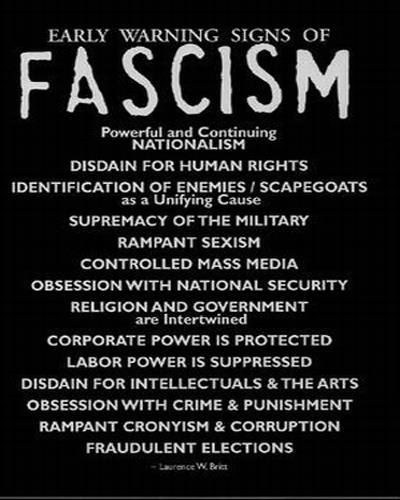
fascism1

By Carl Herman

Source: The Daily Censored

The ancient Greek historian, Polybius, celebrated the Roman republic of ~ 150 BC under its constitution with balance of powers among the Senate, two elected consuls, and the general citizens:

“Such being the power that each part has of hampering the others or co-operating with them, their union is adequate to all emergencies, so that it is impossible to find a better political system than this.”  – The Histories, Book VI, Section V: On the Roman Constitution at its Prime

Americans and people around the world were equally proud of the United States Constitution as “impossible to find a better political system than this.”

About 100 years after Polybius’ account, Rome’s republic had descended into oligarchic competition for power. Contemporary to Julius Caesar, the Roman historian and government insider Sallust blasted the decline of virtue in government:

“To those who had easily endured toils, dangers, and doubtful and difficult circumstances, ease and wealth, the objects of desire to others, became a burden and a trouble. At first the love of money, and then that of power, began to prevail, and these became, as it were, the sources of every evil. For avarice subverted honesty, integrity, and other honorable principles, and, in their stead, inculcated pride, inhumanity, contempt of religion, and general venality. Ambition prompted many to become deceitful; to keep one thing concealed in the breast, and another ready on the tongue; to estimate friendships and enmities, not by their worth, but according to interest; and to carry rather a specious countenance than an honest heart. These vices at first advanced but slowly, and were sometimes restrained by correction; but afterwards, when their infection had spread like a pestilence, the state was entirely changed, and the government, from being the most equitable and praiseworthy, became rapacious and insupportable.” – Conspiracy of Catiline, The Argument

The most prolific Roman historian, Livy, witnessed Rome’s transition into dictatorial empire with Augustus Caesar as first emperor. In his preface to address 700 years of Roman history:

“I have no doubt that the earliest origins and the immediately succeeding period will give less delight to the majority of readers who are hurrying to these recent times in which the might of a most powerful people has long been destroying itself.

… I shall seek this additional reward for my labor (recounting all Rome’s history) so that I may turn away from the contemplation of the evils that our age has seen for so many years.” – The History of Rome, Preface

Tacitus wrote ~ 100 AD, a century into empire. Emperors proclaimed to the public that their government still upheld the highest ideals of their Republic, claiming expanding empire was only and always in “self-defense.”

Emperor Domitian’s assassination in 96 AD (among ~22 murdered emperors), allowed Tacitus to write The Agricola, a biographical text of his father-in-law contrasting claimed virtue of Roman military and citizenry with the emperor’s utterly corrupt despotism.

Importantly, this text describes the problem of virtuous Romans within a psychopathic government. Tacitus describes Agricola attempting to uphold virtue; but without recognition of any evil in serving an expanding dictatorial empire. Tacitus seems to assume the ideal of mos maiorum, “custom/virtue of Roman forefathers” will eventually triumph over the evil of present “leadership.”

In Agricola’s campaign as military and political leader of Roman Britain to expand the empire to modern Scotland from 78 – 84 AD, Tacitus recorded a speech he attributes to Scottish rebel-leader, Calgacus, to voice how those of virtue characterized Roman empire under corrupt emperors:

“It is no use trying to escape their arrogance by submission or good behavior. Robbers of the world, having by universal plunder exhausted the land, their drive is greed. If the enemy be rich, they are rapacious; if poor, they lust for domination. Neither rule of the East nor West can satisfy them. Alone among men, they crave with equal eagerness poverty and riches. To plunder, slaughter, seize with false pretenses, they give the lying name ‘empire.’ And where nothing remains but a desert, they call that ‘peace.’ ” – Tacitus, The Agricola and the Germania (analyses herehere)

Roman imperialists called Calgacus and those who preferred independence from evil empire a name: barbarus. This is translated today as “barbarian,” but its context for using unconventional warfare to oppose the most powerful military in its day is better translated in today’s language with a different word:

Terrorist.

Indeed, Obama combines these terms to call ISIS “barbaric terrorists.”

American Founders created the US Constitution in light of Roman Republic design (herehere, among dozens), and aware previous republics had always self-destructed from corruption within their own nations. Among many of the Founders’ admonitions, James Madison was clear that citizen responsibility was essential to maintain a republic, no matter how well the Constitution was designed:

“A mere demarcation on parchment of the constitutional limits (of government) is not a sufficient guard against those encroachments which lead to a tyrannical concentration of all the powers of government in the same hands.”  – James Madison, Federalist Paper #48, 1788.

On September 18, 1787, just after signing the US Constitution, Benjamin Franklin met with members of the press. He was asked what kind of government America would have. Franklin warned: “A republic, if you can keep it.” In his speech to the Constitutional Convention, Franklin admonished: “This [U.S. Constitution] is likely to be administered for a course of years and then end in despotism… when the people shall become so corrupted as to need despotic government, being incapable of any other.”  – The Quotable Founding Fathers, pg. 39.

These warnings extend to all social science teachers of the present:

“As educators in the field of history–social science, we want our students to… understand the value, the importance, and the fragility of democratic institutions. We want them to realize that only a small fraction of the world’s population (now or in the past) has been fortunate enough to live under a democratic form of government.” – History-Social Science Framework for California Public Schools, pgs. 2, 7-8

US/UK/Israel today: Current Middle East armed attacks are proclaimed by US/UK/Israel “leaderships” as self-defense, just as Rome claimed. US “leaders” claim to uphold America’s highest ideals of freedom while removing almost all Constitutional Rights, as did Roman emperors. Corruption today, as in Rome, is rampant.

US/UK/Israel wars today are not even close to legal, and based on lies known to be false as they are told. Engaging in unlawful Wars of Aggression is the very opposite of a virtuous republic limited in power under its constitution. This is easy to verify for those with about an hour to look:

Solutions learned from the past applied to the present: Tacitus’ argument was to wait-out tyranny in confidence public virtue of past ideals would triumph.

Tacitus was wrong.

A stronger solution would be critical mass recognition by the public of corruption in an Emperor’s New Clothes analogy, arrests, and a clear forum for whistleblowers to disclose the full extent of corruption.

In today’s world of tragic-comic US/UK/Israel corrupt empire, I propose the solution of:

  • public demand for “leader” arrests. An arrest lawfully stops crimes.
  • Truth & Reconciliation to encourage criminal minions to become whistleblowers so we can best discover the extent of the crimes waged by the .01% upon the 99.99%.
  • With removed criminal oligarchs and corporate media who “covered” these crimes, we’d have honest opportunity for available economic solutions that would transform our beautiful, but historically dominated planet.

**

Note: I make all factual assertions as a National Board Certified Teacher of US Government, Economics, and History, with all economics factual claims receiving zero refutation since I began writing in 2008 among Advanced Placement Macroeconomics teachers on our discussion board, public audiences of these articles, and international conferences. I invite readers to empower their civic voices with the strongest comprehensive facts most important to building a brighter future. I challenge professionals, academics, and citizens to add their voices for the benefit of all Earth’s inhabitants.

**

Carl Herman is a National Board Certified Teacher of US Government, Economics, and History; also credentialed in Mathematics. He worked with both US political parties over 18 years and two UN Summits with the citizen’s lobby, RESULTS, for US domestic and foreign policy to end poverty. He can be reached at Carl_Herman@post.harvard.edu

Note: Examiner.com has blocked public access to my articles on their site (and from other whistleblowers), so some links in my previous work are blocked. If you’d like to search for those articles other sites may have republished, use words from the article title within the blocked link. Or, go to http://archive.org/web/, paste the expired link into the box, click “Browse history,” then click onto the screenshots of that page for each time it was screen-shot and uploaded to webarchive. I’ll update as “hobby time” allows; including my earliest work from 2009 to 2011 (blocked author pages: herehere).


No ‘Je Suis Charleston’?

Obama-sings-Amazing-Grace-poolvideo

The De-politicization of Black Oppression

By Ajamu Baraka

Source: Counterpunch

Where are the international marches of solidarity with African Americans? The statements from world leaders condemning the terrorist attack and calling on U.S. Authorities to crack down on the white nationalist terror networks developing in the U.S.? Where are the marches in white communities condemning racism and standing with black people? Why no ‘Je Suis Charleston’?

The fact that these questions are not being raised by most people speaks to the adroit way in which the propagandists of the U.S. state, with the corporate media in lockstep, successfully domesticated and depoliticized the murderous attack in Charleston, South Carolina.

First, President Obama, as the government’s chief propagandist, defined Dylann Roof, the white nationalist assailant, as a pathological, hateful loner who had easy access to guns. The words “terrorist” never crossed his lips or the lips of any other officials of the national government.

Then, the state and corporate media followed-up this framing with a fascinating slight-of-hand stunt: instead of focusing on the domestic security threat posed by violent, racist right-wing extremists groups in the country, the old trope of gun control – along with a new twist, removing the Confederate flag – became the new focus! The implication was that by removing the Confederate battle flag – a symbol of white supremacy and the defense of slavery – from public buildings (no one bothered to explain why, if this was the rationale for removing the Confederate flag, there would not be a discussion around the need to reject the national flag also), that would somehow move the country towards racial reconciliation, much like electing a black president was supposed to do.

The effectiveness of this propaganda effort paid off just a few days after the attack. The domestic and international press gave full coverage to the spate of “terrorist” attacks that took place in three different counties but missing from that coverage was any connection and mention of the terror attack in Charleston.

However, it was at the funeral of Rev Pinckney, the pastor of the Emanuel African Methodist Episcopal Church murdered by Dylann Roof, where the concluding act of the governments’ obscene efforts to co-opt and deflect the pain of the attack played to a world-wide audience. President Obama turned in one of his best performances of a life-time of performances for white supremacy. His eulogy was a masterful example of his special talent to embody an instrumentalist “blackness” while delivering up that blackness to the white supremacist, U.S. settler project. In his eulogy, he couched his narrative of “American exceptionalism” in the language of Christian religiosity that was indistinguishable from the proclamations of the religious right that sees the U.S. as a state bestowed with the grace of their God.

Obama sang ‘Amazing Grace’ and lulled into a stupefying silence black voices that should have demanded answers as to why the Charleston attack was not considered a terrorist attack, even though it fit the definition of domestic terrorism, or why the Obama Administration collaborated with suppressing the 2009 report from the Department of Homeland Security (DHS), which identified violent white supremacist groups as a threat to national security more lethal than the threat from Islamic ‘fundamentalists’.

Because of this threat and the depraved indifference to black life by the U.S. government, international attention and solidarity is critical for African Americans. Yet, by quickly deploying the Obama weapon – aligning the government with the victims of the attack but defining the attack as a domestic criminal act – the political space for international solidarity with the plight of African Americans was significantly reduced, at least in relationship to the Charleston attack.

There is another element of this story that compelled the Administration to get out in front of this issue. Obama needed to draw attention away from the fact that his Administration caved under the pressure from the “respectable” racist right-wingers in Congress who criticized the DHS report in 2009.

John Boehner, the leader of the House of Representatives, characterized the report as “Offensive and unacceptable.” According to Boehner, the Obama Administration should not be condemning “American citizens who disagree with the direction Washington Democrats are taking our nation.”

Instead of defending Secretary Napolitano and the report issued by her Department, or taking the opportunity provided by the report to educate the public on this internal threat, Obama threw Napolitano under the bus and the DHS pulled the report from its website. The unit responsible for monitoring white supremacist organizations and movements was dismantled, and the threat of white supremacist violence becoming the victim of Washington politics.

This is the mindset and the politics of this Administration and the political culture in the U.S., where the differential value placed on black life allows black life to be reduced to an instrumental calculation when considering issues of international public relations and domestic politics.

The result?

For all intents and purposes, the tragedy in Charleston is over, closed out on a song written by a captain on a slave ship in 1779 and sung over 200 years later by a black man still in the service of white supremacy.

Ajamu Baraka is interviewed in Episode 3 of CounterPunch Radio, available for free here.

Ajamu Baraka is a human rights activist, organizer and geo-political analyst. Baraka is an Associate Fellow at the Institute for Policy Studies (IPS) in Washington, D.C. and editor and contributing columnist for the Black Agenda Report. He is a contributor to “Killing Trayvons: An Anthology of American Violence” (Counterpunch Books, 2014). He can be reached at www.AjamuBaraka.com


There are No Easy Solutions for White Terrorism


White Christians are not termed terrorists by media

By Jason Lee Byas

Source: Center for a Stateless Society

On June 17th, a white man named Dylann Roof murdered nine black members of the Emanuel African Methodist Episcopal Church (EAME). I mention race because it was not a coincidence – this was an act of terrorism in the service of white supremacy.

Understandably, people are scrambling for an easy solution, and most proposals involve some show of state force. Unfortunately, the reality is that there are no easy solutions, and most suggestions would only make things worse.

For example, many have used the shooting to push for stronger gun control measures. This is a non-starter.

Roof’s bloodbath was less than ten miles away from where white police officer Michael Slager shot Walter Scott, a black man who was running away. Slager’s case is unique in that we actually know about it, and that he was actually charged. Police kill countless Americans every year, and blacks are most likely to be their victims.

Black people — not just in Charleston, but throughout the United States — experience the police as occupiers, not protectors. Centralizing firearm ownership in the hands of the police will not protect people of color, because the police are the exact group most likely to terrorize people of color.

Furthermore, the actual effect of gun control laws has been to incarcerate black Americansat a rate more disproportionate than any other federal statute, including drug-related offenses. It is not just that gun control leaves disadvantaged communities dependent upon those most likely to terrorize them. Gun control itself is often the pretext of that terrorism.

Many who resist calls for gun control instead point to “doing something” about mental illness. This convenient narrative forgets that people deemed mentally ill are far more likely to be victims of violence, not perpetrators.

It also forgets that Roof’s problems were ideological, not psychological. Instead of just shrugging and saying “you can’t fix crazy,” we should confront Roof’s actual motive, white supremacy.

Finally, there is one almost universally endorsed response to Roof’s crime: his punishment. Some have also urged South Carolina to enact hate crime legislation, so that future Dylann Roofs can be punished even more harshly.

This, too, will only make things worse. No one will be made better off by Roof’s punishment, and the punitive focus of our legal system will rob survivors and victims’ loved ones of what restitution and restoration could have been made instead.

In Roof’s case, survivors and victims’ loved ones have publicly forgiven him, pleading that he repent. That is their desire. Our legal system’s desire, by contrast, is the satisfaction of public bloodlust.

If we are truly interested in fighting racism and violence against marginalized populations, punishment — and its expansion through hate crime legislation — is extremely counterproductive. The same groups “protected” by these statutes are the ones most likely to be harmed.

This is why the Sylvia Rivera Law Project (which specializes in protecting transgender and gender non-conforming people) staunchly opposes hate crime laws. As their powerful statement explains:

[H]ate crime laws … expand and increase the power of the … criminal punishment system. Evidence demonstrates that hate crime legislation, like other criminal punishment legislation, is used unequally and improperly against communities that are already marginalized in our society. These laws increase the already staggering incarceration rates of people of color, poor people, queer people and transgender people based on a system that is inherently and deeply corrupt.

By saying that there are no easy solutions, I am not saying that there are no solutions. The point isn’t “do nothing,” and it isn’t “wait around until we have a justice system based on restitution and restoration.”

What we should do instead is develop solutions from below, and step out of the way so those solutions can take effect. EAME, and other black churches like it, have historically been one such solution. They facilitated black self-empowerment, and in 1822, EAME’s founder even plotted a slave revolt.

The response of the white community was to burn down EAME. EAME’s response was to rebuild.

Now, the black community must rebuild again. White Americans must now work to ensure they don’t burn down those rebuilding efforts.

Many black Americans, such as the Huey P. Newton Gun Club, have begun to arm themselves for protection. When our white-dominated government seeks to burn that down by disarming them, it must be stopped.

Beyond just getting out of the way, white Americans must also work to question their own racism and the racism of their white peers.

None of these solutions are quick, and none of them are easy. But they are also the ones that will actually work.

US War on ISIS a Trojan Horse

obama-isis-cia

In America’s coming war, don’t be surprised if everything in Syria is destroyed except ISIS.

By Ulson Gunnar

Source: Land Destroyer Report

In August of 2013, even as the words came out of US President Barack Obama’s mouth regarding an “impending” US military strike against the Syrian state, the impotence of American foreign policy loomed over him and those who wrote his speech for him like an insurmountable wall.  So absurd was America’s attempt to once again use the canard of “weapons of mass destruction” to justify yet another military intervention, that many believed America’s proxy war in Syria had finally reached its end.

The counterstroke by Russia included Syria’s immediate and unconditional surrendering of its chemical weapons arsenal, and with that, so evaporated America’s casus belli.

Few would believe if one told them then, that in 2015, that same discredited US would be routinely bombing Syrian territory and poised to justify the raising of an entire army of terrorists to wage war within Syria’s borders, yet that is precisely what is happening. President Obama has announced plans to formally increase military force in Iraq and Syria “against ISIS,” but of course includes building up huge armies of “rebels” who by all other accounts are as bad as ISIS itself (not to mention prone to joining ISIS’ ranks by the thousands).

All it took for this miraculous turn in fortune was the creation of “ISIS,” and serial provocations committed by these Hollywood-style villains seemingly engineered to reinvigorate America’s justification to militarily intervene more directly in a war it itself started in Syria beginning in 2011.

ISIS could not be a more effective part of America’s plans to overthrow the Syrian government and destroy the Syrian state if it had an office at the Pentagon.

Having failed to achieve any of its objectives in Syria, it inexplicably “invaded” Iraq, affording the US military a means of “easing into” the conflict by first confronting ISIS in Iraq, then following them back across the border into Syria. When this scheme began to lose its impact on public perception, ISIS first started executing Western hostages including several Americans. When the US needed the French on board, ISIS executed a Frenchman. When the US needed greater support in Asia, two Japanese were beheaded. And just ahead of President Obama’s recent attempt to formally authorize the use of military force against “ISIS,” a Jordanian pilot was apparently burned to death in a cage in an unprecedented act of barbarity that shocked even the most apathetic.

The theatrics of ISIS parallel those seen in a Hollywood production. This doesn’t mean ISIS didn’t really burn to death a Jordanian pilot or behead scores of hostages. But it does mean that a tremendous amount of resources and planning were put into each murder, except apparently, the effect it would have of rallying the world behind the US and its otherwise hopelessly stalled efforts to overturn the government of Syria.

Could ISIS have built a set specifically to capture dramatic shots like a flame trail passing the camera on its way to the doomed Jordanian pilot, planned crane shots, provided matching uniforms for all the extras on their diabolical movie set, but failed to consider the target audience and how they would react to their production? Could they have, just by coincidence, given exactly what the United States needed to continue its war on Syria in 2015 when it otherwise had effectively failed in 2013?

The answer is obviously no. ISIS’s theatrics were designed specifically to accomplish this. ISIS itself is a fictional creation. In reality the legions of terrorists fighting across the Arab World under the flag of “ISIS” are the same Al Qaeda militants the US, Saudi Arabia and others in an utterly unholy axis have been backing, arming and exploiting in a variety of ways for decades.

Just as the “Islamic State” in Iraq was exposed as a fictional cover for what was also essentially Al Qaeda (as reported by the NYT in their article, “Leader of Al Qaeda group in Iraq was fictional, U.S. military says“), ISIS too is just the latest and greatest re-visioning yet.

The fighters are real. Their atrocities are real. The notion that they’ve sprung out of the dunes of Syria and Iraq, picked their weapons from local date trees and have managed to wage war regionally against several collective armies is entirely fantasy. Required to maintain ISIS’ ranks would be billions in constant support. These are billions ISIS simply cannot account for from hostage ransoms and black market oil alone. The only source that could prop ISIS up for as long as it has allegedly existed and to the extent it allegedly exists, is a state or collection of states intentionally sponsoring the terrorist enterprise.

Those states are of course the chief benefactors of ISIS’ atrocities, and we can clearly see those benefactors are the US and its partners both in Europe and in the Middle East. The US would claim that the threat of ISIS necessitates them to intervene militarily in Syria (when lies about WMDs were flatly rejected by the American and international public). Of course, before the serial headline atrocities ISIS committed, the US attempted to sell this same lie but without affect. Now that sufficient blood has been split and the public sufficiently riled, the US is once again trying to move forward its agenda.

Don’t be surprised, if the US manages to succeed, that everything in Syria is left destroyed except for ISIS. A Hollywood villain this popular and effective is surely destined for a sequel in neighboring Iran or southern Russia, coincidentally where the US would like to create strife and carnage the most.

Ulson Gunnar, a New York-based geopolitical analyst and writer especially for the online magazine “New Eastern Outlook”.