Israel is committing an epic war crime with US backing and arms

Where is the U.S. peace movement and the U.S. public outrage?

Image Credit: AFP

By Dave Lindorff

Source: Nation of Change

When the U.S. was bombing levees and hospitals in North Vietnam, peasants in Laos and burning villages in South Vietnam, herding those not killed in the process into “strategic hamlets,” Americans took to the streets en masse, occupied the Pentagon mall, brought central Washington D.C. to a standstill, and broke into an FBI office stealing the records of Cointelpro disruption and spying and into a draft ward destroying the records of potential draftees.

When U.S. military “trainers” helped massacre and slaughter peasant guerrillas and their urban supporters fighting a brutal dictatorship in El Salvador, and the Pentagon was running a proxy war against the revolutionary government in Nicaragua, masses of Americans, even in the absence of a draft and of US deaths, rose to the occasion to massively oppose U.S. intervention in those countries’ internal conflicts.  Even in 2003 when America was preparing to invade Iraq, claiming it was making or hiding weapons of mass destruction, chemical or even nuclear, Americans in record numbers turnout out in Washington to oppose going to war. (It didn’t work, but at least they turned out to protest war.)

Now when America is basically bankrolling and arming Israel as it prepares to commit a massive war crime, collectively punishing and killing ordinary Palestinians trapped in the open-air prison of Gaza. When the Israeli ‘Defense’ Force (IDF)  is giving the 1.1 million Palestinians living in the northern 12-mile-long and 7-mile-wide half of the walled-off enclave 24 hours to relocate themselves to the southern half of the strip or face the full destructive force of an all-out  IDF air and ground attack and invasion of the north—an impossible challenge. When Israel has cut off all supplies of food, medicine, water (in a desert!), electricity, and oil for the enclaves on rickety power plant, already for a week, the protests by Americans have been anemic, and have largely been by specifically pro-Palestinian groups, not by what is left of the once large and broad peace movement.

It is a shameful moment. While a few left-leaning progressive Democratic members of Congress like Reps AOC and Ilhan Omar have denounced Israel’s war crime of collective punishment and U.S. support for it, there is actually more criticism of Israel and of U.S. military aid to that country coming from Republicans than Democrats, (though they aren’t talking about the war crimes, since Republicans favor those tactics in other circumstances). The truth is, one of the arguments being used by Democrats to convince House Republicans to get their shit together and elect a House speaker is so they can pass legislation in that chamber to allow the U.S. to give Israel (and Ukraine) even more military aid.

And still, no burgeoning, blooming peace movement.

The U.S. may not be technically at war, but the U.S. war machine is everywhere, on every continent, in every ocean, its military budget, way over $1 trillion a year when everything is counted, bigger than it was in constant dollars than at the height of the Vietnam War when 500.000 U.S. troops were in that country fighting, dying (and losing) a hot war. But its special forces, its arms merchants of death, and its military “trainers” are busy stirring up and supporting local conflicts and pouring oil on fires like those blazing in Ukraine, Yemen, Gaza, Syria, Niger, Haiti, and elsewhere, while also making trouble off the coast of China, on the Korean peninsula (where it still has troops based and has had since 1950, and in Eastern Europe and the Baltic Sea.

Where is the public anger? Where is the organized protest against this warmongering permanent government in Washington, D.C.?

Americans are mad at Washington to be sure, correctly perceiving that it is corrupt and rotten to the core They know it ignores popular calls for taxes on the rich, for a well funded Social Security system that will pay livable retirement benefits as promised to all retirees into the foreseeable future, instead of facing drastic cuts in a decade or sooner, a medical system that doesn’t drive us into bankruptcy when we get sick, that gives everyone access to care they can afford and doesn’t give mega profits to private insurers and hospital executives, good public schools for our kids, affordable public colleges, an end to debt enslavement, police who are social servants not fear-inspiring centurions, clean air and water, and action of preventing a climate emergency. But too many of us don’t grasp that none of those things that huge majorities of us want will happen as long as the leaders in Washington, almost all of them bought and owned by large corporate and financial interests and the rich, are enamored of weapons, wars and militarism.

We need a focused campaign to use all available means to educate the American public to a common-sense reality: you cannot have guns and butter. And you can’t eat guns.

As a  Vietnam War Era war resister and protester I’m disgusted. How can we U.S. Americans be accepting that almost all the income tax we pay each year (including income taxes on our Social Security benefits for gods’ sakes!) goes straight to funding the Pentagon and America’s endless wars and proxy wars, with the rest of federal government operations being funded using borrowed money– loans that we the taxpayers have to then pay five percent or more  in interest on every year. In the end it’s all because of the military budgets.

Get it?

It’s time to take that to the streets.

A good place to start would be demanding that the U.S. stop propping up the intransigent, apartheid, fake democracy of Israel and demand that it stop its collective punishment of 2.3 million Gazan Palestinians. For once, the U.S. should try to solve an international crisis by taking action to de-escalate conflict instead of pouring oil on the fire by mindlessly offering more weapons and ammunition.

If that approach works there, our troglodyte leaders should try the same thing with the Ukraine/Russia conflict.

Fiscal Insanity: The Government Borrows $6 Billion a Day, and We’re Stuck with the Bill

By John & Nisha Whitehead

Source: The Rutherford Institute

We’re not living the American dream.

We’re living a financial nightmare.

The U.S. government is funding its existence with a credit card.

The government—and that includes the current administration—is spending money it doesn’t have on programs it can’t afford, and “we the taxpayers” are the ones being forced to foot the bill for the government’s fiscal insanity.

According to the number crunchers with the Committee for a Responsible Federal Budget, the government is borrowing roughly $6 billion a day.

As the Editorial Board for the Washington Post warns:

“The nation has reached a hazardous moment where what it owes, as a percentage of the total size of the economy, is the highest since World War II. If nothing changes, the United States will soon be in an uncharted scenario that weakens its national security, imperils its ability to invest in the future, unfairly burdens generations to come, and will require cuts to critical programs such as Social Security and Medicare. It is not a future anyone wants.

Let’s talk numbers, shall we?

The national debt (the amount the federal government has borrowed over the years and must pay back) is $31 trillion and will grow another $19 trillion by 2033. That translates to roughly $246,000 per taxpayer or $94,000 for every single person in the country.

The bulk of that debt has been amassed over the past two decades, thanks in large part to the fiscal shenanigans of four presidents, 10 sessions of Congress and two wars.

It’s estimated that the amount this country owes is now 130% greater than its gross domestic product (all the products and services produced in one year by labor and property supplied by the citizens).

In other words, the government is spending more than it brings in.

The U.S. ranks as the 12th most indebted nation in the world, with much of that debt owed to the Federal Reserve, large investment funds and foreign governments, namely, Japan and China.

Interest payments on the national debt are estimated to top $395 billion this year, which is significantly more than the government spends on veterans’ benefits and services, and according to Pew Research Center, more than it will spend on elementary and secondary education, disaster relief, agriculture, science and space programs, foreign aid, and natural resources and environmental protection combined.

According to the Committee for a Reasonable Federal Budget, the interest we’ve paid on this borrowed money is “nearly twice what the federal government will spend on transportation infrastructure, over four times as much as it will spend on K-12 education, almost four times what it will spend on housing, and over eight times what it will spend on science, space, and technology.”

In ten years, those interest payments will exceed our entire military budget.

This is financial tyranny.

We’ve been sold a bill of goods by politicians promising to pay down the national debt, jumpstart the economy, rebuild our infrastructure, secure our borders, ensure our security, and make us all healthy, wealthy and happy.

None of that has come to pass, and yet we’re still being loaded down with debt not of our own making while the government remains unrepentant, unfazed and undeterred in its wanton spending.

Indeed, the national deficit (the difference between what the government spends and the revenue it takes in) remains at more than $1.5 trillion.

If Americans managed their personal finances the way the government mismanages the nation’s finances, we’d all be in debtors’ prison by now.

Despite the government propaganda being peddled by the politicians and news media, however, the government isn’t spending our tax dollars to make our lives better.

We’re being robbed blind so the governmental elite can get richer.

In the eyes of the government, “we the people, the voters, the consumers, and the taxpayers” are little more than pocketbooks waiting to be picked.

“We the people” have become the new, permanent underclass in America.

Consider: The government can seize your home and your car (which you’ve bought and paid for) over nonpayment of taxes. Government agents can freeze and seize your bank accounts and other valuables if they merely “suspect” wrongdoing. And the IRS insists on getting the first cut of your salary to pay for government programs over which you have no say.

We have no real say in how the government runs, or how our taxpayer funds are used, but we’re being forced to pay through the nose, anyhow.

We have no real say, but that doesn’t prevent the government from fleecing us at every turn and forcing us to pay for endless wars that do more to fund the military industrial complex than protect us, pork barrel projects that produce little to nothing, and a police state that serves only to imprison us within its walls.

If you have no choice, no voice, and no real options when it comes to the government’s claims on your property and your money, you’re not free.

It wasn’t always this way, of course.

Early Americans went to war over the inalienable rights described by philosopher John Locke as the natural rights of life, liberty and property.

It didn’t take long, however—a hundred years, in fact—before the American government was laying claim to the citizenry’s property by levying taxes to pay for the Civil War. As the New York Times reports, “Widespread resistance led to its repeal in 1872.”

Determined to claim some of the citizenry’s wealth for its own uses, the government reinstituted the income tax in 1894. Charles Pollock challenged the tax as unconstitutional, and the U.S. Supreme Court ruled in his favor. Pollock’s victory was relatively short-lived. Members of Congress—united in their determination to tax the American people’s income—worked together to adopt a constitutional amendment to overrule the Pollock decision.

On the eve of World War I, in 1913, Congress instituted a permanent income tax by way of the 16th Amendment to the Constitution and the Revenue Act of 1913. Under the Revenue Act, individuals with income exceeding $3,000 could be taxed starting at 1% up to 7% for incomes exceeding $500,000.

It’s all gone downhill from there.

Unsurprisingly, the government has used its tax powers to advance its own imperialistic agendas and the courts have repeatedly upheld the government’s power to penalize or jail those who refused to pay their taxes.

While we’re struggling to get by, and making tough decisions about how to spend what little money actually makes it into our pockets after the federal, state and local governments take their share (this doesn’t include the stealth taxes imposed through tolls, fines and other fiscal penalties), the government continues to do whatever it likes—levy taxes, rack up debt, spend outrageously and irresponsibly—with little thought for the plight of its citizens.

To top it all off, all of those wars the U.S. is so eager to fight abroad are being waged with borrowed funds. As The Atlantic reports, “U.S. leaders are essentially bankrolling the wars with debt, in the form of purchases of U.S. Treasury bonds by U.S.-based entities like pension funds and state and local governments, and by countries like China and Japan.”

Of course, we’re the ones who have to repay that borrowed debt.

For instance, American taxpayers have been forced to shell out more than $5.6 trillion since 9/11 for the military industrial complex’s costly, endless so-called “war on terrorism.” That translates to roughly $23,000 per taxpayer to wage wars abroad, occupy foreign countries, provide financial aid to foreign allies, and fill the pockets of defense contractors and grease the hands of corrupt foreign dignitaries.

Mind you, that’s only a portion of what the Pentagon spends on America’s military empire.

The United States also spends more on foreign aid than any other nation, with nearly $300 billion disbursed over a five-year period. More than 150 countries around the world receive U.S. taxpayer-funded assistance, with most of the funds going to the Middle East, Africa and Asia. That price tag keeps growing, too.

As Forbes reports, “U.S. foreign aid dwarfs the federal funds spent by 48 out of 50 state governments annually. Only the state governments of California and New York spent more federal funds than what the U.S. sent abroad each year to foreign countries.”

Most recently, the U.S. has allocated nearly $115 billion in emergency military and humanitarian aid for Ukraine since the start of the Russia invasion.

As Dwight D. Eisenhower warned in a 1953 speech, this is how the military industrial complex continues to get richer, while the American taxpayer is forced to pay for programs that do little to enhance our lives, ensure our happiness and well-being, or secure our freedoms.

This is no way of life.

Yet it’s not just the government’s endless wars that are bleeding us dry.

We’re also being forced to shell out money for surveillance systems to track our movements, money to further militarize our already militarized police, money to allow the government to raid our homes and bank accounts, money to fund schools where our kids learn nothing about freedom and everything about how to comply, and on and on.

There was a time in our history when our forebears said “enough is enough” and stopped paying their taxes to what they considered an illegitimate government. They stood their ground and refused to support a system that was slowly choking out any attempts at self-governance, and which refused to be held accountable for its crimes against the people. Their resistance sowed the seeds for the revolution that would follow.

Unfortunately, in the 200-plus years since we established our own government, we’ve let bankers, turncoats and number-crunching bureaucrats muddy the waters and pilfer the accounts to such an extent that we’re back where we started.

Once again, we’ve got a despotic regime with an imperial ruler doing as they please.

Once again, we’ve got a judicial system insisting we have no rights under a government which demands that the people march in lockstep with its dictates.

And once again, we’ve got to decide whether we’ll keep marching or break stride and make a turn toward freedom.

But what if we didn’t just pull out our pocketbooks and pony up to the federal government’s outrageous demands for more money?

What if we didn’t just dutifully line up to drop our hard-earned dollars into the collection bucket, no questions asked about how it will be spent?

What if, instead of quietly sending in our tax checks, hoping vainly for some meager return, we did a little calculating of our own and started deducting from our taxes those programs that we refuse to support?

As I make clear in my book Battlefield America: The War on the American People and in its fictional counterpart The Erik Blair Diaries, if we don’t have the right to decide what happens to our hard-earned cash, then we don’t have any rights at all.

Why Don’t Billionaires Pay the Same High Tax Rates the Rest of Us Pay?

By Charles Hugh Smith

Source: Of Two Minds

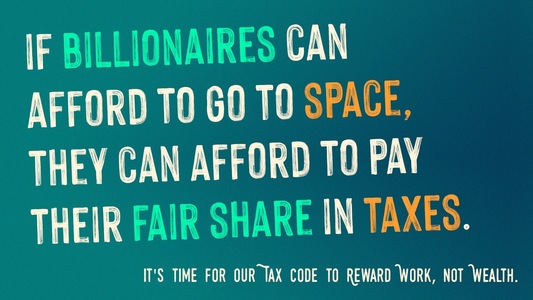
The truth is America has lost its way if commoners pay a rate of 40% but its billionaires pay next to nothing.

As with everything else in polarized America, billionaires proclaiming space tourism is the next big thing for humanity neatly divides opinion into two camps: those who laud the initiative, hard work and innovations of the billionaires as examples of the American Can-Do Dream, and those who wished the billionaire space tourists had taken a one-way flight to a distant orbit of blissful silence.

Setting aside that bitter divide, let’s explore another divide: how our two-tier tax system enables billionaires to become billionaires while the rest of us get poorer. Whenever I discuss the taxes of the non-billionaire self-employed, armies of apologists leap to the defense of the status quo with various quibbles: the 0.9% Medicare surcharge only kicks in above $200,000, the cap on Social Security taxes is $142,800, and so on.

Setting aside the quibbles–and recall the tax code with regulatory notes is thousands of pages–let’s deal with the real issue, which is that billionaires and their corporations pay a thin slice of taxes as a percentage of total income/gains if they pay any at all, while self-employed and small business pay extraordinarily high tax rates.

To all the quibblers: please add the 15.3% Social Security/Medicare tax rate (self-employed / sole proprietors pay both the employee and employer share of this tax) to the federal tax rate of 24% for income above $85,520. It’s 39.3%.

Just how hard would it be to conclude that everyone earning more than $142,000 should pay at least the same rate the rest of us pay? Aren’t we demonstrating all those same laudable traits of the billionaires, just on a smaller scale? Why should we pay 40% and the billionaires pay essentially zero?

Gee, do you reckon paying no taxes might help folks become richer? Garsh, nobody ever asked that question before. And do you reckon paying 40% of your income might make you poorer over time? Golly gee, how come the talking heads worshiping the billionaires never ask these questions?

Since Social Security and Medicare/Medicaid are the bedrock of America’s social safety net, why shouldn’t billionaires pay to support these programs? Well, why not? Just how lame do the excuses have to be to be recognized as laughably self-serving?

Here’s the trick billionaires use to evade taxes. There are countless ways for the super-wealthy to evade taxes–funnel earnings through an Irish post office box, buy a tax break in Washington DC, slide the money into one of dozens of global tax havens, and so on.

But a simple one is to report no income and live large off borrowed money. As the billions of dollars in capital gains pile up as the billionaire’s stock holdings soar (thanks, Federal Reserve, for the free trillions; awful swell of you to give us all that free money), there’s no income generated until the billionaire sells some shares. No sale, no income. Just pay yourself $1 a year in salary, borrow against your billions at super-low rates of interest, and voila, you’re tax-free while you build your super-yacht, buy your private island, and so on.

Just as a thought experiment, suppose the first $50,000 in earnings for everyone were tax-free, and a 40% tax rate was collected on all income above $1 million, both earned and unearned (capital gains), not when the gains were realized in a sale but at the end of every tax year, whether the shares that rose in value were sold or not.

So Billionaire Space Tourist reaped $10 billion in capital gains from the appreciation of stocks held, then the Billionaire pays 40% of those gains: $4 billion. There is a way to not pay any taxes on capital gains–have your portfolio lose value. No gains, no taxes. And to close all the loopholes, the tax rate is on all assets and income connected in any way, shape or form with the U.S. First they pay the U.S. taxes, then if they want to pay other nations’ taxes as well, be my guest. But the 40% is due and payable regardless of any other conditions.

You don’t like it, then stop selling any products in the U.S. or holding any assets in the U.S. Why should billionaires get to set up immensely profitable monopolies, quasi-monopolies, cartels and corporations in the U.S. but pay near-zero in taxes? Why should billionaires be free to profit from America’s economy but pay nothing to support its citizenry?

What precisely is the logic of reducing taxes on the wealthiest few to near-zero? If there is no logic, then we’re left with corruption: America is a moral cesspool.

The truth is America has lost its way if commoners pay a rate of 40% but its billionaires pay next to nothing. Please note Karma and Divine Retribution are not controlled by the billionaire’s lackeys and apparatchiks in the Federal Reserve. The pendulum of exploitation has reached its extreme, and the reversal to the opposite extreme is underway.

The Looming Financial Nightmare: So Much for Living the American Dream

By John W. Whitehead

Source: The Rutherford Institute

“When plunder becomes a way of life for a group of men in a society, over the course of time they create for themselves a legal system that authorizes it and a moral code that glorifies it.” ― Frédéric Bastiat, French economist

Let’s talk numbers, shall we?

The national debt (the amount the federal government has borrowed over the years and must pay back) is $23 trillion and growing.

The amount this country owes is now greater than its gross national product (all the products and services produced in one year by labor and property supplied by the citizens). We’re paying more than $270 billion just in interest on that public debt annually. And the top two foreign countries who “own” our debt are China and Japan.

The national deficit (the difference between what the government spends and the revenue it takes in) is projected to surpass $1 trillion every year for the next 10 years.

The United States spends more on foreign aid than any other nation ($50 billion in 2017 alone). More than 150 countries around the world receive U.S. taxpayer-funded assistance, with most of the funds going to the Middle East, Africa and Asia.

Meanwhile, almost 60% of Americans are so financially strapped that they don’t have even $500 in savings and nothing whatsoever put away for retirement, and yet they are being forced to pay for government programs that do little to enhance or advance their lives.

Folks, if you haven’t figured it out yet, we’re not living the American dream.

We’re living a financial nightmare.

The U.S. government—and that includes the current administration—is spending money it doesn’t have on programs it can’t afford, and “we the taxpayers” are the ones who will pay for it.

As financial analyst Kristin Tate explains, “When the government has its debt bill come due, all of us will be on the hook.” It’s happened before: during the European debt crisis, Cypress seized private funds from its citizens’ bank accounts to cover its debts, with those who had been careful to save their pennies forced to relinquish between 40% to 60% of their assets.

Could it happen here? Could the government actually seize private funds for its own gain?

Look around you. It’s already happening.

In the eyes of the government, “we the people, the voters, the consumers, and the taxpayers” are little more than pocketbooks waiting to be picked.

Consider: The government can seize your home and your car (which you’ve bought and paid for) over nonpayment of taxes. Government agents can freeze and seize your bank accounts and other valuables if they merely “suspect” wrongdoing. And the IRS insists on getting the first cut of your salary to pay for government programs over which you have no say.

We have no real say in how the government runs, or how our taxpayer funds are used, but we’re being forced to pay through the nose, anyhow.

We have no real say, but that doesn’t prevent the government from fleecing us at every turn and forcing us to pay for endless wars that do more to fund the military industrial complex than protect us, pork barrel projects that produce little to nothing, and a police state that serves only to imprison us within its walls.

If you have no choice, no voice, and no real options when it comes to the government’s claims on your property and your money, you’re not free.

It wasn’t always this way, of course.

Early Americans went to war over the inalienable rights described by philosopher John Locke as the natural rights of life, liberty and property.

It didn’t take long, however—a hundred years, in fact—before the American government was laying claim to the citizenry’s property by levying taxes to pay for the Civil War. As the New York Times reports, “Widespread resistance led to its repeal in 1872.”

Determined to claim some of the citizenry’s wealth for its own uses, the government reinstituted the income tax in 1894. Charles Pollock challenged the tax as unconstitutional, and the U.S. Supreme Court ruled in his favor. Pollock’s victory was relatively short-lived. Members of Congress—united in their determination to tax the American people’s income—worked together to adopt a constitutional amendment to overrule the Pollock decision.

On the eve of World War I, in 1913, Congress instituted a permanent income tax by way of the 16th Amendment to the Constitution and the Revenue Act of 1913. Under the Revenue Act, individuals with income exceeding $3,000 could be taxed starting at 1% up to 7% for incomes exceeding $500,000.

It’s all gone downhill from there.

Unsurprisingly, the government has used its tax powers to advance its own imperialistic agendas and the courts have repeatedly upheld the government’s power to penalize or jail those who refused to pay their taxes.

Irwin A. Schiff was one of the nation’s most vocal tax protesters. He spent a good portion of his life arguing that the income tax was unconstitutional, and he put his wallet where his conscience was: Schiff stopped paying federal taxes in 1974.

Schiff paid the price for his resistance, too: he served three separate prison terms (more than 10 years in all) over his refusal to pay taxes. He died at the age of 87 serving a 14-year prison term. As constitutional activist Robert L. Schulz noted in Schiff’s obituary, “In a society where there is so much fear of government, and in particular of the I.R.S., [Schiff] was probably the most influential educator regarding the illegal and unconstitutional operation and enforcement of the Internal Revenue Code. It’s very hard to speak to power, but he did, and he paid a very heavy price.”

It’s still hard to speak to power, and those who do are still paying a very heavy price.

All the while the government continues to do whatever it likes—levy taxes, rack up debt, spend outrageously and irresponsibly—with little thought for the plight of its citizens.

To top it all off, all of those wars the U.S. is so eager to fight abroad are being waged with borrowed funds. As The Atlantic reports, “For 15 years now, the United States has been putting these wars on a credit card… U.S. leaders are essentially bankrolling the wars with debt, in the form of purchases of U.S. Treasury bonds by U.S.-based entities like pension funds and state and local governments, and by countries like China and Japan.”

If Americans managed their personal finances the way the government mismanages the nation’s finances, we’d all be in debtors’ prison by now.

Still, the government remains unrepentant, unfazed and undeterred in its money grabs.

While we’re struggling to get by, and making tough decisions about how to spend what little money actually makes it into our pockets after the federal, state and local governments take their share (this doesn’t include the stealth taxes imposed through tolls, fines and other fiscal penalties), the police state is spending our hard-earned tax dollars to further entrench its powers and entrap its citizens.

For instance, American taxpayers have been forced to shell out more than $5.6 trillion since 9/11 for the military industrial complex’s costly, endless so-called “war on terrorism.”

That translates to roughly $23,000 per taxpayer to wage wars abroad, occupy foreign countries, provide financial aid to foreign allies, and fill the pockets of defense contractors and grease the hands of corrupt foreign dignitaries.

Mind you, that staggering $6 trillion is only a portion of what the Pentagon spends on America’s military empire.

That price tag keeps growing, too.

In this way, the military industrial complex will get even richer, and the American taxpayer will be forced to shell out even more funds for programs that do little to enhance our lives, ensure our happiness and well-being, or secure our freedoms.

As Dwight D. Eisenhower warned in a 1953 speech:

Every gun that is made, every warship launched, every rocket fired signifies, in the final sense, a theft from those who hunger and are not fed, those who are cold and are not clothed. This world in arms is not spending money alone. It is spending the sweat of its laborers, the genius of its scientists, the hopes of its children. The cost of one modern heavy bomber is this: a modern brick school in more than 30 cities. It is two electric power plants, each serving a town of 60,000 population. It is two fine, fully equipped hospitals. It is some fifty miles of concrete pavement. We pay for a single fighter plane with a half million bushels of wheat. We pay for a single destroyer with new homes that could have housed more than 8,000 people. This is, I repeat, the best way of life to be found on the road the world has been taking. This is not a way of life at all, in any true sense. Under the cloud of threatening war, it is humanity hanging from a cross of iron. […] Is there no other way the world may live?

This is still no way of life.

Yet it’s not just the government’s endless wars that are bleeding us dry.

We’re also being forced to shell out money for surveillance systems to track our movements, money to further militarize our already militarized police, money to allow the government to raid our homes and bank accounts, money to fund schools where our kids learn nothing about freedom and everything about how to comply, and on and on.

Are you getting the picture yet?

The government isn’t taking our money to make our lives better. Just take a look at the nation’s failing infrastructure, and you’ll see how little is being spent on programs that advance the common good.

We’re being robbed blind so the governmental elite can get richer.

This is nothing less than financial tyranny.

“We the people” have become the new, permanent underclass in America.

It’s tempting to say that there’s little we can do about it, except that’s not quite accurate.

There are a few things we can do (demand transparency, reject cronyism and graft, insist on fair pricing and honest accounting methods, call a halt to incentive-driven government programs that prioritize profits over people), but it will require that “we the people” stop playing politics and stand united against the politicians and corporate interests who have turned our government and economy into a pay-to-play exercise in fascism.

We’ve become so invested in identity politics that label us based on our political leanings that we’ve lost sight of the one label that unites us: we’re all Americans.

The powers-that-be want to pit us against one another. They want us to adopt an “us versus them” mindset that keeps us powerless and divided.

Trust me, the only “us versus them” that matters anymore is “we the people” against the police state.

We’re all in the same boat, folks, and there’s only one real life preserver: that’s the Constitution and the Bill of Rights.

The Constitution starts with those three powerful words: “We the people.”

The message is this: there is power in our numbers.

That remains our greatest strength in the face of a governmental elite that continues to ride roughshod over the populace. It remains our greatest defense against a government that has claimed for itself unlimited power over the purse (taxpayer funds) and the sword (military might).

This holds true whether you’re talking about health care, war spending, or the American police state.


While we’re on the subject, do me a favor and don’t let yourself be fooled into believing that the next crop of political saviors will be any different from their predecessors. They all talk big when they’re running for office, and when they get elected, they spend big at our expense.

As I make clear in my book Battlefield America: The War on the American People, this is how the middle classes, who fuel the nation’s economy and fund the government’s programs, get screwed repeatedly.

George Harrison, who would have been 77 this year, summed up this outrageous state of affairs in his song Taxman:

If you drive a car, I’ll tax the street,

If you try to sit, I’ll tax your seat.

If you get too cold I’ll tax the heat,

If you take a walk, I’ll tax your feet.

Don’t ask me what I want it for

If you don’t want to pay some more

‘Cause I’m the taxman, yeah, I’m the taxman.

Now my advice for those who die

Declare the pennies on your eyes

‘Cause I’m the taxman, yeah, I’m the taxman

And you’re working for no one but me.

For Economic Truth Turn To Michael Hudson

By Paul Craig Roberts

Source: PaulCraigRoberts.org

Readers ask me how they can learn economics, what books to read, what university economics departments to trust. I receive so many requests that it is impossible to reply individually. Here is my answer.

There is only one way to learn economics, and that is to read Michael Hudson’s books. It is not an easy task. You will need a glossary of terms. In some of Hudson’s books, if memory serves, he provides a glossary, and his recent book “J Is for Junk Economics” defines the classical economic terms that he uses. You will also need patience, because Hudson sometimes forgets in his explanations that the rest of us don’t know what he knows.

The economics taught today is known as neoliberal. This economics differs fundamentally from classical economics that Hudson represents. For example, classical economics stresses taxing economic rent instead of labor and real investment, while neo-liberal economics does the opposite.

An economic rent is unearned income that accrues to an owner from an increase in value that he did nothing to produce. For example, a new road is built at public expense that opens land to development and raises its value, or a transportation system is constructed in a city that raises the value of nearby properties. These increases in values are economic rents. Classical economists would tax away the increase in values in order to pay for the road or transportation system.

Neoliberal economists redefined all income as earned. This enables the financial system to capitalize economic rents into mortgages that pay interest. The higher property values created by the road or transportation system boost the mortgage value of the properties. The financialization of the economy is the process of drawing income away from the purchases of goods and services into interest and fees to financial entities such as banks. Indebtedness and debt accumulate, drawing more income into their service until there is no purchasing power left to drive the economy.

For example, formerly in the US lenders would provide a home mortgage whose service required up to 25% of the family’s monthly income. That left 75% of the family’s income for other purchases. Today lenders will provide mortgages that eat up half of the monthly income in mortgage service, leaving only 50% of family income for other purchases. In other words, a financialized economy is one that diverts purchasing power away from productive enterprise into debt service.

Hudson shows that international trade and foreign debt also comprise a financialization process, only this time a country’s entire resources are capitalized into a mortgage. The West sells a country a development plan and a loan to pay for it. When the debt cannot be serviced, the country is forced to impose austerity on the population by cutbacks in education, health care, public support systems, and government employment and also to privatize public assets such as mineral rights, land, water systems and ports in order to raise the capital with which to pay off the loan. Effectively, the country passes into foreign ownership. This now happens even to European Community members such as Greece and Portugal.

Another defect of neoliberal economics is the doctrine’s denial that resources are finite and their exhaustion a heavy cost not born by those who exploit the resources. Many local and regional civilizations have collapsed from exhaustion of the surrounding resources. Entire books have been written about this, but it is not part of neoliberal economics. Supplement study of Hudson with study of ecological economists such as Herman Daly.

The neglect of external costs is a crippling failure of neoliberal economics. An external cost is a cost imposed on a party that does not share in the income from the activity that creates the cost. I recently wrote about the external costs of real estate speculators. https://www.paulcraigroberts.org/2018/04/26/capitalism-works-capitalists/ Fracking, mining, oil and gas exploration, pipelines, industries, manufacturing, waste disposal, and so on have heavy external costs associated with the activities.

Neoliberal economists treat external costs as a non-problem, because they theorize that the costs can be compensated, but they seldom are. Oil spills result in companies having to pay cleanup costs and compensation to those who suffered economically from the oil spill, but most external costs go unaddressed. If external costs had to be compensated, in many cases the costs would exceed the value of the projects. How, for example, do you compensate for a polluted river? If you think that is hard, how would the short-sighted destroyers of the Amazon rain forest go about compensating the rest of the world for the destruction of species and for the destructive climate changes that they are setting in motion? Herman Daly has pointed out that as Gross Domestic Product accounting does not take account of external costs and resource exhaustion, we have no idea if the value of output is greater than all of the costs associated with its production. The Soviet economy collapsed, because the value of outputs was less than the value of inputs.

Supply-side economics, with which I am associated, is not an alternative theory to neoliberal economics. Supply-side economics is a successful correction to neoliberal macroeconomic management. Keynesian demand management resulted in stagflation and worsening Phillips Curve trade-offs between employment and inflation. Supply-side economics cured stagflation by reversing the economic policy mix. I have told this story many times. You can find a concise explanation in my short book, “The Failure of Laissez Faire Capitalsim.” This book also offers insights into other failures of neoliberal economics and for that reason would serve as a background introduction to Hudson’s books.

I can make some suggestions, but the order in which you read Michael Hudson is up to you. “J is for Junk Economics” is a way to get information in short passages that will make you familiar with the terms of classical economic analysis. “Killing the Host” and “The Bubble and Beyond” will explain how an economy run to maximize debt is an economy that is self-destructing. “Super Imperialism” and “Trade, Development and Foreign Debt” will show you how dominant countries concentrate world economic power in their hands. “Debt and Economic Renewal in the Ancient Near East” is the story of how ancient economies dying from excessive debt renewed their lease on life via debt forgiveness.

Once you learn Hudson, you will know real economics, not the junk economics marketed by Nobel prize winners in economics, university economic departments, and Wall Street economists. Neoliberal economics is a shield for financialization, resource exhaustion, external costs, and capitalist exploitation.

Neoliberal economics is the world’s reigning economics. Russia is suffering much more from neoliberal economics than from Washington’s economic sanctions. China herself is overrun with US trained neoliberal economists whose policy advice is almost certain to put China on the same path to failure as all other neoliberal economies.

It is probably impossible to change anything for two main reasons. One is that so many greed-driven private economic activities are protected by neoliberal economics. So many exploitative institutions and laws are in place that to overturn them would require a more thorough revolution than Lenin’s. The other is that economists have their entire human capital invested in neoliberal economics. There is scant chance that they are going to start over with study of the classical economists.

Neoliberal economics is an essential part of The Matrix, the false reality in which Americans and Europeans live. Neoliberal economics permits an endless number of economic lies. For example, the US is said to be in a long economic recovery that began in June 2009, but the labor force participation rate has fallen continuously throughout the period of alleged recovery. In previous recoveries the participation rate has risen as people enter the work force to take advantage of the new jobs.

In April the unemployment rate is claimed to have fallen to 3.9 percent, but the participation rate fell also. Neoliberal economists explain away the contradiction by claiming that the falling participation rate is due to the retirement of the baby boom generation, but BLS jobs statistics indicate that those 55 and older account for a large percentage of the new jobs during the alleged recovery. This is the age class of people forced into the part time jobs available by the absence of interest income on their retirement savings. What is really happening is that the unemployment rate does not include discouraged workers, who have given up searching for jobs as there are none to be found. The true measure of the unemployment rate is the decline in the labor force participation rate, not a 3.9 percent rate concocted by not counting those millions of Americans who cannot find jobs. If the unemployment rate really was 3.9 percent, there would be labor shortages and rising wages, but wages are stagnant. These anomalies pass without comment from neoliberal economists.

The long expansion since June 2009 might simply be a statistical artifact due to the under-measurement of inflation, which inflates the GDP figure. Inflation is under-estimated, because goods and services that rise in price are taken out of the index and less costly substitutes are put in their place and because price increases are explained away as quality improvements. In other words, statistical manipulation produces the favorable picture required by The Matrix.

Since the financial collapse caused by the repeal of Glass-Steagall and by financial deregulation, the Federal Reserve has robbed tens of millions of American savers by driving real interest rates down to zero for the sole purpose of saving the “banks too big to fail” that financial deregulation created. A handful of banks has been provided with free money—in addition to the money that the Federal Reserve created in order to take the banks’ bad derivative investments off their hands—to put on deposit with the Fed from which to collect interest payments and with which to speculate and to drive up stock prices.

In other words, for a decade the economic policy of the United States has been run for the benefit of a few highly concentrated financial interests at the expense of the American people. The economic policy of the United States has been used to create economic rents for the mega-rich.

Neoliberal economists point out that during the 1950s the labor force participation rate was much lower than today and, thereby, they imply that the higher rates prior to the current “recovery” are an anomaly. Neoliberal economists have no historical knowledge as the past is of no interest to them. They do not even know the history of economic thought. Whether from ignorance or intentional deception, neoliberal economists ignore that the lower labor force participation rates of the 1950s reflect a time when married women were at home, not in the work force. In those halcyon days, one earner was all it took to sustain a family. I remember the days when the function of a married woman was to provide household services for the family.

But capitalists were not content to exploit only one member of a family. They wanted more, and by using economic policy to suppress pay while fomenting inflation, they drove married women into the work force, imposing huge external costs on the family, child-raising, relations between spouses, and on the children themselves. The divorce rate has exploded to 50 percent and single-parent households are common in America.

In effect, unleashed Capitalism has destroyed America. Privatization is now eating away Europe. Russia is on the same track as a result of its neoliberal brainwashing by American economists. China’s love of success and money could doom this rising Asian giant as well if the government opens China to foreign finance capital and privatizes public assets that end up in foreign hands.

Financial Tyranny: ‘We the People’ Are the New Permanent Underclass in America

By John W. Whitehead

Source: The Rutherford Institute

“When plunder becomes a way of life for a group of men in a society, over the course of time they create for themselves a legal system that authorizes it and a moral code that glorifies it.” ― Frédéric Bastiat, French economist

Americans can no longer afford to get sick and there’s a reason why.

That’s because a growing number of Americans are struggling to stretch their dollars far enough to pay their bills, get out of debt and ensure that if and when an illness arises, it doesn’t bankrupt them.

This is a reality that no amount of partisan political bickering can deny.

Many Americans can no longer afford health insurance, drug costs or hospital bills. They can’t afford to pay rising healthcare premiums, out-of-pocket deductibles and prescription drug bills.

They can’t afford to live, and now they can’t afford to get sick or die, either.

To be clear, my definition of “affordable healthcare” is different from the government’s. To the government, you can “afford” to pay for healthcare if your income falls above the poverty line. That takes no account of rising taxes, the cost of living, the cost to clothe and feed a household, the cost of transportation and communication and education, or any of the other line items that add up to a life worth living.

As Helaine Olen points out in The Atlantic:

Just because a person is insured, it doesn’t mean he or she can actually afford their doctor, hospital, pharmaceutical, and other medical bills. The point of insurance is to protect patients’ finances from the costs of everything from hospitalizations to prescription drugs, but out-of-pocket spending for people even with employer-provided health insurance has increased by more than 50 percent since 2010.”

For too many Americans, achieving any kind of quality of life has become a choice between putting food on the table and paying one’s bills or health care coverage.

It’s a gamble any way you look at it, and the medical community is not helping.

Healthcare costs are rising, driven by a medical, insurance and pharmaceutical industry that are getting rich off the sick and dying.

Indeed, Americans currently pay $3.4 trillion a year for medical care. We spent more than $10,000 per person on health care in 2016. Those attempting to shop for health insurance coverage right now are understandably experiencing sticker shock with premiums set to rise 34% in 2018. It’s estimated that costs may rise as high as $15,000 by 2023.

As Bloomberg reports, “Rising health-care costs are eating up the wage gains won by American workers, who are being asked by their employers to pick up more of the heftier tab… The cost of buying health coverage at work has increased faster than wages and inflation for years, pressuring household budgets.”

Appallingly, Americans spend more than any developed country on healthcare and have less to show for it. We don’t live as long, we have higher infant mortality rates, we have fewer hospital and physician visits, and the quality of our healthcare is generally worse. We also pay astronomical amounts for prescription drugs, compared to other countries.

Whether or not you’re insured through an employer, the healthcare marketplace, a government-subsidized program such as Medicare or Medicaid, or have no health coverage whatsoever, it’s still “we the consumers” who have to pay to subsidize the bill whenever anyone gets sick in this country. And that bill is a whopper.

While Obamacare (a.k.a. the Affordable Care Act) may have made health insurance more accessible to greater numbers of individuals, it has failed to make healthcare any more affordable.

Why?

As journalist Laurie Meisler concludes, “One big reason U.S. health care costs are so high: pharmaceutical spending. The U.S. spends more per capita on prescription medicines and over-the-counter products than any other country.”

One investigative journalist spent seven months analyzing hundreds of bills from hospitals, doctors, drug companies, and medical equipment manufacturers. His findings confirmed what we’ve known all along: health care in America is just another way of making corporations rich at consumer expense.

An examination of an itemized hospital bill (only available upon request) revealed an amazing amount of price gouging. Tylenol, which you can buy for less than $10 for a bottle, was charged to the patient at a rate of $15 per pill, for a total of $345 for a hospital stay. $8 for a plastic bag to hold the patient’s personal items and another $8 for a box of Kleenex. $23 for a single alcohol swab. $53 per pair for non-sterile gloves (adding up to $5,141 for the entire hospital stay). $10 for plastic cup in which to take one’s medicine. $93 for the use of an overhead light during a surgical procedure. $39 each time you want to hold your newborn baby. And $800 for a sterile water IV bag that costs about a dollar to make.

This is clearly not a problem that can be remedied by partisan politics.

The so-called Affordable Care Act pushed through by the Obama administration is proving to be anything but affordable for anyone over the poverty line. And the Trump administration’s “fixes” promise to be no better. Indeed, for too many Americans who live paycheck to paycheck and struggle just to get by, the tax penalty for not having health insurance will actually be cheaper than trying to find affordable coverage that actually pays for care.

This is how the middle classes, who fuel the nation’s economy and fund the government’s programs, get screwed repeatedly.

When almost 60% of Americans are so financially strapped that they don’t have even $500 in savings and nothing whatsoever put away for retirement, and yet they are being forced to pay for government programs that do little to enhance their lives, we’re not living the American dream.

We’re living a financial nightmare.

We have no real say in how the government runs, or how our taxpayer funds are used, but that doesn’t prevent the government from fleecing us at every turn and forcing us to pay for endless wars that do more to fund the military industrial complex than protect us, pork barrel projects that produce little to nothing, and a police state that serves only to imprison us within its walls.

We have no real say, but we’re being forced to pay through the nose, anyhow.

George Harrison, who died 16 years ago this month, summed up this outrageous state of affairs in his song Taxman:

If you drive a car, I’ll tax the street,
If you try to sit, I’ll tax your seat.
If you get too cold I’ll tax the heat,
If you take a walk, I’ll tax your feet.

Don’t ask me what I want it for
If you don’t want to pay some more
‘Cause I’m the taxman, yeah, I’m the taxman

Now my advice for those who die
Declare the pennies on your eyes
‘Cause I’m the taxman, yeah, I’m the taxman
And you’re working for no one but me.

In other words, in the eyes of the government, “we the people, the voters, the consumers, and the taxpayers” are little more than indentured servants and sources of revenue.

If you have no choice, no voice, and no real options when it comes to the government’s claims on your property and your money, you’re not free.

Consider: The government can seize your home and your car (which you’ve bought and paid for) over nonpayment of taxes. Government agents can freeze and seize your bank accounts and other valuables if they merely “suspect” wrongdoing. And the IRS insists on getting the first cut of your salary to pay for government programs over which you have no say.

It wasn’t always this way, of course.

Early Americans went to war over the inalienable rights described by philosopher John Locke as the natural rights of life, liberty and property.

It didn’t take long, however—a hundred years, in fact—before the American government was laying claim to the citizenry’s property by levying taxes to pay for the Civil War. As the New York Times reports, “Widespread resistance led to its repeal in 1872.”

Determined to claim some of the citizenry’s wealth for its own uses, the government reinstituted the income tax in 1894. Charles Pollock challenged the tax as unconstitutional, and the U.S. Supreme Court ruled in his favor. Pollock’s victory was relatively short-lived. Members of Congress—united in their determination to tax the American people’s income—worked together to adopt a constitutional amendment to overrule the Pollock decision.

On the eve of World War I, in 1913, Congress instituted a permanent income tax by way of the 16th Amendment to the Constitution and the Revenue Act of 1913. Under the Revenue Act, individuals with income exceeding $3,000 could be taxed starting at 1% up to 7% for incomes exceeding $500,000.

It’s all gone downhill from there.

Unsurprisingly, the government has used its tax powers to advance its own imperialistic agendas and the courts have repeatedly upheld the government’s power to penalize or jail those who refused to pay their taxes.

Irwin A. Schiff was one of the nation’s most vocal tax protesters. He spent a good portion of his life arguing that the income tax was unconstitutional. He paid the price for his resistance, too: Schiff served three separate prison terms (more than 10 years in all) over his refusal to pay taxes. He died at the age of 87 serving a 14-year prison term. As constitutional activist Robert L. Schulz noted in Schiff’s obituary, “In a society where there is so much fear of government, and in particular of the I.R.S., [Schiff] was probably the most influential educator regarding the illegal and unconstitutional operation and enforcement of the Internal Revenue Code. It’s very hard to speak to power, but he did, and he paid a very heavy price.”

It’s still hard to speak to power, and those who do are still paying a very heavy price.

All the while the government continues to do whatever it likes—levy taxes, rack up debt, spend outrageously and irresponsibly—with little thought for the plight of its citizens.

The national debt is $20 trillion and growing. The amount this country owes is now greater than its gross national product (all the products and services produced in one year by labor and property supplied by the citizens). We’re paying more than $270 billion just in interest on that debt annually. And the top two foreign countries who “own” our debt are China and Japan.

To top it all off, all of those wars the U.S. is so eager to fight abroad are being waged with borrowed funds. As The Atlantic reports, “For 15 years now, the United States has been putting these wars on a credit card… U.S. leaders are essentially bankrolling the wars with debt, in the form of purchases of U.S. Treasury bonds by U.S.-based entities like pension funds and state and local governments, and by countries like China and Japan.”

If Americans managed their personal finances the way the government mismanages the nation’s finances, we’d all be in debtors’ prison by now.

Still, the government remains unrepentant, unfazed and undeterred in its money grabs.

While we’re struggling to get by, and making tough decisions about how to spend what little money actually makes it into our pockets after the federal, state and local governments take their share (this doesn’t include the stealth taxes imposed through tolls, fines and other fiscal penalties), the police state is spending our hard-earned tax dollars to further entrench its powers and entrap its citizens.

For instance, American taxpayers have been forced to shell out $5.6 trillion since 9/11 for the military industrial complex’s costly, endless so-called “war on terrorism.” That translates to roughly $23,000 per taxpayer to wage wars abroad, occupy foreign countries, provide financial aid to foreign allies, and fill the pockets of defense contractors and grease the hands of corrupt foreign dignitaries.

Mind you, that staggering $6 trillion is only a portion of what the Pentagon spends on America’s military empire.

That price tag keeps growing, too.

The 16-year war in Afghanistan, which now stands as the longest and one of the most expensive wars in U.S. history, is about to get even longer and more costly, thanks to President Trump’s promise to send more troops over.

In this way, the military industrial complex will get even richer, and the American taxpayer will be forced to shell out even more funds for programs that do little to enhance our lives, ensure our happiness and well-being, or secure our freedoms.

As Dwight D. Eisenhower warned in a 1953 speech:

Every gun that is made, every warship launched, every rocket fired signifies, in the final sense, a theft from those who hunger and are not fed, those who are cold and are not clothed. This world in arms is not spending money alone. It is spending the sweat of its laborers, the genius of its scientists, the hopes of its children. The cost of one modern heavy bomber is this: a modern brick school in more than 30 cities. It is two electric power plants, each serving a town of 60,000 population. It is two fine, fully equipped hospitals. It is some fifty miles of concrete pavement. We pay for a single fighter plane with a half million bushels of wheat. We pay for a single destroyer with new homes that could have housed more than 8,000 people. This is, I repeat, the best way of life to be found on the road the world has been taking. This is not a way of life at all, in any true sense. Under the cloud of threatening war, it is humanity hanging from a cross of iron. […] Is there no other way the world may live?

This is still no way of life.

Yet it’s not just the government’s endless wars that are bleeding us dry.

We’re also being forced to shell out money for surveillance systems to track our movements, money to further militarize our already militarized police, money to allow the government to raid our homes and bank accounts, money to fund schools where our kids learn nothing about freedom and everything about how to comply, and on and on.

Are you getting the picture yet?

The government isn’t taking our money to make our lives better. Just take a look at the nation’s failing infrastructure, and you’ll see how little is being spent on programs that advance the common good.

We’re being robbed blind so the governmental elite can get richer.

This is nothing less than financial tyranny.

“We the people” have become the new, permanent underclass in America.

It’s tempting to say that there’s little we can do about it, except that’s not quite accurate.

There are a few things we can do (demand transparency, reject cronyism and graft, insist on fair pricing and honest accounting methods, call a halt to incentive-driven government programs that prioritize profits over people), but it will require that “we the people” stop playing politics and stand united against the politicians and corporate interests who have turned our government and economy into a pay-to-play exercise in fascism.

We’ve become so invested in identity politics that label us based on our political leanings that we’ve lost sight of the one label that unites us: we’re all Americans.

As I make clear in my book Battlefield America: The War on the American People, the powers-that-be want to pit us against one another. They want us to adopt an “us versus them” mindset that keeps us powerless and divided. Trust me, the only “us versus them” that matters anymore is “we the people” against the police state.

We’re all in the same boat, folks, and there’s only one real life preserver: that’s the Constitution and the Bill of Rights.

The Constitution starts with those three powerful words: “We the people.”

The message is this: there is power in our numbers.

That remains our greatest strength in the face of a governmental elite that continues to ride roughshod over the populace. It remains our greatest defense against a government that has claimed for itself unlimited power over the purse (taxpayer funds) and the sword (military might). As Patrick Henry declared in the last speech before his death, “United we stand, divided we fall. Let us not split into factions … or … exhaust [our strength] in civil commotions and intestine wars.”

This holds true whether you’re talking about health care, war spending, or the American police state.

Policing for Profit: Jeff Sessions & Co.’s Thinly Veiled Plot to Rob Us Blind

By John W. Whitehead

Source: The Rutherford Institute

“Laws are no longer made by a rational process of public discussion; they are made by a process of blackmail and intimidation, and they are executed in the same manner. The typical lawmaker of today is a man wholly devoid of principle — a mere counter in a grotesque and knavish game. If the right pressure could be applied to him, he would be cheerfully in favor of polygamy, astrology or cannibalism. It is the aim of the Bill of Rights, if it has any remaining aim at all, to curb such prehensile gentry. Its function is to set a limitation upon their power to harry and oppress us to their own private profit.”— H.L. Mencken

Let’s not mince words.

Jeff Sessions, the nation’s top law enforcement official, would not recognize the Constitution if he ran right smack into it.

Whether the head of the Trump Administration’s Justice Department enjoys being the architect of a police state or is just painfully, criminally clueless, Sessions has done a great job thus far of sidestepping the Constitution at every turn.

Most recently, under the guise of “fighting crime,” Sessions gave police the green light to rob, pilfer, steal, thieve, swipe, purloin, filch and liberate American taxpayers of even more of their hard-earned valuables (especially if it happens to be significant amounts of cash) using any means, fair or foul.

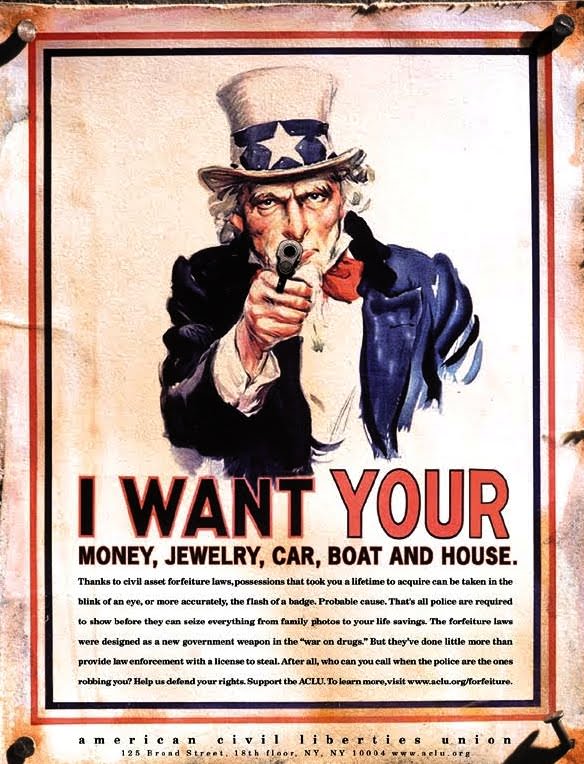
In this case, the foul method favored by Sessions & Co. is civil asset forfeiture, which allows police and prosecutors to “seize your car or other property, sell it and use the proceeds to fund agency budgets—all without so much as charging you with a crime.”

Under a federal equitable sharing program, police turn asset forfeiture cases over to federal agents who process seizures and then return 80% of the proceeds to the police. (In Michigan, police actually get to keep up to 100% of forfeited property.)

This incentive-driven excuse for stealing from the citizenry is more accurately referred to as “policing for profit” or “theft by cop.”

Despite the fact that 80 percent of these asset forfeiture cases result in no charge against the property owner, challenging these “takings” in court can cost the owner more than the value of the confiscated property itself. As a result, most property owners either give up the fight or chalk the confiscation up to government corruption, leaving the police and other government officials to reap the benefits.

And boy, do they reap the benefits.

Police agencies have used their ill-gotten gains “to buy guns, armored cars and electronic surveillance gear,” reports The Washington Post. “They have also spent money on luxury vehicles, travel and a clown named Sparkles.”

Incredibly, these asset forfeiture scams have become so profitable for the government that, according to The Washington Post, “in 2014, law enforcement took more stuff from people than burglars did.” As the Post notes, “the Treasury and Justice departments deposited more than $5 billion into their respective asset forfeiture funds. That same year, the FBI reports that burglary losses topped out at $3.5 billion.”

In 2015, the federal government seized nearly $2.6 billion worth of airplanes, houses, cash, jewelry, cars and other items under the guise of civil asset forfeiture.

According to USA Today, “Anecdotal evidence suggests that allowing departments to keep forfeiture proceeds may tempt them to use the funds unwisely. For example, consider a 2015 scandal in Romulus, Michigan, where police officers used funds forfeited from illicit drug and prostitution stings to pay for …  illicit drugs and prostitutes.”

Memo to the rest of my fellow indentured servants who are living through this dark era of government corruption, incompetence and general ineptitude: this is not how justice in America is supposed to work.

We are now ruled by a government so consumed with squeezing every last penny out of the population that they are completely unconcerned if essential freedoms are trampled in the process.

Our freedoms aren’t just being trampled, however. They’re being eviscerated.

At every turn, “We the People” are getting swindled, cheated, conned, robbed, raided, pickpocketed, mugged, deceived, defrauded, double-crossed and fleeced by governmental and corporate shareholders of the American police state out to make a profit at taxpayer expense.

Americans no longer have to be guilty to be stripped of their property, rights and liberties. All you have to be is in possession of something the government wants. And if you happen to have something the government wants badly enough, trust me, their agents will go to any lengths to get it.

If the government can arbitrarily freeze, seize or lay claim to your property (money, land or possessions) under government asset forfeiture schemes, you have no true rights.

Here’s how the whole ugly business works in a nutshell.

First, government agents (usually the police) use a broad array of tactics to profile, identify, target and arrange to encounter (in a traffic stop, on a train, in an airport, in public, or on private property) those  individuals who might be traveling with a significant amount of cash or possess property of value. Second, these government agents—empowered by the courts and the legislatures—seize private property (cash, jewelry, cars, homes and other valuables) they “suspect” may be connected to criminal activity.

Then—and here’s the kicker—whether or not any crime is actually proven to have taken place, without any charges being levied against the property owner, or any real due process afforded the unlucky victim, the property is seized by the government, which often divvies it up with the local police who helped with the initial seizure.

In a Kafkaesque turn of the screw, the burden of proof falls on the unfortunate citizenry who must mount a long, complicated, expensive legal campaign to prove their innocence in order to persuade the government that it should return the funds they stole. Not surprisingly, very few funds ever get returned.

It’s a new, twisted form of guilt by association, only it’s not the citizenry being accused of wrongdoing, just their money.

Motorists have been particularly vulnerable to this modern-day form of highway robbery.

For instance, police stole $201,000 in cash from Lisa Leonard because the money—which Leonard planned to use to buy a house for her son—was being transported on a public highway also used by drug traffickers. Despite the fact that Leonard was innocent of wrongdoing, the U.S. Supreme Court upheld the theft on a technicality.

Police stole $50,000 in cash from Amanee Busbee—which she planned to use to complete the purchase of a restaurant—and threatened to hand her child over to CPS if she resisted. She’s one of the few to win most of her money back in court.

Police stole $22,000 in cash from Jerome Chennault—which he planned to use as the down payment on a home—simply because a drug dog had alerted police to its presence in his car. After challenging the seizure in court, Chennault eventually succeeded in having most of his money returned, although the state refused to compensate him for his legal and travel expenses.

Police stole $8,500 in cash and jewelry from Roderick Daniels—which he planned to use to purchase a new car—and threatened him with jail and money-laundering charges if he didn’t sign a waiver forfeiting his property.

Police stole $6,000 in cash from Jennifer Boatright and Ron Henderson and threatened to turn their young children over to Child Protective Services if they resisted.

Tenaha, Texas, is a particular hotbed of highway forfeiture activity, so much so that police officers keep pre-signed, pre-notarized documents on hand so they can fill in what property they are seizing.

As the Huffington Post explains, these police forfeiture operations have become little more than criminal shakedowns:

Police in some jurisdictions have run forfeiture operations that would be difficult to distinguish from criminal shakedowns. Police can pull motorists over, find some amount of cash or other property of value, claim some vague connection to illegal drug activity and then present the motorists with a choice: If they hand over the property, they can be on their way. Otherwise, they face arrest, seizure of property, a drug charge, a probable night in jail, the hassle of multiple return trips to the state or city where they were pulled over, and the cost of hiring a lawyer to fight both the seizure and the criminal charge. It isn’t hard to see why even an innocent motorist would opt to simply hand over the cash and move on.

Unsurprisingly, these asset forfeiture scams have become so profitable for the government that they have expanded their reach beyond the nation’s highways.

According to USA Today, the U.S. Department of Justice received $2.01 billion in forfeited items in 2013, and since 2008 local and state law enforcement nationwide has raked in some $3 billion in forfeitures through the federal “equitable sharing” program.

So now it’s not just drivers who have to worry about getting the shakedown.

Any American unwise enough to travel with cash is fair game for the government pickpockets.

In fact, the Drug Enforcement Administration (DEA) has been colluding with the Transportation Security Administration (TSA) and local police departments to seize a small fortune in cash from American travelers using the very tools—scanners, spies and surveillance devices—they claimed were necessary to catch terrorists.

Mind you, TSA agents already have a reputation for stealing from travelers, but clearly the government is not concerned about protecting the citizenry from its own wolfish tendencies.

No, the government bureaucrats aren’t looking to catch criminals. (If so, they should be arresting themselves.)

They’re just out to rob you of your cold, hard cash.

Think about it for a moment. You pay a hefty fee just to be able to walk free. It’s called income tax. As former presidential candidate Ron Paul recognizes, “The Founding Fathers never intended a nation where citizens would pay nearly half of everything they earn to the government.” And if you refuse to pay any of that so-called income tax, you’ll be severely fined and/or arrested and put in jail.

One more thing: you don’t really own your property. That is, your house or your land. Even when you pay off the mortgage, if you fail to pay your property taxes, government agents will evict you and take your home.

This is not freedom.

There was a time in our history when our forebears said “enough is enough” and stopped paying taxes (a pittance compared to what we are forced to shell out in taxes today) to what they considered an illegitimate government. They stood their ground and refused to support a system that was slowly choking out any attempts at self-governance, and which refused to be held accountable for its crimes against the people. Their resistance sowed the seeds for the revolution that would follow.

Unfortunately, in the 200-plus years since we established our own government, we’ve let the corporate elite and number-crunching bureaucrats pilfer our bank accounts to such an extent that we’re back where we started.

Once again, we’ve got a despotic regime with an imperial ruler doing as it pleases.

But what if we didn’t just pull out our pocketbooks and pony up to the federal government’s outrageous demands for more money? What if we didn’t just line up to drop our hard-earned dollars into the corporate collection bucket, no questions asked about how it will be spent? What if, instead of meekly tolerating the government’s ongoing efforts to rob us blind, we did something about it?

As I make clear in my book Battlefield America: The War on the American People, if the government can just take from you what they want, when they want, and then use it however they want, you can’t claim to be anything more than a serf in a land they think of as theirs.

It’s up to “We the People” to demand reform.

These injustices will continue as long as we remain silent.

As American journalist H.L. Mencken observed:

The American of today, in fact, probably enjoys less personal liberty than any other man of Christendom, and even his political liberty is fast succumbing to the new dogma that certain theories of government are virtuous and lawful, and others abhorrent and felonious. Laws limiting the radius of his free activity multiply year by year: It is now practically impossible for him to exhibit anything describable as genuine individuality, either in action or in thought, without running afoul of some harsh and unintelligible penalty. It would surprise no impartial observer if … the goddess of liberty were taken off the silver dollars to make room for a bas-relief of a policeman in a spiked helmet. Moreover, this gradual (and, of late, rapidly progressive) decay of freedom goes almost without challenge; the American has grown so accustomed to the denial of his constitutional rights and to the minute regulation of his conduct by swarms of spies, letter-openers, informers and agents provocateurs that he no longer makes any serious protest.

In other words, make them hear you.

And if they won’t listen, then I suggest it’s time for what Martin Luther King Jr. called for when government doesn’t listen: “militant nonviolent resistance.”

Now Just Five Men Own Almost as Much Wealth as Half the World’s Population

By Paul Buchheit

Source: CommonDreams

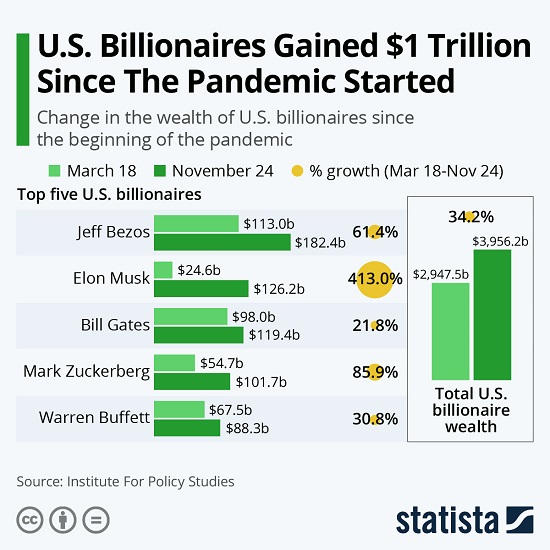
Last year it was 8 men, then down to 6, and now almost 5.

While Americans fixate on Trump, the super-rich are absconding with our wealth, and the plague of inequality continues to grow. An analysis of 2016 data found that the poorest five deciles of the world population own about $410 billion in total wealth. As of 06/08/17, the world’s richest five men owned over $400 billion in wealth. Thus, on average, each man owns nearly as much as 750 million people.

Why Do We Let a Few People Shift Great Portions of the World’s Wealth to Themselves? 

Most of the super-super-rich are Americans. We the American people created the Internet, developed and funded Artificial Intelligence, and built a massive transportation infrastructure, yet we let just a few individuals take almost all the credit, along with hundreds of billions of dollars.

Defenders of the out-of-control wealth gap insist that all is OK, because, after all, America is a ‘meritocracy’ in which the super-wealthy have ‘earned’ all they have. They heed the words of Warren Buffett: “The genius of the American economy, our emphasis on a meritocracy and a market system and a rule of law has enabled generation after generation to live better than their parents did.”

But it’s not a meritocracy. Children are no longer living better than their parents did. In the eight years since the recession the Wilshire Total Market valuation has more than TRIPLED, rising from a little over $8 trillion to nearly $25 trillion. The great majority of it has gone to the very richest Americans. In 2016 alone, the richest 1% effectively shifted nearly $4 trillion in wealth away from the rest of the nation to themselves, with nearly half of the wealth transfer ($1.94 trillion) coming from the nation’s poorest 90%—the middle and lower classes. That’s over $17,000 in housing and savings per lower-to-middle-class household lost to the super-rich.

A meritocracy? Bill Gates, Mark Zuckerberg, and Jeff Bezos have done little that wouldn’t have happened anyway. ALL modern U.S. technology started with—and to a great extent continues with—our tax dollars and our research institutes and our subsidies to corporations.

Why Do We Let Unqualified Rich People Tell Us How To Live? Especially Bill Gates! 

In 1975, at the age of 20, Bill Gates founded Microsoft with high school buddy Paul Allen. At the time Gary Kildall’s CP/M operating system was the industry standard. Even Gates’ company used it. But Kildall was an innovator, not a businessman, and when IBM came calling for an OS for the new IBM PC, his delays drove the big mainframe company to Gates. Even though the newly established Microsoft company couldn’t fill IBM’s needs, Gates and Allen saw an opportunity, and so they hurriedly bought the rights to another local company’s OS — which was based on Kildall’s CP/M system. Kildall wanted to sue, but intellectual property law for software had not yet been established. Kildall was a maker who got taken.

So Bill Gates took from others to become the richest man in the world. And now, because of his great wealth and the meritocracy myth, MANY PEOPLE LOOK TO HIM FOR SOLUTIONS IN VITAL AREAS OF HUMAN NEED, such as education and global food production.

—Gates on Education: He has promoted galvanic skin response monitors to measure the biological reactions of students, and the videotaping of teachers to evaluate their performances. About schools he said, “The best results have come in cities where the mayor is in charge of the school system. So you have one executive, and the school board isn’t as powerful.”

—Gates on Africa: With investments in or deals with MonsantoCargill, and Merck, Gates has demonstrated his preference for corporate control over poor countries deemed unable to help themselves. But no problem—according to Gates, “By 2035, there will be almost no poor countries left in the world.”

Warren Buffett: Demanding To Be Taxed at a Higher Rate (As Long As His Own Company Doesn’t Have To Pay) 

Warren Buffett has advocated for higher taxes on the rich and a reasonable estate tax. But his company Berkshire Hathaway has used “hypothetical amounts” to ‘pay’ its taxes while actually deferring $77 billion in real taxes.

Jeff Bezos: $50 Billion in Less Than Two Years, and Fighting Taxes All the Way 

Since the end of 2015 Jeff Bezos has accumulated enough wealth to cover the entire $50 billion U.S. housing budget, which serves five million Americans. Bezos, who has profited greatly from the Internet and the infrastructure built up over many years by many people with many of our tax dollars, has used tax havens and high-priced lobbyists to avoid the taxes owed by his company.

Mark Zuckerberg (6th Richest in World, 4th Richest in America) 

While Zuckerberg was developing his version of social networking at Harvard, Columbia University students Adam Goldberg and Wayne Ting built a system called Campus Network, which was much more sophisticated than the early versions of Facebook. But Zuckerberg had the Harvard name and better financial support. It was also alleged that Zuckerberg hacked into competitors’ computers to compromise user data.

Now with his billions he has created a ‘charitable’ foundation, which in reality is a tax-exempt limited liability company, leaving him free to make political donations or sell his holdings, all without paying taxes.

Everything has fallen into place for young Zuckerberg. Nothing left to do but run for president.

The False Promise of Philanthropy 

Many super-rich individuals have pledged the majority of their fortunes to philanthropic causes. That’s very generous, if they keep their promises. But that’s not really the point.

American billionaires all made their money because of the research and innovation and infrastructure that make up the foundation of our modern technologies. They have taken credit, along with their massive fortunes, for successes that derive from society rather than from a few individuals. It should not be any one person’s decision about the proper use of that wealth. Instead a significant portion of annual national wealth gains should be promised to education, housing, health research, and infrastructure. That is what Americans and their parents and grandparents have earned after a half-century of hard work and productivity.