America’s Addiction to War Comes with a 15 Trillion Dollar Price Tag

To surmount the debt crisis, America needs to stop feeding the Military-Industrial Complex, the most powerful lobby in Washington.

By Jeffrey D. Sachs

Source: Information Clearing House

In the year 2000, the U.S. government debt was $3.5 trillion, equal to 35% of the Gross Domestic Product (GDP). By 2022, the debt was $24 trillion, equal to 95% of GDP. The U.S. debt is soaring, hence America’s current debt crisis. Yet both Republicans and Democrats are missing the solution: stopping America’s wars of choice and slashing military outlays.

Suppose the government’s debt had remained at a modest 35% of GDP, as in 2000. Today’s debt would be $9 billion, as opposed to $24 trillion. Why did the U.S. government incur the excess $15 trillion in debt?

The single biggest answer is the U.S. government’s addiction to war and military spending. According to the Watson Institute at Brown University, the cost of U.S. wars from fiscal year 2001 to fiscal year 2022 amounted to a whopping $8 trillion, more than half of the extra $15 trillion in debt. The other $7 trillion arose roughly equally from budget deficits caused by the 2008 financial crisis and the Covid-19 pandemic.

Facing down the military-industrial lobby is the vital first step to putting America’s fiscal house in order.

To surmount the debt crisis, America needs to stop feeding the Military-Industrial Complex (MIC), the most powerful lobby in Washington. As President Dwight D. Eisenhower famously warned on January 17, 1961, “In the councils of government, we must guard against the acquisition of unwarranted influence, whether sought or unsought, by the military-industrial complex. The potential for the disastrous rise of misplaced power exists and will persist.” Since 2000, the MIC led the U.S. into disastrous wars of choice in Afghanistan, Iraq, Syria, Libya, and now Ukraine.

The Military-Industrial Complex long ago adopted a winning political strategy by ensuring that the military budget reaches into every Congressional district. The Congressional Research Service recently reminded Congress that, “Defense spending touches every Member of Congress’s district through pay and benefits for military servicemembers and retirees, economic and environmental impact of installations, and procurement of weapons systems and parts from local industry, among other activities.” Only a brave member of Congress would vote against the military-industry lobby, yet bravery is certainly no hallmark of Congress.

America’s annual military spending is now around $900 billion, roughly 40% of the world’s total, and greater than the next 10 countries combined. U.S. military spending in 2022 was triple that of China. According to Congressional Budget Office, the military outlays for 2024-2033 will be a staggering $10.3 trillion on current baseline. A quarter or more of that could be avoided by ending America’s wars of choice, closing down many of America’s 800 or so military bases around the world, and negotiating new arms control agreements with China and Russia.

Yet instead of peace through diplomacy, and fiscal responsibility, the MIC regularly scares the American people with a comic-book style depictions of villains whom the U.S. must stop at all costs. The post-2000 list has included Afghanistan’s Taliban, Iraq’s Saddam Hussein, Syria’s Bashar al-Assad, Libya’s Moammar Qaddafi, Russia’s Vladimir Putin, and recently, China’s Xi Jinping. War, we are repeatedly told, is necessary for America’s survival.
 

A peace-oriented foreign policy would be opposed strenuously by the military-industrial lobby but not by the public. Significant public pluralities already want less, not more, U.S. involvement in other countries’ affairs, and less, not more, US troop deployments overseas. Regarding Ukraine, Americans overwhelmingly want a “minor role” (52%) rather than a “major role” (26%) in the conflict between Russia and Ukraine. This is why neither Biden nor any recent president has dared to ask Congress for any tax increase to pay for America’s wars. The public’s response would be a resounding “No!”

While America’s wars of choice have been awful for America, they have been far greater disasters for countries that America purports to be saving. As Henry Kissinger famously quipped, “To be an enemy of the United States can be dangerous, but to be a friend is fatal.” Afghanistan was America’s cause from 2001 to 2021, until the U.S. left it broken, bankrupt, and hungry. Ukraine is now in America’s embrace, with the same likely results: ongoing war, death, and destruction.

The military budget could be cut prudently and deeply if the U.S. replaced its wars of choice and arms races with real diplomacy and arms agreements. If presidents and members of congress had only heeded the warnings of top American diplomats such as William Burns, the U.S. Ambassador to Russia in 2008, and now CIA Director, the U.S. would have protected Ukraine’s security through diplomacy, agreeing with Russia that the U.S. would not expand NATO into Ukraine if Russia also kept its military out of Ukraine. Yet relentless NATO expansion is a favorite cause of the MIC; new NATO members are major customers of U.S. armaments.

The U.S. has also unilaterally abandoned key arms control agreements. In 2002, the U.S. unilaterally walked out of the Anti-Ballistic Missile Treaty. And rather than promote nuclear disarmament—as the U.S. and other nuclear powers are required to do under Article VI the Nuclear Non-Proliferation Treaty—the Military-Industrial Complex has sold Congress on plans to spend more than $600 billion by 2030 to “modernize” the U.S. nuclear arsenal.

Now the MIC is talking up the prospect of war with China over Taiwan. The drumbeats of war with China are stoking the military budget, yet war with China is easily avoidable if the U.S. adheres to the One-China policy that properly underpins U.S.-China relations. Such a war should be unthinkable. More than bankrupting the U.S., it could end the world.

Military spending is not the only budget challenge. Aging and rising healthcare costs add to the fiscal woes. According to the Congressional Budget Office, debt will reach 185 percent of GDP by 2052 if current policies remain unchanged. Healthcare costs should be capped while taxes on the rich should be raised. Yet facing down the military-industrial lobby is the vital first step to putting America’s fiscal house in order, needed to save the U.S., and possibly the world, from America’s perverse lobby-driven politics.

China, Russia and India Versus USA, EU and Japan: Axis Powers of a New Global Cold War?

By Gilbert Mercier

Source: New Junkie Post

The birth of a bipolar world order?

Since 2014, which marked the first Russian intervention in Ukraine, a new global geopolitical dynamic has amplified under conflicting impulses. The areas of direct, or more often proxy conflicts, have been in many senses contained with some sort of cynical pressure-cooker mechanism. If empires always seek hegemony, sane geopolitics imply balance to avoid slipping into World War scenarios. We have presently reached a Cold War-like balance between two blocks: the West and their satellites on one side, against BRICS nations and their affiliates on the other side. In the best case scenario, this new cold war could give birth to a lasting bipolar world order: curiously enough, following pretty closely Orwell’s cartography of Oceania & Eurasia.

The West is defined by the US empire and its vassals

The two axes of powers must be explained more precisely. On one side “the West” includes US, UK, EU, Canada, Japan, South Korea and Australia. The command headquarters of this imperial structure are of course located in the United States of America. The empire’s military muscle is NATO. As for the junior members such as the UK, European Union and Japan, they are, despite some claims of the contrary the vassals of big Uncle Sam.

One factor could be viewed as a miscalculation by Vladimir Putin. In many ways his decision last year to start a military operation in Ukraine had a paradoxical effect. The intervention was an attempt by Russia to prevent Ukraine from joining NATO & the EU, but this has failed as Western military gears as well as direct assistance have poured in. Just like in Afghanistan in the 1980’s Russia was effectively sucked into a West proxy war. Meanwhile, NATO has found a new raison d’etre with Finland now officially a member and Sweden soon also to become one. The general paranoia used in Western media to depict Putin as the ultimate bogeyman has worked wonders on Europe’s public opinion.

BRICS & affiliates

On the other side it is more complex as China’s dominance is more subdued than that of the US. Besides the BRICS nations of Brazil, Russia, India, China & South-Africa, other nations are gravitating into the same geopolitical orbit: notably Iran, Venezuela and African countries such as Mali and Burkina Faso. While China is clearly the biggest power within BRICS, the other two major players, which are Russia and India, also are heavyweights on an overall geopolitical and economic scale.

Russia holds vast reserves of energy products, such as gas and oil, and since the European sanctions has quickly worked on redirecting its energy production both towards China and India. India, which has become the most populous country on Earth, has just like China a considerable manufacturing power as well as a huge internal market for products and services. In other words, neither China nor India have to rely mainly on exports to sustain their respective economic growth.

Non-alignment is dead

The concept of non-alignment in a multipolar world, dear to the likes of Tito and de Gaulle, has unfortunately become a geopolitical faux pas at best, or a risky behavior for a small state wanting to stay independent at worst. Because of a lack of political will and leadership, the European Union has basically capitulated from asserting itself as a third block to become a provincial entity of the US empire. The notion of true non-alignment might have run its course in this new bipolar order.

As matter of fact, one of the Ukraine war’s major side effects has been to speed up the process of obedient realignment of the EU to the US. European leaders with their respective media propaganda divisions (either state or corporate controlled) have managed to convince the bulk of their public opinion that the ogre Vladimir Putin and Russia had to be defeated in Ukraine as if the hordes from a memory of the Red Army were about to invade Europe. The Ukraine war has been sold in Europe as a war of necessity to counter an existential threat that was never really there. Public opinion largely bought it, and the financial rewards are pouring into the coffers of the military-industrial complex, as well as US and Qatari energy businesses of natural gas liquefaction, to replace the well-organized Russian gas supply Europe used to get before the sanctions against Russia.

Ukraine war cannot be won on the battle fields

Despite what most people are lead to believe in the West, a military victory by Ukrainian forces, even with full logistic support from NATO in equipment and training is quasi impossible. After all, a lesson should be learned from Afghanistan where the Taliban managed to defeat the mighty alliance. If the EU and the United States cared for the welfare of Ukrainians, they would come to the realization that only a diplomatic solution can resolve the crisis. A sine qua non condition of diplomacy is that it requires concessions on all sides.

For example, let’s take the case of Crimea. It has a complex history. During the 15th century Crimea was under control of the Ottoman Empire. In 1783, the Russian Empire of Tsarina Catherine the Great annexed Crimea after a conflict with Turkey. Lastly, under the authority of Nikita Khrushchev, the USSR gave Crimea to Ukraine in 1954. Therefore, Crimea was Russian for 171 years while it was Ukrainian for only 60 years. The weight of history, in this case, should tilt the balance in favor of Russia.

Military-industrial complex Uber Alles

Wars have always been capitalism‘s best friend. Ultimately they are seldom about the lofty notions of patriotism but systematically about profits. Ukraine’s Western proxy adventure is no exception. As matter of fact, it has been a gargantuan bonanza for the global military-industrial complex and its stockholder war profiteers. Case in point: since Russia started its military operation in Ukraine in February 2022, the United States has spent $30 billion in military equipment which was shipped to Ukraine. This is according to the US Department of Defense.

For its part the European Union is planning a 74 billion Euros increase in military spending within three years. This trend of huge increase in military spending affects all the EU 27 members, as they are allocating bigger shares of their respective GDPs to this weapons race. In December 2022, the European Defense Agency proudly announced that EU defense spending had surpassed 200 billion Euros for the first time in the union’s history. What an accomplishment!

Needless to say, military-industrial consortium and their unscrupulous stockholders have collected huge dividends from the death and destruction business. Stocks in the so-called aerospace & defense area of the market have been incredibly profitable for investors and are therefore in high demand. On average, most defense-company stocks have seen their values increase by 25 to 30 percent since February 2022.

Naturally, in terms of military spending, the United States represents the lions’ share with a whopping 38 percent of the global military spending. It is an astronomical $800 billion a year or 3.1 percent of the US GDP. Unfortunately other major powers are catching up. In second place comes China with $293 billion or 1.7 percent of its GDP; then India with $76.6 billion; the UK with 68.4 billion; Russia with $65.9 billion or 3.1 percent of GDP; France and Germany with $56 billion each; and Japan with $54 billion. In France, despite a very concerning debt, the Macron administration has announced that 413 billion Euros will be spent on the military between 2024 and 2030.

Taiwan: the Ukraine of the far-east?

With Russia sucked into what can be called a military quagmire in Ukraine, one has to wonder if the Oceania empire, with its Washington nevralgic center, would not indeed want to take advantage or even provoke a Chinese move to take over Taiwan, in accordance to the One-China precept. This could create a Ukrainian-like situation for China in Taiwan. Instead of having the obedient EU to absorb part of the cost in the West, in the Pacific it could be US vassals such as Japan, South-Korea and Australia that could get involved into a proxy war with China, and therefore increase their military spending in US equipment. Trillion of dollars would be wasted in resources to allow the chess masters of geopolitics to keep playing their mindless criminal games. Everywhere, the brutal Russian roulette folly of capitalism, either state or corporate, would thrive while all populations suffer.

Forecast 2023 — Get Out of the Way if You Can’t Lend a Hand

By James Howard Kunstler

Source: Kunstler.com

“The powerful are panicking, and so they should. Their secrets are leaking.” —Miranda Devine

“It’s all just snake oil. We want to save the planet, and the life upon it, but we’re not willing to pay the price and bear the consequences. So we make up a narrative that feels good and run with it.” — Raul Ilargi Meier

“2023 could be a pivotal year for the USA if the pervasive lying can be exposed, digested, and believed. All that exposure has to happen amidst continuing boondoggles toward the Great Reset agenda.” – Truman Verdun

“More borrowing only ever makes sense if you are expecting a larger economy in the future.  All economic expansion is based on energy.  Countries with energy can expand, those without cannot.” —  Chris Martenson

“To be an enemy to America can be dangerous, but to be a friend is fatal.” — Henry Kissinger

“The incorrect narrative provided by mainstream media (MSM) is that climate change is our worst problem. To lessen this problem, citizens need to move quickly away from fossil fuels and transition to renewables. The real narrative is that we are running short of fossil fuels that can be profitably extracted, and renewables are not adequate substitutes. However, this narrative is too worrisome for most people to handle.” — Ugo Bardi

It’s hard to contemplate 2023 without spiraling into nausea, tachycardia, and cold sweat. But it is an inescapable duty here to lay out the probabilities ahead. I’ve been doing this forecast thing for some years now, and, of course, I am often wrong, so take some solace in that and relax. Maybe the new year will be all unicorns, rainbows, talking gerbils, and candied violets.

   2022 sure was a cold shower. The long emergency I talk so much about finally got up to cruising speed, with the ectoplasmic “Joe Biden” revving our country into economic, political, and cultural collapse — a hat-trick of calamity — and he did it more swiftly and directly than any emperor managed in late-day Rome, with policies and actions 180-degrees contra to America’s public interest — cheered on by a thinking class that had obviously lost it consensual mind.

     Was the governing strategy simply to do the opposite of what the loathed and detested Mr. Trump would do? Could it be that simple or that automatic? The thinking class’s eyes have a zombified glaze these days. It’s obvious, you might agree, that “Joe Biden” is not in charge of anything, really. He’s an animatronic figure programmed to read a teleprompter and not much else. Half the time, he can’t even find his way off-stage after doing that one trick. The claque pulling his strings just may be the crew you see around him (you know, WYSIWYG): Susan Rice, Ron Klain, Jake Sullivan, Antony Blinken, Victoria Nuland, and company. Ms. Rice has kept herself completely hidden backstage at the White House for two years. Nobody ever hears about her or sees her. Weird, a little bit, for the Director of the Domestic Policy Council.

      Or else, are there puppeteers deeper in the shadows, say, “JB’s” former boss Barack Obama, Der Schwabenklaus and his WEF retinue, Bill Gates and other tech billionaires, the “systemically important” bankers, George Soros…? Or some coven of super-elite warlocks we’d never heard of? The US leadership dynamic is truly mystifying and has been for two whole years. Will mysteries be revealed in 2023? Personally, I think so. Things are lining up in that direction, though who knows whether the damage can even be reversed at this point. And now onto the shape of things to come….

Economy

     All you can really say is that the folks running things have hijacked every module of our nation’s interests and tilted them down into decadence and ruin. They’ve tanked whatever’s left of the US economy with an array of surefire idiotic maneuvers. By spending trillions of dollars that don’t exist to buy votes, they’ve inflated away our money’s purchasing power — an Econ 101 level mistake. The “Green New Deal” is a swindle, an out-front, in-your-face nefarious operation to subvert Western Civ by the WEF, and its stooges — laid out explicitly in its house publications.

     There is no way we can run our society as currently outfitted on any combination of alt.energies. All the Greenies can really accomplish with this crusade is to destroy the complex systems we rely on faster than would happen in the normal course of things, foreclosing any chance of an orderly retreat to a plausibly downscaled arrangement for daily life. We are exiting the current system anyway, like it or not — the longstanding thesis of The Long Emergency.

      This gets to the heart of the conundrum we face. Ill-intentioned as the WEF and its allies may be, the world is heading toward a Great Re-set. The catch is, it won’t be the WEF’s version of it, their schematic techno-nirvana with a tiny comfortable elite lording over the bug-eating hoi-polloi. They somehow miss the glaring point that the energy required to run their precious transhuman tech won’t be there. By the way, the WEF’s core idea of central control by a coordinated world government is at odds with the core reality of the times ahead, which is that life is about to get much more local and downscaled — the exact opposite of centralized. Everything organized at the giant scale is veering into failure: empires, global corporations, hypertrophic cities, giant universities, giant farms, you name it. Their business models are broken. The activities these things represent have to get smaller, finer, and more regional. Depending on what we’re able to salvage and re-purpose from the fabricated leftovers of Modernity, we’ll be lucky to land back in life lived at the level of the early 1800s. Or else, if we really mess up, we’ll plunge haplessly into a dark age in a resource-stripped world.

      The “Green New Deal,” based on a combination of wishful thinking and self-destructive malice, includes the deliberate undermining of what’s left of America’s oil industry by cancelling pipelines, drilling licenses on public lands, draining the strategic petroleum reserve, and other efforts to sabotage what’s left. America still has a lot of oil in the ground, yet much of it is hard to get at and uneconomical to produce at the scale required. It’s a money-loser, and losing money consistently doesn’t pencil out for any real business.

     This hard reality is especially true of shale oil, which had a good run production-wise 2009 to 2022, though the producers could barely make a dime at it. The shale oil “miracle” was largely a byproduct of near-zero interest rates. Investors flocked to it after 2009 because they couldn’t get any yield from bonds. Shale oil was played-up as a sure thing. It took investors a decade, and over a hundred oil company bankruptcies, to catch on — and now shale oil can’t attract enough new investment to keep up the giant operations at scale. The main shale oil regions, the Permian Basin in Texas and the Bakken fields of North Dakota, have entered permanent decline as they run out of “sweet spots” to drill and frack. Considering the new era of capital scarcity ahead, money for shale oil companies will be even harder to get and we’ll get less shale oil every year, while conventional oil continues its own remorseless decline. The catch here is that oil prices are just as likely to go down as up because the foundering economy creates substantial demand destruction — meaning that customers drop out of the market.

      Natural gas involves similar dynamics. There seems to be a lot of it for now in the Marcellus formation spread over Pennsylvania, Ohio, West Virginia, and into New York (where fracking has been prohibited for years). Natgas is very useful for electric generation, home heating, and some manufacturing, but not so much for transportation. Shale gas production is also based on “sweet spots” for drilling and there are fewer of them every year. The depletion curve for natgas is even more extreme than it is for oil: the flow stops all at once. The early shale gas plays in the southern US — Haynesville, Fayetteville, Barnett — have been in decline for years. As with shale oil, producing shale gas is expensive, with all the trucks ceaselessly delivering sand, water, and fracking chemicals to the drilling pads, and then transporting waste liquids off-site. Prediction: in 2023, we’ll hear the first rumblings about “nationalizing the oil industry,” which will be a giant step toward killing it altogether, given the all-around incompetence of government.

      The strategy of changing out oil-based cars and trucks for electric vehicles (EVs) is a loser on several counts beyond the disruption and instability facing US oil production. One, it’s premised on the fantasy that we can continue living in a suburban sprawl arrangement by other means. Two, the electric grid is too inadequate and fragile to support the charging of so many millions of EVs in addition to everything else we ask it to do. Three, the middle class is being decimated, so there are fewer credit-worthy customers for cars priced out of their shrinking budgets anyway. Four, far less capital will be available for consumer loans. The car industry itself may not survive the re-possession orgy coming in 2023 for defaulted auto loans. That shortfall will infect banking, too. The economy is already hurting. The “Green New Deal” will cut its wobbly legs off.

     Similarly, the new mandates against the use of nitrogenous fertilizers (made from natgas). European countries are already on-board with this WEF folly. The Netherlands, Europe’s leading food producer, is going so far as to forcibly shut down thousands of farms and limit fertilizer use on the remaining ones. Germany is likewise limiting fertilizers. Canada fell in line next. Prediction: in early 2023, “Joe Biden” will set in motion anti-fertilizer policies in the US. There will be plenty of squawking in the big farming states, rising to angry protests. The tractor convoys may invade Washington. The situation sets up a grim prospect for the US food supply: scarcity, high prices, and hunger ahead.

      The Ukraine bread-basket is out of the picture in 2023, unless military action ends well before planting season. Thanks to “Joe B’s” stupid sanctions policy, a more vulnerable Europe can’t depend on Russia, another world-leading grain producer. By summer, the projected harvests all over Western Civ will be inadequate to feed the existing populations. Routine grain exports to the poor nations of the “global south” will stop and a lot of people will starve in those countries. By then, it will be too late to fix anything. The price of food will soar throughout Western Civ, aggravating other economic crises that will amount to metastasizing poverty. Populations will get very restless. Governments will fall (candidates: France, Germany, UK, Australia, the USA). In some places they will not recover in their prior form.

     As a general proposition, Globalism is done. That got that underway in earnest with the Covid shut-downs. Now, geopolitical friction gets worse and trade relations deteriorate further. There will still be trade between nations, but much reduced. Global supply chains are already wrecked, especially for specialized mechanical replacement parts and electronic components. It will be harder to fix cars, trucks, turbines, really any sort of machine, including computers and things run by them. A lot of commercial activity will just stop.

     Europe has already blundered into buying its one-way ticket to Palookaville. Germany and the rest paid for that ticket by going along with feckless US policy to “weaken” Russia with sanctions (mission not accomplished). The coup de grace was the US wrecking the Nord Stream pipelines. So, Euroland has inadvertently decided to ditch its industrial base, which means they go medieval or worse. They have committed economic suicide. They’d better hope reincarnation is for-real. Anyway, they’re not coming back from this fiasco the way they went into it, that is, the way things were. When the shock of winter is over in early 2023, strife will be the new leitmotif in the Old World. People grow desperate in the six-weeks-wont of springtime. Nations crack up.

     America’s economy largely hinges on finance now that financialization replaced manufacturing as the basis for prosperity. Alas, financialized prosperity is false prosperity, since it consists mainly of borrowing ever greater amounts of money to keep up the mere appearance of prosperity. In real life, prosperity requires producing things of value, not just trading increasingly abstract financial instruments purporting to represent money. I’ve discussed this enough in books, prior blogs, and previous forecasts. Suffice it to say we’ve run out the string on this stunt. All we’re left with now is the debt markers, documents that purport to represent wealth. The collateral is all the stuff we produced previously that is still standing: buildings, developed properties, public works. A lot of this stuff is deteriorating quickly, losing its value — for instance the tens of millions of suburban houses built with shitty, short-lived materials like strand-board and vinyl… all the cars….

    Financialization led to the current inflation in our debt-based money system. More borrowing becomes more money going into existence, chasing a declining amount of goods as production falls off and supply lines choke. Services also suffer. People can’t afford to eat out, get acupuncture, visit hair-dressers. When the inflation is bad enough, say more than ten percent annually, it will cause enough economic damage to provoke a big contraction in activity, bringing on a deluge of loan defaults on mortgages, car payments, and corporate obligations. Loan defaults cause money to disappear from the system. This flips inflation into deflation. The bond-market is blowing up as this occurs, because bonds are debts and they’re not being serviced or paid-off. The imploding bond market infects the stock markets and they crash, too.

      Before long, nobody has money, except people who invested in gold and silver. Prediction: the change-over from inflation to deflation comes in summer of 2023 and gathers momentum into the fall. The implosion leads to economic conditions worse than the Great Depression of the 1930s because our social and family arrangements have disintegrated along with our towns and cities. Civil disorder ignites. The government attempts lockdowns, but this time without a disease to blame it on. It’s no longer safe to be a politician.

The Covid-19 Story Backfires Badly and Hell Breaks Loose

     Against the backdrop of a developing economic depression, the public can no longer avoid seeing the calamity that the mRNA vaccines have instigated. Early death is in the news daily now and from exactly the adverse effects that have been derided as “conspiracy theory” by public health experts since 2021: myocarditis, blood clots, organ damage, neurological illness, unusually aggressive cancers, damaged immune systems. Meanwhile, America’s public health aristocracy — Dr. Tony Fauci, Rochelle Walensky, Francis Collins, Deborah Birx, Surgeon General Vivek Murthy, and many, many others will be compelled to testify under oath before newly re-constituted House committees and finally answer for all their dishonesty in the Covid-19 response saga. They lied about everything, especially the “vaccines?” It will go worse for them as public sentiment turns from submission to official bullshit to rage over a deadly fraud.

      By then, the past efforts of this gang to mislead the public on Twitter and other social media will be well-documented. The exposed slime-trail of money and corruption between Pharma and federal bureaucrats will finally make an impression on the long-bamboozled nation. The mainstream media will be dragged into this morass and the public will begin to understand how the newspaper editors and TV news producers, too, were bought off by Pharma and controlled by the national security state to pimp for the Democratic Party and globalist interests outside the USA. This exposure could be the end of the great legacy news organs, The New York Times and the rest of the gang. Their executives will have to testify along with everyone else. They might not be prosecuted — in a gesture of respect for the First Amendment — but rather will suffer badly from their loss of credibility.

     All of this will aggravate the animus against the government and the Democrat Party’s “Joe Biden” regime — which will be under assault from separate inquiries into the Hunter Biden laptop and its abundant evidence of bribery and treason, and hearings about the wide-open border, payments to Ukraine, and the gestapo-like behavior of the FBI.

    Here’s a scenario for you: The Justice Department will be drowning in criminal referrals. The FBI will be in a state of paralysis, unable to carry out more insults against US citizens as its systematic crimes are revealed. When the DOJ dithers about bringing action, the public will be even more enraged. The current Attorney General, Merrick Garland, gets dragged into Congress to answer for his misconduct and the resulting humiliation will run him out of office. “Joe Biden” may be forced to resign, drowned in a sea of troubles and scandals revealed. A deal will be made to let Veep Kamala Harris off the hook in exchange for her resignation.

      That will leave the Republican Speaker of the House, whoever it is, to become president. He will fire every political appointee in the executive branch and replace them with people who will follow the law. It will look like a promising return to decency and the rule of law. But the damage to America’s prestige will have been so gross by then that the federal government has lost legitimacy. The financial crisis, meanwhile, puts the government into something that smells like bankruptcy. The country is in a ferocious depression, the people have no money, but neither does the government. Real authority devolves to states and localities. The playing out of these dynamics also depends on what is happening outside the USA.

Europe in Macro 

    Don’t forget, Europe, the west end of the Eurasian landmass, used to be an important part of the world, with an aggregate GDP greater than even the USA’s or China’s. Europe is the birthplace of Western Civ, a division of the human project the past few thousand years that yielded tremendous advances in science, art, music, philosophy, and organized intelligence generally. Now it is on the rocks. Europe, in the aggregate, as represented, say, by the European Union, or NATO, made a grave error going along with the USA’s foolish Neocon project to make a heap trouble in Ukraine in order to “weaken” Russia.

     Russia was no longer a threat to the USA after 1991. Once the USSR was done as a political entity, and after Russia recovered from the daze of collapse, it wanted to be treated by the West as a normal European nation. Russia became a market economy, like all the others in Europe. It held elections like the others, had a legislature, a new body of property law, a private news media, regular banks, and all the other trappings of modern political normality. Russia even requested early-on to become a member of NATO. The USA and Europe refused NATO membership, but also refused to admit Russia into European normality. Instead, led by the USA, the West conducted an asset stripping operation which hampered Russia’s redevelopment.

     Otherwise, the West mostly ignored Russia, and in spite of all that Russia got back on its feet, got some industries going, especially oil-and-gas, and enjoyed two decades of relative stability. Russia eventually began reaching out in the world and made trade agreements with other countries. It built those Nord Stream gas pipelines. It organized a regional “customs union” among its Eurasian neighbors that functioned rather like the Eurozone.

     As that was all happening — pay attention — around 2010 then-Secretary of State Hillary Clinton sat on a State Department’s Committee on Foreign Investment in the United States (CFIUS) that threatened to block the sale of a Canadian company, Uranium One, to Rosatom, the Russian State Atomic Energy Corporation, on the grounds that Uranium One’s assets included 20-percent of the USA’s uranium supply. Selling all that American uranium to Russia looked kind of bad, you’d think, and you’d be right. But then, suddenly, about $150-million dollars poured into the Clinton Foundation — much of it from Uranium One’s owner, one Frank Giustra — plus Bill Clinton happened to get a half-million dollar speaking gig in Russia, and… whaddaya know, CFIUS ended up approving the sale. The public hardly heard a peep about it. (Where was the US new media?)

     During that same period, Hillary Clinton also helped facilitate the transfer of American bio-medical, nuclear, and Info technology to the high-tech consortium called Skolkovo, Russia’s version of Silicon Valley. Much of the tech at issue was dual-use, good for civilian and military applications. Again, tens of millions of dollars gushed into the Clinton Foundation from the corporate participants in the Skolkovo deal. Crickets from the news media again.

    In 2011, relations between the US and Russia soured when President Putin accused the US of fomenting protests in Russia over its parliamentary elections. And from there, our State Department decided that Russia and the USA could not even pretend to be friendly.

     Jump ahead to 2014: Neocons in the Obama administration figured it was time to cut Russia back down to size. That effort crystalized around the former Soviet province, Ukraine, and blossomed into the US-sponsored-and-organized Maidan Revolution, utilizing Ukraine’s sizeable Stepan Bandara legacy Nazi forces in the vanguard, to foment violence in Kiev’s main city square. The US shoved out elected Ukraine President Yanukovych — who angered America by pledging to join Russia’s Custom’s Union instead of the EU — and installed its own puppet Yatsenyuk, who was ultimately replaced by the candy tycoon, Poroshenko, replaced by the Ukrainian TV star, comedian Volodymyr Zelensky. Ha Ha. Who’s laughing now? (Nobody.)

     From 2014-on, Ukraine, with America’s backing, did everything possible to antagonize Russia, especially showering the eastern provinces of Ukraine, called the Donbas, with artillery, rockets, and bombs to harass the Russia-leaning population there. After eight years of that, and continued American insults (the Steele Dossier, 2016 election interference), and renewed threats to drag Ukraine into NATO, Mr. Putin had enough and launched his “Special Military Operation” to discipline Ukraine. Once that started, American Defense Secretary Lloyd Austin stated explicitly to the world that America’s general policy now was to “weaken Russia.”

     That declaration was accompanied by America’s policy to isolate Russia economically with ever more sanctions. Didn’t work. Russia just turned eastward to the enormous Asian market to sell its oil and gas and utilized an alternate electronic trade-clearance system to replace America’s SWIFT system. Sanctions also gave Russia a reason to aggressively pursue an import-replacement economic strategy — manufacturing stuff that they had been buying from the West, for instance, German machine tools critical for industry.

     Russia did sacrifice more than $50-billion in financial assets stranded in the US banking system — we just confiscated it — but, ultimately, that only harmed the US banking system’s reputation as a safe place to park money, and made foreign investors much more wary of stashing capital in American banks. Net effect: the value of the ruble increased and stabilized, and Russia found new ways to neutralize American economic bullying.

     Europe was the big loser in all that. For a while, Europe could pretend to go along with the US / NATO project, pouring arms and money into Ukraine, and at the same time depend on Russian oil and gas imports. Eight months into the Ukraine-Russia conflict, the US blew up the Nord Stream One and Two pipelines, and that was the end of Europe’s supply of affordable natgas, to heat homes and power industry. In a sane world, that sabotage would have been considered an act of war against Germany by the USA. But it only revealed the secret, humiliating state of vassalage that Europe was in. Europe had already made itself ridiculous buying into the hysteria over climate change and attempting to tailor its energy use to so-called “renewables” in history’s biggest virtue-signaling exercise. Germany, the engine of the EU’s economy, made one dumb mistake after another. It invested heavily in wind and solar installations, which fell so short of adequacy they were a joke, and it closed down its nuke-powered electric generation plants so as to appear ecologically correct.

    So now, Germany, and many other EU member states, teeter on the edge of leaving Modernity behind. They managed to scramble and fill their gas reserves sufficiently this fall to perhaps squeak through winter without freezing to death, but not without a lot of sacrifice, chopping down Europe’s forests, and wearing their coats indoors. Now, only a few days into Winter, it remains to be seen how that will work out. We’ll know more in March of the new year. France had been the exception in Europe, due to its large fleet of atomic energy plants. But many of them have now aged-out, some shut down altogether, and “green” politics stood in the way of replacing them, so France, too, will find itself increasingly subject to affordable energy shortages.

     Prediction: Europe’s industry will falter and close down by painful increments. The EU will not withstand the economic stress of de-industrialization. It will shatter and leave Europe once again a small continent of many small fractious nations with longstanding grudges. Some of these countries may break-up into smaller entities in turn, as Yugoslavia, Czechoslovakia, and Russia did in the 1990s. Keep in mind, the macro trend world-wide will be downscaling and localization as affordable energy recedes for everyone. Since the end of World War Two, Europe was the world’s tourist theme park. Now it could go back to being a slaughterhouse. The Euro currency will have to be phased out as sovereign bankruptcies make the EU financial system untenable, and animosities and hostilities arise. Each country will have to return to its traditional money. Gold and silver will play a larger role in that.

     The USA poured over $100-billion into Ukraine in arms, goods, and cash in 2022. That largesse will not continue as America sinks into its Second Great Depression. In any case, much of that schwag was fobbed off with. The arms are spent, the launchers destroyed. A lot of weapons were trafficked around to other countries and non-state actors. Russia is going to prevail in Ukraine. The news emanating from American media about Ukraine’s military triumphs has been all propaganda. There was hardly ever any real doubt that Russia dominated the war zone strategically and tactically. Even its withdrawals from one city or another were tactically intelligent and worthwhile, sparing Russian lives. The Special Military Operation wasn’t a cakewalk because Russia wanted to avoid killing civilians and refrain from destroying infrastructure that would leave Ukraine a gutted, failed state. Over time, the USA proved itself to be negotiation-unworthy, and Ukraine’s president Zelensky refused to entertain rational terms for settling the crisis. So, now the gloves are off in Ukraine. As of December 29, Russia shut off the lights in Kiev and Lvov.

     The open questions: how much punishment does Ukraine seek to suffer before it capitulates? Will Zelensky survive? (Even if he runs off to Miami, he may not survive.) What exactly will be left of Ukraine? In 2023 Russia will decide the disposition of things on-the-ground. Failed states make terrible neighbors. One would imagine that Russia’s main goal is to set up a rump Ukraine that can function, but cease to be an annoying pawn of its antagonists. Ukraine will no longer enjoy access to the Black Sea; it will be landlocked. The best case would be for Ukraine to revert to the agricultural backwater it was for centuries before the mighty disruptions of the modern era. Perhaps Russia will take it over altogether and govern it as it had ever since the 1700s — except for Ukraine’s brief interlude post-USSR as one of the world’s most corrupt and mal-administered sovereign states.

     Bottom line: Ukraine is and always was within Russia’s sphere-of-influence, and will remain so. The USA has no business there and it will be best for all concerned when we bug out. Let’s hope that happens without America triggering a nuclear World War Three. (Yeah, “hope” is not a plan. Try prayer, then.) Mr. Putin’s challenge going into 2023 is to conclude the Ukraine hostilities without humiliating the USA to the degree that we do something really stupid.

     Asia

       The enormous region where most of the world’s people live is swirling with quickly changing dynamics. It’s hard to tell what kind of shape China is actually in at the close of 2022. The CCP capitulated on its extreme lockdown policy and now the country seems gripped by a new and severe outbreak of the Covid virus. It’s killing a lot of people, including quite a few higher-ups in the CCP. The world saw the beginning of a popular revolt in China through the fall of 2022 as demonstrations erupted. The political side remains opaque.

     The economic side, less so. China’s wealth since year 2000 has derived from its immense factory capacity and cheap labor force. Globalism is wobbling, and with that the world’s supply line network. If trade relations with the USA continue to sour, both China and the USA will suffer. China will find itself at over-capacity, even for the giant Asian market. And they are competing with several other quickly-industrialized nations in the south, plus India, plus the old stalwarts South Korea and Japan.

      The main problem for China, and indeed all the Pacific Rim nations on the Asian side: energy. China doesn’t have very much oil in the ground and is utterly dependent on imports. It has a lot of low-quality coal. It’s building coal and nuke plants like mad. Will that suffice? Electricity is great, but you need fossil fuels to run heavy industries. In the great shiftings of 2022, China made deals for getting more oil and gas from Russia. That might work for a while. But Russia’s energy resources are probably near peak production now. What happens on the way down from that peak? Maybe Russia will be less avid for sharing its fossil fuels with its neighbors. Maybe that will cause political friction. Maybe a desperate China will reach out and try to grab resources from Russia’s vast Siberian territories? Not next year, though….

     The Neocon-led US foreign policy establishment is insane for sure, but the CCP is only not-crazy during times of great stability. Throw in some popular dissent and some economic distress, and the CCP could go cuckoo. Uncle Xi shows very Mao-like tendencies for creative despotism. The party must have a long game for Taiwan, but a distressed and crazed CCP, and an agitated Uncle Xi, could turn that into a short game out of desperation — and then what? We’d have two really crazed governments, the USA and China, ginning up the Eastern theater of World War Three. The upshot of predicament depends to some extent on how delicately Mr. Putin can organize America’s exit from Ukraine.

     Prediction: For 2023 internal friction will preoccupy China as it attempts to square its operations with those pressing trends of our time: downscaling and relocalization. All this could easily lead to regional strife in China. For decades, the CCP has been the glue between its disparate peoples. It may prove to not be superglue.

     Japan remains as enigmatic as ever. It has drifted economically for nearly forty years. Now it looks like it’s drifting into a sovereign bankruptcy as it loses control of its deeply-gamed bond markets. I’ll stick to my old predication that Japan is en route to going medieval. Its pre-industrial culture was very charming and worked well for long periods of history. Industrial modernity demoralized them. Japan imports all its oil. Without it, you can’t even begin to run a modern war machine, so there won’t be a second reaching-out for resources as in the 20th century. The Japanese will not be alone in the new medievalism when this era completes itself.

The Deep State, an Appreciation

    America is at a crossroads, a threshold, a tipping point. Every vital institution in the land has been at least partially wrecked, most especially the ones in charge of the rule of law, which was the best thing we had going for us. The Deep State is for real — the weaponization of a national bureaucracy against the nation itself. Yet, it’s certainly not just an American thing; it’s happening across Western Civ. Is it some natural process of self-destruction? An auto-immune disorder of a giant cultural organism, with parts attacking the whole? The USA, Great Britain, Canada, and Australia took such special pride in being open societies and now they are consumed in censorious lunacy. Continental Europe had a sketchier history with liberty, the enlightened individualism of Everyman, though they actually birthed its principles. But now the whole works is infected and ailing, and by what? It’s as if some cosmic spike protein came among us all and got into our hearts.

     Most major religions feature some version of the idea of death-and-rebirth, and it’s a fact that we see ourselves embedded in cycles, especially seasons. Things turn and return, are born, develop, degenerate, pass away. This was the brilliant application of Strauss and Howe’s Fourth Turning theory to the study of history, and by those terms we are have entered a deep secular winter of the human project. One can appreciate how the onset of winter spooked our prehistoric ancestors. They developed their prayerful ceremonies for bringing back the sun, and warmth, and new growth, dancing around the fire in the skins of animals, often making blood sacrifices to the mysterious forces in charge of… everything. The modern way of reenacting all that seems to be industrial-strength warfare. Many of us are praying right now that we don’t have to go through that.

      More likely, I think, we’ll forego the nuclear fire and simply go through a collapse of the socioeconomic organization that our governance rests on, and the Deep State illness with it. It’ll come with plenty of hardship, but it will purge the poisons that have disordered us, and when we get through it, we’ll make new arrangements for daily life. For some years, I’ve been calling this process a long emergency, and now we seem to be right in the thick of it. I believe in the natural process called emergence. Systems transform themselves organically from one state to another when acted upon by the circumstances of time and place. The outcome is usually a surprise, and not all surprises are bad. So, adios 2022 and hello little baby 2023. Lead us where you will and let’s go forward into it bravely. As Bob said so many years ago, it’s all right, Ma. It’s life and life only….

The One Chart That Explains Everything

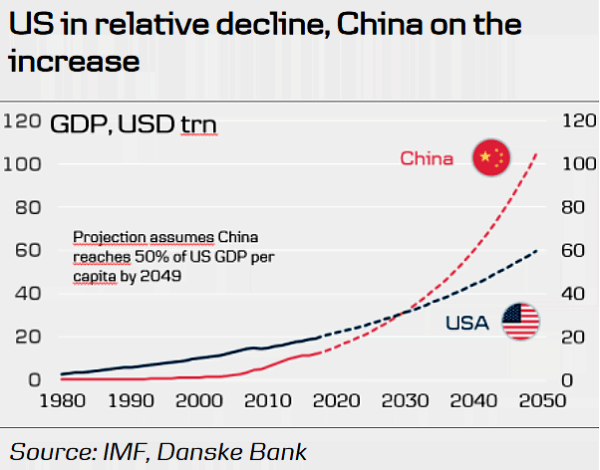
Look at the chart above. The chart explains everything.

By Mike Whitney

Source: The Unz Review

It explains why Washington is so worried about China’s explosive growth. It explains why the US continues to hector China on the issues of Taiwan and the South China Sea. It explains why Washington sends congressional delegations to Taiwan in defiance of Beijing’s explicit requests. It explains why the Pentagon continues to send US warships through the Taiwan Strait and ship massive amounts of lethal weaponry to Taipei. It explains why Washington is creating anti-China coalitions in Asia that are aimed at encircling and provoking Beijing. It explains why the Biden administration is stepping up its trade war on China, imposing onerous economic sanctions on its businesses, and banning critical high-tech semi-conductors that are “are essential not just… for virtually every aspect of modern society, from electronic products and transport to the design and production of all manner of goods.” It explains why China has been singled-out in the US National Security Strategy (NSS) as “the only competitor with both the intent and, increasingly, the capability to reshape the international order.” It explains why Washington now regards China as its biggest and most formidable strategic adversary that must be isolated, demonized and defeated.

The chart above explains everything, not just the hostile diplomatic jabs that are designed to discredit and humiliate China, but also the openly belligerent policies that are aimed at Russia as well. People need to understand this. They need to see what is really going on so they can put events in their proper geopolitical context.

And what “context” is that?

The context of a Third World War; a war that was thoroughly-planned, instigated and (now) prosecuted by Washington and Washington’s proxies. That’s what’s really going on. The increasingly violent conflagrations we see cropping-up in Ukraine and Asia are not the result of “Russian aggression” or “evil Putin”. No. They are the actualization of a sinister geopolitical strategy to quash China’s meteoric rise and preserve America’s dominant role in the world order. Can there be any doubt about that?

No. None.

This is why we are experiencing the redivision of the world into warring blocs. This is why we are seeing the roll back of 30 years of Globalization and massive suppyline disruption. And this is why Europe has been thrust headlong into frigid darkness and forced deindustrialisation. All of these suicidal policies were concocted for one purpose and one purpose alone, to maintain America’s exalted spot in the global system. That is why all of humanity is presently embroiled in a Third World War; a war that is designed to prevent China from becoming the world’s biggest economy; a war that is designed to preserve US global primacy. Check out this excerpt from an article at the World Socialist Web Site:

An October 19 Financial Times article by Edward Luce, entitled “Containing China is Biden’s explicit goal,” sounded the following alarm: “Imagine that a superpower declared war on a great power and nobody noticed. Joe Biden this month launched a full-blown economic war on China—all but committing the US to stopping its rise—and for the most part, Americans did not react.

“To be sure, there is Russia’s war on Ukraine and inflation at home to preoccupy attention. But history is likely to record Biden’s move as the moment when US-China rivalry came out of the closet.”

Moreover, last week, a top Biden administration official indicated that the US was preparing new bans on China in key hi-tech areas. Speaking at the Center for a New American Security, Alan Estevez, the under-secretary of Commerce for Industry and Security, was asked if the US would ban China from accessing quantum information science, biotechnology, artificial intelligence software or advanced algorithms. Estevez admitted that this was already being actively discussed. “Will we end up doing something in those areas? If I was a betting person, I would put down money on that,” he said….

Luce concluded his Financial Times article cited above by declaring: “Will Biden’s gamble work? I’m not relishing the prospect of finding out. For better or worse, the world has just changed with a whimper not a bang. Let us hope it stays that way.”…(“Biden’s technology war against China”, World Socialist Web Site)

Once again, look at the chart. What does it tell you?

The first thing it tells you is that the hostilities we see in Ukraine (and eventually Taiwan), can be traced back to a fundamental shift in the global economy. China is growing stronger. It’s on a path to overtake the United States economy within the decade. And with growth, come certain benefits. As the world’s biggest economy, China will naturally become Asia’s regional hegemon. And, as Asia’s regional hegemon it will be able “to settle regional disputes in its own favor and to de-legitimize U.S. regional and global leadership.”

Can you see the problem here?

For nearly two decades, the US has oriented its foreign policy around a “rebalancing of forces” strategy called the “pivot to Asia”. In short, the US intends to be the dominant player in the world’s most populous and prosperous region, Asia. Can you see how China’s rise derails Washington’s plan for the future?

The United States is not going to let this happen without a fight. Washington is not going to let China muscle-it-out of the markets that it plans to dominate. That’s not going to happen. And if you think that’s going to happen, you’d better think again. The United States will go to war to avoid a scenario in which the US plays “second fiddle” to China. In fact, the foreign policy establishment has already decided that the US will engage China militarily for that very objective.

So, our thesis is simple; we think WW3 has already begun. That’s all we’re saying. The ructions we see in Ukraine are merely the first salvo in a Third World War that has already triggered an unprecedented energy crisis, massive worldwide food insecurity, a catastrophic break-down in global supply lines, widespread and out-of-control inflation, the steady reemergence of extreme nationalism, and the redivision of the world into warring blocs. What more proof do you need?

And it’s all economic. The origins of this conflict can all be traced back to the seismic changes in the global economy, the rise of China and the unavoidable decline of the United States. It is a case of one empire replacing the other. Naturally, a transition of this magnitude is going to generate tectonic changes in global distribution of power. And along with those changes will come more flashpoints, more devastation, and the looming prospect of nuclear war. And this is precisely how things are playing out.

So, how does the chart explain what is happening in Ukraine?

Washington’s proxy war in Ukraine is actually aimed at China not Russia. Russia is not a peer competitor and Russia does not have the economic wherewithal to displace the United States in the global order. NordStream, however, did pose a significant risk to the US by greatly strengthening Moscow’s economic relations with the EU and particularly with Europe’s industrial powerhouse, Germany. The Moscow-Berlin alliance—which was mutually beneficial and key to German prosperity—had to be sabotaged to prevent further economic integration that would have drawn the continents closer together into the world’s biggest free trade zone. Washington had to stop that in order to preserve its economic stranglehold on Europe and defend the dollar as the world’s reserve currency. Even so, no one expected the US to blow up the pipeline itself in—what appears to be—the greatest act of industrial terrorism in history. That was truly shocking.

In essence, Washington sees Russia as an obstacle to its “pivot” plan to encircle, isolate and weaken China. But Russia is not the greatest threat to US global primacy; not even close. That designation belongs to China.

The Third World War is being waged to contain China not Russia. What the war in Ukraine suggests is that—among foreign policy elites—there is general agreement that, The road to Beijing goes through Moscow. That appears to be the consensus view. In other words, US powerbrokers want to weaken Russia in order to spread US military bases across Asia. Ultimately, the military will be called upon to enforce Washington’s economic rule over its new Asian subjects. If that day ever comes.

We think it is extremely unlikely that Washington’s ambitious plan will succeed, but we have no doubt that it will be implemented all the same. Tens of millions of people are likely to die in a desperate attempt to turn-back the clock to the fleeting ‘unipolar moment’ and the equally short-lived American Century. It is a tragedy beyond comprehension.

Escalation: Recent Events Suggest Mounting Economic Danger

By Brandon Smith

Source: Alt-Market.us

A common refrain from people who are critical of alternative economists is that we have been predicting crisis for so long that “eventually we will be right.” These are generally people who don’t understand the nature of economic decline – It’s like an avalanche that builds over time, then breaks and quickly escalates as it flows down the mountain. What they don’t grasp is that they are in the middle of an economic collapse RIGHT NOW, and they just can’t see it because they have been acclimated to the presence of the snow and cold.

Economic decline is a process that takes many years, and while you might get an event like the market crash of 1929 or the crash of 2008, these moments of panic are nothing more than the wreckage left behind by the great wave of tumbling ice that everyone should have seen coming far in advance, but they refused.

In 2022 the job of warning people is far easier than it used to be because we are well past the midpoint of the process of decline. But, believe it or not, I still get people today who claim that we analysts are “doom mongers.” The power of willful ignorance is truly amazing. It’s enough to make a person blind to stagflationary crisis, supply chain disruptions, quickly inflating prices, stock market carnage, bond market instability, record consumer debt, and international conflict.

At this point, I think if a person can’t see the dangers ahead they are probably a waste of time and space and are destined to be buried in the ice; there’s nothing that can be done for them. Yes, there are some people out there that don’t get exposed to the information and we have to take them into account, but my priority will be people that are awake and aware and try to give them a sense of what point in the collapse process we find ourselves.

In the past month there has been a considerable uptick in economic and geopolitical activity that suggests we are entering a new phase, and not surprisingly it’s all accumulating right before we hit October. Here are the events that I find most concerning:

The European Energy Crisis

This is an event that I have been predicting since the Russian invasion of Ukraine and now it is upon us. I wrote about it extensively in my recent article ‘Europe Is Facing Energy Disaster And It’s Going To Bleed Over Into The US’ so I won’t rehash all that information here. What I do want to point out is the complete lack of planning on the part of European officials to deal with the threat. It is as if they WANT a full spectrum disaster.

Russia has now completely cut off natural gas supplies to Europe, which represent around 40% of all EU energy resources. Europe’s benchmark natural gas prices spiked by 28% a week ago, on top of already existing inflation. Oil supplies are also in steep decline for Europe and the EU government has pledged to cut what’s left of Russian oil imports by sea at the end of the year. Sadly, they have offered very little in the way of solutions to the supply-side problem.

There has been talk of increasing imports of alternative resources from other nations, but the EU is already buying up around 75% of all liquid natural gas from the US. OPEC oil producers have indicated they will not be attempting to increase production anytime soon (probably because they can’t due to inflation in operation costs). There is NO backup energy resource for Europe; it doesn’t exist right now. They will try to buy up whatever coal, oil and gas they can find on the market while driving up prices even more for other countries. They will still come up short, which means people are going to freeze this winter.

Best case scenario is that there are mostly mild temps and people barely scrape buy with minimum heating. But EU industry is going to suffer and many manufacturers are going to cut production (which mean more stress on the global supply chain).

Core Inflation Is Still Rising

As I warned last week in my article ‘It’s A Fact That Needs Repeating: The Federal Reserve Is A Suicide Bomber,’ inflation is continuing to rise despite the Fed’s continued interest rate hikes, giving the central bank even more ammunition to justify higher rates into extreme economic weakness.

The latest CPI print showed an increase to 8.3% and was a shock to markets which universally expected a drop. This is the nature of stagflation – Even with falling demand prices continue to climb or remain high for extended periods. The stagflation event of the 1970s lasted for a decade until the Fed jacked rates to 21% and then employment crumbled in the early 1980s.

This doesn’t mean that rates will go to 21% this time; they don’t need to. All it would take is a Federal Funds Rate of around 4% – 5% to crash our current QE addicted system. A 75 bps rate hike is now widely expected at the next Fed meeting this month, with some predicting a 100 bps hike. This would put us close to crash territory for markets and for employment, though I think we still have well into 2023 before unemployment really starts to spike.

Putin’s Meeting With Xi

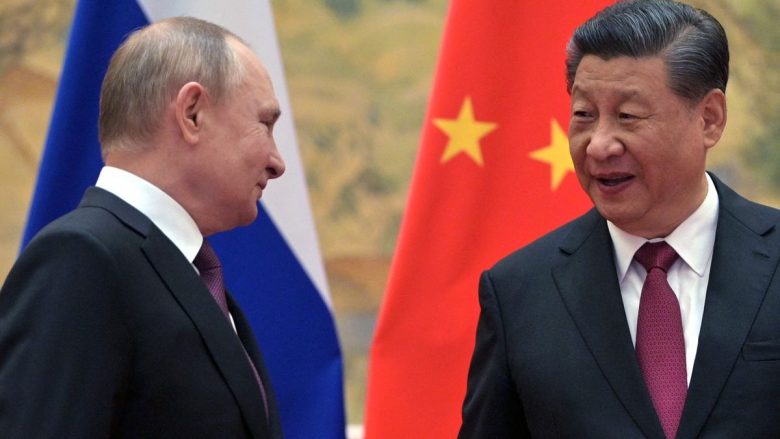
As I write this, Vladimir Putin is set to meet with China’s Xi Jinping and the nature of the conference is not clear. There are the obvious points of agreement such as China’s continued purchases of Russian oil and other commodities, as well as the ongoing plan to build a pipeline to China by 2025. There is also strategic cooperation which is evident in the recent naval exercises between the two nations around Japan and Taiwan.

The timing of the meeting is concerning to me, because the prime season for a potential Chinese invasion of Taiwan is fast approaching (October is the best month for naval movements to avoid typhoons). China would not necessarily need to commit to a ground invasion, either. They could simply cut off all import/export trade from any source other than China and starve Taiwan until they accept unification.

There is also the issue of Ukraine and arms sales. With the amount of propaganda coming from Ukrainian Intelligence and NATO, it’s hard to say what is actually happening, but I suspect Russia is changing strategies and repositioning to deploy missile and artillery bombardment of infrastructure, including power grids and water. This is a tactic that Russia has avoided for months (until this week), which is surprising because one of the first measures usually taken by the US during an invasion is to eliminate most key infrastructure (as we did in Iraq). You would think Russia would have done the same, but perhaps they were saving that scenario for winter when it is harder for Ukraine to cope.

This would make Ukraine essentially unlivable in the coming winter for most of the population. Putin may be seeking to ensure China remains a steady economic partner should geopolitical pressures increase. They may even be making a deal of mutual support: China takes Taiwan while Russia makes Ukraine a resource wasteland and they each support the other economically when NATO counties try to impose sanctions on China. We probably won’t know until October, but the timing of the meeting should raise eyebrows.

If the manure is about to hit the fan in Taiwan along with Ukraine, then diplomatic and economic ties will be severed and western access to China’s manufacturing will be cut. This is a problem for China’s economy, certainly, which may be why they have continued their mass covid lockdowns well after every other government has abandoned them. Could this be practice for civil controls in an impending war environment?

China’s global dominance in imports/exports gives them considerable economic leverage in trade, however. Many nations would not support sanctions against them. Also, their vast holdings of US dollars and Treasuries could be used as a weapon to damage or destroy the dollar’s world reserve status. If China invades Taiwan this year, then all bets are off – The economic decline will move swiftly from that point on.

There are many other trends which factor into the crash environment but the above factors are the most recent and hold the biggest potential for causing a domino effect globally. The question that always arises is “what can we do about it?” Not much in terms of prevention. What we can do, though, is prepare locally to weather the storm. This means stocking necessities before they rise even further in price or become non-existent. Become a producer and learn a valuable skill for survival in a depleted economy Organize with people locally who are on the same page to create security and alternative trade opportunities.

Hopefully, the aware citizenry will rise to the challenge and organization will be extensive, because the worst case scenario would be great masses of completely isolated people all vying against each other rather than working towards mutual security. Even in a slow collapse scenario this is a problem in terms of rising crime; so plan on working with others if you want to avoid inevitable third world conditions.

The Drumbeats of War and US-NATO Propaganda: “China is Bad” and “They are Coming to Enslave Us”

The Truth about China’s Imperial Ambitions, the Uyghurs and What the West Really Fears

By Timothy Alexander Guzman

Source: Silent Crow News

Western media outlets are playing the drumbeats of war by warning the public that a new Chinese empire is going to develop into an unstoppable force capable of ruling the world with an iron fist.  They claim that under the leadership of the Chinese Communist Party (CCP), they will control every country and human being on earth.  Overall, it’s an absurd claim.  It is fair to say that China under the leadership of the CCP has several issues that concerns the Chinese public with a social credit score system, Zero Covid policy rules and a nation-wide surveillance system that is Orwellian to say the least.  China also had a one child policy that has led to a decline in its population which was and still is problematic for its future when it comes to their labor force and economy, but they ended that policy in 2016.  Whatever faults China has, it is not looking to rule the world despite what Western countries claim especially the United States who say that Beijing’s policies reflect a growing appetite for imperial expansion.  On May 25th, 2017, Reuters published ‘China says new Silk Road not about military ambitions’ reported on what China’s Defense ministry had said about China’s future “China’s ambition to build a new Silk Road is not about seeking to expand its military role abroad nor about seeking to set up foreign bases.” The Chinese Defense Ministry spokesman Ren Guoqiang told a regular monthly news briefing conference that China’s Silk Road was not expanding militarily nor setting up bases in any sovereign country and that the accusations were “groundless.” Guoqiang said that “the new Silk Road is about cooperation and trade” and that “The Belt and Road initiative has no military or geostrategic intent. China is not seeking the right to guide global affairs, or spheres of influence, and will not interfere in the internal affairs of other countries.”

According to a report from September 23rd, 2020, by the National Herald India titled ‘China will never seek expansion, has no intention to fight either ‘Cold War’ or ‘hot war’, says Xi Jinping’ as Xi Jinping declared in a pre-recorded video sent to the United Nations meeting that “We will continue to narrow differences and resolve disputes with others through dialogue and negotiation” he continued “We will never seek hegemony, expansion, or sphere of influence. We have no intention to fight either a Cold War or a hot war with any country.”   The report also mentioned India’s Prime Minister Narendra Modi’s surprise visit to the Ladakh region a few months prior where he said that “the era of expansionism is over and that the history is proof that “expansionists” have either lost or perished” in what the report described as a “clear message” to China.  “Xi, also the General Secretary of the ruling Communist Party of China and the Commander-in-Chief of the Chinese military, said his country will not pursue development behind closed doors.” Xi made it clear that a new plan for development for growth domestically and internationally will create more opportunities for China’s economy.  Xi said the following:

Rather, we aim to foster, over time, a new development paradigm with domestic circulation as the mainstay and domestic and international circulations reinforcing each other. This will create more space for China’s economic development and add impetus to global economic recovery and growth

The report also mentioned that during the Covid-19 pandemic, US President, Donald Trump ramped up tensions with China and “demanded that China, where the coronavirus emerged, be held accountable for failure to control the virus and for allowing it to spread across the world” he continued, “As we pursue this bright future, we must hold accountable the nation which unleashed this plague onto the world: China”.  Trump’s rhetoric including his administration slapping tariffs on China’s goods surely increased tensions between Washington and Beijing.  The National Herald India quoted what Xi had said about China’s own decisions that will benefit its own economy and path of development and that it should be respected, “one should respect a country’s “independent choice of development path and model.”  Xi made a point that the world is diverse, and that it can inspire human advancements:

The world is diverse in nature, and we should turn this diversity into a constant source of inspiration driving human advancement. This will ensure that human civilisations remain colourful and diversified

Conflicts and Disagreements: China, India, and the Soviet Union

The history between China and India involved conflicts over border issues.  In 1962, China had a dispute with India over Aksai Chin and Arunachal Pradesh borders.  The conflict was mostly among ground troops of both sides which did not involve any Air force or Naval forces.  What started the conflict was China’s construction of a road that connected the Chinese regions of Tibet and Xinjiang.  However, Aksai Chin was claimed by India.  So, in the months of October and November the Sino-Indian War began.  Several violent conflicts also occurred between China and India after the 1959 Tibetan uprising due to India’s recognition of the Dalai Lama, or who is known as Gyalwa Rinpoche to the Tibetan people.  In an important note to consider, the Dalai Lama was supported by the CIA for many years.  The CIA financially supported the Dalai Lama from the late 1950s until the mid-1970s with more than $180,000 a year for the CIA’s Tibetan program to support anti-China activities and to create foreign offices within Tibet to lobby for international support which was a concern for China. 

In 1960, India had constructed a defensive policy to disrupt China’s military patrols and its logistics in what was called Forward Policy  that placed Indian outposts along the borders in the north of the McMahon Line, the eastern portion of the Line of Actual Control.   However, China did try to implement diplomatic settlements between 1960 and 1962, but India rejected the proposal allowing China to abandon diplomacy and became aggressive along the disputed borders. China defeated Indian forces in Rezang La in Chushul in the west and Tawang in the east.  China declared a ceasefire on November 20th, 1962.  The war ended as China withdrew to its areas claimed in the ‘Line of Actual Control.’  Matters became complicated when the Soviet Union sold MiG fighter aircrafts to India in a show of support since the US and the UK refused to sell arms to India.  However, tensions between China and the Soviet Union were also high during that time which was known as the ‘Sino-Soviet split’ over ideological differences in Marxist-Leninist theories during the Cold War.  There were various agreements between China and India with no progress for peace until 2006.   Although Indian officials were concerned with China’s growing military power and its relationship with Pakistan (India’s main rival), China’s Silk Road opened the doors for peace between both nations.  In October of 2011, China and India formulated border mechanisms regarding the Line of Actual Control as both resumed bilateral army exercises between China and Indian troops by early 2012.  In 2013, what was known as the Depsang standoff, India had agreed to demolish and remove several ‘live-in bunkers’ in the Chumar sector along with the removal of observation posts built along the border among other things that made the resolution of the dispute a success, so the Chinese military withdrew it forces, ending the dispute in May 2013.  Although there are some disagreements between both countries still exist over their borders policies, today China and India are part of the BRICS coalition.

The Sino-Vietnamese War of 1979

On December 21st, 1978, Vietnam launched an attack on the Khmer Rouge.  After more than 10 years of fighting, Vietnam had successfully defeated the Khmer Rouge ending Pol Pot’s reign of terror.  Then in February 1979, China had declared war with Vietnam over its borders.  Now Vietnam was facing a two-front war. China’s invasion was a surprise to the world because China supported Vietnam with its wars against France and the US.  From 1965 until 1969, China had more than 300,000 troops in the Vietnam war with more than 1,000 members from the People’s Liberation Army (PLA) who were killed with 4,300 wounded. 

However, it all changed due to China’s domination of Vietnam for centuries which created animosity among the Vietnamese government and its people towards Beijing thus creating tensions between both countries.  Conflicts on the border also developed between China and the Soviet Union in 1969 during the Sino-Soviet split, so Vietnam had a dilemma, it had to choose one of them as an ally.  On November 3, 1978, Vietnam signed the Treaty of Friendship and Cooperation with the Soviet Union that offered security assurances.  Since tensions were high at the time, more than 150,000 Chinese who were living in Vietnam had fled. Chinese leader Deng Xiaoping and CCP officials viewed Vietnam as ungrateful and traitorous.  The Chinese saw the treaty as a threat since the Soviets had a similar treaty with Mongolia which in a way allowed the Soviets to surround China.  On December 7, 1978, China’s Central Military Commission decided to launch a “limited war” along their borders and at the same time, Vietnam had invaded Cambodia to destroy the Khmer Rouge.

Since Vietnam had border clashes with the China-backed Khmer Rouge in Cambodia along with Beijing’s decision to cut aid to Hanoi, it decided to partner with Moscow.  On January 29th, 1979, for the first time, Chinese Vice-premier Deng Xiaoping went to the US and reportedly told President Jimmy Carter that “The child is getting naughty, it is time he got spanked.”   A couple of weeks later, on February 15th, China terminated the 1950 Sino-Soviet Treaty of Friendship, Alliance and Mutual Assistance and Xiaoping declared that China was going to attack Vietnam to support its ally, the Khmer Rouge of Cambodia among other reasons including the plan to reclaim the Vietnamese occupied Spratly Islands.  China wanted to prevent the Soviet Union from intervening on Vietnam’s behalf, so Xiaoping warned the Soviets that China’s forces were prepared for war.  Declaring an emergency, China deployed all of the PLA forces along the Sino-Soviet border and set up a military command station in Xinjiang, they also evacuated more than 300,000 civilians from the area.

China eventually suffered a defeat by the Vietcong since its military was not prepared to fight an experienced fighting force who previously defeated two Western powers, France, and the US.  It was reported that experienced Vietnamese ‘tank-killing teams’ destroyed or damaged more than 280 tanks and armored vehicles during the war.  China avoided the use of its Air Force and Navy since it promised the Soviets and Americans a limited war against Vietnam.  China also knew that Vietnam had an experienced military as well as having one of the best anti-air capabilities in the world.  After two short weeks of fighting, China began withdrawing its troops.  By March 16, Chinese troops had a ‘scorched-earth campaign’ in Vietnam destroying bridges, factories, mines, farms, and crops.  It is estimated that China had between 7,900 to 26,000 troops killed and between 23,000 to 37,000 wounded.  Vietnam had between 20,000 to 50,000 troops and civilians killed and wounded.  China clearly had a difficult time with Vietnam. 

China’s history with its neighbors shows that it may be difficult even today if they decided to become an imperialist power subjugating the world to its demands because it would face an uphill battle that will become economically and politically costly and that will collapse its economy and society.  Before the US became a global empire, they made sure they contained and controlled its own backyard and that was the Caribbean and Latin America after the Spanish-American War of 1898.  China would have to control its own backyard against several nations including Russia, India, Vietnam, and others.  China understands that imperial projects to dominate the world is a risk not worth taking. 

Remember, China was on the receiving end of Japanese Imperialism that practically destroyed its society.  In 1931, Imperial Japan had invaded the Chinese province of Manchuria for raw materials to fuel its industries, and by 1937 they controlled many areas of China.  The Imperial Japanese war crimes mounted against the Chinese people.  China understands the consequences of war because it sees what has happened to the US and its military adventures which has led to its decline.  It knows it will not benefit anyone, in fact wars can destabilize regions, destroy economies, and disrupt societal norms and China is not at all interested in any of that.  They want to rebuild their civilization.      

The age of empires is over.  A new multipolar world is needed now more than ever before where no single entity or centralized power could rule over any country who wants to remain sovereign.  That would start an era of lasting peace around the world.  Of course, there are no guarantees that total peace would prevail in a multipolar world because there will be bad actors who will prefer a globalized world order over countries who want sovereignty, but in a multipolar world order, wars can be avoided.  It would be a good start where sovereign countries would respect each other’s boundaries and work out their differences.  That’s the way it should be instead of a group of globalist psychopaths making geopolitical and economic decisions to change the social fabric of every country on the planet.         

Inside China: The Surveillance State

China’s internal problems is a stain on its reputation.  China’s surveillance state is indeed problematic.  In 2018, the CCP installed more than 200 million surveillance cameras with an increase in facial recognition technology nationwide.  Surveillance cameras and facial recognition networks would add to the social credit system already in place that gives Chinese citizens a score based on their “social behaviors.”  Going back to 2003, China began its Smart City pilot programs to track and analyze air quality, traffic, wastewater disposal systems, social behaviors of its residents and other areas of urban life.  We can fairly say that China’s surveillance state is rather extreme and unnecessary.  The Chinese people will increasingly voice their concerns to the CCP’s leadership in the future to scrap its surveillance capabilities because it can get out of control, but the question is, will it happen?  Only time will tell.   

The Uyghurs: China’s Problem with the East Turkestan Islamic Movement (ETIM)

One issue that has been mainly ignored in recent years by the Western mainstream media is the terrorism committed in China by the Uyghurs. Why? The Western view of China’s human rights abuses when it comes to the Uyghurs has two sides of the story.  First it benefits the Military-Industrial Complex and its future of selling arms to its allies throughout Asia including Taiwan, South Korea, and Japan.  Second, it’s the demonization of China to gain support among the American people for a future war with China because they are “bad.”  Former US President Barack Obama supported his Secretary of State Hillary Clinton and her ‘Pivot to Asia’ agenda that she had published in Foreign Policy magazine titled ‘America’s Pacific Century.’ Clinton made it clear that the US goal is to remain a global hegemonic power especially in the Asia-Pacific region:

As secretary of state, I broke with tradition and embarked on my first official overseas trip to Asia. In my seven trips since, I have had the privilege to see firsthand the rapid transformations taking place in the region, underscoring how much the future of the United States is intimately intertwined with the future of the Asia-Pacific. A strategic turn to the region fits logically into our overall global effort to secure and sustain America’s global leadership. The success of this turn requires maintaining and advancing a bipartisan consensus on the importance of the Asia-Pacific to our national interests; we seek to build upon a strong tradition of engagement by presidents and secretaries of state of both parties across many decades. It also requires smart execution of a coherent regional strategy that accounts for the global implications of our choices.

What does that regional strategy look like? For starters, it calls for a sustained commitment to what I have called “forward-deployed” diplomacy. That means continuing to dispatch the full range of our diplomatic assets — including our highest-ranking officials, our development experts, our interagency teams, and our permanent assets — to every country and corner of the Asia-Pacific region. Our strategy will have to keep accounting for and adapting to the rapid and dramatic shifts playing out across Asia. With this in mind, our work will proceed along six key lines of action: strengthening bilateral security alliances; deepening our working relationships with emerging powers, including with China; engaging with regional multilateral institutions; expanding trade and investment; forging a broad-based military presence; and advancing democracy and human rights

FOX News is one of the US mainstream media outlets that jumps into the defense of the Uyghurs when it comes to the CCP and its alleged abuses.  However, FOX News ignores the daily abuses of the Israeli regime against the Palestinians or the abuses by the Saudis against the people of Yemen who have been bombarded with US-made weapons since 2015.  To be fair, not only FOX News demonizes China, but so does the liberal media such as CNN, MSNBC, the New York Times that includes the BBC and others throughout Europe.   

One situation that is rarely discussed in the West is the terrorism incidents caused by certain groups and individuals in the Uyghur community not only against the CCP, but also against the Han Chinese, the largest ethnic majority in China.  In Violent Separatism in Xinjiang: A Critical Assessment by James Millward from the East-West Center based in Honolulu, Hawaii and Washington D.C. documented terrorist activities since the early 1990’s that accelerated after the September 11th attacks in New York City and Washington, D.C. Millward wrote the following concerning terror groups originating out of the Xinjiang region in China:

Since the 1990s, concerns about Uyghur separatism have received increasing official and media attention. These concerns have heightened since the events of 9-11 with the advent of a more robust U.S. presence in Central Asia and Chinese attempts to link Uyghur separatism to international jihadist groups. A steady flow of reports from the international media—as well as official PRC releases (a document on “East Turkistan” terrorism, a white paper on Xinjiang, and a list of terrorist groups)—have given the impression of an imminent separatist and terrorist crisis in the Xinjiang region

Some of the terror attacks that were documented occurred in as early as 1992: 

February 5, 1992: Urumqi Bus Bombs. Three were killed and twenty-three injured in two explosions on buses in Urumqi; the PRC’s 2002 document claims that other bombs were discovered and defused around the same time in a cinema and a residential building. Five men were later convicted in this case and reportedly executed in June 1995.

February 1992-September 1993: Bombings. During this period there were several explosions in Yining, Urumqi, Kashgar, and elsewhere; targets included department stores, markets, hotels, and centers of “cultural activity” in southern Xinjiang. One bomb in a building of the Nongji Company (apparently a firm concerned with agricultural equipment) in Kashgar on June 17, 1993, killed two and injured six. One bomb went off in a wing of the Seman Hotel in Kashgar, though no one was hurt in this explosion. The PRC’s 2002 document claims that in the 1993 explosions two people were killed and thirty-six injured overall

On March 9th, 2008, Reuters published an account on what took place during an attempted terrorist attack on a passenger jet on its way to Beijing China foils attempted terror attack on flight.’  The report said that “China foiled a bid to cause an air disaster on a passenger jet en route to Beijing and the plane made a safe emergency landing, an official said on Sunday, in what state media called an attempted terrorist attack.”  According to Reuters sources, “The China Southern flight originated in Urumqi, capital of the restive far western Chinese region of Xinjiang, where militant Uighurs have agitated for an independent “East Turkestan.”  On September 8th, 2011, the BBC reported that a militant Islamic group was behind a terrorist attack in the Xinjiang region that resulted in dozens of people dead.  The BBC report Islamic militant group ‘behind Xinjiang attacks said the following:

A militant Islamic group has released a video saying it was behind recent attacks in China’s Xinjiang region which left dozens of people dead, a US internet monitoring group says.  The video was made by a group calling itself the Turkistan Islamic Party.  The group, which is fighting against Chinese control of Xinjiang, says the attacks were revenge against the Beijing government.

One of the deadliest attacks experienced in China occurred on March 1st, 2014 in the Kunming Railway Station in Kunming which is located in the Yunnan province.  The BBC reported on the incident and said that ‘China separatists blamed for Kunming knife rampage’ and said that “Chinese officials have blamed separatists from the north-western Xinjiang region for a mass knife attack at a railway station that left 29 people dead and at least 130 wounded” and that “a group of attackers, dressed in black, burst into the station in the south-west city of Kunming and began stabbing people at random.”  The report also said that “Images from the scene posted online showed bodies lying in pools of blood” and that the “State news agency Xinhua said police shot at least four suspects dead.”  There were other terrorist attacks that involved the Uyghurs that only pushed the CCP to move forward with facial recognition and a social credit system associated with a criminal offending database.  By 2021, the CCP’s surveillance system expanded in the southern city of Guangzhou that allowed incoming passengers to walk through a biometric security checkpoint. 

In Xinjiang, security checkpoints and identification stations were in many places where people must show proof of ID with their faces being scanned at the same time by various cameras before they enter any supermarket, train stations or any other public place.  China’s security concerns do go beyond what is needed to protect themselves from terrorism. 

However, I do not justify any form of police state tactics against any population despite China’s extreme measures that resembles George Orwell’s 1984, however, at the same time, there are legitimate concerns involving the Uyghur population and their use of terrorism that has caused numerous deaths and injuries of innocent people.

From China to Syria: ETIM joins Al-Qaeda and the Syrian “Moderate” Rebels

One piece of information the Western media usually ignores is the fact that since 2013, there have been thousands of Uyghurs who have traveled to Syria and joined terrorist groups such as Al-Qaeda, the Syrian “Moderate Rebels” and others to fight against Bashar al-Assad’s Syrian army.  One western media news agency reported on the Uyghurs in Syria and their affiliation with US-backed terrorists who were trying to overthrow or kill Syria’s President Bashar al-Assad and that was the Associated Press (AP) who published an Exclusive story Uighurs fighting in Syria take aim at China admits a fact about the Uyghurs and their ties to terrorist groups from the Middle East and Africa and how they are using their experiences to fight China:

Since 2013, thousands of Uighurs, a Turkic-speaking Muslim minority from western China, have traveled to Syria to train with the Uighur militant group Turkistan Islamic Party and fight alongside al-Qaida, playing key roles in several battles. Syrian President Bashar Assad’s troops are now clashing with Uighur fighters as the six-year conflict nears its endgame

The AP mentioned a Uyghur by the name of Ali who said, “We didn’t care how the fighting went or who Assad was,” said Ali, “we just wanted to learn how to use the weapons and then go back to China.”  That’s what Chinese officials needed on their hands, Uyghurs traveling to Syria to learn how Al-Qaeda and others use terrorist tactics and techniques then bring that knowledge back to China.  The CCP had its hands full with the threat of terrorism on Chinese soil.  The AP outlined the facts that the Uyghurs have committed numerous crimes in China over the years: 

Uighur militants have killed hundreds, if not thousands, in attacks inside China in a decades-long insurgency that initially targeted police and other symbols of Chinese authority but in recent years also included civilians. Extremists with knives killed 33 people at a train station in 2014. Abroad, they bombed the Chinese embassy in Kyrgyzstan in September last year; in 2014, they killed 25 people in an attack on a Thai shrine popular with Chinese tourists

In a report from June 2016 by the U.S.-China Economic and Security Review Commission titled China’s Response to Terrorism’ by Murray Scot Tanner and James Bellacqua clarifies what China has been facing when it comes to terrorism:

While tracking the nature and magnitude of China’s terrorist challenges is difficult, it is clear that China faces some level of domestic terrorist threat, and that its citizens have been victims of terrorist attacks both at home and abroad.

Between 2012 and 2015, China suffered multiple domestic terrorist attacks. Reported incidents became more frequent during this period, and they also became more dispersed geographically, with major incidents occurring in Beijing and other eastern cities, in addition to China’s mostly Muslim western regions. Several of these incidents were also targeted at high-traffic urban areas, resulting in indiscriminate injury or death to civilians

In an unusual fashion, in what they call a backgrounder, the Council on Foreign Relations (CFR), a bi-partisan establishment think tank based in New York City published ‘The East Turkestan Islamic Movement (ETIM)’ explained who and what is ETIM and its longtime affiliations with terrorists: 

Reportedly founded by Hasan Mahsum, a Uighur from Xinjiang’s Kashgar region, ETIM has been listed by the State Department as one of the more extreme separatist groups. It seeks an independent state called East Turkestan that would cover an area including parts of Turkey, Kazakhstan, Kyrgyzstan, Uzbekistan, Pakistan, Afghanistan, and the Xinjiang Uighur Autonomous Region (XUAR). After Mahsum’s assassination by Pakistani troops in 2003 during a raid on a suspected al-Qaeda hideout near the Afghanistan border, the group was led by Abdul Haq, who was reportedly killed in Pakistan in 2010. In August 2014, Chinese state media released a report stating that Memetuhut Memetrozi, a co-founder of ETIM who is serving a life sentence in China for his involvement in terrorist attacks, had been indoctrinated in a madrassa in Pakistan. The report, which said Memetuhut had met Mahsum in 1997 and launched ETIM later that year, marked a rare public admission of Pakistani ties to Uighur militancy. 

Some experts say ETIM is an umbrella organization for many splinter groups, including ones that operate in Pakistan and central Asia. The Turkestan Islamic Party (TIP), for instance, is one of the most prominent groups, formed in 2006 by Uighurs who fled to Afghanistan and Pakistan in the 1990s. That group took credit for a series of attacks in several Chinese cities in 2008, including deadly bus explosions in Shanghai and Kunming. According to U.S.-based intelligence firm Stratfor, the TIP’s “claims of responsibility appear exaggerated, but the threat TIP poses cannot be ignored.” Stratfor also said that the TIP had expanded its presence on the Internet, issuing videos calling for a jihad by Uighurs in Xinjiang. Ben N. Venzke, head of the U.S.-based independent terrorism-monitoring firm IntelCenter, says it is unclear whether the TIP is separate from ETIM, but notes that the groups’ objectives are both Islamist and nationalist

In the last year of the Trump administration, despite the proof from various reports including those produced by the US and its think tanks that ETIM committed multiple terrorist attacks in mainland China, the US government removed ETIM from its terror list.  According to Germany’s Deutsche Welle (DW) US removes separatist group condemned by China from terror list reported that The United States said it would no longer designate a Chinese Uighur separatist group as a “terrorist organization” on Friday, sparking sharp condemnation from Beijing.”  This was a clear indication that Washington is doing everything it can to destabilize China.  It is a move that will allow newly trained Uyghurs to use their newly acquired skills to cause more chaos in China.  It’s basically a slap in the face:    

The East Turkestan Islamic Movement (ETIM) was removed from Washington’s terror list, US Secretary of State Mike Pompeo announced in a notice posted in the Federal Register.

“ETIM was removed from the list because, for more than a decade, there has been no credible evidence that ETIM continues to exist,” a State Department spokesperson said, news agency AFP reported

This is a typical turn of events for Washington and its long-term objective of destabilizing China by whatever means necessary to try stop its rise to power. The New World Order is becoming a multipolar world order with China, Russia and others who will compete with declining Western powers who are basically responsible for many of the wars, economic exploitation, and the colonization of the global south and that’s what Washington and its European allies are afraid of. 

US Government Propaganda on China’s Internment Camps for the Uyghurs

In an important investigation by Ben Norton and Ajit Singh of The Grayzone ‘No, the UN did not report China has ‘massive internment camps’ for Uighur Muslims starts off with an introduction on how mainstream media propaganda has claimed that China has imprisoned more than 1 million Uyghurs in designated “internment camps” but as the facts makes itself clear, it is a fabrication by the CIA and the National Endowment for Democracy (NED) that is funded by Washington’s armchair warriors:

A spokesperson from the UN Office of the High Commissioner for Human Rights (OHCHR) confirmed in a statement to The Grayzone that the allegation of Chinese “camps” was not made by the United Nations, but rather by a member of an independent committee that does not speak for the UN as a whole. That member happened to be the only American on the committee, and one with no background of scholarship or research on China.

Moreover, this accusation is based on the thinly sourced reports of a Chinese opposition group that is funded by the American government’s regime-change arm and is closely tied to exiled pro-US activists. There have been numerous reports of discrimination against Uighur Muslims in China. However, information about camps containing 1 million prisoners has originated almost exclusively from media outlets and organizations funded and weaponized by the US government to turn up the heat on Beijing

On August 10, 2018, the United Nations Committee on the Elimination of Racial Discrimination conducted a review for 179 countries who were signed on to the convention which is a process that takes place annually which also included a review for China’s compliance.  “On the day of the review, Reuters published a report with an explosive headline: “U.N. says it has credible reports that China holds million Uighurs in secret camps.”  From CNN, FOX News to the New York Times, all echoed the same propaganda that the UN had investigated China’s actions against the Uyghurs and accused Beijing of genocide, but it was all a lie.  The UN did conduct any investigation into the Uyghur internment camps “and this committee’s official website makes it clear that it is “a body of independent experts,” not UN officials.”  One individual that The Grayzone report focused on is Gay McDougall, a member of the Office of the United Nations High Commissioner for Human Rights (OHCHR):

What’s more, a look at the OHCHR’s official news release on the committee’s presentation of the report showed that the only mention of alleged re-education “camps” in China was made by its sole American member, Gay McDougall. This claim was then echoed by a Mauritanian member, Yemhelhe Mint Mohamed.

During the committee’s regular review of China, McDougall commented that she was “deeply concerned” about “credible reports” alleging mass detentions of millions of Uighurs Muslim minorities in “internment camps.” The Associated Press reported that McDougall “did not specify a source for that information in her remarks at the hearing.” (Note that the headline of the AP news wire is much weaker than that of Reuters: “UN panel concerned at reported Chinese detention of Uighurs”)

The Grayzone received an email from the OHCHR spokesperson Julia Gronnevet “confirmed that the CERD was not representative of the UN as a whole.”  She said that “You are correct that the Committee on the Elimination of Racial Discrimination is an independent body,” Gronnevet wrote. “Quoted comments were made during public sessions of the Committee when members were reviewing State parties.”  The report confirmed that McDougall’s claims were false:

Thus the OHCHR implicitly acknowledged that the comments by McDougall, the lone American member of an independent committee, were not representative of any finding by the UN as a whole. The report by Reuters is simply false

The mainstream media has tried to cover up McDougall’s lies with an “Activist group” called ‘Chinese Human Rights Defenders (CHRD), but the problem with this network is that it is supported by US regime-change operators based in, you guessed it, Washington D.C:

In addition to this irresponsible misreporting, Reuters and other Western outlets have attempted to fill in the gaps left by McDougall, referring to reports made by so-called “activist group” the Network of Chinese Human Rights Defenders (CHRD).

Conveniently left out of the story is that this organization is headquartered in Washington, DC and funded by the US government’s regime-change arm.  CHRD advocates full-time against the Chinese government, and has spent years campaigning on behalf of extreme right-wing opposition figures

CHRD is supported by one of the most notorious organizations involved in Regime-Change operations around the world, and that is the National Endowment for Democracy (NED):

However, tax documents uncovered by The Grayzone show that a significant portion of this group’s budget comes from the US government’s National Endowment for Democracy (NED), a CIA-linked soft-power group that was founded by the Ronald Reagan administration in the 1980s to push regime change against independent governments and support “free markets” around the world.

In 2012, the NED gave the Network of Chinese Human Rights Defenders $490,000. In 2013, it got a $520,000 grant from the NED

The list of funds given to CHRD from the NED continued in 2015 with $496,000, and another $412, 300 was added to its budget in 2016. 

Behind the CHRD is its international director, Renee Xia who is an anti-China activist who in the past has called upon Washington to impose sanctions on CCP officials.  She is an advocate for the release of a neoconservative Chinese dissident by the name of Liu Xiaobo:  

While Liu Xiaobo became a cause celebre of the Western liberal intelligensia, he was a staunch supporter of colonialism, a fan of the most blood-soaked US military campaigns, and a hardcore libertarian. 

As writers Barry Sautman and Yan Hairong reported in The Guardian in 2010, Liu led numerous US government-funded right-wing organizations that advocated mass privatization and the Westernization of China. He also expressed openly racist views against the Chinese. “To choose Westernisation is to choose to be human,” Liu insisted, lamenting that traditional Chinese culture had made its population “wimpy, spineless, and fucked up.”

While CHRD described Liu as an “advocate of non-violence,” he practically worshiped President George W. Bush and strongly supported the illegal US-led invasion of Iraq, as well as the war in Afghanistan. “Non-violence advocate” Liu was even a fan of America’s wars in Korea and Vietnam, which killed millions of civilians

The Grayzone mentioned an article published by The Guardian in 2010, Do supporters of Nobel winner Liu Xiaobo really know what he stands for?’ written by Barry Sautman and Yan Hairong state the fact that Liu supports Israel’s atrocities against the Palestinians and has claimed that they are the provocateurs:

Liu has also one-sidedly praised Israel’s stance in the Middle East conflict. He places the blame for the Israel/Palestine conflict on Palestinians, who he regards as “often the provocateurs”

Overall, the accusations by the CHRD against China and its imprisonment of the Uyghurs is brought to you by the CIA and its propaganda news networks from around the world:

A look at the sourcing of the Network of Chinese Human Rights Defenders’ research raises many doubts about its legitimacy. For one, the most-cited source in the CHRD report, accounting for more than one-fifth of the 101 references, is Radio Free Asia, a news agency created by the CIA during the Cold War pump out anti-China propaganda, and still today funded by the US government.

Even The New York Times has referred to Radio Free Asia as a “Worldwide Propaganda Network Built by the CIA.” Along with Voice of America, Radio Free Europe / Radio Liberty, Radio y Televisión Martí, and Middle East Broadcasting Networks, Radio Free Asia (RFA) is operated by the Broadcasting Board of Governors (BBG), a federal agency of the US government under the supervision of the State Department. Describing its work as “vital to U.S. national interests,” BBG’s primary broadcasting standard is to be “consistent with the broad foreign policy objectives of the United States.”  The near-total reliance on Washington-linked sources is characteristic of Western reporting on Uighurs Muslims in China, and on the country in general, which regularly features sensational headlines and allegations

China’s Threat to the ‘New World Order’ is the Multipolar World Order

The US and its European allies are afraid of China’s economic growth and of its political influence on the world stage, not of its supposed “imperial agenda” they consistently claim.  China is becoming part of a multipolar world where more than one country has the economic and diplomatic influence instead of the Old-World Order where a unified Western power structure led by the US and its European allies that has brought nothing more than death and destruction to most of the global south.  Their imperial expansion accelerated after World War II to become a global empire, but the world is tired of the same old political establishment from the West telling the rest of the world what to do and who they can become allies with.  China is a target of the West, but China will protect its sovereignty at all costs.  China is ready for a war. 

China will be a force economically for centuries to come with their Belt and Road Initiative (BRI) that was introduced in 2013 as a global investment project to develop an economic infrastructure strategy to invest and trade with more than 150 countries who participate in the project.  The US is worried about that, so, like spoiled children, the US House Speaker, Nancy Pelosi and then later on, fellow Democrat Senator, Ed Markey from Massachusetts and other Democrat Representatives including John Garamendi and Alan Lowenthal from California, and Don Beyer of Virginia with Aumua Amata Coleman Radewagen of American Samoa, who is a Republican with more politicians to follow suit in the future, all defiantly went to Taiwan in an effort to antagonize China to see how far will the CCP go knowing that the One-China Policy is what Beijing takes seriously, in fact, it’s the red line for them.  It was an insult, but China did not take any serious actions against the move that would have led to a world war.     

China has human rights issues and to be fair, so does the US government, for example, the US has more people in prison than any other country on the planet.  There is no doubt that the CCP has serious issues when it comes to its internal security policies, but hopefully the Chinese people and their government will work something out in the future when the threat of terrorism and other security issues are no longer a problem.  Perhaps a new beginning can emerge that will benefit China’s society.  But one thing is certain, China and its people will not be bullied by the West.  They experienced an invasion by Imperial Japan during World War II, so it is guaranteed that China will not allow something like that to happen again especially if the US planned to install a military base in Taiwan.    

China was and still is a great civilization.  China had periods of history where they flourished, for example under the Tang Dynasty (618-907), although not a perfect example because there were internal conflicts and rebellions for political reasons, but it was considered China’s golden age.  Under the Tang Dynasty, China had a rich, highly educated society that was well-governed. The Tang Dynasty has a rich history of poetry and numerous innovations with political and cultural influences throughout Asia.  China has the potential to become a great civilization once again.  

Today, China is not a threat to world peace.  What the West fears is China’s rise as an economic powerhouse along with its Russian counterpart and others who challenge US and European hegemony.  Now the rest of the world (especially the global south) can pick and choose who they trade with and who they choose as an ally.  In other words, most countries around the world will now have a choice.  They don’t have to listen to Washington anymore, they can choose whoever they want that will benefit them the most without giving up their sovereignty in doing so.  The US and Europe as a partner is risky, especially for smaller countries who in some cases, have natural resources but don’t have a formidable military that can protect themselves from western powers.  However, China, Russia and Iran have that power to challenge the West, and now the global south sees what is happening geopolitically and they feel more optimistic about the future.  A future without Uncle Sam waving his big stick and telling governments what to do will be a new start for the world.  The era of empires is over with a multipolar world order is on the horizon and that’s a fact the West is not willing to accept. 

We are closer to World War III than ever before, but the question is, where would it begin?  In the South China Sea, in the Middle East or in Eastern Europe? I believe that World War III will begin in the Middle East between Israel and Iran, but it’s hard to tell at this point, but one thing is guaranteed, China will be involved in the next world war.  They want China to become another puppet state that they can control and dominate economically and politically forever and that’s not an exaggeration.  The US and its European allies have been the dominant power on the global stage for centuries and they are not willing to give that up anytime soon, but there is a new multipolar world emerging and that would end the threat of Western hegemonic powers that has only brought misery and pain around the world.  

THE WEST’S FALSE NARRATIVE ABOUT RUSSIA AND CHINA

Vladimir Putin meets with Xi Jinping in Beijing just weeks before the invasion of Ukraine. Photograph: SPUTNIK/Reuters

By Jeffrey Sachs

Source: New Cold War

The world is on the edge of nuclear catastrophe in no small part because of the failure of Western political leaders to be forthright about the causes of the escalating global conflicts. The relentless Western narrative that the West is noble while Russia and China are evil is simple-minded and extraordinarily dangerous. It is an attempt to manipulate public opinion, not to deal with very real and pressing diplomacy.
___________________________

The essential narrative of the West is built into US national security strategy. The core US idea is that China and Russia are implacable foes that are “attempting to erode American security and prosperity.” These countries are, according to the US, “determined to make economies less free and less fair, to grow their. militaries, and to control information and data to repress their societies and expand their influence.”

The irony is that since 1980 the US has been in at least 15 overseas wars of choice (Afghanistan, Iraq, Libya, Panama, Serbia, Syria, and Yemen just to name a few), while China has been in none, and Russia only in one (Syria) beyond the former Soviet Union. The US has military bases in 85 countries, China in 3, and Russia in 1 (Syria) beyond the former Soviet Union.

President Joe Biden has promoted this narrative, declaring that the greatest challenge of our time is the competition with the autocracies, which “seek to advance their own power, export and expand their influence around the world, and justify their repressive policies and practices as a more efficient way to address today’s challenges.” US security strategy is not the work of any single US president but of the US security establishment, which is largely autonomous, and operates behind a wall of secrecy.

The overwrought fear of China and Russia is sold to a Western public through manipulation of the facts. A generation earlier George W. Bush, Jr. sold the public on the idea that America’s greatest threat was Islamic fundamentalism, without mentioning that it was the CIA, with Saudi Arabia and other countries, that had created, funded, and deployed the jihadists in Afghanistan, Syria, and elsewhere to fight America’s wars.

Or consider the Soviet Union’s invasion of Afghanistan in 1980, which was painted in the Western media as an act of unprovoked perfidy. Years later, we learned that the Soviet invasion was actually preceded by a CIA operation designed to provoke the Soviet invasion! The same misinformation occurred vis-à-vis Syria. The Western press is filled with recriminations against Putin’s military assistance to Syria’s Bashar al-Assad beginning in 2015, without mentioning that the US supported the overthrow of al-Assad beginning in 2011, with the CIA funding a major operation (Timber Sycamore) to overthrow Assad years before Russia arrived.

Or more recently, when US House Speaker Nancy Pelosi recklessly flew to Taiwan despite China’s warnings, no G7 foreign minister criticised Pelosi’s provocation, yet the G7 ministers together harshly criticised China’s “overreaction” to Pelosi’s trip.

The Western narrative about the Ukraine war is that it is an unprovoked attack by Putin in the quest to recreate the Russian empire. Yet the real history starts with the Western promise to Soviet President Mikhail Gorbachev that NATO would not enlarge to the East, followed by four waves of NATO aggrandisement: in 1999, incorporating three Central European countries; in 2004, incorporating 7 more, including in the Black Sea and Baltic States; in 2008, committing to enlarge to Ukraine and Georgia; and in 2022, inviting four Asia-Pacific leaders to NATO to take aim at China.

Nor do the Western media mention the US role in the 2014 overthrow of Ukraine’s pro-Russian president Viktor Yanukovych; the failure of the Governments of France and Germany, guarantors of the Minsk II agreement, to press Ukraine to carry out its commitments; the vast US armaments sent to Ukraine during the Trump and Biden Administrations in the lead-up to war; nor the refusal of the US to negotiate with Putin over NATO enlargement to Ukraine.

Of course, NATO says that is purely defensive, so that Putin should have nothing to fear. In other words, Putin should take no notice of the CIA operations in Afghanistan and Syria; the NATO bombing of Serbia in 1999; the NATO overthrow of Moammar Qaddafi in 2011; the NATO occupation of Afghanistan for 15 years; nor Biden’s “gaffe” calling for Putin’s ouster (which of course was no gaffe at all); nor US Defence Secretary Lloyd Austin stating that the US war aim in Ukraine is the weakening of Russia.

At the core of all of this is the US attempt to remain the world’s hegemonic power, by augmenting military alliances around the world to contain or defeat China and Russia. It’s a dangerous, delusional, and outmoded idea. The US has a mere 4.2% of the world population, and now a mere 16% of world GDP (measured at international prices). In fact, the combined GDP of the G7 is now less than that of the BRICS (Brazil, Russia, India, China, and South Africa), while the G7 population is just 6 percent of the world compared with 41 percent in the BRICS.
There is only one country whose self-declared fantasy is to be the world’s dominant power: the US. It’s past time that the US recognised the true sources of security: internal social cohesion and responsible cooperation with the rest of the world, rather than the illusion of hegemony. With such a revised foreign policy, the US and its allies would avoid war with China and Russia, and enable the world to face its myriad environment, energy, food and social crises.

Above all, at this time of extreme danger, European leaders should pursue the true source of European security: not US hegemony, but European security arrangements that respect the legitimate security interests of all European nations, certainly including Ukraine, but also including Russia, which continues to resist NATO enlargements into the Black Sea. Europe should reflect on the fact that the non-enlargement of NATO and the implementation of the Minsk II agreements would have averted this awful war in Ukraine. At this stage, diplomacy, not military escalation, is the true path to European and global security.

How a Missile in Kabul Connects to a Speaker in Taipei

By Pepe Escobar

Source: The Unz Review

This is the way the “Global War on Terror” (GWOT) ends, over and over again: not with a bang, but a whimper.

Two Hellfire R9-X missiles launched from a MQ9 Reaper drone on the balcony of a house in Kabul. The target was Ayman Al-Zawahiri with a $25 million bounty on his head. The once invisible leader of ‘historic’ Al-Qaeda since 2011, is finally terminated.

All of us who spent years of our lives, especially throughout the 2000s, writing about and tracking Al-Zawahiri know how US ‘intel’ played every trick in the book – and outside the book – to find him. Well, he never exposed himself on the balcony of a house, much less in Kabul.

Another disposable asset

Why now? Simple. Not useful anymore – and way past his expiration date. His fate was sealed as a tawdry foreign policy ‘victory’ – the remixed Obama ‘Osama bin Laden moment’ that won’t even register across most of the Global South. After all, a perception reigns that George W. Bush’s GWOT has long metastasized into the “rules-based,” actually “economic sanctions-based” international order.

Cue to 48 hours later, when hundreds of thousands across the west were glued to the screen of flighradar24.com (until the website was hacked), tracking “SPAR19” – the US Air Force jet carrying House Speaker Nancy Pelosi – as it slowly crossed Kalimantan from east to west, the Celebes Sea, went northward parallel to the eastern Philippines, and then made a sharp swing westwards towards Taiwan, in a spectacular waste of jet fuel to evade the South China Sea.

No “Pearl Harbor moment”

Now compare it with hundreds of millions of Chinese who are not on Twitter but on Weibo, and a leadership in Beijing that is impervious to western-manufactured pre-war, post-modern hysteria.

Anyone who understands Chinese culture knew there would never be a “missile on a Kabul balcony” moment over Taiwanese airspace. There would never be a replay of the perennial neocon wet dream: a “Pearl Harbor moment.” That’s simply not the Chinese way.

The day after, as the narcissist Speaker, so proud of accomplishing her stunt, was awarded the Order of Auspicious Clouds for her promotion of bilateral US-Taiwan relations, the Chinese Foreign Minister issued a sobering comment: the reunification of Taiwan with the mainland is a historical inevitability.

That’s how you focus, strategically, in the long game.

What happens next had already been telegraphed, somewhat hidden in a Global Times report. Here are the two key points:

Point 1: “China will see it as a provocative action permitted by the Biden administration rather than a personal decision made by Pelosi.”

That’s exactly what President Xi Jinping had personally told the teleprompt-reading White House tenant during a tense phone call last week. And that concerns the ultimate red line.

Xi is now reaching the exact same conclusion reached by Russian President Vladimir Putin earlier this year: the United States is “non-agreement capable,” and there’s no point in expecting it to respect diplomacy and/or rule of law in international relations.

Point 2 concerns the consequences, reflecting a consensus among top Chinese analysts that mirrors the consensus at the Politburo: “The Russia-Ukraine crisis has just let the world see the consequence of pushing a major power into a corner… China will steadily speed up its process of reunification and declare the end of US domination of the world order.”

Chess, not checkers

The Sinophobic matrix predictably dismissed Xi’s reaction to the fact on the ground – and in the skies – in Taiwan, complete with rhetoric exposing the “provocation by American reactionaries” and the “uncivilized campaign of the imperialists.”

This may be seen as Xi playing Chairman Mao. He may have a point, but the rhetoric is pro forma. The crucial fact is that Xi was personally humiliated by Washington and so was the Communist Party of China (CPC), a major loss of face – something that in Chinese culture is unforgivable. And all that compounded with a US tactical victory.

So the response will be inevitable, and it will be classic Sun Tzu: calculated, precise, tough, long-term and strategic – not tactical. That takes time because Beijing is not ready yet in an array of mostly technological domains. Putin had to wait years for Russia to act decisively. China’s time will come.

For now, what’s clear is that as much as with Russia-US relations last February, the Rubicon has been crossed in the US-China sphere.

The price of collateral damage

The Central Bank of Afghanistan bagged a paltry $40 million in cash as ‘humanitarian aid’ soon after that missile on a balcony in Kabul.

So that was the price of the Al-Zawahiri operation, intermediated by the currently US-aligned Pakistani intelligence agency, the Inter-Services Intelligence (ISI). So cheap.

The MQ-9 Reaper drone carrying the two Hellfire R9X that killed Al-Zawahiri had to fly over Pakistani airspace – taking off from a US base in the Persian Gulf, traversing the Arabian Sea, and flying over Balochistan to enter Afghanistan from the south. The Americans may have also got human intelligence as a bonus.

A 2003 deal, according to which Islamabad facilitates air corridors for US military flights, may have expired with the American withdrawal debacle last August, but could always be revived.

No one should expect a deep dive investigation on what exactly the ISI – historically very close to the Taliban – gave to Washington on a silver platter.

Dodgy dealings

Cue to an intriguing phone call last week between the all-powerful Chief of Staff of the Pakistani Army, Gen Qamar Javed Bajwa, and US deputy Secretary of State Wendy Sherman. Bajwa was lobbying for the International Monetary Fund (IMF) to release a crucial loan at the soonest, otherwise Pakistan will default on its foreign debt.

Were deposed former Prime Minister Imran Khan still in power, he would never have allowed that phone call.

The plot thickens, as Al-Zawahiri’s Kabul digs in a posh neighborhood is owned by a close advisor to Sirajuddin Haqqani, head of the “terrorist” (US-defined) Haqqani network and currently Taliban Interior Minister. The Haqqani network, needless to add, was always very cozy with the ISI.

And then, three months ago, we had the head of ISI, Lieutenant General Nadeem Anjum, meeting with Biden’s National Security Advisor Jake Sullivan in Washington – allegedly to get their former, joint, covert, counter-terrorism machinery back on track.

Once again, the only question revolves around the terms of the “offer you can’t refuse” – and that may be connected to IMF relief. Under these circumstances, Al-Zawahiri was just paltry collateral damage.

Sun Tzu deploys his six blades

Following Speaker Pelosi’s caper in Taiwan, collateral damage is bound to multiply like the blades of a R9-X missile.

The first stage is the People’s Liberation Army (PLA) already having engaged in live fire drills, with massive shelling in the direction of the Taiwan Strait out of Fujian province.

The first sanctions are on too, against two Taiwanese funds. Export of sable to Taiwan is forbidden; sable is an essential commodity for the electronics industry – so that will ratchet up the pain dial in high-tech sectors of the global economy.

Chinese CATL, the world’s largest fuel cell and lithium-ion battery maker, is indefinitely postponing the building of a massive $5 billion, 10,000-employee factory that would manufacture batteries for electric vehicles across North America, supplying Tesla and Ford among others.

So the Sun Tzu maneuvering ahead will essentially concentrate on a progressive economic blockade of Taiwan, the imposition of a partial no-fly zone, severe restrictions of maritime traffic, cyber warfare, and the Big Prize: inflicting pain on the US economy.

The War on Eurasia

For Beijing, playing the long game means the acceleration of the process involving an array of nations across Eurasia and beyond, trading in commodities and manufactured products in their own currencies. They will be progressively testing a new system that will see the advent of a BRICS+/SCO/Eurasia Economic Union (EAEU) basket of currencies, and in the near future, a new reserve currency.

The Speaker’s escapade was concomitant to the definitive burial of the “war on terror” cycle and its metastasis into the “war on Eurasia” era.

It may have unwittingly provided the last missing cog to turbo-charge the complex machinery of the Russia-China strategic partnership. That’s all there is to know about the ‘strategic’ capability of the US political ruling class. And this time no missile on a balcony will be able to erase the new era.