Butcher of the Worst Kind: The Deeper Story Behind Trump’s Assassination of Soleimani

BAGHDAD, IRAQ – JANUARY 05: Iraqi Prime Minister Adel Abdul-Mahdi (L) attends an Iraqi parliament session in Baghdad, Iraq, 05 January 2020. Iraqi parliamentarians attended a session to discuss the presence of US forces in the country after Qasem Soleimani, the head of Iran’s Revolutionary Guards’ elite Quds force, was killed in a U.S. drone airstrike in Iraq. (Photo by Iraqi prime minister office /Handout/Anadolu Agency via Getty Images)

By Federico Pieraccini

Source: Covert Geopolitics

Mainstream media pundits are now talking about “de-escalation” between Iran and the US, after “both sides have fooled everyone that they have achieved victory.” Is that how cheap the life of a man who dedicated his better days fighting against the Deep State controlled ISIS and Al Qaeda terror groups?

Most people in the West believed as Trump, the Democrats, and the CIA mainstream media, were saying that Soleimani was a terrorist, who orchestrated the killing of hundreds of US troops and civilians throughout the Middle East. Yet, it was the US Air Force planes which were airdropping military supplies to terrorist positions in Syria.

It was Gen. Soleimani who directed and coordinated the movements of different forces which successfully averted the fall of Syria and Iraq during the onslaught of ISIS terror in 2011 and onwards. All sides of the conflict have acknowledged the key role played by Soleimani in counter-terrorism.

What has transpired immediately prior to the assassination of Gen. Soleimani should give the Americans an overview of the true nature of the Trump presidency, amidst their high expectations of a meaningful change away from their endless wars abroad.

The Deeper Story Behind the Assassination of Soleimani

Days after the assassination of General Qasem Soleimani, new and important information is coming to light from a speech given by the Iraqi prime minister. The story behind Soleimani’s assassination seems to go much deeper than what has thus far been reported, involving Saudi Arabia and China as well the U.S. dollar’s role as the global reserve currency.

The Iraqi prime minister, Adil Abdul-Mahdi, has revealed details of his interactions with Trump in the weeks leading up to Soleimani’s assassination in a speech to the Iraqi parliament. He tried to explain several times on live television how Washington had been browbeating him and other Iraqi members of parliament to toe the American line, even threatening to engage in false-flag sniper shootings of both protesters and security personnel in order to inflame the situation, recalling similar modi operandi seen in Cairo in 2009, Libya in 2011, and Maidan in 2014. The purpose of such cynicism was to throw Iraq into chaos.

Here is the reconstruction of the story:

[Speaker of the Council of Representatives of Iraq] Halbousi attended the parliamentary session while almost none of the Sunni members did. This was because the Americans had learned that Abdul-Mehdi was planning to reveal sensitive secrets in the session and sent Halbousi to prevent this. Halbousi cut Abdul-Mehdi off at the commencement of his speech and then asked for the live airing of the session to be stopped. After this, Halbousi together with other members, sat next to Abdul-Mehdi, speaking openly with him but without it being recorded. This is what was discussed in that session that was not broadcast: 

Abdul-Mehdi spoke angrily about how the Americans had ruined the country and now refused to complete infrastructure and electricity grid projects unless they were promised 50% of oil revenues, which Abdul-Mehdi refused.

The complete (translated) words of Abdul-Mahdi’s speech to parliament:

This is why I visited China and signed an important agreement with them to undertake the construction instead. Upon my return, Trump called me to ask me to reject this agreement. When I refused, he threatened to unleash huge demonstrations against me that would end my premiership.

Huge demonstrations against me duly materialized and Trump called again to threaten that if I did not comply with his demands, then he would have Marine snipers on tall buildings target protesters and security personnel alike in order to pressure me.

I refused again and handed in my resignation. To this day the Americans insist on us rescinding our deal with the Chinese.

After this, when our Minister of Defense publicly stated that a third party was targeting both protestors and security personnel alike (just as Trump had threatened he would do), I received a new call from Trump threatening to kill both me and the Minister of Defense if we kept on talking about this “third party”.

Nobody imagined that the threat was to be applied to General Soleimani, but it was difficult for Prime Minister Adil Abdul-Mahdi to reveal the weekslong backstory behind the terrorist attack.

I was supposed to meet him [Soleimani] later in the morning when he was killed. He came to deliver a message from Iran in response to the message we had delivered to the Iranians from the Saudis.

We can surmise, judging by Saudi Arabia’s reaction, that some kind of negotiation was going on between Tehran and Riyadh:

The Kingdom’s statement regarding the events in Iraq stresses the Kingdom’s view of the importance of de-escalation to save the countries of the region and their people from the risks of any escalation.

Above all, the Saudi Royal family wanted to let people know immediately that they had not been informed of the U.S. operation:

The kingdom of Saudi Arabia was not consulted regarding the U.S. strike. In light of the rapid developments, the Kingdom stresses the importance of exercising restraint to guard against all acts that may lead to escalation, with severe consequences.

And to emphasize his reluctance for war, Mohammad bin Salman sent a delegation to the United States. Liz Sly, the Washington Post Beirut bureau chief, tweeted:

Saudi Arabia is sending a delegation to Washington to urge restraint with Iran on behalf of [Persian] Gulf states. The message will be: ‘Please spare us the pain of going through another war’.

What clearly emerges is that the success of the operation against Soleimani had nothing to do with the intelligence gathering of the U.S. or Israel. It was known to all and sundry that Soleimani was heading to Baghdad in a diplomatic capacity that acknowledged Iraq’s efforts to mediate a solution to the regional crisis with Saudi Arabia.

It would seem that the Saudis, Iranians and Iraqis were well on the way towards averting a regional conflict involving Syria, Iraq and Yemen. Riyadh’s reaction to the American strike evinced no public joy or celebration. Qatar, while not seeing eye to eye with Riyadh on many issues, also immediately expressed solidarity with Tehran, hosting a meeting at a senior government level with Mohammad Zarif Jarif, the Iranian foreign minister. Even Turkey and Egypt, when commenting on the asassination, employed moderating language.

This could reflect a fear of being on the receiving end of Iran’s retaliation. Qatar, the country from which the drone that killed Soleimani took off, is only a stone’s throw away from Iran, situated on the other side of the Strait of Hormuz. Riyadh and Tel Aviv, Tehran’s regional enemies, both know that a military conflict with Iran would mean the end of the Saudi royal family.

When the words of the Iraqi prime minister are linked back to the geopolitical and energy agreements in the region, then the worrying picture starts to emerge of a desperate U.S. lashing out at a world turning its back on a unipolar world order in favor of the emerging multipolar about which I have long written.

The US, now considering itself a net energy exporter as a result of the shale-oil revolution (on which the jury is still out), no longer needs to import oil from the Middle East. However, this does not mean that oil can now be traded in any other currency other than the U.S. dollar.

The petrodollar is what ensures that the U.S. dollar retains its status as the global reserve currency, granting the U.S. a monopolistic position from which it derives enormous benefits from playing the role of regional hegemon.

This privileged position of holding the global reserve currency also ensures that the U.S. can easily fund its war machine by virtue of the fact that much of the world is obliged to buy its treasury bonds that it is simply able to conjure out of thin air. To threaten this comfortable arrangement is to threaten Washington’s global power.

Even so, the geopolitical and economic trend is inexorably towards a multipolar world order, with China increasingly playing a leading role, especially in the Middle East and South America.

Venezuela, Russia, Iran, Iraq, Qatar and Saudi Arabia together make up the overwhelming majority of oil and gas reserves in the world. The first three have an elevated relationship with Beijing and are very much in the multipolar camp, something that China and Russia are keen to further consolidate in order to ensure the future growth for the Eurasian supercontinent without war and conflict.

Saudi Arabia, on the other hand, is pro-US but could gravitate towards the Sino-Russian camp both militarily and in terms of energy. The same process is going on with Iraq and Qatar thanks to Washington’s numerous strategic errors in the region starting from Iraq in 2003, Libya in 2011 and Syria and Yemen in recent years.

The agreement between Iraq and China is a prime example of how Beijing intends to use the Iraq-Iran-Syria troika to revive the Middle East and and link it to the Chinese Belt and Road Initiative.

While Doha and Riyadh would be the first to suffer economically from such an agreement, Beijing’s economic power is such that, with its win-win approach, there is room for everyone.

Saudi Arabia provides China with most of its oil and Qatar, together with the Russian Federation, supply China with most of its LNG needs, which lines up with Xi Jinping’s 2030 vision that aims to greatly reduce polluting emissions.

The U.S. is absent in this picture, with little ability to influence events or offer any appealing economic alternatives.

Washington would like to prevent any Eurasian integration by unleashing chaos and destruction in the region, and killing Soleimani served this purpose.  The U.S. cannot contemplate the idea of the dollar losing its status as the global reserve currency. Trump is engaging in a desperate gamble that could have disastrous consequences.

The region, in a worst-case scenario, could be engulfed in a devastating war involving multiple countries. Oil refineries could be destroyed all across the region, a quarter of the world’s oil transit could be blocked, oil prices would skyrocket ($200-$300 a barrel) and dozens of countries would be plunged into a global financial crisis. The blame would be laid squarely at Trump’s feet, ending his chances for re-election.

To try and keep everyone in line, Washington is left to resort to terrorism, lies and unspecified threats of visiting destruction on friends and enemies alike.

Trump has evidently been convinced by someone that the U.S. can do without the Middle East, that it can do without allies in the region, and that nobody would ever dare to sell oil in any other currency than the U.S. dollar.

Soleimani’s death is the result of a convergence of U.S. and Israeli interests. With no other way of halting Eurasian integration, Washington can only throw the region into chaos by targeting countries like Iran, Iraq and Syria that are central to the Eurasian project. While Israel has never had the ability or audacity to carry out such an assassination itself, the importance of the Israel Lobby to Trump’s electoral success would have influenced his decision, all the more so in an election year.

Trump believed his drone attack could solve all his problems by frightening his opponents, winning the support of his voters (by equating Soleimani’s assassination to Osama bin Laden’s), and sending a warning to Arab countries of the dangers of deepening their ties with China.

The assassination of Soleimani is the U.S. lashing out at its steady loss of influence in the region. The Iraqi attempt to mediate a lasting peace between Iran and Saudi Arabia has been scuppered by the U.S. and Israel’s determination to prevent peace in the region and instead increase chaos and instability.

Washington has not achieved its hegemonic status through a preference for diplomacy and calm dialogue, and Trump has no intention of departing from this approach.

Washington’s friends and enemies alike must acknowledge this reality and implement the countermeasures necessary to contain the madness.


Federico Pieraccini is an independent freelance writer specialized in international affairs, conflicts, politics and strategies.


The War Pigs Are Finally Revealing Themselves – And This Is Just The Beginning…

By Brandon Smith

Source: Alt-Market

In 2016 during the election campaign of Donald Trump one of the primary factors of his popularity among conservatives was that he was one of the first candidates since Ron Paul to argue for bringing US troops home and ending American involvement in the various elitist fabricated wars in the Middle East. From Iraq, to Afghanistan, to Syria and Yemen and beyond, the Neo-Cons and Neo-Libs at the behest of their globalist masters had been waging war oversees unabated for over 15 years. The time was ripe for a change and people felt certain that if Hillary Clinton entered the White House, another 4-8 years of war were guaranteed.

There was nothing to be gained from these wars. They were only dragging the US down socially and economically, and even the idea of “getting the oil” had turned into a farce as the majority of Iraqi oil has been going to China, not the US. General estimates on the costs of the wars stand at $5 trillion US tax dollars and over 4500 American dead along with around 40,000 wounded. The only people that were benefiting from the situation were globalists and banking elites, who had been clamoring to destabilize the Middle East since the day they launched their “Project For A New American Century” (PNAC). Truly, all wars are banker wars.

The Obama Administration’s attempts to lure Americans into supporting open war with the Assad regime in Syria had failed. Consistent attempts by George W. Bush and Obama to increase tensions with Iran had fizzled. Americans were showing signs of fatigue, FINALLY fed up with the lies being constructed to trick them into being complicit in the banker wars. Trump was a breath of fresh air…but of course, like all other puppets of the globalists, his promises were empty.

In my article ‘Clinton vs. Trump And The Co-Option Of The Liberty Movement’, published before the 2016 election, I warned that Trump’s rhetoric might be a grand show, and that it could be scripted by the establishment to bring conservatives back into the Republican/Neo-Con fold. At the time, leftist media outlet Bloomberg openly reveled in the idea that Trump might absorb and destroy the “Tea Party” and liberty movement and turn them into something far more manageable. The question was whether or not the liberty movement would buy into Trump completely, or remain skeptical.

Initially, I do not think the movement held onto its objectivity at all. Far too many people bought into Trump blindly and immediately based on misguided hopes and a desire to “win” against the leftists. The insane cultism of the political left didn’t help matters much, either.

When Trump started saturating his cabinet with banking elites and globalists from the CFR the moment he entered office, I knew without any doubt that he was a fraud. Close associations with establishment swamp creatures was something he had consistently criticized Clinton and other politicians for during the campaign, but Trump was no better or different than Clinton; he was just an errand boy for the elites. The singular difference was that his rhetoric was designed to appeal directly to liberty minded conservatives.

This meant that it was only a matter of time before Trump broke most of his campaign promises, including his assertions that he would bring US troops home. Eventually, the mask had to come off if Trump was going to continue carrying out the agenda of his masters.

Today, the mask has indeed come off. For the past three years Trump has made announcements of an imminent pull back of troops in the Middle East, including the recent claim that troops would be leaving Syria. All of the announcements were followed by an INCREASE in US troop presence in the region. Consistent attempts have been made to foment renewed strife with Iran. The build-up to war has been obvious, but some people on the Trump train still didn’t get it.

The most common argument I heard when pointing out all the inconsistencies in Trump’s claims as well as his direct links to globalists was that “He hadn’t started any wars, so how could he be a globalist puppet…?” My response has always been “Give it a little time, and he will.”

One of my readers noted recently that “Trump Derangement Syndrome” (TDS) actually goes both ways. Leftists double down on their hatred of Trump at every opportunity, but Trump cultists double down on their support for Trump regardless of how many promises he breaks. This has always been my biggest concern – That conservatives in the liberty movement would ultimately abandon their principles of limited government, the end to banking elites in the White House and ending illegal wars because they had invested themselves so completely in the Trump farce that they would be too embarrassed to admit they had been conned.

Another concern is that the liberty movement would be infected by an influx of people who are neo-conservative statists at their core. These people pretend to be liberty minded conservatives, but when the veil is lifted they show their true colors as the War Pigs they really are. A distinction has to be made between Bush era Neo-Con control freaks and constitutional conservatives; there are few if any similarities between the two groups, but the establishment hopes that the former will devour the latter.

I’ve noticed that the War Pigs are out in force this past week, beating their chests and calling for more blood. The US government has assassinated Iranian military commander Qasem Soleimani, retaliations against US targets have begun, and now the Iraqi government has demanded that US troops be removed from the region, to which Trump has said “no” and demanded payment instead. A new troop surge has been initiated and this WILL end in all out war. The tit-for-tat has just begun.

How do Trump cultists respond? “Kill those terrorists!”

Yes, many of the same people that applauded Trump’s supposed opposition to the wars three years ago are now fanatically cheering for the beginning of perhaps the most destructive war of all. The rationalizations for this abound. Soleimani was planning attacks on US targets in Iraq, they say. And, this might be true, though no hard proof has yet been presented.

I’m reminded of the Bush era claims of Iraqi “Weapons of Mass Destruction”, the weapons that were never found and no proof was found that they ever existed. The only weapons Iraq had were the weapons the US sold to them decades ago. Any government can fabricate an excuse for assassination or war for public consumption; the Trump Administration is no different.

That said, I think the most important factor in this debate has fallen by the wayside. The bottom line is, US troops and US bases should NOT be in Iraq in the first place. Trump himself stated this time and time again. Even if Soleimani was behind the attacks and riots in Iraq, US assets cannot be attacked in the region if they are REMOVED from the region as Trump said he would do.

There is only one reason to keep US assets in Iraq, Afghanistan or Syria at this time, and that is to create ongoing tensions in the area which can be used by the establishment to trigger a new war, specifically with Iran.

The War Pigs always have reasons and rationales, though. They say the Muslim world is a threat to our way of life, and I agree that their ideology is completely incompatible with Western values. That said, the solution is not sending young Americans to die overseas in wars based on lies. Again, these wars only benefit the bankers and globalists; they do not make us safer as a people. The only moral solution is to make sure the fascist elements of Muslim extremism are not imported to our shores.

The War Pigs say that we deserve payment for our “services rendered” in the region before we leave, echoing the sentiments of Donald Trump. I ask, what services? Payment for what? The invasion the Iraqi’s didn’t want, based on fallacies that have been publicly exposed? The US bases that should not be there in the first place? The hundreds of thousands dead from a war that had no purpose except to deliberately destabilize the region?

We will never get “payment” from the Iraqis as compensation for these mad endeavors, and the War Pigs know this. They want war. They want it to go on forever. They want to attach their egos to the event. They want to claim glory for themselves vicariously when we win, and they want to claim victimhood for themselves vicariously when our soldiers or citizens get killed. They are losers that can only be winners through the sacrifices of others.

The War Pigs defend the notion that the president should be allowed to make war unilaterally without support from congress. They say that this type of action is legal, and technically they are right. It is “legal” because the checks and balances of war were removed under the Bush and Obama Administrations. The passage of the AUMF (Authorization For Use Of Military Force) in 2001 gave the Executive Branch dictatorial powers to initiate war on a whim without oversight. Just because it is “legal” does not mean it is constitutional, or right.

In the end, the Trump bandwagon is meant to accomplish many things for the globalists; the main goal though is that it is designed to change liberty conservatives into rabid statists. It is designed to make anti-war pro-constitution activists into war mongers and supporters of big government, as long as it is big government under “our control”. But it’s not under our control. Trump is NOT our guy. He is an agent of the establishment and always has been.

For now, the saber rattling is aggressive but the actions have been limited. This will not be the case for long.  Some may ask why the establishment has not simply launched all out war now?  Why start out small?  Firstly, they need conservatives psychologically invested in the idea.  This may require a false flag event or attack on American civilians.  Secondly, they need to execute an extensive troop build-up, which could take a few months.  Declarations of a “need for peace” are always used to stall for time while the elites position for war.

War with Iran is pointless, and frankly, unwinnable, and the elites know this. It’s not just a war with Iran, it is a war with Iran, their allies, and every other nation that reacts negatively to our actions.  And, these nations do not have to react militarily, they can react economically by dumping US treasuries and the dollar as world reserve.

The establishment wants the US embroiled in Afghanistan, Iraq, Iran, etc. until we are so hollowed out from conflict that we collapse.

They also need a considerable distraction to hide their responsibility for the implosion of the Everything Bubble and the economic pain that will come with it. The end game for the establishment is for America to self destruct, so that it can be rebuilt into something unrecognizable and eternally monstrous. They want every vestige of our original principles to be erased, and to do that, they need us to be complicit in our own destruction. They need us to participate. Don’t participate, and refuse to support new banker wars. Don’t be a War Pig.

America Escalates its “Democratic” Oil War in the Near East

By Michael Hudson

Source: CounterPunch

The mainstream media are carefully sidestepping the method behind America’s seeming madness in assassinating Islamic Revolutionary Guard general Qassim Suleimani to start the New Year. The logic behind the assassination was a long-standing application of U.S. global policy, not just a personality quirk of Donald Trump’s impulsive action. His assassination of Iranian military leader Suleimani was indeed a unilateral act of war in violation of international law, but it was a logical step in a long-standing U.S. strategy. It was explicitly authorized by the Senate in the funding bill for the Pentagon that it passed last year.

The assassination was intended to escalate America’s presence in Iraq to keep control of the region’s oil reserves, and to back Saudi Arabia’s Wahabi troops (Isis, Al Quaeda in Iraq, Al Nusra and other divisions of what are actually America’s foreign legion), to support U.S. control of Near Eastern oil as a buttress of the U.S. dollar. That remains the key to understanding this policy, and why it is in the process of escalating, not dying down.

I sat in on discussions of this policy as it was formulated nearly fifty years ago when I worked at the Hudson Institute and attended meetings at the White House, met with generals at various armed forces think tanks and with diplomats at the United Nations. My role was as a balance-of-payments economist, having specialized for a decade at Chase Manhattan, Arthur Andersen and oil companies in the oil industry and military spending. These were two of the three main dynamics of American foreign policy and diplomacy. (The third concern was how to wage war in a democracy where voters rejected the draft in the wake of the Vietnam War.)

The media and public discussion have diverted attention from this strategy by floundering speculation that President Trump did it, except to counter the (non-)threat of impeachment with a wag-the-dog attack, or to back Israeli lebensraum drives, or simply to surrender the White House to the neocon hate-Iran syndrome. The actual context for the neocon’s action was the balance of payments, and the role of oil and energy as a long-term lever of American diplomacy.

The balance of payments dimension

The major deficit in the U.S. balance of payments has long been military spending abroad. The entire payments deficit, beginning with the Korean War in 1950-51 and extending through the Vietnam War of the 1960s, was responsible for forcing the dollar off gold in 1971. The problem facing America’s military strategists was how to continue supporting the 800 U.S. military bases around the world and allied troop support without losing America’s financial leverage.

The solution turned out to be to replace gold with U.S. Treasury securities (IOUs) as the basis of foreign central bank reserves. After 1971, foreign central banks had little option for what to do with their continuing dollar inflows except to recycle them to the U.S. economy by buying U.S. Treasury securities. The effect of U.S. foreign military spending thus did not undercut the dollar’s exchange rate, and did not even force the Treasury and Federal Reserve to raise interest rates to attract foreign exchange to offset the dollar outflows on military accounts. In fact, U.S. foreign military spending helped finance the domestic U.S. federal budget deficit.

Saudi Arabia and other Near Eastern OPEC countries quickly became a buttress of the dollar. After these countries quadrupled the price of oil (in retaliation for the United States quadrupling the price of its grain exports, a mainstay of the U.S. trade balance), U.S. banks were swamped with an inflow of  foreign deposits – which were lent out to Third World countries in an explosion of bad loans that blew up in 1972 with Mexico’s insolvency. This destroyed Third World government credit for a decade, forcing it into dependence on the United States via the IMF and World Bank.

To top matters, of course, what Saudi Arabia does not save in dollarized assets with its oil-export earnings is spent on buying hundreds of billion of dollars of U.S. arms exports. This locks them into dependence on U.S. supply of replacement parts and repairs, and enables the United States to turn off Saudi military hardware at any point of time, in the event that the Saudis may try to act independently of U.S. foreign policy.

So maintaining the dollar as the world’s reserve currency became a mainstay of U.S. military spending. Foreign countries would not have to pay the Pentagon directly for this spending. They simply finance the U.S. Treasury and U.S. banking system.

Fear of this development was a major reason why the United States moved against Libya, whose foreign reserves were held in gold, not dollars, and which was urging other African countries to follow suit in order to free themselves from “Dollar Diplomacy.” Hillary and Obama invaded, grabbed their gold supplies (we still have no idea who ended up with these billions of dollars worth of gold) and destroyed Libya’s government, its public education system, its public infrastructure and other non-neoliberal policies.

The great threat to this is dedollarization as China, Russia and other countries seek to avoid recycling dollars. Without the dollar’s function as the vehicle for world saving – in effect, without the Pentagon’s role in creating the Treasury debt that is the vehicle for world central bank reserves – the U.S. would find itself constrained militarily and hence diplomatically constrained, as it was under the gold exchange standard.

That is the same strategy that the U.S. has followed in Syria and Iraq. Iran was threatening this dollarization strategy and its buttress in U.S. oil diplomacy.

The oil industry as buttress of the U.S. balance of payments and foreign diplomacy

The trade balance is buttressed by oil and farm surpluses. Oil is the key, because it is imported by U.S. companies at almost no balance-of-payments cost (the payments end up in the oil industry’s head offices here as profits and payments to management), while profits on U.S. oil company sales to other countries are remitted to the United States (via offshore tax-avoidance centers, mainly Liberia and Panama for many years). And as noted above, OPEC countries have been told to keep their official reserves in the form of U.S. securities (stocks and bonds as well as Treasury IOUs, but not direct purchase of U.S. companies being deemed economically important). Financially, OPEC countries are client slates of the Dollar Area.

America’s attempt to maintain this buttress explains U.S. opposition to any foreign government steps to reverse global warming and the extreme weather caused by the world’s U.S.-sponsored dependence on oil. Any such moves by Europe and other countries would reduce dependence on U.S. oil sales, and hence on the U.S’s ability to control the global oil spigot as a means of control and coercion. These are viewed as hostile acts.

Oil also explains U.S. opposition to Russian oil exports via Nordstream. U.S. strategists want to treat energy as a U.S. national monopoly. Other countries can benefit in the way that Saudi Arabia has done – by sending their surpluses to the U.S. economy – but not to support their own economic growth and diplomacy. Control of oil thus implies support for continued global warming as an inherent part of U.S. strategy.

How a “democratic” nation can wage international war and terrorism

The Vietnam War showed that modern democracies cannot field armies for any major military conflict, because this would require a draft of its citizens. That would lead any government attempting such a draft to be voted out of power. And without troops, it is not possible to invade a country to take it over.

The corollary of this perception is that democracies have only two choices when it comes to military strategy: They can only wage airpower, bombing opponents; or they can create a foreign legion, that is, hire mercenaries or back foreign governments that provide this military service.

Here once again Saudi Arabia plays a critical role, through its control of Wahabi Sunnis which motivates terrorist jihadis willing to sabotage, bomb, assassinate, blow up and otherwise fight any target designated as an enemy of “Islam,” the euphemism for Saudi Arabia acting as a U.S. client state. (Religion really is not the key; I know of no ISIS or similar Wahabi attack on Israeli targets.) The United States needs the Saudis to supply or finance Wahabi crazies. So in addition to playing a key role in the U.S. balance of payments by recycling its oil-export earnings into U.S. stocks, bonds and other investments, Saudi Arabia provides manpower by supporting the Wahabi members of America’s foreign legion, ISIS and Al-Nusra/Al-Qaeda. Terrorism has become the “democratic” mode of today U.S. military policy.

What makes America’s oil war in the Near East “democratic” is that this is the only kind of war a democracy can fight – an air war, followed by a vicious terrorist army that makes up for the fact that no democracy can field its own army in today’s world. The corollary is that, terrorism has become the “democratic” mode of warfare.

From the U.S. vantage point, what is a “democracy”? In today’s Orwellian vocabulary, it means any country supporting U.S. foreign policy. Bolivia and Honduras have become “democracies” since their coups, along with Brazil. Chile under Pinochet was a Chicago-style free market democracy. So was Iran under the Shah, and Russia under Yeltsin – but not since it elected Vladimir Putin president, any more than is China under President Xi.

The antonym to “democracy” is “terrorist.” That simply means a nation willing to fight to become independent from U.S. neoliberal democracy. It does not include America’s proxy armies.

Iran’s role as U.S. nemesis

What stands in the way of U.S. dollarization, oil and military strategy? Obviously, Russia and China have been targeted as long-term strategic enemies for seeking their own independent economic policies and diplomacy. But next to them, Iran has been in America’s gun sights for nearly seventy years.

America’s hatred of Iran is starts with its attempt to control its own oil production, exports and earnings. It goes back to 1953, when Mossadegh was overthrown because he wanted domestic sovereignty over Anglo-Persian oil. The CIA-MI6 coup replaced him with the pliant Shah, who imposed a police state to prevent Iranian independence from U.S. policy. The only physical places free from the police were the mosques. That made the Islamic Republic the path of least resistance to overthrowing the Shah and re-asserting Iranian sovereignty.

The United States came to terms with OPEC oil independence by 1974, but the antagonism toward Iran extends to demographic and religious considerations. Iranian support of its Shi’ite population and those of Iraq and other countries – emphasizing support for the poor and for quasi-socialist policies instead of neoliberalism – has made it the main religious rival to Saudi Arabia’s Sunni sectarianism and its role as America’s Wahabi foreign legion.

America opposed General Suleimani above all because he was fighting against ISIS and other U.S.-backed terrorists in their attempt to break up Syria and replace Assad’s regime with a set of U.S.-compliant local leaders – the old British “divide and conquer” ploy. On occasion, Suleimani had cooperated with U.S. troops in fighting ISIS groups that got “out of line” – meaning the U.S. party line. But every indication is that he was in Iraq to work with that government seeking to regain control of the oil fields that President Trump has bragged so loudly about grabbing.

Already in early 2018, President Trump asked Iraq to reimburse America for the cost of “saving its democracy” by bombing the remainder of Saddam’s economy. The reimbursement was to take the form of Iraqi Oil. More recently, in 2019, President Trump asked, why not simply grab Iraqi oil. The giant oil field has become the prize of the Bush-Cheney post 9-11 Oil War. “‘It was a very run-of-the-mill, low-key, meeting in general,” a source who was in the room told Axios.’ And then right at the end, Trump says something to the effect of, he gets a little smirk on his face and he says, ‘So what are we going to do about the oil?’”

Trump’s idea that America should “get something” out of its military expenditure in destroying the Iraqi and Syrian economies simply reflects U.S. policy.

In late October, 2019, The New York Times reported that: “In recent days, Mr. Trump has settled on Syria’s oil reserves as a new rationale for appearing to reverse course and deploy hundreds of additional troops to the war-ravaged country. He has declared that the United States has “secured” oil fields in the country’s chaotic northeast and suggested that the seizure of the country’s main natural resource justifies America further extending its military presence there. ‘We have taken it and secured it,’ Mr. Trump said of Syria’s oil during remarks at the White House on Sunday, after announcing the killing of the Islamic State leader, Abu Bakr al-Baghdadi.” A CIA official reminded the journalist that taking Iraq’s oil was a Trump campaign pledge.

That explains the invasion of Iraq for oil in 2003, and again this year, as President Trump has said: “Why don’t we simply take their oil?” It also explains the Obama-Hillary attack on Libya – not only for its oil, but for investing its foreign reserves in gold instead of recycling its oil surplus revenue to the U.S. Treasury – and of course, for promoting a secular socialist state.

It explains why U.S. neocons feared Suleimani’s plan to help Iraq assert control of its oil and withstand the terrorist attacks supported by U.S. and Saudi Arabia. That is what made his assassination an immediate drive.

American politicians have discredited themselves by starting off their condemnation of Trump by saying, as Elizabeth Warren did, how “bad” a person Suleimani was, how he had killed U.S. troops by masterminding the Iraqi defense of roadside bombing and other policies trying to repel the U.S. invasion to grab its oil. She was simply parroting the U.S. media’s depiction of Suleimani as a monster, diverting attention from the policy issue that explains why he was assassinated now.

The counter-strategy to U.S. oil, dollar and global-warming diplomacy

This strategy will continue, until foreign countries reject it. If Europe and other regions fail to do so, they will suffer the consequences of this U.S. strategy in the form of a rising U.S.-sponsored war via terrorism, the flow of refugees, and accelerated global warming (and extreme weather).

Russia, China and its allies already have been leading the way to dedollarization as a means to contain the balance-of-payments buttress of U.S. global military policy. But everyone now is speculating over what Iran’s response should be.

The pretense – or more accurately, the diversion – by the U.S. news media over the weekend has been to depict the United States as being under imminent attack. Mayor de Blasio has positioned policemen at conspicuous key intersections to let us know how imminent Iranian terrorism is – as if it were Iran, not Saudi Arabia that mounted 9/11, and as if Iran in fact has taken any forceful action against the United States. The media and talking heads on television have saturated the air waves with warnings of Islamic terrorism. Television anchors are suggesting just where the attacks are most likely to occur.

The message is that the assassination of General Soleimani was to protect us. As Donald Trump and various military spokesmen have said, he had killed Americans – and now they must be planning an enormous attack that will injure and kill many more innocent Americans. That stance has become America’s posture in the world: weak and threatened, requiring a strong defense – in the form of a strong offense.

But what is Iran’s actual interest? If it is indeed to undercut U.S. dollar and oil strategy, the first policy must be to get U.S. military forces out of the Near East, including U.S. occupation of its oil fields. It turns out that President Trump’s rash act has acted as a catalyst, bringing about just the opposite of what he wanted. On January 5 the Iraqi parliament met to insist that the United States leave. General Suleimani was an invited guest, not an Iranian invader. It is U.S. troops that are in Iraq in violation of international law. If they leave, Trump and the neocons lose control of oil – and also of their ability to interfere with Iranian-Iraqi-Syrian-Lebanese mutual defense.

Beyond Iraq looms Saudi Arabia. It has become the Great Satan, the supporter of Wahabi extremism, the terrorist legion of U.S. mercenary armies fighting to maintain control of Near Eastern oil and foreign exchange reserves, the cause of the great exodus of refugees to Turkey, Europe and wherever else it can flee from the arms and money provided by the U.S. backers of Isis, Al Qaeda in Iraq and their allied Saudi Wahabi legions.

The logical ideal, in principle, would be to destroy Saudi power. That power lies in its oil fields. They already have fallen under attack by modest Yemeni bombs. If U.S. neocons seriously threaten Iran, its response would be the wholesale bombing and destruction of Saudi oil fields, along with those of Kuwait and allied Near Eastern oil sheikhdoms. It would end the Saudi support for Wahabi terrorists, as well as for the U.S. dollar.

Such an act no doubt would be coordinated with a call for the Palestinian and other foreign workers in Saudi Arabia to rise up and drive out the monarchy and its thousands of family retainers.

Beyond Saudi Arabia, Iran and other advocates of a multilateral diplomatic break with U.S. neoliberal and neocon unilateralism should bring pressure on Europe to withdraw from NATO, inasmuch as that organization functions mainly as a U.S.-centric military tool of American dollar and oil diplomacy and hence opposing the climate change and military confrontation policies that threaten to make Europe part of the U.S. maelstrom.

Finally, what can U.S. anti-war opponents do to resist the neocon attempt to destroy any part of the world that resists U.S. neoliberal autocracy? This has been the most disappointing response over the weekend. They are flailing. It has not been helpful for Warren, Buttigieg and others to accuse Trump of acting rashly without thinking through the consequences of his actions. That approach shies away from recognizing that his action did indeed have a rationale—to draw a line in the sand, to say that yes, America WILL go to war, will fight Iran, will do anything at all to defend its control of Near Eastern oil and to dictate OPEC central bank policy, to defend its ISIS legions as if any opposition to this policy is an attack on the United States itself.

I can understand the emotional response of yet new calls for impeachment of Donald Trump. But that is an obvious non-starter, partly because it has been so obviously a partisan move by the Democratic Party. More important is the false and self-serving accusation that President Trump has overstepped his constitutional limit by committing an act of war against Iran by assassinating Soleimani.

Congress endorsed the assassination of Soleimani as ordered by Trump (and his neocon advisor, Secretary of State Pompeo) and is fully as guilty as he is for having approved the Pentagon’s budget. This is due to the Senate’s removal of the amendment to the 2019 National Defense Authorization Act where Bernie Sanders, Tom Udall and Ro Khanna inserted an amendment in the House of Representatives version, explicitly not authorizing the Pentagon to wage war against Iran or assassinate its officials. When this budget was sent to the Senate, the White House and Pentagon (a.k.a. the military-industrial complex and neoconservatives) removed that constraint. That was a red flag announcing that the Pentagon and White House did indeed intend to wage war against Iran and/or assassinate its officials. Congress lacked the courage to argue this point at the forefront of public discussion.

Conclusion

First came the 9/11 attack (Sept 2001).

In the wake of this, Congress passed the 2002 Authorization Act. This authorized the President to move against Al Qaeda.

Fast forward to today: Suleimani and Iran were fighting AGANST Al Qaeda and its offshoot, ISIS/Daesh. Saudi Arabia had asked Suleimani (with U.S. approval) to help negotiate a peace, whereby the Saudi’s would stop backing ISIS. It was an official mission invited by Iraq to negotiate peace between Saudi Arabia, Iran and Iraq.

This infuriated the United States, which wanted a permanent warfare there as an excuse to occupy Iraq and prevent a Shi’ite Crescent linking Iran, Iraq, Syria and Lebanon, which incidentally would serve as part of China’s Belt and Road initiative. So it killed Suleimani to prevent the peace negotiation.

The implication is that the US wants a PERMANENT occupation of Iraq, which is needed to secure the US grab of Iraq’s oil and Syria’s oil, as well as to prevent any non-U.S. oil transit.

The question is, how to get the world’s politicians – U.S., European and Asians – to see how America’s all-or-nothing policy is threatening new waves of war, refugees, extreme weather and the disruption of the oil trade in the Strait of Hormuz. Ultimately, the aim is to ensure neoliberal dollarization is imposed on all countries to subsidize US imperial hegemony.

It is a sign of how little power exists in the United Nations that no countries are calling for a new Nurenberg-style war crimes trial following the assassination, no threat to withdraw from NATO or even to avoid holding reserves in the form of money lent to the U.S. Treasury to fund America’s military budget.


Notes.

[1] https://www.axios.com/trump-to-iraqi-pm-how-about-that-oil-1a31cbfa-f20c-4767-8d18-d518ed9a6543.html. The article adds: “In the March meeting, the Iraqi prime minister replied, ‘What do you mean?’ according to the source in the room. And Trump’s like, ‘Well, we did a lot, we did a lot over there, we spent trillions over there, and a lot of people have been talking about the oil.’”

[2] Michael Crowly, “‘Keep the Oil’: Trump Revives Charged Slogan for new Syria Troop Mission,” The New York Times, October 26, 2019. . The article adds: “‘I said keep the oil,’ Mr. Trump recounted. ‘If they are going into Iraq, keep the oil. They never did. They never did.’”

On The Idiotic Partisan Debate Over Regime Change In Iran Or Syria

By Caitlin Johnstone

Source: CaitlinJohnstone.com

I love my job. Really, I do. But writing about US military agendas for a living often brings one into contact with such staggering stupidity that all you can do is pause and wonder how our species survived past the invention of the pointy stick.

By far the dumbest thing in all of US politics is the fact that Democrats tend to support regime change in Syria, while Republicans tend to support it more in Iran. I am not talking about the elected officials in those parties; I’m talking about the ordinary rank-and-file Joes and Janets who stand absolutely nothing to gain from toppling either Damascus or Tehran, but who have been brainwashed by lifelong media consumption into supporting one or the other anyway.

Whenever I write against the US government’s longstanding agenda to replace the leadership of Tehran with a compliant puppet regime, I know with absolute certainty that I’m going to spend the rest of my time online arguing with Trump supporters and lifelong Republicans. Whenever I write against the US government’s longstanding agenda to do the same in Syria, I know with absolute certainty that I’m going to be arguing predominantly with so-called centrist liberals.

At no time has this ever failed to occur.

I’ve spent the last few days arguing with Trump supporters who are telling me I’m crazy for not celebrating the death of an Iranian general they had no idea existed one week ago, and many of these pro bono State Department propagandists began following my work because they liked what I’ve been saying about Syria.

Conversely, all the fauxgressives and liberal interventionists who spent all last month telling me I’m a monster for writing about leaked OPCW documents showing we were lied to about an alleged 2018 chemical weapons incident have been staying out of my social media notifications completely these past four days.

It is truly bizarre. And it is truly, deeply, profoundly stupid.

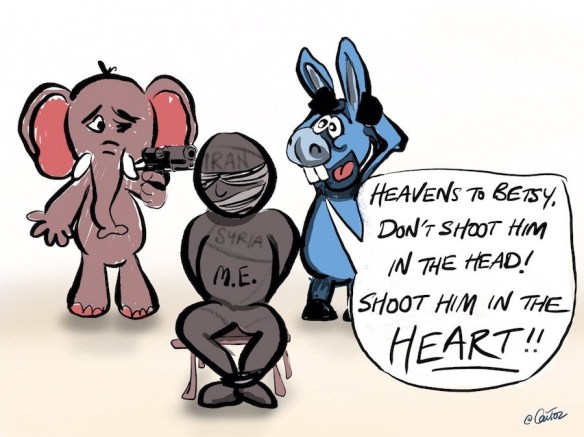
It is truly, deeply and profoundly stupid because the agenda to topple Iran’s government and the agenda to topple Syria’s government are not two separate agendas. They are the same. Supporting one while opposing the other is like wanting to shoot someone in the head but being morally opposed to shooting them in the heart.

Syria and Iran are allies. Eliminating one government necessarily hurts the other. Iran has been helping Syria to win the war against foreign-backed extremist proxy fighters who nearly succeeded in toppling Damascus before its allies stepped in, and should Syria succeed in rebuilding itself (something the Trump administration is actively preventing it from doing) we can be sure it would return the favor when called upon.

The US government’s agenda to “take out” all noncompliant governments in the Middle East is completely removed from any consideration for American party politics. It’s one unified agenda, and the more the imperial blob succeeds in weakening any of the remaining unabsorbed nations, the easier it gets to absorb the others.

Supporting regime change in Iran but not Syria, or vice-versa, is for this reason an inherently absurd position to take. If you opposed Obama’s attempt to topple Damascus via Timber Sycamore-armed proxies, it’s absurd for you to support any maneuvers which could lead to the elimination of Syria’s key ally in that fight. If you oppose Trump’s current warmongering toward Iran, it’s absurd for you to support the elimination of one of Iran’s remaining friends in the region.

If Iran falls you may be sure that Syria will fall next, and vice versa. It’s the same box being ticked; you’re just arguing over whether it should be a left-handed or right-handed check mark.

But such is the strength of propaganda. The perception managers of the US war machine have successfully manipulated the voting public into a debate not about whether regime change interventionism should happen, but which regime change intervention should happen first.

In a sense it’s quite brilliant; we may be quite sure that government agency departments responsible for domestic perception management on US foreign policy have discussed this precise dynamic at length. But in another sense it’s quite mundane: the recent Republican presidents have pursued regime change in Iran, while Obama pursued it in Syria, so Republicans support Republican interventions while Democrats support Democratic ones.

This has nothing to do with any substantial difference in these agendas (again, it’s actually one agenda) and everything to do with what each faction can be more easily propagandized toward. Liberal hearts are easier to grab with horror stories about a monster who gasses babies for no reason and less concerned about refugee crises and the persecution of Syrian Christians, while Republicans are much easier to manipulate into despising a theocracy run by Muslims.

And of course there’s overlap; people who prioritize mass murder above all else like John Bolton and Lindsey Graham will cheer enthusiastically for as much military interventionism as they can get in either country (or any country, really). But by and large, especially among the rank-and-file, people tend to support the interventions their respective presidents propagandized them into supporting. Propaganda is pretty much the only thing the presidential “bully pulpit” is used for.

Because Iraq has poisoned the idea, each mainstream faction may deny actually wanting the US to oust the government of Iran or Syria. Trump supporters who still stand by the anti-interventionist platform he falsely campaigned on may say “I don’t want war with Iran, I just want Iranians to get their freedom and I think it’s awesome they killed Solamumi or however you spell it.” Liberals might say “I don’t want interventionism! I just support the Freedom Fighters™️ in Idlib and want Assad to stop murdering civilians for fun and sexual gratification.” But circulating propaganda narratives about governments targeted for regime change is supporting regime change. You’re participating in it as surely as if you’d deployed the Tomahawk missiles yourself.

Yesterday someone told me that everyone at Qassem Soleimani’s incredibly massive funeral procession was attending because they were forced to. When I asked him if he was claiming that every single one of those millions of people were publicly mourning because they’d been literally forced at gunpoint, he told me no: many were forced in the sense that state propaganda was all they’d ever known, so they were psychologically coerced into grieving Soleimani.

“I don’t accept that your ‘state propaganda their whole lives’ model is any more coercive or fascistic than the kind that causes Americans to turn up to pro- and anti-Trump rallies,” I said. “Americans are no less propagandized than Iranians. If anything it’s worse, since Americans don’t know they’re being propagandized.”

“You’ve got it backwards,” he said. “Iranians don’t know they’re being propagandized because they only have one source of information. The U.S. knows it because we have sides screaming it to other sides all the time and the freedom of information and thought to come to our own conclusions.”

“Nonsense,” I replied. “Nearly all Americans are propagandized to the gills. They’re probably the most aggressively propagandized population on earth, just because so much depends on their swallowing propaganda. It’s just a more scientific sort.”

“And yet here we are, talking about it freely without worrying about swallowing a bullet,” he said.

“Here I am arguing with a man who just so happens to be striving very, very hard to convince me to swallow the exact same narrative that Mike Pompeo is trying to convince me to swallow,” I replied.

The greatest asset of the propagandists is the belief that we haven’t been propagandized.

In Redux of Iraq War Run Up, Media Cheers on Assassination of Soleimani

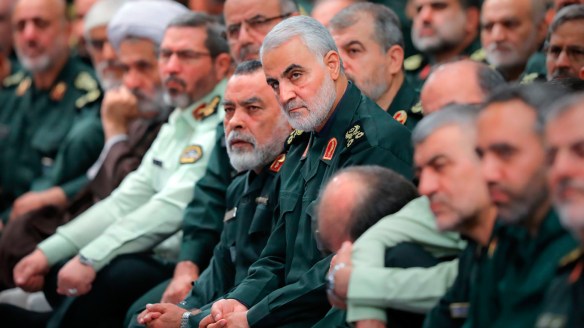
Gen. Qassim Soleimani, center, attends a meeting of a group of the Guard members with Iranian Leader Ayatollah Ali Khamenei, in Tehran, Iran on Oct. 2, 2019. Photo | AP

With echoes of Iraq, media are once again cheering an attack against a Middle Eastern country on the grounds of a supposedly imminent strike against the United States.

By Alan Macleod

Source: Mint Press News

Early Friday morning, a U.S. airstrike assassinated Iranian Lt. General Qassem Soleimani as he traveled from Baghdad’s international airport. A charismatic and capable military figure, Soleimani was widely considered to be one of the most powerful and influential individuals in Iran. Two years to the day since MintPress News reported that the U.S. government had given the green light to assassinate him, Soleimani’s convoy was struck from the air. Secretary of State Mike Pompeo presented the decision as a defensive one, claiming that Soleimani was preparing an “imminent attack” against the U.S. When pressed, he refused to give any more evidence or details. Despite claiming the strike made Americans much safer, the government immediately instructed all U.S. citizens to leave Iraq and avoid the American Embassy.

Assassinating foreign leaders is a major international war crime under international law, yet across the corporate spectrum, media applauded the bombing, or “precision targeting,” as CNN described it. Unsurprisingly, many conservative media outlets supported the Trump administration’s decision to potentially spark a huge international conflict. The Washington Examiner quoted one “expert” celebrating the killing as more important than Bin Laden’s death and a “massive blow to the regime.” Fox News quickly published an opinion piece from Christian Whiton of the strongly hawkish Center for the National Interest, praising Trump for acting “correctly and decisively,” preventing further American bloodshed by taking out a major “terrorist.” It also immediately invited major Neoconservative hawks and public faces of the Iraq War, Karl Rove and Ari Fleischer, on air to discuss the situation and inform its audience what to think.

Media with more liberal audiences ­– who claim to be leading the resistance against a dangerous fascist commander-in-chief – were no less supportive of Trump’s latest aggressive actions. Just as it had done with U.S.-supported coup attempts in Venezuela and Bolivia, resistance media lined up shoulder-to-shoulder with the president and condemned Soleimani as guilty of a myriad of crimes against humanity. CNBC’s headline read, “America just took out the world’s no. 1 bad guy,” accusing him of being the leader of the world’s “most active and pervasive terrorist army.” It claimed that Trump’s decision had “saved current lives” and represented “justice” to his many victims. It also claimed that it saved further American lives as it would “deter future Iranian attack plans.” “There’s no question Soleimani had American blood on his hands” claimed one source in USA Today; “he was an enemy.” It is worth noting, however, that the American deaths being referenced are not civilians, but members of an invading and occupying army in Iraq who were killed by locals resisting a foreign occupier.

The New York Times claimed he had “spent the last decade replicating the Hezbollah model in Iraq, Syria and Yemen, propping up local militias with precision weapons and tactical know-how” and held him responsible for “driving over 10 million [Syrian] people from their homes” not mentioning the American role in any of those warzones. Meanwhile, CNN’s Alex Marquardt claimed that, “US lawmakers are united in their support of the killing of Soleimani” and that Republicans and Democrats alike agreed that, “this is a man who deserved to be killed because of everything he has done against American forces” and were busy “congratulating” Trump for his heroism. The message from corporate media was clear: “Soleimani is a ruthless killer. He’s a horrible human being,” (CNN). The evidence presented for this claim was that “he commanded a division in the Iran/Iraq War” – a war in which the United States armed, funded and supported its then ally Saddam Hussein to invade Iran, causing around one million deaths.

In reality, corporate media are not celebrating Soleimani’s assassination because of his many (real) faults, but rather because of his qualities as an effective leader and organizer, someone who has constantly stymied American efforts to further dominate the region. In Syria, where the U.S. has all but allied with Al-Qaeda/Al-Nusra in order to overthrow the Assad dynasty, Iran has provided a significant counterweight to American-backed forces. Likewise, it continues to support groups such as Hezbollah that resist the U.S. and its allies across the region. It has also, rhetorically at least, supported the Houthi rebels fighting against a U.S./Saudi onslaught, although the extent of Iranian involvement is questionable.

The U.S. government has announced that it is preparing to increase its presence in the wake of the Soleimani assassination, sending at least 3,000 more troops to the region. With echoes of Iraq, media are once again cheering an attack and a military build-up against a Middle Eastern country on the grounds of a supposedly imminent strike against the United States. History, they say, never repeats itself. But it often rhymes.


Related Video

The Art of Doublespeak: Bellingcat and Mind Control

By Edward Curtin

Source: Behind the Curtain

In the 1920s, the influential American intellectual Walter Lippman argued that the average person was incapable of seeing or understanding the world clearly and needed to be guided by experts behind the social curtain.  In a number of books he laid out the theoretical foundations for the practical work of Edward Bernays, who developed “public relations” (aka propaganda) to carry out this task for the ruling elites.  Bernays had honed his skills while working as a propagandist for the United States during World War I, and after the war he set himself up as a public relations counselor in New York City.

There is a fascinating exchange at the beginning of Adam Curtis’s documentary, The Century of Self, where Bernays, then nearly 100 years old but still very sharp, reveals his manipulative mindset and that of so many of those who have followed in his wake.  He says the reason he couldn’t call his new business “propaganda” was because the Germans had given propaganda a “bad name,” and so he came up with the euphemism “public relations.”  He then adds that “if you could use it [i.e. propaganda] for war, you certainly could use it for peace.”  Of course, he never used PR for peace but just to manipulate public opinion (he helped engineer the CIA coup against the democratically elected Arbenz government in Guatemala in 1954 with fake news broadcasts).  He says “the Germans gave propaganda a bad name,” not Bernays and the United States with their vast campaign of lies, mainly aimed at the American people to get their support for going to a war they opposed (think weapons of mass destruction).  He sounds proud of his war propaganda work that resounded to his credit since it led to support for the “war to end all wars” and subsequently to a hit movie about WWI, Yankee Doodle Dandy, made in 1942 to promote another war, since the first one somehow didn’t achieve its lofty goal.

As Bernays has said in his book Propaganda,

The American motion picture is the greatest unconscious carrier of propaganda in the world today.

He was a propagandist to the end.  I suspect most viewers of the film are taken in by these softly spoken words of an old man sipping a glass of wine at a dinner table with a woman who is asking him questions. I have shown this film to hundreds of students and none has noticed his legerdemain.  It is an example of the sort of hocus-pocus I will be getting to shortly, the sly insertion into seemingly liberal or matter-of-fact commentary of statements that imply a different story.  The placement of convincing or confusing disingenuous ingredients into a truth sandwich – for Bernays knew that the bread of truth is essential to conceal untruth.

In the following years, Bernays, Lippman, and their ilk were joined by social “scientists,” psychologists, and sundry others intent on making a sham out of the idea of democracy by developing strategies and techniques for the engineering of social consensus consonant with the wishes of the ruling classes.  Their techniques of propaganda developed exponentially with the development of technology, the creation of the CIA, its infiltration of all the major media, and that agency’s courting of what the CIA official Cord Meyer called in the 1950s “the compatible left,” having already had the right in its pocket. Today most people are, as is said, “wired,” and they get their information from the electronic media that is mostly controlled by giant corporations in cahoots with government propagandists.  Ask yourself: Has the power of the oligarchic, permanent warfare state with its propaganda and spy networks increased or decreased over your lifetime. The answer is obvious: the average people that Lippman and Bernays trashed are losing and the ruling elites are winning.

This is not just because powerful propagandists are good at controlling so-called “average” people’s thinking, but, perhaps more importantly, because they are also adept – probably more so – at confusing or directing the thinking of those who consider themselves above average, those who still might read a book or two or have the concentration to read multiple articles that offer different perspectives on a topic.  This is what some call the professional and intellectual classes, perhaps 15-20 % of the population, most of whom are not the ruling elites but their employees and sometimes their mouthpieces.  It is this segment of the population that considers itself “informed,” but the information they imbibe is often sprinkled with bits of misdirection, both intentional and not, that beclouds their understanding of important public matters but leaves them with the false impression that they are in the know.

Recently I have noticed a group of interconnected examples of how this group of the population that exerts influence incommensurate with their numbers has contributed to the blurring of lines between fact and fiction. Within this group there are opinion makers who are often journalists, writers, and cultural producers of some sort or other, and then the larger number of the intellectual or schooled class who follow their opinions.  This second group then passes on their received opinions to those who look up to them.

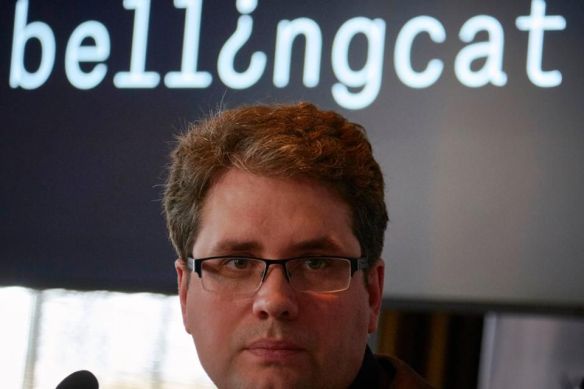
There is a notorious propaganda outfit called Bellingcat, started by an unemployed Englishman named Eliot Higgins, that has been funded by The Atlantic Council, a think-tank with deep ties to the U.S. government, NATO, war manufacturers, and their allies, and the National Endowment for Democracy (NED), another infamous U.S. front organization heavily involved in so-called color revolution regime change operations all around the world, that has just won the International Emmy Award for best documentary. The film with the Orwellian title, Bellingcat: Truth in a Post-Truth World, received its Emmy at a recent ceremony in New York City.  Bellingcat is an alleged group of amateur on-line researchers who have spent years shilling for the U.S. instigated war against the Syrian government, blaming the Douma chemical attack and others on the Assad government, and for the anti-Russian propaganda connected to, among other things, the Skripal poisoning case in England, and the downing of flight MH17 plane in Ukraine. It has been lauded by the corporate mainstream media in the west.  Its support for the equally fraudulent White Helmets (also funded by the US and the UK) in Syria has also been praised by the western corporate media while being dissected as propaganda by many excellent independent journalists such as Eva Bartlett, Vanessa Beeley, Catte Black, among others.  It’s had its work skewered by the likes of Seymour Hersh and MIT professor Theodore Postol, and its US government connections pointed out by many others, including Ben Norton and Max Blumenthal at The Gray Zone. And now we have the mainstream media’s wall of silence on the leaks from the Organization for the Prohibition on Chemical Weapons (OPCW) concerning the Douma chemical attack and the doctoring of their report that led to the illegal U.S. bombing of Syria in the spring of 2018.  Bellingcat was at the forefront of providing justification for such bombing, and now the journalists Peter Hitchens, Tareq Harrad (who recently resigned from Newsweek after accusing the publication of suppressing his revelations about the OPCW scandal) and others are fighting an uphill battle to get the truth out.

Yet Bellingcat: Truth in a Post-Truth World won the Emmy, fulfilling Bernays’ point about films being the greatest unconscious carriers of propaganda in the world today.

Who presented the Emmy Award to the film makers, but none other than the rebel journalist Chris Hedges.  Why he did so, I don’t know.  But that he did so clearly sends a message to those who follow his work and trust him that it’s okay to give a major cultural award to a propaganda outfit.  But then, perhaps he doesn’t consider Bellingcat to be that.

Nor, one presumes, does The Intercept, the billionaire Pierre Omidyar owned publication associated with Glen Greenwald and Jeremy Scahill, and also read by many progressive-minded people. The Intercept that earlier this year disbanded the small team that was tasked with reviewing and releasing more of the massive trove of documents they received from Edward Snowden six years ago, a minute number of which have ever been released or probably ever will be. As Whitney Webb pointed out, last year The Intercept  hosted a workshop for Bellingcat.  She wrote:

The Intercept, along with its parent company First Look Media, recently hosted a workshop for pro-war, Google-funded organization Bellingcat in New York. The workshop, which cost $2,500 per person to attend and lasted five days, aimed to instruct participants in how to perform investigations using “open source” tools — with Bellingcat’s past, controversial investigations for use as case studies…Thus, while The Intercept has long publicly promoted itself as an anti-interventionist and progressive media outlet, it is becoming clearer that – largely thanks to its ties to Omidyar – it is increasingly an organization that has more in common with Bellingcat, a group that launders NATO and U.S. propaganda and disguises it as “independent” and “investigative journalism.”

Then we have Jefferson Morley, the editor of The Deep State, former Washington Post journalist, and JFK assassination researcher, who has written a praiseworthy review of the Bellingcat film and who supports Bellingcat.  “In my experience, Bellingcat is credible,” he writes in an Alternet article, “Bellingcat documentary has the pace and plot of a thriller.”

Morley has also just written an article for Counterpunch“Why the Douma Chemical Attack Wasn’t a ‘Managed Massacre’” – in which he disputes the claim that the April 7, 2018 attack in the Damascus suburb was a false flag operation carried out by Assad’s opponents. “I do not see any evidence proving that Douma was a false flag incident,” he writes in this article that is written in a style that leaves one guessing as to what exactly he is saying.  It sounds convincing unless one concentrates, and then his double messages emerge.  Yet it is the kind of article that certain “sophisticated” left-wing readers might read and feel is insightful.  But then Morley, who has written considerably about the CIA, edits a website that advertises itself as “the thinking person’s portal to the world of secret government,” and recently had an exchange with former CIA Director John Brennan where “Brennan put a friendly finger on my chest,” said in February 2017, less than a month after Trump was sworn in as president, that:

With a docile Republican majority in Congress and a demoralized Democratic Party in opposition, the leaders of the Deep State are the most—perhaps the only—credible check in Washington on what Senator Bob Corker (R-Tenn.) calls Trump’s “wrecking ball presidency.”  

Is it any wonder that some people might be a bit confused?

“I know what you’re thinking about,” said Tweedledum; “but it isn’t so, nohow.”

“Contrariwise,” continued Tweedledee, “if it was so, it might be; and if it were so, it would be; but as it isn’t, it ain’t.  That’s logic.”

As a final case in point, there is a recent book by Stephen Kinzer, Poisoner in Chief: Sidney Gottlieb And The CIA Search For Mind Control, the story of the chemist known as Dr. Death who ran the CIA’s MK-ULTRA mind control project, using LSD, torture, electric shock therapy, hypnosis, etc.; developed sadistic methods of torture still used in black sites around the world; and invented various ingenious techniques for assassination, many of which were aimed at Fidel Castro.  Gottlieb was responsible for brutal prison and hospital experiments and untold death and suffering inflicted on all sorts of innocent people.  His work was depraved in the deepest sense; he worked with Nazis who experimented on Jews despite being Jewish himself.

Kinzer writes in depth about this man who considered himself a patriot and a spiritual person – a humane torturer and killer.  It is an eye-opening book for anyone who does not know about Gottlieb, who gave the CIA the essential tools they use in their “organized crime” activities around the world – in the words of Douglass Valentine, the author of The CIA as Organized Crime and The Phoenix Program. Kinzer’s book is good history on Gottlieb; however, he doesn’t venture into the present activities of the CIA and Gottlieb’s patriotic followers, who no doubt exist and go about their business in secret.

After recounting in detail the sordid history of Gottlieb’s secret work that is nauseating to read about, Kinzer leaves the reader with these strange words:

Gottlieb was not a sadist, but he might well have been…. Above all he was an instrument of history.  Understanding him is a deeply disturbing way of understanding ourselves.

What possibly could this mean?  Not a sadist?  An instrument of history?  Understanding ourselves?  These few sentences, dropped out of nowhere, pull the rug out from under what is generally an illuminating history and what seems like a moral indictment. This language is pure mystification.

Kinzer also concludes that because Gottlieb said so, the CIA failed in their efforts to develop methods of mind control and ended MK-ULTRA’s experiments long ago. Why would he believe the word of a man who personified the agency he worked for: a secret liar? He writes,

When Sydney Gottlieb brough MK-ULTRA to its end in the early 1960s, he told his CIA superiors that he had found no reliable way to wipe away memory, make people abandon their consciences, or commit crimes and then forget them.

As for those who might think otherwise, Kinzer suggests they have vivid imaginations and are caught up in conspiracy thinking: “This [convincing others that the CIA had developed methods of mind control when they hadn’t] is Sydney Gottlieb’s most unexpected legacy,” he asserts. He says this although Richard Helms, the CIA Director, destroyed all MK-Ultra records. He says that Allen Dulles, Gottlieb, and Helms themselves were caught up in a complete fantasy about mind control because they had seen too many movies and read too many books; mind control was impossible, a failure, a myth, he maintains. It is the stuff of popular culture, entertainment. In an interview with Chris Hedges, interestingly posted by Jefferson Morley at his website, The Deep State, Hedges agrees with Kinzer.  Gottlieb, Dulles, et al. were all deluded.  Mind control was impossible.  You couldn’t create a Manchurian Candidate; by implication, someone like Sirhan Sirhan could not have been programmed to be a fake Manchurian Candidate and to have no memory of what he did, as he claims.  He could not have been mind-controlled by the CIA to perform his part as the seeming assassin of Senator Robert Kennedy while the real killer shot RFK from behind. People who think like this should get real.

Furthermore, as is so common in books such as Kinzer’s, he repeats the canard that JFK and RFK knew about and pressured the CIA to assassinate Fidel Castro. This is demonstrably false, as shown by the Church Committee and the Assassinations Record Review Board, among many others. That Kinzer takes the word of notorious liars like Richard Helms and the top-level CIA operative Samuel Halpern is simple incredible, something that is hard to consider a mistake.  Slipped into a truth sandwich, it is devoured and passed on. But it is false. Bullshit meant to deceive.

But this is how these games are played. If you look carefully, you will see them widely.  Inform, enlighten, while throwing in doubletalk and untruths.  The small number of people who read such books and articles will come away knowing some history that has no current relevance and being misinformed on other history that does. They will then be in the know, ready to pass their “wisdom” on to those who care to listen. They will not think they are average.

But they will be mind controlled, and the killer cat will roam freely without a bell, ready to devour the unsuspecting mice.

The Forgotten Past Will Always be Repeated

By Robert Fantina

Source: CounterPunch

“Those who cannot remember the past are condemned to repeat it.” So said George Santayana.

It is difficult today to look at many, many situations in the world and not see some of the worst events in history being repeated, especially as they relate to racism and genocide. Has the world forgotten Nazi atrocities against Jews, Gypsies, intellectuals and others? Do we not remember the horrific U.S. bombing of two Japanese cities? Are Churchill’s colonial atrocities no longer worth considering?

We will review some of the most egregious events unfolding in front of us today.

Israel: This racist, apartheid state, which, for over 70 years has brutally oppressed the Palestinian people, this year declared itself the nation-state of the Jewish people, and only the Jewish people. Yet 25% of people who live within the borders of the Zionist entity are not Jewish. And despite marginalizing fully one-quarter of its residents, and relegating them to second-class citizen status, government spokespeople have the nerve to proclaim Israel as a democracy.

And what international outrage does this bring? Despite flagrant and constant violations of international law, not to mention common human decency, most of the countries of the world either ignore it all, or issue gentle rebukes, at best. And the world’s media seldom reports on it.

Myanmar: For several years now, the repression and expulsion of the Rohingya people has been ongoing government policy. A United Nations study of August 2018 found evidence of widespread violations of human rights. As of that date, nearly three-quarters of a million Rohingya people have had to flee their homeland due to the brutal persecution they have experienced. The U.N. study stated that military abuses of the Rohingyas “undoubtedly amount to the gravest crimes under international law.” Yet, like Israel’s brutal oppression of the Palestinians, this gets little press in North America.

India: Earlier this year, the government of India revoked Article 370 in the constitution that allowed occupied Kashmir some limited autonomy. Since that time, tens of thousands of Indian troops have stormed into Kashmir, communications with the outside world have been cut, and news media personal are forbidden from entering. The death toll from this recent repression is unknown. Government officials have publicly announced plans to colonize Kashmir using the same model of land confiscation and illegal settlement construction that Israel has used for decades against Palestine. Again, one listens in vain for international opposition to these crimes against humanity.

Additionally, India has now passed a law easing the path for citizenship for many refugees, but making immigration by Muslims more difficult. This has caused widespread protest demonstration throughout India, which are being met with police violence.

Saudi Arabia: That nation’s brutal onslaught against the people of Yemen continues, with the Yemeni death toll in the thousands and constantly rising. A bill passed by the U.S. Congress to prevent the U.S. from selling more weaponry to Saudi Arabia (the largest buyer of weapons from the U.S.) for use in Yemen was vetoed by President Donald Trump, thus enabling the continued slaughter of the Yemenis.

United States: Undergirding all this is the United States. That nation provides huge amounts of financial support to apartheid Israel, as well as protecting it from the legitimate consequences of its action on the international stage. Government spokespeople talk of ‘monitoring’ the situation in Myanmar, and have been mainly silent about India.

But the U.S. remains busy: its decades-long sanctions against Cuba remain. Following some easing of restrictions during the administration of President Barack Obama, Trump has re-issued them all. His sanctions against Iran, in violation of the Joint Comprehensive Plan of Action (JCPOA) and international law are causing great hardship for the people there. The U.S. supports the overthrow of the governments of Venezuela, issuing cruel sanctions against that country, and Syria, going so far as to actually arm, equip and train anti-government terrorist groups in the country, where, due largely to U.S. interference, hundreds of thousands of people have died, and hundreds of thousands more have been injured and left homeless. U.S. brutality toward the Yemenis has been mentioned above. The U.S. was involved in the recent overthrow of the Bolivian government.

Yet as recently as this week, U.S. Secretary of State Mike Pompeo proclaimed that the U.S. supports the right of people everywhere to self-determination. He said this when announcing additional sanctions against Iran, the irony of it certainly being lost on him and Trump. Self-determination is all well and good in the eyes of the U.S. government, as long as certain conditions are met: the form of government the people select must not be socialist; it must be a government that will do the U.S.’s bidding; it must not be a government that thinks its country’s natural resources are its own; it must not question or oppose Israel in any way, and it must not put its people before U.S. corporate profits. It must, in all ways and at all times, be willing to do its part to satisfy the U.S.’s geo-political goals.

As we look at the results of forgetting, or not learning from, history, we should ask an important question: When similar behaviors, perpetrated by German, Italian and English leaders happened before, what was the result? Additional questions arise: Did Germany succeed in annexing its neighbors? Were Italy and England successful in achieving their political goals? No, the result of such behaviors was a war whose devastation exceeded anything that can be imagined. And it brought the United States into its role as a super-power, which has been detrimental for much of the world.

The U.S. has never been interested in human rights or international law. Those in power in that country have only coveted riches, and have been, and are, willing to obtain them in any way possible, regardless of how much blood must flow. And that blood can be of innocent men, women and children in a far-off country, or of its own citizens who it sends to war. It will attempt, however futilely, to order the world to its liking. And as people protest, all possible efforts will be made to crush them.

One thing the U.S. and many other nations have failed to learn is that people will only be able to tolerate the thwarting of their legitimate aspirations for a limited amount of time: they will not allow it to go on forever. Working to genuinely assist them will make more friends and allies, and ultimately be far more beneficial for the world than opposing them and oppressing them ever will.

Until the U.S. and other powerful nations learn this vital lesson, the suffering they cause will be unending.

As The OPCW Is Accused Of False Reporting U.S. Propaganda Jumps To Its Help

Source: Moon of Alabama

An international organization published two false reports and got caught in the act. But as the false reports are in the U.S. interests a U.S. sponsored propaganda organization is send out to muddle the issue. As that effort comes under fire the New York Times jumps in to give the cover-up effort some extra help.

The Organisation for the Prohibition of Chemical Weapons (OPCW) manufactured a pretext for war by suppressing its own scientists’ research:

OPCW emails and documents were leaked and whistleblowers came forward to speak with journalists and international lawyers. Veteran journalist Jonathan Steele, who has spoken with the whistleblowers, wrote an excellent piece on the issues. In the Mail on Sunday columnist Peter Hitchens picked up the issue and moved it forward.

Under U.S. pressure the OPCW management modified or suppressed the findings of its own scientists to make it look as if the Syrian government had been responsible for the alleged chemical incident in April 2018 in Douma.

The public attention to the OPCW’s fakery lead to the questioning of other assertions the OPCW had previously made. With the OPCW under fire someone had to come to its help.

To save the propaganda value of the OPCW reports the U.S. financed Bellingcat propaganda organization jumped in to save the OPCW’s bacon. Bellingcat founder “suck my balls” Elliot Higgins claimed that the OPCW reports satisfied the concerns the OPCW scientist had voiced.

That assertion is now further propagated by a New York Times piece which, under the pretense of reporting about open source analysis, boosts Bellingcat and its defense of the OPCW:

The blogger Eliot Higgins made waves early in the decade by covering the war in Syria from a laptop in his apartment in Leicester, England, while caring for his infant daughter. In 2014, he founded Bellingcat, an open-source news outlet that has grown to include roughly a dozen staff members, with an office in The Hague. Mr. Higgins attributed his skill not to any special knowledge of international conflicts or digital data, but to the hours he had spent playing video games, which, he said, gave him the idea that any mystery can be cracked.

Bellingcat journalists have spread the word about their techniques in seminars attended by journalists and law-enforcement officials. Along with grants from groups like the Open Society Foundations, founded by George Soros, the seminars are a significant source of revenue for Bellingcat, a nonprofit organization.

It seems that the New York Times forgot to mention an important monetary source for Bellingcat. Here is a current screenshot of Bellingcat’s About page:

Porticus, Adessium, Pax for Peace and the Postcode Lottery are all Dutch organizations. Then there is the notorious Soros organization the New York Times mentioned. But why did the NYT forgot to tell its readers that Bellingcat is financed by the National Endowment for Democracy which itself is to nearly 100% funded by the U.S. government?

Could that be because the NED, which spends U.S.government money on more than 1.600 U.S. government paid Non-Government Organizations, is a Trojan horse, a cover for the CIA?

Spurred by Watergate – the Church committee of the Senate, the Pike committee of the House, and the Rockefeller Commission, created by the president, were all busy investigating the CIA. Seemingly every other day there was a new headline about the discovery of some awful thing, even criminal conduct, the CIA had been mixed up in for years.

What was done was to shift many of these awful things to a new organization, with a nice sounding name – The National Endowment for Democracy. The idea was that the NED would do somewhat overtly what the CIA had been doing covertly for decades, and thus, hopefully, eliminate the stigma associated with CIA covert activities.

“We should not have to do this kind of work covertly,” said Carl Gershman in 1986, while he was president of the Endowment. “It would be terrible for democratic groups around the world to be seen as subsidized by the C.I.A. We saw that in the 60’s, and that’s why it has been discontinued. We have not had the capability of doing this, and that’s why the endowment was created.”And Allen Weinstein, who helped draft the legislation establishing NED, declared in 1991: “A lot of what we do today was done covertly 25 years ago by the CIA.”

In effect, the CIA has been laundering money through NED.

The fact that the NED is doing the CIA’s work is likely the reason why the NYT puff piece about Bellingcat forgets to mention its payments and also why it jumps to Bellingcat’s and the OPCW’s help:

Some journalists and activists hostile to what they characterize as Bellingcat’s pro-Western narratives have criticized some of its coverage of the war in Syria.At issue is an April 7, 2018, attack on Douma, Syria. Bellingcat reported, based on an analysis of six open-source videos, that it was “highly likely” that Douma civilians had died because of chemical weapons. In March, the Organization for the Prohibition of Chemical Weapons reported that there were “reasonable grounds” to say that chemical weapons had been used in the attack.

Critics of Bellingcat have pointed to an email from an investigator with the organization, saying that it raised questions about the findings. WikiLeaks published the email on Nov. 23. In a response, Bellingcat defended its reporting, saying the final report on Douma from the Organization for the Prohibition of Chemical Weapons reflected the concerns of the investigator whose email was published by WikiLeaks.

By playing video games Elliot Higgins learned to identify chemical attacks in dubious video sequences published by terrorist affiliates. If true it is an admirable capability. Still his assertion that the OPCW report “reflected the concerns of the investigator” who criticized it is, as Caitlin Johnstone demonstrates, utterly false:

Bellingcat simply ignores this absolutely central aspect of the email, as well as the whistleblower’s point about the symptoms of victims not matching chlorine gas poisoning.

“In this case the confidence in the identity of chlorine or any choking agent is drawn into question precisely because of the inconsistency with the reported and observed symptoms,” the whistleblower writes in the email. “The inconsistency was not only noted by the [Fact Finding Mission] team but strongly noted by three toxicologists with expertise in exposure to [Chemical Weapons] agents.”

Bellingcat says nothing about these revelations in the email, and says nothing about the fact that the OPCW excluded them from both its Interim Report in July 2018 and its Final Report in March 2019, the latter of which actually asserted the exact opposite saying there was “reasonable grounds that the use of a toxic chemical as a weapon took place. This toxic chemical contained reactive chlorine. The toxic chemical was likely molecular chlorine.”

Bellingcat completely ignores all of these points, …

In its defense of the OPCW report Bellingcat wrote:

[A] comparison of the points raised in the letter against the final Douma report makes it amply clear that the OPCW not only addressed these points, but even changed the conclusion of an earlier report to reflect the concerns of said employee.

Mail on Sunday columnist Peter Hitchens did not concur with that paragraph:

Apart from the words ‘a’, and ‘the’, everything in the above paragraph is, to put it politely, mistaken. Bellingcat have been so anxious to trash the leak from the OPCW that they have (as many did when the attack was first released) rushed to judgment without waiting for the facts. More is known by the whistleblowers of the OPCW than has yet been released …

Caitlin and Peter should play more video games. I have read in the NYT that they are the true path to learning and to the factual assessment of alleged chemical attacks.

On April 7 2018 terrorists of the Jaish al Islam group ruled in Douma. They killed 40 civilians. The bodies were shown in videos along with chlorine gas canisters to pretend that the Syrian government had killed those people. The OPCW’s fact finding team analyzed the evidence and found that the canisters had not been dropped from the air but were manually placed. The symptoms the victims showed were inconsistent with a chlorine attack and chlorinated substances were only found in extremely low concentrations. There were absolutely no “reasonable grounds” to say that chemical weapons had been used in the attack.

But the OPCW management, under U.S. pressure and despite the protests by its own scientists, put out a report that said the opposite. As the manipulation came to light the U.S. funded Bellingcat made a perfunctory attempt to muddle the issue. Thus another propaganda organization, the New York Times, had to jump in to save Bellingcat and the false OPCW claims.

It is not going to help. There will soon be more evidence that the OPCW management published two false reports on Douma, and likely even more on other issues. There will be a public recognition that the OPCW has failed.