
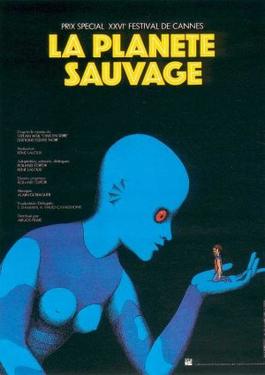
Saturday Matinee: Fantastic Planet

Surrealism and political critique in the animated medium: Fantastic Planet (1973)

By Dan Stalcup

Source: The Goods Firm Reviews

Coming from the “Panic Movement” surrealist art collective is one of the most bizarre animated films of all time: Fantastic Planet, a French-Czech production by director/co-writer René Laloux and co-writer/production designer Roland Topor.

With its title, Fantastic Planet sounds like it should be a cheesy sci-fi flick, and in some ways, it is. (The French title, La Planète sauvage, is much more pleasing.) But this is something much more insular and experimental than most genre films of the era. Thanks to its distinctive pencil-sketched, cutout animation technique (also seen in Monty Python interludes), the film has the look of a history or biology book come to life. The grotesqueries depicted have a diagrammatic, almost clinical look to them, making every alien and bit of worldbuilding feel all the more strange.

Fantastic Planet chronicles a far future when humans have been transplanted to the distant planet Ygam by giant blue aliens with red bug eyes called Draags (or, in some translations, Traags). There, humans serve the role of something resembling a rodent or small dog: occasionally domesticated by Draags, occasionally living in wild colonies as feral creatures. The humans on Ygam are called “Oms” by the Draags. They’re mostly viewed as harmless by the aliens, but often casually exploited and exterminated when convenient.

The story follows Terr, an orphaned human/Om, who is adopted by a Draag, but escapes before organizing an resistance to the giant aliens. Terr’s life has a vaguely mythological arc to it, further enhancing the sense the we’re witnessing some passed-down story. The entire telling is detached and emotionless — when Terr’s mother or compatriots die, there is no mourning or reaction, just a progression to the next item of the story. It’s disquieting.

What really makes Fantastic Planet so bizarre and unforgettable is the depiction of the alien life and planet: flora and fauna that look like something out of a fever dream or acid trip. The ground shifts into squirming intestines; a hookah bar causes the inhabitants to meld into a blur; twirling headless statues perform a mating ritual. It’s baroque and occasionally whimsical; half Dr. Seuss, half Salvador Dali.

Despite the strangeness of the imagery, the film avoids slipping into an all-out dissociated psychedelic trip thanks to its linear and straightforward narrative. This, paradoxically, makes everything feel even more alien: The story takes logical, coherent leaps, but the images and details within are so nonchalantly unearthly. It’s a dizzying juxtaposition.

The story is clearly allegorical: Animal rights is an obvious interpretation given the way that humans are chattelized. It’s not hard to squint and see anti-racism or anti-imperialism in its parable, either — any scenario where the majority or oppressors are negligent, systemic participators rather than active aggressors would fit.

There’s also a lot of coming of age imagery in the film, blown out into absurdism. The semi-comprehending way the humans perceive the Draag world is not too detached from the way kids see the adult world: full of obtuse rituals and norms. Plenty of the designs are charged with phallic and sexual imagery (not to mention casual nudity), but it’s secondary to the overall sweep of the visual invention of the film.

In the half century since its release, Fantastic Planet has become a cult legend, even inducted into the Criterion Collection — one of only a few animated films with the honor. According to Letterboxd, it’s among the most popular films of 1973. I can’t say I blame cinephiles out there. Even at 72 minutes, Fantastic Planet is a bit exhausting, but it’s such a unique and evocative experience that it is essential viewing. At least for weirdos like me.

Saturday Matinee: Gloria’s Call

Source: GloriasCall.com

From the cafés of Paris to the mountaintops of Samiland, a scholar’s life is foreverchanged through her friendships with the women artists of Surrealism.

In 1971, graduate student Gloria Orenstein received a call from Surrealist artist Leonora Carrington that sparked a lifelong journey into art, ecofeminism and shamanism. The short film, Gloria’s Call, uses art, animation and storytelling to celebrate this wild adventure from the cafes of Paris to the mountaintops of Samiland. The film is produced by artists Cheri Gaulke (director), Cheryl BookoutAnne GauldinSue Maberry and Christine Papalexis .

Gloria’s Call was born in October of 2016 during a presentation by renowned scholar Dr. Gloria Feman Orenstein at the Southern California Women’s Caucus for Art (SCWCA) Surrealist Tea in celebration of their 40th Anniversary.

ABOUT GLORIA

While my life has had its challenging moments and I have traversed many a dark woods in my quest for knowledge, I am fulfilled by the wondrous journeys I have made to the realms of the Marvelous, the Magical, the Great Goddess and the Shamanic Mysteries, and I will be forever grateful to the teachers who inspired me and to the feminist activists on whose strong shoulders we now stand as we welcome new generations of visionaries expanding our feminist legacy into the new millennium.   -Gloria Feman Orenstein

Gloria F. Orenstein is Professor Emerita in Comparative Literature and Gender Studies from the University of Southern California. Her areas of research have ranged from Surrealism, contemporary feminist literature and the arts to Ecofeminism and Shamanism.

Her first book The Theater Of The Marvelous: Surrealism And The Contemporary Stage paved the way for her pioneering work on The Women of Surrealism. Leonora Carrington had been a friend and remained a major source of her inspiration in research and scholarship since 1971. Her book The Reflowering Of The Goddess offers a feminist analysis of the movement in the contemporary arts that reclaimed the Goddess as the symbol of a paradigm shift toward a more gynocentric mythos and ethos as women artists forged a link to the pre-patriarchal civilization of the ancient Goddess cultures, referencing them as their source of spiritual inspiration.

Orenstein is also co-editor of Reweaving The World: The Emergence Of Ecofeminism, a collection of essays that grew out of the conference she created at USC in 1987, Ecofeminist Perspectives: Culture, Nature, Theory. During the 80s she was invited by the Shaman of Samiland (Lapland, N. Norway) to be a student with her in Alta, Norway, an experience that continued intermittently for almost five years. She also created The Woman’s Salon in NYC that lasted for ten years beginning in 1975. More recently, her work in Surrealism, in particular, led to her inclusion of an essay in the book In Wonderland that accompanied the important exhibition of the same name that focused on the Women artists of Surrealism in the Americas, both those who were native to the Americas and those who migrated there during or after WWII. Orenstein was a pioneer in introducing the art of Frida Kahlo to North American feminists early in the 70s. Today, she continues her journey investigating the visionary worlds of revelation and the Marvelous, and will continue this pursuit in her research well into the future.

Invisible Architecture III: The Psychogeography of Hyperspace

By Rococo Modem Basilisk

Source: Modern Mythology

Ordinarily, when we discuss psychogeography, we operate at the scale of a city: we discuss how people are drawn through a walkable space, at a speed in which they can be affected by each piece of passing scenery and make a detour to examine it. But, at the same time the Lettrists were wandering Paris and laying the groundwork for Disneyland in the micro-scale, at the macro-scale holes were being punched through the fabric of the United States in the form of highways.

Habitual migration patterns break the close association between culture and geography. There’s a psychogeographic wormhole between Fairfield County, CT and south Florida, and used to be one between there and upstate NY. If you live in Fairfield County (or certain parts of NYC) you’re liable to be culturally closer to some parts of south Florida than to many points in-between, not because of natural rock formations or bodies of water, but because highways have made it possible to pass through the middle without interacting with it.

Areas of transience — the hyperspace of psychogeography — are not ‘non-places’ with ‘non-culture’. They have a uniquely warped kind of culture, in the same way tourist-dependent places do. Some people spend large amounts of their lives there: long-haul truckers, jet-setting businessmen, touring bands or comedians or authors. The attempt at producing a consistent experience across geography produces an experience that can only exist in hyperspace.

Our own psychogeographic hyperspace is not as psychedelic as the one in Cordwainer Smith’s A Game of Rat and Dragon, but it is stranger, in a Ligottian way.

Why do they have ice machines? Why do they have pools? Why are airplanes and airports trapped in a perpetual 1963 idea of what luxury looks like? Path dependence has made the culture of our hyperspace deeply strange: there are low upper limits on quality of manufacture and high lower limits on quality of service, and the assumed transitory state of most inhabitants means bonds cannot be formed.

When new ideas are integrated here at all, they slot into existing structures — structures that don’t exist outside, in the world that is normal for most of us. Wifi passwords come with the keycard; a robot kiosk in front of the check-in desk prints tickets, as the clerk who formerly printed tickets watches.

These liminal spaces are only forgettable for people who have destinations. They’re also populated by residents, or commuters from geographically — nearby places, who fill the service jobs. What’s it like to have a diner with no regulars? This situation is capitalism-optimized. If you are a resident of psychogeographic hyperspace — nomadic or not — you are dog-fooding the experience that Rand thought was natural to man: separation of orbits, mediated by impersonal monetary transactions. It looks like endless beige hotels with broken ice machines.

What are the attributes of this Randian New Man who lives as hyperspace nomad? Sleep deprivation, boredom, and a dependence on stimulants. Gas stations in hyperspace cater to truckers, abnormally large DVD and pornography selections and every variety of pick-me-up not yet banned. Airports, whose nomads are of a higher caste and have less private space or scheduling freedom, focus more on overpriced convenience food, mediocre reading material, and headphones, and pillows. A Cinnabon could not survive outside of hyperspace, even if it grew up in the shallows of the shopping mall, but in this ecosystem, sheltered from competitors and provided with a steady stream of easy prey, it thrives.

The culture of hyperspace is not a psychogeography, except in a fairly minor sense: everywhere is the same, or tries to be. The few deviations, like Denver International Airport, are notable because deviation is so rare. There is an international internet radio station specifically for airports, and I have heard it play the same playlist in three states. (It never played Brian Eno.) However, like the hyperspace of fiction, it is a strange world that fills the gaps as we jump from one point to another without travelling in-between.

Transit systems are not the only holes in psychogeography. Communications systems also create them. Just as the prevalence of snowbirds and Adirondack cottages make it possible for small segments of northern New York and southern Florida to influence Manhattan finance and vice versa, arbitrary decisions or early-mover advantages gave Los Angeles cultural power over film, Cleveland cultural power over radio, and Atlanta cultural power over podcasting.

Communications technologies have their own hyperspace-cultures, although the geographic centralization of the big players has a larger impact on how they manifest than in the case of hotels. Twitter is the internet equivalent of a trucker-optimized gas station, and caters to journalists — the long-haul truckers of the information landscape. Facebook is the internet equivalent of a Holiday Inn: a premium-mediocre imitation of homeyness that is endearing in its complete failure to be convincing but ultimately irritating if you try to stay too long. (Facebook’s ice machine is always broken, and always loud.) The film industry is a bit like any airport: perpetually stuck in a cheap imitation of an imagined luxurious past, adapting poorly to the cosmopolitanism produced by globalization while profiting through its monopoly on the means of that globalization.

The culture of any hyperspace, because the means of association are limited to the Randian, will be corporate in its manifestation: customer service, marketing, selection, returns, free coupons as a means of apology. It differs from non-hyperspace because these are the only forms of communication truly available. This diner has no regulars with whom the waitress can be frank, only strangers perpetually passing through. It can get away with being shallow and having nothing under its surface, because only very rarely will someone stay long enough to peel it back.

Saturday Matinee: Un Chien Andalou and L’Age d’Or

Two Vintage Films by Salvador Dalí and Luis Buñuel: Un Chien Andalou and L’Age d’Or

By Colin Marshall

Source: Open Culture

While studying at the University of Madrid in the late 1910s, a young Luis Buñuel befriended an even younger Salvador Dalí. The first fruit of their association, a short film called Un Chien Andalou, appeared a decade later, in 1929, and quickly achieved the international renown it still has today. Several elements had to fall into place to bring this cinematic dream — or cinematic nightmare, or, most accurately, something nebulously in-between — into reality. First, Buñuel gained experience in the medium by assistant-directing on major silent-era European films like Mauprat, La chute de la maison Usher, and La Sirène des Tropiques. Then, Buñuel dreamt of the simultaneous image of a cloud slicing through the moon and a razor slicing through an eye. Then, Dalí dreamt of a human hand covered in ants. With those two visuals in place, they proceeded to collaborate on the rest of the film, working under the principle that “no idea or image that might lend itself to a rational explanation of any kind would be accepted.”

We could discuss Un Chien Andalou‘s rationally inexplicable images, but wouldn’t that defeat the purpose? The moon, the eye, the hand, the ants, the cyclist in the nun’s habit — these nonsensical but enduring images must be seen, and you can do that free on YouTube. But at sixteen minutes, the movie will only whet your aesthetic appetite for Buñuel and Dalí’s particular flavor of flamboyantly nonsensical, grimly satirical imagery. Luckily, you can follow it up with 1930’s L’Age d’Or, which began as another Buñuel-Dalí joint venture until the two suddenly went their separate ways after writing the script. Buñuel took over, crafting a wryly savage five-part critique of the Roman Catholic Church. Buñuel and Dalí had prepared themselves for shock-induced physical violence at the premiere of Un Chien Andalou, only to find that the crowd had heartily approved. But L’Age d’Or drew enough fire for both pictures and then some, getting banned in France and eventually withdrawn from distribution until re-emerging in 1979. Now you can watch it whenever you like on the internet, suggesting that the controversy has evaporated — yet the images remain as surreal a way as any to begin your weekend. A restored version of the film can be viewed here.


Saturday Matinee: Dreams That Money Can Buy

dreams_that_money_can_buy_01

“Dreams That Money Can Buy” (1947) is a surrealist film produced, and directed by artist and dada film-theorist Hans Richter with contributions from Max Ernst, Marcel Duchamp, Man Ray, Alexander Calder, Darius Milhaud, John Cage and Fernand Léger. Joe is a WW2 vet and starving artist who discovers that he can see the contents of his mind unfolding when gazing into a mirror. After realizing he can apply his gift to others, Joe sets up a business selling tailor-made dreams to a variety of neurotic clients in order to pay his rent.

Saturday Matinee: La Antena

antena372

In “La Antena” (2007), a surreal Argentine parable written and directed by Esteban Sapir, the population of an unknown city is kept under the complete control of Mr. TV through his monopolization of the broadcast system and food supply. Everyone in the city except for a singer, La Voz, has lost their voice (yet are still able to communicate through visual words). With the help of his scientist henchman Dr. Y, Mr. TV kidnaps La Voz in a scheme to take away the last remaining means of communication from the the citizens. A TV repairman gets word of the plan and attempts to foil it using an abandoned antenna in the mountains.

The film is shot in a silent film style reminiscent of the works of Fritz Lang and F.W. Murnau, but also seems to incorporate influences from modern fantasy films such as Dark City and Pan’s Labyrinth. Unfortunately, the only complete version of the film I could find was without subtitles, but those who don’t know Spanish can still enjoy it because the story is conveyed mostly through (beautifully evocative) imagery and doesn’t rely heavily on dialogue.