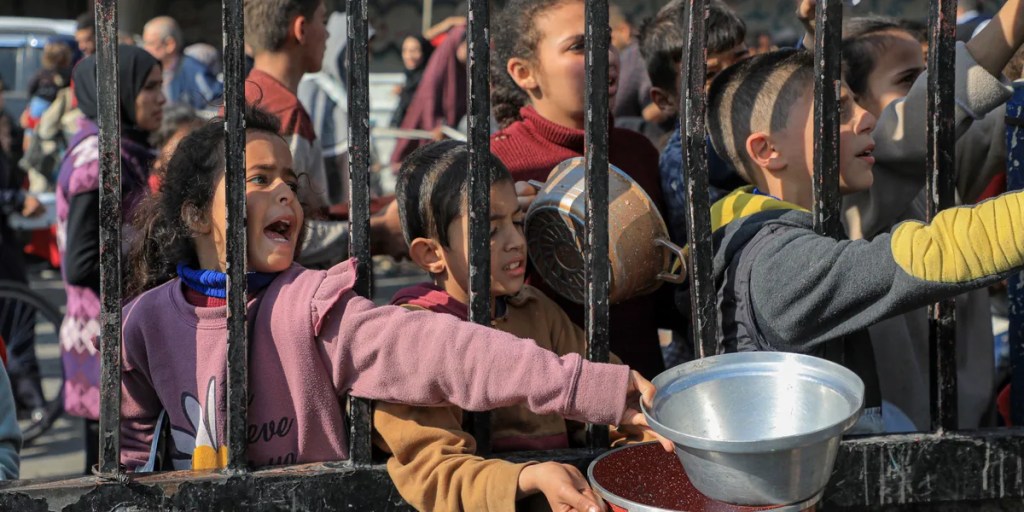
Gaza: Genocide by Starving

By Jamal Kanj

Source: Global Research

Imagine you are at home, with your wife and children. It’s dinner time before you put your three children to sleep. The room is cold, the propane cooking cylinder empty, no food, no electricity, or drinking water.

Your youngest child, Manar, cries, “I’m hungry. We haven’t had food for the last four days.” She rubs her dry bluish hands together, “Uhf-uh-ih-ih-uhhf, … I’m cold.” The words escape her chattering teeth.

You, let’s say your name is Nader, look at Manar’s feeble body, her pale skin has lost color. The once bouncy curly black hair had tangled and knotted like a cluttered eagle nest, unwashed for more than a month.

Ahmad asks his wife, “Noora, did you search the cabinets and closets for the dry food?”

Noora took a deep breath, “More than ten times, our kitchen is as empty as our stomachs.” She looked at the cold floor in despair, her face twisted into a sorrowful mask.

“Press this against Manar’s stomach,” he said in a low voice and handed Noora a bag full of sand. “It’ll help her sleep, again.”

It wasn’t the first night they put their children to sleep with a sack of sand on their stomach. This has become a common method for Gazans to suppress hunger. It was after midnight when Manar stopped crying, only then Nader and Noora had a chance to close their eyes, not knowing how more miserable the next day would be.

Unsure of the time, Nader jumps from the floor mattress to a strong pounding at the door. Loud pandemonium and commotion outside, he looks at his watch, 3:45 am. His first thought, the Israeli military ordering residents to vacate the building before blowing it up, as they had done dynamiting blocks of buildings in his neighborhood a week earlier. Noora and the children awake. Manar crawls to the corner with her siblings, wraps herself around her mother.

Nader leaped to the door to find his neighbor brother, Ali, on the other side panting for air.

“Come Nader … come, let’s go.” He stopped to catch a breath after running up the stairs. “Flour trucks.” His chest ballooned and deflated several times, “trucks arriving at the Nabulsi roundabout.” Ali moved sideways to make way for neighbors clumping down the stairs.

The children’s faces lit up. Their eyes like laser light, at Nader, wide open, waiting for his response.

“There were Israeli tanks at the roundabout. They ordered me home yesterday and didn’t allow me to bring water,” Nader said.

“The UN is distributing the flour. The Israelis allowed the trucks in.” Ali looked down the stairs, “Let’s go before it’s too late.” He urged Nader.

Nader turns his head toward his children, Manar’s laser focused eyes turn into a vacant stare, open mouth. He clenched his teeth, pulled the winter coat from the hook, closed the door behind and followed his older brother Ali, down to the street.

The above is not a work of imagination, but a reality of life endured by thousands of individuals in Gaza for more than 150 days. It is exactly what happened in the Flour Massacre on February 29 to thousands of starving fathers, mothers, brothers and sisters in north Gaza. Where Israel used aid trucks to lure, murder and injure almost 900 hungry civilians. The blood of the starving, young and old, man and woman, drenched the flour sacks meant to feed hungry children.

Israel’s Gaza Solution: Let Palestinians Die Before the World. Bombing Hospitals and UN Institutions. Nobody Will Stop Israel

In its efforts to render life in Gaza uninhabitable, Israel has not only targeted essential infrastructures such as hospitals, universities, water treatment plants, and roads but has also directed attacks towards civilian police. This deliberate targeting of police aimed to exacerbate the suffering and provoke a collapse of law and order. Despite warnings from the U.S. against targeting civilian police who maintained public safety and managed the orderly distribution of food, Israel dismissed such concerns, seeking to create lawlessness and chaotic conditions to worsen starvation and justify its actions as in the case of the Flour Massacre.

In covering the story, the Gaza absent Western media became willing outlets to market Israel disinformation cloaked in euphemisms to obscure the grim reality on the ground. Outlets like CNN along with other print media and the BBC for example referred to the death of 112 and the injuring of 760 hungry human beings as “Gaza food aid carnage” or “a chaotic encounter with Israeli troops,” blaming the death on stampedes and truck drivers. They then broadcasted, unquestionably, Israeli-manipulated videos showing the product of the Israeli designed chaos and claiming the hungry crowd posed a threat to its soldiers.

This wasn’t different from an earlier misinformation propagated by CNN Wolf Blitzer, when hosting Mark Regev, the Israeli version of the German Joseph Goebbels, in his show, The Situation Room, on November 15, 2023 where he started the show by saying “Happening now, the Israeli military says it uncovered Hamas weapons and a command center inside Gaza’s largest hospital.” Needless to say, it was all false. In spite of Regev’s abject disregard to basic truth, the Israeli Goebbels was brought again to CNN this week to market the flour truck massacre spinning lies, unchallenged, and claiming no Israeli involvement in the gunfire and blaming the shooting on “Palestinian armed groups.”

Unarguably, CNN, much like most of the American and European news outlets, have become a platform for disinformation with Israeli embedded hosts such as Blitzer who honed his journalistic prowess as a pro-Israel propogandist working for America Israel Public Affairs Committee, serving as an editor for its Near East Report in the mid 1970s.

It wasn’t until Al Jazeera aired a video showing the “chaotic” scene amidst heavy gunfire around the food truck, along with footage revealing bullet injuries in the upper bodies of victims, when some U.S. outlets, such as  the New York Times, who espouses a faux professionalism, couldn’t continue ignoring the flagrant Israeli lies. The paper revisited the Israeli drone video that was made available to the compliant U.S. media outlets. After careful review the newspaper concluded that the footage had been altered with “multiple clips spliced together.” The edits conveniently erased the events just before the crowd dispersed in all directions, evading bullets, scrambling over trucks, seeking cover behind vehicles and structures, and falling to the ground from direct gunshot wounds. 

It is important to point out, the targeting of aid trucks at the Nabulsi roundabout is neither the first nor the last of Israeli attempts to obstruct the delivery of food aid in Gaza. Approximately three weeks prior, on February 6, Israel fired upon a crowd gathering at the Kuwaiti roundabout, while naval gunboats targeted UNRWA humanitarian food trucks. More recently, or three days following the Flour Massacre, on March 3rd, Israel once again opened fire on a hungry crowd awaiting food trucks at the Kuwaiti roundabout, resulting in the deaths and injuries of several civilians.

The submissive prostration of Western media, providing unchallenged platforms to Israeli PR spokespersons, is unprecedented in the so called “free world.” By agreeing to Israeli directives restricting media access into Gaza, Western mainstream media has no presence to report from the theater. Gone AWOL, the media has been transformed into an active participant in whitewashing Israeli genocide where the Gaza coverage has been regulated, directly and indirectly, by an Israeli hasbara manifested by the managed evidence and narrative of the Flour Massacre. Or to paraphrase the original Goebbels, Western mainstream media has become a “keyboard on which Israel plays.”

In fact, Western, and particularly American genuflection to Israel extends beyond the media. Case in point, almost two weeks ago, the White House National Security Communications Advisor, John Kirby, disparaged his own U.S. army, praising the Israeli forces for taking actions to protect civilians, stating that he was “not sure our own (American) military would take” similar actions.

When asked about the murdering of the hungry civilians in Gaza, Kirby’s boss, Joe Biden pled ignorance stating “There’s two competing versions of what happened. I don’t have an answer yet.” 

In avoiding answering the question, the U.S. president accorded equal credence to the Israeli disinformation machine. In keeping up with his standing, Biden is consistent in his anti-Palestinian bias hyperbolizing Israeli victimhood, while downplaying Israeli crimes against Palestinians under the pretext of not having enough information.

This week and after five months of pleading for Israel to allow more aid trucks into Gaza, Biden joined other inept Arab dictators in an inconsequential gesture dropping 38,000 meals to 2,4 million in Gaza. A stunt by the incompetent leaders which is aimed more at mollifying international outrage against Israel than a genuine desire to alleviate the mounting starvation levels in Gaza.

The made for TV theatrical air drop of mere 38,000 meals was like a grain of sand on the beach of Gaza. The parachuted meals were equivalent to providing a minuscule 0.005 of the daily meal for every Gazans, or the equivalent of offering 5 loaves of bread per 1000 individuals. This is a farce and rings hollow from an Administration that plans to send Israel almost $15 billion, in addition to the weapons and political cover that empower Israel to carry out the very siege the air drops purportedly intend to mitigate. The starvation in Gaza is not due to a drought or a natural disaster, but an Israeli made catastrophe enabled by Biden, Western governments, and blessed by Arab dictators.

As you read this, remember Nader, who joined his brother Ali to feed his hungry child, Manar. He would have been most likely one of those killed or injured in the February 29, Flour Massacre. His children, if alive, are still hungry and cold at home, watching through a broken window (U.S.) aid parcels parachuting from the skies alongside the roar of an American-made jet delivering 2000-pound bombs over their heads. 

Manar, if she wasn’t among the more than 15 children who tragically perished this week from malnutrition and dehydration, will always recall how the Israeli-made starvation drove her father to death.

Humanity Under Assault by the Elites – When Will We Have Had Enough?

By Phil Butler

Source: New Eastern Outlook

“I speak of peace, therefore, as the necessary rational end of rational men. I realize that the pursuit of peace is not as dramatic as the pursuit of war–and frequently the words of the pursuer fall on deaf ears. But we have no more urgent task.” – John F. Kennedy

For most people, it’s difficult to imagine much of what’s happening today. And this is why so many seem in the dark about what we should do to alleviate our problems. Looking at the situation in which a proxy is being waged on Russia from Ukraine, nothing seems to add up. The same is true for the genocide now going on in Gaza. And when we superimpose problems like curing cancer and other diseases, environmental problems, and failing economies, the only thing we can see is that our leaders have failed miserably at prioritising. It’s also obvious that we, the people, are the farthest thing from their minds.

Regarding visualisation, there’s no bigger confusion than grasping just how much money the Western powers are shovelling into the war against Russia. So far, something like $233 billion has been donated to Ukraine. The top donors are the EU($90B) and the United States ($73B). Interestingly, most of the EU funding has been aimed at financial aid, while the US donates are mostly military aid. Neither the EU nor the US spent much on humanitarian aid, at least not by comparison. But then, humanitarian money does not go into the pockets of the elites, now does it? The arms companies and financial institutions seem to be leveraging this Ukraine mess for a return on assets. But that’s another story. Now, I’d like to compare spending on Ukrainian and Israeli wars against efforts that do help human beings.

Let’s look at one of humanity’s most dreaded killers: cancer. In total, global oncology spending in 2022 was $193 billion. The numbers are far more telling in key research, where funding often comes from philanthropy. The Lancet reported recently that some 66,388 awards with a total investment of about $24.5 funded research for 2016–20. And now these figures have nosedived. In 2020, there were 19.3 million cases and 10 million deaths from the dreaded disease.

If we look at how many people are starving on our planet, it’s appalling to think of billions thrown away on unwinnable wars for the sake of selling weapons. In 2021, U.N. World Food Programme Executive Director David Beasley said it would take an estimated $40 billion annually to end world hunger by 2030. Let’s think about that for a moment. Each day, 25,000 people, including more than 10,000 children, die from hunger and related causes. Envision the lost potential of all those children perishing, if you can. Beasley went on to etch the situation in stone with this statement:

“There is 400 trillion dollars’ worth of wealth on the earth today, and the fact that 9 million people die from hunger every year… Shame on us. In the height of COVID, billionaires’ net worth increase was $5.2 billion per day. At the same time, 24,000 people die per day from hunger. Shame on us. Every hour, the net worth of billionaires during the height of COVID was a substantial $216 million per hour. Yet 1000 people per hour were dying from hunger… Shame on us.”

Two-hundred-sixteen million dollars per hour! I’ll wager the vast majority of that wealth had nothing whatsoever to do with helping human beings, curing disease, or stopping the endless wars. Moving on, let’s look at the homeless/poverty situation worldwide. In 2021, there were 150 million homeless people worldwide. While so many people here in Greece and other countries in Europe strive to go live in the United States, few realise that over 18% of the people living in my country live below the poverty line. And no one wanting to become American realises that the overwhelming solution to poverty in my country is to punish and imprison the poor (Homelessness World Cup). Using only what’s been spent on Ukraine so far, the U.S. Government could have issued a check for $1,825 to each of the 40 million homeless people in the country. That’s two or even three months’ rent for all homeless people in the USA.

Even in highly developed countries like Germany, more than 14.8% of the people are living beneath the national poverty line. Interestingly, some Latin American countries equal or better poverty rate than North American or some European countries. Take Argentina as an example. The situation there is no worse than it is in the United States. In Chile, only 9% of the population lives in dire circumstances. Unbelievably, there are countries like Bangladesh, traditionally thought of as the world’s poorest countries, where less than 13% of the population lives below the poverty line. In Romania, 26% of the people live in extreme poverty, and in neighbouring Bulgaria, the rate is almost 24%.

Turning to more practical matters that bear on quality of life and efficiency, we find the United States of America ranks 13th out of 141 countries in overall infrastructure. What a stunning achievement for the richest (supposedly) country in the world! After all, how do we balance what a country’s wealth is? What is the negative value of a dangerous, rusty bridge or a pothole in a road so deep you can hear Chinese being spoken from its depths? How bad is 13th place? Well, the American Society of Civil Engineers estimated that it would take 50 years to complete only the necessary repairs on more than 46,000 deteriorated bridges in the country. Both the Trump and Biden administrations promised to pour more money into the problem, but so far the US of A is still crumbling. So that you understand, Spain, Singapore, South Korea, Japan, and eight other countries have better quality infrastructures than the US. Remember I mentioned at the beginning, prioritisation? Is it possible that the Spaniards are doing more to care for their own people than America? Does Spain start proxy wars on Russia’s borders? I do not see Spanish ships in the South China Sea provoking war.

Since we landed in Spain, let’s take a look at some interesting facts about their quality of life. For instance, the Spanish Constitution includes a right to housing. The reality of homelessness there is that less than 8.5% of the population is homeless, and most of those live in shelters. Spain ranked 27th out of OF 189 countries in the Human Development Index Rankings.  Romania was 49th, the USA was 17th, Chile 43rd, and South Korea was 23rd. For me at least, what is significant in these numbers is the wide disparity in position in a world that was supposed to be some globalisation miracle a couple of decades ago. Despite all the PR and belly-rubbing the people of Earth have received, things in most countries are just not getting better. And trillions are being spent on wars and corporate machinations that steal from our prosperity.

Returning to my thesis, we must add the humongous waste of money that has gone to the state of Israel, Saudi deals, and the new monies soon to flow in that direction simply to eradicate or force migrate the Palestinians. Before the current crisis, the Biden administration had pledged $14.3 billion in aid to Israel since the October 7th Hamas campaign against the Israelis began. But this figure is a bit misleading if we want to see just how massive the American sacrifice for Israel has been. Since World War II, the United States has given Israel more aid than any other nation, currently more than $260 billion. To wrap things up for this report, the U.N. says the conflict in Yemen is one of the world’s worst humanitarian crises. Saudi Arabia does not receive American aid through loans, grants, or gifts pegged for killing Yemenis. However, the US Accounting Office reported that between 2015 and 2021, the US Department of Defense supplied more than $54.6 billion in military support for the Saudis and the United Arab Emirates. Now, imagine what human strife could be alleviated with these hundreds of billions combined with the trillions spent on failed US wars across the globe.

For those who enjoy simple examples of what could be. There are over 33,000 homeless veterans who fought these wars for the United States. The billions in military support only for Saudi Arabia would be enough to gift each one of those vets $1.7 million. You do the math. What is being spent to kill millions of us, could save the millions being killed PLUS millions of others starving, wasting away, or swept away by disasters. Now you tell me when the time will be right to get out the torches and pitchforks.

As Food Shortages Loom, US Kids Starve, Biden to Send $33 Billion MORE to Ukraine to Keep War Going

By Matt Agorist

Source: The Free Thought Project

In 2019, Ukraine’s Volodymyr Zelensky was elected to president of Ukraine after running on a platform of ending the conflict in the Donbass region and making peace with Russia. Unfortunately, however, these goals were not in synch with the US hegemony and instead of pushing for peace, the US supported the far right neo-Nazis who promised to kill Zelensky if he sought peace. 

Over the next two years, the United States continued to funnel weapons, money, and training into Ukraine, ensuring a future conflict with Russia by instigating military conflict directly on their border. In February of this year, Russian president Vladimir Putin announced that a line had been crossed and he then invaded Ukraine, kicking off a violent and deadly war.

Just a few weeks into the war, Russia offered concessions as spokesman Dmitry Peskov announced that Moscow will end the invasion immediately if Ukraine amends its constitution to ensure it stays neutral and doesn’t join NATO, it acknowledges Crimea as Russian territory, and recognizes the separatist republics of Donetsk and Luhansk as independent states.

Since then, the United States has recommended that Ukraine not accept a peace deal and instead continue to allow their people to be used as cannon fodder while US taxpayers are fleeced for billions to fight a proxy war with Russia.

Since the war began in February, Biden has authorized more than $14 billion in your tax dollars to arm literal Nazis in the region. This week, because very few people have spoken out against this war, that request more than doubled and Biden asked Congress for a whopping $33 billion more. 

While encouraging Ukraine to take the deal offered by Russia would be far more effective than US tax dollars at ending the suffering and helping Ukrainians, the military industrial complex is uninterested in such a move.

It is no surprise that the stock market associated with the military industrial complex is booming as the rest of the market plummets.

What’s more, as the politically elite send billions to the other side of the world, 3.7 million children have been pushed into poverty here at home.

According to a recently released Columbia University report, by late January 3.7 million U.S. children were plunged back into poverty, as the government ended the child tax credit.

What’s more, the elite have been publicly warning the world of massive food shortages and supply chain issues — yet here we are sending billions Nazis to prevent Ukraine from seeking peace.

Just last month, the extremely creepy yet exceedingly influential Klaus Schwab warned that “History is truly at a turning point. We do not yet know the full extent and the systemic and structural changes which will happen” but he said that “we do know the global energy systems, food systems, and supply chains will be deeply affected.”

It’s not just the real-life version of Dr. Evil making these warnings either. As we reported at the time, the president of the ominously connected multi-trillion-dollar asset fund, BlackRock, Rob Kapito told oil and gas executives the same week that “entitled” Americans are about to deal with shortages of food and other goods, and should prepare accordingly.

“For the first time, this generation is going to go into a store and not be able to get what they want,” Kapito told a meeting of the Texas Independent Producers and Royalty Owners Association. “And we have a very entitled generation that has never had to sacrifice.”

“I would put on your seat belts because this is something that we haven’t seen,” Kapito added, warning that Americans will soon face “scarcity inflation” – or rising prices compounded by shortages of everything from food and consumer goods to oil and gas.

President Joe Biden has been telling Americans for months now that they have to foot the bill for the war in Ukraine and “do their part” by sending billions to Zelensky and paying high prices for oil. Around the same time Schwab and Kapito made their warnings, Biden took his position to a whole new level, telling Americans that food shortages are “gonna be real.”

This week, Goya Foods CEO Bob Unanue has issued a similar warning: “We are on the precipice of a global food crisis.”

In a Wednesday interview, Unanue told Fox Business’s Maria Bartiromo, “Americans will have to tighten their belts and consume less,” in response to her question about a potential food shortage crisis.

Though the government has been telling us these higher prices and supply chain issues are Russia’s fault, those who have been paying attention have warned since last year that Biden’s policies – which involved spending more in his first eight months than former President Donald Trump did in 2018 and 2019 combined, and throttling domestic energy production – would trigger price spikes and supply chain disruptions for ordinary Americans.

Trump definitely played a role as well by printing nearly 7 trillion in his last year in office. This is why inflation was already at a 40-year high, before the war began and as spending increases, hard times are seemingly inevitable. The Ukraine invasion is most assuredly playing a role in this debacle but it will be the straw that broke the camels back, not the main driver.

Whatever actually sets off this shortage, rest assured that the people warning us about it will be the last to suffer from it. It will be the poor and middle class who suffer the most from these issues.

As Max Blumenthal reminds us, “200,000 small businesses were wrecked and millions left jobless and alone in the name of public health. Now gas and food prices must surge to protect freedom and stand for Ukraine. You will own nothing and be happy and if you don’t like it, you might be a Russian conspiracist.”

8 Critical Factors Behind Every Food Crisis

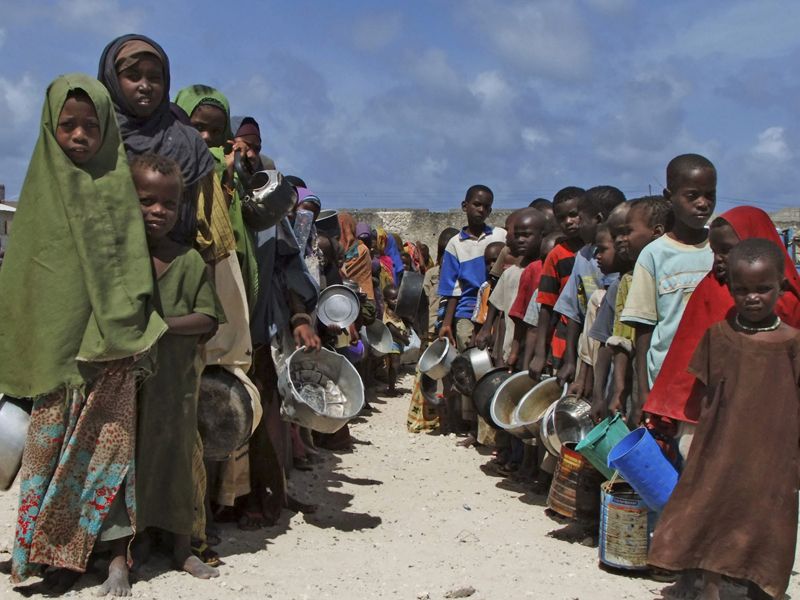
FILE – In this Monday, Aug. 15, 2011 file photo, children from southern Somalia hold their pots as they line up to receive cooked food in Mogadishu, Somalia. A report by two U.S. government-funded famine and food agencies gives the highest death toll yet, estimating that 260,000 people died – more than double previous estimates. (AP Photo/Farah Abdi Warsameh, File)

By John Hawthorne

Source: Business Connect

From the beginning of time, their have been food crises in one form or another. Ancient books such as the Bible have records of various famines devastating portions of the world.

And while it’s easy to attribute these crises to a single cause, such as war or drought, the causes are usually much deeper and much more complex.

Nelson Mandela said, “Overcoming poverty is not an act of charity, it is an act of justice.”

In order for us to achieve the kind of justice envisioned by Mandela, it’s essential that we first understand the underlying causes of food crises. Only after we have understood can we then begin creating meaningful solutions.

With that in mind, here are 8 primary factors behind almost every global food crisis. While not all 8 of these will be present at a time, you will almost always find several of these at work.

Factor #1 – Poverty

One of the greatest factors in every food crisis is stark and abject poverty. This isn’t surprising. With enough money, anyone can ensure they have enough food. But with many developing nations sitting well below the poverty line, the population simply can’t afford the food they so desperately need.

Additionally, poverty has a distinct effect on food output. In Africa, for example, many farmers can’t afford proper irrigation and fertilizer. This, in turn, leads to lower yields, which then reduces the overall amount of food available to the population.

The population of the Sub-Saharan region of Africa is expected to grow at an astronomical rate, topping out at 2.4 billion by 2050. This will continue to exacerbate the poverty issue, which will then continue to drive the lack of sufficient food in the area.

Factor #2 – Drought and Desertification

Widespread droughts, leading to the desertification of particular locations also causes huge disruptions to food production. For example, leading up to and during the global food crisis of 2008, 110 countries experienced significant droughts. This caused even the most well-irrigated, fertile areas to become arid deserts, making it impossible to grow crops.

As Mark Hughes noted:

Australia is normally the second largest exporter of grain, after the U.S. The continent, though, is experiencing an ongoing drought that has been described as the worst in a century. Grain yields have shrunk and many silos remain empty. Australia’s drought is a major factor in global wheat stocks being at their lowest since 1979. In fact, many wheat and rice farmers are switching to crops that demand less water, such as wine grapes.

Additionally, farmers often let animals over-graze on their land, reducing the amount of vegetation and increasing desertification. If the soil becomes dry enough, it is ruined and unable to support any crops at all.

Finally, as populations grow, deforestation occurs at an increased rate, which then leads to less vegetation and more desertification.

Factor #3 – Political Pressure

In the past, the International Monetary Fund has pressured small farmers, particularly in impoverished African countries, to abandon agricultural farming in favor of industrial work. The money generated from this practice would be used to pay off debt and import food.

While it may sound like a working strategy, it has created catastrophic results.

As Eric Holt-Giménez noted:

The urban population increased seven-fold, swelling from 18% to 33% of the population. Millions of poor and unemployed workers have swelled the cities—with two-thirds of them living in slums. The manufacturing and industrial sector did not “take off” in African countries; the percent of the GDP coming from industry was 30% in 1961 and 32% in 2000. In the countryside, as plantations for agro-exports expanded, food production plummeted and poverty grew. Though the rural population, density increased by 180% as more farmers were crowded onto smaller plots.

Factor #4 – Increased Consumption of Meat and Dairy

Many countries have begun adopting a more Western diet, which includes eating significantly more meat and dairy. To make this happen, farmers have been forced to raise more cattle, and more cattle means more grain being consumed.

The problem, however, is that this causes a significant deficiency in terms of calories consumed versus calories available. A cow consumes approximately 700 calories worth of grain to produce a piece of meat containing only 100 calories. When this happens on a massive scale, an enormous shortage of food is the end result. The longer this deficit continues, the greater the imbalance will become.

Factor #5 – Increased Oil and Transportation Costs

When the price of oil goes up, the energy cost for planting and transporting foods goes through the roof. When food costs more to grow, it then costs more to sell. These rising costs then make it more difficult for the local population to purchase crops as well as for farmers to export their crops to industrialized nations.

Additionally, increased oil costs has led many countries to invest heavily in the development of agro-fuels. More agro-fuels always means less food available.

As Esther Vivas helpfully puts it:

The increase in the price of oil, which doubled in 2007 and 2008 and caused a big rise in the price of fertilizers and transport related to the food system, has resulted in increasing investment in the production of alternative fuels such as those of plant origin. Governments in the United States, the European Union, Brazil and others have subsidized production of agro-fuels in response to the scarcity of oil and global warming. But this green fuel production comes into direct competition with the production of food. To give just one example, in 2007 in the United States 20% of the total cereal harvest was used to produce ethanol and it is calculated in the next decade that this figure will reach 33%. We can imagine the situation in the countries of the South.

Factor #6 – Falling World Aid

At the peak of the 2007-2008 food crisis, food aid was at it’s lowest point since 1961. This is one of the oddities about the national food market. When cereal prices are low, countries look to sell their food through international aid. However, when food prices are high, they prefer to sell them on the open market for increased profits.

In other words, during food crises, when food is scarcest and at it’s highest prices, it isn’t available for international aid. When the bottom falls out of world aid, food crises grow in magnitude.

Factor #7 – International Conflicts

International conflicts are a particularly visible factor behind many food crises. During conflicts, it’s common for one country to restrict exports to another country, which then reduces the amount of food available to the general population.

Or, even worse, dictators will intentionally isolate their countries, refusing foreign aid that is desperately needed. Aid workers may be blocked from entering the country, making it difficult for the citizens to receive needed help. If foreign aid does come, they seize it for themselves, depriving the population of desperately needed sustenance.

Factor #8 – Disease

If a country experiences a particularly violent outbreak of a disease, it can completely disrupt the overall food supply. For example, the HIV/AIDS crisis in Africa has killed farmers, which in turn pushes families deep into poverty.

When a population is undernourished, drugs become less effective and can at times create intense hunger pains. These two factors combined create a vicious cycle of death, poverty, and hunger.

Additionally, certain highly contagious diseases can restrict the amount of aid available to a country. For example, during the 2014 Ebola epidemic in West Africa, aid workers were restricted from traveling to the region due to fear of spreading the disease.

Perfect Storms

Most food crises aren’t the result of a single factor. Rather, they are caused by a perfect storm of events that coalesce into a deadly storm.

For example, in 2011, Somalia was devastated by a drought that caused widespread crop failure. The food crisis was made even worse by a non-functioning government as well as a national conflict. All these forces combined to make it difficult for aid workers to reach those who so desperately needed help.

The result was that approximately 260,000 people died.

Because the problems are almost always complex and multi-layered, the solutions must be equally multi-faceted. Simple solutions typically exacerbate the problem at the expense of the local population.

The best solutions are those that involve numerous parties working together to create a tangible, workable solution.

There will always be food crises to one degree or another. But as we grow in our understanding of what causes them, we can also grow in our ability to bring them to an end.

Life on Earth is Dying

deadearth

By Robert J. Burrowes

On the day that you read this article, 200 species of life on Earth (plants, birds, animals, fish, amphibians, insects, reptiles) will cease to exist. Tomorrow, another 200 species will vanish forever.

The human onslaught to destroy life on Earth is unprecedented in Earth’s history. Planet Earth is now experiencing its sixth mass extinction event and Homo sapiens sapiens is the cause. Moreover, this mass extinction event is accelerating and is so comprehensive in its impact
that the piecemeal measures being taken by the United Nations, international agencies and governments constitute a tokenism that is breathtaking in the extreme.

And it is no longer the case that mainly ‘invisible’ species are
vanishing: those insects, amphibians and small animals about which you had never even heard, assuming they have been identified and given a name by humans.

You and I are on the brink of driving to extinction some of the most iconic species alive today. For a photo gallery of threatened species, some of which are ‘critically endangered’, see ‘World’s wildlife being pushed to the edge by humans – in pictures‘.

If you want to read more about some aspects of the extinction threat, you can do so in these recent reports: ‘World Wildlife Crime Report: Trafficking in protected species‘ and ‘2016 Living Planet Report‘ which includes these words: ‘The main statistic from the report … shows a 58% decline between 1970 and 2012. This means that, on average, animal populations are roughly half the size they were 42 years ago.’

And if you want to read just one aspect of what is happening in the world’s oceans, this recent UN report will give you something to ponder:
New UN report finds marine debris harming more than 800 species, costing countries millions‘.

Of course, some of what is happening is related to the ongoing climate catastrophe and there isn’t any good news on that front. See ‘What’s Happening in the Arctic is Astonishing‘.

But not everything that is going badly wrong is well known either. Did you know that we are destroying the Earth’s soil? See ‘Only 60 Years of Farming Left If Soil Degradation Continues‘.

And did you realise that even nitrogen is now a huge problem too? See ‘Scientists shine a spotlight on the overlooked menace of nitrogen‘.

Of course, military violence has devastating consequences on the Earth’s ecosystems too, destroying land, water and atmosphere (not to mention killing human beings) in the fight over resources. You will get no joy from the article ‘Iraq’s oil inferno – government inaction in the face of eco-terrorism
or the website of the Toxic Remnants of War Project. But every single aspect of military spending is ultimately used to destroy. It has no other function.

While 2.5 billion human beings do not have enough to eat. See ‘One in three people suffers malnutrition at global cost of $3.5 trillion a year‘.

As you read all this, you might say ‘Not me’! But you are wrong. You don’t have to be an impoverished African driven to killing elephants for their tusks so that you can survive yourself. You don’t have to be a farmer who is destroying the soil with synthetic poisons. You don’t have to be a soldier who kills and destroys or a person who works for a corporation that, one way to another, forces peasants off their land.

You just have to be an ‘ordinary’ person who pays your military taxes and consumes more than your share of world resources while participating without challenge in the global system of violence and exploitation managed by the global elite.

‘Why is this?’ you might ask.

This is because the primary driver of the human-induced mass extinction is not such things as some people hunting a particular lifeform to extinction, horrendous though this is. In fact, just two things drive most species over the edge: our systematic destruction of land habitat – forests, grasslands, wetlands, peatlands, mangroves… – in our endless effort to capture more of the Earth’s wild places for human use (whether it be residential, commercial, mining, farming or military) and our destruction of waterways and the ocean habitat by dumping into them radioactive contaminants, carbon dioxide, a multitude of poisons and chemical pollutants, and even plastic.

And do you know what drives this destruction of land and water habitats? Your demand for consumer products, all of which are produced by using land and water habitats, and the resources derived from them, often far from where you live. The most basic products, such as food and clothing, are produced on agricultural land, sometimes created by destroying rainforests, or taken from the ocean (where overfishing has savagely depleted global fish stocks). But in using these resources, we have ignored the needs of the land, oceans and the waterways for adequate regenerative inputs and recovery time.

We also participate, almost invariably without question or challenge, in the inequitable distribution of resources that compels some impoverished people to take desperate measures to survive through such means as farming marginal land or killing endangered wildlife.

So don’t sit back waiting for some miracle by the United Nations, international agencies or governments to solve this problem. It cannot happen for the simple reason that these organizations are all taking action within the existing paradigm that prioritizes corporate profit and military violence over human equity and ecological sustainability.

Despite any rhetoric to the contrary, they are encouraging
overconsumption by industrialized populations and facilitating the inequitable distribution of income and wealth precisely because this benefits those who control these organizations, agencies and governments: the insane corporate elites who are devoid of the capacity to see any value beyond the ‘bottom line’. See ‘The Global Elite is Insane‘.

If you want action on the greatest challenge human beings have ever faced – to avert our own extinction by learning to live in harmony with our biosphere and equity with our fellow humans – then I encourage you to take personal responsibility.

If you do, you need to act. At the simplest level, you can make some difficult but valuable personal choices. Like becoming a vegan or vegetarian, buying/growing organic/biodynamic food, and resolutely refusing to use any form of poison or to drive a car or take an airline flight.

But if you want to take an integrated approach, the most powerful way you can do this is to systematically reduce your own personal consumption while increasing your self-reliance. Anita McKone and I have mapped out a fifteen-year strategy for doing this in ‘The FlameTree Project to Save Life on Earth‘. You might also consider signing the online pledge of ‘The People’s Charter to Create a Nonviolent World‘  which obviously includes nonviolence towards our fellow species.

One of the hidden tragedies of modern human existence is that we have been terrorized into believing that we are not personally responsible. See ‘The Delusion “I Am Not Responsible“‘.

For a fuller explanation, see ‘Why Violence?‘ and ‘Fearless Psychology and Fearful Psychology: Principles and Practice‘.

It isn’t true but few people feel powerful enough to make a difference.

And every time you decide to do nothing and to leave it to someone else,  you demonstrate why no-one else should do anything either.

Extinction beckons. What will you do?


Biodata: Robert J. Burrowes has a lifetime commitment to understanding and ending human violence. He has done extensive research since 1966 in an effort to understand why human beings are violent and has been a nonviolent activist since 1981. He is the author of ‘Why Violence?‘ His email address is flametree@riseup.net and his website is at http://robertjburrowes.wordpress.com


Robert J. Burrowes
P.O. Box 68
Daylesford
Victoria 3460
Australia
Email: flametree@riseup.net

Websites:
Nonviolence Charter
Flame Tree Project to Save Life on Earth
‘Why Violence?’
Nonviolent Campaign Strategy
Nonviolent Defense/Liberation Strategy
Anita: Songs of Nonviolence
Robert Burrowes
Global Nonviolence Network