
Getting Out of the Matrix

-The-Matrix-the-matrix-23939751-1360-768

The “government shutdown” may have a silver lining for average citizens after all, it could potentially introduce to the minds of many the possibility that governments can shut down and to get people thinking about what to do if or when it happens for real. Even if you don’t believe it can happen, there’s plenty of reasons to expect a worsening financial crisis,  environmental chaos due to natural and man-made disasters, energy shortages, etc. In short, now is a good time to start seeking alternatives to the current system, finding ways to live off the grid (or at least be less in the grid), and taking basic steps for preparedness.

As important as it is to be aware of the myriad problems affecting our lives, it’s just as important to seek solutions and inspiration to help each other in personal and collective journeys towards a better path. Two podcasts I’ve heard recently may do just that through interviews with creative and iconoclastic individuals who are well on their way on a better path and are encouraging others to join along.

The first is from Kevin Barrett’s Truth Jihad Radio program with author/activist Sander Hicks:

You can read about Hicks’ interests and writings here.

The second was on the latest episode of Greg Carlwood’s The Higherside Chats podcast with author Wendy Tremayne, who gave up a high paying position in New York for a more frugal, sustainable and fulfilling existence in New Mexico:

Both shows cover an interesting mix of information and views on politics, spirituality economics and lifestyle.

Even if one is not ready or able to immediately attempt such a leap, don’t assume it’s not possible. It’s difficult by design to survive within much less escape a system so dominated by corporations and power-mad political bureaucracy without some sacrifice or compromise. However, everyone can take big or small actions everyday to offset compromises, contribute towards positive change and improve one’s situation, whether it’s conscious consumer and lifestyle choices, inner work, learning, communicating, supporting, creating, organizing, resisting and whistleblowing as just a few examples. As Gil Scott-Heron said in his song “Work For Peace”, nobody can do everything but everyone can do something. What one does might depend on personality, passion, skills, knowledge, creativity, and life situation. You might not see immediate results but sometimes change can occur through long-term cumulative efforts.
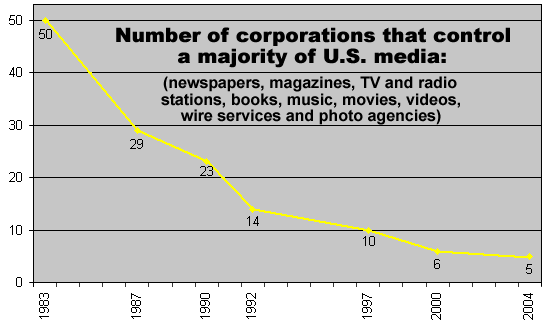
Why Does the Music Industry Keep “Underground Hip-Hop” Underground?

media-ownership

Timothy Alexander Guzman of Silent Crow News just posted an excellent analysis of the modern music industry (currently monopolized by a cartel of just a few dominant entertainment corporations) and their effect on society.

Highlights from the article:

The Corporate Music industry has had a monopoly on what youths from all around the world listen to. They have been controlling the thoughts and beliefs of our youths and even adults through their control of the music industry. The Music industry is a multi-billion dollar business. There are now “Big Three” record labels since 2012 that include Sony Music Entertainment, Warner Music Group and Universal Music Group that dominate the market. They control the artist and set what percentage of the sales receipts they keep as profits. They also keep the competition between the major record labels at a minimum since they are already a monopoly.

…There are many “underground Hip-Hop artists that are politically conscious-driven such as Common, Flobots, Dead Prez, Rebel Diaz and many others. Lowkey is another underground Hip-Hop artist, a former member of Poisonous Poets, lives in the UK and has traveled the world in support of Anti-war and human rights causes. He announced last year that he will leave the Music Industry to pursue his studies. Lowkey is a rapper that can easily be distinguished from main stream rappers. He has numerous albums produced independently that include Dear Listener, Soundtrack to the Struggle and Uncensored. One of his most popular songs is called ‘Obama Nation’. He has toured the world with several rappers including Talib Kweli and Lupe Fiasco. He is an influential part of the underground world of Hip-Hop music transforming how rap music can be used to inform and educate people not to turn them into consumers. Lowkey is one of several rappers who are at the forefront. The main stream media does not mention Lowkey, instead they continue to play Hip-Hop music from the likes of Kanye West, Jay-Z, Snopp Dog among many others. Their Music has no substance or positive meaning behind the lyrics. It is music that destroys the minds of urban youths. But according to the media whether based in the United States, Great Britain and Israel, all criticize Lowkey. The Jewish Chronicle Online describes in a 2011 article how Lowkey and other artists such as Elvis Costello can become a “Potential Nightmare” that can influence youths during an event organized by the Palestine Solidarity Campaign for the second anniversary of Operation Cast Lead and the Gaza conflict that killed thousands:

One expert studying anti-Israel activity described the increasing influence of performers such as Lowkey as a “potential nightmare,” and compared the impact of his backing for the campaign to the effect of artists such as Annie Lennox and Elvis Costello attacking the Jewish state.

…Many rappers in the West come from poor neighborhoods where crime, drugs and high incarceration rates affects their communities and do rap about “life in the ghetto”. But many rap about sex, drugs, prison and money. I have seen rap videos where they have numerous women on multi-million dollar yachts as Jay-Z’s video called ‘Big Pimpin’. According to Dr. Carolyn West, associate professor of psychology and the study of prevention of violence at the University of Washington said “What’s changed over time is the greater sexualization of hip-hop. Initially, it started off as a revolutionary form of music. Now, large corporations produce images that sell, and there is a blatant link between hip-hop and pornography” in a Pittsburg Post-Gazette article in 2008 called ‘Researcher cites negative influences of hip-hop.’ Rappers promote business agenda’s for the music industry where advertisements and propaganda prevail over young minds. Lowkey raps about real issues that affect life on earth. He wants his music to make a change in society. Why does the main stream media (MSM) and the Music industry criticize Lowkey? Why does the Jewish Chronicle Online call him and other musicians of consciousness a “Potential Nightmare?” Can Lowkey’s music inspire youth to seek change or the truth for that matter? Yes, the MSM and the music industry want to keep youths interested in issues that don’t matter. They want them to follow “Uninspiring rappers” who are about nothing. The majority of rappers are used by the major labels to sell propaganda. They use rappers to further demoralize people who have no idea what is happening in their communities and the world. Do music fans who follow main stream rappers know who Lowkey is? I doubt it. But I will bet that the state of Israel does. In 2009, Lowkey was detained in Israel, when he arrived in Tel Aviv’s airport for 9 hours.

Read the full article here: http://silentcrownews.com/wordpress/?p=2405

I highly recommend reading the entire post at Silent Crow News, which includes excerpts of interviews with Jay Woodson (organizer of NHHPC, National Hip Hop Political Convention), Lauryn Hill, Lowkey, and Cee-Lo Green.

The Right Happiness is Felt on a Genetic Level

Happiness

A new study from UCLA and the University of North Carolina suggests that not all happiness is equal, and different types of happiness have different effects on the expression of inflammatory genes and antibody/antiviral genes. Participants of the study with high levels of hedonic happiness (the type of happiness that comes from consummatory self-gratification)  had high levels of inflammatory gene expression and low levels of antibody/antiviral gene expression. Participants with high levels of eudomonic happiness (the kind you get from working towards a noble goal and searching for meaning in life) had low levels of inflammatory gene expression and high levels of antibody/antiviral gene expression.

According to Steven Cole, UCLA professor of medicine and co-author of the study:

What this study tells us is that doing good and feeling good have very different effects on the human genome, even though they generate similar levels of positive emotion. Apparently, the human genome is much more sensitive to different ways of achieving happiness than are conscious minds.

Lead author Professor Barbara L. Fredrickson of UNC suggests that:

We can make ourselves happy through simple pleasures, but those ‘empty calories’ don’t help us broaden our awareness or build our capacity in ways that benefit us physically. At the cellular level, our bodies appear to respond better to a different kind of well-being, one based on a sense of connectedness and purpose.

…Most people are happy in both ways,” she said. And the secret to long-term good health may depend on keeping the two in balance.

Sources:

http://www.pnas.org/content/110/33/13684

http://www.newsobserver.com/2013/08/02/3079003/unc-researcher-not-all-happiness.html

Our Genes Respond Positively to The Right Kind of Happiness

Bill Hicks – Revelations

Video

The complete video of one of Bill Hick’s greatest shows. Filmed at the Dominion Theater, London in late 1992 (1:15):