Sickcare is the Knife in the Heart of Employment–and the Economy

By Charles Hugh Smith

Source: Of Two Minds

We need to change the incentives of the entire system, not just healthcare, but if we don’t start with healthcare, that financial cancer will drag us into national insolvency all by itself.

American Healthcare is a growth industry in the same way cancer is a growth industry: both keep growing until they kill the host, which in the case of healthcare is the U.S. economy.

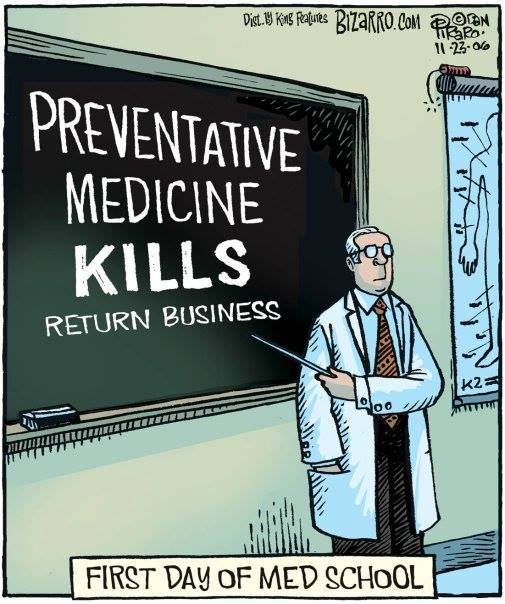
While a great many individuals in the system care about improving the health of their patients, the healthcare system itself only cares about one thing: maximizing profits by any means available, including sending many patients to an early grave via medications which corporations declared “safe” and rigged the political-regulatory-research systems to comply.

I call this maximizing profits by any means available system sickcare, for obvious reasons: this system profits by managing sickness, i.e. chronic diseases, rather than addressing the causes, which in most chronic disorders trace back to lifestyle: SAD (standard American diet), poor fitness and a generally unhealthy lifestyle of convenience (i.e. sedentary), heavy work/financial stress and addictions to meds, drugs, social media, etc.

Sickcare’s single-minded profiteering would be bad enough if we could afford its spiraling ever higher cost, but we cannot: as I noted way back in 2011, Sickcare Will Bankrupt the Nation all by itself. three years ago I noted that U.S. Healthcare Isn’t Broken–It’s Fixed (5/26/18), as generic meds that cost $22.60 for a month’s supply are pushed by Big Pharma as branded meds for $1,120 per month. Such a deal!

I’ve been discussing employment recently, and one of my patrons pointed out the enormously negative impact sickcare costs have on employment. I covered the incredibly negative impact of soaring sickcare insurance costs on small business back in 2011: Here’s Why Small Business Isn’t Hiring, and Won’t be Hiring (7/11/11), but the same soaring-costs dynamic makes Corporate America reluctant to hire anyone in America, too.

You’d have to be insane to pick America as your global base, given the grossly asymmetrical cost of healthcare in the U.S. compared to our developed-world competitors in Europe and East Asia (Japan and South Korea). Sadly, the treatment for your insanity will be so costly in America that your psychiatric problems will soon be exacerbated by financial ruin.

Those with heavily subsidized healthcare insurance may not realize that insurance for a family can cost more than a wage earner’s entire monthly net income. This generates a perverse incentive (from the perspective of a healthy economy, as opposed to a corrupt, rigged economy run for the exclusive benefit of profiteers, fraudsters, speculators and political fixers) for one spouse to quit their jobs or cut their hours to reduce the household income to the point that federal subsidies (ObamaCare) kick in and pay much or most of the insanely overpriced sickcare insurance tab.

The subsidies are of course ultimately paid by the taxpayers; sickcare profiteers thank you.

Needless to say, employers facing monthly healthcare insurance costs of $1,500 for an employee earning $2,500 will be looking for automation or overseas alternatives. How can the employer afford to keep paying healthcare insurance costs that spiral far above the Consumer Price Index (CPI)? Ultimately these higher costs come out of the employee’s paycheck, as employers could have given raises but instead had to fork over all the dough to the sickcare profiteers.

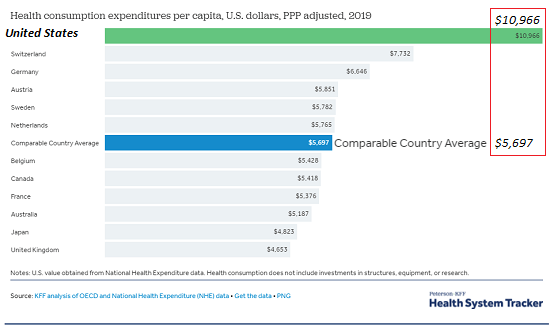
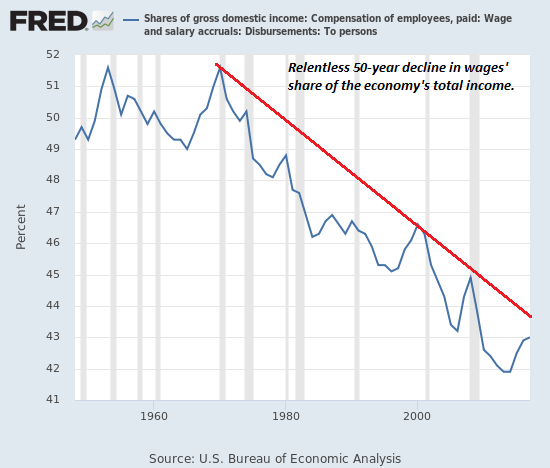
One driver of wages’ ever-declining share of the national income is trillions of dollars have been siphoned off by sickcare. As the comparison chart below shows, the U.S. pays roughly $5,000 more per capita (per person) per year for healthcare than other equally developed nations: the U.S. pays $10,966 per person per year and the average paid by other developed nations pay roughly half: $5,697 per person per year.

330 million Americans X $5,000 is $1.65 trillion a year. No wonder wages have gone nowhere for decades and corporations couldn’t wait to offshore jobs in America. (Not that the Corporate America needed much more of an incentive to offshore U.S. jobs, but let’s recognize that sickcare costs put American companies at a huge global disadvantage.)

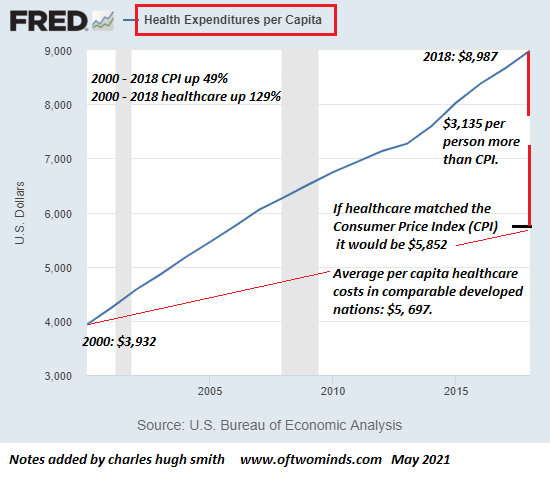
Please examine the chart below of healthcare expenses per capita (per person) in the U.S. from 2000 to 2018 (the last year available on the St. Louis Federal Reserve database). I’ve marked up the chart to indicate where healthcare costs per capita would be if healthcare had tracked the Consumer Price Index (CPI) for the past two decades.

Strikingly, the cost had U.S. healthcare risen by the same percentage as everything else–$5,852 per capita per year–is very close to the average costs in comparable developed nations: $5,697 per capita per year. Instead, U.S. healthcare costs per person were $9,000 per year as of 2018.

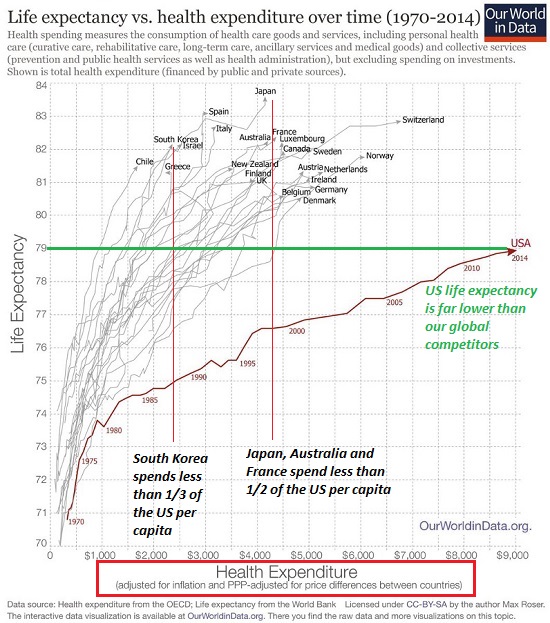
The third chart shows that the results of this asymmetric expenditure on health hasn’t done much in terms of life expectancy or other broad measures of national health and well-being. America is Number One in costs but far down the list of life expectancy and other measures of well-being.

The human and financial costs of this sick system are pervasive. Those trying to provide care within the sickcare system’s perverse incentives are burning out (see last chart), and businesses are crushed by ever-higher costs for everything related to healthcare. The “solution” for employers is to push more of the insane cost increases onto employees, who are already staggering under the weight of stagnant wages and skyrocketing inflation in sectors other than healthcare.

Small business entrepreneurs end up not hiring any workers because they can’t afford to provide the mandated healthcare. Having to do all the work needed to keep the business afloat burns out the owners and they close the business, to the detriment of their community and the local government, which loses the tax revenues generated by the enterprise.

Here’s a real-world example of how healthcare has become unaffordable for employers: in the mid-1980s I could buy comprehensive healthcare insurance for my single employees (mostly young) for 6 hours’ pay for the average employee and 4 hours of my pay. (My partner and I paid all the healthcare insurance costs, the employees paid zero, I’m just using the hours and pay as a means of measuring the cost of healthcare in terms of the purchasing power of wages.)

Can an employer buy equivalent comprehensive healthcare insurance today for 6 hours’ of the employees’ pay? No, not even close. (Note that I’m talking about real insurance, not bogus simulacra of insurance, i.e. catastrophic coverage.)

Sickcare is a win for the sickcare profiteers and a loss for employers, employees, communities, government and the nation. Like cancer, sickcare will keep growing until it kills the host. We’re getting close.

Sickcare is the knife in the heart of employment. Sickcare puts the nation at a tremendous competitive disadvantage, crushes small businesses and generates perverse incentives to automate and offshore jobs just to get out from underneath the dead weight of ever-higher sickcare costs.

We need a whole new approach to healthcare that includes every aspect of American culture, society, education, economics and governance. We need to ditch SAD (standard American diet) and our unhealthy lifestyle, and incentivize improving health from the ground up rather than generating chronic lifestyle diseases such as metabolic disorders and then managing these disorders as a means of maximizing profits. The national goal should not be profiting from an over-medicated populace, it should be eliminating the need for medications. (A healthy person has no need for handfuls of medications.) Rather than profit from 74% of the populace being overweight and 40% being obese, the national goal should be to eliminate lifestyle diseases entirely by changing behaviors and incentives, not costly procedures and medications. That would free healthcare to serve those suffering from non-lifestyle diseases.

As Charlie Munger famously noted, “”Show me the incentive and I will show you the outcome.” That’s how humans operate: we respond to the incentives presented, even if they diminish the health of the populace and bankrupt the nation. We need to change the incentives of the entire system, not just healthcare, but if we don’t start with healthcare, that financial cancer will drag us into national insolvency all by itself.

Jeff Bezos’s Corporate Takeover of Our Lives

Illustration by Mike Faille

How Amazon’s relentless pursuit of profit is squeezing us all—and what we can do about it

By David Dayen

Source: In These Times

AMAZON IS AN ONLINE RETAILER. It also runs a marketplace for other online retailers. It’s also a shipper for those sellers, and a lender to them, and a warehouse, an advertiser, a data manager and a search engine. It also runs brick-and-mortar bookstores. And grocery stores.

There are over 100 million Amazon Prime subscribers in the United States—more than half of all U.S. households. Amazon makes 45 percent of all e-commerce sales. Amazon is also a product manufacturer; its Alexa controls two-thirds of the digital assistant market, and the Kindle represents 84 percentof all e-readers. Amazon created its own holiday, Prime Day, and the surge in demand for Prime Day discounts, followed by a drop afterward, skewed the nation’s retail sales figures with a 1.8% bump in July 2017.

Oh, it’s also a major television and film studio. Its CEO owns a national newspaper. And it runs a streaming video game company called Twitch. And its cloud computing business, Amazon Web Services, runs an astonishing portion of the Internet and U.S. financial infrastructure. And it wants to be a logistics company. And a furniture seller. It’s angling to become one of the nation’s largest online fashion designers. It recently picked up an online pharmacy and partnered with JPMorgan Chase CEO Jamie Dimon and Warren Buffett to create a healthcare company. And at the same time, it’s competing with JPMorgan, pushing Amazon Pay as a digital-based alternative to credit cards and Amazon Lending as a source of capital for its small business marketplace partners.

To quote Liberty Media chair John Malone, himself a billionaire titan of industry, Amazon is a “Death Star” moving its super-laser “into striking range of every industry on the planet.” If you are engaging in any economic activity, Amazon wants in, and its position in the market can distort and shape you in vital ways.

Elizabeth Warren’s proposal to break up Amazon, along with the FTC’s new oversight and investigation, has spurred a conversation on the Left about its overwhelming power. No entity has held the potential for this kind of dominance since the railroad tycoons of the first Gilded Age were brought to heel. Whether you share concerns about Amazon’s economic and political power or you just like getting free shipping on cheap toilet paper, you should at least know the implications of living in Amazon’s world—so you can assess whether it’s the world you want, and how it could be different.

BOOKSELLERS WERE THE FIRST TO FIND THEMSELVES AT THE TIP OF AMAZON’S SPEAR, at the company’s founding in 1994. Years of Amazon peddling books below cost shuttered thousands of bookstores. Today, Amazon sells 42 percent of all books in America.

With such a large share of the market, Amazon determines what ideas reach readers. It ruthlessly squeezes publishers on wholesale costs; in 2014, it deliberately slowed down deliveries of books published by Hachette during a pricing dispute. By stocking best-sellers over independents and backlist copies, and giving publishers less money to work with, Amazon homogenizes the market. Publishers can’t afford to take a chance on a book that Amazon won’t keep in its inventory. “The core belief of bookselling is that we need to have the ideas out there so we can discuss them,” says Seattle independent bookseller Robert Sindelar. “You don’t want one company deciding, only based on profitability, what choice we have.”

These issues in just the book sector are a microcosm of Amazon’s effect on commerce.

The term “retail apocalypse” took hold in 2017 amid bankruptcies of established chains like The Limited, RadioShack, Payless ShoeSource and Toys “R” Us. According to frequent Amazon critic Stacy Mitchell, “more people lost jobs in general-merchandise stores than the total number of workers in the coal industry” in 2017.

Amazon isn’t the only cause; private equity looting must share much of the blame, and a shift to e-commerce was always going to hurt brick-and-mortar stores. But Amazon transformed a diverse collection of website sales into one mammoth business with the logistical power to perform rapid delivery of millions of products and a strategy to underprice everyone. That transformation accelerated a decline going back to the Great Recession (and much earlier for booksellers). Analysts at Swiss bank UBS estimate that every percentage point e-commerce takes from brick-and-mortar translates into 8,000 store closures, and right now e-commerce only has a 16 percent market share.

Take Harry Copeland (or, as he calls himself, “Crazy Harry”) of Harry’s Famous Flowers in Orlando, Fla., at one time a 40-employee retail/wholesale business. Revenue at his operation has shrunk by half since 2008, equal to millions of dollars in gross sales. “The internet … killed us,” Harry says. “I was in a Kroger, this guy walks up and says, ‘I want to apologize. It’s so easy to go on the internet.’ I said, ‘I did your wedding, I did flowers for your babies, and you’re buying [flowers] on the internet?’ ” Even Harry’s own employees receive Amazon packages at the shop every day. In January, tired of the fight, Harry sold his shop after 36 years in business.

Amazon was particularly deadly to the original “everything stores,” the department stores like Sears and J.C. Penney that anchor malls. When the anchor stores shut down, foot traffic slows and smaller shops struggle. Retailers are planning to close more than 4,000 stores in 2019; the 41,201 retail job losses in the first two months of this year were the highest since the Great Recession.

Dead malls trigger not only blight but also property tax losses. The broader shift to online shopping also transfers economic activity from local businesses to corporate coffers, like Amazon’s headquarters in Seattle.

Some of these failed retail spaces have been scooped up, ironically, by Amazon’s suite of physical stores, such as Whole Foods. Amazon also skillfully pits cities against one another and wins tax breaks for its warehouse and data center facilities, starving local budgets even more.

Amazon, of course, argues it is the best friend small business ever had. Jeff Bezos’ 2019 annual letter indicated that 58% of all sales on the website are made by over 2 million independent third-party sellers, who are mostly small in size. In this rendering, Amazon is just a mall, opening its doors for the little guy to access billions of potential customers. “Third-party sellers are kicking our first-party butt,” Bezos exclaimed.

It was a line I repeated to several merchants, mostly to snickers. Take Crazy Harry. In late 2017, Amazon reached out with the opportunity for Harry’s Famous Flowers to sell through its website. Sales representatives promised instant success. “We went live in November,” he says. “I made three transactions, [including] one on Valentine’s Day and one on Christmas.” The closest delivery to his shop was 34 miles away. By the time Harry paid his $39.99 monthly subscription fee for selling on Amazon and a 15% cut of sales, his check came to $6.92. “The gas was $50,” he says.

It wasn’t hard to find the source of the trouble: When Harry searched on Amazon under “flowers in Orlando,” his shop didn’t come up. Without including his name in the search, there was no way for customers to find him. Before long, Harry closed his Amazon account.

Crazy Harry’s troubles could be a function of Amazon running a platform that’s too big to manage. Two million Americans, close to 1% of the U.S. population, sell goods on Amazon. “There’s so much at stake for these sellers,” says Chris McCabe, a former Amazon employee who now runs the consulting site eCommerceChris.com. “They’ve left jobs [to sell on Amazon]. They are supporting themselves and their families.”

Third-party sellers have been a great deal for Amazon—unsurprisingly, since Amazon sets the terms. Sellers pay a flat subscription fee and a percentage of sales, and an extra fee for “Fulfillment by Amazon,” for which Amazon handles customer service, storage and shipping through its vast logistics network. Fee revenue grew to nearly $43 billion in 2018, equal to more than one out of every four dollars that third-party sellers earned.

In other words, Amazon is collecting rent on every sale on its website. This strategy increases selection and convenience for customers, but the sellers, who have nowhere else to go, can get squeezed in the process. Once on the website, sellers are at the mercy of Amazon’s algorithmic placement in search results. They must also navigate rivals’ dirty tricks (like fake one-star reviews that sink sellers in search results) and counterfeit products. And if you get past all that, you must fight the boss level: Amazon, which has 138 house brands. Armed with all the data on sellers’ businesses, Amazon can easily figure out what’s hot and what can be cheaply produced, and then out-compete its own sellers with lower prices and prioritized search results.

Any failure to follow Amazon’s always-changing rules of the road can get a seller suspended, and in that case, Amazon not only stops all future sales, but refuses to release funds from prior sales. And all sellers must sign mandatory arbitration agreements that prevent them from suing Amazon. Several consultants I interviewed talked of sellers crying on the phone, finding themselves trapped after upending their lives to sell on Amazon.

WHILE RETAIL WORKERS LOSE JOBS, AMAZON PICKS UP SOME OF THE UNEMPLOYMENT SLACK, hiring personnel to assemble its packages, make its electronics, and deliver its goods, with a U.S. workforce of more than 200,000, and another 100,000 seasonal workers—though 2018 research from the Conference Board confirmed the jobs created by e-commerce companies like Amazon do not make up for the loss of millions of retail jobs.

Plus, the experience of being a cog in Amazon’s great machine is, shall we say, unhealthy. We know much about the horrors of being an Amazon warehouse worker in the United States. These workplaces are aggressively anti-union. Amazon sets quotas for how many orders are fulfilled, monitoring a worker’s every move. Poor performers may be fired, typically over email. The daily monotony and pressure to perform has pushed workers to suicidal despair. A Daily Beast investigation found 189 instances between October 2013 and October 2018 of 911 calls summoning assistance to deal with suicide attempts or other mental-health emergencies at Amazon warehouses. And even these grunt jobs are insecure; Amazon had to reassure people this year that it wouldn’t turn over all warehouse jobs to robots, even as it rolled out machines that box orders.

Amazon’s other jobs, while less scrutinized than the warehouse workers, can be just as brutal. Thousands of delivery drivers wear Amazon uniforms, use Amazon equipment and work out of Amazon facilities. But they are not technically Amazon employees; they work for outside contractors called delivery service partners. These workers do not qualify for the guaranteed $15 minimum wage Bezos announced to much fanfare last year.

Contracting work out lets Amazon dodge liability for poor labor practices, a trick used by many corporations. At one such contractor in the mid-Atlantic, TL Transportation, one former employee (who requested anonymity) described the work as “running, running, running, rushing. There was no break time.” According to pay stubs, TL built two hours of overtime into its base rate, which is illegal under U.S. labor law. Other workers reported they always worked longer than the time on their pay stubs. Driver Tyhee Hickman of Pennsylvania testified to having to urinate into bottles to maintain the schedule.

Amazon runs plenty of air freight these days as well, through an “Amazon Air” fleet of planes branded with the Amazon logo—but these are also contracted out. At Atlas Air, one of three cargo carriers with Amazon business, pilots have been working without a new union contract since 2011. Atlas pays pilots 30% to 60% below the industry standard, according to Captain Daniel Wells, an Atlas Air pilot and president of the Airline Professionals Association Teamsters Local 1224. Planes are understaffed. “We’ve been critically short of crews,” Wells says. “Everyone is scrambling to keep operations going.”

The go-go-go schedule leaves little time for mechanics; planes go out with stickers indicating deferred maintenance. One Atlas Air flight carrying Amazon packages crashed in Texas in February, killing three workers.

EVEN WHILE DRIVING WORKERS AT A FRENETIC PACE, Amazon doesn’t always deliver on its promise of convenience and efficiency. Many products no longer arrive in 48 hours under Prime’s guaranteed two-day shipping. It’s so challenging to reach customer service that Amazon sells a book on its website about how to do that. Whole Foods shoppers who have groceries delivered get bizarre food substitutions without warning.

Even as two-day shipping is creaking, Amazon has announced a move to one-day shipping, which will strain its systems even further while forcing competitors to adjust. Amazon’s one-day shipping announcement alone caused retail stocks to plummet on April 26, before any changes were implemented.

This feedback effect reveals how Amazon is not merely riding the wave of online retail’s convenience; only a company with ambitions as vast as Amazon’s could influence Fortune 500 business models across America.

Some retailers have given in. Walmart quickly announced its own next-day shipping. Kohl’s sells Amazon Echo devices. Target has bought up competitors to compete with Amazon on a larger scale. Call it concentration creep; one giant business triggers the need for others to get big, too. Corporate America is at once terrified of Amazon and reshaping itself to imitate it.

Take Amazon’s ever more sophisticated ploys to modify consumer behavior. With “personalized pricing,” Amazon uses the data of what someone has paid in the past to test what that person is willing to pay. The price of an item featured in the “buy” box on Amazon’s website may change multiple times per day, and can be tailored to individual shoppers. Amazon has charged more for Kindles based on a buyer’s location, and has steered people to higher-priced products where it makes a greater profit, rather than cheaper versions from outside sellers.

Now, even big-box stores have electronic price tags that retailers can “surge price” when demand increases. Amazon’s Whole Foods stores have become a testing ground for advancing this technique. Prices shown on electronic tags are tested, combined with discounts for Prime members, and relentlessly tweaked.

The potential damage to society from personalized pricing is significant, notes Maurice Stucke, a professor at the University of Tennessee. “It’s not just price discrimination, but also behavioral discrimination,” he says. “Getting people to buy things they might not have otherwise purchased, at the highest price they’re willing to pay.”

Amazon has plenty of options for this behavioral nudging, from listing a fake higher price and crossing it out to make it look like the customer is getting a deal, to its work on a facial recognition system using phone or computer cameras to authenticate purchases. With this tool, Amazon could theoretically read faces and increase prices when someone shows excitement about a product. Amazon has already licensed facial recognition software to local police units for criminal investigations, to outcry from privacy groups.

Then there’s Alexa, Amazon’s digital assistant, a powerful tool for manipulation. Alexa was designed to “be like the Star Trek computer,” said Paul Cutsinger, Amazon’s head of voice design education, at a developer conference earlier this year. Users can ask Alexa to play music and podcasts, answer questions, run health and wellness programs, set appointments, make purchases, even raise the temperature in the shower.

Psychologist Robert Epstein, who has pioneered research into search engine manipulation, has done preliminary studies on Alexa. “It looks like you can very easily impact the thinking and decision-making and purchases of people who are undecided,” Epstein says. “That unfortunately gives a small number of companies tremendous power to influence people without them being aware.” For example, Alexa can suggest a wine to go with the pizza you just ordered. It can also encourage you to set up a recurring purchase, the price of which may then go up based on Amazon’s list price.

The influence only increases as Alexa takes in more data. We know that Alexa is constantly watching and listening to users, transcribing what it hears and even transmitting some of that data back to a team of human listeners at Amazon, who “refine” the machine’s comprehension. The surveillance doesn’t only happen on Alexa, but in the smart home devices it integrates with, and on the website where Amazon tracks search and purchase activity. Amazon even has a Ring doorbell and in-home monitor, which sends information back to Amazon. There is no escape. “Devices all around us are watching everything we do, talking to each other, sharing data,” Epstein says. “We’re embedded in a surveillance network.”

EVEN AS IT’S INFLUENCING OUR BEHAVIOR, Amazon is transforming our physical world. José Holguín-Veras, a logistics and urban freight expert at Rensselaer Polytechnic Institute, estimates that in 2009, there was one daily internet-derived delivery for every 25 people. By 2017, he calculates, this had tripled. “The number of deliveries to households is now larger than the number of deliveries to commercial establishments,” Holguín-Veras says. “In skyscrapers in New York City where 5,000 people live, it’s 750 deliveries a day.”

Think of the difference between one trip to the grocery store for the week, and five or ten trips from the warehouse to your house. Our streets are too narrow and our traffic too plentiful to handle that additional traffic without crippling congestion. Plus, every idling car, and every extra delivery truck on the road, spews more carbon into the atmosphere. Our cities are not designed for the level of freight that instant delivery demands.

More deliveries also means more people staying indoors. “One thing I think about is how much we overlook the community and democracy value of running errands,” says Stacy Mitchell of the Institute for Local Self-Reliance. “These exchanges—chatting with someone in line, bumping into a neighbor on the street, talking with the store owner—may not be all that significant personally. But this kind of interaction pays off for us collectively in ways we don’t think about or measure or account for in policy-making.”

In These Times asked Frank McAndrew of Knox College, who has researched social isolation, whether Amazon’s perfect efficiency could be alienating. He wasn’t ready to make a definitive statement but did see some red flags. “I do think we’re sort of wired to interact with real people in face-to-face situations,” McAndrew says. “When most of our interactions take place virtually, or with Alexa, it’s not going to be satisfying.”

FOR MOST OF OUR HISTORY, Americans didn’t require a personal digital assistant to answer our every whim. Why are we now reordering our social and economic lives, so one man can accumulate more money than anyone in the history of the planet?

One answer is that Amazon has paid as much attention to capturing government as it has to captivating customers. Amazon’s lobbying spending is among the highest of any company in America. After winning a nationwide procurement contract, over 1,500 cities and states can buy office items through the Amazon Business portal; a federal procurement platform is on the way. Amazon Web Services has the inside track on a $10 billion cloud contract to manage sensitive data for the Pentagon, something it already does for the CIA. That’s part of the reason why Amazon moved its second headquarters (after an absurd, game show-style bidding war that gave the company access to valuable data on hundreds of cities’ planning decisions) to a suburb of Washington, D.C., the seat of national power.

Making the directors of the regulatory state dependent on your services is a genius move. What political figure would dare crack down on the behavior of a trusted partner like Amazon?

In fact, Amazon has relied on government largesse since day one. No sales taxes for online purchases gave it a pricing advantage over other sellers (while a 2018 Supreme Court ruling changed that, the damage had been done). No carbon taxes helped Amazon build energy-intensive businesses dependent on fossil fuels for transportation and server farms. A lack of antitrust enforcement created a path for Amazon to super-size into an e-commerce monopoly. Weak federal labor rules let Amazon stamp out collective bargaining and rely on independent contractors. Mandatory arbitration locked third-party sellers inside Amazon’s private appeals process. Favorable tax law allowed Amazon to apply annual losses in previous years to its past two tax returns, paying no federal taxes on billions in income.

Of course, these rules helped all corporate giants and made executives filthy rich, often at the expense of workers. But Amazon tests the laissez-faire system in unique ways. In a future where Amazon broadens its control over our lives such that citizens have nowhere else to shop, businesses have nowhere else to sell, workers have nowhere else to toil, and governments have no other way to function, then who actually holds the power in our society? Avoiding that dark future requires leaders with the political will to stop it.

Elizabeth Warren’s plan to break up Amazon would rein in what she sees as unfair competition by preventing Amazon from selling products while hosting a website platform for other sellers. Warren also suggests splitting off Whole Foods and the online retailer Zappos, which Amazon bought in 2017 and 2009, respectively.

Fostering competition is a good start, but regulation must also prevent Amazon from bullying suppliers and partners. Lawmakers must force Amazon to pay for the externalities associated with its carbon-intensive delivery network. The company must pay a living wage to its workers, including its so-called independent contractors. It must be accountable to the legal system rather than a corporate-friendly arbitration process. It must not profit from spying on its customers.

If Amazon has caused this much upheaval today, when online shopping is still only 16 percent of retail sales, the future is limitless and grim. We have time to reverse this transfer of power and make it our world instead of Amazon’s. It’s an opportunity we cannot afford to squander.

Why Are American Communities Dying?

By Tom Chatham

Source: Project Chesapeake

Most Americans who have been around for a while know life is nothing like it used to be. When someone wanted a job one was found with a little bit of searching. Today jobs are difficult to find, especially in small communities.

When I was growing up in the 70’s, there were several car dealers in my community. There were three tractor dealers and too many mom and pop stores to count. Today there are two used car dealers and the nearest tractor dealer is twenty miles away. So how is it that we now have more people, but fewer businesses to employ them?

A nations wealth is derived from having a product to sell. That wealth needs to circulate in towns and cities to compound the wealth effect and create jobs and businesses. When wealth is not created or it is siphoned off to other places, the wealth effect can not happen, and in many cases goes into reverse. A community needs a certain amount of service related jobs to function but it also needs some type of production jobs to bring in money from the outside. This can be mining , agriculture or manufacturing type jobs, but they must exist to insure a healthy economy.

America has two major problems today. A large amount of our production is done outside the country eliminating production jobs in local communities and many of the small local businesses that kept wealth within communities have been supplanted by large corporations that siphon wealth out of communities and send it to wall street.

In the past when a small business made profit, that profit was kept in the local community because that is where the owner lived. Now, that profit leaves the community never to be seen again. With less money to circulate within the community the businesses that depend on people spending their extra dollars, have fewer customers and eventually go out of business. With fewer jobs there is that much less money circulating and the economic situation spirals down until nothing is left.

These days corporate businesses and government jobs make up the major part of many local communities. In many cases if it were not for the government jobs, many communities would no longer exist. So what do you think would happen if the government suddenly no longer had money to pay those workers? What would happen if corporate profits dropped to the point where corporate stores decided to close and cut their losses?

To some extent we are seeing this happen now in many places. Corporate stores moved in and drove small local businesses out. Then when the profits dried up the corporate stores closed leaving the community with no jobs or products to buy. With no capital in the local communities to rebuild small businesses, the people simply drive to other areas to do their shopping.

The corporate cronies and government laggards control most of the money flowing through communities now and they want to keep it that way. Any attempt to rebuild local businesses is met with luke warm results. Any business that might make a difference is either killed outright or regulated into oblivion before it can get off the ground. The county where I live has all but abandoned local businesses. The bulk of their income comes from property taxes generated by vacation homes and retirement homes of retired government employees. As long as the government pensions and paychecks continue, they see no reason to change the status quo. The result is that the younger people leave as soon as they can and the average age of the population continues to get older. As with many places today, this area has no future.

Where I live is a microcosm of the nation. Corporate and government entities continue to siphon what little money there is out of communities and just as small communities are dying, the nation will soon follow if current trends do not change. A return to small local economics is the only way to reverse some of the damage and keep our communities livable. But, do not be deceived. There is no way to undo all of the damage that has been done and even if we survive, we will only be a shadow of what we once were as a nation.

Bust the Trust: Now is the Time to Break Up Amazon

By Andy Laties with additional reporting by Sander Hicks

Source: The New York Megaphone

Standing at the cash register at an Upper West Side independent bookstore I used to run, I once noted the frequent passage of cars painted all over with Amazon’s “And You’re Done” logo. These same-day delivery vehicles were Amazon’s way of pushing back against the resurgence of New York City independent bookselling in progress. Soon, the cars were joined by a Columbus Circle location of the Amazon Books chain. That brick-and-mortar store gave lie to Amazon’s long-standing rhetoric that physical bookstores were doomed.

I have competed with Amazon for twenty years. A couple years ago, we indies were finally winning. 2015 was a great year. More independent stores were opening than closing: Books Are Magic, Greenlight, Word Up, Stories, Archestratus Books & Foods, Astoria Bookshop and Quimby’s. New locations for Book Culture, McNally Jackson, WORD and Books of Wonder were in the works. That trend was mirrored nationally. While our numbers had fallen from 4,000 to 1,500, between 1995 and 2005, now we were pushing 2,000 bookstores again.

Why do indy bookstores matter so much? Well, here’s one way to put it, from the writer Ocean Vuong, “The way I see it, whenever someone walks into a bookstore, they are walking into the future of their cultural and intellectual life. A bookseller collaborates with who you are in order to show you a way forward towards more of yourself, a way you might not have known existed for you–but is still entirely your own. Amazon, with its algorithms, can only show you where you’ve been, can only give you the calcified mirror of your past. In a bookstore, you get a human being who is also a mapmaker of possibility.”


A PEOPLE’S HISTORY OF AMAZON

Amazon itself had started as a New York City project. But retailers don’t collect sales tax on out-of-state shipments. So when hedge fund boy wonder Jeff Bezos rounded up his one million in in start-up capital, he left New York City behind. He launched his company in the lightly-populated Washington State. Bezos planned a national mail-order operation that wouldn’t have to collect sales tax in any other state, especially populous New York and California. Thus, most customers would enjoy a six percent or more cost reduction on each sale.

We indie businesses fought together for twenty years to force Amazon to collect sales tax. And we won. I’m proud of what we fierce indies did to force Amazon to pay sales tax. These taxes fund public services like Medicaid and the local fire department. But Amazon had evolved during the battle, and like that strangling kudzu vine you thought you killed last Fall, it grew back even bigger in the Spring. Instead of dying, Amazon turned into that monster plant from Little Shop of Horrors.

After our victories at the state and national levels, there was no longer any reason for Bezos to base his company in Seattle. That’s one reason Amazon is expanding with a big new HQ2 planned for Crystal City, VA. They recently planned to come back to New York City, but chickened out due to the public criticisms about Amazon’s lucrative tax breaks.

Ten years ago, Amazon used to be an innovative book-seller online. Today, They work for CIA, NSA, they help do facial recognition for ICE. They are bidding to create a “new brain” for the Pentagon, in the little-known “JEDI” program. With Jeff Bezos’s ownership of the Washington Post, they are simultaneously powerful DC lobbyists, defense contractors, spies, and a leading DC media vehicle. Amazon is one juggernaut of unbridled corporate and war-making power.

Amazon developed its Amazon Web Services (AWS), the highly profitable, cloud-hosting division, out of the software and hardware infrastructure that runs its online retail operation. Recent headlines tell the tale of how Amazon monetized AWS. Technology Review reported, “Amazon is the Invisible Backbone Behind ICE’s Immigration Crackdown” And Business Insider let us know that “Amazon is Launching a ‘Secret’ Cloud Service for the CIA.” “‘Alexa, Drop a Bomb’: Amazon Wants in on US Warfare” reveals the plans between Amazon and the Pengaton, for the new JEDI program, as reported by Truthout.

The new Amazon wants to become a leading merchant of death, specializing in robotic drones, while moonlighting as web host for ICE and CIA. Its planned “Washington D.C. footprint” is just across the highway from the Pentagon. The failed effort to come into Queens was offering “twenty-five-thousand jobs.” But who can count how many jobs Amazon has killed, and how many retail stores have closed, due to Amazon artificially lowering prices? (A recent article in Yale Law School journal makes the case that Amazon might be on the road to being a monopoly, since it artificially lowers prices to kill competition.) Amazon promises to add jobs in NYC, but recently committed to making those jobs non-union. Workers at Amazon warehouses complain of onerous conditions at low wages, in which bathroom breaks are rare, and workers sometimes have to urinate into plastic bottles.

Amazon is super convenient. It’s true. But Amazon’s retail customers will feel angst and regret once they learn their dollars pay for robotic drone warfare and racial profiling of immigrants.

Recently, the American Booksellers Association reported that Amazon could be a monopoly. They control 75% of all online retail bookselling, the way that Standard Oil controlled the oil industry, before it was broken up as a monopoly, in 1911.

Let’s resist this new version of the Amazon monopoly. Amazon is an arms dealer and corporate spy. Let’s advocate that the Federal Trade Commission dismember the Amazon octopus. Let’s support a movement that is fired up to do “trust-busting.”

For our safety, it’s time to break up Amazon.


Andrew Laties is the author of Rebel Bookseller: Why Indie Businesses Stand for Everything You Want to Fight For, from Free Speech to Buying Local to Building Communities. He currently co-owns Book and Puppet Company, in Easton, Pennsylvania.