
Nature Is Not a Machine—We Treat It So at Our Peril

By Jeremy Lent

Source: resilience

From genetic engineering to geoengineering, we treat nature as though it’s a machine. This view of nature is deeply embedded in Western thought, but it’s a fundamental misconception with potentially disastrous consequences.

Climate change, avers Rex Tillerson, ex-CEO of ExxonMobil and erstwhile US Secretary of State,  “is an engineering problem, and it has engineering solutions.” This brief statement encapsulates how the metaphor of the machine underlies the way our mainstream culture views the natural world. It also hints at the grievous dangers involved in perceiving nature in this way.

This mechanistic worldview has deep roots in Western thought. The great pioneers of the Scientific Revolution, such as Galileo, Kepler, and Newton, believed they were decoding “God’s book,” which was written in the language of mathematics. God was conceived as a great clockmaker, the “artificer” who constructed the intricate machine of nature so flawlessly that, once it was set in motion, there was nothing more to do (bar the occasional miracle) than let it run its course. “What is the heart, but a spring,” wrote Thomas Hobbes, “and the nerves but so many strings?” Descartes flatly declared: “I do not recognize any difference between the machines made by craftsmen and the various bodies that nature alone composes.”

In recent decades, the mechanistic conception of nature has been updated for the computer age, with popularizers of science such as Richard Dawkins arguing that “life is just bytes and bytes and bytes of digital information” and as a result, an animal such as a bat “is a machine, whose internal electronics are so wired up that its wing muscles cause it to home in on insects, as an unconscious guided missile homes in on an aeroplane.” This digital metaphor of nature pervades our culture and is used unreflectively by those in a position to direct our society’s future. According to Larry Page, co-founder of Google, for example, human DNA is just “600 megabytes compressed, so it’s smaller than any modern operating system . . .  So your program algorithms probably aren’t that complicated.”

But nature is not in fact a machine nor a computer—and it can’t be engineered or programmed like one. Thinking of it as such is a category error with ramifications that are both deluded and dangerous.

A four-billion-year reversal of entropy

Ultimately, this machine metaphor is based on a simplifying assumption, known as reductionism, which approaches nature as a collection of tiny parts to investigate. This methodology has been resoundingly effective in many fields of inquiry, leading to some of our greatest advances in science and technology. Without it, most of the benefits of our modern world would not exist—no electrical grids, no airplanes, no antibiotics, no internet. However, over the centuries, many scientists and engineers have been so swept up by the success of their enterprise that they have frequently mistaken this assumption for reality—even when advances in scientific research uncover its limitations.

When James Watson and Francis Crick discovered the shape of the DNA molecule in 1953, they used metaphors from the burgeoning information revolution to describe their findings. The genotype was a “program” that determined the exact specifications of an organism, just like a computer program. DNA sequences formed the “master code” of a “blueprint” that contained a detailed set of “instructions” for building an individual. Prominent geneticist Walter Gilbert would begin his public lectures by pulling out a compact disk and proclaiming “This is you!”

Since then, however, further scientific research has revealed fundamental defects in this model. The “central dogma” of molecular biology, as coined by Crick and Watson, was that information could only flow one way: from the gene to the rest of the cell. Biologists now know that proteins act directly on the DNA of the cell, specifying which genes in the DNA should be activated. DNA can’t do anything by itself—it only functions when certain parts of it get switched on or off by the activities of different combinations of proteins, which were themselves formed by the instructions of DNA. This process is a vibrant, dynamic circular flow of interactivity.

This leads to a classic chicken-and-egg problem: if a cell is not determined solely by its genes, what ultimately causes it to “decide” what to do? Biologists who have researched this issue generally agree that the emergence of life on Earth was most likely a self-organized process known as autopoiesis—from the Greek words meaning self-generation—performed originally by non-living molecular structures.

These protocells essentially staged a temporary, local reversal of the Second Law of Thermodynamics which describes how the universe is undergoing an irreversible process of entropy: order inevitably becomes disordered and heat always flows from hot regions to colder regions. We see entropy in our daily lives every time we stir cream into our coffee, or break an egg for an omelet. Once the egg is scrambled, no amount of work will ever get the yolk back together again. It’s a depressing law, especially when applied to the entire universe which, according to most physicists, will eventually dissipate into a bleak expanse of cold, dark nothingness. Those first protocells, however, learned to turn entropy into order by ingesting it in the form of energy and matter, breaking it apart, and reorganizing it into forms beneficial for their continued existence—the process we know as metabolism.

Ever since then, for roughly four billion years, the defining quality of life has been its purposive self-organization. There is no programmer writing a program; no architect drawing up a blueprint. The organism is the weaver of its own fabric, using DNA as an instrument of transmission. It sculpts itself according to its own inner sense of purpose, which it inherited ultimately—like all of us—from those first autocatalytic cells: the drive to resist entropy and generate a temporary vortex of self-created order in the universe. In the words of philosopher of biology Andreas Weber,

“Everything that lives wants more of life. Organisms are beings whose own existence means something to them.”

This implies that, rather than being an aggregation of unconscious machines, life is intrinsically purposive. In recent decades, carefully designed scientific studies have revealed the deep intelligence throughout the natural world employed by organisms as they fulfil their purpose of self-generation. The inner life of a plant, biologists have discovered, is a rich plethora of complex experience. Plants have their own versions of our five senses, as well as up to fifteen other ways of sensing their environment for which we don’t have analogues. Plants act intentionally and purposefully: they have memories and learn, they communicate with each other, and can even allocate resources as a community through what biologist Suzanne Simard calls the “wood-wide web” of mycorrhizal fungi linking their roots together underground.

Extensive studies now point to the profound realization that every animal with a nervous system is likely to have some sort of subjective experience driven by feelings that, at the deepest level, are shared by all of us. Bees have been shown to feel anxious when their hives are shaken. Fish will make trade-offs between hunger and pain, avoiding part of an aquarium where they’re likely to get an electric shock, even if that’s where the food is—until they get so hungry that they’re willing to take a risk. Octopuses, one of the earliest groups to evolve separately from other animals about 600 million years ago, live predominantly solitary lives, but just like humans, get cozy with others when given a dose of the “love-drug” MDMA.

The ideology of human supremacy

As we confront the existential crises of the twenty-first century, the mechanistic thinking that brought us to this place may be driving us headlong toward catastrophe. As each new global problem appears, attention gets focused on short-term, mechanistic solutions, rather than probing deeper systemic causation. In response to the worldwide collapse of butterfly and bee populations, for example, some researchers have designed tiny airborne drones to pollinate trees as artificial substitutes for their disappearing natural pollinators.

As the stakes get higher through this century, the dangers arising from this mechanistic metaphor of nature will only become more harrowing. Already, in response to the acceleration of climate breakdown, the techno-dystopian idea of geoengineering is becoming increasingly acceptable. Following Tillerson’s misconceived logic, rather than disrupt the fossil fuel-based growth economy, policymakers are beginning to seriously countenance treating the Earth as a gigantic machine that needs fixing, and developing massive engineering projects to tinker with the global climate.

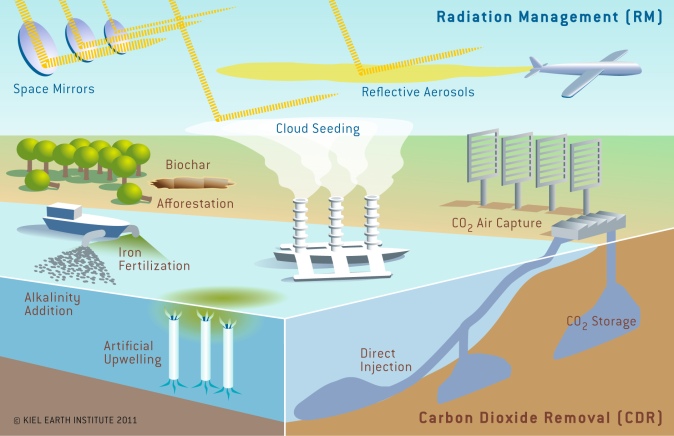
Given the innumerable nonlinear feedback loops that generate our planet’s complex living systems, the law of unintended consequences looms menacingly large. The eerily named field of “solar radiation management”, for example, which has received significant financing from Bill Gates, envisages spraying particles into the stratosphere to cool the Earth by reflecting the Sun’s rays back into space. The risks are enormous, such as causing extreme shifts in precipitation around the world and exacerbating damage we’ve already done to the ozone layer. Additionally, once begun, it could never be stopped without immediate catastrophic rebound heating; it would further increase ocean acidification; and would likely turn the blue sky into a perpetual white haze. These types of feedback effects, arising from the innumerable nonlinear dynamic interdependencies of Earth’s complex systems, get marginalized by a worldview that ultimately sees our planet as a machine requiring a quick fix.

Further, there are deep moral issues that arise from confronting the inherent subjectivity of the natural world. Ever since the Scientific Revolution, the root metaphor of nature as a machine has infiltrated Western culture, inducing people to view the living Earth as a resource for humans to exploit without regard for its intrinsic value. Ecological philosopher Eileen Crist describes this as human supremacy, pointing out that seeing nature as a “resource” permits anything to be done to the Earth with no moral misgivings. Fish get reclassified as “fisheries,” and farm animals as “livestock”—living creatures become mere assets to be exploited for profit. Ultimately, it is the ideology of human supremacy that allows us to blow up mountaintops for coal, turn vibrant rainforest into monocropped wastelands, and trawl millions of miles of ocean floor with nets that scoop up everything that moves.

Once we recognize that other animals with a nervous system are not machines, as Descartes proposed, but likely experience subjective feelings similar to humans, we must also reckon with the unsettling moral implications of factory farming. The stark reality is that around the world, cows, chicken, and pigs are enslaved, tortured, and mercilessly slaughtered merely for human convenience. This systematic torment administered in the name of humanity to over 70 billion animals a year—each one a sentient creature with a nervous system as capable of registering excruciating pain as you or I—quite possibly represents the greatest cataclysm of suffering that life on Earth has ever experienced.

The “quantum jazz” of life

What, then, are metaphors of life that more accurately reflect the findings of biology—and might have the adaptive consequence of influencing our civilization to behave with more reverence toward our nonliving relatives on this beleaguered planet which is our only home?

Frequently, when cell biologists describe the mind-boggling complexity of their subject, they turn to music as a core metaphor. Denis Noble entitled his book on cellular biology The Music of Life, depicting it as “a symphony.” Ursula Goodenough describes patterns of gene expression as “melodies and harmonies.” While this metaphor rings truer than nature as a machine, it has its own limitations: a symphony is, after all, a piece of music written by a composer, with a conductor directing how each note should be played. The awesome quality of nature’s music arises from the fact that it is self-organized. There is no outside agent telling each cell what to do.

Perhaps a more illustrative metaphor would be a dance. Cell biologists increasingly refer to their findings in terms of “choreography,” and philosopher of biology Evan Thompson writes vividly how an organism and its environment relate to each other “like two partners in a dance who bring forth each other’s movements.”

Another compelling metaphor is an improvisational jazz ensemble, where a self-organized group of musicians spontaneously creates fresh melodies from a core harmonic theme, riffing off each other’s creativity in a similar way to how evolution generates complex ecosystems. Geneticist Mae-Wan Ho captures this idea with her portrayal of life as “quantum jazz,” describing it as “an incredible hive of activity at every level of magnification in the organism . . . locally appearing as though completely chaotic, and yet perfectly coordinated as a whole.”

What might our world look if we saw ourselves as participating in a coherent ensemble with all sentient beings interweaving together to collectively reverse entropy on Earth? Perhaps we might begin to see humanity’s role, not to re-engineer a broken planet for further exploitation, but to attune with the rest of life’s abundance, and ensure that our own actions harmonize with the Earth’s ecological rhythms. In the profound words of 20th century humanitarian Albert Schweitzer, “I am life that wills to live, in the midst of life that wills to live.” How, we may ask, might our future trajectory change if we were to reconstruct our civilization on this basis?

The Mechanics Of A Free Society

anarchism_defined_by_ztk2006-d3j3ga4

By Colin Turner

Source: Freeworlder

Most people who have given any consideration to a moneyless, ‘free world’ society are already aware that we have the technology today to create a world of abundance without the constraints and inequality of the traditional market system, owing to how much human labour can now be efficiently automated.

Without scarcity, and a massive reduction in the need for labour, money effectively becomes obsolete. That’s the theory. But it’s not the full story, nor does it convince everybody who comes into contact with the theory. In fact, it convinces surprisingly few indeed.

In my opinion, this kind of super-advanced “Star Trek” moneyless society is still quite a distance away – not because we lack the technology – but because we humans lack the openness and understanding required to make it work.

A truly free society should be just that – unlimited, self-determining and self-organising for the optimum benefit of all. Today it appears that, left to our own devices, humanity just can’t wait to blow itself to pieces. How can you de-regulate society and hope to achieve equilibrium against that backdrop?

Let us remind ourselves that today we share our world with people separated by walls to stop them killing each other, giant corporate agencies detached from the social and ecological effects of their business, people who kill animals for pleasure, and, worst of all, a population that has somehow programmed itself to consume recklessly to compensate for its own imagined insecurity.

To my mind, celebrity/brand worship, religious fervour, and xenophobic flag-waving are all here to remind us that – irrespective of our technological advances – we still have a long way to go before humanity can unite in the common purpose of sharing our world and its bounty equitably and sustainably for all.

As someone who has considered these ideas perhaps more than most, I have had plenty of time to critique and refine my own philosophy along the way. As a result of these self-inquiries, I have come up with a number of ideas that I believe can help us paint a fuller picture of what to expect in a free society, and some ways that we can enact it today.

Social Gravity

This is the glue that keeps society together. We are a social species. By and large, we prefer to do things together. We naturally gravitate into groups, teams, villages and cities.

This all stems from one basic human need –  the urge of individuals to belong to something greater. Everything from our cities, our cultures, our religions, even our great unwritten social contract of be-good-to-others – stems from this need.

Social Gravity is the force that naturally binds us – even keeping our unfair, outdated system together, with all its flaws. This is because most people prefer to accept the broader consensus rather than apply radical new thinking. The fact that it keeps our system together, in plain view of its injustices and suffering, tells you just how powerful a force Social Gravity is.

Now imagine how much more powerful this force could be in a society that positively promotes life, health, diversity and happiness for all. Social Gravity is the primary force that will bond a free society and make it work.

Currently, most free world advocates are fighting against Social Gravity as they meet peoples’ resistance to radically new ideas and change. But we know this is changing ever more by the day as these people are beginning to question the logic and injustice of the prevailing system themselves.

As more change their viewpoint, the more they ‘normalise’ the environment for others to do so too. This is why it’s important to let people know how you are thinking. Even if they disagree now, you will probably become a point of reference for them later as they too begin to change.

This natural social pressure is what will maintain order, balance and efficiency in a free society. The more people benefit from it, the stronger that force becomes.

Self-Determination

Most people do not understand the true meaning of anarchy – to the point that I’ve almost given up using the term. Over the years, the media and prevailing thought have suffused its meaning with disorder, chaos and violence. But this is not anarchy – this is usually just the collapse of oppression.

Our screens are often filled with views of young people rioting, throwing missiles or looting shops, with the strong suggestion that they have become ‘lawless’, or that ‘law and order’ need to be restored – but this is a deep and dangerous misunderstanding.

Scenes like this are, in fact, the backlash of oppression. Whatever happened before is what creates those scenes. This is anger, not anarchy.

The best way to describe anarchy is to look to the animal kingdom. By and large, animals are peaceful creatures and will happily co-exist with each other in a steady-state* environment. The only time an animal is ever violent is when it must kill to eat, or when threatened, and – crucially – no animal ever kills more than it needs.

This is self-determination – the default behaviour of all beings. When survival is not threatened, peaceful coexistence is the default state of all animals, including humans. It’s simply easier than violence.

History books and media are full of references to aggressive culture, heinous acts of violence and torture – man pitted against fellow man. This gives an abiding impression of a bloodthirsty homo sapiens, indiscriminately bludgeoning all in his path to get what he wants. But this is a false impression, and yet another dangerous misunderstanding of the world and of ourselves.

The reason for this is simple. Wars, conflict and aggression make for more interesting stories so are always reported on and read about in our history books and media. Whereas, peace and non-conflict is essentially boring and does not get written about – yet it probably accounts for 99.999% of all human behaviour.

For every lunatic who takes up a gun and starts killing people, there are millions and millions of other people who don’t, but we never hear about them. The reality is, our human experience, from a statistical point of view, is almost entirely peaceful.

A self-determining society doesn’t use or require laws. Laws were invented primarily to protect private interests and enforce the payment of taxes. In a world of abundance, open access and greater understanding of ourselves, these laws would become redundant.

Nor do we need laws to protect ourselves from each other, as that basic morality is already hard-wired into us. We are a social species. We want to get along. We all experience this spirit of humanity every day in the help we get from our work or student colleagues, our friends and families, and from strangers – even in times of crisis. When financial stress is gone, people are good to each other.

The ideological boundaries between us – culture, religion, nationality, etc – are purely superficial, and friction between differing views – much of which is inequality-based – can only diminish as the common ideals and benefits of a free society become apparent.

As long as we each have our survival needs met by society, there is nothing to compete for – at least nothing that is worth killing or dying for.

Of course, we cannot expect self-determination to automatically rule out all acts of senseless violence or anti-social behaviour, but once scarcity is not an object to peoples’ existence, we can certainly expect to reduce such incidences to a minimum.† (See Anti-Aggression Strategies)

* A steady state environment is an environment where scarcity and territories are not an issue. Technically, we humans have long since solved the problem of scarcity through the application of technology. We just have to work on our own ‘software’ to create a fair distribution system for it. Also, by doing so, we will regain sufficient trust between each other to render our territorial and cultural boundaries as meaningless as county lines.

† It’s worth pointing out that senseless violence and anti-social behaviour are already common daily occurences under our current law system – most of which can be related directly to scarcity and inequality. It seems wholly unreasonable to assume such behaviour would increase in a self-determining, abundant society.

Life Education Program

To give a free society any chance of succeeding or surviving, a radical overhaul of our current education system is essential. By and large, our current system prioritises reading, writing and arithmetic as core learning, but, in my opinion, these are far from the most important skills we need to acquire.

Children from the earliest age (even from 0) must have access to the most important information that can help them live a rich and fulfilling life, with all the skills for building great self, inter-personal and community relationships. This information can easily be compiled for children of all levels of cognisance.

Here are some examples of topic headings (though I’m sure many more could be extrapolated here):

  • Nature
    Introduction to our planet, our ecosystem, death and the cycle of life, appreciation of all life.
  • Environment
    Ecology, the food chain, water, weather, city and bio-systems, energy, sustainability, regeneration.
  • Community
    The mechanics of community, the purpose and benefits of sharing, respect, trust, empathy, being responsible, leadership, team-work, resolving disputes,  appreciating unfamiliar races and cultures.
  • Self
    Anatomy of self, basic hygiene, health, nutrition, hydration, oxygenation, meditation, massage, self-awareness, self-acceptance, self-respect.
  • Life Skills
    Interpersonal relationships, effective communication, empathy, understanding and coping with negative emotions, problem solving, critical thinking, creative expression, food growing and preparation, sex, parenting and family.

Of course, traditional learning still has enormous value and will continue to be taught in a free society, but relevant and practical lessons on life and life skills must have precedence in order to create better, happier communities.

By building Life Education as a modular program, we could even start introducing this vital new education in stages today.

Community Service

While many necessary jobs in the community will naturally be filled by those passionate and motivated enough to devote their time unconditionally to it, there will invariably be a shortfall in volunteers to participate in some of the less glamorous functions of modern society – like sweeping the roads, etc.

Community service is a concept that most of us are already familiar with – though we usually associate it with punishment for petty criminals. But the fact is, organised community service is undoubtedly the most efficient way to deliver essential services equitably within a large population.

In the enactment of a free society, every member of the community should be encouraged to contribute a reasonable minimum number of hours community service a month. Remember, for a society without conventional employment, this would be a trivial commitment for most people.

A monthly schedule of required services and tasks in the community could be published, where members would opt to participate in whichever tasks best suited their skills and availability at the time.

The number of recommended hours per month would obviously depend on local factors, ie. what needed to be done, population number, availability of skills, complexity of tasks, etc, but the idea is to keep peoples’ commitment to a minimum by spreading the community workload as widely as possible.

Children should also be actively encouraged to engage in their community’s projects from as young as possible – and in as many diverse tasks as possible. This would help them discover their own aptitude, engage with the community, and gain valuable life experience in the process.

Each service task would have a strong social aspect, where people are encouraged to work in teams, during the same hours, and towards common goals. There’s no reason why community work in a free world should ever be onerous, or could not even be carried out in entertaining ways.

For example, with a little imagination, some tasks could even be turned into sports events where teams compete to fulfil tasks, or see who can come up with the most innovative solutions. The overriding goal is that community service, while providing essential services, would be entirely opt-in, and a fulfilling and engaging experience that people would enjoy.

The Project Pledge Scheme

In any community, large projects always need to be undertaken – like building a new bridge, road, school or hospital. The current market system works quite well in this regard, as it monetarily ‘locks in’ the required personnel to complete large scale tasks uninterrupted for many months or years at a time.

In a moneyless world, rotating volunteer personnel from within local communities to help with long, complex projects may prove inefficient, or, in some cases unworkable.

A solution might be to create a Project Pledge scheme, where willing workers publicly pledge to see the project through until completion. It’s reasonable to assume that any large scale community project would find it easy to enlist local volunteers who would benefit directly from the project.

A project launch ceremony could be held where they each undertake their pledges. What’s important is that the project managers would seek the full commitment and pledge from participants at the outset, while the volunteers themselves become personally invested in the project’s success too.

As with all community service, large projects would also have a strong emphasis on creating an enjoyable social experience for the participants.

As technology gets better and more widely available, large intensive projects would obviously require fewer and fewer personnel, but a Project Pledge Scheme could be a viable interim solution.

Central Resources & Skills Database

A free society needs an effective information network to maintain its efficiency.  We can have a central information database relating to resource location and inventory, and a comprehensive directory of people and skills. Such a database would be maintained and moderated by users.

The resources section would be a map-based inventory and requisition facility for users to list, find and request the resources they require. By resources, I mean anything from raw iron ore to a wooden dining table. Whatever physical resources people have available for sharing, they can list it on the database.

Anyone looking for those resources would simply run a search on the database, find the nearest match, and place a requisition order. If necessary, resource requisitions could be weighted according to urgency and depth of benefit to the community. For example, a community urgently requiring concrete for re-construction of a well would have greater priority than an individual requiring concrete to build a garage.

Like the inventory, the requisition system would be entirely transparent, and a user making the request would be able to see where his request was positioned in the queue and read the other requests. A fully transparent system is the only way to avoid needless misunderstandings and conflicts.

Items that need to be delivered from one area to another could then come under the Community Service system in the despatching area to source a driver and truck to carry the requested goods – if possible on an already existing despatch route.

The skills section would be a map-based directory of people who wish to offer their labour or specialist skills to others. Users looking for those skills would be able to make contact with them directly.

It would seem logical for a company like Google who already have the established infrastructure and reputation to incorporate such a facility into their current portfolio, but of course, it could be any provider.

The HonorPay System

Obviously the notion of giving for reward is firmly embedded in our culture. It’s not entirely clear to me if we can ever fully transcend this essentially ego-based reward paradigm – or even if transcending this would be a good idea.

Many supporters of a free society believe we can surpass ego. I’m not so sure, since at its most base level, ego is part of our survival mechanism, and, in its highest form, embodies our individuality. Certainly in the interim period, moving from a market-based system to a free society, I believe it will be useful to maintain a symbolic reward or Honor system.

The HonorPay system, or something like it, may offer just such a symbolic payment system. It’s a free web utility that provides a means to award limited ‘Honors’ to any person you wish, aggregating their public reputation score.

The Honor awards have no useable value, and are simply tokens of appreciation. In a world powered purely by volunteerism, appreciation will be a valuable incentive.

The HonorPay system is already live (honorpay.org), and something that can be used today, providing people with a means of incentive and reward beyond physical or monetary tokens.

Open Proposals Platform

In matters relating to large numbers of people, it would make sense to have a an open platform where each person can vote on decisions that affect everybody, voice their own opinions, and propose motions of their own.

Relatively simple to implement, such a platform would seem to be a basic requisite for an open society. Though surprisingly, it may end up seeing little use, since a more conscious, abundant and creative society will likely have moved beyond reducing everything to binary choices and leaving an endless trail of disgruntled minorities! However, while still useful, there may be a far more interesting and potentially beneficial purpose for building such a system.

Today, even in supposedly democratic countries, most important decisions relating to things like budgets, laws, jobs or foreign conflict are never put to a public referendum. Most referenda are nothing more than democratic window-dressing that only address political ‘hot potatoes’ or moral hazards that politicians would rather avoid, and which usually have almost no relevance to how the country is actually run.

Implementing a public polling platform today would give people the opportunity to ‘vote’ on every issue that affects their lives. Even though their vote would not officially count, it would still give them a means for their collective voice to be heard. For example, it would be much more difficult for a country’s government to follow through on its own internal policy when the open polling platform is clearly showing a large majority of the population that don’t agree with it.

Such a platform could play a very important role in bringing about change, while also bringing the required technology for post-change society.

Organic Leadership

Just because a self-determining society doesn’t use governance doesn’t mean that we don’t need leaders and role models. Leaders are people who see further, who can envision greater possibilities, who can solve problems, or who have the courage and enthusiasm to inspire people during uncertain times.

In a free society, people will still seek leaders to inspire and help them. However this does not mean that we need rulers. Rulers do not necessarily help, they merely rule – and usually only when there is something to protect.

A truly free society does not require protection, as it is based on the understanding of nature and community first, not on private property. However, some kind of leadership structure is undoubtedly an efficient way of accomplishing complex tasks. (Think film director, for instance)

In Organic Leadership, leaders are nominated for specific tasks based on their ability through the common wishes of the group. Selection can happen in any way, but should be an organic process where the natural choice of the group is obvious.

A leader’s true role is merely to administrate the desires of others, or to adjudicate on which suggested course of action is the best one. Leadership in this form will only exist as and for when it is necessary, and based on the common understanding that, once chosen, the leader has final say on matters for which they are appointed.

Creative Arbitration

No matter how well we design and create the kind of world we want to see, there will always be disputes among people, whether over relationships, personal beliefs, or claims on land or property. That is just part of the deal with being human. We aren’t perfect – so it’s best to begin by accepting that fact!

By far the most crucial instrument in resolving disputes is speed. Unresolved problems create stress, animosity and compound fear. These are the explosive ingredients of aggression and war, so the sooner a solution is found, the better.

Where people are unable to find solutions themselves, it would seem reasonable for both parties to nominate an independent arbitrator whom they both trust to help them reach a solution. (The arbitrator can be anyone from the community who is willing to help)

But let’s define what we mean by ‘solution’. In today’s world, resolutions are usually reached using the law or courts to decide. It almost always come down to a binary choice where one side wins and the other loses. There’s nothing wrong with this in theory, but to create a lasting, stable society, no-one should ever need to be the loser.

For example, if two parties A and B are arguing over property rights, and an arbitrator – acting in the interest of the community – decides that A is the more deserving claimant, it may please A and the community, but still leaves B the loser. Even though B may accept that resolution, they are left with a sense of personal injustice and/or embarrassment that can ferment into one of the previously mentioned ingredients of aggression. This is unnecessary.

In a free society, we should never settle for a resolution that leaves even one person marginalised. This is a limited view. There is always a creative solution that brings an optimal – and preferably superior – outcome for everyone, and nothing should be considered solved until such a solution is found.

Once the limits of traditional society are lifted, much more solutions become available. For example, why would someone want to claim your house if they could readily organise an even better one for themselves elsewhere?

Creative Arbitration is about finding an amazing solution that makes all parties happier than before. We shouldn’t settle for less. The best persons to be elected to assist in dispute resolution ought not necessarily to be those most wise, but those most flexible and creative in problem-solving.

Anti-Aggression Strategies

Implementing a free and abundant society is undoubtedly the best way to reduce incidences and reasons-to-exist of socially aberrant behaviour, but, of course, we are not perfect and some incidences of violence and anti-social behaiour will still arise – albeit many times less than before.

Having a system of prescribed laws and measures to tackle ‘crime’ will not be possible nor desirable in a self-determining society, so what is the solution? How do we stop people perpetrating violence on others? How do we stop people who take unfair advantage? How do we punish people? Should we punish people at all?

The answer is simple: common sense.

Every situation is unique and should be handled using local information, with respect to the people involved, and the application of common sense. Creative Arbitration can be applied to resolve disputes and find an optimal outcome, but if it’s not possible and someone is continually making life miserable for others or being violent, then they need to be restrained. It’s that simple.

Common sense dictates that you don’t allow a gunman to continue his killing spree uninterrupted. He will obviously be restrained. How and in what measure would be determined by the situation. Drastic force may be required.

In the event that anyone does need to be restrained to prevent harming others, then every effort should be made to rehabilitate that person during that time, and to integrate them back to the community as early as possible.

In today’s world, a prison is merely a place to lock people up out of harm’s way, but it should be viewed more as a ‘timeout’ opportunity for someone with social or emotional problems to get the intensive help they need.

There are plenty of effective rehabilitation strategies and techniques available today that can be employed, but which are usually too expensive and labour intensive to be successfully implemented. A free society would have no such restrictions, and plenty of good councillers passionate enough about their work to put in the time.

Community Lighthouse

In order to prevent social decay, or regression back to our former imperial ways, a free society requires an early warning protection system. This could perhaps be incorporated into the Open Proposals platform and act like an immune system for the community at large.

If there are problems in some areas with resources or people where quality of life is becoming less than optimal, then members of that community should be able to raise alerts – anonymously if desired – to warn the greater community of the problem.

As previously stated, speed is the key to finding effective solutions, and applying a creative problem-solving approach. For example, say a remote village is being denied some vital resource due to the actions of a local farmer. A problem like this, if ignored, could end in some violent confrontation, which in turn could lead to repercussions, which in turn could become a larger tribal or familial conflict, etc.

A Community Lighthouse system could alert a neighbouring community who may be able to intervene quickly, impartially, and creatively arbitrate a solution, or, failing that, find an alternative means of providing that resource to the community.  It may even just suffice for the farmer himself to be alerted to how unpopular he is becoming.

All major problems spring from unresolved small problems. By resolving small problems early, we can avoid the larger ones. A Community Lighthouse system would be crucial to the ongoing stability and security of a free society.