Saturday Matinee: OSS 117: Cairo, Nest of Spies

By Marc Savlov

Source: Austin Chronicle

As Hollywood increasingly relies on ever less entertaining parodies of whole cinematic genres to sate an apparently insatiable public appetite for seriously dumb humor, the comparatively sophisticated yuks of Airplane! and The Naked Gun have devolved into the lowest-common-denominator yucks of the Scary Movie franchise and the viciously unfunny gurgles of Not Another Teen Movie, et al. Truly great parody relies in equal measure on both finely calibrated nuance and audience familiarity with the object of comic ridicule and not on how many fart jokes you can jam into an already bloated 90-minute running time. Austin Powers, for example, succeeded as much on the merits of its hyper-detailed production and art design as it did on Mike Myers’ groovy, hirsute mugging. Its swinging, Bond-esque London looked, or at least felt, as real as its modern-day counterpart, and its subject of parody, the 007 films, was universally known. Leave it to the French to beat us at our own bizarrely self-reflexive comic shenanigans. OSS 117: Cairo, Nest of Spies is a model of smart, often very silly, but never, ever stupid comic perfection. Set in 1955, back when Cairo was bristling with anti-English antipathy over a looming Suez canal crisis and radical Islam was just getting warmed up, the French Office of Strategic Services sends its best man, Hubert Bonisseur de la Bath, aka OSS 117 (Dujardin), to Egypt to discover the whereabouts of vanished agent Jack Jefferson (Lefebvre). OSS 117 is, of course, a fatuous, self-involved, debonair jerk who attracts the leggiest ladies and trouble of every sort. But Cairo, Nest of Spies, is far more than a Clouseau-on-holiday knockoff. Simple, period touches like the frequent use of obvious rear-projection (a nod to Hitchcock and a wonderfully evocative gag in and of itself), an ongoing bit about OSS 117’s nicotine independency, and an unexpectedly hilarious undercurrent of homoeroticism among spies of all nations conspire to make this a consistently entertaining parody that never once makes you feel like an idiot for laughing out loud at its idiocy.

___________________

Watch OSS 117: Cairo, Nest of Spies on Crackle here: https://www.crackle.com/details/cde3fda4-76e8-4b82-b612-ba0ae52fa27c/oss-117:-cairo-nest-of-spies

Saturday Matinee: Idiocracy

Review by Fernando F. Croce

Source: Slant

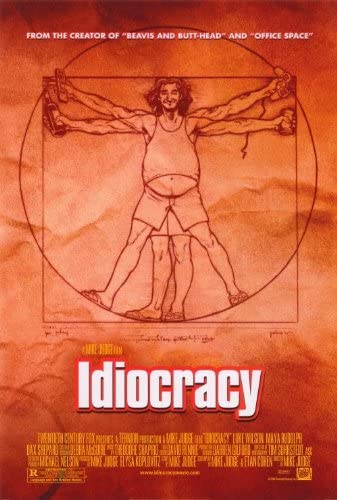
By refusing to distance itself from its targets, Mike Judge’s brand of satire risks being mistaken for what it’s satirizing. The Beavis and Butthead cartoons were erroneously dismissed as a mindless extension (rather than a complicit critique) of misdirected suburban youth, a fate that can similarly befall Idiocracy, Judge’s sophomore live-action comedy—or could have, that is, if the picture had ever been actually released. Brusquely dumped by its studio without even the courtesy of a trailer, this orphaned project has, as a result, acquired such an aura of lacerating subversion—the movie 20th Century Fox was too chickenshit to distribute!—that it is more than slightly disappointing to find, upon actual viewing, not much beyond a solid episode of Futurama. Give it props for nerve, however: A world where Starbucks has become synonymous with handjobs is surely beyond the reach of Fox’s other unceremoniously-axed vision of the future.

Joe Bowers (Luke Wilson) is an ordinary Army schmoe picked as guinea pig in a government experiment. Along with mouthy streetwalker Rita (Maya Rudolph), he’s supposed to be cryogenically frozen for one year to test a hibernation program, but it isn’t until 2505 that the two are thawed out and released into a radically mutated world: The sheer proliferation of stupid people has gradually reversed the Darwinian process in the 500 years since, and the planet has become overrun with slack-jawed numbskulls barely able to string together the slangy insults the language has degenerated into. The President (Terry Alan Crews) is an ex-wrestler and former porn star, water has been replaced everywhere by sports drinks, and people are only too happy to accept, consume, and vegetate. Judge’s dystopia is a pop wasteland triggered by rampant ignorance (the very act of thinking is dubbed “faggy”) and then held down by corporate greed, a daring concept visualized in the picture’s most evocative shot, of Costco merchandise piled high toward the skies to suggest gargantuan towers ready to topple over.

As evident in the cubicle zombies of Office Space, Judge recognizes quotidian frustration and the small ways through which people revolt against it; working on a larger, broader scale in Idiocracy, however, his control quickly dissolves into a freefall of ideas and jokes, some hitting the bullseye and others landing on the floor with a thud. Judge is indifferent to anything resembling space or rhythm, yet the low-tech chintz of his approach ultimately enhances the caustic themes by making the futuristic atmosphere absurdly transparent; as with Godard’s Alphaville, we are already living in the future, for how wide a gap really separates Date Movie and Failure to Launch from Ass, the single, unchanging shot of a gassy, naked butt topping box-office charts in 2025? (The hero recalls a past when moviegoers “cared about whose ass it was, and why it was farting.”) Idiocracy is too scattershot and compromised to push the conceptual bleakness beyond the realm of lowbrow comedy, though Judge’s cultural ire remains bracing throughout: For all the characters’ slapsticky imbecility, Judge makes it clear that it’s their docile acceptance (read: political inactivity) that makes them true dumbasses.

Saturday Matinee: Mike Upchurch short triple feature

Mike Upchurch is a comedy writer who got his start working on Mr. Show and The Chris Rock Show in the late nineties. In recent years he has written, directed and edited a series of short films, the best of which are presented here. They share in common an acerbic wit skewering various genres of pop culture detritus using brilliant editing and low-tech CGI techniques to insert whimsical performances, dialogue and plotlines into found footage.


Charlie Chaplin and Truly Modern Times

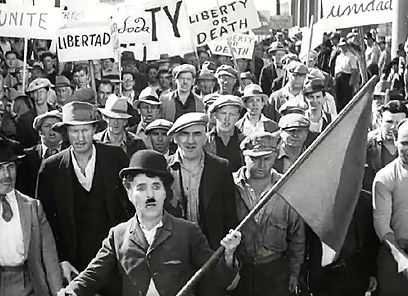
Still of Charlie Chaplin [b. April 16, 1889] from “Modern Times”

By Daniel Warner

Source: CounterPunch

Acrobat, musician, composer, clown, mime, movie star, director and producer, Academy Award winner for lifetime achievement, but still driven from the United States for his backing of the Soviet Union, Charlie Chaplin should need little introduction, except perhaps for Millennials and other late alphabet generations. He was the global star in the crossover from silent films to talkies, making an astonishing $10,000 a week during the Depression, with $150,000 in signing bonuses. Knighted by the Queen, Charlot was universally loved and admired.

But is he relevant today beyond his reputation as a comic icon?

During a recent visit to the magnificent Manoir de Ban near Lausanne, Switzerland, which was his home from 1952 until his death in 1977 and now houses a museum in his honor, I was impressed how his films were political, and how they speak to today’s human rights agenda.

In 1954 Chaplin was awarded the International Peace Prize by the World Peace Council for his outstanding contribution to the cause of peace and friendship among nations. Who can forget his mocking of Hitler in The Dictator when he spins a globe and dances with the world at his fingertips?)

Two examples from his classics show how his films relate to human rights:

The 1921 production The Kid is the story of an unwed, down-and-out mother who abandons her child because she cannot afford to look after him. She places him in an expensive car with a note to the owner to take care of him. After some intrigue, a tramp, Charlie Chaplin, finds the boy and raises and loves him like his own, cementing the idea of the kindness of the fellow impoverished. The tramp and the kid work together against the moneyed class; the kid breaking windows and the tramp repairing them.

The kid is eventually taken away from the tramp by the authorities – border police separating children from their loved ones on the U.S. southern border? – to be returned to his mother. In the end, the kid, the tramp and the mother are re-united.

The Kid was chosen to be preserved in the Library of Congress’s National Film Registry in 2011. It was praised as “an artful melding of touching drama, social commentary and inventive comedy.” The social commentary is what today we would call human rights: the right to a decent life for the mother when she is poor; the right for the mother to have minimum support to raise her boy and not to have to abandon him; the right of the tramp to have a decent wage for his job so he would be able to live properly without having to use illegal means to earn a living; the right to have proper housing for the tramp and the kid; the right to have affordable medical care; the right for the boy to stay with the tramp instead of being sent to an orphanage.

All of these we would call basic social, economic and cultural rights. They are at the heart of Chaplin’s advocacy; they are what make the film so endearing and why we are so relieved when the tramp, kid and mother unite at the end to live happily together. According to Chaplin, and The Kid, there is justice in this world. The good guys overcome injustices and the cruel indifference of the rich with their expensive cars (a foreboding of the 1%?). Although the mother became a rich actress, she takes in the tramp to form a supportive family for the kid, re-uniting him with her son (without the son’s losing the support of the foster father who had raised him, a win-win situation that no family judge could have better decided).

And how does Modern Times, Chaplin’s critique of industrialization, relate to human rights and our modern times of numeric technology? The tramp in Modern Times is a factory worker slaving away on mechanical assembly line. Is this different from today’s information workers tied to their computer screens, forced to work at accelerated speeds as the information flow gets faster and faster, like the quickening assembly line? The hero suffers a nervous breakdown after which he is unemployed, again suffering from having no unemployment insurance or other benefits to carry him over. He is mistakenly arrested with no legal recourse but wishes to stay in jail since he has had no vocational training and is living better in jail than in the street.

The remainder of the film deals with his romance with a fellow hobo who is fleeing punishment because she stole a single loaf of bread (proportional justice?). The film recounts the couple’s various adventures to escape poverty and the desperation of those with no guaranteed income, no right to food or right to housing. Whenever authorities are presented, they are unsympathetic. The poor have no recourse to representation and are left to their own devices to survive. The police – the authorities – are constantly trying to arrest the downtrodden who must seek refuge outside the authoritative system. There is no hope for them within the system; they are left to their own devices in a world with no guaranteed rights.

There is little justice in Modern Times in terms of a happy ending where the heroes overcome injustices. At the end, there is only the love between Chaplin and Ellen. But in the film, as in The Kid, struggles of the underclass represent all the injustices that the 99% of the world today must endure. While economic inequality continues to grow, Chaplin’s films have an important lesson of the struggles of the disenfranchised if one can view the horrors of industrialization and the Depression in our modern context. When 26 individuals are worth as much as 50% of the world’s population, Chaplin’s comic/tragic hero is a pertinent reminder of what it means to live in poverty.

The Manoir de Ban is a beautiful domaine with a lovely park and spectacular view of Lake Geneva. Chaplin died a very rich man. His vision of and advocacy for the poor should remain his greatest legacy. A visit to his museum is a reminder of the schism between the haves and have nots and how a talented, rich genius was able to give such a profound representation of all those who couldn’t afford to live in Vevey and to have the human rights he and many of us enjoy.


Paul Krassner, 4/9/32 – 7/21/19: American Satirist

Photograph Source: Heidi De Vries from Berkeley, CA – CC BY 2.0

By Jonah Raskin

Source: CounterPunch

“He’s gone. Feel free to spread the word,” Michael Simmons said in an email that went out to a few dozen or so of the usual suspects, including Wavy Gravy, Judy Gumbo, Larry (Ratzo) Sloman, Jim Fouratt, Rex Weiner, Aron Kay, Kate Coleman, Jeffrey St. Clair, and Barbara Garson, some of whom had been Yippies, Zippies and their fellow travelers.

“He” who was now gone at the age of 87, was Paul Krassner, who took up where Lenny Bruce left off, edited The Realist, reinvigorated satire, defended free speech at every opportunity and who lived at the end of his life in Desert Hot Springs, California in part because of the climate and also because he could afford to live there.

Before long there will be hefty biographies of Paul that describe his birth and his childhood in Brooklyn, his days and nights in Chicago during the infamous Conspiracy Trial, his provocative piece about LBJ and the Kennedy Assassination, and his performances as a standup comedian who seemed to find less and less to laugh about, and more and more to fret about in a world gone awry. The atomic bomb and nuclear paranoia was something Krassner could laugh about; not so Putin, Trump, the plutocrats and the kleptocrats of the twenty-first century.

Before the formal obituaries that are sure to show up in all the major U.S. newspapers, and before the pundits weigh-in on the significance of Krassner, it might make sense to say here that Paul was irascible and cantankerous, true to his core beliefs and that there were zero sacred cows in his universe, at least at the beginning of his career.

I met him in 1970. Soon afterward, he published in The Realist a piece I wrote about Eldridge Cleaver, Timothy Leary and their wives, but not before he’d turned it from something tame into something irreverent.

Over the years, I saw him in New York and in San Francisco. From 2015 to 2018, I interviewed Paul several times and published most of our conversations in print and online. In 2018, I collected all of them in a booklet titled Paul Krassner Speaks: From Lenny Bruce and Obama to Hebdo. 

Here are a few of the things he had to say:

“Satire has a truth embedded in the laughter and it can serve to wake people up from their cultural brainwashing.”

“Free speech demands a sense of responsibility.”

“I think every child is born with innocent irreverence, but it’s cancelled by the osmosis of cultural repression.”

“What I’d like to forget and can’t is that there are so many prisoners serving time, as Lenny Bruce said, ‘for smoking flowers.’”

“My slogan for The Realist used to be ‘Irreverence is our only sacred cow,’ but I’ve had second thoughts. Irreverence has become an industry and can become irreverence for its own sake. Mean-spirited stereotypes in the guise of satire.”

Thanks, Paul.


Related Podcast:

PAUL KRASSNER: THE LIFE OF AN INVESTIGATIVE SATIRIST

The Year of Putin-Nazi Paranoia

By C. J. Hopkins

Source: Dissident Voice

As my regular readers will probably recall, according to my personal, pseudo-Chinese zodiac, 2017 was “The Year of the Headless Liberal Chicken.” This year, having given it considerable thought, and having consulted the I Ching, and assorted other oracles, I’m designating 2018 “The Year of Putin-Nazi Paranoia.”

Not that 2017 wasn’t already paranoid. It was. It was completely paranoid, and otherwise clinically batshit crazy. But 2018 has been batshit crazier. It started out with the Internet companies that control the flow of information that most of us now perceive as “reality” launching an all-out War on Dissent, purportedly to protect the public from “divisive” and “confusing” content, and other forms of Russian “influencing.”

Twitter started sending out scary emails warning customers that there was “reason to believe” that they had “followed,” “retweeted,” or “liked the content of” accounts “connected to a propaganda effort by a Russian government-linked organization.” Facebook launched its own Ministry of Truth, manned by “a dedicated counter-terrorism team” of “former intelligence and law-enforcement officials” (also known as The Atlantic Council, NATO’s unofficial propaganda wing). Google stepped up its covert deranking of insufficiently Russia-hating and other “non-authoritative” websites.

This Orwellian corporate censorship campaign was enthusiastically welcomed by liberals and other Russia-and-Trump-obsessives, who by this time were already completely convinced that secret Russian Facebook agents were conspiring to transform the Western masses into zombified, Russia-loving neo-Nazis by means of some sort of irresistible Putin-Nazi hypno-technology that would melt their brains to oatmeal the second they clicked on one of those dancing cat GIFs.

But the paranoia was just getting started. By the Spring, professional Putin-Naziologists were issuing warnings explaining that anyone using words like “globalist,” “globalism,” or “global capitalism” was an anti-Semite. There was no such thing as “globalism,” they told us. “Globalist” was just Nazi codespeak for “JEW!” Moreover, anyone criticizing “the media,” or mentioning “banks,” “Wall Street,” or “Hollywood,” or, God help you, making fun of “George Soros,” was clearly a Russia-loving, Sieg-heiling Nazi.

Meanwhile, in London, Blairites were busy combing through six year-old Facebook posts in an effort to prove that Jeremy Corbyn had transformed the British Labour Party into his personal Putin-Nazi death cultThe Guardianpublished over one hundred articles smearing Corbyn as an anti-Semite and “linking” Labour to anti-Semitism. The BBC jacked up the Russia paranoia, doctoring Corbyn’s hat on TV to make it appear more insidiously Slavic. Owen Jones sprang to Corbyn’s defense, explaining that, yes, the Labour Party was a disgusting hive of anti-Semites, but they were doing their utmost to root out the Nazis, ban all criticism of the IDF, and reverse the mass exodus of Jews from London.

All this was happening in the wake of the notorious Novichok Porridge and Perfume Attacks, allegedly perpetrated by two totally incompetent, pot-smoking, prostitute-banging “assassins” that Putin personally dispatched to Salisbury to miserably fail to take out their target and then waltz around getting photographed by every CCTV camera in Great Britain. According to the corporate media, Putin tried to cover the crimes of these Jason Bourne-like GRU assassins by ordering his network of Putin-Nazi Twitter bots to flood the Internet with disinformation. Sky News captured and mercilessly interrogated one of these alleged “Twitter bots,” who it turned out was just a feisty British pensioner by the name of Ian, or at least that’s what Putin wants us to believe!

Back in America, millions of liberals and other Russia-and-Trump-obsessives were awaiting the Putin-Nazi Apocalypse, which despite the predictions of Resistance pundits had still, by the Summer, failed to materialize. The corporate media were speculating that Putin’s latest “secret scheme” was for Trump to destroy the Atlantic alliance by arriving late for the G7 meeting. Or maybe Putin’s secret scheme was to order Trump to sadistically lock up a bunch of migrants in metal cages, exactly as Obama had done before him … but these were special Nazi cages! And Trump was separating mothers and children, which, as General Michael Hayden reminded us, was more or less exactly the same as Auschwitz! Paul Krugman had apparently lost it, and was running around the offices of The New York Times shrieking that “America as we know it is finished!” Soros had been smuggled back into Europe to single-handedly thwart the Putin-Nazi plot to “dominate the West,” which he planned to do by canceling the Brexit (which Putin had obviously orchestrated) and overthrowing the elected government of Italy (which, according to Soros, was a Putin-Nazi front).

As if that wasn’t paranoia-inducing enough, suddenly, Trump flew off to Helisnki to personally meet with the Devil Himself. The neoliberal establishment went totally apeshit. A columnist for The New York Times predicted that Trump, Putin, Le Pen, the AfD, and other such Nazis were secretly forming something called “the Alliance of Authoritarian and Reactionary States,” and intended to disband the European Union, and NATO, and impose international martial law and start ethnically cleansing the West of migrants. That, or Trump and Putin were simply using the summit as cover to attend some Nazi-equestrian homosexual orgy, which The Times took pains to illustrate by creating a little animated film depicting Trump and Putin as lovers. In any event, Jonathan Chait was certain that Trump had been a “Russian intelligence asset” since at least as early as 1987, and was going to Helsinki to “meet his handler.”

In the wake of the summit, the neoliberal Resistance, like some multi-headed mythical creature in the throes of acute amphetamine psychosis, started spastically jabbering about “treason” and “traitors,” and more or less demanding that Trump be tried, and taken out and shot on the White House lawn. A frenzy of neo-McCarthyism followed. Liberals started accusing people of being “traitorous agents of Trump and Moscow,” and openly calling for a CIA coupbecause we were “facing a national security emergency!” A devastating Russian cyber-attack was due to begin at any moment. National Intelligence Director Dan Coats personally assured the Associated Press that the little “Imminent Russia Attack” lights he had on his desk were “blinking red.”

Into this maelstrom of monomania boldly slunk the Charlottesville Nazis, who had resolved to reenact their infamous national white supremacist tikki torch conclave right across the street from the White House this year. The Resistance and Antifa had been promoting this event as the long anticipated Putin-Nazi uprising, and Kristallnacht II, and other such nonsense, so it was a bit of a letdown when only twenty or thirty rather timid Nazis turned up. It felt like maybe the Great Nazi Panic of 2018 was finally over.

But no, of course, it wasn’t over. The Nazis had just gone underground. Weeks later, right there on national television, a Jewish-Mexican-American Nazi was spotted transmitting secret Nazi hand signals to her Nazi co-conspirators. One of them, a U.S. Coast Guard member, then relayed the secret Nazi signal to … well, it wasn’t entirely clear, perhaps the Underground Putin-Nazi Navy, which was steaming toward the Florida coast hidden in the eye of Hurricane Florence.

By the Autumn, with the midterm elections fast approaching, the Putin-Nazi terrorists finally struck. It soon became clear that those secret hand signs were just parts of a much larger Trumpian conspiracy to “embolden” a couple of totally psychotic wackos to unleash their hatred on the public. Wacko Number One accomplished this by mailing a series of non-exploding explosive devices to various prominent members of the neoliberal Resistance. Wacko Number Two stormed into a synagogue in Pittsburgh and murdered a lot of people. While the corporate media were unable to prove that Trump, Putin, or possibly Jeremy Corbyn, had personally “emboldened” these wackos, clearly, they had been “emboldened” by somebody, and thus were definitely domestic Putin-Nazi “terrorists,” and not just mentally disturbed individuals … like all the other mentally-disturbed individuals who go around murdering people all the time.

In November, at last, the tide began to turn. Despite the relentless “chaos campaign to undermine faith in American democracy” that the Russian bots and Nazis were waging, the Democrats managed to win back the House and rescue America from “the brink of fascism.” Apparently, the War on Dissent was working, because the millions of Black people that the Russians had brainwashed into not voting for Clinton in 2016 with those Jesus-doesn’t-like-masturbation memes had all miraculously been deprogrammed.

Liberals celebrated by singing hymns to Special Prosecutor Robert Muellerand compiling lists of people to subpoena to testify before congressional committees in what will someday be known as “the Hitlergate Hearings.” The New York Times even published a “roadmap” that Mueller and his team can follow to “send incriminating evidence directly to Congress,” thus protecting this “evidence” from the Justice Department, which is totally infested with Russians and Nazis!

But it’s not quite time for liberals to break out the vuvuzelas and Trump effigies yet … or to let up on the paranoia. The Putin-Nazi menace is still out there! The Internet is still literally crawling with all sorts of deviant, division sowing content! And now the Russian bots have brainwashed the French into staging these unruly Yellow Vest protests, and the Putin-Nazis have “weaponized” humor, and the economy, and religion, and Brexit, and Wikileaks, and pretty much everything else you can imagine. So this is no time to switch off the television, and log off the Internet, and start thinking critically … or to forget for one moment that THE NAZIS ARE COMING, and that A DEVASTATING RUSSIAN ATTACK IS IMMINENT!

So here’s wishing my Russia-and-Trump-obsessed readers a merry, teeth-clenching, anus-puckering Christmas and a somewhat mentally-healthier New Year! Me, I’m looking forward to discovering how batshit crazy things can get … I have a feeling we ain’t seen nothing yet.

C. J. Hopkins is an award-winning American playwright, novelist and satirist based in Berlin. His plays are published by Bloomsbury Publishing (UK) and Broadway Play Publishing (USA). His debut novel, ZONE 23, is published by Snoggsworthy, Swaine & Cormorant. He can reached at cjhopkins.com or consentfactory.org Read other articles by C. J..

Saturday Matinee: Mayhem

By Brian Tallerico

Source: RogerEbert.com

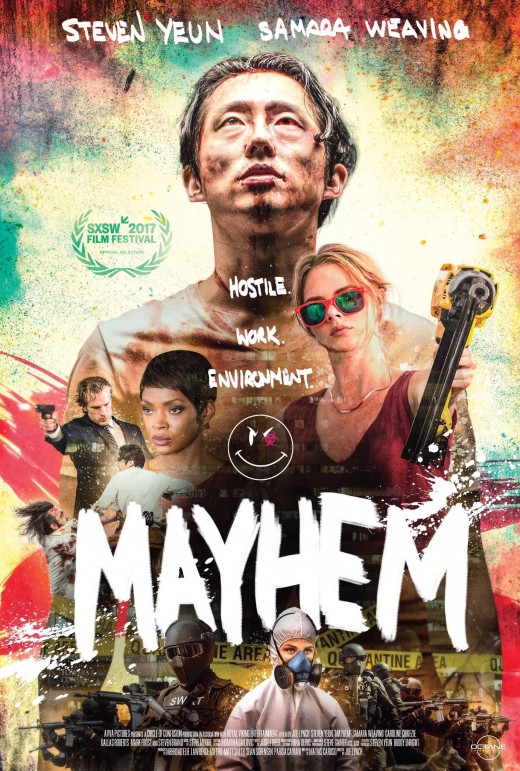
Joe Lynch’s “Mayhem” feels like a timely film in a way it wouldn’t have a couple years ago. Whatever your political party may be, anger has been a palpable emotion in this country recently—it was anger that got Trump elected, and it’s anger that opposes his administration. But what do we do with that anger? How long can we keep it down before it overwhelms us? With his best film since “Wrong Turn 2,” Lynch channels that national anger into a stylish, smart, propulsive gore-fest set in a corporate America that takes no prisoners. But when did it?

Not only is “Mayhem” a brutal, visceral gut punch at a time of the year when we typically drown in awards bait, but it feels like a movie designed to tap into a vein of frustration and anger at a corrupt system. Hate your boss? Can’t control your road rage? Want to push your co-workers down a stairwell? Thinking mean things about the President and his cronies? “Mayhem” channels rage at an unfair society and the bullshit that trickles down from the Powers That Be into a paean to uncontrolled anger. Much more tonally consistent than the similar “The Belko Experiment,” “Mayhem” isn’t as much about id run rampant as it is two people finally loosed from moral and societal constraints in a way that allows them to enact bloody, vicious vengeance. There are times when the whole thing feels like an extended version of that scene from “Kingsman: The Secret Service,” or, worse, the movie that would be the favorite film of the lunatic followers of Tyler Durden in “Fight Club,” but this weird little genre exercise works way more often than it doesn’t, and actually has something to say in the process.

The premise of “Mayhem” is simple in a way that I think a lot of horror masters would admire. There’s an airborne disease, referred to as “Red Eye” for the single red-eye it gives those who suffer from it, that removes all societal and moral governance. So those infected with it don’t just get mad, they get bloody. And it happens to infect a firm (and not just any firm but the one that set the legal precedent for “Red-Eye Defense” by recently getting off a murderer who was infected with it at the time) filled with the kind of well-tailored monsters who barely control their impulse for cruelty anyway. These are the kind of people who gleefully step on the little man in the pursuit of the almighty dollar, and one of the most interesting aspects of “Mayhem” is the choice Lynch makes not to infect “average Joes” but people who seem to have practice unleashing their inner monsters. When John Towers (Steven Brand), the boss of this loathsome company, says to someone beneath him that “You must protect those above you,” it’s the kind of human shield mentality that CEOs and executives have been using for scapegoats for decades.

However, the protection in this case is literal, and the man that Towers needs it from is Derek Cho (Steven Yeun, going from fighting zombies on “The Walking Dead” to maniacal suits here), a rising star who is about to be fired on the day the infection hits the company. Rather than take his corporate execution the way so many do, he picks up a hammer and a nail gun and goes after the people above him, assisted by a client named Melanie Cross (Samara Weaving), who was in the office that day fighting an immoral foreclosure. Caroline Chikezie, Kerry Fox, and Dallas Roberts co-star as corporate monsters at Derek’s company, but the movie belongs to Yeun and Weaving, who both get exactly what Lynch is going for here. They are fearless and intense in ways that other performers would have missed. Yeun proves himself to be a more engaging leading man than I would have expected and Weaving has the energy of Margot Robbie—captivating and a little scary at the same time. They’re both really good, and it’s their commitment that keeps “Mayhem” humming.

“Mayhem” is at its best when it channels relatable stress into utter genre insanity. It’s like “Office Space” if Michael Bolton went on a murderous spree with a nail gun, playing on workplace stress instead of pure id, and it has a violent momentum that’s hard to deny, well-directed by Lynch (who might use a few too many quick cuts but also stages a brutal scene to Faith No More, so all is forgiven). It can be such a relentless experience that it surely won’t be for everyone, but it works best when considered as a film that’s essentially about people willing to kill, bribe and offer power to anyone to not only save their own skins but also excuse their own horrors. Whether you would levy such accusations at Trump or the candidate he beat a year ago, there’s something about watching a movie about unleashing repressed anger at injustice a year after Election Day 2016 that just feels right.


Watch the full film at Hoopla.

Saturday Matinee: Military Intelligence and You!

“Military Intelligence and You!” (2006) is a satire poking fun at the military-industrial complex written and directed by Dale Kutzera. Using public domain archival WW2 propaganda films mixed with new footage, the film tells the story of military intelligence officer Major Nick Reed (Patrick Muldoon) whose job is to locate a secret enemy base housing the dreaded Ghost Squadron. Complicating his mission is the reappearance of his former love, Lt. Monica Tasty (Elizabeth Ann Bennett), now dating fellow Major Mitch Dunning (Mackenzie Astin). There’s also a notable appearance of a gung-ho fighter pilot played by a young Ronald Reagan.