Obama Accuses Russia of Going After America’s “Good Guy Terrorists”

obama_on_isis_10-1-2015_8-50-53_am

By Prof Michel Chossudovsky

Source: Global Research

Amply documented but rarely mentioned in news reports, the ISIS is a creation of US intelligence, recruited, trained and financed by the US and its allies including Britain, France, Saudi Arabia, Qatar, Turkey, Israel and Jordan.  

Until recently, the ISIS was known as Al Qaeda in Iraq (AQI). In 2014, it was renamed the Islamic State (Islamic State of Iraq and Syria, Islamic State of Iraq and the Levant).

Russia is Now Involved in the War on Terrorism

A major turning point in the dynamics of the Syria-Iraq war is unfolding. Russia is now directly involved in the counter-terrorism campaign in coordination with the Syrian and Iraqi governments.

While Washington has acknowledged Moscow’s resolve, Obama is now complaining that the Russians are targeting the “good guy terrorists” who are supported by Washington.

From the Horse’s Mouth

According to the Wall Street Journal:

Russian Airstrike in Syria Targeted CIA-Backed Rebels, U.S. Officials Say

One area hit was location primarily held by rebels receiving funding, arms, training from CIA and allies

One important piece of unspoken information conveyed in this WSJ report is that the CIA is supporting terrorists as a means to triggering “regime change” in Syria, implying the conduct of covert intelligence operations within Syrian territory:

“The U.S. spy agency has been arming and training rebels in Syria since 2013 to fight the Assad regime  (WSJ, September 30, 2015 emphasis added, author’s note: covert support to the terrorists was provided from the outset of the war in March 2011)

The above statement is something which is known and documented but which has barely been acknowledged by the mainstream media.

Al Nusra: “Good Guy Terrorists”

While the Pentagon now candidly acknowledges that the CIA is supporting Al Qaeda affiliated groups inside Syria, including Al Nusra, it nonetheless deplores the fact that Russia is allegedly targeting the “good guy terrorists”, who are supported by Washington:

One of the [Russian] airstrikes hit an area primarily held by rebels backed by the Central Intelligence Agency and allied spy services, U.S. officials said, …

Among seven areas that Syrian state media listed as targets of Russian strikes, only one—an area east of the town of Salamiyah in Hama province—has a known presence of Islamic State fighters. The other areas listed are largely dominated by moderate rebel factions or Islamist groups such as Ahrar al-Sham and the al Qaeda-affiliated Nusra Front.  (WSJ, September 30, 2015 emphasis added)

Affiliated to Al Qaeda, Al Nusra is a US sponsored  ”jihadist” terrorist organization which has been responsible for countless atrocities. Since 2012, AQI and Al Nusra — both supported by US intelligence– have been working hand in glove in various terrorist undertakings within Syria.

In recent developments, the Syrian government has identified its own priority areas for the Russian counter-terrorism air campaign, which consists essentially in targeting Al Nusra.  Al Nusra is described as the terrorist arm of the Free Syrian Army (FSA).

While Washington has categorized Al Nusra as a terrorist organization (early 2012), it nonetheless provides support to both Al Nusra and it’s so-called “moderate rebels” in the form of weapons, training, logistical support, recruitment, etc. This support is channeled by America’s Persian Gulf allies, including Qatar and Saudi Arabia as well as through Turkey and Israel.

Ironically, The UN Security Council in a May 2012 decision “blacklisted Syria’s al-Nusra Front as an alias of al-Qaeda in Iraq”, namely the ISIL:

a decision that will subject the group to sanctions including an arms embargo, travel ban and assets freeze, diplomats said.

The US mission to the United Nations said none of the 15 council members objected to adding al-Nusra as an alias of al-Qaeda in Iraq on Thursday.

Al-Nusra, one of the most effective forces fighting President Bashar al-Assad, last month pledged allegiance to al-Qaeda leader Ayman al-Zawahri. (Al Jazeera, May 2012)

And now Russia is being blamed for targeting a terrorist entity which is not only on the UN Security Council blacklist but which has ties to the Islamic State (ISIS).

What is the significance of these accusations?

While the media narrative acknowledges that Russia has endorsed the counter-terrorism campaign, in practice Russia is (indirectly) fighting the US-NATO coalition  by supporting the Syrian government against the terrorists, who happen to be the foot soldiers of the Western military alliance, with Western mercenaries and military advisers within their ranks. In practice, what Russia is doing is fighting terrorists who are supported by the US.

The forbidden truth is that by providing military aid to both Syria and Iraq, Russia is (indirectly) confronting America. 

Moscow will be supporting both countries in their proxy war against the ISIL which is supported by the US and its allies.

Putin’s Blitz Leaves Washington Rankled and Confused

putin-obama-620x350

By Mike Whitney

Source: Counterpunch

On Monday, Russian President Vladimir Putin delivered a blistering critique of US foreign policy to the UN General Assembly.

On Tuesday, Barack Obama shoved a knife in Putin’s back. This is from Reuters:

“France will discuss with its partners in the coming days a proposal by Turkey and members of the Syrian opposition for a no-fly zone in northern Syria, French President Francois Hollande said on Monday…

French Foreign Minister Laurent Fabius “in the coming days will look at what the demarcation would be, how this zone could be secured and what our partners think,” Hollande told reporters on the sidelines of the annual United Nations General Assembly…

Hollande said such a proposal could eventually be rubber-stamped with a U.N. Security Council resolution that “would give international legitimacy to what’s happening in this zone.”…(France, partners to discuss northern Syria ‘safe zone’: Hollande, Reuters)

Hollande is a liar and a puppet. He knows the Security Council will never approve a no-fly zone. Russia and China have already said so. And they’ve explained why they are opposed to it, too. It’s because they don’t want another failed state on their hands like Libya, which is what happened last time the US and NATO imposed a no-fly zone.

But that’s beside the point. The real reason the no-fly zone issue has resurfaced is because it was one of the concessions Obama made to Turkish President Recep Tayyip Erdogan for the use of Incirlik airbase.  Washington has kept the terms of that deal secret, but Hollande has let the cat out of the bag.

So who put sock-puppet Hollande up to this no-fly zone nonsense?

Why the Obama administration, of course. Does anyone seriously believe that Hollande is conducting his own independent policy in Syria?  Of course not.  Hollande is just doing what he’s been told to do, just like he did when he was told to scotch the Mistral deal that cost France a whopping $1.2 billion. Washington and NATO didn’t like the idea that France was selling state-of-the-art helicopter carriers to arch-rival Putin, so they ordered Hollande to put the kibosh on the deal. Which he did, because that’s what puppets do; they obey their masters.  Now he’s providing cover for Obama so the real details of the Incirlik agreement remain off the public’s radar. That’s why we say,  Obama shoved a knife in Putin’s back, because, ultimately, the no-fly zone damages Russia’s interests in Syria.

The significance of the Reuters article cannot be overstated. It suggests that there was a quid pro quo for the use of Incirlik, and that Turkey’s demands were accepted. Why is that important?

Because Turkey had three demands:

1–Safe zones in north Syria (which means that Turkey would basically annex a good portion of Syrian sovereign territory.)
2–A no-fly zone (which would allow either Turkish troops, US Special Forces or US-backed jihadi militants to conduct their military operations with the support of US air cover.)
3–A commitment from the US that it will help Turkey remove Assad.

Did Obama agree to all three of these demands before Erdogan agreed to let the USAF use Incirlik?

Yes, at least I think he did, which is why I think we are at the beginning of Phase 2 of the US aggression against Syria. Incirlik changes everything. US bombers, drones and fighters can enter Syrian airspace in just 15 minutes instead of 3 to 4 hours from Bahrain. That means more sorties, more surveillance drones, and more air-cover for US-backed militias and Special Forces on the ground.  It means the US can impose a de facto no-fly zone over most of Syria that will expose and weaken Syrian forces tipping the odds decisively in favor of Obama’s jihadi army. Incirlik is a game-changer, the cornerstone of US policy in Syria.  With access to Incirlik, victory is within Washington’s reach. That’s how important Incirlik is.

And that’s why the normally-cautious Putin decided to deploy his warplanes, troops and weaponry so soon after the Incirlik deal was signed. He could see the handwriting on the wall. He knew he had to either act fast and turn the tide or accept the fact that the US and Turkey were going to topple Assad sometime after Turkey’s snap elections on November 1. That was his timeline for action. So he did the right thing and joined the fighting.

But what does Putin do now?

On Wednesday, just two days after Putin announced to the UN General Assembly:  “We can no longer tolerate the current state of affairs in the world,” Putin ordered the bombing of targets in Homs, an ISIS stronghold in West Syria. The attacks, which were unanimously approved by the Russian parliament earlier in the day, and which are entirely legal under international law (Putin was invited by Syria’s sitting president, Assad, to carry out the airstrikes), have put US policy in a tailspin. While the Russian military is maintaining an open channel to the Pentagon and reporting when-and-where it is carrying out its airstrikes, U.S. State Department spokesman John Kirby said that the US plans to “continue to fly missions over Iraq and Syria” increasing the possibility of an unintended clash that could lead to a confrontation between the US and Russia.

Is that what Washington wants, a violent incident that pits one nuclear-armed adversary against the other?

Let’s consider one probable scenario: Let’s say an F-16 is shot down over Syria while providing air cover for Obama’s militants on the ground. Now that Russia is conducting air raids over Syria, there’s a good chance that Putin would be blamed for the incident like he was when the Malaysian airliner was downed over East Ukraine.

So what happens next?

Judging by similar incidents in the past,  the media would swing into full-propaganda mode exhorting the administration to launch retaliatory attacks on Russian military sites while calling for a broader US-NATO mobilization. That, in turn, would force Putin to either fight back and up-the-ante or back-down and face disgrace.  Either way, Putin loses and the US gets one step closer to its objective of toppling Bashar al Assad.

Putin knows all this. He understands the risks of military involvement which is why he has only reluctantly committed to the present campaign. That said; we should expect him to act in much the same way as he did when Georgian troops invaded South Ossetia in 2007. Putin immediately deployed the tanks to push the invading troops back over the border into Georgia and then quickly ended the hostilities. He was lambasted by critics on the right for not invading Georgia and removing their leader, Mikheil Saakashvili, in the Capital. But as it turned out, Putin’s restraint spared Russia the unnecessary hardship of occupation which can drain resources and erode public support. Putin was right and his critics were wrong.

Will his actions in Syria mirror those in South Ossetia?

It’s hard to say, but it’s clear that the Obama crew is thunderstruck by the speed of the intervention. Check this out from the UK Guardian:  “Back at the White House, spokesperson Josh Earnest suggests that Vladimir Putin did not give Barack Obama warning about his intentions to begin air strikes in Syria.

“We have long said we would welcome constructive Russian coordination,” Earnest says, before qualifying that the talks between US and Russian militaries will be purely tactical: “to ensure that our military activities and the military activities of coalition partners would be safely conducted.” (The Guardian)

What does Earnest’s statement mean?  It means the entire US political class was caught off-guard by Putin’s  blitz and has not yet settled on an appropriate response. They know that Putin is undoing years of work by rolling up proxy-units that were supposed to achieve US objectives, but there is no agreement among ruling elites about what should be done. And making a decision of that magnitude could take time, which means that Putin should be able to obliterate a fair number of the terrorist hideouts and restore control of large parts of the country to Assad before the US ever agrees to a strategy. In fact, if he moves fast, he might even be able to force the US and their Gulf allies to the bargaining table where a political solution could be reached.

It’s a long-shot, but it’s a much better option then waiting around for the US to impose a no-fly zone that would collapse the central government and reduce Syria to Libya-type anarchy. There’s no future in that at all.

MIKE WHITNEY lives in Washington state. He is a contributor to Hopeless: Barack Obama and the Politics of Illusion (AK Press). Hopeless is also available in a Kindle edition. He can be reached at fergiewhitney@msn.com.

isis_russia_10-1-2015_8-21-13_am

America created and supports the Islamic State

obama-isis-cia

By Stephen Lendman

Source: Intrepid Report

Obama’s so-called war to degrade and destroy Islamic State is a complete fabrication. Defeating it is simple. Stop recruiting, arming, funding, training and directing its elements.

Stop using terrorists as US proxy foot soldiers. Wage peace, not war. Isolated on its own, it’ll wither over time and disappear, or be too impotent to rampage like now.

Washington bears full responsibility for human floods fleeing war ravaged areas for safe havens anywhere. Bashar al-Assad told RT International the crisis is “not about that Europe didn’t accept them or embrace them as refugees. It’s about not dealing with the cause. If you are worried about them, stop supporting terrorists.”

“If we ask any Syrian today about what they want, the first thing they would say: ‘We want security and safety for every person and every family.’ The international community should unite around what the Syrian people want.”

Ongoing conflict can only be resolved “through dialogue and the political process [as well as] unit[y] in the struggle against terrorism.”

With an approval rating of 89%, Vladimir Putin is likely the world’s most popular leader—for supporting nation-state sovereignty, multi-world polarity and opposing America’s ruthless imperial agenda, waging endless wars on humanity.

He’s vilified in the West for forthrightly supporting world peace and stability, as well as wanting all conflicts resolved diplomatically and proposing workable solutions if adopted.

At the Collective Security Treaty Organization (CSTO) summit in Dushanbe, Tajikistan, he urged the international community to set aside geopolitical differences and unite against a common enemy.

“Extremists from many countries of the world, including, unfortunately, European countries, Russia and the Commonwealth of Independent States (CIS) undertake ideological and military training in the ranks of Islamic State,” he explained. “[C]ertainly we are worried that they could possibly return” and make trouble.

“Russia, as you know, has proposed to form a wide coalition to fight extremists without any delay. It should unite everyone who is ready and is already contributing to tackling terrorism.”

“If Russia had not been supporting Syria, the situation in the country would have been worse than in Libya and the refugee flow would have been even bigger.”

Moscow didn’t ravage and destroy Afghanistan, Iraq, Libya, Syria, Yemen, Donbass, and other countries—or occupy any. It doesn’t use terrorist mercenaries as proxy foot soldiers—or wage endless wars on humanity.

It’s not responsible for exponentially growing human floods of desperate people fleeing war-torn areas for safe havens anywhere out of harm’s way.

It accepted over a million Ukrainian refugees fleeing Obama’s war on Donbass, treating them humanely, regularly supplying Donetsk and Lugansk with badly needed humanitarian aid—doing the same thing for Syrians.

Russia is Europe’s leading peace and stability proponent. Wherever America shows up, genocide, mass destruction and human misery follow.

Peace is anathema. So are democratic freedoms. America’s agenda intends a ruler/serf world unfit to live in—greed and rapaciousness triumphing over equity and justice for all.

Stephen Lendman lives in Chicago. He can be reached at lendmanstephen@sbcglobal.net. His new book as editor and contributor is “Flashpoint in Ukraine: US Drive for Hegemony Risks WW III.” Visit his blog at sjlendman.blogspot.com . Listen to cutting-edge discussions with distinguished guests on the Progressive Radio News Hour on the Progressive Radio Network. It airs three times weekly: live on Sundays at 1PM Central time plus two prerecorded archived programs.


Are Neocons an Existential Threat?

1-kagan-NEOCON

By Robert Parry

Source: Consortium News

The neoconservatives arguably have damaged American national interests more than any group in modern history. They have done more harm than the marginal Communists pursued by Sen. Joe McCarthy in the 1950s, more than the Yippies of the 1960s, more than Richard Nixon’s Watergate burglars in the 1970s or the Iran-Contra conspirators in the 1980s.

The neocons have plunged the U.S. government into extraordinarily ill-considered wars wasting trillions of dollars, killing hundreds of thousands if not millions of people, anddestabilizing large swaths of the planet including the Middle East, much of Africa and now Europe. Those costs include a swelling hatred against America and a deformed U.S. foreign policy elite that is no longer capable of formulating coherent strategies.

Yet, the neocons have remained immune from the consequences of their catastrophes. They still dominate Washington’s major think tanks as well as the op-ed pages of virtually all the leading newspapers, including The Washington Post, Wall Street Journal and New York Times. They hold down key positions in the State Department, and their “liberal interventionist” pals have the ear of President Barack Obama.

Clearly, the neocons are skilled operatives, knowing how to arrange a steady stream of funding for themselves, from military contractors donating to think tanks, from U.S. taxpayers footing the bill for organizations like the National Endowment for Democracy, and from ideological billionaires set on aligning U.S. foreign policy with hard-line Israeli desires.

The neocons are adept at writing op-ed articles that twist any set of facts into support for their ideological cause; they supply just the right quote that fits into the news cycle’s latest narrative; and they host policy conferences that attract powerful politicians and fawning media coverage.

But are the neocons a force that can coexist with the American Republic? Have they become an existential threat not only to the constitutional structure crafted in 1787 but to continued life on the planet? Are they locked on a course of action that could lead to a nuclear holocaust?

Clearly, the neocons’ commitment to Israeli interests violates a key principle established by the nation’s early presidents who all warned against “foreign entangling alliances” as a fundamental threat to a citizens’ republic that would transform America into a warrior state that would inevitably sap the nation’s liberties.

That loss of liberty has surely happened. Not only is there now bipartisan support for a surveillance state that can spy on the personal lives of American citizens, but the U.S. government has wedded itself to the concept of “strategic communications,” a catch-phrase that merges psychological operations, propaganda and P.R. into a seamless approach toward managing public perceptions at home and abroad.

When information is systematically pushed through a filter designed to ensure consent, the core democratic concept of an informed electorate has been turned on its head: The people no longer oversee the government; the government manipulates the people.

Neocon Tactics

All this has been part of the neocon approach dating back to the 1980s when key operatives, such as Robert Kagan and Elliott Abrams, were part of inter-agency task forces designed to whip the American people into line behind the government’s aggressive war policies. Guided by seasoned CIA propagandists, such as Walter Raymond Jr., the neocons learned their lessons well.

But the neocons are no longer just threatening the existence of the Republic; they are now endangering the continuation of life itself. They have decided to launch a new Cold War against Russia that will push the world toward the brink of thermo-nuclear war.

Of course, the neocons will frame their doomsday strategy as all Vladimir Putin’s fault. They will insist that they are just standing up to “Russian aggression” and that anyone who doesn’t join them is a “stooge of Moscow” or “weak.” They will dictate the shape of the debate just as they have in countless other situations, such as guiding Americans to war in Iraq over non-existent WMD stockpiles.

The neocon pundits will write seemingly authoritative op-eds about devious Kremlin strategies which will glue black hats on the Russians and white hats on whomever is on the other side, whether the neo-Nazis in Ukraine or the Islamic State/Al Qaeda terrorists in Syria. Americans will be whipped up into a frenzy that will demand a direct clash with the “Russ-kies” or “regime change” in Moscow.

There will be little or no concern about the risks. With the neocons, there never is. The assumption is that if “Amur-ika” is tough, the other side will back down. Then, with U.S.-led economic sanctions from the outside and U.S.-funded NGOs stirring up trouble from the inside, “regime change” becomes the cure-all.

Everyone who’s important in Official Washington – everyone on the talk shows and op-ed pages – knows that these disruptive situations always play out just the way they’re diagramed inside the top think tanks. A hand-picked “democratic reformer” who’s traveled the think-tank circuit and gotten the seal of approval – the likes of Iraq’s Ahmed Chalabi – will easily be installed and then the target country will do whatever the neocons dictate. After all, that approach worked so well in Iraq. The neocons always know best.

Raising the Stakes

Yet, with Russia, the stakes are even higher than with Iraq. Yes, it’s easy to find fault with Vladimir Putin. I myself have a personal rule that men over 40 should keep their shirts on when out in public (unless maybe they’re actors in a Bond film or going for a swim at the beach).

But Putin at least is a rational player in global affairs. Indeed, he has tried to cooperate with President Obama on a variety of key issues, including convincing Syria to surrender its chemical weapons and getting Iran to make concessions in the nuclear deal – two contributions to world peace that infuriated the neocons who favored bomb-bomb-bombing both Syria and Iran.

At a dinner party in Europe this summer, I was asked by a well-informed British woman what should be done with Putin. My answer was that Putin doesn’t frighten me; it’s the guy who comes after Putin who frightens me – because despite the neocons’ confidence that their “regime change” plans for Moscow will install a malleable moderate, the more likely result would be a much harder-line Russian nationalist than Putin.

The idea of the nuclear codes being handed to someone determined to defend the honor of Mother Russia is what scares me. Then, the clumsily aggressive neocons in Washington would have their reckless counterpart in Moscow, with neither side having the wisdom of a John F. Kennedy or a Nikita Khrushchev as displayed during the Cuban Missile Crisis in 1962.

Would American neocons or a Russian super-nationalist have the wisdom and courage to back down, to compromise, to make the concessions necessary to avoid plunging over the edge? Or would they assume that the other guy would blink first and that they would “win” the showdown?

I recall what William R. Polk, one of Kennedy’s mid-level aides during the Cuban Missile Crisis,wrote recently about what happens to the human mind under such stress.

“Since human beings make the decisions, we must be aware of decision makers’ vulnerabilities,” Polk wrote. “During the Cuban Missile Crisis, I was one of about 25 civilians fully engaged in the events. I was not at the center but in the second or third ‘echelon.’ So I did not feel the full strain, but by the Thursday of the Crisis, I was thoroughly exhausted. My judgment must have been impaired even though I was not aware of it.

“I do remember, however, a terrible episode – fortunately lasting only a few minutes – at which I thought to myself, ‘let’s just get it over with.’ When later I met with my Soviet counterparts, I got the impression, although they denied it, that my feelings were not unique. How the strain impacted on the inner group I can only guess.”

If someone as stable and serious as Bill Polk had such thoughts – “let’s just get it over with” – what might happen when American neocons or hyped-up Russian nationalists are inserted into the decision process? That is an existential question that I don’t want to even contemplate.

Endless Putin-Bashing

And, if you doubt that the neocons will engage in over-the-top Cold War-style Putin bashing, you should read the op-ed by The Washington Post’s neocon deputy editorial page editor Jackson Diehl on Monday, entitled “Putin shifts fronts: With a move into Syria, he continues his in-your-face maneuvers.”

Diehl delves into Putin’s psyche – a process that is so much easier than doing real reporting – and concludes that Putin’s decision to join the fight in Syria against the Islamic State and Al Qaeda is just another attempt to stick his finger in the eye of the righteous but clueless United States.

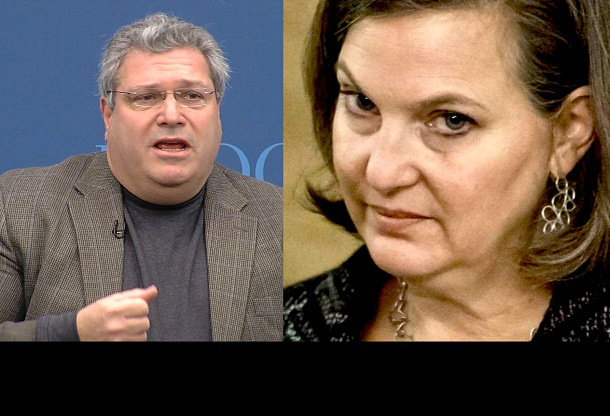
Diehl, of course, starts off with the neocon-approved narrative of the Ukraine crisis, ignoring the key role of neocon Assistant Secretary of State Victoria Nuland (Robert Kagan’s wife) in midwifing the Feb. 22, 2014 coup that overthrew democratically elected President Viktor Yanukovych and installed an intensely anti-Russian regime on Russia’s border. Nuland even handpicked the new Prime Minister Arseniy Yatsenyuk, telling U.S. Ambassador Geoffrey Pyatt in a phone call several weeks before the coup that “Yats is the guy.”

The coup-makers then dispatched neo-Nazi militias (and Islamist militants) to wage a bloody “anti-terrorism operation” against ethnic Russian Ukrainians who resisted the “regime change.” [See Consortiumnews.com’s “Ukraine Merges Nazis and Islamists.”]

But all that complexity is neatly boiled down by American neocons and the mainstream U.S. media as “Russian aggression.” Regarding the Syrian civil war, some neocons have even joined with senior Israeli officials in claiming that a victory by Al Qaeda is preferable to the continuation of Assad’s secular regime. [See Consortiumnews.com’s “Syria’s Nightmarish Narrative.”]

Yet, however the story goes, the biggest bad guy is Putin, always with sinister motives and evil intent. So, in explaining the situation in Ukraine and Syria, Diehl writes:

“Throughout the summer, Russia’s forces in eastern Ukraine kept up a daily drumbeat of attacks on the Ukrainian army, inflicting significant casualties while avoiding a response by Western governments. On Sept. 1, following a new cease-fire, the guns suddenly fell silent. Optimists speculated that Vladi­mir Putin was backing down.

“Then came the reports from Syria: Russian warplanes were overflying the rebel-held province of Idlib. Barracks were under construction at a new base. Ships were unloading new armored vehicles. Putin, it turns out, wasn’t retreating, but shifting fronts — and executing another of the in-your-face maneuvers that have repeatedly caught the Obama administration flat-footed.”

The rest of the op-ed is similarly didactic and one-sided: Putin is the villain and Obama is the rube. In Diehl’s world, only he and other neocons have what it takes to take on Putin and put Russia down.

Any alternative explanation for Russia’s action in Syria is brushed aside, such as Putin deciding that a victory by either Al Qaeda’s Nusra Front – as favored by Israel – or the even more bloodthirsty Islamic State is unacceptable and thus Assad’s regime must be stabilized to avert a major geopolitical catastrophe.

Typically, the neocons breeze past the frightening logic of what the collapse of Assad’s military would mean for the Middle East, Europe and the world. After all, once Israeli leaders decided to throw in their lot with Al Qaeda in Syria, the die was cast as far as the neocons were concerned.

But the notion that the neocons can micromanage the outcome in Syria, with “moderate” Al Qaeda taking Damascus rather than the more “radical” Islamic State, reflects the arrogant know-nothing-ism of these U.S. opinion leaders. More likely, Al Qaeda’s Nusra Front would coordinate with their former allies in the Islamic State and share in the Sunni revenge against Syria’s Christian, Alawite, Shiite and other minorities.

So, while the Islamic State would busy itself chopping off heads of “heretics,” Al Qaeda could use its new headquarters in Damascus to plot the next round of terror attacks against the West. And, as destabilizing as the current refugee flow into Europe has been, it would multiply astronomically as the survivors of the Islamic State/Al Qaeda bloodletting flee Syria.

With Europe in chaos and the neocons still insisting that the real enemy is Russia, the possible consequences would be frightening to contemplate. Yet, this is the course that the neocons have set for the world – and nearly all the Republican candidates for president have signed on for the journey along with Democratic frontrunner Hillary Clinton.

In 2014, arch-neocon Robert Kagan, whom Secretary of State Clinton selected as one of her advisers while also promoting his wife, Victoria Nuland, told The New York Times that he could embrace a Clinton presidency: “If she pursues a policy which we think she will pursue … it’s something that might have been called neocon, but clearly her supporters are not going to call it that; they are going to call it something else.” [For more, see Consortiumnews.com’s “Is Hillary Clinton a Neocon-Lite?” and “Obama’s True Foreign Policy ‘Weakness.’“]

So far, virtually no one in the 2016 presidential race or in the mainstream U.S. news media is seriously addressing the reality of the neocons’ “regime change” chaos spreading across the Middle East and the prospect of a destabilized Europe. What limited discussion there is on the campaign trail mostly echoes Jackson Diehl’s Putin-bashing.

No one dares confront the existential question of whether the United States and the world can continue to tolerate and accommodate the neoconservatives.

Investigative reporter Robert Parry broke many of the Iran-Contra stories for The Associated Press and Newsweek in the 1980s. You can buy his latest book, America’s Stolen Narrative, either in print here or as an e-book (from Amazon andbarnesandnoble.com). You also can order Robert Parry’s trilogy on the Bush Family and its connections to various right-wing operatives for only $34. The trilogy includesAmerica’s Stolen Narrative. For details on this offer, click here.

Living in a PNAC World: The Toxic Legacy of 9/11

pnac-criminals-2-1

By Chris Floyd

Source: Empire Burlesque

In September 2000, an advocacy group called “Project for New American Century,” led by Jeb Bush, Dick Cheney, Donald Rumsfeld, Paul Wolfowitz and others — published a “blueprint” for “transforming” America’s future. PNAC acknowledged that the “revolutionary” changes it envisaged could take decades to bring about — unless, they said, the United States was struck by “some catastrophic and catalyzing event – like a new Pearl Harbor.” One year later, after the disputed election of George W. Bush, came the “catalyzing” event of the 9/11 attacks — which indeed “transformed” America’s future in many “revolutionary” ways.

Here are some of the changes PNAC called for in 2000, all of which came about after the “new Pearl Harbor” they had hoped for: An attack on Iraq. Vast increases in military spending. Planting new American bases all over the world. Embracing the concept of “pre-emptive war” and unilateral action as cornerstones of national strategy. Developing sophisticated new technologies to “control the global commons of cyberspace” by closely monitoring communications and transactions on the Internet. Pursuing the development of “new methods of attack – electronic, ‘non-lethal, biological…in new dimensions, in space, cyberspace and perhaps the world of microbes.”

Oddly enough, although “regime change” in Iraq was clearly a priority for PNAC, it had little to do with Saddam Hussein and his brutal rule. Instead, removing Saddam was tied to the larger goal of establishing a permanent U.S. military presence in the Persian Gulf in order to “secure energy supplies” and preclude any other power from dominating the vital oil regions of the Middle East and Central Asia. The PNAC report puts it quite plainly:
“The United States has for decades sought to play a more permanent role in Gulf regional security. While the unresolved conflict with Iraq provides the immediate justification, the need for a substantial American force presence in the Gulf transcends the issue of the regime of Saddam Hussein.”

This is why the Bush Administration offered a constantly shifting menu of rationales for the impending attack on Iraq: because the decision to remove Saddam was taken long ago, as part of a larger strategic plan, and had little to do with any imminent threat from the broken-backed Iraqi regime, which at that time was constantly bombed, partially occupied (with U.S. forces already working in the autonomous Kurdish territories) and swarming with UN inspectors. If the strategic need for the attack “transcends the issue of the regime of Saddam Hussein,” then almost any rationale will do.

The same desire to “secure energy supplies” and prevent any other power from gaining dominance in the oil regions also underlies current and recent US policies in Libya, Syria, Yemen and elsewhere. That’s why we see the same shifting rationales, see policies that on the surface seem to make no sense: we fight al Qaeda in Iraq, we support al Qaeda in Yemen and Syria; we say defeating ISIS is of supreme global importance, but we prevent other countries (Iran, Russia) from joining the fight; we push “regime change” to “liberate” Libya and Syria while partnering with one of most repressive, extremists nations on earth, Saudi Arabia, and arming other dictators like Sisi in Egypt. We are “fighting” terrorism while turning whole nations (Iraq, Libya, Syria) into swamps of ruin and violence where terrorism can breed. None of these contradictory rationales make sense on the surface. But viewed as part of an ongoing, bipartisan agenda of securing American dominance of economically strategic lands — and of “discouraging advanced industrial nations from challenging our leadership or even aspiring to a larger regional or global role” (as an earlier Cheney-Wolfowitz document put it) — it becomes easier to see a pattern in today’s howling chaos.

This is not “conspiracy theory.” These motives and agendas are out in the open, and always have been. Our bipartisan leaders eagerly trumpet them, and declare that it is our right and our duty to dominate the world in this way. What’s more, any actions we take to accomplish this — wars, regime change, intrusive surveillance, drone campaigns, death squads, torture, killing thousands of innocent people (mere “collateral damage”), fomenting more hatred and extremism, breaking our own laws, turning our own people into fearful cowards ready to throw away their liberties to “stay safe,” etc. — are automatically just and righteous, because we are “exceptional.”

So yes, the “transformations” wrought in American policy — and the American psyche — since that “new Pearl Harbor” have indeed been “revolutionary.” Post-9/11, we are all living in a PNAC world.

Note: The above post was adapted (and updated) from a much more detailed piece originally written in 2002, which can be found here.


Dollar As World’s Reserve Currency Threatened

dollar_2977362b

By Stephen Lendman

Source: Stephen Lendman Blog

US dollar dominance finances Washington’s reckless spending, global militarism, its empire of bases, endless wars, corporate takeovers, as well as speculative excess creating bubbles and economic crises – at the expense of democratic freedoms and beneficial social change.

China, Russia and other nations increasingly trading in their own currencies pose a significant threat to dollar dominance. Mahdi Darius Nazemroaya explained Washington’s currency war on China, saying:

“The Chinese are in the process of displacing the monopoly of the US dollar. They are dropping their US Treasury bonds, stockpiling gold reserves, and opening regional distribution banks for their own national currency.”

“This will give them easier access to capital markets and insulate them from financial manipulation by Washington and Wall Street.”

China bashing by public and private US officials is part of a campaign to denigrate its government – making inflammatory accusations without proof about hacking, defying its legitimate right to do what it wishes in its own waters, and threatening sanctions – legal only by Security Council members, never by individual countries against others, Washington’s longstanding weapon against independent governments.

“As the financial architecture of the world is being altered by China and Russia, the US dollar is gradually being neutralized as one of Washington’s weapon of choice,” Nazemroaya explained.

The post-WW II US-dominated international monetary system is threatened with unraveling. Washington is fighting back with propaganda, energy, financial, economic and currency wars against China and Russia, said Nazemroaya.

Russia sold a fifth of its $125 billion in US Treasuries holdings last March. China’s US Treasuries holdings exceed $1 trillion dollars. It’s been aggressively dumping them.

It’s gone from the world’s largest buyer to its biggest seller. Will other countries follow suit? Nations are increasingly trading in their own currencies. Weakening America’s financial strength is the best way curb its imperial ambitions.

Russia drafted legislation aimed at eliminating dollars and euros in trade between Commonwealth of Independent States (CIS) countries: Armenia, Belarus, Kazakhstan, Kyrgyzstan, Tajikistan, Russia, and other former Soviet republics.

A Kremlin statement said “(t)his would help expand the use of national currencies in foreign trade payments and financial services and thus create preconditions for greater liquidity of domestic currency markets.”

It would facilitate regional trade and help achieve economic stability. It would reduce dependency on the world’s two dominant currencies.

China’s central bank launched a Heilongjiang Province yuan/ruble program – Russia’s currency replacing the dollar.

Both countries are increasingly trading in their own currencies – bypassing dollar transactions. If enough other countries follow suit, dollar strength will weaken. Its hegemonic ambitions will be curbed – how much, how soon remains to be seen.


Stephen Lendman lives in Chicago. He can be reached at lendmanstephen@sbcglobal.net.

His new book as editor and contributor is titled “Flashpoint in Ukraine: US Drive for Hegemony Risks WW III.”

http://www.claritypress.com/LendmanIII.html

Visit his blog site at sjlendman.blogspot.com.

NATO and the West Just Became Irrelevant

antinato

By F. William Engdahl

Source: New Eastern Outlook

The dual summits that took place in Russia’s Ufa beginning 9 July were anything but routine. In fact it may be seen by future historians as a signal event that marked the definitive decline of the global hegemony of European civilization including North America. This is no small event in human history. It’s the most significant shift in relative global economic relations since the Fourth Crusade in 1204 when the Republic of Venice emerged as a world power following their brutal, disgraceful capture and sacking of Constantinople, marking the demise of the Byzantine Empire.

First a look at what transpired. Russia was host to two overlapping summits of emerging alternative organizations, the annual meeting of the BRICS nations as well as the annual meeting of the Shanghai Cooperation Organization. The larger significance has been all but entirely blacked out by western mainstream media such as the New York Times.

First we look at the results from the BRICS meeting where Brazil, Russia, India, China and South Africa are the five member states. The BRICS formally put their New Development Bank (NDB) into operation. It has world headquarters in Shanghai, China’s banking and financial center with a branch in South Africa to serve the African region.

It is explicitly operating as an alternative to the post-1945 domination of the IMF and World Bank, the heart of Washington’s Dollar System. It has member contributions of $50 billion for infrastructure projects mainly, but not exclusively, in the BRICS states. As well it has created a $100 billion financial defense fund, a so-called Contingent Reserves Arrangement, in event of speculative attacks such as were launched by Washington with the Soros Quantum Fund in 1997 to destroy the independent Asian Tiger economies.

The NDB bank is in business one year after the last BRICS summit agreed to its creation, and the meeting announced that first approved infrastructure projects will begin at the beginning of 2016. That’s an impressive testament to the mutual will to create an alternative to the IMF and World Bank, both of the latter controlled by Washington where they are headquartered. Notably BRICS agreed for the first time to institute formal cooperation with the leaders of the Eurasian Economic Union of Russia, Belarus, Kazakhstan, Armenia and Kyrgyzstan.

As well they agreed to meet the leaders of the Shanghai Cooperation Organization (SCO)–Russia, China, Kazakhstan, Kyrgyzstan, Russia, Tajikistan, and Uzbekistan.

SCO adds major security dimension

For its part, the nations of the SCO–Shanghai Cooperation Organization–in addition to formally admitting both India and Pakistan, agreed to increase its role combating terrorism in the region. The SCO was established in 2001 originally to settle border conflicts between China, Russia, Uzbekistan, Kyrgyzstan and Kazakhstan in the years after the dissolution of the Soviet Union. It is now undergoing an organic metamorphosis into something quite different and, in combination with China’s One Belt, One Road New Economic Silk Road high-speed rail network crisscrossing Russia and all Eurasia, potentially the kernel of an economic region whose growth over the next century and more can pale anything the debt-bloated OECD economies of the west are capable of.

This year the SCO members admitted Pakistan and India as full members, a move that undercuts some seventy years of Anglo-American geopolitics on the Indian Subcontinent by bringing the two bitter enemies into a forum dedicated to resolving border conflicts diplomatically. The Ufa BRICS declaration also stressed the importance of reaffirming the UN Charter and condemned unilateral military intervention, a clear reference to guess who?

That enlargement to include India and Pakistan into the Eurasian SCO has huge implications for China’s New Economic Silk Road high-speed rail infrastructure network across all Eurasia as well as potential gas and oil pipeline routes in the region. Significantly, for an Obama Administration that wants to pit Iran against Russia and China with the signing of the latest nuclear Geneva 6-power deal, Iranian President Hassan Rouhani attended the BRICS/SCO summits and held private talks with Russian President Vladimir Putin. Tehran will likely join the Shanghai Cooperation Organization after the embargo is withdrawn, perhaps as early as 2016, something that will give the SCO a major presence in the Middle East geographically.

With the planned lifting now of US economic sanctions on Iran, this could mean a huge economic deepening of the Eurasian economic space from Shanghai to St. Petersburg to Teheran and beyond, the nightmare scenario of US geopolitical actors like Zbigniew Brzezinski or Henry Kissinger.

Notably, the BRICS final declaration also pledged greater cooperation on combating terrorism and dealing with security problems of member states. This overlaps the Russia-initiated Collective Security Treaty Organization (CSTO), created in 1992 after the collapse of the Soviet Union to provide some semblance of security from rampant CIA monkey business using veterans of the CIA’s Afghani Mujahideen to “stir up” (to use Brzezinski’s term for it) the peoples of former Soviet states with large Muslim populations across Central Asia, especially Azerbaijan and the Caucasus.

Today, the CSTO is emerging as a far more serious organization and a means by which Russia can legitimately provide direct security expertise to weaker states inside the Eurasian Economic Union such as Kyrgyzstan or Armenia, both of whom have been targets of new US-sponsored Color Revolutions to spread chaos across the emerging Eurasian economic space.

What is notable about the joint BRICS-SCO-Eurasian Economic Union summit hosted by Russia’s Putin in Ufa, a city of some one million at the foot of the Ural mountain range near to Kazakhstan, is not only the degree of harmonizing that is taking place among the three vast organizations. It is also the fact that Russia uniquely is a member of all three, facilitating the harmonization of the three in terms of strategic goals. Moreover the member states have everything and everyone necessary to be fully independent of the dollar world and the dying EU with its misbegotten Euro sham.

As The Saker pointed out in a recent perceptive piece, “the full list of BRICS/SCO members will now look like this: Brazil , China , India , Kazakhstan , Kyrgyzstan , Pakistan , Russia , South Africa , Tajikistan and Uzbekistan. The BRICS/SCO will thus include 2 Permanent UN Security Council, 4 countries with nuclear weapons (only 3 NATO countries have nukes!), it’s members account for a full third of the world’s land area: they produce 16 trillion dollars in GDP and have a population of 3 billion people or half of the global world population.”

A new architecture of Eurasia is being formed, something which, were they of a mind to, the nations of the EU, above all Germany, France, Italy, could hugely benefit from cooperating with. Yet, what is the response of Washington and her “vassals” in European NATO, to use the term of Brzezinski?

The NATO Washington response

The response of Washington and NATO to all this is a bleak, pathetic contrast to put it mildly.

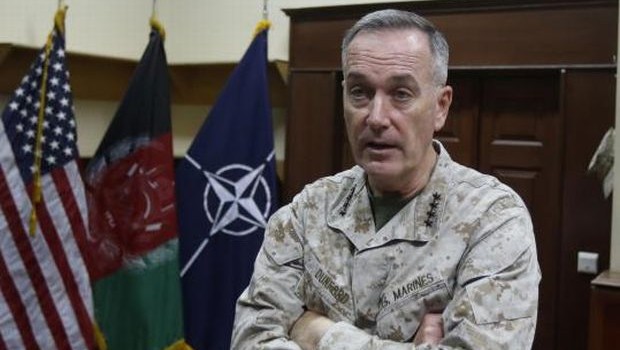
The new Obama nominee to become US Joint Chiefs of Staff chairman, Marine Corps General Joseph Dunford, declared Russia to be America’s greatest threat in his Congressional testimony some days ago. Conveniently forgetting all about the “existential threat” from ISIS, an organization US and Israeli intelligence brought into being to spread their chaos, Dunford declared, “If you want to talk about a nation that could pose an existential threat to the United States, I’d have to point to Russia.” The alarming thing is there was scarcely a peep of protest aside from blog remarks by retired Congressman Ron Paul and a few others. The tom-toms of bellicosity are pounding louder along the Potomac these days.

The war rage in Washington goes deeper than just one general. The Pentagon just released its Military Strategy of the United States, 2015. There the focus has clearly shifted away from “non-state actors” such as ISIS as being the greatest threat to the US and refocuses on “state actors” that are “challenging international norms.” The Pentagon strategy document goes on to name Russia, China, Iran, North Korea as the greatest threatsWhat they do not admit is the “threat” is to the continued sole Superpower hegemony of a United States that insists its will is the only valid one as self-appointed guardian of “democracy” and “human rights,” their New World Order as George Bush senior termed it in 1991.

On the economic front, what is emerging across the vast expanse of Eurasia is the greatest infrastructure investment in real physical infrastructure, which in turn will create new markets where today the remote regions of Siberia or Mongolia remain virtually untouched. By contrast, Obama’s Washington, a once-hegemon that has lost its soul, can only offer the US-dominated secret free trade pact, Trans-Pacific Partnership (TPP), for Asian states absent China, as a way to contain china economically, and the Trans-Atlantic Trade and Investment Partnership (TTIP) that offers the same geopolitical dead end for the economies of the EU. Both trade proposals are a desperate attempt by Washington strategists and their corporate backers in agribusiness such as Monsanto or the pharmaceutical industry to dominate world trade and finance.

Just as an individual can lose themselves through a trauma, so it’s possible for entire nations, even nations as large and apparently mighty as the United States of America, to lose its soul. Once a nation loses its soul, it loses its ability to do good, to be good. That tragically describes America today. The process has been a slow-motion rot from within, much as the Roman Empire in the Third and Fourth centuries AD. The rot has proceeded over decades.

There were many seminal events we as a people let pass without acting. One such over the past century or more was the US Congress’ surrender of the Constitutional responsibility to control the issue of money, handing it over to a private cabal of Wall Street bankers who named it the Federal Reserve. Another was the perfidy of our turning on our wartime allies in Russia and making them the “new Hitler,” so that Nelson Rockefeller’s national security state, complete with a CIA, could be built to justify the devaluation of the essence of the US Constitution. Another was the decision, well, perhaps you can fill in the blanks there are so many, each seemingly minor, but as a cumulative totality toxic to genuine respect for human life and individual freedom. Then, following the events of September 11,2001 we as a nation, crippled by our fear, stood by silently as the Bill of Rights went into the paper shredder of George W. Bush with the misnamed Patriots Act and other police state laws.

Once a people as once-wonderful as the American people lose all that that made them good, it takes a conscious decision and determination to regain that goodness. The first essential step is to become conscious of what is bad in us as a people today. David Rockefeller or George H.W. Bush or Bill Gates or Hillary Clinton or Jeb Bush did not do this. We did, and they merely took the use out of our action. There we must begin if we wish to take ourselves seriously again as a nation and as a people. Seeing ourselves as “victims” regardless of what or whoever is a dead end, literally.

F. William Engdahl is strategic risk consultant and lecturer, he holds a degree in politics from Princeton University and is a best-selling author on oil and geopolitics, exclusively for the online magazine “New Eastern Outlook”.

Countering the Neo-Cold Warriors

afghanistanuscommander-e1376475869307

By Wayne Madsen

Source: Strategic Culture Foundation

Shortly, the «gruesome twosome» of U.S.-Russian relations, Assistant Secretary of State for European and Eurasian Affairs Victoria Nuland and NATO Supreme Commander General Philip Breedlove, will be joined by a third neo-Cold Warrior, Marine Corps General Joseph Dunford, the prospective Chairman of the Joint Chiefs of Staff, to become the «terrible troika» of American officials clamoring for a military showdown with Moscow.

During his confirmation hearings before the Senate Armed Services Committee, Dunford said he viewed Russia as the greatest threat to America. But not just any «threat». In language that could have been pulled out of a U.S. newspaper from the 1960s, Dunford testified, «If you want to talk about a nation that could pose an existential threat to the United States, I’d have to point to Russia», adding, «and if you look at their behavior, it’s nothing short of alarming».

While Dunford’s Cold War rhetoric warmed the cockles of the hearts of leading Senate committee war hawks such as John McCain, McCain’s eyelash-batting pal Lindsey Graham – a 2016 presidential candidate – and Texas Joseph McCarthy lookalike Ted Cruz, it was not well-received at the White House or the State Department. White House Press Secretary John Earnest distanced President Obama from Dunford’s views, stating at a press conference that Dunford was expressing «his own view and [it] doesn’t necessarily reflect the . . . consensus analysis of the president’s national security team».

State Department spokesman Mark Toner, in commenting on Dunford’s remarks, was more emphatic when stating that Secretary of State John Kerry rejected the general’s comments, «The secretary doesn’t agree with the assessment that Russia is an existential threat to the United States, nor China, quite frankly». Toner was referring to Dunford’s testimony that China was second only to Russia in posing a significant threat to the United States.

However, it was Kerry who promoted Nuland, who is married to arch-neoconservative and Project for the New American Century (PNAC) architect Robert Kagan, to the position that placed her in charge of U.S.-Russian relations. Previously, Nuland served as Secretary of State Hillary Clinton’s press spokeswoman. And if Mrs. Clinton’s penchant for «standing by her women» is any indication, a Hillary Clinton presidency could see Nuland, who once worked for Vice President Dick Cheney, promoted to a higher-level position, including Secretary of State or National Security Adviser. Obama and Kerry can distance themselves from Dunford’s alarming comments all they want, however, it is they who have permitted individuals like Nuland, Breedlove, Dunford, and the saber-rattling Defense Secretary Ashton Carter to become major policy officials within the Obama administration.

Dunford and Breedlove appear to have been pulled from central casting for a remake of the 1960s Stanley Kubrick noire comedy film, «Dr. Strangelove». Dunford, who bears the problematic nickname «Fighting Joe» and has been described as a «fervent Catholic», sounds like the blusterous General Buck Turgidson, who, after a wayward B-52 continues on to Russia, against orders, to drop its nuclear payload on a missile base, tells a bewildered president, «It is necessary now to make a choice, to choose between two admittedly regrettable, but nevertheless ‘distinguishable,’ postwar environments: one where you got twenty million people killed, and the other where you got a hundred and fifty million people killed». Breedlove, on the other hand, is just as much an ideologue as is the fictional General Jack Ripper, who in «Dr. Strangelove» tells his British liaison officer, «Today, war is too important to be left to politicians. They have neither the time, the training, nor the inclination for strategic thought».

Dunford, Breedlove, Nuland, and Carter could very well push the United States and Russia to the brink of a hot war. Breedlove championed the creation of NATO’s Very High Readiness Joint Task Force, or VHRJTF as it is known to the acronym- and abbreviation-addicts of the Pentagon. VHRJTF brings ground forces from nine NATO nations to Russia’s borders. The new rapid-response unit took part in the first «live fire» exercise in Poland, code-named NOBLE JUMP, since the end of the Cold War. VHRJTF also consists of U.S.-supplied drones. The possibility that an unmanned drone could bring about a replay of the 1960 U-2 incident, in which a manned American spy plane was shot down over Russia, this time with a drone straying into Russian airspace from one of the Baltic countries, cannot be ruled out.

Obama and Kerry were quick to distance themselves from «Fighting Joe» Dunford’s saber rattling before the Senate committee. However, if they wanted to truly reset relations with Russia, Kerry could fire Nuland, Obama could pull Dunford’s nomination, and both could ask NATO to request a new Supreme Commander. However, as President Dwight Eisenhower warned in his 1961 Farewell Address about the menace of the «military-industrial complex», Obama and Kerry are powerless to get rid of those who were placed in power by what has now become a «military-intelligence-contractor» complex.

What is even more troubling is that Breedlove, Dunford, Nuland, and Carter appear prepared to not only take on Russia and China in a new Cold War, but are willing to confront the new «anti-NATO», the Shanghai Cooperation Organization (SCO), which just wrapped up its summit in Ufa, the capital of the Russian Federation’s autonomous republic of Bashkortostan. If the «gruesome twosome» of Nuland and Breedlove, soon to become the «terrible troika» after Dunford is confirmed by the Senate, have their way, NATO and the United States will not only be willing to face off militarily against SCO members China and Russia but also the new members of Pakistan and India, in addition to charter members Kazakhstan, Uzbekistan, Kyrgyzstan, and Tajikistan.

Russia has savaged the West’s attempts to isolate it and China has broken America’s attempt to establish a military containment «cordon sanitaire» around China by welcoming Belarus as a new observer nation of SCO, joining Afghanistan, Mongolia, and Iran as prospective full members of the alliance. Cambodia, Nepal, Armenia, and Azerbaijan joined the organization as dialogue partners, supplementing existing partners Sri Lanka and Turkey. Egypt, Bangladesh, and Syria are also prospective members of the organization that is a counter to the ever-expanding NATO. SCO’s geopolitical security mission, coupled with the emerging economic power of the BRICS alliance of Brazil, Russia, India, China, and South Africa, equates to a majority of the world’s population rejecting America’s military and economic dominance and NATO’s and the Pentagon’s menacing swagger. It is as if Dunford, Breedlove, and Nuland have never heard of SCO, BRICS, or the Eurasian Economic Union.

It is amazing that Dunford and Breedlove can issue challenges to their perceived enemies when Carter has announced a 40,000 troop strength cut for the U.S. Army. Instead, Carter plans to supplement NATO forces in Europe with more Bradley Fighting Vehicles and tanks that would be manned by a smaller number of U.S. troops. Like the Roman Empire, the United States has over-extended itself around the world.

It is not Russia nor China that maintain troops in 150 countries around the world. That dubious distinction falls on the United States. Fighting Joe Dunford and General Breedlove can talk all they want about the Russian and Chinese «threat». But for the rest of the world, which sees SCO and BRICS as welcome foils to the plans for further NATO expansion, it is America and its policy of fostering «color revolutions» and displaying military shows of force that represent the true threats to global stability.