
By Seth Harris
Source: Pop Cult
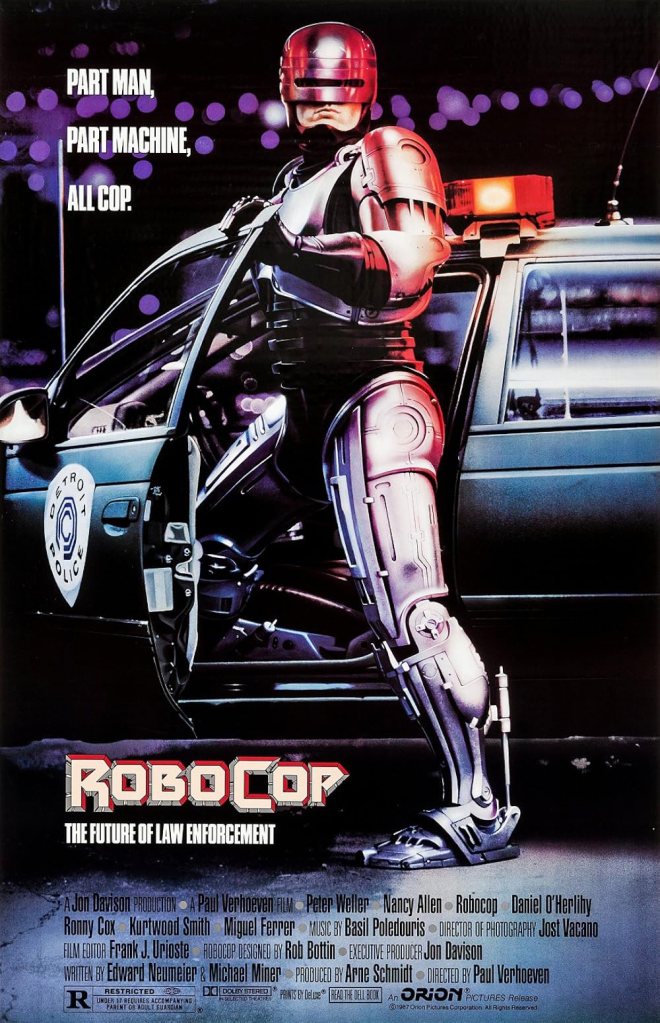
Robocop (1987)
Written by Edward Neumeier & Michael Miner
Directed by Paul Verhoeven
As an adult, I have developed an entirely new appreciation for the work of Paul Verhoeven. He was born in The Netherlands but managed to create a framework for American action movies in the 1980s while simultaneously delivering brutal satire about the United States. Robocop was his second English language film and his first pass at skewering the direction of Reagan’s America. The result is a science fiction classic, a combination of themes from Frankenstein mixed with commentary on the rise in corporatization of the public sphere. It’s not as biting as Starship Troopers, but it is full of brilliant takes on the United States’ ease & comfort with war and violence.
In the future, Detroit is on the verge of collapse. Money is dwindling, and society is overrun with crime. Omni Consumer Products (OCP) now have control of the Detroit PD and have plans to roll out innovations in crime-fighting. They just need a fresh corpse to make that happen. Meanwhile, Alex Murphy (Peter Weller) is transferred from the suburbs to a dangerous new precinct in the city’s heart. Murphy and his partner Lewis (Nancy Allen) begin the bonding process. They respond to a call over a bank robbery and pursue the suspect to an abandoned refinery. The officers get separated, and Murphy ends up riddled with bullets when the criminals ambush him. OCP recovers Murphy’s body and rebuilds him into Robocop. Of course, they don’t tell his fellow officers or his family that he’s partially alive. Even Murphy doesn’t remember his past except for a few flashes here and there.
The origins of Robocop lie in a surprising mishmash of influences. Screenwriter Edward Neumeier snuck his way onto the set of Blade Runner and was inspired by the production design of this future world. He imagined a story set in this place about a human turned into a cyborg police officer. He teamed up with aspiring director Michael Miner to collaborate on the script. They drew on their mutual love of comic books and experiences in 1980s corporate culture. They both found it bizarrely fascinating that the Japanese book The Way of the Five Rings was so popular on Wall Street at the time as it was focused around methods of samurai in the 17th century killing more effectively. Corporate types seemed to imagine themselves as these types of brazen warriors while working in finance and marketing. They envisioned a world influenced by this type of violent thinking leading to societal collapse, as we see in the film.
Paul Verhoeven was not the first choice, but he was suggested by a producer when other directors fell out. Verhoeven reportedly read the first page of Robocop, tossed it aside, and proclaimed it “a piece of shit.” It took his wife reading the script and encouraging him to look at the subtext of what was happening to convince the director to accept the project. Because he wasn’t fluent in English at the time, Verhoeven says a lot of the satire went over his head. When Murphy returns to his home, abandoned by his wife and son, the director clicked with the script.
For someone who didn’t understand the satire fully at the time, you can see the throughline in Verhoeven’s films coming out of Robocop to Total Recall and Starship Troopers. They are hyper-violent films where the villains are fascists. One of the best parts of Robocop are the snippets of news and commercials. They strongly emphasize the twisted psychology of this future world. News anchors smile through reports about apartheid South Africa arming themselves with nuclear weapons and U.S. forces crushing rebellions in Acapulco. Families play board games based around Mutual Assured Destruction. Everyone mindlessly gobbles up inane sitcoms that simply repeat catchphrases. The world feels rotten and hollow. Even as a kid seeing Robocop for the first time, it never felt like a movie where things would get better in the world when the credits rolled.
There’s a constant tension between the “civilized” world and devolution into wanton violence. A boardroom meeting dissolves into a bloodbath when an invention goes awry and kills an executive. Corporate heads employ some of the worst criminals to act as their muscle on the streets.
Robocop is another subversive action movie that seemed to satiate an American bloodlust while openly mocking the culture. It’s so surprising that so many appear to have been oblivious to what is very obvious satire. Robocop isn’t a traditional hero, and the film certainly doesn’t think the police are some flawless institution. Nothing is happening to remedy the circumstances that have led to the collapse of society; instead, corporate powers seek to create more brutal unfeeling enforcers. It’s sad how close to reality Robocop has become.
Watch Robocop on tubi here: https://tubitv.com/movies/389503/robocop-1987


 After the Crash