Fooled by What We Measure, Enlightened by What We Don’t Measure

By Charles Hugh Smith

Source: Of Two Minds

Economists and pundits are falling all over themselves to declare the US is chugging along splendidly, and to express their frustration with the public for their curmudgeonly lack of enthusiasm. For example: If this is a bad economy, please tell me what a good economy would look likeWe should acknowledge that things are going well, even as we continue to look for problems to solve and How the Recession Doomers Got the U.S. Economy So Wrong.

My intention is not to slam Noah Smith or Derek Thompson. I follow their work and gain value from their analysis.

The point I want to make is we only manage what we measure, and the reliance on statistics that are overly broad and easily distorted/gamed leads to generalizations that ignore consequential cause and effect: we are fooled by overly broad and easily distorted/gamed statistics and enlightened by looking at what is not measured or measured inadequately.

The consensus holds that inflation is declining rapidly and unemployment remains low, so the economy is doing great. Please glance at Chart #1 below to see what enthuses the mainstream: the unemployment rate is near historic lows.

But this measure leaves out a great deal of consequential factors. It’s well-known that the unemployment rate is distorted / gamed by leaving out everyone who is in the workforce but not “actively seeking work.” So what does this official unemployment rate actually measure? Not the percentage of the workforce that has a job.

Nor does it measure underemployment–those working far below their potential–or job insecurity or the percentage of workers being pushed into burnout–all consequential reflections of the real economy. All of these are potentially causal factors in why US productivity has fallen so dramatically.

And speaking of productivity, that’s the ultimate source of prosperity–not speculative bubbles or debt-binging. If productivity is tanking, eventually there are negative economic consequences that will be distributed to some segments of the populace, very likely asymmetrically.

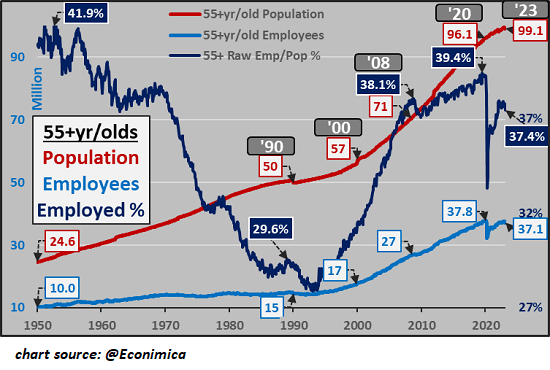
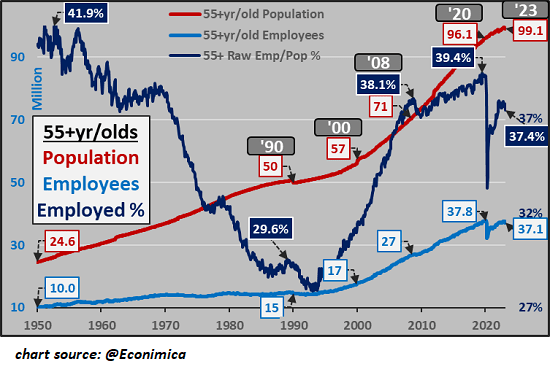
Such a broad-brush measure also ignores the consequences of demographics. Please glance at chart #2 below, of the 55 and over population and workforce. Note that virtually all the 20+ million jobs the US economy added in the past two decades are in this older workforce, which is of course steaming steadily into retirement, even as the percentage of this cohort who continues working has soared.

In other words, virtually all the job growth is the result of older workers working longer. Yes, 70 is the new 50, but try doing the same work at 70 that you did when you were 50. Sure, some people forego retirement because they love their work so much, but we don’t measure how many are still working because they have to for pressing financial reasons.

Have you observed the age of service workers and skilled workers recently? Do you reckon they really love working at Burger King so much that they’re doing it for enjoyment?

What if we measured financial pressures and job insecurity rather than risibly bogus “unemployment”? Would the economy still look so wonderful and resilient?

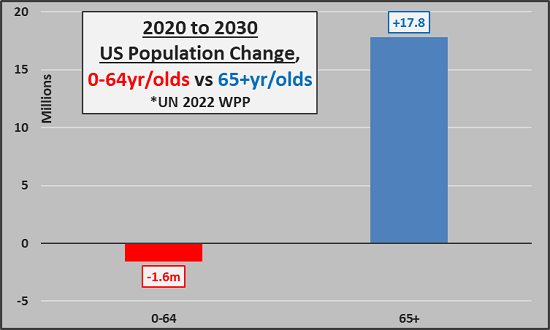
Chart #3 shows that virtually all the population growth ahead is in the cohort of older workers 65+ years old heading into retirement. So the workforce is rapidly aging and the unspoken / unexamined assumption is tens of millions of new workers will enter the workforce with the same skills, motivation, dedication and values as the tens of millions retiring.
But the demographics simply don’t support this breezy assumption.

Now glance at chart #4 which depicts the extraordinary rise in the number of workers who are now disabled. The causes of this are being debated (the pandemic obviously plays a role), but 2.5 million workers leaving the workforce in a few years is something that could be consequential if the trend continues. An assumption that this is a one-off is baseless until proven otherwise.
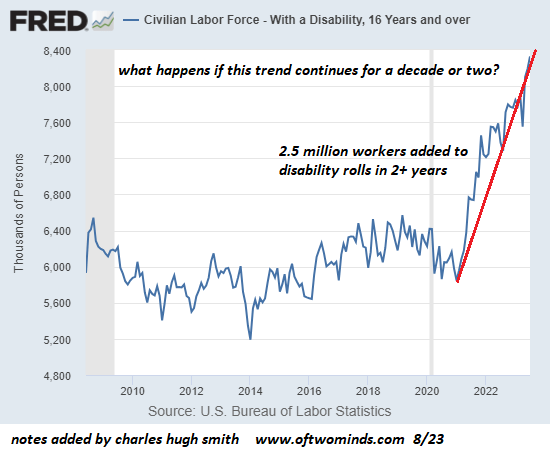
Once again, demographics, productivity and factors such as disability and burnout are not part of the unemployment, GDP and inflation measures currently being touted as proof of economic nirvana.

Item #1 of what’s not even measured is the crapification of goods and services. I addressed this in The “Crapification” of the U.S. Economy Is Now Complete (February 9, 2022) and Stainless Steal (February 26, 2023).

How do we measure the “inflation”–i.e. a loss of purchasing power–when appliances that lasted 20 years a generation ago now break down in 5 years? Where does that 75% decline in utility and durability show up in the official inflation data? How about the tools that once lasted a lifetime now breaking after a few years?

It’s been estimated that America’s food has lost 30% of its nutritive value in the past few decades. Protein per gram has dropped, trace nutrients have dropped, and so on. Rather than pursue sustainably nutrient-rich soil, Big Ag has maximized profits by dumping natural-gas-derived chemical fertilizers on depleted soil to boost production of nutrient-poor, tasteless “product.” A product deemed “organic” offers no guarantee that the soil isn’t depleted of nutrients.

Could this decline have anything to do with the American populace’s increasingly poor health? Nobody knows because these massive declines in quality and value aren’t measured and are certainly not part of the risibly bogus measures of unemployment, GDP and inflation.

The official inflation rate ignores the multi-decade decline in the purchasing power of wages. Rents have soared 25% in a few years, and economists are looking at 5% increases in wages and worrying about the potential inflationary impact of workers’ wages not keeping up with real-world inflation.

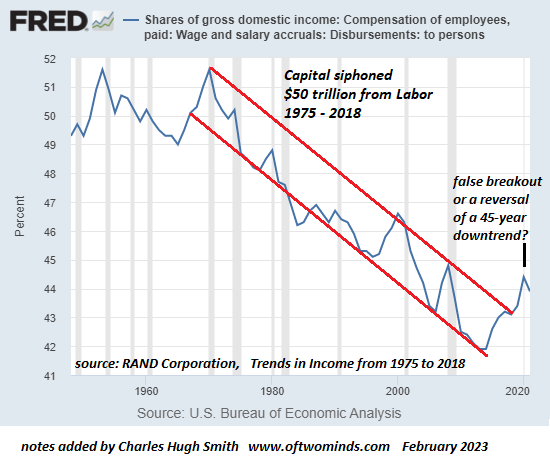
Cheerleading economists and pundits never mention the $50 trillion siphoned from labor by capital over the past 45 years. They also don’t mention the rising trend of loading more work on employees rather than hire more employees, or as a response to not being able to find qualified new hires.

Funny how rosy the picture can be tinted when all the consequential forces are ignored. But this studied ignorance characterizes the American elite, who delight in whining about airfares and travel delays, and finding someone to fix their pool pump. I address our Terminally Stratified Society here:

The Wealthy Are Not Like You and Me–Our Terminally Stratified Society (August 3, 2023)

This protected elite don’t have to put up with the crapified goods and services which generate their capital gains and income. Their wealth and income enable their detachment from the crapified economy the bottom 90% experience. Their experience of the bottom 90% is as service workers, delivery people, etc. who serve their entitled tastes.

Correspondent Tomasz G. provided a telling excerpt from Houellebecq’s The Possibility of an Island:

“… the rich certainly like the company of the rich, no doubt it calms them, it’s nice for them to meet beings subject to the same torments as they are, and who seem to form a relationship with them that is not totally about money; it’s nice for them to convince themselves that the human species is not uniquely made up of predators and parasites… “

As correspondent Ryan R. observed, America’s privileged elites“were born on third, stole home (via asset inflation) and still think they hit that home run.”

We know who the parasites are, but economists and pundits are safely blind to America’s neofeudal aristocracy. After all, who butters the bread of economists and pundits?

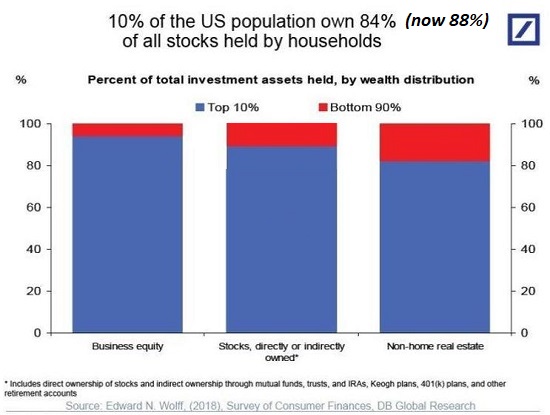
Is it unsurprising there are no measures of neofeudalism or elite privilege? As for the incredible concentration of wealth in the top tiers and the resulting decline in the bottom 90%’s share of the nation’s wealth–nothing to see here, just globalization and financialization doing their thing. What matters is booking my next flight to yet another conference of economists and pundits where we nod our heads and dare not admit all the conferences are nothing but echo chambers of the privileged elites.

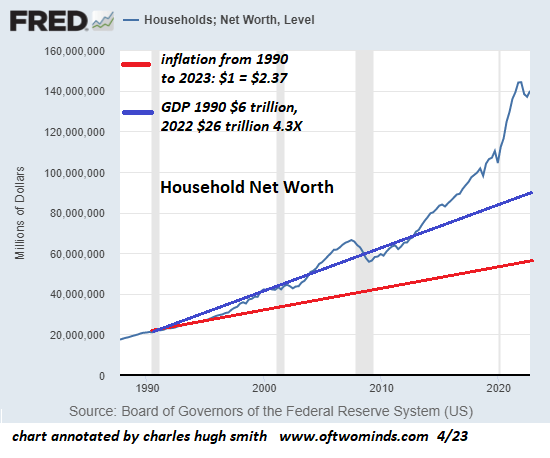
Cheerleading economists and pundits completely ignore the consequences of the system being rigged to favor capital and the already-wealthy who were given the means to buy assets back when they were cheap and affordable to the middle-class. Now that the system generates speculative credit-asset bubbles to create “the wealth effect,” assets such as homes in desirable regions are out of reach of the bottom 90%.

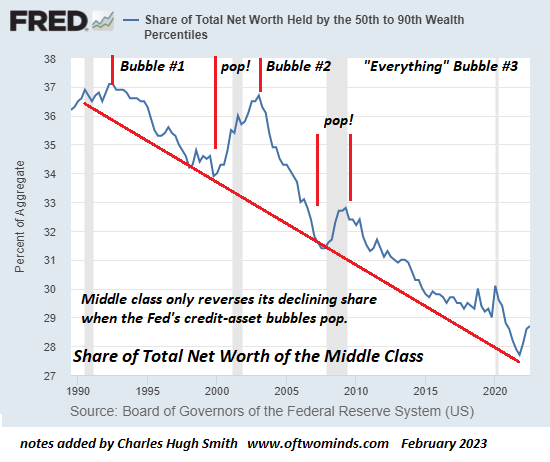
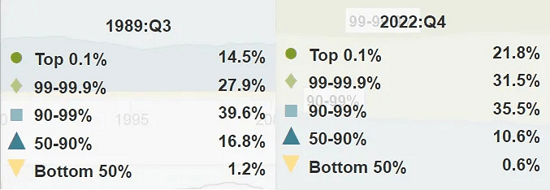
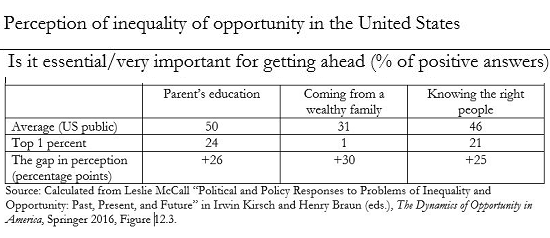
Please study the six charts below of wealth inequality. Try not to laugh out loud when you see that the top 1% reckon that “coming from a wealthy family” has near-zero impact on “getting ahead in America.”

Also note the steady decline in the middle class percentage of national wealth, and how the middle class’s share only rises when the credit-asset bubbles that have enriched the top 10% deflate, a bubble-pop that never lasts longer than a few months thanks to the policies that favor the already-rich at the expense of those who don’t own stocks, rental properties, municipal bonds, etc.

Economists and pundits steer well clear of the eventual social and political consequences of America’s entrenched neofeudal wealth-income inequality. That this neofeudal configuration is inherently destabilizing–never mind, we don’t measure that, look at the wunnerful unemployment and inflation charts!

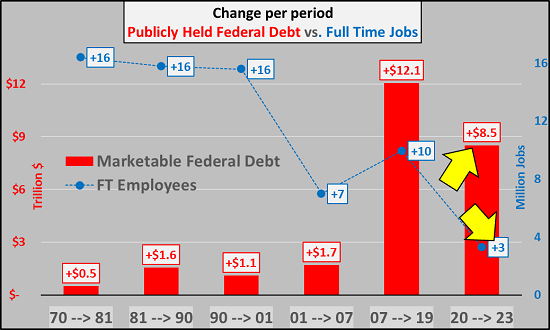
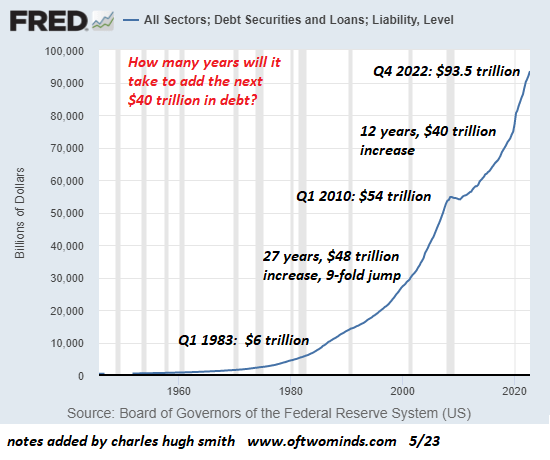
Lastly, consider the skyrocketing federal debt in terms of how many jobs are created in the era of soaring federal spending and debt. (Charts courtesy of CH / Economica) Debt doesn’t matter to economists and pundits, and neither does its diminishing effect on GDP and employment. The same can be said of total debt (public and private), which is skyrocketing (last chart): diminishing returns writ large as higher interest rates are embedded in the policy excesses and neofeudal structure of the past 45 years.

In essence, nothing that is consequential is properly quantified, so the pundit class keeps insisting everything is wunnerful and is mystified why people are so foolishly dissatisfied with our wunnerful economy. The reason why people are not buying the fantasyland story is they have to live and work in the crapified real economy, as serfs serving the economist-punditry-elite aristocracy.

If we want to avoid being led astray by misleading measures, we must seek enlightenment in what isn’t being measured or is cast aside as inconvenient to the “economy is wunnerful” party line.
Here’s How We’ll Have Labor Shortages and High Unemployment at the Same Time

By Charles Hugh Smith

Source: Of Two Minds

This is how we’ll end up with severe shortages of truly skilled labor and high unemployment of those who lack the necessary skills.

The labor force and the job market are referred to as if they were monolithic structures. But they’re not monolithic, they are complex aggregates of very different cohorts of age, skills, mobility, education, experience, opportunity, potential and motivation.

As a result, numbers such as the unemployment rate tell us very little about the labor force and the job market in terms of what matters going forward. So what does matter going forward?

1. Demographics–the aging and retirement of key sectors of the work force.

2. Skills and experience that will be increasingly scarce due to mismatched demand for skills that are diminishing as older workers retire.

3. What skills and experience will be demanded by re-industrialization, reshoring and expanding the electrification of the economy.

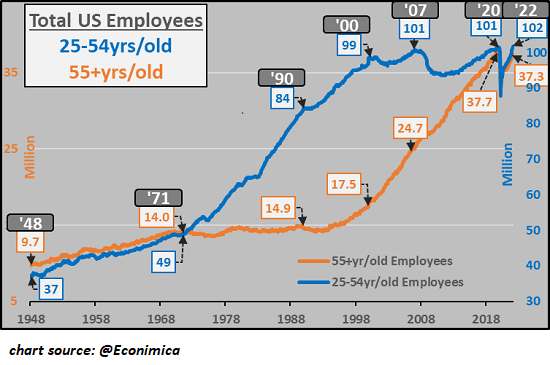
Consider these two charts of the US work force by age. (Courtesy of CH @econimica) In the first chart, Total US Employees, note that the prime working age work force (ages 25-54) has been flatlined for the past 20 years at 101-102 million. In contrast, the 55-and-older cohort of employees soared from 17 million to 37 million. This increase of 20 million accounts for virtually all growth in the employed work force.

A funny thing happens as workers get old; they retire and leave the work force. Their skills and experience are no longer available to employers or the nation’s economy. The second chart shows the aging of the American populace, as the 55+ cohort increased from 57 million to 99 million since 2000, as the number of older employees skyrocketed from 17 million to 37 million.

While the total US population increased by 18% from 281 million in 2000 to 331 million today, the 55+ cohort increased 74% (from 57 million to 99 million).

The key takeaway here is the number of experienced workers who will retire in the next decade will track the explosive growth in the 55+ cohort. The general consensus is this will not be a problem because there are plenty of younger workers available to fill the vacated slots.

But this overlooks the qualitative and quantitative differences in the millions leaving the work force and those joining the work force. This is especially consequential in real-world jobs, i.e. all those jobs that require engaging real-world materials rather than staring at screens.

Though few analysts and commentators will admit to it, the implicit assumption is that the jobs that matter all involve staring at screens–processing data, finance, entertainment and shaping narrative make the world go round. All the real-world stuff (boring!) will magically get done by tax donkeys who are out of sight, out of mind.

This mindset has it backwards: it’s the real-world work of changing the industrial / energy / energy distribution foundation of the economy that matters going forward, not the staring-at-screens jobs.

What few seem to realize is the work force that’s aging and retiring is the cohort with the real-world skills. It’s a nice idea to remake the entire electrical grid of the nation to transport much larger quantities of electrical power, but who’s going to do all that work? Young people whose career goals are becoming YouTube influencers or day-traders? No. All the ChatAI bots in the world aren’t going to get the real work done, either.

In other words, there is a massive mismatch between the skills available to hire in the young-worker cohort and the skills and experience needed to rebuild the material, real-world foundations of the US economy. It’s well-known but apparently not worth worrying about that the average age of the US farmer is pushing 60 years of age. Nobody left to grow all our food? Hey, isn’t there a ChatAI bot to do all that for us? It can all be automated, right? No? Well, why not? Somebody out there, get it done! Food in super-abundance should be delivered to everyone staring at screens 24/7, it’s our birthright.

The average age of skilled tradespeople is also skewed to the aging work force. There is no easy way to quantify real-world skills gained by on-the-job experience. I suspect it follows a power-law distribution: the newly minted worker just out of school / apprenticeship can handle basic functions, but when tough problems arise, the number of workers with the requisite experience to diagnose and fix the problem diminishes rapidly.

This distribution presents an enormous problem for the economy and employers. Once the super-experienced workers who can solve any problem leave, they cannot be replaced by inexperienced workers. So when the really big problems arise, the systems will break down because those who knew how to deal with the problems are no longer available.

This is how you can have 10 million unemployed workers and 1 million unfilled positions that can’t be filled because few are truly qualified. You want to erect new electrical transmission lines? Nice, but you’re not going to get the job done with green workers accustomed to staring at screens. It takes years of hard labor to acquire even a bare minimum of the skills required. These are not assembly-line jobs that can be filled by unskilled labor, these are jobs in the messy real world, not a distribution center.

As I note in my book on Self-Reliance, individuals with a full spectrum of real-world skills are now extremely rare. Skills that were once common are now performed by specialists. We seem to have all the time in the world to stare at hundreds of cooking programs on TV but how many people actually prepare three meals a day, week in, week out, month in, month out, year in, year out? How many people know how to repair anything, build anything, or maintain a machine?

My direct experience is that many young people don’t know how to put air in the tires of the vehicle Mom and Dad gave them. Young people with graduate-level diplomas don’t know what a green bean plant looks like. (Eeew, gross, it grows in dirt?) The cultural value system that only values wealth, regardless of its source, and minting money from staring at screens has generated a fundamental mismatch between the skills that will be needed going forward and the skills being presented as oh-so-valuable.

Yes, there are many young workers with sharp real-world skills. The question is, are there enough?

This is how we’ll end up with severe shortages of truly skilled labor and high unemployment in the cohort of workers with few real-world skills and a surplus of skills for which there is limited demand. As a real-world experiment, go find a tough old rancher and ask them a series of questions about livestock, machinery, fencing, generators, etc., and then ask the average newly minted college graduate that followed the warped values embedded in our economy the same questions.

Of course the young worker can’t match the experience of the old worker, but do they have any experience at all of a spectrum of essential real-world skills? If not, do they have the requisite physical endurance and commitment needed to acquire real-world skills?

Who’s going to do all the real-world work going forward? A few people talk about it as an abstraction, but it’s not an issue to everyone focused on Federal Reserve policy or GDP. But eventually, the real world will matter more than staring at screens and day-trading, because when the systems break down due to lack of truly qualified employees, we’ll all wake up. But by then it will be too late. We’ll be staring at dead screens begging for somebody somewhere to restore power so we can continue playing with ChatAI to trade zero-day options.

The Economic Crash So Far: A Look At The Real Numbers

By Brandon Smith

Source: Alt-Market.com

There are many problems when attempting to track a faltering economy. For one, the people in government generally do not want the public to know when the system is in decline because this looks bad for them. They prefer to rig statistical indicators as much as possible and hope that no one notices. When the crash occurs, they then claim that “no one saw it coming” and the disaster “came out of nowhere”, so how could they be to blame?

I have even heard it argued that political leaders, including the president, have a “duty” to lie about the state of the economy because once they admit to the decline they will cause a panic and perpetuate the crisis. This is stupidity. If an economic system is in disrepair and is built on a faulty foundation, then the problems should be identified and fixed immediately. The weak businesses should be culled, not bailed out. The wasteful government spending should be cut, not increased. The downturn should not be hidden and prolonged for years or decades. In most cases, this only makes the inevitable crash far worse and more damaging.

Another factor, which some people might call “conspiracy theory” – but it has been proven time and time again in history – is that the money elites have a tendency to engineer economic disasters while deliberately hiding the real statistics from the public. Why? Well, if the real data was widely disseminated, then a crash would not be much of a surprise and the populace could be prepared for it. I suspect the elites hide the data because they WANT the crash to be a surprise. The bigger the shock, the bigger the psychological effect on the masses. This fear and confusion allows them to make changes in the power structure of a nation or of the entire world that they would not be able to accomplish otherwise.

The most rigged statistics tend to be the least important overall in analysis, but this does not stop the mainstream media and investors from hyper focusing on them. How many times have you told friends and family about the collapse in manufacturing or the explosion in consumer and corporate debt, only to hear them say, “But the stock market is at all-time highs!” Yes, even though stock markets are a meaningless trailing indicator, even though GDP stats are a complete fallacy, and even though jobless numbers do not include tens of millions of people out of work, these are the stats that the average person takes mental note of when consuming their standard 15 minutes of news per day.

While the issue of rigged statistics makes analysis of a crash difficult, a willfully ignorant citizenry makes reporting on the real data almost impossible. It’s sad to say, but a large number of people do not want to hear about negative information. They want to believe that all is well, and will delude themselves with fantasies of blind optimism and endless summers. Like the tale of “The Ant And The Grasshopper”, they are grasshoppers and they see anyone who focuses on the negative as “chicken littles” and “doom mongers”. In their minds they have all the time in the world, until they freeze and starve when winter comes.

When I encounter people who actually believe the manipulated numbers or buy into the stock market farce or simply don’t want to accept that a crash could happen in their lifetime, I always ask them to consider these questions: If the global economy is not on the verge of collapse, then why did central banks keep propping it up for the past ten years? And if central banks have been propping up the system, how much longer do you think they can do this? How much longer do you think they want to do it? What if one day they decide to let the entire house of cards tumble? What if such an event actually benefits them?

We’ve seen that a broken economy can be technically held together for a decade, but under the surface, the structure continues to rot. The bottom line is that even if the elites wanted to keep the system going for another ten years, and even if politicians continued to help them by pumping out false statistics, there is no way to hide the effects of crumbling fundamentals. We saw this during the crash of 2008, and now we’re seeing it again.

After nearly ten years of stimulus inflated the largest financial bubble in history (the Everything Bubble), the Federal Reserve and other central banks halted stimulus measures and tightened global liquidity. By the end of 2018, a new crash began, the implosion of the Everything Bubble had been triggered. All of this is still just an extension of the crash of 2008, which never really subsided; it was only slowed down through tens of trillions of dollars in central bank intervention. Now, the central banks have started an avalanche that cannot be stopped. But the fact of the matter is, they don’t really want to stop it.

Here are the indicators so far that prove a crash is happening in the U.S. while a majority of the public is oblivious:

GDP numbers are completely manipulated. Government spending of taxpayer dollars on a number of inflated programs, including continued spending on Obamacare, is added to GDP calculations. Without this fancy accounting, U.S. GDP growth would actually be negative, according to ShadowStats. But even with the juiced data, official GDP growth is still in decline, falling to 1.9% and well below the 3% growth we were supposed to see this year.

Official unemployment stats remain at all-time lows, which is commonly cited by the mainstream media, Donald Trump (he used to argue the opposite three years ago), and even the Federal Reserve in reference to the health and stability of the economy. What they do not mention much is the 95 million people not in the labor force and not counted because they have been unemployed for so long. When the media does mention this fact, they claim the number is “misleading”, that most of these people are students or retired, that the retirement age is decreasing and Baby Boomers are leaving the workforce sooner, and that the people who don’t have jobs are simply “not interested” in working. None of this is true.

The retirement age is increasing in the U.S., not decreasing, according the SS Administration. Current average retirement age is now 67, up from 65, almost the same as it was during the Great Depression.

Baby Boomers are not retiring at rates similar to ten years ago, and are in fact attempting to stay in the workforce due to the poor economy. Many of them are trying to come OUT of retirement just to make ends meet.

The labor participation rate remains near record lows.

Interestingly, the Bureau of Labor Statistics (BLS) house survey that is used to determine if people “want a job” assumes that if you are near retirement age and do not have a job, you are simply not interested in a job, and they count you as “non-participating”. However, if you DO have a job and you are near retirement age, they count you as participating. It’s a rather convenient assumption on the government’s part to claim that just because an unemployed person is near retirement age, that means they “don’t want a job”.

While there is surely a small percentage of the 95 million people not counted in the labor force that do not want a job, if unemployment stats counted U-6 measurements as they used to, the unemployment rate would be closer to 20%.

Another problem is the quality of jobs being created. U.S. manufacturing jobs, as well as higher wage jobs, are in steep decline. They have been replaced with low paying jobs in the service sector.

Real wages in the U.S. have not kept up with inflation. The average worker is now losing money overall as prices rise beyond the pace of their incomes.

As more and more Millennials say they cannot afford to buy a home, rental prices have skyrocketed in the past several years. The home ownership rate plunged starting in 2006 and has not recovered since.

U.S. manufacturing has fallen to levels not seen since the crash of 2008. U.S. factory orders have slumped in 2019.

U.S. Services PMI continues to falter since spring of this year. Job growth is now slowing and over 8,500 retail stores have been closed down already in 2019. Web-based retail is not picking up the slack, as online sellers like Amazon are suffering from falling profits.

Corporate profits overall have tumbled this year and projected future profits have been drastically adjusted to the downside.

Corporate debt, consumer debt and national debt are all at historic highs. Corporate cash flow is so tight that Federal Reserve repo purchases continue to run into high demand. This debt signal is one we saw in 2007, just before the credit crisis.

U.S. trucking and railroad freight continue to log steep declines in traffic and goods. This tells us what we already know: Even though consumer spending has increased recently, this does not mean people are buying more stuff or have more disposable income. What is really happening is inflation, or stagflation. Cost of living is going up. Debt payments are going up. Consumers are spending more on the same amount of stuff, or less stuff, and have less expendable income. U.S. consumers are being bled dry.

All of these factors and more show an economy in recession or depression (depending on what historic standards you use). In the darker corners of the investment world, the great hope is that the central banks will return to pumping trillions into the banking sector ($16 trillion during the TARP bailout dwarfs the $250 billion the Fed has recently pumped out in their repo markets). They hope that this will free up even more credit. Meaning, they believe only more debt will save the system from suffering.

I say, time is up on the debt party. More stimulus will not stall the crash that is already happening, and the Fed does not appear poised to print anywhere near what it did during the credit crisis, at least not in time to change the trend. The can has been kicked for the last time. The grasshopper mentality will not save people from the clear reality. Only preparation and planning will.

Forget Techno-Optimism: We Can’t Innovate Our Way Out of Inequality

thediplomat_2015-07-10_09-53-42-386x255

By Chris Lehmann

Source: In These Times

Toward the end of his 250-page hymn to digital-age innovation, The Industries of the Future, Alec Ross pauses to offer a rare cautionary note. Silicon Valley may have incubated all the wonders and conveniences one can imagine—and oh, so many more! But for the international business elites looking to remake their emerging market economies in the Valley’s gleaming, khaki-clad image, there’s some bad news: It can no longer be done. A “decades-long head start” has granted too great a competitive advantage to the charmed peninsula along the Northern California coast.

Not to worry, though! On-the-make tech globalists can still make a go of it, provided they’re prepared to embrace “specific cultural and labor market characteristics that can contradict both a society’s norms and the more controlling impulses of government leaders.”

Stripped of the vague and glowing techno-babble, this is a prescription for good old-fashioned neoliberal market discipline. Everywhere Ross looks across the radically transformed world of digital commerce, the benign logic of market triumphalism wins the day. When Terry Gou—the Taiwanese CEO of Foxconn, the vast Chinese electronics sweatshop that doubles as an incubator for worker suicides—plans to eliminate the headache of supervising an unstable human workforce by replacing it with “the first fully automated plant” in manufacturing history, why, he’s simply “responding to pure market forces”: i.e., an increase in Chinese wages that cuts into Foxconn’s ridiculously broad profit margins. And you and I might see the so-called sharing economy as a means to casualize service workers into nonunion, benefit-free gigs that transfer economic value on a massive scale to a rentier class of Silicon Valley app marketers. But bouncy New Economy cheerleaders like Ross see “a way of making a market out of anything, and a microentrepreneur out of anyone.”

When confronted with the spiraling of income inequality in the digital age, Ross, like countless other prophets of better living through software, sagely counsels that “rapid progress often comes with greater instability.” Sure, the “wealthy generally benefit over the short term,” but remember, kids: “Innovations have the potential to become cheaper over time and spread throughout the greater population.”

Ross first stormed into political prominence as an architect of Barack Obama’s “technology and innovation plan” during his 2008 presidential campaign, and he has spent four years captaining his own charmed, closed circle of tech triumphalism as the White House’s “senior advisor for innovation” under Secretary of State Hillary Clinton. This renders The Industries of the Future something more than another breathless, Tom Friedman-style tour of the wonderments being hatched in startups, trade confabs and gadget factories. Ross’ book is also a tech-policy playbook for the likely Democratic presidential nominee, who has spared no effort in soliciting the policy input—and landing the campaign donations—of the Silicon Valley mogul set. As such, it should give any Hillary-curious supporter of economic justice considerable pause.

To be sure, Ross raises some vague concerns about how, for example, the runaway growth of the sharing economy drains workers of job security, healthcare benefits, pensions and the like. He avers that “as the sharing economy grows … the safety net needs to grow with it,” but, much like his politically savvy boss, he offers nothing in the way of policy specifics besides the inarguable yet unactionable truism that if the sharing economy “generates enormous amounts of wealth for the platform owners, then the platform owners can and should help pay for added costs to society.”

The larger point for Ross, in any event, is that the innovative megafirms of tomorrow will come to spontaneously serve the public good. Not to mention that many IPO investors “are pension funds,” Ross coos, which “manage the retirement funds for people in the working class like teachers, police officers, and other civil servants.” Never mind, of course, that the neoliberal logic of the Uber model means that we’re creating a workforce that’s unlikely ever to come within shouting distance of a pension benefit again.

This kind of terminal Silicon Valley myopia also accounts for the vast economic and political blindspots that continually undermine Ross’ relentlessly chipper TED patter. To take just one instructive instance, in a book that devotes considerable real estate to the innovations of “fintech” (the streamlining of global digital currency exchanges and investment transactions) nowhere does the author acknowledge the pivotal role that tech-savvy Wall Street analysts—the “quants” as they’re known in Street argot—played in stoking the early-aughts housing bubble that led to the near-meltdown of the global economy.

That’s because it’s an axiomatic faith for this brand of techno-prophecy that innovation can never actually make anything worse—in just the same fashion that the quants were insisting, right up until the end, that there could never be a downturn in the national housing market. If this is the kind of wisdom Hillary Clinton relied on to promote her global innovation agenda at the State Department, one shudders to think of how it might run riot through the White House come next January.

Related Video: