11 Predictions Of Economic Disaster In 2015 From Top Experts All Over The Globe

economic-collapse

By Michael Snyder

Source: Economic Collapse Blog

Will 2015 be a year of financial crashes, economic chaos and the start of the next great worldwide depression?  Over the past couple of years, we have all watched as global financial bubbles have gotten larger and larger.  Despite predictions that they could burst at any time, they have just continued to expand.  But just like we witnessed in 2001 and 2008, all financial bubbles come to an end at some point, and when they do implode the pain can be extreme.  Personally, I am entirely convinced that the financial markets are more primed for a financial collapse now than they have been at any other time since the last crisis happened nearly seven years ago.  And I am certainly not alone.  At this point, the warning cries have become a deafening roar as a whole host of prominent voices have stepped forward to sound the alarm.  The following are 11 predictions of economic disaster in 2015 from top experts all over the globe…

#1 Bill Fleckenstein: “They are trying to make the stock market go up and drag the economy along with it. It’s not going to work. There’s going to be a big accident. When people realize that it’s all a charade, the dollar will tank, the stock market will tank, and hopefully bond markets will tank. Gold will rally in that period of time because it’s done what it’s done because people have assumed complete infallibility on the part of the central bankers.”

#2 John Ficenec: “In the US, Professor Robert Shiller’s cyclically adjusted price earnings ratio – or Shiller CAPE – for the S&P 500 is currently at 27.2, some 64pc above the historic average of 16.6. On only three occasions since 1882 has it been higher – in 1929, 2000 and 2007.”

#3 Ambrose Evans-Pritchard, one of the most respected economic journalists on the entire planet: “The eurozone will be in deflation by February, forlornly trying to ignite its damp wood by rubbing stones. Real interest rates will ratchet higher. The debt load will continue to rise at a faster pace than nominal GDP across Club Med. The region will sink deeper into a compound interest trap.”

#4 The Jerome Levy Forecasting Center, which correctly predicted the bursting of the subprime mortgage bubble in 2007: “Clearly the direction of most of the recent global economic news suggests movement toward a 2015 downturn.”

#5 Paul Craig Roberts: “At any time the Western house of cards could collapse. It (the financial system) is a house of cards. There are no economic fundamentals that support stock prices — the Dow Jones. There are no economic fundamentals that support the strong dollar…”

#6 David Tice: “I have the same kind of feel in ’98 and ’99; also ’05 and ’06.  This is going to end badly. I have every confidence in the world.”

#7 Liz Capo McCormick and Susanne Walker: “Get ready for a disastrous year for U.S. government bonds. That’s the message forecasters on Wall Street are sending.”

#8 Phoenix Capital Research: “Just about everything will be hit as well. Most of the ‘recovery’ of the last five years has been fueled by cheap borrowed Dollars. Now that the US Dollar has broken out of a multi-year range, you’re going to see more and more ‘risk assets’ (read: projects or investments fueled by borrowed Dollars) blow up. Oil is just the beginning, not a standalone story.

If things really pick up steam, there’s over $9 TRILLION worth of potential explosions waiting in the wings. Imagine if the entire economies of both Germany and Japan exploded and you’ve got a decent idea of the size of the potential impact on the financial system.”

#9 Rob Kirby: “What this breakdown in the crude oil price is going to spawn another financial crisis.  It will be tied to the junk debt that has been issued to finance the shale oil plays in North America.  It is reported to be in the area of half a trillion dollars worth of junk debt that is held largely on the books of large financial institutions in the western world.  When these bonds start to fail, they will jeopardize the future of these financial institutions.  I do believe that will be the signal for the Fed to come riding to the rescue with QE4.  I also think QE4 is likely going to be accompanied by bank bail-ins because we all know all western world countries have adopted bail-in legislation in their most recent budgets.  The financial elites are engineering the excuse for their next round of money printing . . .  and they will be confiscating money out of savings accounts and pension accounts.  That’s what I think is coming in the very near future.”

#10 John Ing: “The 2008 collapse was just a dress rehearsal compared to what the world is going to face this time around. This time we have governments which are even more highly leveraged than the private sector was.

So this time the collapse will be on a scale that is many magnitudes greater than what the world witnessed in 2008.”

#11 Gerald Celente: “What does the word confidence mean? Break it down. In this case confidence = con men and con game. That’s all it is. So people will lose confidence in the con men because they have already shown their cards. It’s a Ponzi scheme. So the con game is running out and they don’t have any more cards to play.

What are they going to do? They can’t raise interest rates. We saw what happened in the beginning of December when the equity markets started to unravel. So it will be a loss of confidence in the con game and the con game is soon coming to an end. That is when you are going to see panic on Wall Street and around the world.”

If you have been following my website, you know that I have been pointing to 2015 for quite some time now.

For example, in my article entitled “The Seven Year Cycle Of Economic Crashes That Everyone Is Talking About“, I discussed the pattern of financial crashes that we have witnessed every seven years that goes all the way back to the Great Depression.  The last two major stock market crashes began in 2001 and 2008, and now here we are seven years later.

Will the same pattern hold up once again?

In addition, there are many other economic cycles that seem to indicate that we are due for a major economic downturn.  I discussed quite a few of these theories in my article entitled “If Economic Cycle Theorists Are Correct, 2015 To 2020 Will Be Pure Hell For The United States“.

But just like in 2000 and 2007, there are a whole host of doubters that are fully convinced that the party can continue indefinitely.  Even though our economic fundamentals continue to get worse, our debt levels continue to grow and every objective measurement shows that Wall Street is more reckless and more vulnerable to collapse than ever before, they mock the idea that a financial collapse is imminent.

So let’s see what happens in 2015.

I have a feeling that it is going to be an extremely “interesting” year.
Cynicism, Recession, and the Resurgence of Cyberpunk

books

By Marshall Sandoval

Source: PopMatters

Human nature might be augmented and highly channeled by technology, but human nature stays the same. And that tech might actually amplify all the worst things about us too.

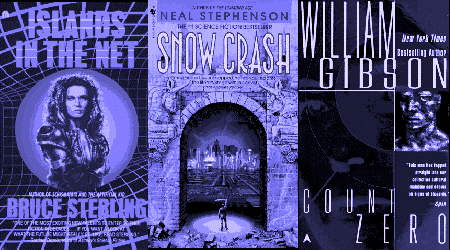
Cyberpunk has seen a recent resurgence in video games. Seemingly every game developer working today has a William Gibson book tucked under their arm or follows @swiftonsecurity (a satirical Twitter account that imagines a Taylor Swift consumed with cyber security). Cyberpunk video games are pervasive, including cyberpunk game jam projects on itch.io, Twine games, indie titles, and major AAA releases. All of these projects embrace cyberpunk themes and aesthetics. Observers credit the current trend to a number of cyclical and cultural factors. After talking to the indie developers behind a number of exciting cyberpunk titles at the center of this resurgence, I believe that the creators of these games are overwhelmingly inspired by the headlines in today’s newspapers.

It seems like no coincidence that these games have all appeared in a short time period following the economic recession. On the most basic level of analysis, it seems that these games may be providing a sense of escape from recent economic events. Last Life developer Sam Farmer notes, “I’m gonna go back to my film school class on Sci-Fi and Fantasy and say that it’s escapism. Horror, in general, and escapism, in particular, is often more popular in times of economic downturn, when you want to be somewhere else.”

Garrett Cooper’s Black Ice is an action game which casts the player as a hacker taking down corporate servers. Promoting the game, he’s found that cyberpunk narratives may be popular for reflecting reality as much as for providing an escape. He says, “I’ve talked to people about my game. I say, ‘All the corporations are evil.’ So they’re like, ‘Oh. So you’re talking about real life?’ I’m like, ‘No. Not exactly.’ That’s what people feel. The fantasy of being the one guy that can take something technological and turn it against the corporation.”

Games writer Austin Walker is an academic and cyberpunk superfan who sees the same throughline in these games and the literary roots of the genre. Walker says, “A key to traditional cyberpunk again and again is that there is economic inequality. We are positioning ourselves somewhere on that scale of how we feel about this stuff. Cyberpunk stories do that too. Usually they position the hero at the bottom of that; they’re usually in or near poverty.” In a time of extreme real-world inequality, cyberpunk stories locate players in a fantasy of rising up to subvert the system and taking down greedy corporations.

David Pittman’s indie project Neon Struct deals with a fictional near-future surveillance state. The game was heavily influenced by the recent leaks about actual domestic surveillance in the present day in the United States. Pittman says, “Edward Snowden’s release of NSA documents in 2013 was an essential part of the inception of Neon Struct (formerly Die Augen der Welt, or ‘The Eyes of the World’). I have strong feelings about the abuse of surveillance by the U.S. government, and I’ve known for close to a year that I wanted to make a game about it.” He’s quick to add, “Despite my own interest and leaning in the real world debate over mass surveillance, I am developing a way to introduce the story, which does not require the player character to actually leak any classified information. I don’t want to assume that the player shares my biases.” Nonetheless, it’s clear that the forthcoming project was informed by recent events.

Other examples of indie games providing commentary on and gaining inspiration from world events abound. Brigador is an isometric cyberpunk shooter with an extremely stylish trailer, and developer Jack Monahan lists a surprising influence. Monahan says, “While I’m not sure if the author would agree with the genre classification {of cyberpunk}, my brother and I both read and enjoyed (and were worried by) a book called Cities Under Siege: The New Military Urbanism by Stephen Graham. Like William Gibson said, the future caught up to all of his writing, more or less. We basically are living in a dystopic future”. Notably, Monahan made these statements before the recent military-style urban clashes in Ferguson, Missouri. The aforementioned Last Life is shaped by real world advances in medicine and philosophical debates about transhumanism. Matt Conn is seeking to expand LGBT representation in the games space with the cyberpunk RPG R.O.M. He says, “Because I did GaymerX and prior to that I did a startup that was very successful and then crashed. Seeing how all that happened, I feel like I have an interesting perspective of the tech scene and the LGBT rights scene.” These varied examples show the differing events influencing today’s cyberpunk boom.

As strongly as these games are influenced by the socio-political climate, it is reductionist to say this is the only thing bringing cyberpunk back into prominence. Again, Austin Walker says, “It’s tempting to just say, ‘Oh that’s happening again. We’re getting concerned again about things like privatization and inequality.’ I think that’s part of it. I don’t know if I’d be comfortable saying, ‘This is the one reason why’”. Many developers also noted the power of nostalgia as a reason for the influx of cyberpunk games. Alex Preston a developer behind Hyper Light Drifter says, “I think my generation is coming into its own, creatively, and we have a fondness for these themes and ideas. A lot of us grew up with books, films, and games that touched on these themes, and it bleeds through in our creative work. I think nostalgia is a powerful force.”

Likewise, Brendan Chung, creator of ‘90s-influenced hacker game Quadrilateral Cowboy has noticed the cyclical nature of cyberpunk themes. He says, “My guess is that the people who grew up fiddling with old PC tech are now at an age where they now have the skillset and financial means to make their own games. Now that we can make games, we’re making things that harken back to one of the things that got us interested in games in the first place.” Nostalgia for ‘80s and ‘90s cyberpunk is another likely force bringing these kinds of games back to the games market.

Additionally, I kept hearing indie developers suggest their own outlook about the state of the world today is extremely bleak. Conn says, “On a more philosophical note, this is a way of writing about the future we kind of want to see. Even if it’s dystopian or dark. I think that for a lot of us, it’s very scary going into the future.” A similarly grim outlook is shared by Monahan. He says, “I think the dystopic elements of cyberpunk point to a certain cynicism that things aren’t going to get any better. Human nature might be augmented and highly channeled by technology, but human nature stays the same. And that tech might actually amplify all the worst things about us too.” Monahan also sees this cynicism in the nostalgia that drives the cyberpunk resurgence. He adds, “So much great work from the ‘80s was in a similar vein. I think of Snake Plissken’s deadpan response to news that the president’s plane has gone down: ‘President of what?’. There’s a disillusionment from the classic era of cyberpunk that makes a revival now seem fairly natural, I think.” Natural or not, the revival is in full force, and it’s becoming a strong and subversive undercurrent in the indie games space.

Money Woes and the Trials of Job

6

By Mark Anthony Rockeymoore

Source: Sacred Space in Time

Being broke seems to be endemic. Money woes, bills pilling up, creditors calling for blood and first born children. Money flowing in is gone before it is received and there seems to be no end in sight.

How can we focus on higher spiritual ideals when the daily grind calls for all our attention?

We can’t, as long as the two are separated.

By two, I mean, material concerns and spiritual concerns. Simply put, Divinity is not separate from the world. How we deal with our worldly concerns is directly related to how we deal with our spiritual concerns. If we diligently apply ourselves to becoming more accountable and responsible in our daily lives, carefully attending to the details of a normative life, then this concentration will similarly affect our pursuit of the higher goals. And vice versa, if balance is sought.

Money is energy. It greases the wheels of the mechanism of life, providing impetus to support our lifestyles. Money flows where energy goes. And our work, produces that energy. Labors of love produce value that result in success in life. If you do not care for what you do then your efforts are in vain and doomed to failure.

How hard are you working toward your goals? Or are you a debt slave, working toward someone else’s goals? Do you love what you do? If so, could you – in any conceivable way – get paid for it?

Whatever you are thinking about right this moment – that art, that writing, that building, that repairing, that knitting, that video game, that party you put together, the food you make – whatever it may be, if your passion is there then your joy is there as well. If you can get paid by doing what you love to do, then your success is guaranteed.

Money woes – being broke – are a transitory state, as money comes and goes. The idea of wealth itself is subjective and not necessarily even related to money. Health, family, friends are a form of wealth that are worth more than gold. Ask Job, of bible fame, who lost all – money, family, friends – but never disbelieved in the oneness of spirituality, thereafter receiving what he had lost and more as a result of his faith. For Job, there was no separation between his life and his relationship to his god. He saw all he experienced as expressive of his own failures, although the test of his faith through physical illness also challenged his understanding of the Greater Plan for his life. His humility in the face of total ruin is an exemplar of true faith, which is certain knowledge of the efficacy and necessity of each and every lesson we go through that we perceive as negative in nature. The appearance of God in the storm was all that was necessary for his faith to be restored, despite his continuing ignorance in the face of the Adversary’s enmity. It is funny, how, in life, so many things that appear bad, turn out good at some point.

As life shifts, perspectives shift. Life shifts as the mind and spirit undergo transformation. What occurs within, affects that which occurs without.

The trials of Job occurred because he was the best, not the worst. A faithful servant to his god. His faith and devotion were cast upon the flames of tribulation, resulting in the loss of his wealth, his health and his family. And yet, throughout his torment, Job’s confusion, misery and even anger reveal his pain and desperation and also his utter reliance upon his god as the ultimate salvation from his problems. Throughout his trials, his knowledge of the interwoven strands of body and soul remained intact. For him, there was no separation and, in the end, this knowing was his saving grace.

Hard times can be instructional if the lesson is internalized. As we undergo one or more of the trials of Job, realizing that, in the end, even though the workings of creation can be inscrutable and beyond our ability to understand, there is a reason for every iota of pain, suffering and heartache we experience. That the experience, no matter its intensity, is designed to lift us up, to make us stronger, and to bring us closer to the God that holds us in his arms, that loves, that is Love itself.

Building upon strong foundations can only lead to a solid structure. Living, then, within this structure – this house of many mansions – can be the realization of one’s highest dreams and aspirations, if the dream, the joy and the energy coincide.

9 Ominous Signals Coming From The Financial Markets That We Have Not Seen In Years

Meltdown-Secret-History-of-Global-Financial-Collapse

By Michael Snyder

Source: The Economic Collapse

Is the stock market about to crash?  Hopefully not, and there definitely have been quite a few “false alarms” over the past few years.  But without a doubt we have been living through one of the greatest financial bubbles in U.S. history, and the markets are absolutely primed for a full-blown crash.  That doesn’t mean that one will happen now, but we are starting to see some ominous things happen in the financial world that we have not seen happen in a very long time.  So many of the same patterns that we witnessed just prior to the bursting of the dotcom bubble and just prior to the 2008 financial crisis are repeating themselves again.  Hopefully we still have at least a little bit more time before stocks completely crash, because when this market does implode it is going to be a doozy.

The following are 9 ominous signals coming from the financial markets that we have not seen in years…

#1 By the time the markets closed on Monday, we had witnessed the biggest three day decline for U.S. stocks since 2011.

#2 On Monday, the S&P 500 moved below its 200 day moving average for the first time in about two years.  The last time this happened after such an extended streak of success, the S&P 500 ended up declining by a total of 22 percent.

#3 This week the put-call ratio actually moved higher than it was at any point during the collapse of Lehman Brothers in 2008.  This is an indication that there is a tremendous amount of fear on Wall Street right now.

#4 Everybody is watching the VIX at the moment.  According to the Economic Policy Journal, the VIX has now risen to the highest level that it has been since the heart of the European debt crisis.  This is another indicator that there is extraordinary fear on Wall Street…

US stock market volatility has jumped to the highest since the eurozone debt crisis, according to a closely watched index, the the CBOE Vix index of implied US share price volatility.

It jumped to 24.6 late on Monday and is up again this morning. On Thursday, it was as low as 15.

That’s a very strong move, but things have been much worse. At height of the recent financial crisis – the Vix index peaked at 80.1 in November 2008.

Could we get there again? Yeah.

#5 The price of oil is crashing.  This also happened in 2008 just before the financial crisis erupted.  At this point, the price of oil is now the lowest that it has been in more than two years.

#6 As Chris Kimble has pointed out, the chart for the Dow has formed a “Doji Star topping pattern”.  We also saw this happen in 2007.  Could this be an indication that we are on the verge of another stock market crash similar to what happened in 2008?

#7 Canadian stocks are actually doing even worse than U.S. stocks.  At this point, Canadian stocks have already dropped more than 10 percent from the peak of the market.

#8 European stocks have also had a very rough month.  For example, German stocks have already dropped about 10 percent since July, and there are growing concerns about the overall health of the German economy.

#9 The wealthy are hoarding cash and precious metals right now.  In fact, one British news report stated that sales of gold bars to wealthy customers are up 243 percent so far this year.

So what comes next?

Some experts are saying that this is the perfect time to buy stocks at value prices.  For example, USA Today published a story with the following headline on Tuesday: “Time to ‘buy’ the fear? One Wall Street pro says yes“.

Other experts, however, believe that this could represent a major turning point for the financial markets.

Just consider what Abigail Doolittle recently told CNBC

Technical strategist Abigail Doolittle is holding tight to her prediction of market doom ahead, asserting that a recent move in Wall Street’s fear gauge is signaling the way.

Doolittle, founder of Peak Theories Research, has made headlines lately suggesting a market correction worse than anyone thinks is ahead. The long-term possibility, she has said, is a 60 percent collapse for the S&P 500.

In early August, Doolittle was warning both of a looming “super spike” in the CBOE Volatility Index as well as a “death cross” in the 10-year Treasury note. The former referenced a sharp move higher in the “VIX,” while the latter used Wall Street lingo for an event that already occurred in which the fixed income benchmark saw its 50-day moving average cross below its 200-day trend line.

Both, she said, served as indicators for trouble ahead.

Growing Social Inequality in America. Wealth Concentration and Decline in Living Standards

inequality-illo

New Federal Reserve report US median income has plunged, inequality has grown in Obama “recovery”

By Andre Damon

Source: Global Research

The yearly income of a typical US household dropped by a massive 12 percent, or $6,400, in the six years between 2007 and 2013. This is just one of the findings of the 2013 Federal Reserve Survey of Consumer Finances released Thursday, which documents a sharp decline in working class living standards and a further concentration of wealth in the hands of the rich and the super-rich.

The report makes clear that the drop in a typical household’s income was not merely the result of what is referred to as the 2008 recession, which officially lasted only 18 months, through June 2009. Much of the decline in workers’ incomes occurred during the so-called “economic recovery” presided over by the Obama administration.

In the three years between 2010 and 2013, the annual income of a typical household actually fell by 5 percent.

household_income

Reserve Survey of Consumer Finances

The Fed report exposes as a fraud the efforts of the Obama administration to present itself as a defender of the “middle class”. It has systematically pursued policies to redistribute wealth from the bottom to the very top of the income ladder. These include the multi-trillion-dollar bailout of the banks, near-zero interest rates to drive up the stock market, and austerity measures and wage cutting to lift corporate profits and CEO pay to record highs.

The Federal Reserve data, based on in-person interviews, show a far larger decline in the median income of American households than indicated by earlier figures from the Census Bureau’s Current Population Survey.

In line with the figures on household income, the report shows an ever-growing concentration of wealth among the richest households. The Fed’s summary of its data notes that “the wealth share of the top 3 percent climbed from 44.8 percent in 1989 to 51.8 percent in 2007 and 54.4 percent in 2013,” while the wealth of the “next 7 highest percent of families changed very little.”

The report states that “the rising wealth share of the top 3 percent of families is mirrored by the declining share of wealth held by the bottom 90 percent,” which fell from 33.2 percent in 1989 to 24.7 percent in 2013.

income_shares

Reserve Survey of Consumer Finances

The ongoing impoverishment of the population is an indictment of capitalism. There has been no genuine recovery from the Wall Street crash of 2008, only a further plundering of the economy by the financial aristocracy. The crisis precipitated by the rapacious, criminal practices of the bankers and hedge fund speculators has been used to restructure the economy to the benefit of the rich at the expense of everyone else.

Decent-paying jobs have been wiped out and replaced by low-wage, part-time and temporary jobs, with little or no benefits. Pensions and health benefits have come under savage attack, as seen in the bankruptcy of Detroit.

Not surprisingly, the Fed report has been buried by the American media, confined to the inside pages of the major newspapers.

Measured in 2013 dollars, a typical household received an income of $53,100 in 2007. By 2010, this had fallen to $49,000. It hit $46,700 by 2013. At the same time, the average income for the wealthiest tenth of families grew by ten percent.

While median income fell between 2010 and 2013, mean (average) income grew, from $84,100 to $87,200. The report noted that, “the decline in median income coupled with the rise in mean income is consistent with a widening income distribution during this period.”

For the poorest households, the drop in income has been even more dramatic. Among the bottom quarter of households, mean income fell a full 10 percent between 2010 and 2013.

The report reveals other aspects of the social crisis. The share of young families burdened by education debt nearly doubled, from 22.4 percent to 38.8 percent, between 2001 and 2013. The share of young families with more than $100,000 in debt has grown nearly tenfold, from 0.6 percent to 5.6 percent.

These statistics reflect both a historic and insoluble crisis of the profit system and the brutal policies of the American ruling class, which is carrying out a relentless assault on working people and preparing to go even further by dismantling bedrock social programs such as Medicare and Social Security. The data undercuts the endless talk of “partisan gridlock” in Washington and the media presentation of a political system paralyzed by irreconcilable differences between the Democratic and Republican parties.

There has, in fact, been a seamless continuity between the Bush and Obama administrations in the pursuit of reactionary policies of war abroad and class war at home. The two parties have worked hand in glove to make the working class pay for the crisis of the capitalist system.

The Federal Reserve has itself played a critical role in the growth of social inequality in the US. The bailout of the banks, estimated at $7 trillion, has been followed by six years of virtually free money for the banks.

Every facet of American life is dominated by the immense concentration of wealth at the very top of society. The grotesque levels of wealth amassed by the parasites and criminals who dominate American business, and the flaunting of their fortunes before tens of millions struggling to pay their bills and keep from falling into destitution, are fueling the growth of social anger. This anger will increasingly be directed against the entire economic and political system.

The figures released by the Fed reflect a society riven by class divisions that must inevitably trigger social upheavals. The explosive state of social relations is itself a major factor in the endless recourse by the Obama administration to military aggression and war, which serve to deflect internal tensions outward.

The growth of inequality likewise underlies the relentless attack on democratic rights in the US, including the massive domestic spying exposed by Edward Snowden and the use of militarized police to crack down on social opposition, as seen most recently in Ferguson, Missouri.

A Lie That Serves the Rich — the truth about the American economy

american-economy-tiago-hoisel-wallpaper-wallchan-h-n-ibackgroundz.com

By Paul Craig Roberts, John Titus, and Dave Kranzler

Source: PaulCraigRoberts.org

The labor force participation rate has declined from 66.5% in 2007 prior to the last downturn to 62.7% today. This decline in the participation rate is difficult to reconcile with the alleged economic recovery that began in June 2009 and supposedly continues today. Normally a recovery from recession results in a rise in the labor force participation rate.

The Obama regime, economists, and the financial presstitutes have explained this decline in the participation rate as the result of retirements by the baby boomers, those 55 and older. In this five to six minute video, John Titus shows that in actual fact the government’s own employment data show that baby boomers have been entering the work force at record rates and are responsible for raising the labor force participation rate above where it would otherwise be. http://www.tubechop.com/watch/3544087

It is not retirees who are pushing down the participation rate, but those in the 16-19 age group whose participation rate has fallen by 10.4%, those in the 22-14 age group whose participation rate has fallen by 5.4%, and those in the 24-54 age group whose participation rate is down 2.5%.

The offshoring of US manufacturing and tradable professional service jobs has resulted in an economy that can only create new jobs in lowly paid, increasingly part-time nontradable domestic service jobs, such as waitresses, bartenders, retail clerks, and ambulatory health care workers. These are not jobs that can support an independent existence. However, these jobs can supplement retirement incomes that have been hurt by many years of the Federal Reserve’s policy of zero or negative interest rates. Those who were counting on interest earnings on their savings to supplement their retirement and Social Security incomes have reentered the labor force in order to fill the gaps in their budgets created by the Fed’s policy. Unlike the young who lack savings and retirement incomes, the baby boomers’ economic lives are not totally dependent on the lowly-paid, part-time, no-benefits domestic service jobs.

Lies are told in order to make the system look acceptable so that the status quo can be continued. Offshoring America’s jobs benefits the wealthy. The lower labor costs raise corporate profits, and shareholders’ capital gains and performance bonuses of corporate executives rise with the profits. The wealthy are benefitting from the fact that the US economy no longer can create enough livable jobs to keep up with the growth in the working age population.

The clear hard fact is that the US economy is being run for the sole benefit of a few rich people.

It’s Time to Start Believing Again – Why Basic Income Could and Should be the Next Global Political Movement

Source: Thought Infection

Things change slowly and then all at once. 

If there is one great consistency about change in the 21st century, it is that things seem to change almost imperceptibly right up until they become inevitable. Many good examples of this effect can be found in the world of technology such as the rise of the internetthe fall of film-cameras, or the explosive growth of the green energy industry. In all of these cases the exponential nature of technological advances led many to discount major changes that eventually disrupted entire industries. While this effect is best understood in the world of technology I think this kind of change can also be seen in social and political spheres.

Political movements must by necessity start with only a minority of individuals working very hard for very many years to push forward on an issue. For a very long time it can appear that little or no progress is being made, but below the surface opinions and minds are slowly shifting. This slow progression continues in the background, almost imperceptibly until some sort of tipping point is reached and a sudden shift in the public and political sentiment can occur. A good example of this effect would be the momentous shift away from a deep and vitriolic hatred of gays only a few decades ago towards increasing acceptance today.

In addition to the energy provided by a small group of dedicated individuals, flashpoint social or political change also requires the maneuvering room in order for rapid revolutionary change to happen. The room for new ideas to maneuver can be created by a collapse of incumbent ideology, or in the case of the greatest shifts it often comes from a wider, systemic loss of faith in the system. When people become embittered with things as they are they will inevitably start looking to those offering alternative views.

A person without belief is a power vacuum. 

I think we are currently stand at time when conditions are set for the next global political movement to take hold. We are seeing clear symptoms of a systemic erosion of faith in the political and economic systems as they stand today.

Economic hardship and unemployment has become endemic across large parts of the developed world. Those who do work find themselves squeezed between longer working hours, higher on the job demands, increasing costs of living, and loss of both job security and benefits.

Times feel tough, and people are starting to ask why they are tough. Did we have some sort of disaster? Are our crops failing, or our industries falling apart? What happened that is making institutions like education and health too expensive to support?

Thomas Piketty, in his recent book provides strong evidence that the economic pathology of the current geopolitical situation may simply be the symptoms of a larger economic disease. When capital out-competes labour, it inevitably leads to increasing wealth disparity and the associated economic problems that we see today. People can see that the economic gains that our collective hard-work creates is going disproportionately into the hands of the wealthy. People can see that the game is rigged against them, and they don’t really want to play any more.

At the same time as economic realities are being thrust upon workers around the world, people are also increasingly detached from mainstream politics. Little real change has happened despite perpetual political promises to deliver such. Political detachment combined with economic hardship is a dangerous mix, and is credited with leading to the rise of extreme political groups like the Golden Dawn in Greece and other far-right parties in the UK and France. The rise of more extremist politics is also apparent in the increasingly polarized and broken political landscape of the United States.

The disengagement of the public from the political sphere is particularly strong for those who are also disproportionately affected by the economic slow-down, the youth. It is an unappreciated fact that there are actually more millenials in the United States than there are baby boomers. Whatever politician figures out how to engage the millenial generation politically is going to run the world.

From my perspective, there seems to be a clear build-up of political tension across the globe. While we can argue about specific economic and political maladies that have led us to this point, I think the simple fact is that people are losing faith in the system as a whole. As people lose faith, governments become more detached and fearful of their citizens, leading more people to lose faith in the system, and thus a vicious cycle of political breakdown is perpetuated.

So how do we stop this?

The answer is surprisingly simple – We need to believe again.

People need to believe that the world will be better for their children than it was for them. This is the magic that drives people to get up in the morning and go to school and work, to put in the long hours of hard work, to make discoveries, to invent new technologies, and improve the world. The economy will flourish only as long as people truly believe they can better their own life, and that of their children.

Without faith in the global economic and political system, we have nothing. 

Believe it or not, there just might be one simple medicine which (while it would not solve all of our problems) could go a long way to solving the twin problems of political and economic break down.

Basic income.

There is a long list of reasons that basic income makes for sensible economic policy, which I will not go through here. Suffice it to say that basic income would (1) give workers the leverage to demand more from work, (2) give individuals and innovators the means to do their thing, (3) give corporations more incentive to automate their production, and (4) generally support the consumption economy. (Some worry that such a basic income might lead to less incentive to work, but I say that if you need to use starvation as a threat to get people to work for you, then your business is not profitable enough.)

Perhaps most importantly, basic income would be the solution to restore the faith of the common individual in the current system of global capitalism. By institutionalizing the social contract in the form of a cash dividend for everyone, basic income would finally enshrine the promise that a rich and successful society must first deliver a minimal living standard to everyone.

Serious realistic types might rush to play down the importance of belief in the political system. Who cares whether the rabble believes in what the government and politicians do, as long as it is functional? But these people are completely missing the central truth of the matter here. Belief is the only power in the world that matters. My dollar is only worth what we collectively agree it to be worth, and the same goes for our societies. If we fail to create societies which inspire belief, then we are lost. If we do not find a way fill that vacuum left by eroding belief, then someone else will.

It is time for something that we can believe in, it is time for basic income. 

Inequality Has Been Eliminated

etc_stack15__01__630x420

By Chad Hill

Source: the Hipcrime Vocab

Have you heard? Inequality has been eliminated.

What? You didn’t know that? Well, certain “professional” economists have proved it is true.
You may wonder, when you drive around your town, why formerly occupied strip malls lie abandoned, and the only local businesses are Cash-For-Gold, Payday Loans, Dollar Stores, and tattoo parlours. You may ignore the people standing near freeway exits with signs begging for work or money (these have exploded where I live), or the people rolling around shopping carts with all their worldly possessions, or the people living in their cars. It’s all an illusion. Detroit? Chicago? Merely a mirage.

You may wonder at all the empty, shuttered factories, or the fact that the Wal-Mart Super Store is the town’s biggest employer, or that “help wanted” signs seem to appear only in the local Arby’s or Home Depot (or my favorite “owner operators wanted”). You may puzzle at the foreclosed homes stripped of copper and being overgrown with weeds that litter towns from coast to coast. The entire neighborhoods that lie empty and abanadoned? Another mirage, silly. The crumbling roads and local governments “tightening their belts?” Not happening.

Not happening. Nope, none of it.

You may have heard stories about people thirty or forty years ago with high-school educations being able to get jobs that supported families, allowed them to buy a house and save money. You may have heard about people able to save up enough to go to college by just working a summer job. You may have heard of people twenty or thirty years ago with full-time jobs that had benefits such as paid vacations and health care, which are now being stripped away job by job. You may have heard about something called a “union.”

False. All false. The world is getting more equal every day thanks to globalized corporate capitalism. The economists told me so.

You may even know people who have lost their job and are unable to find another one because employers discriminate against the unemployed. You may know someone with huge debt burdens because the cost to train workers is borne entirely by the workers themselves, and you have to go tens of thousands of dollars into debt just to get a job at all. Or you may know someone who was foreclosed upon, or drowning in debt due to an unforeseen circumstance or medical emergency. You might know people who’ve had to take jobs with much lower pay and benefits than the ones they had before. You may know people working brutally long hours, or denied extra work time so that they don’t qualify for health care benefits. You may know people who have used food stamps to feed themselves or their families, even though they work full time jobs. You may know older people who have to work because they can’t afford to retire.

They all deserve it. All of them. They’re all lazy. Laziness has exploded since 2008, don’t you know. Everyone gets exactly what they deserve. It’s never been  better time to be a worker under capitalism.

You may look on the outrageous fortunes spend by the rich and conclude that they are reaping more and more benefits by breaking wages and shipping jobs overseas. Don’t you believe it! Their riches are making everyone better off. Just look at Bill Gates! He gives money to poor people in Africa. And Steve Jobs. He invented the iPod in his basement, or something. Soaring CEO salaries are great. The bailouts were all paid back. And the soaring stock market prices will make everyone rich! Don’t worry about the costs for food, housing, education and transport. The “free market” will take care of it all and unleash abundance, but only if the “job creators” don’t have to pay taxes. Those trust fund kids getting unpaid internships and getting jobs downtown – that’s just a natural part of capitalism, it has nothing to do with inequality. The fact that entire cities are unaffordable for people making less than six figures? College and health care costs? Forget about it. Nothing to do with inequality, which, by the way, has been going down, not up. Besides, even if it were going up, inequality doesn’t matter, what matters is that life is getting better even for people even at the bottom. They love being in debt and working for minimum wage! And besides, the life for the average person is getting better and better the more riches the wealthy and powerful accumulate. After all we have smart phones. SMART PHONES!!!

All those people protesting around the world? They just don’t understand capitalism.

You may even have read books and articles asserting that we are a “winner-take-all” economy, a “servant economy,” or something like that. Not true! Those books and articles were all written by “leftists” and “liberals” who don’t understand science and statistics. Articles like this are just sensationalism by liberals who hate our freedom:

76% of Americans are living paycheck-to-paycheck (CNN)

The Middle Class Is Steadily Eroding. Just Ask the Business Community (NYT)

The Financial Vulnerability of Americans (House of Debt)

Employment Down, Profits Up: The Aftermath of the Financial Crisis in 1 Graph (The Atlantic)

‘Happy Days’ no more: Middle-class families squeezed as expenses soar, wages stall (Wall Street Journal)

A Dozen Facts about America’s Struggling Lower-Middle-Class (Brookings)

America’s Sinking Middle Class (NYT)

Why So Little Media Coverage of How the Rich Are Becoming Richer and the Middle Class Wages are Being Squeezed? (Naked Capitalism)

RIP, the middle class: 1946-2013 (Salon)

Yep, Being a Young, American Adult Is a Financial Nightmare (The Atlantic)

Ripping Off Young America: The College-Loan Scandal (Rolling Stone)

Median CEO Pay Just Topped $10M for the First Time (Slate)

Upgrade or Die (George Packer)

San Francisco’s Income Inequality Rivals that of Developing Nations (Vanity Fair)

Gap Between Rich And Poor In Manhattan “Rivals Sub-Saharan Africa” (Gothamist)

How did the economists come to this conclusion, you ask? Well, Piketty made a few spreadsheet errors. And thanks to that, the professional economist caste can breathe a sigh of relief that all of the things I named above don’t exist, and happily go back to their blackboards and spreadsheets in their corporate-funded free-market think-tank cubicles and university offices.

Because inequality is entirely dependent upon r being greater than g. That is, the rate of return to capital (yes, let’s just argue about what constitutes “capital,” that will make this whole thing go away), must be greater than g, the rate of growth of the economy. Because, heaven knows, it’s not like workers could ever get paid less than the growth of the economy, right?

Right?

Read the full article here: http://hipcrime.blogspot.com/2014/06/inequality-has-been-eliminated.html