Here’s How We’ll Have Labor Shortages and High Unemployment at the Same Time

By Charles Hugh Smith

Source: Of Two Minds

This is how we’ll end up with severe shortages of truly skilled labor and high unemployment of those who lack the necessary skills.

The labor force and the job market are referred to as if they were monolithic structures. But they’re not monolithic, they are complex aggregates of very different cohorts of age, skills, mobility, education, experience, opportunity, potential and motivation.

As a result, numbers such as the unemployment rate tell us very little about the labor force and the job market in terms of what matters going forward. So what does matter going forward?

1. Demographics–the aging and retirement of key sectors of the work force.

2. Skills and experience that will be increasingly scarce due to mismatched demand for skills that are diminishing as older workers retire.

3. What skills and experience will be demanded by re-industrialization, reshoring and expanding the electrification of the economy.

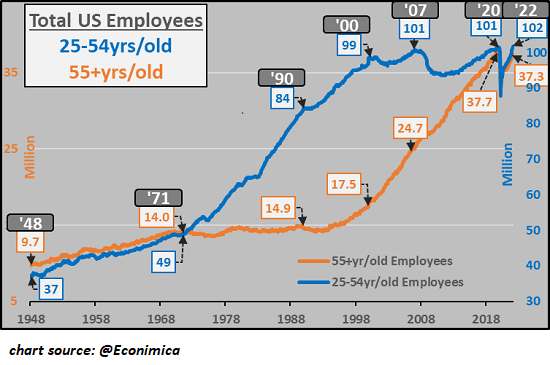
Consider these two charts of the US work force by age. (Courtesy of CH @econimica) In the first chart, Total US Employees, note that the prime working age work force (ages 25-54) has been flatlined for the past 20 years at 101-102 million. In contrast, the 55-and-older cohort of employees soared from 17 million to 37 million. This increase of 20 million accounts for virtually all growth in the employed work force.

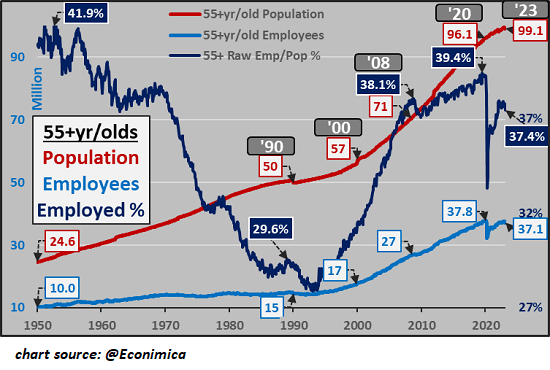
A funny thing happens as workers get old; they retire and leave the work force. Their skills and experience are no longer available to employers or the nation’s economy. The second chart shows the aging of the American populace, as the 55+ cohort increased from 57 million to 99 million since 2000, as the number of older employees skyrocketed from 17 million to 37 million.

While the total US population increased by 18% from 281 million in 2000 to 331 million today, the 55+ cohort increased 74% (from 57 million to 99 million).

The key takeaway here is the number of experienced workers who will retire in the next decade will track the explosive growth in the 55+ cohort. The general consensus is this will not be a problem because there are plenty of younger workers available to fill the vacated slots.

But this overlooks the qualitative and quantitative differences in the millions leaving the work force and those joining the work force. This is especially consequential in real-world jobs, i.e. all those jobs that require engaging real-world materials rather than staring at screens.

Though few analysts and commentators will admit to it, the implicit assumption is that the jobs that matter all involve staring at screens–processing data, finance, entertainment and shaping narrative make the world go round. All the real-world stuff (boring!) will magically get done by tax donkeys who are out of sight, out of mind.

This mindset has it backwards: it’s the real-world work of changing the industrial / energy / energy distribution foundation of the economy that matters going forward, not the staring-at-screens jobs.

What few seem to realize is the work force that’s aging and retiring is the cohort with the real-world skills. It’s a nice idea to remake the entire electrical grid of the nation to transport much larger quantities of electrical power, but who’s going to do all that work? Young people whose career goals are becoming YouTube influencers or day-traders? No. All the ChatAI bots in the world aren’t going to get the real work done, either.

In other words, there is a massive mismatch between the skills available to hire in the young-worker cohort and the skills and experience needed to rebuild the material, real-world foundations of the US economy. It’s well-known but apparently not worth worrying about that the average age of the US farmer is pushing 60 years of age. Nobody left to grow all our food? Hey, isn’t there a ChatAI bot to do all that for us? It can all be automated, right? No? Well, why not? Somebody out there, get it done! Food in super-abundance should be delivered to everyone staring at screens 24/7, it’s our birthright.

The average age of skilled tradespeople is also skewed to the aging work force. There is no easy way to quantify real-world skills gained by on-the-job experience. I suspect it follows a power-law distribution: the newly minted worker just out of school / apprenticeship can handle basic functions, but when tough problems arise, the number of workers with the requisite experience to diagnose and fix the problem diminishes rapidly.

This distribution presents an enormous problem for the economy and employers. Once the super-experienced workers who can solve any problem leave, they cannot be replaced by inexperienced workers. So when the really big problems arise, the systems will break down because those who knew how to deal with the problems are no longer available.

This is how you can have 10 million unemployed workers and 1 million unfilled positions that can’t be filled because few are truly qualified. You want to erect new electrical transmission lines? Nice, but you’re not going to get the job done with green workers accustomed to staring at screens. It takes years of hard labor to acquire even a bare minimum of the skills required. These are not assembly-line jobs that can be filled by unskilled labor, these are jobs in the messy real world, not a distribution center.

As I note in my book on Self-Reliance, individuals with a full spectrum of real-world skills are now extremely rare. Skills that were once common are now performed by specialists. We seem to have all the time in the world to stare at hundreds of cooking programs on TV but how many people actually prepare three meals a day, week in, week out, month in, month out, year in, year out? How many people know how to repair anything, build anything, or maintain a machine?

My direct experience is that many young people don’t know how to put air in the tires of the vehicle Mom and Dad gave them. Young people with graduate-level diplomas don’t know what a green bean plant looks like. (Eeew, gross, it grows in dirt?) The cultural value system that only values wealth, regardless of its source, and minting money from staring at screens has generated a fundamental mismatch between the skills that will be needed going forward and the skills being presented as oh-so-valuable.

Yes, there are many young workers with sharp real-world skills. The question is, are there enough?

This is how we’ll end up with severe shortages of truly skilled labor and high unemployment in the cohort of workers with few real-world skills and a surplus of skills for which there is limited demand. As a real-world experiment, go find a tough old rancher and ask them a series of questions about livestock, machinery, fencing, generators, etc., and then ask the average newly minted college graduate that followed the warped values embedded in our economy the same questions.

Of course the young worker can’t match the experience of the old worker, but do they have any experience at all of a spectrum of essential real-world skills? If not, do they have the requisite physical endurance and commitment needed to acquire real-world skills?

Who’s going to do all the real-world work going forward? A few people talk about it as an abstraction, but it’s not an issue to everyone focused on Federal Reserve policy or GDP. But eventually, the real world will matter more than staring at screens and day-trading, because when the systems break down due to lack of truly qualified employees, we’ll all wake up. But by then it will be too late. We’ll be staring at dead screens begging for somebody somewhere to restore power so we can continue playing with ChatAI to trade zero-day options.
Why the Banking System Is Breaking Up

By Michael Hudson

Source: The Unz Review

The collapses of Silvergate and Silicon Valley Bank are like icebergs calving off from the Antarctic glacier. The financial analogy to the global warming causing this collapse of supporting shelving is the rising temperature of interest rates, which spiked last Thursday and Friday to close at 4.60 percent for the U.S. Treasury’s two-year bonds. Bank depositors meanwhile were still being paid only 0.2 percent on their deposits. That has led to a steady withdrawal of funds from banks – and a corresponding decline in commercial bank balances with the Federal Reserve.

Most media reports reflect a prayer that the bank runs will be localized, as if there is no context or environmental cause. There is general embarrassment to explain how the breakup of banks that is now gaining momentum is the result of the way that the Obama Administration bailed out the banks in 2008 with fifteen years of Quantitative Easing to re-inflate prices for packaged bank mortgages – and with them, housing prices, along with stock and bond prices.

The Fed’s $9 trillion of QE (not counted as part of the budget deficit) fueled an asset-price inflation that made trillions of dollars for holders of financial assets – the One Percent with a generous spillover effect for the remaining members of the top Ten Percent. The cost of home ownership soared by capitalizing mortgages at falling interest rates into more highly debt-leveraged property. The U.S. economy experienced the largest bond-market boom in history as interest rates fell below 1 percent. The economy polarized between the creditor positive-net-worth class and the rest of the economy – whose analogy to environmental pollution and global warming was debt pollution.

But in serving the banks and the financial ownership class, the Fed painted itself into a corner: What would happen if and when interest rates finally rose?

In Killing the Host I wrote about what seemed obvious enough. Rising interest rates cause the prices of bonds already issued to fall – along with real estate and stock prices. That is what has been happening under the Fed’s fight against “inflation,” its euphemism for opposing rising employment and wage levels. Prices are plunging for bonds, and also for the capitalized value of packaged mortgages and other securities in which banks hold their assets on their balance sheet to back their deposits.

The result threatens to push down bank assets below their deposit liabilities, wiping out their net worth – their stockholder equity. This is what was threatened in 2008. It is what occurred in a more extreme way with S&Ls and savings banks in the 1980s, leading to their demise. These “financial intermediaries” did not create credit as commercial banks can do, but lent deposits out in the form of long-term mortgages at fixed interest rates, often for 30 years. But in the wake of the Volcker spike in interest rates that inaugurated the 1980s, the overall level of interest rates remained higher than the interest rates that S&Ls and savings banks were receiving. Depositors began to withdraw their money to get higher returns elsewhere, because S&Ls and savings banks could not pay higher their depositors higher rates out of the revenue coming in from their mortgages fixed at lower rates. So even without fraud Keating-style, the mismatch between short-term liabilities and long-term interest rates ended their business plan.

The S&Ls owed money to depositors short-term, but were locked into long-term assets at falling prices. Of course, S&L mortgages were much longer-term than was the case for commercial banks. But the effect of rising interest rates has the same effect on bank assets that it has on all financial assets. Just as the QE interest-rate decline aimed to bolster the banks, its reversal today must have the opposite effect. And if banks have made bad derivatives trades, they’re in trouble.

Any bank has a problem of keeping its asset valuations higher than its deposit liabilities. When the Fed raises interest rates sharply enough to crash bond prices, the banking system’s asset structure weakens. That is the corner into which the Fed has painted the economy by QE.

The Fed recognizes this inherent problem, of course. That is why it avoided raising interest rates for so long – until the wage-earning bottom 99 Percent began to benefit by the recovery in employment. When wages began to recover, the Fed could not resist fighting the usual class war against labor. But in doing so, its policy has turned into a war against the banking system as well.

Silvergate was the first to go, but it was a special case. It had sought to ride the cryptocurrency wave by serving as a bank for various currencies. After SBF’s vast fraud was exposed, there was a run on cryptocurrencies. Investor/gamblers jumped ship. The crypto-managers had to pay by drawing down the deposits they had at Silvergate. It went under.

Silvergate’s failure destroyed the great illusion of cryptocurrency deposits. The popular impression was that crypto provided an alternative to commercial banks and “fiat currency.” But what could crypto funds invest in to back their coin purchases, if not bank deposits and government securities or private stocks and bonds? What is crypto, ultimately, if not simply a mutual fund with secrecy of ownership to protect money launderers?

Silicon Valley Bank also is in many ways a special case, given its specialized lending to IT startups. New Republic bank also has suffered a run, and it too is specialized, lending to wealthy depositors in the San Francisco and northern California area. But a bank run was being talked up last week, and financial markets were shaken up as bond prices declined when Fed Chairman Jerome Powell announced that he actually planned to raise interest rates even more than he earlier had targeted, in view of the rising employment making wage earners more uppity in their demands to at least keep up with the inflation caused by the U.S. sanctions against Russian energy and food and the actions by monopolies to raise prices “to anticipate the coming inflation.” Wages have not kept pace with the resulting high inflation rates.

It looks like Silicon Valley Bank will have to liquidate its securities at a loss. Probably it will be taken over by a larger bank, but the entire financial system is being squeezed. Reuters reported on Friday that bank reserves at the Fed were plunging. That hardly is surprising, as banks are paying about 0.2 percent on deposits, while depositors can withdraw their money to buy two-year U.S. Treasury notes yielding 3.8 or almost 4 percent. No wonder well-to-do investors are running from the banks.

The obvious question is why the Fed doesn’t simply bail out banks in SVB’s position. The answer is that the lower prices for financial assets looks like the New Normal. For banks with negative equity, how can solvency be resolved without sharply reducing interest rates to restore the 15-year Zero Interest-Rate Policy (ZIRP)?

There is an even larger elephant in the room: derivatives. Volatility increased last Thursday and Friday. The turmoil has reached vast magnitudes beyond what characterized the 2008 crash of AIG and other speculators. Today, JP Morgan Chase and other New York banks have tens of trillions of dollar valuations of derivatives – casino bets on which way interest rates, bond prices, stock prices and other measures will change.

For every winning guess, there is a loser. When trillions of dollars are bet on, some bank trader is bound to wind up with a loss that can easily wipe out the bank’s entire net equity.

There is now a flight to “cash,” to a safe haven – something even better than cash: U.S. Treasury securities. Despite the talk of Republicans refusing to raise the debt ceiling, the Treasury can always print the money to pay its bondholders. It looks like the Treasury will become the new depository of choice for those who have the financial resources. Bank deposits will fall. And with them, bank holdings of reserves at the Fed.

So far, the stock market has resisted following the plunge in bond prices. My guess is that we will now see the Great Unwinding of the great Fictitious Capital boom of 2008-2015. So the chickens are coming hope to roost – with the “chicken” being, perhaps, the elephantine overhang of derivatives fueled by the post-2008 loosening of financial regulation and risk analysis.

Major Economic Contraction Coming In 2023 – Followed By Even More Inflation

By Brandon Smith

Source: Investment Watch

The signs are already present and obvious, but the overall economic picture probably won’t be acknowledged in the mainstream until the situation becomes much worse (as if it’s not bad enough). It’s a problem that arises at the onset of every historic financial crisis – Mainstream economists and commentators lie to the public about the chances of recovery, constantly giving false reassurances and lulling people back to sleep. Even now with price inflation pummeling the average consumer they tell us that there is nothing to worry about. The Federal Reserve’s “soft landing” is on the way.

I remember in 2007 right before the epic derivatives collapse when media pundits were applauding the US housing market and predicting even greater highs in sales and in valuations. I had only been writing economic analysis for about a year, but I remember thinking that the overt display of optimism felt like compensation for something. It seemed as if they were trying to pull the wool over the eyes of the public in the hopes that if people just believed hard enough that all was well then the fantasy could be manifested into reality. Unfortunately, that’s not how economics works.

Supply and demand, debt and deficit, money velocity and inflation; these things cannot be ignored. If the system is out of balance, collapse will set its ugly foot down somewhere and there’s nothing anyone including central banks can do about it. In fact, there are times when they deliberately ENGINEER collapse.

This is the situation we are currently in today as 2022 comes to a close. The Fed is in the midst of a rather aggressive rate hike program in a “fight” against the stagflationary crisis that they created through years of fiat stimulus measures. The problem is that the higher interest rates are not bringing prices down, nor are they really slowing stock market speculation. Easy money has been too entrenched for far too long, which means a hard landing is the most likely scenario.

In the early 2000s the Fed had been engaged in artificially low interest rates which inflated the housing and derivatives bubble. In 2004, they shifted into a tightening process. Rates in 2004 were at 1% and by 2006 they rose to over 5%. This is when cracks began to appear in the credit structure, with 4.5% – 5.5% being the magic cutoff point before debt became too expensive for the system to continue the charade. By 2007/2008 the nation witnessed an exponential implosion of credit, setting off the biggest money printing bonanza in US history in order to save the banking sector, at least for a time.

Since nothing was actually fixed by the Fed back then, I will continue to use the 5% funds rate as a marker for when we will see another major contraction. The difference this time is that the central bank does not have the option to flood the economy with more fiat, at least not without immediately triggering a larger stagflationary spiral. I am also operating on the premise that the Fed WANTS a crash at this time.

As I noted in my article ‘The Fed Is Taking The Punch Bowl Away – But The Inflation Crisis Will Continue To Grow’, published in May:

Mainstream financial commentators want to believe the Fed will capitulate because they desperately want the party in stock markets to continue, but the party is over. Sure, there will be moments when the markets rally based on nothing more than a word or two from a Fed official planting false hopes, but this will become rare. Ultimately, the Fed has taken away the punch bowl and it’s not coming back. They have the perfect excuse to kill the economy and kill markets in the form of a stagflationary disaster THEY CAUSED. Why would they reverse course now?”

How Money Printing Made Supply Chain Disruptions Even Worse

By Nicholas Baum

Source: Activist Post

Over the last few years, an unwelcome phrase has grown to plague American consumers and producers alike: supply chain issues. The recurring term is frequently offered by mainstream economists as the go-to explanation for record inflation, while the Biden Administration has seemingly twisted it into a sign of economic recovery. Commerce Secretary Gina Raimondo states,

“What we have here is a demand issue. The economy is doing better… People have money in their pocket. They’re spending that money. Demand is through the roof… Supply has to catch up.”

Although Raimondo said this back in October 2021, inflation has only worsened from an annual rate of 6.2 percent to 7.7 percent more than twelve months later, leading one to wonder if the Secretary is right that inflation is a matter of supply chains adjusting to an increase in wealth. Yet as it turns out, in the words of the Mises Institute’s Ryan McMaken, “the administration’s defenders are right about consumer demand and spending – even if for the wrong reasons.”

That is, although we’re indeed witnessing a large spike in demand (which is perhaps best quantified by changes in nominal GDP), this increase in demand is a symptom of a larger problem: the massive expansion of the money supply under the watch of the Federal Reserve and the White House. The implications of this unprecedented expansion are two-fold, not only stirring this increase in “demand” but contributing to supply chain issues through the distortion of price signals.

With state governments responding to the rise of Covid-19 by imposing lockdowns and forcibly closing “non-essential businesses,” both the Fed and the Trump and Biden Administrations stepped in with an extraordinarily expansive monetary and fiscal policy, respectively.

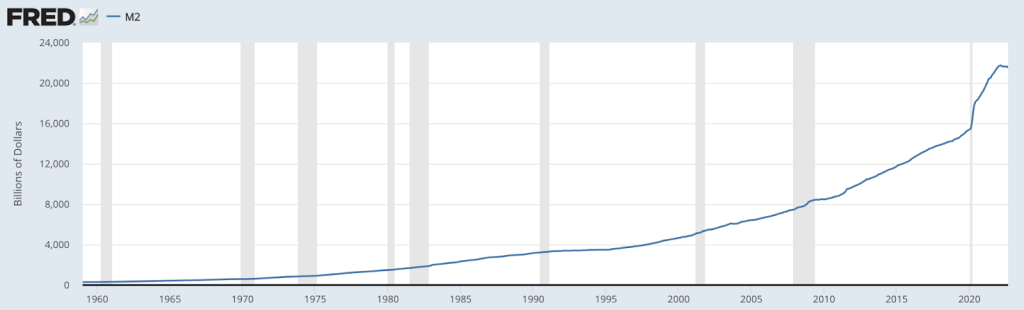
M2 is a figure for the money supply, which surged by more than $6.2 trillion, a 40 percent increase, between February 2020 and February 2022. This is the result of a variety of initiatives, from the Fed’s quantitative easing and purchase of over $2 trillion in assets to new federal programs such as stimulus checks, PPP loans, and the $1.9 trillion American Rescue Plan Act.

Through these ventures that flooded the economy with new cash, Americans indeed had more money in their pockets. The problem is, obviously, that such money soon became worth a lot less. That’s because an increase in the money supply, without a corresponding increase in economic output, means an increase in prices, with more money chasing roughly the same quantity of goods.

This is where Raimondo serves to mislead viewers in her comments; just because Americans have more money, doesn’t mean they’re any wealthier. There certainly is a large spike in demand, but that doesn’t represent an increase in the real wealth of Americans, but an increase in the amount of money they have access to thanks to an unprecedented monetary expansion.

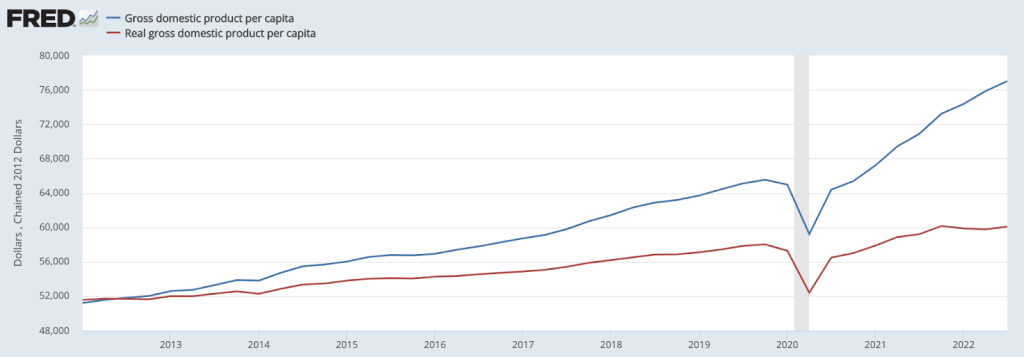
This is perhaps best represented by comparing nominal to real GDP per capita, which is a rough proxy for standard of living:

If you were to look only at nominal GDP per capita (the blue line) you would think that the average American’s wealth has increased greatly since the pandemic. This, however, is incredibly misleading, because it doesn’t take into account inflation and the decreasing value of the dollar.

The large demand increase noted by Raimondo and other economists does not reflect a growing economy and an increase in wealth but an increase in the money supply which has created upward pressure on prices. Yet just as the Biden Administration declares that “supply has to catch up,” the ability for producers to do so has been greatly strained by inflation (not to mention the aforementioned lockdowns).

That’s because of the role prices—which economist Alex Tabarrok refers to as “a signal wrapped up in an incentive” —play in coordinating economic activity. Changes in prices usually convey changes in the scarcity and demand for different goods, products, and resources. When the price of something in a company’s supply chain increases, this hurts the company’s profitability and incentivizes it to economize and find a more efficient alternative.

On a macro scale, economic growth (or recovery) comes through thousands, if not millions, of businesses and firms finding new ways to innovate and maximize profits, which is the result of comparing the prices of alternative inputs and production methods. Inflation, by raising the general price level of the economy and often affecting the price of each good differently, can cause economic discoordination and confusion because prices no longer reflect changing efficiencies and scarcities.

Even if inflation impacted all prices equally, we still wouldn’t know to what extent a rise in the price of a certain resource reflects actually important information about it, given that the rate of inflation is always changing and can only be measured in hindsight.

In the context of the last few years, this has meant that firms have essentially been blindfolded, piecing back together supply chains forcibly closed during the pandemic without the ability for prices to convey the efficiency of competing alternatives. This is exactly why “supply chain issues” has continued to be a lingering excuse for inflation and shortages, with Volkswagen chief executive Oliver Blume going so far as to say that, “Challenges to our supply chains will become the rule, not the exception.”

Nor is this a relatively recent phenomenon. Paul Volcker, the late Fed Chairman notable for remedying the United States’ last encounter with runaway inflation in the late 1970s and early 1980s, observed that, “The inflationary process itself brought so many dislocations, and stresses and strains that you were going to have a recession sooner or later.”

Given the fact that the United States technically entered a recession during the first half of 2022—at least according to a common definition of recession—Volcker’s words proved prescient. Not only has an unprecedented monetary expansion under the purview of the Fed and White House triggered a dangerous period of inflation; the inflation has also caused disruptions to the supply chain, which agencies (ironically) use as a scapegoat for inflation.

Now, with economic growth stagnant and inflation persisting at high levels, the fate of supply, demand, and the price signals that they convey rests in the hands of the problems’ culprits.

Europe, more than Putin, must shoulder the blame for the energy crisis

The same arrogant, self-righteous posturing from the West that fuelled the Ukraine war is now plunging Europe into recession

Ukraine’s President Volodymyr Zelensky appears on a giant screen as he addresses a Nato summit in Madrid, 29 June 2022 (AFP)

By Jonathan Cook

Source: Middle East Eye

Outraged western leaders are threatening a price cap on imports of Russian natural gas after Moscow cut supplies to Europe this month, deepening an already dire energy and cost-of-living crisis. In response, Russian President Vladimir Putin has warned that Europe will “freeze” this winter unless there is a change of tack.

In this back-and-forth, the West keeps stepping up the rhetoric. Putin is accused of using a mix of blackmail and economic terror against Europe. His actions supposedly prove once more that he is a monster who cannot be negotiated with, and a threat to world peace.

Denying fuel to Europe as winter approaches, in a bid to weaken the resolve of European states to support Kyiv and alienate European publics from their leaders, is Putin’s opening gambit in a plot to expand his territorial ambitions from Ukraine to the rest of Europe.

Or so runs the all-too-familiar narrative shared by western politicians and media.

In fact, Europe’s arrogant, self-righteous posturing over Russian gas supplies, divorced from any discernible geopolitical reality, reflects precisely the same foolhardy mindset that helped provoke Moscow’s invasion of Ukraine in the first place.

It is also the reason why there has been no exit ramp – a path to negotiations – even as Russia has taken vast swaths of Ukraine’s eastern and southern flanks – territory that cannot be reclaimed without a further massive loss of life on both sides, as the limited Ukrainian assault around Kharkiv has highlighted.

The western media has to carry a major share of the blame for these serial failures of diplomacy. Journalists have amplified only too loudly and uncritically what US and European leaders want their publics to believe is going on. But maybe it is time that Europeans heard a little of how things might look to Russian eyes.

Economic war

The media could start by dropping their indignation at “insolent” Moscow for refusing to supply Europe with gas. After all, Moscow has been only too clear about the reason for the shutdown of gas supplies: it is in retaliation for the West imposing economic sanctions – a form of collective punishment on the wider Russian population that risks violating the laws of war. 

The West is well practised in waging economic war on weak states, usually in a futile attempt to topple leaders they don’t like or as a softening-up exercise before it sends in troops or proxies.

Iran has faced decades of sanctions that have inflicted a devastating toll on its economy and population but done nothing to bring down the government.

Meanwhile, Washington is waging what amounts to its own form of economic terrorism on the Afghan people to punish the ruling Taliban for driving out US occupation forces last year in a humiliating fashion. The United Nations reported last month that sanctions had contributed to the risk of more than a million Afghan children dying from starvation.

There is nothing virtuous about the current economic sanctions on Russia either, any more than there is about the blackballing of Russian sportspeople and cultural icons. The sanctions are not intended to push Putin to the negotiating table. As US President Biden made clear in March, the West is planning for a long war and he wants to see Putin removed from power

Rather, the goal has been to weaken his authority and – in some fantasy scenario – encourage his subordinates to turn on him. The West’s game plan – if it can be dignified with that term – is to force Putin to over-extend Russian forces in Ukraine by flooding the battlefield with armaments, and then watch his government collapse under the weight of popular discontent at home.

But in practice, the reverse has been happening, just as it did through the 1990s when the West imposed sanctions on Iraq’s Saddam Hussein. Putin’s position has been bolstered, as it will continue to be whether Russia is triumphing or losing on the battlefield. 

The West’s economic sanctions against Russia have been doubly foolish. They have reinforced Putin’s message that the West seeks to destroy Russia, just as it previously did IraqAfghanistanLibyaSyria and Yemen. A strongman is all that stands between an independent Russia and servitude, Putin can plausibly argue.

And at the same time, the sanctions have demonstrated to Russians how truly artful their leader is. Economic pressure from the West has largely backfired: sanctions have barely made an impression on the value of the rouble, while Europe looks to be heading into recession as Putin turns off the gas spigot.

It will doubtless not only be Russians quietly rejoicing at seeing the West get a dose of the medicine it so regularly force-feeds others.

Western conceit

But there is a more troubling dimension to the West’s conceit. It was the same high-handed belief that the West would face no consequences for waging economic warfare on Russia, just as earlier assumed it would be pain-free for Nato to station missiles on Moscow’s doorstep. (Presumably, the effect on Ukrainians was not factored into the calculations.)

The decision to recruit ever-more east European states into the Nato fold over the past two decades not only broke promises made to Soviet and Russian leaders, but flew in the face of advice from the West’s most expert policy-makers.

Guided by the US, Nato countries closed the military noose around Russia year by year, all the while claiming that the noose was entirely defensive.

Nato flirted openly with Ukraine, suggesting that it too might be admitted to their anti-Russia alliance.

The US had a hand in the 2014 protests that overthrew Ukraine’s government, one elected to keep channels open with Moscow. 

With a new government installed, the Ukrainian army incorporated ultra-nationalist, anti-Russia militias that engaged in a devastating civil war with Russian communities in the country’s east.

And all the while, Nato secretly cooperated with and trained that same Ukrainian army.

At no point in the eight long years of Ukraine’s civil war did Europe or the US care to imagine how all these events unfolding in Russia’s backyard might look to ordinary Russians. Might they not fear the West just as much as western publics have been encouraged by their media to fear Moscow? Putin did not need to invent their concern. The West achieved that all by itself.

The encirclement of Russia by Nato was not a one-off error. Western meddling in the coup and support for a nationalist Ukrainian army increasingly hostile to Russia were not one-offs either. Nato’s decision to flood Ukraine with weapons rather than concentrate on diplomacy is no aberration. Nor is the decision to impose economic sanctions on ordinary Russians.

These are all of a piece, a pattern of pathological behaviour by the West towards Russia – and any other resource-rich state that does not utterly submit to western control. If the West were an individual, the patient would be diagnosed as suffering from a severe personality disorder, one with a strong impulse for self-destruction.

Bogeyman needed

Worse still, this impulse does not appear to be open to correction – not as things stand. The truth is that Nato and its US ringmaster have no interest in changing.

Their purpose is to have a credible bogeyman, one that justifies continuing the massive wealth redistribution from ordinary citizens to an elite of the already ultra-rich. A supposed threat to Europe’s safety justifies pouring money into the maw of an expanding war machine masquerading as the “defence industries” – the military, the arms manufacturers, and the ever-growing complex of the surveillance, intelligence and security industries. Both Nato and a US network of more than 800 military bases around the globe just keep growing.

A bogeyman also ensures western publics are unified in their fear and hatred of an external enemy, making them readier to defer to their leaders to protect them – and with it, the institutions of power those leaders uphold and the status quo they represent.

Anyone suggesting meaningful reform of that system can be rounded on as a threat to national security, a traitor or a fool, as Britain’s former Labour leader Jeremy Corbyn found out.

And a bogeyman distracts western publics from thinking about deeper threats, ones that our own leaders – rather than foreigners – are responsible for, such as the climate crisis they not only ignored but still fuel through the very military posturing and global confrontations they use to distract us. It is a perfect circle of self-harm.

Since the fall of the Berlin Wall, and the demise of the Soviet Union, the West has been casting around for a useful bogeyman to replace the Soviet Union, one that supposedly presents an existential threat to western civilisation.

Iraq’s weapons of mass distraction were only 45 minutes away – until we learned they did not, in fact, exist.

Afghanistan’s Taliban was harbouring al-Qaeda – until we learned that the Taliban had offered to hand Osama bin Laden over even before the 9/11 attacks.

There was the terrifying threat from the head-choppers of the Islamic State (IS) group – until we learned that they were the West’s arm’s-length allies in Syria and being supplied with weapons from Libya after it was liberated by the West from its dictator, Muammar Gadaffi.

And there is always Iran and its supposed nuclear weapons to worry about, even though Tehran signed an agreement in 2015 putting in place strict international oversight to prevent it from developing a bomb – until the US casually discarded the deal under pressure from Israel and chose not to replace it with anything else.

Braced for recession

Each of these threats was so grave it required an enormous expenditure of energy and treasure, until it had served its purpose of terrifying western publics into acquiescence. Invariably, the West’s meddling spawned a backlash that created another temporary enemy.

Now, like a predictable Hollywood sequel, the Cold War is back with a vengeance. Russia’s President Putin has a starring role. And the military-industrial complex is licking its lips with delight.

Ordinary people and small businesses are being told by European leaders to brace for a recession as energy companies once again clock up “eye-watering” profits.

Just as with the financial crash nearly 15 years ago, when the public was required to tighten its belt through austerity policies, a crisis is providing ideal conditions for wealth to be redistributed upwards.

Like other officials, Nato’s Secretary-General Jens Stoltenberg has sounded the alarm about “civil unrest” this winter as prices across Europe soar, even while demanding public money be used to send yet more weapons to Ukraine.

The question is whether western publics will keep buying the narrative of an existential threat that can only be dealt with if they, rather than their leaders, dig deep into their pockets. 

Escalation: Recent Events Suggest Mounting Economic Danger

By Brandon Smith

Source: Alt-Market.us

A common refrain from people who are critical of alternative economists is that we have been predicting crisis for so long that “eventually we will be right.” These are generally people who don’t understand the nature of economic decline – It’s like an avalanche that builds over time, then breaks and quickly escalates as it flows down the mountain. What they don’t grasp is that they are in the middle of an economic collapse RIGHT NOW, and they just can’t see it because they have been acclimated to the presence of the snow and cold.

Economic decline is a process that takes many years, and while you might get an event like the market crash of 1929 or the crash of 2008, these moments of panic are nothing more than the wreckage left behind by the great wave of tumbling ice that everyone should have seen coming far in advance, but they refused.

In 2022 the job of warning people is far easier than it used to be because we are well past the midpoint of the process of decline. But, believe it or not, I still get people today who claim that we analysts are “doom mongers.” The power of willful ignorance is truly amazing. It’s enough to make a person blind to stagflationary crisis, supply chain disruptions, quickly inflating prices, stock market carnage, bond market instability, record consumer debt, and international conflict.

At this point, I think if a person can’t see the dangers ahead they are probably a waste of time and space and are destined to be buried in the ice; there’s nothing that can be done for them. Yes, there are some people out there that don’t get exposed to the information and we have to take them into account, but my priority will be people that are awake and aware and try to give them a sense of what point in the collapse process we find ourselves.

In the past month there has been a considerable uptick in economic and geopolitical activity that suggests we are entering a new phase, and not surprisingly it’s all accumulating right before we hit October. Here are the events that I find most concerning:

The European Energy Crisis

This is an event that I have been predicting since the Russian invasion of Ukraine and now it is upon us. I wrote about it extensively in my recent article ‘Europe Is Facing Energy Disaster And It’s Going To Bleed Over Into The US’ so I won’t rehash all that information here. What I do want to point out is the complete lack of planning on the part of European officials to deal with the threat. It is as if they WANT a full spectrum disaster.

Russia has now completely cut off natural gas supplies to Europe, which represent around 40% of all EU energy resources. Europe’s benchmark natural gas prices spiked by 28% a week ago, on top of already existing inflation. Oil supplies are also in steep decline for Europe and the EU government has pledged to cut what’s left of Russian oil imports by sea at the end of the year. Sadly, they have offered very little in the way of solutions to the supply-side problem.

There has been talk of increasing imports of alternative resources from other nations, but the EU is already buying up around 75% of all liquid natural gas from the US. OPEC oil producers have indicated they will not be attempting to increase production anytime soon (probably because they can’t due to inflation in operation costs). There is NO backup energy resource for Europe; it doesn’t exist right now. They will try to buy up whatever coal, oil and gas they can find on the market while driving up prices even more for other countries. They will still come up short, which means people are going to freeze this winter.

Best case scenario is that there are mostly mild temps and people barely scrape buy with minimum heating. But EU industry is going to suffer and many manufacturers are going to cut production (which mean more stress on the global supply chain).

Core Inflation Is Still Rising

As I warned last week in my article ‘It’s A Fact That Needs Repeating: The Federal Reserve Is A Suicide Bomber,’ inflation is continuing to rise despite the Fed’s continued interest rate hikes, giving the central bank even more ammunition to justify higher rates into extreme economic weakness.

The latest CPI print showed an increase to 8.3% and was a shock to markets which universally expected a drop. This is the nature of stagflation – Even with falling demand prices continue to climb or remain high for extended periods. The stagflation event of the 1970s lasted for a decade until the Fed jacked rates to 21% and then employment crumbled in the early 1980s.

This doesn’t mean that rates will go to 21% this time; they don’t need to. All it would take is a Federal Funds Rate of around 4% – 5% to crash our current QE addicted system. A 75 bps rate hike is now widely expected at the next Fed meeting this month, with some predicting a 100 bps hike. This would put us close to crash territory for markets and for employment, though I think we still have well into 2023 before unemployment really starts to spike.

Putin’s Meeting With Xi

As I write this, Vladimir Putin is set to meet with China’s Xi Jinping and the nature of the conference is not clear. There are the obvious points of agreement such as China’s continued purchases of Russian oil and other commodities, as well as the ongoing plan to build a pipeline to China by 2025. There is also strategic cooperation which is evident in the recent naval exercises between the two nations around Japan and Taiwan.

The timing of the meeting is concerning to me, because the prime season for a potential Chinese invasion of Taiwan is fast approaching (October is the best month for naval movements to avoid typhoons). China would not necessarily need to commit to a ground invasion, either. They could simply cut off all import/export trade from any source other than China and starve Taiwan until they accept unification.

There is also the issue of Ukraine and arms sales. With the amount of propaganda coming from Ukrainian Intelligence and NATO, it’s hard to say what is actually happening, but I suspect Russia is changing strategies and repositioning to deploy missile and artillery bombardment of infrastructure, including power grids and water. This is a tactic that Russia has avoided for months (until this week), which is surprising because one of the first measures usually taken by the US during an invasion is to eliminate most key infrastructure (as we did in Iraq). You would think Russia would have done the same, but perhaps they were saving that scenario for winter when it is harder for Ukraine to cope.

This would make Ukraine essentially unlivable in the coming winter for most of the population. Putin may be seeking to ensure China remains a steady economic partner should geopolitical pressures increase. They may even be making a deal of mutual support: China takes Taiwan while Russia makes Ukraine a resource wasteland and they each support the other economically when NATO counties try to impose sanctions on China. We probably won’t know until October, but the timing of the meeting should raise eyebrows.

If the manure is about to hit the fan in Taiwan along with Ukraine, then diplomatic and economic ties will be severed and western access to China’s manufacturing will be cut. This is a problem for China’s economy, certainly, which may be why they have continued their mass covid lockdowns well after every other government has abandoned them. Could this be practice for civil controls in an impending war environment?

China’s global dominance in imports/exports gives them considerable economic leverage in trade, however. Many nations would not support sanctions against them. Also, their vast holdings of US dollars and Treasuries could be used as a weapon to damage or destroy the dollar’s world reserve status. If China invades Taiwan this year, then all bets are off – The economic decline will move swiftly from that point on.

There are many other trends which factor into the crash environment but the above factors are the most recent and hold the biggest potential for causing a domino effect globally. The question that always arises is “what can we do about it?” Not much in terms of prevention. What we can do, though, is prepare locally to weather the storm. This means stocking necessities before they rise even further in price or become non-existent. Become a producer and learn a valuable skill for survival in a depleted economy Organize with people locally who are on the same page to create security and alternative trade opportunities.

Hopefully, the aware citizenry will rise to the challenge and organization will be extensive, because the worst case scenario would be great masses of completely isolated people all vying against each other rather than working towards mutual security. Even in a slow collapse scenario this is a problem in terms of rising crime; so plan on working with others if you want to avoid inevitable third world conditions.

Thanks To The Rapidly Imploding U.S. Economy, Joe Biden’s Poll Numbers Have Plunged To Unprecedented Levels

By Michael Snyder

Source: Economic Collapse Blog

These are not good times for Joe Biden.  When the U.S. economy is performing well whoever is in the White House is going to get most of the credit.  Likewise, when the U.S. economy is performing poorly whoever is in the White House is going to get most of the blame.  That is just the way that it is, and that is one of the primary reasons why most Americans are quite displeased with Joe Biden right now.  Things are not going well at all, and the outlook for the months ahead is even worse.  The American people are becoming increasingly frustrated, and a new Gallup poll that was just released discovered that “confidence” in the presidency has fallen to the lowest level ever recorded

President Joe Biden has pushed the presidency to a place it hasn’t been in nearly 50 years.

In the latest Gallup poll, less than a quarter of those surveyed have “confidence” in the presidency, worse than during the Trump presidency and nearly as bad as the end of the George W. Bush presidency.

Going back to 1975, Gallup has never recorded a confidence reading as low as Biden’s 23%.

Other polls have come up with similarly stunning results.  For example, a different survey that was just released discovered that a whopping 88 percent of all Americans believe that the nation is heading in the wrong direction…

The White House was faced with another dire poll Tuesday that found that 54 percent of Americans believe the middle class hasn’t benefited ‘at all’ from President Joe Biden’s policies.

On top of that, the new Monmouth University Poll found that 88 percent of Americans surveyed said the country was headed in the wrong direction – with just 10 percent saying it’s headed the right way – a record low.

Just think about that.

88 percent.

In this day and age, it is difficult to get 88 percent of Americans to agree on anything.

But almost all of us seem to agree that the country is going downhill, and according to that same survey Americans are currently more concerned about economic matters than anything else

Nearly half those surveyed said inflation and gas were the biggest concerns currently facing their families, with 33 percent saying inflation and 15 percent pointing to fuel costs.

A lot of people out there don’t really care much about what is going on in the world until it starts affecting their personal finances.

And these days the American people are feeling a tremendous amount of pain.

In fact, the consumer confidence index that is put out by the University of Michigan just fell to an all-time record low

The University of Michigan’s gauge of consumer sentiment fell sharply to a record-low reading of 50.2, down from a May reading of 58.4. Economists polled by the Wall Street Journal had expected an June reading of 59.

The level is comparable to the low point reached in the middle of the 1980 recession, the university said.

The American people have never been more pessimistic about the economy.

Ever.

And we have a guy in the White House that has a really difficult time even putting a coherent sentence together at this point.

Of course the team around Biden is not exactly competent either.

Time after time, the Biden administration has made colossal blunders.  This week, we learned that someone in the Biden administration apparently thought that it would be a good idea to send oil from our strategic petroleum reserve to China

Because he hates Americans, President Joe Biden is shipping much-needed American oil to foreign countries, including… China.

The whole idea of the Strategic Petroleum Reserve (SPR), which is owned by the U.S. government, specifically the U.S. Department of Energy, is to hold on to about 700 million barrels of oil in the event of an emergency or disruption.

I was floored when I first read that.

Who would be stupid enough to do such a thing?

Someday we are going to need the oil in the strategic petroleum reserve, and hopefully there will be some left when that moment finally arrives.

This week we have also been getting more numbers that indicate that the economic slowdown in the United States appears to be picking up speed.

According to LinkedIn, hiring in the U.S. is really starting to fall off

LinkedIn, a unit of Microsoft, saw its hiring rate fall 5.4% month over month in June on a seasonally adjusted basis, the lowest level since December 2021, according to new data released on Friday. On an annual basis, the employment platform’s hiring rate tumbled 11.9% in June.

LinkedIn’s hiring rate is calculated based on the percentage of the platform’s members who added a new employer to their profile in the same month the new job began divided by the total number of LinkedIn members in the United States.

And we just learned that new vehicle sales during the month of June were depressingly low

Automakers have now reported their June new vehicle sales, or their Q2 new vehicle sales, for the US, except Tesla, which doesn’t report US sales but only global sales. All automakers, even Toyota, and now even Tesla, are struggling with the ongoing semiconductor shortages, and they started the month of June with desperately low inventories on dealer lots and in transit.

And so new vehicle sales in June plunged by 13.5% from the already horribly beaten-down June 2021, to 1.127 million vehicles, and collapsed by 25% from June 2019, the last decent year in the industry, according to data released by the Bureau of Economic Analysis today

It appears that a recession is already here, and the months ahead are going to be really tough.

So I would encourage you to get out of debt.

And I would also encourage you to build up your emergency fund.

This is not a time to fritter away your money on unnecessary things.  You want to put yourself in the best position possible to weather the “perfect storm” that is ahead, because things certainly aren’t going to be getting easier from here.

As the economy deteriorates, the frustration of the American people is going to get deeper and deeper.

Needless to say, that isn’t good news for Joe Biden.

What “Normal” Are We Returning To? The Depression Nobody Dares Acknowledge

By Charles Hugh Smith

Source: Of Two Minds

Perhaps we need an honest national dialog about declining expectations, rising inequality, social depression and the failure of the status quo.

Even as the chirpy happy-talk of a return to normal floods the airwaves, what nobody dares acknowledge is that “normal” for a rising number of Americans is the social depression of downward mobility and social defeat.

Downward mobility is not a new trend–it’s simply accelerating. As this RAND Corporation report documents, ( Trends in Income From 1975 to 2018) $50 trillion in earnings has been transferred to the Financial Aristocracy from the bottom 90% of American households over the past 45 years.

Time magazine’s article on the report is remarkably direct: The Top 1% of Americans Have Taken $50 Trillion From the Bottom 90% — And That’s Made the U.S. Less Secure.

“The $50 trillion transfer of wealth the RAND report documents has occurred entirely within the American economy, not between it and its trading partners. No, this upward redistribution of income, wealth, and power wasn’t inevitable; it was a choice–a direct result of the trickle-down policies we chose to implement since 1975.

We chose to cut taxes on billionaires and to deregulate the financial industry. We chose to allow CEOs to manipulate share prices through stock buybacks, and to lavishly reward themselves with the proceeds. We chose to permit giant corporations, through mergers and acquisitions, to accumulate the vast monopoly power necessary to dictate both prices charged and wages paid. We chose to erode the minimum wage and the overtime threshold and the bargaining power of labor. For four decades, we chose to elect political leaders who put the material interests of the rich and powerful above those of the American people.”

I’ve been digging into downward mobility and social depression for years: Are You Really Middle Class?

The reality is that the middle class has been reduced to the sliver just below the top 5%–if we use the standards of the prosperous 1960s as a baseline.

The downward mobility isn’t just financial–it’s a decline in political power, control of one’s work and ownership of income-producing assets. This article reminds us of what the middle class once represented: What Middle Class? How bourgeois America is getting recast as a proletariat.

This reappraisal of the American Dream is also triggering a reappraisal of the middle class in the decades of widespread prosperity: The Myth of the Middle Class: Have Most Americans Always Been Poor?

Downward mobility excels in creating and distributing what I term social defeat: In my lexicon, social defeat is the spectrum of anxiety, insecurity, chronic stress, fear and powerlessness that accompanies declining financial security and social status.

Downward mobility and social defeat lead to social depression. Here are the conditions that characterize social depression:

1. High expectations of endlessly rising prosperity instilled as a birthright no longer align with economy reality.

2. Part-time and unemployed people are marginalized, not just financially but socially.

3. Widening income/wealth disparity as those in the top 10% pull away from the bottom 90%.

4. A systemic decline in social/economic mobility as it becomes increasingly difficult to move from dependence on the state or one’s parents to financial independence.

5. A widening disconnect between higher education and employment: a college/university degree no longer guarantees a stable, good-paying job.

6. A failure in the Status Quo institutions and mainstream media to recognize social depression as a reality.

7. A systemic failure of imagination within state and private-sector institutions on how to address social depression issues.

8. The abandonment of middle class aspirations: young people no longer aspire to (or cannot afford) consumerist status symbols such as luxury autos or conventional homeownership.

9. A generational abandonment of marriage, families and independent households as these are no longer affordable to those with part-time or unstable employment.

10. A loss of hope in the young generations as a result of the above conditions.

The rising tide of collective anger arising from social depression is visible in many places: road rage, violent street clashes between groups seething for a fight, the destruction of friendships for holding “incorrect” ideological views, and so on.

A coarsening of the entire social order is increasingly visible: The Age of Rudeness.

Depressive thoughts (and the emotions they generate) tend to be self-reinforcing, and this is why it’s so difficult to break out of depression once in its grip.

One part of the healing process is to expose the sources of anger that we are repressing. As psychiatrist Karen Horney explained in her 1950 masterwork, Neurosis and Human Growth: The Struggle Towards Self-Realization, anger at ourselves sometimes arises from our failure to live up to the many “shoulds” we’ve internalized, and the idealized track we’ve laid out for ourselves and our lives.

The article The American Dream Is Killing Us does a good job of explaining how our failure to obtain the expected rewards of “doing all the right things” (getting a college degree, working hard, etc.) breeds resentment and despair.

Since we did the “right things,” the system “should” deliver the financial rewards and security we expected. This systemic failure to deliver the promised rewards is eroding the social contract and social cohesion. Fewer and fewer people have a stake in the system.

We are increasingly angry at the system, but we reserve some anger for ourselves, because the mass-media trumpets how well the economy is doing and how some people are doing extremely well. Naturally, we wonder, why them and not us? The failure is thus internalized.

One response to this sense that the system no longer works as advertised is to seek the relative comfort of echo chambers–places we can go to hear confirmation that this systemic stagnation is the opposing ideological camp’s fault.

Part of the American Exceptionalism we hear so much about is a can-do optimism: set your mind to it and everything is possible.

The failure to prosper as anticipated is generating a range of negative emotions that are “un-American”: complaining that you didn’t get a high-paying secure job despite having a college degree (or advanced degree) sounds like sour-grapes: the message is you didn’t work hard enough, you didn’t get the right diploma, etc.

It can’t be the system that’s failed, right? I discuss this in my book Why Our Status Quo Failed and Is Beyond Reform: the top 10% who are benefiting mightily dominate politics and the media, and their assumption is: the system is working great for me, so it must be working great for everyone. This implicit narrative carries an implicit accusation that any failure is the fault of the individual, not the system.

The inability to express our despair and anger generates depression. Some people will redouble their efforts, others will seek to lay the blame on “the other” (some external group) and others will give up. What few people will do is look at the sources of systemic injustice and inequality.

Perhaps we need an honest national dialog about declining expectations, rising inequality and the failure of the status quo that avoids polarization and the internalization trap (i.e. it’s your own fault you’re not well-off).

We need to value honesty above fake happy-talk. Once we can speak honestly, there will be a foundation for optimism.