
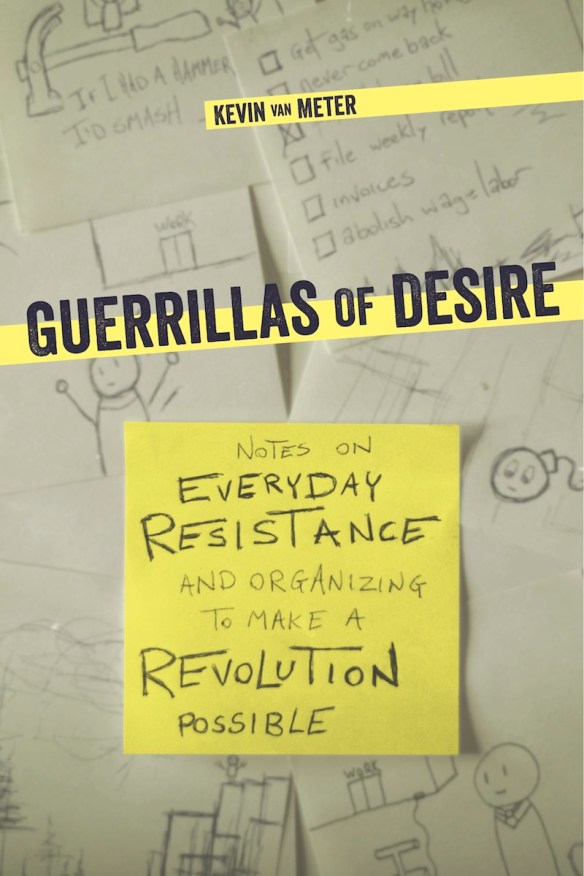
The Seeds of Anti-Capitalist Revolt Found in Everyday Resistance: A Review of Guerrillas of Desire – Notes on Everyday Resistance and Organizing to Make a Revolution Possible by Kevin Van Meter (AK Press, 2017)

By Scott Campbell

Source: Institute for Anarchist Studies

Back when I first began selling my labor for a wage in the wasteland of suburbia’s strip malls, I can recall the tedium of stocking shelves, summoning up insincere courtesy in the face of entitled customers and obnoxious bosses, comparing the stacks of money counted at the end of the day with the totals on our paychecks, and feigning adherence to whatever motivational façade management cooked up to mask the reality of our exploitation.

Yet I also remember, much more vividly and fondly, the latent and occasionally eruptive defiance among my co-workers. This included the constant collective complaining about the job, taking more and longer-than-approved breaks, working as little as possible, fudging time sheets, stealing, and the intermittent screaming matches with the boss in the middle of the store. Underpinning all these actions was an unspoken but broadly understood code of silence when it came to such transgressions and, when appropriate, expressions of support for them.

At the time, I didn’t think much about this, it was just how things happened and I’ve encountered similar experiences to varying degrees in every workplace since. Our actions weren’t guided by a political framework nor was there any attempt to organize them in a directed manner. It was more a spontaneous, innate reaction to experiencing the coercion of capitalism. I had cause to reflect upon this anew while reading Kevin Van Meter’s new book, Guerrillas of Desire: Notes on Everyday Resistance and Organizing to Make a Revolution Possible, published by AK Press and the Institute for Anarchist Studies.

In the preface, Van Meter observes that the question motivating him is not “What is to be done?” but “How do people become what they are?” Throughout the course of the book he seeks to provide an answer by locating power in the resistance of workers, apart from any political ideology or organization. Whether and how that inherently anti-capitalist refusal of work develops into revolt or rebellion are the questions he compellingly urges us to reflect and act upon.

To reach that point, Guerrillas of Desire ambitiously takes on multiple tasks that feed into and build on one another. Van Meter initiates a dialogue between anarchism and Autonomist Marxism that leads to a reconceptualization of the working class, bolstered in part by a historical accounting of workplace actions such as the ones I recounted. He labels these “everyday resistance,” committed by “guerrillas of desire,” and proposes a focus on those deeds as the entry point for organizing revolutionary resistance to capitalism. The impetus for this initiative, concisely carried out in under 160 pages, is his proposal that the current approach to organizing is conceptually flawed and therefore destined to fail. “Guerrillas of Desire offers a contentious hypothesis: the fundamental assumption underlying Left and radical organizing, including many strains of anarchism, is wrong. I do not mean organizationally dishonest, ideologically inappropriate, or immoral. I mean empirically incorrect” (13). The incorrect basis for current organizing is the assumption that the poor and working classes are unorganized and passive and that it therefore rests upon activists and organizations to educate and mobilize them for their own sakes. Van Meter instead proposes that there is in fact informal organization and resistance occurring, it is just of a sort that does not fit within the Left’s organizing vision and therefore goes unseen, unrecognized, and unincorporated into political theories, analysis, and action.

To provide a political frame for understanding the “everyday resistance” of the working class, Van Meter draws upon anarchism’s mutual aid – the material and emotional cooperation and reciprocal support that exists in societies – with Autonomist Marxism’s self-valorization – autonomous working class action that counters the state and capitalism, primarily the refusal of work in its myriad forms. Combined together and reinforcing one another, mutual aid and the refusal of work comprise the “everyday resistance” of the working class.

These phenomena also give definition to what is meant by “working class,” which Van Meter defines as “autonomous from both capitalism and the official organization of the Left, broadly including all those who work under capitalism, based in relationships between workers rather than as a structural component of the economy or sociological category” (32). Rather than being premised on income, occupation, or union membership, the working class under Van Meter’s formulation is made up of all those who must perform work under capitalism – be it waged or unwaged, in the factory, home, office, bedroom, affective, or social spheres. However, when they are not taking action in response to their subjugation under capitalism, these people are just workers. They become a class through the process of struggling against the conditions imposed upon them by capitalism. This struggle initially takes the form of everyday resistance based on mutual aid and the refusal of work. It is everyday resistance that unites individual workers as a class because such resistance, even when performed by one person, requires at a bare minimum the tacit complicity of co-workers and preferably their active collaboration.These acts and the social relationships they create and depend on lay the groundwork for the broader and overt organizing against capitalism more commonly interpreted as working class struggle. Using this framework as offered by Van Meter, we can understand the working class as composed of the relationships forged among workers actively in resistance against capitalism.Without anti-capitalist struggle, the working class does not exist.

After laying this theoretical groundwork, the bulk of the book traces the various forms of resistance by slaves, peasants, and workers in the industrial and social factories (the expansion of capitalist logic from the factory into society at large, in particular in service, immaterial, and reproductive work), creating a lineage and legacy of working class resistance against the various formations of capitalism that spans centuries. “Viewing the working class broadly to include slaves and peasants as well as students, homemakers, immigrants, and factory and office workers reveals the breadth of struggle and generalized revolt against work that continues to be imposed” (128). In doing so, Van Meter further builds the framework of the working class as being formed through its self-activity against the demands and deprivations of capitalism.

The historical survey brings the discussion into the present, where Van Meter offers a proposal to address his initial hypothesis that the Left is carrying out its organizing work in an incorrect way. His suggestion is for the organizers of today and in the future to begin their work by “reading the struggles” already underway in the form of everyday resistance. Through investigation and documentation by organizers, new relationships may be fostered with guerillas of desire that allow everyday resistance to expand into larger and more overt forms of autonomous anti-capitalist struggle. He proposes that the seeds of the new, liberatory worlds sought by anarchism and Autonomist Marxism are to be found in the everyday resistances that are already occurring rather than in the latest organizing manual or official Left strategy document..

While impressed after reading through this formulation, I was left with lingering questions. It remained unclear how, for instance, everyday resistance morphed into more overt, organized resistance and the part organizers positioning themselves as readers of struggle played in such a development. The personal anecdotes he provided on stepping back from ideological assumptions and reorienting towards the collective experiences of communities during his work in Long Island were helpful. It brought to mind the story of Marxist-Leninist intellectuals heading off to the Chiapan jungle with grand plans of starting a peasant guerrilla force. Only when they arrived, they found the population had no time or interest in their grandiose ideology. It was only when they dropped their assumptions and worked within the community to understand its needs, concerns and own history of resistance that the Zapatistas emerged. That, however, is a rather specific and exceptional example. I feel Van Meter’s proposal to begin organizing from within everyday resistance based on the notion that it will lead to more overt resistance could benefit from further articulation and direction.

Similarly, the focus on work as existing solely within the capitalist sphere left me curious as to his vision of the place of non-leisure activity under capitalism or even after capitalism. The refusal of the work that maintains capitalism is indispensable. Yet I would not advocate the refusal of work that maintains communal and personal well-being or builds autonomous organization, or writes books reviews in spare time, for example. Certainly, Van Meter would not advocate that either, but it remains a matter necessitating clarification and one that I believe extends beyond an issue of semantics.

Despite those questions, Guerrillas of Desire is aspirational in its scope and contains ideas and proposals worthy of consideration by radicals reflecting on how to engage in the current moment. In a time when mobilizing and organizing around class has fallen off the radar of many, it is a welcome reminder of the importance of paying attention to the working class and the integral role working class struggle plays in resistance to capitalism, alongside the currently more prevalent resistances to capitalist white supremacy, heteropatriarchy, colonization, environmental destruction and more.

Van Meter assists in this advocacy by accessibly presenting an updated Autonomist Marxist perspective of the working class, expanding it, breathing life into, and imbuing it with its own power, separate from both capitalism and the official Left. As such, he allows readers who may toil in a variety of ways under capitalism to see themselves within the working class, conceptualize their activities as part of a broader resistance with a rich history, and inspire them to build on that legacy.


Scott Campbell is a radical writer and translator based in California. He is part of the collectives that publish the websites El Enemigo Común and It’s Going Down. His personal site is fallingintoincandescence.com

Guerrillas of Desire is available here!


Counterculture: The Rebel Commodity

Screen-Shot-2013-09-23-at-2.48.39-PM

By James Curcio

Source: Rebel News

Let’s talk about being a rebel.

Everyone seems to want to be one. But it’s not entirely clear what it means. Does it take camo- pants? A Che T-shirt? A guitar? Is it just doing the opposite of whatever your parents did? “Be an individual, a rebel, innovate,” so many advertisements whisper. They’d have us believe that True Revolutionaries think different. They use Apple, or drink Coke. We signal our dissent to one another with the music we listen to and the cars we drive.

There’s something very peculiar going on here, something elusive and deeply contentious.

In the 1997 book, Commodify Your Dissent, Thomas Frank laid out a thesis that may appear common sense to those that have watched or lived in the commodified subcultures of the 90s, 00s, and beyond. A New York Times review comments,

… business culture and the counterculture today are essentially one and the same thing. Corporations cleverly employ the slogans and imagery of rebellion to market their products, thereby (a) seizing a language that ever connotes “new” and “different,” two key words in marketing, and (b) coaxing the young effortlessly into the capitalist order, where they will be so content with the stylishly packaged and annually updated goods signifying nonconformity they’ll never so much as consider real dissent — dissent against what Frank sees as the concentrated economic power of the “Culture Trust,” those telecommunications and entertainment giants who, he believes, “fabricate the materials with which the world thinks.” To have suffered the calculated pseudo-transgressions of Madonna or Calvin Klein, to have winced at the Nike commercial in which the Beatles’ “Revolution” serves as a jingle, is to sense Frank is on to something. (After reading Frank, in fact, you’ll have a hard time using words like “revolution” or “rebel” ever again, at least without quotation marks.)

The urge to rebel fuels the same system they ostensibly oppose. Whether it’s in arms trade, or far less ominously, manners of dress and behavior, there are dollars to be made fighting “The Man.” And maybe making money isn’t always an altogether bad thing. But it is certainly a complication, especially for those espousing neo-Marxists ideals.

As Guy Debord observed, “revolutionary theory is now the enemy of all revolutionary ideology and knows it.” Rebel movements are a counterculture, regardless of what they call themselves.

Rebellion is Cool

We’ll begin with a quintessential icon of the branded, shiny counterculture. The Matrix. We’ve probably all seen it. Even as an example it’s a cliché, and that’s part of the point. Here’s a framed sketch of the first movie, for those that haven’t: when it first ran, it was a slick take on the alienation most suburban American youth feel, packaged within the context of the epistemological skepticism Descartes wrestled with in the 17th century. Taken out of the cubicle and into the underworld, we witness the protagonist “keeping it real” by eating mush, donning co-opted fetish fashion, and fighting an army of identical men in business suits in slow motion. The movie superimposes the oligarchic and imperialist powers-that-be atop Neo’s quest of adolescent self-mastery. A successful piece of marketing — you can be sure no one collecting profits or licensing deals let their misgivings about “the Man” keep them from paying the rent.

This is not to point an accusatory finger, but rather to show the essential dependence of the counterculture upon the mainstream, because counter-cultures are not self-sustaining, and every culture produces a counter-culture in its shadow, just as every self produces an other. Any counterculture. Punk, mod, beatnik, romantic, hippy, psychedelic, straight edge, or occult. Even the early adopters of Internet culture started a group of outsiders that shared a collective vision,

The computer enthusiasts who could only dream of an open, global network in 1990 would go on to staff the dot-coms of the next decade. The closed networks that once guarded forbidden knowledge quickly fell by the wayside, and curiosity about computers could no longer be imagined a crime.

Our cyberspace today has its share of problems, but it is no dystopia — and for that, we must acknowledge the key part played by the messy collision of table-top games, computer hacking, law enforcement overreach and cyberpunk science fiction in 1990.

This article explores the strange history of Peter Jackson games, TSR, and the FBI. But it wasn’t the only one. Shadow Run, another popular cyberpunk RPGs of the 1990s, presented one of the more seemingly-improbable of cyberpunk futures, where you could play a freelancing mutant scrambling to survive in an ecosystem of headless corporations connected through cyberspace. Sound familiar? The Matrix just represented the final translation of these and similar fringe narratives into the mainstream.

Future vision has some effect on future reality, both in the identities we imagine for ourselves and the technologies we choose to explore. They almost always have unexpected consequences. Now we carry the networked planet in our palms, granting near instant communication with anyone, anywhere and anytime, and your intended subject isn’t always the only one listening.

We shouldn’t be surprised by this feedback loop. Without laying the material, mythic, and social groundwork for a new society, counterculture cannot be a bridge; it almost invariably leads back to the mainstream, though not necessarily without first making its mark and pushing some new envelope.

This even presents something of a false dichotomy — that old models of business can’t themselves be co-opted by countercultural myths. Yesterday’s counterculture is today’s mainstream. What better way to understand the so-called revolution of iPads or social media?

Our cultural symbols and signifiers are never static. Psychedelic and straight edge can share the same rack in a store if the store owner can co-brand the fashions, and people can brand themselves “green” through their purchasing power without ever leaving those boxes or worrying about the big picture. AdBuster’s Buy Nothing Day still capitalizes on the “rebel dollar.”

Rebellion is cool.  “Cool” is what customers pay a premium for, along with the comfort of a world with easy definitions and pre-packaged cultural rebellions. This process itself isn’t new. The rebel or nonconformist is probably a constitutive feature of the American imagination: original colonies were religious non-conformist, the country was founded by rebellion, the frontier, the civil war, the swinging 20s, Jazz, James Dean, John Wayne, Elvis, the list goes on. The non-conformist imagination is as paradoxically and problematically American as cowboys and indians, apple pie and racism.

The territory between aesthetic, ideals, and social movement is blurry at best. But the most well-known expression of this trend in recent history is the now somewhat idealized 1960s, a clear view of which has been obscured through a haze of pot-smoke and partisan politics. Though this revolution certainly didn’t start in the 1960s, there we have one of the clearest instances of what good bed-fellows mass advertising and manufacturing make when branded under the zeitgeist of the counterculture.

When people bought those hip clothes to make a statement, whose pockets were they lining? It’s a revolving door of product tie-ins, and it all feeds on the needs of the individual, embodied in a sub-culture. The moment that psychedelic culture gained a certain momentum, Madison Avenue chewed it up and spit it back out in 7up ads. That interpretation of what it meant to be a hippie, a revolutionary, became an influence on the next generation. The rise of Rolling Stone magazine could also be seen as an example of this — a counterculture upstart turned mainstream institution.

While advertising and counterculture get along just fine, authenticity and profit often make strange bedfellows. But they aren’t necessarily diametric opposites, either. As movements gain momentum, they present a market, and markets are essentially agnostic when it comes to ideals.

There are many examples of how troubled that relationship can be. The Grunge movement in the 90s, before it was discovered, was just a bunch of poor ass kids playing broken ass instruments in the Pacific Northwest. This was the very reason it struck disenfranchised youth — the relationship between those acts and the aging record industry in many ways seemed to reflect the relationship of adolescent Gen Xers with their Boomer parents. They retained the desire to “drop out,” as Timothy Leary had preached to the previous counterculture generation of Laguna Beach and Haight Ashbury, but without the mystical optimism of “tuning in.” Hunter S Thompson maybe presaged this transition in the quotation from Fear and Loathing In Las Vegas that’s now rendered famous to the kids of 90s thanks to Terry Gilliam’s film adaptation,

We are all wired into a survival trip now. No more of the speed that fueled that 60’s. That was the fatal flaw in Tim Leary’s trip. He crashed around America selling “consciousness expansion” without ever giving a thought to the grim meat-hook realities that were lying in wait for all the people who took him seriously… All those pathetically eager acid freaks who thought they could buy Peace and Understanding for three bucks a hit. But their loss and failure is ours too. What Leary took down with him was the central illusion of a whole life-style that he helped create… a generation of permanent cripples, failed seekers, who never understood the essential old-mystic fallacy of the Acid Culture: the desperate assumption that somebody… or at least some force – is tending the light at the end of the tunnel.

I don’t think it’s a great stretch to imagine the suddenly-famous bands of the Grunge era as a part of this same legacy. Alice In Chains or Nirvana songs about dying drugged out and alone weren’t oracular prophecy, they were journal entry. And it became part of the allure, because it too was “authentic.” The greatest irony of all was that the tragic meltdowns and burn outs that followed on fame’s heels became part of the commodity. (Not that this vulture economy is new to tabloids).

Our narratives about authentic moments of aesthetic expression or innovation often depict them like volcanic eruptions: they build up and acquire force in subterranean and occluded environments, before erupting in a momentary and spectacular public display of creativity. It is telling that this quote from On The Road has become so popular, very likely cited in the papers and journals of more rebellion-minded American teens than any other from that book, “… The only people for me are the mad ones, the ones who are mad to live, mad to talk, mad to be saved, desirous of everything at the same time, the ones who never yawn or say a commonplace thing, but burn, burn, burn like fabulous yellow roman candles exploding like spiders across the stars.”

Hendrix, Joplin, Morrison, Cobain… the 27 Club is big. And quite a few more could be added if it was “the 20-something club.” Are the public self destructions of so many young, creative minds informed by this myth, or do they create it?

Maybe a bit of both. The Spectacle, in the sense Guy Debord uses it, disseminates its sensibilities, styles — a version of the truth. The particular moves ever toward the general, as facts gradually turn to legend and, eventually, myth. Mainstream appropriation is the process in which aesthetic movements affect broader society and culture. The ideals need a pulpit to reach the people, even if invariably it is fitted with guillotines for the early adopters once that message has been heard.

YOUR FATASS DIRTY DOLLAR

A message is a commodity, or it is obscure. Capitalism survives so well, in part, because it adapts to any message. If we instead think counterculture is an ideal that exists somehow apart from plebeian needs like making money, then countercultures will forever hobble itself. It doesn’t matter that these ideologies have little in common. It is the fashion or mystique that gets sold. Anti-corporate ideology sells as well as pro-. When all an ideology really boils down to is an easy to replicate aesthetic, how could they not?

Where do we draw the line between idealism and profit? The question is how individuals utilize or leverage the potential energy represented by that currency, and what ends it is applied to. Hard nosed books on business by the old guard, such as Drucker’s Management: Tasks, Responsibilities, Practices say exactly the same thing, in a less epigrammatic, Yoda-like way: profit is not a motive, it is a means. This much, at least, doesn’t change with the changing of the (sub)cultural tides. Within our present economic paradigm, without profit, nothing happens. Game over.

Those who position themselves as extreme radicals within the counterculture framework just  disenfranchise themselves through an act of inept transference, finding anything with a dollar sign on it questionable. To this view, anyone that’s made a red cent off of their work is somehow morally bankrupt. This mentality generally ends one way: howling after the piece of meat on the end of someone else’s string, working by day for a major corporation, covering their self-loathing at night in tattoos, and body-modifications they can hide. That is, unless they lock themselves in a cave or try to start an agrarian commune. None of this posturing is in any way necessary, since business rhetoric itself has long since co-opted the countercultural message. For instance, this passage from Commodify your Dissent,

Dropping Naked Lunch and picking up Thriving on Chaos, the groundbreaking 1987 management text by Tom Peters, the most popular business writer of the past decade, one finds more philosophical similarities than one would expect from two manifestos of, respectively, dissident culture and business culture. If anything, Peters’ celebration of disorder is, by virtue of its hard statistics, bleaker and more nightmarish than Burroughs’. For this popular lecturer on such once-blithe topics as competitiveness and pop psychology there is nothing, absolutely nothing, that is certain. His world is one in which the corporate wisdom of the past is meaningless, established customs are ridiculous, and “rules” are some sort of curse, a remnant of the foolish fifties that exist to be defied, not obeyed. We live in what Peters calls “A World Turned Upside Down,” in which whirl is king and, in order to survive, businesses must eventually embrace Peters’ universal solution: “Revolution!”

“To meet the demands of the fast-changing competitive scene,” he counsels, “we must simply learn to love change as much as we have hated it in the past.” He advises businessmen to become Robespierres of routine, to demand of their underlings, “‘What have you changed lately?’ ‘How fast are you changing?’ and ‘Are you pursuing bold enough change goals?’” “Revolution,” of course, means for Peters the same thing it did to Burroughs and Ginsberg, Presley and the Stones in their heyday: breaking rules, pissing off the suits, shocking the bean-counters: “Actively and publicly hail defiance of the rules, many of which you doubtless labored mightily to construct in the first place.”

Growth on its own is never a clear indicator that the underlying ideals of a movement will remain preserved. If history has shown anything, it is that successful movements spread until core message becomes an empty, parroted aesthetic, as with most musical scenes and their transition from content to fashion; or that core is otherwise so emphasized that the meaning within is lost through literalism, as we can see in the history of the world’s major religions. One version of early Christian Gnostic history — of “love thy neighbor,” “all is one,” and scurrilous rumors of agape orgies — were replaced by the Roman Orthodoxy and the authority provided through the ultimate union of State and Religion. The hippies traded in their sandals and beat up VWs for SUVs and overpriced Birkenstocks. The relationship between ideology and act is far to complicated to enter into here, but the counter-history of Communism when viewed against the backdrop of Marxist ideals is perhaps equally insightful.

Enantiodromia, the tendency of things to turn into their opposites, is as much social observation as psychological. It oftentimes seems that succeeding too well can be the greatest curse to befall a movement. When the pendulum swings far in one direction, it often turns into its opposite without having the common decency to wait to swing back the other way.

As we’ve seen, this was part of the supposed downfall of counterculture in capitalism: “suits” decided they could deconstruct an organic process and manufacture it. They could own it from the ground up.

But this isn’t necessarily so. The branding of Cirque Du Soleil points toward a third option — arts movements will be dissected in the jargon of marketing, and they must succeed on those grounds to be taken seriously or accomplish anything.

Burning Man isn’t suddenly opening its gates to the wealthy. Yacht Communism has been a part of that movement ever since it gained some mainstream appeal, likely before. Seen as an arts and cultural movement, it has been vastly successful. Seen as an example of how to create a true egalitarian society, it would be an utter failure. But that was never the point.

Two weeks at Burning Man might be fun, even transformative, but spend two years there and you’d find out what hell is like.