The Duran’s Alex Christoforou: Treating Russia As The ‘Bogeyman’ Has Failed

russia_wants_war_look_how_closely_they_put_country_to_our_military_bases

By

Source: MintPress News

ATHENS — So-called “fake news” has been in the news in recent months, and this debate over what is and what isn’t legitimate news reflects the political divisiveness that is increasingly prevalent in the United States and in Europe.

Like MintPress News, another website which was accused of purveying “fake news” is The Duran, a recently-launched website which offers perspectives and analysis on geopolitical issues which are frequently not found in mainstream U.S. and European media.

As the news cycle moved at lightning speed in recent months, MintPress had the opportunity to conduct a series of interviews with Alex Christoforou, one of the co-founders and writers for The Duran. In this wide-ranging interview, Christoforou discusses Trump’s election, foreign policy rhetoric and maneuvers thus far, the Russian reaction to the NATO buildup along its border, the anti-Russian sentiment in the U.S. political arena and mass media, developments in Syria and the Ukraine, the recent Cyprus reunification talks which were held in Geneva, the role of Turkey in the region and Turkish relations with the U.S. and Russia, the Trump administration’s support for “Brexit” and the possibility of a “Grexit,” the accusations of “fake news,” and more. These interviews first aired on Dialogos Radio in January and February.

MintPress News (MPN): President Trump has spoken out in favor of improved U.S. relations with Russia and with Vladimir Putin. Do you believe that Trump will make good on this pledge, in light of the challenges he is facing?

Alex Christoforou (AC): That’s an interesting question, and I think that’s something that everyone’s debating right now, how sincere he is in creating an atmosphere of detente between the U.S. and Russia. The first thing is that Obama was absolutely terrible for U.S.-Russia relations. He pretty much threw the whole relationship back into the Cold War era. Trump has got a lot of ground to cover, and there’s a lot of forces at work right now which are adamant about not having Trump create an atmosphere of detente with Russia. So Trump is really in a tough position here, especially given the initiatives that the Obama administration took up, which was really an effort by the outgoing administration to box Trump in.

They’ve created a hysteria of Russian hacking which has no evidence whatsoever, no evidence has been presented to the public at all. You have various media outlets really publishing a lot of fake news about Trump’s relationship with Putin and Russia. The fact is that Trump has never even met Vladimir Putin. So you have this interesting dynamic; if Trump does approach Russia with a much friendlier foreign policy and a much more workable foreign policy, right away Trump is going to be labeled by the mainstream media, the establishment media as a Putin stooge, as a Kremlin stooge, as a Russian “useful idiot,” and they’re going to point fingers and say, “Look, we told you so, Trump is the Manchurian candidate of the Kremlin.” It’s all absolutely ridiculous, to be honest.

My opinion is, sure the Kremlin was relieved to have Trump win the presidency, but not for the reasons that people think. Putin has made no secret of the fact that he wants a good partner in the United States and that the last eight years, especially the second term of Obama, have been very tense between Russia and the U.S. So Putin is probably looking forward to having a world leader that he can speak with on equal terms. Obama definitely was not that world leader. Without a doubt, Obama and Putin did not get along.

I think from that standpoint, Russia understands that in Trump they may have a leader that they can speak with. On the other hand, there’s this misconception that Russia was happy to see Hillary Clinton lose. This is false. Yes, Hillary Clinton was a dangerous prospect for a U.S. president. She was very bullish, very much a war hawk on Russia, especially with regard to Syria and the Ukraine, which are two geopolitical regions that are extremely important to Russia. But saying that, Putin definitely got the best of Obama on just about every single foreign policy initiative that the two countries faced in the last eight years. So the Kremlin pretty much knew that it if was going to be four years of Hillary Clinton, it would be a very easy go as to dealing with the U.S. on various challenges that the two countries faced.

On the one hand, I think they’re looking forward to Trump, and speaking with a world leader that they could work with. On the other hand, I think there’s a big part of Russia and a big part of the Kremlin that says, “We really ran over Obama pretty easily,” as far as geopolitics is concerned, and Hillary Clinton likely would have been a lot easier of an opponent to deal with. Will Trump stand by his word? I think he will. He’s a negotiator and I think he’s going to want to do deals.


MPN: The Trump administration’s foreign policy could be characterized as contradictory thus far, with this opening toward warmer relations with Russia on the one hand and an increased rhetoric against Iran on the other hand. Where do you believe these foreign policy contradictions can lead?

AC: I don’t think anybody knows yet where it could lead. Certainly we are seeing a change. On the one hand, we see that Trump would like better relations with Russia, which is what he was saying during his campaign as well. However, the mass media and most politicians from both sides of the aisle are quite hostile toward Russia. Trump has continued to maintain, however, that he desires good relations with Putin’s government. On the other hand, we see that Iran has taken over the “bogeyman” role which Russia held during the Obama administration, and it is evident that the Trump administration wants to do something about Iran. What this something will be, we don’t know just yet. The Trump administration is acting in a hostile manner toward Iran, including President Trump himself and [Secretary of Defense James] Mattis. Until now, we haven’t seen any concrete actions, other than a reinstatement of certain sanctions. But I do fear what action the Trump administration might decide to take against Iran. We will just have to see.

I do think that Trump, so far, is testing the waters, and it is clear that he does want better relations with Russia, while with Iran he is not following the same path as Obama. What these changes will be though and what policies will be adopted is not yet certain. It is still early, though, and much can change.

I think you definitely have a Cabinet that’s got mixed feelings about Russia, a Cabinet that’s very deep in its military experience. That could be seen as a good thing or a bad thing. One thing that military people seem to understand is the price of war and the risks of war, and that’s a good thing. They’re just not flippant about going into war because they understand what’s at stake and the human tragedy of war. On the other hand, military Cabinet picks tend to be a lot more hawkish and a lot more eager to project America’s military superiority.

I don’t agree with all of Trump’s Cabinet selections, but I think the most significant selection of all is that of Secretary of State Rex Tillerson. The Obama administration and Hillary Clinton and John Kerry left behind so much chaos, so many problems that Tillerson really has his work cut out for him. It’s not just Russia, but Syria, the Ukraine, Libya, ISIS, China, and Iran. For the first time, though, a successful businessperson will be in charge of the State Department, and it will be interesting to see which policies he will enforce.

I think at the end of the day, Trump will await people’s opinions, but I think the buck will stop with him. At least that’s the impression that I get as to what type of leader he will be. I think all the decisions will begin and end with his final word. It’s going to be a wait-and-see, but all signs show that he’s going to take a very CEO type of approach to running the country.


MPN: Do you believe that the fierce backlash that the Trump administration has faced is precisely a result of this desire for developing better relations with Russia?

AC: Yes, of course. That’s part of it. This panic over Russia began with Obama, continued with Hillary Clinton, and it seems that all of Washington, all of the advisers and certainly all of the media, are trying to undermine any efforts toward achieving detente between the two countries. My opinion is that this is an effort to smear Trump and to claim that he is unfit for the presidency.

For the time being, I don’t think we will see a significant shift in U.S.-Russia relations. I think we’ll be in a better position to judge things after six months or a year of the new administration. For now, the Russia hysteria has been thrust to the forefront to cast a negative cloud over Trump. However, the average American does not care about what’s happening with Russia. They are concerned with jobs, jobs, jobs. That is how they will evaluate the Trump administration and the new president. I think that this tactic of blaming Russia for everything and casting Putin as the bogeyman has failed, as proven by the election result itself, and I think it will continue to fail. The American people don’t care about what’s happening with Russia. They care about what’s happening at home.


MPN: Where do you believe all of the anti-Russian fearmongering can ultimately lead?

AC: It can lead to a hot war. It definitely has led to a cold war. The last thing we want is a hot war. You have two nuclear powers who are inching closer to each other in conflict, and I think that needs to be scaled back, and scaled back right away. I think we’ve already seen various proxy wars between the U.S. and Russia take place. We saw it in the Ukraine, we saw it in Syria. We already see the two sides engaging with each other, though they’re not engaging directly with each other. NATO troops moving up to Russia’s border is very provocative. We should never forget that the last time forces amassed on Russia’s border was during World War II, and during that war we cannot forget that Russia lost 28 million people. They paid a very, very heavy price for defeating Nazi Germany on the Eastern Front. So if there’s one thing that there’s any red lines that Russia is very firm about, it’s about having troops amassed on their border, and the other red line was about having any countries that are bordering them, for example the Ukraine, be integrated into NATO. These are red lines that Russia has been very firm in saying may not be crossed.

Saying that, Trump has really got to scale back the aggressive posturing of Obama. The media has helped to portray Russia as the aggressor, but when you take a step back and see who has provoked all the conflict in the various hot spots of the world, Russia has been very reactionary. The Ukraine was a coup d’etat. The U.S. and the European Union overthrew a democratically-elected government. That’s a fact. It’s indisputable, and that coup d’etat was initiated by [Assistant Secretary of State] Victoria Nuland and Ambassador [Geoffrey] Pyatt in Athens. This coup d’etat was instigated by a neoconservative faction in Washington. They put in place a far-right government, and some factions of that far-right party are openly fascist and neo-Nazi, and Russia reacted. Syria is the same thing. In Syria, you see a situation where the United States, with the help of Turkey, Saudi Arabia, and Qatar, went to overthrow a secular sovereign leader, once again, internationally recognized by the United Nations. They went to overthrow that leader, and they created chaos. Russia, once again, reacted to that, to the facts on the ground, and you have what’s been a complete disaster in Syria.

You have a very deep state and neocon faction in the U.S. that’s combined forces with this Hillary Clinton-neoliberal faction to create a lot of tension between U.S.-Russia relations. You have the mainstream media, which was in the tank with the neoliberal Hillary cabal from the get-go, fueling the fires of Russian hysteria, but the situation is anything but Russia being the aggressor. Russia has actually reacted to the facts being created by these neoconservatives and neoliberals that have really just run roughshod over the world disastrously, in Syria, in Libya, in Somalia, in Iraq, in Afghanistan, in the Ukraine. It’s been one disaster after another, and Putin has been very correct in really castigating the United States and saying, during his U.N. speech, “Do you realize what you’ve done?” That’s a profound statement, in telling the world this cannot continue, this regime change policy, this constant war-like attitude toward the Middle East has to stop, otherwise we’re going to turn a cold war and various proxy wars into hot war. The mainstream media is not helping, that’s for sure.


MPN: Recently, NATO forces have been mobilized in Germany and in Eastern Europe, the Russian ambassador to Turkey was murdered and the Russian ambassador to Greece lost his life under unclear circumstances. We had the Russian diplomats that were expelled from Washington in the final days of the Obama administration, and of course the accusations of Russian hacking and meddling in the U.S. elections. How has Vladimir Putin responded to all of this, in your view?

AC: Brilliantly, I think. Vladimir Putin’s response to all of this has really been wait-and-see. He was well within his diplomatic range and his diplomatic standing to retaliate against Obama’s kicking out of the 35 diplomats and the closing down of the two Russian locations in the U.S., but he didn’t. He took a very smart attitude of “Obama is gone in two or three weeks, let’s wait and see what Trump says and what Trump does when he comes into office.”

It was, in my opinion, such childish behavior from Obama toward Trump and toward the transition. Obama should not have been doing these things. It was very childish of him, and I think he lost a lot of respect from a lot of people on the world stage, as just being a very spiteful and childish world leader. He should not have taken these actions against Russia with only two, three weeks left in office. He should not have tried to sabotage Trump’s transition, and he should have really worked with the Trump administration to create a smooth transition.

The diplomat that died in Greece was actually a very underreported news story. Very, very few mainstream media outlets even picked up on that story, and it was, from what I’m seeing in the Greek media that’s reporting on it, under very unclear, very suspicious circumstances. No one really knows much about it. So that was an interesting story that was not picked up.


MPN: On the part of Russia, we have not seen much of a response to new Ukrainian attacks against the Donbass. What is the Ukraine trying to achieve, and why has Russia seemingly not responded?

AC: It’s very simple. The Ukraine is one of the problems that was created by Obama, Hillary Clinton, John Kerry, Victoria Nuland, and the EU. Let’s not forget that they overthrew the Ukrainian government. This was an illegal and provocative action, and in any event, the Ukraine was scheduled to hold elections the following year. There was no need for the U.S. and the EU to undertake this action against the Ukraine, the Ukrainian people, and against Russia, but they did so.

Now, I believe that the Ukraine is trying to start a new conflict and to once again draw attention to itself, because Kiev fears that Trump does not care much about the Ukrainian issue. I think Trump has shown this thus far. Trump recently spoke with Ukrainian President [Petro] Poroshenko, and it was the first time that the U.S. president did not use the phrase “Russian aggression toward the Ukraine,” which Obama would repeatedly state. Trump said that a solution has to be found for the Ukraine, that the two sides need to sit at the same table. This rhetoric was much different from that which was employed by Obama all these years, and I think the Ukrainian authorities are in shock. I detect some panic on their part, but instead of trying to find a solution to this problem, they are going in the opposite direction and trying to provoke a new conflict, hoping that the U.S. will intervene and side with them and that this will undermine the positive relations that Trump is seeking to develop with Putin. This is an incorrect strategy and it will not succeed. Europe cannot handle a war in the Ukraine. I think German Chancellor Angela Merkel understands this and Putin clearly stated this to her, that the Ukrainian government must halt these actions and sit at the negotiating table again and enforce the Minsk Protocol.

For the time being, I think Russia is holding steady with regard to the Ukraine and won’t make a move, because Russia knows, as does the EU, Merkel, and Trump, that the Ukraine is in a difficult situation. It’s a failed state. The efforts of the Obama administration and the EU in the Ukraine have failed, the Ukraine can’t handle any more. It is a corrupt state, its people are suffering, their current government is facing tremendous difficulties, and I think it’s a matter of time before we see major changes in the Ukraine.


MPN: What is the situation on the ground in Syria presently, how is Russia currently involved, and what might we expect to see from the Trump administration with regard to its policy toward Syria?

AC: In Syria you had a situation where Russia came in and they pounded the hell out of ISIS and al-Qaida. Al-Qaida, a.k.a. al-Nusra [Jabhat al-Nusra, the former name of the group now known as Jabhat Fateh al-Sham], a.k.a. the “moderate rebels” that the mainstream media seems to love, were lumped in along with ISIS as terrorist groups, which they are. Russia did not separate the two, and they took over military operations within that country along with Iran and the Syrian army. They defeated these terrorist organizations in Aleppo, and they liberated and gained control of the city. The people in Aleppo were extremely happy, they were celebrating. These are things that were not reported in the establishment media. All the reports were saying that [Syrian President Bashar] Assad was going to Aleppo and burning people. These reports have been proven to be 100 percent false. Aleppo is now under the sovereign, internationally-recognized control of the Syrian government, and now that they have control of the major cities in Syria, you’re going to see a campaign to push ISIS, al-Qaida, and al-Nusra out of the country.

Russia has now worked with Turkey to hammer out a ceasefire plan and a plan toward peace. Interestingly enough, the United States was left out of this deal. This was a huge blotch on Obama’s foreign policy record. Here, you have for the first time other powers in the region — Russia, Turkey, Iran — actually hammering out a peace deal without the United States. For Obama and John Kerry, this was probably the lowest point in their foreign policy record over the past eight years. Not only did they destroy a secular, internationally-recognized country, a secular nation that gave women rights, that gave freedom of religion to the all the people, that had health care, that had university education for all, they destroyed that country by trying to move it into the hands of al-Qaida/al-Nusra. But they also were pushed out of the peace plan for that country.

After Aleppo was liberated, I don’t see many people talking about Syria any longer. This was followed by Russia, Iran, and Syria working together to draft a new constitution, without American input, and to try to achieve a solution for Syria, again without U.S. involvement. This is significant. Now, with Trump, we just have to wait and see what his stance toward Syria will be. One thing is certain, though: Trump does not view Assad as the problem. He views ISIS as the problem, and I believe he will be able to collaborate with Russia to fight ISIS wherever it exists. For the time being, I wouldn’t say that the situation in Syria has calmed, it is still an ugly situation there, but there are efforts being made to find a solution. I think this solution will come from the defeat of ISIS and from Assad staying in power. This is clear. Assad is going nowhere.

I just want to make one more note, as far as the way that the press and the media has been covering this war. It was not a civil war. What happened in Syria was an invasion. It was an invasion of foreign jihadist, Wahhabi, ISIS, al-Qaida, al-Nusra forces, and they destabilized the nation and destroyed what was one of the few secular, stable nations in the region. This is a huge point. It’s very, very good that Syria did not go the way of Libya. Hopefully, the Syrian people can get rid of ISIS, can get rid of al-Qaida’s foreign invaders, and can get back to being the secular and peaceful nation that they were. It’s been a disastrous six years for the Syrian people.


MPN: In the closing days of the Obama administration, outgoing Assistant Secretary of State Victoria Nuland was dispatched to broker a solution regarding the divided island of Cyprus. Who is Victoria Nuland and what was her role in the Ukraine?

AC: She overthrew the government, plain and simple. I mean, we have it on tape. Do we not have her calling the ambassador to the Ukraine at that time, Geoffrey Pyatt, pretty much telling him who’s going to be in government? They were going over all the government appointees, they said the famous words about the EU, and the people that they talked about being placed into government were the people, in fact, that were placed into government. Victoria Nuland overthrew a democratically-elected government.

The previous government, as corrupt as it may have been or as unpopular as it may have been by 50 percent of the population that saw it in unfavorable terms, was still a democratically-elected government. Ukraine was going to have elections in a years’ time anyway, so what happened in the Ukraine was extremely regretful. It was the most blatant and obvious coup d’etat that has happened in probably the last 100 years.

[Author’s Note: The husband of Victoria Nuland, Robert Kagan, is a senior fellow with the Project on International Order and Strategy in the Foreign Policy program at the Brookings Institution, and the self-described “liberal interventionist” is widely regarded as a leading neoconservative.]


MPN: Victoria Nuland was one of the major players in these talks, which were held in Geneva in January, regarding the potential reunification in Cyprus. What was the outcome of these talks?

AC: If there’s one person that has taken the Cyprus reunification talks very seriously from the U.S. side, it has been Joe Biden. He’s shown a very big interest in solving the Cyprus problem. Joe Biden, as a politician, has always historically been very warm with the Greek-American population, and he seems to take Greek foreign policy issues very much to heart. Victoria Nuland has shown an interest in solving the Cyprus problem, though I would caution that Victoria Nuland does not seek a solution because she wants to create peace within the island of Cyprus. She sees things more from a geopolitical standpoint, of making sure that Cyprus is aligned with Western Europe, with NATO, and used as very much a geopolitical tool against Russian influence within the region.

The players involved in solving the Cyprus issue are, of course, the Greek Cypriots and the Turkish Cypriots, and along with them are the three guarantor states, which are the United Kingdom, Greece, and Turkey. For this solution to crystallize, it’s my belief that the framework of having a “guarantor nation,” in other words, to guarantee the peace on the island between the two communities, those guarantor nations have to be removed. That means that the 40,000 Turkish soldiers stationed on the island obviously have to leave, the Greek soldiers that are stationed on the island have to leave, and Cyprus has to find its path toward being a unified nation.

The negotiations right now are taking place between the two communities, the U.N. is very actively involved, and we’re very close to hammering out a deal between the two communities. The guarantor nations — Turkey, Greece, and the United Kingdom — will most likely be called in to oversee and to weigh in on whatever deal is finalized between the two sides. I believe that the concept of having “guarantor states” of a sovereign nation is going to be a thing of the past, and I think Cyprus will be a sovereign nation, not a divided island anymore. Victoria Nuland is out, so whatever influence she had in the negotiation process is all but over. Rex Tillerson, as the new Secretary of State, will take over from here on out, and we’ll see how engaged [the U.S. is] or how disengaged it is. We’re very close, and we’ll see how things play out. There’s a few issues at hand that they have to hammer out, very sticky issues, very tough issues, but we’re very, very close to seeing a unified Cyprus.

Saying that, what you’re looking at is a bi-zonal, bi-communal federal state, so you’ll have one country, but you’ll have a two-state solution. Each state will have its laws and certain powers to govern their side of the island, but you will also have one executive branch, which will also govern the island as a whole; a whole member of the international community, of the EU, of the U.N. You’re really looking at a “United States of Cyprus,” and that’s the solution that will most likely be brought to the table.

Regarding the talks, I think that Turkey got what it was looking for — namely, for nothing significant to happen with the Cyprus issue until the Turkish constitutional reforms have been passed. Until then, I believe talks will proceed slowly, step by step, but we won’t see any significant developments until Turkey is ready. Until then, we will only see minor developments. I foresee we will see more developments toward the summer, beginning in May and June and thereafter. Everything, however, will depend on Turkey, and I think that Turkey is not yet ready to express a clear position on the Cyprus issue.


MPN: Where do things stand at the present time with regard to Russian-Turkish relations? Is Turkish president Recep Tayyip Erdogan once again turning away from the U.S./NATO/EU sphere and moving toward Russia?

AC: That’s a good question. Erdogan, he’s something else. I think Erdogan is a survivor, he’s extremely controversial, he’s a very tough person to deal with both for the Russians and for the Americans. There’s no doubt that Erdogan has been hot and cold with Russia. They’ve had huge moments of disparity and very tense moments in recent months, but they’ve also found ways to bridge those gaps and to move past those tense moments. The same holds true with the United States. Erdogan has been playing the U.S. hot and cold as well for the past six months to a year.

I would say, two or three years ago, Erdogan had a vision of a “grand Ottoman resurgence,” a grand Ottoman empire in which Turkey would have influence over Syria, over Iraq, etc. I think now Erdogan has been forced to scale that vision down, and I would say that now Erdogan’s number one concern is the Kurds in the north of Syria. His number one foreign policy initiative is that he cannot allow a Kurdish state to form in the north of Syria and the north of Iraq. That would be disastrous for Turkey and would probably lead to the breakup of Turkey, given that Turkey has, I believe, an estimated 15 million Kurds who reside in the borders of the Turkish state. Having any type of autonomous Kurdish region in the north of Syria and the north of Iraq would be a red line that Erdogan would caution both the United States and Russia cannot be crossed.

Erdogan has scaled back his grand Ottoman vision and is now looking more to consolidating his power in Turkey and making sure that the Turkish state remains intact, without any Kurdish interference. Russia, with regard to Turkey, it’s been hot and cold in recent months, but they keep the channels of communication open. The relations are not the same as they were five to ten years ago, but they are steady, and Russia and Turkey are collaborating on Syria and have found some common ground on this issue. The same holds true for the United States. Erdogan is not an easy world leader to deal with. That’s just a fact.

I believe that Turkey is waiting for the constitutional reforms to pass, so that Erdogan attains absolute power. Until then I don’t believe we’ll see significant developments coming out of Turkey, and I think everyone is waiting to see what policy Trump and Rex Tillerson will adopt toward Turkey. I think we’ll see Turkey take an active role again in about six months. It will not make any moves until Erdogan attains absolute power. We will likely see some adverse developments, perhaps even some positive ones, but we will just have to wait and see.


MPN: Recently, we have seen an increase in Turkish belligerence toward Greece. Do you believe that Erdogan is angling toward fueling a conflict with Greece?

AC: No. There is no chance of such a development. I don’t believe we’ll see anything happen with Turkey. Erdogan, of course, will remain Erdogan. He’ll do what he does, he’ll be provocative toward Greece, Syria, NATO, and Cyprus. But I do not think we’ll see anything major happen until Erdogan attains full control. Turkey is slated to hold a referendum on constitutional reform in April, and in the new system the president will hold absolute power. In other words, we’ll be talking about “Sultan Erdogan” in a couple months’ time. Until this happens, nothing of significance will come out of Turkey. Erdogan will continue to be provocative, that’s his style, but we won’t see anything more until the constitution is changed and power is concentrated in his hands.


MPN: The Trump administration seems to have adopted a positive stance toward Brexit, while Trump’s nominee for the U.S. ambassadorship to the EU, Ted Malloch, has made a series of interesting statements recently, stating that the eurozone is headed toward collapse and predicting that Greece will unilaterally depart from the eurozone. What position do you believe we will see from the Trump administration going forward with regard to the EU, the euro, and issues like Brexit and Grexit?

AC: I think that Malloch and the Trump administration view Brexit positively. I believe that following Brexit, Trump will draw Britain closer to the U.S. sphere and put them against EU interests. Let’s not forget that Trump is a businessman and he is looking for certain things from Europe and from NATO members. He’s been clear about this, and I think he will use the United Kingdom, post-Brexit, to get what he wants from Europe, and in a manner which favors the interests of the United States. That’s how Trump operates; he’s a businessman above all.

Regarding Europe, the EU is doing a fine job destroying itself without the assistance of the United States, Trump, or Brexit. The EU, on its own, has managed to be a dysfunctional institution and European officials are performing a “miracle” in managing to destroy the EU from within. It’s nonsense for Brussels to blame Trump and Brexit for the EU’s problems, when Brussels is managing quite nicely on its own to destroy the EU. The EU has no one to blame but itself.


MPN: It’s been two years since the Syriza government took over power in Greece. How do you evaluate the current situation in the country and the first two years of Syriza’s reign in office?

AC: I think that it’s been terrible. Greece has been in an eight or nine year period of slow suffering. We’ve seen the country hollowed out economically and socially. It’s been just an economic crisis that seems to be never-ending, and you see it on the ground when you’re in Athens. The shops are closing, the people really have very, very few options as far as employment and earning an income. The Syriza government, in my opinion, has done everything in its power to make sure that the public sector is okay but the private sector is just marginalized and, I would say, almost demolished. The taxes have just become so sky high that it’s just destroyed any form of entrepreneurship, any form of desire within the people to start businesses, to run a business, because you just can’t pay the high taxes to keep that business open.

It’s not looking good for Greece, and they definitely need to figure out a way to either remove themselves from the euro and find a way to get back to some sort of economic sustainability, or they need to find a way to get that €350 billion debt wiped off the books, and that’s not going to happen. Germany has been very firm on their stance over the debt. But as long as that debt is hanging over the Greeks’ heads, that situation will never improve. It just cannot, it’s fiscally impossible.


MPN: Let’s talk about the site you write for, The Duran. This is a new online news initiative and you are one of its co-founders. Share with us a few words about it.

AC: The Duran is a publication that we started about eight or nine months ago. Myself, Peter Lavelle, Alexander Mercouris and Vladimir Rodzianko are the co-founders of The Duran, and we take an approach to geopolitics and news from a realpolitik standpoint. In other words, we try to see things from a very logical standpoint. The site is not about feel-good values and what should be right and what should be wrong. It takes a look at news from a perspective of how the world is and from the perspective that nation-states have interests, nation-states approach each other with those interests in mind, some states are big and powerful, some states are not big and powerful. The way the world works is not so much through what I would say has been, the last eight years, a value-based kind of outlook, that our values are morally superior to your values. We take an approach that each nation-state has certain interests and they’re going to deal with each other with those interests in mind and create a realpolitik type of an approach to world order.

The Duran is definitely not looking at things from the left, but we’re also not looking at things from the right. We try to take a much more balanced approach and just look at things from a very logical standpoint in terms of how we cover the news. We’re 100 percent independent. We’ve been accused of being Kremlin or Russia stooges. That’s not the case. We’re very transparent and open with our readers, we have live events with our readers where they can ask us questions via Facebook Live. We don’t try to hide our positions as to how we see geopolitics and the news that’s coming out of the U.S., Europe, etc., and we challenge people and leaders to give us their leaders and to engage in debate. That’s the only way we’re going to understand what has become a very complicated world, and it’s not going to get easier. There’s a lot of moving parts, and we’re moving away from U.S. hegemony to a more multipolar type of world order, where China has become a world power, where Russia has become a world power, where the EU is in a bit of disarray, where the United States with Trump and the election [are going through] a very divisive period, so it’s a very challenging time to cover news, but it’s also a very interesting time to cover news.

Mainstream Media’s ‘Victimhood’

aa-corporate-media-very-good-poster

By Robert Parry

Source: Consortium News

It’s heartwarming that The New York Times and The Washington Post are troubled that President Trump is loosely throwing around accusations of “fake news.” It’s nice and that they now realize that truth does not reliably come from the mouth of every senior government official or from every official report.

The Times is even taking out full-page ads in its own pages to offer truisms about truth: “The truth is hard. The truth is hidden. The truth must be pursued. The truth is hard to hear. The truth is rarely simple. The truth isn’t so obvious. …”  On Sunday, those truth truisms ran opposite an alarmist column by Jim Rutenberg entitled, “Will the Real Democracy Lovers Please Stand Up?” Meanwhile, The Washington Post launched its own melodramatic slogan, “Democracy Dies in Darkness.”

Yet, it was only weeks ago when the Post and Times were eagerly promoting plans for silencing or blacklisting independent news sites that didn’t toe the line on what the U.S. government and its allies were claiming was true.

On Nov. 20, the Times published a lead editorial calling on Facebook and other technology giants to devise algorithms that could eliminate stories that the Times deemed to be “fake.” The Times and other mainstream news outlets – along with a few favored Internet sites – joined a special Google-sponsored task force, called the First Draft Coalition, to decide what is true and what is not. If the Times’ editorial recommendations were followed, the disfavored stories and the sites publishing them would no longer be accessible through popular search engines and platforms, essentially blocking the public’s access to them. [See Consortiumnews.com’s “What to Do About ‘Fake News.’”]

On Thanksgiving Day, the Post ran a front-page story citing an anonymous group, called PropOrNot, blacklisting 200 Web sites, including Consortiumnews.com and other important sources of independent journalism, because we supposedly promoted “Russian propaganda.”

Although PropOrNot and the Post didn’t bother to cite any actual examples or to ask the accused for comment, the point was clear: If you didn’t march in lockstep behind the Official Narrative on, say, the Ukraine crisis or the war in Syria, you were to be isolated, demonized and effectively silenced. In the article, the Post blurred the lines between “fake news” – stories that are simply made up – and what was deemed “propaganda,” in effect, information that didn’t jibe with what the U.S. State Department was saying.

Back then, in November, the big newspapers believed that the truth was easy, simple, obvious, requiring only access to some well-placed government official or a quick reading of the executive summary from some official report. Over the last quarter century or so, the Times, in particular, has made a fetish out of embracing pretty much whatever Officialdom declared to be true. After all, such well-dressed folks with those important-sounding titles couldn’t possibly be lying.

That gullibility went from the serious, such as rejecting overwhelming evidence that Ronald Reagan’s Nicaraguan Contra rebels were deeply involved in drug trafficking, to the silly, trusting the NFL’s absurd Deflategate allegations against Tom Brady. In those “old” days, which apparently ended a few weeks ago, the Times could have run full-page ads, saying “Truth is whatever those in authority say it is.”

In 2002, when the George W. Bush administration was vouching for a motley crew of Iraqi “defectors” describing Saddam Hussein’s hidden WMDs, Iraq’s purchase of some “aluminum tubes” must have been for building nuclear bombs. In 2003, when Secretary of State Colin Powell showed some artist drawings of “mobile chemical weapons labs,” they must really exist – and anyone who doubted Powell’s “slam-dunk” testimony deserved only contempt and ridicule.

When the Obama administration issued a “government assessment” blaming the Syrian military for the sarin gas attack outside Damascus on Aug. 21, 2013, there was no need to scrutinize its dubious assertions or ask for actual proof. To do so made you an “Assad apologist.”

When a bunch of U.S. allies under the effective control of Ukraine’s unsavory SBU intelligence service presented some videos with computer-generated graphics showing Russians supplying the Buk missile that shot down Malaysia Airlines Flight 17 over eastern Ukraine on July 17, 2014, there was no need to examine the holes in the evidence or note that the realistic-looking graphics were fictional and based on dubious assumptions. To do so made you a “Moscow stooge.”

In other words, when the U.S. government was gluing black hats on an “enemy” and white hats on a U.S. “ally,” the Times never seemed to object. Nor did pretty much anyone else in the mainstream media. No one seemed to note that both sides usually deserved gray hats. With very few exceptions – when the State Department or other U.S. agencies were making the charges – the Times and its cohorts simply stopped applying responsible journalistic skepticism.

Of course, there is a problem with “fake news,” i.e., stories that are consciously made up for the purpose of making money from lots of clicks. There are also fact-free conspiracy theories that operate without evidence or in defiance of it. No one hates such bogus stories more than I do — and they have long been a bane of serious journalism, dating back centuries, not just to the last election.

But what the Times, the Post and the rest of the mainstream media have typically ignored is that there are many situations in which the facts are not clear or when there are alternative explanations that could reasonably explain a set of facts. There are even times when the evidence goes firmly against what the U.S. government is claiming. At those moments, skepticism and courage are necessary to challenge false or dubious Official Narratives. You might even say, “The truth is rarely simple. The truth isn’t so obvious…”

A Tough Transition

During the transition from the Obama administration to the Trump team, the Times, the Post and other mainstream media outlets got caught in their own transition from trusting whatever the outgoing officials said to distrusting whatever the incoming officials said. In those final days, big media accepted what President Obama’s intelligence agencies asserted about Russia supposedly interfering in the U.S. election despite the lack of publicly available evidence that could be scrutinized and tested.

Even something as squirrelly as the attack on Trump’s National Security Adviser Michael Flynn – with Obama holdovers citing the never-prosecuted Logan Act from 1799 as the pretext for ginning up some kind of criminal-sounding case that scared Trump into firing Flynn – was treated as legitimate, without serious questions asked. Since Obama officials were doing the feeding, the no-skepticism rule applied to the eating. But whatever statements came from Trump, even his few lucid moments explaining why war with nuclear-armed Russia wasn’t such a great idea, were treated as dangerous nonsense.

When Trump scolded the mainstream press for engaging in “fake news” and then applied the phrase “enemy of the people,” the Times, the Post and the rest went into full victimization-mode. When a few news companies were excluded from a White House news briefing, they all rushed to the barricades to defend freedom of the press. Then, Trump went even further – he rejected his invitation to the White House Correspondents Dinner, the black-tie/evening-gown event where mainstream media stars compete to attract the hottest celebrity guests and hobnob with important government officials, a walking-talking conflict-of-interest-filled evening, an orgy of self-importance.

So, the Times, the Post and their mainstream-media friends now feel under attack. Whereas just weeks ago they were demanding that Google, Facebook and other powerful information platforms throttle those of us who showed professional skepticism toward dubious claims from the U.S. government, now the Times, the Post and the others are insisting that we all rally around them, to defend their journalistic freedom. In another full-page ad on Sunday, the Times wrote: “Truth. It’s more important now than ever.”

I would argue that truth is always important, but especially so when government officials are leading countries toward war, when lives are at stake, whether in Iraq or Syria or Ukraine or the many other global hotspots. At those moments in the recent past, the Times did not treat truth – in all its subtlety and nuance – as important at all.

I would argue, too, that the stakes are raised even higher when propagandists and ideologues are risking the prospect of nuclear war that could kill billions and effectively end human civilization. However, in that case, the American people have seen little truly professional journalism nor a real commitment to the truth. Instead, it’s been much more fun to demonize Russian President Vladimir Putin and paint black-and-white pictures of the evil Russians.

At such moments, those New York Times’ truisms about truth are forgotten: “The truth is rarely simple. The truth isn’t so obvious. …”

Investigative reporter Robert Parry broke many of the Iran-Contra stories for The Associated Press and Newsweek in the 1980s. You can buy his latest book, America’s Stolen Narrative, either in print here or as an e-book (from Amazon and barnesandnoble.com).

Goose-stepping Our Way Toward Pink Revolution

7158ef9ad95b21ae22abe271cdefd349

By CJ Hopkins

Source: CounterPunch

So the global capitalist ruling classes’ neutralization of the Trumpian uprising seems to be off to a pretty good start. It’s barely been a month since his inauguration, and the corporate media, liberal celebrities, and their millions of faithful fans and followers are already shrieking for his summary impeachment, or his removal by … well, whatever means necessary, including some sort of “deep state” coup. Words like “treason” are being bandied about, treason being grounds for impeachment (not to mention being punishable by death), which appears to be where we’re headed at this point.

In any event, the nation is now officially in a state of “crisis.” The editors of The New York Times are demanding congressional investigations to root out the Russian infiltrators who have assumed control of the executive branch. According to prize-winning economist Paul Krugman, “a foreign dictator intervened on behalf of a US presidential candidate” … “we are being governed by people who take their cues from Moscow,” or some such nonsense. The Washington Post, CNN, MSNBC, The Guardian, The New Yorker, Politico, Mother Jones, et al. (in other words virtually every organ of the Western neoliberal media) are robotically repeating this propaganda like the Project Mayhem cultists in Fight Club.

The fact that there is not one shred of actual evidence to support these claims makes absolutely no difference whatsoever. As I wrote about in these pages previously, such official propaganda is not designed to be credible; it is designed to bludgeon people into submission through sheer relentless repetition and fear of social ostracization … which, once again, is working perfectly. Like the “Iraq has WMDs” narrative before it, the “Putin Hacked the Election” narrative has now become official “reality,” an unchallengeable axiomatic “fact” that can be cited as background to pretend to bolster additional ridiculous propaganda.

This “Russia Hacked the Election” narrative, let’s remember, was generated by a series of stories that it turned out were either completely fabricated or based on “anonymous intelligence sources” that could provide no evidence “for reasons of security.” Who could forget The Washington Post‘s “Russian Propagandist Blacklist” story (which was based on the claims of some anonymous’ blog and a third rate neo-McCarthyite think tank), or their “Russians Hacked the Vermont Power Grid” story (which, it turned out later, was totally made up), or CNN’s “Golden Showers Dossier” story (which was the work of some ex-MI6 spook-for-hire the Never Trump folks had on their payroll), or Slate‘s “Trump’s Russian Server” story (a half-assed smear piece by Franklin Foer, who is now pretending to have been vindicated by the hysteria over the Flynn resignation), or (and this is my personal favorite) The Washington Post‘s “Clinton Poisoned by Putin” story? Who could possibly forget these examples of courageous journalists speaking truth to power?

Well, OK, a lot of people, apparently, because there’s been a new twist in the official narrative. It seems the capitalist ruling classes now need us to defend the corporate media from the tyrannical criticism of Donald Trump, or else, well, you know, end of democracy. Which millions of people are actually doing. Seriously, absurd as it obviously is, millions of Americans are now rushing to defend the most fearsome propaganda machine in the history of fearsome propaganda machines from one inarticulate, populist boogeyman who can’t maintain his train of thought for more than fifteen or twenty seconds.

All joking aside, the prevailing mindset of the ruling classes, and those aspiring thereto, is more frightening than at any time I can remember. “The Resistance” is exhibiting precisely the type of mindlessly fascistic, herd-like behavior it purports to be trying to save us from. Yes, the mood in Resistance quarters has turned quite openly authoritarian. William Kristol captured it succinctly: “Obviously strongly prefer normal democratic and constitutional politics. But if it comes to it, [I] prefer the deep state to the Trump state.” Neoliberal Rob Reiner put it this way: “The incompetent lying narcissistic fool is going down. Intelligence community will not let DT destroy democracy.” Subcommandante Micheal Moore went to the caps lock to drive the point home: “It doesn’t take a rocket scientist to figure out what was going on: TRUMP COLLUDING WITH THE RUSSIANS TO THROW THE ELECTION TO HIM,” and demanded that Trump be immediately detained and renditioned to a secure facility: “Let’s be VERY clear: Flynn DID NOT make that Russian call on his own. He was INSTRUCTED to do so. He was TOLD to reassure them. Arrest Trump.”

These a just a few of the more sickening examples. The point is, millions of American citizens (as well as citizens of other countries) are prepared to support a deep state coup to remove the elected president from office … and it doesn’t get much more fascistic than that.

Now I want to be clear about this “deep state” thing, as the mainstream media is already labeling anyone who uses the term a hopelessly paranoid conspiracy theorist. The deep state, of course, is not a conspiracy. It is simply the interdependent network of structures where actual power resides (i.e., the military-industrial complex, multinational corporations, Wall Street, the corporate media, and so on). Its purpose is to maintain the stability of the system regardless of which party controls the government. These are the folks, when a president takes office, who show up and brief him on what is and isn’t “possible” given economic and political “realities.” Despite what Alex Jones may tell you, it is not George Soros and roomful of Jews. It is a collection of military and intelligence officers, CEOs, corporate lobbyists, lawyers, bankers, politicians, power brokers, aides, advisers, and assorted other permanent members of the government and the corporate and financial classes. Just as presidents come and go, so do the individuals comprising the deep state, albeit on a longer rotation schedule. And, thus, it is not a monolithic entity. Like any other decentralized network, it contains contradictions, conflicts of interest. However, what remains a constant is the deep state’s commitment to preserving the system … which, in our case, that system is global Capitalism.

I’m going to repeat and italicize that to hopefully avoid any misunderstanding. The system the deep state primarily serves is not the United States of America, i.e., the country most Americans believe they live in; the system it serves is globalized Capitalism. The United States, the nation state itself, while obviously a crucial element of the system, is not the deep state’s primary concern. If it were, Americans would all have healthcare, affordable education, and a right to basic housing, like more or less every other developed nation.

And this is the essence of the present conflict. The Trump regime (whether they’re sincere or not) has capitalized on people’s discontent with globalized neoliberal Capitalism, which is doing away with outmoded concepts like the nation state and national sovereignty and restructuring the world into one big marketplace where “Chinese” investors own “American” companies that manufacture goods for “European” markets by paying “Thai” workers three dollars a day to enrich “American” hedge fund crooks whose “British” bankers stash their loot in numbered accounts in the Cayman Islands while “American” workers pay their taxes so that the “United States” can give billions of dollars to “Israelis” and assorted terrorist outfits that are destabilizing the Middle East to open up markets for the capitalist ruling classes, who have no allegiance to any country, and who couldn’t possibly care any less about the common people who have to live there. Trump supporters, rubes that they are, don’t quite follow the logic of all that, or see how it benefits them or their families.

But whatever … they’re all just fascists, right? And we’re in a state of crisis, aren’t we? This is not the time to sit around and analyze political and historical dynamics. No, this is a time for all loyal Americans to set aside their critical thinking and support democracy, the corporate media, and the NSA, and CIA, and the rest of the deep state (which doesn’t exist) as they take whatever measures are necessary to defend us from Putin’s diabolical plot to Nazify the United States and reenact the Holocaust for no discernible reason. The way things are going, it’s just a matter of time until they either impeach his puppet, Trump, or, you know, remove him by other means. I imagine, once we get to that point, Official State Satirist Stephen Colbert will cover the proceedings live on the “Late Show,” whipping his studio audience up into a frenzy of mindless patriotic merriment, as he did in the wake of the Flynn fiasco (accusing the ruling classes’ enemies of treason being the essence of satire, of course). After he’s convicted and dying in jail, triumphant Americans will pour out onto the lawn of Lafayette Square again, waving huge flags and hooting vuvuzelas, like they did when Obama killed Osama bin Laden. I hope you’ll forgive me if I don’t attend. Flying home may be a little complicated, as according to The Washington Post, I’m some kind of Russian propagandist now. And, also, I have this problem with authority, which I don’t imagine will go over very well with whatever provisional government is installed to oversee the Restoration of Normality, and Love, of course, throughout the nation.

Nationalist Propaganda has Many Progressives Demonizing ‘The Russians’

79deb5d0f06719de3743bb630d314563

By Robert Barsocchini

Source: Washington’s Blog

Neocon and neoliberal war propaganda, as exhibited in the Washington Post, New York Times, etc., “has turned much of the liberal/progressive community” in the US “into a pro-New Cold War constituency willing to engage in a new breed of McCarthyism”, Robert Parry notes today.  (This author has personally witnessed similar displays.)

Leading Russia expert Stephen Cohen, a professor at Princeton, observes there has been a possibly ‘unprecedented’ ‘propaganda’ ‘tsunami’ occurring in the US targeting Russia and Putin and increasing the already high risk of nuclear war. (The Nation)  This predates the election and the “unproven allegations that Putin had intervened … to put Trump in the White House”, and largely stems from Russia’s intervention at the behest of the Syrian government to prevent the Western-sponsored overthrow of the Syrian state by what US officials privately say is an insurgency dominated by Islamic terrorists being funded by US-backed Saudi dictator Salman bin Abdulaziz’s cadre and similar parties.

Jeff McMahan, a philosopher at Rutgers, notes of the kind of propaganda observed by Cohen that “the powerful sense of collective identity within a nation is often achieved by contrasting an idealized conception of the national character with caricatures of other nations, whose members are regarded as less important or worthy or, in many cases, are dehumanized and despised as inferior or even odious.”  As Parry noted last week, another example of this is the Washington establishment doctrine, partially a holdover from eugenics scholarship and largely a PR tactic serving overtly stated goals of hegemonic expansion, that Russia as a nation is so inferior that any “equivalence” between it and the US is impossible.

However, the world outside the US doctrinal system sees the matter somewhat differently.  In a Western-run global poll taken during the height of the ongoing Ukraine crisis, the international community considered both Russia and the US, along with other countries, for the title of “greatest threat to world peace”.  The US was voted greatest threat by far, receiving twelve times more votes than Russia and three times more votes than the runner-up, Pakistan.

As author David Swanson recently noted in Foreign Policy Journal, in the 95% of the world that is not the US, it is scarcely a secret “that the United States is (as that Putin stooge Martin Luther King Jr. put it) the greatest purveyor of violence on earth. The United States is the top weapons dealer, the top weapons buyer, the biggest military spender, the most widespread imperial presence, the most frequent war maker, the most prolific overthrower of governments, and from 1945 to 2017 the killer of the most people through war.”

McMahan continues: “When nationalist solidarity is maintained” through the type of nationalism described above (which includes keeping much of what Swanson describes secret from or distorting it for the domestic population) “the result is often brutality and atrocity on an enormous scale.”  The Bulletin of Atomic Scientists, which includes respected thinkers and sponsors such as Stephen Hawking, notes the world is at an extremely dangerous moment in terms of the potential for nuclear war, and has set its “doomsday clock” to three minutes to midnight.

Somewhat similar to gang membership, nationalism, McMahan concludes, provides people with “a sense of security and belonging and, by merging their individual identities into the larger national identity, enables them to expand the boundaries of the self, thereby enhancing their self-esteem.

“[W]hile nationalist sentiment may have beneficial effects within the nation, these are greatly outweighed from an impartial point of view by the dreadful effects that it has on relations between nations.”*


Robert J. Barsocchini is an independent researcher and reporter whose interest in propaganda and global force dynamics arose from working as a cross-cultural intermediary for large corporations in the film and Television industry. His work has been cited, published, or followed by numerous professors, economists, lawyers, military and intelligence veterans, and journalists. Updates on Twitter.

*McMahan, Jeff. The Ethics of Killing: Problems at the Margins of Life. 6th ed. New York: Oxford University Press, 2002. Pp 221. Print.

The Trump Dossier: Created by Spies”R”Us?

chris-steele-1

By Phil Butler

Source: New Eastern Outlook

Chris Steele is a former MI6 and FBI asset who compiled a dossier of unsubstantiated allegations about President-elect Donald Trump. The current Director at the private security and investigation firm Orbis Business Intelligence, is a curious player in the sensational efforts of Trump adversaries. Here is what I discovered about the former British intelligence officer.

For Donald Trump’s part, his press conference this week revealed his righteous indignation at just how far his opponents will go to smear his coming administration. Shunning Buzzfeed and ostracizing CNN for their irresponsible broadcasting of the “dossier”, Mr. Trump was crystal clear in pointing the finger at crooked media and the people behind. The incoming president was also clear in identifying his adversaries, a fact that has been corroborated.

The Steele dossier was contracted by both Republican and Democratic adversaries of Mr. Trump. Senator John McCain, the notoriously hawkish Arizona arms industry puppet, admitted he turned over the dossier to the FBI. While McCain’s involvement is shocking enough, I believe other familiar faces funded the extended smear campaign. The Guardian has done some of the homework in tracking down how this dossier came into being, but this “Steele” character is still a bit of an enigma.

Chris Steele has only this week come into the limelight, but Mother Jones had actually reported on some of his activities back in October of 2016. By using The Guardian story, and what can be gleaned from the Mother Jones report, profiling Mr. Trump’s new nemesis is actually not so difficult. Steel’s LinkedIn profile and connections are telling. Steele has received some interesting endorsements on LinkedIn.

First, Jonathan Winer, who’s a Special Envoy at US Department of State, acknowledged the former MI6 agent on his international relations skills, it is key to note that Winer is not only the special envoy for Libya, but he was previously a senior director at Margery Kraus’ APCO Worldwide, a former Assistant Secretary of State, and Secretary of State John Kerry’s legislative assistant. Are your eyebrows raised?

Paul Andrews, who’s director of Ultrax Consulting Limited also recommended Steele. Of further interest is the fact Andrews was a member of Her Majesty’s Foreign Commonwealth Office for 15 years. Maybe a direct quote from Andrews’ security agency will shed more light:

“ULTRAX has, both directly and indirectly, been a leading provider of training services to Her Majesty’s Government and is one of a small number of private companies to have been entrusted with providing consultancy services and training to Ministry of Defence and Government Agencies with a National Security agenda.”

Clovis Meath Baker CMG OBE is a senior adviser to the UK Government’s so-called Stabilisation Unit. He recommended Steele for his “counterterrorism” capacity. As an interesting note here, Baker is an associate fellow at the Royal United Services Institute (RUSI) is the world’s oldest independent think tank on international defense and security.

Chris Burrows, Steele’s fellow director at Orbis, he’s in the same circles as the Trump dossier author, but with a wider reach within the LinkedIn community. Burrows was the First Secretary of the UK Foreign and Commonwealth Office for 9 years, and is perhaps tied in part to the Moscow element of this story. His recommendations include one from Fedor Zhavoronkov, who is the most intriguing figure in this loop of spooks I found so far. Zhavoronkov was a key security account manager for the famous Grant Vympel agency in Russia formed from the famous special operations Group “Vympel, which took part in storming the Russian “White House” in support of then President Boris Yeltsin. I mention this only because the 2nd October Revolution only narrowly failed with the reluctant help of elements of the Russian military. Of dissenters in Russia, there are still many.

Tyler Durden at Zero Hedge takes the same track I did in framing the connections of Christopher Steele, but he goes further in assessing the credibility of the so-called “Trump dossier”. Durden quotes one Andrew Wordsworth, co-founder of London-based investigations firm Raedas, who often works on Russian issues, who called the dossier “unconvincing” at best. What is most “convincing” for me is the fact Chris Steele was involved with Alexander Litvinenko, the man whose death the British leadership tried to pin on Vladmir Putin. According to today’s reports, Steele has now fled his multimillion pound sterling home fearing his own life. You read this correctly, the web of “Putin probably did it” macabre is growing huge.

The murdered Russian double agent Alexander Litvinenko, Ukraine revolution cheerleader and warmonger Senator John McCain, MI6 spooks out the ying yang, Fake News going rampant, the US intelligence community melting down, and Donald Trump accused of more infidelity than Putin himself – what else can we expect in the next few days? McCain visits the scene of his war crimes, then flies home to turn over make-believe dossiers on a new president? Oh well, just read this Daily Mail piece and find a copy of Alice in Wonderland, then come back and tell me which crazy world we live in.

‘Then We Will Fight in the Shade’ – A Guide to Winning the Media Wars

screen-shot-2016-12-08-at-9-32-54-am-768x326

By Michael Krieger

Source: Liberty Blitzkrieg

Victorious warriors win first and then go to war, while defeated warriors go to war first and then seek to win.

– Sun Tzu, The Art of War

The ongoing battle between independent, alternative media and legacy corporate-government sponsored propaganda media is in full swing following Donald Trump’s victory in the 2016 election. While I’m no big fan of Trump, his win has so emotionally damaged the U.S. status quo they have begun to lash out in a hysterical and careless manner against those they feel prevented Her Highness, Hillary Clinton, from ascending to the throne.

The escalation of this fight, which I have referred to as “The Media Wars” since the summer, was easy to foresee. As I noted in the post, Questioning Hillary’s Health is No Conspiracy Theory:

As I look at the landscape in 2016 to-date, I observe emergent signs that alternative media is finally beginning to take over from the legacy mainstream media when it comes to impact and influence. The mainstream media (unlike with John McCain in 2008), had decided that Hillary Clinton’s health was not an issue and chose not to pursue it. Many in the alternative media world took a different position, and due to mainstream media’s failure to inform the American public for decades, the alternative media drove that issue to the top of the news cycle. That’s power.

This is an incredibly big deal, and the mainstream media intuitively knows what it means. It means a total loss of legitimately, prestige and power. All of which is well deserved of course.

So here’s the bottom line. 2016 represents the true beginning of what I would call the Media Wars. Alternative media is now capable of driving the news cycle. Mainstream media now has no choice but to fight back, and fight back it will. It will fight back dirty. This is going to get very ugly, but by the time the dust has settled, I think much of the mainstream media will be left as a shell of its former self.

2016 was the year when alternative, independent media went from being merely influential, to affecting the outcome of a Presidential election. As was widely reported, basically every single newspaper in the nation endorsed Hillary Clinton for President. The fact she lost anyway represented the greatest middle finger to the media (and the status quo generally) doled out by the American public in at least a generation.

While genuinely fake Macedonia-based news sites certainly garnered a lot of clicks (and revenue) by inventing ridiculous stories, anyone who really thinks this is what led to Hillary’s defeat is simply in denial. We all know that independent websites taking Hillary to task on her very real and very deplorable track record of being a compulsive liar is what was truly decisive. The mainstream media knows this, which is why they haven’t actually been focusing on censoring provably fake news sites, but rather have been promoting an agenda to lump any non-establishment perspectives within the umbrella of “fake news” in order to destroy their competition and regain an upper hand in the national narrative. If those of us who value independent media want to thwart this nefarious plan, we need to fully understand what these cretins are up to.

To that end, I want to turn your attention to one of the best articles I’ve read on the topic. Published at Counterpunch and titled, Manufacturing Normality, here are a few excerpts (definitely make sure to read the entire thing):

Sometime circa mid-November, in the wake of Hillary Clinton’s defeat (i.e., the beginning of the end of democracy), the self-appointed Guardians of Reality, better known as the corporate media, launched a worldwide marketing campaign against the evil and perfidious scourge of “fake news.” This campaign is now at a fever pitch. Media outlets throughout the empire are pumping out daily dire warnings of the imminent, existential threat to our freedom posed by the “fake news” menace. This isn’t the just the dissemination of disinformation, propaganda, and so on, that’s been going on for thousands of years … Truth itself is under attack. The very foundations of Reality are shaking.

Who’s behind this “fake news” menace? Well, Putin, naturally, but not just Putin. It appears to be the work of a vast conspiracy of virulent anti-establishment types, ultra-alt-rightists, ultra-leftists, libertarian retirees, armchair socialists, Sandernistas, Corbynistas, ontological terrorists, fascism normalizers, poorly educated anti-Globalism freaks, and just garden variety Clinton-haters.

As I suggested in these pages previously, what we are experiencing is the pathologization (or the “abnormalization”) of political dissent, i.e., the systematic stigmatization of any and all forms of non-compliance with neoliberal consensus reality. Political distinctions like “left” and “right” are disappearing, and are being replaced by imponderable distinctions like “normal” and “abnormal,” “true” and “false,” and “real” and “fake.” Such distinctions do not lend themselves to argument. They are proffered to us as axiomatic truths, empirical facts which no normal person would ever dream of contradicting.

In place of competing political philosophies, the neoliberal intelligentsia is substituting a simpler choice, “normality” or “abnormality.” The nature of the “abnormality” varies according to what is being stigmatized. Today it’s “Corbyn the anti-Semite,” tomorrow it’s “Sanders the racist crackpot,” or “Trump the Manchurian candidate,” or whatever. That the smears themselves are indiscriminate (and, in many instances, totally ridiculous) belies the effectiveness of the broader strategy, which is simply to abnormalize the target and whatever he or she represents. It makes no difference whether one is smeared as a racist, as Sanders was during the primaries, or as an anti-Semite, as Corbyn has been, or a fascist, as Trump has relentlessly been, or peddlers of Russian propaganda, as Truthout, CounterPunch, Naked Capitalism, and a number of other publications have been … the message is, they are somehow “not normal.”

Why is this any different from the shameless smear jobs the press has been doing on people since the invention of the press and shameless smear jobs? Well, hold on, because I’m about to tell you. Mostly it has to do with words, especially binary oppositions like “real” and “fake,” and “normal” and “abnormal,” which are, of course, essentially meaningless … their value being purely tactical. Which is to say they denote nothing. They are weapons deployed by a dominant group to enforce conformity to its consensus reality. This is how they’re being used at the moment.

The meaningless binary oppositions that the neoliberal intelligentsia and the corporate media are supplanting traditional opposing political philosophies with (i.e., normal/abnormal, real/fake), in addition to stigmatizing a diversity of sources of non-conforming information and ideas, are also restructuring our consensus reality as a conceptual territory in which anyone thinking, writing, or speaking outside the mainstream is deemed some kind of “deviant,” or “extremist,” or some other form of social pariah. Again, it doesn’t matter what kind, as “deviance” in itself is the point.

Actually, the opposite of deviance is the point. Because this is how “normality” is manufactured. And how consensus reality as a whole is manufactured … and how the manufacturing process is concealed.

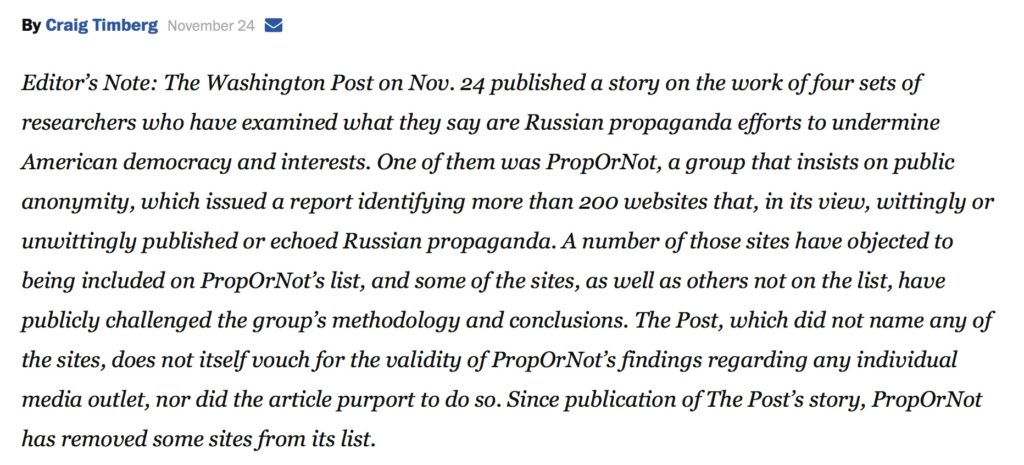
The above hits the nails entirely on the head. It also explains why it took the Washington Post two weeks to even address the fact that it published a fake news article about “fake news.” Here’s how The Washington Post is “taking responsibility.”

screen-shot-2016-12-08-at-10-30-16-am

While absolutely pathetic, the editor’s note is equally telling in its sloppiness and arrogance. For instance, the article was a such a gross piece of journalistic malpractice, the only honest, professional move by the paper would be to fully retract the story and apologize; yet The Washington Post didn’t do that. Why?

The reason is because the paper and its editors knew exactly what they were doing with the publication and promotion of this nonsensical fake news hit-piece. Sure, they’re now a bit embarrassed because they were called out by pretty much everybody, but the intent all along was to tie independent media sites with absolutely no connection to Russia, to Russia, in a desperate attempt to recapture the public narrative via blacklists and tech company censorship.

As an aside, for specifics on how the status quo is attempting to use developers and social media companies to censor alternative opinion under the guise of fighting “fake news,” read this excellent article published at Naked Capitalism: Witch Hunt: “Fake News” Software Touted by CBS Smears Naked Capitalism, ShadowProof, TruthDig, Others; Creator Admits He Made Up Who Went on Hit List.

Now that we know what they are up to, how worried should we be? Although I’m extremely optimistic about the future of decentralized, independent media, and the proliferation of individual voices generally, it’s quite obvious legacy media gatekeepers will not go down without a fight. The good news is they are the ones who are on the defensive, not us. They are the ones who are battling on our terms, not the other way around. A great example of this can be seen in how the “fake news” meme has been turned around against the mainstream media to great effect. As I tweeted earlier today:

It is when you get desperate, scared and panicky that you make the biggest mistakes, and the legacy media is currently desperate, scared and panicky.  As Napoleon Bonaparte allegedly said:

“Never interrupt your enemy when he is making a mistake.”

Whether or not he actually said them, those words still ring true. We mustn’t get in the way of the legacy media’s inevitable self-destruction. Part of this means that we do not self-destruct in the process. We need to recognize that there’s a reason independent, alternative media is winning the battle of ideas in the first place. For all the warts, mistakes and bad actors, the emergence of the internet is indeed the historical equivalent of the invention of the printing press on steroids.

Only a clueless self-important elitist actually believes that the smartest, most informed people in America are the pundits on tv and the journalists employed by the mainstream media. With a handful of companies and a few oligarchs in charge, you’d have to be the most naive fool on earth to not understand that legacy media is driven by well defined narratives, and that these narratives are not in your best interest. The rest of us understand that the Internet has served as a much needed countervailing force, and has been an incredible blessing to human knowledge, connectivity and the marketplace of ideas. Just because some people can’t distinguish truth from fiction, doesn’t negate the incredible progress that decentralized information dissemination provides. It is only those who do not wish to engage in public debate on the issues themselves who want to censor stuff. The rest of us are more than happy to have an open discussion.

Many of us have spent years, if not decades, building up our online reputations and we should be careful not to squander all we have gained. There will be attempts at co-option, explicitly and otherwise. Be on guard. There will be hit-pieces and smear attempts. Stay cool and fight back from a position of strength and calm. However, I believe the greatest threat comes from the ever present danger of self-inflicted error. Part of the reason independent, alternative media has been so successful is legacy media has made it easy to look good by being so obviously captured, puerile and propagandistic. We must continue to be better than they are. As such, we must be more honest in our actions, less hypocritical in our analysis of events, and just more ethical overall. Given the competition, this shouldn’t be difficult.

Another way the status quo will fight back is by attacking our means of surviving financially, which means readers must be prepared to donate to your favorite sites more than ever before (you can support Liberty Blitzkrieg here). The other way will be to prevent our content from appearing on social media sites or search engines, or when it does appear, it will come with a warning. If this is the tactic they choose, it’ll be relatively easy to fight back.

Ten years ago it would’ve been hard to counter such a strategy, but not today. The cat is simply too far out of the bag. Too many of us reach too many people, and many of the people we reach are smart and influential. We have already sufficiently infiltrated and influenced the public discourse, so denying us a voice is no longer an option. If Facebook or Google start presenting Liberty Blitzkrieg, Zerohedge, or Naked Capitalism with warning labels, the intelligent amongst us with see right through this tactic and become disgusted.

So let me end this with a warning to Facebook, Google, and all the other tech behemoths. You start this fight at your own risk. Any disingenuous attempt to smear genuine, independent media websites via blacklists and censorship will ultimately harm you more than it harms us. In a misguided attempt to destroy us, you will destroy yourselves. Tread carefully and be on the right side of history.

To everyone else, stay strong. My writing would be irrelevant without you. It is not alternative media writers who will inflict the final blow against legacy media, it will be you, the readers. We are in this together and dependent on each other. Together we will win.

For related articles, see:

Obama Enters the Media Wars – Why His Recent Attack on Free Speech is So Dangerous and Radical

Hillary Clinton Enters the Media Wars

The Death of Mainstream Media

Liberty Blitzkrieg Included on Washington Post Highlighted Hit List of “Russian Propaganda” Websites

Additional Thoughts on “Fake News,” The Washington Post, and the Absence of Real Journalism

If you enjoyed this post, and want to contribute to genuine, independent media, consider visiting Liberty Blitzkrieg’s Support Page.

In Liberty,
Michael Krieger

The Democrats “Russia Hacking” Campaign is Political Suicide

images

By Mike Whitney

Source: CounterPunch

The Democratic Party is doing incalculable damage to itself by shapeshifting into the party of baseless conspiracy theories, groundless accusations, and sour grapes. Hillary Clinton was already the most distrusted presidential candidate in party history. Now she’s become the de facto flag-bearer for the nutso-clique of aspiring propagandists at the CIA, the New York Times and Bezo’s Military Digest. How is that going to improve the party’s prospects for the long term?

It won’t, because the vast majority of Americans do not want to align themselves with a party of buck-passing juveniles that have no vision for the future but want to devote all their energy to kooky witch-hunts that further prove they are unfit for high office.

The reason Hillary Clinton lost the election is because she is a polarizing, untrustworthy warmonger. Period. Putin had nothing to do with it.

And the same rule applies to the major media that has attached itself leech-like to this pathetic fairytale. Here’s a clip from the Times headline story connecting FSB-agent Trump with the evil Kremlin:

“American intelligence agencies have told the White House they have “high confidence” that the Russian government was behind the theft of emails and documents from the Democratic National Committee. …

The attack on the congressional committee’s system appears to have come from an entity known as “Fancy Bear,” which is connected to the G.R.U., the Russian military intelligence service, according to an official involved in the forensic investigation…

Clinton campaign officials have suggested that President Vladimir V. Putin of Russia could be trying to tilt the election to Mr. Trump, who has expressed admiration for the Russian leader.” (Computer Systems Used by Clinton Campaign Are Said to Be Hacked, Apparently by Russians, New York Times)

If there was a Pulitzer Prize for fearmongering innuendo or spurious accusations, the Times would win it hands-down. As it happens, readers have to delve much deeper into the article to find this shocking disclaimer:

“But the campaign officials acknowledge that they have no evidence. The Trump campaign has dismissed the accusations about Russia as a deliberate distraction…..”

“No evidence”???

They got nothing. NOTHING!

All they have is a few anonymous agents who refuse to identify themselves speculating on alleged hacking incidents that (they surmise) were the work of Vladimir P. Strangelove in his remote Soviet Cyber-war bunker. That’s not even enough material for a decent spy thriller.

But, of course, all this bunkum about “Fancy Bear” and  “Russian military intelligence” and the “high confidence” of (unnamed) US intelligence agents is enough to scare the hell out of many readers and leave them with the impression that the Kremlin is up to its old Cold War tricks again.  The Times editors are wise enough to know that it’s quite easy to tap into 40-years of anti-Soviet brainwashing and convince the gullible sheeple that Washington and Moscow are still mortal enemies. It would have been helpful if the Times had given the story a bit of context, that is, pointed out that the US has relentlessly expanded NATO eastward establishing military bases in all of the former Soviet satellite states, toppled the Moscow-friendly regime in Ukraine, and built nuclear weapons sites in east Europe just a few hundred miles from Moscow.

The Times writers might have also noted that this latest propaganda campaign against Russia could very well be the result of Moscow’s triumph over US-backed militants in Syria that are facing a decisive defeat due in large part to Russian involvement. In other words, the Times and the other US propaganda organs are functioning as they always do, whipping up public sentiment against the “evildoers” so Washington can drag the country into another imperial war of expansion. The whole “hacking” mantra fits perfectly with the Pentagon’s hybrid war strategy which manipulates information in order to shape public perceptions and gain support for another round of genocidal violence in some far-flung location. (Raqqa, perhaps?)

Do you think that bloodthirsty Hillary would be on-board with such a plan?

Of course she would. Hillary never met a war she didn’t like.

But let’s cut to the chase: Putin didn’t lose the election for Hillary. Obama did. People wanted change, and they didn’t get it, so they moved on to Door Number 2: Donald Trump. Take a look at these three short clips from a recent survey from PEW Research and you’ll get a feel for what really happened in the election:

“The Republican Party made deep inroads into America’s middle-class communities in 2016. Although many middle-class areas voted for Barack Obama in 2008, they overwhelmingly favored Donald Trump in 2016, a shift that was a key to his victory…..In 2016, Trump successfully defended all 27 middle-class areas won by Republicans in 2008. In a dramatic shift, however, Hillary Clinton lost in 18 of the 30 middle-class areas won by Democrats in 2008…

Overall, Democrats experienced widespread erosion in support from 2008 to 2016. Their share of the vote fell in 196 of the 221 metropolitan areas examined. The loss in support was sufficiently large to move 37 areas from the Democratic column to the Republican column…

Not coincidentally, Democrats also were more likely to have lost ground in manufacturing-dependent areas. Of the 56 communities with a relatively large share of manufacturing jobs, Trump picked up victories in 15 metro areas that had supported Obama in 2008 and held onto another 29, leaving only 12 communities in the Democrats’ column.” (GOP gained ground in middle-class communities in 2016, Pew Research)

Get it? The Dems lost ground everywhere because Obama didn’t deliver the goods. That’s reason number one. Second, Hillary didn’t address the issues that ordinary working people really care about. And what they care about is the economy. Money, security, jobs. Is that hard to understand?

People are afraid because things are getting worse not better. Their standards of living are slipping, they’re worried about their retirement, their jobs, their health care, and the pile of debt their kids have accumulated to go to college. They’ve lost confidence in the media, the congress, the courts and the president who promised change but never lifted a finger for working people his entire time in office.

That’s why Hillary lost, just look at the research.

The Democrats have no vision for the future, and without vision, the party will disintegrate which is precisely what’s happening. The Democratic Party is disintegrating before our very eyes. This latest “Russian hacking” diversion is just speeding along the process.

MIKE WHITNEY lives in Washington state. He is a contributor to Hopeless: Barack Obama and the Politics of Illusion (AK Press). Hopeless is also available in a Kindle edition. He can be reached at fergiewhitney@msn.com.

Rigged

delegates

By David Swanson

Source: Let’s Try Democracy

The 2016 Republican presidential primary was rigged. It wasn’t rigged by the Republicans, the Democrats, Russians, space aliens, or voters. It was rigged by the owners of television networks who believed that giving one candidate far more coverage than others was good for their ratings. The CEO of CBS Leslie Moonves said of this decision: “It may not be good for America, but it’s damn good for CBS.” Justifying that choice based on polling gets the chronology backwards, ignores Moonves’ actual motivation, and avoids the problem, which is that there ought to be fair coverage for all qualified candidates (and a democratic way to determine who is qualified).

The 2016 Democratic presidential primary was rigged. It wasn’t rigged by bankers, misogynists, Russians, Republicans, or computer hackers. It was rigged by the Democratic National Committee and its co-conspirators in the media, many of whom have helpfully confessed (in case it wasn’t obvious) in emails leaked from the DNC and from John Podesta. The DNC chose Hillary Clinton and worked hard to make sure that she “won.” Nobody has produced a hint of evidence as to who leaked the emails that added unnecessary confirmation of this rigging, but they should be thanked for informing us, whoever they are.

The FBI investigation of Hillary Clinton’s misuse of email was as rigged as the non-prosecution of the CEO of Wells Fargo. The U.S. political system is bought and paid for. Without millions of dollars to funnel to television networks for advertising, any candidate is rigged right out of participating. This rigging of the system is not fixed by someone like Donald Trump pretending for a while that he won’t take bribes, that he’ll spend only his own money, because most people don’t have that kind of money to spend. This rigging is not fixed by making someone like Hillary Clinton take her bribes through her family foundation or requiring that her political action committees remain theoretically separate from the campaign they are collaborating hand-in-glove with, because money buys power.

The debates are rigged by a private entity with no official status that calls itself the Commission on Presidential Debates and transforms open debates among multiple candidates into exclusively bipartisan joint appearances with many large and fine points negotiated beforehand.

Actual governance of the United States is rigged. Congress plans to attempt to ram through a number of intensely unpopular measures just after the election, including a supplemental spending bill for more wars and including the Trans-Pacific Partnership. The hope is that most people will have tuned out after the election circus, and that most of them will forget what happened 2 or 4 years later.

The demonization of Vladimir Putin is rigged. Nobody has seen evidence that he or his government did us the favor of informing us of the DNC’s corruption. He proposed a ban on cyber “war” that was rejected by the United States, for goodness sake. There’s no evidence that Russia shot down an airplane in Ukraine or invaded Ukraine or seized Crimea or plotted attacks on the United States. The United States pulled out of the ABM treaty, expanded NATO to Russia’s border, built missile bases, arranged military “exercises,” facilitated a Ukrainian coup, and pushed a string of hostile lies. Russia has shown even more restraint than your typical U.S. voter (who usually sits home and does not vote, especially in primaries).

Military spending is rigged. Nobody knows it amounts to over half of U.S. discretionary spending.  Nobody knows it’s as much in the U.S. as in the rest of the world (allies and otherwise) combined. Nobody pays attention to the bribes from war profiteers, or to the threats held over Congress members to pull weapons jobs out of districts or states. Supporters of both big candidates claim their candidate plans to cut military spending. Both candidates have said the exact opposite. The debates and interviews steer clear of the whole topic.

The shapes of the districts are blatantly rigged by gerrymandering. The existence of the Senate, in which Rhode Island and Wyoming each have as much say as California is rigged against the popular will. The electoral college is rigged against the popular will and in favor of concentrating national campaigns in a handful of “swing states.”

Voter registration is rigged. A handful of states have now made it automatic, as most states have long-since done for military draft registration. In the rest of the country, thousands of young people run around registering voters, imagining they are engaged in “activism.” Meanwhile, the right to vote can be denied to anyone by claiming they aren’t registered.

People’s names are stripped from voting rolls through a so-called justice system that brands them as felons, and through the careful rigging of those rolls by corrupt and partisan state governments that intentionally strip out people likely to vote for a particular party. This includes racial profiling. Bob Fitrakis, Harvey Wasserman, Greg Palast and others have reported extensively on these practices.

Election day is rigged as well. It’s not a holiday. Most people have to work. Poor districts and racial minority districts tend to have fewer machines and longer lines. ID requirements are used to deny people the right to vote. Intimidation and racial profiling by partisan activists serve the same function of rigging the election. The myths and lies about the virtually nonexistent phenomenon of “voter fraud” also serve to rig the election.

The election machines are also rigged. That is to say: instead of verifiable paper ballots publicly hand-counted in front of observers from all interested parties in each polling place, we have a faith-based system of voting on black-box machines that can never, even in theory, be checked for accuracy. These machines have been very easily hacked in demonstrations. These machines have visibly flipped votes before the eyes (and cameras) of countless voters. These machines have almost certainly played a key role in flipping the results of numerous elections.

Now, the wider the margin of victory, the less likely an electronic flipping. And the fact that machines can easily be used to steal an election does not mean that they always will be. But it was very odd during the late summer of 2016 to watch the U.S. media announce that these machines were totally unreliable — just what many of us had been saying for years. But the media said this in order to accuse Russia of planning to sabotage the coming U.S. election, or in order to accuse Russia of exactly what these media reports themselves did: plant seeds of doubt in U.S. minds.

Those doubts should be there. People should watch for visible problems with machines and with partisan and racist intimidators, and report all such to 1-866-OUR-VOTE, to county clerks, to secretaries of state, and to corporate and independent media. Then we should work for necessary reforms, including a respectful cessation of the U.S. government’s routine practice of interfering in elections and overthrowing governments in other people’s countries — a practice that has clearly resulted in the U.S. media projecting such behavior on others.

Ultimately, an unrigging of the U.S. system might take the form of amending the U.S. Constitution to slip in words like these:

The rights protected by the Constitution of the United States are the rights of natural persons only.

Artificial entities, such as corporations, limited liability companies, and other entities, established by the laws of any State, the United States, or any foreign state shall have no rights under this Constitution and are subject to regulation by the People, through Federal, State, or local law. The privileges of artificial entities shall be determined by the People, through Federal, State, or local law.

The judiciary shall not construe the spending of money to influence elections to be speech under the First Amendment.

All elections for President and members of the United States House of Representatives and the United States Senate shall be entirely publicly financed. No political contributions shall be permitted to any federal candidate, from any other source, including the candidate. No political expenditures shall be permitted in support of any federal candidate, or in opposition to any federal candidate, from any other source, including the candidate. The Congress shall, by statute, provide limitations on the amounts and timing of the expenditures of such public funds and provide criminal penalties for any violation of this section.

State and local governments shall regulate, limit, or prohibit contributions and expenditures, including a candidate’s own contributions and expenditures, for the purpose of influencing in any way the election of any candidate for state or local public office or any state or local ballot measure.

The right of the individual U.S. citizen to vote and to directly elect all candidates by popular vote in all pertinent local, state, and federal elections shall not be violated. Citizens will be automatically registered to vote upon reaching the age of 18 or upon becoming citizens at an age above 18, and the right to vote shall not be taken away from them. Votes shall be recorded on paper ballots, which shall be publicly counted at the polling place. Election day shall be a national holiday.

Nothing contained in this amendment shall be construed to abridge the freedom of the press. During a designated campaign period of no longer than six months, free air time shall be provided in equal measure to all candidates for federal office on national, state, or district television and radio stations, provided that each candidate has, during the previous year, received the supporting signatures of at least five percent of their potential voting-age constituents. The same supporting signatures shall also place the candidate’s name on the ballot and require their invitation to participate in any public debate among the candidates for the same office.