Why the Drug War Has Been a Forty-Year Lynching

nixon-war-on-drugs-quote

By Bob Fitrakis and Harvey Wasserman

Source: FreePress.org

The Drug War has been a forty-year lynching….
…the corporate/GOP response to the peace and civil rights movements.

It’s used the Drug Enforcement Administration and other policing operations as a high-tech Ku Klux Klan, meant to gut America’s communities of youth and color.

It has never been about suppressing drugs. Quite the opposite.

And now that it may be winding down, the focus on suppressing minority votes will shift even stronger to electronic election theft.

The Drug War was officially born June 17, 1971, (http://www.drugpolicy.org/new-solutions-drug-policy/brief-history-drug-war) when Richard Nixon pronounced drugs to be “Public Enemy Number One.” In a nation wracked by poverty, racial tension, injustice, civil strife, ecological disaster, corporate domination, a hated Vietnam War and much more, drugs seemed an odd choice.
In fact, the Drug War’s primary target was black and young voters.

It was the second, secret leg of Nixon’s “Southern Strategy” meant to bring the former Confederacy into the Republican Party.

Part One was about the white vote.

America’s original party of race and slavery (https://zinnedproject.org/materials/a-peoples-history-of-the-united-states-updated-and-expanded-edition/)was Andrew Jackson’s Democrats (born 1828).

After the Civil War the Party’s terror wing, the KKK, made sure former slaves and their descendants “stayed in their place.”

A century of lynchings (at least 3200 of them) (http://www.yale.edu/ynhti/curriculum/units/1979/2/79.02.04.x.html)efficiently suppressed the southern black community.

In the 1930s Franklin Roosevelt’s New Deal social programs began to attract black voters to the Democratic Party. John Kennedy and Lyndon Johnson’s support for civil and voting rights legislation, plus the 24th Amendment ending the poll tax, sealed the deal. Today blacks, who once largely supported the Party of Lincoln,  vote 90% or more Democrat (http://blackdemographics.com/culture/black-politics/).

But the Democrats’ lean to civil rights angered southern whites. Though overt racist language was no longer acceptable in the 1970s, Nixon’s Republicans clearly signaled an open door to the former Confederacy (https://www.thenation.com/article/why-todays-gop-crackup-is-the-final-unraveling-of-nixons-southern-strategy/).

But recruiting angry southern whites would not be enough for the Republicans to take the south. In many southern states more than 40% of potential voters were black. If they were allowed to vote, and if their votes were actually counted, all the reconstructed Democrat Party would need to hold the south would be a sliver of moderate white support.

That’s where the Drug War came in.

Reliable exact national arrest numbers from 1970 through 1979 are hard to come by.

But according to Michelle Alexander’s superb, transformative The New Jim Crow, and according to research by Marc Mauer and Ryan King of the Sentencing Project, more than 31,000,000 Americans were arrested for drugs between 1980 and 2007 (http://newjimcrow.com).

Further federal uniform crime report statistics compiled by www.freepress.org indicate that, between 2008 and 2014, another 9,166,000 were arrested for drug possession.
Taken together, than means well over 40,000,000 American citizens have been arrested for drugs in the four decades since Nixon’s announcement.
It is a staggering number: more than 10% of the entire United States, nearly four times the current population of Ohio, far in excess of more than 100 countries worldwide.
A number that has gutted the African-American community.  A national terror campaign far beyond the reach of even the old KKK.
Justice Department statistics indicate than half of those arrests have been for simple possession of marijuana.
According to US Bureau of Justice statistics, between 1980 and 2013, while blacks were 12% of the population, blacks constituted 30% of those arrested for drug law violations and nearly 40% of those incarcerated in all U.S. prisons.  Thus some 20,000,000 African-American men have been sent to prison for non-violent “crimes” in the past forty years.
If the Hispanic population is added in, as much as 60% of drug arrests are of racial or ethnic minorities.
On the 40th anniversary of the Drug War in 2010, the Associated Press used public records to calculate that the taxpayer cost of arresting and imprisoning all these human beings has been in excess of $1,000,000,000.
Sending them all to college would have been far cheaper.  It also would have allowed them to enhance and transform their communities.
Instead, they were taken from their families.  Their children were robbed of their parents.  They were assaulted by the prison culture, stripped of their right to vote and stopped from leading the kind of lives that might have moved the nation in a very different direction.
Nixon also hated hippies and the peace movement. So in addition to disenfranchising 20,000,000 African-Americans, the Drug War has imprisoned additional millions of young white and Hispanic pot smokers.
Thus the DEA has been the ultra-violent vanguard of the corporate culture war.
In 1983 Ronald Reagan took the Drug War to a new level.  Using profits from his illegal arms sales to Iran, he illegally funded the Contra thugs who were fighting Nicaragua’s duly elected Sandinista government.
The Contras were drug dealers who shipped large quantities of cocaine into the US—-primarily in the Los Angeles area—-where it was mostly converted to crack.
That served a double function for the GOP.
First, it decimated the inner city.
Then Reagan’s “Just Say No” assault—-based on the drugs his Contra allies were injecting into our body politic—-imposed penalties on crack far more severe than those aimed at the powdered cocaine used in the white community.
In 1970 the US prison population was roughly 300,000 people.  Today it’s more than 2.2 million, the largest in world history by both absolute number and percentage of the general population.  There are more people in prison in the US than in China, which has five times the population (http://www.bjs.gov/index.cfm?ty=tp&tid=11).

According to the Sentencing Project, one in seventeen white males has been incarcerated, one in six Latinos, and one in three blacks.
By all accounts the Drug War has had little impact on drug consumption in the US, except to make it more profitable for drug dealers (http://www.bjs.gov/index.cfm?ty=tp&tid=11).  It’s spawned a multi-billion-dollar industry in prison construction, policing, prison guards, lawyers, judges and more, all of them invested in prolonging the drug war despite its negative impacts on public health.

For them, the stream of ruined lives of non-violent offenders is just another form of cash flow.
Like the Klan since the Civil War, the Drug War has accomplished its primary political goal of suppressing the black vote and assaulting the African-American community.
It’s shifted control of the South from the Democrats back to the Republican Party. By slashing voter eligibility and suppressing black turnout, the Drug War crusade has helped the GOP take full control of both houses of the US Congress and a majority of state governments across the US.
But the repressive impacts hit everyone, and ultimately enhance the power of the corporate state.
Toward that end, the southern corporate Democrat Bill Clinton’s two terms as a Drug Warrior further broadened the official attack on grassroots America. Clinton was determined to make sure nobody appeared tougher on “crime.”  He escalated the decimation of our democracy far beyond mere party politics, deepening the assault on the black community, and the basic rights of all Americans for the benefit of his Wall Street funders.  Obama has been barely marginally better.
In political terms, the Nixon-Reagan GOP remains the Drug War’s prime beneficiary. Today’s Republicans are poised to continue dominating our electoral process through the use of rigged electronic registration rolls and voting machines. That’s a core reality we all must face.
But no matter which party controls the White House or Congress, by prosecuting a behavior engaged in by tens of millions of Americans, the Drug War lets the corporate state arrest (and seize assets from) virtually anyone it wants at any time. It has empowered a de facto corporate police state beyond public control.

Regardless of race, we all suffer from the fear, repression and random assaults of a drug-fueled repressive police force with no real accountability.
In the interim, the Drug War is not now and never has been about drugs.
Legalizing pot is just the beginning of our recovery process.
Until we end the Drug War as a whole, America will never know democracy, peace or justice.
____________________
THE SIXTH JIM CROW: ELECTRONIC ELECTION THEFT & THE 2016 SELECTION will be released by Bob Fitrakis & Harvey Wasserman by January, 2016. Their CITIZEN KASICH will follow soon thereafter. Bob’s FITRAKIS FILES are at www.freepress.org; Harvey’s ORGANIC SPIRAL OF US HISTORY will appear in 2016.

Related video:

The Root of Support for the Drug War

war-on-drugs

By Laurence M. Vance

Source: The Future of Freedom Foundation

Although many states have legalized the use of marijuana for medical purposes, some states have decriminalized the possession of certain amounts of marijuana, and four states (Alaska, Colorado, Oregon, and Washington) have legalized the recreational use of marijuana, bipartisan support for the drug war throughout the United States continues unabated and unquestioned.

Why?

Why do so many Americans think that the property of other Americans should be confiscated, and that some of their fellow Americans should be fined, arrested, put on probation, subject to no-knock SWAT team raids, be treated as criminals, or locked in a cage for growing, manufacturing, processing, buying, selling, distributing, “trafficking in,” using, or possessing some substance the government doesn’t approve of?

Why do so many Americans support a war on drugs that

  • unnecessarily makes criminals out of otherwise law-abiding Americans, clogs the judicial system with noncrimes, and expands the prison population with nonviolent offenders;
  • violates the Constitution, the principle of federalism, and increases the size and scope of government;
  • has utterly failed to prevent drug use, reduce drug abuse, or end drug overdoses;
  • fosters violence, corrupts law enforcement, and militarizes the police;
  • hinders legitimate pain management, hampers the treatment of debilitating diseases, and turns doctors into criminals;
  • destroys personal and financial privacy, and negates personal responsibility and accountability;
  • has been unsuccessful in keeping drugs out of the hands of addicts, teenagers, and convicts;
  • assaults individual liberty, private property, and the free market; or
  • wastes billions of taxpayer dollars and has financial and human costs that far exceed any of its supposed benefits?

I see a number of reasons that Americans in general support a government war on the mind-altering and mood-altering substances we refer to as drugs.

For some the reason is history. As far as many Americans are concerned, drugs have always been illegal and should therefore always remain so. It is simply unthinkable that it should be any other way. Yet, for the first half of our nation’s history there were no prohibitions against anyone’s possessing or using any drug.

For some the reason is society. The use of marijuana — for medical reasons or not — is still viewed negatively. And of course the use of other drugs such as cocaine, LSD, and heroin is disparaged even more. There is almost universal support for the drug war among all facets of society: engineers, teachers, preachers, physicians, clerks, accountants, secretaries, and housewives. But, of course, it doesn’t follow that because a majority of society supports something the power of government should be used against those who don’t.

For some the reason is political. The war on drugs enjoys widespread bipartisan support. Liberals, conservatives, Democrats, Republicans, moderates, populists, progressives, centrists, Tea Partiers — they all generally support government prohibition of certain drugs. The drug war is never an issue in any congressional primary or general election. As long as their party or their political group supports the drug war, most Americans will follow suit. The decision to use drugs should be an ethical, religious, medical, or moral decision, not a political decision.

For some the reason is religion. Support for the drug war can be found across the religious spectrum, encompassing Christians and Jews, Protestants and Catholics, liberals and conservatives, fundamentalists and progressives, and Trinitarians and Unitarians. Yet, there is no ethical precept in any religion that should lead anyone to believe that it is the job of government to prohibit, prevent, regulate, restrict, or otherwise control any substance that any adult desires to ingest of his own free will.

For some the reason is morality. Because, some assert, it is immoral to alter one’s mind or mood with illegal drugs, the government should ban the use of these substances. Do drug warriors likewise believe that it is immoral to alter one’s mind or mood with alcohol? If not, then they are woefully inconsistent in their proscription; if so, then they are woefully inconsistent in their prescription.

Dangers and vices

For some the reason is safety. Because it can be dangerous to use illicit drugs, some think the government should ban them. Yet there is no question that smoking marijuana is less dangerous than drinking alcohol. Alcohol abuse is a factor in many drownings; home, pedestrian, car, and boating accidents; and fires. How many drug warriors propose that the government ban alcohol? There are plenty of things that are much more dangerous than using illicit drugs: skydiving, bungee jumping, coal mining, boxing, mountain climbing, cliff diving, drag racing — even crossing the street at a busy intersection. According to the Journal of Forensic Sciences, there are more than 28,000 chainsaw-related injuries annually in the United States. Shouldn’t governments across the country declare war on chainsaws?

For some the reason is vice. Using drugs is said to be a vice like gambling, profanity, drunkenness, using pornography, and prostitution. But as only the latter is actually banned outright by the government, arguments for government action against select drugs are extremely weak. And what about the vices of pride, envy, wrath, sloth, avarice, gluttony, and lust? Why don’t drug warriors advocate government action against them? Vices in 2014 are still as the 19th-century political philosopher Lysander Spooner explained:

Vices are those acts by which a man harms himself or his property. Crimes are those acts by which one man harms the person or property of another. Vices are simply the errors which a man makes in his search after his own happiness. Unlike crimes, they imply no malice toward others, and no interference with their persons or property.

For some the reason is health. The use of mind-altering and mood-altering substances is said to be unhealthy. The federal government classifies marijuana as a Schedule I drug with “no currently accepted medical use in treatment in the United States.” But even if drugs such as marijuana don’t provide benefits for certain diseases and medical conditions, they are certainly not nearly as deadly as the drugs administered by physicians that kill thousands of Americans every year, the drugs that cause thousands of hospital patients every year to have adverse reactions, and nonsteroidal anti-inflammatory drugs such as aspirin that kill thousands every year. The most unhealthy drug is alcohol, which is a contributing factor in many cases of cancer, mental illness, fetal abnormalities, and cirrhosis of the liver. Alcohol abuse is one of the leading causes of premature deaths in the United States. There is no question that smoking marijuana is less dangerous than smoking tobacco. Common sense would dictate that it is tobacco that should be banned, not marijuana. And of course, the greatest health threat Americans face is obesity, not illegal drugs.

For some the reason is addiction. Certain drugs should be illegal, we are told, because they are addictive. The federal government says that marijuana “has a high potential for abuse.” But is that because it is addictive or because some people just want to get high? Legal drugs prescribed by physicians are certainly just as addictive as any drugs that are illegal. And of course, pornography, smoking, gambling, sex, shopping, and eating can be addictive. Drug warriors are very selective about which addictive behaviors deserve government action.

For some the reason is irrationality. Although every bad thing that could be said about drugs could also be said about alcohol, some drug warriors hold the irrational belief that drugs are just different from alcohol. Why? Because they just are.

For all, the reason is government. I believe the root of support for the drug war is simply this: trust in government. Unnecessary, irrational, and naive trust in government.

What’s so disturbing is that nowhere does the Constitution authorize the federal government to intrude itself into the personal eating, drinking, or smoking habits of Americans or concern itself with the nature and quantity of any substance Americans want to ingest. The Constitution is supposed to be the foundation of American government. The federal government is not supposed to have the authority to do anything unless it is included in the limited, enumerated powers granted to it in the Constitution. Yet some of the ardent enthusiasts of the Constitution are some of the most rabid drug warriors.

The war on drugs is a war on individual liberty, private property, limited government, the Constitution, American taxpayers, personal responsibility, the free market, and a free society that has ruined more lives than drugs themselves.

Every facet of government that contributes in some way to the monstrous evil that is the war on drugs should be dismembered, root and branch, and cast to the four winds.

This article was originally published in the January 2015 edition of Future of Freedom.

Legalizing Marijuana Now More Popular Than All Political Candidates

yes-we-cannabis-marijuana-poster

By John Vibes

Source: TheAntiMedia.org

It is no secret that Americans are losing faith in the US political system. With the potential of a choice between a Clinton and a Bush in 2016, it is likely that even more people will stop participating.

Now that there have been states where people have been allowed to vote for the legalization of marijuana, that topic has actually become more popular than the candidates themselves.

According to a Quinnipiac University poll conducted in March, in the key swing states of Ohio, Pennsylvania and Florida, marijuana is far more popular than all the major political candidates. The survey found that over 80% of people in all states supported medical marijuana, with over 50% also supporting full legalized recreational marijuana.

Meanwhile, all of the major political candidates have the approval of less than 50% of the people polled.

In some ways marijuana policy is the perfect issue for a presidential campaign. It has far reaching consequences that both parties have reason to engage,” John Hudak of the Brookings Institution told the Washington Post, in response to the poll.

Prohibition of any kind should be opposed for the reasons I have laid out in the past. However, marijuana is of specific immediate importance because of its ability to heal sick people and create environmentally friendly industrial products. It is also one of the safest drugs known to our species.

A recent Gallup poll found that major political parties in the United States are seeing their lowest popularity levels in recent memory.

Both the Democrats and the Republicans fall well below 50% in terms of approval, with 39% viewing the Democratic party favorable and 37% viewing the Republican party favorable.


John Vibes is an author, researcher and investigative journalist who takes a special interest in the counter culture and the drug war. In addition to his writing and activist work he organizes a number of large events including the Free Your Mind Conference, which features top caliber speakers and whistle-blowers from all over the world. You can contact him and stay connected to his work at his Facebook page. You can find his 65 chapter Book entitled “Alchemy of the Timeless Renaissance” at bookpatch.com.


5 Myths About Marijuana–Debunked

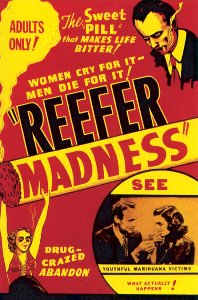
ReeferMadnessPoster

The more research is released, the more legalization makes sense.

By Owen Poindexter

Source: Alternet

Back in the 1930s, the arguments to criminalize cannabis were bizarre and openly racist. The anti-pot crusader Harry Anslinger made all sorts of over-the-top claims, such as, “Marihuana is a short cut to the insane asylum. Smoke marihuana cigarettes for a month and what was once your brain will be nothing but a storehouse of horrid specters.”

Nowadays more than 100 million Americans say they’ve smoke pot, millions use cannabis regularly to treat illnesses and it is as legal as alcohol in two U.S. states. However, it remains illegal under federal law largely due to scare tactics ingrained in our society, which date back even prior to Anslinger.

Today, pot legalization opponents try a little harder to sound reasonable, but their claims don’t do much better than Anslinger’s under scrutiny. Recent studies have picked apart the justifications for criminalizing marijuana. Here are five of the most popular arguments against cannabis legalization that are easily undermined by objective data.

1. Pot leads to crime. If alcohol prohibition taught us anything it’s that prohibition itself leads to crime, not what is prohibited. While cannabis has shaken the psychotic Reefer Madness reputation over the years, the association between weed and crime is still alive and well in certain realms of the media, which are happy to present data without appropriate statistical caveats.

As for the studies that carefully and objectively examine their data, they find no association between cannabis and crime. A recent study in the journal PLOS One found that in states that legalized medical marijuana between 1990 and 2006 the crime rate either remained the same or decreased.

Another study looked at the Lambeth borough of London, which depenalized cannabis for 13 months in 2001-2002. The study found that this actually reduced other types of crime, because Lambeth police could focus their energy elsewhere.

These results fit with common sense. Cannabis has a range of effects on mood and behavior, but they don’t include violence, impulsivity or other traits that would turn otherwise law-abiding citizens into criminals.

2. The gateway theory. The gateway theory has long been the stock response of marijuana opponents to the notion that cannabis itself isn’t that bad for you. They falsely claim it leads to harder stuff, and insist that what starts with a joint ends with a heroin needle.

While it’s true that most users of hard drugs used marijuana and alcohol first, that doesn’t prove that cannabis use leads to harder drugs. Correlation does not equal causality—most heroin users have worn jeans at some point in their lives, but it’s unlikely that one leads to another.

But is it at least plausible that cannabis use creates a bridge to experimenting with more dangerous chemicals? The research says no.

A RAND Institute study using data collected from 1982-1994 found that drug use patterns in American youths can be explained without resorting to a gateway effect. People who are interested in mind-altering substances are likely to have tried pot, as it is the most popular and available illicit drug. This and other circumstantial factors related to drug availability and how old someone was when they first used cannabis were sufficient to explain drug use patterns. Since then, numerous peer-reviewed studies have been published, supporting RAND’s basic conclusions.

Holland provides a good natural experiment in the effects of cannabis use, as marijuana has been legal there for citizens since 1976. A RAND Corporation study from 2011, titled What Can We Learn From The Dutch Coffee Shop Experience? found no causal relationship between using cannabis and harder drugs. In fact, because legalization meant that people went to a coffee shop, not a dealer, to get high, RAND found that legal cannabis likely reduced rates of harder drug use.

3. Cannabis has no medicinal purpose. Even though it has been slain many times over at this point, this idea is worth mentioning because cannabis is still listed as a Schedule I substance by the U.S. government, which implies that the official federal stance is that it has no medical use and is “dangerous.” However, just the opposite is true according to the actual facts. Almost half the states in the U.S. already have some kind of medical marijuana law (20 plus Washington D.C.) and many more are likely to legalize medical marijuana in this year’s elections.

Cannabis has been shown to effectively treat a slew of conditions including seizure disorders ( often quite dramatically), glaucoma, and symptoms related to chemotherapy. There is even evidence it can reduce certain types of cancerous tumors.

This is all well known and well documented, and yet cannabis remains a Schedule I drug. While it’s hard to find anyone who will still defend this policy, it remains the law of the land, and a major stumbling block on the path to reform.

4. Marijuana is addictive. The addiction claim has been contained over time, but never fully eradicated. Cannabis faces some guilt by association. How could alcohol, tobacco, heroin and cocaine all be clearly addictive and yet weed somehow isn’t?

Furthermore, with words like stoner and pothead in the lexicon, our culture has a firm grasp of the weed-dependent stereotype. When we think of marijuana addiction, an image comes to mind. He (usually a he), smokes pot and eats all day, is smelly and unshaven, watches too much TV and/or plays too many video games, and has a crappy job if he has a job at all. And sure, a lot of people actually do know someone like that, but the research show that, that someone is probably choosing their lifestyle rather than trapped in it by an actual addiction.

Regardless of how the addiction myth has stuck around, it is just that: a myth. The most commonly cited study on cannabis dependence declared that 4% of Americans 15-54 are dependent on cannabis. That’s compared to 24% who are dependent on tobacco and 14% on alcohol. Among users, they found that 9% of cannabis users who try it get hooked, as compared to 32% for tobacco and 15% for alcohol.

So cannabis seems to show some propensity for dependence, but for every dependent user, there are 10 who don’t develop that sort of issue, and this rate is better than that of popular legal drugs.

Furthermore, even the 9% figure is likely inflated. A subject in the oft-cited study was deemed “dependent” if they answered yes to at least three of seven questions. The survey included questions that would take a very different meaning with legal drugs than illegal, such as if “a great deal of time was spent in activities necessary to get the substance, taking the substance, or recovering from its effects.”

This study was conducted in the 1990s, before any state had recognized the medical use of cannabis, and acquiring it regularly involved considerable effort. Because of this, it’s not hard to imagine that users would experience “important social, occupational, or recreational activities given up or reduced because of use,” which was another criterion for dependence. It is quite possible the survey mistook habitual use for dependence in some cases.

We can be sure that cannabis is significantly less habit-forming than alcohol, and especially tobacco, and the degree to which people become dependent is probably overstated.

5. Pot makes users lazy. This idea is the most persistent: we rarely question the cultural belief that getting high saps one’s motivation. If there is any truth to that, it has been difficult to find in studies. What seems to be going on instead is that about 5-6% of the population has “amotivational syndrome,” and there is no significant difference in this between cannabis users and everyone else. One study looked at daily pot smokers and compared them to people who never touch pot. This found no significant difference between the two groups. There was a small difference in “subjective well-being” (how happy the subject says he or she is) favoring non-smokers, but the study authors ascribed much of this to medical conditions some of the subjects were taking cannabis to mitigate.

More than anything, the idea that stoners are lazy seems to be confirmation bias. We shrug off the examples that contradict that notion as special cases and nod sagely when our suspicions are confirmed. Furthermore, we fail to group unmotivated non-users with unmotivated users.

***

As the stigma against cannabis research has disappeared and more good data has been made available, the arguments against legalization have fallen. If cannabis is a plant with legitimate medical uses, does not lead to crime or harder drugs, is not addictive and doesn’t make you lazy, what argument for prohibition remains?

If there are still legitimate reasons to keep cannabis criminalized, let’s talk about them, but if not, let’s cut out a major revenue stream of Mexico’s vicious drug cartels, grant easy access to medicine for people who need it, provide a major boost to our economy, and legalize already.


Owen Poindexter is a freelance writer. See his work at owenpoindexter.com and follow him @owenpoindexter.

Surprise: The Drug War Isn’t About Drugs

Drug-War1By Kevin Carson

Source: Center for a Stateless Society

On the morning of November 6 the US Federal Bureau of Investigation trumpeted its takedown of the Silk Road 2.0 website and the arrest of  alleged operator Blake Benthall.

In so doing the FBI demonstrated, once again, that the War on Drugs has nothing to do with anything its propagandists claim it’s about. If drug criminalization is a public safety issue — about fighting violent crime and gangs, or preventing overdoses and poisoning — shutting down Silk Road is one of the dumbest things the feds can do. Silk Road was a secure, anonymous marketplace in which buyers and sellers could do business without the risk of violence associated with street trade. And the seller reputational system meant that drugs sold on Silk Road were far purer and safer than their street counterparts.

This is true of all the other selling points for the Drug War. Hillary Clinton, in possibly one of the stupidest remarks ever uttered by a human being, says legalizing narcotics is a bad idea “because there’s too much money in it” — referring, presumably, to the lucrative drug trade and the cartels fighting over it.

But there’s so much money in it, and the cartels fight to control it, only because it’s illegal. That’s what happens when you criminalize stuff people want to buy: You create black markets with much higher prices, which organized crime gangs fight to control. Alcohol prohibition created the gangster culture of the 1920s. It’s been with us ever since. When Prohibition was repealed, organized crime just shifted to fighting over other illegal markets. The more consensual, non-violent activities are made illegal, the larger the portion of the economy that’s turned into black markets for gangs to fight over.

In related news, the Mexican drug cartels are reportedly making less money since the legalization or decriminalization of pot in several American states. I wonder why.

Perhaps the biggest joke is that the War on Drugs is fought to reduce drug use. No doubt many people involved in the domestic enforcement side of the Drug War actually believe this, but the left hand doesn’t know what the right hand’s doing. The narcotics trade is an enormous source of money for the criminal gangs that control it, and guess what? The US intelligence community is one of the biggest criminal drug gangs in the world, and the global drug trade is a great way for it to raise money to do morally repugnant stuff it can’t get openly funded by Congress. It’s been twenty years since journalist Gary Webb revealed the Reagan cabinet’s collusion with drug cartels in marketing cocaine inside the United States, to raise money for the right-wing Contra death squads in Nicaragua — a revelation he was gaslighted and driven to suicide for by the US intelligence community and mainstream press.

Now we hear that the US is “losing the drug war in Afghanistan.” Well, obviously — it’s a war that’s designed to be lost. The Taliban were so easy to overthrown in the fall of 2001 because they really did try to stamp out opium poppy cultivation, and with a fair degree of success. This didn’t sit well with the Afghan populace, which traditionally makes a lot of money growing poppies. But the Northern Alliance — which the United States turned into the national government of Afghanistan — was quite friendly to poppy cultivation in its territory. When the Taliban was overthrown, poppy and heroin cultivation resumed normal levels. Putting the US in charge of a “war on drugs in Afghanistan” is like putting Al Capone in charge of alcohol prohibition.

Besides, actually “winning” the drug war would mean ending it. And who in US domestic law enforcement wants to cut off the source of billions in federal aid and military equipment, militarized SWAT teams and unprecedented surveillance and civil forfeiture powers? This is a war meant to go on forever, just like the so-called War on Terror.

The state always encourages moral panic and “wars” on one thing or another in order to keep us afraid, so we’ll give it more power over our lives. Don’t believe its lies.


At the Stuff They Don’t Want You to Know podcast Ben and Matt share their views on the War on Drugs.

mp3 link: http://podcasts.howstuffworks.com/hsw/podcasts/stdwytk-audio/2014-11-14-stdwytk-war-on-drugs.mp3