
Humanity Under Assault by the Elites – When Will We Have Had Enough?

By Phil Butler

Source: New Eastern Outlook

“I speak of peace, therefore, as the necessary rational end of rational men. I realize that the pursuit of peace is not as dramatic as the pursuit of war–and frequently the words of the pursuer fall on deaf ears. But we have no more urgent task.” – John F. Kennedy

For most people, it’s difficult to imagine much of what’s happening today. And this is why so many seem in the dark about what we should do to alleviate our problems. Looking at the situation in which a proxy is being waged on Russia from Ukraine, nothing seems to add up. The same is true for the genocide now going on in Gaza. And when we superimpose problems like curing cancer and other diseases, environmental problems, and failing economies, the only thing we can see is that our leaders have failed miserably at prioritising. It’s also obvious that we, the people, are the farthest thing from their minds.

Regarding visualisation, there’s no bigger confusion than grasping just how much money the Western powers are shovelling into the war against Russia. So far, something like $233 billion has been donated to Ukraine. The top donors are the EU($90B) and the United States ($73B). Interestingly, most of the EU funding has been aimed at financial aid, while the US donates are mostly military aid. Neither the EU nor the US spent much on humanitarian aid, at least not by comparison. But then, humanitarian money does not go into the pockets of the elites, now does it? The arms companies and financial institutions seem to be leveraging this Ukraine mess for a return on assets. But that’s another story. Now, I’d like to compare spending on Ukrainian and Israeli wars against efforts that do help human beings.

Let’s look at one of humanity’s most dreaded killers: cancer. In total, global oncology spending in 2022 was $193 billion. The numbers are far more telling in key research, where funding often comes from philanthropy. The Lancet reported recently that some 66,388 awards with a total investment of about $24.5 funded research for 2016–20. And now these figures have nosedived. In 2020, there were 19.3 million cases and 10 million deaths from the dreaded disease.

If we look at how many people are starving on our planet, it’s appalling to think of billions thrown away on unwinnable wars for the sake of selling weapons. In 2021, U.N. World Food Programme Executive Director David Beasley said it would take an estimated $40 billion annually to end world hunger by 2030. Let’s think about that for a moment. Each day, 25,000 people, including more than 10,000 children, die from hunger and related causes. Envision the lost potential of all those children perishing, if you can. Beasley went on to etch the situation in stone with this statement:

“There is 400 trillion dollars’ worth of wealth on the earth today, and the fact that 9 million people die from hunger every year… Shame on us. In the height of COVID, billionaires’ net worth increase was $5.2 billion per day. At the same time, 24,000 people die per day from hunger. Shame on us. Every hour, the net worth of billionaires during the height of COVID was a substantial $216 million per hour. Yet 1000 people per hour were dying from hunger… Shame on us.”

Two-hundred-sixteen million dollars per hour! I’ll wager the vast majority of that wealth had nothing whatsoever to do with helping human beings, curing disease, or stopping the endless wars. Moving on, let’s look at the homeless/poverty situation worldwide. In 2021, there were 150 million homeless people worldwide. While so many people here in Greece and other countries in Europe strive to go live in the United States, few realise that over 18% of the people living in my country live below the poverty line. And no one wanting to become American realises that the overwhelming solution to poverty in my country is to punish and imprison the poor (Homelessness World Cup). Using only what’s been spent on Ukraine so far, the U.S. Government could have issued a check for $1,825 to each of the 40 million homeless people in the country. That’s two or even three months’ rent for all homeless people in the USA.

Even in highly developed countries like Germany, more than 14.8% of the people are living beneath the national poverty line. Interestingly, some Latin American countries equal or better poverty rate than North American or some European countries. Take Argentina as an example. The situation there is no worse than it is in the United States. In Chile, only 9% of the population lives in dire circumstances. Unbelievably, there are countries like Bangladesh, traditionally thought of as the world’s poorest countries, where less than 13% of the population lives below the poverty line. In Romania, 26% of the people live in extreme poverty, and in neighbouring Bulgaria, the rate is almost 24%.

Turning to more practical matters that bear on quality of life and efficiency, we find the United States of America ranks 13th out of 141 countries in overall infrastructure. What a stunning achievement for the richest (supposedly) country in the world! After all, how do we balance what a country’s wealth is? What is the negative value of a dangerous, rusty bridge or a pothole in a road so deep you can hear Chinese being spoken from its depths? How bad is 13th place? Well, the American Society of Civil Engineers estimated that it would take 50 years to complete only the necessary repairs on more than 46,000 deteriorated bridges in the country. Both the Trump and Biden administrations promised to pour more money into the problem, but so far the US of A is still crumbling. So that you understand, Spain, Singapore, South Korea, Japan, and eight other countries have better quality infrastructures than the US. Remember I mentioned at the beginning, prioritisation? Is it possible that the Spaniards are doing more to care for their own people than America? Does Spain start proxy wars on Russia’s borders? I do not see Spanish ships in the South China Sea provoking war.

Since we landed in Spain, let’s take a look at some interesting facts about their quality of life. For instance, the Spanish Constitution includes a right to housing. The reality of homelessness there is that less than 8.5% of the population is homeless, and most of those live in shelters. Spain ranked 27th out of OF 189 countries in the Human Development Index Rankings.  Romania was 49th, the USA was 17th, Chile 43rd, and South Korea was 23rd. For me at least, what is significant in these numbers is the wide disparity in position in a world that was supposed to be some globalisation miracle a couple of decades ago. Despite all the PR and belly-rubbing the people of Earth have received, things in most countries are just not getting better. And trillions are being spent on wars and corporate machinations that steal from our prosperity.

Returning to my thesis, we must add the humongous waste of money that has gone to the state of Israel, Saudi deals, and the new monies soon to flow in that direction simply to eradicate or force migrate the Palestinians. Before the current crisis, the Biden administration had pledged $14.3 billion in aid to Israel since the October 7th Hamas campaign against the Israelis began. But this figure is a bit misleading if we want to see just how massive the American sacrifice for Israel has been. Since World War II, the United States has given Israel more aid than any other nation, currently more than $260 billion. To wrap things up for this report, the U.N. says the conflict in Yemen is one of the world’s worst humanitarian crises. Saudi Arabia does not receive American aid through loans, grants, or gifts pegged for killing Yemenis. However, the US Accounting Office reported that between 2015 and 2021, the US Department of Defense supplied more than $54.6 billion in military support for the Saudis and the United Arab Emirates. Now, imagine what human strife could be alleviated with these hundreds of billions combined with the trillions spent on failed US wars across the globe.

For those who enjoy simple examples of what could be. There are over 33,000 homeless veterans who fought these wars for the United States. The billions in military support only for Saudi Arabia would be enough to gift each one of those vets $1.7 million. You do the math. What is being spent to kill millions of us, could save the millions being killed PLUS millions of others starving, wasting away, or swept away by disasters. Now you tell me when the time will be right to get out the torches and pitchforks.

How “Food Shortages” & Economic Collapse Protects the Status Quo

Engineered Food & Poverty Crises Secure Continued US Dominance

By Colin Todhunter

Source: Off-Guardian

In March 2022, UN Secretary-General Antonio Guterres warned of a “hurricane of hunger and a meltdown of the global food system” in the wake of the crisis in Ukraine.

Guterres said food, fuel and fertiliser prices were skyrocketing with supply chains being disrupted and added this is hitting the poorest the hardest and planting the seeds for political instability and unrest around the globe.

According to the International Panel of Experts on Sustainable Food Systems, there is currently sufficient food and no risk of global food supply shortages.

We see an abundance of food but skyrocketing prices. The issue is not food shortage but speculation on food commodities and the manipulation of an inherently flawed global food system that serves the interests of corporate agribusiness traders and suppliers of inputs at the expense of people’s needs and genuine food security.

The war in Ukraine is a geopolitical trade and energy conflict. It is largely about the US engaging in a proxy war against Russia and Europe by attempting to separate Europe from Russia and imposing sanctions on Russia to harm Europe and make it further dependent on the US.

Economist Professor Michael Hudson recently stated that ultimately the war is against Europe and Germany. The purpose of the sanctions is to prevent Europe and other allies from increasing their trade and investment with Russia and China.

Neoliberal policies since the 1980s have hollowed out the US economy. With its productive base severely weakened, the only way for the US to maintain hegemony is to undermine China and Russia and weaken Europe.

Hudson says that, beginning a year ago, Biden and the US neocons attempted to block Nord Stream 2 and all (energy) trade with Russia so that the US could monopolise it itself.

Despite the ‘green agenda’ currently being pushed, the US still relies on fossil fuel-based energy to project its power abroad. Even as Russia and China move away from the dollar, the control and pricing of oil and gas (and resulting debt) in dollars remains key to US attempts to retain hegemony.

The US knew beforehand how sanctions on Russia would play out. They would serve to divide the world into two blocks and fuel a new cold war with the US and Europe on one side with China and Russia being the two main countries on the other.

US policymakers knew Europe would be devastated by higher energy and food prices and food importing countries in the Global South would suffer due to rising costs.

It is not the first time the US has engineered a major crisis to maintain global hegemony and a spike in key commodity prices that effectively trap countries into dependency and debt.

In 2009, Andrew Gavin Marshall described how in 1973 – not long after coming off the gold standard – Henry Kissinger was integral to manipulating events in the Middle East (the Arab-Israeli war and the ‘energy crisis’). This served to continue global hegemony for the US, which had virtually bankrupted itself due to its war in Vietnam and had been threatened by the economic rise of Germany and Japan.

Kissinger helped secure huge OPEC oil price rises and thus sufficient profits for Anglo-American oil companies that had over-leveraged themselves in North Sea oil. He also cemented the petrodollar system with the Saudis and subsequently placed African nations, which had embarked on a path of (oil-based) industrialisation, on a treadmill of dependency and debt due to the spike in oil prices.

It is widely believed that the high-priced oil policy was aimed at hurting Europe, Japan and the developing world.

Today, the US is again waging a war on vast swathes of humanity, whose impoverishment is intended to ensure they remain dependent on the US and the financial institutions it uses to create dependency and indebtedness – the World Bank and IMF.

Hundreds of millions will experience (are experiencing) poverty and hunger due to US policy. These people (the ones that the US and Pfizer et al supposedly cared so much about and wanted to get a jab into each of their arms) are regarded with contempt and collateral damage in the great geopolitical game.

Contrary to what many believe, the US has not miscalculated the outcome of the sanctions placed on Russia. Michael Hudson notes energy prices are increasing, benefiting US oil companies and US balance of payments as an energy exporter. Moreover, by sanctioning Russia, the aim is to curtail Russian exports (of wheat and gas used for fertiliser production) and for agricultural commodity prices to therefore increase. This too will also benefit the US as an agricultural exporter.

This is how the US seeks to maintain dominance over other countries.

Current policies are designed to create a food and debt crisis for poorer nations especially. The US can use this debt crisis to force countries to continue privatising and selling off their public assets in order to service the debts to pay for the higher oil and food imports.

This imperialist strategy comes on the back of ‘COVID relief’ loans which have served a similar purpose. In 2021, an Oxfam review of IMF COVID-19 loans showed that 33 African countries were encouraged to pursue austerity policies. The world’s poorest countries are due to pay $43 billion in debt repayments in 2022, which could otherwise cover the costs of their food imports.

Oxfam and Development Finance International have also revealed that 43 out of 55 African Union member states face public expenditure cuts totalling $183 billion over the next five years.

The closure of the world economy in March 2020 (‘lockdown’) served to trigger an unprecedented process of global indebtedness.

Conditionalities mean national governments will have to capitulate to the demands of Western financial institutions. These debts are largely dollar-denominated, helping to strengthen the US dollar and US leverage over countries.

The US is creating a new world order and needs to ensure much of the Global South remains in its orbit of influence rather than ending up in the Russian and especially Chinese camp and its belt road initiative for economic prosperity.

Post-COVID, this is what the war in Ukraine, sanctions on Russia and the engineered food and energy crisis are really about.

Back in 2014, Michael Hudson stated that the US has been able to dominate most of the Global South through agriculture and control of the food supply. The World Bank’s geopolitical lending strategy has transformed countries into food deficit areas by convincing them to grow cash crops – plantation export crops – not to feed themselves with their own food crops.

The oil sector and agribusiness have been joined at the hip as part of US geopolitical strategy.

The dominant notion of ‘food security’ promoted by global agribusiness players like Cargill, Archer Daniel Midland, Bunge and Louis Dreyfus and supported by the World Bank is based on the ability of people and nations to purchase food. It has nothing to do with self-sufficiency and everything to do with global markets and supply chains controlled by giant agribusiness players.

Along with oil, the control of global agriculture has been a linchpin of US geopolitical strategy for many decades. The Green Revolution was exported courtesy of oil-rich interests and poorer nations adopted agri-capital’s chemical- and oil-dependent model of agriculture that required loans for inputs and related infrastructure development.

It entailed trapping nations into a globalised food system that relies on export commodity mono-cropping to earn foreign exchange linked to sovereign dollar-denominated debt repayment and World Bank/IMF ‘structural adjustment’ directives. What we have seen has been the transformation of many countries from food self-sufficiency into food deficit areas.

And what we have also seen is countries being placed on commodity crop production treadmills. The need for foreign currency (US dollars) to buy oil and food entrenches the need to increase cash crop production for exports.

The World Trade Organization’s Agreement on Agriculture (AoA) set out the trade regime necessary for this type of corporate dependency that masquerades as ‘global food security’.

This is explained in a July 2022 report by Navdanya International – Sowing Hunger, Reaping Profits – A Food Crisis by Design – which notes international trade laws and trade liberalisation has benefited large agribusiness and continue to piggyback off the implementation of the Green Revolution.

The report states that US lobby and trade negotiations were headed by former Cargill Investors Service CEO and Goldman Sachs executive – Dan Amstutz – who in 1988 was appointed chief negotiator for the Uruguay round of GATT by Ronald Reagan. This helped to enshrine the interests of US agribusiness into the new rules that would govern the global trade of commodities and subsequent waves of industrial agriculture expansion.

The AoA removed protection of farmers from global market prices and fluctuations. At the same time, exceptions were made for the US and the EU to continue subsidising their agriculture to the advantage of large agribusiness.

Navdanya notes:

“With the removal of state tariff protections and subsidies, small farmers were left destitute. The result has been a disparity in what farmers earn for what they produce, versus what consumers pay, with farmers earning less and consumers paying more as agribusiness middlemen take the biggest cut.”

‘Food security’ has led to the dismantling of food sovereignty and food self-sufficiency for the sake of global market integration and corporate power.

We need look no further than India to see this in action. The now repealed recent farm legislation in India was aimed at giving the country the ‘shock therapy’ of neoliberalism that other countries have experienced.

The ‘liberalising’ legislation was in part aimed at benefiting US agribusiness interests and trapping India into food insecurity by compelling the country to eradicate its food buffer stocks – so vital to the nation’s food security – and then bid for food on a volatile global market from agribusiness traders with its foreign reserves.

The Indian government was only prevented from following this route by the massive, year-long farmer protest that occurred.

The current crisis is also being fuelled by speculation. Navdanya cites an investigation by Lighthouse Reports and The Wire to show how speculation by investment firms, banks and hedge funds on agricultural commodities are profiting off rising food prices. Commodity future prices are no longer linked to actual supply and demand in the market but are based purely on speculation.

Archer Daniels Midland, Bunge, Cargill and Louis Dreyfus and investment funds like Black Rock and Vanguard continue to make huge financial killings, resulting in the price of bread almost doubling in some poorer countries.

The cynical ‘solution’ promoted by global agribusiness to the current food crisis is to urge farmers to produce more and seek better yields as if the crisis is that of underproduction. It means more chemical inputs, more genetic engineering techniques and suchlike, placing more farmers in debt and trapped in dependency.

It is the same old industry lie that the world will starve without its products and requires more of them. The reality is that the world is facing hunger and rising food prices because of the system big agribusiness has instituted.

And it is the same old story – pushing out new technologies in search of a problem and then using crises as justification for their rollout while ignoring the underlying reasons for such crises.

Navdanya sets out possible solutions to the current situation based on principles of agroecology, short supply lines, food sovereignty and economic democracy – policies that have been described at length in many articles and official reports over the years.

As for fighting back against the onslaught on ordinary people’s living standards, support is gathering among the labour movement in places like the UK. Rail union leader Mick Lynch is calling for a working class movement based on solidarity and class consciousness to fight back against a billionaire class that is acutely aware of its own class interests.

For too long, ‘class’ has been absent from mainstream political discourse. It is only through organised, united protest that ordinary people will have any chance of meaningful impact against the new world order of tyrannical authoritarianism and the devastating attacks on ordinary people’s rights, livelihoods and standards of living that we are witnessing.

An Engineered Food and Poverty Crisis to Secure Continued US Dominance 

By Colin Todhunter

Source: Dissident Voice

In March 2022, UN Secretary-General Antonio Guterres warned of a “hurricane of hunger and a meltdown of the global food system” in the wake of the crisis in Ukraine.

Guterres said food, fuel and fertiliser prices were skyrocketing with supply chains being disrupted and added this is hitting the poorest the hardest and planting the seeds for political instability and unrest around the globe.

According to the International Panel of Experts on Sustainable Food Systems, there is currently sufficient food and no risk of global food supply shortages.

We see an abundance of food but skyrocketing prices. The issue is not food shortage but speculation on food commodities and the manipulation of an inherently flawed global food system that serves the interests of corporate agribusiness traders and suppliers of inputs at the expense of people’s needs and genuine food security.

The war in Ukraine is a geopolitical trade and energy conflict. It is largely about the US engaging in a proxy war against Russia and Europe by attempting to separate Europe from Russia and imposing sanctions on Russia to harm Europe and make it further dependent on the US.

Economist Professor Michael Hudson recently stated that ultimately the war is against Europe and Germany. The purpose of the sanctions is to prevent Europe and other allies from increasing their trade and investment with Russia and China.

Neoliberal policies since the 1980s have hollowed out the US economy. With its productive base severely weakened, the only way for the US to maintain hegemony is to undermine China and Russia and weaken Europe.

Hudson says that, beginning a year ago, Biden and the US neocons attempted to block Nord Stream 2 and all (energy) trade with Russia so that the US could monopolise it itself.

Despite the ‘green agenda’ currently being pushed, the US still relies on fossil fuel-based energy to project its power abroad. Even as Russia and China move away from the dollar, the control and pricing of oil and gas (and resulting debt) in dollars remains key to US attempts to retain hegemony.

The US knew beforehand how sanctions on Russia would play out. They would serve to divide the world into two blocks and fuel a new cold war with the US and Europe on one side with China and Russia being the two main countries on the other.

US policy makers knew Europe would be devastated by higher energy and food prices and food importing countries in the Global South would suffer due to rising costs.

It is not the first time the US has engineered a major crisis to maintain global hegemony and a spike in key commodity prices that effectively trap countries into dependency and debt.

In 2009, Andrew Gavin Marshall described how in 1973 – not long after coming off the gold standard – Henry Kissinger was integral to manipulating events in the Middle East (the Arab-Israeli war and the ‘energy crisis’). This served to continue global hegemony for the US, which had virtually bankrupted itself due to its war in Vietnam and had been threatened by the economic rise of Germany and Japan.

Kissinger helped secure huge OPEC oil price rises and thus sufficient profits for Anglo-American oil companies that had over-leveraged themselves in North Sea oil. He also cemented the petrodollar system with the Saudis and subsequently placed African nations, which had embarked on a path of (oil-based) industrialisation, on a treadmill of dependency and debt due to the spike in oil prices.

It is widely believed that the high-priced oil policy was aimed at hurting Europe, Japan and the developing world.

Today, the US is again waging a war on vast swathes of humanity, whose impoverishment is intended to ensure they remain dependent on the US and the financial institutions it uses to create dependency and indebtedness – the World Bank and IMF.

Hundreds of millions will experience (are experiencing) poverty and hunger due to US policy. These people (the ones that the US and Pfizer et al supposedly cared so much about and wanted to get a jab into each of their arms) are regarded with contempt and collateral damage in the great geopolitical game.

Contrary to what many believe, the US has not miscalculated the outcome of the sanctions placed on Russia. Michael Hudson notes energy prices are increasing, benefiting US oil companies and US balance of payments as an energy exporter. Moreover, by sanctioning Russia, the aim is to curtail Russian exports (of wheat and gas used for fertiliser production) and for agricultural commodity prices to therefore increase. This too will also benefit the US as an agricultural exporter.

This is how the US seeks to maintain dominance over other countries.

Current policies are designed to create a food and debt crisis for poorer nations especially. The US can use this debt crisis to force countries to continue privatising and selling off their public assets in order to service the debts to pay for the higher oil and food imports.

This imperialist strategy comes on the back of ‘COVID relief’ loans which have served a similar purpose. In 2021, an Oxfam review of IMF COVID-19 loans showed that 33 African countries were encouraged to pursue austerity policies. The world’s poorest countries are due to pay $43 billion in debt repayments in 2022, which could otherwise cover the costs of their food imports.

Oxfam and Development Finance International have also revealed that 43 out of 55 African Union member states face public expenditure cuts totalling $183 billion over the next five years.

The closure of the world economy in March 2020 (‘lockdown’) served to trigger an unprecedented process of global indebtedness. Conditionalities mean national governments will have to capitulate to the demands of Western financial institutions. These debts are largely dollar-denominated, helping to strengthen the US dollar and US leverage over countries.

The US is creating a new world order and needs to ensure much of the Global South remains in its orbit of influence rather than ending up in the Russian and especially Chinese camp and its belt road initiative for economic prosperity.

Post-COVID, this is what the war in Ukraine, sanctions on Russia and the engineered food and energy crisis are really about.

Back in 2014, Michael Hudson stated that the US has been able to dominate most of the Global South through agriculture and control of the food supply. The World Bank’s geopolitical lending strategy has transformed countries into food deficit areas by convincing them to grow cash crops – plantation export crops – not to feed themselves with their own food crops.

The oil sector and agribusiness have been joined at the hip as part of US geopolitical strategy.

The dominant notion of ‘food security’ promoted by global agribusiness players like Cargill, Archer Daniel Midland, Bunge and Louis Dreyfus and supported by the World Bank is based on the ability of people and nations to purchase food. It has nothing to do with self-sufficiency and everything to do with global markets and supply chains controlled by giant agribusiness players.

Along with oil, the control of global agriculture has been a linchpin of US geopolitical strategy for many decades. The Green Revolution was exported courtesy of oil-rich interests and poorer nations adopted agri-capital’s chemical- and oil-dependent model of agriculture that required loans for inputs and related infrastructure development.

It entailed trapping nations into a globalised food system that relies on export commodity mono-cropping to earn foreign exchange linked to sovereign dollar-denominated debt repayment and World Bank/IMF ‘structural adjustment’ directives. What we have seen has been the transformation of many countries from food self-sufficiency into food deficit areas.

And what we have also seen is countries being placed on commodity crop production treadmills. The need for foreign currency (US dollars) to buy oil and food entrenches the need to increase cash crop production for exports.

The World Trade Organization’s Agreement on Agriculture (AoA) set out the trade regime necessary for this type of corporate dependency that masquerades as ‘global food security’.

This is explained in a July 2022 report by Navdanya International – Sowing Hunger, Reaping Profits – A Food Crisis by Design – which notes international trade laws and trade liberalisation has benefited large agribusiness and continue to piggyback off the implementation of the Green Revolution.

The report states that US lobby and trade negotiations were headed by former Cargill Investors Service CEO and Goldman Sachs executive – Dan Amstutz – who in 1988 was appointed chief negotiator for the Uruguay round of GATT by Ronald Reagan. This helped to enshrine the interests of US agribusiness into the new rules that would govern the global trade of commodities and subsequent waves of industrial agriculture expansion.

The AoA removed protection of farmers from global market prices and fluctuations. At the same time, exceptions were made for the US and the EU to continue subsidising their agriculture to the advantage of large agribusiness.

Navdanya notes:

With the removal of state tariff protections and subsidies, small farmers were left destitute. The result has been a disparity in what farmers earn for what they produce, versus what consumers pay, with farmers earning less and consumers paying more as agribusiness middlemen take the biggest cut.

‘Food security’ has led to the dismantling of food sovereignty and food self-sufficiency for the sake of global market integration and corporate power.

We need look no further than India to see this in action. The now repealed recent farm legislation in India was aimed at giving the country the ‘shock therapy’ of neoliberalism that other countries have experienced.

The ‘liberalising’ legislation was in part aimed at benefiting US agribusiness interests and trapping India into food insecurity by compelling the country to eradicate its food buffer stocks – so vital to the nation’s food security – and then bid for food on a volatile global market from agribusiness traders with its foreign reserves.

The Indian government was only prevented from following this route by the massive, year-long farmer protest that occurred.

The current crisis is also being fuelled by speculation. Navdanya cites an investigation by Lighthouse Reports and The Wire to show how speculation by investment firms, banks and hedge funds on agricultural commodities are profiting off rising food prices. Commodity future prices are no longer linked to actual supply and demand in the market but are based purely on speculation.

Archer Daniels Midland, Bunge, Cargill and Louis Dreyfus and investment funds like Black Rock and Vanguard continue to make huge financial killings, resulting in the price of bread almost doubling in some poorer countries.

The cynical ‘solution’ promoted by global agribusiness to the current food crisis is to urge farmers to produce more and seek better yields as if the crisis is that of underproduction. It means more chemical inputs, more genetic engineering techniques and suchlike, placing more farmers in debt and trapped in dependency.

It is the same old industry lie that the world will starve without its products and requires more of them. The reality is that the world is facing hunger and rising food prices because of the system big agribusiness has instituted.

And it is the same old story – pushing out new technologies in search of a problem and then using crises as justification for their rollout while ignoring the underlying reasons for such crises.

Navdanya sets out possible solutions to the current situation based on principles of agroecology, short supply lines, food sovereignty and economic democracy – policies that have been described at length in many articles and official reports over the years.

As for fighting back against the onslaught on ordinary people’s living standards, support is gathering among the labour movement in places like the UK. Rail union leader Mick Lynch is calling for a working class movement based on solidarity and class consciousness to fight back against a billionaire class that is acutely aware of its own class interests.

For too long, ‘class’ has been absent from mainstream political discourse. It is only through organised, united protest that ordinary people will have any chance of meaningful impact against the new world order of tyrannical authoritarianism and the devastating attacks on ordinary people’s rights, livelihoods and standards of living that we are witnessing.

More Billions to Ukraine as America Falls Apart

By Ron Paul

Source: Ron Paul Institute

There is a video clip making the rounds showing President Biden speaking at a recent NATO summit about the seven billion dollars the US government had – at that time – provided to Ukraine. Attached to that is another clip showing the horrific state of several US major cities, including in Pennsylvania, California, and Ohio. The video of American cities is shocking: endless landscapes of filth, trash, homelessness, open fires on the street, drug-addicted zombies. It doesn’t look like the America most of us remember.

Watching Biden bragging about sending billions of dollars to corrupt leaders overseas with American cities looking like bombed-out Iraq or Libya is US foreign policy in a nutshell. The Washington elites tell the rest of America that they must “promote democracy” in some far-off land. Anyone who objects is considered in league with the appointed enemy of the day. Once it was Saddam, then Assad and Gaddafi. Now it’s Putin. The game is the same, only the names are changed.

What is seldom asked, is what is in this deal for those Americans who suffer to pay for our interventionist foreign policy. Do they really think a working American in Ohio or Pennsylvania is better off or safer because we are supposedly protecting Ukraine’s borders? I think most Americans would wonder why they aren’t bothering to protect our own borders.

A reported 200,000 illegals crossed the border into the US in July alone. You can believe they are learning quickly about the free money provided by the US government to illegals. They’ll probably get a voting card as well.

Last Friday the Pentagon announced that yet another $775 million would be sent to Ukraine. As Antiwar.com reported, it was the eighteenth weapons package to Ukraine in six months. Has there ever been a more idiotic US intervention in history?

Supporters of this proxy war may celebrate more aid to Ukraine, but the reality is that it is in no way aid to Ukraine. That’s not how the system works. It is money created out of thin air by the Fed and appropriated by Congress to be spent propping up the politically-connected military-industrial complex. It is a big check written by middle America to rich people who run Raytheon and Lockheed Martin. Americans watch their budget being stretched to the limit while the Beltway fat-cats loosen their belts to continue enjoying the gravy train.

Bloomberg reported earlier this summer that inflation is costing the average American household more than $5,200 this year. Inflation is a tax on middle class and poor Americans. The wealthy – like those who run Raytheon and Lockheed Martin – always get the new money first, before prices go up. The rest of us watch as the dollar buys less and less.

As Washington salivates over fighting Russia in Ukraine, the rest of America feels like we’re becoming Zimbabwe. How long until it takes a trillion dollars for a loaf of bread? Will there be a run on wheelbarrows?

There is a way out. It’s called “non-interventionism.” The war in Ukraine was caused by the US regime change in 2014 and the neocon insistence that Ukraine join NATO. The State Department and CIA thought it was a great victory to overthrow the elected government, but meanwhile the rest of us get the bill. No NATO and not one more penny for Ukraine!

As Food Shortages Loom, US Kids Starve, Biden to Send $33 Billion MORE to Ukraine to Keep War Going

By Matt Agorist

Source: The Free Thought Project

In 2019, Ukraine’s Volodymyr Zelensky was elected to president of Ukraine after running on a platform of ending the conflict in the Donbass region and making peace with Russia. Unfortunately, however, these goals were not in synch with the US hegemony and instead of pushing for peace, the US supported the far right neo-Nazis who promised to kill Zelensky if he sought peace. 

Over the next two years, the United States continued to funnel weapons, money, and training into Ukraine, ensuring a future conflict with Russia by instigating military conflict directly on their border. In February of this year, Russian president Vladimir Putin announced that a line had been crossed and he then invaded Ukraine, kicking off a violent and deadly war.

Just a few weeks into the war, Russia offered concessions as spokesman Dmitry Peskov announced that Moscow will end the invasion immediately if Ukraine amends its constitution to ensure it stays neutral and doesn’t join NATO, it acknowledges Crimea as Russian territory, and recognizes the separatist republics of Donetsk and Luhansk as independent states.

Since then, the United States has recommended that Ukraine not accept a peace deal and instead continue to allow their people to be used as cannon fodder while US taxpayers are fleeced for billions to fight a proxy war with Russia.

Since the war began in February, Biden has authorized more than $14 billion in your tax dollars to arm literal Nazis in the region. This week, because very few people have spoken out against this war, that request more than doubled and Biden asked Congress for a whopping $33 billion more. 

While encouraging Ukraine to take the deal offered by Russia would be far more effective than US tax dollars at ending the suffering and helping Ukrainians, the military industrial complex is uninterested in such a move.

It is no surprise that the stock market associated with the military industrial complex is booming as the rest of the market plummets.

What’s more, as the politically elite send billions to the other side of the world, 3.7 million children have been pushed into poverty here at home.

According to a recently released Columbia University report, by late January 3.7 million U.S. children were plunged back into poverty, as the government ended the child tax credit.

What’s more, the elite have been publicly warning the world of massive food shortages and supply chain issues — yet here we are sending billions Nazis to prevent Ukraine from seeking peace.

Just last month, the extremely creepy yet exceedingly influential Klaus Schwab warned that “History is truly at a turning point. We do not yet know the full extent and the systemic and structural changes which will happen” but he said that “we do know the global energy systems, food systems, and supply chains will be deeply affected.”

It’s not just the real-life version of Dr. Evil making these warnings either. As we reported at the time, the president of the ominously connected multi-trillion-dollar asset fund, BlackRock, Rob Kapito told oil and gas executives the same week that “entitled” Americans are about to deal with shortages of food and other goods, and should prepare accordingly.

“For the first time, this generation is going to go into a store and not be able to get what they want,” Kapito told a meeting of the Texas Independent Producers and Royalty Owners Association. “And we have a very entitled generation that has never had to sacrifice.”

“I would put on your seat belts because this is something that we haven’t seen,” Kapito added, warning that Americans will soon face “scarcity inflation” – or rising prices compounded by shortages of everything from food and consumer goods to oil and gas.

President Joe Biden has been telling Americans for months now that they have to foot the bill for the war in Ukraine and “do their part” by sending billions to Zelensky and paying high prices for oil. Around the same time Schwab and Kapito made their warnings, Biden took his position to a whole new level, telling Americans that food shortages are “gonna be real.”

This week, Goya Foods CEO Bob Unanue has issued a similar warning: “We are on the precipice of a global food crisis.”

In a Wednesday interview, Unanue told Fox Business’s Maria Bartiromo, “Americans will have to tighten their belts and consume less,” in response to her question about a potential food shortage crisis.

Though the government has been telling us these higher prices and supply chain issues are Russia’s fault, those who have been paying attention have warned since last year that Biden’s policies – which involved spending more in his first eight months than former President Donald Trump did in 2018 and 2019 combined, and throttling domestic energy production – would trigger price spikes and supply chain disruptions for ordinary Americans.

Trump definitely played a role as well by printing nearly 7 trillion in his last year in office. This is why inflation was already at a 40-year high, before the war began and as spending increases, hard times are seemingly inevitable. The Ukraine invasion is most assuredly playing a role in this debacle but it will be the straw that broke the camels back, not the main driver.

Whatever actually sets off this shortage, rest assured that the people warning us about it will be the last to suffer from it. It will be the poor and middle class who suffer the most from these issues.

As Max Blumenthal reminds us, “200,000 small businesses were wrecked and millions left jobless and alone in the name of public health. Now gas and food prices must surge to protect freedom and stand for Ukraine. You will own nothing and be happy and if you don’t like it, you might be a Russian conspiracist.”

America’s Bottom 50% Have Nowhere To Go But Down

By Charles Hugh Smith

Source: Of Two Minds

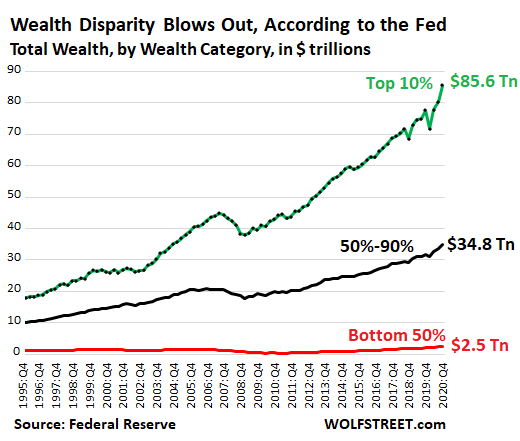
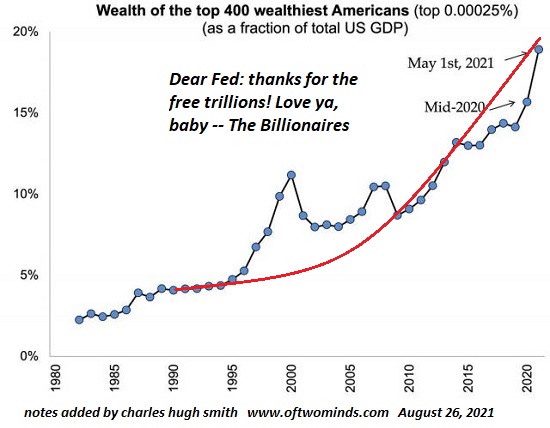
One might anticipate that the bottom 50%’s meager share of the nation’s exploding wealth would have increased as smartly as the wealth of the billionaires, but alas, no.

America’s economy has changed in ways few of the winners seem to notice, as they’re too busy cheerleading their own brilliance and success. In the view of the winners, who just so happen to occupy all the seats at the media-punditry-Federal Reserve, etc. table–the rising tide of stock, bond and real estate bubbles are raising all boats. What’s left unsaid is except for the 50% of boats with gaping holes below the waterline, i.e. stagnant wages and a fast-rising cost of living.

The truth the self-satisfied winners don’t include in their self-congratulatory rah-rah is there’s no place for the bottom 50% of American households to go but down. All the winnings flow to those who already owned assets back when they were affordable– the already-wealthy–whose wealth has soared as assets have shot to the moon while the the burdens of inflation and debt service hit the bottom 50% the hardest.

Meanwhile, the Federal Reserve is whining that inflation isn’t high enough yet for their refined tastes. Boo-hoo, how sad for the Fed–inflation isn’t yet high enough. Oh wait–didn’t they each mint millions by front-running their own policies? No wonder they’re not worried about inflation.

The reality few acknowledge is that globalization and financialization have stripped the American economy of low-skilled jobs that don’t demand much of the employee. The reality is that a great many people don’t have what it takes to learn high-level skills and work at a demanding pace under constant pressure–the description of the average job in America.

There were once millions of low-skill, low-pay jobs for people who for whatever mix of reasons were unable to muster the wherewithal to fulfill the fantasy of working extra hard, going to night school, soaking up high-level skills, moving quickly up the ladder to higher pay, buying the starter home and then moving up the food chain to middle class security from there.

The cost of living was low enough that those working these low-skill, low-pay jobs could still have an independent life. There were still low-cost rentals, often derided by the wealthy, in nooks and crannies of even the costliest cities. (I once lived in a room stuffed with old tax records in a poolside shack in an upscale neighborhood. The room had been cleared for a single bed and a path to the decrepit bathroom. Its most important attribute was that I could afford it on my low earnings.)

Affordable housing has vanished, eliminated by the financialization of America’s economy. Once landlords pay double the price for the property, rents have to double to pay their higher expenses. The apartment didn’t double in size or amenities–the rent doubled without any increase in utility to the renter. You get nothing more for double the price–nice.

Yes, people could make better choices, and some do. The point here is the game is rigged against those in the lower tier of the economy who can no longer afford a house or other stake in the only winning game in town–speculative asset bubbles. Go ahead and work a second job and go to night school–you’ll still be left behind the already-rich.

Globalization opened every job in America to global competition via offshoring or the influx of undocumented workers so desperate to support their families back home that no pay was too low and no working condition too wretched to refuse.

Many overindulged pundits who never worked an honest day in their lives sneer about burger flippers without realizing how hard those burger flippers have to work. I doubt the well-dressed pundits, snobbish about their university degrees and general brilliance, could manage to work a single day in a demanding fast-food job.

As the price of housing and other assets have soared, enriching the already rich, they’re out of reach for the bottom 50% who struggle to pay their bills as wages have stagnated and the costs of essentials have skyrocketed.

The rising cost of parking tickets, junk fees, user fees, utilities and food don’t impact the well-paid top 5% technocrat class, whose stake in the Everything Bubble keeps expanding by tens or hundreds of thousands of dollars. But for the bottom 50%, those incremental increases are, when added to higher rents, absolutely crushing.

As for getting high-quality healthcare that includes mental health support–those are reserved for the rich. But no worries, self-medication is always a “choice.”

Getting a boost in pay from $12 an hour to $15 an hour is welcome, but that doesn’t put the worker any closer to affording a house or equivalent stake in the Everything Bubble.

The new feudalism is masked by the glossy SillyCon Valley PR of a gig economy where (per the PR fantasy) bright, shiny and totally independent workers freely choose to serve the winners in the rigged sweepstakes for low pay and zero benefits.

In the SillyCon Valley PR, serfs freely choose to serve their noble masters for nothing but survival because they love the “freedom” and “choice” of kissing the nobility’s plump derrieres. (After all, there were “choices” even back in the good old days of feudalism–one could join the brigands in the forest, or enlist in a poorly paid mercenary army where the odds of dying were high–you know, “choices” of “gigs.”)

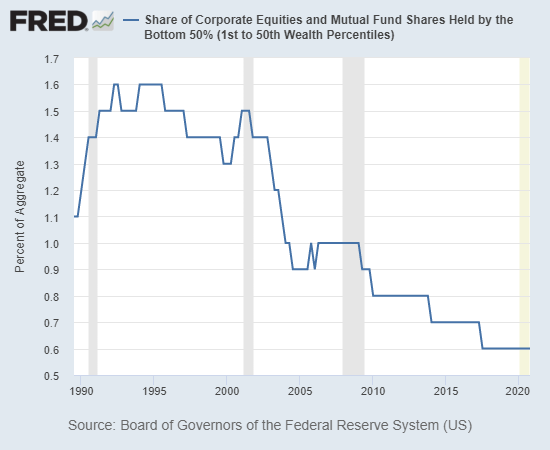
One might anticipate that the bottom 50%’s meager share of the nation’s exploding wealth would have increased as smartly as the wealth of the billionaires, but alas, no–the bottom 50%’s share of stocks (equities) actually plummeted in the the glorious decades of Federal Reserve free money for financiers, stock buy-backs and asset bubbles.

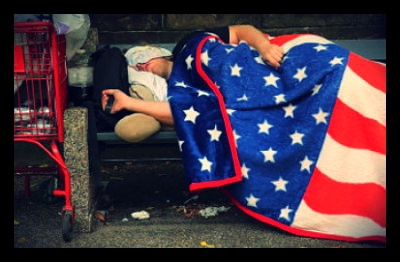
All this suits the billionaires and those collecting the crumbs of the Everything Bubble just fine. So what if the bottom 50% have nowhere to go but down? There’s plenty of room in the homeless encampment for another broken down station wagon or an old camper. There’s lots of “choices.”

And no consequences for the winners, of course, because The Fed has our backs.

Amazon, “Economic Terrorism” and the Destruction of Competition and Livelihoods

By Colin Todhunter

Source: Off-Guardian

Global corporations are colonising India’s retail space through e-commerce and destroying small-scale physical retail and millions of livelihoods.

Walmart entered into India in 2016 with a US$3.3 billion take-over of the online retail start-up Jet.com. This was followed in 2018 with a US$16 billion take-over of India’s largest online retail platform, Flipkart. Today, Walmart and Amazon control almost two thirds of India’s digital retail sector.

Amazon and Walmart have a record of using predatory pricing, deep discounts and other unfair business practices to attract customers to their online platforms. A couple of years ago, those two companies generated sales of over US$3 billion in just six days during Diwali. India’s small retailers reacted by calling for a boycott of online shopping.

If you want to know the eventual fate of India’s local markets and small retailers, look no further than what US Treasury Secretary Steven Mnuchin said in 2019. He stated that Amazon had “destroyed the retail industry across the United States.”

AMAZON’S CORPORATE PRACTICES

In the US, an investigation by the House Judiciary Committee concluded that Amazon exerts monopoly power over many small- and medium-size businesses. It called for breaking up the company and regulating its online marketplace to ensure that sellers are treated fairly.

Amazon has spied on sellers and appropriated data about their sales, costs and suppliers. It has then used this information to create its own competing versions of their products, often giving its versions superior placement in the search results on its platform.

The Institute for Local Self-Reliance (ILSR) published a revealing document on Amazon in June 2021 that discussed these issues. It also notes that Amazon has been caught using its venture capital fund to invest in start-ups only to steal their ideas and create rival products and services.

Moreover, Amazon’s dominance allows it to function as a gatekeeper: retailers and brands must sell on its site to reach much of the online market and changes to Amazon’s search algorithms or selling terms can cause their sales to evaporate overnight.

Amazon also makes it hard for sellers to reduce their dependence on its platform by making their brand identity almost invisible to shoppers and preventing them from building relationships with their customers. The company strictly limits contact between sellers and customers.

According to the ILSR, Amazon compels sellers to buy its warehousing and shipping services, even though many would get a better deal from other providers, and it blocks independent businesses from offering lower prices on other sites. The company also routinely suspends sellers’ accounts and seizes inventories and cash balances.

The Joint Action Committee against Foreign Retail and E-commerce (JACAFRE) was formed to resist the entry of foreign corporations like Walmart and Amazon into India’s e-commerce market. Its members represent more than 100 national groups, including major trade, workers’ and farmers’ organisations.

JACAFRE issued a statement in 2018 on Walmart’s acquisition of Flipkart, arguing that it undermines India’s economic and digital sovereignty and the livelihoods of millions in India. The committee said the deal would lead to Walmart and Amazon dominating India’s e-retail sector. It would also allow them to own India’s key consumer and other economic data, making them the country’s digital overlords, joining the ranks of Google and Facebook.

In January 2021, JACAFRE published an open letter saying that the three new farm laws, passed by parliament in September 2020, centre on enabling and facilitating the unregulated corporatisation of agriculture value chains. This will effectively make farmers and small traders of agricultural produce become subservient to the interests of a few agrifood and e-commerce giants or will eradicate them completely.

Although there was strong resistance to Walmart entering India with its physical stores, online and offline worlds are now merged: e-commerce companies not only control data about consumption but also control data on production and logistics. Through this control, e-commerce platforms can shape much of the physical economy.

What we are witnessing is the deliberate eradication of markets in favour of monopolistic platforms.

BEZOS NOT WELCOME

Amazon’s move into India encapsulates the unfair fight for space between local and global markets. There is a relative handful of multi-billionaires who own the corporations and platforms. And there are the interests of hundreds of millions of vendors and various small-scale enterprises who are regarded by these rich individuals as mere collateral damage to be displaced in their quest for ever-greater profit.

Thanks to the helping hand of various COVID-related lockdowns, which devastated small businesses, the wealth of the world’s billionaires increased by $3.9tn (trillion) between 18 March and 31 December 2020.

In September 2020, Jeff Bezos, Amazon’s executive chairman, could have paid all 876,000 Amazon employees a $105,000 bonus and still be as wealthy as he was before COVID. Jeff Bezos – his fortune constructed on unprincipled methods that have been well documented in recent years – increased his net wealth by $78.2bn during this period.

Bezos’s plan is clear: the plunder of India and the eradication of millions of small traders and retailers and neighbourhood mom and pop shops.

This is a man with few scruples. After returning from a brief flight to space in July, in a rocket built by his private space company, Bezos said during a news conference:

I also want to thank every Amazon employee and every Amazon customer because you guys paid for all of this.”

In response, US congresswoman Nydia Velazquez wrote on Twitter:

While Jeff Bezos is all over the news for paying to go to space, let’s not forget the reality he has created here on Earth.”

She added the hashtag #WealthTaxNow in reference to Amazon’s tax dodging, revealed in numerous reports, not least the May 2021 study ‘The Amazon Method: How to take advantage of the international state system to avoid paying tax’ by Richard Phillips, Senior Research Fellow, Jenaline Pyle, PhD Candidate, and Ronen Palan, Professor of International Political Economy, all based at the University of London.

Little wonder that when Bezos visited India in January 2020, he was hardly welcomed with open arms.

Bezos praised India on Twitter by posting:

Dynamism. Energy. Democracy. #IndianCentury.”

The ruling party’s top man in the BJP foreign affairs department hit back with:

Please tell this to your employees in Washington DC. Otherwise, your charm offensive is likely to be waste of time and money.”

A fitting response, albeit perplexing given the current administration’s proposed sanctioning of the foreign takeover of the economy, not least by the unscrupulous interests that will benefit from the recent farm legislation.

Bezos landed in India on the back of the country’s antitrust regulator initiating a formal investigation of Amazon and with small store owners demonstrating in the streets. The Confederation of All India Traders (CAIT) announced that members of its affiliate bodies across the country would stage sit-ins and public rallies in 300 cities in protest.

In a letter to PM Modi, prior to the visit of Bezos, the secretary of the CAIT, General Praveen Khandelwal, claimed that Amazon, like Walmart-owned Flipkart, was an “economic terrorist” due to its predatory pricing that “compelled the closure of thousands of small traders.”

In 2020, Delhi Vyapar Mahasangh (DVM) filed a complaint against Amazon and Flipkart alleging that they favoured certain sellers over others on their platforms by offering them discounted fees and preferential listing. The DVM lobbies to promote the interests of small traders. It also raised concerns about Amazon and Flipkart entering into tie-ups with mobile phone manufacturers to sell phones exclusively on their platforms.

It was argued by DVM that this was anti-competitive behaviour as smaller traders could not purchase and sell these devices. Concerns were also raised over the flash sales and deep discounts offered by e-commerce companies, which could not be matched by small traders.

The CAIT estimates that in 2019 upwards of 50,000 mobile phone retailers were forced out of business by large e-commerce firms.

Amazon’s internal documents, as revealed by Reuters, indicated that Amazon had an indirect ownership stake in a handful of sellers who made up most of the sales on its Indian platform. This is an issue because in India Amazon and Flipkart are legally allowed to function only as neutral platforms that facilitate transactions between third-party sellers and buyers for a fee.

UNDER INVESTIGATION

The upshot is that India’s Supreme Court recently ruled that Amazon must face investigation by the Competition Commission of India (CCI) for alleged anti-competitive business practices. The CCI said it would probe the deep discounts, preferential listings and exclusionary tactics that Amazon and Flipkart are alleged to have used to destroy competition.

However, there are powerful forces that have been sitting on their hands as these companies have been running amok.

In August 2021, the CAIT attacked the NITI Aayog (the influential policy commission think tank of the Government of India) for interfering in e-commerce rules proposed by the Consumer Affairs Ministry.

The CAIT said that the think tank clearly seems to be under the pressure and influence of the foreign e-commerce giants.

The president of CAIT, BC Bhartia, stated that it is deeply shocking to see such a callous and indifferent attitude of the NITI Aayog whch have remained a silent spectator for so many years when:

…the foreign e-commerce giants have circumvented every rule of the FDI policy and blatantly violated and destroyed the retail and e-commerce landscape of the country but have suddenly decided to open their mouth at a time when the proposed e-commerce rules will potentially end the malpractices of the e-commerce companies.”

Of course, money talks and buys influence. In addition to tens of billions of US dollars invested in India by Walmart and Amazon, Facebook invested US$5.5 billion last year in Mukesh Ambani’s Jio Platforms (e-commerce retail). Google has also invested US$4.5 billion.

Since the early 1990s, when India opened up to neoliberal economics, the country has become increasingly dependent on inflows of foreign capital. Policies are being governed by the drive to attract and retain foreign investment and maintain ‘market confidence’ by ceding to the demands of international capital which ride roughshod over democratic principles and the needs of hundreds of millions of ordinary people. ‘Foreign direct investment’ has thus become the holy grail of the Modi-led administration and the NITI Aayog.

The CAIT has urged the Consumer Affairs Ministry to implement the draft consumer protection e-commerce rules at the earliest as they are in the best interest of the consumers as well as the traders of the country.

Meanwhile, the CCI probably will complete its investigation within two months.

Freedom Rider: How the billionaires rule

Predatory capitalism has driven down wages and created a dystopia for workers.

By Margaret Kimberley

Source: Intrepid Report

President Calvin Coolidge said, “The business of America is business.” The expression is memorable because it always rang true. But nearly 100 years later an old trite saying has taken on an ever more terrifying meaning.

The ruling class wield their power more blatantly than ever. There is little effort to conceal their determination to rule over the people and to control the politicians who are now little more than their personal minions.

When the people get a little help, as happened with additional stimulus funds for the unemployed, politicians across the country took up arms for the ruling class and turned down free money just to stay in the good graces of their bosses.

Currently 25 states out of 50 have rejected additional help for the unemployed. The money came from the federal government and didn’t impact state budgets, but politicians know who calls the shots. When called upon to help struggling people they chose to do just the opposite. They helped their exploiters and, in the process, made a mockery of what passes for democracy.

There is no labor shortage in this country. Instead, there is a shortage of jobs that pay a living wage and that is because of the power of capitalists. They have grown richer precisely because they have forced workers to live in a constant state of precarity, and now it is quite literally better to stay home than to work for a pittance.

Of course, the richest man in the world, Amazon’s Jeff Bezos, is a master at coming up with new ways to subjugate workers. Any reports of job growth should be viewed with a very jaundiced eye as predatory capitalism has driven down wages and created a dystopia for workers. Bezos has mastered squeezing the most and giving the least.

Amazon warehouse workers suffer from injuries at higher rates than other employees in similar jobs but the injuries are part of the cost of doing business. It is expected that the grueling working conditions will create high turnover which is exactly what Amazon wants. A revolving door of employees serves their needs quite nicely. Bezos made a big deal about a $15 per hour starting salary but he could certainly afford to pay a lot more, a real living wage. The tight-fisted billionaire who could potentially become a trillionaire got rich the old fashioned way. He cheats workers.

Bezos also comes up with new and ingenious ways to spread the suffering. Amazon Flex delivery drivers are hired by apps and fired by algorithms. They have no interaction with human resources or any humans at all and they must pay a $200 fee to contest terminations that are rarely decided in their favor.

Even when American workers lose their jobs they are still at the mercy of corporate giants. ID.me contracts with states to provide public access to web sites such as those used for unemployment claims. Their facial recognition software doesn’t verify everyone properly and desperate people wait days and weeks for their unemployment payments to arrive. As with Amazon there is no one to speak to for help. But state governments turn over millions of dollars to ID.me in order to cheat people out of benefits they have earned. Currently 30 states contract with ID.me to make sure that the most vulnerable are kicked while they are down.

The algorithm hirings and firings and the facial recognition technology problems are not bugs in the system. They are features. They are doing precisely what they are intended to do, keep workers poor, desperate, and at the mercy of capitalists. Cruelty is the point.

One might ask who speaks for the people. Workers in several states had their unemployment saved by court decisions but those are few and far between. Politicians are as blatant as their corporate bosses and openly side with them against their constituents.

There is no way to reform this system. Democrats and republicans are equally eager to act at the behest of corporate interests. The people either vote in hopes of change that never comes or are apathetic because they see that the odds are against them.

The workers who refuse low pay under dangerous conditions are moving in the right direction. Whether they know it or not they are potentially building a new movement. A general strike is what the country needs. Of course that is why the hammer fell in an attempt to nip any resistance in the bud and get the cogs back into the machine. But the direction we must move in is clear. There is no salvation from a Biden or a Harris or any other name being floated. The people will have to move in a different direction if they are to save themselves.