
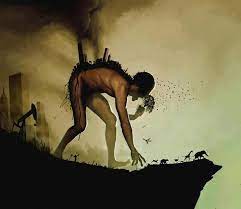
Illustration by Luke Seitz
By Robert J. Burrowes
At the beginning of the nineteenth century, it is estimated that the total number of passenger pigeons in the United States was about three billion birds. The bird was immensely abundant, as illustrated by this passage written by the famous ornithologist, naturalist and painter John James Audubon:
‘I dismounted, seated myself on an eminence, and began to mark with my pencil, making a dot for every flock that passed. In a short time finding the task which I had undertaken impracticable, as the birds poured in countless multitudes, I rose, and counting the dots then put down, found that 163 had been made in twenty-one minutes. I traveled on, and still met more the farther I proceeded. The air was literally filled with Pigeons; the light of noon-day was obscured as by an eclipse, the dung fell in spots, not unlike melting flakes of snow; and the continued buzz of wings had a tendency to lull my senses to repose… Before sunset I reached Louisville, distance from Hardensburgh fifty-five miles. The Pigeons were still passing in undiminished numbers, and continued to do so for three days in succession.’ See ‘Passenger Pigeon’.
So numerous was this bird that, in the nineteenth century, the passenger pigeon was one of the most abundant birds on Earth.
In 1914 it was extinct.
While new settlements kept reducing the bird’s habitat, more importantly, it was literally hunted from the sky. Shot for its meat.
So I have two questions for you? When is the last time that you saw a flock of birds so vast that ‘the light of noon-day was obscured as by an eclipse’? And when did you last see a flock of just 20 birds?
Sobering to ponder, isn’t it?
The origin of birds
Birds evolved from small carnivorous dinosaurs of the Late Jurassic and in the 65 million years since the extinction of the rest of the dinosaurs, this ancestral lineage diversified into the major groups of birds alive today. See ‘The origin of birds’.
Because they did not exist during the first five mass extinction events on Earth, birds have been spared the widespread extinctions suffered by those species that did exist in earlier eras.
Extinctions of birds in prehistory and history
Nevertheless, the fossil record tells us of the existence of prehistoric birds that became extinct before the Late Quaternary (that is, the past half to one million years) and thus occurred in the absence of significant human interference – see ‘List of fossil bird genera’ – while various sources tell us of both prehistoric and historic bird species, including flightless megafauna birds, that became extinct between 40,000 BCE and 1500 AD and ‘was coincident with the expansion of Homo sapiens beyond Africa and Eurasia, and in most cases, anthropogenic factors played a crucial part in their extinction, be it through hunting, introduced predators or habitat alteration’. See ‘List of Late Quaternary prehistoric bird species’.
Of course, there is an even wider range of evidence of bird extinctions since 1500. See ‘List of recently extinct bird species’. Most notably perhaps, given the symbolism it has since acquired, the dodo, a flightless bird of Mauritius, was driven to extinction by 1681 but not before it was carefully drawn. See ‘Dodo’.
How many bird species are there on Earth now?
While one recent estimate – see ‘Scaling laws predict global microbial diversity’ – indicates that Earth may be the home to one trillion species (the vast bulk of which are microorganisms such as bacteria, archaea and microscopic fungi), of which only an estimated 8.7 million species fall into the usual and simpler categories of plants, birds, animals, fish, amphibians, insects and reptiles, the most recent research conducted by George F. Barrowclough, Joel Cracraft, John Klicka and Robert M. Zink and published in 2016 indicated that there are just 18,043 species of birds worldwide. See ‘How Many Kinds of Birds Are There and Why Does It Matter?’
Somewhat controversially – see ‘New Study Doubles the World’s Number of Bird Species By Redefining “Species”’ – this figure is nearly twice as many as previously thought because the study focused on ‘hidden’ avian diversity: birds that look similar to one another or were thought to interbreed but are actually different species. In any case, whether there are just 10,000 species of birds, 11,000+ as estimated by the recognized international authority BirdLife International – see ‘Introducing the IUCN Red List’ – or even18,000, just like other species of life on Earth, birds are now under siege in a way they have never been before.
Killing birds in the late twentieth and early twenty-first centuries
More than 100 years have passed since the passenger pigeon became extinct. However, while one might have hoped that humans had become more adept at nurturing populations of birds, the reality is that we are continuing to drive bird populations to extinction. Moreover, we are now doing this with breathtaking efficiency, slaughtering birds by the millions in ever-shortening timeframes.
As a result, the fate of the passenger pigeon has been replicated many times over with a vast number of bird species passing through the International Union for Conservation of Nature’s eight preliminary categories – Not Evaluated, Data Deficient, Least Concern, Near Threatened, Vulnerable, Endangered, Critically Endangered, Extinct in the Wild – before reaching the ninth and final category: Extinct. See ‘IUCN Red List Categories and Criteria’. At the moment, the ‘IUCN Red List of Threatened Species’ identifies 14% of remaining bird species as ‘threatened with extinction’. Also see ‘Introducing the IUCN Red List’.
Of course, this ongoing assault on birds is well documented in the scientific literature, along with descriptions of long-standing causes as well as those that are more recent.
In recently published research on the status of birds in North America, Dr. Kenneth V. Rosenberg led an international team of scientists from seven institutions in analyzing the population trends of 529 bird species on the North American continent. Their study quantified, for the first time, the total decline in bird populations in the continental U.S. and Canada: a loss of 2.9 billion breeding adult birds, with devastating losses among birds in every biome, since 1970. Moreover, their research revealed that ‘declines are not restricted to rare and threatened species – those once considered common and widespread are also diminished’. See ‘Decline of the North American avifauna’ and ‘Vanishing: More Than 1 in 4 Birds Has Disappeared in the Last 50 Years’.
Like scholars researching dramatic declines and extinctions of other species, such as insects, Rosenberg and his colleagues stress that their results have ‘major implications for ecosystem integrity, the conservation of wildlife more broadly, and policies associated with the protection of birds and native ecosystems on which they depend’. While species extinctions ‘have defined the global biodiversity crisis’, extinction ‘begins with loss in abundance of individuals that can result in compositional and functional changes of ecosystems’. Hence, the staggering loss of bird abundance ‘signals an urgent need to address threats to avert future avifaunal collapse and associated loss of ecosystem integrity, function, and services’. See ‘Decline of the North American avifauna’.
In more blunt language ‘the most comprehensive inventory ever done for North American birds, points to ecosystems in disarray because of habitat loss and other factors that have yet to be pinned down’. See ‘Billions of North American birds have vanished’. And, yet more bluntly: ‘The scale of loss portrayed in the [Rosenberg et.al.] study is unlike anything recorded in modern natural history.’ See ‘Vanishing: More Than 1 in 4 Birds Has Disappeared in the Last 50 Years’.
Even more importantly, however, pointing out that the study results ‘transcend the world of birds’, Rosenberg explained that ‘These bird losses are a strong signal that our human-altered landscapes are losing their ability to support birdlife’ and ‘that is an indicator of a coming collapse of the overall environment.’ See ‘Vanishing: More Than 1 in 4 Birds Has Disappeared in the Last 50 Years’.
Is North America alone in its decimation of bird populations? Far from it. Other research and data have revealed that ‘farmland birds in Europe have declined by over 50 per cent collectively in the last 30 or 40 years’ according to Professor Richard Gregory, head of species monitoring and research at the Royal Society for the Protection of Birds (RSPB) in the UK where, according to Martin Harper, director of conservation at the RSPB, ‘Our beleaguered farmland birds have declined by 56 per cent between 1970 and 2015 along with declines in other wildlife linked to changes in agricultural practices, including the use of pesticides’.
And, Professor Romain Julliard, a conservation biologist at France’s National Museum of Natural History, confessed his ‘shock’ when the latest research revealed that France has lost one-third of its birds in the past 15 years in what is being labeled a ‘dramatic collapse’ and ‘ecological catastrophe’ particularly because the decline has accelerated dramatically in recent years. See ‘“Shocking” decline in birds across Europe due to pesticide use, say scientists’.
In Germany, bird populations are vanishing with scientists using words like ‘decimated’ and ‘collapse’ to describe the enormity of the problem. In a recent study of government data, the German environmental organization Nature And Biodiversity Conservation Union (NABU) estimated ‘that more than 25 million birds [15% of the country’s total bird population] disappeared from Germany over the past 12 years’. See ‘Über zwölf Millionen Vogelbrutpaare weniger in Deutschland’, ‘Insect and bird populations declining dramatically in Germany’ and ‘“Decimated”: Germany’s birds disappear as insect abundance plummets 76%’. But why?
While habitat destruction and other factors played roles, scientists have also long linked pesticide use to insect decline – a reasonable assumption given that killing insects is the purpose of pesticides – and research clearly demonstrates that pesticides are killing more than target insects. For instance, a 2008 study demonstrated low but persistent levels of a common neonicotinoid pesticide in aquatic ecosystems can kill off or reduce the growth of insects (such as mosquitoes) that have an acquatic phase. See ‘Acute and Chronic Toxicity of Imidacloprid to the Aquatic Invertebrates Chironomus tentans and Hyalella azteca under Constant- and Pulse-Exposure Conditions’ and ‘“Decimated”: Germany’s birds disappear as insect abundance plummets 76%’.
In essence, the problem is that killing the insects is tantamount to killing the birds that feed on them.
Another recent study came to the same conclusion. The study, conducted in the Lake Constance area in southern Germany, found that the population of six of the most common birds had ‘declined massively’. According to Hans-Guenther Bauer of the Max Planck Institute for Behavioral Biology: ‘These are truly shocking figures, especially when you consider that the decline in birds began decades before our first data collection in 1980.’ Why is it happening? According to Bauer, a key reason for the decline is the loss of food. ‘This confirms what we have long suspected. The death of insects caused by humans has a massive impact on our birds.’ To stem the tide of losses, scientists are calling for a rethink in agricultural and forestry policy including ‘drastic restrictions on insecticides and herbicides in agriculture, forestry, public areas and private gardens’ and significantly less fertilization. See ‘Scientists fear “collapse” of bird populations in Germany’.
As is the case elsewhere around the world, birds in Africa also face a wide variety of threats, the most significant of which are habitat fragmentation, degradation and destruction as well as direct impacts including hunting and trapping (mainly for meat and trafficking). See ‘Multiple threats are driving threatened birds towards extinction in Africa’.
But nowhere is safe with the killing of migratory birds in China – see ‘Market trade is fuelling the killing of migratory birds in Northern China’ – and various factors adversely impacting penguins in Antarctica – see ‘Climate-driven reductions in krill abundance have caused Adélie penguin declines’ – just two more of many examples that could be cited.
Illegal hunting and trapping of birds
According to Birdlife International, the organization responsible for monitoring the welfare of birds for the IUCN’s Red List, ‘The illegal killing and taking of wild birds remains a major threat on a global scale’ with recent examples including the illegal poisoning of vultures in Sub-Saharan Africa, the illegal shooting of raptors in Europe and North America, the illegal trapping of passerines (perching birds) in Asia and the illegal capture for the bird trade in South America.
For example, based on extensive research over many years in relation to bird killing during migratory flights across the Mediterranean and through Northern and Central Europe and the Caucasus, BirdLife International has compiled a series of reports. These reports document massive illegal killing of birds, often in ways that constitute torture, and totaling in excess of 25 million birds annually, including birds of species that are threatened with extinction. For recent reports, see ‘The Killing 2.0: A View to a Kill’, ‘Assessing the scope and scale of illegal killing and taking of birds in the Mediterranean, and establishing a basis for systematic monitoring’ and ‘Review of illegal killing and taking of birds in Northern and Central Europe and the Caucasus’. For a more detailed scientific report on this issue, see ‘Preliminary assessment of the scope and scale of illegal killing and taking of birds in the Mediterranean’.
But if you would simply prefer to be revolted, then watch BirdLife’s one minute video: ‘Help us STOP illegal #birdkilling’. Or read a straightforward account of how ‘innocent’ human behaviours can be deadly for birds, in this case by ‘vacuuming’ millions of sleeping birds into oblivion each year during olive harvesting at night. See ‘Millions of Birds Killed by Nighttime Harvesting in Mediterranean’.
Unfortunately, if you think the descriptions and video of birdkilling above are bad, you won’t be impressed with the sheer insanity that militarized humans can display: ‘The Farmagusta area of Cyprus comes out as the worst place for illegally killing birds in the Mediterranean, while the British Territory in Cyprus is also affected, with the Dhekelia UK military base seeing hundreds of thousands of birds killed each autumn. The Ministry of Defence has started a programme to remove illegally planted trees and shrubs in the area, which trappers use for cover and to lure birds in.’ See ‘Millions of Birds Killed in the Mediterranean’. So, instead of ordering soldiers to stop shooting birds while using a combination of education and law enforcement measures to prevent civilians doing so, they removed ‘illegally planted trees and shrubs’!
Wild Bird trafficking
Another major killer of birds is the wildlife trade. Birds are often killed as a ‘byproduct’ of the trade in exotic birds, most of which is illegal, but which is a multi-billion dollar a year industry along with human, weapons, currency and drug trafficking. Equally importantly, however, once traded, birds no longer form part of their original habitat and hence they are lost as contributing and breeding members of that ecosystem. According to the Convention on International Trade in Endangered Species of Wild Fauna and Flora (CITES), species listed in Appendix I of the Convention are considered to be threatened with extinction and are not allowed to be traded commercially. There are currently 161 bird species on Appendix I. However, birds included on Appendix II are allowed to enter international trade ‘under specific controlled circumstances’; there are 1,300 bird species on this appendix. See ‘Wild Bird Trade and CITES’ and ‘CITES Appendices I, II and III’.
In theory, state parties are obliged to develop national legislation effectively implementing the obligations of the Convention including setting sustainable quotas for Appendix II species. But I am sure that you can imagine how well this regime works given the incredibly profitable wildlife trafficking industry, in which birds are a crucial component. In fact, ‘one third (3,337) of living bird species [that is, 2,000 species more than those that are “legal”] have been recorded as traded internationally for the pet trade and other purposes’. Of these species, 266 (that is, 8% of those internationally traded) are considered globally threatened. See ‘The Red List Index for internationally traded bird species shows their deterioration in status’.
And if the domestic trade in birds is taken into account as well, then ‘Nearly 4,000 bird species involving several million individuals annually are subject to domestic or international trade with finches, weavers, parrots and raptors being some of the most heavily affected groups.’ See ‘Wild Bird Trade and CITES’.
For a candid account of bird trafficking at its origin which describes the fate of macaw chicks being stolen from their forest nests in Ecuador, see ‘Wildlife Trafficking’.
Seabirds
In relation to seabirds, one recent study found that the global population of these birds declined by 70% between 1950 and 2010 as a result of a multiplicity of threats. These threats included ‘entanglement in fishing gear, overfishing of food sources, climate change, pollution, disturbance, direct exploitation, development, energy production, and introduced species (predators such as rats and cats introduced to breeding islands that were historically free of land-based predators)’. See ‘Population Trend of the World’s Monitored Seabirds, 1950-2010’.
Another study concluded just recently, was ‘the first objective quantitative assessment of the threats to all 359 species of seabirds’ and identified the main threats to their survival while outlining priority actions for their conservation. Using the standardized ‘Threats Classification Scheme’ developed for the IUCN Red List to objectively assess threats to each species, a team of ten scientists identified the top three threats to seabirds – in terms of number of species affected and average impact – to be as follows: invasive alien species (particularly rats and cats) which affected 165 species across all of the most threatened groups; bycatch in fisheries which ‘only’ affected 100 species but with the greatest average impact; and the climate catastrophe which affected 96 species. ‘Overfishing, hunting/trapping and disturbance were also identified as major threats to seabirds.’ The study emphasized that 70% of seabirds, especially those that are globally threatened, face multiple threats. For the three most threatened groups of seabirds – albatrosses, petrels and penguins – it is essential to tackle both terrestrial and marine threats to reverse declines. See ‘Threats to seabirds: A global assessment’.
In addition, however, another problem that has been getting insufficient attention is the result of the expanding impacts of the rapidly increasing levels of ocean acidification, ocean warming, ocean carbon flows and ocean plastics. Taken in isolation each of these changes clearly has negative consequences for the ocean. All these shifts taken together, however, result in a rapid and serious decline in ocean health and this, in turn, adversely impacts all species dependent on the ocean, including seabirds. Moreover, on top of these problems is the issue of oxygen availability given that oxygen in the air or water is of paramount importance to most living organisms. As the recently released report ‘Ocean deoxygenation: Everyone’s problem. Causes, impacts, consequences and solutions’ describes in some detail, oxygen levels are currently declining across the ocean.
But to graphically illustrate just one of the threats to seabirds, consider the impact of our chronic overfishing which is depleting the oceans of fish. In November 2019, thousands of short-tailed shearwater birds migrating from Alaska were washed up dead on Sydney’s iconic beaches in Australia. Moreover, thousands more shearwaters died out at sea in clear confirmation of the incredible fish shortages in the Pacific Ocean. After spending the summer in Alaska, the shearwaters were migrating back to southern Australia to breed: a 14,000km trip over the Pacific that requires the birds to be at full strength.
Unfortunately, vast numbers died due to lack of food because the krill and other fish they feed on have vanished. But if you think the problem only occurred along or at the end of their journey, in fact there had been ‘a series of catastrophic die-offs’ before and shortly after the birds departed to head south with thousands of shearwaters (along with puffins, murres and auklets too) lying dead from starvation on the beaches of Alaska and on Russia’s Chukotka Peninsula back in mid-year as well. The overall ‘large die-off’ pattern has been repeating since 2015 with little knowledge of the full extent of the crisis because millions of the birds ‘die at sea’. See ‘Fish all gone!… Millions of small sea birds died since 2015’.
Tragically though, as touched on above, an ocean emptied of fish is not the only hazard that seabirds have no choice but to attempt to navigate. An ocean full of plastic – with concentrations up to 580,000 pieces per square kilometer – is also deceiving many seabirds into attempting to eat pieces of plastic and this only complicates efforts by seabirds to get adequate nutrition. See ‘Threat of plastic pollution to seabirds is global, pervasive, and increasing’ and ‘Nearly Every Seabird on Earth Is Eating Plastic’. This is graphically illustrated in this photo of a dead albatross – see ‘Laysan Albatrosses’ Plastic Problem’ – although, tragically, plastic is not the only non-food item that is consumed by and is killing these majestic birds, with an abandoned US military base on Midway Atoll – where 65% of the global albatross population breeds – playing a vital role too. See ‘Study shows lead-based paint is poisoning albatross chicks at Midway Atoll National Wildlife Refuge’.
But why do seabirds eat plastic instead of correctly identifying food? Well, one recent research project provided ‘the first evidence that, in addition to looking like food, plastic debris may also confuse seabirds that hunt by smell’. See ‘Marine plastic debris emits a keystone infochemical for olfactory foraging seabirds’ and ‘The oceans are full of plastic, but why do seabirds eat it?’
Other threats to birds
Another threat faced by birds in the nuclear age is the outcome of the radioactive contamination of the Earth in many places. For example, while there are ‘severe reductions in species richness and density’ in the regions surrounding the sites of the Chernobyl and Fukushima nuclear catastrophes, surviving birds display a wide range of deformities and dysfunctionalities, notably including impaired brain development as reflected by head volume with its negative implications for cognitive ability and hence viability. See ‘Chernobyl Birds Have Smaller Brains’ and ‘Bird populations near Fukushima are more diminished than expected’.
Yet another threat to birds is posed by the deployment of 5G. ‘Typical effects of radiation from cellular communication antennas on resident, breeding, and migratory birds [include] site abandonment, feather deformation, locomotion problems, weight loss, weakness, reduced survivorship and death.’ Moreover, it can ‘blot out a bird’s perception of the earth’s field, causing the bird to fly in the wrong direction, and also disrupt a bird’s internal clock based on the sun’s changing position’. See ‘5G to Kill the Birds, Bees and Your Loved Ones?’ and ‘Western Insanity and 5G Electromagnetic Radiation’.
Finally, without elaboration, vast numbers of birds are also killed each year by warfare and other military activities – see, for example, ‘The impact of the 1991 Gulf War oil spill on bird populations in the northern Arabian Gulf – a review’ – by industrial activity and accidents – see, for example, ‘Effects of the Exxon Valdez Oil Spill on Birds: Comparisons of Pre- and Post-spill Surveys in Prince William Sound, Alaska’ – by road and air traffic, the spread of certain avian diseases to previously unaffected species – see ‘Avian diseases are spreading to impact hitherto unaffected populations’ – wind turbines, cats, windows and communication towers, with 7 million birds losing their lives each year in the United States alone to the ‘web-like traps of wire and metal’ used for communication. See ‘Communication Towers Are Death Traps for Threatened Bird Species’. Other birds are now being killed in response to conflict generated between birds. See ‘Climate Change Leading to Fatal Bird Conflicts’. And, of course, ‘domesticated’ birds such as chickens and turkeys are farmed and consumed in prodigiously huge quantities, including for Christmas.
Sadly, too, millions of birds of many species are imprisoned in cages as ‘pets’ denied the freedom that all humans crave for themselves.
So, in essence, if you were a bird, here is a survival strategy that should work. Only live in a habitat that will not be impacted, in any way, by human beings and their activities. That is, don’t live on Earth.
Saving the birds
Given the vast range of threats posed to birdlife by humans – see a straightforward summary of ‘The greatest threats facing Important Bird & Biodiversity Areas today’ which doesn’t mention all threats and those that are emerging – it is clearly going to take a monumental effort on many fronts to contain the killing of birds and avert the ongoing extinction of bird species on Earth.
And, unless you are naive enough to believe that elite-controlled governments or international organizations and processes are going to do something that is actually effective – see ‘The Global Elite is Insane Revisited’ – then it is up to us to make the difference. Of course, we can do a few things that are specific to saving birds but the bulk of what must happen is really about saving the biosphere (which includes birds) generally. The biosphere is, after all, one deeply-interconnected living entity.
This is why, according to some biologists, laws that focus on the protection of rare species miss the big picture. Joel Cracraft, for example, argues that ‘We’re losing the battle because we’re fighting over single endangered species’. Species protection tends to focus on charismatic species – beautiful birds and mammals – and doesn’t value rare ecosystems or collections of species. See ‘New Study Doubles the World’s Number of Bird Species By Redefining “Species”’. Nor does it value the biosphere as a whole.
Still, some superlative efforts have been made on behalf of birds. For example, you can read some inspirational success stories by BirdLife International: ‘10 vital bird habitats saved through conservation action’.
And for one man’s initiative 120 years ago that is having ongoing impact, see ‘How one man changed a Christmas tradition forever – to save birds’.
So you can, of course, support the efforts of Birdlife International and the local, national and other organizations like it. See ‘Welcome to BirdLife’s Globally Threatened Bird Forums’ and, for example, ‘Stop Wildlife Trafficking’.
Separately from initiatives that focus specifically on birds, if you wish to fight powerfully to save Earth’s biosphere consider joining those participating in ‘The Flame Tree Project to Save Life on Earth’ which outlines a simple program to systematically reduce your consumption and increase your local self-reliance over a period of years. Among many other beneficial environmental outcomes, this will reduce the ongoing destruction of bird habitat to produce the products we all consume.
But given the fear-driven violent parenting and education models that drive all violence in our world and which, among a multitude of other adverse outcomes, generates the addiction of most people in industrialized countries to the over-consumption that is destroying Earth’s biosphere – see ‘Love Denied: The Psychology of Materialism, Violence and War’ – then consider addressing this directly starting with yourself – see ‘Putting Feelings First’ – and by reviewing your relationship with children. See ‘My Promise to Children’ and ‘Nisteling: The Art of Deep Listening’. For fuller explanations, see ‘Why Violence?’ and ‘Fearless Psychology and Fearful Psychology: Principles and Practice’.
If you wish to campaign strategically to defend birds against particular threats, such as the climate catastrophe, military violence or the deployment of 5G, for example, consider joining those campaigning to halt these and other threats as well. See Nonviolent Campaign Strategy which already includes a comprehensive list of strategic goals necessary to achieve these outcomes in two key contexts in ‘Strategic Aims’.
But, whatever you do, don’t fall into the trap of fearfully begging elites to act on your behalf as, for example, the antiwar and climate movements are doing (with climate ‘activists’ marginalized at the latest COP25 gathering in Madrid). If we do not focus our efforts on engaging all people who are powerful enough to do so to respond strategically, then we will fail. And our failure will not only be the result of the elite refusing to take the requisite action despite your entreaties but also because the elite, as a group, is powerless to make sufficient difference: only a massive response from the wider population can produce the outcome we now need. For explanations of this, see ‘Why Activists Fail’, ‘The Global Climate Movement is Failing: Why?’ and ‘The War to End War 100 Years On: An Evaluation and Reorientation of our Resistance to War’.
Moreover, in those cases where corrupt or even electorally unresponsive governments are leading the destruction of the biosphere – by supporting, sponsoring and/or engaging in environmentally destructive practices – it might be necessary to remove these governments as part of the effort. See Nonviolent Defense/Liberation Strategy.
You might also consider joining the global network of people resisting violence in all contexts, including against the biosphere, by signing the online pledge of ‘The People’s Charter to Create a Nonviolent World’.
Or, if none of the above options appeal or they seem too complicated, consider committing to:
The Earth Pledge
Out of love for the Earth and all of its creatures, and my respect for their needs, from this day onwards I pledge that:
- I will listen deeply to children (see explanation above)
- I will not travel by plane
- I will not travel by car
- I will not eat meat and fish
- I will only eat organically/biodynamically grown food
- I will minimize the amount of fresh water I use, including by minimizing my ownership and use of electronic devices
- I will not buy rainforest timber
- I will not buy or use single-use plastic, such as bags, bottles, containers, cups and straws
- I will not use banks, superannuation (pension) funds or insurance companies that provide any service to corporations involved in fossil fuels, nuclear power and/or weapons
- I will not accept employment from, or invest in, any organization that supports or participates in the exploitation of fellow human beings or profits from killing and/or destruction of the biosphere
- I will not get news from the corporate media (mainstream newspapers, television, radio, Google, Facebook, Twitter…)
- I will make the effort to learn a skill, such as food gardening or sewing, that makes me more self-reliant
- I will gently encourage my family and friends to consider signing this pledge.
Do all these options sound unpalatable? Prefer something requiring less commitment? You can, if you like, do as most sources suggest: nothing (or its many tokenistic equivalents). I admit that the options I offer are for those powerful enough to comprehend and act on the truth. Why? Because there is so little time left and I have no interest in deceiving people or treating them as unintelligent and powerless. See ‘Human Extinction by 2026? A Last Ditch Strategy to Fight for Human Survival’ and ‘Doomsday by 2021?’
Conclusion
Birds are being killed with ruthless efficiency by human beings and their activities all over the world. Obviously, this is an unmitigated tragedy for Earth’s birds, the biosphere as a whole and those humans who love life generally. But what are the practical implications of this ongoing bird killing for us?
Well just as the death of one canary in a coal mine warned miners about their dangerous environment, the mass death of birds is yet another warning that we are destroying the planetary biosphere.
However, in this case, we are not treating the canary’s death as a warning and, even if we were, it does not mean that we can escape because there is nowhere else to go.
In short, if we don’t save the birds, we won’t save ourselves.
Biodata: Robert J. Burrowes has a lifetime commitment to understanding and ending human violence. He has done extensive research since 1966 in an effort to understand why human beings are violent and has been a nonviolent activist since 1981. He is the author of ‘Why Violence?’ His email address is flametree@riseup.net and his website is here.

 After the Crash