Arab regimes collude with Israel’s genocide and ethnic cleansing of Gaza

By By Jean Shaoul

Source: Defend Democracy Press

As Israel’s fascist government prepares to launch a massive ground invasion to take over Rafah city, discussions are now under way about setting up 15 campsites—each with around 25,000 tents—across the southwestern part of the Gaza Strip, to house the million-plus Palestinians that have taken refuge in the city.

These tent cities are to be funded by the United States and Arab despots and operated by the butcher of Cairo, Egypt’s Abdel Fattah el-Sisi. Egypt and other Arab regimes are in effect providing Israeli Prime Minister Benjamin Netanyahu with the ability to claim he has assured the “safe passage” he said he would provide so that the planned ground invasion could take place. As Netanyahu again declared as Israel mounted a massive aerial bombardment of the city, his real goal is “total victory”—which means killing as many Palestinians as possible and driving the rest into the desert.

That such proposals could even be discussed with the Arab regimes confirms that their collusion with Israel’s genocidal offensive against Gaza, from day one, has now become direct participation in its ethnic cleansing through a second Nakba.

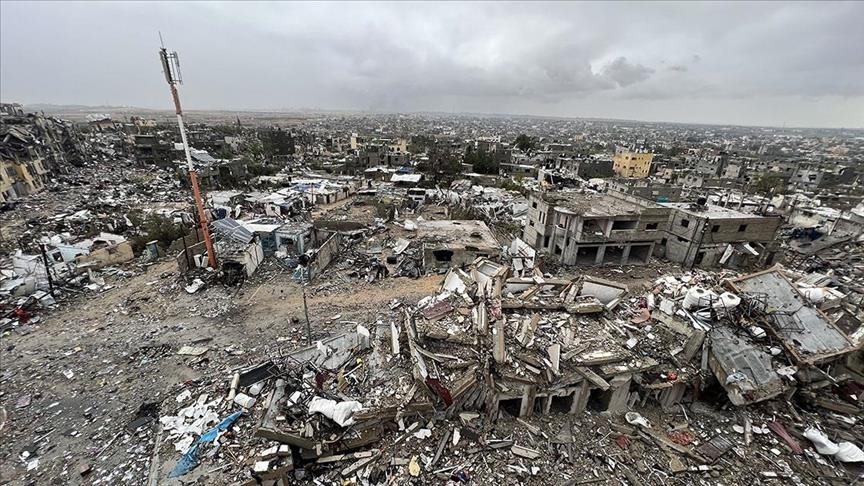
Israel has already killed at least 29,000 people, mostly women, children and the elderly, buried thousands more under the rubble, and displaced approximately 86 percent of Gaza’s population—1.7 million out of 2.3 million people. The majority are now sheltering in Rafah, close to the border with Egypt where they face famine, lack access to clean water and medical care and the imminent prospect of extermination.

Egypt: Israel’s border guard

Egypt, the most populous Arab state with 104 million people and the key frontline state, has for decades played a criminal role as a direct accomplice in Israel’s suppression of the Palestinians and its de facto border guard.

Since signing a peace treaty with Israel in 1979, Cairo has extended its ties with Tel Aviv, importing natural gas from Israel for refining and re-export, coordinating security over their shared border and the Gaza Strip, maintaining Israel’s blockade on Gaza, and strictly limiting the movement of people and goods across its borders after Hamas took control in 2007. Egypt stood by when Israel launched murderous assaults on the besieged enclave in 2008-9, 2012, 2014, the 2018-29 Great March of Return and 2021.

When the Gaza offensive started in October, Israel’s “wartime proposal” to push Gaza’s 2.3 million Palestinians into Egypt’s Sinai desert was met with a furious response from Cairo. However, this was not out of any concern for the Palestinians but because of what El-Sisi called “Gaza’s existential threat to Egypt’s national security.” If a million Gazans crossed the border, he warned, this would lead to a resurgence of Islamist “militancy” in Sinai.

When El-Sisi refers to a resurgence of Islamist militancy, he means a renewal of the mass popular opposition known as the 25 January Revolution, which in 2011, at the height of the “Arab Spring”, ended Mubarak’s personal rule. On July 3, 2013, the junta was able to resume power in a military coup thanks to the political bankruptcy of the bourgeois liberal opposition and their pseudo-left appendages in the Revolutionary Socialists, who provided leading personnel for the anti-Islamist Tamarod movement through which the military and its billionaire backers prepared the political ground for the coup. El-Sisi has brutally crushed all dissent ever since and the last thing he wants is millions of displaced and angry Palestinians to act as the focus for broader political opposition to his regime, to US imperialism and all its allies in the region.

The army has already fortified the concrete border wall with Gaza, installing barbed wire to prevent the Palestinians from crossing into the Sinai and deploying troops and 40 tanks along the border.

El-Sisi, speaking at a press conference on October 18 with German Chancellor Olaf Scholz in Cairo, argued that Israel could move Gaza’s Palestinians to Israel’s Negev desert instead of Sinai “until Israel is capable of defeating Hamas and Islamic Jihad. Afterwards, Palestinians could return to their homeland.”

Reports are circulating, citing the Sinai Foundation for Human Rights, that Egypt is constructing an eight-square-mile walled enclosure in northern Sinai to host Palestinians forcibly expelled from Gaza, though this is described as a “contingency plan” in the event Palestinians succeed in breaching the reinforced border.

But wherever the de facto concentration camps being discussed are eventually established, Egypt and the other Arab regimes involved are giving a greenlight for mass murder in Rafah. On Sunday, with breathtaking cynicism Egyptian officials, responding to these latest proposals for tent cities, told Israel that they would not object to a military operation in Rafah as long as it is conducted without harming Palestinian civilians. Army Radio also said that Egypt had emphatically denied reports it might pullout of its 1979 Camp David treaty if Israel attacked Rafah.

All the oil-rich despots are working openly with Israel to enable it to pursue its genocidal war, even deepening their ties to ensure Israel can continue the war without hindrance. They cover their treachery with crocodile tears over the plight of the Palestinians in Gaza, support for South Africa’s case against Israel at the International Court of Justice and appeals for an urgent meeting of the toothless UN Security Council that is subject to Washington’s veto “to prevent Israel from causing an imminent humanitarian disaster for which everyone who supports the aggression is responsible.”

Jordan: Repressing Palestinian protests

Jordan has played the most open role in repressing popular opposition to Israel. It shares a long border with Israel and is home to over 2.2 million registered Palestinian refugees driven there by wars between 1947 and 1967, and their descendants. Around half of its 11 million population are of Palestinian descent, of whom around two thirds have been granted citizenship, but they face discrimination while nearly 400,000 still live in 10 refugee camps. Jordan has maintained a “cold peace” with Israel following a US Clinton administration-brokered normalization treaty in 1994.

The Jordanian government has banned protests along its border with the West Bank and clamped down on protests against Israel’s war on Gaza. According to Human Rights Watch (HRW), it has “arrested or harassed” over 1,000 pro-Palestine protesters who have called for the Jordanian government to take action against Israel. Lama Fakih, HRW’s Middle East director, said “Jordanian authorities are trampling the right to free expression and assembly to tamp down Gaza-related activism.”

Last week, the authorities arrested activist, Khaled al-Natour, after he shared posts calling for the lifting of the blockade on Gaza, as part of the government’s heightened crackdown on pro-Palestine activists, under a controversial new cybercrime law. According to Amnesty International, the vaguely worded law, passed in August, gives the government huge latitude to crack down on free speech and has been used to arrest and charge at least six political activists for their “social media posts expressing pro-Palestinian sentiments or criticizing the authorities’ policies towards Israel and advocating for public strikes and protests.”

Arab regimes keeping Israel’s economy running

Jordan, along with several other Arab states, is also playing a central role in keeping Israel’s economy functioning during the war.

According to Israel’s television Channel 13, the United Arab Emirates-based PureTrans FZCO and Israel-based Trucknet, which provides logistics technology for the Arab shipping companies, are transporting vital goods, including food, plastics, chemicals and electronic devices and components, between Dubai’s Jebel Ali Port and Haifa port, via roads passing through Saudi Arabia and Jordan.

The route was established prior to the Gaza offensive. In June, Miri Regev, Israel’s Minister of Transportation and Road Safety, announced plans to develop the route, stating on X/Twitter that “the overland transportation of the goods will shorten the time by 12 days and greatly reduce the existing waiting time due to the wire problem. We will do it and we will succeed.” In September, Trucknet signed a shipping agreement with the UAE and Bahrain.

The plans also include a railway line, yet to be agreed, linking the UAE and Israel with a high-speed train service between Israel’s northern city of Beit She’an and southern port of Eilat on the Red Sea.

The route has assumed greater strategic significance since October and especially because of Houthi attacks on Israeli-linked shipping in the Red Sea, helping Israel circumvent the shipping blockade and cutting the 14-day sea route around the Cape to four days.

Acutely conscious of the mass opposition within its already restive population to Israel’s genocidal war, Jordan denied that goods were being transported to Israel via its territory. But television reports showing trucks from the UAE crossing Jordanian territory to reach Israel exposed this lie, sparking anger and demonstrations against Jordan’s ‘shameful land bridge’ to Israel.

The Dubai-Haifa “land corridor” was in fact first mooted in 2017 by Israel’s transport minister Yisrael Katz and highlighted at the signing in 2020 of the Abraham Accords with the UAE and Bahrain–and later with Sudan and Morrocco–that ended the participants’ long-standing economic boycott of Israel. It made apparent Israel’s economic ties with the Gulf states that had long been kept under wraps.

The Accords not only signified the ditching of their long defunct adherence to securing a “two-state solution,” even as Netanyahu threatened to annex one third of the West Bank, illegally occupied by Israel since the 1967 Arab Israeli war. It crucially paved the way for trade and investment deals with Tel Aviv, particularly in arms, technology and cyberware, and Israel’s broader economic integration into the region begun clandestinely after the 1993 Oslo Accords.

Saudi Arabia and the planned war against Iran

Bahrain could only sign up to the Accords with the tacit consent of its paymaster in Saudi Arabia. Riyadh is now directly involved in the Dubai-Haifa corridor as part of its efforts to extract as many concessions as possible from Washington, including a defence agreement, commitment of “security” support, arms and fighter jets and help with a civilian nuclear program, even as it expanded its economic and political links with China to strengthen its bargaining position.

The land corridor is a key concern for the US and European imperialist powers. It is aimed at positioning the Israeli port of Haifa as a major gateway to Europe, altering the political and economic map of the region by bypassing the Red Sea and furthering Israel’s integration into the Gulf states’ economies.

Haifa would be the linchpin of the India-Middle East Europe Economic Corridor (IMEC), a major transport infrastructure project aimed at integrating India, the Gulf and Europe while avoiding Iran, which would bring India closer to US imperialism and counter China’s Belt and Road Initiative. Oman’s Salalah Port, which has extensive ties with India, could also become part of the new network.

The project, which excludes Turkey, the largest non-oil economy in the Middle East, has aroused Ankara’s wrath, with government officials saying that the most suitable route for east-west trade passes through Turkey not Greece. It also undermines Egypt’s Suez Canal that is already suffering financial losses from the diversion of shipping round the Cape, intensifying its economic and social crisis.

The Arab regimes now account for one quarter of Israel’s $12.5 billion defence exports. Leaders from the UAE have also reiterated their commitment to the Abraham Accords, with UAE presidential foreign affairs adviser Anwar Gargash telling a conference in Dubai last month, “The UAE has taken a strategic decision, and strategic decisions are long-term.”

The bilateral flow of goods has exploded, expanding from $11.2 million in 2019 to $2 billion, excluding software, from January to August 2023, according to Israel’s UAE ambassador. The UAE-Israel partnership deal that came into force last year lowered tariffs with the aim of increasing bilateral trade to $10bn within five years. While far less than Israel’s trade with the European Union and Turkey, this is nevertheless far more than Israel’s trade with Egypt and Jordan.

As Israeli CEOs told the Financial Times, amid the Gaza genocide it has been “business as usual,” with new investment plans going ahead and the UAE’s airline continuing its flights to Tel Aviv even as others cancel theirs.

While Saudi Arabia was never a “frontline state” in the Arab Israeli conflict, in October 1973 it led the Organisation of Petroleum Exporting Countries’ (OPEC) ban on the export of oil to those countries that had supported Israel during the October 1973 Arab Israeli War. The war began after Egypt and Syria launched a surprise attack on Israel in an ultimately unsuccessful attempt to recover the territories lost in the 1967 war. Only Iraq and Libya did not take part in the oil embargo that was lifted in March 1974, by which time the price of oil had risen nearly threefold, massively increasing the oil states’ wealth and reactionary political influence in the region.

50 years later, there has been no mention of a similar embargo in defence of the 2.3 million Palestinians in Gaza, indicating the monarchies’ backing for Israel’s war, paid for and planned by the Biden administration, to assert US hegemony over the resource-rich region and suppress all opposition to Washington and its regional allies and to their own regime.

Israel’s war on Gaza has done nothing to derail Washington’s long-running efforts to broker a normalization deal between Israel and Saudi Arabia. A potential Saudi-Israel deal is a crucial part of its bid to settle the Gaza conflict with Riyadh indicating its willingness to proceed with discussions. For their part, the US and UK have consolidated the reversal of their previous opposition to Riyadh’s war to unseat the Houthis in Yemen, launching hundreds of aerial strikes on the Houthis in response to their attacks on shipping linked to Israel aimed at putting pressure on Israel to end its war and blockade of Gaza.

The Arab regimes, whose populations hold them in contempt, have made a pact with the devil: support for Israel—and by implication US imperialism—in return for Washington’s commitment to back their “security” in the event of a new “Arab Spring” or mass movement to unseat them, and to wage war against Iran, which has backed opposition forces to their rule, as part of its preparations for war on China.
A war Russia set to win

The Europeans have been nicely played by the Americans

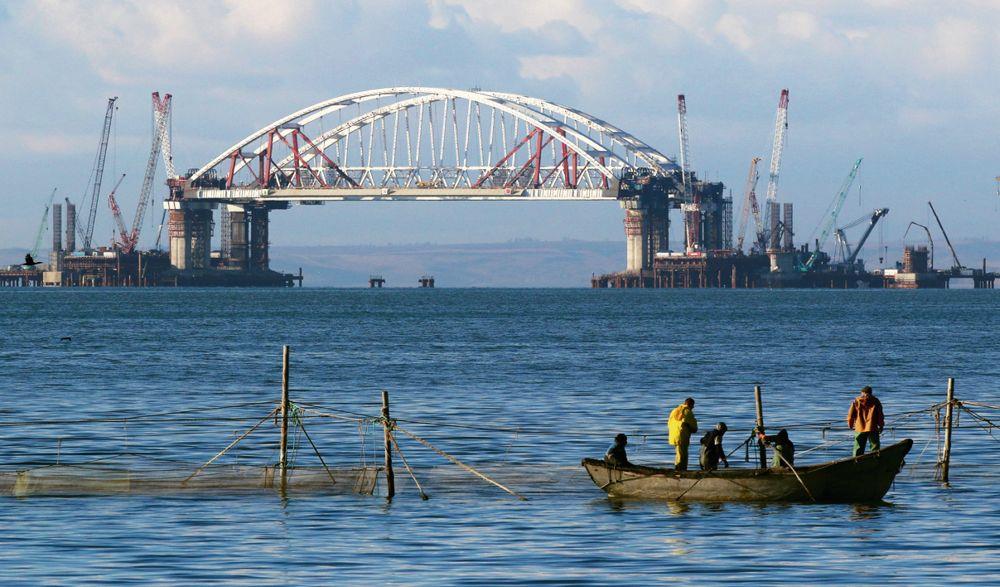
Breached: With the attack on the Crimean Bridge, Ukrainian President Zelenskyy has crossed a red line that Moscow had warned him against. Reuters

By MK Bhadrakumar

Source: The Tribune of India

Two massive terrorist strikes misfired spectacularly and a terrible beauty is born in the Ukraine war. These two carefully planned attacks in quick succession — on Nord Stream gas pipelines and Crimean Bridge — were intended as a knockout blow to Russia. According to President Vladimir Putin, people ‘who want to finally sever ties between Russia and the EU, weaken Europe’ are behind the Nord Stream blasts. He named the US, Ukraine and Poland as ‘beneficiaries’.

Last Wednesday, Russia’s domestic intelligence service FSB identified Ukraine’s military intelligence chief, Kyrylo Budanov, as the mastermind behind the Crimean attack. The New York Times and Washington Post also pointed fingers at Kiev, quoting ‘sources’. While Nord Stream-1 has been crippled, one of the strings of Nord Stream-2 remains intact. Putin said last week that the pipeline could be restored and Russia could deliver about 27 billion cubic metres of gas. ‘The ball is on the side of the European Union, if they want — let’s turn on the tap,’ he said.

But mum’s the word from Brussels. It is a profoundly embarrassing moment for the EU. The triumphalism has vanished as Europe is threatened by years of recession caused by the blowback from sanctions against Russia, where the US insisted on the cut off of energy ties with Moscow. The EU has now become a captive market for Big Oil and is left to buy LNG from the US at the asking price, which is six to seven times higher than the domestic price in the US. (Contracted price for long-term Russian supply for Germany used to be about $280 per 1,000 cubic metres as against the current market price hovering around $2,000.)

Plainly put, the Europeans have been nicely played by the Americans. India should take note of the US’ sense of entitlement. Basically, the Biden administration created a contrived energy crisis whose real aim is war profiteering.

The Crimean Bridge attack of October 8 is much more serious. Zelenskyy has crossed a red line that Moscow had repeatedly warned him against. Putin has disclosed that there have also been three terrorist attacks against the Kursk NPP. Russians will settle for nothing less than the ouster of the Zelenskyy regime.

Russia’s retaliation against Ukraine’s ‘critical infrastructure’, something Moscow refrained from so far, has serious implications. Since October 9, Russia has begun systematically targeting Ukraine’s power system and railways. Noted Russian military expert Vladislav Shurygin told Izvestia that if this tempo was kept up for a week or so, it ‘will disrupt the entire logistics of the Ukrainian military — system for transporting personnel, military equipment, ammunition, related cargo, as well as the functioning of military and repair plants.’

The Americans are cocooned in a surreal world of their self-serving narrative that Russia ‘lost’ the war. In the real world, though, Ivan Tertel, KGB chief in Belarus, who has an insider view of Moscow, said last Tuesday that with Russia boosting its troop strength in the war zone — 3 lakh troops who have been mobilised plus 70,000 volunteers — and the deployment of advanced weaponry, ‘the military operation will enter a key phase. According to our estimates, a turning point will come in the period from November of this year to February of next year.’

Policy-makers and strategists in Delhi should make a careful note of the timeline. The bottom line is, Russia is looking for an all-out victory and will not settle for anything less than a friendly government in Kiev. Western politicians, including Biden, understand that there is nothing stopping the Russians now. The US’ weapon kitty is running dry as Kiev keeps asking for more.

When asked whether he’d meet Biden at the G20 in Bali, Putin derisively remarked on Friday, ‘He (Biden) should be asked whether he is ready to hold such negotiations with me or not. To be honest, I don’t see any need, by and large. There is no platform for any negotiations for the time being.’

However, Washington has not yet thrown in the towel and the Biden administration remains obsessed with exhausting the Russian military — even at the cost of Ukraine’s destruction. And, for the Russians too, there is still much to be worked out on the battlefield: the oppressed Russian populations in Odessa (which suffered unspeakable atrocities from the neo-Nazis), Mykolaiv, Zaporizhya, Dnipropetrovsk, Kharkov are expecting ‘liberation’. It’s a highly emotive issue for Russia. Again, the overarching agenda of ‘demilitarisation’ and ‘denazification’ of Ukraine must be taken to its logical conclusion.

When all that is over, Putin knows Biden will not even want to meet him. Hungarian PM Viktor Orban said last week, ‘Anyone who seriously believes that the war can be ended through Russian-Ukrainian negotiations lives in another world. Reality looks different. In reality, such issues can only be discussed between Washington and Moscow. Today, Ukraine is able to fight only because it receives military assistance from the United States…

‘At the same time, I do not see President Biden as the person who would really be suitable for such serious negotiations. President Biden has gone too far. Suffice it to recall his statements to Russian President Putin.’

India should expect the defeat of the US and NATO, which completes the transition to a multipolar world order. Sadly, Indian elites are yet to purge their ‘unipolar predicament’. Europe, including Britain, is devastated and there is palpable discontent over the US’s ‘transatlantic leadership’. Indo-Pacific strategy is hopelessly adrift. New power centres are emerging in India’s extended neighbourhood, as the OPEC’s rebuff to Washington shows. A profound adjustment is needed in the Indian strategic calculus.

America Escalates its “Democratic” Oil War in the Near East

By Michael Hudson

Source: CounterPunch

The mainstream media are carefully sidestepping the method behind America’s seeming madness in assassinating Islamic Revolutionary Guard general Qassim Suleimani to start the New Year. The logic behind the assassination was a long-standing application of U.S. global policy, not just a personality quirk of Donald Trump’s impulsive action. His assassination of Iranian military leader Suleimani was indeed a unilateral act of war in violation of international law, but it was a logical step in a long-standing U.S. strategy. It was explicitly authorized by the Senate in the funding bill for the Pentagon that it passed last year.

The assassination was intended to escalate America’s presence in Iraq to keep control of the region’s oil reserves, and to back Saudi Arabia’s Wahabi troops (Isis, Al Quaeda in Iraq, Al Nusra and other divisions of what are actually America’s foreign legion), to support U.S. control of Near Eastern oil as a buttress of the U.S. dollar. That remains the key to understanding this policy, and why it is in the process of escalating, not dying down.

I sat in on discussions of this policy as it was formulated nearly fifty years ago when I worked at the Hudson Institute and attended meetings at the White House, met with generals at various armed forces think tanks and with diplomats at the United Nations. My role was as a balance-of-payments economist, having specialized for a decade at Chase Manhattan, Arthur Andersen and oil companies in the oil industry and military spending. These were two of the three main dynamics of American foreign policy and diplomacy. (The third concern was how to wage war in a democracy where voters rejected the draft in the wake of the Vietnam War.)

The media and public discussion have diverted attention from this strategy by floundering speculation that President Trump did it, except to counter the (non-)threat of impeachment with a wag-the-dog attack, or to back Israeli lebensraum drives, or simply to surrender the White House to the neocon hate-Iran syndrome. The actual context for the neocon’s action was the balance of payments, and the role of oil and energy as a long-term lever of American diplomacy.

The balance of payments dimension

The major deficit in the U.S. balance of payments has long been military spending abroad. The entire payments deficit, beginning with the Korean War in 1950-51 and extending through the Vietnam War of the 1960s, was responsible for forcing the dollar off gold in 1971. The problem facing America’s military strategists was how to continue supporting the 800 U.S. military bases around the world and allied troop support without losing America’s financial leverage.

The solution turned out to be to replace gold with U.S. Treasury securities (IOUs) as the basis of foreign central bank reserves. After 1971, foreign central banks had little option for what to do with their continuing dollar inflows except to recycle them to the U.S. economy by buying U.S. Treasury securities. The effect of U.S. foreign military spending thus did not undercut the dollar’s exchange rate, and did not even force the Treasury and Federal Reserve to raise interest rates to attract foreign exchange to offset the dollar outflows on military accounts. In fact, U.S. foreign military spending helped finance the domestic U.S. federal budget deficit.

Saudi Arabia and other Near Eastern OPEC countries quickly became a buttress of the dollar. After these countries quadrupled the price of oil (in retaliation for the United States quadrupling the price of its grain exports, a mainstay of the U.S. trade balance), U.S. banks were swamped with an inflow of  foreign deposits – which were lent out to Third World countries in an explosion of bad loans that blew up in 1972 with Mexico’s insolvency. This destroyed Third World government credit for a decade, forcing it into dependence on the United States via the IMF and World Bank.

To top matters, of course, what Saudi Arabia does not save in dollarized assets with its oil-export earnings is spent on buying hundreds of billion of dollars of U.S. arms exports. This locks them into dependence on U.S. supply of replacement parts and repairs, and enables the United States to turn off Saudi military hardware at any point of time, in the event that the Saudis may try to act independently of U.S. foreign policy.

So maintaining the dollar as the world’s reserve currency became a mainstay of U.S. military spending. Foreign countries would not have to pay the Pentagon directly for this spending. They simply finance the U.S. Treasury and U.S. banking system.

Fear of this development was a major reason why the United States moved against Libya, whose foreign reserves were held in gold, not dollars, and which was urging other African countries to follow suit in order to free themselves from “Dollar Diplomacy.” Hillary and Obama invaded, grabbed their gold supplies (we still have no idea who ended up with these billions of dollars worth of gold) and destroyed Libya’s government, its public education system, its public infrastructure and other non-neoliberal policies.

The great threat to this is dedollarization as China, Russia and other countries seek to avoid recycling dollars. Without the dollar’s function as the vehicle for world saving – in effect, without the Pentagon’s role in creating the Treasury debt that is the vehicle for world central bank reserves – the U.S. would find itself constrained militarily and hence diplomatically constrained, as it was under the gold exchange standard.

That is the same strategy that the U.S. has followed in Syria and Iraq. Iran was threatening this dollarization strategy and its buttress in U.S. oil diplomacy.

The oil industry as buttress of the U.S. balance of payments and foreign diplomacy

The trade balance is buttressed by oil and farm surpluses. Oil is the key, because it is imported by U.S. companies at almost no balance-of-payments cost (the payments end up in the oil industry’s head offices here as profits and payments to management), while profits on U.S. oil company sales to other countries are remitted to the United States (via offshore tax-avoidance centers, mainly Liberia and Panama for many years). And as noted above, OPEC countries have been told to keep their official reserves in the form of U.S. securities (stocks and bonds as well as Treasury IOUs, but not direct purchase of U.S. companies being deemed economically important). Financially, OPEC countries are client slates of the Dollar Area.

America’s attempt to maintain this buttress explains U.S. opposition to any foreign government steps to reverse global warming and the extreme weather caused by the world’s U.S.-sponsored dependence on oil. Any such moves by Europe and other countries would reduce dependence on U.S. oil sales, and hence on the U.S’s ability to control the global oil spigot as a means of control and coercion. These are viewed as hostile acts.

Oil also explains U.S. opposition to Russian oil exports via Nordstream. U.S. strategists want to treat energy as a U.S. national monopoly. Other countries can benefit in the way that Saudi Arabia has done – by sending their surpluses to the U.S. economy – but not to support their own economic growth and diplomacy. Control of oil thus implies support for continued global warming as an inherent part of U.S. strategy.

How a “democratic” nation can wage international war and terrorism

The Vietnam War showed that modern democracies cannot field armies for any major military conflict, because this would require a draft of its citizens. That would lead any government attempting such a draft to be voted out of power. And without troops, it is not possible to invade a country to take it over.

The corollary of this perception is that democracies have only two choices when it comes to military strategy: They can only wage airpower, bombing opponents; or they can create a foreign legion, that is, hire mercenaries or back foreign governments that provide this military service.

Here once again Saudi Arabia plays a critical role, through its control of Wahabi Sunnis which motivates terrorist jihadis willing to sabotage, bomb, assassinate, blow up and otherwise fight any target designated as an enemy of “Islam,” the euphemism for Saudi Arabia acting as a U.S. client state. (Religion really is not the key; I know of no ISIS or similar Wahabi attack on Israeli targets.) The United States needs the Saudis to supply or finance Wahabi crazies. So in addition to playing a key role in the U.S. balance of payments by recycling its oil-export earnings into U.S. stocks, bonds and other investments, Saudi Arabia provides manpower by supporting the Wahabi members of America’s foreign legion, ISIS and Al-Nusra/Al-Qaeda. Terrorism has become the “democratic” mode of today U.S. military policy.

What makes America’s oil war in the Near East “democratic” is that this is the only kind of war a democracy can fight – an air war, followed by a vicious terrorist army that makes up for the fact that no democracy can field its own army in today’s world. The corollary is that, terrorism has become the “democratic” mode of warfare.

From the U.S. vantage point, what is a “democracy”? In today’s Orwellian vocabulary, it means any country supporting U.S. foreign policy. Bolivia and Honduras have become “democracies” since their coups, along with Brazil. Chile under Pinochet was a Chicago-style free market democracy. So was Iran under the Shah, and Russia under Yeltsin – but not since it elected Vladimir Putin president, any more than is China under President Xi.

The antonym to “democracy” is “terrorist.” That simply means a nation willing to fight to become independent from U.S. neoliberal democracy. It does not include America’s proxy armies.

Iran’s role as U.S. nemesis

What stands in the way of U.S. dollarization, oil and military strategy? Obviously, Russia and China have been targeted as long-term strategic enemies for seeking their own independent economic policies and diplomacy. But next to them, Iran has been in America’s gun sights for nearly seventy years.

America’s hatred of Iran is starts with its attempt to control its own oil production, exports and earnings. It goes back to 1953, when Mossadegh was overthrown because he wanted domestic sovereignty over Anglo-Persian oil. The CIA-MI6 coup replaced him with the pliant Shah, who imposed a police state to prevent Iranian independence from U.S. policy. The only physical places free from the police were the mosques. That made the Islamic Republic the path of least resistance to overthrowing the Shah and re-asserting Iranian sovereignty.

The United States came to terms with OPEC oil independence by 1974, but the antagonism toward Iran extends to demographic and religious considerations. Iranian support of its Shi’ite population and those of Iraq and other countries – emphasizing support for the poor and for quasi-socialist policies instead of neoliberalism – has made it the main religious rival to Saudi Arabia’s Sunni sectarianism and its role as America’s Wahabi foreign legion.

America opposed General Suleimani above all because he was fighting against ISIS and other U.S.-backed terrorists in their attempt to break up Syria and replace Assad’s regime with a set of U.S.-compliant local leaders – the old British “divide and conquer” ploy. On occasion, Suleimani had cooperated with U.S. troops in fighting ISIS groups that got “out of line” – meaning the U.S. party line. But every indication is that he was in Iraq to work with that government seeking to regain control of the oil fields that President Trump has bragged so loudly about grabbing.

Already in early 2018, President Trump asked Iraq to reimburse America for the cost of “saving its democracy” by bombing the remainder of Saddam’s economy. The reimbursement was to take the form of Iraqi Oil. More recently, in 2019, President Trump asked, why not simply grab Iraqi oil. The giant oil field has become the prize of the Bush-Cheney post 9-11 Oil War. “‘It was a very run-of-the-mill, low-key, meeting in general,” a source who was in the room told Axios.’ And then right at the end, Trump says something to the effect of, he gets a little smirk on his face and he says, ‘So what are we going to do about the oil?’”

Trump’s idea that America should “get something” out of its military expenditure in destroying the Iraqi and Syrian economies simply reflects U.S. policy.

In late October, 2019, The New York Times reported that: “In recent days, Mr. Trump has settled on Syria’s oil reserves as a new rationale for appearing to reverse course and deploy hundreds of additional troops to the war-ravaged country. He has declared that the United States has “secured” oil fields in the country’s chaotic northeast and suggested that the seizure of the country’s main natural resource justifies America further extending its military presence there. ‘We have taken it and secured it,’ Mr. Trump said of Syria’s oil during remarks at the White House on Sunday, after announcing the killing of the Islamic State leader, Abu Bakr al-Baghdadi.” A CIA official reminded the journalist that taking Iraq’s oil was a Trump campaign pledge.

That explains the invasion of Iraq for oil in 2003, and again this year, as President Trump has said: “Why don’t we simply take their oil?” It also explains the Obama-Hillary attack on Libya – not only for its oil, but for investing its foreign reserves in gold instead of recycling its oil surplus revenue to the U.S. Treasury – and of course, for promoting a secular socialist state.

It explains why U.S. neocons feared Suleimani’s plan to help Iraq assert control of its oil and withstand the terrorist attacks supported by U.S. and Saudi Arabia. That is what made his assassination an immediate drive.

American politicians have discredited themselves by starting off their condemnation of Trump by saying, as Elizabeth Warren did, how “bad” a person Suleimani was, how he had killed U.S. troops by masterminding the Iraqi defense of roadside bombing and other policies trying to repel the U.S. invasion to grab its oil. She was simply parroting the U.S. media’s depiction of Suleimani as a monster, diverting attention from the policy issue that explains why he was assassinated now.

The counter-strategy to U.S. oil, dollar and global-warming diplomacy

This strategy will continue, until foreign countries reject it. If Europe and other regions fail to do so, they will suffer the consequences of this U.S. strategy in the form of a rising U.S.-sponsored war via terrorism, the flow of refugees, and accelerated global warming (and extreme weather).

Russia, China and its allies already have been leading the way to dedollarization as a means to contain the balance-of-payments buttress of U.S. global military policy. But everyone now is speculating over what Iran’s response should be.

The pretense – or more accurately, the diversion – by the U.S. news media over the weekend has been to depict the United States as being under imminent attack. Mayor de Blasio has positioned policemen at conspicuous key intersections to let us know how imminent Iranian terrorism is – as if it were Iran, not Saudi Arabia that mounted 9/11, and as if Iran in fact has taken any forceful action against the United States. The media and talking heads on television have saturated the air waves with warnings of Islamic terrorism. Television anchors are suggesting just where the attacks are most likely to occur.

The message is that the assassination of General Soleimani was to protect us. As Donald Trump and various military spokesmen have said, he had killed Americans – and now they must be planning an enormous attack that will injure and kill many more innocent Americans. That stance has become America’s posture in the world: weak and threatened, requiring a strong defense – in the form of a strong offense.

But what is Iran’s actual interest? If it is indeed to undercut U.S. dollar and oil strategy, the first policy must be to get U.S. military forces out of the Near East, including U.S. occupation of its oil fields. It turns out that President Trump’s rash act has acted as a catalyst, bringing about just the opposite of what he wanted. On January 5 the Iraqi parliament met to insist that the United States leave. General Suleimani was an invited guest, not an Iranian invader. It is U.S. troops that are in Iraq in violation of international law. If they leave, Trump and the neocons lose control of oil – and also of their ability to interfere with Iranian-Iraqi-Syrian-Lebanese mutual defense.

Beyond Iraq looms Saudi Arabia. It has become the Great Satan, the supporter of Wahabi extremism, the terrorist legion of U.S. mercenary armies fighting to maintain control of Near Eastern oil and foreign exchange reserves, the cause of the great exodus of refugees to Turkey, Europe and wherever else it can flee from the arms and money provided by the U.S. backers of Isis, Al Qaeda in Iraq and their allied Saudi Wahabi legions.

The logical ideal, in principle, would be to destroy Saudi power. That power lies in its oil fields. They already have fallen under attack by modest Yemeni bombs. If U.S. neocons seriously threaten Iran, its response would be the wholesale bombing and destruction of Saudi oil fields, along with those of Kuwait and allied Near Eastern oil sheikhdoms. It would end the Saudi support for Wahabi terrorists, as well as for the U.S. dollar.

Such an act no doubt would be coordinated with a call for the Palestinian and other foreign workers in Saudi Arabia to rise up and drive out the monarchy and its thousands of family retainers.

Beyond Saudi Arabia, Iran and other advocates of a multilateral diplomatic break with U.S. neoliberal and neocon unilateralism should bring pressure on Europe to withdraw from NATO, inasmuch as that organization functions mainly as a U.S.-centric military tool of American dollar and oil diplomacy and hence opposing the climate change and military confrontation policies that threaten to make Europe part of the U.S. maelstrom.

Finally, what can U.S. anti-war opponents do to resist the neocon attempt to destroy any part of the world that resists U.S. neoliberal autocracy? This has been the most disappointing response over the weekend. They are flailing. It has not been helpful for Warren, Buttigieg and others to accuse Trump of acting rashly without thinking through the consequences of his actions. That approach shies away from recognizing that his action did indeed have a rationale—to draw a line in the sand, to say that yes, America WILL go to war, will fight Iran, will do anything at all to defend its control of Near Eastern oil and to dictate OPEC central bank policy, to defend its ISIS legions as if any opposition to this policy is an attack on the United States itself.

I can understand the emotional response of yet new calls for impeachment of Donald Trump. But that is an obvious non-starter, partly because it has been so obviously a partisan move by the Democratic Party. More important is the false and self-serving accusation that President Trump has overstepped his constitutional limit by committing an act of war against Iran by assassinating Soleimani.

Congress endorsed the assassination of Soleimani as ordered by Trump (and his neocon advisor, Secretary of State Pompeo) and is fully as guilty as he is for having approved the Pentagon’s budget. This is due to the Senate’s removal of the amendment to the 2019 National Defense Authorization Act where Bernie Sanders, Tom Udall and Ro Khanna inserted an amendment in the House of Representatives version, explicitly not authorizing the Pentagon to wage war against Iran or assassinate its officials. When this budget was sent to the Senate, the White House and Pentagon (a.k.a. the military-industrial complex and neoconservatives) removed that constraint. That was a red flag announcing that the Pentagon and White House did indeed intend to wage war against Iran and/or assassinate its officials. Congress lacked the courage to argue this point at the forefront of public discussion.

Conclusion

First came the 9/11 attack (Sept 2001).

In the wake of this, Congress passed the 2002 Authorization Act. This authorized the President to move against Al Qaeda.

Fast forward to today: Suleimani and Iran were fighting AGANST Al Qaeda and its offshoot, ISIS/Daesh. Saudi Arabia had asked Suleimani (with U.S. approval) to help negotiate a peace, whereby the Saudi’s would stop backing ISIS. It was an official mission invited by Iraq to negotiate peace between Saudi Arabia, Iran and Iraq.

This infuriated the United States, which wanted a permanent warfare there as an excuse to occupy Iraq and prevent a Shi’ite Crescent linking Iran, Iraq, Syria and Lebanon, which incidentally would serve as part of China’s Belt and Road initiative. So it killed Suleimani to prevent the peace negotiation.

The implication is that the US wants a PERMANENT occupation of Iraq, which is needed to secure the US grab of Iraq’s oil and Syria’s oil, as well as to prevent any non-U.S. oil transit.

The question is, how to get the world’s politicians – U.S., European and Asians – to see how America’s all-or-nothing policy is threatening new waves of war, refugees, extreme weather and the disruption of the oil trade in the Strait of Hormuz. Ultimately, the aim is to ensure neoliberal dollarization is imposed on all countries to subsidize US imperial hegemony.

It is a sign of how little power exists in the United Nations that no countries are calling for a new Nurenberg-style war crimes trial following the assassination, no threat to withdraw from NATO or even to avoid holding reserves in the form of money lent to the U.S. Treasury to fund America’s military budget.


Notes.

[1] https://www.axios.com/trump-to-iraqi-pm-how-about-that-oil-1a31cbfa-f20c-4767-8d18-d518ed9a6543.html. The article adds: “In the March meeting, the Iraqi prime minister replied, ‘What do you mean?’ according to the source in the room. And Trump’s like, ‘Well, we did a lot, we did a lot over there, we spent trillions over there, and a lot of people have been talking about the oil.’”

[2] Michael Crowly, “‘Keep the Oil’: Trump Revives Charged Slogan for new Syria Troop Mission,” The New York Times, October 26, 2019. . The article adds: “‘I said keep the oil,’ Mr. Trump recounted. ‘If they are going into Iraq, keep the oil. They never did. They never did.’”

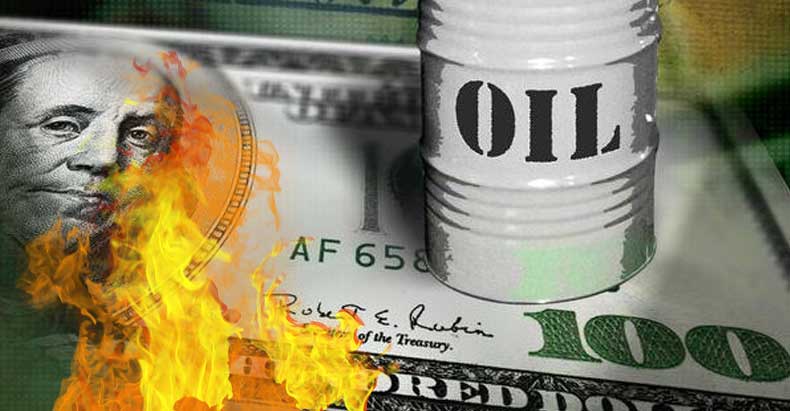
Demise Of The Petrodollar Has The Potential To Reshape The Geopolitical World

By James ONeill

Source: New Eastern Outlook

In the early 1970s President Richard Nixon instigated two changes that had profound effects. The first of these was taking United States off the gold standard; i.e. henceforth US dollars would no longer be convertible to Gold. Ordinarily this might have been expected to have significant ramifications for the value of the US dollar.

Deleterious effects however, were avoided by another equally profound change. Nixon’s National Security Adviser Henry Kissinger negotiated an agreement with Saudi Arabia that henceforth all oil(initially from Saudi Arabia but rapidly extended to all OPEC) countries would be traded only in US dollars, the birth of the so called petrodollar.

It was a classic mafia style arrangement. In exchange for Saudi Arabia’s agreement to the sole use of the dollar for oil transactions, the US underwrote Saudi Arabia’s security thereby ensuring the continuity of one of the world’s most corrupt and repressive regimes.

Also unknown at the time, the US and Saudi Arabia entered an arrangement whereby Islamist terrorist groups (as long as they were Sunni) would be financed by Saudi Arabia and armed by the Americans and then used in pursuit of US geopolitical goals. Operation Cyclone, begun under the Carter administration in the 1970s was an early forerunner of this tactic, but it has been refined and utilized in different formats in a wide number of countries ever since.

The objective was always fundamentally the same: to undermine and if necessary replace governments that were insufficiently compliant with US geopolitical aims. As and when necessary, US troops and their “coalition” allies would be inserted into the target countries. The destruction of Afghanistan (2001 and continuing) Iraq (2003 and continuing) Libya (2011 and continuing) are only three of the better-known examples.

The huge financial cost of these military and geopolitical ventures did not impose a proper price upon the US because of the hegemonic role of the US dollar. The US, in effect, had their multiple wars of choice paid for by other countries as the dollar’s role in world trade created a constant demand for US Treasury bonds.

The role of the US dollar also permitted the US to impose sanctions on recalcitrant countries. The selective nature of the sanctions, always directed toward a US geopolitical or commercial advantage, were clearly an instrument of repressive power. Notwithstanding claims that they were to “punish” the alleged misconduct of the specified country, their actually use betrayed their geopolitical purpose.

Sanctions against Russia for its” invasion” of Ukraine “annexation” of Crimea, and against Iran for its “nuclear program” are two of the better known illustrations of sanctions being justified on spurious grounds..

The use and abuse of the dollar’s power is clearly unacceptable, but the capacity to invoke countermeasures was until quite recently severely limited. The single most important countervailing force is the rise of China as the economic powerhouse of the world, and importantly, the creation of alternative structures in trade, finance and security, that translate China’s economic power into a force for major change.

That change is assisted by the number of collateral developments. In 1990, the G7 nations (Canada, France, Germany, Italy, Japan, the US and UK) had a combined GDP approximately six times greater then the seven economically most important emerging nations (Brazil, China, India, Indonesia, Mexico, Russia and South Korea).

By 2013 the “emerging seven” had surpassed the G7’s GDP total and according to the IMF’s estimates for 2017, the GDP of the two groups will be $47 .5 trillion and $37.8 trillion for the emerging seven and the G7 respectively. Turkey, which is growing at 5% per annum, has replaced Mexico in the top emerging seven.

BRICS, which contains four of the emerging seven nations and the Shanghai Corporation Organisation (SCO), which includes China, India and Russia, are working together on the architecture of a monetary alternative to the dollar. The SCO alone contains 42% of the world’s population.

India’s role in BRICS and the SCO is one reason it is being assiduously cultivated by Australia, Japan and the United States in an attempt to set up a “quadrilateral four” to slow and undermine the role of China and Russia in creating an alternative to longstanding western domination and exploitation.

It was in this context that Russia’s President Putin at the recent BRICS meeting in Xiamen, China said that

“Russia shares the BRICS countries concerns over the unfairness of the global financial and economic architecture, which does not give due regard to the growing weight of the emerging economies.”

This speech developed a theme that Putin had developed in an article published prior to the BRICS meeting. Putin bluntly vowed to destroy the US led financial system, aiming to reform a system that gives excessive domination to a limited number of reserve (i.e. predominantly western) currencies.

China has developed a new Cross Border Interbank Payments System (CIPS) to replace the US dominated SWIFT system, itself used as a tool for financial bullying by the US. Russia has also taken steps to insulate itself from the ill effects of being excluded from SWIFT.

Other major changes are also occurring. Venezuela, with the world’s largest known oil reserves, has ceased accepting payment in US dollars. In the past US retaliation through regime change would have been immediate as happened to Libya’s Gaddafi (confirmed by Clinton’s leaked emails) and the Iraq’s Saddam Hussein who had announced that he would henceforth accept payment in euros and not dollars.

China and Qatar recently concluded a $50 billion deal denominated in Yuan. There were immediate threats and absurd demands from Saudi Arabia, undoubtedly acting as the voice of the US administration, but nothing more serious. The lack of military intervention or attempted regime change was probably attributable to Turkey’s military intervention, a series of agreements with Iran, and the probable implied threat of Chinese intervention should the Saudis further demonstrate their military incompetence (as in Yemen) by anything as rash as direct military moves against Qatar.

Saudi Arabia is rapidly reaching a crunch point in its relationship with China, a huge purchaser of Saudi Arabia’s oil. It is widely known that China wants future oil contracts denominated in Yuan. The attraction for Saudi Arabia is that the Chinese guarantee their Yuan with gold traded on the Hong Kong and Shanghai exchanges. Ironically, this puts China in the same position as the United States prior to Nixon’s withdrawal from the gold backed dollar.

The dilemma for the Saudis is that if they comply with the Chinese demands they risk losing the Americans underwriting their security. US instigated regime change in Saudi Arabia is a very real possibility and the recent maneuverings by Mohammad bin Salman to consolidate his power can be interpreted as a response to that possibility.

Typically, the western media focused on relative trivialities, such as women being able to drive motor vehicles from 2018 (in limited circumstances), rather than examining the underlying geopolitical power struggle.

The other major development worth mentioning in this context is the rapid increase in the number of countries doing deals with China using the Yuan or their own national currencies as the medium of exchange. China’s Belt and Road Initiative, currently involving 65 nations, will undoubtedly accelerate this trend. Russia and China are already each other’s critically important trading partners and all agreements between them are being denominated in either Yuan or Rubles.

It would be naïve to assume that this is all going to occur without a massive rearguard action by the Americans who know full well that their ability to defy economic logic is only possible because of the dollar’s unique role, allowing in turn military interventions to prop up their now rapidly declining power.

The United States’ aggressive and provocative actions in the South China Sea, North Korea, Ukraine, Syria and elsewhere our best interpreted as the flailing’s of a declining empire. The real question is will the United States accept the disappearance of the unique power that it has wielded since the Bretton Woods agreement of 1944 and adjust its policies accordingly, or destroy us all in their attempts to recapture a lost world.

Exposing the Libyan Agenda: A Closer Look at Hillary’s Emails

hilary_clinton_laughs_gaddafi_

By Ellen Brown

Source: Web of Debt

Critics have long questioned why violent intervention was necessary in Libya. Hillary Clinton’s recently published emails confirm that it was less about protecting the people from a dictator than about money, banking, and preventing African economic sovereignty.

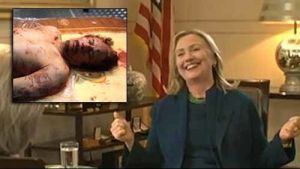
The brief visit of then-Secretary of State Hillary Clinton to Libya in October 2011 was referred to by the media as a “victory lap.” “We came, we saw, he died!” she crowed in a CBS video interview on hearing of the capture and brutal murder of Libyan leader Muammar el-Qaddafi.

But the victory lap, write Scott Shane and Jo Becker in the New York Times, was premature. Libya was relegated to the back burner by the State Department, “as the country dissolved into chaos, leading to a civil war that would destabilize the region, fueling the refugee crisis in Europe and allowing the Islamic State to establish a Libyan haven that the United States is now desperately trying to contain.”

US-NATO intervention was allegedly undertaken on humanitarian grounds, after reports of mass atrocities; but human rights organizations questioned the claims after finding a lack of evidence. Today, however, verifiable atrocities are occurring. As Dan Kovalik wrote in the Huffington Post, “the human rights situation in Libya is a disaster, as ‘thousands of detainees [including children] languish in prisons without proper judicial review,’ and ‘kidnappings and targeted killings are rampant’.”

Before 2011, Libya had achieved economic independence, with its own water, its own food, its own oil, its own money, and its own state-owned bank. It had arisen under Qaddafi from one of the poorest of countries to the richest in Africa. Education and medical treatment were free; having a home was considered a human right; and Libyans participated in an original system of local democracy. The country boasted the world’s largest irrigation system, the Great Man-made River project, which brought water from the desert to the cities and coastal areas; and Qaddafi was embarking on a program to spread this model throughout Africa.

But that was before US-NATO forces bombed the irrigation system and wreaked havoc on the country. Today the situation is so dire that President Obama has asked his advisors to draw up options including a new military front in Libya, and the Defense Department is reportedly standing ready with “the full spectrum of military operations required.”

The Secretary of State’s victory lap was indeed premature, if what we’re talking about is the officially stated goal of humanitarian intervention. But her newly-released emails reveal another agenda behind the Libyan war; and this one, it seems, was achieved.

Mission Accomplished?

Of the 3,000 emails released from Hillary Clinton’s private email server in late December 2015, nearly a third were from her close confidante Sidney Blumenthal, the Clinton aide who gained notoriety when he testified against Monica Lewinsky. One of these emails, dated April 2, 2011, reads in part:

Qaddafi’s government holds 143 tons of gold, and a similar amount in silver . . . . This gold was accumulated prior to the current rebellion and was intended to be used to establish a pan-African currency based on the Libyan golden Dinar. This plan was designed to provide the Francophone African Countries with an alternative to the French franc (CFA).

In a “source comment,” the original declassified email adds:

According to knowledgeable individuals this quantity of gold and silver is valued at more than $7 billion. French intelligence officers discovered this plan shortly after the current rebellion began, and this was one of the factors that influenced President Nicolas Sarkozy’s decision to commit France to the attack on Libya. According to these individuals Sarkozy’s plans are driven by the following issues:

  1. A desire to gain a greater share of Libya oil production,
  2. Increase French influence in North Africa,
  3. Improve his internal political situation in France,
  4. Provide the French military with an opportunity to reassert its position in the world,
  5. Address the concern of his advisors over Qaddafi’s long term plans to supplant France as the dominant power in Francophone Africa

Conspicuously absent is any mention of humanitarian concerns. The objectives are money, power and oil.

Other explosive confirmations in the newly-published emails are detailed by investigative journalist Robert Parry. They include admissions of rebel war crimes, of special ops trainers inside Libya from nearly the start of protests, and of Al Qaeda embedded in the US-backed opposition. Key propaganda themes for violent intervention are acknowledged to be mere rumors. Parry suggests they may have originated with Blumenthal himself. They include the bizarre claim that Qaddafi had a “rape policy” involving passing Viagra out to his troops, a charge later raised by UN Ambassador Susan Rice in a UN presentation. Parry asks rhetorically:

So do you think it would it be easier for the Obama administration to rally American support behind this “regime change” by explaining how the French wanted to steal Libya’s wealth and maintain French neocolonial influence over Africa – or would Americans respond better to propaganda themes about Gaddafi passing out Viagra to his troops so they could rape more women while his snipers targeted innocent children? Bingo!

Toppling the Global Financial Scheme

Qaddafi’s threatened attempt to establish an independent African currency was not taken lightly by Western interests. In 2011, Sarkozy reportedly called the Libyan leader a threat to the financial security of the world. How could this tiny country of six million people pose such a threat? First some background.

It is banks, not governments, that create most of the money in Western economies, as the Bank of England recently acknowledged. This has been going on for centuries, through the process called “fractional reserve” lending. Originally, the reserves were in gold.  In 1933, President Franklin Roosevelt replaced gold domestically with central bank-created reserves, but gold remained the reserve currency internationally.

In 1944, the International Monetary Fund and the World Bank were created in Bretton Woods, New Hampshire, to unify this bank-created money system globally. An IMF ruling said that no paper money could have gold backing. A money supply created privately as debt at interest requires a continual supply of debtors; and over the next half century, most developing countries wound up in debt to the IMF. The loans came with strings attached, including “structural adjustment” policies involving austerity measures and privatization of public assets.

After 1944, the US dollar traded interchangeably with gold as global reserve currency. When the US was no longer able to maintain the dollar’s gold backing, in the 1970s it made a deal with OPEC to “back” the dollar with oil, creating the “petro-dollar.”  Oil would be sold only in US dollars, which would be deposited in Wall Street and other international banks.

In 2001, dissatisfied with the shrinking value of the dollars that OPEC was getting for its oil, Iraq’s Saddam Hussein broke the pact and sold oil in euros. Regime change swiftly followed, accompanied by widespread destruction of the country.

In Libya, Qaddafi also broke the pact; but he did more than just sell his oil in another currency.

As these developments are detailed by blogger Denise Rhyne:

For decades, Libya and other African countries had been attempting to create a pan-African gold standard.  Libya’s al-Qadhafi and other heads of African States had wanted an independent, pan-African, “hard currency.”

Under al-Qadhafi’s leadership, African nations had convened at least twice for monetary unification.  The countries discussed the possibility of using the Libyan dinar and the silver dirham as the only possible money to buy African oil.

Until the recent US/NATO invasion, the gold dinar was issued by the Central Bank of Libya (CBL).  The Libyan bank was 100% state owned and independent.  Foreigners had to go through the CBL to do business with Libya.  The Central Bank of Libya issued the dinar, using the country’s 143.8 tons of gold.

Libya’s Qadhafi (African Union 2009 Chair) conceived and financed a plan to unify the sovereign States of Africa with one gold currency (United States of Africa).  In 2004, a pan-African Parliament (53 nations) laid plans for the African Economic Community – with a single gold currency by 2023.

African oil-producing nations were planning to abandon the petro-dollar, and demand gold payment for oil/gas.

Showing What Is Possible

Qaddafi had done more than organize an African monetary coup. He had demonstrated that financial independence could be achieved. His greatest infrastructure project, the Great Man-made River, was turning arid regions into a breadbasket for Libya; and the $33 billion project was being funded interest-free without foreign debt, through Libya’s own state-owned bank.

That could explain why this critical piece of infrastructure was destroyed in 2011. NATO not only bombed the pipeline but finished off the project by bombing the factory producing the pipes necessary to repair it. Crippling a civilian irrigation system serving up to 70% of the population hardly looks like humanitarian intervention. Rather, as Canadian Professor Maximilian Forte put it in his heavily researched book Slouching Towards Sirte: NATO’s War on Libya and Africa:

[T]he goal of US military intervention was to disrupt an emerging pattern of independence and a network of collaboration within Africa that would facilitate increased African self-reliance. This is at odds with the geostrategic and political economic ambitions of extra-continental European powers, namely the US.

Mystery Solved

Hillary Clinton’s emails shed light on another enigma remarked on by early commentators. Why, within weeks of initiating fighting, did the rebels set up their own central bank? Robert Wenzel wrote in The Economic Policy Journal in 2011:

This suggests we have a bit more than a rag tag bunch of rebels running around and that there are some pretty sophisticated influences. I have never before heard of a central bank being created in just a matter of weeks out of a popular uprising.

It was all highly suspicious, but as Alex Newman concluded in a November 2011 article:

Whether salvaging central banking and the corrupt global monetary system were truly among the reasons for Gadhafi’s overthrow . . . may never be known for certain – at least not publicly.

There the matter would have remained – suspicious but unverified like so many stories of fraud and corruption – but for the publication of Hillary Clinton’s emails after an FBI probe. They add substantial weight to Newman’s suspicions: violent intervention was not chiefly about the security of the people. It was about the security of global banking, money and oil.

Errata: Sidney Blumenthal is not an attorney, as originally stated in this article. When he earned notoriety as Bill Clinton’s defender against Monica Lewinsky, it was as special adviser for the Clintons.

__________________

Ellen Brown is an attorney and author of twelve books, including the best-selling Web of Debt. Her latest book, The Public Bank Solution, explores successful public banking models historically and globally. Her 300+ blog articles are at EllenBrown.com. Listen to “It’s Our Money with Ellen Brown” on PRN.FM.


Related Podcast:  Progressive Commentary Hour – 03.15.16 James and Joanne Moriarty on the real motives behind the 2011 invasion of Libya.