How Did Someone Like Me Get Shadow-Banned?

By Charles Hugh Smith

Source: Of Two Minds

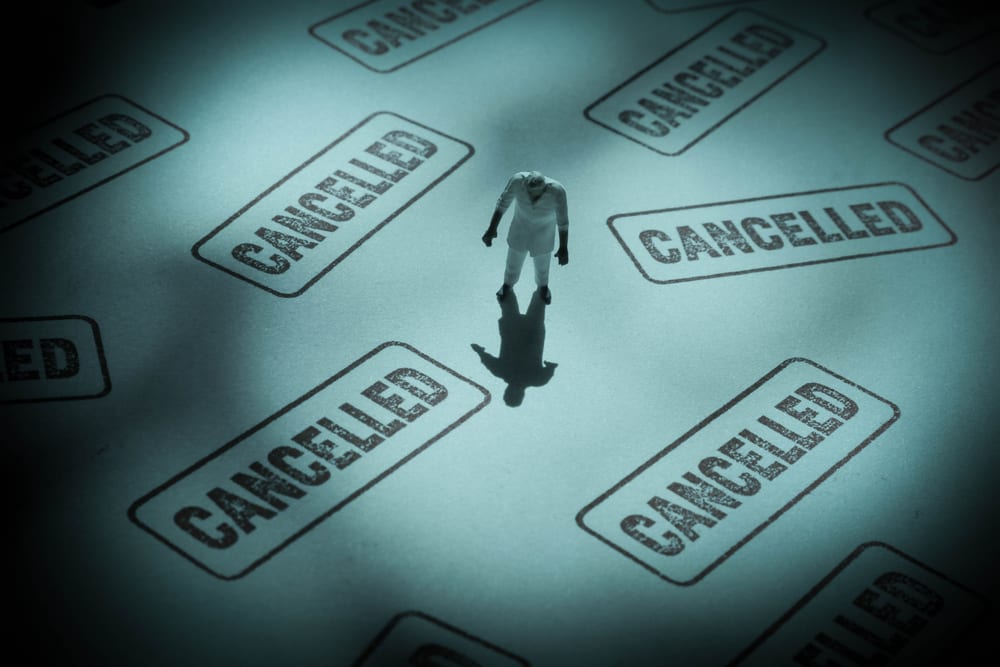
It seems there are many reasons to get shadow-banned, but unfortunately we’re never told what “crime” we committed nor are we given a chance to defend ourselves from the “indictment” in whatever “court” found us “guilty.” As in a nightmarish tale right out of Kafka, the powers making the charges, declaring the verdict “guilty as charged” and imposing the penalty are completely obscured.

Those found “guilty” discover their secret “conviction” and “sentence” when their livelihood is destroyed (i.e. they’re demonetized) and their online presence suddenly diminishes or vanishes.

I call this being sent to Digital Siberia. As with the real gulag, most of those convicted in the secret digital Star Chamber are innocent of any real crime; their “crime” was challenging the approved narratives.

Which leads to my question: why was little old marginalized-blogger me shadow-banned? Those responsible are under no obligation to reveal my “crime,” the evidence used against me, or offer me an opportunity to defend myself against the charges, much less file an appeal.

My astonishment at being shadow-banned (everyone in Digital Siberia claims to be innocent, heh) is based on my relatively restrained online presence, as I stick to the journalistic standards I learned as a free-lancer for mainstream print media: source data, excerpts and charts from mainstream / institutional sources and raise the questions / build the thesis on those links / data.

I avoid conspiracy-related topics (not my interest, not my expertise) and hot-button ideological / political cleavages (us vs. them is also not my interest). My go-to source for charts and data is the Federal Reserve database (FRED) and government agencies such as the Census Bureau, Bureau of Labor Statistics, IRS, etc., and respected non-governmental organizations (NGOs) such as the Pew Research Center, RAND, investment banks, etc.

Given my adherence to journalistic standards, I wonder: how did someone like me get shadow-banned?

The standard cause (or excuse) for being overtly banned is “distributing misinformation.” This charge is never specific; something you posted “violates our community standards,” or equivalent broad-brush language.

Shadow-banning is even more pernicious because you’re not even notified that your visibility to others has been restricted or dropped to zero. You see your post, but nobody else does.

What are the precise standards for declaring a link or statement as “misinformation?” As the twitter files revealed, what qualifies as “misinformation” is constantly shifting as a sprawling ecosystem of censors share information and blacklists. This report is well worth reading: The Censorship-Industrial Complex: Top 50 Organizations To Know (Zero Hedge).

Not only do we not know what qualifies as “misinformation,” we also don’t know what Big Tech algorithms are flagging and what their response is to whatever’s been flagged. My colleague Nate Hagens, who is equally scrupulous about using authoritative sources, posted this comment last year:

“It’s both funny and scary. It was explained to me today that the new Facebook/Meta algorithm downrates users who have cookies w evidence of visiting non-mainstream news sources/blogs. Even when one uses proxy servers and incognito mode, if you frequent e.g. Aljazeera or other news sites instead of CNN or FOX the algorithms categorizes your FB content (even if it’s a chicken soup recipe) as ‘non-mainstream’.
Big brother is watching (and not even thinking).
Those ideas/voices outside the status quo aren’t on equal footing- and the status quo (material growth/cultural values) is what’s leading us down the current path, without a map or plan.”

The systems that shadow-ban us are completely opaque. Who’s to say that a knowledgeable human reviews who’s been banned or shadow-banned? Given the scale of these Big Tech platforms and Search Engines, is that even possible?

It’s well known that YouTube constantly changes its ranking algorithms so they are harder to game, i.e. manipulate to advance one’s visibility.

It’s also known that simply posting a link to a site flagged as “misinformation” is enough to get your post excommunicated and your site flagged in unknown ways with unknown consequences.

What I do know is that Of Two Minds was publicly identified as “Russian Propaganda” by a bogus organization with no supporting data, PropOrNot in 2016. This front’s blacklist was prominently promoted by the Washington Post on page one in 2016, more or less giving it the authority of a major MSM outlet.

One might ask how a respected, trusted newspaper could publish a list from a shadowy front without specifying the exact links that were identified as “Russian Propaganda.” Standard journalistic protocol requires listing sources, not just publishing unverified blacklists.

Clearly, the Washington Post should have, at a minimum, demanded a list of links from each site on the blacklist that were labeled as “Russian Propaganda” so the Post journalists could check for themselves. At a minimum, the Post should have included inks as examples of “Russian Propaganda” for each site on the list. They did neither, a catastrophic failure of the most fundamental journalistic standards. Yet no one in the media other than those wrongfully blacklisted even noted or questioned this abject failure.

In effect, the real propaganda was the unsourced, un-investigated blacklist on the front page of the Washington Post.

How did I get on a list of “Russian Propaganda” when I never wrote about Russia or anything related to Russia?

There are two plausible possibilities. One is “guilt by association.” I’ve been interviewed by Max Keiser since 2011, and Max and his partner Stacy Herbert posted their videos on RT (Russia Today) and an Iranian media outlet. Needless to say, these sources were flagged, as was anyone associated with them. So perhaps merely having a link to an interview I did with Max and Stacy was enough to get me shadow-banned. (Shout-out to Max and Stacy in El Salvador.)

Alternatively, perhaps questioning the coronation of Queen Hillary in any way also got me on the blacklist.

Once on the blacklist, then the damage was already done, as the network of censors share blacklists without verifying the “crime”–a shadowy “crime” without any indictment, hearing or recourse, right out of Kafka.

Shadow-banning manifests in a number of ways. Readers reported that they couldn’t re-tweet any of my tweets. Another reader said the Department of Commerce wouldn’t load a page from my site, declaring it “dangerous,” perhaps with the implication that it was a platform for computer viruses and worms–laughable because there is nothing interactive on my sites and thus no potential source for viruses other than links to legitimate sources and adverts served by Investing Channel.

Users of platforms such as Twitter and Facebook have probably noticed that your feed is populated by the same “friends” or “folks you follow.” In other words, the feed you’re presented with is curated by algorithms which sort and display posts / tweets / search results according to parameters that are invisible to users and regulators.

It’s easy to send flagged accounts to Digital Siberia, and trouble-free to leave them there until the trouble-maker goes broke.

It’s impossible to chart the extent of the shadow-banning, or who’s doing it, sharing blacklists, etc. This entire ecosystem of censorship is invisible. Recall that in the Soviet gulag, having an “anti-Soviet dream” was enough to get you a tenner (10-year sentence) in the gulag. Here, posting a flagged link will get you a tenner in Digital Siberia.

When Your Own Government Confirms It Paid Censors To Silence You…

In today’s zeitgeist, merely mentioning the possibility that the COVID-19 virus escaped from a lab resulted in an instant ban in 2020. How could the possibility that it escaped from a nearby lab dedicated to viral research be labeled as “disinformation” when the facts were not yet known?

The answer is of course that the lab-escape theory was “politically sensitive” and therefore verboten.

You see the problem: what’s deemed “politically sensitive” changes with the wind, and so the boundaries of what qualifies as “misinformation” have no visible or definable edge. Virtually anything consequential can suddenly become “politically sensitive” and then declared “misinformation.” When the guidelines of what’s a “crime” and the processes of “conviction” are all opaque, and there is no hearing or recourse to being “convicted” of a shadow-“crime,” we’ve truly entered a Kafkaesque world.

How did someone like me get shadow-banned? There is no way to know, and that’s a problem for our society and our ability to solve the polycrisis we now face.

I joke that what got me shadow-banned was using Federal Reserve charts. Perhaps that’s not that far from reality.

When It Becomes Serious, First They Lie–When That Fails, They Arrest You

ost2

By Charles Hugh Smith

Source: Of Two Minds

When lying is no longer enough to gain compliance, then the organs of security are unleashed on dissent and resistance.

“When it becomes serious, you have to lie.” Jean-Claude Juncker simply gave voice to what the world’s leaders practice on a daily basis, because now it’s always serious.


And why is it now serious? Persuading tax donkeys and debt serfs that everything is going their way is now impossible without lies. Persuading the populace that the leadership is working on their behalf was jettisoned in the wake of the 2008 bailout of bankers and parasites.

Stripped of the artifice that they care about anything other than preserving the wealth of their cronies, global political leaders now rely on propaganda: narratives designed to manage expectations and perceptions, bolstered by carefully tailored official statistics.

Reliance on lies erodes legitimacy. As the rich get richer and the burdens on tax donkeys and debt serfs increase, the gulf between the official happy-story narrative and reality widens to the breaking point, and faith in the narrative and the leadership espousing it declines.

When 20% of the populace no longer believe the lies and begins questioning the state’s enforcement of the status quo, the government devotes its resources to punishing dissenters and resisters. Whistleblowers are charged with trumped-up crimes; those publicly refuting the status quo’s narrative of lies are harassed and discredited, and those who resist state enforcement of parasitic cronyism are set up, beaten, entrapped, investigated, interrogated and arrested once suitably Kafkaesque charges can be conjured up by the apparatchiks of enforcement.

Why 20%? It’s the Pareto Distribution (the 80/20 rule): the 20% of any populace that accepts a new trend, technology or narrative has an outsized influence over the other 80%.

Governments operate on the premise that propaganda and threats will always be enough to cow their populaces into compliance and bribes will induce complicity. When lies, bribes and threats no long work, the state unleashes its full pathological powers on dissent.

The last mass campaign of political suppression in the U.S. occurred in the late 1960s and early 1970s, when resistance to the war of choice in Vietnam reached mainstream proportions.

The U.S. government was accustomed to manipulating and managing the populace with very simple propaganda: Communism is our deadly enemy, we must fight it everywhere on the planet, etc. But when thousands of American service personnel started coming home in body bags from the latest “we must fight Communism everywhere because it’s dangerous to us” war in East Asia, this simplistic justification made no sense: what existential threat to the U.S. did a Communist Vietnam pose?

The U.S. has faced only two existential threats to its sovereignty since 1860: World War II (1941-45) and the potential for a nation-destroying nuclear war with the Soviet Union. The idea that the U.S. was existentially threatened by falling dominoes in East Asia was always ludicrous, and the U.S. status quo (the political leadership, the Deep State, private industry profiting from war, etc.) soon abandoned the absurd justification.

Vietnam was always more of a domestic-politics issue than a geopolitical one: the Democrats feared being perceived as being “weak on Communism” because that impacted the results of elections. Throwing treasure and American lives away in Vietnam was pure domestic politics from 1961-68 (once mired, Democrats feared being tagged as the party that “lost Vietnam”), and thereafter the treasure and lives were sacrificed on the equally contrived Nixon-Kissinger policy of avoiding losing geopolitical face with a withdrawal that amounted to surrender.

Though it is not well known, the Federal Bureau of Investigation (FBI) was ordered to devote essentially all its resources to suppressing dissent in these years. Teams assigned to organized crime were reassigned to track down draft resisters and other political malcontents. COINTELPRO was a vast program devoted to illegally entrapping, beating up and undermining any and all political resistance to the war and the government’s increasingly heavy-handed oppression of dissent.

For more on COINTELPRO, please read War at Home: Covert action against U.S. activists and what we can do about it.

Simply put: when lies no longer work, governments freak out and devote their resources not to eliminating wars of choice, cronyism and corruption but to suppressing dissent and resistance to those policies.

The U.S. government has always been free to pursue wars of choice with its professional military, with little risk of widespread political blowback. A variety of “splendid little wars” have been waged, generally for conquest or enforcement of hemispheric hegemony. The government’s success in rallying the nation during World War II instilled a false confidence that merely raising the flag of existential threat would be enough to eliminate dissent and elicit compliance in the masses.

Vietnam was the first time the American public went through the process of buying the usual “threat” justification for war, questioning the threat and eventually rejecting the state’s narrative. The government responded by lashing out at its own citizenry, engaging in a full spectrum of illegal and blatantly immoral actions designed not to right wrongs or fix broken policies, but to suppress dissent and resistance to destructive policies and broken systems.

The U.S. government is not unique in this; on the contrary, all governments, by their very nature as concentrations of coercive power, will pursue the same path. Rather than confess the government is operated by cronies, for cronies, the machinery of the state will increasingly be turned on its citizenry.

Rendering unto Caesar that which is Caesar’s is no longer enough; abiding by the laws of the land are no longer enough. What the state demands is not just compliance with its countless laws and regulations, but absolute obedience to its narratives and policies.


Anyone who withholds obedience is quickly deemed a traitor–not to the nation or its Constitution, but to the state itself, which is ultimately a collection of cronies and self-serving vested interests protecting their fiefdoms at the expense of the citizenry.

When lying is no longer enough to gain compliance, then the organs of security are unleashed on dissent and resistance. This process is well under way in nation-states around the world.

If I had to pick the two key operative dynamics of the next 20 years, I would choose:

1. The over-expansion and implosion of credit/debt bubbles.

2. The over-reach of the central state as it seeks to win the hearts and minds of its people by ruthlessly suppressing dissent.

The two dynamics are of course causally connected. Central states depend entirely on credit bubbles for their financial survival, and on enforcing increasingly untenable official narratives for their legitimacy.

Both are unraveling, and will continue to unravel, no matter how many state resources are thrown at the symptoms of political illegitimacy, rather than at the root causes of that illegitimacy.


Social Schizophrenia, Social Depression: What does TV tell us about America?

wash_dees

By Charles Hugh Smith

Source: Dangerous Minds

The difference between what we experience and what we’re told we experience creates a social schizophrenia that leads to self-destructive attitudes and behaviors.

What can popular television programs tell us about the zeitgeist (spirit of the age) of our culture and economy?

It’s an interesting question, as all mass media both responds to and shapes our interpretations and explanations of changing times. It’s also an important question, as mass media trends crystallize and express new ways of understanding our era.

Those who shape our interpretation of events also shape our responses.  This of course is the goal of propaganda: Shape the interpretation, and the response predictably follows.

As a corporate enterprise, mass media’s goal is to make money—the more the better—and that requires finding entertainment products that attract and engage large audiences.  The products that change popular culture are typically new enough to fulfill our innate attraction to novelty—but this isn’t enough. The product must express an interpretation of our time that was nascent but that had not yet found expression.

We can understand this complex process of crystallizing and giving expression to new contexts as one facet of the politics of experience.

The Politics of Experience

It is not coincidental that the phrase politics of experience was coined by a psychiatrist, R.D. Laing, for the phrase unpacks the way our internalized interpretation of experience can be shaped to create uniform beliefs about our society and economy that then lead to norms of behavior that support the political/economic status quo.

Here’s how Laing described the social ramifications in Chapter Four of his 1967 book, The Politics of Experience:

“All those people who seek to control the behavior of large numbers of other people work on the experiences of those other people. Once people can be induced to experience a situation in a similar way, they can be expected to behave in similar ways. Induce people all to want the same thing, hate the same things, feel the same threat, then their behavior is already captive – you have acquired your consumers or your cannon-fodder.”

For Laing, the politics of experience is not just about influencing social behavior – it has an individual, inner consequence as well:

“Our behavior is a function of our experience. We act according to the way we see things. If our experience is destroyed, our behavior will be destructive. If our experience is destroyed, we have lost our own selves.”

How the media shapes our interpretation affects not just our beliefs and responses, but our perceptions of self and our role in society. If the media’s interpretation no longer aligns with our experience, the conflict can generate self-destructive behaviors.

In other words, mass media interpretations can create a social schizophrenia that can lead to self-destructive attitudes and behaviors.

Social Analysis of TV

By its very nature as a mass shared experience, popular entertainment is fertile ground for social analysis.

Here’s a common example: what does a child learn about conflict resolution if he’s seen a thousand TV programs in which the “hero” is compelled to kill the “bad guy” in a showdown? What does that pattern suggest, not just about the structure of drama, but about the society that creates that drama?

Analyzing entertainment has been popular in America since the 1950s, if not earlier.  The film noir of the 1950s, for example, was widely deemed to express the angst of the Cold War era.  Others held that the rising prosperity of the 1950s enabled the populace to explore its darker demons—something the hardships and anxieties of the Depression did not encourage.

Many believe the Depression gave rise to screwball comedies and light-hearted entertainment featuring the casually wealthy precisely because these were escapist antidotes to the grinding realities of the era.

Even television shows that were denigrated as superficial in their own time (for example, Bewitched in the 1960s) can be seen as politically inert but subconsciously potent expressions of profound social changes: the “witch” in Bewitched is a powerful young female who is constantly implored by her conventional husband to conform to all the bland niceties of a suburban housewife, but she finds ways to rebel against these strictures.

Laing saw the potential conflict between what we experience and how we’re told to interpret that experience not just in social terms but in psychiatric terms: such splits open a gulf that can lead to a form of schizophrenia.

Diagnosing Our Disease with TV

What can we make of the popular TV series of the present era? What do they say, beneath the surface, about American society?

I contend that popular TV expresses three key aspects of U.S. society and economy that are at odds with the core idealized values espoused in civic classes and the media. The three idealized values are:

1.  America is a meritocracy—selections, admissions, etc., are based on the candidates’ merits

2.  Anyone can get ahead if they get an education and work hard

3.  America is the wealthiest nation on earth in terms of opportunity, fairness and capital

TV expresses three aspects that confound these idealized values:

1.  Life is a game in which the winner takes all

2.  The opportunity to “get ahead” via conventional means—getting educated, working hard, etc.—is a joke; only those who skirt conventions and the law get rich

3.  Life is a tortuous endurance course where those in charge demand the cruel and the impossible

Winner-Take-All Talent Shows

Let’s start with the genre that has been a dominant force in American TV since the 2000s: the winner-take-all talent show (reality and game shows).

The long-running Survivor series, for example, was a winner-take-all contest of physical prowess and political guile, while the many programs staging singing/dancing contests (American Idol, etc.) put entertainment skills to the competitive test.  A wide range of other entries stage competitions in cooking, entrepreneurship, losing weight, negotiating obstacle courses, and so on.

What interpretations of our experience do these highly competitive winner-take-all reality shows promote?

We could start with the fact that the stars (other than the hosts/judges) are apparently ordinary “every man/woman” Americans, i.e. people not unlike us.  Watching them, it is not too much of a stretch to imagine ourselves on stage, in the kitchen, etc., trying to impress the judges with our talents. It’s easy to identify with the contestants.

These shows enable us to vicariously experience the fantasy that we, too, could be on national TV and could win the accolades of the judges and fans and be the winner who takes it all.

This natural empathy with the temporarily famous with whom we can vicariously share the thrill of victory and the agony of defeat is clearly tapping a deep cultural desire to taste celebrity and the implied financial rewards of winning in an increasing winner-take-all society/economy.

Could the financial/political marginalization of the average citizen and the widening gulf between the typical household and those at the top of the fame/wealth pyramid have something to do with this fascination for winner-take-all competitions on the public stage?

Since there have been game shows on TV for decades, it could be argued that this proliferation of winner-take-all contests is nothing new. But this fails to account for the difference between a game show in which the correct answer is a fact and the subjective votes of judges, other players and the audience that count in winner-take-all contests.

I would argue that this recent explosion of competitions (“modern gladiator,” anyone?) is an expression of deeply held shared cultural values: we accept that ours is a highly competitive society, and that it is becoming even more so as the top “winners” skim the vast majority of the winnings (media visibility, wealth, adulation, social status. etc.), leaving a few morsels for the top 5% and nothing but crumbs for the bottom 95%.

But these TV programs also project the fantasy that our fight-to-the-figurative-death society is still a meritocracy—the best guy/gal wins, as judged by “experts” (or celebrities claiming expertise; the judges’ expertise is structured to be unassailable, just like all the other “experts” in our society).

But if we can’t win it all on merit, there is an alternative way to win: display superior political guile or greater popularity with the audience. (Interestingly, this echoes the coliseum audiences of the late Roman era, who also had some sway over who lived to fight another day on the choreographed battlefield below.)

Perhaps this helps explain our collective obsession with celebrity and the many measures of popularity available to everyone now—Instagram, Facebook likes, Twitter followers (for sale in lots of 10,000), Klout scores, and so on.

In other words, as success in the real world grows increasingly distant, vicariously competing and “winning it all” becomes very compelling. Rather than deal with the vast injustices of our system, we cling to the idealized norm that meritocracy matters, even as “winning” in real life is increasingly a game of cronyism, guile, gaming the system, misrepresenting the truth, etc.

And so we thrill to these play-acting displays of meritocracy in action, as it confirms our cultural value system that that despite the predations of Wall Street and Washington, merit still counts.

And when all else fails, we have a fallback source of identity and “winning”—our popularity. And if we don’t have enough of our own, then we can share vicariously in the popularity of TV show winners and celebrities who have reached the pinnacle.

This is the core message of an interesting and erudite half-hour talk on celebrity given by Games of Thrones actor Jack Gleeson:

“During a recent visit to the Oxford Union, Gleeson took the opportunity to dismantle the ‘religious hysteria’ of celebrity worship with an appropriately epic rant, breaking down the economic, psychological, and sociological catalysts for public reverence of celebrities and their negative impact on society as a whole.”

Gleeson draws upon a number of intellectual sources (Weber, Baudrillard, et al.) in his discussion of the contemporary culture of celebrity, and concludes that celebrity fills the void left when development of an authentic self is stunted.

The parallel with Laing’s “lost self” is striking.

In effect, when the opportunities for developing an authentic self have been reduced to popularity, public visibility and the status that flows from these forms of recognition, then the worship of celebrity and the aching desire for a moment in the spotlight become rational substitutes for a True Self.

As these wispy contingencies can never form an authentic selfhood, even those who do “win” the competition for celebrity are ultimately dissatisfied and disillusioned.

My conclusion: the popularity of competitive winner-take-all TV programs reflects the paucity of opportunities for selfhood and the substitution of celebrity worship for the difficult task of forging an independent identity in a society that marginalizes all but the top players.

If this isn’t a form of cultural schizophrenia, then what exactly is it? The claim that this is all just good clean fun is absurd, as is the claim that it’s perfectly healthy to sacrifice one’s identity in a competition for recognition that 99.9% of us are sure to lose.

Why Has Classical Capitalism Devolved to Crony-Capitalism?

Crony-Capitalism_200x200

By Charles Hugh Smith

Source: OfTwoMinds.com

Here is the quote that perfectly captures our era: “People of privilege will always risk their complete destruction rather than surrender any material part of their advantage.” (John Kenneth Galbraith) The trick, of course, is to mask the unspoken second half of of that statement: everybody else gets destroyed along with the Elites when the system implodes.

Union pension funds: toast. Government employees’ pension funds: toast. 401Ks: toast. IRAs: toast. The echo-bubble in housing: toast. The Fed’s favorite PR cover to cloak the enrichment of their financier cronies, the wealth effect:toast.

The primary tool the Elites use to mask the risk of complete destruction is magical thinking–specifically, that “given enough time, the system will heal itself.”

That’s rich, considering that the Elites’ primary tool of avoiding destruction is crippling the market’s self-healing immune system: price discovery. Thanks to ceaseless interventions by central banks, the price discovery mechanism has been shattered: want to know the price of risk? It’s near-zero. Yield on sovereign bonds? Near-zero. And so on.

Prices have been so distorted (the ultimate goal of Central Planning everywhere, from China to the EU to Japan to the U.S.) that the illusion of stability is impossible without more intervention.

This leads to two self-liquidating dynamics: diminishing returns (every intervention yields less of the desired result) and the Darwinian selection of only those money managers who believe risk has been vanquished.

Everyone who pursues prudent risk management has either been fired or saw the writing on the wall and exited stage right. So the only people left at the gaming tables of the big institutional players are those individuals who are genetically incapable of responding appropriately to rising risk. Those who did have long been fired for “underperformance.”

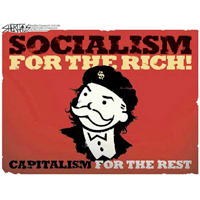
So how did classical free-market capitalism become state-cartel crony-capitalism, a Ponzi scheme of epic proportions that is entirely dependent on ceaseless central bank perception management and interventions on a scale never before seen?

We can start with these six factors:

1. Those who control most of the wealth are willing to risk systemic collapse to retain their privileges and wealth. Due to humanity’s virtuosity with rationalization, those at the top always find ways to justify policies that maintain their dominance and downplay the distortions the policies generate. This as true in China as it is in the U.S.

2. Short-term thinking: if we fudge the numbers, lower interest rates, etc. today, we (politicians, policy-makers, money managers, etc.) will avoid being sacked tomorrow. The longer term consequences of these politically expedient policies are ignored.

3. Legitimate capital accumulation has become more difficult and risky than buying political favors. Global competition and the exhaustion of developed-world consumers has made it difficult to reap outsized profits from legitimate enterprise. In terms of return-on-investment (ROI), buying political favors is far lower risk and generates much higher returns than expanding production or risking investment in R&D.

4. The centralization of state/central bank power has increased the leverage of political contributions/lobbying. The greater the concentration of power, the more attractive it is to sociopaths and those seeking to buy state subsidies, sweetheart contracts, protection from competition, etc.

5. Any legitimate reform will require dismantling crony-capitalist/state-cartel arrangements. Since that would hurt those at the top of the wealth/power pyramid, reform is politically impossible.

6. Understood in this light, it’s clear that central bank monetary policy—zero-interest rates, asset purchases, cheap credit to banks and financiers, QE, etc.—is designed to paper over the structural problems that require real reform.

Japan is a case in point: the Powers That Be in Japan have put off real reforms of the Japanese economy and political system for 25 years, and they’ve enabled this avoidance by pursuing extremes of fiscal and monetary policy that have eroded the real economy and created long-term structural imbalances.

In this 24 minute video Gordon T. Long and Charles Hugh Smith discuss through the aid of 17 slides the rapid advancement of Crony Capitalism in America. The facts are undeniable, but why is it becoming so obvious and undeniable? Why is it accelerating without any apparent ‘checks and balances’? Where have the safeguards against this happening gone?