By Paul Levy
Source: Waking Times
One of the recurring thought-forms that I hear repeated everywhere during these apocalyptic times is, “We are all in this together.” It is ironic that “we are all in this together,” and yet, our world feels anything but together, as it is in an incredibly polarized and dissociated state. Our species is suffering from what Jung calls a “sickness of dissociation,” which is a state of fragmentation deep within the unconscious itself that has seemingly spilled outside of our skulls and, through psychic forces beyond our conscious awareness, has taken the form of polarizing collective events playing themselves out en masse on the world stage. Our dissociation is not solely pathological, however, but is an expression of a deeper holistic process that is in the act of revealing itself. To quote Jung, “the sickness of dissociation in our world is at the same time a process of recovery, or rather, the climax of a period of pregnancy which heralds the throes of birth. A time of dissociation … is simultaneously an age of rebirth.”[1]
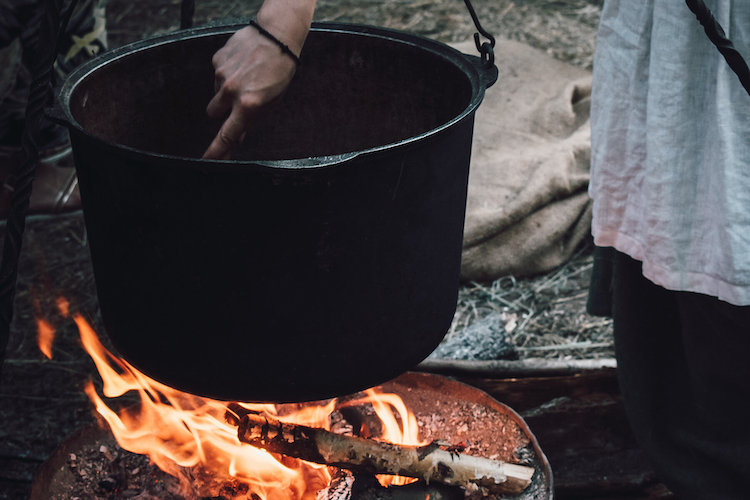
Whenever I hear “We are all in this together,” it reminds me of an amazing paragraph that Jung wrote in the late 1950’s that is as relevant today as it was then. Here is an excerpt: “We are in the soup that is going to be cooked for us, whether we claim to have invented it or not…. We are threatened with universal genocide if we cannot work out the way of salvation by a symbolic death.”[2] In other words, we are fated to suffer an unconscious “literal” death if we don’t consciously go through a “symbolic” death. What does Jung mean by this?
We are all in the soup together, yet we are suffering from a sickness of dissociation, and we are needing to go through a symbolic death experience, while another part of us is being reborn! What is going on here? Is what’s happening in our world meaningless chaos, or is there “something deeper” going on? The short answer: Our species has gotten drafted into an archetypal death/rebirth experience – in symbolically dying to a part of ourselves that is no longer serving us, another part of us is being reborn. As Jung points out, “there are times [and ours seems to be one of them] when the spirit is completely darkened because it needs to be reborn.”[3]
We can deepen our understanding of the archetypal process of death and rebirth that we are living out by shedding light on a prototypical example of death and rebirth – i.e., The Incarnation. Contemplating the West’s prevailing myth of the birth of God as a human being—the Christ event—psychologically, which is to say symbolically (i.e., as if it is a dream of our species) can help us gain some crucial insights into the deeper archetypal process that we are collectively enacting unconsciously on the world stage during these truly apocalyptic times.
The word “apocalypse,” etymologically speaking, refers to something previously hidden being unveiled and brought to light – in other words, something is being revealed to us during these apocalyptic times. Whereas in religious language, the apocalypse has to do with the Incarnation of God and the coming of the Messiah, psychologically speaking, the “apocalypse” means the momentous, world-shattering event of the coming of what Jung calls “the Self” (the wholeness of our personality, i.e., the God within) into conscious realization. Instead of incarnating through one man, however, like God did over two thousand years ago through the individual person of Jesus, the divine is now incarnating through the unconscious psyche of all of humanity. “God,” Jung writes, “wants to become man,” and instead of choosing a pure, guiltless vessel, God has chosen, in Jung’s words, “the creaturely man filled with darkness—the natural man who is tainted with original sin.”[4]
In that same amazing paragraph Jung writes, “Through his further incarnation God becomes a fearful task for man, who must now find ways and means to unite the divine opposites in himself. He is summoned…. Christ has shown how everybody will be crucified upon his destiny, i.e., upon his self, as he was. He did not carry his cross and suffer crucifixion so that we could escape.”[5] In other words, regardless of our outer religious orientation, everyone of us is fated (whether we like it or not) to carry our cross—to consciously bear our shadow and suffer the tension of the opposites within us—just as Christ did. And yet, something that we could not have created via the efforts of our own ego can potentially emerge as a result of consciously bearing this creative tension.
In being “summoned,” like a healer, shaman or artist who is being called by their inner voice and sacred vocation, we are being subpoenaed by a higher power. Whenever the archetype of the Self is constellated, due to the opposites intrinsic to the nature of this experience, we invariably feel a state of extreme conflict within us that is epitomized by the Christian symbol of the cross. Viewed symbolically, Christ on the cross reveals to us that the development and differentiation of consciousness leads to an ever-increasing awareness of a primordial conflict within our soul which necessarily involves a crucifixion of the ego. To understand this conflict psychologically, we could say that the unconscious longs to reach the light of consciousness, while at the same time continually recoils against it, because it would rather remain unconscious. In theological terms, to quote Jung, “God wants to become man, but not quite.”[6]
The Self is made manifest—i.e., real in space and time—through consciously suffering the conflict between the opposites to the point where we begin to experience their synthesis and complementarity. Jung comments, “This condition of the crucifixion, then, is a symbolic expression for the state of extreme conflict, where one simply has to give up, where one no longer knows, where one almost loses one’s mind. Out of that condition grows the thing which is really fought for … the birth of the self.”[7] It is by going through an internal experience of what the historical crucifixion symbolizes that the divine holy and whole-making spirit gets born through us.
Jung comments, “One shouldn’t evade this conflict by escaping into a premature and anticipated state of redemption, otherwise one provokes it in the outside world. And that is of the devil.”[8] If we don’t deal with the source of the divine conflict within us, it will get projected outside of ourselves and dreamed up in the external world. In other words, in our avoidance of dealing with the conflict within us, we are unwittingly colluding with the darker forces of death and destruction that are playing out in the outer world.
Nature herself does not come to a permanent standstill when confronted with opposites – rather, she uses them to create, out of their very opposition, a synthesis, a new birth. When Christ is nailed to the cross during the crucifixion, it symbolically represents that it is through the experience of being bound and severely limited in the space/time continuum that itself becomes the doorway through which we become introduced to the transcendent part of us that is beyond the physical, i.e., our spiritual nature. In other words, it is in experiencing our finite limitations to the max that becomes a doorway to the infinite part of ourselves.
Nothing so promotes the growth of consciousness as confronting the opposites within ourselves. Holding the tension of the opposites that is inherent in the crucifixion experience invariably liberates us from holding and identifying with our fixed and cherished perspectives. Helping us transcend the notion of a privileged and correct point of view, we become aperspectival in our viewpoint, as we see the relativity of all viewpoints – a way of seeing which coincides with the meta-perspective of the Self.
The essence of the Christian gnosis—the Incarnation of God through humanity—can be best understood as humanity’s creative confrontation with the opposites and their synthesis in the Self. The Self—which Jung equates with Christ—is present in everyone, but typically in an unconscious and unrealized condition. Once we withdraw our projections and fixations upon an external historical or metaphysical figure, however, we can realize that the Self/Christ (or whatever name we call it) lives within us – in Jung’s words, we then “wake up the Christ within.”[9]
Nature herself does not come to a permanent standstill when confronted with opposites – rather, she uses them to create, out of their very opposition, a synthesis, a new birth. When Christ is nailed to the cross during the crucifixion, it symbolically represents that it is through the experience of being bound and severely limited in the space/time continuum that itself becomes the doorway through which we become introduced to the transcendent part of us that is beyond the physical, i.e., our spiritual nature. In other words, it is in experiencing our finite limitations to the max that becomes a doorway to the infinite part of ourselves.
Nothing so promotes the growth of consciousness as confronting the opposites within ourselves. Holding the tension of the opposites that is inherent in the crucifixion experience invariably liberates us from holding and identifying with our fixed and cherished perspectives. Helping us transcend the notion of a privileged and correct point of view, we become aperspectival in our viewpoint, as we see the relativity of all viewpoints – a way of seeing which coincides with the meta-perspective of the Self.
The essence of the Christian gnosis—the Incarnation of God through humanity—can be best understood as humanity’s creative confrontation with the opposites and their synthesis in the Self. The Self—which Jung equates with Christ—is present in everyone, but typically in an unconscious and unrealized condition. Once we withdraw our projections and fixations upon an external historical or metaphysical figure, however, we can realize that the Self/Christ (or whatever name we call it) lives within us – in Jung’s words, we then “wake up the Christ within.”[9]
The cross is the symbol of the suffering Godhead that redeems humanity. This suffering would not have occurred without darker forces seemingly opposed to God. This is to say that the powers of evil play a crucial, mysterious and essential role in the redemption of humanity. Jung continues, “Christ is the model for the human answers and his symbol is the cross, the union of the opposites. This will be the fate of man, and this he must understand if he is to survive at all.”[11]
To quote Trappist monk and author Thomas Merton, “every man is Christ on the Cross, whether he realizes it or not. But we, if we are Christians [and in the deeper symbolic sense we are all “Christians”], must learn to realize it.”[12] Realizing we are Christ on the Cross re-contextualizes our suffering, transforming it from a deeply problematic personal situation to a more universal process in which we have all gotten enlisted. It is important to distinguish our neurotic suffering—which is a result of our unconscious clinging and is totally unproductive—from the suffering which is “sent by God” (as Christian mystics would say) in order to purify us of our obscurations. Our neurotic suffering blocks us from experiencing the divine, while the suffering that is a result of our participation in the archetypal process of crucifixion, through connecting us to the deeper passion that Christ went through, is the doorway introducing us to something beyond ourselves.
Russian philosopher Nicolas Berdyaev writes, “But there was a tendency to forget that the cross had a universal significance and application. The Crucifixion awaits not only the individual man but also society as a whole, a State or a civilization.”[13] In other words, it is not just individuals who are symbolically going through a crucifixion experience, but our global civilization as a whole. The microcosm (the individual) and the macrocosm (the collective), like iterations of the same fractal, are mirrored reflections of each other. The Self (or whatever name we call it) is incarnating through us—both individually and as a species—and it makes all the difference in the world whether we consciously realize this or not.[14]
If we remain unconscious when a living archetypal process is activated within us, this inner process will physically manifest itself externally in the outside world, where, as if by fate, it will get unconsciously dreamed up and acted out in a “literal,” concrete and oftentimes destructive way. Instead of going through an inner symbolic death, for example, we then literally kill each other, as well as, ultimately, ourselves. If we recognize, however, that we are being cast to play a role in a deeper cosmic process, instead of being destined to enact it unconsciously, and hence, destructively, we are able to consciously and creatively “incarnate” this archetypal process as individuation.
We, as a species, to quote Jung, have been “drawn into the cycle of the death and rebirth of the gods.”[15] In other words, having become part of a deeper mythic, archetypal and alchemical process of transformation, we are going through a cosmic death-rebirth experience of a higher order. Jung describes “how the divine process of change manifests itself to our human understanding and how man experiences it – as punishment, torment, death, and transfiguration.”[16] This divinely-sponsored process is subjectively experienced by the human ego as torture.[17] However, if we don’t personalize the experience, identify with it or get stuck in its nightmarish aspect—a great danger—but allow this deeper process to refine us as it needs to, it can lead to a transfiguration of our very being.
Whether consciously or not, we are all in a state of grieving – the world we have known is dying. In addition, our sense of who we think we are—imagining we exist as a separate self, alien to and apart from other separate selves as well as the rest of the universe—is an illusion whose expiration date has now been reached. This illusion is like a non-existent mirage that, if not recognized as illusory, can become reified and thereby become a lethal mirage. Either our illusion expires, or we do. As the poet Rumi would say, we need to “die before we die.”
To step out of the illusion of thinking we exist as a separate self is to recognize—and be born into—our greater identity (whether we call it the Self, Christ, Buddha, etc.), that includes and embraces everything under the sun. The Self—who we actually are—is simultaneously the source and fruit of life itself, enhancing life beyond measure. Connecting with the Self is not only our only hope in these dark times, it’s what everything that is happening in our world is potentially helping us to realize. And yet, the way to ascend to the light of the Higher Self (in Christian terminology, to attain The Resurrected Body)—as Christ himself indicates via his descent to the underworld after his death on the cross—is by journeying through the darkness.
To quote Jung, “God really wants to become man, even if he rends him asunder[18] … because he wants to become man, the uniting of his antinomy must take place in man.”[19] Where else, after all, could the opposites intrinsic to God’s nature (e.g., light and dark, good and evil) attain unity except in the very vessel—humanity—that God has prepared just for this very purpose? Being cooked in the soup together, we are being immersed and baptized into a deeper cosmic process. We are playing a crucial role in the divine drama of incarnation, an insight that renders meaning to our suffering and assists us in discovering our place in the world as well as helping us to find our very selves.
 After the Crash