Make Sure You Download the Latest Ministry of Propaganda Updates

By Charles Hugh Smith

Source: Of Two Minds

It’s time once again to check for Ministry of Propaganda updates, which like Windows and iOS is constantly being updated to counter new threats and enhance the user experience (heh).

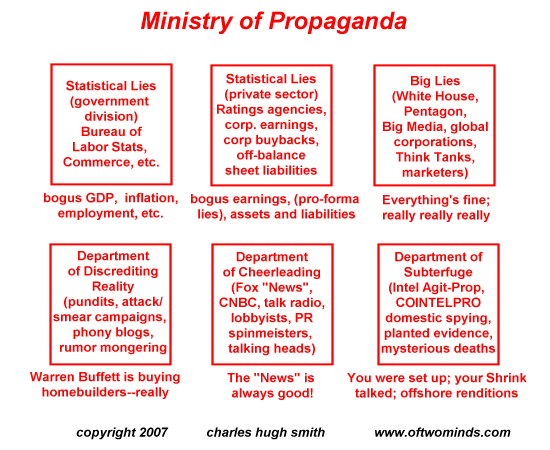
Much like the other operating systems that underpin our daily lives, the core functions of the MoP don’t change much. My chart from 2007 remains an instructive summary of MoP operations, with the only changes being Mr. Buffett is now buying oil companies and social media corporations are now major media players.

The core mission of the Ministry of Propaganda isn’t just to push a desirable narrative–it’s to mystify the underlying dynamics of a system that benefits the few at the expense of the many by promoting a self-serving worldview (weltanschauung) that explains how the world works in a way that protects the interests of those in power.

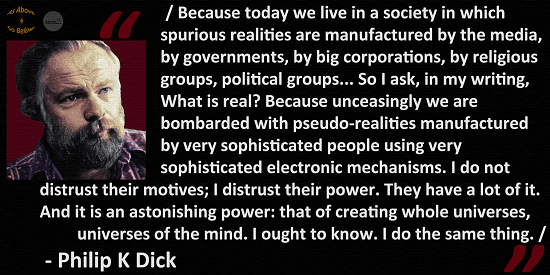
As science fiction author Philip K. Dick explains in the quote below, the MoP narrative isn’t just a cloak thrown over the underlying dynamics, it’s the creation of an entire universe / worldview, including contexts for understanding what’s going on, establishing what’s valuable and what isn’t, and what behaviors enhance status and which ones marginalize us.

The Ministry of Propaganda isn’t monolithic: various factions compete to push their self-serving narratives. As Dick noted, this includes governments, corporations, religious and political groups, each of which understands that once the populace accepts their worldview, their power is cemented in realms far above mere force.

A key mechanism in establishing a dominant worldview is the think-tank or equivalent self-serving body claiming authority over what’s true / false and important / unimportant. This can be authority over the “correct” interpretation of spiritual texts, economic policies, healthcare “standards of care,” geopolitical goals, etc.

Since humans are innately social, status-striving beings, hierarchies of authority and power are the air we breathe. Those who establish themselves as authorities don’t just gain power, they cement their power on the basis of their authority rather than on loyalty or competence.

The enormous powers of social media and traditional media to promote claims of authority have generated a deranging snarl of conflicting agendas and narratives. Various centers of power collaborate on pushing worldviews that benefit their interests, but this isn’t entirely coherent. The one thing all participants in the Ministry of Propaganda agree on is our power is deserved and must be defended against all threats, which includes hostile entities inside and outside the national borders.

This fragmented, constantly shifting cacophony of competing authorities is destabilizing. As the tectonic plates of worldviews collide, the edges crumble and people naturally seek the safety of some core set of beliefs, in effect “circling the wagons” in an attempt to restore some internal stability.

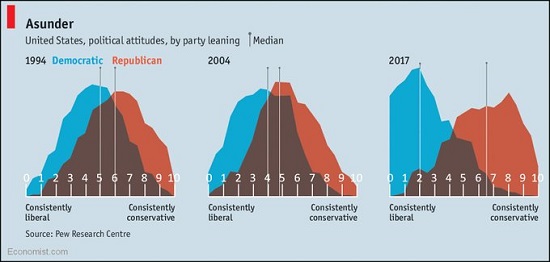
We see this in the intense political polarization of this era (see chart below). To make sense of the competing claims of authority, we reduce the perimeter of what’s defendable, putting more of the world into “outside enemies” (them) and reserving the “safe, trusted place” for fewer of “us.”

With so many competing factions in the Ministry of Propaganda, there’s a proliferation of propaganda such that there is literally nothing left but PR. In a universe constructed of nothing but agit-prop and PR, we all have our favorites examples. James Bond picks up his Nokia phone. Even though nobody’s seen a Nokia phone in ages, if you want to be cool like Bond, go buy a Nokia phone.

Marketing is the MoP’s entire universe. Everybody’s selling something to gain or maintain power, status, mindshare or the ultimate prize, the dominant worldview.

To ease the confusion, please download the latest updates from the Ministry. These updates replace all that misinformation, misdirection, and blatant marketing with the, ahem, facts, or the correct interpretation of the facts. (We had to destroy the village in order to save it. OK, got it.)

While it’s fun to sort all the propaganda into various boxes, we would do well to look for what all the marketers / MoP players seek to mystify. In my analysis, what must be mystified at all costs boils down to the unsustainability of 1) the current consumption of resources, 2) the current method of creating capital so the few can buy up the planet’s most valuable assets, 3) neocolonialism, the modern replacement for the old model of occupation and exploitation by force, and 4) neofeudalism, the economic / social /political arrangement in which the majority of the populace are modern-day serfs with extremely limited agency and power which they are told is limitless.

“You can be anything you choose to be!” Or at least your digital avatar can do so, and that’s practically as good as actually having agency and power in the real world. Or so we’re told, mindlessly, endlessly without pause or respite.

More on these topics in the coming weeks.
Embedded beings: how we blended our minds with our devices

besucher-mit-smartphone-im-louvre-in-paris_image_width_884

By Saskia K Nagel  & Peter B Reiner

(aeon)

Like life itself, technologies evolve. So it is that the telephone became the smartphone, that near-at-hand portal to the information superhighway. We have held these powerful devices in the palms of our hands for the better part of a decade now, but there is a palpable sense that in recent years something has shifted, that our relationship with technology is becoming more intimate. Some people worry that one day soon we might physically attach computer chips to our minds, but we don’t actually need to plug ourselves in: proximity is a red herring. The real issue is the seamless way in which we are already hybridising our cognitive space with our devices. In ways both quotidian and profound, they are becoming extensions of our minds.

To get a sense of this, imagine being out with a group of friends when the subject of a movie comes up. One person wonders aloud who the director was. Unless everyone is a movie buff, guesses ensue. In no time at all, someone responds with: ‘I’ll just Google that.’ What is remarkable about this chain of events is just how unremarkable it has become. Our devices are so deeply enmeshed in our lives that we anticipate them being there at all times with access to the full range of the internet’s offerings.

This process of blending our minds with our devices has forced us to take stock of who we are and who we want to be. Consider the issue of autonomy, perhaps the most cherished of the rights we have inherited from the Enlightenment. The word means self-rule, and refers to our ability to make decisions for ourselves, by ourselves. It is a hard-earned form of personal freedom and, at least in Western societies over the past 300 years, the overall trajectory has been towards more power to the individual and less to institutions.

The first inkling that modern technology might threaten autonomy came in 1957 when an American marketing executive called James Vicary claimed to have increased sales of food and drinks at a movie theatre by flashing the subliminal messages ‘Drink Coca-Cola’ and ‘Hungry? Eat Popcorn’. The story turned out to be a hoax, but after attending a demonstration of sorts, The New Yorker reported that minds had been ‘softly broken and entered’. These days, we regularly hear news stories about neuromarketing, an insidious strategy by which marketers tap findings in neuropsychology to read our thoughts as they search for the ‘buy button’ in our brains. To date, none of these plots to manipulate us have been successful.

But the threat to autonomy remains. Persuasive technologies, designed to change people’s attitudes and behaviours, are being deployed in every corner of society. Their practitioners are not so much software engineers as they are social engineers. The most benign of these ‘nudge’ us in an attempt to improve decisions about health, wealth and wellbeing. In the world of online commerce, they strive to capture our attention, perhaps doing nothing more nefarious than getting us to linger on a webpage for a few extra moments in the hope that we might buy something. But it is hard not to be cynical when Facebook carries out an experiment on more than 680,000 of its loyal users in which it covertly manipulates their emotions. Or when the choices of undecided voters can be shifted by as much as 20 per cent just by altering the rankings of Google searches. There is, of course, nothing new about persuasion. But the ability to do so in covert fashion exists for one simple reason: we have handed the social engineers access to our minds.

Which leads us to the threat to privacy of thought. Together with his Boston law partner Samuel Warren, the future US Supreme Court Justice Louis Brandeis published the essay ‘The Right to Privacy’ (1890). They suggested that when law was still being developed as codified agreements among early societies, redress was given only for physical interference with life and property. Over time, society came to recognise the value of the inner life of individuals, and protection of physical property expanded to include the products of the mind – trademarks and copyright, for example. But the intrusive technology of the day – apparently, the first paparazzi had appeared on the scene, and there was widespread worry about photographs appearing in newspapers – raised new concerns.

Today’s worries are very similar, except that the photos might be snatched from the privacy of any one of your interconnected devices. Indeed, having institutions gain access to the information on our devices, whether flagrantly or surreptitiously, worries people: 93 per cent of adults say that being in control of who can get information about them is important. But in the post-Snowden era, discussions of privacy in the context of technology might be encompassing too broad a palette of potential violations – what we need is a more pointed conversation that distinguishes between everyday privacy and privacy of thought.

These issues matter, and not just because they represent ethical quandaries. Rather, they highlight the profound implications that conceiving of our minds as an amalgam between brain and device have for our image of ourselves as humans. Andy Clark, the philosopher who more than anyone has advanced the concept of the extended mind, argues that humans are natural-born cyborgs. If that is the case, if we commonly incorporate external tools into our daily routines of thinking and being, then we might have overemphasised the exceptionalism of the human brain for the concept of mind. Perhaps the new, technologically extended mind is not so much something to fear as something to notice.

The fruits of the Enlightenment allowed us to consider ourselves as rugged individuals, navigating the world by our wits alone. This persistent cultural meme has weakened, particularly over the past decade as research in social neuroscience has emphasised our essentially social selves. Our relationship to our devices provides a new wrinkle: we have entered what the US engineer and inventor Danny Hillis has termed ‘the Age of Entanglement’. We are now technologically embedded beings, surrounded and influenced by the tools of modernity, seemingly without pause.

In 2007, Steve Jobs introduced the world to the iPhone with the catchphrase ‘this changes everything’. What we didn’t know was that the everything was us.