
Ferguson and the Logic of Neoliberalism

Ferguson-RiotA Political Economy Premised on Exploitation and Social Repression

By Rob Urie

Source: Counterpunch.org

While the U.S. Department of Justice report on racist policing practices in Ferguson, Missouri provides direct evidence for skeptical Whites that institutional racism is fact, limiting the investigation to Ferguson implausibly delimits the scope of race based repression in the U.S. Additionally, from slavery to convict leasing to funding the Ferguson city budget with fines and penalties overwhelmingly extracted from poor and middle class Blacks, the economic basis of police repression is isolated in an improbable present. And in fact, the ‘tricks and traps’ used by the Ferguson police for economic extraction closely resembles corporate practices of using contract law, state institutions and monopoly power to take economic resources from those who lack the social power to resist.

A cognitive challenge for White Americans (and ‘conservative’ Blacks) is the distance between facts like police repression in Ferguson and the mythology of capitalist democracy that we live by. Use of the police for economic extraction in Ferguson, for funding the town budget through racial repression, ties state power to economic power within the particular circumstances of American racial and economic history. In a most basic sense this integration reframes state-market relations claimed to relate capitalism to democracy. More broadly, the TPP and TIPP ‘trade’ deals being pushed by President Obama are a variation on the racist shakedown in Ferguson. Their intent is to replace state power with corporate power while leaving Western states intact to provide state services for the benefit of corporations and the illusion of democratic control.

Discovery of a police ‘black site’ in Chicago, the prevalence of racist violence by the police across the U.S., the return of debtor’s prisons and ‘civil forfeiture’ laws that allow the police to take belongings without evidence of a crime illustrate the growing lawlessness of the police. When tied to illegal surveillance carried out by the NSA, DEA and FBI against citizens and non-citizens alike and the extra-judicial powers claimed by Mr. Obama a picture of widespread state lawlessness emerges. When considered in the context of no criminal prosecutions for war crimes against the (George W) Bush administration or against prominent bankers in the financial and economic debacle of the last decade a picture of widespread elite lawlessness emerges. Clearly the state, including local police departments, exists for purposes other than enforcing fealty to the law.

Based on supporting economic theories it is superficially ironic that the resurgence of neo-liberalism since the 1970s is coincident with this growing integration of state and ‘private’ power. Premised on clearly delineated state and market roles, neo-liberalism was / is in theory the economic realm unhindered by state restrictions. This state-market delineation facilitates the facade that capitalism is related to democracy— political freedom in the realm of the political and economic freedom in the realm of the economic. As fact and metaphor the role of the Ferguson police using asymmetrical social power to take economic wealth from vulnerable citizens demonstrates the implausibility of this theorized differentiation in the realm of the political. And new debtor’s prisons (link above) have police and the prison system acting as collection agents for Payday Lenders.

The TPP and TTIP trade deals being pushed by Mr. Obama are designed with analogous levers for extorting wealth. The investor resolution clauses in TTIP have a supranational judiciary ruling on ‘investor’ lawsuits against governments for hypothetical lost profits and taxpayers on the hook for adverse rulings. The relative absence of remaining trade restrictions and tariffs is well covered territory. What remains to be accomplished with these ‘agreements’ is the consolidation of economic power as the power to extract wealth. As with proposals for tradable carbon credits, the ‘product’ of the agreements combines the right to extort by putting forward projects never intended to be built with guarantees against adverse economic developments.

The police in Ferguson used a particular social lever, the residual of slavery, for gratuitous racial repression and for economic extraction. Slavery is a social institution, but it most particularly is an economic institution. It is a social mechanism for accruing the product of slave labor to the slave master. And slavery in the U.S. was ‘legal’ until it wasn’t. Convict leasing was explicit use of ‘the law’ and the judicial system to force poor Blacks to work for little or no pay. ‘The law’ was used as an instrument of economic exploitation and extraction. The push back from Whites and conservative Blacks that the murdered Mike Brown was a criminal because he likely stole a box of cigars takes this same law at face value. This view of the law depends on a similarly improbable separation of political and economic realms as neo-liberal theory.

As political theory might have it, if all of the citizens of Ferguson were intended to benefit from city resources while poor and middle class Blacks were disproportionately forced to pay for them that represents economic taking by some citizens for the benefit of others. The racial character of this taking places it in history. The history of Western colonialism, neo-colonialism and imperialism places it in broader internal and external context. And this history is evidence that distinct realms of the economic and the political never described existing circumstance. The practical relevance is that it places the actions of the police in Ferguson, past and pending ‘trade’ agreements and global economic relations in the space where economic and political power act in an integrated social dimension.

The effect is to reframe ‘the law’ in terms of who is committing particular acts rather than the acts being committed. The police in Ferguson can murder with impunity and shake down citizens at their discretion to fund the city budget (and their paychecks) while poor and middle class Blacks are disproportionately murdered and sent to prison for similar acts. What is legal and what isn’t is determined by who has social power, not by the acts themselves. In a racist and classist society the law is codification of class and race interests. If a black citizen of Ferguson puts a gun to someone’s head and demands their valuables they are a criminal but if the same act is committed by a cop it is within the law. Here events in Ferguson are fact and metaphor— overwhelming evidence (links above) suggests that similar social relations exist across much of the country.

This view of the law has precedence in Richard Nixon’s contention that “when the President does it that means that it is not illegal.” Earlier precedence can be found in Nazi law and in the laws of fascist Italy in the 1930s and 1940s. This isn’t to call anyone who isn’t a self-proclaimed Nazi a Nazi. The precedence lies in the view that the law is the will of a leadership class, be it the Nazi leadership in Germany or city government in Ferguson. One problem with this theory is that it makes the law capricious and ultimately impossible to follow. Race based law enforcement criminalizes race, not nominally proscribed acts. Stories of the Chicago police department’s black site (link above) have political protesters and poor Blacks accused of no crimes taken there. If people can be arrested without evidence that a crime was committed then what is the difference in outcomes between committing and not committing crimes?

A relation of neo-liberalism to fascism can be made through replacement of civil governance with corporate governance that subordinates the rights and privileges of civil society to corporate interests. The investor-state dispute mechanisms (link above) being broadened and formally codified in the TTIP trade deal will be used to demand compensation for environmental regulations that keep drinking water safe and limit greenhouse gas emissions, the metaphorical equivalent of threatening to end the planet if we don’t pay up. Civil forfeiture has the police taking valuables they might want at the point of a gun if necessary. The Ferguson police shake down poor Blacks using the law as a weapon. At the same time a ruling elite has immunity from prosecution for well documented crimes.

Much of what is written here was well understood in the 1950s, 1960s and 1970s. It hardly seems an accident that this collective memory was lost to narrow ideological dogma. Across the country property taxes are being cut with partial differences made up through regressive fees and penalties. This fits the neo-liberal preference for property over labor incomes. And neo-liberal theory has no place for history because all acts within it take place in a temporally isolated present. This dissociates racist policing in Ferguson, Chicago, New York, Detroit and Philadelphia from the roles of the legislature, judiciary, police and prisons in reconstituting the economic exploitation of slavery under the guise of free choice in capitalist democracy. Race is the particular case in America; class is the broader expression of economic power.

The tension between the DOJ report (link above) on racist policing in Ferguson and the Obama administration’s broad support for neo-liberal policies will likely produce a tight circle drawn around events in Ferguson. Already supporters of police repression are raising the argument that the words “hands up, don’t shoot” never transpired. What bearing does precise wording have on a Black child being murdered by the police? And why wouldn’t Black youth have a right to be hostile to police who, as the DOJ reports concludes, are running a racist shakedown operation to force poor and middle class Blacks to fund city government? How would White readers react to being harassed, intimidated, disproportionately jailed and forced to pay for the privilege? Ultimately the problem is larger than Ferguson and social accountability should address political economy premised in exploitation and social repression.

Rob Urie is an artist and political economist. His book Zen Economics is written and awaiting publication.

 

Life in the Algorithm

images

By Douglas Haddow

Source: Adbusters

The searches we make, the news we read, the dates we go on, the advertisements we see, the products we buy and the music we listen to. The stock market. The surveillance society. The police state, and the drones. All guided by a force we never see and few understand.

A series of calculation procedures that come together to constitute capitalism’s secret ingredient — the all holy algorithm, that which binds and optimizes. Those strange numerical gods who decide whether or not you’re a terrorist and what kids’ toy is going to set the market on fire this Christmas. But what are they, where did they come from and how did they get so powerful?

Algorithms are not new. You can trace their origin all the way back to a 9th century Persian mathematician by the name of Muhammad ibn Musa al–Khwarizmi (Algoritmi in Latin) from whom the word derives its name. Then there was Abu Yusaf Ya’qub ibn Ishaq al–Kindi, a contemporary of al–Khwarizmi’s at Baghdad’s House of Wisdom. He discovered and developed the science of frequency analysis, or code–breaking, providing a basis for code breaker Alan Turing to develop his Turing Machine, the theoretical prototype for the 9 billion devices currently sending and receiving signals through the Internet.

When we talk about algorithms, when they come up in conversation, often tied to latent and emerging fears, we’re not talking about the mathematical models behind them, we’re talking about the models that the models were modeled on. Most people have never heard of a polytope, Boolean Logic or the Hirsch Conjecture. But everyone has a credit score, whether they like it or not.

If we want to interrogate the true nature of these numbers, the wizard behind the ghost in the machine, we need to look no further than Adam Smith, that dour Scot who lived with his mum and accidentally created the modern world.

Smith was neither a modernist nor a cosmopolitan. He was an absent’minded hermit who never married, had few friends, suffered from alternating fits of depression and hypochondria, travelled outside Britain on just one occasion and demanded that all his personal writing be burned upon his death. He was the supreme king of unintended consequences, a humble and misunderstood moral philosopher who became the patron saint of greed.

Most famously, and most tragically, Smith was an ambitious writer who got a bit flowery with his language on occasion, and, as a result, his entire legacy was reduced to two words: invisible and hand. As in, the Invisible Hand — that mysterious market force that secretly and surreptitiously guides all our actions and decisions. Or so we’ve been told.

In The Wealth of Nations, the blueprint for what became known as capitalism, Smith drops the phrase but once. It’s situated in a rather dry discussion on trade policy and is used as a metaphor in a straightforward critique of mercantilism’s excessive restrictions.

And that’s it. Just a cursory metaphor used for poetic flourish in an otherwise obscure and forgettable passage. And for the 150 years that followed the book’s publication, that’s exactly what it was — obscure and forgotten. Smith didn’t mention it, his contemporaries didn’t mention it, nor did his critics. Nary a soul on Earth repeated those two words or paid them any heed.

That is, until 1948, when everything changes.

If you look at a Google NGRAM chart of “invisible hand,” you’ll see that there was little to no interest in the phrase up until the 1930s and ’40s, at which point it begins to bubble up a bit, gaining traction in a few peripheral spheres here and there. Then in ’48, Chicago School economist Paul Samuelson writes a book called Economics: An Introductory Analysis, which would go on to become the best–selling economics book of all time.

In his book, Samuelson grabs hold of Smith’s wordplay and freebases meaning from it until a mere metaphor mutates into the economic doctrine that would define the shape and form of global finance for the remainder of the century, and beyond.

“Every individual, in pursuing only his own selfish good, was led, as if by an invisible hand, to achieve the best good for all, so that any interference with free competition by government was almost certain to be injurious,” writes Samuelson. And with that, not only is it justifiable to be callous in the pursuit of wealth, your callousness will somehow, vis–à–vis the invisible hand, uplift those you trample on your way to the top.

Picture Gordon Gekko, hair trickling with high–end product, walking with the gait of limitless sprezzatura, saying, “Greed is right, greed works. Greed clarifies, cuts through and captures the essence of the evolutionary spirit. Greed, in all of its forms; greed for life, for money, for love, knowledge has marked the upward surge of mankind.”

Samuelson would later go on to regret the liberties he took with Smith’s words, but the meme had already been injected into the passive hive mind of economics. What followed was a long and tangled game of economic telephone wherein Smith’s fatalistic conceit gradually took on mythical qualities. From turn of phrase to doctrine, from doctrine to dogma, from dogma to metaphysical law. The invisible hand became the celestial justification of the free market and the economic rationalist’s negation of anything that stood in its way.

Austrian economist Friedrich Hayek even went so far as to develop an entire theory of human interaction based on the myth. It was called Catallactics, and proposed that we did not live within an economy, but rather, a Catallaxy — a complex and self–organizing system in which every individual sent out a constant stream of complex signals that mixed to create overall market behavior.

Knowledge, Hayek argued, was distributed on an individual level, each person containing their own fraction of the whole.

The vast repository of human knowledge was inherently decentralized. Because of this, no central body or government agency could ever hope to contain enough of it to know what was really going on. But if allowed to move freely without meddling, these messages would come together to create order and equilibrium in the market.

This, he argued, is why the government should never meddle in the market. And why order could never be “planned,” and was instead “brought about by the mutual adjustment of many individual economies in a market.” As long as the signals, our private info–snowflakes, could float freely, the market would reach equilibrium.

Through Hayek, dogma became revelation — the invisible hand was not merely a magical presence promising equilibrium, it was also pointing us toward a not–too–distant utopia. And if we didn’t follow the hand? Oppression and despair would follow mankind into a dark hole of tyranny.

Hayek’s ideas spread swiftly through a series of think tanks connected to his economic clique, The Mont Pelerin Society, which counted Karl Popper, Ludwig von Mises and, of course, who else but Milton Friedman among its members. Together they successfully launched what we now call “neoliberalism” into the political consciousness.

Neoliberalism found its champions in Margaret Thatcher and Ronald Reagan. Thatcher regularly corresponded with Hayek and used the slogan There Is No Alternative (TINA) to explain her affection for its concepts. Reagan hired Friedman to be his economic advisor. And together they carried out an economic revolution that smashed trade unions and deregulated and privatized anything and everything that could be guillotined. From this axis of Anglos, it spread to other parts of the Commonwealth, then to Europe, Asia, South America and beyond.

But no matter how much they stripped away government meddling, somehow the “abstract signals” still weren’t getting through. The hand remained clenched and crises endemic. Asia, Argentina, the Eurozone, the 2008 meltdown, the flash crash. The market continually failing to magically self–correct and achieve equilibrium.

The faithful kept their faith and stuck to the program. The crisis, both economic and existential, were met with a recommitment to the faith in the form of austerity and technology and the dream persisted.

The problem was obvious to anyone outside the neoliberal thought–bubble: the invisible hand wasn’t real and it didn’t exist. It never had existed. It wasn’t just invisible, but immaterial, made from the twisted fantasies of economists obsessed with achieving an impossible “equilibrium.” You couldn’t touch it, and it couldn’t touch you.
Until now.

In 2010, when the Dow Jones Industrial dropped 1000 points in under a minute, the biggest one–day point decline in history, it received far less attention then it deserved, because everything returned to normal a few seconds later. Now, miniature flash crashes occur constantly throughout the day. But this crash was a turning point, demonstrating that something had changed. That something was that the neoliberals had achieved what communists, socialists and Christians never could: they made their god real, and in doing so, achieved their utopia. They just didn’t let the rest of us in on it.

The critical flaw in Hayek’s vision of the hand was that a “central body” could never gather enough information. We know this to be untrue, and with big data and the analysis and manipulation of that data through algorithmic equation, the missing link between money and the machine was discovered.

The searches we make, the news we read, the dates we go on, the advertisements we see, the products we buy and the music we listen to. The stock market … All informed by this marriage between mathematics and capital, all working together in perfect harmony to achieve a singular goal — equilibrium. But it’s a curious sort of equilibrium. Less to do with the relationship between supply and demand, and more about the man and the market.

All these algorithms we encounter throughout the day, they’re working toward a greater goal: solving problems and learning how to think. Like the advent and rise of high–frequency trading, they’re part of an optimization trend that leads to a strange brand of perfection: automated profit.

And their current day use, no matter how impressive the specs, is still rooted in 7th century code–breaking. Only now it’s about breaking our individual codes. Throughout the day we send out thousands of our own individual abstract signals and the algorithms figure out how best to streamline our existence into the market’s needs. We’re all just cyphers waiting to get cracked.

This is not the stuff of Orwell and Huxley, but Amazon and the NSA.

There is an overwhelming feeling of inevitability surrounding all of this. With computational capacity still threatening to double every two years, the algorithmic estate will continue to expand and become more sophisticated. All of this development, testing and research is leading to a predictable outcome. Given that they are leading investment and research in the sector, Wall Street financiers will develop the world’s first fully functioning Artificial Intelligence.

If any of this feels inevitable, it’s because it was designed to make us feel that way. If the algorithms that organize the world of money were turned on their head and used to analyze the defects in their guiding philosophy, they would shred it all on one razor sharp fact: the world beyond the market is still a real one. And no matter how sophisticated the math, how brilliant the AI, we will always be living in it.

Outside of The Wealth of Nations, Smith employed the Invisible Hand concept on only two other occasions. Once in his Theory of Moral Sentiments, where he slags off the rich, and the other in the History of Astronomy, where he says:

For it may be observed, that in all Polytheistic religions, among savages, as well as in the early ages of Heathen antiquity, it is the irregular events of nature only that are ascribed to the agency and power of their gods. Fire burns, and water refreshes; heavy bodies descend, and lighter substances fly upwards, by the necessity of their own nature; the invisible hand of Jupiter was never apprehended to be employed in those matters.

These days, the “savages” kick back, polish their yachts and let the machines do their thinking for them. Their god is a primitive and cruel one. Worse yet, it lacks imagination. The future it sees is just an optimized version of the present. Everything that falls within its gaze is predictable, because mathematical sequences are predictable. What remains to be seen is whether or not human beings are as predictable as the machines think we are.

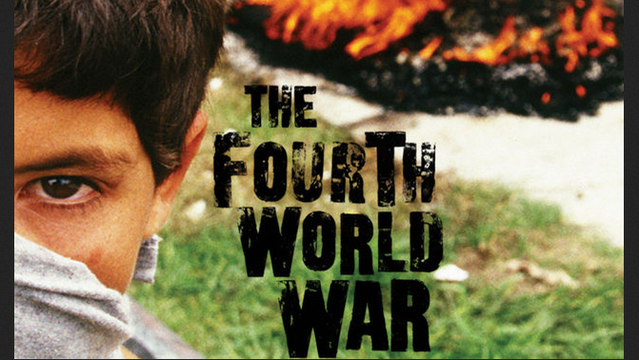
Saturday Matinee: The Fourth World War

the_fourth_world_war

From Big Noise Films:

From the front-lines of conflicts in Mexico, Argentina, South Africa, Palestine, Korea, and the North; from Seattle to Genova, and the War on Terror in New York, Afghanistan, and Iraq, The Fourth World War is the story of men and women around the world who resist being annihilated in this war.While our airwaves are crowded with talk of a new world war, narrated by generals and filmed from the noses of bombs, the human story of this global conflict remains untold. The Fourth World War brings together the images and voices of the war on the ground. It is a story of a war without end and of those who resist.The product of over two years of filming on the inside of movements on five continents, The Fourth World War is a film that would have been unimaginable at any other moment in history. Directed by the makers of This Is What Democracy Looks Like and Zapatista, produced through a global network of independent media and activist groups, it is a truly global film from our global movement.

For English speakers, portions of the film may need translation, activated by clicking on the “CC” button on bottom right corner of the video (on some mobile device browsers the function can be found on the upper right corner).