Not ONLY Ukraine Lacks Options, No Plan B for US Hegemony: Pouring Sand Down a Rat Hole

By Henry Kamens

Source: New Eastern Outlook

When a title in the Washington Post is so revealing, you can understand that the handwriting is on the wall, and that really is SO revealing, and if it is not an “I hate to tell you so, but I told you so” moment, then how else can we interpret the headline “Ukraine’s inability to demonstrate decisive success on the battlefield is stoking fears that the conflict is becoming a stalemate and international support could erode?”

Not only appears to be!

Has not the veneer of legitimacy not already eroded enough to lay bare the bedrock of a military conflict that never had to be, but is instead is a conflict of choice, especially for the West—but the SHOW MUST GO ON—at least until after the US presidential elections. The Washington Post’s Susannah George is saying what even laymen know, Ukraine appears to be running out of options in a counteroffensive that officials originally framed as Kyiv’s “crucial operation” to retake significant territory from occupying Russian forces this year.

Yes, the military conflict is stalemated, and few want to be used as cannon fodder.  It is only a matter of time until the West and the coalition of the willing will lose interest and start asking the hard questions: such as “where did all the money go, and how did the supposed NATO standard weapons disappeared so quickly and how did the West get engaged in this mess in the first place?”

All the promises of one weapons system after another, be it artillery, Bradley Infantry Fighting Vehicles (IFVs), or anti-tank or anti-aircraft systems have all proved to be more talk than firepower, and only now will some F-16 get delivered. But who is qualified enough to fly them and use them for the purpose and manner they were designed for, and what is a ground offensive without air cover and close air support?

Pouring sand down a rathole”

Is a figurative expression that refers to a futile or pointless action—a waste of time and money, and the lives of a generation.  The phrase fits the effort made in Ukraine by the West as having been ineffective and wasteful. And most certainly, there are more than a few rats in the Ukrainian government, its Western sponsors, and partners in organized crime.  They have shown themselves for what they REALLY are!

And now the West has the audacity to complain that Ukraine is casualty averse, not willing to die in droves for some greater cause, the American cause! As the headline, based on the work of Caitlin Johnstone sums it up well, The West Keeps Whining that Ukrainians Are Cowards, and how Western officials – under the cover of anonymity and from the safety of their desks – are expressing disapproval of Ukraine’s aversion to being killed!

It is an understatement to highlight that this proxy war has not brought about any meaningful results, and it has not gone well for regional security. Sand down a rathole sums it up well, as the expression often used to convey a sense of frustration or disappointment when someone is engaged in some action or causes that seems to have no real value or purpose—at least for normal people

The gathering clouds are not looking good for Kyiv, it has not been able to deliver on the battlefield, and as a result, its backers are backing off, as they know that political and physical (as in terms of the financial costs, and conceivably even worse) blowback is coming, reputations and careers are at stake. More aid to Ukraine is like pouring sand down a rathole, it just disappears, no result, other than negative consequences.

But just how much longer will it be before the West does an Afghanistan, or Iraq, or Vietnam, and just walks away and moves on to the next war to be orchestrated? But first it will look for a scapegoat, and that should not be difficult among the minions of the corrupt in Ukraine.

All the wonder weapons have thus far failed to live up to the hype, now the west is moving to supply early model F-16As, admittedly upgraded to an extent, from the forty-year-old examples still operated by Holland and Denmark.

But who is qualified enough to fly them and use them for the purpose and in the manner they were designed–and only too soon will they crash and burn, if they are able to get airborne- and are not simply destroyed on the ground by Russian cruise and hypersonic missile systems, as happened too much of the Ukrainian Air Force in the first days of the war.

As we have discussed before in NEO, about how American policymakers in their many attempts to isolate and antagonize Russia should have been asking, “How many more ‘redlines’ have to be crossed in order for Putin to fully act?”

Were any of them actually so naïve to have considered that Putin would not have acted when the Ukrainian government invaded its predominately ethnic Russian regions in the East of, not to face dire consequences as a result?

The answer to these questions should be a no-brainer in the BIGGER scheme of things, and that now includes the potential blow back over China and punitive action to anyone who refuses to toe-the-line and march to the same music as proffered by the collective West.

It becomes the question of staying power, and the financial lifeline that the West is willing to provide—but for how long?  Already, the writing is on the wall, considering that Ukraine’s apparent inability to demonstrate decisive success on the battlefield is stoking fears that the conflict is becoming a stalemate.

There were high hopes that Ukraine’s counteroffensive would turn the tide in its favor. While the West was trying to convince itself of its own rhetoric, with wishful thinking that the Russian army would panic and flee at the first sign of NATO supplied Wunderwaffen such as the Bradley IFV and Leopard 2 tanks, and constantly trumpeting the upcoming offensive to cut the land bridge to Crimea by retaking Melitopol and reaching the Sea of Azov, the Russians took the time to dig in along the front line spanning east to south Ukraine, creating deep defensive lines that are in parts made up of networks of mines, bunkers, trenches and layers of anti-tank obstacles over 75 kilometers deep.

Without more advanced weapons to buttress the front line or troops enough in reserve, as reported by CNBC, quoting [unnamed] Defense experts who say “it’s unlikely that the Ukrainian counteroffensive will see any breakthroughs this year. But they note it’s crucial for Ukraine to be able to show at least some gains in order to maintain Western support for the war into 2024 — and perhaps beyond.”

This translates,

“We don’t care if you can achieve any strategic objective, only to gain ground, for PR purposes, so to placate Western taxpayers.  You need not concern yourselves about the mistakes of the German army who also thought military gains could be measured by territory gained.  It also does not matter the causalities taken, as you still have enough warm bodies to conscript, young and old, to be used as fresh cannon fodder.”

“The question here is which of the two sides is going to be worn out sooner,” said Franz-Stefan Gady, a senior fellow with the International Institute for Strategic Studies and the Center for a New American Security, who visited Ukraine in July. “We shouldn’t expect the achievement of any major military objectives overnight.”

And the question for NATO and its new turn on life, what is its purpose of existence, and has it really evolved? You can do anything in the name of combating the other side; just ask the people of Haiti under Papa Doc. The only rational conclusion is that NATO has to fulfill some mission in a post-Cold War world. It is pursuing a two-pronged strategy to try and find one.

One prong is to try and start another Cold War by declaring everything Un-American to be wrong and hostile—including alternative media that takes exception to what is being done for the sake of the few well-connected elites who are becoming rich through arms sales.

Collective West and Claimed Supremacy

The other is to insert terrorist groups into various countries to give the “international democratic order” something evil to fight against. There is no reason a defensive alliance should have a cultural dimension.  Westerners need to stop claiming credit for the West’s achievements, while disassociating themselves from its crimes. This only reinforces misplaced loyalty to a civilization and policy that is based on greed and misguided values.

The West, especially the United States, wants to take collective credit for good things but to individualize blame on others. The villains of the West are grouped together as being foreign, even when they are home-grown; Hitler was a product of Western Civilization, King Leopold, Harry Truman, and most of those who came after them – in their dirty wars that span the last 70 plus years of “peace”.

Very different political models can co-exist, side-by-side, and even within the same country, as the differences between local councils in pluralistic countries often demonstrates. But NATO insists on its partners having a one culture, one value system—it being the one the US likes and trusts, which is always something close to what the US itself claims it has developed, and mostly on its own.

You can’t talk to Communists, Muslims, or Russians, and if you do, you will pay the price, as Ukraine is discovering the hard way now. NATO is aware of this weakness, but has no real intention of addressing it. This leaves it only one way out – coming out of the stockade with all guns blazing, like Robert Redford and Paul Newman in Butch Cassidy and the Sundance Kid.

Probably with much the same result…

So which state is next on the list of countries to be knocked off?

Could it be that Biden and team is finally realizing the US is putting itself further up that list by the day? US policy is in flux and is already overextended, (in actions and recriminations), and its own worst enemy. It has to win. However, this begs the question, where are the troops coming from? As clear as day, we can see that Biden wants to be a war president and let someone else die for that war.

US policy lacks consistency, and media spin is the solution.  Take for instance, Antony Blinken, the US Secretary of State, who was always constantly warning that Moscow that Washington, as the collective West,  will “respond” to any acts of aggression or recklessness carried out by the Russian government, as if this function is his sole claim to fame.

He knew very well that allowing the Ukrainian government installed by the west after the Maidan revolution (or coup?) to attack and murder local citizens in the East of Ukraine was crossing one of many redlines for Putin. However, he still does not cut back on the rhetoric, doubling-down as [if the US is REALLY willing] to back its statements with direct support for Kiev for the long-term, at least until after the presidential elections.

For the Biden administration, Ukraine is a way to demonstrate America’s claimed “unwavering support” for the independence, sovereignty and territorial integrity of Ukraine and a collection of claimed Western values, all of which are neatly wrapped in propagandized sound bites.  But we know better, and based on the political and military reality, nothing new can be added to the discussion of Ukraine from a policy position.

Screaming Foul

US Secretary of State Mr. Blinken is always screaming foul over something: China or Russia, and now West Africa, as if it is going to really make some difference in how the world spins.

He forgets what NATO does  is invariably on the orders of the US Federal government, even if it goes against the needs and best interests of the majority of its members,  and against claimed Western values. Ukraine, Poland and other NATO members, even fledging potential members, only have the future of being transformed into outposts of men and equipment—in order for the US to have the ability to take “protective reaction” measures if necessary—so that the Hawks can trumpet “America will respond!”

It comes as no surprise, since 2014 nothing has actually really changed, and even with the extra baggage, rhetoric and range of military hardware delivered by Biden and team. It is all but a continuation of a failed bullying policy, a familiar but UGLY FACE  in the long-running Washington-Moscow standoff over Ukraine, and confirmation that the world is no longer unipolar.

Biden and his minions are still pushing hegemonic actions to interfere and topple actual and fledgling democracies—and spilling the blood of so many innocents in the process.  Sooner rather than later all this will backfire, for the sake of civilization, and the survival of the species, and the sooner, the better!
America’s Domestic Party Politics Fuel the Ukraine Catastrophe

The war can only end when it helps Biden reelection

By Philip Giraldi

Source: The Unz Review

I am surely not the only one who has noticed that the defensive propaganda lines that are flowing out the Democratic Administration have become more than ordinarily ridiculous of late. One is astonished at the melding of fact and fiction to create narratives that depict the White House and all that pertains to it as forging a new and more wonderful country. Wasn’t “Build Back Better” the battle cry, whatever that is supposed to mean? And the spin is endless, even when a clueless Joe Biden belatedly winds up in Maui to relate to the tragedy in which at least 1,000 died, only to be greeted by surviving local residents saluting the president with their middle fingers upraised. As the president looked out over the destruction of an entire city by fire he reminisced by recalling his long ago “almost” encounter with a fire in his kitchen. Locals who were screaming for help from government were, in fact, getting almost nothing while the nation’s Chief Executive was in the Oval Office gloating over sending another $23 billion to the arch crook Volodymyr Zelensky of Ukraine, money to fight a war that Biden encouraged and has blithely entered into.

Washington politicians characteristically have no morals and are driven only by their desire to perpetuate their party’s dominance so that the corruption that makes so many of those who adhere to the process rich, including Joe Biden. How do 500,000 dead Ukrainians and Russians matter if a myth about the United States and its values can be exploited to obtain electoral victory for Biden in 2024? As the greatly esteemed monster Madeleine Albright once put it, “I think it is worth it!”

I would suggest that our political class and the parasites that surround it are approaching depths not yet plumbed when I occasionally peruse articles or listen to speeches produced by the Washington DC spin machine. But even by that measure, I was appalled by a recent article that appeared in Politico and which immediately received considerable replay in other publications frequented by the inside-the-Beltway crowd.

Politico was acquired by Axel Springer, a German publisher in 2021, Europe’s largest newspaper and magazine conglomerate. Ideologically, some have described Springer publications’ political bias “as leaning left of center or moderate” but my personal exposure to the group since my army days in Germany has led me to believe that it is actually much more conservative than that. All employees at Springer, to include Politico, are expected to support the European Union, NATO, Israel, the war against Ukraine, the open society, and free market policies.

The article is entitled “Here Are 3 Ways to End the War in Ukraine. One Might Actually Work” with a subtitle “Putin has a veto over two endgames for Ukraine. But there’s a third that would bypass him.” The piece was penned by one Tom Malinowski, an assistant secretary of State for democracy, human rights and labor in the Obama administration before serving as a Democratic Party congressman from New Jersey’s 7th district between 2019 and 2023. He is currently under investigation by the Office of Congressional Ethics over “substantial reason to believe” that he had violated federal laws relating to conflicts of interest. He had reportedly traded and failed to disclose approximately $1 million of stock in medical and technical companies that would be receiving taxpayer assistance as part of the COVID-19 pandemic response, which would inevitably result in a large surge in stock values.

Malinowski is currently a senior fellow at the McCain Institute, one of those foundations funded by defense industries where politicians go to hide and get rich between terms in elected office. The Institute is a Washington DC based allegedly “nonpartisan think tank established in cooperation with Arizona State University.” Its declared mission is to “fight for democracy, human dignity, and security for a world that is free, safe, and just for all people.” Inevitably, it is rather selective in terms of who exactly benefits from its largesse and one might recall that its eponymous founder Senator John McCain hardly ever saw a war he didn’t like and once dismissed Vladimir Putin’s Russia as a “gasoline station pretending to be a real country.” McCain was also a major player in the “regime change” operation in Ukraine in 2014, suggesting that his judgement about America’s relationship with the rest of the world just might be a little flawed.

Malinowski is inevitably fully on board with the White House view of why the United States has gone whole hog in a proxy war against Russia that uses Ukraine as its instrument of choice He says in his first paragraph that “’Ukraine will never be a victory for Russia — never,’ President Joe Biden said in a speech in Poland this year, and rightly so. For the war in Ukraine to end on terms consistent with American interests and ideals, Ukraine must be seen to have won, and Russia’s invasion must go down in history as a decisive failure, enough to deter other authoritarian powers from launching similar wars of aggression in the future.”

Malinowski poses his “3 Ways” as follows: first, for “its armed forces to take back all the territory Russia has unlawfully seized since its first invasion in 2014 — including Crimea. This would be a fantastic outcome. It is still possible. And the United States should do everything possible to support it, including, if Congress approves more funding, by providing the more advanced weapons Ukraine has requested.”

If Malinowski thinks armed victory by Ukraine is “still possible” he is delusional, but he does not seriously expect that outcome, except for the “more funding” part. His Second Way, also a “red herring” to disguise where he really wants to go, would be “through a diplomatic agreement. Earlier this month, 40 countries, including China and the United States, met in Saudi Arabia to discuss President Volodymyr Zelensky’s 10-point plan for peace, which would require the withdrawal of all Russian troops from Ukraine, the return of abducted children and justice for war crimes. Any settlement based on that plan would, of course, be wonderful. But Russia under Putin has never ended its wars at the negotiating table; at best it has frozen them, keeping its options open. Russia has shown zero interest in making concessions that would come close to the minimal requirements of Ukraine and its allies. As long as his military avoids total collapse, and he believes there is a chance of political change in the West, Putin will likely keep sacrificing Russians to stay in the fight.”

So Malinowski’s Second Way is a deliberately designed dead end and he, of course, blames it all on Putin. His actual “solution” would be the Third Way: “So if Russia manages to stymie plans A and B, where would that leave us by, say this time next year? Should Ukraine and its allies simply carry on, hoping for a breakthrough in 2025 or beyond? Given what’s at stake — not just the survival of Ukraine but of the whole international order — that would be risky. It would make success dependent on events we cannot predict or control, including on the outcome of elections in Western countries, including the United States. And while we have no right to tell Ukrainians to stop fighting before their country is whole, we also have no right to expect them to keep fighting at any cost. Fortunately, there is a third possible way to satisfy the need for Ukrainian success and Russian failure, over which Putin would have no veto.”

Malinowski requires that “the United States would give the Ukrainian military whatever it needs to advance as far as possible in its counteroffensive. At an appropriate point next year, Ukraine would declare a pause in offensive military operations and shift its primary focus to defending and rebuilding liberated areas while integrating with Western institutions. Then, at its July, 2024 summit in Washington, NATO would invite Ukraine to join the Western alliance, guaranteeing the security of all territory controlled by the Ukrainian government at that point under Article 5 of the NATO treaty… This would be a defensive pact, but not a commitment to take direct part in any future offensive operations Ukraine might choose to undertake. Ukraine joining NATO could itself be how the war ends, consistent with Biden’s current policy — and at a time and on terms set by Ukraine and its allies, not by Russia. Gaining security within NATO as a strong, pluralistic, democratic state would absolutely count as a victory for Ukraine — arguably as big as quickly regaining Crimea. It might make it politically possible for Zelensky, if he so chooses, to emphasize nonmilitary strategies for reclaiming any parts of his country still under Russian occupation, which Ukraine’s allies would also continue to support — potentially including anything from diplomacy and sanctions to blockade and sabotage… Adding a democratic Ukraine in NATO would mark the utter and permanent defeat of Putin’s crusade to absorb it into a Russian empire… Yes, Russian forces could try to go on the offensive again, but the likely futility of attacking fortified Ukrainian positions now backed by the threat of NATO firepower would be a strong deterrent. Meanwhile, sanctions on Russia would remain; its economic and military strength would continue to erode; and Putin could only watch as his frozen assets abroad are drawn down to pay for Ukraine’s reconstruction.”

It is easy to see what is wrong with the Malinowski Third Way apart from it being an open door to initiating a nuclear World War III. And one might suggest that it is also possible to discern the US domestic politics that are driving it. How the war in Ukraine ends all depends on Zelensky behaving rationally, which he is not renowned for, and he is quite capable of joining NATO before using a false flag or otherwise provoking an incident with Russia that would require NATO Article 5 intervention. Also, all the other parties involved would have to act predictably and sanely, including the US, which is unlikely. Zelensky in particular is desperate to draw the US and NATO into his war and will do whatever it takes to arrive at that point and his non-negotiable demand for full restoration of all Ukrainian territory including Crimea, endorsed by Malinowski, is a deal breaker that in any event Russia could not accept.

Even the up-until-now supportive US mainstream media is beginning to see the light and is admitting both that the highly touted Ukrainian counteroffensive has been a failure and that Ukraine has no ability to defeat Russia no matter how many weapons are put in the pipeline at great cost to sustain it. And there is also the fraud from the Biden regime that is taking place with reports that even the normally biddable CIA has been warning to no avail that the war is unwinnable. The fact that as many as half a million Ukrainians and Russians have already been killed or wounded is starting to hit home with both Americans and Europeans and will increase demands to end the fighting as unconditionally as necessary.

A final but very important point that must be made is the deliberate timing of Malinowski’s “3rd Way” which very conveniently presents Joe Biden with a great military victory just before the US presidential election, erasing all memories of the disgraceful withdrawal from Afghanistan. It apparently matters not that in doing so it continues a bloody and pointless war and destroys Ukraine as a state and as a people. Online substack observer Simplicius the Thinker describes how “Democrats will need all the help they can get. If a plan could be designed and packaged in a way where it can be sold as a major ‘victory’ then certainly Democrats will attempt to drag it out until the eve of the election to try to use ‘Biden’s major Ukrainian victory’ as a huge final hour boost.” Joe and Malinowski apparently believe that victory in an election is more important that finding the sanity to take steps to save hundreds of thousands of lives and they will continue to do whatever it takes to “win.” Sickening.

The Third World Revolt vs American Greatness

By Christopher Roach

Source: Covert Geopolitics

Although losing a war and taking a blow to prestige can be a painful process, the American people’s interests require the dismantling of the American empire.

Back in my high-school debating days, policy debate teams frequently concluded their arguments with an extreme and somewhat absurd parade of horribles. This was a testament to their intelligence and creativity, plus being dead wrong carried few consequences. Through convoluted chains of logic, they argued that some small change in environmental or trade policy would lead to nuclear war or America’s domination by the “global south.”

Even then, this all struck me as ridiculous. How could the Third World, with its periodic famines and coups, ever threaten the United States? Back then we were fully dominant over the entire world after the collapse of the Soviet Union and the Warsaw Pact.

A lot has changed.

The Birth of the Nonaligned Movement

During the Cold War, the various nations on the periphery acted, in some ways, as judges of the two competing systems. While the United States and Soviet Union were accused of manipulating the Third World for selfish reasons, the manipulation went both ways. Being coy, Third World leaders often managed to squeeze real benefits, like infrastructure projectsdiscounted military equipment, and other forms of aid by siding with one side or the other.

During the Cold War, the nations of the Third World were wary of being compelled to take sides, risking conflicts orthogonal to their own interests and sacrificing their sovereignty through excessive dependence on a patron. This is why the nonaligned movement gained power, with India in particular at the forefront, where it was joined by interested Middle Eastern, African, and Latin American nations.

These nations, which had gained sovereignty only very recently from their colonial masters, were understandably touchy about their independence. They did not want to exchange a formal colonial structure for an informal one.

When the Cold War ended, the United States remained the sole superpower for some time, but, rather than achieving worldwide assent, this instead fueled envy, fear, and resentment. No longer able to chart their own path, every nation became subordinate on some level to American power.

Aggressive Idealism Fuels Anti-Americanism

At the height of its military power, starting during the Clinton presidency, American leaders began to embrace an aggressive “idealism” that set out to change the character, values, and customs of other countries. Purely “humanitarian” interventions like Kosovo and Somalia became common.

In Iraq and Afghanistan, this idealism meant feminism and democracy. In Eastern Europe, it meant the promotion of gay rights and secularism, alienating the conservative and religious people who once idealized the United States. In Latin America, idealism demanded capitalism and loosened trade restrictions.

The invocation of “Freedom” and “Democracy,” while it sounds noble and idealistic to our ears, began to sound like a threat to nations who were out of step with the West’s ruling classes. Unilateral American military intervention in such diverse places as Panama, Iraq, Serbia, Syria, and Libya made nations on the sidelines wary that they could be next.

Brazil, Russia, China, India and South Africa—the so-called BRICS—do not have much in common. They have diverse economic and political systems, distinct languages, very different histories, and members appeared on both sides of Cold War alliances. But they share a common orientation to American power:  our aspirations to maintain “sole superpower” status threatens their national power and independence.  Perceiving this as a zero-sum game, they seek to pivot world attention, prosperity, and power away from the United States and its Western European allies.

Among these American competitors, China and Russia stand out most of all. Through their de facto alliance, they now dominate the Eurasian landmass. Their industrial capacity has revealed significant advantages in a war of attrition. And, finally, with their history as former American enemies, they have a habitual and strong resistance to American interference with their destinies.

While Russia and China’s conduct is easily understood, the growing and diverse anti-American coalition, along with these other nations’ willingness to accept Russian and Chinese leadership, needs explanation.  The heart of the matter is sovereignty. American demands and desires currently constrain each of the BRICS nations and the many smaller nations of the Third World, whether it is in energy, central banking, sanctions, trade, or even domestic policies on issues like feminism and gay rights.

The proposed “multipolar world” has a lot of momentum because it does not require submission to a particular Chinese or Russian model for internal governance. Russia and China are mostly agnostic about internal affairs, unlike the “idealistic” United States. Rather, the alternative promotes a more organic (and potentially chaotic) distribution of power from the current system.

Finally, neither Russia nor China could displace the United States. Thus, at most, they can usher in a world of “multipolarity,” where all countries will be less constrained, and larger countries like them have, at most, regional strength.

Ukraine War Now Existential for the American Empire

The current war in Ukraine is bringing a lot of things to a head. The United States and Europe imagined the rest of the world would view the conflict as a morality play: a big, powerful bully dominating its innocent and unassuming neighbor. This, indeed, is how most leaders and many people in the West perceive events.

But this has been a tough sell in the Third World, which is the chief reason sanctions have faced resistance. While Russia is bigger than Ukraine, Ukraine is big relative to its separatist eastern provinces, with whom it has had a conflict since 2014. Since most developing nations began as anti-colonial movements for national liberation, Ukraine’s attempts to forcibly reintegrate the East does not look so different from the types of struggles Brazil and India had during their independence movements.

Moreover, with Ukraine aligned so closely with the West—using NATO tanks, NATO mercenaries, and NATO money to prosecute its defense—much of the world does not perceive a bully pushing around its stalwart neighbor, but rather an American bully using its Ukrainian lackey for realpolitik designs against Russia. This is a particularly popular view in China, of course. But, judging from editorials and open source comments, it is also widely held in places like Africa and India, where many people view Russia in a positive light because of its opposition to the United States.

Until now, American power rested on actual American superiority in economics, military power, and cultural influence.  The United States soundly defeated Iraq in the first Gulf War, emerged from the Cold War intact and wealthy, and soon proceeded to project power with great skill in the early days of the Afghanistan and Iraq campaigns. But since that time, we have departed Afghanistan and Iraq without a victory. In parallel, we spread chaos in Libya and Syria, failing to conclude regime change operations in the latter.

American military prowess is no longer undisputed or inevitable, undermining the broader claim of America as the “sole superpower.” This was all avoidable, but having overextended itself, the visible evidence of American decline is now confirmed. This is what happens when a nation is ruled by disloyal, short-sighted, and foolish people.

To state the obvious, losing wars is never good for an empire. The Ottoman and Russian empires dissolved under the stresses of the First World War. While part of the victorious allies, World War II cemented the subordinate status of France and the United Kingdom, and their empires fell apart after the war. Finally, and most recently, the Soviet Union broke apart after its costly and controversial campaign in Afghanistan.

Russia’s attempts to assert power in its near-abroad fueled America’s interest in the current Ukraine War.  The theory was that we would pursue our interests on the cheap, prevent challenges to American hegemony, with the added benefit that Ukrainians would be doing the dying. Because of our military and economic superiority, supporters claimed the war would kill Russians, weaken their military, and destabilize Putin’s hold on power.

Proponents of the war did not really consider what would happen in the reverse case. What if not Russia, but the United States found itself strained economically, losing critical and hard-to-replace weapons in a war of attrition, visibly demonstrating its impotence and weakness on the world stage? Wouldn’t the same dire consequences intended for Russia now happen to us?

Indeed, they would. Luckily, actual American security does not depend on the continuation of America’s dominance of the globe, nor does American prosperity. Indeed, our prosperity has declined as the requirements of the military industrial complex and the behemoth welfare state devalue our currency and impoverish taxpayers. Further, our aspirations to maintain sole superpower status has endangered us by fueling anti-Americanism, while encouraging significant moral compromise at home.

Although losing a war and taking a blow to prestige can be a painful process, the American people’s interests require the dismantling of the American empire. Our current course risks manifesting the dire and once-implausible scenarios popular on the high school debate circuit. It is time to change course.

NATO Now Acknowledges that Western Media Lie About Ukraine’s War

By Eric Zuesse

Source: The Duran

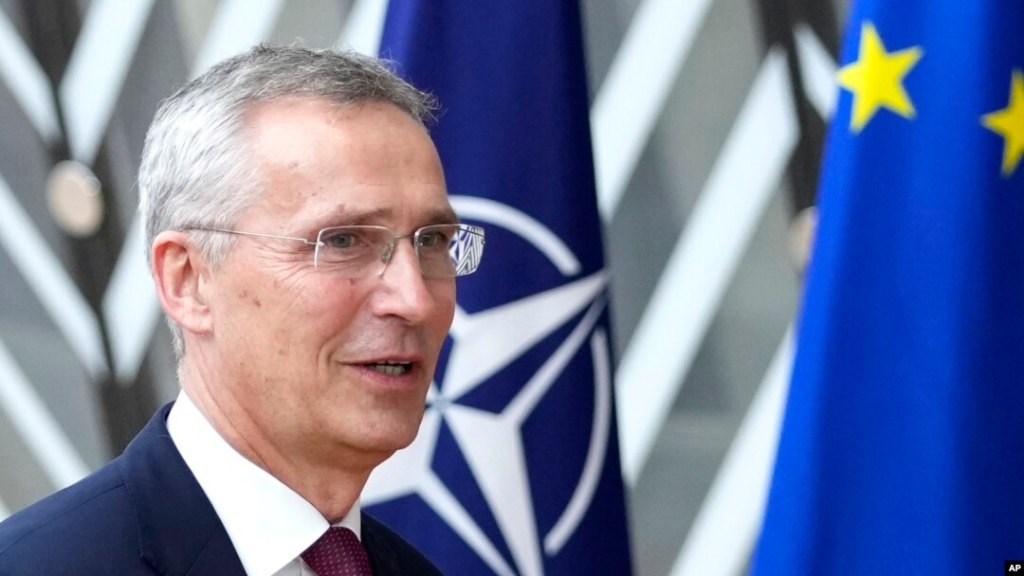
On September 7th, NATO’s Secretary General, Jens Stoltenberg, acknowledged that the war in Ukraine did not start on 24 February 2022 when Russia invaded Ukraine, like Western ‘news’-media say, but much earlier, in 2014, and that Russia’s invasion in 2022 resulted from NATO’s efforts to bring Ukraine into NATO and to bring NATO’s military forces closer to Russia’s borders: “He [Putin] went to war to prevent NATO, more NATO, close to his borders.” In other words: Russia’s invasion actually was defensive, not aggressive, on Russia’s side. And Stoltenberg proudly proclaimed that Russia has been defeated in that defensive objective, because instead both Sweden and especially Finland (one of the nearest nations to The Kremlin, other than the nearest of all, which is Ukraine) rushed to join NATO as a direct result of Russia’s invasion of Ukraine. Stoltenberg was so proud of having turned to dust Putin’s goal of making Russia safer, that Stoltenberg repeated many times NATO having done the exact opposite of what Putin was urging. Stoltenberg was clearly proud to have overseen the frustration of Russia’s need for a defense against a possible blitz-nuclear attack by NATO.

Furthermore: Stoltenberg acknowledged that this war is and has been good for NATO because it’s forcing NATO member countries to increase their expenditures on military weapons, and is thereby forcing down these countries’ expenditures on other matters that voters usually care more about.

Here are excerpts from what he said:

https://archive.ph/HKPPW

“Opening remarks by NATO Secretary General Jens Stoltenberg at the joint meeting of the European Parliament’s Committee on Foreign Affairs (AFET) and the Subcommittee on Security and Defence (SEDE) followed by an exchange of views with Members of the European Parliament”

07 September 2023

The war didn’t start in February last year. It started in 2014. The full-fledged invasion happened last year, but the war, the illegal annexation of Crimea, Russia went into eastern Donbas in 2014.

Since then, NATO has implemented the biggest adaptation on this Alliance in modern history, in decades. And part of that is to invest more in defence. I think I’ve told you before that I know it’s hard to allocate money for defence, because most politicians want to spend money on health, on education, on infrastructure instead of defence. …

The background was that President Putin declared in the autumn of 2021, and actually sent a draft treaty, that they wanted NATO to sign, to promise no more NATO enlargement. That was what he sent us. And was a pre-condition for not invade Ukraine. Of course we didn’t sign that.

The opposite happened. He wanted us to sign that promise, never to enlarge NATO. He wanted us to remove our military infrastructure in all Allies that have joined NATO since 1997, meaning half of NATO, all the Central and Eastern Europe, we should remove NATO from that part of our Alliance, introducing some kind of B, or second class membership. We rejected that.

So he went to war to prevent NATO, more NATO, close to his borders. He has got the exact opposite. He has got more NATO presence in eastern part of the Alliance and he has also seen that Finland has already joined the Alliance and Sweden will soon be a full member.

Earlier, Stoltenberg had said on 9 May 2023, “The war started in 2014.” He even was explicit that “You have to remember that the war didn’t start in 2022” (referring to Russia’s response on 24 February 2022 by invading Ukraine). Here is the best short video (only ten minutes long) accurately showing in the original historic video clips how Ukraine’s war started, and it is very clear there that the U.S. Government, U.S. President Obama, started it in February 2014, by means of a coup, which the Obama Administration had had in the planning stages for quite some time. The founder and head of the ‘private CIA’ firm Stratfor even called it “the most blatant coup in history”. The smoking-gun piece of evidence proving that it had been a coup by the U.S. Government is this recording of Obama’s mastermind of the coup, Victoria Nuland, telling Obama’s Ambassador in Ukraine Geoffrey Pyatt, a month before the coup became climaxed, whom to get appointed to lead the post-coup Ukraine. And, then, the smoking-gun piece of evidence proving that even the top officials of the EU didn’t know that it had been a coup instead of the ‘democratic revolution’ that the U.S. regime claimed, is this recording of the EU’s minister of foreign affairs being told in a phone call from Kiev, by her investigator there, immediately after the coup was over, that it had been a coup. On 4 November 2019, after enough verified evidence had become known about it and about how the war in Ukraine had actually been started by the U.S. Government, I headlined “The Obama Regime’s Plan to Seize the Russian Naval Base in Crimea”, which was the only part of Obama’s plan that failed; and that article documented also how the war had been started by that coup.

Stoltenberg’s speech on September 7th ignored America’s coup, and he even ignored that the coup was quickly followed by the breakaway of Crimea because a plebiscite was held there on 16 March 2014, which produced a 90%+ vote for Crimea to again be a part of Russia, of which Crimea had been a part from 1783 to 1954. And he ignored that the breakaway of Donbass resulted after the Obama-installed Ukrainian government started in April 2014 an ethic-cleansing invasion of Donbass because over 90% of the voters there had voted for the Ukrainian President whom Obama’s coup had replaced, and Obama didn’t want those voters ever again to vote in a Ukrainian election.

So, although what Stoltenberg said there was true, it was very incomplete, because it failed to mention the coup, and the coup-regime’s ethnic-cleansing campaign, though those American initiatives were actually the things that started the war in Ukraine.

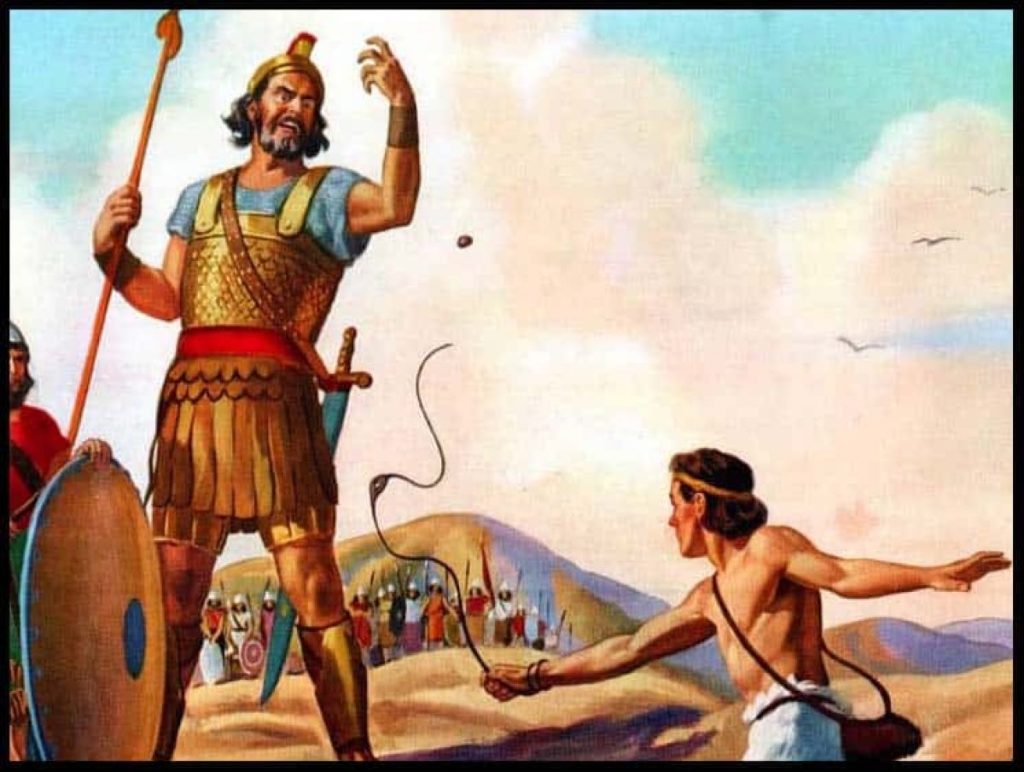
How the Russian David Can Finally Defeat the U.S.-NATO Goliath

By Eric Zuesse

Source: The Duran

When the Soviet Union broke up, and ended its Warsaw Pact military alliance, and ended its communism — all of which happened in 1991 — there was a very clearly understood verbal agreement that the U.S. and its NATO military alliance against the Soviet Union made to the Soviet leaders, repeatedly promising that NATO would not expand toward Russia’s borders; or, as George Herbert Walker Bush’s U.S. Secretary of State, James Baker, famously put it at the time, that NATO would not expand even “one inch to the east.” In other words, America promised that if the Cold War would end on the Soviet side, then it would end also on the American side, and so its military alliance wouldn’t expand to become nearer to Russia’s command-center The Kremlin, which would constitute a threat to blitz-invade Russia from that more-nearby nation.

Mikhail Gorbachev, the last Soviet leader, didn’t demand the termination of America’s military alliance against the Soviet Union, as a condition for the Soviet Union to end its military alliance against America and its NATO, but demanded only that NATO no longer would be a military alliance against Russia — that NATO would not take any of the former Warsaw Pact countries, nor any of the former Soviet countries, the countries that adjoin or are near to Russia and that would then become a threat to become a staging-area to invade Russia.

That was the agreement: to end the Cold War on both sides, not merely on the Russian side. But, on 24 February 1990, G.H.W. Bush secretly started telling his allied European heads-of-state that he and they would not be keeping their part of the bargain, because “We prevailed, they didn’t.” In other words, he was saying that they would go for conquest against Russia itself, and that they all had actually been liars to the contrary — that their instructions now were to go for conquest against Russia.

However, the expansion toward Russia’s borders couldn’t take place immediately, because they needed to continue the pretense of friendliness at least for a while in order to infiltrate their billionaires into Russia’s economy in partnership with whomever in Russia would get privatized Russian businesses so as to make Russia so dependent upon American capital as to become peacefully an American colony. That’s what happened during the 1990s, the Yeltsin years. Then, in 1999, Bill Clinton finally sprung upon Russia the start of NATO’s expansion, by adding Czechoslovakia and Poland to NATO. By the time that Putin came into power in 2000, it was already clear that America was an imperialistic, hostile, nation, and a liar, never to be trusted on anything.

In 2007 — after George W. Bush brought, into NATO, Bulgaria, Estonia, Latvia, Lithuania, Romania, Slovakia, and Slovenia — Putin said at the Munich Security Conference, on 10 February 2007, that NATO’s expansion “represents a serious provocation that reduces the level of mutual trust. And we have the right to ask: against whom is this expansion intended?” It was a remarkably weak statement on the matter, but even so was unacceptable to the imperialists. And, from that moment on, the U.S. Government and media started turning openly against him and for “regime-change in Russia.” Americans’ favorability ratings of Russia, which had been 58% in 2006, never again reached that high a level, and reached a new low of 24% in 2015 (after America’s coup grabbed Ukraine), and a new all-time low of 9% in 2023, while American’s favorability toward Ukraine as a new U.S. vassal nation reached an all-time high of 68% in 2023. The American masses were interpreting things in precisely the ways that America’s Government and billionaires, and their media, wanted them to.

If America wins its war against Russia in the battlefields of Ukraine, then the next step will be placing its missiles against The Kremlin onto Ukraine’s border 300 miles and five minutes of missile-flying distance away from their target, to blitz-behead Russia, and so to ‘win’ WW III.

At this stage, Russia has only two realistic options to achieve national security: either it will form a mutual-defense pact with China guaranteeing that any nation which invades either Russia or China will immediately find itself in a WW III against BOTH China and Russia; or else, it will relocate Russia’s capital city out of Moscow, which is now only seven minutes away from NATO, into Novosibirsk, which is nearly 2,000 miles and 40 minutes away from NATO and also away from Japan — truly a safe location for Russia’s capital city (which no western-Russian city can be). Russia is the only nation that is so vast it contains a city located nearly 2,000 miles away from any U.S.-or-allied military base or launching site. It needs to take advantage of this unique national-security asset which it contains.

Other countries have moved their capital cities, for far lesser reasons; so, Russia should do it now, in order to achieve national security (which is the biggest reason imaginable).  And, then, all of the trillions of dollars that America has been spending to conquer Russia will be immediately turned to dust. Once Russia has moved its capital to Novosibirsk, nothing that America does will be able to threaten Russia seriously again. It would radically transform international relations, because U.S.-and-allied aggression would finally have a natural limit. There would then be one country, at last, that the voracious U.S. empire won’t be able to grab. And this, of course, would also make Russia a magnet for all other countries that haven’t yet been successfully grabbed by the U.S. and now hosting any of its 900 foreign military bases. So: the number of U.S.-occupied countries might then finally begin to decline — which decline would add yet more to the entire world’s security, by removing the world’s biggest national-security threat. America’s foreign military bases threaten every nation, and don’t merely vassalize the given nation. Simply moving Russia’s capital to Novosibirsk would achieve all of this — for Russia, and for the world.

—————

Investigative historian Eric Zuesse’s new book, AMERICA’S EMPIRE OF EVIL: Hitler’s Posthumous Victory, and Why the Social Sciences Need to Change, is about how America took over the world after World War II in order to enslave it to U.S.-and-allied billionaires. Their cartels extract the world’s wealth by control of not only their ‘news’ media but the social ‘sciences’ — duping the public.

France never stopped looting Africa, now the tables are turning

As developments in West Africa demonstrate, the francophone countries are no longer willing to accept French neo-colonialism. With the fear factor finally removed, Africa’s quest for genuine independence is steadily coming to fruition.

By Brad Pearce

Source: TheCradle.co

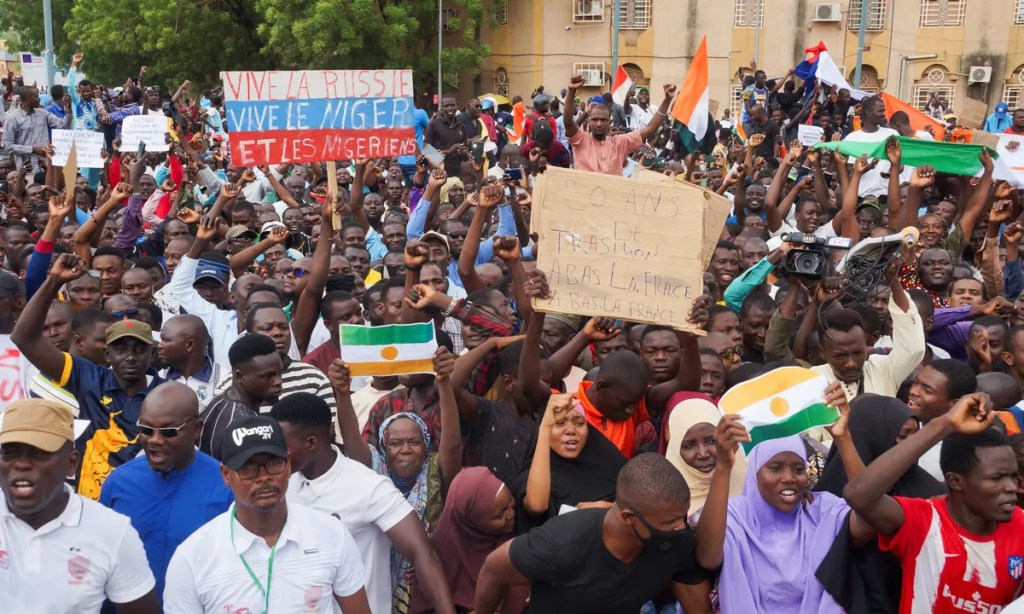
The 26 July coup in the West African nation of Niger, which threatens to undermine French and US military presence in the region, has shed light on the historical exploitation and continued practices of Francafrique – the term used to describe the persistent exploitation by the former French Empire in Africa.

France heavily relies on nuclear energy, with 68 percent of its power coming from nuclear plants. It obtains 19 percent of the uranium required to run these plants from Niger. Despite this significant contribution toward France’s energy needs, only 14.3 percent of Nigeriens have access to a power grid, and even that is often unreliable. This stark contrast highlights the disparities and ongoing exploitation by rapine foreign powers throughout the African continent. 

The Legacy of Francafrique

Francafrique has been known for its exploitative systems designed to profit from African resources, using pressure, capital, and frequently outright force to maintain control over its former empire. As a result, many African states, including Niger, continue to face poverty and underdevelopment.

Burkina Faso’s young, charismatic leader Ibrahim Traore recently spoke at the Russia-Africa summit in St. Petersburg and decried the fact that Africa is resource-rich, but its people are poor, and criticized African leaders seeking hand-outs from the west, as they perpetuate dependency and poverty. He also described what is being imposed on Africa as a form of slavery, stating:

“As far as what concerns Burkina Faso today, for more than eight years we’ve been confronted with the most barbaric, the most violent form of imperialist neo-colonialism. Slavery continues to impose itself on us. Our predecessors taught us one thing: a slave who cannot assume his own revolt does not deserve to be pitied. We do not feel sorry for ourselves, we do not ask anyone to feel sorry for us.”

France’s inability to justify its presence in Africa with a coherent narrative further complicates the situation. Paris cannot openly confess its greed, feign a “civilizing mission,” or admit to any responsibility due to its past crimes. This lack of purpose weakens French power on the continent, leading to violence and poverty in its wake.

West Africa’s drive for further independence has left Atlanticists concerned about the opening this leaves for Eurasian powers like Russia and China to increase their influence in Africa. The west’s reaction reflects a lack of respect for the sovereignty of African countries, viewing the continent merely as a theater to maintain global dominance.

Since the Ukraine war’s onset in early 2022, Atlanticists have expressed alarm over the unwillingness of Global South states to support the west’s anti-Russia policies, a trend further amplified by the shift to multipolarism everywhere. This weakening of western hegemony has opened a path for many nations to avidly explore their geopolitical options and diversify their economies.

A report from the Munich Security Conference held in February highlighted this very real schism with the west:

“Many countries in Africa, Asia, and Latin America have steadily lost faith in the legitimacy and fairness of an international system which has neither granted them an appropriate voice in global affairs, nor sufficiently addressed their core concerns. To many states, these failures are deeply tied to the west. They find that the western-led order has been characterized by post-colonial domination, double standards, and neglect for developing countries’ concerns.”

Fleeced by the CFA Franc

The aftermath of the Second World War marked a significant shift in global power dynamics, and the victorious powers sought to establish a new world order that would maintain peace and promote economic balance. 

In the context of African colonies, where colonial troops played a major role in the allied victory, the victorious powers, including France, aimed to retain economic control and benefit from their former colonies even as the world moved towards decolonization.

This included the establishment of new currency systems, with French leader Charles De Gaulle creating two currencies collectively known as the CFA Franc in 1945 for former colonies in the Western and Central zone.

As the push for political independence grew stronger in the late 1950s, France organized referendums in its African colonies to vote on accepting a constitution drafted by the French. 

Guinea, led by former trade unionist Sekou Toure, opposed accepting the French constitution and voted overwhelmingly against it. In a furious response, De Gaulle’s government withdrew all French administrators from Guinea and took action to sabotage the country’s infrastructure and resources. The harsh measures by Paris aimed to serve as an example of what would happen to any former French colony that resisted France’s agenda.

During the Cold War, the Communist states exploited such actions by presenting themselves as liberators and allies of African countries that sought independence from European influence. This stance has led to some Africans viewing countries like Russia as more equitable partners compared to France.

Over the years, France has demonstrated a pattern of intervening militarily – over 50 times since 1960 – in African countries to secure governments that remain compliant with French economic interests, particularly related to the continued use of the CFA Franc.

The system by which the CFA Franc operates has historically been one of a fixed exchange rate where the currency has unlimited convertibility but is permanently pegged to the French currency, previously the Franc and then the Euro. 

African currency under French control

This means that African countries cannot influence the value of their own currency, and the difference in value makes it so that France can buy African products artificially cheap while Africans are able to buy fewer goods with the money they exchange.

Worse yet, France had requirements to store, and thus profit from, the foreign reserves owned by its former colonies, though the requirement of holding 50 percent of their foreign exchange reserves in a French-ran bank was dropped for the western zone in 2019. 

Under this scheme, African states received a nominal amount of interest, but the bank benefited from lending that capital out at higher rates and attaining massive profits off of African resources and labor. This is despite the fact that many countries in Francophone Africa are major gold exporters and thus have a multitude of options for storing wealth to back a currency in alternative central banks.

While the CFA Franc system has provided some benefits in terms of stability and preventing Zimbabwean-style hyperinflation, it has also come under scrutiny for imposing requirements on African countries that are not placed on more powerful nations. The lack of control over their own currency has hindered economic growth and made these countries vulnerable to global economic shocks.

Northern African states such as Tunisia, Algeria, and Morocco chose to leave the CFA Franc upon gaining independence and have experienced relatively higher prosperity. Similarly, Botswana’s success with its own national currency demonstrates that proper management can lead to stable democracy and economic growth, even for less developed nations.

Exclusive rights and privileges

The CFA Franc system has been the geopolitical equivalent of one’s father insisting he manages their savings while leaving them out of his will. There are benefits to having a trade and currency zone, such as the current ECOWAS union that covers the Western part of the continent, but by design under the CFA Franc system, independence has been an illusion by which France has fleeced these countries. 

France has been dependent on Africa for its status as a world power for more than a century. Among other privileges it has carved out for itself in post-colonial treaties, France has had the exclusive right to sell military equipment to former colonies, and enjoys the first right to any natural resources discovered. Paris makes great use of these privileges: as just one example, 36.4 percent of France’s gas is sourced from the African continent.

Moreover, a vast network of French business interests, which include major multinational companies, dominate industries such as energy, communications, and transportation in many African countries. France’s government also supports French businesses in Africa in several ways, including through an enormous public company called COFACE which guarantees French exports into these underdeveloped markets. 

Towards independence and self-reliance

This economic dependence has contributed to the perpetuation of a system where African states remain weak, pliant, and reliant on resource exports, primarily benefiting French companies and interests. Additionally, African states are obligated to ally with France in any major conflict, further eroding their national sovereignty. 

The African continent suffers from many ailments, but perhaps the most persistent and nefarious are a lack of sovereignty and access to capital. Meanwhile, much of Europe’s prosperity has been derived from looting the Global South for centuries. 

The case of Brussels, built on the wealth derived from the brutal exploitation of the Congo under Belgian King Leopold II, is a stark reminder of the deep-rooted impact of colonialism. When the monarch’s crimes against humanity were discovered, he was ultimately forced to bequeath the majority of his fortune to the Belgian state upon his death. 

Not wanting to do so, he embarked on an enormous series of public works to spend his ill-gotten gains, creating modern Brussels. Now the EU and NATO meet there and audaciously give disingenuous lectures about universal human rights while surrounded by the profits of some of the most brutal cases of oppression in human history. 

While military governments often face challenges in achieving their stated goals, it is evident that western-backed “civil democracies” have also struggled to significantly improve the security and well-being of the African public. 

The path to solving Africa’s problems lies in transformative leaders who can shrug off the legacy and remaining shackles of colonialism and enable the continent to carve out a genuine, homegrown path to independence and self-reliance.

The Ukraine Mess is Animal Farm in Reverse: Starring Blackrock and Other Pigs

By Phil Butler

Source: New Eastern Outlook

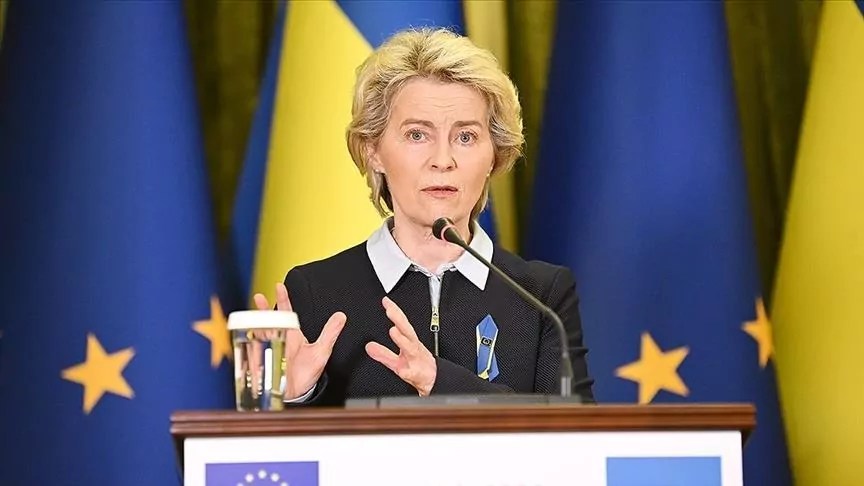
Recently, the head of the European Commission, Ursula von der Leyen, said that the European Union should double its assistance to Ukraine. She went on to say the EU should create a support fund of 50 billion euros by the end of the year and that everything should be done to ensure victory on the battlefield for the Ukrainians.

The European Union has created a “support package” for Ukraine for 2023 of up to €18 billion. This money, however, is not in the form of gifts, grants, or to create an emergency war chest. These billions are a loan under an EU macro-financial assistance program dubbed the MFA+ Instrument. In the fine print, EU member states are guaranteeing these loans as well as paying the interest for the Ukrainians. The move is extraordinary given that Ukraine is not an EU member and that, even before the current conflict, was one of the most corrupt governments on Earth. This begs the question, “Why?”

The EU is issuing special bonds to be sold to investors for this purpose at a time when many people in the European Union go without proper healthcare, services, and even employment. The European Union, EU Member States, and European financial institutions have already dispersed some €49 billion to President Zelensky’s regime. This figure, added to the $76.8 billion already funneled to Ukraine, dwarfs any assistance given to any other country in the world. This very conservative report from the Council of Foreign Relations shows the U.S. alone has shoveled more into Zelensky’s coffers than Afghanistan, Israel, Jordan, Ethiopia, and Iraq combined in 2020.

In all, some 47 countries have given money and arms to Ukraine. As of now, EU Institutions (?) handed Zelensky over €30 billion. The UK has forked over about €10 billion as their pensioners worry about what’s for dinner next. Germany has given somewhere around €8 billion, and Japan almost €7 billion. The Netherlands, Canada, and Poland have pitched in about €5 billion each, and the list of others about €14 billion. The numbers, as you would expect, do not all add up. A U.S. News & World Reports story from earlier this year claimed total aid to Zelensky’s country had exceeded €150 billion as of January of this year. Again, why?

The answer, this time, is really simple. BlackRock, and the new investment initiative to rebuild Ukraine (whatever’s left of it). You already knew this, right? Zelensky and BlackRock’s BlackRock CEO Larry Fink met late last year, and in November, the Ukrainian Ministry of the Economy (MoE) and BlackRock Financial Markets Advisory (FMA) signed a memorandum to structure Ukraine’s reconstruction funds (PDF). Also, in on the moneymaking schemes in war-torn Ukraine are Nestlé, International Finance Corporation, the private investment arm of the World Bank, Australia’s Tattarang Group,

Zelensky has called the rebuilding of his country, once it’s been used up as a proxy NATO against Russia, “the greatest opportunity in Europe since World War Two.” Earlier this year, Fink told Barron’s and other financial magazines that Western investors will be “flooding” Ukraine post-war and the country could become “a beacon to the rest of the world of the power of capitalism”. Also, JPMorgan Chase is joining BlackRock to help Ukraine set up a reconstruction bank to steer public seed capital.

This American Conservative report says, “BlackRock Plots to Buy Ukraine,” in a recent editorial. Author Bradley Devlin outlines the Ukraine case, while also revealing how Fink and BlackRock are transforming America into a nation of renters by artificially elevating the prices of normal houses. If ever a man were appropriately named, Fink is that man.

“Why?” Is there any doubt about why some poor untrained bartender from Kyiv is in a foxhole being bombarded by Russian artillery? Doesn’t all the misleading media, inflated Ukraine military gains, and Joe Biden’s cock of the walk attitude toward a peace deal make more sense now? And Ursula, the lady I fondly refer to as Frau von der Clucky for her chicken-like pecking and strutting about while millions either die or are in harm’s way because of all the Western world barnyard antics right out of Orwell’s Animal Farm. While someone’s Dad takes a bullet or shrapnel in Donetsk, our leaders keep crowing, snorting, braying, and hog-wallering in their capitalistic farm dream.

Why? Greed, that’s why.

The Dynamics of War Insanity: NATO’s Ukraine Roulette

By Alfred de Zayas

Source: Information Clearing House

Deliberate provocations of a nuclear rival, coups d’état, colour revolutions, broken promises, broken treaties, escalation of tensions, demonization, invective, double-standards — all this while asserting adherence to international legal norms and playing innocent about our aggressions, our violations of the Hague and Geneva Conventions, of articles 1(2)[1], 2(3)[2], 2(4)[3] and 39[4] of the UN Charter.

Abrams tanks, Leopard tanks, F-16, indiscriminate weapons, depleted uranium, cluster bombs. Summits illustrate how the moral compass of the collective West is lost in the avalanche of fake news[5], fake history, fake law, bellicose rhetoric, media hyperbole, serial mobbing of dissenters, persecution of whistleblowers, censorship. The Western binary mindset continues to divide the world into good and bad countries, democracies and autocracies. There is little room to accommodate a comprehensive picture of the pre-history, root causes of conflicts, and nuances. One observes an almost total absence of a sense for proportions.

The Global Majority in Latin America, Africa and Asia is increasingly alarmed by the surrealistic spectacle of a collective West that seems out of control, developing its own lethal dynamic, displaying a paroxysm of Russophobia and Sinophobia, incitement to hatred, cancel culture, refusal to entertain serious dialogue, doubling-down on eschatological demands. Many non-Western thinkers and politicians are articulating justified warnings that the on-going intestinal conflicts in the West are adversely impacting the economies of third-world countries and may ultimately result in Apocalypse for the entire planet. The West is not playing the classical Russian roulette – it has developed its own version: Ukrainian roulette, compulsive apocalyptic vabanque.

Meanwhile the Western media, notably Reuters, AP, CNN, Fox, New York Times, Washington Post, BBC, Le Monde, Figaro, FAZ, der Spiegel, even the Swiss NZZ ensure the daily indoctrination doses for the Western public, purveying skewed narratives that repeat and embellish what Washington and Brussels ordain, blithely ignoring other views and perspectives and the principle audiatur et altera pars. Freedom of the media in the collective West seems to mean the right to repeat NATO narratives ad nauseam, even when they have been proven wrong. This “freedom” also includes the freedom to ignore every critical voice about NATO and to refrain from asking critical questions at NATO press conferences.

Western media systematically fail to report on the fears of billions of human beings in the rest of the world, Brazilians, Mexicans, South Africans, Ugandans, Indians, Chinese, who want peace and stability in the world as well as a chance for sustainable development. Many in these countries blame not Russia but Washington and Brussels for provoking the Ukraine conflict. This Global majority is not interested in whether Crimea lies in Russia or Ukraine. They demand a peaceful solution to an internal Western strife, so that the spill-over does not dislocate the economies of non-Western countries. Peace must be sought and achieved at the negotiating table and not on the battlefield.

The power of propaganda

On the legal, moral and political arenas, truth is less important than the perception of truth. Since time immemorial language has shaped our perception of reality, coloured it according to the political agenda of the powerful. Propaganda was not invented in the 21st century. It has always existed and generated an opportunistic pseudo-reality, an epistemology that subverts our understanding of facts and events. Labels, caricatures, generalizations serve as shortcuts to judgment and influence our daily behaviour in making choices. We are not obliged to use these templates, but most people unthinkingly do so.

The narrative managers of the mainstream media are bent on persuading us into believing who is good and who is bad, what politicians we should like, whom we should despise, what “metaphysic” we should consider valid within the mainstream epistemology. Of course, we still have our own brains and can use them – sapere aude! As Horatius used to say[6]. The sad thing is that even highly educated persons, graduates of Harvard, Oxford, Science-Po, continue to put their trust in media outlets that do not deserve our trust. As Julius Caesar put it: quae volumus, ea credimus libenter — we believe what we want to believe[7]. Indeed, it takes temerity to realize that our own politicians and media lie to us, that they are purveyors of dis-information and practitioners of Orwellian doublethink.

The human being has an innate desire to believe in a positive metaphysic, wants to look up to some authority, needs to have benchmarks, orientation points. That is why we are all to some degree negationists, resilient to bad news. In spite of the egregious official dis-information that preceded Western aggressions in Vietnam, Yugoslavia, Afghanistan, Iraq, Libya and Syria, we still want to believe that our governments are really champions of the rule of law and human rights, that they “mean well”, even if occasionally they inadvertently “make mistakes.”

Of course, it is painful to accept that some things that affect us are ugly, but the realization actually opens new vistas. If we reject blind faith in our leaders and practice a healthy scepticism, if we pro-actively look for other views and perspective, we grow up, become mature and experience a sense of liberation from illusions, acquiring a new purpose based on the facts as they stand, and not as we would like them to be.

The function of law

Law has an epistemological function in defining what is allowed and what is reprehensible. Law is not immutable or God-given, but constitutes a codification of the rules of the game at a particular moment in time and in a particular context. Law should not be confused with justice. Law is only the expression of a certain order of things, past and future generations and other civilizations may have entirely different legal orders and different ideas as to what justice entails.

Education teaches us to respect certain “red lines” established by the scribes of our society – the law makers in Parliaments, in the United Nations, in international conferences, such as those organized by the International Committee of the Red Cross, which have concretized the ius in bello, the laws of war. These codifications include the rejection of indiscriminate weapons such as land mines and cluster bombs. The international Convention banning Cluster Munition (123 signatories, 111 states parties)[8] of 3 December 2008 was signed by many states that now consider furnishing cluster bombs to Ukraine. Go figure!

Judges apply the laws that have been codified by institutions possessing law-making authority. This is what we like to call the “rule of law”, which must not be confused with the “rule of justice”. Moreover, the “rule of law” is systematically undermined when the legal profession engages in brazen double-standards and international tribunals like the International Criminal Court[9] practice selectivity, investigating only some crimes, while letting the crimes committed by Western countries go unpunished.

Criminal Organizations

Articles 9 and 10 of the London Agreement of 8 August 1945, the Statute of the International Military Tribunal at Nuremberg, as well as the Nuremberg judgment of 1 October 1946[10] created a precedent for a previously uncodified crime – membership in a “criminal organization”. Several NAZI organizations including the SS, the Gestapo and the Reich Cabinet were found to be criminal organizations, a problematic concept that flies in the face of the legal principle of the presumption of innocence.

If we fast-forward to the 21st century and consider the activities of the CIA, MI6, Mossad, targeted assassinations, overt and covert actions in violation of the Hague and Geneva Conventions, what is the relevance of the Nuremberg precedent to these organizations and to the North Atlantic Treaty Organization itself. If we compile the evidence of war crimes and crimes against humanity committed by NATO forces over the past 30 years, this would largely suffice for the International Criminal Court to issue indictments for violations of article 7 (crimes against humanity) and 8 (war crimes) of the Statute of Rome.

Initially NATO had its raison d’être under its 1949 Treaty. But the moment that the Warsaw Pact was dismantled in 1991 this justification fell away, and it gradually morphed into an imperialistic hegemonic military bloc, bent on imposing the Weltanschauung of the collective West on the rest of the world.

While Chapter VIII of the UN Charter recognizes the legitimacy of “regional arrangements” (articles 52-54) in the field of collective security, this requires that these regional arrangements be subordinated to the higher authority of the Security Council, which has a monopoly over the legal use of force. Since the 1990’s NATO has conspired to usurp the functions of the Security Council and thus far gotten away with it, although the NATO treaty must yield to the primacy of the UN Charter, pursuant to article 103 of the Charter, the “supremacy clause”. If States are dissatisfied with the current state of international law, it is for them to seek an amendment to the UN Charter pursuant to article 108.

Undoubtedly it was contrary to the UN Charter for NATO countries to use military force against Yugoslavia in 1999 in the absence of a Security Council resolution under Chapter VII and a finding under article 39 of the Charter that there had been a previous threat or breach of international peace and security and a failure of peaceful negotiations under the auspices of the United Nations. Without approval by the Security Council, NATO’s actions in Yugoslavia and elsewhere were simply illegal and engaged State civil and penal responsibility, including the obligation to pay reparations to the victims of the aggression. NATO actions since the entry into force of the Statute of Rome in 2001 deserve to be investigated under the rubric “crime of aggression” (article 5 off the Rome Statute) as complemented by the Kampala definition of aggression, and, of course under articles 7 and 8.

The end never justifies the means

The Florentine diplomat Nicolo Machiavelli never wrote the phrase “the end justifies the means” in his famous book The Prince. However, the thrust of the entire book is precisely that. Throughout the ages wielders of power have always claimed that because their goals were supposedly noble, the means to achieve those ends should be allowed. The same idea is expressed in the common idiom that you cannot make an omelette without cracking some eggs. But this is a lame excuse. What must be understood is that the evil means contaminate the end and render it evil as well.

Politicians and media in the collective West try to justify the unjustifiable, including the delivery of indiscriminate weapons to Ukraine, covering up the US involvement in the blowing up of the Nordstream pipelines[11], the responsibility of Ukraine for the bombing of the Zaporozhe nuclear plant and the Kakhovka dam[12] and other dams[13]. Politicians and media systematically engage in apologetics about the war crimes committed by NATO forces. Beyond merely whitewashing the crimes, they engage in a form of totalitarian censorship and practice a vicious persecution of whistleblowers who tell us what crimes are being committed in our name. Indeed, secrecy is an enabler of crime. Few people know that the Holocaust, the greatest crime of the twentieth century, was largely perpetrated under the cover of secrecy, that Hitler’s Führerbefehl Nr. 1 required absolute secrecy about government practices[14], that the killers of the Einzatzgruppen had to sign on pain of death that they would never reveal anything about the killings, why Heinrich Himmler reminded the killers in his 1943 Posen speech of the absolute necessity of secrecy. That is why there was the Nazi Operation 1005[15] to attempt to erase the evidence of the killings by the Einsatzgruppen, digging up mass graves and churning the skeletons, why most concentration camps in the East were evacuated and destroyed before their capture by the Soviet Army. Secrecy and denial were indispensable elements of the criminal conspiracy[16].

UN Rapporteur Nils Melzer’s book The Trial of Julian Assange[17] documents the egregious violations of the rule of law in the US, UK, Sweden, Ecuador in connection with the Assange frame-up and “prosecution”. Indeed, Nils Melzer is the Emile Zola of the 21st century, demonstrating far worse judicial misconduct than Zola revealed in the 1890’s in connection with the frame-up of Alfred Dreyfus by a French military court. The Assange scandal is much worse than the Dreyfus Affair[18], but the mainstream media today has totally failed in its watchdog duty and many journalists have even joined the wolves.

What future for NATO?

Professors like John Mearsheimer[19], Richard Falk[20], Jeffrey Sachs[21], Stephen Kinzer[22] and others have expressed their concern about the dangers that NATO poses for the survival of humanity, of the logic that it should be dismantled. The best that could be hoped for is that NATO be phased out and that the Global Majority will succeed in rejecting NATO’s ambition to further expand not only in Europe but also in the Asia-Pacific region. Perhaps if the Global Majority exposes the multiple war crimes of NATO forces over the past 30 years and demands accountability from NATO countries, the perception of NATO as a “defence alliance” will be replaced by the label “criminal organization”.

When the media indoctrination and propaganda about NATO is exposed as false, when the perception in Western countries moves from positive to negative, when people realize that NATO is a Machiavellian institution that has exhausted its usefulness, it will be possible to gradually wind it down.

Ultimately, NATO must be recognized not only as a criminal organization, a blustering vestige of a moribund Western imperialism, but as a mortal danger to the survival of civilization on Earth. NATO is on the wrong side of history.

==== 

1. Among the purposes of the UN “To develop friendly relations among nations based on respect for the principle of equal rights and self-determination of peoples, and to take other appropriate measures to strengthen universal peace” 

2. All Members shall settle their international disputes by peaceful means in such a manner that international peace and security, and justice, are not endangered. 

3. All Members shall refrain in their international relations from the threat or use of force against the territorial integrity or political independence of any state, or in any other manner inconsistent with the Purposes of the United Nations. 

4. The Security Council shall determine the existence of any threat to the peace, breach of the peace…. 

5. https://www.abc.net.au/news/2023-07-13/key-takeaways-from-nato-day-two-putin-zelenskyy-matter/102595358.

https://edition.cnn.com/2023/07/12/politics/biden-nato-summit/index.html.Compare https://www.normanfinkelstein.com/the-mask-is-off-why-ukraine-will-never-be-a-nato-member/ 

6. Dare to think by yourself, dare to know! Horatius, First book of Letters (20 BC). Immanuel Kant also used the expression in his 1784 essay “What is Enlightenment?”

7. De bello civile, 2, 27, 2 

8. https://www.clusterconvention.org/ 

9. A. de Zayas, Chapter 4, The Human Rights History, Clarity Press, Atlanta 2023. 

10. https://avalon.law.yale.edu/imt/judgen.asp 

11. https://seymourhersh.substack.com/p/how-america-took-out-the-nord-stream 

12. https://abcnews.go.com/International/strategically-vital-nova-khakovka-dam-blown-border-ukraine/story?id=99863763

https://www.reuters.com/world/europe/putin-accuses-ukraine-destroying-kakhovka-dam-behest-west-2023-06-07  / 

13. https://www.npr.org/2022/09/06/1121201310/ukraine-flooded-village-dam-blown-up  

14. https://www.tagesspiegel.de/kultur/staatsgeheimnis-1989490.html  

15. https://www.jewishvirtuallibrary.org/aktion-1005  

16. A de Zayas, Völkermord als Staatsgeheimnis, Olzog Verlag, Munich 2011. 

17. Verso Books, New York, 2022. 

18. https://www.britannica.com/place/France/The-Dreyfus-Affair  

19. The Great Delusion, Yale University Press, 2018. https://www.jstor.org/stable/24483306
https://www.jstor.org/stable/24483306  

20. https://richardfalk.org/2022/03/31/make-peace-not-war-in-ukraine/  

21. https://www.commondreams.org/opinion/the-war-in-ukraine-was-provoked-and-why-that-matters-if-we-want-peace  

22. https://podcasts.apple.com/us/podcast/stephen-kinzer-on-the-uss-immoral-proxy-war-in-ukraine/id1525433436?i=1000605659299