Freedom Rider: No Chemical Attacks in Syria

By Margaret Kimberly

Source: Black Agenda Report

The corporate media is concealing a leaked UN agency report that shows Syrian government innocence in an alleged chemical attack.

“Americans have been fed a steady diet of ‘Assad the butcher’ and any counter narrative is disappeared.”

The corporate media march in lock step with the United States and its allies around the world. They have a tacit agreement to exclude any information which might inconvenience pro-war, pro-interventionist narratives.

Claims of chemical weapons use by the Syrian government are but one example of this tactic. These improbable stories have been repeated with regularity ever since the United States and its allies began using jihadist proxies to overthrow the Syrian government in 2011. In 2013 we were told that president Assad waged a chemical weapons attack on the same day that United Nations weapons inspectors arrived in the country. It is an understatement to say that this scenario is unlikely to be true.

In 2018 the U.S. and its European allies repeated that they would take military action against Syria if there were any reports of chemical weapons use. Like clockwork, such an event was reported and a bombing campaign took place in April of that year.

Anyone with common sense should doubt these reports. Assad had no reason to do anything which guaranteed military attacks on his country. Furthermore, persons with credibility and expertise had already provided evidence that these claims are nothing but false flags meant to get public buy-in for aggression.

“Assad had no reason to do anything which guaranteed military attacks on his country.”

The claims and counter claims always merited serious scrutiny. But a leaked document from the Organization for the Prohibition of Chemical Weapons (OPCW) makes the case that even supposedly disinterested parties take the side of the U.S. and its allies if enough pressure is applied.

The leaked report makes clear that there were serious questions about the 2018 reports, even among OPCW staff. The New York Times and the rest of their partners in propaganda wanted to make the case for the once and future war and accused the Syrian government of dropping chlorine gas devices onto an apartment building. But the leaked document  shows that there were serious doubts expressed by the some of the expert investigators. “…there is a higher probability that both cylinders were manually placed at both locations rather than being delivered by aircraft.”

There are many dots to connect here and they point away from the “Assad is gassing his own people” tale. The OPCW was pressured into taking on the role of judge and jury and assigning blame, rather than merely reporting on its technical findings. The politicization of its work dove tailed nicely with charges of Syrian gas and Russian poisonings against former KGB operatives. As the old saying goes, there is no such thing as coincidence.

“The politicization of the OPCW’s work dove tailed nicely with charges of Syrian gas and Russian poisonings against former KGB operatives.”

The recently leaked documents ought to make for headlines around the world. Instead the story has been ignored by corporate media. Only those who are already interested in the topic or who are familiar with organizations such as the Working Group  on Syria, Propaganda and Media know anything about this news. It has been deliberately kept hidden so that the next call for an armed response will receive little or no opposition.

The U.S. Congress came very close to calling for a Syrian war in a May 20, 2019 letter signed by 70% of its members . The AIPAC inspired massive calls for president Trump to “stabilize” Syria, protect Israel and stop Russian and Iranian influence. The call was bipartisan and bicameral with 79 senators and 303 members of the house signing on to the call for imperialism. Presidential candidates Kamala Harris and Cory Booker are among those calling for the dangerous slippery slope. Congressional Black Caucus (CBC) chairwoman Karen Bass signed too as did Hakeem Jeffries, James Clyburn, and Elijah Cummings among others.

Americans have been fed a steady diet of “Assad the butcher” and any counter narrative is disappeared, just like the OPCW leak. It is a useful ploy to have around. Let us not forget that last year’s bombing resulted in praise from the so-called resistance crowd who think they are supporting a humanitarian action. When he next decides to protect the U.S. jihadist proxies the gas attack story will suddenly reappear. Revealing any doubts about its veracity will undermine the U.S. hegemonic project.

“Seventy-nine senators and 303 members of the house signing on to the call for imperialism.”

There is plenty of collusion in the United States and it isn’t between Trump and Russia. The love triangle involves the corporate media, both sides of the war party, and foreign ally puppet states. They all play nicely together in the sandbox when there is an evil deed to carry out. The public are mostly hapless dupes who give approval for destruction and carnage just like the state want them to.

We have been through this often enough to know when lies are being told. It wasn’t that long ago that Colin Powell went to the United Nations with a vial and a tall tale about WMD. The cast of characters changes but the story is the same. It is time to grow up and end useful idiocy.


Margaret Kimberley’s Freedom Rider column appears weekly in BAR, and is widely reprinted elsewhere. She maintains a frequently updated blog as well at http://freedomrider.blogspot.com . Ms. Kimberley lives in New York City, and can be reached via e-Mail at Margaret.Kimberley(at)BlackAgendaReport.com.

Understanding NATO, Ending War

By Robert J. Burrowes

On 4 April 2019, the North Atlantic Treaty Organization, better known as NATO, marked the 70th anniversary of its existence with a conference attended by the foreign ministers of member nations in Washington DC. This will be complemented by a meeting of the heads of state of member nations in London next December.

Coinciding with the anniversary event on 4 April, peace activists and concerned scholars in several countries conducted a variety of events to draw attention to, and further document, the many war crimes and other atrocities committed by NATO (sometimes by deploying its associate and crony terrorist armies – ISIS, Al Qaeda, Al Nusra – recruited and trained by the CIA and funded by Saudi Arabia, other Gulf countries and the US directly or through one or other of its many agencies: see ‘NATO – No Need – NATO-EXIT: The Florence Declaration’), the threat that NATO poses to global peace and security as an appendage of the US military, and to consider ways that NATO might be terminated.

These protests and related activities included several outlined in ‘No To NATO: Time To End Aggressive Militarism’ which also explains how NATO ‘provides a veneer of legality’ when ‘the US is unable to get the United Nations Security Council to approve military action’ and ‘Congress will not grant authority for US military action’ and despite the clearcut fact that NATO has no ‘international legal authority to go to war’, the grounds for which are clearly defined in the Charter of the United Nations and are limited to just two: authorization by the UN Security Council and a response in self-defense to a military attack.

The most significant gathering of concerned scholars was undoubtedly the ‘Exit NATO!’ conference in Florence, Italy, which culminated in the Florence Declaration calling for an end to NATO. See ‘The Florence Declaration: An International Front Calling for NATO-Exit’.

If NATO’s record of military destruction is so comprehensive – in the last 20 years virtually destroying Yugoslavia (balkanized into various successor states), Iraq and Libya, while inflicting enormous damage on many others, particularly Afghanistan and Syria – how did it come into existence and why does it exist now?

The Origin and Functions of NATO

Different authors offer a variety of reasons for the establishment of NATO. For example, Yves Engler argues that two of the factors driving the creation of NATO were ‘to blunt the European Left’ and ‘a desire to bolster colonial authority and bring the world under a US geopolitical umbrella’. See ‘On NATO’s 70th anniversary important to remember its anti-democratic roots’ and ‘Defense of European empires was original NATO goal’.

But few would disagree with Professor Jan Oberg’s brief statement on the origin of NATO: ‘Its raison d’etre… had always and unambiguously been the very existence of the Soviet Union… and its socialist/communist ideology.’ See ‘NATO at 70: An unlawful organisation with serious psychological problems’.

In other words, NATO was established as one response to the deep fear the United States government harbored in relation to the Soviet Union which, despite western propaganda to the contrary and at staggering cost to its population and industrial infrastructure, had led the defeat of Nazi Germany in World War II.

As Professor Michel Chossudovsky elaborates this point: The NATO ‘alliance’ of 29 member states (with Israel also a de facto member), most with US military bases, US military (and sometimes nuclear) weapons and significant or substantial deployments of US troops on their territory, was designed to sustain ‘the de facto “military occupation” of Western Europe’ and to confront the Soviet Union as the US administration orchestrated the Cold War to justify its imperial agenda – global domination guaranteed by massive US military expansion – in service of elite interests (including the profit maximization of the military industrial complex, its fossil fuel and banking corporations, and its media and information technology giants).

While NATO has the appearance of a multinational military alliance, the US controls NATO command structures with the Pentagon dominating NATO decision-making. NATO’s Supreme Allied Commander Europe (SACEUR) and Supreme Allied Commander Atlantic (SACLANT) are Americans appointed by Washington with the NATO Secretary General Jens Stoltenberg performing merely bureaucratic functions.

In light of the above, Chossudovsky observes: ‘Under the terms of the military alliance, NATO member states are harnessed into endorsing Washington’s imperial design of World conquest under the doctrine of collective security.’ Even worse, he argues, given the lies and fabrications that permeate US-NATO military doctrine, key decision-makers believe their own propaganda. ‘Immediately after the Cold War, a new nuclear doctrine was formulated, focused on the preemptive use of nuclear weapons, meaning a nuclear first strike as a means of self-defense.’ More recently: ‘Not only do they believe that tactical nuclear weapons are peace-making bombs, they are now putting forth the concept of a “Winnable Third World War”. Taking out China and Russia is on the drawing board of the Pentagon.’ See ‘NATO-Exit: Dismantle NATO, Close Down 800 US Military Bases, Prosecute the War Criminals’ and ‘NATO Spending Pushes Europe from Welfare to Warfare’.

So, given the ongoing military threats – with an expanding range of horrific weapons (including, to nominate just two, ‘more usable’ low yield nuclear weapons and technologies on ‘weather warfare’ offered by the military/nuclear corporate war planners) that threaten previously unimagined outcomes – and interventions by a US-led NATO, with Venezuela and now Iran the latest countries to be directly threatened – see ‘“Dangerous game”: US, Europe and the “betrayal” of Iran’ – as well as a gathering consensus among peace activists and scholars of the importance of stopping NATO (particularly given the many opportunities, beginning with aborting its origin, that have been missed already as explained by Professor Peter Kuznick: see ‘“Obscene” Bipartisan Applause for NATO in Congress’) how do we actually stop NATO?

While several authors, including those with articles cited above, offer ideas on what should be done about ending NATO, Chossudovsky offers the most comprehensive list of ideas in this regard well aware that stopping NATO is intimately connected to the struggle to end war and globalization. Chossudovsky’s ideas range from organizational suggestions such as integrating anti-war protest with the campaign against the gamut of neoliberal economic ‘reforms’ and the development of a broad based grassroots network independent of NGOs funded by Wall Street, objectives such as dismantling the propaganda apparatus which sustains the legitimacy of war and neoliberalism, challenging the corporate media (including by using alternative media outlets on the Internet), providing encouragement (including information about the illegality of their orders) for military personnel to refuse to fight (perhaps like the GI coffeehouse movement during the US war on Vietnam: see ‘The story of the GI coffeehouses’), working to close down weapons assembly plants and many other suggestions. See Towards a World War III Scenario: The Dangers of Nuclear War and ‘NATO-Exit: Dismantle NATO, Close Down 800 US Military Bases, Prosecute the War Criminals’.

Given my own deep interest in this subject of US/NATO wars and in developing and implementing a strategy that ends their war-making, let me elaborate Chossudovsky’s explanation of NATO’s function in the world today by introducing a book by Professor Peter Phillips.

In his book Giants: The Global Power Elite, Phillips observes that the power elite continually worries about rebellion by the ‘unruly exploited masses’ against their structure of concentrated wealth. This is why the US military empire has long played the role of defender of global capitalism. As a result, the United States has more than 800 military bases (with some scholars suggesting 1,000) in 70 countries and territories. In comparison, the United Kingdom, France, and Russia have about 30 foreign bases. In addition, US military forces are now deployed in 70 percent of the world’s nations with US Special Operations Command (SOCOM) having troops in 147 countries, an increase of 80 percent since 2010. These forces conduct counterterrorism strikes regularly, including drone assassinations and kill/capture raids.

‘The US military empire stands on hundreds of years of colonial exploitation and continues to support repressive, exploitative governments that cooperate with global capital’s imperial agenda. Governments that accept external capital investment, whereby a small segment of a country’s elite benefits, do so knowing that capital inevitably requires a return on investment that entails using up resources and people for economic gain. The whole system continues wealth concentration for elites and expanded wretched inequality for the masses….

‘Understanding permanent war as an economic relief valve for surplus capital is a vital part of comprehending capitalism in the world today. War provides investment opportunity for the Giants and TCC elites and a guaranteed return on capital. War also serves a repressive function of keeping the suffering masses of humanity afraid and compliant.’

As Phillips elaborates: This is why defense of global capital is the prime reason that NATO countries now account for 85 percent of the world’s military spending; the United States spends more on the military than the rest of the world combined.

In essence, ‘the Global Power Elite uses NATO and the US military empire for its worldwide security. This is part of an expanding strategy of US military domination around the world, whereby the US/ NATO military empire, advised by the power elite’s Atlantic Council, operates in service to the Transnational Corporate Class for the protection of international capital everywhere in the world’.

In short, ending NATO requires recognition of its fundamental role in preserving the US empire (at the expense of national sovereignty) and maintaining geopolitical control to defend the global elite’s capital interests – reflected in the capitalist agenda to endlessly expand economic growth – and particularly the profits the elite makes by inciting, supplying and justifying the massively profitable wars that the US/NATO conduct on its behalf.

So if you thought that wars were fought for reasons other than profit (like defense, a ‘just cause’ or ‘humanitarian’ motives) you have missed the essential function of US/NATO wars. And while these wars might be promoted by the corporate media as conflicts over geostrategic considerations (like ‘keeping open the Straits of Hormuz’), access to resources (‘war for oil’) or even markets (so that we can have US junk-food chains in every country on Earth), these explanations are all merely more palatable versions of the word ‘profit’ and are designed to obscure the truth.

And this raises another question worth pondering. Given that wars are the highly organized industrial-scale killing of fellow human beings (for profit) as well as the primary means of expanding the number of fellow human beings who are drawn into the global capitalist economy to be exploited (for profit) and the primary method used for destroying Earth’s climate and environment (for profit), you might wander if those who conduct wars are sane. Well, as even posing the question suggests, the global elite – which drives wars, the highly exploitative capitalist economy and destruction of the biosphere – is quite insane. And there is a brief explanation of this insanity and how it is caused in the article ‘The Global Elite is Insane Revisited’.

Stopping NATO

So if war is precipitated and now maintained perpetually by an insane elite that controls and utilizes the US and NATO military forces to secure profits by killing and exploiting fellow human beings while destroying the climate and environment, how can we stop it? Clearly, not without a sophisticated strategy that addresses each dimension of the conflict.

Hence, my own suggestion is that we do three things simultaneously:

  1. Invite participation in a comprehensive strategy to end war, of which NATO is a symptom
  2. Invite participation in one or another program to substantially reduce consumption to systematically reduce the vital driver of ‘wars for resources’ (which will also reduce the gross exploitation of fellow human beings and humanity’s adverse impact on the biosphere), and
  3. Invite participation in programs to increase human emotional functionality so that an increasing proportion of the human population is empowered to actively engage in struggles for peace, justice and sustainability and to perceive the propaganda of elites and their agents, including NATO functionaries and corporate media outlets, without being deceived by it.

There is a comprehensive strategy to end war explained on this website – Nonviolent Campaign Strategy – which includes identification of the two strategic aims and a basic list of 37 strategic goals to end war. See ‘Strategic Aims’.

There is a strategy for people to systematically reduce their consumption and increase their self-reliance mapped out in ‘The Flame Tree Project to Save Life on Earth’. But if you want a simpler 12-point list which still has strategic impact, see ‘The Earth Pledge’ included in ‘Why Activists Fail’. If you want to better understand why people over-consume, you can find out here: ‘Love Denied: The Psychology of Materialism, Violence and War’.

There is a process for improving your own emotional functionality (which will develop your conscience, courage and capacity to think strategically) described in the article ‘Putting Feelings First’. If you would like to assist children to grow up without emotional dysfunctionalities, consider making ‘My Promise to Children’. If you want to read the foundation behind these two suggestions, see Why Violence? and Fearless Psychology and Fearful Psychology: Principles and Practice.

Complementary to these suggestions, you might like to sign the online pledge of The Peoples Charter to Create a Nonviolent World which links people working to end violence in all contexts.

There is one question that remains unaddressed by the suggestions above: How do we mobilize sufficient people (both anti-war activists and others) and organizations (including anti-war groups and others) to participate in the effort to end elite-sponsored war, including its organizational structures such as NATO?

Given the notorious difficulty of mobilizing activists to act strategically in any context (a much more complex version of the basic problem of mobilizing people), my primary suggestion is that individuals within the anti-war movement invite other individuals and activist groups to choose and campaign on one or more of the strategic goals necessary to end war listed in ‘Strategic Aims’. While some activist groups are already working to achieve one or more of these strategic goals, we clearly need to engage more groups to work on the many other goals so that each of these goals is being addressed. War will not be ended otherwise.

One thing that a section of the climate movement does well is to research and report on those banks, superannuation funds and insurance companies that provide financial services, loans, investment capital and insurance cover to fossil fuel corporations and to then invite concerned people to sign standard letters sent to these organizations requesting them to cease their support of fossil fuels. The anti-war movement could usefully emulate this tactic (on a far wider scale than has existed previously) in relation to weapons corporations and to invite individuals and organizations everywhere to boycott banks, superannuation funds and insurance companies with any involvement in the weapons industry.

But this is just one simple tactic (involving no risk and little effort) on a small but important range of ‘targets’ in the anti-war struggle. Unfortunately, there are plenty more targets that need our attention and that will require more commitment than signing a letter given that, for example, essential funding for the weapons industry is supplied by government procurement programs using your taxes.

Similarly, we need individuals and groups working to mobilize people to substantially reduce their consumption, and individuals and groups working to mobilize people to prioritize their emotional well-being (the foundation of their courage to act conscientiously and strategically in resisting war, exploitation and destruction of the biosphere generally). If we do not undertake these complementary but essential programs, our efforts to end war will be endlessly undermined by our own fear and over-consumption.

Because, in the final analysis, it is our fearfully surrendered tax dollars and our dollars spent consuming the resources seized in wars that will ensure that elite-driven wars for profit by the US and NATO will be financially sustained, whatever words we utter and actions we take.

So our strategy must address this fear and over-consumption too if it is to have the sophistication and comprehensiveness necessary to shut down NATO and end war.


Biodata: Robert J. Burrowes has a lifetime commitment to understanding and ending human violence. He has done extensive research since 1966 in an effort to understand why human beings are violent and has been a nonviolent activist since 1981. He is the author of Why Violence? His email address is flametree@riseup.net and his website is here.

Saturday Matinee: The Veto

THE VETO: Film exposing CNN, Al Jazeera, Channel 4 and the western media propaganda war against Syria

By Vanessa Beeley

Source: 21st Century Wire

I met journalist and friend Rafiq Lutf and cameraman Abdul-Mun’aim Arnous in January 2018 and I was honoured when Rafiq asked me to work with him on his film project, The Veto.

As Dr Shaaban said to me in August 2016, “Western propaganda is paid for in Syrian blood”. This is true. The horrifying bloodshed and loss of life in Syria could never have happened without the colonial media manufacturing consent for another illegal war against a Sovereign nation.

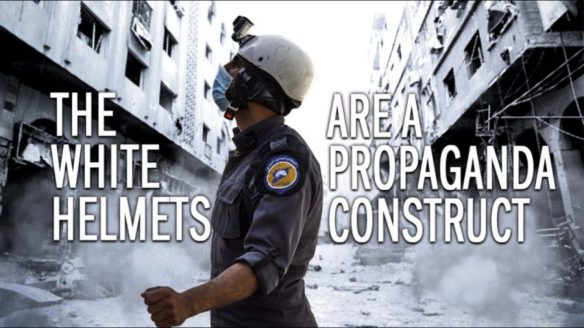
The Veto tracks the evolution of the propaganda campaign waged by Western media against Syria. From Baba Amr in Homs 2011/2012 until the modern day “propaganda construct” – the NATO-member-state funded White Helmets. It honours Russia and China’s vetoes that have consistently defended Syria’s sovereignty and territorial integrity in the UN.

George Orwell said “The most effective way to destroy people is to deny and obliterate their own understanding of their history.” Western media has been tasked with writing the history of the Syrian conflict to serve the aggressors in the US Coalition of terrorism.

As Dr Shaaban also told me:

“The US alliance and its media are focusing on our history, material history, cultural history, identity, our army. Any power that keeps you as an entire state, or any statesman that represents strength or unity will be demonized and destroyed.”

The Veto exposes the criminal intentions of Western media and it archives the progression of the propaganda war waged by the West against Syria. Syrians are writing the history of the Syrian conflict because Syria and her allies have courageously resisted the Imperialist machine.

As Rafiq has said so eloquently “we are the Veto” and we must use it against the Industrial Media Complex in the West. Syria’s history belongs to the Syrians and Syria’s final victory must ensure that Western media is never again given the power to destroy a nation, divide its people and promote international terrorism both military and economic. Watch the film: 

Mueller Report Ends a Shameful Period for the Press

By Chris Hedges

Source: Truthdig

The Mueller report’s categorical statement that Donald Trump and his campaign did not collude with Russia ends one of the most shameful periods in modern American journalism, one that rivals the mindless cheerleading for the Iraq War by most of the press. It further erodes and may prove fatal to the credibility of a press that has steadfastly rendered most of the country invisible and functions as little more than an array of gossiping courtiers to the elites.

“ ‘[T]he investigation did not establish that members of the Trump Campaign conspired or coordinated with the Russian government in its election interference activities,’ ” the report by special counsel Robert Mueller says, according to a direct quotation given in an official letter by U.S. Attorney General William Barr.

The charge that Russia stole the 2016 presidential election, that Vladimir Putin has secret “pee tapes” of Trump cavorting in a Moscow hotel with prostitutes or that Trump has been a longtime “Kremlin agent,” repeated by reporters whose work I admired in the past, is demagoguery as pernicious as the vile taunts and racist tropes that come out of the White House. The press endlessly repeated such allegations while ignoring the expanding social inequality and suffering of a country where half the population lives in poverty, as well as the collapse of our democratic institutions. These facts, not Russian manipulation, saw enraged American voters elect a demagogue who at least belittles the elites, including those in the press, who sold them out. The charge that Trump was a tool of Russia is entertaining. It attracts billions in advertising dollars. It allows the press to posture as a moral crusader. But over the past three years this obsession blotted out most of the real crimes committed by this administration and the reality most Americans endure.

The mainstream press, owned by the corporations that have extinguished the democratic state and are fleecing the public, as well as destroying the ecosystem on which we depend for life, does not hold its employers to account. The empty chatter about Russia, including in The New York Times, exposes the bankruptcy of the U.S. media. MSNBC and CNN, which long ago abandoned journalism for entertainment, have breathlessly clogged the airwaves with ridiculous conspiracy theories and fantasies and used them to justify a faux crusade.

Don’t expect any of this to change. Rachael Maddow, like Jack Tapper or any other fatuous news celebrity, will not be held to account for slogging through this fiction night after night. Maddow will still collect her $10-million-a-year salary. And the handful of reporters who exhibited journalistic integrity—Glenn GreenwaldMatt Taibbi, Aaron Maté, Robert Scheer, Max Blumenthal and Katrina vanden Heuvel—will continue to remain on the margins of the media landscape. The press is an arm of the corporate-funded burlesque that has replaced the country’s political life and turned civic debate into a vast reality show.

The more the big news outlets try to spin this report, arguing that they need to see the full report rather than the attorney general’s summary, or that Jared Kushner sought to use the communications systems of Russian diplomats, the more credibility they will lose. And they do not have much credibility left. The lurid details of the president’s alleged sexual relations with a porn star and a Playboy bunny, and of “Russiagate,” have replaced journalism. These stories have nothing to do with the lives of most Americans. This descent into the inane and the tawdry gives immunity to Trump. In attacking the press he attacks an institution most Americans loath. And with good reason. The press, unwittingly, enhances a president it seeks to destroy. And its decline, accelerated by its collaboration with liberal Democratic elites who scapegoat Russia to avoid confronting their responsibility for trashing the country in the service of corporate oligarchs, will get worse. Little the press says about Trump will now be believed.

There was, of course, massive interference in our election by a foreign power—Israel. But try saying this naked truth out loud and you will suffer the character assassination, chanted by the unified chorus in the press and the political hierarchy of both parties, that was unleashed on Rep. Ilhan Omar. The engine driving our animosity toward Russia comes from the arms industry, which with the expansion of NATO up to Russia’s border—despite assurances given upon the unification of Germany that this would not happen—is making billions of dollars selling weapons to countries in Eastern Europe. The situation is also exacerbating tensions between two of the world’s biggest nuclear powers. But this is just one more suppressed truth.

The Trump administration has carried out policies that, rather than serve Russian interests, have further antagonized our relationship with Moscow. It has imposed sanctions. It is openly attempting to overthrow the government of a country that Russia supports, Venezuela. It is attempting to block the sale of Russian natural gas to Europe. It has sold weapons to Ukraine, a foe of the Kremlin. It has armed insurgents in Syria and carried out airstrikes, even as Russian troops seek to prop up the Syrian regime. It has withdrawn from the Intermediate-Range Nuclear Forces (INF) Treaty. But facts matter little to Russian-conspiracy theorists.

It is not only Trump who has obliterated the line between fact and fiction. It is the press. It hyped and reported allegations it never investigated or confirmed. And by doing this, repeating failures of the kind that appeared in its coverage of the invasion of Iraq, it has committed suicide. A nation that lacks a functioning press becomes a tyranny. This is not Trump’s fault, but our own.

Book Review: The Doomsday Machine

By Alex Cox

Source: Lobster Magazine

Until recently I only knew Daniel Ellsberg as the whistleblower who made the
Pentagon Papers public, and for his peace campaigning over the years. I had
no idea that prior to releasing a trove of documents related to the American
War in Vietnam, Ellsberg had been employed by the US Air Force at the RAND
corporation, as a nuclear war planner.

He had originally intended to reveal his nuclear war materials at the same
time as the Pentagon Papers, even though he knew he might face life
imprisonment for doing so. A bizarre series of events, recounted in The
Doomsday Machine, put them beyond the reach of both the FBI and the author.
There is much in Ellsberg’s book that is bizarre, if not amusing, as he recounts
what he learned about the workings of the nuclear-military-political complex. It
is disconcerting reading.

Ellsberg reveals the officially stated policy – that only the President can
authorise nuclear weapons use – to be a fiction. Based on what he learned
reviewing nuclear armed bases for RAND, there is delegation in the use of
nukes at every level. Local base commanders had discretion – or considered
they had it – to launch their nuclear bombers rather than risk losing them. As
in the film Dr Strangelove, there were envelopes aboard each plane containing
secret nuclear go codes (Strategic Air Command [SAC]’s one-size-fits-all
nuclear launch code was 00000000), but there were no recall orders.

As Ellsburg relates, base commanders and bomber pilots had real
autonomy to use their nukes; yet there was no system in place to stop them,
in the event (for example) of an error of judgment, or a presidential change of
heart. His description of the plans to get nuclear-equipped planes airborne at
US bases in Japan is grimly absurd. Smaller bombers were meant to take off in
neat rows, with other rows of bombers following seconds afterwards. Ellsberg
soon saw the possibility that a single pilot error could cause a catastrophic pileup, and atomic explosions, on the runway. Pilots who made it out, and other
US bases, would see or hear of the explosions and assume that Russian bombs
had landed . . . .

Not that it mattered where the US forces thought the bombs came from.
One of Ellsberg’s assignments was to find areas for flexibility in nuclear
weapons use. When he started working for RAND, the US Air Force had one
plan – SIOP, the Single Integrated Operating Plan – which involved a massive,
concerted nuclear weapons salvo against Russia, China, East Germany, Poland,
Hungary, and the other ‘Iron Curtain’ states. President Kennedy and his
defence chief, Robert McNamara, wanted some other options on the table,
besides instantaneous total destruction of all foreign communists and their
neighbours. Ellsberg tried hard to separate US nuclear war plans against
Russia from US nuclear war plans for China, but it was tough going. The Joint
Chiefs preferred one massive nuclear strike (‘general war’ or ‘central war’) to a
piecemeal one.

All the while, Ellsberg writes, he was morally opposed to the bombing of
cities, with the inevitable unnecessary loss of human life. In a brief aside he
recounts his friendship with Sam Cohen – another RAND specialist who liked to
be thought of as the ‘father of the Neutron Bomb’. 1

SIOP also worried Ellsberg since it was a plan for a first strike: all-out first
use of thousands of nuclear warheads against the Soviet Union and its allies, at
a time when the Russians had merely a handful of working atomic bombs.
RAND and Pentagon estimates of damage from nuclear weapons use never
included fire or firestorms; nor the spread of radiation into allied states; nor
the likely consequences for the climate. The consequences of nuclear weapons
use therefore being vastly underestimated, thousands of additional weapons
were built. In presidential briefings, the Pentagon was confident of prevailing
with a first strike: ‘if worst came to worst . . . a preemptive attack on the
Soviet Union would result in less than ten million deaths in the U.S.’

We now know that even a ‘small’ nuclear war – between India and
Pakistan, say – could have climate impacts which would cause billions of
deaths. ‘General’ or ‘central’ wars would do for just about all of us. Ellsberg
was foiled when he proposed changing US targeting policy so that Moscow
would not be destroyed in a first strike: at a NATO meeting, he was told that
even if SAC agreed to spare Moscow, the French would not. Moscow remained
a prime target for French nukes – and presumably for British ones, as well.

Over time, Ellsberg writes, the Russians and the Americans built a
‘doomsday machine’ very like the one Terry Southern envisaged in his script
for Stanley Kubrick’s Dr Strangelove. To protect them against surprise attack,
American and Russian nuclear weapons are numerous, widely dispersed, on
hair-trigger alert. In case the civilian or military leadership is killed, or unable
to communicate, the duty to launch those weapons has been delegated to
pretty much anyone capable of doing so. If the computers say a nuclear first
strike is incoming, if seismographs report massive, blast-style earth tremors, if contact with the leadership breaks down . . . someone will still be there to
push the button/insert the key code/flip the switch.

Ellsberg considers the bombing of civilians – whatever the weapons used –
to be a terrorist atrocity, not an act of war. He calls the ongoing nuclear
standoff between NATO and Russia a ‘moral catastrophe’. If you’re interested in
how close our silly species has come to wreaking its own imminent demise,
this is a valuable and fascinating book by a committed activist and excellent
writer.


1 I knew Sam Cohen, too, and he considered his Bomb to be a moral weapon, as it killed
fewer people than the Hydrogen Bomb, and left most of the physical infrastructure intact and potentially usable . . . at least once radiation levels dropped. Sam was insane, of course, but most of the people Ellsberg encountered on board the nuclear weapons project appear to have been insane, in the same way.

Alex Cox is a film-maker and writer.
He blogs at <https://alexcoxfilms.wordpress.com>.

RIP INF Treaty: Russia’s Victory, America’s Waterloo

By Dmitry Orlov

Source: Club Orlov

On March 1, 2018 the world learned of Russia’s new weapons systems, said to be based on new physical principles. Addressing the Federal Assembly, Putin explained how they came to be: in 2002 the US withdrew from the Anti-Ballistic Missile Treaty. At the time, the Russians declared that they will be forced to respond, and were basically told “Do whatever you want.”

And so they did, developing new weapons that no anti-ballistic missile system can ever hope to stop. The new Russian weapons include one that is already on combat duty (Kinzhal), one that is being readied for mass production (Avangard) and several that are currently being tested (Poseidon, Burevestnik, Peresvet, Sarmat). Their characteristics, briefly, are as follows:

• Kinzhal: a hypersonic air-launched cruise missile that flies at Mach 10 (7700 miles per hour) and can destroy both ground installations and ships.

• Avangard: a maneuverable hypersonic payload delivery system for intercontinental ballistic missiles that flies at better than Mach 20 (15300 miles per hour). It has a 740-mile range and can carry a nuclear charge of up to 300 kilotons.

• Poseidon: an autonomous nuclear-powered torpedo with unlimited range that can travel at a 3000-foot depth maintaining a little over 100 knots.

• Burevestnik: a nuclear-powered cruise missile that flies at around 270 miles per hour and can stay in the air for 24 hours, giving it a 6000-mile range.

• Peresvet: a mobile laser complex that can blind drones and satellites, knocking out space and aerial reconnaissance systems.

• Sarmat: a new heavy intercontinental missile that can fly arbitrary suborbital courses (such as over the South Pole) and strike arbitrary points anywhere on the planet. Because it does not follow a predictable ballistic trajectory it is impossible to intercept.

The initial Western reaction to this announcement was an eerie silence. A few people tried to convince anyone who would listen that this was all bluff and computer animation, and that these weapons systems did not really exist. (The animation was of rather low quality, one might add, probably because Russian military types couldn’t possibly imagine that slick graphics, such as what the Americans waste their money on, would make Russia any safer.) But eventually the new weapons systems were demonstrated to work and US intelligence services confirmed their existence.

Forced to react, the Americans, with the EU in tow, tried to cause public relations scandals over some unrelated matter. Such attempts are repeated with some frequency. For instance, after the putsch in the Ukraine caused Crimea to go back to Russia there was the avalanche of hysterical bad press about Malaysian Airlines flight MH17, which the Americans had shot down over Ukrainian territory with the help of Ukrainian military.

Similarly, after Putin’s announcement of new weapons systems, there was an eruption of equally breathless hysterics over the alleged “Novichok” poisoning of Sergei Skripal and his daughter. A couple of Russian tourists, if you recall, were accused of poisoning Skripal by smearing some toxic gas on the doorknob of his house some time after he left it never to return. Perhaps such antics made some people feel better, but opposing new, breakthrough weapons systems by generating fake news does not an adequate response make.

Say what you will about the Russian response to the US pulling out of the ABM treaty, but it was adequate. It was made necessary by two well-known facts. First, the US is known for dropping nuclear bombs on other countries (Hiroshima, Nagasaki). It did so not in self-defense but just to send a message to the USSR that resistance would be futile (a dumb move if there ever was one). Second, the US is known to have repeatedly planned to destroy the USSR using a nuclear first strike. It was prevented from carrying it out time and again, first by a shortage of nuclear weapons, then by the development of Soviet nuclear weapons, then by the development of Soviet ICBMs.

Ronald Reagan’s “Star Wars” was an attempt to develop a system that would shoot down enough Soviet ICBMs to make a nuclear first strike on the USSR winnable. This work was terminated when Reagan and Gorbachev signed the Anti-Ballistic Missile Treaty in December, 1987. But then when Bush Jr. pulled out of the ABM treaty in 2002 it was off to the races again. Last year Putin declared that Russia has won: the Americans can now rest assured that if they ever attack Russia the result will be their complete, guaranteed annihilation, and the Russians can rest secure in the knowledge that the US will never dare to attack them.

But that was just the prelude. The real victory happened on February 2, 2019. This day will be remembered as the day when the Russian Federation decisively defeated the United States in the battle for Eurasia—from Lisbon to Vladivostok and from Murmansk to Mumbai.

So, what did the Americans want, and what did they get instead? They wanted to renegotiate the INF treaty, revise some of the terms and expand it to include China. Announcing that the US is suspending the INF treaty, Trump said: “I hope we’re able to get everybody in a big, beautiful room and do a new treaty that would be much better…” By “everybody” Trump probably meant the US, China and Russia.

Why the sudden need to include China? Because China has an entire arsenal of intermediate-range weapons with a range of 500-5500 (the ones outlawed by the INF treaty) pointed at American military bases throughout the region—in South Korea, Japan and Guam. The INF treaty made it impossible for the US to develop anything that could be deployed at these bases to point back at China.

Perhaps it was Trump’s attempt to practice his New York real-estate mogul’s “art of the deal” among nuclear superpowers, or perhaps it’s because imperial hubris has rotted the brains of just about everyone in the US establishment, but the plan for renegotiating the INF treaty was about as stupid as can be imagined:

1. Accuse Russia of violating the INF treaty based on no evidence. Ignore Russia’s efforts to demonstrate that the accusation is false.

2. Announce pull-out of the INF treaty.

3. Wait a while, then announce that the INF treaty is important and essential. Condescendingly forgive Russia and offer to sign a new treaty, but demand that it include China.

4. Wait while Russia convinces China that it should do so.

5. Sign the new treaty in Trump’s “big, beautiful room.”

So, how did it actually go? Russia instantly announced that it is also pulling out of the INF treaty. Putin ordered foreign minister Lavrov to abstain from all negotiations with the Americans in this matter. He then ordered defense minister Shoigu to build land-based platforms for Russia’s new air and ship-based missile systems—without increasing the defense budget. Putin added that these new land-based systems will only be deployed in response to the deployment of US-made intermediate-range weapons. Oh, and China announced that it is not interested in any such negotiations. Now Trump can have his “big, beautiful room” all to himself.

Why did this happen? Because of the INF treaty, for a long time Russia has had a giant gaping hole in its arsenal, specifically in the 500-5500 km range. It had air-launched X-101/102s, and eventually developed the Kalibr cruise missile, but it had rather few aircraft and ships—enough for defense, but not enough to guarantee that it could reliably destroy all of NATO. As a matter of Russia’s national security, given the permanently belligerent stance of the US, it was necessary for NATO to know that in case of a military conflict with Russia it will be completely annihilated, and that no air defense system will ever help them avoid that fate.

If you look at a map, you will find that having weapons in the 500-5500 km range fixes this problem rather nicely. Draw a circle with a 5500 km radius around the Russian enclave of Kaliningrad; note that it encompasses every single NATO country, North Africa and Middle East. The INF treaty was not necessarily a good deal for Russia even when it was first signed (remember, Gorbachev, who signed it, was a traitor) but it became a stupendously bad deal as NATO started to expand east. But Russia couldn’t pull out of it without triggering a confrontation, and it needed time to recover and rearm.

Already in 2004 Putin announced that “Russia needs a breakthrough in order to have a new generation of weapons and technology.” At the time, Americans ignored him, thinking that Russia could fall apart at any moment and that they will be able to enjoy Russian oil, gas, nuclear fuel and other strategic commodities for free forever even as the Russians themselves go extinct. They thought that even if Russia tried to resist, it would be enough to bribe some traitors—like Gorbachev or Yeltsin—and all would be well again.

Fast-forward 15 years, and is that what we have? Russia has rebuilt and rearmed. Its export industries provide for a positive trade balance even in absence of oil and gas exports. It is building three major export pipelines at the same time—to Germany, Turkey and China. It is building nuclear generating capacity around the world and owns a lion’s share of the world’s nuclear industry. The US can no longer keep the lights on without Russian nuclear fuel imports. The US has no new weapons systems with which to counter Russia’s rearmament. Yes, it talks about developing some, but all it has at this point are infinite money sinks and lots of PowerPoint presentations. It no longer has the brains to do the work, or the time, or the money.

Part of Putin’s orders upon pulling out of the INF treaty was to build land-based medium-range hypersonic missiles. That’s a new twist: not only will it be impossible to intercept them, but they will reduce NATO’s remaining time to live, should it ever attack Russia, from minutes to seconds. The new Poseidon nuclear-powered torpedo was mentioned too: even if an attack on Russia succeeds, it will be a Pyrrhic one, since subsequent 100-foot nuclear-triggered tsunamis will wipe clean both coasts of the United States for hundreds of miles inland, effectively reducing the entire country to slightly radioactive wasteland.

Not only has the US lost its ability to attack, it has also lost its ability to threaten. Its main means of projecting force around the world is its navy, and Poseidon reduces it to a useless, slow-moving pile of scrap steel. It would take just a handful of Poseidons quietly shadowing each US aircraft carrier group to zero out the strategic value of the US Navy no matter where in the world it is deployed.

Without the shackles of the INF treaty, Russia will be able to fully neutralize the already obsolete and useless NATO and to absorb all of Europe into its security sphere. European politicians are quite malleable and will soon learn to appreciate the fact that good relations with Russia and China are an asset while any dependence on the US, moving forward, is a huge liability. Many of them already understand which way the wind is blowing.

It won’t be a difficult decision for Europe’s leaders to make. On the one pan of the scale there is the prospect of a peaceful and prosperous Greater Eurasia, from Lisbon to Vladivostok and from Murmansk to Mumbai, safe under Russia’s nuclear umbrella and tied together with China’s One Belt One Road.

On the other pan of the scale there is a certain obscure former colony lost in the wilds of North America, imbued with an unshakeable faith in its own exceptionalism even as it grows ever weaker, more internally conflicted and more chaotic, but still dangerous, though mostly to itself, and run by a bloviating buffoon who can’t tell the difference between a nuclear arms treaty and a real estate deal. It needs to be quietly and peacefully relegated to the outskirts of civilization, and then to the margins of history.

Trump should keep his own company in his “big, beautiful room,” and avoid doing anything anything even more tragically stupid, while saner minds quietly negotiate the terms for an honorable capitulation. The only acceptable exit strategy for the US is to quietly and peacefully surrender its positions around the world, withdraw into its own geographic footprint and refrain from meddling in the affairs of Greater Eurasia.

Saker interview with Michael Hudson on Venezuela, February 7, 2019

By The Saker and Michael Hudson

Source: The Saker

Introduction: There is a great deal of controversy about the true shape of the Venezuelan economy and whether Hugo Chavez’ and Nicholas Maduro’s reform and policies were crucial for the people of Venezuela or whether they were completely misguided and precipitated the current crises.  Anybody and everybody seems to have very strong held views about this.  But I don’t simply because I lack the expertise to have any such opinions.  So I decided to ask one of the most respected independent economists out there, Michael Hudson, for whom I have immense respect and whose analyses (including those he co-authored with Paul Craig Roberts) seem to be the most credible and honest ones you can find.  In fact, Paul Craig Roberts considers Hudson the “best economist in the world“!
I am deeply grateful to Michael for his replies which, I hope, will contribute to a honest and objective understanding of what really is taking place in Venezuela.
The Saker

The Saker: Could you summarize the state of Venezuela’s economy when Chavez came to power?

Michael Hudson: Venezuela was an oil monoculture. Its export revenue was spent largely on importing food and other necessities that it could have produced at home. Its trade was largely with the United States. So despite its oil wealth, it ran up foreign debt.

From the outset, U.S. oil companies have feared that Venezuela might someday use its oil revenues to benefit its overall population instead of letting the U.S. oil industry and its local comprador aristocracy siphon off its wealth. So the oil industry – backed by U.S. diplomacy – held Venezuela hostage in two ways.

First of all, oil refineries were not built in Venezuela, but in Trinidad and in the southern U.S. Gulf Coast states. This enabled U.S. oil companies – or the U.S. Government – to leave Venezuela without a means of “going it alone” and pursuing an independent policy with its oil, as it needed to have this oil refined. It doesn’t help to have oil reserves if you are unable to get this oil refined so as to be usable.

Second, Venezuela’s central bankers were persuaded to pledge their oil reserves and all assets of the state oil sector (including Citgo) as collateral for its foreign debt. This meant that if Venezuela defaulted (or was forced into default by U.S. banks refusing to make timely payment on its foreign debt), bondholders and U.S. oil majors would be in a legal position to take possession of Venezuelan oil assets.

These pro-U.S. policies made Venezuela a typically polarized Latin American oligarchy. Despite being nominally rich in oil revenue, its wealth was concentrated in the hands of a pro-U.S. oligarchy that let its domestic development be steered by the World Bank and IMF. The indigenous population, especially its rural racial minority as well as the urban underclass, was excluded from sharing in the country’s oil wealth. The oligarchy’s arrogant refusal to share the wealth, or even to make Venezuela self-sufficient in essentials, made the election of Hugo Chavez a natural outcome.

The Saker: Could you outline the various reforms and changes introduced by Hugo Chavez? What did he do right, and what did he do wrong?

Michael Hudson: Chavez sought to restore a mixed economy to Venezuela, using its government revenue – mainly from oil, of course – to develop infrastructure and domestic spending on health care, education, employment to raise living standards and productivity for his electoral constituency.

What he was unable to do was to clean up the embezzlement and built-in rake-off of income from the oil sector. And he was unable to stem the capital flight of the oligarchy, taking its wealth and moving it abroad – while running away themselves.

This was not “wrong”. It merely takes a long time to change an economy’s disruption – while the U.S. is using sanctions and “dirty tricks” to stop that process.

The Saker: What are, in your opinion, the causes of the current economic crisis in Venezuela – is it primarily due to mistakes by Chavez and Maduro or is the main cause US sabotage, subversion and sanctions?

Michael Hudson: There is no way that’s Chavez and Maduro could have pursued a pro-Venezuelan policy aimed at achieving economic independence without inciting fury, subversion and sanctions from the United States. American foreign policy remains as focused on oil as it was when it invaded Iraq under Dick Cheney’s regime. U.S. policy is to treat Venezuela as an extension of the U.S. economy, running a trade surplus in oil to spend in the United States or transfer its savings to U.S. banks.

By imposing sanctions that prevent Venezuela from gaining access to its U.S. bank deposits and the assets of its state-owned Citco, the United States is making it impossible for Venezuela to pay its foreign debt. This is forcing it into default, which U.S. diplomats hope to use as an excuse to foreclose on Venezuela’s oil resources and seize its foreign assets much as Paul Singer hedge fund sought to do with Argentina’s foreign assets.

Just as U.S. policy under Kissinger was to make Chile’s “economy scream,” so the U.S. is following the same path against Venezuela. It is using that country as a “demonstration effect” to warn other countries not to act in their self-interest in any way that prevents their economic surplus from being siphoned off by U.S. investors.

The Saker: What in your opinion should Maduro do next (assuming he stays in power and the USA does not overthrow him) to rescue the Venezuelan economy?

Michael Hudson: I cannot think of anything that President Maduro can do that he is not doing. At best, he can seek foreign support – and demonstrate to the world the need for an alternative international financial and economic system.

He already has begun to do this by trying to withdraw Venezuela’s gold from the Bank of England and Federal Reserve. This is turning into “asymmetrical warfare,” threatening what to de-sanctify the dollar standard in international finance. The refusal of England and the United States to grant an elected government control of its foreign assets demonstrates to the entire world that U.S. diplomats and courts alone can and will control foreign countries as an extension of U.S. nationalism.

The price of the U.S. economic attack on Venezuela is thus to fracture the global monetary system. Maduro’s defensive move is showing other countries the need to protect themselves from becoming “another Venezuela” by finding a new safe haven and paying agent for their gold, foreign exchange reserves and foreign debt financing, away from the dollar, sterling and euro areas.

The only way that Maduro can fight successfully is on the institutional level, upping the ante to move “outside the box.” His plan – and of course it is a longer-term plan – is to help catalyze a new international economic order independent of the U.S. dollar standard. It will work in the short run only if the United States believes that it can emerge from this fight as an honest financial broker, honest banking system and supporter of democratically elected regimes. The Trump administration is destroying illusion more thoroughly than any anti-imperialist critic or economic rival could do!

Over the longer run, Maduro also must develop Venezuelan agriculture, along much the same lines that the United States protected and developed its agriculture under the New Deal legislation of the 1930s – rural extension services, rural credit, seed advice, state marketing organizations for crop purchase and supply of mechanization, and the same kind of price supports that the United States has long used to subsidize domestic farm investment to increase productivity.

The Saker: What about the plan to introduce a oil-based crypto currency? Will that be an effective alternative to the dying Venezuelan Bolivar?

Michael Hudson: Only a national government can issue a currency. A “crypto” currency tied to the price of oil would become a hedging vehicle, prone to manipulation and price swings by forward sellers and buyers. A national currency must be based on the ability to tax, and Venezuela’s main tax source is oil revenue, which is being blocked from the United States. So Venezuela’s position is like that of the German mark coming out of its hyperinflation of the early 1920s. The only solution involves balance-of-payments support. It looks like the only such support will come from outside the dollar sphere.

The solution to any hyperinflation must be negotiated diplomatically and be supported by other governments. My history of international trade and financial theory, Trade, Development and Foreign Debt, describes the German reparations problem and how its hyperinflation was solved by the Rentenmark.

Venezuela’s economic-rent tax would fall on oil, and luxury real estate sites, as well as monopoly prices, and on high incomes (mainly financial and monopoly income). This requires a logic to frame such tax and monetary policy. I have tried to explain how to achieve monetary and hence political independence for the past half-century. China is applying such policy most effectively. It is able to do so because it is a large and self-sufficient economy in essentials, running a large enough export surplus to pay for its food imports. Venezuela is in no such position. That is why it is looking to China for support at this time.

The Saker: How much assistance do China, Russia and Iran provide and how much can they do to help? Do you think that these three countries together can help counter-act US sabotage, subversion and sanctions?

Michael Hudson: None of these countries have a current capacity to refine Venezuelan oil. This makes it difficult for them to take payment in Venezuelan oil. Only a long-term supply contract (paid for in advance) would be workable. And even in that case, what would China and Russia do if the United States simply grabbed their property in Venezuela, or refused to let Russia’s oil company take possession of Citco? In that case, the only response would be to seize U.S. investments in their own country as compensation.

At least China and Russia can provide an alternative bank clearing mechanism to SWIFT, so that Venezuela can by pass the U.S. financial system and keep its assets from being grabbed at will by U.S. authorities or bondholders. And of course, they can provide safe-keeping for however much of Venezuela’s gold it can get back from New York and London.

Looking ahead, therefore, China, Russia, Iran and other countries need to set up a new international court to adjudicate the coming diplomatic crisis and its financial and military consequences. Such a court – and its associated international bank as an alternative to the U.S.-controlled IMF and World Bank – needs a clear ideology to frame a set of principles of nationhood and international rights with power to implement and enforce its judgments.

This would confront U.S. financial strategists with a choice: if they continue to treat the IMF, World Bank, ITO and NATO as extensions of increasingly aggressive U.S. foreign policy, they will risk isolating the United States. Europe will have to choose whether to remain a U.S. economic and military satellite, or to throw in its lot with Eurasia.

However, Daniel Yergin reports in the Wall Street Journal (Feb. 7) that China is trying to hedge its bets by opening a back-door negotiation with Guaido’s group, apparently to get the same deal that it has negotiated with Maduro’s government. But any such deal seems unlikely to be honored in practice, given U.S. animosity toward China and Guaido’s total reliance on U.S. covert support.

The Saker: Venezuela kept a lot of its gold in the UK and money in the USA. How could Chavez and Maduro trust these countries or did they not have another choice? Are there viable alternatives to New York and London or are they still the “only game in town” for the world’s central banks?
Michael Hudson: There was never real trust in the Bank of England or Federal Reserve, but it seemed unthinkable that they would refuse to permit an official depositor from withdrawing its own gold. The usual motto is “Trust but verify.” But the unwillingness (or inability) of the Bank of England to verify means that the formerly unthinkable has now arrived: Have these central banks sold this gold forward in the post-London Gold Pool and its successor commodity markets in their attempt to keep down the price so as to maintain the appearance of a solvent U.S. dollar standard.

Paul Craig Roberts has described how this system works. There are forward markets for currencies, stocks and bonds. The Federal Reserve can offer to buy a stock in three months at, say, 10% over the current price. Speculators will by the stock, bidding up the price, so as to take advantage of “the market’s” promise to buy the stock. So by the time three months have passed, the price will have risen. That is largely how the U.S. “Plunge Protection Team” has supported the U.S. stock market.

The system works in reverse to hold down gold prices. The central banks holding gold can get together and offer to sell gold at a low price in three months. “The market” will realize that with low-priced gold being sold, there’s no point in buying more gold and bidding its price up. So the forward-settlement market shapes today’s market.

The question is, have gold buyers (such as the Russian and Chinese government) bought so much gold that the U.S. Fed and the Bank of England have actually had to “make good” on their forward sales, and steadily depleted their gold? In this case, they would have been “living for the moment,” keeping down gold prices for as long as they could, knowing that once the world returns to the pre-1971 gold-exchange standard for intergovernmental balance-of-payments deficits, the U.S. will run out of gold and be unable to maintain its overseas military spending (not to mention its trade deficit and foreign disinvestment in the U.S. stock and bond markets). My book on Super-Imperialism explains why running out of gold forced the Vietnam War to an end. The same logic would apply today to America’s vast network of military bases throughout the world.

Refusal of England and the U.S. to pay Venezuela means that other countries means that foreign official gold reserves can be held hostage to U.S. foreign policy, and even to judgments by U.S. courts to award this gold to foreign creditors or to whoever might bring a lawsuit under U.S. law against these countries.

This hostage-taking now makes it urgent for other countries to develop a viable alternative, especially as the world de-dedollarizes and a gold-exchange standard remains the only way of constraining the military-induced balance of payments deficit of the United States or any other country mounting a military attack. A military empire is very expensive – and gold is a “peaceful” constraint on military-induced payments deficits. (I spell out the details in my Super Imperialism: The Economic Strategy of American Empire (1972), updated in German as Finanzimperium(2017).

The U.S. has overplayed its hand in destroying the foundation of the dollar-centered global financial order. That order has enabled the United States to be “the exceptional nation” able to run balance-of-payments deficits and foreign debt that it has no intention (or ability) to pay, claiming that the dollars thrown off by its foreign military spending “supply” other countries with their central bank reserves (held in the form of loans to the U.S. Treasury – Treasury bonds and bills – to finance the U.S. budget deficit and its military spending, as well as the largely military U.S. balance-of-payments deficit.

Given the fact that the EU is acting as a branch of NATO and the U.S. banking system, that alternative would have to be associated with the Shanghai Cooperation Organization, and the gold would have to be kept in Russia and/or China.

The Saker:  What can other Latin American countries such as Bolivia, Nicaragua, Cuba and, maybe, Uruguay and Mexico do to help Venezuela?

Michael Hudson: The best thing neighboring Latin American countries can do is to join in creating a vehicle to promote de-dollarization and, with it, an international institution to oversee the writedown of debts that are beyond the ability of countries to pay without imposing austerity and thereby destroying their economies.

An alternative also is needed to the World Bank that would make loans in domestic currency, above all to subsidize investment in domestic food production so as to protect the economy against foreign food-sanctions – the equivalent of a military siege to force surrender by imposing famine conditions. This World Bank for Economic Acceleration would put the development of self-reliance for its members first, instead of promoting export competition while loading borrowers down with foreign debt that would make them prone to the kind of financial blackmail that Venezuela is experiencing.

Being a Roman Catholic country, Venezuela might ask for papal support for a debt write-down and an international institution to oversee the ability to pay by debtor countries without imposing austerity, emigration, depopulation and forced privatization of the public domain.

Two international principles are needed. First, no country should be obliged to pay foreign debt in a currency (such as the dollar or its satellites) whose banking system acts to prevents payment.

Second, no country should be obliged to pay foreign debt at the price of losing its domestic autonomy as a state: the right to determine its own foreign policy, to tax and to create its own money, and to be free of having to privatize its public assets to pay foreign creditors. Any such debt is a “bad loan” reflecting the creditor’s own irresponsibility or, even worse, pernicious asset grab in a foreclosure that was the whole point of the loan.

The Saker:  Thank you very much for taking the time to reply to my questions!

“The War on Terrorism” is “Fake”: On the Need for Mass Social Mobilizations and Transformative Changes

By Mark Taliano

Source: GlobalResearch.ca

Myriad agencies, funded by Western governments, foundations, and NATO, continue to erect o barriers to freedoms of thought and expression in the West’s post-democratic, New Fascist, societies.

The totalitarianism implicit in these restrictions means that colonial media is monochromatic, tightly framed, and ubiquitous. There is no “free exchange” of ideas, a necessary foundation of democratic societies. Hence, messaging that promotes wars of aggression, and dysfunctional economic ideologies remains ascendant in the public sphere.

The public is led to believe that never-ending criminal wars and vast outflows of public monies to the military industrial complex are normal and necessary. Similarly, publicly bailed-out, predatory, diseconomies are presented as the only viable economic models.  Socially-oriented, (democratic) political economies, we are told, “do not work”.  The public remains unaware that Empire wages criminal economic and “kinetic”, terrorist-supporting warfare, against societies that seek to determine their own political economies.  Socially-oriented political-economies in countries such as Libya, Iraq, Syria, Nicaragua, Venezuela and on and on, are constantly under attack, and not allowed to thrive. Empire targets these countries criminally, aggressively, and perpetually.

The covert barriers which create bounded, framed restrictions on freedoms of expression create a “chilling effect” that promotes self-censorship, and disappears evidence-based truths which would otherwise counter-balance narratives from media conglomerates, all of which are unduly impacted, and subservient to “establishment” pressures from Big Oil, Banking, Military Industrial Complex, Big Pharmaceutical, and other monopolies.

Thought leaders who step outside of the confines of Establishment narratives are targeted. The University of Sydney’s warrantless suspension of best-selling author and Senior lecturer, Prof. Tim Anderson[1], from his teaching duties, is a case in point. Not only does his suspension create a “chilling effect”, and a culture of academic self-censorship, but it also restricts the amount of evidence-based research that reaches the public arena.

Military/Intelligence fronts, such as the Integrity Initiative[2]– well-funded by state agencies and even NATO[3]– add to the oppression, not only by targeting individuals for smear campaigns, but also by guaranteeing a non-stop flow of war propaganda.

Time and again, policymakers use Private Intelligence Contractors (PICS) as sources of fake intelligence that they wrap around previously planned policies, to give an air of credibility to war propaganda. Have we forgotten already the lies used to justify the West’s supremely criminal destruction of Iraq? All of the post-9/11 wars (and beyond) were sold to gullible domestic populations by means of well-planned strategies of deception.

It is an unequal battle, but the broad-based public must first free itself from foundational war lies if we are to make transformative changes. Foremost amongst these lies is “The War On Terrorism”. The public needs to understand that this War on Terror myth is cover for criminal wars of conquest. Our governments and their agencies support the terrorists. Pretending that the West is fighting ISIS and other terrorists (i.e al Qaeda) prolongs the suffering of its victims, past, present, and future. It is not a war against ISIS. It never was. The West and its allies support all of the terrorists in Syria, (and beyond), including ISIS.

If the public can be disabused of the “War on Terrorism” myth, then it will be ready for mass social unrest and mobilizations for fundamental reforms.  Incremental reforms only bolster Establishment positions by providing illusions of democratic policymaking.

For starters, Canada needs to leave NATO, cut its military budget, end its “neoliberal” diseconomy, instate a socially-oriented economy, and regain its sovereignty and democracy.

Given all of the structural barriers that we face, these goals may never be achieved, but we still “win” when we at least struggle for justice.


Note to readers: please click the share buttons. Forward this article to your email lists. Crosspost on your blog site, internet forums. etc.

Mark Taliano is a Research Associate of the Centre for Research on Globalization (CRG) and the author of Voices from Syria, Global Research Publishers, 2017.

Notes

[1] Prof. Tim Anderson, “STEPHEN GARTON’S OVERREACH: INTELLECTUAL FREEDOM AT THE UNIVERSITY OF SYDNEY.” Avant Garde, 12 December, 2018.( https://avantgarde2009.wordpress.com/2018/12/12/stephen-gartons-overreach-intellectual-freedom-at-the-university-of-sydney/?fbclid=IwAR1MpVAZX-F7LcuwbZvSzHAio1mN-L2BemweI7IVMuBrEGrjRjT-sRSRLpc) Accessed 19 December, 2018.

[2] Mohamed Elmaazi and Max Blumenthal, “Inside The Temple Of Covert Propaganda: The Integrity Initiative And The U.K’s Scandalous Information War.” Gray Zone,17 November, 2018. (https://grayzoneproject.com/2018/12/17/inside-the-temple-of-covert-propaganda-the-integrity-initiative-and-the-uks-scandalous-information-war/) Accessed 19 December, 2018.

[3] George Eliason, “A Crisis in Intelligence: Unthinkable Consequences of Outsourcing U.S. Intel. (Part 3)” Consortium News, 18 February, 2018.( https://consortiumnews.com/2018/02/18/a-crisis-in-intelligence-unthinkable-consequences-of-outsourcing-u-s-intel-part-3/?fbclid=IwAR2DKmAtaSMattb28apQZ-gCJ61stFYP3jem97t93PLm-bSpQLGp-0Z_4No) Accessed 18 February, 2018.