Europe, more than Putin, must shoulder the blame for the energy crisis

The same arrogant, self-righteous posturing from the West that fuelled the Ukraine war is now plunging Europe into recession

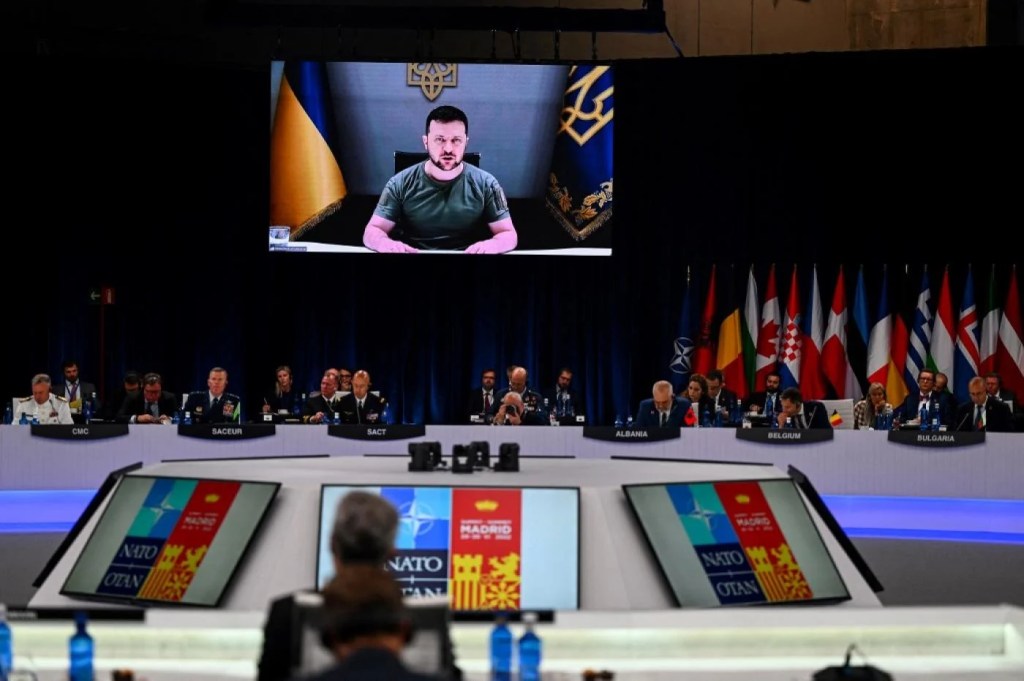
Ukraine’s President Volodymyr Zelensky appears on a giant screen as he addresses a Nato summit in Madrid, 29 June 2022 (AFP)

By Jonathan Cook

Source: Middle East Eye

Outraged western leaders are threatening a price cap on imports of Russian natural gas after Moscow cut supplies to Europe this month, deepening an already dire energy and cost-of-living crisis. In response, Russian President Vladimir Putin has warned that Europe will “freeze” this winter unless there is a change of tack.

In this back-and-forth, the West keeps stepping up the rhetoric. Putin is accused of using a mix of blackmail and economic terror against Europe. His actions supposedly prove once more that he is a monster who cannot be negotiated with, and a threat to world peace.

Denying fuel to Europe as winter approaches, in a bid to weaken the resolve of European states to support Kyiv and alienate European publics from their leaders, is Putin’s opening gambit in a plot to expand his territorial ambitions from Ukraine to the rest of Europe.

Or so runs the all-too-familiar narrative shared by western politicians and media.

In fact, Europe’s arrogant, self-righteous posturing over Russian gas supplies, divorced from any discernible geopolitical reality, reflects precisely the same foolhardy mindset that helped provoke Moscow’s invasion of Ukraine in the first place.

It is also the reason why there has been no exit ramp – a path to negotiations – even as Russia has taken vast swaths of Ukraine’s eastern and southern flanks – territory that cannot be reclaimed without a further massive loss of life on both sides, as the limited Ukrainian assault around Kharkiv has highlighted.

The western media has to carry a major share of the blame for these serial failures of diplomacy. Journalists have amplified only too loudly and uncritically what US and European leaders want their publics to believe is going on. But maybe it is time that Europeans heard a little of how things might look to Russian eyes.

Economic war

The media could start by dropping their indignation at “insolent” Moscow for refusing to supply Europe with gas. After all, Moscow has been only too clear about the reason for the shutdown of gas supplies: it is in retaliation for the West imposing economic sanctions – a form of collective punishment on the wider Russian population that risks violating the laws of war. 

The West is well practised in waging economic war on weak states, usually in a futile attempt to topple leaders they don’t like or as a softening-up exercise before it sends in troops or proxies.

Iran has faced decades of sanctions that have inflicted a devastating toll on its economy and population but done nothing to bring down the government.

Meanwhile, Washington is waging what amounts to its own form of economic terrorism on the Afghan people to punish the ruling Taliban for driving out US occupation forces last year in a humiliating fashion. The United Nations reported last month that sanctions had contributed to the risk of more than a million Afghan children dying from starvation.

There is nothing virtuous about the current economic sanctions on Russia either, any more than there is about the blackballing of Russian sportspeople and cultural icons. The sanctions are not intended to push Putin to the negotiating table. As US President Biden made clear in March, the West is planning for a long war and he wants to see Putin removed from power

Rather, the goal has been to weaken his authority and – in some fantasy scenario – encourage his subordinates to turn on him. The West’s game plan – if it can be dignified with that term – is to force Putin to over-extend Russian forces in Ukraine by flooding the battlefield with armaments, and then watch his government collapse under the weight of popular discontent at home.

But in practice, the reverse has been happening, just as it did through the 1990s when the West imposed sanctions on Iraq’s Saddam Hussein. Putin’s position has been bolstered, as it will continue to be whether Russia is triumphing or losing on the battlefield. 

The West’s economic sanctions against Russia have been doubly foolish. They have reinforced Putin’s message that the West seeks to destroy Russia, just as it previously did IraqAfghanistanLibyaSyria and Yemen. A strongman is all that stands between an independent Russia and servitude, Putin can plausibly argue.

And at the same time, the sanctions have demonstrated to Russians how truly artful their leader is. Economic pressure from the West has largely backfired: sanctions have barely made an impression on the value of the rouble, while Europe looks to be heading into recession as Putin turns off the gas spigot.

It will doubtless not only be Russians quietly rejoicing at seeing the West get a dose of the medicine it so regularly force-feeds others.

Western conceit

But there is a more troubling dimension to the West’s conceit. It was the same high-handed belief that the West would face no consequences for waging economic warfare on Russia, just as earlier assumed it would be pain-free for Nato to station missiles on Moscow’s doorstep. (Presumably, the effect on Ukrainians was not factored into the calculations.)

The decision to recruit ever-more east European states into the Nato fold over the past two decades not only broke promises made to Soviet and Russian leaders, but flew in the face of advice from the West’s most expert policy-makers.

Guided by the US, Nato countries closed the military noose around Russia year by year, all the while claiming that the noose was entirely defensive.

Nato flirted openly with Ukraine, suggesting that it too might be admitted to their anti-Russia alliance.

The US had a hand in the 2014 protests that overthrew Ukraine’s government, one elected to keep channels open with Moscow. 

With a new government installed, the Ukrainian army incorporated ultra-nationalist, anti-Russia militias that engaged in a devastating civil war with Russian communities in the country’s east.

And all the while, Nato secretly cooperated with and trained that same Ukrainian army.

At no point in the eight long years of Ukraine’s civil war did Europe or the US care to imagine how all these events unfolding in Russia’s backyard might look to ordinary Russians. Might they not fear the West just as much as western publics have been encouraged by their media to fear Moscow? Putin did not need to invent their concern. The West achieved that all by itself.

The encirclement of Russia by Nato was not a one-off error. Western meddling in the coup and support for a nationalist Ukrainian army increasingly hostile to Russia were not one-offs either. Nato’s decision to flood Ukraine with weapons rather than concentrate on diplomacy is no aberration. Nor is the decision to impose economic sanctions on ordinary Russians.

These are all of a piece, a pattern of pathological behaviour by the West towards Russia – and any other resource-rich state that does not utterly submit to western control. If the West were an individual, the patient would be diagnosed as suffering from a severe personality disorder, one with a strong impulse for self-destruction.

Bogeyman needed

Worse still, this impulse does not appear to be open to correction – not as things stand. The truth is that Nato and its US ringmaster have no interest in changing.

Their purpose is to have a credible bogeyman, one that justifies continuing the massive wealth redistribution from ordinary citizens to an elite of the already ultra-rich. A supposed threat to Europe’s safety justifies pouring money into the maw of an expanding war machine masquerading as the “defence industries” – the military, the arms manufacturers, and the ever-growing complex of the surveillance, intelligence and security industries. Both Nato and a US network of more than 800 military bases around the globe just keep growing.

A bogeyman also ensures western publics are unified in their fear and hatred of an external enemy, making them readier to defer to their leaders to protect them – and with it, the institutions of power those leaders uphold and the status quo they represent.

Anyone suggesting meaningful reform of that system can be rounded on as a threat to national security, a traitor or a fool, as Britain’s former Labour leader Jeremy Corbyn found out.

And a bogeyman distracts western publics from thinking about deeper threats, ones that our own leaders – rather than foreigners – are responsible for, such as the climate crisis they not only ignored but still fuel through the very military posturing and global confrontations they use to distract us. It is a perfect circle of self-harm.

Since the fall of the Berlin Wall, and the demise of the Soviet Union, the West has been casting around for a useful bogeyman to replace the Soviet Union, one that supposedly presents an existential threat to western civilisation.

Iraq’s weapons of mass distraction were only 45 minutes away – until we learned they did not, in fact, exist.

Afghanistan’s Taliban was harbouring al-Qaeda – until we learned that the Taliban had offered to hand Osama bin Laden over even before the 9/11 attacks.

There was the terrifying threat from the head-choppers of the Islamic State (IS) group – until we learned that they were the West’s arm’s-length allies in Syria and being supplied with weapons from Libya after it was liberated by the West from its dictator, Muammar Gadaffi.

And there is always Iran and its supposed nuclear weapons to worry about, even though Tehran signed an agreement in 2015 putting in place strict international oversight to prevent it from developing a bomb – until the US casually discarded the deal under pressure from Israel and chose not to replace it with anything else.

Braced for recession

Each of these threats was so grave it required an enormous expenditure of energy and treasure, until it had served its purpose of terrifying western publics into acquiescence. Invariably, the West’s meddling spawned a backlash that created another temporary enemy.

Now, like a predictable Hollywood sequel, the Cold War is back with a vengeance. Russia’s President Putin has a starring role. And the military-industrial complex is licking its lips with delight.

Ordinary people and small businesses are being told by European leaders to brace for a recession as energy companies once again clock up “eye-watering” profits.

Just as with the financial crash nearly 15 years ago, when the public was required to tighten its belt through austerity policies, a crisis is providing ideal conditions for wealth to be redistributed upwards.

Like other officials, Nato’s Secretary-General Jens Stoltenberg has sounded the alarm about “civil unrest” this winter as prices across Europe soar, even while demanding public money be used to send yet more weapons to Ukraine.

The question is whether western publics will keep buying the narrative of an existential threat that can only be dealt with if they, rather than their leaders, dig deep into their pockets. 

How America Is Crushing Europe

By Eric Zuesse

Source: Modern Diplomacy

America creates, imposes, and enforces the sanctions against Russia, which are forcing up energy-prices in Europe, and are thereby driving Europe’s corporations to move to America, where taxes, safety-and-environmental regulations, and the rights of labor, are far lower, and so profits will be far higher for the investors. Furthermore, America can supply its own energy. Therefore, supply-chains are less dicey in the U.S. than in Europe. There is less and less reason now for a firm to be doing anything in Europe except selling to Europeans, who are becoming increasingly desperate to get whatever they can afford to buy, now that Russia, which had been providing the lowest-cost energy and other commodities, is being strangled out of European markets, by the sanctions. Money can move even when its owner can’t. The European public will now be left farther and farther behind as Europe’s wealth flees — mainly to America (whose Government had created this capital-flight of Europe’s wealth).

Europe’s leaders have cooperated with America’s leaders, to cause this European decline (by joining, instead of rejecting, America’s sanctions against Russia), but Germany’s companies can also enjoy significant benefits from relocating or expanding in America. Germany’s business daily newspaper, Handlelsblatt, reported, on September 25th, “More and more German companies are expanding their locations in North America: Washington attracts German companies with cheap energy and low taxes. This applies above all to the southern states. Berlin is alarmed – and wants to take countermeasures.” (Original: “Immer mehr deutsche Unternehmen bauen ihre Standorte in Nordamerika aus: Washington lockt deutsche Firmen mit billiger Energie und niedrigen Steuern. Das gilt vor allem für die Südstaaten. Berlin ist alarmiert – und will gegensteuern.”) It says that “Numerous German companies are planning to set up or expand their U.S. locations. … U.S. states such as Virginia, Georgia, and Oklahoma, show increasing interest” in offering special inducements for these firms to relocate, or to at least expand, their production in the U.S. For example, Pat Wilson, Commissioner of the Georgia Department of Economic Development, tells German companies that, “Our energy costs are low, and the networks are stable. … Companies coming to Georgia [from Germany] are reducing their carbon footprint.” Considering that one of the major reasons why Germany’s Government is squeezing-out Russia’s fuel-supplies (other than to ‘support democracy in Ukraine’, etc.) is that those Russian supplies are fossil fuels, an important benefit by which America can attract European firms (even on the basis of ‘Green’ arguments) is by advertising bigger ‘energy efficiency’ than in Europe — not necessarily in a strictly environmental sense, but definitely in the bottom-line sense, of lowered energy-costs, since America’s regulations are far less strict than in the EU. 

Also on the 25th, the Irish Examiner bannered “European industry buckles under weight of soaring energy prices: Volkswagen, Europe’s biggest carmaker, warned last week that it could reallocate production out of Germany and eastern Europe if energy prices don’t come down.”

Also on the 25th, Oil Price dot com headlined “Europe Faces An Exodus Of Energy-Intensive Industries”, and mentioned especially that “the U.S. Steel giant ArcelorMittal said earlier this month that it would slash by half production at a steel mill in Germany and a unit at another plant, also in Germany. The company said it had based the decision on high gas prices. … ArcelorMittal earlier this year announced it had plans to expand a Texas operation.”

On September 26th, the New York Times bannered “Factory Jobs Are Booming Like It’s the 1970s: U.S. manufacturing is experiencing a rebound, with companies adding workers amid high consumer demand for products.” In total, “As of August this year, manufacturers had added back about 1.43 million jobs, a net gain of 67,000 workers above prepandemic levels.” And this is only the start of America’s re-industrialization and economic recovery, because the hemorrhaging of jobs from Europe has only just begun. These German firms are getting in on the ground floor in America, leaving Europe’s workers behind, to swim or sink on their own (the ones that can).

Also on September 26th, Thomas Fazi at unherd dot com headlined “The EU is sleepwalking into anarchy: Its sanctions are crippling the bloc’s working class”, and documented that this hollowing-out of Europe’s economies is being experienced the most by Europe’s lower economic classes, who are the least capable of dealing with it but are being abandoned by the higher-wealth group, the investors, who are sending their money abroad, like banana-republic oligarchs do, and who might easily relocate themselves there too. 

On September 19th, the New York Times headlined “‘Crippling’ Energy Bills Force Europe’s Factories to Go Dark: Manufacturers are furloughing workers and shutting down lines because they can’t pay the gas and electric charges.” For example, a major employer in northern France, Arc International glass factory, doesn’t know whether they will survive: “Nicholas Hodler, the chief executive, surveyed the assembly line, shimmering blue with natural gas flames [gas that came from Russia and that now costs ten times as much as just a year ago]. For years, Arc had been powered by cheap energy that helped turn the company into the world’s largest producer of glass tableware. … But the impact of Russia’s abrupt cutoff of gas to Europe [forced by the sanctions] has doused the business with new risks. Energy prices have climbed so fast that Mr. Hodler has had to rewrite business forecasts six times in two months. Recently, he put a third of Arc’s 4,500 employees on partial furlough to save money. Four of the factory’s nine furnaces will be idled; the others will be switched from natural gas to diesel, a cheaper but more polluting fuel.” The “Green” Parties throughout Europe, such as in the persons of Germany’s Foreign Minister Annalena Baerbock, and Germany’s Minister for Economic Affairs and Climate Action Robert Habeck, had led the European movement against importing Russian fuels, and could turn out to have led Europe actually to increase its carbon footprint, if the end result turns out to be to switch to more coal and diesel fuels, as they now are doing.

It could not have happened without the leaderships both in America and in Europe, who are leading the way for Europe’s economies to decline, and for America’s to boom from this — attracting more and more investors, and their investments, into America, from the U.S. regime’s vassal-nations (such as Germany and France), especially in the EU and NATO (these new banana-republics). The beneficiaries of all this are not only America’s weapons-manufacturing firms, such as Lockheed Martin, and extraction firms such as ExxonMobil, that are growing because of the plunge in Europe that’s due to Europe’s cutting itself off from the cheap energy that it had formerly enjoyed. The future is opening up again, for investors in the United States. It’s come-one, come-all, to investors from Europe, and leaving everyone else in Europe simply to sink, if they can’t get out. 

AMERICA’s GRAND MASTERS CHECKMATE THE BALTIC SEA

The net result of these terrorist attacks is to render obsolete German popular demands to open Nord Stream 2, Declan Hayes writes.

By Declan Hayes

Source: The 21st Century

The CIA’s terrorist attack off the Danish coast on the Nord Stream pipelines Germany depends on may best be understood through the prism of Zbigniew Brzezinski‘s The Grand Chessboard: American Primacy and Its Geostrategic Imperatives, America’s game plan to control the world and rid it of competitors

First off, there can be no doubt that Joe Biden’s America is the culprit.

Not only had the USA the most to gain by this terrorist act which only a handful of militaries could have pulled off but, as Tucker Carlson shows, both Victoria Fuck the EU Nuland and Joe Biden himself had each earlier promised to decommission these pipelines by any necessary means and, as the same clip shows, these terrorist acts are part and parcel of America’s green energy policies, which Greta Thunberg, Extinction Rebellion and a host of other American assets have long promulgated.

The net result of these terrorist attacks is to render obsolete German popular demands to open Nord Stream 2 as both pipelines are now out of service for the foreseeable future.

Good news for the new Norwegian-Polish pipeline which opened on the same day the Americans blew up Nord Stream but bad news for German industry, which is relocating to the United States to survive these never ending below the belt blows to their viability.

Good news also for MEP Radek Sikorski and America’s other clowns who run Poland and who, like the American cat’s paw that they are, now believe themselves to be the king makers as to which West European countries will get oil and from whom.

And that is at the heart of Poland’s EU problem.

Because it has a large population, it demands to be an EU heavyweight, much as Germany and France are, rather than being the American lapdog that it currently is in this and all other matters.

The Jack Russell Baltic countries are likewise schizophrenic: fond as these Jack Russells may be of barking and sniping, they are, at day’s end, little mutts of no great consequence.

The same is increasingly becoming the case with Germany, which is allowing herself to be pulled like a rag doll hither and thither by the United States and her agents, who have holed the bedrocks of a stable currency and low inflation, upon which post-war German prosperity was built.

Back in saner days, German leaders like Angela Merkel commanded respect.

Bolstered by cheap Russian energy and her own technological, logistical and industrial relations genius, Germany was not only the beating economic heart of the European Union but was very much a major global player as well.

Now, Germany’s erstwhile leaders kowtow to Ursula von der Leyen and America’s other unelectable EU puppet assets.

Whilst trying to compete with the rising Chinese behemoth, Germany finds herself betrayed at every turn, most especially by her American overseer, who covets not only Germany’s export markets but her domestic ones as well.

Given that Germany’s major producer of toilet paper has folded, it seems Germany will be importing toilet paper as well as other “luxury goods” from the United States this winter.

Germany is really in dire straits.

And Germany’s shortage of toilet paper is at the heart of the matter.

Whereas Germany and the Netherlands are on their knees, the American economy is booming, at least until the mid term elections are over.

Without the CIA’s systematic destruction of the German and allied economies, it is quite likely that would not be the case and Biden’s war mongering Democrats would be annihilated in the November elections.

However, thanks to the self immolation of the German and British economies, that will not be the case and Biden’s cronies will be able to make some sort of argument that they kept the Good Ship America afloat.

And, should Biden prevail, Extinction Rebellion, Greta Thunberg, Ursula von der Leyen and those others who capsized the German economy should take their share of the credit.

As, perhaps, should those of us who vote for political parties that collude with Uncle Sam and thereby collude with Brzezinski’s blueprint for American hegemony.

Brzezinski’s basic thesis is that the United States must micro manage the conflicts and relationships it instigates in Europe, Asia, and the Middle East so that no rival superpower can arise to threaten the benefits that accrue to America by exploiting those regions.

It is within Brzezinski’s framework that American terrorism in Denmark, Armenia, Iraq, Ukraine and Syria all congeal into the one over riding thesis that America’s desire for hegemony is at the root of all our ills and Hollywood’s corresponding antithesis that America is a beacon of goodwill, democracy and all the other puerile garbage NATO’s studios churn out.

But it also helps to explain NATO’s phantom fears of red-green brown and similarly multi-colored alliances, where the far right, the far left and disaffected Muslims would unite to give them and their thieving ways the heave ho.

NATO, Joe Biden and Ursula von der Leyen fear no such thing.

What they do fear is a strong sovereign people, an alliance of Dutch or German citizens who would demand, as the French demanded in 1789, that these parasites and the self-serving political system they have cocooned themselves in get off their backs once and for all.

Now, though I don’t believe that the Germans are suddenly going to storm their equivalent of the Bastille, I would hope and even pray that Germany’s industrial, financial and labor leaders would lead Europe in calling time on Biden, von der Leyen and all their cronies who insist that we emulate Australian school children and eat crickets to save the environment, whilst Joe and Hunter Biden cause massive environmental havoc in the Baltic Sea, as well as in Ukraine, Yemen, Syria, Iraq, Libya, Armenia and the countless other sovereign nations they have destroyed.

Whodunnit? – Facts Related to The Sabotage Attack On The Nord Stream Pipelines

Source: Moon of Alabama

For decades the U.S. opposed European projects to receive energy from Russia. It wants Europe to buy more expensive U.S. oil and gas.

the Lemniscat @theLemniscat – 15:56 UTC · Sep 27, 2022

US plan was always to stop EU buying Russia’s gas
2014
Rice:”You want to change the structure of energy dependence. You want to depend more on the North America energy platform … to have pipelines that don’t go through Ukraine & Russia”
https://youtube.com/watch?v=aF0uYIjaTNE

Europe’s, and especially Germany’s industry, depends on cheap energy from Russia. Without it Europe will be de-industrialized and go broke.

The U.S. had threatened to disable the pipelines connecting Europe to Russia.

ABC News @ABC – 9:59pm · 7 Feb 2022

Pres. Biden: “If Russia invades…then there will be no longer a Nord Stream 2. We will bring an end to it.”
Reporter: “But how will you do that, exactly, since…the project is in Germany’s control?”
Biden: “I promise you, we will be able to do that.”
abcn.ws/3B5SScx

Currently the U.S. is winning its war on Europe’s, mainly Germany’s, industries and people. Yesterday’s sabotage attack on the Nord Stream I and II pipelines, which are supposed to bring Russian natural gas to Germany, mean that the the war on Germany has entered its hot phase.

A question remains: Whodunnit?

Russia has no motive to destroy the pipelines it owns. These are valuable, long term assets and the gas that escaped from them yesterday was on its own worth some $600 to $800 million.

A pipeline that could be turned off and on again was a leverage point for Russia that gave it some negotiation power. A destroyed pipeline gives Russia no leverage. This is truly elementary. One can not spin that away.

During the war in Ukraine Russia has not stopped to deliver gas to Europe as contractually agreed. Instead European countries, Poland, Ukraine and Germany have blocked overland and sub sea pipelines that brought gas to Germany.

German people have protested against the U.S. ordered shut down of the Nord Stream II pipeline. (Nord Stream I was recently offline because Siemens was prevented by sanctions from maintaining its compressor turbines.)

RadioGenova @RadioGenova – 18:02 UTC · Sep 26, 2022

Thousands of people in Gera in Germany against Olaf Scholz’s policy and the explosion of energy and gas prices. They demand an end to sanctions on Russia and the reopening of the Nord Stream 2 gas pipeline. Demonstrations also in other German cities but EU media censors them.
Embedded video

A day after the protests the pipelines were sabotaged:

AZ @AZmilitary1 – 12:51 UTC · Sep 27, 2022

HERE IT IS
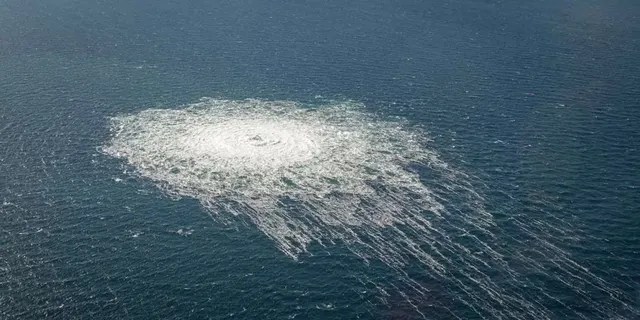
Footage from the site of a gas leak on the underwater section of the Nord Stream.
The video was published by the Danish military.
Earlier, the Kremlin said that it was most likely about sabotage.
The same opinion was expressed in the German government.
Embedded video

Yesterday’s attack on the Nord Stream system is not unprecedented:

professional hog groomer @bidetmarxman – 15:51 UTC · Sep 27, 2022

In 2015, the annual routine underwater survey of the Nord Stream 1 pipelines came across a remote operated vehicle rigged with explosives right next to one of the lines in Swedish waters.
The umbilical cable had been cut. The drone’s national origin was never disclosed. 🧵

In 2015 Pipeline Journal reported:

[T]he Swedish military has successfully cleared a remote operated vehicle (drone) rigged with explosives found near Line 2 of the Nord Stream Natural Gas offshore pipeline system.

The vehicle was discovered during a routine survey operation as part of the annual integrity assessment of the Nord Stream pipeline. Since it was within the Swedish Exclusive Economic Zone (EEZ) approximately 120 km away from the island of Gotland, the Swedes called on their armed forces to remove and ultimately disarm the object.

The national identity of the drone has not been verified so far, as many countries use Unmanned Underwater Vehicles (UUVs) of a similar construction, [Jesper Stolpe, Swedish Armed Forces spokesman,] said.

To destroy a sub sea pipeline requires more than a ROV/drone delivered shaped charge.

Javier Blas @JavierBlas – 15:18 UTC · Sep 27, 2022

How strong is a Nord Stream pipe? Quite!
The steel pipe itself has a wall of 4.1 centimeters (1.6 inches), and it’s coated with another 6-11 cm of steel-reinforced concrete. Each section of the pipe weighs 11 tonnes, which goes to 24-25 tonnes after the concrete is applied.

It wasn’t earthquakes that destroyed the pipelines. These were several well targeted and massive explosions:

A Swedish seismologist said on Tuesday he was certain the seismic activity detected at the site of the Nord Stream pipeline gas leaks in the Baltic Sea was caused by explosions and not earthquakes nor landslides.

Bjorn Lund, seismologist at the Swedish National Seismic Network at Uppsala University, said seismic data gathered by him and Nordic colleagues showed that the explosions took place in the water and not in the rock under the seabed.

The targeted explosions were not small:

Dagny Taggart @DagnyTaggart963 – 15:56 UTC · Sep 27, 2022

Swedish seismologists from Lund University noted that “at least 100 kg of TNT (perhaps more) were used to destroy the pipelines.”

Here is where the pipelines were hit:

The Baltic Sea is controlled by NATO. This from June 2022:

“BALTOPS, with the high degree of complexity, tested our collective readiness and adaptability, while also highlighting the strength of our Alliance and resolve in providing a maritime domain with freedom of navigation for all,” said Vice Adm. Gene Black, commander, U.S. Sixth Fleet and Naval Striking and Support Forces NATO (STRIKFORNATO).

Led by U.S. Sixth Fleet, BALTOPS 22 was command and controlled by STRIKFORNATO. From the staff’s headquarters in Oeiras, Portugal, Rear Adm. James Morley, STRIKFORNATO deputy commander, was responsible for ensuring participants met all training objectives.

[Rear Adm. John Menoni, commander, Expeditionary Strike Group Two,] also noted several instances in which forces stepped beyond know warfare methods to push limits with new technologies at sea and ashore. “Whether it was mine-hunting UUVs, persistent Intelligence, Surveillance, and Reconnaissance from an observable UAV, or demonstrating the value of the emerging Marine Corps concept of Expeditionary Advance Base Operations (EABO), our men and women continue to develop the tactics, techniques, and procedures that ultimately make meaningful contributions to Maritime Domain Awareness and increase the lethality of our forces.”

At sea, ships fine-tuned tactical maneuvering, anti-submarine warfare, live-fire training, mine countermeasures operations, and replenishments at sea. The Swedish submarine participating in the exercise, the U.K.’s Daring-class air-defense destroyer HMS Defender (D 36), and aircraft from other participating nations trained in anti-submarine warfare. Meanwhile, mine operations served as an ideal area of focus for testing new technology.

Scientists from five nations brought the latest advancements in Unmanned Underwater Vehicle (UUV) mine hunting technology to the Baltic Sea to demonstrate the vehicle’s effectiveness in operational scenariosThe BALTOPS Mine Counter Measure Task Group ventured throughout the Baltic region practicing ordnance location, exploitation, and disarming in critical maritime chokepoints.

While the Baltops 22 maneuver already took place in June and July of this year the U.S. Sixth Fleet left the Baltic Sea only a few days ago (in German, my translation):

Big Fleet Group From U.S. Navy Passes [German island passage] Fehmanbelt

On Wednesday morning the amphibious assault ship USS Kearsarge, escorted by the Landing Ships USS Arlington and USS Gunston Hall, was en route towards west. Previously, the ships were part of US units that took part in NATO maneuvers and called at numerous ports in Germany, Scandinavia and the Baltic States.

The “USS Kearsarge”, flagship of the association and largest warship of the US Navy, which was in action in the Baltic Sea in the last 30 years, has 40 helicopters and fighter planes as well as more than 2000 soldiers on board, the escort ships about 1000. For the around 4,000 soldiers are heading back home on the east coast of the US after their six-month deployment.

Parts of the Kearsange operations in the Baltic Sea were dedicated to test special sub sea mine destruction technologies:

A significant focus of BALTOPS every year is the demonstration of NATO mine hunting capabilities, and this year the U.S. Navy continues to use the exercise as an opportunity to test emerging technology, U.S. Naval Forces Europe-Africa Public Affairs said June 14.

In support of BALTOPS, U.S. Navy 6th Fleet partnered with U.S. Navy research and warfare centers to bring the latest advancements in unmanned underwater vehicle mine hunting technology to the Baltic Sea to demonstrate the vehicle’s effectiveness in operational scenarios.

Experimentation was conducted off the coast of Bornholm, Denmark, with participants from Naval Information Warfare Center Pacific, Naval Undersea Warfare Center Newport, and Mine Warfare Readiness and Effectiveness Measuring all under the direction of U.S. 6th Fleet Task Force 68.

Off the coast of Bornholm, Denmark, is where the pipelines were hit. Just days ago the USS Kearsarge was in that area:

AZ @AZmilitary1 – 13:52 UTC · Sep 27, 2022

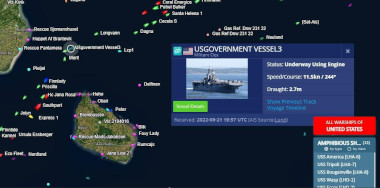
An expeditionary detachment of US Navy ships led by the universal amphibious assault ship USS Kearsarge days ago was in the Baltic Sea
It was 30 km from the site of the alleged sabotage on the Nord Stream-1 gas pipeline and 50 km from the threads of Nord Stream-2 gas pipeline

AZ @AZmilitary1 – 14:12 UTC · Sep 27, 2022

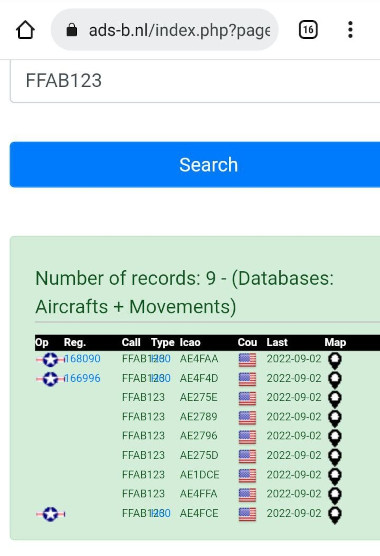
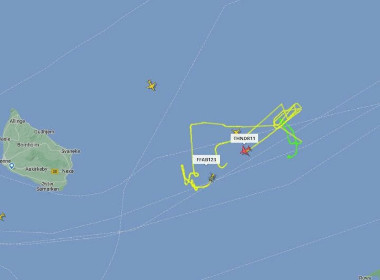
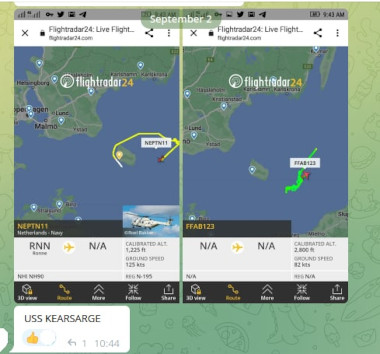
On September 2, interesting maneuvers performed by an American helicopter with the call sign FFAB123. Then it was assumed that this board was from the USS Kearsarge air wing, and today more details were looked.

According to the website ads-b.nl , this call sign was used by 6 boards that day, of which we managed to establish the side numbers of three. All of them are Sikorsky MH-60S.

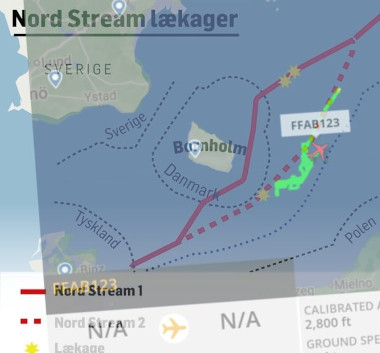
By superimposing the FFAB123 route on the scheme of yesterday’s accident, we get a rather interesting result — the helicopter either flew along the Nord Stream-2 highway, or even between the points where the accident occurred.

On Twitter, meanwhile, there were screenshots of other flights of American aviation — the following screenshot was taken on September 13.

The MH-60S carries big electromagnetic sensors which allows it to detect submarines, mines and – in the shallow waters of the Baltic Sea –  sub sea pipelines.

This overlay picture of two others posted above is especially of interest:

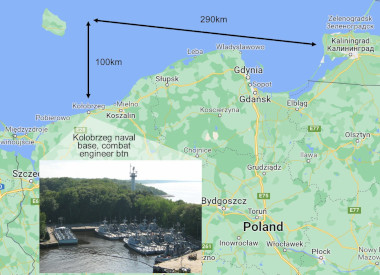
The U.S. military is not the only force that was near the area of the pipeline damage. Just a 100 kilometer south is the Polish naval base Kolobrzeg (the former German Kolberg) which harbors mine laying ships and the 8th Kołobrzeg Naval Combat Engineer Battalion. Naval combat engineers are experts in blowing up anything that is under water, be it mines or pipelines.

In 2021, while Nord Stream 2 was still being build, the Polish navy had interfered and endangered the pipe laying vessels in the very same place.

Artifaktus @bzyqer – 7:49 UTC · Sep 28, 2022

Gdy Wy mycie zęby, przebieracie się w piżamy i szykujecie do snu, jeden niestrudzony Polak wyrusza w swoją łodzią w kierunku Bornholmu mając na sercu dobro Polski a może i Niemiec …

Translated from Polish by Google
When you brush your teeth, put on your pajamas and get ready to go to sleep, one tireless Pole sets off in his boat towards Bornholm with the good of Poland and maybe Germany at heart …
Image

During the recent Ukraine crisis Poland has rejected to receive Russian gas. It closed the Yamal pipeline that transports natural gas from Russia to Germany. Poland continued to consume Russia gas. It received it from Germany which had received it through the Nord Stream I pipeline from Russia.

Poland and Denmark have build a new sub sea pipeline which connects it to the pipeline that brings Norwegian gas to the Netherlands and Europe.

The pipeline was opened yesterday, the very same day the Nord Stream system was sabotaged.

Chancellery of the Prime Minister of Poland @PremierRP_en – 11:25 UTC · Sep 27, 2022

🇵🇱🤝🇩🇰 The #BalticPipe is a joint Polish-Danish investment in the energy security of the region.
Image

Chancellery of the Prime Minister of Poland @PremierRP_en – 13:43 UTC · Sep 27, 2022

🎥The launching ceremony of the #BalticPipe gas pipeline with participation of PM @MorawieckiM , PM of Denmark Mette Frederiksen & @prezydentpl @AndrzejDuda.
The Baltic Pipe is a strategic infrastructure project aimed at creating a new gas supply corridor on the European market.
Video

The Baltic Pipe has a capacity of only 10 billion cubic meters per year. The Nord Stream system could carry up to 110 cubic meter per year. All of which is needed to keep Europe’s industries running.

For more on Poland’s involvement, likely in cooperation with the U.S., read these informed speculations by John Helmer:

The explosions at Bornholm are the new Polish strike for war in Europe against Chancellor Olaf Scholz. So far the Chancellery in Berlin is silent, tellingly.

The Poles should be reminded that other countries also have the capabilities to sabotage sub sea pipelines.

Radosław Sikorski is a former Minister of Defense and Foreign Minister of Poland. He is now a Member of the European Parliament. Yesterday he posted a picture of the gas escaping the damaged Nord Stream pipelines and thanked the U.S. for blowing them up.

Sikorski is married to the neoconservative writer Anne Appelbaum who is notorious for her anti-Russian and anti-German screeds widely published in U.S. media.

In 2014 during the Maidan coup in Ukraine another notorious neoconservative, Assistant Secretary of State Victoria Nuland, told the U.S. ambassador to Ukraine, Geoffrey Pyatt, who should become the new prime minister of the Ukraine. She famously expressed her opinion about European concerns: “Fuck the EU” Nuland said. She is currently the U.S. Under Secretary of State for Political Affairs.

Over the last decades Germany has financed the Euro zone with up to 1.24 trillion Euros. (See also this thread). This was possible because Germany was exporting lots of industrial products and had a yearly surplus from its trade. With Germany’s industry going down because a lack of cheap energy that surplus will vanish. Europe, all of it, will become a poor continent.

Philip Pilkington @philippilk – 21:23 UTC · Sep 27, 2022

9/ The European energy war will likely go down in history, together with the Treaty of Versailles and the trade wars of the 1930s, as one of the biggest economic policy errors in history.

10/ Another thing: when Trump was elected on a platform of milder protectionism, many people rightly pointed to the 1920s and 1930s and warned against these policies. These same people appear to have supported these much more 1920s/30s-like policies this past year. Ironic.

This does not happen by chance or fate. It is part of a long term neoconservative plan for continued U.S. supremacy over the world. The Anglo-American axis is the only party to benefit from the recent events.

The U.S. allegedly warned Germany of sabotage of the Nord Stream system (in German).

This reminds of President Joe Biden’s warning of a Russian invasion in Ukraine early this year.

It is easy to predict such events when you are the one who intends to cause them.

The U.S. knew that the Ukraine was going to launch an attack on the Donbas republics. The U.S. knew that Russia would intervene to help its brethren. Russia had said so. The Ukrainian attack started with artillery preparations on February 17. Russia intervened on February 24.

The above is a collection of the currently available facts. You can draw your own conclusions from them.

Silencing the Lambs — How Propaganda Works

Leni Riefenstahl said her epic films glorifying the Nazis depended on a “submissive void” in the German public. This is how propaganda is done.

By John Pilger

Source: Consortium News

In the 1970s, I met one of Hitler’s leading propagandists, Leni Riefenstahl, whose epic films glorified the Nazis. We happened to be staying at the same lodge in Kenya, where she was on a photography assignment, having escaped the fate of other friends of the Fuhrer.
She told me that the “patriotic messages” of her films were dependent not on “orders from above” but on what she called the “submissive void” of the German public.

Did that include the liberal, educated bourgeoisie? I asked.  “Yes, especially them,” she said. 

I think of this as I look around at the propaganda now consuming Western societies. 

Of course, we are very different from Germany in the 1930s. We live in information societies. We are globalists. We have never been more aware, more in touch, better connected. 

Or do we in the West live in a Media Society where brainwashing is insidious and relentless, and perception is filtered according to the needs and lies of state and corporate power? 

The United States dominates the Western world’s media. All but one of the top 10 media companies are based in North America. The internet and social media – Google, Twitter, Facebook – are mostly American owned and controlled.

In my lifetime, the United States has overthrown or attempted to overthrow more than 50 governments, mostly democracies. It has interfered in democratic elections in 30 countries. It has dropped bombs on the people of 30 countries, most of them poor and defenceless. It has attempted to murder the leaders of 50 countries.  It has fought to suppress liberation movements in 20 countries. 

The extent and scale of this carnage is largely unreported, unrecognised, and those responsible continue to dominate Anglo-American political life.

Harold Pinter Broke the Silence

In the years before he died in 2008, the playwright Harold Pinter made two extraordinary speeches, which broke a silence.

“U.S. foreign policy,” he said, is

“best defined as follows: kiss my arse or I’ll kick your head in. It is as simple and as crude as that. What is interesting about it is that it’s so incredibly successful. It possesses the structures of disinformation, use of rhetoric, distortion of language, which are very persuasive, but are actually a pack of lies. It is very successful propaganda. They have the money, they have the technology, they have all the means to get away with it, and they do.”

In accepting the Nobel Prize for Literature, Pinter said this: 

“The crimes of the United States have been systematic, constant, vicious, remorseless, but very few people have actually talked about them. You have to hand it to America. It has exercised a quite clinical manipulation of power worldwide while masquerading as a force for universal good. It’s a brilliant, even witty, highly successful act of hypnosis.”

Pinter was a friend of mine and possibly the last great political sage – that is, before dissenting politics were gentrified. I asked him if the “hypnosis” he referred to was the “submissive void” described by Leni Riefenstahl. 

“It’s the same,” he replied. “It means the brainwashing is so thorough we are programmed to swallow a pack of lies. If we don’t recognise propaganda, we may accept it as normal and believe it. That’s the submissive void.”

In our systems of corporate democracy, war is an economic necessity, the perfect marriage of public subsidy and private profit: socialism for the rich, capitalism for the poor. The day after 9/11 the stock prices of the war industry soared. More bloodshed was coming, which is great for business.

Today, the most profitable wars have their own brand. They are called “forever wars” — Afghanistan, Palestine, Iraq, Libya, Yemen and now Ukraine. All are based on a pack of lies.

Iraq is the most infamous, with its weapons of mass destruction that didn’t exist. NATO’s destruction of Libya in 2011 was justified by a massacre in Benghazi that didn’t happen. Afghanistan was a convenient revenge war for 9/11, which had nothing to do with the people of Afghanistan. 

Today, the news from Afghanistan is how evil the Taliban are —not that U.S. President Joe Biden’s theft of $7 billion of the country’s bank reserves is causing widespread suffering. Recently, National Public Radio in Washington devoted two hours to Afghanistan — and 30 seconds to its starving people.

At its summit in Madrid in June, NATO, which is controlled by the United States, adopted a strategy document that militarises the European continent, and escalates the prospect of war with Russia and China. It proposes “multi domain warfighting against nuclear-armed peer-competitor.” In other words, nuclear war.

It says: “NATO’s enlargement has been an historic success.” 

I read that in disbelief. 

The news from the war in Ukraine is mostly not news, but a one-sided litany of jingoism, distortion, omission.  I have reported a number of wars and have never known such blanket propaganda. 

In February, Russia invaded Ukraine as a response to almost eight years of killing and criminal destruction in the Russian-speaking region of Donbass on their border. 

In 2014, the United States had sponsored a coup in Kiev that got rid of Ukraine’s democratically elected, Russian-friendly president and installed a successor whom the Americans made clear was their man. 

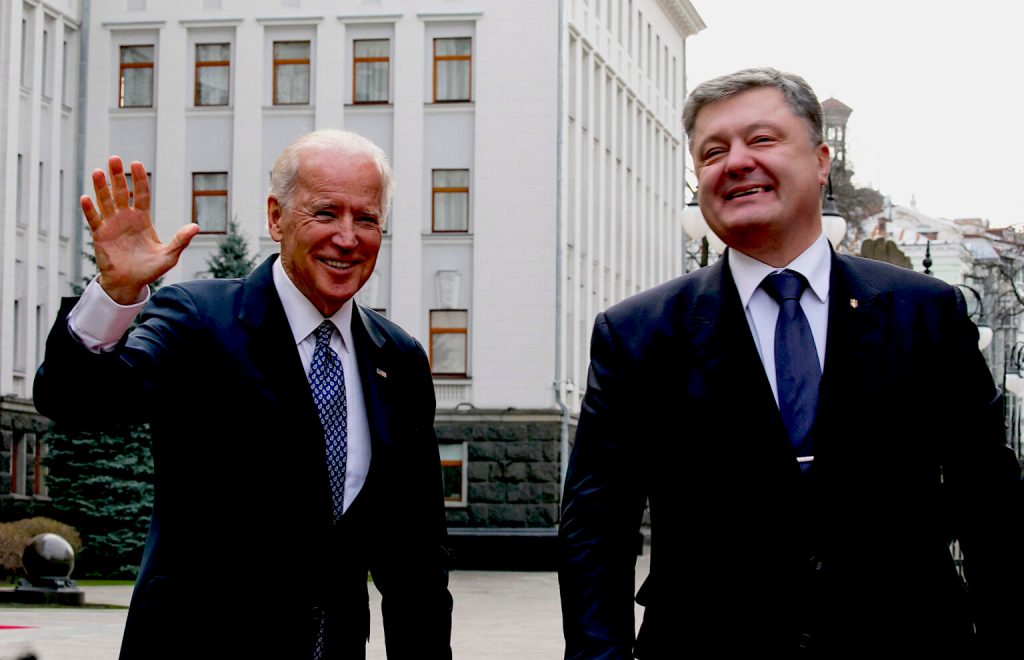
Dec. 7, 2015: U.S. Vice President Joe Biden meets with Ukrainian President Petro Poroshenko in Kiev. (U.S. Embassy Kyiv, Flickr)

In recent years, American “defender” missiles have been installed in eastern Europe, Poland, Slovenia, the Czech Republic, almost certainly aimed at Russia, accompanied by false assurances all the way back to James Baker’s “promise” to Soviet leader Mikhail Gorbachev in February 1990 that NATO would never expand beyond Germany. 

NATO on Hitler’s Borderline

Ukraine is the frontline. NATO has effectively reached the very borderland through which Hitler’s army stormed in 1941, leaving more than 23 million dead in the Soviet Union. 

Last December, Russia proposed a far-reaching security plan for Europe. This was dismissed, derided or suppressed in the Western media. Who read its step-by-step proposals? On Feb. 24, President Volodymyr Zelensky threatened to develop nuclear weapons unless America armed and protected Ukraine.  

[Related: John Pilger: War in Europe & the Rise of Raw Propaganda]

On the same day, Russia invaded — an unprovoked act of congenital infamy, according to the Western media. The history, the lies, the peace proposals, the solemn agreements on Donbass at Minsk counted for nothing. 

On April 25, U.S. Defense Secretary Lloyd Austin flew into Kiev and confirmed that America’s aim was to destroy the Russian Federation — the word he used was “weaken.” America had got the war it wanted, waged by an American bankrolled and armed proxy and expendable pawn.

Almost none of this was explained to Western audiences.

[Read:  Joe Lauria: Biden Confirms Why the US Needed This War]

Russia’s invasion of Ukraine is wanton and inexcusable. It is a crime to invade a sovereign country. There are no “buts” — except one.

When did the present war in Ukraine begin and who started it? According to the United Nations, between 2014 and this year, some 14,000 people have been killed in the Kiev regime’s civil war on the Donbass. Many of the attacks were carried out by neo-Nazis. 

Watch an ITV news report from May 2014, by the veteran reporter James Mates, who is shelled, along with civilians in the city of Mariupol, by Ukraine’s Azov (neo-Nazi) battalion.

In the same month, dozens of Russian-speaking people were burned alive or suffocated in a trade union building in Odessa besieged by fascist thugs, the followers of the Nazi collaborator and anti-Semitic fanatic Stepan Bandera.  The New York Times called the thugs “nationalists.”

“The historic mission of our nation in this critical moment,” said Andreiy Biletsky, founder of the Azov Battaltion, “is to lead the White Races of the world in a final crusade for their survival, a crusade against the Semite-led Untermenschen.”

Since February, a campaign of self-appointed “news monitors” (mostly funded by the Americans and British with links to governments) have sought to maintain the absurdity that Ukraine’s neo-Nazis don’t exist. 

Airbrushing, once associated with Stalin’s purges, has become a tool of mainstream journalism.

In less than a decade, a “good” China has been airbrushed and a “bad” China has replaced it: from the world’s workshop to a budding new Satan.  

Much of this propaganda originates in the U.S., and is transmitted through proxies and “think-tanks,” such as the notorious Australian Strategic Policy Institute, the voice of the arms industry, and by journalists such as Peter Hartcher of The Sydney Morning Herald, who has labeled those spreading Chinese influence as “rats, flies, mosquitoes and sparrows” and suggested these “pests” be “eradicated.” 

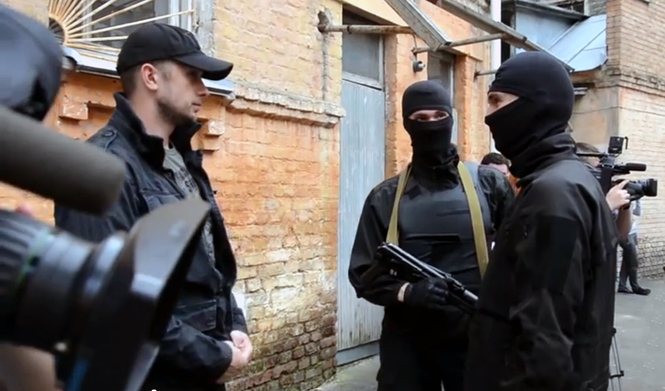
Andriy Beletsky, commanding officer of the special Ukrainian neo-Nazi police regiment Azov, with volunteers in 2014. (My News24, CC BY 3.0, Wikimedia Commons)

News about China in the West is almost entirely about the threat from Beijing. Airbrushed are the 400 American military bases that surround most of China, an armed necklace that reaches from Australia to the Pacific and south east Asia, Japan and Korea. The Japanese island of Okinawa and the Korean island of Jeju are like loaded guns aimed point blank at the industrial heart of China. A Pentagon official described this as a “noose.”

Palestine has been misreported for as long as I can remember. To the BBC, there is the “conflict” of “two narratives.” The longest, most brutal, lawless military occupation in modern times is unmentionable. 

The stricken people of Yemen barely exist. They are media unpeople.  While the Saudis rain down their American cluster bombs with British advisers working alongside the Saudi targeting officers, more than half a million children face starvation.

This brainwashing by omission is not new. The slaughter of the First World War was suppressed by reporters who were given knighthoods for their compliance.  In 1917, the editor of The Manchester Guardian, C.P. Scott, confided to Prime Minister Lloyd George: “If people really knew [the truth], the war would be stopped tomorrow, but they don’t know and can’t know.”

The refusal to see people and events as those in other countries see them is a media virus in the West, as debilitating as Covid.  It is as if we see the world through a one-way mirror, in which “we” are moral and benign and “they” are not. It is a profoundly imperial view.

The history that is a living presence in China and Russia is rarely explained and rarely understood. Vladimir Putin is Adolf Hitler. Xi Jinping is Fu Man Chu. Epic achievements, such as the eradication of abject poverty in China, are barely known. How perverse and squalid this is.

When will we allow ourselves to understand? Training journalists factory style is not the answer. Neither is the wondrous digital tool, which is a means, not an end, like the one-finger typewriter and the linotype machine.

In recent years, some of the best journalists have been eased out of the mainstream. “Defenestrated” is the word used. The spaces once open to mavericks, to journalists who went against the grain, truth-tellers, have closed.  

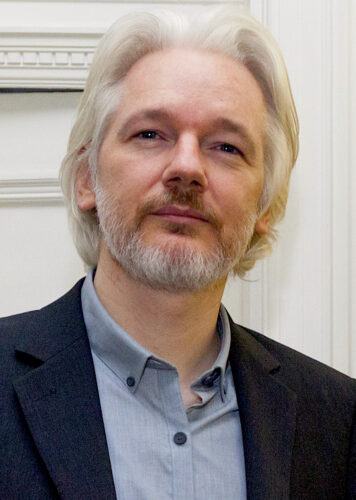
The case of Julian Assange is the most shocking.  When Julian and WikiLeaks could win readers and prizes for The GuardianThe New York Times and other self-important “papers of record,” he was celebrated. 

When the dark state objected and demanded the destruction of hard drives and the assassination of Julian’s character, he was made a public enemy. Vice President Joe Biden compared him to a “hi-tech terrorist.” Hillary Clinton asked, “Can’t we just drone this guy?” 

The ensuing campaign of abuse and vilification against Julian Assange — the U.N. rapporteur on torture called it “mobbing” — brought the liberal press to its lowest ebb. We know who they are. I think of them as collaborators: as Vichy journalists. 

When will real journalists stand up? An inspirational samizdat  already exists on the internet: Consortium News, founded by the great reporter Robert Parry, Max Blumenthal’s  The GrayzoneMint Press News, Media Lens, DeclassifiedUK, Alborada, Electronic IntifadaWSWSZNetICH, CounterPunchIndependent Australia, the work of Chris Hedges, Patrick Lawrence, Jonathan Cook, Diana Johnstone, Caitlin Johnstone and others who will forgive me for not mentioning them here. 

And when will writers stand up, as they did against the rise of fascism in the 1930s? When will film-makers stand up, as they did against the Cold War in the 1940s? When will satirists stand up, as they did a generation ago? 

Having soaked for 82 years in a deep bath of righteousness that is the official version of the last world war, isn’t it time those who are meant to keep the record straight declared their independence and decoded the propaganda? The urgency is greater than ever.

John Pilger has twice won Britain’s highest award for journalism and has been International Reporter of the Year, News Reporter of the Year and Descriptive Writer of the Year. He has made 61 documentary films and has won an Emmy, a BAFTA and the Royal Television Society prize. His ‘Cambodia Year Zero’ is named as one of the ten most important films of the 20th century. He can be contacted at www.johnpilger.com

Journalists who challenge NATO narratives are now ‘information terrorists’

By Vanessa Beeley

Source: Vanessa Beeley Substack

A US state department sponsored round table on ‘countering disinformation’ was recently held at the National Security and Defence Council of Ukraine.

“Information terrorists should know that they will have to answer to the law as war criminals” Andrii Shapovalov

According to the press release – “NGOs, mass media and international experts” took part in the round table discussions. Delegates discussed ‘disinformation methods’ used in Ukraine and abroad. On the agenda was legal and state prevention of ‘fakes and disinformation in the context of cyber security’.

Andrii Shapovalov, head of the Ukrainian Centre for Combatting Disinformation emphasized that those who ‘deliberately spread disinformation are information terrorists’. Shapovalov recommended changes to the legislation to crack down on these terrorists – reminiscent of the pre-WW2 Nazi Germany suppression of media and information channels. Shapovalov determined that ‘information terrorists should know that they will have to answer to the law as war criminals’.

It goes without saying that the crushing of dissent is essential for public support for NATO’s proxy war in Ukraine to be maintained. Russian media has already been wiped from the Western-controlled internet sphere. Ukrainian ‘kill lists’ such as the infamous Myrotvorets already include the courageous Canadian independent journalist Eva Bartlett and outspoken Pink Floyd co-founder Roger Waters.

Bartlett was also doxxed on Twitter by former UK Conservative Party MP Louise Mensch who alerted Ukrainian Special Forces to her presence in Donetsk. A few days later an attack was carried out on the hotel in Donetsk housing multiple journalists including Bartlett – coincidence?

German journalist Alina Lipp has been effectively sanctioned and threatened with prosecution by the German government for reporting on the daily atrocities committed by Ukrainian Nazi forces against civilians in Donetsk and Lughansk. Lipp told Stalkerzone:

“They just closed my bank account. Then they closed my father’s account. A month ago, I noticed that all the money disappeared from my account – 1,600 euros. I realised that something was happening in Germany. A few days ago, I received a notification from the prosecutor’s office, and a criminal case was opened against me for supporting the special operation. In Germany, special operations are considered a crime, and I am also a criminal. I face three years in prison or a huge fine.”

British journalist Graham Philips has illegally been sanctioned by the UK regime without any investigation or Philips being given a ‘right to reply’. Most mainstream media reports on this violation of his human rights describe Philips as ‘one of the most prominent pro-Kremlin online conspiracy theorists’. A familiar smear deployed by NATO-aligned media outlets to dehumanise and discredit challenging voices.

Philips like many other journalists being targeted lives in Donbass which has been threatened with brutal ethnic cleansing by the NATO proxy Ukrainian Nazi and ultra-nationalist forces since Washington’s Victoria Nuland- engineered coup in 2014.

These journalists transmit the voices of the Russian-speaking Ukrainians who have been subjected to horrendous war crimes, torture, detention and persecution for eight years and ignored by the West. For this they are now to be designated ‘information terrorists’ – because they expose terrorism sanctioned by NATO member states.

Organisations are springing up in the UK like Molfar Global whose ‘Book of Orcs’ project employs 200 alleged volunteers to identify ‘Russian (Orcs) war criminals’ and to compile a legal ‘kill list’. The ‘Orc’ terminology is another dehumanisation process, converting Russian citizens and military into fantasy science fiction monsters to soften western publics to the measures being taken to silence and punish them for…being Russian or speaking Russian. They state on their website homepage:

“Every Russian occupier must be identified and punished according to the law. War crimes and and crimes against Humanity have no statute of limitations. That is why we set ourselves the goal of finding everyone and preventing them from escaping justice”

Who determines who should be put on the list? Who determines their fate? What justice? In a country like Ukraine seeped in corruption – where executions or the disappearance of dissidents and political or media opposition is a regular occurrence – who is to be made accountable for action taken against those listed on the ‘Orc hit list’? This is lawless justice that falls under the umbrella of US “rules based global governance” – comply or die and newly furnished legislation will make your death or state-sanctioned assassination a legal one.

The organisers of the round table were the National Security Service Academy, the US State Department/Department of Defence-funded Civilian Research and Development Fund (CRDF Global Urkaine), the International Academy of Information, the US state department-linked National Cyber Security Cluster.

The tentacles of US and UK dominated intelligence agencies are spreading further and deeper into society trying to strangle kick back against their respective regime oppressive domestic policies and foreign policy perpetual war objectives. We are all under attack, we are all facing the same fate as Julian Assange if we do not break the cycle and start to fight back.

If you oppose imperialist wars, racism, Nazism, terrorism, violent extremism, global health tyranny, technocratic supremacy, predator class elitism and pharmaceutical-controlled Eugenics- you are a ‘terrorist’. We are all ‘terrorists’.

NATO prolongs the Ukraine proxy war, and global havoc

With diplomacy thwarted, the US and its allies plan for “open-ended” military and economic warfare against Russia, no matter the costs at home and abroad.

(US Dept. of Defense)

By Aaron Maté

Source: Aaron Mate Substack

Russia has announced plans to mobilize an additional 300,000 troops for the war in Ukraine. In his speech unveiling the expanded war effort, Vladimir Putin vowed to achieve his main goal of the “liberation of Donbas,” and issued a thinly veiled nuclear threat in the process. The move comes days ahead of planned referendums in breakaway Ukrainian areas to formalize Russian annexation.

Russia’s escalation ensures that the fighting is entering an even more dangerous phase. While Russia bears legal and moral responsibility for its invasion, recent developments underscore that NATO leaders have shunned opportunities to prevent further catastrophe and chosen instead to fuel it.

Putin’s announcement comes just after the Ukrainian military’s routing of Russian forces from Kharkiv, which relied extensively on US planning, weaponry and intelligence, sparked triumphant declarations that the tide has turned.

According to The Atlantic’s Anne Applebaum, “Americans and Europeans need to prepare for a Ukrainian victory,” one so overwhelming that it may well bring “about the end of Putin’s regime.”

Beyond the chorus of emboldened neoconservatives, Western officials are less sanguine.

“Certainly it’s a military setback” for Russia, a US official said of the Kharkiv retreat to the Washington Post. “I don’t know if I could call it a major strategic loss at this point.” Germany’s defense chief, General Eberhard Zorn, said that while Ukraine “can win back places or individual areas of the frontlines,” overall, its forces can “not push Russia back over a broad front.”

Whether or not it marked a major strategic loss for Russia, the battle in Kharkiv is already a major victory for NATO leaders seeking to prolong their proxy war in Ukraine and economic warfare next door.

Ukraine’s expulsion of Russian forces in the northeast, the New York Times reports, has “amplified voices in the West demanding that more weapons be sent to Ukraine so that it could win.”

“Despite Ukrainian forces’ startling gains in the war against Russia,” the Washington Post adds, “the Biden administration anticipates months of intense fighting with wins and losses for each side, spurring U.S. plans for an open-ended campaign with no prospect for a negotiated end in sight.”

As has been apparent since the Ukraine crisis erupted, US planning for open-ended proxy warfare against Russia has led it to sabotage any prospect of a negotiated end.

The US rejection of diplomacy around Ukraine has been newly substantiated by former White House Russia expert Fiona Hill. Citing “multiple former senior U.S. officials,” Hill reports that in April of this year “Russian and Ukrainian negotiators appeared to have tentatively agreed on the outlines of a negotiated interim settlement.” Under this framework, Russia would withdraw to its pre-invasion position, while Ukraine would pledge not to join NATO “and instead receive security guarantees from a number of countries.”

In confirming that US officials were aware of this tentative agreement, Hill bolsters previous news that Washington’s junior partner in London was enlisted to thwart it. As Ukrainian media reported, citing sources close to Ukrainian President Volodymyr Zelensky, UK Prime Minister Boris Johnson traveled to Kiev in April and relayed the message that Russia “should be pressured, not negotiated with.” Johnson also informed Zelensky that “even if Ukraine is ready to sign some agreements on [security] guarantees with Putin,” his Western patrons “are not.” The talks promptly collapsed.

In his speech announcing the expanded war effort, Putin invoked this episode. After the invasion began, he said, Ukrainian officials “reacted very positively to our proposals… After certain compromises were reached, Kyiv was actually given a direct order to disrupt all agreements.”

Having undermined the prospect of a negotiated peace in the war’s early weeks, proxy warriors in Washington are openly celebrating their success.

“I like the structural path we’re on here,” Republican Senator Lindsey Graham recently declared. “As long as we help Ukraine with the weapons they need and the economic support, they will fight to the last person.”

Graham’s avowed willingness to expend every “last person” in Ukraine to fight Russia is in line with a broader US strategy that views the entire world as subordinate to its war aims. As the Washington Post reported in June, the White House is willing to “countenance even a global recession and mounting hunger” in order to hand Russia a costly defeat. In Ukraine, this now means also countenancing the threat of nuclear disaster, as the crisis surrounding the Zaporizhzhia nuclear power plant has laid bare.

The prevailing willingness to sacrifice civilian well-being extends to the US public, as National Security Advisor Jake Sullivan has newly made clear. Appearing at the Aspen Security Conference, Sullivan was asked if he is worried about the “American people’s staying power” on the Ukraine proxy war, amid “criticism that we’re spending billions and billions to support Ukraine, and not spending it here.”

 “Fundamentally not,” Sullivan responded. “It’s very important for Putin to understand what exactly he’s up against from the point of view of the United States’ staying power.” That staying power, Sullivan explained, was cemented in the $40 billion war funding measure overwhelmingly approved by Congress (including every self-identified progressive Democrat) in May.

“That can go on, just on the basis of what we have already had allocated to us and resources for a considerable period of time,” Sullivan vowed. “And then, I strongly believe that there will be bipartisan support in the Congress to re-up those resources should it become necessary.”

To policymakers like Sullivan, there is not only an endless pool of money to “re-up” the war, but a “fundamentally” indifferent posture toward the taxpayers footing the bill.

Despite Biden’s reported scolding of Defense Secretary Lloyd Austin for admitting that the US goal in Ukraine is to leave Russia “weakened,” Sullivan – speaking before a friendly Beltway crowd — also forgot to stick to the script.

The US “strategic objective” in Ukraine, Sullivan explained, is to “ensure that Russia’s invasion of Ukraine… is a strategic failure for Putin,” and that “Russia pay a longer-term price in terms of the elements of its national power.” This would teach a “lesson,” he added, “to would-be aggressors elsewhere.”

By “would-be aggressors elsewhere”, Sullivan naturally precludes the US and its allies, whose aggression is not only permitted but promoted under the US-led “rules-based international order.”

President Biden has made that clear by abandoning his pledge to make Saudi Arabia a “pariah” state, notwithstanding its murderous (US-backed) aggression in Yemen. The regular aggression by US ally Israel against Gaza and Syria also continues unabated. The United Nations just reported that an Israeli strike on the Damascus international airport in June – one of hundreds of Israeli bombings on Syria that go largely ignored — “led to considerable damage to infrastructure” and “meant the suspension of U.N. deliveries of humanitarian assistance” to Syrians in need for nearly two weeks. As of this writing, the latest Israeli strike killed five Syrian soldiers, eliciting no Western media and political protest. It is more accurate to describe Israeli aggression on Syria as a joint Israeli-US effort, given that the US reviews and approves the strikes.

Allied NATO leaders are also vocally countenancing the Ukraine proxy war’s costs on their domestic populations. In response to the European sanctions, Russia has now halted gas deliveries to the EU via the key Nord Stream 1 pipeline. Having previously relied on Russia for close to 40 percent of its gas needs, European industries are facing layoffs, factory closures, and higher energy bills that “are pushing consumers to near poverty,” the Financial Times reports.

“People want to end the war because they cannot bear the consequences, the costs,” the EU’s Josep Borell observed this month. While ending the war might appeal to some, it does not interest the EU’s top diplomat. “This mentality must be overcome,” Borell declared. “The offensive on the northeastern front helps with that.”

Europe, NATO chief Jens Stoltenberg recently wrote, may even face “civil unrest,” as economies contract and temperatures drop, but “for Ukraine’s future and for ours, we must prepare for the winter war and stay the course.”

“No matter what my German voters think, I want to deliver to the people of Ukraine,” Germany’s Foreign Minister Annalena Baerbock told a conference in Prague last month. During the upcoming winter, Baerbock acknowledged, “we will be challenged as democratic politicians. People will go in the street and say ‘We cannot pay our energy prices’.” While pledging to help people “with social measures,” Baerbock insisted that the European Union’s sanctions on Russia will remain. “The sanctions will stay also in wintertime, even if it gets really tough for politicians,” she said.

Whereas Western leaders appear confident they can manage civil unrest at home, they face additional resistance abroad. In Africa, a leaked report from the European Union’s envoy to the continent warns that African nations are blaming the EU’s Russia sanctions for food shortages. The report also cautions that “the EU is seen as fueling the conflict,” in Ukraine, “not as a peace facilitator.”

Rather than address these African concerns, the envoy’s office proposes a “more transactional… approach” in which the EU makes “clear” that its “willingness” to “maintain higher levels” of foreign aid “will depend on working based on common values and a joint vision,” – in short, on Africa falling in line.

That is undoubtedly the US policy, as UN Ambassador Linda Thomas-Greenfield made clear last month. After promising a “listening tour,” Thomas-Greenfield instead came to Africa with a dictate and an outright threat. “Countries can buy Russian agricultural products, including fertilizer and wheat,” she decreed. But “if a country decides to engage with Russia” and break US sanctions, “they stand the chance of having actions taken against them.” That Africa faces a food security crisis, with hundreds of millions going hungry, is apparently of lower importance.

While Western sanctions on Russia wreak havoc worldwide, the architects in Washington seem only perturbed by their failure, so far, to inflict the intended levels of suffering on Russian civilians. “We were expecting” that US sanctions “would totally crater the Russian economy” by now, a disappointed senior US official told CNN.

Other US officials are leaving room for hope. “There’s going to be long-term damage done to the Russian economy and to generations of Russians as a result of this,” CIA Director William Burns told a cybersecurity conference this month. Burns’ long-term forecast of harming “generations of Russians” is based on extensive planning. As one US official explained it to CNN, when the sanctions were designed, Biden officials not only “wanted to keep pressure on Russia over the long term as it waged war on Ukraine,” but also “wanted to degrade Russia’s economic and industrial capabilities.” Accordingly, “we’ve always seen this as a long-term game.”

The “long-term game” of trying to destroy Russia’s economy and immiserate “generations” of its citizens is accompanied by increasing plans for a long-term fight. The Biden administration plans to formally name the US military mission in Ukraine – such as in prior campaigns like Operation Desert Storm — while also appointing a general to oversee the effort. The naming, the Wall Street Journal observes, is “significant bureaucratically, as it typically entails long-term, dedicated funding.”

The US plan for a long-term military and economic campaign against Russia is being implemented despite the awareness that Ukraine could face far worse.

“Some American officials express concern that the most dangerous moments are yet to come,” the New York Times reports. To date, “Putin has avoided escalating the war in ways that have, at times, baffled Western officials.” Unlike US military campaigns in Iraq, Russia “has made only limited attempts to destroy critical infrastructure or to target Ukrainian government buildings.”

“The current moment draws attention to a tension that underlies America’s strategy for the war,” the Washington Post observes, “as officials channel massive military support to Ukraine, fueling a war with global consequences, while attempting to remain agnostic about when and how Kyiv might strike a deal to end it.”

These rare admissions not only contradict the typical portrayal of a genocidal Russia that is used to justify the proxy war, but capture the underlying policy driving it. More than six months in, US officials are aware that Russia has “avoided escalating the war” and targeting “critical infrastructure,” – to the point where these same officials are “baffled” by Russian restraint. Despite this, their policy centers on “fueling” this same war, while remaining “agnostic” about ending it.

War being fluid – and US-led military support for Ukraine ever-expanding – it is of course possible that Ukraine will continue to defy expectations and drive out the invading Russian forces.

What the latest developments on and off the battlefield make undoubtedly clear is that NATO states are willing to use Ukraine for as long as it takes to achieve the stated aim of leaving Russia “weakened” or even achieving regime change, no matter the damage knowingly inflicted on Ukrainians, Russians, the Global South, and their own citizens.

The Drumbeats of War and US-NATO Propaganda: “China is Bad” and “They are Coming to Enslave Us”

The Truth about China’s Imperial Ambitions, the Uyghurs and What the West Really Fears

By Timothy Alexander Guzman

Source: Silent Crow News

Western media outlets are playing the drumbeats of war by warning the public that a new Chinese empire is going to develop into an unstoppable force capable of ruling the world with an iron fist.  They claim that under the leadership of the Chinese Communist Party (CCP), they will control every country and human being on earth.  Overall, it’s an absurd claim.  It is fair to say that China under the leadership of the CCP has several issues that concerns the Chinese public with a social credit score system, Zero Covid policy rules and a nation-wide surveillance system that is Orwellian to say the least.  China also had a one child policy that has led to a decline in its population which was and still is problematic for its future when it comes to their labor force and economy, but they ended that policy in 2016.  Whatever faults China has, it is not looking to rule the world despite what Western countries claim especially the United States who say that Beijing’s policies reflect a growing appetite for imperial expansion.  On May 25th, 2017, Reuters published ‘China says new Silk Road not about military ambitions’ reported on what China’s Defense ministry had said about China’s future “China’s ambition to build a new Silk Road is not about seeking to expand its military role abroad nor about seeking to set up foreign bases.” The Chinese Defense Ministry spokesman Ren Guoqiang told a regular monthly news briefing conference that China’s Silk Road was not expanding militarily nor setting up bases in any sovereign country and that the accusations were “groundless.” Guoqiang said that “the new Silk Road is about cooperation and trade” and that “The Belt and Road initiative has no military or geostrategic intent. China is not seeking the right to guide global affairs, or spheres of influence, and will not interfere in the internal affairs of other countries.”

According to a report from September 23rd, 2020, by the National Herald India titled ‘China will never seek expansion, has no intention to fight either ‘Cold War’ or ‘hot war’, says Xi Jinping’ as Xi Jinping declared in a pre-recorded video sent to the United Nations meeting that “We will continue to narrow differences and resolve disputes with others through dialogue and negotiation” he continued “We will never seek hegemony, expansion, or sphere of influence. We have no intention to fight either a Cold War or a hot war with any country.”   The report also mentioned India’s Prime Minister Narendra Modi’s surprise visit to the Ladakh region a few months prior where he said that “the era of expansionism is over and that the history is proof that “expansionists” have either lost or perished” in what the report described as a “clear message” to China.  “Xi, also the General Secretary of the ruling Communist Party of China and the Commander-in-Chief of the Chinese military, said his country will not pursue development behind closed doors.” Xi made it clear that a new plan for development for growth domestically and internationally will create more opportunities for China’s economy.  Xi said the following:

Rather, we aim to foster, over time, a new development paradigm with domestic circulation as the mainstay and domestic and international circulations reinforcing each other. This will create more space for China’s economic development and add impetus to global economic recovery and growth

The report also mentioned that during the Covid-19 pandemic, US President, Donald Trump ramped up tensions with China and “demanded that China, where the coronavirus emerged, be held accountable for failure to control the virus and for allowing it to spread across the world” he continued, “As we pursue this bright future, we must hold accountable the nation which unleashed this plague onto the world: China”.  Trump’s rhetoric including his administration slapping tariffs on China’s goods surely increased tensions between Washington and Beijing.  The National Herald India quoted what Xi had said about China’s own decisions that will benefit its own economy and path of development and that it should be respected, “one should respect a country’s “independent choice of development path and model.”  Xi made a point that the world is diverse, and that it can inspire human advancements:

The world is diverse in nature, and we should turn this diversity into a constant source of inspiration driving human advancement. This will ensure that human civilisations remain colourful and diversified

Conflicts and Disagreements: China, India, and the Soviet Union

The history between China and India involved conflicts over border issues.  In 1962, China had a dispute with India over Aksai Chin and Arunachal Pradesh borders.  The conflict was mostly among ground troops of both sides which did not involve any Air force or Naval forces.  What started the conflict was China’s construction of a road that connected the Chinese regions of Tibet and Xinjiang.  However, Aksai Chin was claimed by India.  So, in the months of October and November the Sino-Indian War began.  Several violent conflicts also occurred between China and India after the 1959 Tibetan uprising due to India’s recognition of the Dalai Lama, or who is known as Gyalwa Rinpoche to the Tibetan people.  In an important note to consider, the Dalai Lama was supported by the CIA for many years.  The CIA financially supported the Dalai Lama from the late 1950s until the mid-1970s with more than $180,000 a year for the CIA’s Tibetan program to support anti-China activities and to create foreign offices within Tibet to lobby for international support which was a concern for China. 

In 1960, India had constructed a defensive policy to disrupt China’s military patrols and its logistics in what was called Forward Policy  that placed Indian outposts along the borders in the north of the McMahon Line, the eastern portion of the Line of Actual Control.   However, China did try to implement diplomatic settlements between 1960 and 1962, but India rejected the proposal allowing China to abandon diplomacy and became aggressive along the disputed borders. China defeated Indian forces in Rezang La in Chushul in the west and Tawang in the east.  China declared a ceasefire on November 20th, 1962.  The war ended as China withdrew to its areas claimed in the ‘Line of Actual Control.’  Matters became complicated when the Soviet Union sold MiG fighter aircrafts to India in a show of support since the US and the UK refused to sell arms to India.  However, tensions between China and the Soviet Union were also high during that time which was known as the ‘Sino-Soviet split’ over ideological differences in Marxist-Leninist theories during the Cold War.  There were various agreements between China and India with no progress for peace until 2006.   Although Indian officials were concerned with China’s growing military power and its relationship with Pakistan (India’s main rival), China’s Silk Road opened the doors for peace between both nations.  In October of 2011, China and India formulated border mechanisms regarding the Line of Actual Control as both resumed bilateral army exercises between China and Indian troops by early 2012.  In 2013, what was known as the Depsang standoff, India had agreed to demolish and remove several ‘live-in bunkers’ in the Chumar sector along with the removal of observation posts built along the border among other things that made the resolution of the dispute a success, so the Chinese military withdrew it forces, ending the dispute in May 2013.  Although there are some disagreements between both countries still exist over their borders policies, today China and India are part of the BRICS coalition.

The Sino-Vietnamese War of 1979

On December 21st, 1978, Vietnam launched an attack on the Khmer Rouge.  After more than 10 years of fighting, Vietnam had successfully defeated the Khmer Rouge ending Pol Pot’s reign of terror.  Then in February 1979, China had declared war with Vietnam over its borders.  Now Vietnam was facing a two-front war. China’s invasion was a surprise to the world because China supported Vietnam with its wars against France and the US.  From 1965 until 1969, China had more than 300,000 troops in the Vietnam war with more than 1,000 members from the People’s Liberation Army (PLA) who were killed with 4,300 wounded. 

However, it all changed due to China’s domination of Vietnam for centuries which created animosity among the Vietnamese government and its people towards Beijing thus creating tensions between both countries.  Conflicts on the border also developed between China and the Soviet Union in 1969 during the Sino-Soviet split, so Vietnam had a dilemma, it had to choose one of them as an ally.  On November 3, 1978, Vietnam signed the Treaty of Friendship and Cooperation with the Soviet Union that offered security assurances.  Since tensions were high at the time, more than 150,000 Chinese who were living in Vietnam had fled. Chinese leader Deng Xiaoping and CCP officials viewed Vietnam as ungrateful and traitorous.  The Chinese saw the treaty as a threat since the Soviets had a similar treaty with Mongolia which in a way allowed the Soviets to surround China.  On December 7, 1978, China’s Central Military Commission decided to launch a “limited war” along their borders and at the same time, Vietnam had invaded Cambodia to destroy the Khmer Rouge.

Since Vietnam had border clashes with the China-backed Khmer Rouge in Cambodia along with Beijing’s decision to cut aid to Hanoi, it decided to partner with Moscow.  On January 29th, 1979, for the first time, Chinese Vice-premier Deng Xiaoping went to the US and reportedly told President Jimmy Carter that “The child is getting naughty, it is time he got spanked.”   A couple of weeks later, on February 15th, China terminated the 1950 Sino-Soviet Treaty of Friendship, Alliance and Mutual Assistance and Xiaoping declared that China was going to attack Vietnam to support its ally, the Khmer Rouge of Cambodia among other reasons including the plan to reclaim the Vietnamese occupied Spratly Islands.  China wanted to prevent the Soviet Union from intervening on Vietnam’s behalf, so Xiaoping warned the Soviets that China’s forces were prepared for war.  Declaring an emergency, China deployed all of the PLA forces along the Sino-Soviet border and set up a military command station in Xinjiang, they also evacuated more than 300,000 civilians from the area.

China eventually suffered a defeat by the Vietcong since its military was not prepared to fight an experienced fighting force who previously defeated two Western powers, France, and the US.  It was reported that experienced Vietnamese ‘tank-killing teams’ destroyed or damaged more than 280 tanks and armored vehicles during the war.  China avoided the use of its Air Force and Navy since it promised the Soviets and Americans a limited war against Vietnam.  China also knew that Vietnam had an experienced military as well as having one of the best anti-air capabilities in the world.  After two short weeks of fighting, China began withdrawing its troops.  By March 16, Chinese troops had a ‘scorched-earth campaign’ in Vietnam destroying bridges, factories, mines, farms, and crops.  It is estimated that China had between 7,900 to 26,000 troops killed and between 23,000 to 37,000 wounded.  Vietnam had between 20,000 to 50,000 troops and civilians killed and wounded.  China clearly had a difficult time with Vietnam. 

China’s history with its neighbors shows that it may be difficult even today if they decided to become an imperialist power subjugating the world to its demands because it would face an uphill battle that will become economically and politically costly and that will collapse its economy and society.  Before the US became a global empire, they made sure they contained and controlled its own backyard and that was the Caribbean and Latin America after the Spanish-American War of 1898.  China would have to control its own backyard against several nations including Russia, India, Vietnam, and others.  China understands that imperial projects to dominate the world is a risk not worth taking. 

Remember, China was on the receiving end of Japanese Imperialism that practically destroyed its society.  In 1931, Imperial Japan had invaded the Chinese province of Manchuria for raw materials to fuel its industries, and by 1937 they controlled many areas of China.  The Imperial Japanese war crimes mounted against the Chinese people.  China understands the consequences of war because it sees what has happened to the US and its military adventures which has led to its decline.  It knows it will not benefit anyone, in fact wars can destabilize regions, destroy economies, and disrupt societal norms and China is not at all interested in any of that.  They want to rebuild their civilization.      

The age of empires is over.  A new multipolar world is needed now more than ever before where no single entity or centralized power could rule over any country who wants to remain sovereign.  That would start an era of lasting peace around the world.  Of course, there are no guarantees that total peace would prevail in a multipolar world because there will be bad actors who will prefer a globalized world order over countries who want sovereignty, but in a multipolar world order, wars can be avoided.  It would be a good start where sovereign countries would respect each other’s boundaries and work out their differences.  That’s the way it should be instead of a group of globalist psychopaths making geopolitical and economic decisions to change the social fabric of every country on the planet.         

Inside China: The Surveillance State

China’s internal problems is a stain on its reputation.  China’s surveillance state is indeed problematic.  In 2018, the CCP installed more than 200 million surveillance cameras with an increase in facial recognition technology nationwide.  Surveillance cameras and facial recognition networks would add to the social credit system already in place that gives Chinese citizens a score based on their “social behaviors.”  Going back to 2003, China began its Smart City pilot programs to track and analyze air quality, traffic, wastewater disposal systems, social behaviors of its residents and other areas of urban life.  We can fairly say that China’s surveillance state is rather extreme and unnecessary.  The Chinese people will increasingly voice their concerns to the CCP’s leadership in the future to scrap its surveillance capabilities because it can get out of control, but the question is, will it happen?  Only time will tell.   

The Uyghurs: China’s Problem with the East Turkestan Islamic Movement (ETIM)

One issue that has been mainly ignored in recent years by the Western mainstream media is the terrorism committed in China by the Uyghurs. Why? The Western view of China’s human rights abuses when it comes to the Uyghurs has two sides of the story.  First it benefits the Military-Industrial Complex and its future of selling arms to its allies throughout Asia including Taiwan, South Korea, and Japan.  Second, it’s the demonization of China to gain support among the American people for a future war with China because they are “bad.”  Former US President Barack Obama supported his Secretary of State Hillary Clinton and her ‘Pivot to Asia’ agenda that she had published in Foreign Policy magazine titled ‘America’s Pacific Century.’ Clinton made it clear that the US goal is to remain a global hegemonic power especially in the Asia-Pacific region:

As secretary of state, I broke with tradition and embarked on my first official overseas trip to Asia. In my seven trips since, I have had the privilege to see firsthand the rapid transformations taking place in the region, underscoring how much the future of the United States is intimately intertwined with the future of the Asia-Pacific. A strategic turn to the region fits logically into our overall global effort to secure and sustain America’s global leadership. The success of this turn requires maintaining and advancing a bipartisan consensus on the importance of the Asia-Pacific to our national interests; we seek to build upon a strong tradition of engagement by presidents and secretaries of state of both parties across many decades. It also requires smart execution of a coherent regional strategy that accounts for the global implications of our choices.

What does that regional strategy look like? For starters, it calls for a sustained commitment to what I have called “forward-deployed” diplomacy. That means continuing to dispatch the full range of our diplomatic assets — including our highest-ranking officials, our development experts, our interagency teams, and our permanent assets — to every country and corner of the Asia-Pacific region. Our strategy will have to keep accounting for and adapting to the rapid and dramatic shifts playing out across Asia. With this in mind, our work will proceed along six key lines of action: strengthening bilateral security alliances; deepening our working relationships with emerging powers, including with China; engaging with regional multilateral institutions; expanding trade and investment; forging a broad-based military presence; and advancing democracy and human rights

FOX News is one of the US mainstream media outlets that jumps into the defense of the Uyghurs when it comes to the CCP and its alleged abuses.  However, FOX News ignores the daily abuses of the Israeli regime against the Palestinians or the abuses by the Saudis against the people of Yemen who have been bombarded with US-made weapons since 2015.  To be fair, not only FOX News demonizes China, but so does the liberal media such as CNN, MSNBC, the New York Times that includes the BBC and others throughout Europe.   

One situation that is rarely discussed in the West is the terrorism incidents caused by certain groups and individuals in the Uyghur community not only against the CCP, but also against the Han Chinese, the largest ethnic majority in China.  In Violent Separatism in Xinjiang: A Critical Assessment by James Millward from the East-West Center based in Honolulu, Hawaii and Washington D.C. documented terrorist activities since the early 1990’s that accelerated after the September 11th attacks in New York City and Washington, D.C. Millward wrote the following concerning terror groups originating out of the Xinjiang region in China:

Since the 1990s, concerns about Uyghur separatism have received increasing official and media attention. These concerns have heightened since the events of 9-11 with the advent of a more robust U.S. presence in Central Asia and Chinese attempts to link Uyghur separatism to international jihadist groups. A steady flow of reports from the international media—as well as official PRC releases (a document on “East Turkistan” terrorism, a white paper on Xinjiang, and a list of terrorist groups)—have given the impression of an imminent separatist and terrorist crisis in the Xinjiang region

Some of the terror attacks that were documented occurred in as early as 1992: 

February 5, 1992: Urumqi Bus Bombs. Three were killed and twenty-three injured in two explosions on buses in Urumqi; the PRC’s 2002 document claims that other bombs were discovered and defused around the same time in a cinema and a residential building. Five men were later convicted in this case and reportedly executed in June 1995.

February 1992-September 1993: Bombings. During this period there were several explosions in Yining, Urumqi, Kashgar, and elsewhere; targets included department stores, markets, hotels, and centers of “cultural activity” in southern Xinjiang. One bomb in a building of the Nongji Company (apparently a firm concerned with agricultural equipment) in Kashgar on June 17, 1993, killed two and injured six. One bomb went off in a wing of the Seman Hotel in Kashgar, though no one was hurt in this explosion. The PRC’s 2002 document claims that in the 1993 explosions two people were killed and thirty-six injured overall

On March 9th, 2008, Reuters published an account on what took place during an attempted terrorist attack on a passenger jet on its way to Beijing China foils attempted terror attack on flight.’  The report said that “China foiled a bid to cause an air disaster on a passenger jet en route to Beijing and the plane made a safe emergency landing, an official said on Sunday, in what state media called an attempted terrorist attack.”  According to Reuters sources, “The China Southern flight originated in Urumqi, capital of the restive far western Chinese region of Xinjiang, where militant Uighurs have agitated for an independent “East Turkestan.”  On September 8th, 2011, the BBC reported that a militant Islamic group was behind a terrorist attack in the Xinjiang region that resulted in dozens of people dead.  The BBC report Islamic militant group ‘behind Xinjiang attacks said the following:

A militant Islamic group has released a video saying it was behind recent attacks in China’s Xinjiang region which left dozens of people dead, a US internet monitoring group says.  The video was made by a group calling itself the Turkistan Islamic Party.  The group, which is fighting against Chinese control of Xinjiang, says the attacks were revenge against the Beijing government.

One of the deadliest attacks experienced in China occurred on March 1st, 2014 in the Kunming Railway Station in Kunming which is located in the Yunnan province.  The BBC reported on the incident and said that ‘China separatists blamed for Kunming knife rampage’ and said that “Chinese officials have blamed separatists from the north-western Xinjiang region for a mass knife attack at a railway station that left 29 people dead and at least 130 wounded” and that “a group of attackers, dressed in black, burst into the station in the south-west city of Kunming and began stabbing people at random.”  The report also said that “Images from the scene posted online showed bodies lying in pools of blood” and that the “State news agency Xinhua said police shot at least four suspects dead.”  There were other terrorist attacks that involved the Uyghurs that only pushed the CCP to move forward with facial recognition and a social credit system associated with a criminal offending database.  By 2021, the CCP’s surveillance system expanded in the southern city of Guangzhou that allowed incoming passengers to walk through a biometric security checkpoint. 

In Xinjiang, security checkpoints and identification stations were in many places where people must show proof of ID with their faces being scanned at the same time by various cameras before they enter any supermarket, train stations or any other public place.  China’s security concerns do go beyond what is needed to protect themselves from terrorism. 

However, I do not justify any form of police state tactics against any population despite China’s extreme measures that resembles George Orwell’s 1984, however, at the same time, there are legitimate concerns involving the Uyghur population and their use of terrorism that has caused numerous deaths and injuries of innocent people.

From China to Syria: ETIM joins Al-Qaeda and the Syrian “Moderate” Rebels

One piece of information the Western media usually ignores is the fact that since 2013, there have been thousands of Uyghurs who have traveled to Syria and joined terrorist groups such as Al-Qaeda, the Syrian “Moderate Rebels” and others to fight against Bashar al-Assad’s Syrian army.  One western media news agency reported on the Uyghurs in Syria and their affiliation with US-backed terrorists who were trying to overthrow or kill Syria’s President Bashar al-Assad and that was the Associated Press (AP) who published an Exclusive story Uighurs fighting in Syria take aim at China admits a fact about the Uyghurs and their ties to terrorist groups from the Middle East and Africa and how they are using their experiences to fight China:

Since 2013, thousands of Uighurs, a Turkic-speaking Muslim minority from western China, have traveled to Syria to train with the Uighur militant group Turkistan Islamic Party and fight alongside al-Qaida, playing key roles in several battles. Syrian President Bashar Assad’s troops are now clashing with Uighur fighters as the six-year conflict nears its endgame

The AP mentioned a Uyghur by the name of Ali who said, “We didn’t care how the fighting went or who Assad was,” said Ali, “we just wanted to learn how to use the weapons and then go back to China.”  That’s what Chinese officials needed on their hands, Uyghurs traveling to Syria to learn how Al-Qaeda and others use terrorist tactics and techniques then bring that knowledge back to China.  The CCP had its hands full with the threat of terrorism on Chinese soil.  The AP outlined the facts that the Uyghurs have committed numerous crimes in China over the years: 

Uighur militants have killed hundreds, if not thousands, in attacks inside China in a decades-long insurgency that initially targeted police and other symbols of Chinese authority but in recent years also included civilians. Extremists with knives killed 33 people at a train station in 2014. Abroad, they bombed the Chinese embassy in Kyrgyzstan in September last year; in 2014, they killed 25 people in an attack on a Thai shrine popular with Chinese tourists

In a report from June 2016 by the U.S.-China Economic and Security Review Commission titled China’s Response to Terrorism’ by Murray Scot Tanner and James Bellacqua clarifies what China has been facing when it comes to terrorism:

While tracking the nature and magnitude of China’s terrorist challenges is difficult, it is clear that China faces some level of domestic terrorist threat, and that its citizens have been victims of terrorist attacks both at home and abroad.

Between 2012 and 2015, China suffered multiple domestic terrorist attacks. Reported incidents became more frequent during this period, and they also became more dispersed geographically, with major incidents occurring in Beijing and other eastern cities, in addition to China’s mostly Muslim western regions. Several of these incidents were also targeted at high-traffic urban areas, resulting in indiscriminate injury or death to civilians

In an unusual fashion, in what they call a backgrounder, the Council on Foreign Relations (CFR), a bi-partisan establishment think tank based in New York City published ‘The East Turkestan Islamic Movement (ETIM)’ explained who and what is ETIM and its longtime affiliations with terrorists: 

Reportedly founded by Hasan Mahsum, a Uighur from Xinjiang’s Kashgar region, ETIM has been listed by the State Department as one of the more extreme separatist groups. It seeks an independent state called East Turkestan that would cover an area including parts of Turkey, Kazakhstan, Kyrgyzstan, Uzbekistan, Pakistan, Afghanistan, and the Xinjiang Uighur Autonomous Region (XUAR). After Mahsum’s assassination by Pakistani troops in 2003 during a raid on a suspected al-Qaeda hideout near the Afghanistan border, the group was led by Abdul Haq, who was reportedly killed in Pakistan in 2010. In August 2014, Chinese state media released a report stating that Memetuhut Memetrozi, a co-founder of ETIM who is serving a life sentence in China for his involvement in terrorist attacks, had been indoctrinated in a madrassa in Pakistan. The report, which said Memetuhut had met Mahsum in 1997 and launched ETIM later that year, marked a rare public admission of Pakistani ties to Uighur militancy. 

Some experts say ETIM is an umbrella organization for many splinter groups, including ones that operate in Pakistan and central Asia. The Turkestan Islamic Party (TIP), for instance, is one of the most prominent groups, formed in 2006 by Uighurs who fled to Afghanistan and Pakistan in the 1990s. That group took credit for a series of attacks in several Chinese cities in 2008, including deadly bus explosions in Shanghai and Kunming. According to U.S.-based intelligence firm Stratfor, the TIP’s “claims of responsibility appear exaggerated, but the threat TIP poses cannot be ignored.” Stratfor also said that the TIP had expanded its presence on the Internet, issuing videos calling for a jihad by Uighurs in Xinjiang. Ben N. Venzke, head of the U.S.-based independent terrorism-monitoring firm IntelCenter, says it is unclear whether the TIP is separate from ETIM, but notes that the groups’ objectives are both Islamist and nationalist

In the last year of the Trump administration, despite the proof from various reports including those produced by the US and its think tanks that ETIM committed multiple terrorist attacks in mainland China, the US government removed ETIM from its terror list.  According to Germany’s Deutsche Welle (DW) US removes separatist group condemned by China from terror list reported that The United States said it would no longer designate a Chinese Uighur separatist group as a “terrorist organization” on Friday, sparking sharp condemnation from Beijing.”  This was a clear indication that Washington is doing everything it can to destabilize China.  It is a move that will allow newly trained Uyghurs to use their newly acquired skills to cause more chaos in China.  It’s basically a slap in the face:    

The East Turkestan Islamic Movement (ETIM) was removed from Washington’s terror list, US Secretary of State Mike Pompeo announced in a notice posted in the Federal Register.

“ETIM was removed from the list because, for more than a decade, there has been no credible evidence that ETIM continues to exist,” a State Department spokesperson said, news agency AFP reported

This is a typical turn of events for Washington and its long-term objective of destabilizing China by whatever means necessary to try stop its rise to power. The New World Order is becoming a multipolar world order with China, Russia and others who will compete with declining Western powers who are basically responsible for many of the wars, economic exploitation, and the colonization of the global south and that’s what Washington and its European allies are afraid of. 

US Government Propaganda on China’s Internment Camps for the Uyghurs

In an important investigation by Ben Norton and Ajit Singh of The Grayzone ‘No, the UN did not report China has ‘massive internment camps’ for Uighur Muslims starts off with an introduction on how mainstream media propaganda has claimed that China has imprisoned more than 1 million Uyghurs in designated “internment camps” but as the facts makes itself clear, it is a fabrication by the CIA and the National Endowment for Democracy (NED) that is funded by Washington’s armchair warriors:

A spokesperson from the UN Office of the High Commissioner for Human Rights (OHCHR) confirmed in a statement to The Grayzone that the allegation of Chinese “camps” was not made by the United Nations, but rather by a member of an independent committee that does not speak for the UN as a whole. That member happened to be the only American on the committee, and one with no background of scholarship or research on China.

Moreover, this accusation is based on the thinly sourced reports of a Chinese opposition group that is funded by the American government’s regime-change arm and is closely tied to exiled pro-US activists. There have been numerous reports of discrimination against Uighur Muslims in China. However, information about camps containing 1 million prisoners has originated almost exclusively from media outlets and organizations funded and weaponized by the US government to turn up the heat on Beijing

On August 10, 2018, the United Nations Committee on the Elimination of Racial Discrimination conducted a review for 179 countries who were signed on to the convention which is a process that takes place annually which also included a review for China’s compliance.  “On the day of the review, Reuters published a report with an explosive headline: “U.N. says it has credible reports that China holds million Uighurs in secret camps.”  From CNN, FOX News to the New York Times, all echoed the same propaganda that the UN had investigated China’s actions against the Uyghurs and accused Beijing of genocide, but it was all a lie.  The UN did conduct any investigation into the Uyghur internment camps “and this committee’s official website makes it clear that it is “a body of independent experts,” not UN officials.”  One individual that The Grayzone report focused on is Gay McDougall, a member of the Office of the United Nations High Commissioner for Human Rights (OHCHR):

What’s more, a look at the OHCHR’s official news release on the committee’s presentation of the report showed that the only mention of alleged re-education “camps” in China was made by its sole American member, Gay McDougall. This claim was then echoed by a Mauritanian member, Yemhelhe Mint Mohamed.

During the committee’s regular review of China, McDougall commented that she was “deeply concerned” about “credible reports” alleging mass detentions of millions of Uighurs Muslim minorities in “internment camps.” The Associated Press reported that McDougall “did not specify a source for that information in her remarks at the hearing.” (Note that the headline of the AP news wire is much weaker than that of Reuters: “UN panel concerned at reported Chinese detention of Uighurs”)

The Grayzone received an email from the OHCHR spokesperson Julia Gronnevet “confirmed that the CERD was not representative of the UN as a whole.”  She said that “You are correct that the Committee on the Elimination of Racial Discrimination is an independent body,” Gronnevet wrote. “Quoted comments were made during public sessions of the Committee when members were reviewing State parties.”  The report confirmed that McDougall’s claims were false:

Thus the OHCHR implicitly acknowledged that the comments by McDougall, the lone American member of an independent committee, were not representative of any finding by the UN as a whole. The report by Reuters is simply false

The mainstream media has tried to cover up McDougall’s lies with an “Activist group” called ‘Chinese Human Rights Defenders (CHRD), but the problem with this network is that it is supported by US regime-change operators based in, you guessed it, Washington D.C:

In addition to this irresponsible misreporting, Reuters and other Western outlets have attempted to fill in the gaps left by McDougall, referring to reports made by so-called “activist group” the Network of Chinese Human Rights Defenders (CHRD).

Conveniently left out of the story is that this organization is headquartered in Washington, DC and funded by the US government’s regime-change arm.  CHRD advocates full-time against the Chinese government, and has spent years campaigning on behalf of extreme right-wing opposition figures

CHRD is supported by one of the most notorious organizations involved in Regime-Change operations around the world, and that is the National Endowment for Democracy (NED):

However, tax documents uncovered by The Grayzone show that a significant portion of this group’s budget comes from the US government’s National Endowment for Democracy (NED), a CIA-linked soft-power group that was founded by the Ronald Reagan administration in the 1980s to push regime change against independent governments and support “free markets” around the world.

In 2012, the NED gave the Network of Chinese Human Rights Defenders $490,000. In 2013, it got a $520,000 grant from the NED

The list of funds given to CHRD from the NED continued in 2015 with $496,000, and another $412, 300 was added to its budget in 2016. 

Behind the CHRD is its international director, Renee Xia who is an anti-China activist who in the past has called upon Washington to impose sanctions on CCP officials.  She is an advocate for the release of a neoconservative Chinese dissident by the name of Liu Xiaobo:  

While Liu Xiaobo became a cause celebre of the Western liberal intelligensia, he was a staunch supporter of colonialism, a fan of the most blood-soaked US military campaigns, and a hardcore libertarian. 

As writers Barry Sautman and Yan Hairong reported in The Guardian in 2010, Liu led numerous US government-funded right-wing organizations that advocated mass privatization and the Westernization of China. He also expressed openly racist views against the Chinese. “To choose Westernisation is to choose to be human,” Liu insisted, lamenting that traditional Chinese culture had made its population “wimpy, spineless, and fucked up.”

While CHRD described Liu as an “advocate of non-violence,” he practically worshiped President George W. Bush and strongly supported the illegal US-led invasion of Iraq, as well as the war in Afghanistan. “Non-violence advocate” Liu was even a fan of America’s wars in Korea and Vietnam, which killed millions of civilians

The Grayzone mentioned an article published by The Guardian in 2010, Do supporters of Nobel winner Liu Xiaobo really know what he stands for?’ written by Barry Sautman and Yan Hairong state the fact that Liu supports Israel’s atrocities against the Palestinians and has claimed that they are the provocateurs:

Liu has also one-sidedly praised Israel’s stance in the Middle East conflict. He places the blame for the Israel/Palestine conflict on Palestinians, who he regards as “often the provocateurs”

Overall, the accusations by the CHRD against China and its imprisonment of the Uyghurs is brought to you by the CIA and its propaganda news networks from around the world:

A look at the sourcing of the Network of Chinese Human Rights Defenders’ research raises many doubts about its legitimacy. For one, the most-cited source in the CHRD report, accounting for more than one-fifth of the 101 references, is Radio Free Asia, a news agency created by the CIA during the Cold War pump out anti-China propaganda, and still today funded by the US government.

Even The New York Times has referred to Radio Free Asia as a “Worldwide Propaganda Network Built by the CIA.” Along with Voice of America, Radio Free Europe / Radio Liberty, Radio y Televisión Martí, and Middle East Broadcasting Networks, Radio Free Asia (RFA) is operated by the Broadcasting Board of Governors (BBG), a federal agency of the US government under the supervision of the State Department. Describing its work as “vital to U.S. national interests,” BBG’s primary broadcasting standard is to be “consistent with the broad foreign policy objectives of the United States.”  The near-total reliance on Washington-linked sources is characteristic of Western reporting on Uighurs Muslims in China, and on the country in general, which regularly features sensational headlines and allegations

China’s Threat to the ‘New World Order’ is the Multipolar World Order

The US and its European allies are afraid of China’s economic growth and of its political influence on the world stage, not of its supposed “imperial agenda” they consistently claim.  China is becoming part of a multipolar world where more than one country has the economic and diplomatic influence instead of the Old-World Order where a unified Western power structure led by the US and its European allies that has brought nothing more than death and destruction to most of the global south.  Their imperial expansion accelerated after World War II to become a global empire, but the world is tired of the same old political establishment from the West telling the rest of the world what to do and who they can become allies with.  China is a target of the West, but China will protect its sovereignty at all costs.  China is ready for a war. 

China will be a force economically for centuries to come with their Belt and Road Initiative (BRI) that was introduced in 2013 as a global investment project to develop an economic infrastructure strategy to invest and trade with more than 150 countries who participate in the project.  The US is worried about that, so, like spoiled children, the US House Speaker, Nancy Pelosi and then later on, fellow Democrat Senator, Ed Markey from Massachusetts and other Democrat Representatives including John Garamendi and Alan Lowenthal from California, and Don Beyer of Virginia with Aumua Amata Coleman Radewagen of American Samoa, who is a Republican with more politicians to follow suit in the future, all defiantly went to Taiwan in an effort to antagonize China to see how far will the CCP go knowing that the One-China Policy is what Beijing takes seriously, in fact, it’s the red line for them.  It was an insult, but China did not take any serious actions against the move that would have led to a world war.     

China has human rights issues and to be fair, so does the US government, for example, the US has more people in prison than any other country on the planet.  There is no doubt that the CCP has serious issues when it comes to its internal security policies, but hopefully the Chinese people and their government will work something out in the future when the threat of terrorism and other security issues are no longer a problem.  Perhaps a new beginning can emerge that will benefit China’s society.  But one thing is certain, China and its people will not be bullied by the West.  They experienced an invasion by Imperial Japan during World War II, so it is guaranteed that China will not allow something like that to happen again especially if the US planned to install a military base in Taiwan.    

China was and still is a great civilization.  China had periods of history where they flourished, for example under the Tang Dynasty (618-907), although not a perfect example because there were internal conflicts and rebellions for political reasons, but it was considered China’s golden age.  Under the Tang Dynasty, China had a rich, highly educated society that was well-governed. The Tang Dynasty has a rich history of poetry and numerous innovations with political and cultural influences throughout Asia.  China has the potential to become a great civilization once again.  

Today, China is not a threat to world peace.  What the West fears is China’s rise as an economic powerhouse along with its Russian counterpart and others who challenge US and European hegemony.  Now the rest of the world (especially the global south) can pick and choose who they trade with and who they choose as an ally.  In other words, most countries around the world will now have a choice.  They don’t have to listen to Washington anymore, they can choose whoever they want that will benefit them the most without giving up their sovereignty in doing so.  The US and Europe as a partner is risky, especially for smaller countries who in some cases, have natural resources but don’t have a formidable military that can protect themselves from western powers.  However, China, Russia and Iran have that power to challenge the West, and now the global south sees what is happening geopolitically and they feel more optimistic about the future.  A future without Uncle Sam waving his big stick and telling governments what to do will be a new start for the world.  The era of empires is over with a multipolar world order is on the horizon and that’s a fact the West is not willing to accept. 

We are closer to World War III than ever before, but the question is, where would it begin?  In the South China Sea, in the Middle East or in Eastern Europe? I believe that World War III will begin in the Middle East between Israel and Iran, but it’s hard to tell at this point, but one thing is guaranteed, China will be involved in the next world war.  They want China to become another puppet state that they can control and dominate economically and politically forever and that’s not an exaggeration.  The US and its European allies have been the dominant power on the global stage for centuries and they are not willing to give that up anytime soon, but there is a new multipolar world emerging and that would end the threat of Western hegemonic powers that has only brought misery and pain around the world.