
RAY McGOVERN: Catapulting Russian-Meddling Propaganda

By Ray McGovern

Source: Consortium News

The fresh orgy of anti-Russian invective in the lickspittle media (LSM) has the feel of fin de siècle. The last four reality-impaired years do seem as though they add up to a century. And no definitive fin is in sight, as long as most people don’t know what’s going on.

The LSM should be confronted: “At long last have you left no sense of decency?” But who would hear the question — much less any answer? The corporate media have a lock on what Americans are permitted or not permitted to hear. Checking the truth, once routine in journalism, is a thing of the past.

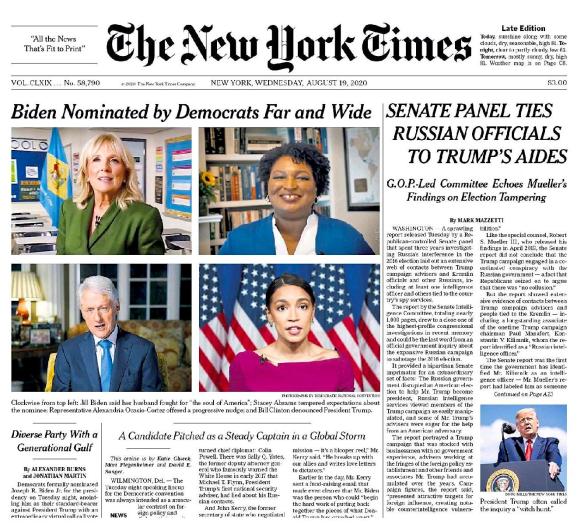
Thus the reckless abandon with which The New York Times is leading the current full-court press to improve on what it regards as Special Counsel Robert Mueller’s weak-kneed effort to blame the Russians for giving us Donald Trump. The press is on, and there are no referees to call the fouls.

The recent release of a 1,000-page, sans bombshells and already out-of-date report by the Senate Intelligence Committee has provided the occasion to “catapult the propaganda,” as President George W. Bush once put it.

As the the Times‘s Mark Mazzetti put it in his article Wednesday:

“Releasing the report less than 100 days before Election Day, Republican-majority senators hoped it would refocus attention on the interference by Russia and other hostile foreign powers in the American political process, which has continued unabated.”

Mazzetti is telling his readers, soto voce: regarding that interference four years ago, and the “continued-unabated” part, you just have to trust us and our intelligence community sources who would never lie to you. And if, nevertheless, you persist in asking for actual evidence, you are clearly in Putin’s pocket.

Incidentally, Mueller’s report apparently was insufficient, only two years in the making, and just 448 pages. The Senate committee’s magnum opus took three years, is almost 1,000 pages — and fortified. So there.

Iron Pills

Recall how disappointed the LSM and the rest of the Establishment were with Mueller’s anemic findings in spring 2019. His report claimed that the Russian government “interfered in the 2016 presidential election in sweeping and systematic fashion” via a social media campaign run by the Internet Research Agency (IRA) and by “hacking” Democratic emails. But the evidence behind those charges could not bear close scrutiny.

You would hardly know it from the LSM, but the accusation against the IRA was thrown out of court when the U.S. government admitted it could not prove that the IRA was working for the Russian government. Mueller’s ipse dixit did not suffice, as we explained a year ago in “Sic Transit Gloria Mueller.”

The Best Defense …

… is a good offense, and the Senate Intelligence Committee’s release of its study — call it “Mueller (Enhanced)” — and the propaganda fanfare — come at a key point in the Russiagate/Spygate imbroglio. It also came, curiously, as the Democratic Convention was beginning, as if the Republican-controlled Senate was sending Trump a message.

One chief worry, of course, derives from the uncertainty as to whether John Durham, the US Attorney investigating those FBI and other officials who launched the Trump-Russia investigation will let some heavy shoes drop before the election. Barr has said he expects “developments in Durham’s investigation hopefully before the end of the summer.”

FBI attorney Kevin Clinesmith already has decided to plead guilty to the felony of falsifying evidence used to support a warrant from the Foreign Intelligence Surveillance Court to surveillance to spy on Trump associate Carter Page. It is abundantly clear that Clinesmith was just a small cog in the deep-state machine in action against candidate and then President Trump. And those running the machine are well known. The president has named names, and Barr has made no bones about his disdain for what he calls spying on the president.

The cognoscenti and the big fish themselves may be guessing that Trump/Barr/Durham will not throw out heavier lines for former FBI Director James Comey, his deputy Andrew McCabe, CIA Director John Brennan, and Director of National Intelligence James Clapper, for example. But how can they be sure? What has become clear is that the certainty they all shared that Hillary Clinton would be the next president prompted them not only to take serious liberties with the Constitution and the law, but also to do so without taking rudimentary steps to hide their tracks.

The incriminating evidence is there. And as Trump becomes more and more vulnerable and defensive about his ineptness — particularly with regard to Covid-19 — he may summon the courage to order Barr and Durham to hook the big fish, not just minnows like Clinesmith. The neuralgic reality is that no one knows at this point how far Trump will go. To say that this kind of uncertainty is unsettling to all concerned is to say the obvious.

So, the stakes are high — for the Democrats, as well — and, not least, the LSM. In these circumstances it would seem imperative not just to circle the wagons but to mount the best offense/defense possible, despite the fact that virtually all the ammunition (as in the Senate report) is familiar and stale (“enhanced” or not).

Black eyes might well be in store for the very top former law enforcement and intelligence officials, the Democrats, and the LSM — and in the key pre-election period. So, the calculation: launch “Mueller Report (Enhanced)” and catapult the truth now with propaganda, before it is too late.

No Evidence of Hacking

The “hacking of the DNC” charge suffered a fatal blow three months ago when it became known that Shawn Henry, president of the DNC-hired cyber-security firm CrowdStrike, admitted under oath that his firm had no evidence that the DNC emails were hacked — by Russia or anyone else.

Henry gave his testimony on Dec. 5, 2017, but House Intelligence Committee chair Adam Schiff was able to keep it hidden until May 7, 2020.

Here’s a brief taste of how Henry’s testimony went: Asked by Schiff for “the date on which the Russians exfiltrated the data”, Henry replied, “We just don’t have the evidence that says it actually left.”

You did not know that? You may be forgiven — up until now — if your information diet is limited to the LSM and you believe The New York Times still publishes “all the news that’s fit to print.”  I am taking bets on how much longer the NYT will be able to keep Henry’s testimony hidden; Schiff’s record of 29 months will be hard to beat.

Putting Lipstick on the Pig of Russian ‘Tampering’

Worse still for the LSM and other Russiagate diehards, Mueller’s findings last year enabled Trump to shout “No Collusion” with Russia. What seems clear at this point is that a key objective of the current catapulting of the truth is to apply lipstick to Mueller’s findings.

After all, he was supposed to find treacherous plotting between the Trump campaign and the Russians and failed miserably. Most LSM-suffused Americans remain blissfully unaware of this, and the likes of Pulitzer Prize winner Mazzetti have been commissioned to keep it that way.

In Wednesday’s article, for example, Mazzetti puts it somewhat plaintively:

“Like the special counsel … the Senate report did not conclude that the Trump campaign engaged in a coordinated conspiracy with the Russian government — a fact that the Republicans seized on to argue that there was ‘no collusion’.”

How could they!

Mazzetti is playing with words. “Collusion,” however one defines it, is not a crime; conspiracy is.

‘Breathtaking’ Contacts: Mueller (Enhanced)

Mazzetti emphasizes that the Senate report “showed extensive evidence of contacts between Trump campaign advisers and people tied to the Kremlin,” and Sen. Mark Warner (D-VA), the intelligence committee’s vice chairman, said the committee report details “a breathtaking level of contacts between Trump officials and Russian government operatives that is a very real counterintelligence threat to our elections.”

None of that takes us much beyond the Mueller report and other things generally well known — even in the LSM. Nor does the drivel about people like Paul Manafort “sharing polling data with Russians” who might be intelligence officers. That data was “mostly public” the Times itself reported, and the paper had to correct a story that the data was intended for Russian oligarchs, when it was meant for Ukrainian oligarchs instead. That Manafort was working to turn Ukraine towards the West and not Russia is rarely mentioned.

Recent revelations regarding the false data given the FISA court by an FBI lawyer to “justify” eavesdropping on Trump associate Carter Page show the Senate report to be not up to date and misguided in endorsing the FBI’s decision to investigate Page. The committee may wish to revisit that endorsement — at least.

On the Steele Dossier, the committee also missed a ruling by a British judge against Christopher Steele, labeling his dossier an attempt to help Hillary Clinton get elected. Consortium News explained back in October 2017 that both CrowdStrike and Steele were paid for by the Democratic Party and Clinton campaign to push Russiagate.

Also missed by the intelligence committee was a document released by the Senate Judiciary Committee last month that revealed that Steele’s “Primary Subsource and his friends peddled warmed-over rumors and laughable gossip that Steele dressed up as formal intelligence memos.”

Smearing WikiLeaks

The Intelligence Committee report also repeats thoroughly debunked myths about WikiLeaks and, like Mueller, the committee made no effort to interview Julian Assange before launching its smears. Italian journalist Stefania Maurizi, who partnered with WikiLeaks in the publication of the Podesta emails, described the report’s treatment of WikiLeaks in this Twitter thread:

2. the description of #WikiLeaks‘ publishing activities by this #SenateIntelligenceCommittee‘s Report appears a true #EdgarHoover‘s disinformation campaign to make a legitimate media org completely radioactive

3. Clearly, to describe #WikiLeaks and its publishing activities the #SenateIntelligenceCommittee’s Report completely rely on #US intelligence community+ #MikePompeo’s characterisation of #WikiLeaks. There is not even any pretense of an independent approach

4. there are also unsubstantiated claims like:
– “[WikiLeaks’] disclosures have jeopardized the safety of individual Americans and foreign allies” (p.200)
– “WikiLeaks has passed information to U.S. adversaries” (p.201)

5. it’s completely false that “#WikiLeaks does not seem to weigh whether its disclosures add any public interest value” (p.200) and any longtime media partner like me could provide you dozens of examples on how wrong this characterisation [is].

Titillating

Mazzetti did add some spice to the version of his article that dominated the two top right columns of Wednesday’s Times with the blaring headline: “Senate Panel Ties Russian Officials to Trump’s Aides: G.O.P.-Led Committee Echoes Mueller’s Findings on Election Tampering.”

Those who make it to the end of Mazzetti’s piece will learn that the Senate committee report “did not establish” that the Russian government obtained any compromising material on Mr. Trump or that they tried to use such materials [that they didn’t have] as leverage against him.” However, Mazzetti adds,

“According to the report, Mr. Trump met a former Miss Moscow at a party during one trip in 1996. After the party, a Trump associate told others he had seen Mr. Trump with the woman on multiple occasions and that they ‘might have had a brief romantic relationship.’

“The report also raised the possibility that, during that trip, Mr. Trump spent the night with two young women who joined him the next morning at a business meeting with the mayor of Moscow.”

This is journalism?

Another Pulitzer in Store?

The Times appends a note reminding us that Mazzetti was part of a team that won a Pulitzer Prize in 2018 for reporting on Donald Trump’s advisers and their connections to Russia.

And that’s not the half of it. In September 2018, Mazzetti and his NYT colleague Scott Shane wrote a 10,000-word feature, “The Plot to Subvert an Election,” trying to convince readers that the Russian Internet Research Agency (IRA) had successfully swayed U.S. opinion during the 2016 election with 80,000 Facebook posts that they said had reached 126 million Americans.

That turned out to be a grotesquely deceptive claim. Mazzetti and Shane failed to mention the fact that those 80,000 IRA posts (from early 2015 through 2017, meaning about half came after the election), had been engulfed in a vast ocean of more than 33 trillion Facebook posts in people’s news feeds – 413 million times more than the IRA posts. Not to mention the lack of evidence that the IRA was the Russian government, as Mueller claimed.

In exposing that chicanery, prize-winning investigative reporter Gareth Porter commented:

“The descent of The New York Times into this unprecedented level of propagandizing for the narrative of Russia’s threat to U.S. democracy is dramatic evidence of a broader problem of abuses by corporate media … Greater awareness of the dishonesty at the heart of the Times’ coverage of that issue is a key to leveraging media reform and political change.”

Nothingburgers With Russian Dressing: the Backstory

“It’s too much; it’s just too much, too much”, a sedated, semi-conscious Robert Parry kept telling me from his hospital bed in late January 2018 a couple of days before he died. Bob was founder of Consortium News.

It was already clear what Bob meant; he had taken care to see to that. On Dec. 31, 2017 the reason for saying that came in what he titled “An Apology & Explanation” for “spotty production in recent days.” A stroke on Christmas Eve had left Bob with impaired vision, but he was able to summon enough strength to write an Apologia — his vision for honest journalism and his dismay at what had happened to his profession before he died on Jan. 27, 2018. The dichotomy was “just too much”.

Parry rued the role that journalism was playing in the “unrelenting ugliness that has become Official Washington. … Facts and logic no longer mattered. It was a case of using whatever you had to diminish and destroy your opponent … this loss of objective standards reached deeply into the most prestigious halls of American media.”

What bothered Bob most was the needless, dishonest tweaking of the Russian bear. “The U.S. media’s approach to Russia,” he wrote, “is now virtually 100 percent propaganda. Does any sentient human being read The New York Times’ or The Washington Post’s coverage of Russia and think that he or she is getting a neutral or unbiased treatment of the facts? … Western journalists now apparently see it as their patriotic duty to hide facts that otherwise would undermine the demonizing of Putin and Russia.”

Parry, who was no conservative, continued:

“Liberals are embracing every negative claim about Russia just because elements of the CIA, FBI and National Security Agency produced a report last Jan. 6 that blamed Russia for ‘hacking’ Democratic emails and releasing them to WikiLeaks.”

Bob noted that the ‘hand-picked’ authors “evinced no evidence and even admitted that they weren’t asserting any of this as fact.”

It was just too much.

Robert Parry’s Last Article

Bob posted his last substantive article on Dec. 13, 2017, the day after text exchanges between senior FBI officials Peter Strzok and Lisa Page were made public. (Typically, readers of The New York Times the following day would altogether miss the importance of the text-exchanges.)

Bob Parry rarely felt any need for a “sanity check.” Dec. 12, 2017 was an exception. He called me about the Strzok-Page texts; we agreed they were explosive. FBI Agent Peter Strzok was on Special Counsel Robert Mueller’s staff investigating alleged Russian interference, until Mueller removed him.

Strzok reportedly was a “hand-picked” FBI agent taking part in the Jan 2017 evidence-impoverished, rump, misnomered “intelligence community” assessment that blamed Russia for hacking and other election meddling. And he had helped lead the investigation into Hillary Clinton’s misuse of her computer servers. Page was Deputy Director Andrew McCabe’s right-hand lawyer.

His Dec. 13, 2017 piece would be his fourth related article in less than two weeks; it turned out to be his last substantive article.  All three of the earlier ones are worth a re-read as examples of fearless, unbiased, perceptive journalism. Here are the links.

Bob began his article on the Strzok-Page bombshell:

“The disclosure of fiercely anti-Trump text messages between two romantically involved senior FBI officials who played key roles in the early Russia-gate inquiry has turned the supposed Russian-election-meddling “scandal” into its own scandal, by providing evidence that some government investigators saw it as their duty to block or destroy Donald Trump’s presidency.?

“As much as the U.S. mainstream media has mocked the idea that an American ‘deep state’ exists and that it has maneuvered to remove Trump from office, the text messages between senior FBI counterintelligence official Peter Strzok and senior FBI lawyer Lisa Page reveal how two high-ranking members of the government’s intelligence/legal bureaucracy saw their role as protecting the United States from an election that might elevate to the presidency someone as unfit as Trump.”

Not a fragment of Bob’s or other Consortium News analysis made any impact on what Bob used to call the Establishment media. As a matter of fact, eight months later during a talk in Seattle that I titled “Russia-gate: Can You Handle the Truth?”, only three out of a very progressive audience of some 150 had ever heard of Strzok and Page.

And so it goes.

Lest I am accused of being “in Putin’s pocket,” let me add the explanatory note that we Veteran Intelligence Professionals for Sanity included in our most explosive Memorandum for President Trump, on “Russian hacking.”

Full Disclosure: Over recent decades the ethos of our intelligence profession has eroded in the public mind to the point that agenda-free analysis is deemed well nigh impossible. Thus, we add this disclaimer, which applies to everything we in VIPS say and do: We have no political agenda; our sole purpose is to spread truth around and, when necessary, hold to account our former intelligence colleagues.

We speak and write without fear or favor. Consequently, any resemblance between what we say and what presidents, politicians and pundits say is purely coincidental. The fact we find it is necessary to include that reminder speaks volumes about these highly politicized times.

Ray McGovern works with Tell the Word, a publishing arm of the ecumenical Church of the Saviour in inner-city Washington. A CIA analyst for 27 years, he served as Chief of the Soviet Foreign Policy Branch and as a downtown morning briefer of the President’s Daily Brief.

Finally Time for DNC Email Evidence

By Patrick Lawrence

Source: Consortium News

Three years after the narrative we call Russiagate was framed and incessantly promoted, it crumbles into rubble as we speak. The mini-empire of allegations, presuppositions, fallacious syllogisms, leaps of logic, imagined connections and mis– and disinformation marshaled to support charges of Russian interference in the 2016 elections is more or less a ruin.

The total collapse of the Russiagate orthodoxy now appears within reach — this for the first time since the Democratic National Committee set the narrative in motion after its email servers were compromised during the Trump–Clinton presidential contest. There is a good chance — though this is not a certainty — that Attorney General William Barr’s just-launched investigation will fully expose the numerous charges of Russian intervention as fabrications. Evidence of these fabrications, long available but ignored in a remarkably prevalent case of willful blindness, continues to grow such that it may be difficult to obscure it much longer.

It is now officially acknowledged that there is no credible evidence that Donald Trump colluded with Russia to defeat Hillary Clinton in the 2016 election. At this point, the demonstrably bogus assertion that Russian intelligence hacked into the DNC’s email system in mid–2016 is the one remaining feature of the Russiagate orthodoxy that is commonly considered rock solid.

The mythology on this question remains deeply embedded, the absence of any supporting evidence notwithstanding. Press and broadcast reports rarely miss an opportunity to cast Russian responsibility for the DNC email intrusion as a foregone conclusion. But this, too, is a tower built on sand. To put Russiagate decisively in the past now comes to demolishing this last, unsound edifice. The rest is already too discredited for anyone but naïve liberals, wishful-thinking “progressives” and the most committed ideologues to take seriously.
This focuses attention on the evidence — considerable and accumulating — that Russian intelligence agencies, officially charged with intrusion into the DNC’s servers, had nothing to do with it. It is now two years since technically qualified intelligence professionals of long experience reported viaConsortium News that the theft of Democratic Party email in 2016 was neither a hack nor a Russian intelligence operation. In July 2017 Veteran Intelligence Professionals for Sanity presented persuasive evidence that the DNC’s servers had been compromised by someone with direct access to them.

The email messages subsequently posted by WikiLeaks had been pilfered by an insider of unknown identity: This was the conclusion VIPS drew in VIPS50, the group’s report on the mail incident, on the basis of the evidence it had gathered while working with other independent forensic investigators. The “hack,” in short, was not a hack. It was a leak.

A cacophony of objections erupted after Consortium posted VIPS50. Much — vastly too much — has been made of a group of “dissenters” within the VIPS organization who did not endorse the report. But neither these dissenters nor the many others attempting to discredit VIPS50 have succeeded in doing so. No countervailing evidence from any quarter has been presented. Based on continuing research, VIPS subsequently altered some of its initial conclusions, as noted in this space a year ago. But its principal findings stand.

VIPS50 

This puts VIPS50, while still officially excluded from the record, among the most consequential documents to be published since the Russiagate narrative took shape three years ago. If we are to recover from the destructive, divisive nightmare Russiagate has become, VIPS50 will be key to the process. There are indications now that its findings, based on impartially conducted data analysis and forensic science, will soon get the consideration they have deserved from the first. My sources suggest Barr’s office is making use of VIPS report and subsequent findings as it begins its investigation into the genesis of the Russiagate allegations.

Much anticipation preceded the publication in mid–April of the report on Russian interference completed in the office of Special Counsel Robert Mueller. Contrary to prevalent expectations, however, the 448–page document failed to confirm the case for Russiagate and did much to weaken it. Not only did the report conclude that neither President Trump nor anyone in his campaign colluded with Russia as he fought the 2016 election; it also made clear that the special counsel’s office did not undertake a credible investigation of the charge that Russian intelligence hacked the DNC’s mail servers.

Mueller failed to call numerous key witnesses, among them Julian Assange, the WikiLeaks founder and publisher, and Bill Binney, formerly a technical director at the National Security Agency and one of several technical experts in the VIPS group. He also failed to pursue alternative theories in the email-theft case; a duty of any investigator in Mueller’s position. Only the willfully blind can accept these irregularities as legitimate conduct.

Remarkably enough, Mueller’s investigation appears to have conducted no forensic tests of its own to verify allegations of a Russian hacking operation. It relied instead on the patently faulty findings of Crowdstrike, the disreputable cyber-security firm that was working for the DNC by mid–2016. Critically, the special counsel also appears to have neglected to consult the NSA for evidence pertaining to the DNC incident. Had the intrusion been a hack conducted over the internet, by Russians or anyone else, the agency would have a fully detailed digital record of the operation and the means to trace the intervention to its perpetrators. Why, it is perfectly logical to ask, was such a record not cited prominently in the Mueller report?

Mueller’s testimony before two congressional committees on July 24 was a further blow to the Russiagate thesis. The special counsel came over as a detached, out-of-touch figurehead with a very loose grip on his own investigation and poor knowledge of the report bearing his signature. Soon afterward, even Trump’s adversaries in the Democratic camp began to give up the ghost. “In the hours and days after Mr. Mueller gave his opening statement before the House Judiciary Committee,” wrote Samuel Moyn, a Yale law professor, “it became clear how tenaciously many liberals and progressives are clinging to fantasy.” Moyn’s piece appeared in The New York Times. The headline reads, “The Mueller Fantasy Comes Crashing Down.”

Despite the stunningly anticlimactic outcome of the Mueller report and his subsequent appearance on Capitol Hill — which was intended from the first to be a matter of spectacle rather than substance — new allegations of Russian interference  continue to arrive on front pages and in news broadcasts. The latest came the day after Mueller’s testimony, when the Senate Intelligence Committee reported that Russia intruded into the election systems of all 50 states during the 2016 campaigns. The report offered no supporting evidence, per usual. It was heavily redacted at the request of the relevant intelligence agencies, again per usual.

Question of Evidence

This brings us to the question of evidence. To go back to the initial allegations of Russian interference three years ago, at no point since have any of these commonly accepted charges been accompanied by hard, legally and logically sound evidence to back them up. This astonishing lacuna, while intently papered over in the media, on Capitol Hill, at the Justice Department, in the intelligence apparatus, and among law-enforcement agencies, has rendered the Russiagate orthodoxy vulnerable from the first. It now emerges that the evidence problem is worse than even the most committed critics of the Russiagate narrative had thought.

This came to light this spring, during the pre-trial discovery phase of the case against Roger Stone, the onetime Trump aide charged with obstructing justice and misleading Congress. When Stone’s attorneys requested Crowdstrike’s final report on the DNC email theft, which they said was relevant to his defense, prosecutors returned with the stunning revelation that Crowdstrike, the DNC’s cyber-security firm, never submitted a final report. “The government does not possess the information the defendant seeks,” the Justice Department responded via a court filing.

The Federal Bureau of Investigation’s failure to take possession of the DNC’s email servers from Crowdstrike after the mid–2016 intrusion, a shocking case of official malfeasance, has long been dismissed as an unimportant detail. We now know that the FBI, the Justice Department and the Mueller investigation relied on nothing more than three Crowdstrike drafts — all of them redacted by Crowdstrike — to build the case for Russia’s culpability in the theft of the DNC’s email.

Not only did the FBI fail to establish a proper chain of evidentiary custody after the incident at the DNC; it is now clear the bureau knows of the email theft only what Crowdstrike chose to tell it. There is no evidence that the FBI asked the NSA for its records of the incident. Nor is there any indication that Crowdstrike has ever given the FBI or prosecutors in the Stone case the data it used to produce its never-completed report. “Crowdstrike appears to have destroyed evidence or is hiding it,” Bill Binney said in a telephone interview.

The corporate media continue to pretend in their press reports and news broadcasts that the official investigation of the DNC email incident was conducted according to the highest standard of legitimacy. Democrats on Capitol Hill, still pursuing their own investigations, never question the validity of the officially constructed case alleging Russia’s responsibility. The revelation of negligence the Stone trial brings to light, which amounts to corruption, could hardly expose this prolonged charade more starkly.

Forensic investigators, meantime, continue to gather evidence supporting the leak-not-hack case made in VIPS50. The gap thus widens between the official story of the DNC mail incident and the case supported by forensic research done by VIPS and other independent investigators working in association with it.

Last February these investigators discovered that email pilfered in 2016 and subsequently conveyed toWikiLeaks had been stored according to a system called File Allocation Table, or FAT. The FAT system time-stamps data according to their last modifications and, because it is less precise than other storage systems, it rounds up time stamps to the next even number. If the FAT system is used to store data, it is a strong indication that the data were stored on a memory key or another such portable device.

In the 35, 816 email messages investigators examined, the FAT system assigned even-numbered time stamps to all of them. Binney, a mathematician by training, puts the chance of this occurring without the use of a portable storage device at 1 in 2 to the 35,816thpower — meaning it is a virtual impossibility.

The FAT numbering pattern detected in the email messages tested does not indicate at what stage or where a portable device was used. It shows only that such a device was used at some point in the handling of the data; a portable device may or may not have been used to execute the initial download. But the presence of the FAT system in the metadata of the emails tested adds another layer of circumstantial evidence supporting the VIPS case that the theft of DNC mail was a leak executed locally via a portable device and not a remote hack conducted through the internet. At the very least, it is an additional line of inquiry the FBI, the intelligence agencies, and the Mueller investigation have left unexamined.

VIPS Dissenters

Among the critics of VIPS50, none has influenced public opinion as much as the dissenters within the group’s membership. The presence of these dissenters has been evident since VIPS50 went through repeated drafts over a period of nearly two weeks. This is a group of honorable, in many cases brave people. But they advanced no coheren objections to the VIPS document prior to its publication, and this remained the case for some time after Consortium News posted it on July 24, 2017. Having begun reporting on VIPS50 shortly after that date, I found — and continue to find — the dissenters’ position heavily inflected with personal animosities and political leanings having no bearing on the validity of the VIPS50 findings.

A number of dissenters signed a contribution to a forum The Nation hosted after the magazine published a piece I wrote on VIPS50 in August 2017. This was the first time the dissenters publicly presented substantive objections to VIPS50, and they focused on the core of the VIPS case. This case continues to rest primarily on the speed at which a mail theft could be executed in mid–2016. The transfer speed, identified by an analysis of metadata found on documents stolen at that time, was considerably faster than the rate possible over the internet at the time of the intrusion, indicating a leak by someone using a portable storage device and with direct access to the DNC’s servers.

The dissenting group took specific issue with these findings. “Data-transfer speeds across networks and the Internet measured in megabits per second (or megabytes per second) can easily achieve rates that greatly exceed the cited reference in the VIPS memo,” the dissidents wrote.

It was at this point the dissenters repeated the failures of the intelligence apparatus and the Mueller investigation: They produced no evidence. There is no indication the dissenters conducted tests to support their assertion on the speed question. The VIPS memo applied scientific method to the DNC mail theft for the first time and was intended as an “evidence to date” document. This marked a transformative advance in how the DNC incident can be understood: The imperative since has been to bring countervailing evidence to the investigative process, which continues. No one —not the dissenters, not the DNC, not the “intelligence community,” not Mueller, not the press — has done so.

The dissenters have been silent since their contribution to The Nation’s forum. Members have declined invitations to work with VIPS50 signatories to develop further the evidence presented in the memo. When I queried a number of dissenters for this commentary, one replied. This person did not address the findings of forensic investigators while reproducing what VIPS50 signatories term the “emotional arguments” that have characterized the dissenters’ response to the memo since the drafting phase two summers ago. These continuing difficulties appear partly to reflect a desire not to be seen defending either Trump or the Russians.

Barr’s Investigation

The NSA, the CIA, the FBI, the Mueller investigation, the press — none has shown the slightest interest in the findings outlined in VIPS50. This can come as no surprise, given the heavy investments all of these entities have made in the Russians-did-it explanation of the DNC email incident. But this omission is nonetheless negligent when one considers the contradicting evidence VIPS and those associated with it continue to amass. A key question now arises: Will the Barr investigation into the genesis of allegations of Russian interference, begun three months ago, transcend this politically inspired ignorance to expose official accounts of the mid–2016 mail theft as fallacies?

The early signs were that Barr’s investigators would at last explode the Russiagate narrative. Trump was unmistakably determined to do so when he urged Barr to “investigate the investigators” last spring. In mid–May Barr appointed John Durham, a federal prosecutor, to direct this effort. Ten days later Trump gave Barr “full and complete authority to declassify information” related to the conduct of the intelligence agencies, the FBI, and the Justice Department.

It was clear very early that Trump was aware of VIPS50 and entertained a lively interest in its findings. In September 2017, two months after Consortium published the memo, he ordered Mike Pompeo, then director of the CIA, to interview Bill Binney, the leading technical expert within the VIPS group. Pompeo did so in October 2017, but by Binney’s account he flinched: Pompeo heard Binney out at the president’s insistence, but he never pursued the forensic findings the former NSA technical director walked him through.

This was an early sign, it is now plain, that even efforts to unearth the truth of the allegations against Russia that emanate from the White House would meet political resistance. Another came last Friday, when Trump was forced to drop John Ratcliffe, a Texas Republican who pledged to support a full investigation of Russiagate, as his nominee to replace Dan Coats as director of national intelligence. While Ratcliffe considered the orthodox Russiagate narrative bogus, Coats was vigorous in his promotion of it.

This makes political will another key question to ask of the Barr investigation: Full exposure of the travesty of Russiagate is almost certainly within Barr’s power to achieve. Will he do so?

Whether Trump will remain consistent in his backing of Barr is another such question. While Trump habitually terms Russiagate “a hoax,” he has also indicated on a number of occasions that his true objective is simply to escape the charge that he colluded with Russians to win the 2016 election. “I never said Russia did not meddle in the election,” Trump tweeted earlier this year. “I said, ‘It may be Russia, or China, or another country or group, or it may be a 400–pound genius sitting in bed and playing with his computer.’ The Russian ‘hoax’ was that the Trump campaign colluded with Russia—it never did!”

A president who slips and slides, an administrative state — the Deep State if you like — thoroughly committed to defending falsified accounts of the mid–2016 intrusions into the DNC’s email servers, a supine press: It is impossible to say when or whether the truth of the events of three years ago will emerge. The evidence is there, sufficient now to conclude the Russigate case. The greatest remaining obstacle is the willful ignorance that incubated the Russiagate narrative and now prolongs it. We reach a point when evidence and more evidence, along with political integrity, are the only effective replies to this cynical, foolish, and costly recalcitrance.


Patrick Lawrence, a correspondent abroad for many years, chiefly for the International Herald Tribune, is a columnist, essayist, author and lecturer. His most recent book is “Time No Longer: Americans After the American Century” (Yale). Follow him on Twitter @thefloutistHis website is Patrick Lawrence. Support his work via his Patreon site. 

High Fives to Jimmy Dore for Laughing Russiagaters out of the Room

By John V. Walsh

Source: Dissident Voice

Jimmy Dore is a comic who has taken on Russiagate, a deadly serious matter.  He is one of those brave souls who count themselves as progressives but dared to call into question Russiagate.

There are those who will tell you that Trump is a despicable human; and so if Russiagate tarnished Trump, the argument goes, what did it matter whether it was true.  (The proposition that Trump is more monstrous than his predecessors, Obama, W or the Clintons is highly dubious to say the least – but that is a different topic.). There is, however, a very good reason why it does matter whether the charges making up Russiagate are true; for opposing Trump over his tax policies or stance on health care is quite a different matter from labeling him a Manchurian Candidate who colluded with Vlad Putin in 2016.  Russiagate put a US President in a position where he was unable to negotiate crucial issues with the other nuclear superpower.  To do so invited charges of being a Putin puppet, as evidenced by the howls that went up from the Establishment and most progressives over the Helsinki Summit.

What if the tensions between the US and Russia were to spin out of control in hot spots like Syria, where troops from the two nuclear superpowers pass within a whisker of one another, or Ukraine or even Venezuela?  To extract us from such a predicament, Putin and Trump would need to make concessions to one another, as Kennedy and Krushchev did successfully in the Cuban Missile Crisis.  But with the cloud of Russiagate hanging over his head Trump could make no such concession without being labelled a treasonous Putin puppet.  So Russiagate took away from Trump the ability to negotiate his way out of an existential threat should one emerge.  As such it should have been based on the highest levels of evidence.  In fact, it was not based on any hard evidence at all – there was none for the central charge of collusion.  And the Mueller investigation finally admitted this.  Given this, those who knowingly concocted Russiagate owe us all a great apology, for they committed the most serious of crimes by creating a situation that potentially threatened the existence of the American and Russian peoples – and perhaps all of humanity.

The absurdity of Russiagate and the absence of evidence for it was evident from the start.  But very few on the progressive side broke with the mainstream media and the Democratic Party political herd to say so.  That carried the risk of being shunned in progressive circles.  Or as one brave Russiagate dissident said under his breath, “I don’t have much social life any longer.”  That fact, in itself, is a sad commentary on what is called “progressivism” in the U.S.

Nevertheless, a handful of Russiagate debunkers emerged on the left, including Robert Parry and others at Consortium News, Aaron Maté now at The Nation, Pulitzer Prize winner Glenn Greenwald at the Intercept, Michael Tracey, Stephen F. Cohen of EastWestAccord.com, Ray McGovern of Veteran Intelligence Professionals for Sanity, Matt Taibi of Rolling Stone, Craig Murray and others. They deserve enormous credit for poring over the detritus that the media dumped on us 24/7 for over two years and refuting it, one noxious bit at a time.

A standout among these dissidents is Jimmy Dore, a nightclub comic with a YouTube show run out of his garage in Pasadena. Dore took on Russiagate just as he took on the Dem Establishment and backed Bernie in 2016, and as he now offers high praise for Tulsi Gabbard, the peace candidate for 2020.  Jimmy Dore made the exposure of Russiagate fun.

Dore enjoys raising a simple question in the wake of the Mueller report:  How did a “jagoff comedian,” as he calls himself, who claims on occasion to smoke marijuana when he gets out of bed in the morning, get Russiagate right when grads of the Columbia School of Journalism and pundits like Rhodes Scholar Rachel Maddow and David Corn got it so wrong?

Dore has the answer, taking Maddow as an example who earns $30,000 for every single show.  For that and the celebrity career that goes with it, she lies – simple as that.   Dore even allows that he might be willing to lie at $30,000 an hour. But, he laments, the invitation has not been forthcoming.  And what is true of Maddow and the other Cable “News” talking heads is just as true of the upscale propagandists who dump their extrusions into gilded receptacles like the NYT, WaPo, New Yorker, NPR.  In contrast to be a Jimmy Dore or any of the other truth tellers requires a considerable dose of courage, because swimming against the mainstream can be a career terminator as Chris Hedges once of the NYT and a number of others can testify.

One of Dore’s approaches is especially powerful.  He provides a quote from the mainstream media, an establishment journalist or a faux progressive, reads it and then tears it apart.  Dore likes to play down his intellect – a good comic shtick – but the precision of his takedowns tells another story.  The takedown is followed by invective that is as accurate as it is impassioned.  Dore’s invective for which he has considerable talent would turn Jeremiah green with envy. In this task he is usually aided by his fellow comic, the insightful Ron Placone and Dore’s wife Stefane Zamorano, who styles herself The Miserable Liberal.

It is very satisfying to watch Dore in action – and funny.  In fact, at the gym I watch Jimmy on my iPad to save me from looking up at the omnipresent fake news on CNN.  My cardiac health, as well as my mental health, over the past two years has depended on his show.  If Dore were a physician, he could bill me.

You can best appreciate the Jimmy Dore show by going to YouTube and watching an episode.  I recommend this one, “Mueller Report Drops! Aaron Maté Explains.”  Here Maté also names the names of the fake progressives who caved to the Establishment narrative and some of the heroes who did not.  Dore expresses his usual sympathy for Mate’ for having to live among journalists most of whom compromise themselves whereas Dore gets to dwell among comics.

For a dose of truth, sanity and fun – catch the Jimmy Dore Show.  Russiagate is behind us but Dore already has the bogus basis for war on Venezuela and Iran clearly in his sites – along with the 2020 election and its rich veins of hypocrisy to mine.

Recent Highlights From the Jimmy Dore Show


Are “Conspiracy Theories” Tearing Society Apart Or Saving Us From Destruction?

By Brandon Smith

Source: Activist Post

The phrase “conspiracy theory” is often used by establishment agencies, the mainstream media and useful idiots as a tool to dismiss legitimate evidence or viewpoints that disagree with their predetermined version of events. This method of propaganda was not always as widespread as it is today. The phrase was not “created” by the CIA, but it was in fact weaponized by them in the 1960s after the assassination of John F. Kennedy with the express purpose of shutting down rational debate.

CIA memo 1035-960, circulated within the CIA in 1967 and exposed through a freedom of information act request by The New York Times in 1976, outlines strategies the agency would use to shut down critics of the Warren Commission Report. Specifically, they suggested the accusation of “conspiracy” with negative connotations attached, predominantly in mainstream books and articles. This was indeed done through the CIA’s many puppets in the media, and the concept of “conspiracy theory” as a pejorative was born.

Through the use of straw man arguments, red herring fallacies and sophistry, the incredible scale of evidence (exposed by investigators like New Orleans District Attorney Jim Garrison) suggesting the Warren Commission was either corrupt or ignorant in its findings was buried in a flurry of hatchet jobs and hit pieces. And this was the goal, of course; to attack the messenger and silence the truth without having to go through the ugly process of directly confronting the truth.

Until recently, this strategy was highly effective. Attacking a person as a “conspiracy theorist” was the only tool critics really needed to keep a piece of evidence or a concrete viewpoint from going viral. Conspiracy theory is equated to insanity, or stupidity, or buffoonery. Everyone knows a conspiracy theorist is not to be taken seriously, so why waste time listening to what they have to say in the first place?

It should come as no surprise that conspiracy REALITY is not something these people want entertained by the public. Conspiracies are a fact of history. Governments lie, all the time, and they have been caught doing it. The media lies, constantly, and has been caught doing it. Yet, we are supposed to ignore this and assume that anyone daring to stand contrary to government and media claims is some kind of lunatic?

In the past 5-10 years, however, things have been changing. Suddenly, anti-establishment views and investigations of corruption are bulldozing the mainstream scripted narrative, and the elites and the media are bewildered. They can see they are losing control of popular thought and they are disturbed, to say the least. A steady stream of articles and essays have been flooding the MSM recently lamenting the rise of “conspiracy culture” and warning of the “death of democracy” if this is allowed to continue.

They seem specifically angered by the idea that their “journalistic” and “professional” status no longer matters to most people. Not long ago, anyone wearing a suit, a uniform, a lab coat, a journalist’s badge or collecting a government paycheck was supposed to be immediately taken seriously as a designated “expert”. As Noam Chomsky describes them in his book Manufacturing Consent, they were the professional class, the top 10% or less of individuals with “all the answers”. These were the people the establishment sought to indoctrinate most of all, because these were the community leaders that many in the public listened to without question.

Now there is a growing movement of people who could not care less about what kind of degree someone’s parents purchased for them from an Ivy League university. They don’t care about establishment designations and fake accolades and titles and credentials. What they care about are facts and evidence. What they care about are the arguments a person puts forth, rather than how important they purport to be. This is causing some consternation among the elites.

A key figure and gatekeeper in the propaganda war against the alternative media and conspiracy reality is Cass Sunstein, former “Information Czar” in the Obama Administration. Sunstein has written numerous books and articles lamenting the growing influence of the alternative media, including his book Conspiracy Theories And Dangerous Ideas.

The main thrust of Sunstein’s position is that conspiracy theories isolate the populace into small groups of like-minded people perpetuating each other’s “misguided” views. He also suggests that these groups represent a concrete threat to the stability of government and of society by spreading wrong (or perhaps inconvenient) information and civil unrest. In other words, a few decades ago all information was centralized and filtered by the corporate media and government, and now the Internet is decentralizing information flow thereby allowing people to think differently and break from the majority narrative, which is unacceptable by Sunstein’s standards.

Sunstein sees the creation of a public hive mind as the best outcome for social order. He suggests in his book Nudge the concept of “Libertarian Paternalism” (which is neither libertarian nor paternal). He advocates for the control of society through subversive means of influence (nudging) while allowing people to continue believing that their choices are actually their own.

But how would Sunstein go about executing this influence? His solution to the threat of the alternative media was first made clear in his paper titled “Conspiracy Theories”, published in 2008. In it, he argues in favor of government interference or control of alternative media or “conspiracy theory” sources. His primary tactic was the infiltration of alternative media forums and sites by government agents or private actors paid by the government to disrupt discussion, derail activism and sow seeds of doubt or chaos. Effectively, Sunstein wanted the covert destruction of the liberty media by paid agitators.

So, the same man who accuses the alternative media of conspiracy mongering and the destruction of the Western world is actively seeking to foment a conspiracy to undermine that movement. Is this irony, or hypocrisy or both?  Doesn’t this mean that Sunstein is a part of one of the very conspiracies he criticizes people like me for being concerned about?

Sunstein and his elitist ilk want the power to erase or sabotage the alternative media. In fact, there are probably a few of their agents provocateurs attacking this article in the comments below right now. They would prefer that the government eventually take full control of the Internet and dictate the terms of media participation directly. This gives rise to one of the most important questions that the establishment does not want to answer – Who gets to decide what is and what is not “dangerous conspiracy theory”?

If pressed, the elites will ultimately suggest that they are the best qualified. Sunstein describes the general public in his books as essentially lazy, unintelligent, impulsive and not to be trusted to make good decisions. He does not seem to include himself and his globalist comrades as being prone to the same weaknesses. They are apparently wise and benevolent enough to make the best decisions for all of us. Imagine that…

This elitism bias and Sunstein’s overall methodology for biting at the ankles of the liberty media is being carried over into a new wave of propaganda in the past couple of years, primarily coming from (though not limited to) the political left.

Sunstein’s gatekeeping has spawned a cancerous growth of copycats in progressive academics. This is going on everywhere, but one particular example I found recently was on Vox, a leftist rag which shamelessly flaunts its political bias and actively slanders conservatives.  Vox‘s article “Conspiracy Theories Are Getting More Absurd And Harder To Refute” promotes a new book which regurgitates Sunstein’s propaganda model. The article takes special time to reassert the old disinformation narrative by stating that:

Democracy requires a minimum amount of mutual trust among citizens, and conspiracism destroys it.

Are you getting the sense yet that there is a repetitive message coming from these people that they want you to embrace? Is there ANYTHING true about the statement above?  The fundamental root of their argument is that conspiracy theories (viewpoints outside the mainstream) must be treated as existential threats to society. In other words, some ideas are so dangerous that they must be controlled or outlawed. The basis of this argument, though, is entirely fraudulent.

First, leftists incessantly refer to our society as a “democracy”, I think because they believe if they tell the lie enough it will become reality by default.  The US was never intended to be a “democracy”, but a Republic, and with good reason. Democracy requires blind and often misplaced faith in the system. A Republic requires constant vigilance and healthy skepticism. In a Republic, we are not supposed to simply “trust” that our leaders are going to do the right thing. We are supposed to put them under a microscope, uncover criminality and corruption, and generally make them uncomfortable at all times. It is our civic duty to become “conspiracy theorists”.

The establishment prefers a democracy because in a democracy 51% of the population can dictate the individual liberties of the other 49%, and they are rightly convinced that they can influence the thinking and decisions of the larger half. Also, in a democracy, society revolves around moral relativism and the ever arbitrary “greater good for the greater number”, instead of governing according to individual liberty, inherent moral compass and human conscience.

The Vox article goes on to make the claim that while there are some correct conspiracy theories, they have all come from the left side of the political spectrum (which they call “progressive conspiracy theories”). They then assert that there are no verifiable conspiracy theories coming from the political right. This is madness.

When Cass Sunstein describes the tribalist isolation and conspiracy delusions of certain groups, he was clearly trying to mislabel conservative activists and the alternative media, but the REAL conspiracy nutbags have actually been on the left this whole time.

A lot of young leftist millennials, professional (I say this with the utmost sarcasm) mainstream media personalities and celebrities foolishly bought into the Russiagate conspiracy theory; a theory based on ZERO concrete evidence and a garbage heap of empty conjecture. For example, how many sessions of Real Time With Bill Maher or Late Night With Stephen Colbert was the Russiagate fantasy propped up as verified fact by a screeching flock of leftist parrots, blanketed in the protective peanut-brained imbecility of the audiences in their Los Angeles and New York echo chambers?

Even today, after the long-anticipated Mueller Report led to no indictments, leftists continue to cling desperately like hemorrhoids to the anus that is Russiagate.

Leftists have to this point justified much of their schizophrenic and sometimes violent and criminal behavior on the lie that Donald Trump is a usurper put into office by Russian manipulation of US elections. Now isn’t this the epitome of a conspiracy theory that is destructive to society?

Not all conspiracy theories are started by the alternative media. Many are started by the establishment itself, and these are indeed designed to cause the destabilization of the nation.

At the same time, the fabricated Russiagate conspiracy has been very effective at leading the left away from the very real conspiracy of Trump’s saturation of his cabinet with banking elites and globalist think tank ghouls like John Bolton, Steven Mnuchin or Wilber Ross. Weren’t these the same elites that Trump was going to “drain from the swamp”? Why hasn’t the left talking about that for the past two years?

The article also makes no mention of the DNC rigging of the Democratic primaries in favor of Hillary Clinton and against Bernie Sanders. This was a conspiracy conservatives had to help expose, while the left sat idle and ignored it, hyperfocusing on their hatred of Trump while propping up Hillary Clinton, a repeat criminal offender. But, hey, conservative conspiracies are always wrong and leftist conspiracies are often correct according to Vox and friends…

And what about the verified fact of mass digital surveillance by government on the public?  This was a conspiracy that conservative groups had been warning about for years.  We were called kooks, because why would the government care about what the average person did in their day-to-day life?  Our fears were verified by the exposure of classified data by people like Edward Snowden and Julian Assange (who is now facing extradition and prosecution for nothing more than publishing truths on the Internet).  Both the political left and political right are aggressively hostile to both these men, and are seeking to bury them.

My question is, what is really more dangerous?  Conspiracy theories, or the actual conspiracies governments and elitists execute against the people?

The message here is not ambiguous at all. To summarize, the establishment wants control of Internet media, by hook or by crook, in the name of protecting people from themselves and from ideas they consider unsettling to the world order. The political left is all on board with this as long as their conspiracy theories are treated with legitimacy; and they will be, because their conspiracy theories are the establishment’s conspiracy theories.

The only theories that are being threatened with subjugation are those of conservatives and the alternative media that are contrary to centralization and government power. Not because our theories are dangerous to the fabric of society, but because our theories are dangerous to the people who want to dictate the fabric of society. Our activism and journalism represents decentralized thought which could choke the engine of the globalist agenda. We aren’t tearing down the Western world, we’re the only thing keeping it alive.


You can read more from Brandon Smith at his site Alt-Market. If you would like to support the work that Alt-Market does while also receiving content on advanced tactics for defeating the globalist agenda, subscribe to our exclusive newsletter The Wild Bunch Dispatch.  Learn more about it HERE.