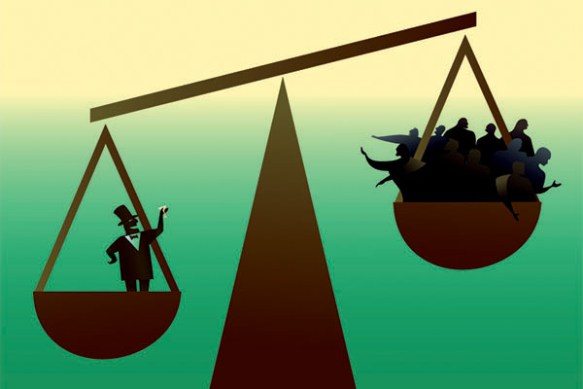
“The War on Terrorism” is “Fake”: On the Need for Mass Social Mobilizations and Transformative Changes

By Mark Taliano

Source: GlobalResearch.ca

Myriad agencies, funded by Western governments, foundations, and NATO, continue to erect o barriers to freedoms of thought and expression in the West’s post-democratic, New Fascist, societies.

The totalitarianism implicit in these restrictions means that colonial media is monochromatic, tightly framed, and ubiquitous. There is no “free exchange” of ideas, a necessary foundation of democratic societies. Hence, messaging that promotes wars of aggression, and dysfunctional economic ideologies remains ascendant in the public sphere.

The public is led to believe that never-ending criminal wars and vast outflows of public monies to the military industrial complex are normal and necessary. Similarly, publicly bailed-out, predatory, diseconomies are presented as the only viable economic models.  Socially-oriented, (democratic) political economies, we are told, “do not work”.  The public remains unaware that Empire wages criminal economic and “kinetic”, terrorist-supporting warfare, against societies that seek to determine their own political economies.  Socially-oriented political-economies in countries such as Libya, Iraq, Syria, Nicaragua, Venezuela and on and on, are constantly under attack, and not allowed to thrive. Empire targets these countries criminally, aggressively, and perpetually.

The covert barriers which create bounded, framed restrictions on freedoms of expression create a “chilling effect” that promotes self-censorship, and disappears evidence-based truths which would otherwise counter-balance narratives from media conglomerates, all of which are unduly impacted, and subservient to “establishment” pressures from Big Oil, Banking, Military Industrial Complex, Big Pharmaceutical, and other monopolies.

Thought leaders who step outside of the confines of Establishment narratives are targeted. The University of Sydney’s warrantless suspension of best-selling author and Senior lecturer, Prof. Tim Anderson[1], from his teaching duties, is a case in point. Not only does his suspension create a “chilling effect”, and a culture of academic self-censorship, but it also restricts the amount of evidence-based research that reaches the public arena.

Military/Intelligence fronts, such as the Integrity Initiative[2]– well-funded by state agencies and even NATO[3]– add to the oppression, not only by targeting individuals for smear campaigns, but also by guaranteeing a non-stop flow of war propaganda.

Time and again, policymakers use Private Intelligence Contractors (PICS) as sources of fake intelligence that they wrap around previously planned policies, to give an air of credibility to war propaganda. Have we forgotten already the lies used to justify the West’s supremely criminal destruction of Iraq? All of the post-9/11 wars (and beyond) were sold to gullible domestic populations by means of well-planned strategies of deception.

It is an unequal battle, but the broad-based public must first free itself from foundational war lies if we are to make transformative changes. Foremost amongst these lies is “The War On Terrorism”. The public needs to understand that this War on Terror myth is cover for criminal wars of conquest. Our governments and their agencies support the terrorists. Pretending that the West is fighting ISIS and other terrorists (i.e al Qaeda) prolongs the suffering of its victims, past, present, and future. It is not a war against ISIS. It never was. The West and its allies support all of the terrorists in Syria, (and beyond), including ISIS.

If the public can be disabused of the “War on Terrorism” myth, then it will be ready for mass social unrest and mobilizations for fundamental reforms.  Incremental reforms only bolster Establishment positions by providing illusions of democratic policymaking.

For starters, Canada needs to leave NATO, cut its military budget, end its “neoliberal” diseconomy, instate a socially-oriented economy, and regain its sovereignty and democracy.

Given all of the structural barriers that we face, these goals may never be achieved, but we still “win” when we at least struggle for justice.


Note to readers: please click the share buttons. Forward this article to your email lists. Crosspost on your blog site, internet forums. etc.

Mark Taliano is a Research Associate of the Centre for Research on Globalization (CRG) and the author of Voices from Syria, Global Research Publishers, 2017.

Notes

[1] Prof. Tim Anderson, “STEPHEN GARTON’S OVERREACH: INTELLECTUAL FREEDOM AT THE UNIVERSITY OF SYDNEY.” Avant Garde, 12 December, 2018.( https://avantgarde2009.wordpress.com/2018/12/12/stephen-gartons-overreach-intellectual-freedom-at-the-university-of-sydney/?fbclid=IwAR1MpVAZX-F7LcuwbZvSzHAio1mN-L2BemweI7IVMuBrEGrjRjT-sRSRLpc) Accessed 19 December, 2018.

[2] Mohamed Elmaazi and Max Blumenthal, “Inside The Temple Of Covert Propaganda: The Integrity Initiative And The U.K’s Scandalous Information War.” Gray Zone,17 November, 2018. (https://grayzoneproject.com/2018/12/17/inside-the-temple-of-covert-propaganda-the-integrity-initiative-and-the-uks-scandalous-information-war/) Accessed 19 December, 2018.

[3] George Eliason, “A Crisis in Intelligence: Unthinkable Consequences of Outsourcing U.S. Intel. (Part 3)” Consortium News, 18 February, 2018.( https://consortiumnews.com/2018/02/18/a-crisis-in-intelligence-unthinkable-consequences-of-outsourcing-u-s-intel-part-3/?fbclid=IwAR2DKmAtaSMattb28apQZ-gCJ61stFYP3jem97t93PLm-bSpQLGp-0Z_4No) Accessed 18 February, 2018.

Reflections on 2018, Forecasting 2019

By Robert J. Burrowes

In many ways it is painful to reflect on the year 2018; a year of vital opportunities lost when so much is at stake.

Whether politically, militarily, socially, economically, financially or ecologically, humanity took some giant strides backwards while passing up endless opportunities to make a positive difference in our world.

Let me, very briefly, identify some of the more crucial backward steps, starting with the recognition by the Bulletin of the Atomic Scientists in January that the year had already started badly when they moved the Doomsday Clock to two minutes to midnight, the closest it has ever been to ‘doomsday’ (and equal to 1953 when the Soviet Union first exploded a thermonuclear weapon matching the US capacity). See ‘It is now two minutes to midnight’.

This change reflected the perilous state of our world, particularly given the renewed threat of nuclear war and the ongoing climate catastrophe. It didn’t even mention the massive and unrelenting assault on the biosphere (apart from the climate) nor, of course, the ongoing monumental atrocities against fellow human beings.

Some Lowlights of 2018

  1. The global elite, using key elite fora such as the Group of 30, the Trilateral Commission, the Bilderberg Group and the World Economic Forum, continued to plan, generate and exacerbate the many ongoing wars, deepening exploitation within the global economy, climate and environmental destruction, and the refugee crisis, among many other violent impacts, in pursuit of greater elite power, profit and privilege.
  1. International organizations (such as the United Nations, the World Bank and International Monetary Fund) and national governments used military forces, legal systems, police forces and prison systems around the world to serve the global elite by defending its interests against the bulk of the human population, including those individuals and organizations audacious enough to challenge elite power, profit and privilege.
  1. $US1.7 trillion was officially spent worldwide on military weapons to kill fellow human beings and other lifeforms, and to destroy the biosphere. See ‘Global military spending remains high at $1.7 trillion’.

However, so out-of-control is this spending that the United States has now spent $US21trillion on its military in the past 20 years for which it cannot even account! That’s right, $US1trillion each year, including 2018, above the official US national budget for killing is ‘lost’. See Army General Fund Adjustments Not Adequately Documented or Supported, ‘Has Our Government Spent $21 Trillion Of Our Money Without Telling Us?’ and ‘The Pentagon Can’t Account for $21 Trillion (That’s Not a Typo)’.

  1. War and other military violence continued to rage across the planet wreaking devastation on many countries and regions, particularly in the Middle East and Africa. If you missed this, read what is happening to Yemen, described as ‘ the world’s worst [humanitarian] crisis in decades’ with ‘three quarters of the entire Yemeni population – 22 million women, children and men – dependent on some form of humanitarian assistance to survive.’ See ‘Yemen: UN chief hails “signs of hope” in world’s worst man-made humanitarian disaster’.
  1. Not content with the nature and extent of the military violence they are inflicting already, during 2018 elites continued to plan how to do it more effectively in future with research and development of artificial intelligence just one manifestation of this: ‘an “arms race in AI” is now underway, with the U.S., China, Russia, and other nations (including Britain, Israel, and South Korea) seeking to gain a critical advantage in the weaponization of artificial intelligence and robotics’ so that ‘artificial intelligence will be applied to every aspect of warfare, from logistics and surveillance to target identification and battle management’. See ‘“Alexa, Launch Our Nukes!” Artificial Intelligence and the Future of War’.
  1. The United States government unilaterally withdrew from the Intermediate Nuclear Forces (INF) Treaty (which limits the deployment of intermediate range nuclear weapons).
  1. Another significant proportion of global private financial wealth – conservatively estimated by the Tax Justice Network in 2010 to already total between $US21 and $US32 trillion – has been invested virtually tax-free through the world’s still-expanding black hole of more than 80 ‘offshore’ tax havens (such as the City of London Corporation, Jersey, Guernsey, the Isle of Man, Bermuda, the Cayman Islands, Hong Kong, Nauru, St. Kitts, Antigua, Tortola, Switzerland, the Channel Islands, Monaco, Cyprus, Gibraltar and Liechtenstein). This is just financial wealth. ‘A big share of the real estate, yachts, racehorses, gold bricks – and many other things that count as non-financial wealth – are also owned via offshore structures where it is impossible to identify the owners.’ See Tax Justice Network.

Controlled by the global elite, Wall Street and other major banks manage this monstrous diversion of wealth under Government protection. ‘Their business is fraud and grand theft.’ Tax haven locations offer more than tax avoidance. ‘Almost anything goes on.’ It includes ‘bribery, illegal gambling, money laundering, human and sex trafficking, arms dealing, toxic waste dumping, conflict diamonds and endangered species trafficking, bootlegged software, and endless other lawless practices.’ See ‘Trillions Stashed in Offshore Tax Havens’.

  1. The world’s major corporations continued to inflict enormous ongoing violence (in a myriad of ways) in their pursuit of endless profit at the expense of living beings (human and otherwise) and Earth’s biosphere by producing and marketing a wide range of life-destroying products ranging from nuclear weapons and nuclear power to junk food, pharmaceutical drugs, synthetic poisons and genetically mutilated organisms (GMOs). These corporations include those involved in the following industries: weapons manufacturers, major banks and their ‘industry groups’ like the International Monetary Conference, asset management firms, investment companies, financial services companies, fossil fuel (coal, oil and gas) corporations, technology corporations, media corporations, major marketing and public relations corporations, agrochemical (pesticides, seeds, fertilizers) giants, pharmaceutical corporations, biotechnology (genetic mutilation) corporations, mining corporations, nuclear power corporations, food multinationals and water corporations. You can see a list of the major corporations in this article: ‘The Global Elite is Insane Revisited’.
  1. More than a billion people continued to live under occupation, dictatorship or threat of genocidal assault. See, for example, ‘500 Years is Long Enough! Human Depravity in the Congo’.
  1. 36,500,000 human beings (mainly in Africa, Asia and Central/South America) were starved to death.
  1. 18,250,000 children were killed by adults in wars, by starving them to death, and in a large variety of other ways.
  1. 8,000,000 children were trafficked into sexual slavery; executed in sacrificial killings after being kidnapped; bred to be sold as a ‘cash crop’ for sexual violation, to produce child pornography (‘kiddie porn’) and ‘snuff’ movies (in which children are killed during the filming); ritually tortured and murdered as well as raped by dogs trained for the purpose. See ‘Humanity’s “Dirty Little Secret”: Starving, Enslaving, Raping, Torturing and Killing our Children’.
  1. Hundreds of thousands of individuals were kidnapped or tricked into slavery, which now denies 46,000,000 human beings the right to live the life of their choice, condemning many individuals – especially women and children – to lives of sexual slavery, forced labor or as child soldiers. See The Global Slavery Index’ and 46 million people living as slaves, latest global index reveals’.
  1. Well over 100,000 people (particularly Falun Gong practitioners) in China, where an extensive state-controlled program is conducted, were subjected to forced organ removal for the trade in human organs. See Bloody Harvest and The Slaughter.
  1. 15,750,000 people were displaced by war, persecution or famine. There are now 68,500,000 people, more that half of whom are children and 10,000,000 of whom are stateless, who have been forcibly displaced worldwide and remain precariously unsettled, usually in adverse circumstances. One person in the world is forcibly displaced every two seconds. See ‘Figures at a Glance’.
  1. Millions of people were made homeless in their own country as a result of war, persecution, ‘natural’ disasters, internal conflict, poverty or as a result of elite-driven national economic policy. The last time a global survey was attempted – by the United Nations back in 2005 – an estimated 100 million people were homeless worldwide. As many as 1.6 billion people lack adequate housing (living in slums, for example). See ‘Global Homelessness Statistics’.
  1. 73,000 species of life (plants, birds, animals, fish, amphibians, insects and reptiles) on Earth were driven to extinction with the worldwide loss of insects, including vital pollinators such as bees, now between 75% and 90%, depending on the species. See ‘Insect Decimation Upstages Global Warming’. Have you seen a butterfly recently?
  1. Separately from global species extinctions, Earth continued to experience ‘a huge episode of population declines and extirpations, which will have negative cascading consequences on ecosystem functioning and services vital to sustaining civilization. We describe this as a “biological annihilation” to highlight the current magnitude of Earth’s ongoing sixth major extinction event.’ Moreover, local population extinctions ‘are orders of magnitude more frequent than species extinctions. Population extinctions, however, are a prelude to species extinctions, so Earth’s sixth mass extinction episode has proceeded further than most assume.’ See ‘Biological annihilation via the ongoing sixth mass extinction signaled by vertebrate population losses and declines’ and ‘Biological Annihilation on Earth Accelerating’.
  1. Wildlife trafficking, worth up to $20 billion in 2018, is pushing many endangered species to the brink of extinction. Illegal wildlife products include jewelry, traditional medicine, clothing, furniture, and souvenirs, as well as some exotic pets, most of which are sold to unaware/unconcerned consumers in the West. See, for example, Stop Wildlife Trafficking.
  1. 16,000,000 acres of pristine rainforest were destroyed (with more than 40,000 tropical tree species now threatened with extinction). See ‘Measuring the Daily Destruction of the World’s Rainforests’, ‘Estimating the global conservation status of more than 15,000 Amazonian tree species’ and ‘Half of Amazon Tree Species Face Extinction’.
  1. Vast quantities of soil were washed away as we destroyed the rainforests, and enormous quantities of both inorganic constituents (such as heavy metals like cadmium, chromium, lead, mercury, nickel and zinc) and organic pollutants (particularly synthetic chemicals in the form of fertilizers, pesticides and herbicides) were dumped into the soil as well, thus reducing its nutrients and killing the microbes within it. We also contaminated enormous quantities of soil with radioactive waste. See Soil-net, ‘Glyphosate effects on soil rhizosphere-associated bacterial communities’ and ‘Disposing of Nuclear Waste is a Challenge for Humanity’.
  1. The TEPCO nuclear power plant in Fukushima, Japan discharged 109,000 tons of radioactive waste into the Pacific Ocean killing an incalculable number of fish and other marine organisms and indefinitely contaminating expanding areas of that ocean. See ‘Fukushima: A Nuclear War without a War: The Unspoken Crisis of Worldwide Nuclear Radiation’.
  1. Human use of fossil fuels to power aircraft, shipping and vehicles (among other purposes) released 10 billion metric tons (gigatons) of carbon dioxide into Earth’s atmosphere, a 2.7% increase over 2017. See ‘Global Carbon Budget 2018’ and ‘Carbon dioxide emissions will hit a record high globally in 2018’. As a measure of their concern elite-controlled governments and corporations around the world are currently planning or have under construction 1,380 new coal plants? That’s right. 1,380 new coal plants. In 59 countries. See ‘NGOs Release List of World’s Top Coal Plant Developers’ and ‘2018 Coal Plant Developers List’.
  1. 90 billion land animals and 60 billion marine animals were killed for human consumption, more than 100 million animals were killed for laboratory purposes in the United States alone and there were other animal deaths in shelters, zoos and in blood sports. See ‘How Many Animals Are Killed Each Year?’

In addition, 40 million animals were killed for their fur. Approximately 30 million of these animals were raised on fur farms and killed, about 10 million wild animals were trapped and killed, and hundreds of thousands of seals were killed for their fur. See ‘How Many Animals are Killed Each Year?’

  1. Farming of animals for human consumption released 7,100,000,000 tonnes of CO2-equivalent into Earth’s atmosphere. About 44% of livestock emissions were in the form of methane (which was 44% of anthropogenic CH4 emissions), 29% as Nitrous Oxide (which was 53% of anthropogenic N2O emissions) and 27% as Carbon Dioxide (which was 5% of anthropogenic CO2 emissions). See ‘GHG Emissions by Livestock’.
  1. Human use of fossil fuels and farming of animals released 3.2 million metric tons of (CO2 equivalent) nitrous oxide (N2O) into Earth’s atmosphere. See ‘Nitrous oxide emissions’.
  1. As a result of previous greenhouse gas (GHG) emissions and the consequent rise of about one degree celsius in the global temperature, causing the melting of Arctic permafrost and undersea methane ice clathrates, an incalculable quantity of methane was uncontrollably released into the atmosphere during 2018 (with the quantity being released getting ever closer to ‘exploding’). See ‘7,000 underground gas bubbles poised to “explode” in Arctic’ and ‘Release of Arctic Methane “May Be Apocalyptic,” Study Warns’.
  1. Ice in the Antarctic is melting at a record-breaking rate, losing 219 billion tonnes of ice in 2018 at a rate that has accelerated threefold in the last five years. See ‘Antarctic ice melting faster than ever, studies show’.
  1. An incalculable amount of agricultural poisons, fossil fuels and other wastes was discharged into the ocean, adversely impacting life at all ocean depths – see ‘Staggering level of toxic chemicals found in creatures at the bottom of the sea, scientists say’ – and generating ocean ‘dead zones’: regions that have too little oxygen to support marine organisms. See ‘Our Planet Is Exploding With Marine “Dead Zones”’.
  1. At least 8 million metric tons of plastic, of which 236,000 tons were microplastics, was discharged into the ocean. See ‘Plastic waste inputs from land into the ocean’ and ‘Plastics in the Ocean’.
  1. Earth’s fresh water and ground water was further depleted and contaminated. These contaminants included bacteria, viruses and household chemicals from faulty septic systems; hazardous wastes from abandoned and uncontrolled hazardous waste sites (of which there are over 20,000 in the USA alone); leaks from landfill items such as car battery acid, paint and household cleaners; the pesticides, herbicides and other poisons used on farms and home gardens; radioactive waste from nuclear tests; and the chemical contamination caused by hydraulic fracturing (fracking) in search of shale gas, for which about 750 chemicals and components, some extremely toxic and carcinogenic like lead and benzene, have been used. See ‘Groundwater contamination’, ‘Groundwater drunk by BILLIONS of people may be contaminated by radioactive material spread across the world by nuclear testing in the 1950s’ and ‘Fracking chemicals’.
  1. The longstanding covert military use of geoengineering – spraying tens of millions of tons of highly toxic metals (including aluminium, barium and strontium) and toxic coal fly ash nanoparticulates (containing arsenic, chromium, thallium, chlorine, bromine, fluorine, iodine, mercury and radioactive elements) into the atmosphere from jet aircraft to weaponize the atmosphere and weather – in order to enhance elite control of human populations, continued unchecked. Geoengneering is systematically destroying Earth’s ozone layer – which blocks the deadly portion of solar radiation, UV-C and most UV-B, from reaching Earth’s surface – as well as adversely altering Earth’s weather patterns and polluting its air, water and soil at incredible cost to the health and well-being of living organisms and the biosphere. See ‘Geoengineering Watch’.
  1. As one outcome of our dysfunctional parenting model and political systems, fascism continued to rise around the world. See ‘The Psychology of Fascism’.
  1. Despite the belief that we have ‘the right to privacy’, privacy (in any sense of the word) was ongoingly eroded in 2018 and is now effectively non-existent, particularly thanks to Alphabet (owner of Google). Taken together, ‘Uber, Amazon, Facebook, eBay, Tinder, Apple, Lyft, Foursquare, Airbnb, Spotify, Instagram, Twitter, Angry Birds… have turned our computers and phones into bugs that are plugged in to a vast corporate-owned surveillance network. Where we go, what we do, what we talk about, who we talk to, and who we see – everything is recorded and, at some point, leveraged for value.’ Moreover, given Google’s integrated relationship with the US government, the US military, the CIA, and major US weapons manufacturers, there isn’t really anything you can do that isn’t known by those who want to know it. In essence, Google is ‘a powerful global corporation with its own political agenda and a mission to maximise profits for shareholders’ and it partly achieves this by expanding the surveillance programs of the national security state at the direction of the global elite. See ‘Google’s Earth: How the Tech Giant Is Helping the State Spy on Us’ and the documentary ‘The Modern Surveillance State’.
  1. The right to free speech was ongoingly eroded in 2018. For just a couple of examples in the United States alone, see ‘Marc Lamont Hill On Getting Fired From CNN, His Remarks On Palestine + More’ and ‘A Texas Elementary School Speech Pathologist Refused to Sign a Pro-Israel Oath, Now Mandatory in Many States – so She Lost Her Job’.
  1. Believing that we know better than evolution, humans created the first gene-edited baby in 2018. See ‘Why we are not ready for genetically designed babies’ and China’s Golem Babies: There is Another Agenda’.
  1. An incalculable amount of junk was added to the 100 trillion items of junk already in Space. See ‘Space Junk: Tracking & Removing Orbital Debris’.
  1. Incalculable amounts of antibiotic waste, nuclear waste, nanowaste and genetically engineered organisms were released into Earth’s biosphere. See ‘Junk Planet: Is Earth the Largest Garbage Dump in the Universe?’
  1. Ongoing violence against children – see Why Violence? and Fearless Psychology and Fearful Psychology: Principles and Practice – ensured that more people will grow up accepting (and quite powerless to challenge) our dysfunctional and violent world, as described above.
  1. The corporate media, education and entertainment industries continued to distract us from reality ensuring that most people remain oblivious to our predicament and their own role in it, let alone what they can do to respond powerfully.

While the above list of the setbacks humanity and the Earth suffered in 2018 is very incomplete, it still provides clear evidence that humanity is rapidly entering a dystopian future far more horrific than the worst novel or film in the genre. The good news is that, at the current rate, this dystopian world will be shortlived as humans drive themselves over the edge of extinction. See ‘Human Extinction by 2026? A Last Ditch Strategy to Fight for Human Survival’.

But so that the picture is clear and ‘balanced’: were there any gains made against this onslaught?

Of course, it goes without saying that the global elite, international organizations (such as the United Nations), governments, corporations and other elite agents continued to live in delusion/denial endlessly blocking any initiative requiring serious action that would cut into corporate profits, or arguing over tangential issues of insignificant consequence to humanity’s future.

In short, I could find no record of official efforts during the year to plan for the development and implementation of a comprehensive, just and sustainable peace, but perhaps I missed it.

Separately from this, there have been some minor activist gains: for example, some western banks and insurance companies are no longer financially supporting the expansion of the western weapons industry and the western coal industry, some rainforest groups have managed to save portions of Earth’s rainforest heritage, and activist groups continue to work on a variety of issues sometimes making modest gains.

In essence however, as you probably realize, many of the issues above are not even being tackled and, even when they are, activist efforts have been hampered by inadequate analysis of the forces driving conflicts and problems, limited vision (particularly unambitious aims such as those in relation to ending war and the climate catastrophe), unsophisticated strategy (necessary to have profound impact against a deeply entrenched, highly organized and well-resourced opponent, with the endless lobbying of elite institutions, such as governments and corporations, despite this effort simply absorbing and dissipating our dissent, as is intended – as Mark Twain once noted: ‘If voting made a difference, they wouldn’t let us do it.’) and failure to make the difficult decisions to promote necessary solutions that are ‘unpopular’.

Fundamentally, these ‘difficult decisions’ include the vital need to campaign for the human population, particularly in the West, to substantially reduce their consumption – by 80% – involving both energy and resources of every kind as the central feature of any strategy to curtail destruction of the environment and climate, to undermine capitalism and to eliminate the primary driver of war: violent resource acquisition from Middle Eastern and developing nations for the production of consumer goods and services for western consumers.

While we live in the delusion that we can simply substitute renewable energy for fossil fuels and nuclear power (or believe such delusions that a 1.5 degrees celsius increase above the preindustrial temperature is acceptable or that we have an ‘end of century’ timeframe to solve the climate crisis), we ignore the fundamental reality that Earth’s biosphere is under siege on many fronts as a result of our endless extraction of its natural resources – such as fresh water, minerals, timber and, again, fossil fuels – for consumer production and the provision of services that go well beyond energy.

In short, for example, we will not save the world’s rainforests because we switch to renewable energy. We must reduce demand for the consumer products that require rainforest inputs. We must stop mining the Earth for minerals that end up in our mobile phones, computers, vehicles, ships and aircraft by not using the products and services these minerals make possible. We must stop eating meat and other animal products. And so the list goes on.

Forecasting 2019

In many ways it is painful to forecast what will happen in 2019 mainly because of the absurd simplicity of doing so: It will be another year when vital opportunities will be lost when so much is at stake.

Given the insanity of the global elite – see ‘The Global Elite is Insane Revisited’ – which will continue to drive the dynamics producing the lowlights mentioned above with the active complicity of their agents in governments and corporations coupled with a human population that is largely terrified, self-hating and powerless to resist – see ‘In Defense of the Human Individual’ – it is a straightforward task to forecast what will happen in 2019.

So let me forecast 40 lowlights for 2019:

  1. See list above.
  2. See list above.
  3. See list above.

.
.

  1. See list above.

So unless you play your part, 2019 and the few years thereafter will simply be increasingly worse versions of 2018 and it will all be over by 2026. See ‘Human Extinction by 2026? A Last Ditch Strategy to Fight for Human Survival’ which cites a wide range of scientific and other evidence which you are welcome to consider for yourself if this date seems premature.

Responding Powerfully

If you already feel able to act powerfully in response to this multifaceted crisis, in a way that will have strategic impact, you are invited to consider joining those participating in The Flame Tree Project to Save Life on Earth, which outlines a simple plan for you to systematically reduce your consumption, by at least 80%, involving both energy and resources of every kind – water, household energy, transport fuels, metals, meat, paper and plastic – while dramatically expanding your individual and community self-reliance in 16 areas, so that all environmental and climate concerns are effectively addressed.

If you are also interested in conducting or participating in a campaign to systematically address one of the issues identified above, you are welcome to consider acting strategically in the way that Mohandas K. Gandhi did. Whether you are engaged in a peace, climate, environment or social justice campaign, the 12-point strategic framework and principles are the same. See Nonviolent Campaign Strategy. And, for example, you can see a basic list of the strategic goals necessary to end war and halt the climate catastrophe. See ‘Strategic Aims’.

If you want to know how to nonviolently defend against a foreign invading power or a political/military coup, to liberate your country from a dictatorship or a foreign occupation, or to defeat a genocidal assault, you will learn how to do so in Nonviolent Defense/Liberation Strategy.

If you are interested in nurturing children to live by their conscience and to gain the courage necessary to resist elite violence fearlessly, while living sustainably despite the entreaties of capitalism to over-consume, then you are welcome to make ‘My Promise to Children’.

To reiterate: capitalism, war and destruction of the environment and climate are outcomes of our dysfunctional parenting of children which distorts their intellectual and emotional capacities, destroys their conscience and courage, and actively teaches them to over-consume as compensation for having vital emotional needs denied. See ‘Love Denied: The Psychology of Materialism, Violence and War’.

If your own intellectual and/or emotional functionality is the issue and you have the self-awareness to perceive that, and wish to access the conscience and courage that would enable you to act powerfully, try ‘Putting Feelings First’.

And if you want to be part of the worldwide movement committed to ending all of the violence identified above, consider signing the online pledge of ‘The People’s Charter to Create a Nonviolent World’.

In summary: if we do not rapidly, systematically and substantially reduce our consumption in several key areas and radically alter our parenting model, while resisting elite violence strategically on several fronts, homo sapiens will enter Earth’s fossil record within a few years. Given the fear, self-hatred and powerlessness that paralyses most humans, your choices in these regards are even more vital than you realize.


Biodata: Robert J. Burrowes has a lifetime commitment to understanding and ending human violence. He has done extensive research since 1966 in an effort to understand why human beings are violent and has been a nonviolent activist since 1981. He is the author of Why Violence? His email address is flametree@riseup.net and his website is here.

Robert J. Burrowes
P.O. Box 68
Daylesford, Victoria 3460
Australia

Email: flametree@riseup.net

Websites:
Nonviolence Charter
Flame Tree Project to Save Life on Earth
‘Why Violence?’
Feelings First
Nonviolent Campaign Strategy
Nonviolent Defense/Liberation Strategy
Anita: Songs of Nonviolence
Robert Burrowes
Global Nonviolence Network

The Pentagon’s Massive Accounting Fraud Exposed

How US military spending keeps rising even as the Pentagon flunks its audit.

By Dave Lindorff

Source: Information Clearing House

On November 15, Ernst & Young and other private firms that were hired to audit the Pentagon announced that they could not complete the job. Congress had ordered an independent audit of the Department of Defense, the government’s largest discretionary cost center—the Pentagon receives 54 cents out of every dollar in federal appropriations—after the Pentagon failed for decades to audit itself. The firms concluded, however, that the DoD’s financial records were riddled with so many bookkeeping deficiencies, irregularities, and errors that a reliable audit was simply impossible.

Deputy Secretary of Defense Patrick Shanahan tried to put the best face on things, telling reporters, “We failed the audit, but we never expected to pass it.” Shanahan suggested that the DoD should get credit for attempting an audit, saying, “It was an audit on a $2.7 trillion organization, so the fact that we did the audit is substantial.” The truth, though, is that the DoD was dragged kicking and screaming to this audit by bipartisan frustration in Congress, and the result, had this been a major corporation, likely would have been a crashed stock.

As Republican Senator Charles Grassley of Iowa, a frequent critic of the DoD’s financial practices, said on the Senate floor in September 2017, the Pentagon’s long-standing failure to conduct a proper audit reflects “twenty-six years of hard-core foot-dragging” on the part of the DoD, where “internal resistance to auditing the books runs deep.” In 1990, Congress passed the Chief Financial Officers Act, which required all departments and agencies of the federal government to develop auditable accounting systems and submit to annual audits. Since then, every department and agency has come into compliance—except the Pentagon.

Now, a Nation investigation has uncovered an explanation for the Pentagon’s foot-dragging: For decades, the DoD’s leaders and accountants have been perpetrating a gigantic, unconstitutional accounting fraud, deliberately cooking the books to mislead the Congress and drive the DoD’s budgets ever higher, regardless of military necessity. DoD has literally been making up numbers in its annual financial reports to Congress—representing trillions of dollars’ worth of seemingly nonexistent transactions—knowing that Congress would rely on those misleading reports when deciding how much money to give the DoD the following year, according to government records and interviews with current and former DoD officials, congressional sources, and independent experts.

“If the DOD were being honest, they would go to Congress and say, ‘All these proposed budgets we’ve been presenting to you are a bunch of garbage,’ ” said Jack Armstrong, who spent more than five years in the Defense Department’s Office of Inspector General as a supervisory director of audits before retiring in 2011.

The fraud works like this. When the DoD submits its annual budget requests to Congress, it sends along the prior year’s financial reports, which contain fabricated numbers. The fabricated numbers disguise the fact that the DoD does not always spend all of the money Congress allocates in a given year. However, instead of returning such unspent funds to the US Treasury, as the law requires, the Pentagon sometimes launders and shifts such moneys to other parts of the DoD’s budget.

Veteran Pentagon staffers say that this practice violates Article I Section 9 of the US Constitution, which stipulates that

No Money shall be drawn from the Treasury, but in Consequence of Appropriations made by Law; and a regular Statement and Account of the Receipts and Expenditures of all public Money shall be published from time to time.

Among the laundering tactics the Pentagon uses: So-called “one-year money”—funds that Congress intends to be spent in a single fiscal year—gets shifted into a pool of five-year money. This maneuver exploits the fact that federal law does not require the return of unspent “five-year money” during that five-year allocation period.

The phony numbers are referred to inside the Pentagon as “plugs,” as in plugging a hole, said current and former officials. “Nippering,” a reference to a sharp-nosed tool used to snip off bits of wire or metal, is Pentagon slang for shifting money from its congressionally authorized purpose to a different purpose. Such nippering can be repeated multiple times “until the funds become virtually untraceable,” says one Pentagon-budgeting veteran who insisted on anonymity in order to keep his job as a lobbyist at the Pentagon.

The plugs can be staggering in size. In fiscal year 2015, for example, Congress appropriated $122 billion for the US Army. Yet DoD financial records for the Army’s 2015 budget included a whopping $6.5 trillion (yes, trillion) in plugs. Most of these plugs “lack[ed] supporting documentation,” in the bland phrasing of the department’s internal watchdog, the Office of Inspector General. In other words, there were no ledger entries or receipts to back up how that $6.5 trillion supposedly was spent. Indeed, more than 16,000 records that might reveal either the source or the destination of some of that $6.5 trillion had been “removed,” the inspector general’s office reported.

In this way, the DoD propels US military spending higher year after year, even when the country is not fighting any major wars, says Franklin “Chuck” Spinney, a former Pentagon whistle-blower. Spinney’s revelations to Congress and the news media about wildly inflated Pentagon spending helped spark public outrage in the 1980s. “They’re making up the numbers and then just asking for more money each year,” Spinney told The Nation. The funds the Pentagon has been amassing over the years through its bogus bookkeeping maneuvers “could easily be as much as $100 billion,” Spinney estimated.

Indeed, Congress appropriated a record amount—$716 billion—for the DoD in the current fiscal year of 2019. That was up $24 billion from fiscal year 2018’s $692 billion, which itself was up $6 billion from fiscal year 2017’s $686 billion. Such largesse is what drives US military spending higher than the next ten highest-spending countries combined, added Spinney. Meanwhile, the closest thing to a full-scale war the United States is currently fighting is in Afghanistan, where approximately 15,000 US troops are deployed—only 2.8 percent as many as were in Vietnam at the height of that war.

The DoD’s accounting practices appear to be an intentional effort to avoid accountability, says Armstrong. “A lot of the plugs—not all, but a substantial portion—are used to force general-ledger receipts to agree with the general budget reports, so what’s in the budget reports is basically left up to people’s imagination,” Armstrong says, adding, “Did the DoD improperly spend funds from one appropriated purpose on another? Who can tell?”

“The United States government collects trillions of dollars each year for the purpose of funding essential functions, including national-security efforts at the Defense Department,” Senator Grassley told The Nation. “When unelected bureaucrats misuse, mismanage and misallocate taxpayer funds, it not only takes resources away from vital government functions, it weakens citizens’ faith and trust in their government.”

This Pentagon accounting fraud is déjà vu all over again for Spinney. Back in the 1980s, he and a handful of other reform-minded colleagues exposed how the DoD used a similar accounting trick to inflate Pentagon spending—and to accumulate money for “off-the-books” programs. “DoD routinely over-estimated inflation rates for weapons systems,” Spinney recalled. “When actual inflation turned out to be lower than the estimates, they did not return the excess funds to the Treasury, as required by law, but slipped them into something called a ‘Merged Surplus Account,’” he said.

“In that way, the Pentagon was able to build up a slush fund of almost $50 billion” (about $120 billion in today’s money), Spinney added. He believes that similar tricks are being used today to fund secret programs, possibly including US Special Forces activity in Niger. That program appears to have been undertaken without Congress’s knowledge of its true nature, which only came to light when a Special Forces unit was ambushed there last year, resulting in the deaths of four US soldiers.

“Because of the plugs, there is no auditable way to track Pentagon funding and spending,” explains Asif Khan of the Government Accountability Office, the Congress’s watchdog on the federal bureaucracy. “It’s crucial in auditing to have a reliable financial record for prior years in order to audit the books for a current year,” notes Khan, the head of the National Security Asset Management unit at GAO. Plugs and other irregularities help explain why the Pentagon has long been at or near the top of the GAO’s list of “high risk” agencies prone to significant fraud, waste, and abuse, he adds.

The Nation submitted detailed written questions and requested interviews with senior officials in the Defense Department before publishing this article. Only public-affairs staff would speak on the record. In an e-mailed response, Christopher Sherwood of the DoD’s Public Affairs office denied any accounting impropriety. Any transfer of funds between one budgetary account and another “requires a reprogramming action” by Congress, Sherwood wrote, adding that any such transfers amounting to more than 1 percent of the official DoD budget would require approval by “all four defense congressional committees.”

The scale and workings of the Pentagon’s accounting fraud began to be ferreted out last year by a dogged research team led by Mark Skidmore, a professor of economics specializing in state and local government finance at Michigan State University. Skidmore and two graduate students spent months poring over DoD financial statement reviews done by the department’s Office of Inspector General. Digging deep into the OIG’s report on the Army’s 2015 financial statement, the researchers found some peculiar information. Appendix C, page 27, reported that Congress had appropriated $122 billion for the US Army that year. But the appendix also seems to report that the Army had received a cash deposit from the US Treasury of $794.8 billion. That sum was more than six times larger than Congress had appropriated—indeed, it was larger than the entire Pentagon budget for the year. The same appendix showed that the Army had accounts payable (accounting lingo for bills due) totaling $929.3 billion.

“I wondered how you could possibly get those kinds of adjustments out of a $122 billion budget,” Skidmore recalled. “I thought, initially, ‘This is absurd!’ And yet all the [Office of Inspector General] seemed to do was say, ‘Here are these plugs.’ Then, nothing. Even though this kind of thing should be a red flag, it just died. So we decided to look further into it.”

To make sure that fiscal year 2015 was not an anomaly, Skidmore and his graduate students expanded their inquiry, examining OIG reports on Pentagon financial records stretching back to 1998. Time and again, they found that the amounts of money reported as having flowed into and out of the Defense Department were gargantuan, often dwarfing the amounts Congress had appropriated: $1.7 trillion in 1998, $2.3 trillion in 1999, $1.1 trillion in 2000, $1.1 trillion in 2007, $875 billion in 2010, and $1.7 trillion in 2012, plus amounts in the hundreds of billions in other years.

In all, at least a mind-boggling $21 trillion of Pentagon financial transactions between 1998 and 2015 could not be traced, documented, or explained, concluded Skidmore. To convey the vastness of that sum, $21 trillion is roughly five times more than the entire federal government spends in a year. It is greater than the US Gross National Product, the world’s largest at an estimated $18.8 trillion. And that $21 trillion includes only plugs that were disclosed in reports by the Office of Inspector General, which does not review all of the Pentagon’s spending.

To be clear, Skidmore, in a report coauthored with Catherine Austin Fitts, a former assistant secretary of the Department of Housing and Urban Development who complained about similar plugs in HUD financial statements, does not contend that all of this $21 trillion was secret or misused funding. And indeed, the plugs are found on both the positive and the negative sides of the ledger, thus potentially netting each other out. But the Pentagon’s bookkeeping is so obtuse, Skidmore and Fitts added, that it is impossible to trace the actual sources and destinations of the $21 trillion. The disappearance of thousands of records adds further uncertainty. The upshot is that no one can know for sure how much of that $21 trillion was, or was not, being spent legitimately.

That may even apply to the Pentagon’s senior leadership. A good example of this was Donald Rumsfeld, the notorious micromanaging secretary of defense during the Bush/Cheney administration. On September 10, 2001 Rumsfeld called a dramatic press conference at the Pentagon to make a startling announcement. Referring to the huge military budget that was his official responsibility, he said, “According to some estimates we cannot track $2.3 trillion in transactions.” This shocking news that an amount more than five times as large as the Pentagon’s FY 2001 budget of an estimated $313 billion was lost or even just “untrackable” was—at least for one 24-hour news cycle—a big national story, as was Secretary Rumsfeld’s comment that America’s adversary was not China or Russia, but rather was “closer to home: It’s the Pentagon bureaucracy.” Equally stunning was Rumsfeld’s warning that the tracking down of those missing transactions “could be…a matter of life and death.” No Pentagon leader had ever before said such a thing, nor has anyone done so since then. But Rumsfeld’s exposé died quickly as, the following morning on September 11, four hijacked commercial jet planes plowed full speed into the two World Trade Center towers, the Pentagon, and a field in Pennsylvania. Since that time, there has been no follow-up and no effort made to find the missing money, either.

Recalling his decades inside the Pentagon, Spinney emphasized that the slippery bookkeeping and resulting fraudulent financial statements are not a result of lazy DoD accountants. “You can’t look at this as an aberration,” he said. “It’s business as usual. The goal is to paralyze Congress.”

That has certainly been the effect. As one congressional staffer with long experience investigating Pentagon budgets, speaking on background because of the need to continue working with DoD officials, told The Nation, “We don’t know how the Pentagon’s money is being spent. We know what the total appropriated funding is for each year, but we don’t know how much of that funding gets spent on the intended programs, what things actually cost, whether payments are going to the proper accounts. If this kind of stuff were happening in the private sector, people would be fired and prosecuted.”

DoD officials have long insisted that their accounting and financial practices are proper. For example, the Office of Inspector General has attempted to explain away the absurdly huge plugs in DoD’s financial statements as being a common, widely accepted accounting practice in the private sector.

When this reporter asked Bridget Serchak, at the time a press spokesperson for the inspector general’s office, about the Army’s $6.5 trillion in plugs for fiscal year 2015, she replied, “Adjustments are made to the Army General Fund financial statement data…for various reasons such as correcting errors, reclassifying amounts and reconciling balances between systems…. For example, there was a net unsupported adjustment of $99.8 billion made to the $0.2 billion balance reported for Accounts Receivable.”

There is a grain of truth in Serchak’s explanation, but only a grain.

As an expert in government budgeting, Skidmore confirmed that it is accepted practice to insert adjustments into budget reports to make both sides of a ledger agree. Such adjustments can be deployed in cases where receipts have been lost—in a fire, for example—or where funds were incorrectly classified as belonging to one division within a company rather than another. “But those kinds of adjustments should be the exception, not the rule, and should amount to only a small percentage of the overall budget,” Skidmore said.

For its part, the inspector general’s office has blamed the fake numbers found in many DoD financial statements on the Defense Finance and Accounting Service (DFAS), a huge DoD accounting operation based in Indianapolis, Indiana. In review after review, the inspector general’s office has charged that DFAS has been making up “unsupported” figures to plug into DoD’s financial statements, inventing ledger entries to back up those invented numbers, and sometimes even “removing” transaction records that could document such entries. Nevertheless, the inspector general has never advocated punitive steps against DFAS officials—a failure that suggests DoD higher-ups tacitly approve of the deceptions.

Skidmore repeatedly requested explanations for these bookkeeping practices, he says, but the Pentagon response was stonewalling and concealment. Even the inspector general’s office, whose publicly available reports had been criticizing these practices for years, refused to answer the professor’s questions. Instead, that office began removing archived reports from its website. (Skidmore and his grad students, anticipating that possibility, had already downloaded the documents, which were eventually were restored to public access under different URLs.)

Nation inquiries have met with similar resistance. Case in point: A recent DoD OIG report on a US Navy financial statement for FY 2017. Although OIG audit reports in previous years were always made available online without restriction or censorship, this particular report suddenly appeared in heavily redacted form—not just the numbers it contained, but even its title! Only bureaucratic sloppiness enabled one to see that the report concerned Navy finances: Censors missed some of the references to the Navy in the body of the report, as shown in the passages reproduced here.

A request to the Office of Inspector General to have the document uncensored was met with the response: “It was the Navy’s decision to censor it, and we can’t do anything about that.” At The Nation’s request, Senator Grassley’s office also asked the OIG to uncensor the report. Again, the OIG refused. A Freedom Of Information Act request by The Nation to obtain the uncensored document awaits a response.

The GAO’s Khan was not surprised by the failure of this year’s independent audit of the Pentagon. Success, he points out, would have required “a good-faith effort from DoD officials, but to date that has not been forthcoming.” He added, “As a result of partial audits that were done in 2016, the Army, Navy, Air Force, and Marines have over 1,000 findings from auditors about things requiring remediation. The partial audits of the 2017 budget were pretty much a repeat. So far, hardly anything has been fixed.”

Let that sink in for a moment: As things stand, no one knows for sure how the biggest single-line item in the US federal budget is actually being spent. What’s more, Congress as a whole has shown little interest in investigating this epic scandal. The absurdly huge plugs never even get asked about at Armed Services and Budget Committee hearings.

One interested party has taken action—but it is action that’s likely to perpetuate the fraud. The normally obscure Federal Accounting Standards Advisory Board sets the accounting standards for all federal agencies. Earlier this year, the board proposed a new guideline saying that agencies that operate classified programs should be permitted to falsify figures in financial statements and shift the accounting of funds to conceal the agency’s classified operations. (No government agency operates more classified programs than the Department of Defense, which includes the National Security Agency.) The new guideline became effective on October 4, just in time for this year’s end-of-year financial statements.

So here’s the situation: We have a Pentagon budget that a former DOD internal-audit supervisor, Jack Armstrong, bluntly labels “garbage.” We have a Congress unable to evaluate each new fiscal year’s proposed Pentagon budget because it cannot know how much money was actually spent during prior years. And we have a Department of Defense that gives only lip service to fixing any of this. Why should it? The status quo has been generating ever-higher DoD budgets for decades, not to mention bigger profits for Boeing, Lockheed, and other military contractors.

The losers in this situation are everyone else. The Pentagon’s accounting fraud diverts many billions of dollars that could be devoted to other national needs: health care, education, job creation, climate action, infrastructure modernization, and more. Indeed, the Pentagon’s accounting fraud amounts to theft on a grand scale—theft not only from America’s taxpayers, but also from the nation’s well-being and its future.

As President Dwight D. Eisenhower, who retired from the military as a five-star general after leading Allied forces to victory in World War II, said in a 1953 speech, “Every gun that is made, every warship launched, every rocket fired signifies, in the final sense, a theft from those who hunger and are not fed, those who are cold and are not clothed.” What would Eisenhower say today about a Pentagon that deliberately misleads the people’s representatives in Congress in order to grab more money for itself while hunger, want, climate breakdown, and other ills increasingly afflict the nation?


Boycott Facebook, Twitter, and Google. Here’s Why

By Eric Zuesse

Source: Strategic Culture Foundation

NATO — the neoconservatives, the marketeers for firms such as Lockheed Martin and BAE — has taken over the social-media giants and much of online international ‘news’-reporting, including that of virtually all independent news-sites and blogs.

Facebook, Twitter, and Google, in recent days, delivered what might be the death-blows.

NATO’s main PR agency, think-tank, and lobbying organization, is ‘non-profit’ — a legal tax-dodge that’s financed by donations from those weapons-making firms and their supporting firms and their ‘non-profits’, so that the taxes that it doesn’t pay will need to be paid instead by the general public. Billionaires know how to avoid taxes, and they hire politicians who write the laws with all the ‘right’ loopholes for them — and only for the very richest — to use. This PR agency is called “The Atlantic Council,” and it was set up in 1961, the exact same year that U.S. President Dwight Eisenhower left office warning that “the military-industrial complex” might take control of the U.S. Well, it did so, with The Atlantic Council’s help; and, now, it is finally lowering the boom against democracy itself — at least among the U.S. and its allied nations (the governments whose weapons-manufacturing firms are in, and sell to, NATO governments). The aim is to drive up the percentage of government-expenditures there that go to pay those firms, and so to reduce the percentages that go to pay everything else. The aim, in short, is the permanent-warfare-economy. After all, firms such as Lockheed Martin and BAE sell only to allied governments. They have virtually no consumers except those governments. So: their (and their ‘charities’) basic message is ‘austerity’ — except on ‘defense’ or realistically called “aggression.” This is national ‘defense’ such as against Iraq in 2003, and against Libya in 2011 — it is instead sheer aggression. George Orwell predicted “Newspeak” — well, here it is. It’s today’s norm, so normal that the public think it’s just natural, and conservatives and even many liberals think it’s the way that ‘a free market’ ought to be.

Here was Facebook’s announcement, on October 11th:

——

newsroom.fb.com

11 October 2018

Removing Additional Inauthentic Activity from Facebook

Today, we’re removing 559 Pages and 251 accounts that have consistently broken our rules against spam and coordinated inauthentic behavior. Given the activity we’ve seen — and its timing ahead of the US midterm elections — we wanted to give some details about the types of behavior that led to this action. Many were using fake accounts or multiple accounts with the same names and posted massive amounts of content across a network of Groups and Pages to drive traffic to their websites. Many used the same techniques to make their content appear more popular on Facebook than it really was. Others were ad farms using Facebook to mislead people into thinking that they were forums for legitimate political debate.

——

Those 559 and 251 weren’t identified; none of them were. Facebook wants them to need to scream in order for them to be able to be noticed at all by the public. The announcement didn’t even say by what criteria they were measuring ‘Inauthentic Activity’ versus ‘legitimate political debate’. Their announcement did say “we look at these actors’ behavior – such as whether they’re using fake accounts or repeatedly posting spam – rather than their content when deciding which of these accounts, Pages or Groups to remove,” but unless they make public what the actual algorithms are by means of which they remove sites, no one should trust them, at all, because they can remove whatever NATO or The Atlantic Council (neither of which their announcement even mentioned) want them to remove.

The background for this act by the war-economy’s billionaires had already been reported at Mint Press on May 18th“Facebook Partners With Hawkish Atlantic Council, a NATO Lobby Group, to ‘Protect Democracy’”, where Elliott Gabriel opened:

Facebook is hoping that a new alliance with the Atlantic Council — a leading geopolitical strategy think-tank seen as a de facto PR agency for the U.S. government and NATO military alliance – will not only solve its “fake news” and “disinformation” controversy, but will also help the social media monolith play “a positive role” in ensuring democracy on a global level.

The new partnership will effectively ensure that Atlantic Council will serve as Facebook’s “eyes and ears,” according to a company press statement. With its leadership comprised of retired military officers, former policymakers, and top figures from the U.S. National Security State and Western business elites, the Atlantic Council’s role policing the social network should be viewed as a virtual takeover of Facebook by the imperialist state and the council’s extensive list of ultra-wealthy and corporate donors.

Then, on October 12th, Mint Press’s Whitney Webb bannered “Facebook Purges US-Based Independent Media For Political Disinformation”, and reported that,

Notably, Facebook’s statement on the mass purge of pages was co-authored by Facebook Head of Cybersecurity Nathaniel Gleicher, who is a former White House National Security Council director of cybersecurity policy.

Twitter also banned many of the pages targeted for deletion by Facebook on Thursday, suggesting a coordinated censorship effort between the two most popular social media platforms.

Many of the pages banned had millions of likes, such as the Free Thought Project (3.1 million likes), Antimedia (2.1 million), Cop Block (1.7 million), and Police the Police (1.9 million). Several of the pages that were deleted on Thursday had been targeted by Facebook in recent months, both through new censorship algorithms and Facebook’s controversial team of “fact checkers.”

For instance, the Free Thought Project had been flagged earlier this year as “fake news” by Facebook “fact checking” partner organizations, including  the Associated Press (AP) and Snopes. In one case, a story published by the Free Thought Project was flagged as “false” by the AP. That story, which detailed the documented case of Senator Jeff Merkley (D-OR) being forcibly removed from a DHS migrant detention center that had once been a Walmart, was marked false because the AP asserted that the article made the claim that Walmart was housing immigrants for DHS. However, the article does not make the claim, instead accurately noting that the facility used to be a Walmart.

Censorship algorithms had also greatly affected traffic to the recently deleted pages for much of the past year. In the case of Antimedia, its traffic dropped from around 150,000 page views per day in early June to around 12,000 by the end of that month. As a reference, in June of last year, Antimedia’s traffic stood at nearly 300,000 views per day.

Also on October 12th, heavy dot com bannered “‘Facebook Purge’: List of Some Deleted Accounts on Left & Right” and listed a few dozen sites that the article’s writer had seen online screaming about having been removed.

Meanwhile, in UK’s very mainstream Daily Mail (the second-largest-circulation of all UK’s newspapers), columnist Michael Burleigh headlined on October 13th “Putin’s taking over Libya by stealth in order to point a new weapon at the West — millions of desperate migrants” and he opened:

So bloody and extensive is President Putin’s record of aggression, not least in Syria and Ukraine, that an incursion into the empty deserts of North Africa might hardly seem worth noting.

Yet the discovery that Russia is moving troops and missiles into war-torn Libya has rightly caused alarms to sound throughout the capitals of Europe.

It is a step of huge significance, and one with potentially disastrous results for Western nations.

The discovery that Vladimir Putin, above, and his government is moving troops and missiles into war-torn Libya has rightly caused alarm. Russia – this time in the form of Rosneft, the huge oil company controlled by Putin’s sinister crony Igor Sechin – is interested in a slice of Libya’s vast oil reserves, the largest in Africa

Libya has both oil and Mediterranean ports, and Russia is hungry for both.

But was it Russia that in 2011 had invaded and destroyed Libya, or was it U.S., UK, and France, who invaded and destroyed Libya — a country that like Iraq, Syria, Yemen and others which The West has destroyed, had never threatened nor invaded any of them?

Burleigh continued:

– cause enough for concern, perhaps. Yet the real fear for European governments is this: Libya, with its porous southern borders, has become the main jumping-off point for the hundreds of thousands of African migrants now seeking to cross the Mediterranean to the shores of the EU and, in particular, Italy.

So, his own country, UK, had helped with the bombing of Libya that had caused all those ‘migrants’ (actually refugees) into Europe, but now he’s trying to blame Putin for it, as if Russia and not UK, U.S., and France were the cause of it. Doesn’t that “mislead people”?

But is the Daily Mail being strangled by Facebook, Twitter, and Google; or is it instead being done to the small-fry political sites, which aren’t owned and controlled by the aristocracies of the U.S., UK, France, and their allied aristocracies — all the aristocracies that are in NATO and promoted by The Atlantic Council?

Here is yet more from Elliott Gabriel’s excellent news-report at Mint Press on May 18th, providing background to the present purges and censorships:

The announcement, made last Thursday in a Facebook Newsroom post, explained that the social network’s security, policy and product teams will coordinate their work with the Atlantic Council’s Digital Forensic Research Lab (DFRLab) to analyze “real-time insights and updates on emerging threats and disinformation campaigns from around the world.”

DFRLab employees include pro-war media activist Eliot Higgins (of Bellingcat fame) and Ben Nimmo — a senior fellow for information defense at the Atlantic Council, who earned infamy for his groundless accusations that actual Twitter users are Russian trolls.

Read more on Facebook

Continuing, Facebook global politics and government outreach director Katie Harbath explained:

“This will help increase the number of ‘eyes and ears’ we have working to spot potential abuse on our service — enabling us to more effectively identify gaps in our systems, preempt obstacles, and ensure that Facebook plays a positive role during elections all around the world.”

“We know that tackling these problems effectively also requires the right policies and regulatory structures, so that governments and companies can help prevent abuse while also ensuring that people have a voice during elections. The Atlantic Council’s network of leaders is uniquely situated to help all of us think through the challenges we will face in the near- and long-term.”

“The think-tank’s Digital Research Unit Monitoring Missions will also be tapped by the social network during elections and “other highly sensitive moments” to allow Facebook the ability to zero in on key locales and monitor alleged misinformation and foreign interference.”

Who is the Atlantic Council?

Hillary Clinton at the 2013 Atlantic Council Distinguished Leadership Awards (Photo: Atlantic Council)

The Atlantic Council was recently in the news for receiving a donation of $900,000 from the U.S. State Department for a “Peace Process Support Network” program to “promote non-violent conflict resolution” in support of Venezuela’s scattered opposition, with which the council enjoys very close ties. The council also advocates the arming of extremist militants in Syria (a “National Stabilization Force”) and a hard-line policy toward Russia.

Established in 1961 by former U.S. Secretaries of State Dean Acheson and Christian Herter, the Atlantic Council of the United States was originally conceived as a means to drum up support for the Cold War-era NATO alliance, which had formed in 1949 as the basis of the Euro-Atlantic security architecture during the post-WWII competition with the Soviet Union. Dozens of similar Atlantic Councils were eventually established throughout the NATO and Partnership for Peace states.

The council is a part of the Atlantic Treaty Association, a NATO offshoot that claims to unite “political leaders, academics, military officials, journalists and diplomats in an effort to further the values set forth in the North Atlantic Treaty, namely: democracy, freedom, liberty, peace, security, and the rule of law.”

In general, groups such as the Atlantic Council are meant to secure the legitimacy of U.S. policies and neoliberal economics in the eyes of world audiences and academia, whether they live in the “advanced democracies” (the imperialist center) or “developing democracies” (the post-colonial and economically exploited nations).

Mint Press — a real news-operation, instead of the fake-news operations that are being boosted by Facebook, Twitter, and Google — apparently hasn’t yet been removed by Facebook, but the permanent-war-economy is only just starting to lower the boom. And, who knows what’s next, in American ‘democracy’, now?

The way to boycott Facebook, Twitter, and Google, is to NOT respond to their ads, but instead to blacklist their advertisers and all media that rely upon those giant social-media sites. There are competitors, and those need to be aggressively favored by anyone who doesn’t want to be mentally strangulated by these three giant corporations.

These media-giants want to strangle the public; so, the public needs to strangle them first.

A New World Order: Brought to you by the Global-Industrial Deep State

By John W. Whitehead

Source: Intrepid Report

“There are no nations. There are no peoples . . . There is only IBM and ITT and AT&T, and DuPont, Dow, Union Carbide and Exxon. Those are the nations of the world today. The world is a collage of corporations, inexorably determined by the immutable by-laws of business.”—Network (1976)

There are those who will tell you that any mention of a New World Order government—a power elite conspiring to rule the world—is the stuff of conspiracy theories.

I am not one of those skeptics.

What’s more, I wholeheartedly believe that one should always mistrust those in power, take alarm at the first encroachment on one’s liberties, and establish powerful constitutional checks against government mischief and abuse.

I can also attest to the fact that power corrupts, and absolute power corrupts absolutely.

I have studied enough of this country’s history—and world history—to know that governments (the U.S. government being no exception) are at times indistinguishable Civilfrom the evil they claim to be fighting, whether that evil takes the form of terrorism, torture, drug traffickingsex trafficking, murder, violence, theft, pornography, scientific experimentations or some other diabolical means of inflicting pain, suffering and servitude on humanity.

And I have lived long enough to see many so-called conspiracy theories turn into cold, hard fact.

Remember, people used to scoff at the notion of a Deep State (a.k.a. Shadow Government), doubt that fascism could ever take hold in America, and sneer at any suggestion that the United States was starting to resemble Nazi Germany in the years leading up to Hitler’s rise to power.

We’re beginning to know better, aren’t we?

The Deep State (“a national-security apparatus that holds sway even over the elected leaders notionally in charge of it”) is real.

We are already experiencing fascism, American-style.

Not with jackboots and salutes, as Robert Kagan of the Brookings Institution notes, “but with a television huckster, a phony billionaire, a textbook egomaniac ‘tapping into’ popular resentments and insecurities, and with an entire national political party—out of ambition or blind party loyalty, or simply out of fear—falling into line behind him.”

And the United States is increasingly following in Nazi Germany’s footsteps, at least in the years leading up to Hitler’s rise to power.

Given all that we know about the U.S. government—that it treats its citizens like faceless statistics and economic units to be bought, sold, bartered, traded, and tracked; that it repeatedly lies, cheats, steals, spies, kills, maims, enslaves, breaks the laws, overreaches its authority, and abuses its power at almost every turn; and that it wages wars for profit, jails its own people for profit, and has no qualms about spreading its reign of terror abroad—it is not a stretch to suggest that the government has been overtaken by global industrialists, a new world order, that do not have our best interests at heart.

Indeed, to anyone who’s been paying attention to the goings-on in the world, it is increasingly obvious that we’re already under a new world order, and it is being brought to you by the Global-Industrial Deep State, a powerful cabal made up of international government agencies and corporations.

It is as yet unclear whether the American Police State answers to the Global-Industrial Deep State, or whether the Global-Industrial Deep State merely empowers the American Police State. However, there is no denying the extent to which they are intricately and symbiotically enmeshed and interlocked.

This marriage of governmental and corporate interests is the very definition of fascism.

Where we go wrong is in underestimating the threat of fascism: it is no longer a national threat but has instead become a global menace.

Consider the extent to which our lives and liberties are impacted by this international convergence of governmental and profit-driven interests in the surveillance state, the military industrial complex, the private prison industry, the intelligence sector, the technology sector, the telecommunications sector, the transportation sector, and the pharmaceutical industry.

All of these sectors are dominated by mega-corporations operating on a global scale and working through government channels to increase their profit margins: Walmart, Alphabet (formerly Google), AT&T, Toyota, Apple, Exxon Mobil, Facebook, Lockheed Martin, Berkshire Hathaway, UnitedHealth Group, Samsung, Amazon, Verizon, Nissan, Boeing, Microsoft, Northrop Grumman, Citigroup . . . these are just a few of the global corporate giants whose profit-driven policies influence everything from legislative policies to economics to environmental issues to medical care.

The U.S. government’s deep-seated and, in many cases, top secret alliances with foreign nations and global corporations are redrawing the boundaries of our world (and our freedoms) and altering the playing field faster than we can keep up.

Global surveillance

Spearheaded by the National Security Agency (NSA), which has shown itself to care little for constitutional limits or privacy, the surveillance state has come to dominate our government and our lives.

Yet the government does not operate alone.

It cannot.

It requires an accomplice.

Thus, the increasingly complex security needs of our massive federal government, especially in the areas of defense, surveillance and data management, have been met within the corporate sector, which has shown itself to be a powerful ally that both depends on and feeds the growth of governmental bureaucracy.

Take AT&T, for instance. Through its vast telecommunications network that crisscrosses the globe, AT&T provides the U.S. government with the complex infrastructure it needs for its mass surveillance programs. According to The Intercept, “The NSA considers AT&T to be one of its most trusted partners and has lauded the company’s ‘extreme willingness to help.’ It is a collaboration that dates back decades. Little known, however, is that its scope is not restricted to AT&T’s customers. According to the NSA’s documents, it values AT&T not only because it ‘has access to information that transits the nation,’ but also because it maintains unique relationships with other phone and internet providers. The NSA exploits these relationships for surveillance purposes, commandeering AT&T’s massive infrastructure and using it as a platform to covertly tap into communications processed by other companies.”

Now magnify what the U.S. government is doing through AT&T on a global scale, and you have the “14 Eyes Program,” also referred to as the “SIGINT Seniors.” This global spy agency is made up of members from around the world (United States, United Kingdom, Australia, Canada, New Zealand, Denmark, France, Netherlands, Norway, Germany, Belgium, Italy, Sweden, Spain, Israel, Singapore, South Korea, Japan, India and all British Overseas Territories).

Surveillance is just the tip of the iceberg when it comes to these global alliances, however.

Global war profiteering

War has become a huge money-making venture, and America, with its vast military empire and its incestuous relationship with a host of international defense contractors, is one of its best buyers and sellers. In fact, as Reuters reports, “[President] Trump has gone further than any of his predecessors to act as a salesman for the U.S. defense industry.”

The American military-industrial complex has erected an empire unsurpassed in history in its breadth and scope, one dedicated to conducting perpetual warfare throughout the earth. For example, while erecting a security surveillance state in the U.S., the military-industrial complex has perpetuated a worldwide military empire with American troops stationed in 177 countries (over 70% of the countries worldwide).

Although the federal government obscures so much about its defense spending that accurate figures are difficult to procure, we do know that since 2001, the U.S. government has spent more than $1.8 trillion in the wars in Afghanistan and Iraq (that’s $8.3 million per hour). That doesn’t include wars and military exercises waged around the globe, which are expected to push the total bill upwards of $12 trillion by 2053.

The illicit merger of the global armaments industry and the Pentagon that President Dwight D. Eisenhower warned us against more than 50 years ago has come to represent perhaps the greatest threat to the nation’s fragile infrastructure today. America’s expanding military empire is bleeding the country dry at a rate of more than $15 billion a month (or $20 million an hour)—and that’s just what the government spends on foreign wars. That does not include the cost of maintaining and staffing the 1,000-plus U.S. military bases spread around the globe.

Incredibly, although the U.S. constitutes only 5% of the world’s population, America boasts almost 50% of the world’s total military expenditure,spending more on the military than the next 19 biggest spending nations combined. In fact, the Pentagon spends more on war than all 50 states combined spend on health, education, welfare, and safety. There’s a good reason why “bloated,” “corrupt” and “inefficient” are among the words most commonly applied to the government, especially the Department of Defense and its contractors. Price gouging has become an accepted form of corruption within the American military empire.

It’s not just the American economy that is being gouged, unfortunately.

Driven by a greedy defense sector, the American homeland has been transformed into a battlefield with militarized police and weapons better suited to a war zone. Trump, no different from his predecessors, has continued to expand America’s military empire abroad and domestically, calling on Congress to approve billions more to hire cops, build more prisons and wage more profit-driven war-on-drugs/war-on-terrorism/war-on-crime programs that pander to the powerful money interests (military, corporate and security) that run the Deep State and hold the government in its clutches.

Global policing

Glance at pictures of international police forces and you will have a hard time distinguishing between American police and those belonging to other nations. There’s a reason they all look alike, garbed in the militarized, weaponized uniform of a standing army.

There’s a reason why they act alike, too, and speak a common language of force.

For example, Israel—one of America’s closest international allies and one of the primary yearly recipients of more than $3 billion in U.S. foreign military aid—has been at the forefront of a little-publicized exchange program aimed at training American police to act as occupying forces in their communities. As The Intercept sums it up, American police are “essentially taking lessons from agencies that enforce military rule rather than civil law.”

Then you have the Strong Cities Network programFunded by the State Department, the U.S. government has partnered with the United Nations to fight violent extremism “in all of its forms and manifestations” in cities and communities across the world. Working with the UN, the federal government rolled out programs to train local police agencies across America in how to identify, fight and prevent extremism, as well as address intolerance within their communities, using all of the resources at their disposal. The cities included in the global network include New York City, Atlanta, Denver, Minneapolis, Paris, London, Montreal, Beirut and Oslo.

What this program is really all about, however, is community policing on a global scale.

Community policing, which relies on a “broken windows” theory of policing, calls for police to engage with the community in order to prevent local crime by interrupting or preventing minor offenses before they could snowball into bigger, more serious and perhaps violent crime.

It sounds like a good idea on paper, but the problem with the broken windows approach is that it has led to zero tolerance policing and stop-and-frisk practices among other harsh police tactics.

When applied to the Strong Cities Network program, the objective is ostensibly to prevent violent extremism by targeting its source: racism, bigotry, hatred, intolerance, etc. In other words, police—acting ostensibly as extensions of the United Nations—will identify, monitor and deter individuals who exhibit, express or engage in anything that could be construed as extremist.

Of course, the concern with the government’s anti-extremism program is that it will, in many cases, be utilized to render otherwise lawful, nonviolent activities as potentially extremist. Keep in mind that the government agencies involved in ferreting out American “extremists” will carry out their objectives—to identify and deter potential extremists—in concert with fusion centers (of which there are 78 nationwide, with partners in the private sector and globally), data collection agencies, behavioral scientists, corporations, social media, and community organizers and by relying on cutting-edge technology for surveillance, facial recognition, predictive policing, biometrics, and behavioral epigenetics (in which life experiences alter one’s genetic makeup).

This is pre-crime on an ideological scale and it’s been a long time coming.

Are you starting to get the picture now?

We’re the sitting ducks in the government’s crosshairs.

On almost every front, whether it’s the war on drugs, or the sale of weapons, or regulating immigration, or establishing prisons, or advancing technology, if there is a profit to be made and power to be amassed, you can bet that the government and its global partners have already struck a deal that puts the American people on the losing end of the bargain.

Unless we can put the brakes on this dramatic expansion, globalization and merger of governmental and corporate powers, we’re not going to recognize this country 20 years from now.

It’s taken less than a generation for our freedoms to be eroded and the police state structure to be erected, expanded and entrenched.

Rest assured that the U.S. government will not save us from the chains of the global police state.

The current or future occupant of the White House will not save us.

For that matter, anarchy, violence and incivility will not save us.

Unfortunately, the government’s divide and conquer tactics are working like a charm.

Despite the laundry list of grievances that should unite “we the people” in common cause against the government, the nation is more divided than ever by politics, by socio-economics, by race, by religion, and by every other distinction that serves to highlight our differences.

The real and manufactured events of recent years—the invasive surveillance, the extremism reports, the civil unrest, the protests, the shootings, the bombings, the military exercises and active shooter drills, the color-coded alerts and threat assessments, the fusion centers, the transformation of local police into extensions of the military, the distribution of military equipment and weapons to local police forces, the government databases containing the names of dissidents and potential troublemakers—have all conjoined to create an environment in which “we the people” are more divided, more distrustful, and fearful of each other.

What we have failed to realize is that in the eyes of the government, we’re all the same.

In other words, when it’s time for the government to crack down—and that time is coming—it won’t matter whether we voted Republican or Democrat, whether we marched on Washington or stayed home, or whether we spoke out against government misconduct and injustice or remained silent.

When the government and its Global-Industrial Deep State partners in the New World Order crack down, we’ll all suffer.

If there is to be any hope of freeing ourselves, it rests—as it always has—at the local level, with you and your fellow citizens taking part in grassroots activism, which takes a trickle-up approach to governmental reform by implementing change at the local level.

One of the most important contributions an individual citizen can make is to become actively involved in local community affairs, politics and legal battles. As the adage goes, “Think globally, act locally.”

America was meant to be primarily a system of local governments, which is a far cry from the colossal federal bureaucracy we have today. Yet if our freedoms are to be restored, understanding what is transpiring practically in your own backyard—in one’s home, neighborhood, school district, town council—and taking action at that local level must be the starting point.

Responding to unmet local needs and reacting to injustices is what grassroots activism is all about. Attend local city council meetings, speak up at town hall meetings, organize protests and letter-writing campaigns, employ “militant nonviolent resistance” and civil disobedience, which Martin Luther King Jr. used to great effect through the use of sit-ins, boycotts and marches.

And then, as I make clear in my book A Government of Wolves: The Emerging American Police State, if there is any means left to us for thwarting the government in its relentless march towards outright dictatorship, it may rest with the power of communities and local governments to invalidate governmental laws, tactics and policies that are illegitimate, egregious or blatantly unconstitutional.

Nullification works.

Nullify the court cases. Nullify the laws. Nullify everything the government does that flies in the face of the principles on which this nation was founded.

We could transform this nation if only Americans would work together to harness the power of their discontent.


Constitutional attorney and author John W. Whitehead is founder and president of The Rutherford Institute. His book A Government of Wolves: The Emerging American Police State is available online at www.amazon.com. Whitehead can be contacted at johnw@rutherford.org. Information about The Rutherford Institute is available at www.rutherford.org.

National (In)Security In the United States of Inequality

By Rajan Menon

Source: Unz Review

So effectively has the Beltway establishment captured the concept of national security that, for most of us, it automatically conjures up images of terrorist groups, cyber warriors, or “rogue states.” To ward off such foes, the United States maintains a historically unprecedented constellation of military bases abroad and, since 9/11, has waged wars in Afghanistan, Iraq, Syria, Libya, and elsewhere that have gobbled up nearly $4.8 trillion. The 2018 Pentagon budget already totals $647 billion — four times what China, second in global military spending, shells out and more than the next 12 countries combined, seven of them American allies. For good measure, Donald Trump has added an additional $200 billion to projected defense expenditures through 2019.

Yet to hear the hawks tell it, the United States has never been less secure. So much for bang for the buck.

For millions of Americans, however, the greatest threat to their day-to-day security isn’t terrorism or North Korea, Iran, Russia, or China. It’s internal — and economic. That’s particularly true for the 12.7% of Americans (43.1 million of them) classified as poor by the government’s criteria: an income below $12,140 for a one-person household, $16,460 for a family of two, and so on… until you get to the princely sum of $42,380 for a family of eight.

Savings aren’t much help either: a third of Americans have no savings at all and another third have less than $1,000 in the bank. Little wonder that families struggling to cover the cost of food alone increased from 11% (36 million) in 2007 to 14% (48 million) in 2014.

The Working Poor

Unemployment can certainly contribute to being poor, but millions of Americans endure poverty when they have full-time jobs or even hold down more than one job. The latest figures from the Bureau of Labor Statistics show that there are 8.6 million“working poor,” defined by the government as people who live below the poverty line despite being employed at least 27 weeks a year. Their economic insecurity doesn’t register in our society, partly because working and being poor don’t seem to go together in the minds of many Americans — and unemployment has fallen reasonably steadily. After approaching 10% in 2009, it’s now at only 4%.

Help from the government? Bill Clinton’s 1996 welfare “reform” program concocted in partnership with congressional Republicans, imposed time limits on government assistance, while tightening eligibility criteria for it. So, as Kathryn Edin and Luke Shaefer show in their disturbing book, $2.00 a Day: Living on Almost Nothing in America, many who desperately need help don’t even bother to apply. And things will only get worse in the age of Trump. His 2019 budget includes deep cuts in a raftof anti-poverty programs.

Anyone seeking a visceral sense of the hardships such Americans endure should read Barbara Ehrenreich’s 2001 book Nickel and Dimed: On (Not) Getting By in America. It’s a gripping account of what she learned when, posing as a “homemaker” with no special skills, she worked for two years in various low-wage jobs, relying solely on her earnings to support herself. The book brims with stories about people who had jobs but, out of necessity, slept in rent-by-the-week fleabag motels, flophouses, or even in their cars, subsisting on vending machine snacks for lunch, hot dogs and instant noodles for dinner , and forgoing basic dental care or health checkups. Those who managed to get permanent housing would choose poor, low-rent neighborhoods close to work because they often couldn’t afford a car. To maintain even such a barebones lifestyle, many worked more than one job.

Though politicians prattle on about how times have changed for the better, Ehrenreich’s book still provides a remarkably accurate picture of America’s working poor. Over the past decade the proportion of people who exhausted their monthly paychecks just to pay for life’s essentials actually increased from 31% to 38%. In 2013, 71% of the families that had children and used food pantries run by Feeding America, the largest private organization helping the hungry, included at least one person who had worked during the previous year. And in America’s big cities, chiefly because of a widening gap between rent and wages, thousands of working poor remain homeless, sleeping in shelters, on the streets, or in their vehicles, sometimes along with their families. In New York City, no outlier when it comes to homelessness among the working poor, in a third of the families with children that use homeless shelters at least one adult held a job.

The Wages of Poverty

The working poor cluster in certain occupations. They are salespeople in retail stores, servers or preparers of fast food, custodial staff, hotel workers, and caregivers for children or the elderly. Many make less than $10 an hour and lack any leverage, union or otherwise, to press for raises. In fact, the percentage of unionized workers in such jobs remains in the single digits — and in retail and food preparation, it’s under 4.5%. That’s hardly surprising, given that private sector union membership has fallen by 50% since 1983 to only 6.7% of the workforce.

Low-wage employers like it that way and — Walmart being the poster child for this — work diligently to make it ever harder for employees to join unions. As a result, they rarely find themselves under any real pressure to increase wages, which, adjusted for inflation, have stood still or even decreased since the late 1970s. When employment is “at-will,” workers may be fired or the terms of their work amended on the whim of a company and without the slightest explanation. Walmart announced this year that it would hike its hourly wage to $11 and that’s welcome news. But this had nothing to do with collective bargaining; it was a response to the drop in the unemployment rate, cash flows from the Trump tax cut for corporations (which saved Walmart as much as $2 billion), an increase in minimum wages in a number of states, and pay increases by an arch competitor, Target. It was also accompanied by the shutdown of 63 of Walmart’s Sam’s Club stores, which meant layoffs for 10,000 workers. In short, the balance of power almost always favors the employer, seldom the employee.

As a result, though the United States has a per-capita income of $59,500 and is among the wealthiest countries in the world, 12.7% of Americans (that’s 43.1 million people), officially are impoverished. And that’s generally considered a significant undercount. The Census Bureau establishes the poverty rate by figuring out an annual no-frills family food budget, multiplying it by three, adjusting it for household size, and pegging it to the Consumer Price Index. That, many economists believe, is a woefully inadequate way of estimating poverty. Food prices haven’t risen dramatically over the past 20 years, but the cost of other necessities like medical care (especially if you lack insurance) and housing have: 10.5% and 11.8% respectively between 2013 and 2017 compared to an only 5.5% increase for food.

Include housing and medical expenses in the equation and you get the Supplementary Poverty Measure (SPM), published by the Census Bureau since 2011. It reveals that a larger number of Americans are poor: 14% or 45 million in 2016.

Dismal Data

For a fuller picture of American (in)security, however, it’s necessary to delve deeper into the relevant data, starting with hourly wages, which are the way more than 58%of adult workers are paid. The good news: only 1.8 million, or 2.3% of them, subsist at or below minimum wage. The not-so-good news: one-third of all workers earn less than $12 an hour and 42% earn less than $15. That’s $24,960 and $31,200 a year. Imagine raising a family on such incomes, figuring in the cost of food, rent, childcare, car payments (since a car is often a necessity simply to get to a job in a country with inadequate public transportation), and medical costs.

The problem facing the working poor isn’t just low wages, but the widening gap between wages and rising prices. The government has increased the hourly federal minimum wage more than 20 times since it was set at 25 cents under the 1938 Fair Labor Standards Act. Between 2007 and 2009 it rose to $7.25, but over the past decade that sum lost nearly 10% of its purchasing power to inflation, which means that, in 2018, someone would have to work 41 additional days to make the equivalent of the 2009 minimum wage.

Workers in the lowest 20% have lost the most ground, their inflation-adjusted wages falling by nearly 1% between 1979 and 2016, compared to a 24.7% increase for the top 20%. This can’t be explained by lackluster productivity since, between 1985 and 2015, it outstripped pay raises, often substantially, in every economic sector except mining.

Yes, states can mandate higher minimum wages and 29 have, but 21 have not, leaving many low-wage workers struggling to cover the costs of two essentials in particular: health care and housing.

Even when it comes to jobs that offer health insurance, employers have been shifting ever more of its cost onto their workers through higher deductibles and out-of-pocket expenses, as well as by requiring them to cover more of the premiums. The percentage of workers who paid at least 10% of their earnings to cover such costs — not counting premiums — doubled between 2003 and 2014.

This helps explain why, according to the Bureau of Labor Statistics, only 11% of workers in the bottom 10% of wage earners even enrolled in workplace healthcare plans in 2016 (compared to 72% in the top 10%). As a restaurant server who makes $2.13 an hour before tips — and whose husband earns $9 an hour at Walmart — put it, after paying the rent, “it’s either put food in the house or buy insurance.”

The Affordable Care Act, or ACA (aka Obamacare), provided subsidies to help people with low incomes cover the cost of insurance premiums, but workers with employer-supplied healthcare, no matter how low their wages, weren’t covered by it. Now, of course, President Trump, congressional Republicans, and a Supreme Court in which right-wing justices are going to be even more influential will be intent on poleaxing the ACA.

It’s housing, though, that takes the biggest bite out of the paychecks of low-wage workers. The majority of them are renters. Ownership remains for many a pipe dream. According to a Harvard study, between 2001 and 2016, renters who made $30,000-$50,000 a year and paid more than a third of their earnings to landlords (the threshold for qualifying as “rent burdened”) increased from 37% to 50%. For those making only $15,000, that figure rose to 83%.

In other words, in an ever more unequal America, the number of low-income workers struggling to pay their rent has surged. As the Harvard analysis shows, this is, in part, because the number of affluent renters (with incomes of $100,000 or more) has leapt and, in city after city, they’re driving the demand for, and building of, new rental units. As a result, the high-end share of new rental construction soared from a third to nearly two-thirds of all units between 2001 and 2016. Not surprisingly, new low-income rental units dropped from two-fifths to one-fifth of the total and, as the pressure on renters rose, so did rents for even those modest dwellings. On top of that, in places like New York City, where demand from the wealthy shapes the housing market, landlords have found ways — some within the law, others not — to get rid of low-income tenants.

Public housing and housing vouchers are supposed to make housing affordable to low-income households, but the supply of public housing hasn’t remotely matched demand. Consequently, waiting lists are long and people in need languish for years before getting a shot — if they ever do. Only a quarter of those who qualify for such assistance receive it. As for those vouchers, getting them is hard to begin with because of the massive mismatch between available funding for the program and the demand for the help it provides. And then come the other challenges: finding landlords willing to accept vouchers or rentals that are reasonably close to work and not in neighborhoods euphemistically labelled “distressed.”

The bottom line: more than 75% of “at-risk” renters (those for whom the cost of rent exceeds 30% or more of their earnings) do not receive assistance from the government. The real “risk” for them is becoming homeless, which means relying on shelters or family and friends willing to take them in.

President Trump’s proposed budget cuts will make life even harder for low-income workers seeking affordable housing. His 2019 budget proposal slashes $6.8 billion(14.2%) from the resources of the Department of Housing and Urban Development’s (HUD) by, among other things, scrapping housing vouchers and assistance to low-income families struggling to pay heating bills. The president also seeks to slash funds for the upkeep of public housing by nearly 50%. In addition, the deficits that his rich-come-first tax “reform” bill is virtually guaranteed to produce will undoubtedly set the stage for yet more cuts in the future. In other words, in what’s becoming the United States of Inequality, the very phrases “low-income workers” and “affordable housing” have ceased to go together.

None of this seems to have troubled HUD Secretary Ben Carson who happily ordered a $31,000 dining room set for his office suite at the taxpayers’ expense, even as he visited new public housing units to make sure that they weren’t too comfortable (lest the poor settle in for long stays). Carson has declared that it’s time to stop believing the problems of this society can be fixed merely by having the government throw extra money at them — unless, apparently, the dining room accoutrements of superbureaucrats aren’t up to snuff.

Money Talks

The levels of poverty and economic inequality that prevail in America are not intrinsic to either capitalism or globalization. Most other wealthy market economies in the 36-nation Organization for Economic Cooperation and Development (OECD) have done far better than the United States in reducing them without sacrificing innovation or creating government-run economies.

Take the poverty gap, which the OECD defines as the difference between a country’s official poverty line and the average income of those who fall below it. The United States has the second largest poverty gap among wealthy countries; only Italy does worse.

Child poverty? In the World Economic Forum’s ranking of 41 countries — from best to worst — the U.S. placed 35th. Child poverty has declined in the United States since 2010, but a Columbia University report estimates that 19% of American kids (13.7 million) nevertheless lived in families with incomes below the official poverty line in 2016. If you add in the number of kids in low-income households, that number increases to 41%.

As for infant mortality, according to the government’s own Centers for Disease Control, the U.S., with 6.1 deaths per 1,000 live births, has the absolute worst record among wealthy countries. (Finland and Japan do best with 2.3.)

And when it comes to the distribution of wealth, among the OECD countries only Turkey, Chile, and Mexico do worse than the U.S.

It’s time to rethink the American national security state with its annual trillion-dollar budget. For tens of millions of Americans, the source of deep workaday insecurity isn’t the standard roster of foreign enemies, but an ever-more entrenched system of inequality, still growing, that stacks the political deck against the least well-off Americans. They lack the bucks to hire big-time lobbyists. They can’t write lavish checks to candidates running for public office or fund PACs. They have no way of manipulating the myriad influence-generating networks that the elite uses to shape taxation and spending policies. They are up against a system in which money truly does talk — and that’s the voice they don’t have. Welcome to the United States of Inequality.


Rajan Menon, a TomDispatch regular, is the Anne and Bernard Spitzer Professor of International Relations at the Powell School, City College of New York, and Senior Research Fellow at Columbia University’s Saltzman Institute of War and Peace Studies. He is the author, most recently, of The Conceit of Humanitarian Intervention 

The Suicidal Empire

By Dmitry Orlov

Source: Club Orlov

There are a lot of behaviors being exhibited by those in positions of power in the US that seem disparate and odd. We watch Trump who is imposing sanctions on country after country, dreaming of eradicating his country’s structural trade deficit with the rest of the world. We watch pretty much all of US Congress falling over each other in their attempt to impose the harshest possible sanctions on Russia. People in Turkey, a key NATO country, are literally burning US dollars and smashing iPhones in a fit of pique. Confronted with a new suite of Russian and Chinese weapons systems that largely neutralize the ability of the US to dominate the world militarily, the US is setting new records in the size of its already outrageously bloated yet manifestly ineffectual defense spending. As a backdrop to this military contractor feeding frenzy, the Taliban are making steady gains in Afghanistan, now control over half the territory, and are getting ready to stamp “null and void,” in a repeat of Vietnam, on America’s longest war. A lengthening list of countries are set to ignore or compensate for US sanctions, especially sanctions against Iranian oil exports. In a signal moment, Russia’s finance minister has recently pronounced the US dollar “unreliable.” Meanwhile, US debt keeps galloping upwards, with its largest buyer being reported as a mysterious, possibly entirely nonexistent “Other.”

Although these may seem like manifestations of many different trends in the world, I believe that a case can be made that these are all one thing: the US—the world’s imperial overlord—standing on a ledge and threatening to jump, while its imperial vassals—too many to mention—are standing down below and shouting “Please, don’t jump!” To be sure, most of them would be perfectly happy to watch the overlord plummet and jelly up the sidewalk. But here is the key point: if this were to happen today, it would cause unacceptable levels of political and economic collateral damage around the world. Does this mean that the US is indispensable? No, of course not, nobody is. But dispensing with it will take time and energy, and while that process runs its course the rest of the world is forced to keep it on life support no matter how counterproductive, stupid and demeaning that feels.

What the world needs to do, as quickly as possible, is to dismantle the imperial center, which is in Washington politically and militarily and in New York and London financially, while somehow salvaging the principle of empire. “What?!” you might exclaim, “Isn’t imperialism evil.” Well, sure it is, whatever, but empires make possible efficient, specialized production and efficient, unhindered trade over large distances. Empires do all sorts of evil things—up to and including genocide—but they also provide a level playing field and a method for preventing petty grievances from escalating into tribal conflicts.

The Roman Empire, then Byzantium, then the Tatar/Mongol Golden Horde, then the Ottoman Sublime Porte all provided these two essential services—unhindered trade and security—in exchange for some amount of constant rapine and plunder and a few memorable incidents of genocide. The Tatar/Mongol Empire was by far the most streamlined: it simply demanded “yarlyk”—tribute—and smashed anyone who attempted to rise above a level at which they were easy to smash. The American empire is a bit more nuanced: it uses the US dollar as a weapon for periodically expropriating savings from around the world by exporting inflation while annihilating anyone who tries to wiggle out from under the US dollar system.

All empires follow a certain trajectory. Over time they become corrupt, decadent and enfeebled, and then they collapse. When they collapse, there are two ways to go. One is to slog through a millennium-long dark age—as Western Europe did after the Western Roman Empire collapsed. Another is for a different empire, or a cooperating set of empires, to take over, as happened after the Ottoman Empire collapsed. You may think that a third way exists: of small nations cooperating sweetly and collaborating successfully on international infrastructure projects that serve the common good. Such a scheme may be possible, but I tend to take a jaundiced view of our simian natures.

We come equipped with MonkeyBrain 2.0, which has some very useful built-in functions for imperialism, along with some ancillary support for nationalism and organized religion. These we can rely on; everything else would be either a repeat of a failed experiment or an untested innovation. Sure, let’s innovate, but innovation takes time and resources, and those are the exact two things that are currently lacking. What we have in permanent surplus is revolutionaries: if they have their way, look out for a Reign of Terror, followed by the rise of a Bonaparte. That’s what happens every time.

Lest you think that the US isn’t an empire—a collapsing one—consider the following. The US defense budget is larger than that of the next ten countries combined, yet the US can’t prevail even in militarily puny Afghanistan. (That’s because much of its defense budget is trivially stolen.) The US has something like a thousand military bases, essentially garrisoning the entire planet, but to unknown effect. It claims the entire planet as its dominion: no matter where you go, you still have to pay US income taxes and are still subject to US laws. It controls and manipulates governments in numerous countries around the world, always aiming to turn them into satrapies governed from the US embassy compound, but with results that range from unprofitable to embarrassing to lethal. It is now failing at virtually all of these things, threatening the entire planet with its untimely demise.

What we are observing, at every level, is a sort of blackmail: “Do as we say, or no more empire for you!” The US dollar will vanish, international trade will stop and a dark age will descend, forcing everyone to toil in the dirt for a millennium while mired in futile, interminable conflicts with neighboring tribes. None of the old methods of maintaining imperial dominance are working; all that remains is the threat of falling down and leaving a huge mess for the rest of the world to deal with. The rest of the world is now tasked with rapidly creating a situation where the US empire can be dealt a coup de grâce safely, without causing any collateral damage—and that’s a huge task, so everyone is forced to play for time.

There is a lot of military posturing and there are political provocations happening all the time, but these are sideshows that are becoming an unaffordable luxury: there is nothing to be won through these methods and plenty to be lost. Essentially, all the arguments are over money. There is a lot of money to be lost. The total trade surplus of the BRICS countries with the West (US+EU, essentially) is over a trillion dollars a year. SCO—another grouping of non-Western countries—comes up with almost the same numbers. That’s the amount of products these countries produce for which they currently have no internal market. Should the West evaporate overnight, nobody will buy these products. Russia alone had a 2017 trade surplus of $116 billion, and in 2018 so far it grew by 28.5%. China alone, in its trade just with the US, generated $275 billion in surplus. Throw in another $16 billion for its trade with the EU.

Those are big numbers, but they are nowhere near enough if the project is to build a turnkey global empire to replace US+EU in a timely manner. Also, there are no takers. Russia is rather happy to have shed its former Soviet dependents and is currently invested in building a multilateral, international system of governance based on international institutions such as SCO, BRICS and EAEU. Numerous other countries are very interested in joining together in such organizations: most recently, Turkey has expressed interest in turning BRICS into BRICTS. Essentially, all of the post-colonial nations around the world are now forced to trade away some measure of their recently won independence, essentially snatching defeat from the jaws of victory. The job vacancy of Supreme Global Overlord is unlikely to attract any qualified candidates.

What everyone seems to want is a humble, low-budget, cooperative global empire, without all of the corruption and with a lot less life-threatening militarism. It will take time to build, and the resources to build it can only come from one place: from gradually bleeding US+EU dry. In order to do this, the wheels of international commerce must continue to spin. But this is exactly what all of the new tariffs and sanctions, the saber-rattling and the political provocations, are attempting to prevent: a ship laden with soya is now doing circles in the Pacific off the coast of China; steel I-beams are rusting at the dock in Turkey…

But it is doubtful that these attempts will work. The EU has been too slow in recognizing just how pernicious its dependence on Washington has become, and will take even more time to find ways to free itself, but the process has clearly started. For its part, Washington runs on money, and since its current antics will tend to make money grow scarce even faster than it otherwise would, those who stand to lose the most will make the Washingtonians feel their pain and will force a change of course. As a result, everyone will be pushing in the same direction: toward a slow, steady, controllable imperial collapse. All we can hope for is that the rest of the world manages to come together and build at least the scaffolding of a functional imperial replacement in time to avoid collapsing into a new post-imperial dark age.

US Intelligence Community as a Collapse Driver

By Dmitry Orlov

Source: Club Orlov

In today’s United States, the term “espionage” doesn’t get too much use outside of some specific contexts. There is still sporadic talk of industrial espionage, but with regard to Americans’ own efforts to understand the world beyond their borders, they prefer the term “intelligence.” This may be an intelligent choice, or not, depending on how you look at things.

First of all, US “intelligence” is only vaguely related to the game of espionage as it has been traditionally played, and as it is still being played by countries such as Russia and China. Espionage involves collecting and validating strategically vital information and conveying it to just the pertinent decision-makers on your side while keeping the fact that you are collecting and validating it hidden from everyone else.

In eras past, a spy, if discovered, would try to bite down on a cyanide capsule; these days torture is considered ungentlemanly, and spies that get caught patiently wait to be exchanged in a spy swap. An unwritten, commonsense rule about spy swaps is that they are done quietly and that those released are never interfered with again because doing so would complicate negotiating future spy swaps. In recent years, the US intelligence agencies have decided that torturing prisoners is a good idea, but they have mostly been torturing innocent bystanders, not professional spies, sometimes forcing them to invent things, such as “Al Qaeda.” There was no such thing before US intelligence popularized it as a brand among Islamic terrorists.

Most recently, British “special services,” which are a sort of Mini-Me to the to the Dr. Evil that is the US intelligence apparatus, saw it fit to interfere with one of their own spies, Sergei Skripal, a double agent whom they sprung from a Russian jail in a spy swap. They poisoned him using an exotic chemical and then tried to pin the blame on Russia based on no evidence. There are unlikely to be any more British spy swaps with Russia, and British spies working in Russia should probably be issued good old-fashioned cyanide capsules (since that supposedly super-powerful Novichok stuff the British keep at their “secret” lab in Porton Down doesn’t work right and is only fatal 20% of the time).

There is another unwritten, commonsense rule about spying in general: whatever happens, it needs to be kept out of the courts, because the discovery process of any trial would force the prosecution to divulge sources and methods, making them part of the public record. An alternative is to hold secret tribunals, but since these cannot be independently verified to be following due process and rules of evidence, they don’t add much value.

A different standard applies to traitors; here, sending them through the courts is acceptable and serves a high moral purpose, since here the source is the person on trial and the method—treason—can be divulged without harm. But this logic does not apply to proper, professional spies who are simply doing their jobs, even if they turn out to be double agents. In fact, when counterintelligence discovers a spy, the professional thing to do is to try to recruit him as a double agent or, failing that, to try to use the spy as a channel for injecting disinformation.

Americans have been doing their best to break this rule. Recently, special counsel Robert Mueller indicted a dozen Russian operatives working in Russia for hacking into the DNC mail server and sending the emails to Wikileaks. Meanwhile, said server is nowhere to be found (it’s been misplaced) while the time stamps on the files that were published on Wikileaks show that they were obtained by copying to a thumb drive rather than sending them over the internet. Thus, this was a leak, not a hack, and couldn’t have been done by anyone working remotely from Russia.

Furthermore, it is an exercise in futility for a US official to indict Russian citizens in Russia. They will never stand trial in a US court because of the following clause in the Russian Constitution: “61.1 A citizen of the Russian Federation may not be deported out of Russia or extradited to another state.” Mueller may summon a panel of constitutional scholars to interpret this sentence, or he can just read it and weep. Yes, the Americans are doing their best to break the unwritten rule against dragging spies through the courts, but their best is nowhere near good enough.

That said, there is no reason to believe that the Russian spies couldn’t have hacked into the DNC mail server. It was probably running Microsoft Windows, and that operating system has more holes in it than a building in downtown Raqqa, Syria after the Americans got done bombing that city to rubble, lots of civilians included. When questioned about this alleged hacking by Fox News, Putin (who had worked as a spy in his previous career) had trouble keeping a straight face and clearly enjoyed the moment. He pointed out that the hacked/leaked emails showed a clear pattern of wrongdoing: DNC officials conspired to steal the electoral victory in the Democratic Primary from Bernie Sanders, and after this information had been leaked they were forced to resign. If the Russian hack did happen, then it was the Russians working to save American democracy from itself. So, where’s the gratitude? Where’s the love? Oh, and why are the DNC perps not in jail?

Since there exists an agreement between the US and Russia to cooperate on criminal investigations, Putin offered to question the spies indicted by Mueller. He even offered to have Mueller sit in on the proceedings. But in return he wanted to question US officials who may have aided and abetted a convicted felon by the name of William Browder, who is due to begin serving a nine-year sentence in Russia any time now and who, by the way, donated copious amounts of his ill-gotten money to the Hillary Clinton election campaign. In response, the US Senate passed a resolution to forbid Russians from questioning US officials. And instead of issuing a valid request to have the twelve Russian spies interviewed, at least one US official made the startlingly inane request to have them come to the US instead. Again, which part of 61.1 don’t they understand?

The logic of US officials may be hard to follow, but only if we adhere to the traditional definitions of espionage and counterespionage—“intelligence” in US parlance—which is to provide validated information for the purpose of making informed decisions on best ways of defending the country. But it all makes perfect sense if we disabuse ourselves of such quaint notions and accept the reality of what we can actually observe: the purpose of US “intelligence” is not to come up with or to work with facts but to simply “make shit up.”

The “intelligence” the US intelligence agencies provide can be anything but; in fact, the stupider it is the better, because its purpose is allow unintelligent people to make unintelligent decisions. In fact, they consider facts harmful—be they about Syrian chemical weapons, or conspiring to steal the primary from Bernie Sanders, or Iraqi weapons of mass destruction, or the whereabouts of Osama Bin Laden—because facts require accuracy and rigor while they prefer to dwell in the realm of pure fantasy and whimsy. In this, their actual objective is easily discernible.

The objective of US intelligence is to suck all remaining wealth out of the US and its allies and pocket as much of it as possible while pretending to defend it from phantom aggressors by squandering nonexistent (borrowed) financial resources on ineffective and overpriced military operations and weapons systems. Where the aggressors are not phantom, they are specially organized for the purpose of having someone to fight: “moderate” terrorists and so on. One major advancement in their state of the art has been in moving from real false flag operations, à la 9/11, to fake false flag operations, à la fake East Gouta chemical attack in Syria (since fully discredited). The Russian election meddling story is perhaps the final step in this evolution: no New York skyscrapers or Syrian children were harmed in the process of concocting this fake narrative, and it can be kept alive seemingly forever purely through the furious effort of numerous flapping lips. It is now a pure confidence scam. If you are less then impressed with their invented narratives, then you are a conspiracy theorist or, in the latest revision, a traitor.

Trump was recently questioned as to whether he trusted US intelligence. He waffled. A light-hearted answer would have been:

“What sort of idiot are you to ask me such a stupid question? Of course they are lying! They were caught lying more than once, and therefore they can never be trusted again. In order to claim that they are not currently lying, you have to determine when it was that they stopped lying, and that they haven’t lied since. And that, based on the information that is available, is an impossible task.”

A more serious, matter-of-fact answer would have been:

“The US intelligence agencies made an outrageous claim: that I colluded with Russia to rig the outcome of the 2016 presidential election. The burden of proof is on them. They are yet to prove their case in a court of law, which is the only place where the matter can legitimately be settled, if it can be settled at all. Until that happens, we must treat their claim as conspiracy theory, not as fact.”

And a hardcore, deadpan answer would have been:

“The US intelligence services swore an oath to uphold the US Constitution, according to which I am their Commander in Chief. They report to me, not I to them. They must be loyal to me, not I to them. If they are disloyal to me, then that is sufficient reason for their dismissal.”

But no such reality-based, down-to-earth dialogue seems possible. All that we hear are fake answers to fake questions, and the outcome is a series of faulty decisions. Based on fake intelligence, the US has spent almost all of this century embroiled in very expensive and ultimately futile conflicts. Thanks to their efforts, Iran, Iraq and Syria have now formed a continuous crescent of religiously and geopolitically aligned states friendly toward Russia while in Afghanistan the Taliban is resurgent and battling ISIS—an organization that came together thanks to American efforts in Iraq and Syria.

The total cost of wars so far this century for the US is reported to be $4,575,610,429,593. Divided by the 138,313,155 Americans who file tax returns (whether they actually pay any tax is too subtle a question), it works out to just over $33,000 per taxpayer. If you pay taxes in the US, that’s your bill so far for the various US intelligence “oopsies.”

The 16 US intelligence agencies have a combined budget of $66.8 billion, and that seems like a lot until you realize how supremely efficient they are: their “mistakes” have cost the country close to 70 times their budget. At a staffing level of over 200,000 employees, each of them has cost the US taxpayer close to $23 million, on average. That number is totally out of the ballpark! The energy sector has the highest earnings per employee, at around $1.8 million per. Valero Energy stands out at $7.6 million per. At $23 million per, the US intelligence community has been doing three times better than Valero. Hats off! This makes the US intelligence community by far the best, most efficient collapse driver imaginable.

There are two possible hypotheses for why this is so.

First, we might venture to guess that these 200,000 people are grossly incompetent and that the fiascos they precipitate are accidental. But it is hard to imagine a situation where grossly incompetent people nevertheless manage to funnel $23 million apiece, on average, toward an assortment of futile undertakings of their choosing. It is even harder to imagine that such incompetents would be allowed to blunder along decade after decade without being called out for their mistakes.

Another hypothesis, and a far more plausible one, is that the US intelligence community has been doing a wonderful job of bankrupting the country and driving it toward financial, economic and political collapse by forcing it to engage in an endless series of expensive and futile conflicts—the largest single continuous act of grand larceny the world has ever known. How that can possibly be an intelligent thing to do to your own country, for any conceivable definition of “intelligence,” I will leave for you to work out for yourself. While you are at it, you might also want to come up with an improved definition of “treason”: something better than “a skeptical attitude toward preposterous, unproven claims made by those known to be perpetual liars.”