Will Palestine Ever Be Free? Understanding Elite Strategy in the Global Context

By Robert J. Burrowes

As the Elite program to kill or enslave us all proceeds virtually unimpeded, one way in which this is being accomplished is by using two of the Elite’s oldest known tools: War and genocide. With the active complicity of its agents in governments and elsewhere, the Elite is killing off substantial numbers of ‘ordinary’ people (but certainly not Elite members or agents) in wars between various countries, most notably, Ukraine and Russia, as well as in genocidal attacks such as that by Israel against the Palestinian ghetto of Gaza.

While I have previously explained how the war between Russia and Ukraine (along with the latter’s NATO allies) is being used to advance the Elite program – see ‘The War in Ukraine: Understanding and Resisting the Global Elite’s Deeper Agenda’ – it is equally clear that wars anywhere, as well as genocides, serve the same purpose.

In this article I will focus on how the genocidal assault on Gaza and the ongoing military attacks on the occupied West Bank constitute a fundamental threat to the people of Palestine while at the same time they are only a local manifestation of the wider assault on humanity. See ‘We Are Being Smashed Politically, Economically, Medically and Technologically by the Elite’s “Great Reset”: Why? How Do We Fight Back Effectively?’

Unfortunately, very few people are perceiving this connection and the fundamental threat it poses to us all and, in the sense that this is being achieved, the genocide in Gaza is successfully distracting people from the wider program to kill or enslave everyone.

This is obvious from any candid assessment of the evidence readily available to those seeking it. Let me start with an overview of the evidence in relation to Israel’s genocidal assault on Gaza.

Israel’s Genocide in Gaza

To begin, this evidence reveals the fact that the Israeli government has long supported and funded Hamas as one part of its strategy to divide and disempower the official Palestinian leadership, keep ordinary Israelis and Palestinians in a state of fearful submission to their respective elites, and undermine any efforts to achieve Palestinian statehood. There are many studies that discuss various elements and motivations for this arrangement. See, for example, How and why Israel helped create Hamas?’, ‘Criminality Beyond Description: Netanyahu Supports both Hamas as well as Al Qaeda Terrorists. Israel Actively “Cooperates” with Hamas, the Islamic State and Al Qaeda’, ‘Hamas’ Attack on Israelis Strengthens, Not Weakens, Israel’s Right Wing Political Elite’ and ‘Hamas Created by Israel and Recognised by Council of Europe’.

In the words of Israeli Prime Minister Benjamin Netanyahu cited in the Israeli newspaper Haaretz: ‘Anyone who wants to thwart the establishment of a Palestinian state has to support bolstering Hamas and transferring money to Hamas’. See ‘Analysis: Another Concept Implodes: Israel Can’t Be Managed by a Criminal Defendant’.

It includes evidence that, despite the claim of an ‘intelligence failure’ by Israel when Mossad is possibly the most powerful intelligence agency on the planet – see No, the Hamas Invasion Was Not an Israeli “Intelligence Failure”’ – Israel and Hamas colluded to facilitate the Hamas incursion into Israel on 7 October 2023. According to former Israeli intelligence analyst Efrat Fenigson: ‘To me this surprise attack seems like a planned operation…. the work of the Deep State…. the people of Israel and the people of Palestine have been sold, once again, to the higher powers that be.’ See ‘Israel-Hamas War – An Update Oct. 7th, 2023, an update from the field, with my key insights, questions and concerns’.

And, according to one source citing a former commander of the Kerem Shalom Battalion which oversaw a section of the high-security barrier between Gaza and Israel, and who knows the area in detail: ‘The obstacle is built so that even a fox cannot pass it.’ He goes on to elaborate why this is the case in considerable detail. See ‘Section Commander of the Gaza Fence: “The obstacle is built so that even a fox cannot pass it”. They Let It Happen. The Hamas Attack Was Allowed to Close the Book on Palestine’. Probably as part of the official cover-up, this was effectively denied by General Herzl Halevi, formerly head of the IDF Southern Command and now Israel Defense Force Chief of Staff. See ‘Israeli army chief admits “failure”’.

But let us assume for a moment that Hamas is not an Israeli collaborator. Was the raid on 7 October ‘The Most Successful Military Raid of this Century’ as it was characterized and described by military analyst Scott Ritter? See ‘The October 7 Hamas Assault on Israel: The Most Successful Military Raid of this Century’.

Did it actually matter that Hamas appears to have achieved movement in the direction of its stated goals – as noted by Ritter: to reassert the right of the Palestinian people to a homeland, release of the 10,000-plus Palestinian political prisoners (including children) locked up in Israel, a return to the sanctity of the Al Aqsa Mosque – as Ritter claims and despite or even because of the enormous ‘sacrifice’ made by the ordinary men, women and children of Gaza?

Did all of those Palestinians – including children – who weren’t consulted about the raid and have been (or will be) killed during Israel’s genocidal response knowingly and willingly sacrifice their lives? Or were they hapless victims of the violent ideology of their leaders who do not value ‘ordinary’ lives?

Despite the truism that Ritter identifies – ‘you can’t solve a problem unless you first properly define it…. any solution which has nothing to do with the problem involved is, literally, no solution at all’ – with which I agree, Ritter has a very limited, essentially military, interpretation of the conflict and what will be necessary to resolve it. That is, he suggests, the conflict is between the Israeli government and Hamas, it is military in nature and it will be won (or lost) according to political shifts the military resistance offered by Hamas generates in other parts of the world (including the Arab/Islamic worlds and the United States).

But as will be obvious from my explanation below, Ritter does not understand this conflict, particularly the global forces driving it and their reasons for doing so and that, from the perspective of ‘ordinary’ people, the ‘gains’ from the raid he nominates (and the genocide following) are worth nothing, and that the deaths of both ordinary Israelis and Palestinians as a result is a terrible price to pay.

For brief attempts to offer some insight into this overall conflict and ways forward, these articles by Professor Johan Galtung (written more than a decade ago) are worth considering: ‘Palestine/Israel: What Peace Would Look Like’ and ‘Israel’s Sociocide, Genocide, Ecocide in Gaza’.

In any case, whatever the origin of the military raid by Hamas (and its ongoing engagement with Israeli forces in Gaza), the evidence of the killing of ordinary Israelis and Palestinians is well documented.

This includes evidence that, in accordance with the Israeli military’s ‘Hannibal Directive’ – crudely, ‘better dead than abducted’ – the Israeli military was responsible for a significant number of the military and civilian deaths of its own citizens during the attack by Hamas. See ‘A growing number of reports indicate Israeli forces responsible for Israeli civilian and military deaths following October 7 attack’.

It includes evidence that the Hamas incursion known as ‘Operation Al-Aqsa Flood’ and the ongoing Israeli response has led to hostilities that have so far killed well over a thousand ordinary Israeli citizens and soldiers (and zero governing Israelis) as well as more than 10,000 ordinary Palestinian men, women and children, and some ‘soldiers’ (but zero leading Palestinians). See ‘Is the Gaza-Israel Fighting “A False Flag”? They Let it Happen? Their Objective Is “to Wipe Gaza Off the Map”?’, ‘Israel-Palestine: Names released of 7,028 Palestinians killed after Biden questions death toll’ and ‘More than 10,000 Palestinians killed since 7 October, say health officials’.

It includes evidence that Israel intends to ‘ethnically cleanse’ Gaza, possibly by forcing the Palestinian population out of Gaza and into the Sinai desert in Egypt. See ‘Israeli Intelligence Ministry Policy Paper on Gaza’s Civilian Population, October 2023’ and ‘Expel all Palestinians from Gaza, recommends Israeli gov’t ministry’.

In his thoughtful analysis of the situation, former UN Special Rapporteur on Palestine Professor Richard Falk offers a similar conclusion:

My analysis leads me to conclude that this ongoing war is not primarily about security in Gaza or security threats posed by Hamas, but rather about something much more sinister and absurdly cynical.

Israel has seized this opportunity to fulfill Zionist territorial ambitions amid “the fog of war” by inducing one last surge of Palestinian catastrophic dispossession. Whether it is called “ethnic cleansing” or “genocide” is of secondary importance, although it already qualifies as one of the biggest humanitarian catastrophes of the 21st century. See ‘Israel-Palestine war: Israel’s endgame is much more sinister than restoring “security”’.

While Hasan Illaik argues that the plan to ‘displace millions of Palestinians’ is ‘nigh impossible to achieve’ and notes that the plan has been rejected by Egyptian President Abdel Fattah Al-Sisi – see ‘The US is fueling, not avoiding, a regional war’ – even its substantial or just partial fulfillment would open new possibilities for Israel and the United States.

Nevertheless, despite the evidence presented above and the considered opinion of the experts cited, Scott Ritter argues that Israel will find it extraordinarily difficult to defeat Hamas. Ritter offers historical evidence of battles taking place in confined spaces where damage has been inflicted by prior bombing that impedes subsequent ground operations because of the vast quantities of rubble. He also cites other battles where large tunnel networks were extremely difficult to neutralize. In Ritter’s view, Hamas has both of these battlefield advantages in Gaza, including over 500 kilometres of tunnels. See Israel Faces “Near Impossible Task” in Gaza’.

Unfortunately, however, there is some evidence that Israel is planning to flood Hamas tunnels with nerve gas – see ‘Israel-Palestine war: Israel plans to flood Hamas tunnels with nerve gas, source says’ – but, whether or not it does so, a ground invasion is not the only way to ‘clear’ Gaza of its ‘surface’ population with another weapon already being used by Israel against Gaza.

As in earlier manifestations of war and genocide, military forces have sometimes laid siege to a trapped population to starve it to death. And this is now happening in Gaza. According to Israeli Defense Minister Yoav Gallant: ‘We are imposing a complete siege on Gaza. There will be no electricity, no food, no water, no fuel. Everything will be closed. We are fighting against human animals, and we are acting accordingly.’ See ‘Israeli Defense Minister Announces Siege On Gaza To Fight “Human Animals”’.

Employing this tactic in Gaza will compound the death toll dramatically as time goes by with water treatment plants and medical facilities, such as hospitals, already destroyed by a sophisticated combination of weapons. See They let humanitarian aid in. Then they bombed it so that Gaza would starve’ and ‘“Operation Al-Aqsa Flood” Day 20: Human rights group warns Israel is “using starvation as a weapon of war” in Gaza’.

You can see photos of the devastation in Gaza and its genocidal impact on the Palestinian people in the compilation presented by Antonio C. S. Rosa here: ‘Genocide in Pictures: Worth a Trillion Words’.

In any case, if we step back from the immediacy of this conflict and consider the Elite perspective on what is taking place, plenty of people are being killed and other Elite objectives are being achieved by what is happening.

A Regional War?

Beyond what happens in Gaza, however, the conflict includes evidence that this war could be expanded beyond Israeli and Palestinian borders into the wider region so that the killing can be compounded and a wider set of Elite objectives fulfilled.

This could occur by engaging Hezbollah in Lebanon – although prior speculation regarding the role of Hezbollah in supporting the Palestinians was toned down following Hezbollah leader Hassan Nasrallah’s carefully-crafted speech on 3 November, which was notably moderate: see ‘Hezbollah’s Hassan Nasrallah speech on Israel-Hamas war: Key takeaways’ – resistance groups in Syria and by attacking Iran. While previously considered ‘unlikely’ by the prominent analyst Professor Michel Chossudovsky, he now believes ‘The war on Iran Is No Longer On Hold’. See ‘“Regional Middle East war is possible, including a US attack on Iran,” interview with Dr. Jamal Wakim’ and ‘Israel and the US-NATO Alliance. Towards Military Escalation? “Theater Iran Near Term (TIRANNT)”? The War on Iran Is No Longer On Hold?’

In fact, as Chossudovsky points out in his most recent video interview, Israel has a vast military (including nuclear) capability compared to the poorly-armed Palestinians and is reinforced by both extensive military aid from the United States as well as a major US military presence (including two aircraft carrier battle groups, a substantial fleet of fighter aircraft and special forces troops) that has been deployed to the Middle East to engage in a wider war in pursuit of long-standing US political objectives to subjugate Iran and reshape the Middle East. See ‘A Planned US-Israeli Attack on Iran is Contemplated: The U.S. led War on the People of Palestine and the Middle East is a Criminal Undertaking’.

Professor Michael Hudson agrees. In an interview, Hudson indicated that ‘the United States has always viewed Israel as just our foreign military base, not Israel…. [our] landed aircraft carrier… takeoff point’ for the US to control the Middle East with its vast oil and gas reserves. But in elaborating his explanation, Hudson goes on to highlight that the US supports Netanyahu (rather than Israel itself), ‘an unpleasant, opportunist, and corrupt person’ to distract attention from the US role in supplying the military weapons to kill people in Gaza and the West Bank which is essentially designed to provoke a response from Hezbollah in Lebanon. Why? By using the corporate media to keep talking about Hamas and Hezbollah as puppets of Iran, the intention is to use any military response from Hezbollah to ‘justify’ a ‘move not only against Lebanon, but all the way via Syria, Iraq, to Iran’ with the aim of controlling Middle Eastern oil. This would make it possible ‘to cut off oil and gas and to sanction any country that tries to go multipolar, any country that tries to resist US unipolar control.’ In essence, Hudson summarizes, ‘Basically, there’s a fight for who is going to control the world right now’. Watch ‘Why Does the US Support Israel?’

Many analysts have discussed the possibility of a wider war with Hasan Illaik arguing that ‘Both in practice, and publicly, the US government and military are running this Israeli war’ with the intention of fueling a wider one. See ‘The US is fueling, not avoiding, a regional war’. Huseyin Vodinali considers the possible role of countries like Yemen and Turkey as the war expands and argues that ‘China and Russia support Palestine and declare that they will stand by Syria and Iran.’ See ‘“A Big Event is Coming, its Name is a Regional War”? The Danger Waiting for Turkiye’.

In contrast, however, Scott Ritter cogently argues that the US and Israel combined do not have the logistical capacity to successfully fight and defeat Iran. See ‘US Not Ready for War With Iran’.

Military and geopolitical analyst Andrei Martyanov agrees. In a wide-ranging interview in which he referred to the two US aircraft carriers now in the region as ‘sitting ducks’, he offered an outline of Iran’s sophisticated air-defense systems and its ballistic missile capabilities (which could easily knock out all US bases in the Middle East, the carrier battle groups now in the region and leave ‘Tel Aviv and Jerusalem… burning’) as just two of the problems confronting the US and Israel in any consideration of an attack on Iran. Beyond these problems and among others, he mentioned that the mythology attached to the Israeli military was largely propaganda from 1967 and 1973 and did not apply now. He described the Israeli army as a ‘very well equipped police force’ and also briefly discussed the debilitating decline in US military production and noted that ‘the decline and degradation of the American political class is astonishing’. Watch ‘The US and Israel cannot defeat Iran’.

And what about nuclear weapons, which neither Ritter nor Martyanov considered in the cited sources? While the US and Russia might be reluctant to use nuclear weapons, Col. Douglas Macgregor (ret.) argues that Israel cannot be relied upon in the same way. Watch ‘Israel A “Nuclear Wildcard” On “Dangerous Road To Armageddon”’. Former CIA agent, Philip Giraldi agrees. See ‘The Gaza Genocide Continues: Israel is an unrestrained monster that endangers all of us’.

In contrast, and despite the use of a nuclear weapon on Gaza being advocated by Israeli government Heritage Minister Amichai Eliyahu, Timothy Alexander Guzman argues that ‘There is no doubt that Russia and other world powers including China would not allow Israel to hit Iran with a nuclear bomb. If Israel decided to use a nuclear weapon anywhere in the Middle East, it would unite all Muslims against Israel’ and that is something for which Tel Aviv and Washington are not prepared. See ‘“Drop a Nuclear Bomb on Gaza”: Israeli Minister Says Using Nukes on Gaza an Option’.

In essence, while there are sound political and military reasons for both Israel and the US to avoid the use of nuclear weapons, given the insanity of some key figures in this conflict, it is difficult to assert anything with certainty in this regard.

Moreover, irrespective of the many factors that might be considered in relation to the ‘wider war’ issue, it should be noted that there are plenty of ‘minor’ military clashes already taking place throughout the Middle East. As reported by the highly reputable ‘South Front’, and confirmed by the Telegram channel ‘War Monitor’, ongoing military engagements are being reported taking place involving Hezbollah (for example, targeting Israeli army positions on the Lebanese-Palestinian border), Syria (for example, using air defences to confront Israeli targets in the vicinity of Damascus), Yemen (for example, with the Houthis reporting the targeting of sensitive sites in Israel’s Eliat area on the Gulf of Aquaba) and the US Pentagon (reporting engagement by pro-Iranian groups in both Syria and Iraq).

These reports are also confirmed in the article by Professor Adham Saouli who suggests that, like the US, ‘Hezbollah is using the time to set the stage for a regional war should that become necessary.’ See ‘Hezbollah and the 2023 Israeli War on Gaza’.

Before proceeding however, there is one more critical issue to consider, nothwithstanding what has been written above.

What is the prospect of the US orchestrating a false flag attack – perhaps on a US vessel in one of its two carrrier strike groups in the region – to ‘justify’ an attack on Iran? With the USS Gerald R. Ford and escort vessels stationed in the eastern Mediterranean Sea and the USS Dwight D. Eisenhower and escorts currently operating in the Gulf of Oman off the Arabian Peninsula – see ‘Aircraft Carrier USS Dwight D. Eisenhower Now in Gulf of Oman’ – such an attack could ignite a regional war (and easily expand beyond the Middle East).

How might this be done?

Most simply by directing Israel to launch a missile (from land, sea or air) at the designated target and then deluging the corporate media with the claim that it was Iran that launched the missile.

Under cover of the initial confusion, it would be simple enough to initiate military action against Iran (and, possibly, certain allies) by Israeli and US forces to ‘respond’ to this attack and any debate about the source of the attack would be relegated to the backburner while the war quickly inflamed and national populations were manipulated to ‘rally around the flag’.

You might ask, of course, why would this be done? Why start a war where there is none?

The answer is the same as it has been throughout history. If you like, you can read brief accounts of 42 false flag attacks in the past century. See ‘42 ADMITTED False Flag Attacks’.

Wars enable Elites to consolidate and expand their power, and make vast profits. Every weapon fired represents profit; every weapon, building and other asset destroyed represents profit (for example, in subsequent rebuilding); every country subjugated represents profit in the form of control of its resources (strategic minerals, fossil fuels, fresh water, cultural heritage…); every person killed represents progress in the Elite depopulation program; and every war presents opportunities for tightening Elite control (particularly while submissively frightened populations tolerate government actions supposedly to enhance ‘national security’ but really to enslave us in one of the Elite’s increasingly technocratic prisons cities).

Have you ever wondered why governments are never really interested in avoiding or even winning wars (despite rhetoric to the contrary)?

The Elite most effectively consolidates its power and maximizes its profit by ensuring perpetual war. And it simply ensures that its agents in government make this happen.

In this scheme of things, you are the victim in every sense of the word: You vote in elections believing you are living in a ‘democracy’, you pay the taxes to buy the weapons, you join the military to fight (believing you are defending ‘your country’), you are the soldier or civilian who is killed (not a member of the Elite profiting from your killing/dying), and you do the suffering when someone you love dies.

War is one of the Elite’s most profitable enterprises and control of everything from the human ‘socialization’ (that is, terrorization) process and ‘education’ systems to the messaging of the corporate media and ‘entertainment’ industry means that you learn that violence is not only ‘necessary’ but really the ‘only’ effective way to deal with international conflict.

You are always the victim.

World War III?

Separately from the nuclear threat and whether or not there is a false flag attack to precipitate a wider war, there is some expert opinion that the war could expand into World War III, although Guzman draws attention to another US problem: It’s ‘$33 trillion… debt with a US dollar reserve currency that is not so popular as before’. See ‘The Powder Keg in the Middle East has Exploded: What Israel’s War on Gaza Means for the Rest of the World’ and ‘Large Scale U.S. Military Buildup in the Middle East: Is America Preparing to Launch World War III?’

In any case, the conflict is attracting meaningful attention from well beyond the region with statements, for example, from key Russian leaders including President Vladimir Putin expressing solidarity with the people of Palestine. See ‘Vladimir Putin held a meeting with members of the Security Council and Government, and the heads of security agencies’ and ‘Russia’s public pivot to Palestine’.

So far, however, Putin has shown himself to be adept at avoiding direct military confrontation with the USA over the war in Ukraine and, from a nation-state perspective, the latter clearly lacks the capacity to engage Russia directly for the reasons Martyanov gave in relation to the USA and Iran.

But to elaborate my point above: There are plenty of powerful vested interests with a stake in this conflict and a lot of insane individuals involved too which means that there are enormous pressures pushing for a wider regional war. However, if the war expands beyond Israel and Palestine, there is no guarantee it will remain contained within the region either.

And, as explained just above, it doesn’t matter what countries are involved or how many are killed. The Elite will carefully consider its options with the inclination to expand its power and increase its profits at every opportunity.

The Rothschilds

Before departing this immensely complex subject, about which a great deal has been written, there is another dimension to this conflict that is invariably ignored. And that dimension concerns the role of the Rothschild family.

Why highlight the Rothschild family? Consider the following.

As noted by Richard S. Dunn in his historical overview of events leading to the establishment of a Jewish homeland in Palestine – see ‘Israel Should Know: “What Thou Sowest, Thou Shall Also Reap”’ – the letter advising the Jews of the British government intention was sent to Lionel Rothschild.

According to the official Rothschild Archive:

On November 2, 1917, the British Government expressed its sympathy with Jewish Zionist aspirations and announced that it would use its “best endeavours” to facilitate “the establishment in Palestine of a national home for the Jewish people”. The announcement came in a letter from Foreign Secretary Arthur Balfour to Lionel Walter, 2nd Lord Rothschild (1868-1937), the unofficial leader of the British Jewish community. The Balfour agreement became the diplomatic foundation stone of the state of Israel….

The Balfour Declaration used deliberately vague language. The term “national home” was chosen in order to minimize the Zionist dream, to make Palestine a Jewish state. The Arabs, whose “civil and religious” (not national and political) rights were not to be prejudiced as the declaration put it, were referred to only as “existing non-Jewish communities”. You can read the letter and the Rothschild commentary on it here: ‘Walter Rothschild and the Balfour Declaration’.

The Rothschild commentary on this development includes these words: ‘Beginning in 1916, the British hoped that in exchange for their support of Zionism, “the Jews” would help to finance the growing expenses of the First World War, which was becoming increasingly burdensome. More importantly, policy-makers in the Foreign Office believed that Jews could be prevailed upon to persuade the United States to join the War.’

Since the founding of the state of Israel in 1948 (at the expense of the indigenous Palestinians), in which they played such a critical role, the Rothschilds have continued to exercise their enormous political and economic clout to both build the state of Israel and ‘defend’ Israel, including by mobilizing the military and financial support for it from the United States. While some of this support is publicly known (such as that of James de Rothschild in financing the building of the Knesset in Israel), as with the bulk of Rothschild affairs (including in the US), most of this support is concealed behind a myriad of Rothschild-controlled corporations, front groups and ‘third parties’, many with significant public profiles.

And this explains why supposedly scholarly books such as Jews in American Politics do not reference the Rothschilds even once while Benjamin Ginsberg, one of the authors, readily acknowledges that ‘the greatest triumph of American Jewish organizations during the postwar period [was] recognition of the state of Israel. Despite the opposition of large segments of the British government and the U.S. State and Defense departments, American Jewish groups succeeded in securing President Truman’s support for the creation of a Jewish state to house Jewish refugees from Europe. Over the ensuing decades, American Jews successfully urged the U.S. government to provide Israel with billions of dollars in American military and economic assistance. In recent years, Jewish groups have fought not only for aid for Israel but for American humanitarian intervention in other regions of the world as well.’

While not discounting the roles of other prominent individuals and families, it is nevertheless the case that the long-standing Rothschild practice of obscuring their role has ensured that much of what it does is concealed. This is why, for example, few people know that the Rothschilds control the US Federal Reserve and own substantial holdings (again, often through tightly-controlled ‘third parties’) in the global (including US) weapons industry. So while Molly Gott and Derek Seidman offer a fine report on ‘Corporate Enablers of Israel’s War on Gaza’ and even name some prominent individual donors to pro-Israeli lobby groups, rarely do studies of this nature expose the human individuals who ultimately own the weapons corporations.

And yet, as official Rothschild biographer Oxford scholar Niall Ferguson candidly noted ‘If late-nineteenth-century imperialism had its “military-industrial complex” the Rothschilds were unquestionably part of it.’ See The House of Rothschild: Volume 2: The World’s Banker: 1849-1998: Volume 2: The World’s Banker: 1849-1999 p. 579.

But now with a significantly expanded range of ways of obscuring the family investments, such as through the private but major asset management corporation Vanguard, the Rothschilds will benefit handsomely from President Biden’s recent announcement of a ‘giant’ weapons package to Israel – see ‘Biden asks Congress for Israel, Ukraine aid in giant defense package’ – with most of the money going to US weapons corporations in which the Rothschilds have substantial investments. Profiting from war (and military conflict generally) is the second oldest trick (after profiting from money) in the Rothschild money-making machine. See Historical Analysis of the Global Elite: Ransacking the World Economy Until ‘You’ll Own Nothing.’

And there is a third old trick too: ownership of massive resource corporations, starting with oil and gas.

Thus, yet another part of the long-standing plan behind the current genocide is undoubtedly to enable Israeli seizure of the gigantic Leviathan maritime natural gas reserves in the Mediterranean Sea off the coast of Gaza. See ‘“Wiping Gaza Off The Map”: Big Money Agenda. Confiscating Palestine’s Maritime Natural Gas Reserves’.

While Felicity Arbuthnot, in the 2013 article just cited, nominated the interest of the BG Group in Gaza’s gas and oil reserves, in early 2016, the BG Group became part of Shell Global. See Combining Shell and BG: a simpler and more profitable company’.

Of course, Shell has been a Rothschild corporation since the very early 20th century. According to the Rothschild Archive: ‘As it turned out, Rothschilds had a decisive influence in shaping Royal Dutch Shell, more so than anyone had previously imagined.’ See ‘Searching for oil in Roubaix’. But Shell does not represent the only Rothschild investment in energy supplies.

Another motivation for Rothschild involvement concerns a long-standing interest of the family’s. Following a brief discussion with British Prime Minister Benjamin Disraeli on 14 November 1875, Lionel Rothschild agreed to finance the British Government’s purchase of 177,000 shares in ‘one of the world’s great commercial and strategic assets’, the Suez Canal Company, from Egypt’s debt-ridden Khedive for £4,000,000 at 3% interest. See The Rothschilds: A Family Portrait pp. 150-152. This gave the British government a majority holding in the waterway that enabled commercial and military shipping to bypass the Cape of Good Hope in traveling from Europe to Asia and Oceania.

In 1882 the UK invaded and occupied Egypt, taking control of the country as well as the Suez canal which then became a geopolitical weapon during subsequent wars. It also later became critical for the transport of oil from the Middle East to Europe (and elsewhere).

During and following World War II, Britain maintained a vast military complex at Suez with a garrison of some 80,000 soldiers.

But following a military coup that removed the Egyptian monarchy in 1952 and in the context of a geopolitical world in considerable turmoil on various levels (including the decolonization process, the Cold War, and the Arab-Israeli conflict), ownership of the Suez Canal became increasingly contentious. Thus, on 26 July 1956, the Suez Canal Company was nationalized by Egyptian president Gamal Abdel Nasser. This led to the Suez Crisis in October when Israel and, subsequently, the UK and France invaded Egypt and Gaza in an attempt to remove President Nasser and restore western control. Pressure from the United States and the UN led to withdrawal of the invaders.

Today, the Suez Canal earns Egypt $US9.4billion each year. See ‘Suez Canal records historic high as revenues reach $9.4B’.

But what if there was a second canal through Israel?

In fact, in 1963 there was a plan to investigate the creation of another canal, this one known to Israelis as the Ben Gurion Canal. The plan was to use 520 nuclear weapons to blast a new canal from the Gulf of Aquaba to the Mediterranean Sea, exiting adjacent to Gaza. See ‘Use of Nuclear Explosives for Excavation of Sea-Level Canal Across the Negev Desert’, ‘The US had a plan in the 1960s to blast an alternative Suez Canal through Israel using 520 nuclear bombs’, ‘Israel Destroys Gaza to Control World’s Most Important Shipping Lane’ and An alternative to the Suez Canal is central to Israel’s genocide of the Palestinians’.

The plan was eventually shelved, presumably at least in part because the fallout from the nuclear explosions would have made the environmental cost of the project prohibitive. But what if such a plan was now feasible and the shortest route went through Gaza?

Is there a more ‘acceptable’ (that is, non-nuclear) weapon that could be deployed to create the canal now?

The obvious domain to look for possible answers is the expanding range of geoengineering weapons.

Why?

After many years spent researching geoengineering weapons, in a 1996 article, Dr. Rosalie Bertell summarized 50 years of destructive programs targeting control of the upper atmosphere. She concluded the article with the following words: ‘The ability of the HAARP/Spacelab/rocket combination to deliver very large amounts of energy, comparable to a nuclear bomb, anywhere on earth via laser and particle

beams, is frightening.’ See ‘Background on the HAARP Project’ but you can read much more in Dr. Bertell’s book Planet Earth: The Latest Weapon of War.

So if one considers the range of geoengineering weapons that might be used in this context, one possibility would be to use HAARP: the High Frequency Active Auroral Research Program. HAARP is currently ‘the most important facility used to generate extremely low frequency (ELF) electromagnetic radiation in the ionosphere. In order to produce this ELF radiation the HAARP transmitter radiates a strong beam of highfrequency (HF) waves modulated at ELF…. high-power ELF radiation generated by HF ionospheric heaters, such as the current HAARP heater, can cause Earthquakes, Cyclones and strong localized heating.’ See ‘High-power ELF radiation generated by modulated HF heating of the ionosphere can cause Earthquakes, Cyclones and localized heating’.

If this weapon could be used, it would need to be calibrated to perform the massive task of excavating the canal (or at least pulverizing the materials that need to be excavated into a readily removable form).

Another possibility would be what are called ‘Rods from God’ (Kinetic Orbital Bombardment). See ‘Aerospace Historical Engineering Analysis: Project ThorWhen the U.S. tried to turn Telephone Poles into Weapons of Mass Destruction’ and ‘“Rods from God” not that destructive, Chinese study finds’.

These weapons were used to create the earthquake in Turkey in February 2023. See ‘Serdar Hussein Yildirim statement re Turkish earthquake’ with an English transcript of Serdar Hussein’s statement here.

So, as in the case in relation to the HAARP ELF radiation option, if this weapon was to be used to construct another canal, it would need to be calibrated to be less destructive than those used in Turkey.

But whatever technological challenges might remain in choosing the geoengineering weapon(s) and deploying it/them effectively, the financial rewards of having a second canal would be vast. And given existing Rothschild financial interests in infrastructure – ‘Over the last 200 years the Rothschilds have systematically gained control of much of the infrastructure of the modern industrial world.’ See Enemies of the People: The Rothschilds and their corrupt global empire p. 23. – and geoengineering – see ‘The Rothschilds and the Geoengineering Empire’ – it is reasonable to postulate their interest in financing such a project and profiting from it indefinitely into the future.

Beyond its profound control of money, weapons, energy and infrastructure (not to mention other sectors), the Rothschilds own a substantial proportion of the corporate media, again both directly and through agents. For example, by the late C19th their Paribas Bank ‘controlled the all-powerful news agency Havas, which in turn owned the most important advertising agency in France.’ See Hidden History: The Secret Origins of the First World War p. 214.

But Rothschild interests in the corporate media extend far beyond France. If you would like to read more about the extensive Rothschild ownership and control of the media, Paul Cudenec offers more examples in his thoughtful and wide-ranging overview of the family’s extraordinary violence and exploitation in Enemies of the People: The Rothschilds and their corrupt global empire.

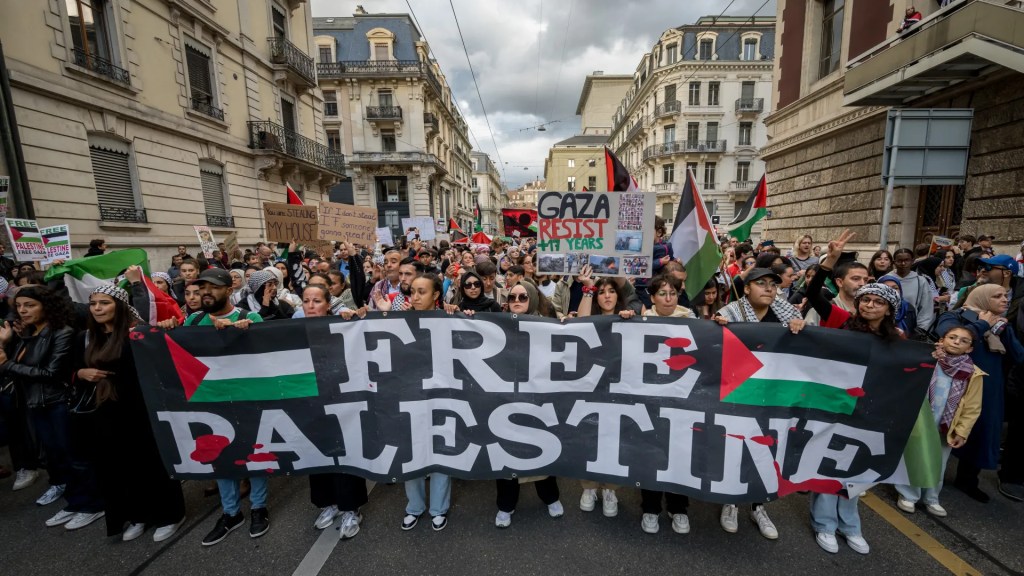
Their extensive media ownership means that the Rothschilds have significant control of the primary narrative presented in worldwide ‘news’ outlets, including in relation to Israel: the ‘victim’ Israel must always ‘defend’ itself. So that even when some accurate and graphic media get through some corporate social media channels (Facebook, X, Youtube…) or some events not sponsored by the Elite, such as the current wave of pro-Palestinian demonstrations around the world, are reported in the corporate media – see ‘Around the world, people take to the streets for Palestine’ and ‘More Demonstrations for Palestine’ – it doesn’t mean anything. Even footage of demonstrations that are protesting the genocide in Gaza can be blandly presented as demonstrations ‘calling for a ceasefire’ or something equally effective at distracting people from the truth. And even if they do not, demonstrations are routinely ignored. History records the futility of such protest demonstrations even when they garner some attention for a secondary narrative.

The reason for this is simple. Demonstrations as well as any number of randomly advocated ‘actions’ – such as those nominated in lists such as these: ‘What You Can Do’, Defund Israeli Genocide & Colonialism – 8 Tips for Getting Involved’ and ‘Calendar of Resistance for Palestine! Events and actions around the world’ – mean nothing in a strategic sense. Why?

Because for any particular tactic (action) to have strategic value, it must be derived from a strategy that has been designed to alter the power relationship between the actual perpetrator and their victim. If there is no comprehensive strategy to guide tactical choice, or if the tactic is chosen to achieve a political objective rather than a strategic goal – see ‘The Political Objective and Strategic Goal of Nonviolent Actions’ – it is not possible for the tactic to achieve a strategic gain (although it might allow those doing the action to let off a little emotional steam and feel good about themselves).

Unfortunately, demonstrations and many other ‘actions’ are routinely endorsed by those who have never considered the importance of using strategic guidance to determine tactical choice (and ensuring this does not happen is also an excellent way of subverting the resistance). See ‘The Elite Coup to Kill or Enslave Us: Why Can’t Governments, Legal Actions and Protests Stop Them?’

But to return to the theme above, if you believe that the Rothschilds do not leverage their ownership and control of such vast assets (in money, weapons, energy, infrastructure and media to name just a few key sectors) to achieve outcomes in the perceived interest of the family, including by manipulation of political leaders, you can read relevant Rothschild history – and even the official biography written by Niall Ferguson cited above – which documents a rather endless list of ‘gifts’ (that is, bribes) to a range of monarchs, including the British Crown, and political leaders.

Moreover, while many people are a little squeamish in response to the profoundly distasteful images of Palestinian children mangled by Israeli-fired weapons, the Rothschilds had turned their backs on such suffering more than 200 years ago. You cannot profit by financing both sides of wars for more than 200 years and have any sense of human compassion. From the Rothschild perspective and compared to other mass slaughters from which they have profited enormously, such as World Wars I and II, the genocide in Gaza is inconsequential.

Hence, if we are to understand the current Israeli genocidal campaign against the Palestinians in Gaza, it is necessary to understand the foundations of the Israeli-Palestinian conflict and the background role that the Rothschilds continue to play. Using a longstanding network of allies and agents, which includes corrupt (that is, ‘bought’) politicians in Israel and the United States as well as such networks as the ‘The Israel Lobby’ in the USA, it is not difficult to shape the words that come out of the mouths of Israeli Prime Minister Netanyahu and US President Biden as well as the military actions that follow.

Which is why it also matters nought that Netanyahu and Biden are registering their highest unpopularity ratings with their respective electorates at the moment. See ‘Shock at Attack, Fury at Failure: How Netanyahu’s Approval Ratings Have Hit Rock Bottom in Israel’ and ‘How un/popular is Joe Biden?’

They do not answer to their electorates and Netanyahu and Biden are well aware of that. As long as they serve their masters faithfully, their roles are secure (however they unfold), even despite their extensively-documented corruption as well. See ‘Benjamin Netanyahu’s corruption scandals, explained’ and ‘Joe Biden – Corrupt’.

Of course, Rothschild allies and agents ensure that these two individuals are surrounded and supported by a wide coterie of equally corrupt and politically unaccountable agents ranging from a wide spectrum of other national political leaders, to members of the US Congress and Israeli Knesset.

These allies and agents also ensure that those who are openly critical of Israeli apartheid and genocide are subjected to sufficient backlash so that many, and more of those who witness the treatment, are cowed into silence. As Sam Adler-Bell points out: ‘For decades, it has been the explicit mission of pro-Israel groups to disallow certain kinds of speech, conflating criticism of Israel with antisemitism.’ But this is just the start of a wide range of censure options used against those who support the liberation of Palestine. See ‘War of the Statements: The unusual way Americans have processed the Israel-Hamas War’, ‘The Free Speech Exception: Support for Palestinian rights is facing a McCarthyite backlash’ and ‘Lawless in Gaza: Why Britain and the West back Israel’s crimes’.

It also explains why statements by powerless actors ranging from the UN Secretary-General – see ‘UN chief says “clear violations of international humanitarian law” in Gaza’ and ‘Secretary-General’s statement – on the situation in Gaza’ – and some UN agency heads – see ‘“Enough is enough. This must stop now,” UN agency chiefs say in joint statement urging Gaza ceasefire’ as well as some US diplomats – see ‘U.S. diplomats slam Israel policy in leaked memo’ – are a waste of time although they achieve their purpose by deceiving some people into believing that ‘key’ people are concerned and something might happen. It won’t.

In fact, issuing statements is an industry in itself and highlights the powerlessness of a staggering array of actors, some of whom might be more meaningfully engaged in the struggle to liberate Palestine were they given strategically impactful actions to take. See ‘War of the Statements: The unusual way Americans have processed the Israel-Hamas War’.

But to return to the main point, as Emanuel Pastreich characterizes this connection, ‘The billionaires made Israel and the United States their toys, using the armies, the economies, and the technologies of these two countries to advance their plans for world domination.’ See ‘The Forbidden Truth: Israel and the U.S. Are “Toys of the Billionaires”. “A War with Iran Is Just Around the Corner”.’

Consequently, and despite possible initiatives by third parties, a critical variable that cannot be ignored is that containing the insane Global Elite that is driving these wars and genocides as well as the overall descent into technocracy is extraordinarily difficult. See ‘The Global Elite is Insane Revisited’.

And it means that their wars, genocides and the ongoing imposition of their technocracy won’t be stopped by statements, petitions, lobbying politicians, protests or legal challenges although Elite-controlled media will talk about these as part of their strategy to ensure our dissent is absorbed and dissipated.

Summary

Thus, as is happening behind the scenes of mass slaughter of ordinary (mainly Ukrainian but also Russian) soldiers in Ukraine, where the creation of all of the infrastructure necessary to impose the Global Elite’s technocracy on both populations proceeds apace with Presidents Putin and Zelensky fully complicit – again, see ‘The War in Ukraine: Understanding and Resisting the Global Elite’s Deeper Agenda’ – there is little doubt that the heavily technocratized Israel at the behest of the United States and (intentional or otherwise) complicity of Hamas, is simply killing Palestinians in Gaza (and the West Bank) while displacing as many as possible. This is being done to precipitate responses from other countries that will enable the United States to ‘justify’ pursuit of a range of geopolitical goals – inevitably involving more killing – on behalf of its Elite masters, while facilitating the more elaborate imposition of the necessary ‘smart city’ technologies on whatever population lives in Gaza when the genocide is concluded and the inevitable technocratic rebuilding commences.

My point is unpalatable but simple: The Global Elite is in the process of implementing its long-planned and complex program to kill off vast numbers of people and imprison those left alive as transhuman slaves in their technocratic cities. So while there is value in considering events from various perspectives, it is important that sight is not lost of this fundamental Elite program and the insight that this perspective offers.

Of course, the Elite’s ‘kill or enslave’ program is being implemented everywhere, not just in war zones and zones of obvious genocide. And all governments are complicit, not just the US and Israeli governments and the Palestinian leadership.

So whatever position we might take on any given war, genocide or other violent conflict, we also need to understand and resist the fundamental Elite program – see below – if we are to successfully defend ourselves and those we love, from both its genocidal programs and rapidly advancing technocracy.

In addition, as always, if we want to end war as an instrument of Elite policy, we must strategically campaign to do so. See ‘Strategic Goals for Ending War’.

And if national populations such as the Palestinians wish to defend themselves from genocidal attacks, rather than simply lobby for the beneficial intervention of third parties, they must use an appropriate strategic response (modified from this template). See ‘Strategic Goals for Defeating a Genocidal Assault’.

Of course, it they wish to liberate themselves from occupation, they must bypass the corrupt Palestinian leadership in both the West Bank and Gaza and mobilize ‘ordinary’ Palestinians and international solidarity activists to campaign strategically to do so, as I have been explaining since the early 1990s. See Nonviolent Defense/Liberation Strategy’ or, for the fullest elaboration, The Strategy of Nonviolent Defense: A Gandhian Approach.

This means they must do far more than encourage involvement in just a few tactics as advocated by the Boycott Divestment Sanctions Movement. Of course, these tactics could usefully form part of a comprehensive strategy.

In any case, a start on this comprehensive strategy – both to end the genocide and end the occupation – is just starting to happen with trade unionists in Palestine calling for solidarity action from fellow unionists worldwide. See ‘Palestinian Trade Unions Call for an End to Arming Israel’. And this is getting some traction as unions start to respond. See ‘Unions Worldwide Boycott Arms Supplies to Israel’.

Needless to say, there are a great many social groups (within Palestine, in Israel and in third-party countries) – identified on the ‘Strategic Goals’ page – who can be mobilized to take action, as well as a large number of nonviolent acts of noncooperation and intervention – listed in ‘198 Tactics of Nonviolent Action’ – from which the appropriate combination of tactics can be strategically chosen as explained in ‘Strategic Considerations in the Selection and Implementation of Nonviolent Tactics’. By following this process, concerned people anywhere can take solidarity action with Palestine (not just protest) to end the genocide in the short term and the occupation in the medium term.

The reality is simple: Unless Palestinians commit to developing and implementing a comprehensive nonviolent strategy of liberation, Palestine will continue to be the victim of forces beyond its control at the cost of an enormous number of lives, whatever optimism some might feel at the outpouring of popular support being exhibited by those attending Palestinian solidarity demonstrations around the world at the moment.

Strategy is determinative; not numbers.

Resisting the Elite’s Technocracy

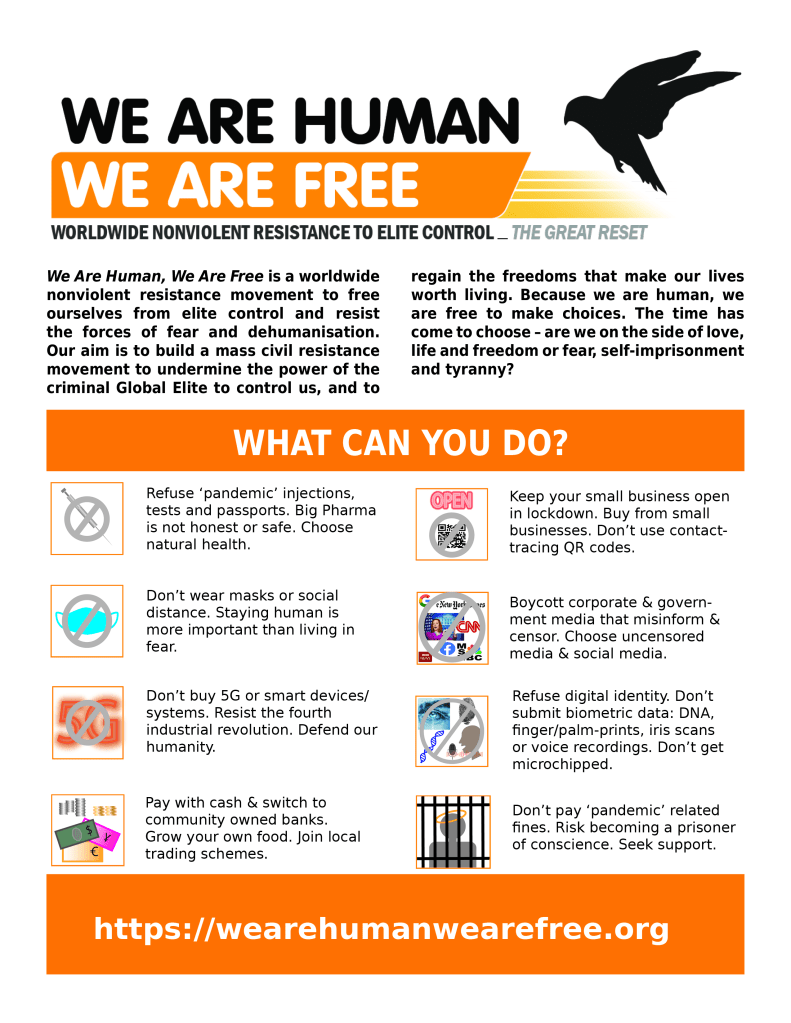
Beyond the defense of Palestine, if you are committed to being strategic in your resistance to the Elite’s ongoing imposition of its genocidal and technocratic programs on us all, you are welcome to participate in the ‘We Are Human, We Are Free’ campaign which identifies a list of 30 strategic goals for doing so.

More simply, and as a minimum, you can download the ‘We Are Human, We Are Free’ one-page flyer that identifies a short series of crucial nonviolent actions that anyone can take. This flyer, now available in 23 languages (Chinese, Croatian, Czech, Danish, Dutch, English, Finnish, French, German, Greek, Hebrew, Hungarian, Italian, Japanese, Malay, Polish, Portuguese, Romanian, Russian, Serbian, Spanish, Slovak and Turkish) with more languages in the pipeline, can be downloaded from here: ‘One-page Flyer’.

You are also welcome to consider sharing the article ‘Policing the Elite’s Technocracy: How Do We Resist This Effectively?’ with your local police. Resistance by police will be vital to the success of our resistance efforts.

And you might also consider organizing or participating in a local strategy to halt the deployment of 5G, given its crucial role in making the Elite’s ‘smart city’ technocratic prisons function. See ‘Halting the Deployment of 5G’.

If you like, you can also watch, share and/or organize to show, a short video about the campaign here: ‘We Are Human, We Are Free’ video.

Moreover, if this strategic resistance to the ‘Great Reset’ (and related agendas) appeals to you, consider joining the ‘We Are Human, We Are Free’ Telegram or Signal groups (with advice on accessing the necessary links on the website).

Conclusion

The world system is a system of power. And it is extraordinarily violent. See Why Violence? and Fearless Psychology and Fearful Psychology: Principles and Practice.

This world system is controlled by a small group of extremely wealthy and powerful families that had established their supremacy in world affairs by the late 19th century. See Historical Analysis of the Global Elite: Ransacking the World Economy Until ‘You’ll Own Nothing.’

Thus, what happens now in a particular global, regional, national or even local context has been fundamentally shaped by detailed Elite plans that have been ongoingly formulated and refined, as well as progressively implemented over the past 5,000 years. And we have long ago past the point in which a local population confronts a local Elite in what might once have been a local fight.

Consequently, what happens in this world system is an outcome of power. Laws and legal systems, human rights and human needs count for nothing in this world, unless they do not impact power relationships. Whatever laws exist are breached when it is convenient for powerful actors to do so. And no-one holds those responsible for such breaches accountable. Do you really think that anyone in Israel, or the Rothschild family and its agents, will be held accountable for the genocidal atrocities inflicted on Gaza?

However, just because the Elite and its agents are extraordinarily powerful, operate beyond the rule of law and have no conception of morality, it does not mean that they cannot be stopped. But if we are to stop them in any context, we must work together both strategically and in sufficient numbers. Turning up at a demonstration or doing any one or more of a million things when it suits us will not stop them.

Thus, if we are to resolve any conflict, including those that involve military violence, several things are necessary.

Primarily, the conflict configuration must be analyzed very carefully so that it is fully understood. This includes an understanding of who, most fundamentally, is driving the conflict, why (and for what purposes and benefits) and how they are doing so. This is essential and in sharp contrast to just assuming the conflict is how it is routinely presented or even how it superficially appears.

We must then design a strategy that, if implemented, will succeed in achieving our desired outcome. And, finally, we must mobilize sufficient people to participate in implementing this strategy.

For example, in the current context, it is easy to perceive that people like Klaus Schwab, Yuval Noah Harari and Bill Gates are benefiting from the World Economic Forum push to impose a technocracy on us all, but they are just the front men, positioned to act on behalf of far more powerful global actors.

And it is easy to identify that Benjamin Netanyahu is benefiting from the violence in Palestine but this is utterly superficial. Like any politician he is the lackey of more powerful global actors who offer him trinkets (but of value to him) to do their bidding.

So we have a choice. Whether as a global population or a local one, we can continue to be the victims while we attribute blame to the puppets (political leaders and a vast range of organizations) put in place to perform on behalf of others.

Or, as I have tried to do in this article, we can do the work to understand how the world works, who really exercises power, the means they are using to exercise it, and then mobilize enough people to participate in carefully-designed nonviolent strategies to stop them.

If we do not take the latter course very soon now, those of us left alive will all be enslaved in one of the Elite’s technocratic (‘smart city’) prisons.

Biodata: Robert J. Burrowes has a lifetime commitment to understanding and ending human violence. He has done extensive research since 1966 in an effort to understand why human beings are violent and has been a nonviolent activist since 1981. He is the author of ‘Why Violence?’ His email address is flametree@riseup.net and his website is here.
Gee, Thanks America! U.S. Sanctions Make Russian Economy Stronger and Precipitate Multipolar World

By SCF Editorial

Source: Strategic Culture Foundation

The paradoxical thing is that U.S. and European sanctions against Russia while intended to cripple the Russian economy have made the stronger.

Russia’s economy is performing strongly, according to recent forecasts from the World Bank and International Monetary Fund. The outcome defies earlier predictions by the United States and its European allies which held that Western sanctions would bring the Russian economy to its knees and force it to submissively “Cry Uncle”.

When the conflict in Ukraine escalated 16 months ago (after eight years of NATO-sponsored aggression using the Kiev Neo-Nazi regime), various Western politicians and pundits were relishing the prospect of the Russian economy collapsing from “Total War” launched against its international banking and trade.

Well, it didn’t turn out like that. Far from it. As the World Bank noted above, the Western sanctions have simply helped Russia boost alternative markets in China, India, and elsewhere around the globe. A principal earner for Russia is energy exports of oil and gas. Increased sales to Asia have maintained revenues despite the loss of European markets due to Western sanctions.

The paradoxical thing is that U.S. and European sanctions against Russia while intended to cripple the Russian economy have actually made the latter stronger.

Michael Hudson, an American global economics analyst, points out: “The sanctions have obliged Russia to become self-sufficient in food production, manufacturing production and consumer goods.”

Hudson also notes that the U.S. geopolitical strategy is to use sanctions in order to make its supposed European allies more dependent and subservient to Washington.

Another respected commentator, Glenn Diesen, a Norwegian geoeconomics professor, likened the use of Western sanctions to the self-destructive behavior of “self-harm”. The United States and European Union, he says, have “handed over a huge market to the rest of the world”.

Diesen also observes that 85 percent of the world’s population lives in countries that do not comply with Western sanctions against Russia. This global majority is more than ever creating new forms of trade and finance that obviate Western control. A major impetus for this positive development is the necessity bequeathed by Washington’s systematic abuse of power and privilege.

The repercussions are more far-reaching and profound than the inadvertent benefits accruing to Russia’s national economy. What the Western sanctions are also doing is accelerating the development of a multipolar world and the demise of the U.S. dollar as a global reserve currency. The upshot of those two trends is the historic dwindling of American imperial power – albeit with outbursts of militarism and warmongering along the way down.

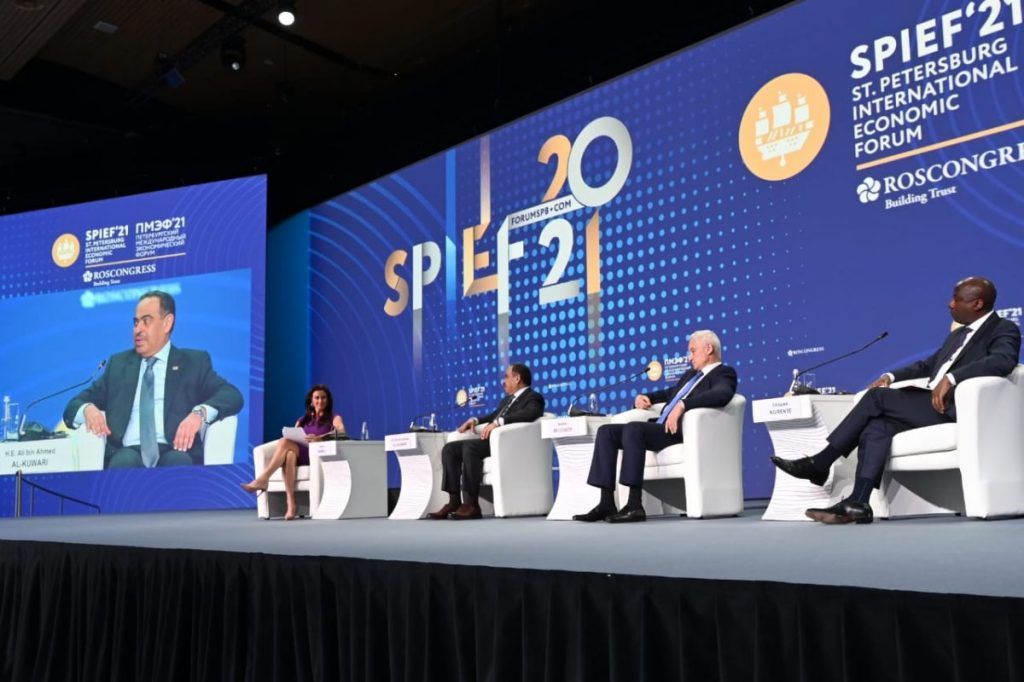
A significant illustration of the times a-changing was seen this week at the 25th summit of the St Petersburg International Economic Forum (SPIEF). Attending the four-day event were 17,000 delegates from some 130 nations. This year’s convocation witnessed large representations from Asia, Latin America and Africa.

The bustling event not only reflected Russia’s own economic strength but the fact that – far from being “isolated” and downtrodden – Russia is viewed by the rest of the world as an engine for growth and more prosperous multipolar relations.

Indeed, from the perspective of most nations, it looks like the United States and its Western allies are the ones who are isolated and anachronistic.

One of the attendees at SPIEF was American industrial analyst Douglas Andrew Littleton who commented: “Western sanctions against Russia have backfired.” And he added: “I’m happy that Russia has been able to bypass and skirt the sanctions in so many ways with their friends and allies.”

What’s going on here is not just merely the emergence of an alternative system, but an epochal political and perhaps moral paradigm shift. The globe wants more peaceful and mutual relations of cooperation and development. Most people on this Earth want endless warmongering, militarism and unilateral bullying by self-ordained powers to be put to an end. The planet is crying out for a world based on justice and peace.

What the world is realizing more than ever is that the unilateral use of economic sanctions by Washington is nothing but warfare and state terrorism by another, more palatable name. For decades, the U.S. has tried to use economic weapons to strangle and kill other nations. North Korea, Cuba, Iran, Iraq and many other countries come to mind where U.S. imperialism has imposed conditions of economic genocide.

The world is well aware of this fiendish legacy and has had enough of American barbarism wielded with the help of its Western lackeys in NATO and the European Union.

We should here make special mention of Syria, the Arab nation struggling to recover from 12 years of war that was inflicted upon it by Washington and its NATO partners for “regime change”. Today, Syria’s recovery is cruelly hampered by economic sanctions imposed by the U.S. and EU. How despicable is that?

There is an unerring historical sense, however, that Washington, has finally met its nemesis. By racking up sanctions against Russia and dragooning its EU lackeys to follow suit, the United States has now unleashed a historic dynamic process of its own imperial collapse.

For decades, U.S. sanctions worked to a nefarious degree on isolated, smaller nations to indeed enforce vengeful hardship.

Not anymore. Russia’s vast natural wealth and economy are too big to contain. Militarily, too, Russia will not be pushed around. Indeed, it has pushed back in Ukraine against the West’s deceptive and pernicious proxy war.

Organically and consciously, the world economy and international relations have been transformed in recent years, especially with the rise of China and Eurasia generally.

Another key development is that the Western imperialist media monopoly has also been broken. Washington and its minions in the European political class are held in contempt as liars and charlatans, even by their own populations.

By unwisely attempting to trap the Russian bear, the West has only created a scenario of revolt by the rest of the world from the West’s exploitative control. Five centuries of European and American Western parasitism have run their course.

Russia’s economic strength is galvanizing the rest of the world to shake off the chains of Western domination and subjugation. The process of dumping the dollar is gathering momentum which self-harming sanctions are precipitating. Pillars and facades are crumbling in real time.

The theme for the SPIEF event this year was “Sovereign Development – the Basis for a Just World”.

As with many other empires in the annals of history that have collapsed, arrogance and hubris often precede the fall. The American and Western elite thought they had an eternal license to wreak havoc for their own selfish gain. Their economic plunder and weaponry are now turning on their own heads. And it’s long overdue.

US Empire of Debt Headed for Collapse

By Pepe Escobar

Source: The Unz Review

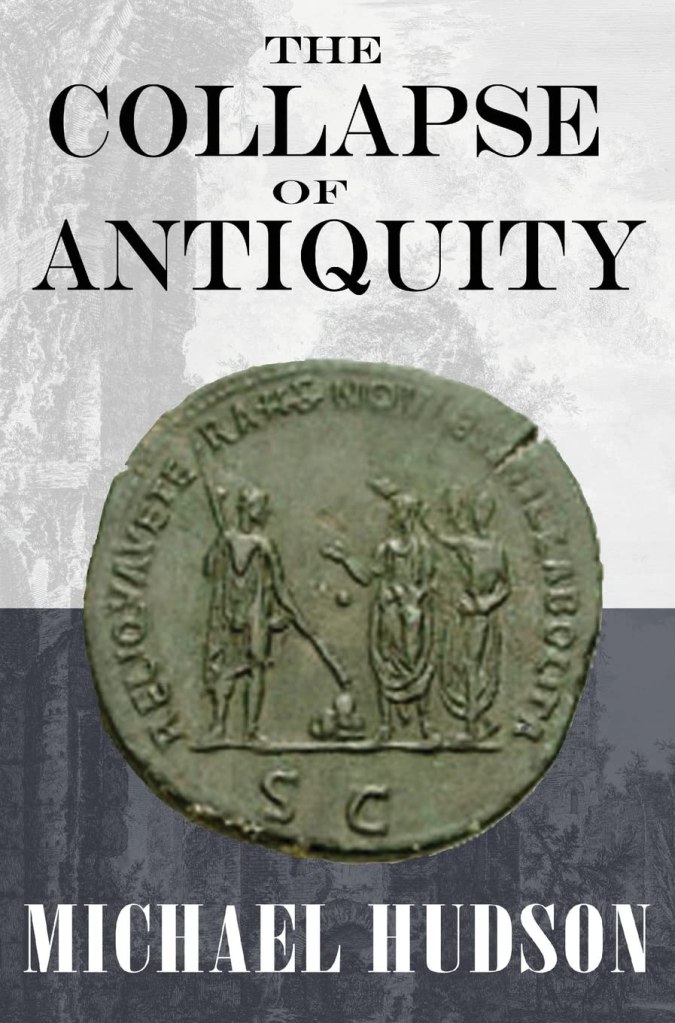
Prof. Michael Hudson’s new book, The Collapse of Antiquity: Greece and Rome as Civilization’s Oligarchic Turning Point is a seminal event in this Year of Living Dangerously when, to paraphrase Gramsci, the old geopolitical and geoeconomic order is dying and the new one is being born at breakneck speed.

Prof. Hudson’s main thesis is absolutely devastating: he sets out to prove that economic/financial practices in Ancient Greece and Rome – the pillars of Western Civilization – set the stage for what is happening today right in front of our eyes: an empire reduced to a rentier economy, collapsing from within.

And that brings us to the common denominator in every single Western financial system: it’s all about debt, inevitably growing by compound interest.

Ay, there’s the rub: before Greece and Rome, we had nearly 3,000 years of civilizations across West Asia doing exactly the opposite.

These kingdoms all knew about the importance of canceling debts. Otherwise their subjects would fall into bondage; lose their land to a bunch of foreclosing creditors; and these would usually try to overthrow the ruling power.

Aristotle succinctly framed it: “Under democracy, creditors begin to make loans and the debtors can’t pay and the creditors get more and more money, and they end up turning a democracy into an oligarchy, and then the oligarchy makes itself hereditary, and you have an aristocracy.”

Prof. Hudson sharply explains what happens when creditors take over and “reduce all the rest of the economy to bondage”: it’s what’s called today “austerity” or “debt deflation”.

So “what’s happening in the banking crisis today is that debts grow faster than the economy can pay. And so when the interest rates finally began to be raised by the Federal Reserve, this caused a crisis for the banks.”

Prof. Hudson also proposes an expanded formulation: “The emergence of financial and landholding oligarchies made debt peonage and bondage permanent, supported by a pro-creditor legal and social philosophy that distinguishes Western civilization from what went before. Today it would be called neoliberalism.”

Then he sets out to explain, in excruciating detail, how this state of affairs was solidified in Antiquity in the course of over 5 centuries. One can hear the contemporary echoes of “violent suppression of popular revolts” and “targeted assassination of leaders” seeking to cancel debts and “redistribute land to smallholders who have lost it to large landowners”.

The verdict is merciless: “What impoverished the population of the Roman Empire” bequeathed a “creditor-based body of legal principles to the modern world”.

Predatory oligarchies and “Oriental Despotism”

Prof Hudson develops a devastating critique of the “social darwinist philosophy of economic determinism”: a “self-congratulatory perspective” has led to “today’s institutions of individualism and security of credit and property contracts (favoring creditor claims over debtors, and landlord rights over those of tenants) being traced back to classical antiquity as “positive evolutionary developments, moving civilization away from ‘Oriental Despotism’”.

All that is a myth. Reality was a completely different story, with Rome’s extremely predatory oligarchies waging “five centuries of war to deprive populations of liberty, blocking popular opposition to harsh pro-creditor laws and the monopolization of the land into latifundia estates”.

So Rome in fact behaved very much like a “failed state”, with “generals, governors, tax collectors, moneylenders and carpet beggars” squeezing out silver and gold “in the form of military loot, tribute and usury from Asia Minor, Greece and Egypt.” And yet this Roman wasteland approach has been lavishly depicted in the modern West as bringing a French-style mission civilisatrice to the barbarians – while carrying the proverbial white man’s burden.

Prof. Hudson shows how Greek and Roman economies actually “ended in austerity and collapsed after having privatized credit and land in the hands of rentier oligarchies”. Does that ring a – contemporary – bell?

Arguably the central nexus of his argument is here:

“Rome’s law of contracts established the fundamental principle of Western legal philosophy giving creditor claims priority over the property of debtors – euphemized today as ‘security of property rights’. Public expenditure on social welfare was minimized – what today’s political ideology calls leaving matters to ‘the market’. It was a market that kept citizens of Rome and its Empire dependent for basic needs on wealthy patrons and moneylenders – and for bread and circuses, on the public dole and on games paid for by political candidates, who often themselves borrowed from wealthy oligarchs to finance their campaigns.”

Any similarity with the current system led by the Hegemon is not mere coincidence. Hudson: “These pro-rentier ideas, policies and principles are those that today’s Westernized world is following. That is what makes Roman history so relevant to today’s economies suffering similar economic and political strains.”

Prof. Hudson reminds us that Rome’s own historians – Livy, Sallust, Appian, Plutarch, Dionysius of Halicarnassus, among others – “emphasized the subjugation of citizens to debt bondage”. Even the Delphic Oracle in Greece, as well as poets and philosophers, warned against creditor greed. Socrates and the Stoics warned that “wealth addiction and its money-love was the major threat to social harmony and hence to society.”

And that brings us to how this criticism was completely expunged from Western historiography. “Very few classicists”, Hudson notes, follow Rome’s own historians describing how these debt struggles and land grabs were “mainly responsible for the Republic’s Decline and Fall.”

Hudson also reminds us that the barbarians were always at the gate of the Empire: Rome, in fact, was “weakened from within”, by “century after century of oligarchic excess.”

So this is the lesson we should all draw from Greece and Rome: creditor oligarchies “seek to monopolize income and land in predatory ways and bring prosperity and growth to a halt.” Plutarch was already into it: “The greed of creditors brings neither enjoyment nor profit to them, and ruins those whom they wrong. They do not till the fields which they take from their debtors, nor do they live in their houses after evicting them.”

Beware of pleonexia

It would be impossible to fully examine so many precious as jade offerings constantly enriching the main narrative. Here are just a few nuggets (And there will be more: Prof. Hudson told me, “I’m working on the sequel now, picking up with the Crusades.”)

Prof. Hudson reminds us how money matters, debt and interest came to the Aegean and Mediterranean from West Asia, by traders from Syria and the Levant, around 8th century B.C. But “with no tradition of debt cancellation and land redistribution to restrain personal wealth seeking, Greek and Italian chieftains, warlords and what some classicists have called mafiosi [ by the way, Northern European scholars, not Italians) imposed absentee land ownership over dependent labor.”

This economic polarization kept constantly worsening. Solon did cancel debts in Athens in the late 6th century – but there was no land redistribution. Athens’ monetary reserves came mainly from silver mines – which built the navy that defeated the Persians at Salamis. Pericles may have boosted democracy, but the eventful defeat facing Sparta in the Peloponnesian War (431-404 B.C.) opened the gates to a heavy debt-addicted oligarchy.

All of us who studied Plato and Aristotle in college may remember how they framed the whole problem in the context of pleonexia (“wealth addiction”) – which inevitably leads to predatory and “socially injurious” practices. In Plato’s Republic, Socrates proposes that only non-wealthy managers should be appointed to govern society – so they would not be hostages of hubris and greed.

The problem with Rome is that no written narratives survived. The standard stories were written only after the Republic had collapsed. The Second Punic War against Carthage (218-201 B.C.) is particularly intriguing, considering its contemporary Pentagon overtones: Prof. Hudson reminds us how military contractors engaged in large-scale fraud and fiercely blocked the Senate from prosecuting them.

Prof. Hudson shows how that “also became an occasion for endowing the wealthiest families with public land when the Rome state treated their ostensibly patriotic donations of jewelry and money to aid the war effort as retroactive public debts subject to repayment”.

After Rome defeated Carthage, the glitzy set wanted their money back. But the only asset left to the state was land in Campania, south of Rome. The wealthy families lobbied the Senate and gobbled up the whole lot.

With Caesar, that was the last chance for the working classes to get a fair deal. In the first half of the 1st century B.C. he did sponsor a bankruptcy law, writing down debts. But there was no widespread debt cancellation. Caesar being so moderate did not prevent the Senate oligarchs from whacking him, “fearing that he might use his popularity to ‘seek kingship’” and go for way more popular reforms.

After Octavian’s triumph and his designation by the Senate as Princeps and Augustus in 27 B.C., the Senate became just a ceremonial elite. Prof Hudson summarizes it in one sentence: “The Western Empire fell apart when there was no more land for the taking and no more monetary bullion to loot.” Once again, one should feel free to draw parallels with the current plight of the Hegemon.

Time to “uplift all labor”

In one of our immensely engaging email exchanges, Prof. Hudson remarked how he “immediately had a thought” on a parallel to 1848. I wrote in the Russian business paper Vedomosti: “After all, that turned out to be a limited bourgeois revolution. It was against the rentier landlord class and bankers – but was as yet a far cry from being pro-labor. The great revolutionary act of industrial capitalism was indeed to free economies from the feudal legacy of absentee landlordship and predatory banking — but it too fell back as the rentier classes made a comeback under finance capitalism.”

And that brings us to what he considers “the great test for today’s split”: “Whether it is merely for countries to free themselves from US/NATO control of their natural resources and infrastructure — which can be done by taxing natural-resource rent (thereby taxing away the capital flight by foreign investors who have privatized their natural resources). The great test will be whether countries in the new Global Majority will seek to uplift all labor, as China’s socialism is aiming to do.”

It’s no wonder “socialism with Chinese characteristics” spooks the Hegemon creditor oligarchy to the point they are even risking a Hot War. What’s certain is that the road to Sovereignty, across the Global South, will have to be revolutionary: “Independence from U.S. control is the Westphalian reforms of 1648 — the doctrine of non-interference in the affairs of other states. A rent tax is a key element of independence — the 1848 tax reforms. How soon will the modern 1917 take place?”

Let Plato and Aristotle weigh in: as soon as humanly possible.

How “Food Shortages” & Economic Collapse Protects the Status Quo

Engineered Food & Poverty Crises Secure Continued US Dominance

By Colin Todhunter

Source: Off-Guardian

In March 2022, UN Secretary-General Antonio Guterres warned of a “hurricane of hunger and a meltdown of the global food system” in the wake of the crisis in Ukraine.

Guterres said food, fuel and fertiliser prices were skyrocketing with supply chains being disrupted and added this is hitting the poorest the hardest and planting the seeds for political instability and unrest around the globe.

According to the International Panel of Experts on Sustainable Food Systems, there is currently sufficient food and no risk of global food supply shortages.

We see an abundance of food but skyrocketing prices. The issue is not food shortage but speculation on food commodities and the manipulation of an inherently flawed global food system that serves the interests of corporate agribusiness traders and suppliers of inputs at the expense of people’s needs and genuine food security.

The war in Ukraine is a geopolitical trade and energy conflict. It is largely about the US engaging in a proxy war against Russia and Europe by attempting to separate Europe from Russia and imposing sanctions on Russia to harm Europe and make it further dependent on the US.

Economist Professor Michael Hudson recently stated that ultimately the war is against Europe and Germany. The purpose of the sanctions is to prevent Europe and other allies from increasing their trade and investment with Russia and China.

Neoliberal policies since the 1980s have hollowed out the US economy. With its productive base severely weakened, the only way for the US to maintain hegemony is to undermine China and Russia and weaken Europe.

Hudson says that, beginning a year ago, Biden and the US neocons attempted to block Nord Stream 2 and all (energy) trade with Russia so that the US could monopolise it itself.

Despite the ‘green agenda’ currently being pushed, the US still relies on fossil fuel-based energy to project its power abroad. Even as Russia and China move away from the dollar, the control and pricing of oil and gas (and resulting debt) in dollars remains key to US attempts to retain hegemony.

The US knew beforehand how sanctions on Russia would play out. They would serve to divide the world into two blocks and fuel a new cold war with the US and Europe on one side with China and Russia being the two main countries on the other.

US policymakers knew Europe would be devastated by higher energy and food prices and food importing countries in the Global South would suffer due to rising costs.

It is not the first time the US has engineered a major crisis to maintain global hegemony and a spike in key commodity prices that effectively trap countries into dependency and debt.

In 2009, Andrew Gavin Marshall described how in 1973 – not long after coming off the gold standard – Henry Kissinger was integral to manipulating events in the Middle East (the Arab-Israeli war and the ‘energy crisis’). This served to continue global hegemony for the US, which had virtually bankrupted itself due to its war in Vietnam and had been threatened by the economic rise of Germany and Japan.

Kissinger helped secure huge OPEC oil price rises and thus sufficient profits for Anglo-American oil companies that had over-leveraged themselves in North Sea oil. He also cemented the petrodollar system with the Saudis and subsequently placed African nations, which had embarked on a path of (oil-based) industrialisation, on a treadmill of dependency and debt due to the spike in oil prices.

It is widely believed that the high-priced oil policy was aimed at hurting Europe, Japan and the developing world.

Today, the US is again waging a war on vast swathes of humanity, whose impoverishment is intended to ensure they remain dependent on the US and the financial institutions it uses to create dependency and indebtedness – the World Bank and IMF.

Hundreds of millions will experience (are experiencing) poverty and hunger due to US policy. These people (the ones that the US and Pfizer et al supposedly cared so much about and wanted to get a jab into each of their arms) are regarded with contempt and collateral damage in the great geopolitical game.

Contrary to what many believe, the US has not miscalculated the outcome of the sanctions placed on Russia. Michael Hudson notes energy prices are increasing, benefiting US oil companies and US balance of payments as an energy exporter. Moreover, by sanctioning Russia, the aim is to curtail Russian exports (of wheat and gas used for fertiliser production) and for agricultural commodity prices to therefore increase. This too will also benefit the US as an agricultural exporter.

This is how the US seeks to maintain dominance over other countries.

Current policies are designed to create a food and debt crisis for poorer nations especially. The US can use this debt crisis to force countries to continue privatising and selling off their public assets in order to service the debts to pay for the higher oil and food imports.

This imperialist strategy comes on the back of ‘COVID relief’ loans which have served a similar purpose. In 2021, an Oxfam review of IMF COVID-19 loans showed that 33 African countries were encouraged to pursue austerity policies. The world’s poorest countries are due to pay $43 billion in debt repayments in 2022, which could otherwise cover the costs of their food imports.

Oxfam and Development Finance International have also revealed that 43 out of 55 African Union member states face public expenditure cuts totalling $183 billion over the next five years.

The closure of the world economy in March 2020 (‘lockdown’) served to trigger an unprecedented process of global indebtedness.

Conditionalities mean national governments will have to capitulate to the demands of Western financial institutions. These debts are largely dollar-denominated, helping to strengthen the US dollar and US leverage over countries.

The US is creating a new world order and needs to ensure much of the Global South remains in its orbit of influence rather than ending up in the Russian and especially Chinese camp and its belt road initiative for economic prosperity.

Post-COVID, this is what the war in Ukraine, sanctions on Russia and the engineered food and energy crisis are really about.

Back in 2014, Michael Hudson stated that the US has been able to dominate most of the Global South through agriculture and control of the food supply. The World Bank’s geopolitical lending strategy has transformed countries into food deficit areas by convincing them to grow cash crops – plantation export crops – not to feed themselves with their own food crops.

The oil sector and agribusiness have been joined at the hip as part of US geopolitical strategy.

The dominant notion of ‘food security’ promoted by global agribusiness players like Cargill, Archer Daniel Midland, Bunge and Louis Dreyfus and supported by the World Bank is based on the ability of people and nations to purchase food. It has nothing to do with self-sufficiency and everything to do with global markets and supply chains controlled by giant agribusiness players.

Along with oil, the control of global agriculture has been a linchpin of US geopolitical strategy for many decades. The Green Revolution was exported courtesy of oil-rich interests and poorer nations adopted agri-capital’s chemical- and oil-dependent model of agriculture that required loans for inputs and related infrastructure development.

It entailed trapping nations into a globalised food system that relies on export commodity mono-cropping to earn foreign exchange linked to sovereign dollar-denominated debt repayment and World Bank/IMF ‘structural adjustment’ directives. What we have seen has been the transformation of many countries from food self-sufficiency into food deficit areas.

And what we have also seen is countries being placed on commodity crop production treadmills. The need for foreign currency (US dollars) to buy oil and food entrenches the need to increase cash crop production for exports.

The World Trade Organization’s Agreement on Agriculture (AoA) set out the trade regime necessary for this type of corporate dependency that masquerades as ‘global food security’.

This is explained in a July 2022 report by Navdanya International – Sowing Hunger, Reaping Profits – A Food Crisis by Design – which notes international trade laws and trade liberalisation has benefited large agribusiness and continue to piggyback off the implementation of the Green Revolution.

The report states that US lobby and trade negotiations were headed by former Cargill Investors Service CEO and Goldman Sachs executive – Dan Amstutz – who in 1988 was appointed chief negotiator for the Uruguay round of GATT by Ronald Reagan. This helped to enshrine the interests of US agribusiness into the new rules that would govern the global trade of commodities and subsequent waves of industrial agriculture expansion.

The AoA removed protection of farmers from global market prices and fluctuations. At the same time, exceptions were made for the US and the EU to continue subsidising their agriculture to the advantage of large agribusiness.

Navdanya notes:

“With the removal of state tariff protections and subsidies, small farmers were left destitute. The result has been a disparity in what farmers earn for what they produce, versus what consumers pay, with farmers earning less and consumers paying more as agribusiness middlemen take the biggest cut.”

‘Food security’ has led to the dismantling of food sovereignty and food self-sufficiency for the sake of global market integration and corporate power.

We need look no further than India to see this in action. The now repealed recent farm legislation in India was aimed at giving the country the ‘shock therapy’ of neoliberalism that other countries have experienced.

The ‘liberalising’ legislation was in part aimed at benefiting US agribusiness interests and trapping India into food insecurity by compelling the country to eradicate its food buffer stocks – so vital to the nation’s food security – and then bid for food on a volatile global market from agribusiness traders with its foreign reserves.

The Indian government was only prevented from following this route by the massive, year-long farmer protest that occurred.

The current crisis is also being fuelled by speculation. Navdanya cites an investigation by Lighthouse Reports and The Wire to show how speculation by investment firms, banks and hedge funds on agricultural commodities are profiting off rising food prices. Commodity future prices are no longer linked to actual supply and demand in the market but are based purely on speculation.

Archer Daniels Midland, Bunge, Cargill and Louis Dreyfus and investment funds like Black Rock and Vanguard continue to make huge financial killings, resulting in the price of bread almost doubling in some poorer countries.

The cynical ‘solution’ promoted by global agribusiness to the current food crisis is to urge farmers to produce more and seek better yields as if the crisis is that of underproduction. It means more chemical inputs, more genetic engineering techniques and suchlike, placing more farmers in debt and trapped in dependency.

It is the same old industry lie that the world will starve without its products and requires more of them. The reality is that the world is facing hunger and rising food prices because of the system big agribusiness has instituted.

And it is the same old story – pushing out new technologies in search of a problem and then using crises as justification for their rollout while ignoring the underlying reasons for such crises.

Navdanya sets out possible solutions to the current situation based on principles of agroecology, short supply lines, food sovereignty and economic democracy – policies that have been described at length in many articles and official reports over the years.

As for fighting back against the onslaught on ordinary people’s living standards, support is gathering among the labour movement in places like the UK. Rail union leader Mick Lynch is calling for a working class movement based on solidarity and class consciousness to fight back against a billionaire class that is acutely aware of its own class interests.

For too long, ‘class’ has been absent from mainstream political discourse. It is only through organised, united protest that ordinary people will have any chance of meaningful impact against the new world order of tyrannical authoritarianism and the devastating attacks on ordinary people’s rights, livelihoods and standards of living that we are witnessing.

An Engineered Food and Poverty Crisis to Secure Continued US Dominance 

By Colin Todhunter

Source: Dissident Voice

In March 2022, UN Secretary-General Antonio Guterres warned of a “hurricane of hunger and a meltdown of the global food system” in the wake of the crisis in Ukraine.

Guterres said food, fuel and fertiliser prices were skyrocketing with supply chains being disrupted and added this is hitting the poorest the hardest and planting the seeds for political instability and unrest around the globe.

According to the International Panel of Experts on Sustainable Food Systems, there is currently sufficient food and no risk of global food supply shortages.

We see an abundance of food but skyrocketing prices. The issue is not food shortage but speculation on food commodities and the manipulation of an inherently flawed global food system that serves the interests of corporate agribusiness traders and suppliers of inputs at the expense of people’s needs and genuine food security.

The war in Ukraine is a geopolitical trade and energy conflict. It is largely about the US engaging in a proxy war against Russia and Europe by attempting to separate Europe from Russia and imposing sanctions on Russia to harm Europe and make it further dependent on the US.

Economist Professor Michael Hudson recently stated that ultimately the war is against Europe and Germany. The purpose of the sanctions is to prevent Europe and other allies from increasing their trade and investment with Russia and China.

Neoliberal policies since the 1980s have hollowed out the US economy. With its productive base severely weakened, the only way for the US to maintain hegemony is to undermine China and Russia and weaken Europe.

Hudson says that, beginning a year ago, Biden and the US neocons attempted to block Nord Stream 2 and all (energy) trade with Russia so that the US could monopolise it itself.

Despite the ‘green agenda’ currently being pushed, the US still relies on fossil fuel-based energy to project its power abroad. Even as Russia and China move away from the dollar, the control and pricing of oil and gas (and resulting debt) in dollars remains key to US attempts to retain hegemony.

The US knew beforehand how sanctions on Russia would play out. They would serve to divide the world into two blocks and fuel a new cold war with the US and Europe on one side with China and Russia being the two main countries on the other.

US policy makers knew Europe would be devastated by higher energy and food prices and food importing countries in the Global South would suffer due to rising costs.

It is not the first time the US has engineered a major crisis to maintain global hegemony and a spike in key commodity prices that effectively trap countries into dependency and debt.

In 2009, Andrew Gavin Marshall described how in 1973 – not long after coming off the gold standard – Henry Kissinger was integral to manipulating events in the Middle East (the Arab-Israeli war and the ‘energy crisis’). This served to continue global hegemony for the US, which had virtually bankrupted itself due to its war in Vietnam and had been threatened by the economic rise of Germany and Japan.

Kissinger helped secure huge OPEC oil price rises and thus sufficient profits for Anglo-American oil companies that had over-leveraged themselves in North Sea oil. He also cemented the petrodollar system with the Saudis and subsequently placed African nations, which had embarked on a path of (oil-based) industrialisation, on a treadmill of dependency and debt due to the spike in oil prices.

It is widely believed that the high-priced oil policy was aimed at hurting Europe, Japan and the developing world.

Today, the US is again waging a war on vast swathes of humanity, whose impoverishment is intended to ensure they remain dependent on the US and the financial institutions it uses to create dependency and indebtedness – the World Bank and IMF.

Hundreds of millions will experience (are experiencing) poverty and hunger due to US policy. These people (the ones that the US and Pfizer et al supposedly cared so much about and wanted to get a jab into each of their arms) are regarded with contempt and collateral damage in the great geopolitical game.

Contrary to what many believe, the US has not miscalculated the outcome of the sanctions placed on Russia. Michael Hudson notes energy prices are increasing, benefiting US oil companies and US balance of payments as an energy exporter. Moreover, by sanctioning Russia, the aim is to curtail Russian exports (of wheat and gas used for fertiliser production) and for agricultural commodity prices to therefore increase. This too will also benefit the US as an agricultural exporter.

This is how the US seeks to maintain dominance over other countries.

Current policies are designed to create a food and debt crisis for poorer nations especially. The US can use this debt crisis to force countries to continue privatising and selling off their public assets in order to service the debts to pay for the higher oil and food imports.

This imperialist strategy comes on the back of ‘COVID relief’ loans which have served a similar purpose. In 2021, an Oxfam review of IMF COVID-19 loans showed that 33 African countries were encouraged to pursue austerity policies. The world’s poorest countries are due to pay $43 billion in debt repayments in 2022, which could otherwise cover the costs of their food imports.

Oxfam and Development Finance International have also revealed that 43 out of 55 African Union member states face public expenditure cuts totalling $183 billion over the next five years.

The closure of the world economy in March 2020 (‘lockdown’) served to trigger an unprecedented process of global indebtedness. Conditionalities mean national governments will have to capitulate to the demands of Western financial institutions. These debts are largely dollar-denominated, helping to strengthen the US dollar and US leverage over countries.

The US is creating a new world order and needs to ensure much of the Global South remains in its orbit of influence rather than ending up in the Russian and especially Chinese camp and its belt road initiative for economic prosperity.

Post-COVID, this is what the war in Ukraine, sanctions on Russia and the engineered food and energy crisis are really about.

Back in 2014, Michael Hudson stated that the US has been able to dominate most of the Global South through agriculture and control of the food supply. The World Bank’s geopolitical lending strategy has transformed countries into food deficit areas by convincing them to grow cash crops – plantation export crops – not to feed themselves with their own food crops.

The oil sector and agribusiness have been joined at the hip as part of US geopolitical strategy.

The dominant notion of ‘food security’ promoted by global agribusiness players like Cargill, Archer Daniel Midland, Bunge and Louis Dreyfus and supported by the World Bank is based on the ability of people and nations to purchase food. It has nothing to do with self-sufficiency and everything to do with global markets and supply chains controlled by giant agribusiness players.

Along with oil, the control of global agriculture has been a linchpin of US geopolitical strategy for many decades. The Green Revolution was exported courtesy of oil-rich interests and poorer nations adopted agri-capital’s chemical- and oil-dependent model of agriculture that required loans for inputs and related infrastructure development.

It entailed trapping nations into a globalised food system that relies on export commodity mono-cropping to earn foreign exchange linked to sovereign dollar-denominated debt repayment and World Bank/IMF ‘structural adjustment’ directives. What we have seen has been the transformation of many countries from food self-sufficiency into food deficit areas.

And what we have also seen is countries being placed on commodity crop production treadmills. The need for foreign currency (US dollars) to buy oil and food entrenches the need to increase cash crop production for exports.

The World Trade Organization’s Agreement on Agriculture (AoA) set out the trade regime necessary for this type of corporate dependency that masquerades as ‘global food security’.

This is explained in a July 2022 report by Navdanya International – Sowing Hunger, Reaping Profits – A Food Crisis by Design – which notes international trade laws and trade liberalisation has benefited large agribusiness and continue to piggyback off the implementation of the Green Revolution.

The report states that US lobby and trade negotiations were headed by former Cargill Investors Service CEO and Goldman Sachs executive – Dan Amstutz – who in 1988 was appointed chief negotiator for the Uruguay round of GATT by Ronald Reagan. This helped to enshrine the interests of US agribusiness into the new rules that would govern the global trade of commodities and subsequent waves of industrial agriculture expansion.

The AoA removed protection of farmers from global market prices and fluctuations. At the same time, exceptions were made for the US and the EU to continue subsidising their agriculture to the advantage of large agribusiness.

Navdanya notes:

With the removal of state tariff protections and subsidies, small farmers were left destitute. The result has been a disparity in what farmers earn for what they produce, versus what consumers pay, with farmers earning less and consumers paying more as agribusiness middlemen take the biggest cut.

‘Food security’ has led to the dismantling of food sovereignty and food self-sufficiency for the sake of global market integration and corporate power.

We need look no further than India to see this in action. The now repealed recent farm legislation in India was aimed at giving the country the ‘shock therapy’ of neoliberalism that other countries have experienced.

The ‘liberalising’ legislation was in part aimed at benefiting US agribusiness interests and trapping India into food insecurity by compelling the country to eradicate its food buffer stocks – so vital to the nation’s food security – and then bid for food on a volatile global market from agribusiness traders with its foreign reserves.

The Indian government was only prevented from following this route by the massive, year-long farmer protest that occurred.

The current crisis is also being fuelled by speculation. Navdanya cites an investigation by Lighthouse Reports and The Wire to show how speculation by investment firms, banks and hedge funds on agricultural commodities are profiting off rising food prices. Commodity future prices are no longer linked to actual supply and demand in the market but are based purely on speculation.

Archer Daniels Midland, Bunge, Cargill and Louis Dreyfus and investment funds like Black Rock and Vanguard continue to make huge financial killings, resulting in the price of bread almost doubling in some poorer countries.

The cynical ‘solution’ promoted by global agribusiness to the current food crisis is to urge farmers to produce more and seek better yields as if the crisis is that of underproduction. It means more chemical inputs, more genetic engineering techniques and suchlike, placing more farmers in debt and trapped in dependency.

It is the same old industry lie that the world will starve without its products and requires more of them. The reality is that the world is facing hunger and rising food prices because of the system big agribusiness has instituted.

And it is the same old story – pushing out new technologies in search of a problem and then using crises as justification for their rollout while ignoring the underlying reasons for such crises.

Navdanya sets out possible solutions to the current situation based on principles of agroecology, short supply lines, food sovereignty and economic democracy – policies that have been described at length in many articles and official reports over the years.

As for fighting back against the onslaught on ordinary people’s living standards, support is gathering among the labour movement in places like the UK. Rail union leader Mick Lynch is calling for a working class movement based on solidarity and class consciousness to fight back against a billionaire class that is acutely aware of its own class interests.

For too long, ‘class’ has been absent from mainstream political discourse. It is only through organised, united protest that ordinary people will have any chance of meaningful impact against the new world order of tyrannical authoritarianism and the devastating attacks on ordinary people’s rights, livelihoods and standards of living that we are witnessing.

Follow the Money – How Russia Will Bypass Western Economic Warfare

By Pepe Escobar

Source: OpEdNews.com

So a congregation of NATO’s top brass ensconced in their echo chambers target the Russian Central Bank with sanctions and expect what? Cookies?

What they got instead was Russia’s deterrence forces bumped up to “a special regime of duty” – which means the Northern and Pacific fleets, the Long-Range Aviation Command, strategic bombers, and the entire Russian nuclear apparatus on maximum alert.

One Pentagon general very quickly did the basic math on that, and mere minutes later, a Ukrainian delegation was dispatched to conduct negotiations with Russia in an undisclosed location in Gomel, Belarus.

Meanwhile, in the vassal realms, the German government was busy “setting limits to warmongers like Putin” – quite a rich undertaking considering that Berlin never set any such limits for western warmongers who bombed Yugoslavia, invaded Iraq, or destroyed Libya, in complete violation of international law.

While openly proclaiming their desire to “stop the development of Russian industry,” damage its economy, and “ruin Russia” – echoing American edicts on Iraq, Iran, Syria, Libya, Cuba, Venezuela and others in the Global South – the Germans could not possibly recognize a new categorical imperative.

They were finally liberated from their WWII culpability complex by none other than Russian President Vladimir Putin. Germany is finally free to support and weaponize neo-Nazis out in the open all over again – now of the Ukrainian Azov battalion variety.

To get the hang of how these NATO sanctions will “ruin Russia,” I asked for the succinct analysis of one of the most competent economic minds on the planet, Michael Hudson, author, among others, of a revised edition of the must-read Super-Imperialism: The Economic Strategy of American Empire.

Hudson remarked how he is “simply numbed over the near-atomic escalation of the US.” On the confiscation of Russian foreign reserves and cut-off from SWIFT, the main point is “it will take some time for Russia to put in a new system with China. The result will end dollarization for good, as countries threatened with ‘democracy’ or displaying diplomatic independence will be afraid to use US banks.”

This, Hudson says, leads us to “the great question – whether Europe and the Dollar Bloc can buy Russian raw materials – cobalt, palladium, etc, and whether China will join Russia in a minerals boycott.”

Hudson is adamant that “Russia’s Central Bank, of course, has foreign bank assets in order to intervene in exchange markets to defend its currency from fluctuations. The ruble has plunged. There will be new exchange rates. Yet it’s up to Russia to decide whether to sell its wheat to West Asia, that needs it; or to stop selling gas to Europe via Ukraine, now that the US can grab it.”

About the possible introduction of a new Russia-China payment system – bypassing SWIFT and combining the Russian SPFS (System for Transfer of Financial Messages) with the Chinese CIPS (Cross-Border Interbank Payment System) – Hudson has no doubts, “the Russian-China system will be implemented. The Global South will seek to join and at the same time keep SWIFT – moving their reserves into the new system.”

I’m going to de-dollarize myself

So the US itself, in another massive strategic blunder, will speed up de-dollarization. As the managing director of Bocom International Hong Hao told the Global Times, with energy trade between Europe and Russia de-dollarized, “that will be the beginning of the disintegration of dollar hegemony.”

It’s a refrain the US administration was quietly hearing last week from some of its own largest multinational banks, including notables like JPMorgan and Citigroup.

Bloomberg article sums up their collective fears:

“Booting Russia from the critical global system – which handles 42 million messages a day and serves as a lifeline to some of the world’s biggest financial institutions – could backfire, sending inflation higher, pushing Russia closer to China, and shielding financial transactions from scrutiny by the west. It might also encourage the development of a SWIFT alternative that could eventually damage the supremacy of the US dollar.”

Those with IQs over 50 in the European Union (EU) must have understood that Russia simply could not be totally excluded from SWIFT, but maybe only a few of its banks: after all, European traders depend on Russian energy.

From Moscow’s point of view, that’s a minor issue. A number of Russian banks are already connected to China’s CIPS system. For instance, if someone wants to buy Russian oil and gas with CIPS, payment must be in the Chinese yuan currency. CIPS is independent of SWIFT.

Additionally, Moscow already linked its SPFS payment system not only to China but also to India and member nations of the Eurasia Economic Union (EAEU). SPFS already links to approximately 400 banks.

With more Russian companies using SPFS and CIPS, even before they merge, and other maneuvers to bypass SWIFT, such as barter trade – largely used by sanctioned Iran – and agent banks, Russia could make up for at least 50 percent in trade losses.

The key fact is that the flight from the US-dominated western financial system is now irreversible across Eurasia and that will proceed in tandem with the internationalization of the yuan.

Russia has its own bag of tricks

Meanwhile, we’re not even talking yet about Russian retaliation for these sanctions. Former President Dmitry Medvedev already gave a hint – everything, from exiting all nuclear arms deals with the US, to freezing the assets of western companies in Russia, is on the table.

So what does the “Empire of Lies” want? – Putin terminology, on Monday’s meeting in Moscow to discuss the response to sanctions.

In an essay published this morning, deliciously titled America Defeats Germany for the Third Time in a Century: the MIC, OGAM and FIRE conquer NATO, Michael Hudson makes a series of crucial points, starting with how “NATO has become Europe’s foreign policy-making body, even to the point of dominating domestic economic interests.”

He outlines the three oligarchies in control of US foreign policy:

First is the military-industrial complex, which Ray McGovern memorably coined as MICIMATT (military industrial Congressional intelligence media academia think tank).

Hudson defines their economy base as “monopoly rent, obtained above all from its arms sales to NATO, to West Asian oil exporters, and to other countries with a balance-of-payments surplus.”

Second is the oil and gas sector, joined by mining (OGAM). Their aim is “to maximize the price of energy and raw materials so as to maximize natural resource rent.

Monopolizing the Dollar Area’s oil market and isolating it from Russian oil and gas has been a major US priority for over a year now, as the Nord Stream 2 pipeline from Russia to Germany threatened to link the western European and Russian economies together.”

Third is the “symbiotic” Finance, Insurance and Real Estate (FIRE) sector, which Hudson defines as “the counterpart to Europe’s old post-feudal landed aristocracy living by land rents.”

As he describes these three rentier sectors that completely dominate post-industrial finance capitalism at the heart of the western system, Hudson notes how “Wall Street always has been closely merged with the oil and gas industry namely, the Citigroup, and Chase Manhattan banking conglomerates.”

Hudson shows how “the most pressing US strategic aim of NATO confrontation with Russia is soaring oil and gas prices. In addition to creating profits and stock market gains for US companies, higher energy prices will take much of the steam out of the German economy.”

He warns how food prices will rise “headed by wheat” – Russia and Ukraine account for 25 percent of world wheat exports. From a Global South perspective, that’s a disaster: “This will squeeze many West Asian and Global South food-deficient countries, worsening their balance of payments, and threatening foreign debt defaults.”

As for blocking Russian raw materials exports, “this threatens to cause breaks in supply chains for key materials, including cobalt, palladium, nickel, aluminum.”

And that leads us, once again, to the heart of the matter – “The long-term dream of the US new Cold Warriors is to break up Russia, or at least to restore its managerial kleptocracy seeking to cash in their privatizations in western stock markets.”

That’s not going to happen. Hudson clearly sees how “the most enormous unintended consequence of US foreign policy has been to drive Russia and China together, along with Iran, Central Asia, and countries along the Belt and Road initiative.”

Let’s confiscate some technology

Now compare all of the above with the perspective of a central European business tycoon with vast interests, east and west, and who treasures his discretion.

In an email exchange, the business tycoon posed serious questions about the Russian Central Bank support for its national currency, the ruble, “which according to US planning is being destroyed by the west through sanctions and currency wolf packs who are exposing themselves by selling rubles short. There is really almost no amount of money that can beat the dollar manipulators against the ruble. A 20 percent interest rate will kill the Russian economy unnecessarily.”

The businessman argues that the chief effect of the rate hike “would be to support imports that should not be imported. The fall of the ruble is thus favorable to Russia in terms of self-sufficiency. As import prices rise, these goods should start to be produced domestically. I would just let the ruble fall to find its own level which will for a while be lower than natural forces would permit as the US will be driving it lower through sanctions and short selling manipulation in this form of economic war against Russia.”

But that seems to tell only part of the story. Arguably, the lethal weapon in Russia’s arsenal of responses has been identified by the head of the Center for Economic Research of the Institute of Globalization and Social Movements (IGSO), Vasily Koltashov – the key is to confiscate technology – as in Russia ceasing to recognize US rights to patents.

In what he qualifies as “liberating American intellectual property,” Koltashov calls for passing a Russian law on “friendly and unfriendly states. If a country turns out to be on the unfriendly list, then we can start copying its technologies in pharmaceuticals, industry, manufacturing, electronics, medicine. It can be anything – from simple details to chemical compositions.” This would require amendments to the Russian constitution.

Koltashov maintains that “one of the foundations of success of American industry was copying of foreign patents for inventions.” Now, Russia could use “China’s extensive know-how with its latest technological production processes for copying western products: the release of American intellectual property will cause damage to the United States to the amount of $10 trillion, only in the first stage. It will be a disaster for them.”

As it stands, the strategic stupidity of the EU beggars belief. China is ready to grab all Russian natural resources with Europe left as a pitiful hostage of the oceans and of wild speculators.

It looks like a total EU-Russia split is ahead – with little trade left and zero diplomacy.

Now listen to the sound of champagne popping all across the MICIMATT.

Economic effect of coronavirus could be revolutionary

By Paul Craig Roberts

Source: Intrepid Report

Coronavirus and globalism will teach us vital lessons. The question is whether we can learn vital lessons that do not serve the ruling interest groups and ideologies.

Coronavirus will teach us that a country without free national health care is severely handicapped. Millions of Americans live paycheck to paycheck. They cannot afford health care premiums, deductions, and copays. Millions have no insurance. This means millions of people infected with coronavirus who cannot get medical help. The morbidity from this is intolerable in any society.

Shutdowns associated with efforts to contain the spread of coronavirus will deny income to millions of Americans who live paycheck to paycheck. What do they do for food, shelter, transportation?  You don’t have to think very long along these lines to see a very frightening scenario.

Globalism has taken down the ladders of upward mobility by exporting American middle class jobs to Asia. A population once able to save now lives on debt, the service of which is interrupted by recession/depression and by debt service absorbing all net disposable income.

Globalism has also reduced the survivability of our society by making it dependent  on externally produced goods, the supply of which can be cut off by disruptions in other societies, by policy disagreements leading to sanctions, and by an inability to export enough to pay for imports, which is what the offshored production of US firms is.

The United States has an unprotected population and an economy in trouble. For years, corporate executives have run the companies for the benefit of their bonuses, which are largely dependent on rises in their company’s share price. Consequently, profits and borrowings have been invested in buying back the companies’ shares and not in new investment in the businesses. Corporate indebtedness is extreme and will threaten many corporations and many jobs in a downturn. Boeing is a case in point.

Economist Michael Hudson has for many decades studied the use of debt-forgiveness to restart economies killed by debt burdens. Debt forgiveness for corporations has a different implication than debt forgiveness for individuals. For corporations, forgiving debts lets those who financialized and indebted the economy and the population off the hook. To avoid rewarding them for the catastrophe they produced and to prevent widespread public outcry and distrust, nationalization is implied for insolvent companies and banks.

Nationalization would be limited to insolvent companies and financial institutions and doesn’t mean that there would be no private companies or businesses. Additional nationalization could be used to prevent strategic companies from substituting their interests for national interests, which they do when they move American jobs and factories offshore. Pharmaceuticals could be nationalized along with health care. Energy which often sacrifices the environment to its profits could be considered for nationalization. A successful society has to have more driving it than private profit.

For most Americans nationalization is a dirty word, but it has many benefits. For example, a national health care system reduces costs tremendously by taking profits out of the system. Additionally, nationalized pharmaceutical companies could be made more focused on research and cures than on profit avenues. Everyone knows how Big Pharma influences medical schools and medical practice in line with Big Pharma’s approach. A more open-minded approach to medicine would be beneficial.

Socialist is another American dirty word, one that is being used against Bernie Sanders.  I have not turned into a socialist overnight. I am simply thinking outloud. How can the economy recover when the population and corporations are smothered by debt?  Debt forgiveness is the only way out of this debt suffocation. Can debts be forgiven without nationalization? Not without a huge giveaway to financial mangers and Wall Street. It is the members of the “one percent” who have received 95% of the increase in us income and wealth since 2008. Do we want to reward them for smothering the economy with debt by bailing them out without nationalizing them?

The combination of an economy covered in debt and an unprotected population is clearly revolutionary. Do we have leadership capable of breaking out of interest group politics and ruling ideologies in order to save our society and put it on a more sustainable basis?

Or will the economic hardships be blamed on the virus, the catalyst that ignited the debt timebomb?

The Scourge of US Hostility to World Peace and Stability

By Stephen Lendman

Source: StephenLendman.org

The US is a warrior state, a global menace hostile to peace, stability, equity, justice, and the rule of law.

Its agenda is all about advancing its imperium by achieving control over nations and resources, especially their oil and gas.

Dollar hegemony is key. Maintaining it as the world’s reserve currency facilitates corporate takeovers, finances militarism, endless wars, and America’s global empire of bases.

Large dollar inflows into US Treasuries finance the nation’s budget deficit.

As long as world central banks buy US dollars and they dominate international trade, its hegemony is preserved.

De-dollarization, nations increasingly trading more in their own currencies, could undermine US imperial aims if the trend continues.

“Without the dollar’s function as the vehicle for world saving – in effect, without the Pentagon’s role in creating the Treasury debt that is the vehicle for world central bank reserves – the US would find itself constrained militarily and hence diplomatically constrained,” economist Michael Hudson explained.

Russia, China, Iran and other nations the US doesn’t control threaten dollar hegemony, the source of its strength on the world stage.

Soleimani was assassinated because of his success in combatting US-supported ISIS and other terrorists, undermining its regional imperial aims.

In Iraq on a peace mission, according to its PM Mahdi, not plotting imminent attacks on US regional interests as Trump falsely claimed, Hudson explained the following:

“(E)very indication is that he was in Iraq to work with that government seeking to regain control of the oil fields that President Trump has bragged so loudly about grabbing.”

Along with maintaining dollar hegemony, controlling Middle East and global energy resources are key US imperial objectives.

Without them, its hegemonic aims are undermined — furthered by endless wars and other hostile actions, its key strategies.

Independent nations controlling their own hydrocarbon resources are targeted by the US for regime change, including Russia, China and Iran.

For the Islamic Republic, wanting its government replaced by pro-Western puppet rule is also about eliminating Israel’s main regional rival.

Netanyahu, other regime hardliners, and their Jewish state counterparts need the US to wage its wars. Achieving Israeli regional hegemony depends on it.

Trump overstepped by assassinating Soleimani and Iraqi deputy PMU head Muhandis, connected to the country’s military.

His action backfired, uniting tens of millions of Iranians, Iraqis, others in the region and elsewhere against the menace that the US poses.

US troops occupy Iraq to control the country and its oil. Expelling them, if things turn out this way, would eliminate this lever of control.

It’s why policymakers in Washington are resisting Baghdad’s demand to leave, things uncertain so far whether they’ll stay or go.

By letter on Monday, US Task Force Iraq commander General William Seely discussed “measures to ensure that the movement (of US forces) out of Iraq is conducted in a safe and efficient manner,” adding:

They’ll “be reposition(ed) over the course of the coming days and weeks to prepare for onward movement.”

Not so, according to US war secretary Mark Esper, indicating no preparations for “movement out of Iraq…no decision whatsoever to leave” the country, adding:

Seely’s letter is “inconsistent with where we are right now.” Joint Chiefs Chairman Mark Milley said “(i)t shouldn’t have been sent.”

Trump warned Baghdad of sanctions “like they’ve never seen before” if US forces are expelled from the country — what Iraqi parliamentarians voted for, PM Mahdi supporting their demand.

According to the CIA-connected Washington Post, the Trump regime began drafting possible sanctions on Iraq, citing anonymous sources.

Separately on Monday, Russia and China blocked a US sponsored Security Council statement to condemn last week’s storming of Baghdad’s heavily fortified Green Zone by angry Iraqis in response to the Trump regime’s assassination of Soleimani and Muhandis.

This action more greatly destabilized the region already embroiled in multiple US wars of aggression.

Do its hardliners have another one in mind against Iran? Will the Trump regime strike a nation able to retaliate strongly against US regional interests and its allies?

Year 2020 began with a bang. It’s an ominous sign for what may lie ahead in the new year and beyond.