The notion that consequence can be as easily managed as PR is the ultimate artifice and the ultimate delusion.
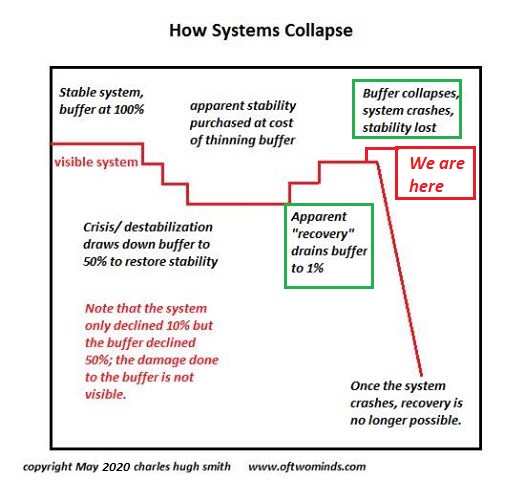
The consequences of the drip-drip-drip of moral decay is difficult to discern in day-to-day life. It’s easy to dismiss the ubiquity of artifice, PR, spin, corruption, racketeering, fraud, collusion and narrative manipulation (a.k.a. propaganda) as nothing more than human nature, but this dismissal of moral decay is nothing more than rationalizing the rot to protect insiders from the sobering reality that the entire system is unraveling and heading for its final reckoning: collapse.
We’ve become so accustomed to the excesses of marketing that we’ve lost the ability to recognize the difference between “science” that’s been carefully designed to reach a pre-planned conclusion and science that accepts the outcome, even if it harms well-funded interests.
The vast expanses of ignorance greatly aid this artifice. Even though high school physics, chemistry and biology are sufficient to tease apart the vast majority of rigged experiments, trials and studies, few Americans have the interest or fortitude to read Phase III trial results, etc. critically, and so the corporate media can trumpet bogus results without fear of exposure: all the statistical tricks and gimmicks are passed off as “science” to the distracted and gullible.
And if someone dares to examine the results critically, then those benefiting from the ignorance make the results “secret” until the year 2929. And that’s the entire game in a nutshell: maximizing private gain from artifice, PR, spin, corruption, racketeering, fraud, collusion and narrative manipulation, all masked by an putrid spew of virtue-signaling and PR.
Every institution that was once trustworthy has been debauched to maximize private gain: higher education, science, medicine, national defense–the list includes virtually every sector and industry in America. Nothing can be trusted because somebody behind the scenes is spinning the story and data to mask their self-interest, their immense gains and the carefully contrived structure of diverting investigation and eliminating transparency, competition and accountability.
Our technocratic obsession denies the existence of the moral universe, reducing the world to techno-gimmicks (electric air taxis for everyone!), techno-fantasies (fusion reactors on every corner!) and techno-distractions (which billionaire will be the first on Mars?), as if a nation and society hurtling toward moral, social, civic and economic collapse can be saved by some “innovation” that beneath the surface is nothing more than another profiteering monopoly or cartel.
Many people fear collapse, but quality, service and reliability have already collapsed. The washing machine that two generations ago was designed and built to last 25 years now breaks down after a few years–so sorry, the motherboard failed. That will cost you almost as much as new washer, and so the manufacturer, bank and retailer win because the weary, clueless consumer will do the easy thing and buy a new, expensive appliance on credit. The “old” appliance (brand-new by previous standards) is hauled off to the landfill, the ultimate destination of everything in our Landfill Economy of poorly made junk.
Service would be hauled to the landfill as well if it was tangible. Alas, it is simply maddening, as nothing works and Kafkaesque bureaucracies have so much power that they are immune to transparency, competition and accountability. their websites don’t work, they botch the most basic transactions and they perpetuate incorrect information, but too bad–there is no recourse.
Big Tech is equally impervious to transparency, competition and accountability. Your “crime” is never explained, and there is no recourse, for the Machine has no judiciary or human contact: you query the Machine knowing full well that you will never extract anything remotely fair or just from its algorithmic monstrosity.
Technology doesn’t extinguish moral decay or eliminate the stench of self-serving artifice, PR, spin, corruption, racketeering, fraud, collusion and narrative manipulation. Technology only enhances the potential for profiteering under the tissue-thin guise of “innovation,” “technological advance” and the threadbare delusions of a populace that has watched too many contrived narratives in which technology saves the day.
The moral buffers have already thinned; there is nothing left to tap. There is nothing left in what actually matters: social cohesion, moral legitimacy, civic virtue–all stripped, depleted, gone.
Drones and robots won’t save us from collapse. Neither will fusion reactors, electric air taxis, billionaires in space, missions to Mars, algae-based meat or any of the other thousand “innovations” those profiting from moral rot promote in the hopes that the banquet of consequences being served can be swept away by more gimmicks, more artifice, more delusions, more fantasies, more PR, more spin and more narrative control.
Collapse can’t be gimmicked away. The notion that consequence can be as easily managed as PR is the ultimate artifice and the ultimate delusion.
Back in the 1880s, the mathematician and theologian Edwin Abbott tried to help us better understand our world by describing a very different one he called Flatland.
Imagine a world that is not a sphere moving through space like our own planet, but more like a vast sheet of paper inhabited by conscious, flat geometric shapes. These shape-people can move forwards and backwards, and they can turn left and right. But they have no sense of up or down. The very idea of a tree, or a well, or a mountain makes no sense to them because they lack the concepts and experiences of height and depth. They cannot imagine, let alone describe, objects familiar to us.
In this two-dimensional world, the closest scientists can come to comprehending a third dimension are the baffling gaps in measurements that register on their most sophisticated equipment. They sense the shadows cast by a larger universe outside Flatland. The best brains infer that there must be more to the universe than can be observed but they have no way of knowing what it is they don’t know.
This sense of the the unknowable, the ineffable has been with humans since our earliest ancestors became self-conscious. They inhabited a world of immediate, cataclysmic events – storms, droughts, volcanoes and earthquakes – caused by forces they could not explain. But they also lived with a larger, permanent wonder at the mysteries of nature itself: the change from day to night, and the cycle of the seasons; the pin-pricks of light in the night sky, and their continual movement; the rising and falling of the seas; and the inevitability of life and death.
Perhaps not surprisingly, our ancestors tended to attribute common cause to these mysterious events, whether of the catastrophic or the cyclical variety, whether of chaos or order. They ascribed them to another world or dimension – to the spiritual realm, to the divine.
Paradox and mystery
Science has sought to shrink the realm of the inexplicable. We now understand – at least approximately – the laws of nature that govern the weather and catastrophic events like an earthquake. Telescopes and rocket-ships have also allowed us to probe deeper into the heavens to make a little more sense of the universe outside our tiny corner of it.
But the more we investigate the universe the more rigid appear the limits to our knowledge. Like the shape-people of Flatland, our ability to understand is constrained by the dimensions we can observe and experience: in our case, the three dimensions of space and the additional one of time. Influential “string theory” posits another six dimensions, though we would be unlikely to ever sense them in any more detail than the shadows almost-detected by the scientists of Flatland.
The deeper we peer into the big universe of the night sky and our cosmic past, and the deeper we peer into the small universe inside the atom and our personal past, the greater the sense of mystery and wonder.
At the sub-atomic level, the normal laws of physics break down. Quantum mechanics is a best-guess attempt to explain the mysteries of movement of the tiniest particles we can observe, which appear to be operating, at least in part, in a dimension we cannot observe directly.
And most cosmologists, looking outwards rather inwards, have long known that there are questions we are unlikely ever to answer: not least what exists outside our universe – or expressed another way, what existed before the Big Bang. For some time, dark matter and black holes have baffled the best minds. This month scientists conceded to the New York Times that there are forms of matter and energy unknown to science but which can be inferred because they disrupt the known laws of physics.
Inside and outside the atom, our world is full of paradox and mystery.
Breaking News: Evidence is mounting that a tiny subatomic particle is being influenced by forms of matter and energy that are not yet known to science but which may nevertheless affect the nature and evolution of the universe. https://t.co/8cwwhlPCOe
Despite our science-venerating culture, we have arrived at a similar moment to our forebears, who gazed at the night sky in awe. We have been forced to acknowledge the boundaries of knowledge.
There is a difference, however. Our ancestors feared the unknowable, and therefore preferred to show caution and humility in the face of what could not be understood. They treated the ineffable with respect and reverence. Our culture encourages precisely the opposite approach. We show only conceit and arrogance. We seek to defeat, ignore or trivialise that which we cannot explain or understand.
The greatest scientists do not make this mistake. As an avid viewer of science programmes like the BBC’s Horizon, I am always struck by the number of cosmologists who openly speak of their religious belief. Carl Sagan, the most famous cosmologist, never lost his sense of awestruck wonder as he examined the universe. Outside the lab, his was not the language of hard, cold, calculating science. He described the universe in the language of poetry. He understood the necessary limits of science. Rather than being threatened by the universe’s mysteries and paradoxes, he celebrated them.
When in 1990, for example, space probe Voyager 1 showed us for the first time our planet from 6 billion km away, Sagan did not mistake himself or his fellow NASA scientists for gods. He saw “a pale blue dot” and marvelled at a planet reduced to a “mote of dust suspended in a sunbeam”. Humility was his response to the vast scale of the universe, our fleeting place within it, and our struggle to grapple with “the great enveloping cosmic dark”.
Mind and matter
Sadly, Sagan’s approach is not the one that dominates the western tradition. All too often, we behave as if we are gods. Foolishly, we have made a religion of science. We have forgotten that in a world of unknowables, the application of science is necessarily tentative and ideological. It is a tool, one of many that we can use to understand our place in the universe, and one that is easily appropriated by the corrupt, by the vain, by those who seek power over others, by those who worship money.
Until relatively recently, science, philosophy and theology sought to investigate the same mysteries and answer the same existential questions. Through much of history, they were seen as complementary, not in competition. Abbott, remember, was a mathematician and theologian, and Flatland was his attempt to explain the nature of faith. Similarly, the man who has perhaps most shaped the paradigm within which much western science still operates was a French philosopher using the scientific methods of the time to prove the existence of God.
Today, Rene Descartes is best remembered for his famous – if rarely understood – dictum: “I think, therefore I am.” Four hundred years ago, he believed he could prove God’s existence through his argument that mind and matter are separate. Just as human bodies were distinct from souls, so God was separate and distinct from humans. Descartes believed knowledge was innate, and therefore our idea of a perfect being, of God, could only derive from something that was perfect and objectively real outside us.
Weak and self-serving as many of his arguments sound today, Descartes’ lasting ideological influence on western science was profound. Not least so-called Cartesian dualism – the treatment of mind and matter as separate realms – has encouraged and perpetuated a mechanistic view of the world around us.
We can briefly grasp how strong the continuing grip of his thinking is on us when we are confronted with more ancient cultures that have resisted the west’s extreme rationalist discourse – in part, we should note, because they were exposed to it in hostile, oppressive ways that served only to alienate them from the western canon.
Hearing a Native American or an Australian Aboriginal speak of the sacred significance of a river or a rock – or about their ancestors – is to become suddenly aware of how alien their thinking sounds to our “modern” ears. It is the moment when we are likely to respond in one of two ways: either to smirk internally at their childish ignorance, or to gulp at a wisdom that seems to fill a yawning emptiness in our own lives.
Science and power
Descartes’ legacy – a dualism that assumes separation between soul and body, mind and matter – has in many ways proved a poisonous one for western societies. An impoverished, mechanistic worldview treats both the planet and our bodies primarily as material objects: one a plaything for our greed, the other a canvas for our insecurities.
The British scientist James Lovelock who helped model conditions on Mars for NASA so it would have a better idea how to build the first probes to land there, is still ridiculed for the Gaia hypothesis he developed in the 1970s. He understood that our planet was best not viewed as a very large lump of rock with life-forms living on it, though distinct from it. Rather Earth was as a complete, endlessly complex, delicately balanced living entity. Over billions of years, life had grown more sophisticated, but each species, from the most primitive to the most advanced, was vital to the whole, maintaining a harmony that sustained the diversity.
Few listened to Lovelock. Our god-complex got the better of us. And now, as the bees and other insects disappear, everything he warned of decades ago seems far more urgent. Through our arrogance, we are destroying the conditions for advanced life. If we don’t stop soon, the planet will dispose of us and return to an earlier stage of its evolution. It will begin again, without us, as simple flora and microbes once again begin recreating gradually – measured in aeons – the conditions favourable to higher life forms.
But the abusive, mechanistic relationship we have with our planet is mirrored by the one we have with our bodies and our health. Dualism has encouraged us to think of our bodies as fleshy vehicles, which like the metal ones need regular outside intervention, from a service to a respray or an upgrade. The pandemic has only served to underscore these unwholesome tendencies.
In part, the medical establishment, like all establishments, has been corrupted by the desire for power and enrichment. Science is not some pristine discipline, free from real-world pressures. Scientists need funding for research, they have mortgages to pay, and they crave status and career advancement like everyone else.
Kamran Abbasi, executive editor of the British Medical Journal, wrote an editorial last November warning of British state corruption that had been unleashed on a grand scale by covid-19. But it was not just politicians responsible. Scientists and health experts had been implicated too: “The pandemic has revealed how the medical-political complex can be manipulated in an emergency.”
He added: “The UK’s pandemic response relies too heavily on scientists and other government appointees with worrying competing interests, including shareholdings in companies that manufacture covid-19 diagnostic tests, treatments, and vaccines.”
So many conflicts of interest in the decisions that shape our understanding of the world. Here's just one more tiny, unremarkable nugget told in passing:
'Google’s parent company, Alphabet, owns 12% of Vaccitech', the biotech firm behind AstraZeneca's jab https://t.co/XSslDkpDd4
But in some ways Abbasi is too generous. Scientists haven’t only corrupted science by prioritising their personal, political and commercial interests. Science itself is shaped and swayed by the ideological assumptions of scientists and the wider societies to which they belong. For centuries, Descartes’ dualism has provided the lens through which scientists have often developed and justified medical treatments and procedures. Medicine has its fashions too, even if they tend to be longer-lived – and more dangerous – than the ones of the clothing industry.
In fact, there were self-interested reasons why Descartes’s dualism was so appealing to the scientific and medical community four centuries ago. His mind-matter division carved out a space for science free from clerical interference. Doctors could now claim an authority over our bodies separate from that claimed by the Church over our souls.
But the mechanistic view of health has been hard to shake off, even as scientific understanding – and exposure to non-western medical traditions – should have made it seem ever less credible. Cartesian dualism reigns to this day, seen in the supposedly strict separation of physical and mental health. To treat the mind and body as indivisible, as two sides of the same coin, is to risk being accused of quackery. “Holistic” medicine still struggles to be taken seriously.
Faced with a fear-inducing pandemic, the medical establishment has inevitably reverted even more strongly to type. The virus has been viewed through a single lens: as an invader seeking to overwhelm our defences, while we are seen as vulnerable patients in desperate need of an extra battalion of soldiers who can help us to fight it off. With this as the dominant framework, it has fallen to Big Pharma – the medical corporations with the greatest firepower – to ride to our rescue.
Vaccines are part of an emergency solution, of course. They will help save lives among the most vulnerable. But the reliance on vaccines, to the exclusion of everything else, is a sign that once again we are being lured back to viewing our bodies as machines. We are being told by the medical establishment we can ride out this war with some armour-plating from Pfizer, Moderna and AstraZeneca. We can all be Robocop in the battle against Covid-19.
Pfizer claims people will likely need a third dose of its Covid-19 vaccine within six to 12 months of receiving the first two doses.
CEO Albert Bourla says, from then on, it is also possible that people may require annual booster shots. pic.twitter.com/Ki9nVLVg7v
But there are others ways to view health than as an expensive, resource-depleting technological battle against virus-warriors. Where is the focus on improving the ever-more nutrient-deficient, processed, pesticide-laden, and sugar and chemical-rich diets most of us consume? How do we address the plague of stress and anxiety we all endure in a competitive, digitally connected, no-rest world stripped of all spiritual meaning? What do we do about the cosseted lifestyles we prefer, where exertion is a lifestyle choice renamed as exercise rather than integral to our working day, and where regular exposure to sunshine, outside of a beach vacation, is all but impossible in our office-bound schedules?
Fear and quick-fixes
For much of human history, our chief concern was the fight for survival – against animals and other humans, against the elements, against natural disasters. Technological developments proved invaluable in making our lives safer and easier, whether it was flint axes and domesticated animals, wheels and combustion engines, medicines and mass communications. Our brains now seem hardwired to look to technological innovation to address even the smallest inconvenience, to allay even our wildest fears.
So, of course, we have invested our hopes, and sacrificed our economies, in finding a technological fix to the pandemic. But does this exclusive fixation on technology to solve the current health crisis not have a parallel with the similar, quick-fix technological remedies we keep seeking for the many ecological crises we have created?
Global warming? We can create an even whiter paint to reflect back the sun’s heat. Plastics in every corner of our oceans? We can build giant vacuum-cleaners that will suck it all out. Vanishing bee populations? We can invent pollinator drones to take their place. A dying planet? Jeff Bezos and Elon Musk will fly millions of us to space colonies.
Were we not so technology obsessed, were we not so greedy, were we not so terrified of insecurity and death, if we did not see our bodies and minds as separate, and humans as separate from everything else, we might pause to ponder whether our approach is not a little misguided.
Science and technology can be wonderful things. They can advance our knowledge of ourselves and the world we inhabit. But they need to be conducted with a sense of humility we increasingly seem incapable of. We are not conquerors of our bodies, or the planet, or the universe – and if we imagine we are, we will soon find out that the battle we are waging is one we can never hope to win.
A close friend of mine, a professor of English literature, has been researching American philosopher John Dewey, whose book Quest for Certainty captivated me so much many years ago that I read it again right after I had finished it the first time. My friend has been reminding me why I found Dewey so profound while shedding new light on the philosopher’s thinking.
Dewey, it turns out, is one of the few thinkers in American life who absorbed the true import of the work of Charles Darwin. Dewey reminds us that, quite simply, Darwin posited that we humans are organisms in an environment just like every other organism. Dewey’s star faded after World War II. American and world society have since lapsed into a narrative that puts humans above and outside nature, protected by technological advancements that supposedly shield us from nature’s demands and vicissitudes. The general narrative is that we are heading into a push-button, voice-activated technocratic paradise. (I think of the various Star Trek television series as popular cultural reflections of this view.)
But, the first pandemic in a century is forcefully and sadly reminding all of us that Darwin was right about our place in the natural world, more specifically, that we will never be outside of it.
That the world is “wildly unprepared” for this pandemic is in part a result of our belief the we are on a separate journey from the rest of the natural world, headed toward a perfected existence in which nature obeys all of our commands and bothers us not at all. Why prepare for something that is merely a product of nature? We have the technology to overcome it, don’t we? There must be a pill, right? Actually, wrong.
Those who understand human vulnerabilities have been sounding the alarm for years. But the idea that our entire way of life could be dramatically disrupted worldwide simultaneously simply was not on the radar of most governments—at least not enough to get them to stockpile even the most basic medical supplies; face masks come to mind.
There is much talk of creating a vaccine and doing it quickly. But such an endeavor can take more than a year and even more time to manufacture and distribute. There is less talk about the unhealthy lifestyles and chronic disease such as heart disease and diabetes that result from that lifestyle which might need to be addressed if we are going to cope better with the world of microorganisms we inhabit. There is even less talk that those at the bottom of the economic ladder are the most vulnerable and that the wealth gap and the gap in access to health care it implies are actually a huge public health problem for all of us.
If we continue to think of health as the absence of illness, of illness as something that is prevented by a pill or a shot—and if not ultimately prevented, treated by a pill or a shot—we humans won’t make the necessary changes as a global society to better withstand more frequent pandemics.
Robust health, not techofixes, is the best way to confront the biological perils of the natural world in which we participate. Such a focus would, however, take a complete rethinking of who we humans are, namely, organisms in an environment. Will the coronavirus awaken any more of us to this fact?
California has very strict compulsory vaccination laws for children in school, and as a result more parents are deciding to homeschool their children. The latest information regarding vaccines in California that’s making noise is Senate Bill 276 by Senator Richard Pan. The bill eliminated nearly all vaccine medical exemptions. Under this bill, politicians, not physicians, are in charge of deciding whether or not children may receive medical exemptions, which in turn would determine whether or not they can attend school.
This bill, which was recently signed into law, represents medical tyranny that is similar to a police state. Forcing vaccinations on any segment of the population and taking away their freedom of choice is ridiculous. All of this is done under the assumption that unvaccinated children pose a danger to vaccinated children, and this is simply not true for several reasons.
Herd immunity is a largely theoretical concept, yet for decades, it has furnished one of the key underpinnings for vaccine mandates in the United States. The public health establishment borrowed the herd immunity concept from pre-vaccine observations of natural disease outbreaks. Then, without any apparent supporting science, officials applied the concept to vaccination, using it not only to justify mass vaccination but to guilt-trip anyone objecting to the nation’s increasingly onerous vaccine mandates.
In a 2014 analysis in the Oregon Law Review by New York University (NYU) legal scholars Mary Holland and Chase E. Zachary (who also has a Princeton-conferred doctorate in chemistry), the authors show that 60 years of compulsory vaccine policies “have not attained herd immunity for any childhood disease.” It is time, they suggest, to cast aside coercion in favor of voluntary choice.
This is true, in fact, there has been a history of disease outbreaks in heavily vaccinated populations. I wrote an article not long ago providing multiple studies showing this, and the studies are elaborated on and linked in that article, which you can go through here.
According to a MedAlertssearch of the FDA Vaccine Adverse Event Reporting System (VAERS) database as of 2/5/19, the cumulative raw count of adverse events from measles, mumps, and rubella vaccines alone was: 93,929 adverse events, 1,810 disabilities, 6,902 hospitalizations, and 463 deaths. What is even more disturbing about these numbers is that VAERS is a voluntary and passive reporting system that has been found to only capture 1% of adverse events.
How can vaccines produce herd immunity if they’re not safe for everybody? It’s impossible.
The various forms of vaccine failure not only make herd immunity impossible to achieve, but also feed the occurrence of “vaccine-preventable illnesses” in highly or even fully vaccinated populations. There are numerous examples of this in published literature, again, some of which I link and go into greater detail about measles here.
Vaccines Aren’t Safe For Everyone
It’s no secret that vaccines are not completely safe for everyone, it’s clearly not a ‘one size fits all’ product, and that’s evident by the fact that nearly $4 billion has been paid out to families of vaccine injured children via the National Childhood Vaccine Injury Act (NCVIA). As astronomical as the monetary awards are, they’re even more alarming when you consider that only an estimated 1% of vaccine injuries are even reported to the Vaccine Adverse Events Reporting System (VAERS). If the numbers from VAERS are correct – only 1% of vaccine injuries are reported and only 1/3 of the petitions are compensated – then up to 99% of vaccine injuries go unreported and the families of the vast majority of people injured by vaccines are picking up the costs, once again, for vaccine makers’ flawed products.
This completely debunks the validity of herd immunity.
Speech From Kennedy
While California’s tragic fall into what might rightly be described as a Medical Police State has many up in arms, RFK Jr. spontaneously delivered a speech outside Gov. Newsom’s office, helping to transform the anger and grief experienced by thousands of shaken onlookers into inspiration and hope, no doubt catalyzing further what is clearly becoming this country’s next grassroots civil rights movement.
In the astoundingly powerful and uplifting speech by RFK Jr. below, one senses the historical importance of what just transpired. And that the fall of California into medical fascism also marks the beginning of a new, broad-based civil rights movement, including all sexes, races, walks of life, religions, and socioeconomic classes — as it concerns the primary, inviolable human right of bodily self-sovereignty and health freedom, and a parent’s right to make informed health choices for their children, which can have life and death consequences. [From the Youtube video description]
Merck introduced its measles vaccine in 1963, claiming the vaccine would convey lifelong immunity equivalent to a natural infection, with health officials promising that 55% vaccine coverage would produce “herd immunity” sufficient to eradicate measles by 1967.
Leading scientists of the day, including the world’s preeminent bacteriologist, Sir Graham Wilsonand Harvard Virologist John Enders, who first isolated measles, warned against introducing a vaccine unless it provided lifelong immunity. Measles, they cautioned, would rebound with increased virulence and mortality as the vaccine forced the evolution of more virulent strains and shifted outbreaks away from children—biologically evolved to handle measles—to the elderly who could die from pneumonia, and young infants now unequipped with maternal immunity.
A 1984 Johns Hopkins University modeling study predicted that Merck’s population-wide experiment would increase measles outbreaks by 2050, (when the last generation subject to natural immunity died off,) compared to the pre-vaccine era. This is exactly what has happened. Merck’s vaccine, with a growing failure rate has been incapable of abolishing the disease. Vaccine failure has left millions of adult Californians effectively unvaccinated. And 79% of people affected by measles in this year’s California outbreak were adults.
When eradication predictably didn’t materialize and measles attacked fully-vaccinated populations, Merck simply moved the goalpost saying that herd immunity required 75% vaccination, then 85%, then 95%, then 98%. And now 99%. To distract the world’s citizens from its failed vaccine, Merck started blaming “anti-vaxxers.” (The Vaccine Safety Movement)
California’s bought or brain-dead lawmakers are proposing to “fix” Merck’s vaccine failure problem by punishing 4,000 vulnerable children with medical exemptions. In an act of legislative savagery, Democratic politicians propose to forcibly vaccinate children whose doctors have told them that a vaccine could kill or severely injure them. SB276 will not fix the measles outbreak or solve the problem of vaccine failure, it will only reward a corrupt company for a defective product.
The Takeaway
The idea that politicians can force children to be vaccinated, including those deemed to be in danger of severe adverse reactions, and strip them of their rights to attend public school is insane. Freedom of choice and medical freedom should always exist, especially with regards to vaccines. If parents want to vaccinate, fine, but parents who wish to not vaccinate their children for whatever reasons should always have the freedom to do so.
Mandatory vaccination is tyrannical.
“The fight for liberty and health freedom in California is far from over. There will be legal challenges,” said RFK. Jr., “all the way up to the Supreme Court if necessary. In fact, this incident brings to the forefront a deep, dark problem in the United States that has been festering for decades: the rise of the Pharmaceutical industry’s influence on the government to mandate products that the free market would otherwise reject, due to the profound liability these products have now underwritten completely by the government via their indemnification through the National Childhood Vaccine Injury Compensation Act (NCVIA) of 1986. Now, over three decades since the inception of NVICA, that same industry is starting to use the police powers of the state to enforce these mandates.” [Taken from the Youtube description in the video posted above]
If you thought banking in our time was a miserable racket — which it is, of course, and by “racket” I mean a criminal enterprise — then so-called health care has it beat by a country mile, with an added layer of sadism and cruelty built into its operations. Lots of people willingly sign onto mortgages and car loans they wouldn’t qualify for in an ethically sound society, but the interest rates and payments are generally spelled out on paper. They know what they’re signing on for, even if the contract is reckless and stupid on the parts of both borrower and lender. Pension funds and insurance companies foolishly bought bundled mortgage bonds of this crap concocted in the housing bubble. They did it out of greed and desperation, but a little due diligence would have clued them into the fraud being served up by the likes of Goldman Sachs.
Medicine is utterly opaque cost-wise, and that is the heart of the issue. Nobody in the system will say what anything costs and nobody wants to because it would break the spell that they work in an honest, legit business. There is no rational scheme for the cost of any service from one “provider” to the next or even one patient to the next. Anyway, the costs are obscenely inflated and concealed in so many deliberately deceptive coding schemes that even actuaries and professors of economics are confounded by their bills. The services are provided when the customer is under the utmost duress, often life-threatening, and the outcome even in a successful recovery from illness is financial ruin that leaves a lot of people better off dead.
It is a hostage racket, in plain English, a disgrace to the profession that has adopted it, and an insult to the nation. All the idiotic negotiations in congress around the role of insurance companies are a grand dodge to avoid acknowledging the essential racketeering of the “providers” — doctors and hospitals. We are never going to reform it in its current incarnation. For all his personality deformities, President Trump is right in saying that ObamaCare is going to implode. It is only a carbuncle on the gangrenous body of the US medical establishment. The whole system will go down with it.
The New York Times departed from its usual obsessions with Russian turpitude and transgender life last week to publish a valuable briefing on this aspect of the health care racket: Those Indecipherable Medical Bills? They’re One Reason Health Care Costs So Much by Elisabeth Rosenthal. Much of this covers ground exposed in the now famous March 4, 2013 Time Magazine cover story (it took up the whole issue): Bitter Pill: Why Medical Bills Are Killing Us, by Steven Brill. The American public and its government have been adequately informed about the gross and lawless chiseling rampant in every quarter of medicine. The system is one of engineered criminality. It is inflicting ruin on millions. It is really a wonder that the public has not stormed the hospitals with pitchforks and flaming brands to string up that gang in the parking lots high above their Beemers and Lexuses.
There are only two plausible arcs to this story. One is that the nation might face the facts and resort to the Single Payer system found in virtually every other nation that affects to be civilized. There is no other way to eliminate the deliberate racketeering. The other outcome would be the inevitable collapse of the system and its eventual re-set to a much less complex, cash-on-the-barrelhead, local clinic-based model with far less heroic high-tech interventions available for the broad public, but much more affordable basic care. Both outcomes would require jettisoning the immense overburden of administrative dross that clutters up the current model, with its absurd tug-of-war between the price-gouging hospital “Chargemaster” clerks and the sadistic insurance company monitors bent on denying treatment to their sick and hapless “customers” (hostages). Be warned: these represent tens of thousands of supposedly “good” jobs. Of course, they are “good” because they pay middle class wages, of which there are fewer and fewer elsewhere in the economy. But, they are well-paid because of the grotesquely profitable racket they serve. They’ve turned an entire generation of office workers into servants of criminal enterprise. Imagine the damage this does to the soul of our culture.
My suggestion for real reform of the medical racket looks to historical precedent:
In 1932 (before the election of FDR, by the way), the US Senate formed a commission to look into the causes of the 1929 Wall Street Crash and recommend corrections in banking regulation to obviate future episodes like it. It is known to history as the Pecora Commission, after its chief counsel Ferdinand Pecora, an assistant Manhattan DA, who performed gallantly in his role. The commission ran for two years. Its hearings led to prison terms for many bankers and ultimately to the Glass-Steagall Act of 1932, which kept banking relatively honest and stable until its nefarious repeal in 1999 under President Bill Clinton — which led rapidly to a new age of Wall Street malfeasance, still underway.
The US Senate needs to set up an equivalent of the Pecora Commission to thoroughly expose the cost racketeering in medicine, enable the prosecution of the people driving it, and propose a Single Payer remedy for flushing it away. The Department of Justice can certainly apply the RICO anti-racketeering statutes against the big health care conglomerates and their executives personally. I don’t know why it has not done so already — except for the obvious conclusion that our elected officials have been fully complicit in the medical rackets, which is surely the case of new Secretary of Health and Human Services, Tom Price, a former surgeon and congressman who trafficked in medical stocks during his years representing his suburban Atlanta district. A new commission could bypass this unprincipled clown altogether.
It is getting to the point where we have to ask ourselves if we are even capable of being a serious people anymore. Medicine is now a catastrophe every bit as pernicious as the illnesses it is supposed to treat, and a grave threat to a nation that we’re supposed to care about. What party, extant or waiting to be born, will get behind this cleanup operation?




 After the Crash
