
The Imperial President’s Toolbox of Terror: A Dictatorship Waiting to Happen


pimps-inc-improved_presidential_seal_by_sharpwriter-d486y6m_zps3hnflawe

By John W. Whitehead

Source: Waking Times

“When the President does it, that means that it is not illegal.”~Richard Nixon

Presidents don’t give up power.

Executive orders don’t expire at the end of each presidential term.

And every successive occupant of the Oval Office since George Washington, who issued the first executive order, has expanded the reach and power of the presidency.

The Constitution invests the President with very specific, limited powers: to serve as Commander-in-Chief of the military, grant pardons, make treaties (with the approval of Congress), appoint ambassadors and federal judges (again with Congress’ blessing), and veto legislation.

In recent years, however, American presidents have anointed themselves with the power to wage war, unilaterally kill Americans, torture prisoners, strip citizens of their rights, arrest and detain citizens indefinitely, carry out warrantless spying on Americans, and erect their own secretive, shadow government.

These are the powers that will be inherited by the next heir to the throne, and it won’t make a difference whether it’s a President Trump or a President Clinton occupying the Oval Office.

The powers amassed by each successive president through the negligence of Congress and the courts—powers which add up to a toolbox of terror for an imperial ruler—empower whomever occupies the Oval Office to act as a dictator, above the law and beyond any real accountability.

Consider some of the presidential powers—which have been acquired through the use of executive orders, decrees, memorandums, proclamations, national security directives and legislative signing statements and can be activated by any sitting president—that have allowed past presidents to operate above the law and beyond the reach of the Constitution.

The power to kill. As the New York Times concluded, “President Obama, who came to office promising transparency and adherence to the rule of law, has become the first president to claim the legal authority to order an American citizen killed without judicial involvement, real oversight or public accountability.” Obama’s kill lists—signature drone strikes handpicked by the president—have been justified by the Justice Department as lawful because they are subject to internal deliberations by the executive branch. “In other words,” writes Amy Davidson for the New Yorker, “it’s due process if the President thinks about it.”

The power to wage war. Ever since Congress granted George W. Bush the authorization to use military force in the wake of 9/11, the United States has been in a state of endless war without Congress ever having declared one. Having pledged to end Bush’s wars, Barack Obama has extended them. As the New York Times notes, “He has now been at war longer than Mr. Bush, or any other American president… he will leave behind an improbable legacy as the only president in American history to serve two complete terms with the nation at war.” More than that, as the Atlantic makes clear, “Obama is inaugurating an era of unbridled war-making by the commander in chief, without any of the checks and balances contemplated by the American constitutional system.”

The power to torture. Despite the fact that the Bush Administration’s use of waterboarding as a torture tactic was soundly criticized by Obama, the Obama Administration refused to hold anyone accountable for participating in the rendition and torture programs. In the absence of any finding of criminality, the authorization of such torture tactics remain part of the president’s domain—should he or she ever choose to revive it.

The power to spy on American citizens. In the wake of the 9/11 terror attacks, President Bush secretly authorized the National Security Agency to carry out surveillance on Americans’ phone calls and emails. The Bush Administration claimed that the Constitution gives the president inherent powers to protect national security. The covert surveillance has continued under Obama.

The power to indefinitely detain American citizens. In 1942, President Franklin D. Roosevelt issued an executive order requiring that all Japanese-Americans be held in internment camps. While that order was later rescinded, the U.S. Supreme Court declared it to be constitutional. The ruling has never been overturned. Pointing out that such blatantly illegal detentions could happen again—with the blessing of the courts—Justice Scalia warned, “In times of war, the laws fall silent.” In fact, each National Defense Authorization Act enacted since 2012 has included a provision that permits the military to detain individuals—including Americans citizens—indefinitely without trial.

The power to strip American citizens of their constitutional rights. The Bush Administration claimed it could strip American citizens of their constitutional rights, imprison them indefinitely, and deny them legal representation simply by labeling them as enemy combatants. While the Obama Administration jettisoned the use of the term “enemy combatant,” it has persisted in defending the president’s unilateral and global right to detain anyone suspected of supporting terrorist activities.

The power to secretly rewrite or sidestep the laws of the country. Secret courts, secret orders, and secret budgets have become standard operating procedure for presidential administrations in recent years. A good case in point is Presidential Policy Directive 20, a secret order signed by President Obama as a means of thwarting cyberattacks. Based on what little information was leaked to the press about the clandestine directive, it appears that the president essentially put the military in charge of warding off a possible cyberattack. A FOIA request by the Electronic Privacy Information Center (EPIC) seeking more details on the directive was allegedly denied because doing so could cause “exceptionally grave damage to the national security.” However, EPIC believes the order allows for military deployment within the United States, including the ability to shut off communications with the outside world if the military believes it is necessary.

The power to transform the police into extensions of the military and indirectly institute martial law. What began in the 1960s as a war on drugs transitioned into an all-out campaign to transform America’s police forces into extensions of the military. Every successive president since Nixon has added to the police’s arsenal, tactics and authority. In fact, the Obama Administration has accelerated police militarization by distributing military weapons and equipment to police and incentivizing SWAT team raids and heavy-handed police tactics through the use of federal grants and asset forfeiture schemes.

The power to command the largest military and intelligence capabilities in the world and, in turn, “wag the dog.”As law professor William P. Marshall points out:

In his roles as Commander-in-Chief and head of the Executive Branch, the President directly controls the most powerful military in the world and directs clandestine agencies such as the Central Intelligence Agency and National Security Agency. That control provides the President with immensely effective, non-transparent capabilities to further his political agenda and/or diminish the political abilities of his opponents. Whether a President would cynically use such power solely for his political advantage has, of course, been the subject of political thrillers and the occasional political attack. President Clinton, for one, was accused of ordering the bombing of terrorist bases in Afghanistan to distract the nation from the Lewinsky scandal, and President Nixon purportedly used the Federal Bureau of Investigation to investigate his political enemies. But regardless whether such abuses actually occurred, there is no doubt that control of covert agencies provides ample opportunity for political mischief, particularly since the inherently secretive nature of these agencies means their actions often are hidden from public view. And as the capabilities of these agencies increase through technological advances in surveillance and other methods of investigation, so does the power of the President.

Thus, it doesn’t matter what the pundits predict, the candidates promise, and the people decree.

It doesn’t even matter whether the people elect Trump or Clinton. After all, politicians sing a different tune once elected. For instance, the Chicago Tribune editorial board observed that although Barack Obama opposed the imperial tendencies of George W. Bush, once in office, Obama “wound up behaving as if he had a scepter and throne.”

What matters is that the damage has already been done.

As Professor Marshall explains, “every extraordinary use of power by one President expands the availability of executive branch power for use by future Presidents.” Moreover, it doesn’t even matter whether other presidents have chosen not to take advantage of any particular power, because “it is a President’s action in using power, rather than forsaking its use, that has the precedential significance.”

In other words, each successive president continues to add to his office’s list of extraordinary orders and directives, granting him- or herself near dictatorial powers.

So let’s not have any more talk of which candidate would be more dangerous with these powers.

The fact that any individual—or branch of government—is empowered to act like a dictator is danger enough.

This abuse of presidential powers has been going on for so long that it has become the norm and it will continue no matter which corporate puppet wins the election. The Constitution be damned.

The government of laws idealized by John Adams has fallen prey to a government of men.

As a result, we no longer have a system of checks and balances.

“The system of checks and balances that the Framers envisioned now lacks effective checks and is no longer in balance,”concludes Marshall. “The implications of this are serious. The Framers designed a system of separation of powers to combat government excess and abuse and to curb incompetence. They also believed that, in the absence of an effective separation-of-powers structure, such ills would inevitably follow. Unfortunately, however, power once taken is not easily surrendered.”

The solution is far from simple but it’s time, as Marshall suggests, to recalibrate the balance of power. This will mean putting an end to the use of executive orders, decrees, memorandums, proclamations, national security directives and legislative signing statements as a means of getting around Congress and the courts. It will mean that Americans will have to stop letting their politics blind them to government wrongdoing. And it will mean holding all three branches of government accountable to the Constitution (i.e., if they abuse their powers, vote them out of office).

Thus far, Congress, with little spine, less integrity and too busy running for re-election, has offered little attempt at oversight, enabling the president to ride roughshod over the Constitution. The media—the perfect accomplice in this stealthy, bloodless coup—continues to inundate us with the latest celebrity scandal, says virtually nothing about these burgeoning powers. All the while, most Americans continue to operate in blissful near-ignorance, unaware or uncaring that the republic is about to fall.

Yet as I point out in my book Battlefield America: The War on the American People, it will be “we the people”—not the president, the politicians, the corporate elite or the media—who will suffer the consequences when freedom falls and tyranny rises. They may justify violating our freedoms in the name of whatever phantom menace-of-the-month threatens “national security,” but we will always be the ones to pay the price.
 

Fear of the Walking Dead: The American Police State Takes Aim

cdc_zombie_attacks

By John W. Whitehead

Source: The Rutherford Institute

“Fear is a primitive impulse, brainless as hunger, and because the aim of horror fiction is the production of the deepest kinds of fears, the genre tends to reinforce some remarkably uncivilized ideas about self-protection. In the current crop of zombie stories, the prevailing value for the beleaguered survivors is a sort of siege mentality, a vigilance so constant and unremitting that it’s indistinguishable from the purest paranoia.”— Terrence Rafferty, New York Times

The zombies are back. They are hungry. And they are lurking around every corner.

In Kansas, Governor Sam Brownback has declared October “Zombie Preparedness Month” in an effort to help the public prepare for a possible zombie outbreak.

In New York, researchers at Cornell University have concluded that the best place to hide from the walking dead is the northern Rocky Mountains region.

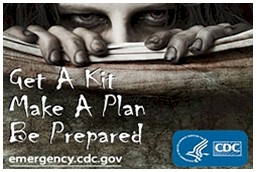
And in Washington, DC, the Centers for Disease Control and Prevention have put together a zombie apocalypse preparation kit “that details everything you would need to have on hand in the event the living dead showed up at your front door.”

The undead are also wreaking havoc at gun shows, battling corsets in forthcoming movie blockbusters such as Pride and Prejudice and Zombies, running for their lives in 5K charity races, and even putting government agents through their paces in mock military drills arranged by the Dept. of Defense (DOD) and the Center for Disease Control (CDC).

The zombie narrative, popularized by the hit television series The Walking Dead, in which a small group of Americans attempt to survive in a zombie-ridden, post-apocalyptic world where they’re not only fighting off flesh-eating ghouls but cannibalistic humans, plays to our fears and paranoia.

Yet as journalist Syreeta McFadden points out, while dystopian stories used to reflect our anxieties, now they reflect our reality, mirroring how we as a nation view the world around us, how we as citizens view each other, and most of all how our government views us.

Fear the Walking Dead—AMC’s new spinoff of its popular Walking Dead series—drives this point home by dialing back the clock to when the zombie outbreak first appears and setting viewers down in the midst of societal unrest not unlike our own experiences of the past year (“a bunch of weird incidents, police protests, riots, and … rapid social entropy”). Then, as Forbes reports, “the military showed up and we fast-forwarded into an ad hoc police state with no glimpse at what was happening in the world around our main cast of hapless survivors.”

Forbes found Fear’s quick shift into a police state to be far-fetched, but anyone who has been paying attention in recent years knows that the groundwork has already been laid for the government—i.e., the military—to intervene and lock down the nation in the event of a national disaster.

Recognizing this, the Atlantic notes: “The villains of [Fear the Walking Dead] aren’t the zombies, who rarely appear, but the U.S. military, who sweep into an L.A. suburb to quarantine the survivors. Zombies are, after all, a recognizable threat—but Fear plumbs drama and horror from the betrayal by institutions designed to keep people safe.”

We’ve been so hounded in recent years with dire warnings about terrorist attacks, Ebola pandemics, economic collapse, environmental disasters, and militarized police that it’s no wonder millions of Americans have turned to zombie fiction as a way to “envision how we and our own would thrive if everything went to hell and we lost all our societal supports.” As Time magazine reporter James Poniewozik phrases it, the “apocalyptic drama lets us face the end of the world once a week and live.”

Here’s the curious thing, however: while zombies may be the personification of our darkest fears, they embody the government’s paranoia about the citizenry as potential threats that need to be monitored, tracked, surveilled, sequestered, deterred, vanquished and rendered impotent.

Why else would the government feel the need to monitor our communications, track our movements, criminalize our every action, treat us like suspects, and strip us of any means of defense while equipping its own personnel with an amazing arsenal of weapons?

For years now, the government has been carrying out military training drills with zombies as the enemy. In 2011, the DOD created a 31-page instruction manual for how to protect America from a terrorist attack carried out by zombie forces. In 2012, the CDC released a guide for surviving a zombie plague. That was followed by training drills for members of the military, police officers and first responders.

As journalist Andrea Peyser reports:

Coinciding with Halloween 2012, a five-day national conference was put on by the HALO Corp. in San Diego for more than 1,000 first responders, military personnel and law enforcement types. It included workshops produced by a Hollywood-affiliated firm in…overcoming a zombie invasion. Actors were made up to look like flesh-chomping monsters. The Department of Homeland Security even paid the $1,000 entry fees for an unknown number of participants…

“Zombie disaster” drills were held in October 2012 and ’13 at California’s Sutter Roseville Medical Center. The exercises allowed medical center staff “to test response to a deadly infectious disease, a mass-casualty event, terrorism event and security procedures”…

[In October 2014], REI outdoor-gear stores in Soho and around the country are to hold free classes in zombie preparedness, which the stores have been providing for about three years.

The zombie exercises appear to be kitschy and fun—government agents running around trying to put down a zombie rebellion—but what if the zombies in the exercises are us, the citizenry, viewed by those in power as mindless, voracious, zombie hordes?

Consider this: the government started playing around with the idea of using zombies as stand-ins for enemy combatants in its training drills right around the time the Army War College issued its 2008 report, warning that an economic crisis in the U.S. could lead to massive civil unrest that would require the military to intervene and restore order.

That same year, it was revealed that the government had amassed more than 8 million names of Americans considered a threat to national security, to be used “by the military in the event of a national catastrophe, a suspension of the Constitution or the imposition of martial law.” The program’s name, Main Core, refers to the fact that it contains “copies of the ‘main core’ or essence of each item of intelligence information on Americans produced by the FBI and the other agencies of the U.S. intelligence community.”

Also in 2008, the Pentagon launched the Minerva Initiative, a $75 million military-driven research project focused on studying social behavior in order to determine how best to cope with mass civil disobedience or uprisings. The Minerva Initiative has funded projects such as “Who Does Not Become a Terrorist, and Why?” which “conflates peaceful activists with ‘supporters of political violence’ who are different from terrorists only in that they do not embark on ‘armed militancy’ themselves.”

In 2009, the Dept. of Homeland Security issued its reports on Rightwing and Leftwing Extremism, in which the terms “extremist” and “terrorist” were used interchangeably to describe citizens who were disgruntled or anti-government.

Meanwhile, a government campaign was underway to spy on Americans’ mail, email and cell phone communications. News reports indicate that the U.S. Postal Service has handled more than 150,000 requests by federal and state law enforcement agencies to monitor Americans’ mail, in addition to photographing every piece of mail sent through the postal system.

Fast forward a few years more and you have local police being transformed into extensions of the military, taught to view members of their community as suspects, trained to shoot first and ask questions later, and equipped with all of the technology and weaponry of a soldier on a battlefield.

Most recently, the Obama administration hired a domestic terrorism czar whose job is to focus on anti-government American “extremists” who have been designated a greater threat to America than ISIS or al Qaeda. As part of the government’s so-called war on right-wing extremism, the Obama administration has agreed to partner with the United Nations to take part in its Strong Cities Network program, which will train local police agencies across America in how to identify, fight and prevent extremism.

In other words, those who believe in and exercise their rights under the Constitution (namely, the right to speak freely, worship freely, associate with like-minded individuals who share their political views, criticize the government, own a weapon, demand a warrant before being questioned or searched, or any other activity viewed as potentially anti-government, racist, bigoted, anarchic or sovereign), have just been promoted to the top of the government’s terrorism watch list.

Noticing a pattern yet?

“We the people” or, more appropriately, “we the zombies” are the enemy in the eyes of the government.

So when presented with the Defense Department’s battle plan for defeating an army of the walking dead, you might find yourself tempted to giggle over the fact that a taxpayer-funded government bureaucrat actually took the time to research and write about vegetarian zombies, evil magic zombies, chicken zombies, space zombies, bio-engineered weaponized zombies, radiation zombies, symbiant-induced zombies, and pathogenic zombies.

However, in an age of extreme government paranoia, this is no laughing matter.

The DOD’s strategy for dealing with a zombie uprising, outlined in “CONOP 8888,” is for all intents and purposes a training manual for the government in how to put down a citizen uprising or at least an uprising of individuals “infected” with dangerous ideas about freedom.

Rest assured that the tactics and difficulties outlined in the “fictional training scenario” are all too real, beginning with martial law.

As the DOD training manual states: “zombies [read: “activists”] are horribly dangerous to all human life and zombie infections have the potential to seriously undermine national security and economic activities that sustain our way of life. Therefore having a population that is not composed of zombies or at risk from their malign influence is vital to U.S. and Allied national interests.”

So how does the military plan to put down a zombie (a.k.a. disgruntled citizen) uprising?

The strategy manual outlines five phases necessary for a counter-offensive: shape, deter, seize initiative, dominate, stabilize and restore civil authority. Here are a few details:

Phase 0 (Shape): Conduct general zombie awareness training. Monitor increased threats

(i.e., surveillance). Carry out military drills. Synchronize contingency plans between federal and state agencies. Anticipate and prepare for a breakdown in law and order.

Phase 1 (Deter): Recognize that zombies cannot be deterred or reasoned with. Carry out training drills to discourage other countries from developing or deploying attack zombies and publicly reinforce the government’s ability to combat a zombie threat. Initiate intelligence sharing between federal and state agencies. Assist the Dept. of Homeland Security in identifying or discouraging immigrants from areas where zombie-related diseases originate.

Phase 2 (Seize initiative): Recall all military personal to their duty stations. Fortify all military outposts. Deploy air and ground forces for at least 35 days. Carry out confidence-building measures with nuclear-armed peers such as Russia and China to ensure they do not misinterpret the government’s zombie countermeasures as preparations for war. Establish quarantine zones. Distribute explosion-resistant protective equipment. Place the military on red alert. Begin limited scale military operations to combat zombie threats. Carry out combat operations against zombie populations within the United States that were “previously” U.S. citizens.

Phase 3 (Dominate): Lock down all military bases for 30 days. Shelter all essential government personnel for at least 40 days. Equip all government agents with military protective gear. Issue orders for military to kill all non-human life on sight. Initiate bomber and missile strikes against targeted sources of zombie infection, including the infrastructure. Burn all zombie corpses. Deploy military to lock down the beaches and waterways.

Phase 4 (Stabilize): Send out recon teams to check for remaining threats and survey the status of basic services (water, power, sewage infrastructure, air, and lines of communication). Execute a counter-zombie ISR plan to ID holdout pockets of zombie resistance. Use all military resources to target any remaining regions of zombie holdouts and influence. Continue all actions from the Dominate phase.

Phase 5 (Restore civil authority): Deploy military personnel to assist any surviving civil authorities in disaster zones. Reconstitute combat capabilities at various military bases. Prepare to redeploy military forces to attack surviving zombie holdouts. Restore basic services in disaster areas.

Notice the similarities?

Surveillance. Military drills. Awareness training. Militarized police forces. Martial law.

As I point out in my book, Battlefield America: The War on the American People, if there is any lesson to be learned, it is simply this: whether the threat to national security comes in the form of actual terrorists, imaginary zombies or disgruntled American citizens infected with dangerous ideas about freedom, the government’s response to such threats remains the same: detect, deter and annihilate.

To return to AMC’s Fear the Walking Dead: it’s the police state “tasked with protecting the vulnerable” that poses some of the gravest threats to the citizenry.

From the Atlantic:

When the military arrives, mowing down hostile “walkers” with ease, setting up camp to screen out any further infection, the moment is presented with an ironic note of triumph. The main character, Travis Manawa (Cliff Curtis), tells his group they can rest easy—help has finally arrived… As the soldiers begin hauling anyone spiking a fever away to quarantine zones, Travis insists their intentions are noble while the rest of his family begins to realize the military doesn’t really have a plan except to crush any potential threat. Are you a zombie? They’ll shoot you in the head. Do you look sick? You’re probably about to be a zombie. Do you have a problem with their approach? Then they have a problem with you, too.

One of the show’s most brilliant touches has been the characterization of the soldiers themselves, not as impassive robots hell-bent on enforcing martial law, but as worryingly recognizable guys around town. Whenever Travis pleads with his local commander to address community fears and complaints, he might as well be talking to an ornery bowling buddy. The soldiers are tetchy and irritable rather than monstrous, clearly overwhelmed by the impossible situation they face, and granted authority through the guns in their hands and little else. In a pivotal scene, one of them tries to cajole Travis into firing a killshot at a distant zombie through a sniper scope, even though he knows Travis believes there might be a cure. The soldiers insist the zombies are dead beyond salvation—an unfortunate truth on the show, but also a sad reflection of just how dehumanized the enemy can become in the midst of war.

The latest episode, “Cobalt,” revealed the military’s endgame: With the zombie situation deteriorating, they plan to flee and wipe out everyone they leave behind, at this point motivated only by the need to survive, rather than to protect. Countering that is the family unit that has forged new bonds in the crisis. These organically loyal communities, the writers Robert Kirkman and David Erickson argue, are the only kind that can survive in such a world… More than anything, Fear the Walking Dead is a drama about occupation, the breakdown of society, and the ease with which seemingly decent people can decide that might makes right. Like any dystopian fiction, it’s easy to dismiss as fantasy, but remove the zombies and Fear could be taking place in dozens of real-world locations… This is happening here, Kirkman and Erickson are saying, but it could happen anywhere.


Battlefield America: The War on the American People

police-state-founders-warning

By John W. Whitehead

Source: The Rutherford Institute

“A government which will turn its tanks upon its people, for any reason, is a government with a taste of blood and a thirst for power and must either be smartly rebuked, or blindly obeyed in deadly fear.”—John Salter

We have entered into a particularly dismal chapter in the American narrative, one that shifts us from a swashbuckling tale of adventure into a bone-chilling horror story.

As I document in my new book Battlefield America: The War on the American People, “we the people” have now come full circle, from being held captive by the British police state to being held captive by the American police state. In between, we have charted a course from revolutionaries fighting for our independence and a free people establishing a new nation to pioneers and explorers, braving the wilderness and expanding into new territories.

Where we went wrong, however, was in allowing ourselves to become enthralled with and then held hostage by a military empire in bondage to a corporate state (the very definition of fascism). No longer would America hold the moral high ground as a champion of freedom and human rights. Instead, in the pursuit of profit, our overlords succumbed to greed, took pleasure in inflicting pain, exported torture, and imported the machinery of war, transforming the American landscape into a battlefield, complete with military personnel, tactics and weaponry.

To our dismay, we now find ourselves scrambling for a foothold as our once rock-solid constitutional foundation crumbles beneath us. And no longer can we rely on the president, Congress, the courts, or the police to protect us from wrongdoing.

Indeed, they have come to embody all that is wrong with America.

For instance, how does a man who is relatively healthy when taken into custody by police lapse into a coma and die while under their supervision? What kind of twisted logic allows a police officer to use a police car to run down an American citizen and justifies it in the name of permissible deadly force? And what country are we living in where the police can beat, shoot, choke, taser and tackle American citizens, all with the protection of the courts?

Certainly, the Constitution’s safeguards against police abuse means nothing when government agents can crash through your door, terrorize your children, shoot your dogs, and jail you on any number of trumped of charges, and you have little say in the matter. For instance, San Diego police, responding to a domestic disturbance call on a Sunday morning, showed up at the wrong address, only to shoot the homeowner’s 6-year-old service dog in the head.

Rubbing salt in the wound, it’s often the unlucky victim of excessive police force who ends up being charged with wrongdoing. Although 16-year-old Thai Gurule was charged with resisting arrest and strangling and assaulting police officers, a circuit judge found that it was actually the three officers who unlawfully stopped, tackled, punched, kneed, tasered and yanked his hair who were at fault. Thankfully, bystander cell phone videos undermined police accounts, which were described as “works of fiction.”

Not even our children are being spared the blowback from a growing police presence. As one juvenile court judge noted in testimony to Congress, although having police on public school campuses did not make the schools any safer, it did result in large numbers of students being arrested for misdemeanors such as school fights and disorderly conduct. One 11-year-old autistic Virginia student was charged with disorderly conduct and felony assault after kicking a trashcan and resisting a police officer’s attempt to handcuff him. A 14-year-old student was tasered by police, suspended and charged with disorderly conduct, resisting arrest and trespassing after he failed to obey a teacher’s order to be the last student to exit the classroom.

There is no end to the government’s unmitigated gall in riding roughshod over the rights of the citizenry, whether in matters of excessive police powers, militarized police, domestic training drills, SWAT team raids, surveillance, property rights, overcriminalization, roadside strip searches, profit-driven fines and prison sentences, etc.

The president can now direct the military to detain, arrest and secretly execute American citizens. These are the powers of an imperial dictator, not an elected official bound by the rule of law. For the time being, Barack Obama wears the executioner’s robe, but you can rest assured that this mantle will be worn by whomever occupies the Oval Office in the future.

A representative government means nothing when the average citizen has little to no access to their elected officials, while corporate lobbyists enjoy a revolving door relationship with everyone from the President on down. Indeed, while members of Congress hardly work for the taxpayer, they work hard at being wooed by corporations, which spend more to lobby our elected representatives than we spend on their collective salaries. For that matter, getting elected is no longer the high point it used to be. As one congressman noted, for many elected officials, “Congress is no longer a destination but a journey… [to a] more lucrative job as a K Street lobbyist… It’s become routine to see members of Congress drop their seat in Congress like a hot rock when a particularly lush vacancy opens up.”

As for the courts, they have long since ceased being courts of justice. Instead, they have become courts of order, largely marching in lockstep with the government’s dictates, all the while helping to increase the largesse of government coffers. It’s called for-profit justice, and it runs the gamut of all manner of financial incentives in which the courts become cash cows for communities looking to make an extra buck. As journalist Chris Albin-Lackey details, “They deploy a crushing array of fines, court costs, and other fees to harvest revenues from minor offenders that these communities cannot or do not want to raise through taxation.” In this way, says Albin-Lackey, “A resident of Montgomery, Alabama who commits a simple noise violation faces only a $20 fine—but also a whopping $257 in court costs and user fees should they seek to have their day in court.”

As for the rest—the schools, the churches, private businesses, service providers, nonprofits and your fellow citizens—many are also marching in lockstep with the police state. This is what is commonly referred to as community policing. After all, the police can’t be everywhere. So how do you police a nation when your population outnumbers your army of soldiers? How do you carry out surveillance on a nation when there aren’t enough cameras, let alone viewers, to monitor every square inch of the country 24/7? How do you not only track but analyze the transactions, interactions and movements of every person within the United States? The answer is simpler than it seems: You persuade the citizenry to be your eyes and ears.

It’s a brilliant ploy, with the added bonus that while the citizenry remains focused on and distrustful of each other, they’re incapable of focusing on more definable threats that fall closer to home—namely, the government and its militarized police. In this way, we’re seeing a rise in the incidence of Americans being reported for growing vegetables in their front yard, keeping chickens in their back yard, letting their kids walk to the playground alone, and voicing anti-government sentiments. For example, after Shona Banda’s son defended the use of medical marijuana during a presentation at school, school officials alerted the police and social services, and the 11-year-old was interrogated, taken into custody by social workers, had his home raided by police and his mother arrested.

Now it may be that we have nothing to worry about. Perhaps the government really does have our best interests at heart. Perhaps covert domestic military training drills such as Jade Helm really are just benign exercises to make sure our military is prepared for any contingency. As the Washington Post describes the operation:

The mission is vast both geographically and strategically: Elite service members from all four branches of the U.S. military will launch an operation this summer in which they will operate covertly among the U.S. public and travel from state to state in military aircraft. Texas, Utah and a section of southern California are labeled as hostile territory, and New Mexico isn’t much friendlier.

Now I don’t believe in worrying over nothing, but it’s safe to say that the government has not exactly shown itself to be friendly in recent years, nor have its agents shown themselves to be cognizant of the fact that they are civilians who answer to the citizenry, rather than the other way around.

Whether or not the government plans to impose some form of martial law in the future remains to be seen, but there can be no denying that we’re being accustomed to life in a military state. The malls may be open for business, the baseball stadiums may be packed, and the news anchors may be twittering nonsense about the latest celebrity foofa, but those are just distractions from what is really taking place: the transformation of America into a war zone.

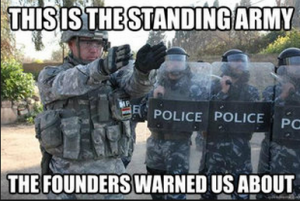
Trust me, if it looks like a battlefield (armored tanks on the streets, militarized police in metro stations, surveillance cameras everywhere), sounds like a battlefield (SWAT team raids nightly, sound cannons to break up large assemblies of citizens), and acts like a battlefield (police shooting first and asking questions later, intimidation tactics, and involuntary detentions), it’s a battlefield.

Indeed, what happened in Ocala, Florida, is a good metaphor for what’s happening across the country: Sheriff’s deputies, dressed in special ops uniforms and riding in an armored tank on a public road, pulled a 23-year-old man over and issued a warning violation to him after he gave them the finger. The man, Lucas Jewell, defended his actions as a free speech expression of his distaste for militarized police.

Translation: “We the people” are being hijacked on the highway by government agents with little knowledge of or regard for the Constitution, who are hyped up on the power of their badge, outfitted for war, eager for combat, and taking a joy ride—on taxpayer time and money—in a military tank that has no business being on American soil.

Rest assured, unless we slam on the brakes, this runaway tank will soon be charting a new course through terrain that bears no resemblance to land of our forefathers, where freedom meant more than just the freedom to exist and consume what the corporate powers dish out.

Rod Serling, one of my longtime heroes and the creator of The Twilight Zone, understood all too well the danger of turning a blind eye to evil in our midst, the “things that scream for a response.” As Serling warned, “if we don’t listen to that scream – and if we don’t respond to it – we may well wind up sitting amidst our own rubble, looking for the truck that hit us – or the bomb that pulverized us. Get the license number of whatever it was that destroyed the dream. And I think we will find that the vehicle was registered in our own name.”

If you haven’t managed to read the writing on the wall yet, the war has begun.