
A Low-Trust Society Is an Impoverished Society

By Charles Hugh Smith

Source: Of Two Minds

The sole remaining reservoirs of trust in American life are personal networks, local enterprises and local institutions.

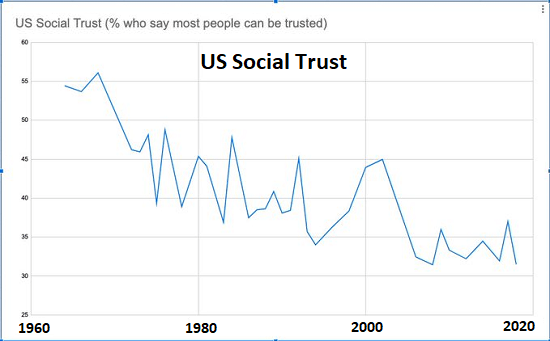
It’s not exactly news that social trust has declined significantly in the United States. Surveys find that public trust in institutions and the professional classes that dominate those institutions has cratered. (see chart below) Social trust–our confidence that other people are trustworthy–has also fallen to multi-decade lows.

This was not the case in decades past. Americans maintained high levels of trust in their institutions, government and fellow citizens. The decline in social trust is across the entire spectrum: our trust in institutions, professional elites and our fellow Americans has declined precipitously.

The causes of this decay of social trust can be debated endlessly, but several factors are obvious:

1. Institutions forfeited the trust of the citizenry by withholding / editing realities to serve the interests of hidden agendas and insiders’ careers. The Vietnam War was pursued on fabrications, as was the second Gulf War to topple Saddam. Watergate eroded trust on multiple levels, as did the Church Committee’s investigation of America’s security agencies’ domestic spying / over-reach.

2. The managerial / professional elites at the top of the nation’s institutions no longer put the citizenry’s interests above their own. The public’s trust has eroded as institutions are primarily viewed as vehicles for self-enrichment and career advancement: healthcare CEOs pay themselves millions, higher education is bloated with layers of non-teaching administration, defense contractors and the Pentagon have greased the revolving door to the benefit of incumbents and insiders, and so on, in an endless parade of self-serving cloaked with smirking PR claims of “serving the public.”

The shift from a high-trust society to a low-trust society is consequential economically, politically and socially. Low-trust societies have stagnant economies, as nobody trusts anyone they don’t know personally or through personally trusted networks, and nobody trust institutions to function effectively or fulfill their stated mission to serve the public good.

Faced with incompetent, unaccountable, corrupt bureaucracies and a culture overflowing with scams, frauds, imposters and get-rich-quick schemes, people give up and drop out. Rather than start a business and accept all the risks just to get dumped on or ripped off, they don’t even try to start a business. Given the financial insecurity that is now the norm, they decide not to get married or have children.

The vast trading networks of the Roman Empire were based on personal trusted networks and trust in Rome’s functionaries / institutions. The owners of trading ships dealt with trusted captains and merchants, who then paid duties to Roman functionaries in Alexandria and other major trading ports.

In other words, tightly bound personal trusted networks work well as long as the state institutions that bind the entire economy are trusted as fair and reliable–not perfect, of course, but efficient and “good enough.”

But when public institutions are viewed as unfair, unreliable, corrupt or incompetent, the entire economy decays. Even personal trusted networks cannot survive in an economy of unfair, unreliable, corrupt or incompetent state bureaucracies and private institutions.

The American economy is now dominated by enormous privately owned and managed monopolies and cartels that are the private-sector equivalent of self-serving state bureaucracies. Big Tech, Big Pharma, Big Healthcare, Big Ag, Big Finance, etc., are even worse than state bureaucracies because there are no legal requirements for transparency or recourse. Try getting a response from a Big Tech corporation when you’ve been shadow-banned or sent to Digital Siberia.

The sole remaining reservoirs of trust in American life are personal networks, local enterprises and local institutions. These are not guaranteed, of course; in many locales, even these reservoirs have been drained. But in other locales, enterprises and institutions such as the county water utility, the local newspaper, the local community college, etc. continue to earn the trust of the public by performing the services they exist to provide effectively and at a reasonable cost.

The larger the institution and the greater its wealth and power, the lower the social trust–for good reasons. The greater the influence of the managerial elites, the greater the disconnect from the everyday experiences of the citizenry and customers, and the more extreme the self-serving PR.

Sure, I trust Big Tech, Big Pharma, Big Healthcare, Big Finance–to rip me off, profiteer, send me obfuscating bills, jack up junk fees, make it impossible to contact them, and send me to Digital Siberia if I complain.

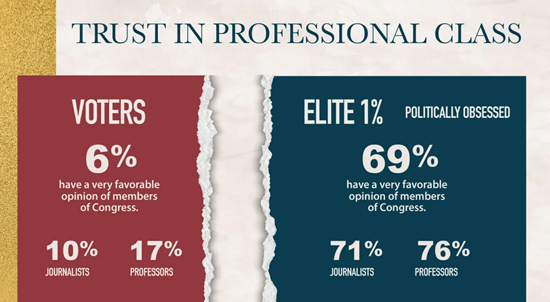
The divide between the elites and the commoners should prompt us to examine the low-trust path we’re sliding down:
In a society in which everything is phony, low quality or fraudulent, you’re taking a chance trusting anyone you don’t know personally–and even that can be risky now that self-aggrandizing flim-flam is the last remaining path to financial security for non-elites.
A low-trust society is an impoverished society, economically stagnant and socially threadbare. That’s where we are now, and the more fragmented, greedy, self-serving, desperate and deranged we become, the lower the odds that we’ll find the means to rebuild trust.

Sadly, we already know that anyone claiming to “rebuild trust” is spouting PR designed to mask self-enrichment. We also know that the vast army of well-paid flacks, factotums, enforcers, happy-story apologists, lackeys, toadies and sell-out minions are declaring “everything’s great!”

Just mumble, “Uh, sure” and continue to Tune in (to degrowth), drop out (of hyper-consumerism and debt-serfdom) and turn on (to self-reliance and relocalizing capital and agency).
How to Navigate Our Low-Trust, Increasingly Dysfunctional Society and Economy

By Charles Hugh Smith

Source: Of Two Minds

Politicians and corporate managers have an enviable record of self-enrichment but very little to show in terms of putting the long-term interests of the citizenry above their own short-term gains.

This week’s focus is on self-reliance, a topic of increasing relevance than is more complex that it may seem.

Sociologists differentiate between high-trust and low-trust societies: in high-trust social orders, citizens tend to trust institutions and each other to conform to social norms, enabling strangers to trust a vast circle of transactions and socio-economic ties. Low-trust societies are plagued with distrust of authority and institutions and fear of getting taken advantage of by strangers, so the circles of trust are small, inhibiting social mobility and economic growth.

Economies and political systems can also be understood as high-trust or low-trust. If the political system excels at rewarding insiders and incumbents while leaving critical problems unsolved, citizens have little reason to trust the system.

The same is true of economies that greatly enrich insiders and incumbents at the expense of the citizenry via monopoly/cartel price-gouging, shrinkflation, degrading the quality of goods and services and the immiseration of standard services, forcing customers to “upgrade” from wretched to merely dismal.

Conventional pundits and economists are constantly whining that Americans “just don’t get it”: they tout our soaring per capita wealth, i.e. we’re getting richer, so everyone should be delighted, yet only 20% of the public are “satisfied with the way things are going.”

What the well-compensated pundits and economists are ignoring (or are paid to ignore) is the decay of the U.S. from a high-trust-functional to a low-trust-dysfunctional society and economy: Americans will still go out of their way to aid strangers, but their trust in institutions has plummeted to lows, as has their trust in the political-corporate elites’ leadership: politicians and corporate managers have an enviable record of self-enrichment but very little to show in terms of putting the long-term interests of the citizenry above their own short-term gains.

People understand the name of the game now is to spout all the expected optimistic PR of “innovation” and “serving the public” while maximizing their private gain at the expense of the nation. Offshoring America’s essential industrial supply chains wasn’t done to serve the nation; it was done to maximize profits, 90% of which flow to the top 10%. Pushing us into debt servitude is highly profitable, but it isn’t benefiting us or the nation.

Americans were told to trust long, hyper-globalized single-source supply chains as “efficient” (i.e. profitable) and trustworthy, yet they’ve discovered these supply chains are vulnerable and fragile. Americans were told that corporate monopolies were selling them “innovations” when in fact they were being sold highly addictive (and therefore highly profitable) goods and services.

Americans were told that their financial security was increasing even as the U.S. economy became increasingly dependent on hyper-financialized asset bubbles and central bank bailouts, the precise opposite of stability. Rather than producing more financial security for the bottom 80%, these “innovations” greatly expanded the gulf between the wealthy and the increasingly precarious bottom 80%.

Americans were told to trust that the hyper-centralization of political and financial power would benefit them, when the evidence is piling up that this hyper-centralization has increased the dysfunction of core institutions and the fragility of essential systems.

Doesn’t it ring hollow to glorify our soaring wealth while households declare bankruptcy due to medical bills, college students sign up for a lifetime of debt servitude to pay tuition and inflation has destroyed 20% of every wage earner’s paycheck just since January 2020? All that “soaring wealth” is asymmetrically distributed, but let’s not talk about that, let’s talk about statistics that mask that asymmetry.

What the well-compensated pundits and economists are paid to ignore is the concentration of the vast majority of all this new wealth and income in the top 10%. Soaring wealth only widens wealth inequality; it doesn’t benefit the nation, it weakens its foundations by accelerating the decay of trust in core institutions and systems.

What happens when high-trust decays to low-trust is the circle of reliable, trustworthy sources and people shrinks to the local, decentralized level. Rather than trust Big Ag, Big Fast-Food and supply chains of highly processed glop to feed us, we start turning to local sources of real food.

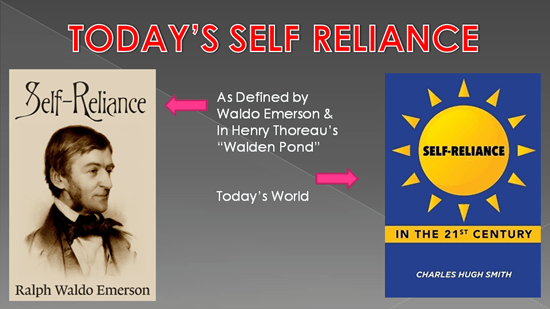
In the same way, we rediscover the value of thinking for ourselves rather than accepting self-serving memes-of-the-day. We rediscover the value of what Ralph Waldo Emerson wrote about in his 1841 essay Self-Reliance (free text, Project Gutenberg).

Emerson counsels us to “be our best selves,” and not to count property wealth above all else. (“They measure their esteem of each other by what each has, and not by what each is.”)

Emerson understood that the values of a society are the foundation of its economic order. A system lacking any principles and values other than greed and self-enrichment is a rotten structure doomed to collapse. It is not just the larger socio-economic order that needs a rock-solid value system; each individual must ground their choices and actions in a value system they have embraced on their own. (“Nothing can bring you peace but yourself. Nothing can bring you peace but the triumph of principles.”)

What Emerson is espousing is self-reliance, in thought, in values, and in economic and financial matters. In today’s world of crumbling hyper-globalization, self-reliance extends to the practical world of where our essential goods and services are coming from.

Gordon Long and I discuss these and many other aspects of Self-Reliance in the 21st Century in our wide-ranging podcast Self Reliance (45 min).

We discuss how the American economy has changed over the past 40 years, to the detriment of the nation’s values and the security of its citizenry, and what self-reliance means today– the topic of my book Self-Reliance in the 21st Century. (Read the first chapter for free.)

How can we best navigate our low-trust, increasingly dysfunctional society and economy? By strengthening our own self-reliance.