The Way to Defeat the Globalist Reset: Local Production for Local Consumption…

By Peter Koenig

Source: Dissident Voice

The Globalists have semi-clandestinely introduced some kind of “covid-Martial Law” that overrules everything that is an otherwise Constitutional Right. We are in most of the western world a direct dictatorship. In most countries the Constitutional Amendment from “Democracy” to Dictatorship has happened clandestinely or at least semi-clandestinely. That’s what dictators do. Most of the people have no idea. Many of those who do know, don’t agree. They launch initiatives for new laws – that fall by the way side, because they have no teeth under a Martial Law-broken Constitution.

In Switzerland, the situation is slightly different, better of sorts. The Confederation Helvetica (CH) has a semi-direct Democracy. With 50,000 signatures, scrupulously verified for their validity, Swiss citizens can launch a referendum against a specific law. The referendum may eventually come to a popular vote, and a government/Parliament let law may be overruled. Though, this happens very rarely – the money lobby-propaganda is too strong – occasionally the people may have a chance. In these covid-times, it may actually happen.

We are currently undergoing the worst “tyrannification” of society in human history and in all western world countries. Covid-martial law overrules everything. This happened very fast. Within 18 months, from the beginning of 2020 to about mid-2021 citizens have basically no longer the very rights they could otherwise call as a human right. HRs have become worthless. In most cases police and military are under strict orders to obey. Those who don’t may lose their jobs, or worse.

Although, there are vivid and positive signs that the tides are turning. For example, at a London anti-covid-measures, anti-vaxx-certificates rally in London. Dr. Reiner Fuellmich, Corona Committee, spoke via a huge video screen to the crowd on Trafalgar Square, tens of thousands of people, telling them that class actions suits are under way in the US, Canada, and that institutions and individuals, especially those responsible for the invalid PCR-tests, particularly in Europe and the US, that are the basis for governments lying about “cases”, serving to manipulate up-and-down the “infection” figures, leading to false numbers on hospitalization and death, about a virus that is less deadly than the common flu. Yes, you read correctly, less deadly than the common flu. This is the onset to Nuremberg 2.0 – where justice will prevail, as much as light prevails over darkness.

Dr. Fuellmich closed his talk on a positive and encouraging note.

It is humanity, versus inhumanity. We are human. We can laugh, cry, sing and hug. The other side can’t. The other side has no access to the spiritual side. Therefore, the other side, without any doubt, the inhuman side, will lose this inhuman battle for life….

See this 10-min video.

The transformation is beginning to take place. This is the health side, the human side, the most immediately important side – where real science is overcoming “bought” science, in order to avoid a genocide of biblical proportions – which is the eugenists plan, probably developing over the past about 100 years. However, there are two other, complementary plans which also need to be stopped.

The first one of the two is the digitization of everything. It is already descending upon humanity, had actually started already decades ago – and is now in its final round – just so as to coincide with the massive population reduction. It includes not only digitization of all forms of monetary transactions – which is rapidly pushing forward, through Artificial Intelligence (AI) algorithms and most importantly, the vehicle to drive it all, the worldwide installation of 5G and soon to come 6G. This is foreseen to turn the entire globe into an electromagnetic field. And humans will be turned into “transhumans”, especially those that have survived the experimental, untested messenger spike protein injections called mRNA inoculations, falsely called “vaccines”.

This is not a joke. This is actually the plan already divulged in 2016 by Klaus Schwab, founder and forever CEO of the World Economic Forum (WEF) in an interview with Swiss French TV broadcast, see this 2-min video:

According to Klaus Schwab’s “The Great Reset”, algorithms, Artificial Intelligence (AI) and robots will soon rule the masses. By 2025, give or take a year or two, about half of today’s jobs will be run by AI. This electronic technology will in turn be ruled by some dirty-rich individuals, who somehow have given themselves the liberty to “run the world”. And we, the people, have let them.

They – the Deep Dark Statlers – call them Satanists – have planned this for about the last century. With great precision and intensity at times – and – what’s worse, much worse, right in front of our eyes. We have ignored them. Anybody who dared to draw attention to their evil machinations was dismissed with the convenient label “conspiracy theorist”.

Imagine, according to the Great Reset, half of our jobs will be taken over by AI, in just the next 5 years or so. By 2030, only about 5% to 10% of the current jobs will be existing and carried out by humans – maybe “transhumans”. All the others may be gone. Massive unemployment?  Maybe. But Schwab tries to tranquilize the world, saying that there will be new jobs for which newly unemployed people will be trained. They may be transhumans, because training is done by, and in partnership with, AI – and for the Epsilon People, the down-to-earth working class, robots will do the supervising.

This may sound depressing, despairing. It ain’t, if we think about the situation which we, pretty much on our own, have allowed to happen. It is not the end of the road, but only a stepping stone, onto which we too can step, when awakened – and not in anger, but with the bright spirit of light – a new world shaped by humans, shaped with the forces of light, Leaving the devil behind. Not even mentioning the beast. No letting it bother our minds. We are up to something much higher, much cleaner, clearer and much nobler. Our project is for humanity, for planet earth with all her sentient beings.

The simple model “Small is Beautiful” may be an appropriate vision forward. It may include another simple principle:
Local production for local consumption with local money, a local community run central bank working with a public banking system. Trade will be practiced with like-minded mostly neighboring sister countries, benefiting from comparative advantages. The money supply will be a reflection of the local economy. It will be backed by the local economy. Quite different from the current globalist-run fiat money pyramid.

This appears like a perfect recipe for de-globalization. And deglobalize we must. We must become again individuals that can and want to bond, not separate, individuals for whom solidarity is not just a term from a rusty vocabulary but means “we do it together”. This is the way to go, we will be satisfied with what we can achieve as a common, as a society with goals that serve the people, with values that do not depend on vertical growth, but rather reflect horizontal expansion of social infrastructure and well-being.

Let’s imagine a new type of economy with novel yardsticks – Happiness Indicators. Actually, not so novel, just not often talked about. In July 2011, the UN General Assembly adopted resolution 65/309 Happiness: Towards a Holistic Definition of Development inviting member countries to measure the happiness of their people and to use the data to help guide public policy. The first Happiness report was issued by the UN in April 2012.

If we are able to abandon the magical concept of “growth” and exchange it for happiness, we not only protect and preserve Mother Earth but will also preserve our human health – our sanity. Our today’s society is sick. It strives for ever more growth, for more possessions, for more affluence, for more control – but happiness that is the basis for a healthy life – is but an abstract term in today’s business-driven world. Happiness is more often than not confused with material wealth.

The no-growth, but social growth concept, is the basis for our escaping from the globalist agenda.

Human wealth comes from the heart. And it is through the heart that we may pass it on, replicate it. How does one define Happiness? There surely is no blueprint for happiness, as we are moving away from the all-modelled sets of values, away from the “musts” and the “Must-nots”.

The website “LifeHack.org” offers a few definitions of Happiness. Among them, the following two:

Happy people find balance in their lives. Folks who are happy have this in common: they’re content with what they have, and don’t waste a whole lot of time worrying and stressing over things they don’t. Unhappy people do the opposite: they spend too much time thinking about what they don’t have,; and,

According to the Dalai Lama, Happiness is not something readymade. It comes from your own actions. And let me add, from our actions driven by our heart and soul.

The General Assembly of the United Nations in its resolution 66/281 of 12 July 2012 proclaimed 20 March the International Day of Happiness recognizing the relevance of happiness and well-being as universal goals and aspirations in the lives of human beings around the world.

How does the UN define “Happiness”? Happiness is not contained in GDP, and less in GDP growth. To the contrary. It’s most important that we start detaching from material wealth, that we see the moral and friendship wealth in our society. That we see and strive for equality, inclusion, solidarity – that we learn to smile at each other, even in adverse situations. This requires an elevated spirit, a mentality of light that defeats satanic darkness.

Happy people abide by the golden rule: They let stuff go. Happy people realize this, are able to take things in stride, and move on – without fear.

That’s what we have to do – shed the fear – and move on, in a higher spiritual mode, floating out of the darkness into the light. It’s possible. Let’s give it a collective try. ‘They’ are blackmailing us into accepting the poisonous jab they fraudulently call vaccine. They may go as far as blocking us from getting food, from entering supermarkets without the vaccine certificate – or getting the test every time you need food. – No worries. They won’t succeed.

Is this ever-more encroaching human rights abuse-tyranny a malicious provocation? See this.

Are they on purpose driving people to the edge? To provoke a revolution? And bring in NATO and maybe even UN troops to subdue the upheavals, personal freedoms, national sovereignty – and even national borders towards a globalist world, a One World Order, a One Government world, led by the WEF and the club of billionaires directed by a satanic cult?

It is possible. But we are stronger. We will defeat this evil cult. Dr. Reiner Fuellmich et al, from the Corona Council, has already launched class action suits in Canada and the US and is taking legal actions against EU institutions and individuals. The tide is turning. Of course, you will not read or hear about it in the mainstream media.

Think small. Think community – your community, think self-sufficiency as much as possible. Think local production for local consumption with local money and local banks for the wellbeing of all within the community. Think trading with friends and with think-alike nations, societies, people.

We shall overcome – and we will.

Sweat Shops, GMOs and Neoliberal Fundamentalism: The Agroecological Alternative to Global Capitalism

By Colin Todhunter

Source: Global Research

Much of the argument in favour of GM agriculture involves little more than misrepresentations and un scrupulous attacks on those who express concerns about the technology and its impacts. These attacks are in part designed to whip up populist sentiment and denigrate critics so that corporate interests can secure further control over agriculture. They also serve to divert attention from the underlying issues pertaining to hunger and poverty and genuine solutions, as well as the self-interest of the pro-GMO lobby itself.

The very foundation of the GMO agritech sector is based on a fraud. The sector and the wider transnational agribusiness cartel to which it belongs have also successfully captured for their own interests many international and national bodies and policies, including the WTO, various trade deals, governments institutions and regulators. From fraud to duplicity, little wonder then the sector is ridden with fear and paranoia.

“They are scared to death,” says Marion Nestle, professor of nutrition, food studies, and public health at New York University and author of several books on food policy. She adds: “They have an industry to defend and are attacking in the hope that they’ll neutralize critics … It’s a paranoid industry and has been from the beginning.”

War against reason

Global corporations like Monsanto are waging an ideological war against not only critics but the public too. For instance, consider that the majority of the British public and the Canadian public have valid concerns about GM food and do not want them. However, the British government was found to have been secretly colluding with the industry and the Canadian government is attempting to soften up the public to try to get people to change their opinions.

Instead of respecting public opinion and serving the public interest by holding powerful corporations to account, officials seem more inclined to serve the interests of the sector, regardless of genuine concerns about GM that, despite what the industry would like to have believe, are grounded in facts and involve rational discourse.

Whether via the roll-out of GMOs or an associated chemical-intensive industrialised monocrop system of agriculture, the agritech/agribusiness sector wants to further expand its influence throughout the globe. Beneath the superficial façade of working in the interest of humanity, however, the sector is driven by a neoliberal fundamentalism which demands the entrenchment of capitalist agriculture via deregulation and the corporate control of seeds, land, fertilisers, water, pesticides and food processing.

If anything matters to the corporate agribusiness/agritech industry, contrary to the public image it tries to convey, it clearly has little to do with ‘choice’, ‘democracy’ or objective science. It has more to do with undermining and debasing these concepts and displacing existing systems of production: economies are “opened up through the concurrent displacement of a pre-existing productive system. Small and medium-sized enterprises are pushed into bankruptcy or obliged to produce for a global distributor, state enterprises are privatised or closed down, independent agricultural producers are impoverished” (Michel Chossudovsky in The Globalization of Poverty, p16).

Critics are highlighting not only how the industry has subverted and debased science and has infiltrated key public institutions and regulatory bodies, but they are also showing how trade and aid is used to subjugate regions and the most productive components of global agriculture – the small/peasant farmer – to the needs of powerful commercial entities.

Critics stab at the heart of neoliberalism

By doing this, critics stab hard at the heart such corporate interests and their neoliberal agenda.

According to Eric Holt-Giménez:

“The World Bank, the World Trade Organization, the World Food Program, the Millennium Challenge, The Alliance for a Green Revolution in Africa, the U.S. Department of Agriculture, and industrial giants like Yara Fertilizer, Cargill, Archer Daniels Midland, Syngenta, DuPont, and Monsanto, carefully avoid addressing the root causes of the food crisis. The ‘solutions’ they prescribe are rooted in the same policies and technologies that created the problem in the first place: increased food aid, de-regulated global trade in agricultural commodities, and more technological and genetic fixes. These measures only strengthen the corporate status quo controlling the world’s food… The future of our food-and fuel-systems are being decided de facto by unregulated global markets, financial speculators, and global monopolies.”

The geopolitics of food and agriculture has played a significant role in creating food-deficit regions. For instance, African agriculture has been reshaped on behalf of the interests described in the above extract. The Gates Foundation is currently spearheading the ambitions of corporate America and the scramble for Africa by global agribusiness. And in India, there has been an ongoing attempt to do the same: a project that is now reaching a critical phase as the motives of the state acting on behalf of private (foreign) capital are laid bare and the devastating effects on health, environment and social conditions are clear for all to see.

Any serious commitment to feeding the world sustainably and equitably must work to challenge a globalised system of capitalism that has produced structural inequality and poverty; a system which fuels the marginalisation of small-scale farms and their vitally important cropping systems and is responsible for the devastating impacts of food commodity speculationland takeoversrigged trade and an industrial system of agriculture.

And embedded within the system is a certain mentality. Whether it is the likes of Monsanto’s High GrantRobb Fraley or Bill Gates, highly paid (multi-millionaire) white men with an ideological commitment to corporate power are trying to force a profitable but bogus model of food production on the world.

They do so while conveniently ignoring the effects of a system of capitalism that they so clearly promote and have financially profited from.

It is a capitalism and a system of agriculture propped up by the blood money of militarism (Ukraine and Iraq), ‘structural adjustment’ and strings-attached loans (Africa) or slanted trade deals (India) whereby transnational agribusiness drives a global agenda to suit its interests and eradicate impediments to profit. And it doesn’t matter how much devastation ensues or how unsustainable their model is, ‘crisis management’ and ‘innovation’ fuel the corporate-controlled treadmill they seek to impose.

Genuine solutions: agroecology, decentralisation and localism

However, what really irks the corporate interests which fuel the current GMO/chemical-intensive industrialised model of agriculture is that critics are offering genuine alternatives and solutions. They advocate a shift towards more organic-based systems of agriculture, which includes providing support to small farms and an agroecology movement that is empowering to people politically, socially and economically.

This represents a challenge to all good neoliberal evangelists (and outright hypocrites) with a stake in corporate agriculture who rely on smears to attack those who advocate for such things.

To understand what agroecology involves, let us turn to Raj Patel:

“To understand what agro-ecology is, it helps first to understand why today’s agriculture is called “industrial.” Modern farming turns fields into factories. Inorganic fertilizer adds nitrogen, potassium, and phosphorous to the soil; pesticides kill anything that crawls; herbicides nuke anything green and unwanted—all to create an assembly line that spits out a single crop… Agro-ecology uses nature’s far more complex systems to do the same thing more efficiently and without the chemistry set. Nitrogen-fixing beans are grown instead of inorganic fertilizer; flowers are used to attract beneficial insects to manage pests; weeds are crowded out with more intensive planting. The result is a sophisticated polyculture—that is, it produces many crops simultaneously, instead of just one.”

And it works. Look no further than what Cuba has achieved and the successes outlined in this article. Indeed, much has been written about agroecology and its potential for radical social change, its successes and the challenges it faces (see thisthis and this). And now there a major new book from Food First and Groundswell International: Fertile Ground: Scaling agroecology from the ground up.

Executive Director of Food First Eric Holtz-Gimenez argues that agroecology offers concrete, practical solutions to many of the world’s problems that move beyond (but which are linked to) agriculture. In doing so, it challenges – and offers alternatives to – the prevailing moribund doctrinaire economics of a neoliberalism that drives a failing system (also see this and this) of GM/chemical-intensive industrial agriculture.

He adds that the scaling up of agroecology can tackle hunger, malnutrition, environmental degradation and climate change. By creating securely paid labour-intensive agricultural work, it can also address the interrelated links between labour offshoring by rich countries and the removal of rural populations elsewhere who end up in sweat shops to carry out the outsourced jobs: the two-pronged process of neoliberal globalisation that has devastated the economies of the US and UK and which is displacing existing indigenous food production systems and undermining the rural infrastructure in places like India to produce a reserve army of cheap labour.

When you fail to understand capitalism and the central importance of agriculture, you fail to grasp many of the issues currently affecting humanity. At the same time, when you are part of the problem and fuel and benefit from it, you will do your best to attack and denigrate anything or anyone that challenges your interests.

Historical cycles: are we doomed to repeat the past?

content_9366

By Stefan Verstappen

Source: Intrepid Report

“Those who fail to learn from the past are doomed to repeat it.”—George Santayana

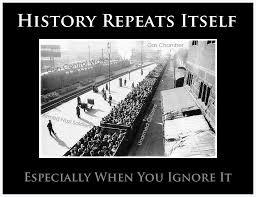
Few people have not heard the above quote, but is the reason history repeats itself because we fail to learn from it, or because history follows an unbreakable pattern we are doomed to repeat? The answer is crucial since, by all indicators, we are about to repeat the classic pattern of social collapse. This would explain why your government is preparing for the worst.

The theory of history repeating itself is as old as history itself. The earliest written account dates back 3,500 years to the Hindu writings known as the Vedas. Since then, many who studied history, from the Greek historian Polybius, to the father of modern history A. J. Toynbee, have formulated a theory of historical cycles.

The clearest example of repeating patterns can be seen in the Chinese Dynastic Cycle. China’s three-thousand-year unbroken history shows a repetitive rise and fall of dynasties. Historians divide this cycle into four parts; the founding of the dynasty, the flowering, the decline, and the period of chaos between dynasties.

This four stage pattern is common to most theories of historical cycles from the Roman poet Ovid, to Hindu philosopher P. J. Sarkar, and more recently in the Strauss–Howe generational theory. Although the titles of the four stages vary among the theories, their characteristics remain nearly identical. I have combined the most commonly used terms for each age as: Warrior, Intellectual, Merchant, and Chaos.

To better illustrate the four stages let us see how they compare to China’s rollercoaster of history.

Warrior

After the previous dynasty has collapsed and the country broken apart, a new warlord vanquishes his rivals, declares himself emperor, and founds the next dynasty.

This is the age of heroes with value placed on honor, strength, and courage. Notable activities include exploration, conquering, colonising, and building infrastructure. Crime is at its lowest, women’s equality at its highest. Wealth is distributed on a meritocratic basis and the population level recovers from previous lows.

Intellectual

Each new dynasty needs to establish its legitimacy through benevolent rule and so during the reigns of the next few emperors the living conditions of the common people begin to improve. This is often the dynasty’s ‘Golden Age.’

This is the age of arts and sciences valuing new ideas, inventions, and techniques. Notable activities include public art projects and the founding of libraries and universities. Crime is low, women’s equality remains high, and wealth begins accumulating towards administration. Population continues to increase.

Merchant

While the empire enjoys a period of peace and stability, merchants prosper and the standard of living continues to improve. However, the seeds of the dynasty’s decline are already being sown in the growth of a vast bureaucracy. Soon the government is controlling and taxing all facets of daily life.

This is the age when greed dominates the political system. Crime increases, women’s social status declines, wealth begins accumulating towards oligarchs. Population continues to increase.

Chaos

The dynasty is in decay and on the verge of collapse. The court and courtiers are corrupt and decadent. The emperor is effeminate, licentious, often an idiot.

Having pilfered the treasury, the empire raises taxes until the common people are reduced to poverty.

The country’s infrastructure falls into disrepair. Levies and irrigations systems fail, destroying farms and crops and causing famines. The people rise up.

This is the age where government is so corrupt that it is unable to effectively rule. There is a breakdown of law and order. Crime is rampant, women’s status reaches its lowest point, and because of disease, warfare, and natural disasters, population declines rapidly. Wealth is in the hands of criminals.

The country splits apart into warring factions each fighting for dominance through a series of civil wars. The fighting continues until a new ‘Hero’ takes control and founds the next dynasty.

This then is the Chinese Dynastic cycle based on a four stage pattern. Can the theory be applied to all civilizations and used to predict future trends? If you study various histories from ancient Egypt and Rome, to the Aztec and Inca you will find this four stage pattern, with slight variations, always discernible.

So what stage in this cycle is America in and where are we heading?

Comparing the characteristics of each stage to our current conditions we can quickly eliminate the Warrior and Intellectual ages. The days of heroic leaders and brilliant thinkers belong to an America long past.

Obviously we are in the Merchant stage, and as anyone who has tried to buy anything ‘Made in America’ can tell you, we are at the end of that stage. The destruction of America’s manufacturing base and devastation of its natural resources can only mean that the fat lady is about to take to the stage.

So is history doomed to repeat itself or can we learn from previous mistakes and avoid rushing headlong into chaos?

In the case of China, their history shows no dynasty was able to avoid this fate. Did they fail to learn from the past? Far from it, Chinese history is the most thoroughly documented of any civilization. China’s philosophers and historians were well aware of the mistakes made by the previous dynasties and ceaselessly warned the emperors of the perils of ignoring the past, all to no avail.

Unfortunately, the evidence suggests that civilizations are indeed doomed to repeat the past.

Whether warned by a predictive model based on historical cycles, or mindlessly playing out their villainous roles, there can be little doubt that the current elite are preparing for Chaos. How else to explain the militarization of domestic police, the massive purchase of arms, ammunition, and armored vehicles, the full spectrum domestic surveillance and the endless nibbling away at our rights and freedoms.

Obviously their plan, as was the plan of all despots before them, is to hole up behind a wall of security while the rest of us fight over the remaining scraps of our civilization.

What to expect

Of the four ages the easiest to predict is the age of Chaos. It seems every regime throughout history uses the same worn out playbook on how to self-destruct. So here is the future.

Widespread corruption drains the state of its treasury. To recover the losses, the state increases taxation driving businesses into bankruptcy and employees into poverty. Taxation quickly becomes forcible confiscation of property, precious metals, and food.

Food protests turn into riots. The state marches out their henchmen to ‘teach the rabble a lesson.’ Martial law is declared and the full array of terror tactics, from unreasonable search and seizure, to imprisonment and torture are used against ‘dissenters.’

Meanwhile, the lack of government funding leaves the infrastructure to crumble. In the past, this meant farmlands were either flooded, or dried up. Crops failed and starvation ensued. In our modern world we can add grid failure, no gas to heat your homes or run your vehicles, and no access to clean drinking water.

Starving people become desperate and crime increases. Poor nutrition and a lack of funding for hospitals or medical supplies contribute to an increase in epidemic diseases.

The state’s last play is to start a war to kill off a goodly number of ‘useless eaters’ and cower the survivors into submission.

So what did people in the past do to survive the age of Chaos? One strategy used in many civilizations is the monastic system. After the fall of Rome, monasteries served as centers of trade and produced much of the local wealth through farming, winemaking, and small industries. They were the only places where one could receive any sort of education, and if not for the books they preserved and copied, we would know nothing about ancient history.

In China, India, Japan, and the Middle East monasteries were able to survive relatively unscathed while their societies collapsed around them.

If we remove the religious aspect, what we have are autonomous communities that are self-sufficient, share knowledge and skills, and support each other during the bad times. A more recent and secular example of such communities can be found in the mutual aid societies of the 1800s. Learning basic disaster preparedness and working together in mutual support is the key survival strategy.

Despite the grim short-term forecast, the not too distant future will be brighter since the next stage is the Warrior age and a return to ethics, prosperity, and equality.

So what of the elite? Will they emerge from their bunkers to enslave and rule the world as their ultimate dream comes true? In this Chinese history is in accord with Karma. Every member of the aristocracy, of each failed dynasty, was hunted down and executed during the ages of Chaos. Only one emperor lived long enough to see the founding of the succeeding dynasty, and he did so by hiding for forty years—in a monastery.

Stefan H. Verstappen is a Canadian writer, and researcher and author of six books, including The Art of Urban Survival” and “The Thirty-Six Strategies of Ancient China.