
The FBI is Great at Disrupting (Its Own) “Terror Plots”

index

By Kevin Carson

Source: Center for a Stateless Society

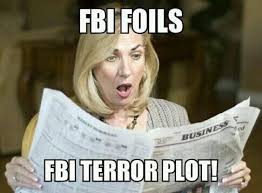
On January 14 the US Department of Justice announced that the Joint Terrorism Task Force had disrupted the latest “domestic terrorism plot” — this time by “a Cincinnati-area man … to attack the U.S. Capital and kill government officials.” House Speaker  John Boehner immediately cited the disrupted plot as evidence that Congress should think carefully before refusing to renew the NSA’s bulk data collection powers. Only it turns out the feds had at least as much to do with hatching the plot as did the alleged plotter, Christopher Cornell.

The FBI investigator became aware of Cornell’s pro-ISIS comments on Twitter thanks to a tip-off from an unnamed informant who “began cooperating with the FBI in order to obtain favorable treatment with respect to his criminal exposure on an unrelated case.” The informant, on FBI orders, arranged two meetings with Cornell where they discussed attacks on the capital, after which the FBI arrested him to “prevent” the attacks. In other words, it identified Cornell as a suspect entirely on the basis of his expression of radical political opinions, with the help of a jailhouse snitch who rolled over in response to prosecutorial blackmail. And the actual “plot” was worked out only in subsequently arranged meetings in which one party — working for the FBI — may well have been leading Cornell. It wasn’t for nothing that ecological activist Judi Bari said “the first person to mention bringing dynamite is probably a fed.”

In this the Cornell case has a lot in common with a great many other so-called “domestic terrorism plots” federal law enforcement has “disrupted,” going back to the Lackawanna Six. A good example is the so-called “plot” of the Newburgh Four, who supposedly plotted to blow up synagogues and attack a military base. The judge commented that the government “came up with the crime, provided the means, and removed all relevant obstacles,” in the process making a terrorist out of a man “whose buffoonery is positively Shakespearean in scope” (“US: Terrorism Prosecutions Often An Illusion,” Human Rights Watch, July 21, 2014).

This reminds me of a story I read — from Dilbert cartoonist Scott Adams, I think — about a software company that offered programmers a bonus for every bug they detected in code. Predictably, creating bugs to “detect” became a major source of revenue for employees. H.L. Mencken once remarked on government’s tendency “to keep the populace alarmed (and hence clamorous to be led to safety) by menacing it with an endless series of hobgoblins, all of them imaginary.”

We see this in the dismaying, Starship Troopers-like media narrative involving any and all armed government personnel in uniform. Last weekend’s highest U.S. box office receipts came not from Selma (the story of oppressed people organizing to fight for their freedom) but from American Sniper. The latter movie glorifies a vile wretch who gloated over all the “savages” (his word for any male age 16 to 60) he murdered in Iraq, on the grounds that he was saving American troops from being shot at. Never mind that the people in Iraq were shooting back at an invading army in their own country. Domestically, we see the same phenomenon with shows like COPS, and local news coverage of police in paramilitary gear (breathlessly referred to as “the authorities” by nitwit reporters) storming alleged “meth labs.”

And remember, the very concept of a “sting operation” (also known as “entrapment”) invokes the principle that some human beings are superior to the law. The first professional police forces were justified on the grounds that they were simply being paid to exercise the same posse comitatus powers of “citizen’s arrest” possessed by any other member of society. By that standard, if it’s illegal for an ordinary citizen to solicit or instigate illegal activity, it should be illegal for anyone — including uniformed state officials.

But most importantly, this is an example of how the state mostly “solves” problems of its own making — and has an incentive to keep creating more problems to justify giving it the power and resources to “solve” them.

 

Education and the “Progressive” Corporate State

anti_public_education_propaganda_by_8manderz8-d5xz1cj

By Kevin Carson

Source: Center for a Stateless Society

Speaking in Knoxville, Tennessee on January 9 US president Barack Obama unveiled an initiative to provide two years of community college tuition-free, nationwide, to anyone meeting attendance and grade requirements. The idea, inspired by a similar program in Tennessee, aims to make two years of college as universal as high school is now. Obama’s proposal is in keeping, in more ways than one, with traditions going back to the origins of the American corporate state 150 years ago.

Since the mid-19th century, a few hundred large industrial corporations and banks have dominated the American economy. And the American state, functionally, has been closely intertwined with the interests of those corporations. One of its functions is to subsidize the corporate bottom line and artificially prop up the rate of profit by socializing provision of a growing share of inputs — among them the cost of reproducing and training human labor power.

The first statewide public school systems were introduced in New England to meet mill owners’ need for a workforce that was docile, obedient and educated to minimal standards; a function supplemented by education in “100% Americanism” at the turn of the 20th century, and a home economics curriculum in the ’20s and ’30s aimed at processing students into good mass consumers.

As recounted by New Left historian David Noble in America by Design, federal government aid to land grant colleges coincided with the national railroad and industrial corporations’ growing need for trained mechanical and industrial engineers. This trajectory carries through the GI Bill and to Obama’s latest proposal.

These institutional developments were accompanied by the rise of a meritocratic legitimizing ideology which replaced earlier American notions of equality and autonomy. Rather than genuine equality based on widespread economic empowerment and self-employment, the new meritocratic ideology treated step hierarchies of wealth, skill and managerial authority as both normal and necessary, but relied on the ideal of universal education to justify the ideology as “democratic.” With the widespread availability of secondary, higher and technical education, the theory goes, the individual’s rise in the managerial-technical hierarchy is limited only by their own willingness to learn and work. This peculiar American religion combines the existence of deep structural inequalities in wealth and power with the moralistic assumption that everyone gets exactly what they deserve.

The official White House happy talk, predictably, takes the corporate state’s assumptions for granted: “In our growing global economy, Americans need to have more knowledge and more skills to compete — by 2020, an estimated 35 percent of job openings will require at least a bachelor’s degree, and 30 percent will require some college or an associate’s degree.” That it’s the place of the “growing global economy” and the corporate HR departments in it to set the “required” qualifications for labor, and the place of the state’s education system to process people to those standards, goes without saying.

Never mind that globalization, concentration of economic power in the hands of a few giant, capital-intensive corporations, and a wage system that separates labor from both ownership and control of work, are none of them natural or inevitable processes. They all result from the deliberate policies of a state in league with capital.

The real irony is that the system of power Obama’s proposal is designed to serve is doomed to extinction. The revolution in cheap small-scale machine tools means an end to the material rationale for the wage system, and to corporate control of production. Coupled with the rise of open-source or pirated textbooks, free online lectures and syllabi and DIY learning networks, it also means an end to control over access to employment by the unholy alliance of big universities and human resources departments. In an economy where a few months’ wages can purchase a garage factory full of open-source tools and the economy is dominated by commons-based peer production and craft production in self-managed shops, credentialing will be largely stackable and ad hoc, negotiated informally to suit the needs of the groups of people working together.

The days of the educational Cult of Moloch and its human sacrifices are numbered.

Related post: Schools are Becoming Privatized Prisons


“Protect and Serve?” More like Hate and Fear

dyqniri

By Kevin Carson

Source: Center for a Stateless Society

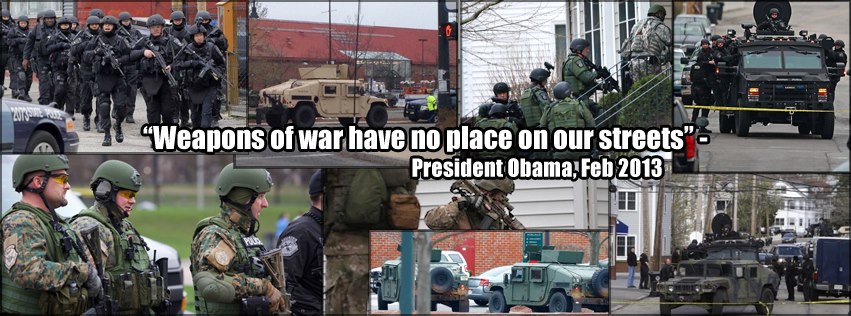
The recent trajectory of events leading up to the shooting of NYPD officers Wenjian Liu and Rafael Ramos, and the nationwide police backlash afterward, have made it clearer than ever how police feel about the public they supposedly protect and serve: they’re terrified of us. For more than twenty years, the Drug War and associated police militarization encouraged an increasing tendency of urban police to see local populations as a dangerous occupied enemy. In Radley Balko’s Rise of the Warrior Cop they admit to stopping and exiting patrol cars randomly in non-white neighborhoods solely to make a show of force, reminding cowed residents who’s boss. And thanks to the mushroom proliferation of SWAT teams (originally designed for use in rare situations like hostage crises) even in small towns, and the enormous flow of surplus military equipment to local police forces like Ferguson, that hostile and fearful attitude towards the local population has spread downward into suburbs and towns.

Meanwhile internal police culture has taken on the same paranoid coloring that caused Lt. Calley and his men to snap and massacre the population of My Lai. Since Hill Street Blues days, cops have commonly described their jobs patrolling the community using “Band of Brothers” rhetoric reminiscent of extended recon missions in Vietnam. But these self-perceptions are utterly detached from reality. Soldiers in Vietnam actually had a high risk of getting killed. But police on-duty casualty rates have fallen steadily for decades. Policing is the ninth-most dangerous job (the top two are logging and fishing); sanitation work is twice as deadly.

That embattled self-image has been the police norm, to an increasing extent, for the past twenty years or more. In recent years police resentment ratcheted further upward over the “chilling effect” of widespread citizen recording of brutality with smart phones, and social media criticism after the Occupy camp shutdowns. But internal police culture went into full-blown panic mode in response to protests over the shooting of Michael Brown, and to the nationwide #WeCantBreathe and #BlackLivesMatter demonstrations after the verdicts in the Michael Brown and Eric Garner shootings.

On police-only message boards, off-duty cops feel free to admit how they really see us: a bunch of sniveling ingrates too spoiled to appreciate the “thin blue line” protecting them from chaos.  Virtually any unarmed non-white person killed by a cop is referred to in such venues as a “criminal” or “thug.” Police apologists go frantically to work digging up dirt on the victims. They depict the victims in language appealing to the most bestial, menacing stereotypes of black men (like the fixation on 12-year-old Tamir Rice’s height and the description of Michael Brown as a hulking linebacker grunting like an animal).

Poul Anderson once wrote that government is the only institution that’s entitled to kill you for disobeying it. That comes through loud and clear with the police — especially the “entitled” part. A police union spokesman flat-out said, if you don’t want to get killed, obey police orders without question. (As if even that were a sufficient guarantee, considering the people having epileptic seizures or in diabetic comas who were killed for “resisting arrest.”) Among the general public “Stop resisting! Stop resisting!” is a punchline, but police even joke among themselves about literally getting away with murder (for example those “We Show Up Early to Beat the Crowds” t-shirts).

To police any criticism at all, even a suggestion that police may sometimes engage in racial profiling or excessive force, is seen as an existential threat. Those same police message boards mentioned above were rife with complaints that protests over the Brown and Garner verdicts were creating an “open season” on cops. The NYPD union gave Mayor Bill de Blasio notice, after he mentioned warning his biracial son to be especially careful around cops, that he would not be welcome at police funerals.

Police paranoia increased its simmer to a boil in response to the protests over Brown’s death and the verdicts; the shooting of Liu and Ramos made it an exploding pressure cooker. Internal NYPD emails accused de Blasio of having “blood on his hands” for his remarks, and implicated protestors as accomplices. Police nationwide have echoed the sentiments.

In short, the cops blame everyone for the hostility that led to Liu’s and Ramos’s death except themselves. Police are professionals at playing the victim card.

The NYPD now considers itself at war. Cops only patrol in pairs, serving warrants and summonses only when absolutely necessary to make an arrest. After decades of asserting how inconceivably dangerous their jobs are, the NYPD responds to two line-of-duty deaths in a force of thousands — the first in THREE YEARS — like it was Pearl Harbor. That speaks volumes about how privileged and entitled they really are.

We can safely assume that, NYPD officers minimize interactions with the public to when an arrest is absolutely necessary, rates of crime by both the public and the cops themselves can only decrease. While they’re at it, maybe they can go on strike — another phenomenon that’s historically associated with drastic drops in the crime rate. That’s one good way of taking criminals off the street.

Podcast Roundup

9/7: On Expanding Minds, hosts Maja D’Aoust and Erik Davis have a conversation with Andy Sharp of English Heretic about death, Horror films, Hiroshima, psychogeography, and his latest release, The Underworld Service.

 
http://s50.podbean.com/pb/fd840a4721e38d3f25dd4ec01834d2c6/541340f7/data2/blogs18/276613/uploads/ExpandingMind_090714.mp3

9/8: R.U. Sirius joins hosts Chris Dancy and Klint Finley to discuss technology transhumanism, and the current social/political climate among other topics.

https://soundcloud.com/itsmweekly/pending-mindful-cyborgs-episode-37
 
9/9: Peter Null interviews Professor Andrew Kolin, a professor of political science at Hilbert College in Hamburg and Kevin Carson, researcher at the Center for a Stateless Society, on militarization of police, centralization of power, war and the military-industrial complex.


http://s53.podbean.com/pb/e788a26888199ef114360f06cc89f48c/541347f9/data1/blogs18/371244/uploads/ProgressiveCommentaryHour_090914.mp3

9/10: On the C-Realm, KMO and June Pulliam discuss and dissect the archetypes and cultural meaning of zombie apocalypse narratives.


http://c-realmpodcast.podOmatic.com/enclosure/2014-09-10T12_48_22-07_00.mp3

9/11: Christopher Knowles joins Aeon Byte Gnostic Radio to examine how Gnosticism connects to alternative cultures, politics and humanity’s existential crisis.


http://content.screencast.com/users/AeonByte/folders/AEON%20BYTE/media/7984ec1d-8363-4162-a034-0dabc54aef33/1.%20Gnosticism%20and%20Politics%20with%20Chris%20Knowles.mp3

9/12: On New World Next Week, James Corbett and James Evan Pilato report on 9/11 terror hysteria, Obama’s private CFR event with Sandy Berger (9/11 document thief) and the cryptocurrency/anti-surveillance potential of a new off-the-grid communications technology.

 
http://www.corbettreport.com/mp3/2014-09-11%20James%20Evan%20Pilato.mp3