
IN THE CULTURE OF HUNGRY GHOSTS

By Dylan Charles

Source: Waking Times

“No society can understand itself without looking at its shadow side.” ― Gabor Maté, In the Realm of Hungry Ghosts: Close Encounters with Addiction

Something wicked bubbles just beneath the surface of the collective conscience. Our society is rife with corruption, predation, perversion, over-consumption, violence, addiction and so much more. Somehow enough is never enough, as if the driving force behind human existence is pure want.

This is not true, though, for we know that spiritually well beings are content beings, looking no further than the present moment’s blessings for satisfaction. We don’t have an inherent need for want. Want is a symptom, not the condition. It’s something that enters when the spirit is untended to.

It must then be a spiritual illness which plagues society. Something secretly driving so many of us mad with insatiable desire for sensation and objects. Unforgiving cravings that manifest in any way imaginable, from sex, to money, to food, to power and even in the need to be perfect. It’s a war against the self, waged unconsciously by the self. A below subconscious campaign of self-annihilation.

There are no contemporary metaphors to understand this kind of emptiness. The void just is. And since the void is so rarely acknowledged and so rarely looked at deeply, it sits in the shadows driving us mad, steering with impulse.

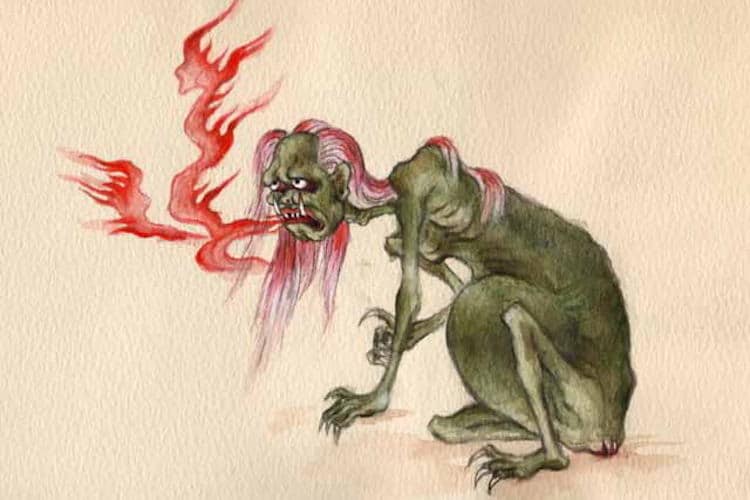
In Chinese Buddhist philosophy, though, there is a story that fits. The hungry ghost.

“In Chinese Buddhist teachings, “hungry ghosts are unable to take in or assimilate what they desperately need. The problem lies in their constricted throats — which cannot open for nourishment. They wander aimlessly in search of relief that is not forthcoming.”” [Source]

Interestingly, according to some of its origin myths, the hungry ghost was born out an act of cruelty. In many of the stories, it is a wealthy man’s wife who did some terrible thing to a monk, and when she eventually dies her spirit takes the form of the hungry ghost, forever lurking in purgatory, unable to ever fill its distorted belly and therefore always needing and wanting more.

The hungry ghost, then, is an expression of karma.

Hungry ghosts are the demon-like creatures described in Buddhist, Taoist, Hindu, Sikh, and Jain texts as the remnants of the dead who are afflicted with insatiable desire, hunger or thirst as a result of bad deeds or evil intent carried out in their life times. [Source]

In the realm of hungry ghosts, a deep drama between the ego and the ghost plays out ad infinitum. It’s an interplay that feeds the ego just enough for it to survive, so that in turn the ego can feed the hungry ghost. A dead-end cul-de-sac of sorts. A looping projection of one of our worst human vulnerabilities.

“The work of the ghost does not want to completely destroy its prey. Having fed off the other through dissociative trajectories of turbulence, the ego again becomes more robust. The hungry ghost now has, as companion and source of nurture, a replenished ego on which internal feeding may resume inside the space of erasure until the plenitude of the ghost-within again permeates the intersubjective.” ~  Nick Totton, Psychoanalysis and the Paranormal: Lands of Darkness

Spiritually healthy people understand their cravings for what they, expressions of innumerable forms of pain. Manifestations of the suffering caused by disconnection from the self, and from nature. And the self is nature. There really is no distinction between the two. The illusion is of separateness.

The ghosts are there to remind us that our real work is transmuting our suffering and cruelty into resilience and compassion. It’s not enough to numb the pain, it must be used to our advantage, for our growth, to serve as a catalyst for transformation, and to provide a chrysalis in which the transformation can take place.

“We are social beings. When we feel disconnected or alienated, we experience pain. Addiction, depression, anger, and violence are different ways we react to pain. To heal our society we must heal the emotional wounds.” ~Chris Agnos

Few understand this more clearly than Dr. Gabor Maté, whose work with drug addicts has transformed our understanding of what it means to be stuck in the realm of hungry ghosts.

Omens, Portents, Karma and the Mandate of Heaven

By Charles Hugh Smith

Source: Of Two Minds

The question of legitimacy isn’t limited to China.

what makes humans unique among social mammals? Some say humor, I would nominate superstition: regardless of how hard we promote our rationality and logic, humanity continues to sense portents and omens in events and feel the intangible tug of karma: the consequences of past actions that we arrogantly thought we’d escaped forever.

Michael Snyder recently compiled a list of peculiarities that are raising eyebrows around the globe: One, sure, two, not that unusual, three, well things happen in threes, but ten disturbances and we’re only six weeks into 2020? 10 ‘Plagues’ That Are Hitting Our Planet Simultaneously (Zero Hedge)

As the saying has it, Nature Bats Last, and maybe arrogant, destructive humanity’s war on Nature is about to get its comeuppance. Maybe overdosing hundreds of millions of chickens and pigs to knock down bacteria in overcrowded conditions has finally generated a karmic blowback via bird and swine viruses.

As for karma in human society: maybe the disruption of the supply chain in China is a karmic response to offshoring production to fatten Corporate America’s profits at the expense of all else in America’s society and economy.

Then there’s the celestial right to rule, a.k.a. The Mandate of Heaven, the concept rooted in Chinese culture that political leadership which fails the people invites divine retribution in the form of withdrawing the support of Heaven. This withdrawal of support manifests in the tangible world as natural disasters: earthquakes, floods, droughts, plagues, etc.

Though it’s not politically correct to discuss The Mandate of Heaven in any serious way, the reading of omens goes back in Chinese history to oracle bones, the process of heating bones until they crack and then interpreting the patterns as portents to the future.

With human and domestic animal epidemics devastating China in a novel cluster of natural disasters, The Mandate of Heaven is in play even if no one dares speak of it openly. The regime is well aware that these parallel plagues are understood as manifestations that question the legitimacy of the current regime.

The question of legitimacy isn’t limited to China. Soaring wealth inequality, the dependence on debt to fund “growth” and the political disenfranchisement of the masses are global manifestations of political-financial systems that invite divine retribution for their excesses of corruption, self-aggrandizement, and exploitation of the planet and its human workforce.

8 Simple Steps to Forgive Even the Unforgivable


Cats And Dogs Hugging

By Christina Sarich

Source: Yoga for the New World

Are you feeling resentment? Pain? Anguish? Perhaps even fury? It doesn’t matter if your emotions are directed at the general idiocy of a government that seems bought-out by an elitist class, or a close friend or family member. It doesn’t matter if you are raging at a complete stranger on the road, in a moment that dissipates fairly quickly, or if you are dealing with years of abuse or emotional torment. Forgiveness is a spiritual act that requires us to see things differently than we do now.

It doesn’t seem to be so when we are thinking of the wrong another has done to us, or the hurt they’ve so carelessly lavished, but forgiveness can free us from even the most unforgivable acts. Many of us hold onto our anger in hopes that this emotion will somehow anchor in some Universal Justice – as if our teeth gritting, and brow furrowing can somehow balance the teetering scales of righteousness in the world.

Sadly, the act or words of another that we keep running in our minds is like emotional cement, keeping us stuck and unable to move into peace. Our unforgiveness often doesn’t even affect the ‘other’ as much as it does us. There is a Tibetan Buddhist story about two monks who encounter each other many years after being released from prison where they had been horribly tortured by their captors. “Have you forgiven them?” asks the first. “I will never forgive them! Never!” replies the second. “Well, I guess they still have you in prison, don’t they?” the first says.

Many mistakenly believe that forgiveness somehow absolves another from their wrong-doing. That in forgiving, we helplessly accept, give up, surrender to defeat – that we are helpless. The exact opposite is true. When we face a terrible wrong, and look within to see how we can prevent the same incident from happening again, then we are truly on the correct spiritual path.

Dr. Fred Luskin is the Director of the Stanford University Forgiveness Projects. He has led the largest research project to date to study the effects of forgiveness on hurt individuals. He has dealt with people suffering from a huge range of things needing to be forgiven – from a romantic break up to the murder of a child. He believes that there are specific steps one can take to reduce the stress that comes with holding onto hurt, and make the progress of forgiveness as easy as possible. I tend to agree. Forgiveness usually takes a little time, but it needn’t consume your life for years. You can start with these eight steps to move your heart into the right place, and begin to forgive:

  1. We are often afraid to truly articulate just how much we have been wronged, but we must. In cases that are more obvious – such as losing a family member in a war-torn country to the hands of an unfeeling mercenary – it is easier to explain how angry and sad we are, but in other cases, such as with long-term familial abuse, we may have even come to think the behaviors we were subjected to were ‘normal,’ and only later do we realize how much pain and hurt we stuffed down over the years in order to function within our family unit. When that pain is realized, it is helpful to articulate it to a counselor or a few close friends. Keeping those emotions locked inside does not permit the process of forgiveness to begin.
  1. Forgiveness is a personal journey. You do it for yourself, not for the person you think needs to be forgiven, or anyone else. Once you make a commitment to do whatever it takes to let go of the pain and feel better – and do it for you, then forgiveness starts to become an easier endeavor. When you feel better about yourself, after all, you will find it more difficult to hold grudges against others. When needed practice self-care and self-love. If you are still involved with the person or people who you are trying to forgive, you can simply explain to them that you need time to care for yourself. If this is not appropriate due to the ongoing behavior of another, then simply practice uncompromising self-love and distance yourself from the other person until your feelings of anger and hatred dissipate. Reconciliation may be possible in the future.
  1. While reconciliation is at times possible, sometimes it just isn’t. If someone is emotionally unstable, and will likely continue to act in hurtful or harmful ways, we don’t need to be physically or emotionally near them to forgive them. What you’re after is internal peace. Forgiveness can be defined as the peace and understanding that comes from dropping the blame for whoever has hurt you – changing your never-ending story of grievance, and realizing that they were possibly playing a role in the grand play of life – called maya – to help you learn more about yourself. It doesn’t mean that murdering your child is right, or that stealing, cheating, emotional abuse, or other ‘wrongs’ are ‘right.’ It simply means that you choose to see that person’s pain as the impetus for their own actions, and not as a personal affront to you. Maya Angelou once said, “You can’t forgive without loving. And I don’t mean sentimentality. I don’t mean mush. I mean having enough courage to stand up and say, ‘I forgive, I’m done with it.’” If someone has been narcissistic, selfish, hateful, or jealous, you can forgive them for your own peace of mind, and allow them to learn from the Universal lessons, which are surely coming their way, to help them forgive those who hurt them also. While you don’t have to reconcile with others who are not ready to do this spiritual work for themselves, you do have to reconcile your own emotions.
  1. Believe it or not your hurt is coming from what you feel now, not what happened ten minutes ago, an hour ago, days ago, or even ten years ago. That old adage about time healing all wounds is true, but this is because we tend to get caught in karmic cycles that cause us to mentally recycle pain instead of letting it go. In the book Karma and Reincarnation Transcending Your Past, Transforming Your Future, Elizabeth Clare Prophet and Patricia R. Spadaro explain that while “karma means accountability and payback, reincarnation is simply another word for opportunity.” Karmic retribution is not punishment, but the benevolent Universe’s way of allowing us free will. It does mean, however, that what we do unto others, will be done unto us, somehow, at some time, in some way. The Sioux holy man, Black Elk, has explained that even nature comes full circle, and Voltaire espoused the fact that “it is not more surprising to be born twice, than once; everything in nature is resurrection. The cycles of karma and reincarnation can help us to understand family patterns, community patterns, and even wider societal patterns that need undoing. When we stay stuck in thoughts of the pain another has caused us, we miss the opportunity of this incarnation. After talking about a hurt with another person, and expressing it fully, it is time to start letting it go, and looking at the patterns which we created it. This is the true gift of being ‘hurt’ be another – it is really a chance to see how we have hurt ourselves.

I had the feeling that I was a historical fragment, an excerpt for which the preceding and succeeding text was missing . . . I could well imagine that I might have lived in former centuries and there encountered questions I was not yet able to answer; that I had to be born again because I had not fulfilled the task that was given to me. ~ Carl Jung

  1. Stop your fight or flight response. When we start to ruminate about what another has done to us, our hypothalamus gets in gear, engaging both the sympathetic nervous system and the adrenal-cortical system. When the effect of these two systems goes ‘online’ the fight or flight response begins – this means we are in moderate to full-blown fear mode. We are afraid this will happen to us again. We are feeling the incident as if it were happening right now, no matter now long ago it occurred. Our heart rates and blood pressure rise. We might even sweat a little. Our bodies are flooded with 30 different stress hormones and it can make ‘forgiving’ very difficult. By instead practicing a simple, calming mantra meditation, a few yoga asanas, yoga nidra, nadi shodhana, or going for a short walk outdoors, we can reverse this fight-or-flight response, and deal with the fear behind our pain from a more level emotional state.
  1. Give up your expectations of others – Dr. Luskin calls this ‘recognizing the unenforceable rules.’ In other words, you can’t expect to get from others, what they have no ability or desire to give you. While we can practice love without expectation, we also should be aware that others aren’t always capable of loving back. If your inner child is still bemoaning the inability of an emotionally shutdown father to be affectionate and caring, or you expect a selfish boss to behave differently, then you are setting yourself up for more pain, and often. Realize that what you seek from others – kindness, love, affection, support – will come from those willing and able to give it, and the more you offer it to yourself, the more likely these individuals will come into your orbit. Just let the others, who are not ready to act as evolved, be. No resentment – that’s just where they are at in their cycle or karma and reincarnation.
  1. Know that a life well lived is your best revenge – as long as you stay hurt and angry, you are feeding the ego of the person who felt the need to hurt you. You give that person power over you – you are still in ‘prison’ like the two monks said. Find personal power in the good things in your life. Robert Emmons and Michael McCullough are two of the leading American investigators of gratitude. They describe gratitude as personality strength—the ability to be keenly aware of the good things that happen to you and never take them for granted. Grateful individuals express their thanks and appreciation to others in a heartfelt way, not just to be polite. If you possess a high level of gratitude, you often feel an emotional sense of wonder, thankfulness and appreciation for life itself. Start a gratitude journal, or simply practice a few moments of quiet contemplation realizing all you do have now, instead of getting stuck on your hurt feelings. Counting your blessings is not only good for your health, but it helps to dissipate sadness, anger, and frustration.
  1. Change your ‘story’ – Instead of telling a story to yourself and others about how you were done wrong, decide to rewrite the script. You can, instead of being a victim, decide to use the experience as a way to heal others, and practice one of the most profound spiritual practices ever taught. Imagine the ripples that the pebbles of forgiveness could send out into the world. I give the example of a man named Robert Rule to explain exactly how profound changing your story can be:

“Gary Leon Ridgway is better known as the infamous Green River Killer. In 2003, he confessed to the murders of 48 women. In 2011, Ridgway was convicted of the murder of Rebecca Marrero, bringing the victim count up to 49. By his own confession, he may have murdered as many as 60 women. Ridgway especially despised prostitutes and targeted them for his killings. At Ridgway’s 2003 sentencing, the families of the victims had the opportunity to speak out and address Ridgway directly. Understandably, many were angry and lashed out at Ridgway for the unimaginable grief he had put them through. As Ridgway stonily listened to the family members express their grief and anger, one person came up and said something unexpected. When the time came for Robert Rule, the father of teenage victim Linda Jane Rule, to speak, Ridgway finally showed a glimpse of remorse. Rule’s words to Ridgway were: “Mr. Ridgway . . . there are people here that hate you. I’m not one of them. You’ve made it difficult to live up to what I believe, and that is what God says to do, and that’s to forgive. You are forgiven, sir.” These words brought Ridgway to tears.”

About the Author

Christina Sarich is a musician, yogi, humanitarian and freelance writer who channels many hours of studying Lao Tzu, Paramahansa Yogananda, Rob Brezny, Miles Davis, and Tom Robbins into interesting tidbits to help you Wake up Your Sleepy Little Head, and *See the Big Picture*. Her blog is Yoga for the New World . Her latest book is Pharma Sutra: Healing The Body And Mind Through The Art Of Yoga. Please reprint this article with attribution bio and all links in tact.