Eyewitness to the Agony of Julian Assange

By Timothy Erik Strom and John Pilger

Source: CounterPunch

John Pilger has watched Julian Assange’s extradition trial from the public gallery at London’s Old Bailey. He spoke with Timothy Erik Ström of Arena, Australia:

Q:  Having watched Julian Assange’s trial firsthand, can you describe the prevailing atmosphere in the court?

The prevailing atmosphere has been shocking. I say that without hesitation; I have sat in many courts and seldom known such a corruption of due process; this is due revenge. Putting aside the ritual associated with ‘British justice’, at times it has been evocative of a Stalinist show trial. One difference is that in the show trials, the defendant stood in the court proper. In the Assange trial, the defendant was caged behind thick glass, and had to crawl on his knees to a slit in the glass, overseen by his guard, to make contact with his lawyers. His message, whispered barely audibly through face masks, WAS then passed by post-it the length of the court to where his barristers were arguing the case against his extradition to an American hellhole.

Consider this daily routine of Julian Assange, an Australian on trial for truth-telling journalism. He was woken at five o’clock in his cell at Belmarsh prison in the bleak southern sprawl of London. The first time I saw Julian in Belmarsh, having passed through half an hour of ‘security’ checks, including a dog’s snout in my rear, I found a painfully thin figure sitting alone wearing a yellow armband. He had lost more than 10 kilos in a matter of months; his arms had no muscle. His first words were: ‘I think I am losing my mind’.

I tried to assure him he wasn’t. His resilience and courage are formidable, but there is a limit. That was more than a year ago. In the past three weeks, in the pre-dawn, he was strip-searched, shackled, and prepared for transport to the Central Criminal Court, the Old Bailey, in a truck that his partner, Stella Moris, described as an upended coffin. It  had one small window; he had to stand precariously to look out. The truck and its guards were operated by Serco, one of many politically connected companies that run much of Boris Johnson’s Britain.

The journey to the Old Bailey took at least an hour and a half. That’s a minimum of three hours being jolted through snail-like traffic every day. He was led into his narrow cage at the back of the court, then look up, blinking, trying to make out faces in the public gallery through the reflection of the glass. He saw the courtly figure of his dad, John Shipton, and me, and our fists went up. Through the glass, he reached out to touch fingers with Stella, who is a lawyer and seated in the body of the court.

We were here for the ultimate of what the philosopher Guy Debord called The Society of the Spectacle: a man fighting for his life. Yet his crime is to have performed an epic public service: revealing that which we have a right to know: the lies of our governments and the crimes they commit in our name. His creation of WikiLeaks and its failsafe protection of sources revolutionised journalism, restoring it to the vision of its idealists. Edmund Burke’s notion of free journalism as a fourth estate is now a fifth estate that shines a light on those who diminish the very meaning of democracy with their criminal secrecy. That’s why his punishment is so extreme.

The sheer bias in the courts I have sat in this year and last year, with Julian in the dock, blight any notion of British justice. When thuggish police dragged him from his asylum in the Ecuadorean embassy—look closely at the photo and you’ll see he is clutching a Gore Vidal book; Assange has a political humour similar to Vidal’s—a judge gave him an outrageous 50-week sentence in a maximum-security prison for mere bail infringement.

For months, he was denied exercise and held in solitary confinement disguised as ‘heath care’. He once told me he strode the length of his cell, back and forth, back and forth, for his own half-marathon. In the next cell, the occupant screamed through the night. At first he was denied his reading glasses, left behind in the embassy brutality. He was denied the legal documents with which to prepare his case, and access to the prison library and the use of a basic laptop. Books sent to him by a friend, the journalist Charles Glass, himself a survivor of hostage-taking in Beirut, were returned. He could not call his American lawyers. He has been constantly medicated by the prison authorities. When I asked him what they were giving him, he couldn’t say. The governor of Belmarsh has been awarded the Order of the British Empire.

At the Old Bailey, one of the expert medical witnesses, Dr Kate Humphrey, a clinical neuropsychologist at Imperial College, London, described the damage: Julian’s intellect had gone from ‘in the superior, or more likely very superior range’ to ‘significantly below’ this optimal level, to the point where he was struggling to absorb information and ‘perform in the low average range’.

This is what the United Nations Special Rapporteur on Torture, Professor Nils Melzer, calls ‘psychological torture’, the result of a gang-like ‘mobbing’ by governments and their media shills. Some of the expert medical evidence is so shocking I have no intention of repeating it here. Suffice to say that Assange is diagnosed with autism and Asperger’s syndrome and, according to Professor Michael Kopelman, one of the world’s leading neuropsychiatrists, he suffers from ‘suicidal preoccupations’ and is likely to find a way to take his life if he is extradited to America.

James Lewis QC, America’s British prosecutor, spent the best part of his cross-examination of Professor Kopelman dismissing mental illness and its dangers as ‘malingering’. I have never heard in a modern setting such a primitive view of human frailty and vulnerability.

My own view is that if Assange is freed, he is likely to recover a substantial part of his life. He has a loving partner, devoted friends and allies and the innate strength of a principled political prisoner. He also has a wicked sense of humour.

But that is a long way off. The moments of collusion between the judge— a Gothic-looking magistrate called Vanessa Baraitser, about whom little is known—and the prosecution acting for the Trump regime have been brazen. Until the last few days, defence arguments have been routinely dismissed. The lead prosecutor, James Lewis QC, ex SAS and currently Chief Justice of the Falklands, by and large gets what he wants, notably up to four hours to denigrate expert witnesses, while the defence’s examination is guillotined at half an hour. I have no doubt, had there been a jury, his freedom would be assured.

The dissident artist Ai Weiwei came to join us one morning in the public gallery. He noted that in China the judge’s decision would already have been made. This caused some dark ironic amusement. My companion in the gallery, the astute diarist and former British ambassador Craig Murray wrote:

I fear that all over London a very hard rain is now falling on those who for a lifetime have worked within institutions of liberal democracy that at least broadly and usually used to operate within the governance of their own professed principles. It has been clear to me from Day 1 that I am watching a charade unfold. It is not in the least a shock to me that Baraitser does not think anything beyond the written opening arguments has any effect. I have again and again reported to you that, where rulings have to be made, she has brought them into court pre-written, before hearing the arguments before her.

I strongly expect the final decision was made in this case even before opening arguments were received.

The plan of the US Government throughout has been to limit the information available to the public and limit the effective access to a wider public of what information is available. Thus we have seen the extreme restrictions on both physical and video access. A complicit mainstream media has ensured those of us who know what is happening are very few in the wider population.

There are few records of the proceedings. They are: Craig Murray’s personal blog, Binoy Kampmark on CounterPunch, Joe Lauria’s live reporting on Consortium News and the World Socialist Website. American journalist Kevin Gosztola’s blog, Shadowproof, funded mostly by himself, has reported more of the trial than the major US press and TV, including CNN, combined.

In Australia, Assange’s homeland, the ‘coverage’ follows a familiar formula set overseas. The London correspondent of the Sydney Morning Herald, Latika Bourke, wrote this recently:

The court heard Assange became depressed during the seven years he spent in the Ecuadorian embassy where he sought political asylum to escape extradition to Sweden to answer rape and sexual assault charges.

There were no ‘rape and sexual assault charges’ in Sweden. Bourke’s lazy falsehood is not uncommon. If the Assange trial is the political trial of the century, as I believe it is, its outcome will not only seal the fate of a journalist for doing his job but intimidate the very principles of free journalism and free speech. The absence of serious mainstream reporting of the proceedings is, at the very least, self-destructive. Journalists should ask: who is next?

How shaming it all is. A decade ago, the Guardian exploited Assange’s work, claimed its profit and prizes as well as a lucrative Hollywood deal, then turned on him with venom. Throughout the Old Bailey trial, two names have been cited by the prosecution, the Guardian’s David Leigh, now retired as ‘investigations editor’ and Luke Harding, the Russiaphobe and author of a fictional Guardian ‘scoop’ that claimed Trump adviser Paul Manafort and a group of Russians visited Assange in the Ecuadorean embassy. This never happened, and the Guardian has yet to apologise. The Harding and Leigh book on Assange—written behind their subject’s back—disclosed a secret password to a WikiLeaks file that Assange had entrusted to Leigh during the Guardian’s ‘partnership’. Why the defence has not called this pair is difficult to understand.

Assange is quoted in their book declaring during a dinner at a London restaurant that he didn’t care if informants named in the leaks were harmed. Neither Harding nor Leigh was at the dinner. John Goetz, an investigations reporter with Der Spiegel, was at the dinner and testified that Assange said nothing of the kind. Incredibly, Judge Baraitser stopped Goetz actually saying this in court.

However, the defence has succeeded in demonstrating the extent to which Assange sought to protect and redact names in the files released by WikiLeaks and that no credible evidence existed of individuals harmed by the leaks. The great whistle-blower Daniel Ellsberg said that Assange had personally redacted 15,000 files. The renowned New Zealand investigative journalist Nicky Hager, who worked with Assange on the Afghanistan and Iraq war leaks, described how Assange took ‘extraordinary precautions in redacting names of informants’.

Q: What are the implications of this trial’s verdict for journalism more broadly—is it an omen of things to come?

The ‘Assange effect’ is already being felt across the world. If they displease the regime in Washington, investigative journalists are liable to prosecution under the 1917 US Espionage Act; the precedent is stark. It doesn’t matter where you are. For Washington, other people’s nationality and sovereignty rarely mattered; now it does not exist. Britain has effectively surrendered its jurisdiction to Trump’s corrupt Department of Justice. In Australia, a National Security Information Act promises Kafkaesque trials for transgressors. The Australian Broadcasting Corporation has been raided by police and journalists’ computers taken away. The government has given unprecedented powers to intelligence officials, making journalistic whistle-blowing almost impossible. Prime Minister Scott Morrison says Assange ‘must face the music’. The perfidious cruelty of his statement is reinforced by its banality.

‘Evil’, wrote Hannah Arendt, ‘comes from a failure to think. It defies thought for as soon as thought tries to engage itself with evil and examine the premises and principles from which it originates, it is frustrated because it finds nothing there. That is the banality of evil’.

Q: Having followed the story of WikiLeaks closely for a decade, how has this eyewitness experience shifted your understanding of what’s at stake with Assange’s trial?

I have long been a critic of journalism as an echo of unaccountable power and a champion of those who are beacons. So, for me, the arrival of WikiLeaks was exciting; I admired the way Assange regarded the public with respect, that he was prepared to share his work with the ‘mainstream’ but not join their collusive club. This, and naked jealousy, made him enemies among the overpaid and undertalented, insecure in their pretensions of independence and impartiality.

I admired the moral dimension to WikiLeaks. Assange was rarely asked about this, yet much of his remarkable energy comes from a powerful moral sense that governments and other vested interests should not operate behind walls of secrecy. He is a democrat. He explained this in one of our first interviews at my home in 2010.

What is at stake for the rest of us has long been at stake: freedom to call authority to account, freedom to challenge, to call out hypocrisy, to dissent. The difference today is that the world’s imperial power, the United States, has never been as unsure of its metastatic authority as it is today. Like a flailing rogue, it is spinning us towards a world war if we allow it. Little of this menace is reflected in the media.

WikiLeaks, on the other hand, has allowed us to glimpse a rampant imperial march through whole societies—think of the carnage in Iraq, Afghanistan, Libya, Syria, Yemen, to name a few, the dispossession of 37 million people and the deaths of 12 million men, women and children in the ‘war on terror’—most of it behind a façade of deception.

Julian Assange is a threat to these recurring horrors—that’s why he is being persecuted, why a court of law has become an instrument of oppression, why he ought to be our collective conscience: why we all should be the threat.

The judge’s decision will be known on the 4th of January.
Slow-Motion US/UK Killing of Julian Assange

By Stephen Lendmen

Source: StephenLendmen.org

Establishment media are in cahoots with US/UK ruling regimes against Assange for the “crime” of truth-telling journalism abhorred in the West — totalitarian rule where these societies are heading.

In mid-October, UN special rapporteur on torture Nils Melzer denounced Assange’s judicial lynching and egregious mistreatment, saying the following:

“What has the man done? He has disclosed an enormous amount of information that governments want to remain secret, most infamously the ‘Collateral Murder’ video, which, in my view, is evidence for war crimes.”

“What is the scandal in this case is that everyone focuses on Julian Assange. Here is someone who exposes evidence for war crimes, including torture and murder, and he is under this constant pressure.”

“I am absolutely convinced he will not receive a fair trial in Virginia, and he will remain in prison under inhumane conditions for the rest of his life.”

Tulsi Gabbard is the only US presidential aspirant expressing support for journalist Assange, as well as whistleblowers Chelsea Manning, Edward Snowden, and others like them, opposing their “prosecution like criminals.”

If elected president, she’d drop charges against them, she said, calling for greater “protect(ion) (of) our civil liberties,” adding:

Assange’s arrest in Britain “poses a great threat to our freedom of the press and to our freedom of speech” — the same true about how Chelsea Manning, Snowden, and other whistleblowers are mistreated.

What happened to them “could happen to you. It could happen to any of us,” she stressed.

Bipartisan politicians in the US and UK, along with establishment media, refuse to support Assange’s struggle for justice.

On Monday, he appeared in London’s Westminster Magistrates Court. Showing the effects of egregious mistreatment since unlawfully dragged from the city’s Ecuadorian embassy and imprisoned under harsh conditions, he was too physically and emotionally shattered to participate in his defense.

He’s an investigative journalist/whistleblower, publishing material supplied by sources believed to be credible, unidentified for their protection.

WikiLeaks is not an intelligence operation. Nor it it connected to Russia or any other country. Claims otherwise are fabricated.

Assange earlier explained that WikiLeaks has the right “to publish newsworthy content. Consistent with the US Constitution, we publish material that we can confirm to be true,” he stressed.

US charges against him are fabricated and malicious, what no legitimate tribunal would accept.

Justice Department lawyer James Lewis falsely accused him of “spying,” lied saying he’s “not a journalist,” turned truth on its head claiming his actions were “criminal in both the US and UK” — the above Big Lies how all fascist police states operate.

Assange attorney Mark Summers called for dismissal of Washington’s illegitimate extradition request, saying:

According to the 2003 UK/US extradition treaty, it “shall not be granted if the offense for which extradition is requested is a political offense,” adding:

The unjustifiable persecution of Assange and Chelsea Manning is “part of an avowed war on whistleblowers to include investigative journalists and publishers.”

Summers requested a three-month delay of Assange’s February 25 extradition hearing because “we need more time” to prepare a proper defense, given the “enormity” of issues involved, requiring “evidence gathering that would test most lawyers.”

Operating as an imperial tool, judge Vanessa Baraitser denied the request, saying the extradition hearing will proceed as schedule on February 25 at Woolwich Magistrates Court near Belmarsh Prison.

Its public gallery has three seats, assuring Assange’s judicial lynching will be virtually closed to public scrutiny.

Barely able to stand and speak after months of barbaric mistreatment, when asked if there’s “anything (he) would like to say, he replied barely audibly that he doesn’t “understand how this is equitable,” adding:

Imperial USA “had 10 years to prepare (its judicial lynching). I can’t remember anything. I can’t access any of my written work.”

“It’s very difficult to do anything with such limited resources against a superpower intent on” an illegitimate crucifixion. “I can’t think properly” from the barbaric ordeal he’s endured.

Baraitser dismissively replied that “conditions of your detainment are not the subject of this court.”

Following the hearing, WikiLeaks editor-in-chief Kristinn Hrafnsson called for the case against Assange to “be thrown out immediately,” adding:

“Not only is it illegal on the face of the (extradition) treaty, the US has conducted illegal operations against Assange and his lawyers which are the subject of a major investigation in Spain.”

John Pilger witnessed Monday’s spectacle, saying “(t)he whole thing is a grotesque absurdity. There is an extradition law between this country and the United States.”

“It states specifically that someone cannot be extradited if the offenses are political.”

“The source of this is a rogue (US) state — a state that ignores its own laws and international laws and the laws of this country.”

Summers called Assange’s crucifixion “a political attempt to signal to journalists the consequences of publishing information” ruling regimes want suppressed.

“It’s legally unprecedented…part of an avowed war on (truth-telling) whistleblowers to include investigative journalists and publishers.”

In cahoots with the Trump regime, police state Britain is killing Assange slowly, wanting him, whistleblowers like Chelsea Manning, and other truth-tellers silenced.

What’s going on is the hallmark of totalitarian rule – controlling the message, eliminating what conflicts with it, notably on major geopolitical issues.

Losing the right of free expression endangers all others. When truth-telling and dissent are considered threats to national security, free and open societies no longer exist – the slippery slope America and other Western societies are heading on.

Judge Denies Assange Extension on Extradition Hearing

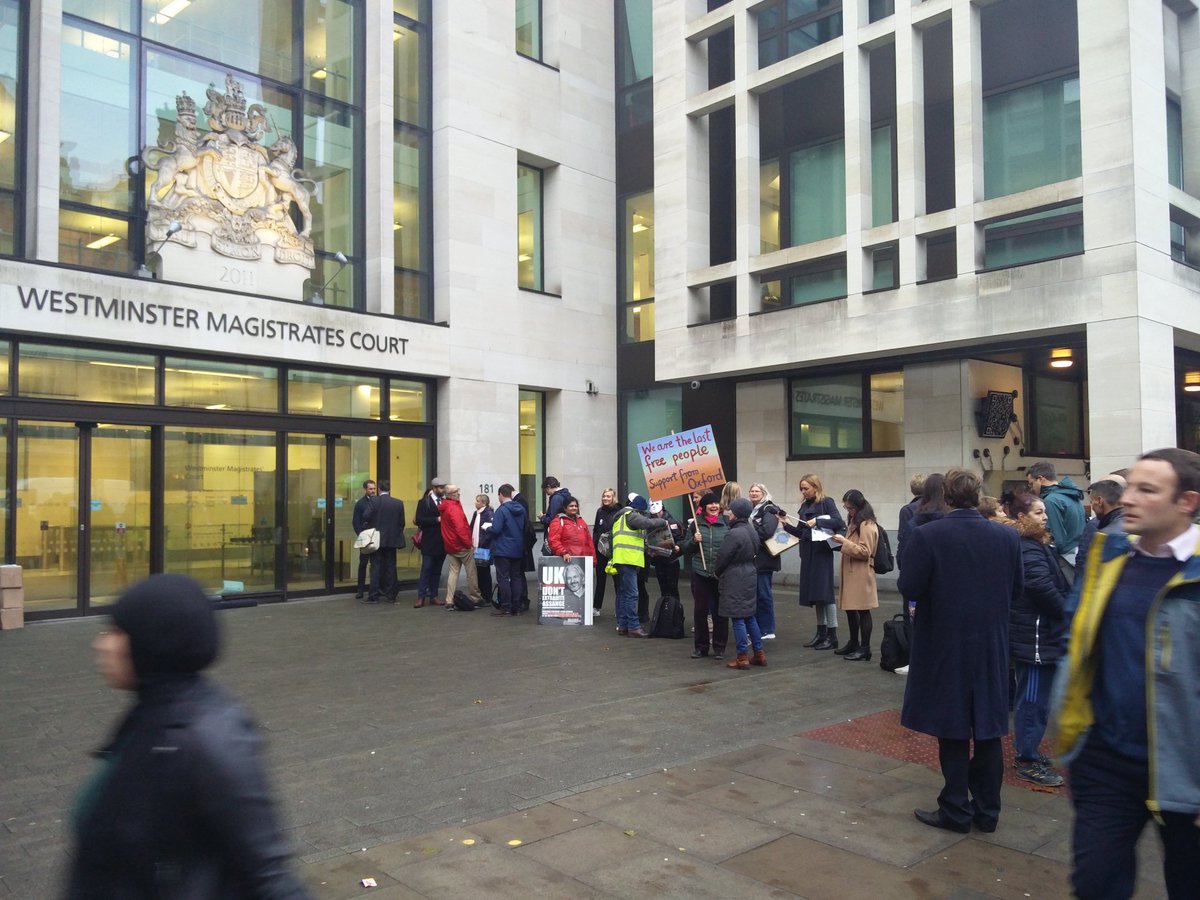
Protestors line up at courthouse Monday morning. (Gordon Dimmack)

A judge at a hearing in London has denied the WikiLeaks’ publisher more time to prepare his defense, while a group of Australian politicians coalesce around a demand to return Julian Assange home.

By Joe Lauria

Source: Consortium News

The judge in Julian Assange’s extradition process on Monday denied his lawyer’s appeal for more time to prepare his case as the imprisoned WikiLeaks publisher weakly told the court he was unable to “research anything” in the conditions under which he is being held in high-security Belmarsh Prison.

Assange appeared in person at Westminster Magistrate’s Court in London Monday morning for a case management hearing on the request by the United States for Assange to be sent to Virginia to face 18 charges, including allegedly violating the U.S. Espionage Act for possessing and disseminating classified information that revealed prima facie evidence of U.S. war crimes.

Mark Summers, Assange’s lawyer, told the court the charges were “a political attempt” by the U.S. “to signal to journalists the consequences of publishing information.” The Espionage Act indictment against Assange by the Trump Administration is the first time a journalist has been charged under the 1917 Act for publishing classified material.

“It is legally unprecedented,” Summers told Judge Vanessa Baraitser. He argued that President Donald Trump was politically motivated by the 2020 election to pursue Assange.

Summers also argued before Baraitser that the U.S. “has been actively engaged in intruding into privileged discussions between Assange and his lawyers.” It was revealed this month that the Central Intelligence Agency was given access to surveillance video shot by a private Spanish company of all interactions Assange had with lawyers, doctors and visitors.

“This is part of an avowed war on whistleblowers to include investigative journalists and publishers,” Summers said. “The American state has been actively engaged in intruding on privileged discussions between Mr Assange and his lawyer.”

Because of this surveillance, including “unlawful copying of their telephones and computers” as well as “hooded men breaking into offices,” Assange’s lawyers needed more time to prepare his defense, Summers argued. But Baraitser refused the request, and ordered Assange back in court for a second management hearing on Dec. 19. The full extradition hearing is scheduled to begin on Feb. 25 next year.

Not Equitable

As the hearing ended Monday, Baraitser asked Assange if he understood what had just transpired. “Not really. I can’t think properly,” he said.

“I don’t understand how this is equitable. This superpower had 10 years to prepare for this case and I can’t access my writings. It’s very difficult where I am to do anything but these people have unlimited resources. They are saying journalists and whistleblowers are enemies of the people. They have unfair advantages dealing with documents. They [know] the interior of my life with my psychologist. They steal my children’s DNA. This is not equitable what is happening here.”

The Guardian quoted WikiLeaks Editor-in-Chief Kristinn Hrafnsson as saying that Assange’s case should be thrown out because of interference with preparing his defense. “Not only is it illegal on the face of the treaty, the U.S. has conducted illegal operations against Assange and his lawyers which are the subject of a major investigation in Spain,” Hrafnsson said.

According to witnesses in the courtroom, Assange appeared physically and mentally enfeebled after months in isolation in prison. Tristan Kirk, correspondent for the London Evening Standard, tweeted: “Julian Assange struggled to say his own name and date of birth as he appeared in the dock. He claimed to have not understood what happened in the case management hearing, and was holding back tears as he said: ‘I can’t think properly.’”

In response to Kirk’s message, Assange’s mother, Christine Assange, tweeted: “This breaks my heart! They are breaking my beautiful bright, brave journalist son, the corrupt bastards!”

https://twitter.com/AssangeMrs/status/1186254253481811970

Supporters Outside

Assange’s supporters swarmed the van in which Assange was driven away from the courthouse back to his dreary isolation in the hospital ward at Belmarsh.

https://twitter.com/matthabusby/status/1186239398385504256

Speaking outside the courthouse after the hearing, journalist John Pilger called the legal assault on Assange a “deliberate action of a rogue state, a state that ignores its own laws and international law.”

“There were people crying in the gallery,” said Assange supporter Emmy Butlin. “He is like a ghost. He could hardly talk. He’s dying.”

Australian MPs Back Assange

Meanwhile in Assange’s native Australia, members of Parliament have demanded that Assange be returned to his country.

MP Andrew Wilkie told the House of Representatives last week that Assange is “an Australian citizen and must be treated like any other Australian. He was not in the U.S. when he provided evidence of U.S. war crimes in Iraq. He can’t possibly have broken their laws.”

If Assange is extradited, Wilkie said he

“faces serious human rights violations including exposure to torture and a dodgy trial. And this has serious implications for freedom of speech and freedom of the press here in Australia, because if we allow a foreign country to charge an Australian citizen for revealing war crimes, then no Australian journalist or publisher can ever be confident that the same thing won’t happen to them. Put simply, he must be allowed to return to Australia.”

Wilkie, an Australian former intelligence officer who resigned because of the falsehoods about WMD in Iraq before the 2003 invasion, is reportedly working to set up a parliamentary committee that crosses party lines to demand that the Liberal government of Prime Minister Scott Morrison opposes Assange’s extradition.

The Australian TV program “The Project” reported on Sunday that up to 10 politicians were ready to join the committee.

“It’s important that parliamentarians learn the facts of this matter,” Wilkie told the program. “There’s so much naiveté and ignorance and disinformation swirling around that it’s no wonder that a lot of people are wary or even dislike Julian, but I reckon that when people find out the facts of the matter they will get behind him.

“This is about the right of person not to be extradited to another country based on a whim or the politics of it. The whole thing stinks quite frankly, I think he should be allowed to come to Australia.”

Wilkie called the ability for Morrison to stand up to Trump, with whom he’s said to be close, “a test for the prime minister.”

“It’s one thing to be mates with someone, but it’s another thing entirely to agree to do something which is entirely improper. I mean ScoMo is the prime minister of Australia, he’s not the vice president of the United States I hope. And this is an opportunity for Australia to say we stand for the rule of law and we stand behind people who stand up and speak about war crimes. Australian politicians kowtow to the U.S. all the time without realizing that our alliance would be even stronger if sometimes we said, ‘No.’ Because if ScoMo just rolls over on this and is happy for Julian Assange to be extradited from Belmarsh Prison in the UK to the U.S., well that just means Australia can be taken for granted. You actually lose leverage bizarrely by having a really close relationship that Scott Morrison seems to have with Donald Trump. Rather than putting Australia in a better position it can put Australia in a weaker position because the U.S. knows it can be taken for granted.”

Wilkie joined right-wing MP Barnaby Joyce who the previous week came out in Assange’s defense. “Whether you like a person or not, they should be afforded the proper rights and protections and the process of justice,” Joyce said.

Wilkie told “The Project,” “When someone like Barnaby Joyce thinks there’s an issue here then people should pay attention.”


Joe Lauria is editor-in-chief of Consortium News and a former correspondent for The Wall Street Journal, Boston GlobeSunday Times of London and numerous other newspapers. He can be reached at joelauria@consortiumnews.com and followed on Twitter @unjoe .

“Truth ultimately is all we have:” Julian Assange appeals for public supporta

By Oscar Grenfell

Source: WSWS.org

In his first publicly-released comments to supporters since his arrest, WikiLeaks founder and publisher Julian Assange has detailed the repressive conditions he faces in Britain’s Belmarsh prison and called for a campaign against his threatened extradition to the United States.

“I am defenceless and am counting on you and others of good character to save my life,” Assange wrote, adding, “Truth ultimately is all we have.”

Assange’s comments were made in a letter addressed to independent British journalist Gordon Dimmack, who decided to make it public following last Thursday’s announcement by the US Justice Department of additional charges against Assange under the Espionage Act. The WSWS is republishing the letter, with Dimmack’s permission, in full below.

Assange explained that since he was convicted on trumped-up bail charges shortly after his arrest on April 11, he has been “isolated from all ability to prepare to defend myself, no laptop, no internet, no computer, no library so far, but even if I do get access it will be just for half an hour with everyone else once a week.”

The WikiLeaks founder stated that he is allowed “Just two visits a month and it takes weeks to get someone on the call list.”

All of his calls, except those to his lawyers, are monitored and limited to a maximum of ten minutes. There is a window of just 30 minutes per day for phone calls to be made “in which all prisoners compete for the phone.” Assange receives only a few pounds of phone credit per week and is not allowed to receive inbound calls.

The WikiLeaks founder declared that, despite these onerous conditions, he is “unbroken albeit literally surrounded by murderers. But the days when I could read and speak and organise to defend myself, my ideals and my people are over until I am free. Everyone else must take my place.”

The WikiLeaks founder stated that he faced “A superpower” that has “been preparing for 9 years with hundreds of people and untold millions spent” on the case against him.

He warned that “The US government or rather those regrettable elements in it that hate truth liberty and justice want to cheat their way into my extradition and death rather than letting the public hear the truth for which I have won the highest awards in journalism and have been nominated seven times for the Nobel Peace Prize.”

The unveiling of the US charges is a vindication of Assange’s warnings, in the letter and over the past nine years, that he faces a politically-motivated US prosecution for his role in WikiLeaks’ exposures of war crimes, mass surveillance operations and global diplomatic conspiracies.

The 17 counts against Assange carry a combined maximum prison sentence of 175 years. They are an unprecedented attempt to criminalise investigative journalism, and abolish the free press protections of the US Constitution’s First Amendment.

The charges centre on WikiLeaks’ receipt and publication of classified US government documents. These core journalistic practices are presented as criminal activities which “risked serious harm to United States national security to the benefit of our adversaries.”

The documents covered include the Afghan war logs, which exposed the extrajudicial killing of civilians by US-led forces, and other violations of international law.

Assange’s letter further exposes the ongoing political conspiracy against him, which included his illegal expulsion from Ecuador’s London embassy and detention by the British authorities.

The WikiLeaks founder was convicted, within hours of his arrest, on the British charges. The judge dismissed the fact that the offenses were effectively resolved years ago as a result of Assange’s forfeiture of bail monies, his years of arbitrary detention in the small embassy building and his United Nations-upheld status as a political refugee.

Despite the minor character of the bail conviction, Assange has been held in virtual isolation in a maximum security prison. This is a clear attempt to hinder his defence against the Trump administration’s extradition request, and the revived Swedish investigation into allegations of sexual misconduct, which is aimed at blackening his name and creating an alternate route for him to be dispatched to a US prison.

Assange’s call for a campaign in his defence coincides with growing opposition to his persecution and to the Espionage Act charges against him.

In a Tweet shared almost 5,000 times, investigative journalist John Pilger warned that “The war on Julian #Assange is now a war on all. Eighteen absurd charges including espionage send a burning message to every journalist, every publisher… Modern fascism is breaking cover.”

The American Civil Liberties Union branded the charges “an extraordinary escalation of the Trump administration’s attacks on journalism, establishing a dangerous precedent that can be used to target all news organizations that hold the government accountable by publishing its secrets.”

The Freedom of the Press Foundation described them as “the most significant and terrifying threat to the First Amendment in the 21st century.”

In Australia, there are mounting calls for the government to fulfil its obligations to Assange as an Australian citizen and journalist. Former Labor politician Bob Carr yesterday cynically warned that Foreign Minister Marise Payne “needs to protect herself from the charge that she’s failed in her duty to protect the life of an Australian citizen”

Greg Barns, an Australian-based advisor to Assange, declared “Australia does have a role to play here and our view is that the Australian government needs to intervene.” He said the US prosecution of the WikiLeaks founder was aimed at applying US domestic law extraterritorially. This meant that “anyone who publishes information the US deems to be classified anywhere in the world” could be targeted by the US government.

Over the past 18 months, the WSWS and the Socialist Equality Parties (SEP) around the world have played a prominent role in the struggle against the stepped-up persecution of Assange.

The SEP (Australia) has held a series of rallies, demanding that the Australian government secure Assange’s release from Britain and return to Australia, with a guarantee against extradition to the US.

The events, addressed by SEP national secretary James Cogan, and well-known fighters for civil liberties, including Pilger, Consortium News editor-in-chief Joe Lauria and Professor Stuart Rees, have been attended by hundreds of workers, students and young people.

The SEP (Britain) held a powerful public meeting in London on May 12, which brought together 150 defenders of Assange, and featured speakers from around the world. It was streamed live on Dimmack’s YouTube page to an audience of thousands.

On May 18, the Sozialistische Gleichheitspartei held a rally in Berlin, attended by 300 people, under the banner “freedom for Julian Assange.”

Over the coming weeks, the WSWS and the SEP’s will intensify the struggle against Assange’s extradition to the US, and for his complete freedom. We appeal to all supporters of civil liberties to join us in this crucial fight, which is the spearhead of the defence of democratic rights and against imperialist war.

Assange’s next hearing is set for Thursday May 30 at Westminster Magistrates Court in London. We urge all readers of the WSWS in the UK to attend.

Below is the full text of Assange’s letter to Gordon Dimmack:

I have been isolated from all ability to prepare to defend myself, no laptop, no internet, no computer, no library so far, but even if I do get access it will be just for half an hour with everyone else once a week. Just two visits a month and it takes weeks to get someone on the call list and the Catch-22 in getting their details to be security screened. Then all calls except lawyer are recorded and are a maximum 10 minutes and in a limited 30 minutes each day in which all prisoners compete for the phone. And credit? Just a few pounds a week and no one can call in.

A superpower that has been preparing for 9 years with hundreds of people and untold millions spent on the case. I am defenceless and am counting on you and others of good character to save my life

I am unbroken albeit literally surrounded by murderers. But the days when I could read and speak and organise to defend myself, my ideals and my people are over until I am free. Everyone else must take my place.

The US government or rather those regrettable elements in it that hate truth liberty and justice want to cheat their way into my extradition and death rather than letting the public hear the truth for which I have won the highest awards in journalism and have been nominated seven times for the Nobel Peace Prize.

Truth ultimately is all we have.


Related Video

Cyberwar: #RussiaGate Is US

By Rob Williams

Source: Project Censored

The following is a critical book review of Kathleen Hall Jamieson’s Cyberwar: How Russian Hackers and Trolls Helped Elect A President – What We Don’t, Can’t, And Do Know (Oxford: Oxford University Press, 2018).

“Russia hacked the 2016 US election!”

Since November 2016, the US “news” chatterati – pundits and poets, priests, prognosticators and politicians – have repeated this statement ad nauseum. The #RussiaGate story has become a commonly-accepted article of faith amongst the US neoliberal faithful – disgruntled Clintonistas, bereaved “Bernie Bros,” US news flaks, and anyone else who dislikes the current occupant of the White House. If the “Russia hacked the 2016 US election” meme warriors had a high-viz US standard bearer, it would probably be popular MSNBC performance artist Rachel “All Russia, All The Time” Maddow, who serves up the #RussiaGate sauce with reckless abandon to high TeeVee viewer ratings, earning somewhere between $30 and $40 K daily in salary. (LINK to RM mashup here).

And now, we have a scholarly book published by Oxford University Press with an epic title – Cyberwar: How Russian Hackers and Trolls Helped Elect A President – What We Don’t, Can’t, And Do Know – that purports to prove that Russia’s cyber-meddling helped sabotage the HRC campaign, swinging the 2016 US presidential election in favor of DJT.

To approach Cyberwar, first consider everything on the table re: the 2016 US presidential election.

Here‘s just a short list.

Witness the two most unpopular presidential candidates in US political history (one of whom confidently encouraged the other to run, convinced she could beat him); massive and well-documented bipartisan digital vote count manipulation (“electile dysfunction”) courtesy the 2002 “Help America Vote Act” (Orwell would be impressed); the grotesque (human) nature of Donald J Trump and Republicans’ comical attempts to first displace and then eventually come to terms with his 2016 candidacy; the complete corruption of the national Democratic Party leadership, which did everything it could to crown HRC the Dem standard bearer, from systematically undermining insurgent Vermont “progressive” Bernie Sanders’ presidential bid (read the 110 page report “Democracy Lost” for detailed descriptions of how the DNC manipulated 2016 Democratic primary outcomes in 11 swing states) to diverting DNC fundraising – millions of dollars collected from the pockets of ordinary Americans – away from so-called “down ballot” local office races and into HRC presidential campaign coffers during the heated months of 2016.

There’s so much more, but I’ll simply stop there.

Rather than looking in the 2016 mirror, however, US blames…Russians?

To be clear, I approached Cyberwar with an open mind. I am a big fan of the book’s author, distinguished US media scholar Kathleen Hall Jamieson (KHJ), longtime badass in the world of political communications scholarship, and current Elizabeth Ware Packard Professor at the Annenberg School for Communication at the University of Pennsylvania and the Director of the Annenberg Public Policy Center. Jamieson’s got street cred. However, after a close read and re-read of KHJ’s new book, including all the footnotes, Cyberwar left me unconvinced by its “more or less” central conclusion – “Russia trolled and hacked the 2016 US election, sorta!” In fact, I’d suggest that Cyberwar is a deeply problematic book, a fascinating scholarly study in “manufacturing consent” – the term Edward Herman and Noam Chomsky borrowed from Walter Lippman to title their 1988 book of the same name – describing how US elites “massage” US news channels like the New York Times, “filtering” into public view the “news” stories most beneficial to their strategic goals, while downplaying or censoring other worthy “news” stories of significance.

To fully understand my critique of Cyberwar, start with Jamieson’s credulous acceptance of “facts” provided by the US “intelligence community” (my new favorite Orwellian trope) re: the Russian government’s “interference” to advance her Cyberwar case. More on that in a moment. In the meantime, here is KHJ’s central Cyberwar claim, summarized in a single long sentence, slightly paraphrased for brevity, from her book’s conclusion: “In the run up to the 2016 US presidential election, Russian trolls and hackers carried out a strategically systematic and ultimately successful communications campaign to discredit Democratic presidential candidate Hillary Rodham Clinton and support Republican presidential candidate Donald J. Trump through sufficiently widespread messaging that focused on issues compatible with Trump’s strategic needs, addressing constituencies he had to mobilize and demobilize, by employing persuasive, visually evocative and well-targeted content that was amplified in swing states through sharing, liking, and commenting.” (p. 203).

It’s a mouthful, I know, and when you read it over a few times, removing both Clinton and Trump’s names, you quickly realize that this is what ANY strategic political campaign using digital tools –Cyberspace’s unique power and reach – would set out to do to try and win any election, anywhere. Russian president Vladimir Putin himself concedes that Russia wages “campaigns of political influence” wherever and whenever they can, just as the US and other powerful countries do and have done for decades, using as many communications tools as they can leverage.

So – how does Jamieson set out to prove Russian Cyberwar? She divides her book into four parts.

Part One of Jamieson’s book explores “who did it, why, and what research says about it might matter.” Here, KHJ flags the Internet Research Agency (IRA), a Russian troll farm, and introduces the reader to her previous ground-breaking work on communications effects research – how techniques like agenda-setting, framing, priming and “contagion creation” have worked over time to influence US voter decisions, and thus, perhaps, election outcomes. Big caveat here, that KHJ leaves unacknowledged. To wit – presumably, Russian “trolls” share the same primary goal as ALL trolls on the Internet, namely, maximizing audience engagement (and thus profit) through the creation and deployment of relevant content, with their chief “currency” being click-throughs, likes, shares, retweets, etc.

In Part Two of Cyberwar, Jamieson looks at what she calls “the prerequisites of [Russian] troll influence.” “Were the extent and virality of Russian social media content and the nature, coverage, and exposure of Russian-hacked Democratic materials,” she asks, “sufficient and sufficiently persuasive to plausibly affect the outcome of an election decided in three states by about 78,000 votes?” (p. 65). Hint – her final answer is a circumspectly strong “maybe.”

Part Three of Cyberwar finds KHJ considering “how the Russians affected the news and debate agendas in the last month of the presidential campaign.” Here, Jamieson looks at how “Russian hacked content” (her words) transformed the nature of US news coverage surrounding HRC in the month before the 2016 election, with a particular focus on the “drip drip drip” impact of “WikiLeak’d” emails illegally obtained from Democratic National Committee (DNC) servers, as well as FBI director James Comey’s role, during October 2016, in reopening the investigation into “newly-found” HRC emails, which KHJ argues helped shape public impressions around HRC for undecided US voters in the days just before the election.

Jamieson uses Cyberwar Part Four to provide a brief summary of “what we don’t, can’t, and do know about how Russian hackers and trolls helped elect Donald Trump.” “My case that the uses of Russian-hacked (emphasis added) Democratic materials influenced voters is built on scholars’ understandings of the effects of linguistic priming, media agenda setting, and framing the susceptibilities of late deciders, the dispositions of those who view both candidates unfavorably, the effects of imbalances in the amount of negative information available about alternative candidates, and scholarship on how debates affect voter attitudes,” Jamieson concludes. “It is scaffolded on evidence that the hacked content not only altered the media and debate agendas but also increased the negative press about Clinton. And it is bolstered by the possibility that Russian access and anticipated use of illegally gotten or fabricated Democratic content shaped a key decision by FBI director Comey.” (210)

To be fair, Cyberwar is an engaging read. Jamieson is a fine scholarly writer, and she has a field day digging into the aesthetics of individual Russian troll farm memes – complete with pictures. (The “Army Of Jesus” Facebook page, purportedly created by Russian trolls, features a boxing glove clad HRC sporting devil horns engaged in a fierce arm-wrestling match with Aryan Jesus himself. Hilarious.) KHJ also does a credible job tracing the evolution of the US news narrative around HRC in the weeks leading up to the 2016 election, showing how pivotal moments may have influenced voter perceptions about both HRC and DJT.

However! Individual Russian troll farm memes and evolving US “news” media coverage negatively impacting HRC do NOT a strategic Kremlin-led messaging campaign make.

Cyberwar continually flirts with a central question (which has become a story routinely told by US “news” media outlets)  – “Was Russian troll farming some sort of Kremlin-staged strategic cyber-op?” – without ever really answering it. The result is a book-length begging of this very important question, and here we come to the primary problem with Cyberwar– and it’s a whopper. Jamieson build her case for the Russian “tanking” of HRC’s candidacy on two central assumptions, both unproven.

Assumption #1: Jamieson implicitly asserts in Cyberwar that the Russians “hacked” into the Democratic National Committee (DNC) computer servers (as well as other hacks) and obtained digital copies of thousands of what became publicly damning emails from members of the DNC leadership team – Clinton campaign advisor John Podesta, HRC herself, and others – and then (by extension) tried to leverage the contents of these stolen documents for months in US social media spaces (and, by extension, influenced the shaping of US news narratives about HRC.) Interestingly, KHJ sneaks in “Russia hacked” and “Russian-stolen Democratic content” language into the last third of her book, without directly addressing this BIG rhetorical move or providing any proof that the Russians did so. Instead, she appears to implicitly draw on “evidence” for Russian hacking provided by the US “intelligence community” – former FBI director turned Trump special prosecutor Bob Mueller, former director of national intelligence James Clapper, and former National Security Agency director Michael Hayden chief among them. (Mueller, Clapper, Hayden – three US government officials who have all been less than honest with the American people, and I’m being generous.)

The counternarrative to the “Russia hacked into the DNC computers” story? Information was “leaked” from inside the DNC, not hacked from the outside. How might we know? Former NSA cryptographer Bill Binney, former CIA official Ray McGovern, and many other members of the 2003-founded Veteran Intelligence Professionals for Sanity (VIPS) argue that, based on their review of computer bit rate information, the stolen DNC content traveled at bandwidth rates too high to have been an external “hack,” but rather an internal “leak.” The reality? We’ll never know for sure, because the DNC refused to hand over their compromised computer servers to the FBI, instead contracting with Crowd Strike, a private US cybersecurity firm, to ascertain affirmative Russian hacking involvement (#Surprise!). For interested readers, NSA whistleblower Bill Binney discusses his “leak versus hack” conclusions on this recent episode of Brass Check TV between 1:27 – 1:37 here.

Assumption #2: In Cyberwar, Jamieson implies that WikiLeaks closely collaborated with the Russian government, or at the very least (it’s a bit hard to tell from her lack of analysis here), Putin used WikiLeaks as its public relations machine to destroy HRC’s reputation and elevate DJT as a presidential candidate. In other words, from his Ecuadorian embassy prison, Assange was in close cahoots with Putin, Cyberwar implies, or at the very least, Assange served as a “useful idiot” for the Kremlin. Here again, KHJ offers no proof, other than continually flagging the usual suspects, Russian troll farmers and hackers, as well as other sources such as the popular RT (formerly Russia Today) news channel for alleged disinformation shenanigans, such as broadcasting an exclusive in-depth interview between independent British journalist John Pilger and WikiLeaks’ co-founder Julian Assange on November 6, 2016, two days before the election.

Side note – this interview, entitled “Secret World of US Election,” is fascinating (see here).

RT/Russia Today now carries a variety of US news shows  hosted by US news journalists now unable to find access to the US airwaves, individuals like former MSNBC journalist Ed Schultz (now deceased), former US talk show host Larry King, and Pulitzer Prize winning former New York Times foreign correspondent Chris Hedges. Ironically, RT’s news content is often much more in-depth than any stories provided by the US corporate commercial TeeVee channels – watch any episode of Chris Hedges’ “On Contact,” for example, to hear perspectives on US politics you’ll rarely find on any other US news channel. On December 31, 2018, RT aired an episode of Larry King’s program talking with longtime Russia expert and War With Russia? author Stephen Cohen, and the show begins with King parroting the “Russia interfered in the US election” meme, a claim Cohen respectfully disputes before launching into a cogent and thoughtful analysis of the importance of a 21st century US-Russia “partnership” (not “friendship”) instead of more US/NATO aggression on Russia’s borders,  and how DJT’s overtures to Russia have been continually hamstrung by US political and media elites. Here’s a link for further listening. It bears repeating, and King and Cohen discuss this at some length, that Cohen’s point of view re: Russia is now considered “radical” in US policy-making circles, despite the Cold War between the US and Russia having been officially over for thirty years.

Back to WikiLeaks and the organization’s alleged conspiring with the Kremlin. Suffice to say, as the world’s first truly “stateless” news organization, WikiLeaks’ role as a powerful platform for publishing information provided by corporate and state insiders-turned-whistleblowers has been consistently credible and accurate, as well as proving a colossal PITA for US political and economic elites on all sides of the aisle. And yes, Assange and WikiLeaks have reserved special ire for the Clintons, and indeed, Assange admitted to actively working with the DJT campaign in the months leading up to the 2016 US presidential election. To implicitly blame the Russians for WikiLeaks’ behavior, however, as KHJ does in Cyberwar, is disingenuous at best.

Here’s a single example of this troublesome conflation based on faulty assumptions from page 149 pf KHJ’s Cyberwaranalysis: In early October 2016, Jamieson asserts, “a DHS-ODNI intelligence report confirmed that the Russians were behind the hacking of the DNC…and a first tranche of Russian-hacked Podesta emails was WikiLeak’d.” She then goes on to detail (rightly in my estimation) the damning impact of these documents on US news coverage of HRC’s campaign. But read her sentence above again to understand the broad leaps she is making, which go well beyond Russian troll farmers.

And here is the rub. At day’s end, Jamieson’s case for Russian Cyberwar squarely rests on these two assumptions, both unproven. The result? KHJ makes mountains out of molehills – amateurish Russian troll farming on Facebook and Twitter, and (maybe?) a “campaign of influence targeting HRC” is transmogrified, in her implicit final analysis AND by uncritical coverage of her Cyberwar book in the popular US news media, into Putin’s Russian government strategically penetrating to the very heart of the US electoral process, “gaming” the outcome against HRC and in favor of DJT. In this tense geopolitical moment, when corporate for-profit and “deep state” US “news” media mouthpieces supporting the Empire’s “full-spectrum dominance” of planet Earth on the Pentagon’s behalf are blindly thrashing about looking for someone (or some country) to blame, Cyberwar only adds fuel to the fires of the #RussiaGate hysteria.

Bigger picture? Even more troublesome for any American who still believes in the transformative power of free, open, and democratic discourse are the ways in which the two-year-old #RussiaGate tale is now being leveraged by US elites here in the “Homeland.” “Behavioral microtargeting,” a digital communications strategy pioneered in 2016 by UK-based Cambridge Analytica CEO Alexander Nix, Trump chief strategist Steve Bannon, and Facebook (unwittingly?) through “data breaches” of 50 million (with an M) Facebook user accounts, is now being used in state and local political races around the US as a viable political strategy. Social media censorship, meanwhile, is emerging as a strategic US synergistic state/corporate response to so-called “fake news” – witness neoliberal think tank Atlantic Council’s recent collaboration with Facebook to “purge” more than 800 “suspect” Facebook accounts, or Google’s “algorithmic censorship,” gaming its algorithm to marginalize US news outlets – TruthDig, Alternet, TruthOut, WWSA – critical of the US imperial status quo, or the complete purging of controversial independent analyst and so-called “conspiracy theorist” Alex Jones from pretty much ALL mainstream (read corporate) US digital platforms – all happened within the past year. And, as US comedienne Michelle Wolf pointed out at the annual Washington Press Club banquet last spring, MOUNDS of money are being made by US neoliberal “news” outlets – clicks, ratings, book sales – through this sort of Trump-bashing and fear-mongering, while pressing issues impacting the lives of ordinary Americans – “still no clean water in Flint, Michigan!” – are completely ignored. #RussiaGate, in sum, is now a rationale for demonizing, marginalizing, and censoring any US individual or organization that does not tow the #RussiaGate party line.

Despite the US news-induced hysteria surrounding the #RussiaGate tale, voices of reason persist. Most prominent include Rolling Stone investigative journalist Matt Taibbi, LA-based nightclub comedian Jimmy Dore (who regularly covers the excesses of the #RussiaGate story with his comedic colleagues on is popular YouTube channel “The Jimmy Dore Show”), and Nation reporter Aaron Maté, whose December 28, 2018 article calls BS on the #Russiagate nonsense. The complete title of Maté’s article? “New Studies Show Pundits Are Wrong About Russian Social-Media Involvement in US Politics – Far from being a sophisticated propaganda campaign, it was small, amateurish, and mostly unrelated to the 2016 election.” (read Maté’s piece here). Maté, who has covered the #RussiaGate story extensively since 2016, provides in-depth analysis of two new reports alleging Russian cyber meddling – one produced by the University of Oxford’s Computational Propaganda Research Project and the other by the US consulting corporation with deep ties to the national security state, New Knowledge. I encourage interested readers to take the time to read his story.

Maté’s conclusion, meanwhile, is worth quoting here at length:

Based on all of this data, we can draw this picture of Russian social-media activity: It was mostly unrelated to the 2016 election; microscopic in reach, engagement, and spending; and juvenile or absurd in its content. This leads to the inescapable conclusion, as the New Knowledge study acknowledges, that “the operation’s focus on elections was merely a small subset” of its activity. They qualify that “accurate” narrative by saying it “misses nuance and deserves more contextualization.” Alternatively, perhaps it deserves some minimal reflection that a juvenile social-media operation with such a small focus on elections is being widely portrayed as a seismic threat that may well have decided the 2016 contest.

Indeed.

Would that Kathleen Hall Jamieson was not a bit more “nuanced” in “contextualizing” her Cyberwar analysis.

What to do? The best answer is critical media literacy education – moving beyond partisan politics and moral panics to more thoughtfully engage these important political questions in open dialogue and debate.

Until we do so, we will continue to be enthralled by the #RussiaGate tale, with potentially deleterious geopolitical consequences. (Again, Cohen’s interview with Larry King is a good starting place).

To wit, in Pogo’s famous phrase – “we have met the enemy and he is US.”

The Battle for Our Minds

By Patrick Lawrence

Source: Consortium News

After reading The New York Times piece “The Plot to Subvert an Election” I put the paper down with a single question.

Why, after two years of allegations, indictments, and claims to proof of this, that, and the other did the newspaper of record—well, once the newspaper of record—see any need to publish such a piece? My answer is simple: The orthodox account of Russia-gate has not taken hold: It has failed in its effort to establish a consensus of certainty among Americans. My conclusion matches this observation: The orthodox narrative is never going to achieve this objective. There are too many holes in it.

“The information age is actually a media age,” John Pilger, the noted British–Australian journalist, remarked during a symposium four years ago, when the Ukraine crisis was at its peak. “We have war by media; censorship by media; demonology by media; retribution by media; diversion by media—a surreal assembly line of obedient clichés and false assumptions.” Pilger revisited the theme in a piece last week on Consortium News, arguing that once-tolerated, dissenting opinion has in recent years “regressed into a metaphoric underground.”

There are battlefields in Syria, Ukraine, Yemen, and elsewhere, but perhaps the most consequential battle now being fought is for our minds.

Those who dispense with honest intellectual inquiry, healthy skepticism of all media, and an insistence that assertions require supporting evidence should not win this war. The Times piece by Scott Shane and Mark Mazzetti—two of the paper’s top-tier reporters—is a case in point: If the Russia-gate narrative were so widely accepted as their report purports, there would have been no need to publish such a piece at this late date.

Many orthodox narratives are widely accepted however among a public that is not always paying attention. The public too often participates in the manufactured consent. Usually it take years for the truth to be widely understood. Sometimes it comes when the U.S. admits it decades later, such as the role of the CIA in the coups in Iran and Chile. Other times it comes through admissions by former U.S. officials, such as former Defense Secretary Robert McNamara about the Vietnam War.

Even Recent Narratives are Fraying

There are more recent examples of official narratives quickly fraying if not starting to fall apart, though Establishment media continues to push them.

For instance, there are serious doubts about who was responsible for alleged chemical weapons attacks in Syria. The most significant was in Eastern Ghouta in August 2013 followed by attacks in Khan Sheikhoun (April 2017) and Douma (April 2018).

The corporate media accounts of each of these attacks have been countered with persuasive evidence against the prevailing view that the government of Bashar al–Assad was to blame. It has been provided journalists (Seymour Hersh ), a scientist (Theodore Postol ), and on-the-ground correspondents and local witnesses. These reports are subject to further verification. But by no means do official narratives stand without challenge.

There is also the case of Malaysian Flight MH–17, shot down over Ukrainian territory in June 2014. The official report, issued a year later, concluded that the plane was downed by Ukrainian rebels using a Russian-supplied missile. The report was faulty from the first: Investigators never visited the site , some evidence was based on a report produced by Bellingcat , an open-source web site affiliated with the vigorously anti–Russian Atlantic Council, and Ukraine was given the right to approve the report before it was issued.

Last week the Russian military disclosed evidence that serial numbers found in the debris at the MH–17 crash site indicate the missile that downed the plane was produced at a Soviet military-production plant in 1986 owned by Ukraine. Let us see further verification of this evidence (although I seriously doubt any Western correspondent will seek any). The official report of 2015 noted the serial numbers, so we know they are authentic, but it did not use them to trace the missile’s provenance.

There is also the seriously muddled case of the poisoning of the Skripals in Britain.  Why hasn’t the Western media dug into this story rather than accept at face value the pronouncements of the British government?

A month ago I lamented the damage Russia-gate has done to many of our most important institutions, the press not least among them. What is the corporate media thinking? That once President Trump is dumped, all will return to normal and professional standards will be restored? One can also argue the reverse: that adversarial journalism has returned to the White House beat largely out of personal animus towards Trump and that it will disappear again once a more “normal” president is in office.

As Pilger put it, “This is a seismic shift, with journalists policing the new ‘groupthink,’ as [Robert] Parry called it, dispensing myths and distractions, pursuing its enemies.”

In other words, Establishment journalism has shifted far afield from its traditional ideals of non-partisan, objective reporting and is instead vying for your mind to enlist it in its agenda to promote American interests abroad or one party or the other at home.

We can’t let them get away with it. Our minds are our own.

End of Nuclearism or the End of the World: Utopian Dreams, Dystopian Nightmares

By Richard Falk

Source: Global Justice in the 21st Century

We are living amid contradictions whether we like it or not, driving expectations about the future toward opposite extremes. Increasingly plausible are fears that the ‘sixth extinction’ will encompass the human species, or at least, throw human society back to a technology of sticks and stones, with a habitat limited to caves and forests. This dark vision is countered by gene editing designer promises of virtual immortality and super-wise beings programming super-intelligent machines, enabling a life of leisure, luxury, and security for all. Whether the reality of such a scientistic future would be also dark is a matter of conjecture, but from a survival perspective, it offers an optimistic scenario.

On political levels, a similar set of polar scenarios are gaining ground in the moral imagination, producing national leaders who seem comfortable embracing an apocalyptic telos without a second thought. The peoples of the world, entrapped in a predatory phase of global capitalism, are using their democratic prerogative to shut down dissent, rationality, and science. On one side, 122 governments pledge a legal commitment to the prohibition of nuclear weapons as an unprecedented prelude to the abolition of the weaponry; on the other side, all nine nuclear weapons states, and their closest allies, oppose the prohibition and opt for modernizing their nuclear weapons arsenals even devising strategic plans for their possible use, prompting an urgent search for counter measures.

John Pilger issues a solemn reminder that Nevile Shute’s On the Beach depicting a post-nuclear human future that is now more resonant than when it was published in 1957. Leaders that could bluff their way to shared catastrophe bellow forth in Washington and Pyongyang, each deluded by the belief that military options even with nuclear weapons are the only geopolitical security blanket worth relying upon, projecting a reckless obliviousness to the risk of losing their balance while engaging in inflammatory rhetorical posturing alarmingly close to the nuclear precipice.

As Pilger also points out, the liberal opposition to this right wing populism in the West is also dangerously disposed toward warmongering. Donald Trump is being pilloried by a bipartisan anti-Russian hysteria that imposes harsh sanctions, seemingly intent on driving Putin’s Kremlin into a corner from which there is no retreat except by way of confrontation, and possibly war.

We read of record heat waves, extreme weather events, extended droughts, and wild fires as common as clouds in the sky without blinking. The newspapers report that climate scientists are ready to push the panic button in reaction to the latest studies of grim global warning trends, while the Trump factor renews coal mining and treats denial a political virtue.

While these alarming realities dim the light of hope for many of us, the American stock market, a barometer of capitalist expectations by the shrewdest investors, achieves record heights. At the same time famine warnings have been officially endorsed for a series of long suffering populations: Syria, Yemen, South Sudan, northern Nigeria, Gaza. The entire Middle East is being turned into a war and conflict zone, with an anti-Iran warmongering coalition pressuring Iran to choose between nuclear deterrence and sectarian warfare inflamed by militarist Israeli/U.S. grand strategy that appears to be motivated by a regional vision of geopolitical pacification.

How best to endure in the face of such fatalistic dualisms? That may be the question of our time, dodged for the sake of sanity by almost all of us, at least most of the time. Business as usual, while living with therapeutic forms of cultural blindness, the opioids of those fortunate enough to live for now in gated communities, whether on the scale of private dwellings or walled off countries.

Recently a lively young woman told me that many of her friends had decided not to have children because they are so fearful of the storm clouds of the future, and refuse to wait around for liberating rainbows. At the other extreme, today’s International Edition of the New York Times contains a front page ad of enticement encouraging attendance at an International Luxury Conference to be held in Brussels, November 13-14, on the demeaning theme of “What’s Next: Luxury in a Turbulent World.” My somewhat impatient response—‘whatever turns out to be next, it will not be and should not be luxury!’ More likely, those grown accustomed to luxury will shift their residences to those underground homes built by Silicon Valley billionaires on vast tracts of lands in the New Zealand countryside as the ultimate hedge against an imminent global catastrophe. It could be that the NYT conference will devote its attention to this form of post-apocalyptic luxury living! Yet that assumes a quite unlikely focus on how the world of luxury is adapting to the unpleasant realities of the Sixth Extinction.