As Maui Burns, Biden Demands Another $24 Billion…For Ukraine

By Ron Paul

Source: Eurasia Review

I am not a big fan of Federal Government disaster relief. Too much of the time the money never gets to those who need it most, and too often Washington’s armies of disaster “experts” are more interested in pushing people around than helping them.

Nevertheless, it’s hard to look at recent footage of the devastation in Maui and then hear President Biden tell Congress that he needs another $24 billion for Ukraine. How can this Administration continue to justify tens of billions of dollars for this losing war that is not in our interest while the rest of the United States disintegrates?

Biden’s new $24 billion request comes on top of well over $120 billion already spent to fight the US proxy war on Russia in Ukraine. Heritage Foundation budget expert Richard Stern has done the math and determined that Biden’s spending on the Ukraine war thus far will cost each and every American household $900. How many Americans would rather have those $900 dollars back in their pocket rather than in the pockets of Lockheed-Martin, Raytheon, and Ukraine’s oligarchs?

Recent surveys have shown that a majority of Americans could not afford to cover a sudden $1,000 emergency. Will Americans connect the dots and realize that the reason they can’t find that $1,000 for an emergency is because the neocons have already sent it to Ukraine?

Ukraine has long been known as among the most corrupt countries on earth and not long ago investigative journalist Seymore Hersh wrote that Ukrainian president Vladimir Zelensky has embezzled at least $400 million in aid from the American people. Corruption scandals continue to break in Ukraine. Just last week Zelensky fired the heads of all local draft boards for corruption. Some press reports suggest that sales of luxury cars in Ukraine have broken all previous records. I wonder why.

No wonder the tide of US public opinion is turning against further involvement in the war. Recently CNN found that among all Americans, more than 55 percent are opposed to continued aid to Ukraine. Among Republicans the number opposing more aid to Ukraine rises to three-out-of-four. That is why we are finally starting to see more Republican Members raising concerns. I’d like to think they have seen the light that an aggressive and interventionist foreign policy is not in America’s interest, but most likely they are worried about losing elections. Whatever their motivation, this turning tide should be welcomed.

Yet the Biden Administration persists in backing Ukraine even as the US mainstream media is increasingly pointing out the obvious: Ukraine is not winning and cannot win, and continuing to pour money into a losing cause will just result in bankruptcy at home and more dead Ukrainians overseas.

Last week Newsweek published an article asking, “Does Ukraine Have Kompromat on Joe Biden?” In the article, Northeastern University Professor Max Abrahms wonders out loud whether Biden’s continued support for Ukraine might be related to compromising information held in Kiev about the many Biden family shady business ventures in Ukraine and the region. It is certainly worth considering.

Meanwhile, the residents of Maui that survived the recent horrific fire will take little comfort knowing that the Biden Administration is more interested in sending their money to Ukraine than in helping them recover.

The Ukraine Mess is Animal Farm in Reverse: Starring Blackrock and Other Pigs

By Phil Butler

Source: New Eastern Outlook

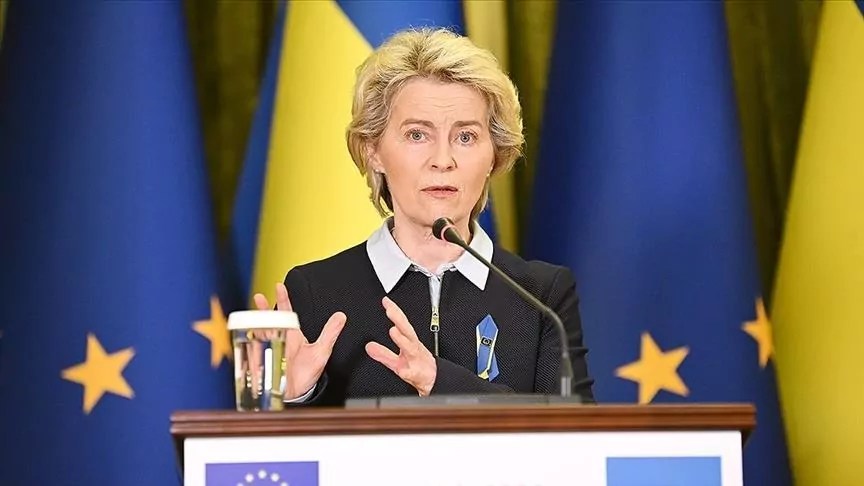
Recently, the head of the European Commission, Ursula von der Leyen, said that the European Union should double its assistance to Ukraine. She went on to say the EU should create a support fund of 50 billion euros by the end of the year and that everything should be done to ensure victory on the battlefield for the Ukrainians.

The European Union has created a “support package” for Ukraine for 2023 of up to €18 billion. This money, however, is not in the form of gifts, grants, or to create an emergency war chest. These billions are a loan under an EU macro-financial assistance program dubbed the MFA+ Instrument. In the fine print, EU member states are guaranteeing these loans as well as paying the interest for the Ukrainians. The move is extraordinary given that Ukraine is not an EU member and that, even before the current conflict, was one of the most corrupt governments on Earth. This begs the question, “Why?”

The EU is issuing special bonds to be sold to investors for this purpose at a time when many people in the European Union go without proper healthcare, services, and even employment. The European Union, EU Member States, and European financial institutions have already dispersed some €49 billion to President Zelensky’s regime. This figure, added to the $76.8 billion already funneled to Ukraine, dwarfs any assistance given to any other country in the world. This very conservative report from the Council of Foreign Relations shows the U.S. alone has shoveled more into Zelensky’s coffers than Afghanistan, Israel, Jordan, Ethiopia, and Iraq combined in 2020.

In all, some 47 countries have given money and arms to Ukraine. As of now, EU Institutions (?) handed Zelensky over €30 billion. The UK has forked over about €10 billion as their pensioners worry about what’s for dinner next. Germany has given somewhere around €8 billion, and Japan almost €7 billion. The Netherlands, Canada, and Poland have pitched in about €5 billion each, and the list of others about €14 billion. The numbers, as you would expect, do not all add up. A U.S. News & World Reports story from earlier this year claimed total aid to Zelensky’s country had exceeded €150 billion as of January of this year. Again, why?

The answer, this time, is really simple. BlackRock, and the new investment initiative to rebuild Ukraine (whatever’s left of it). You already knew this, right? Zelensky and BlackRock’s BlackRock CEO Larry Fink met late last year, and in November, the Ukrainian Ministry of the Economy (MoE) and BlackRock Financial Markets Advisory (FMA) signed a memorandum to structure Ukraine’s reconstruction funds (PDF). Also, in on the moneymaking schemes in war-torn Ukraine are Nestlé, International Finance Corporation, the private investment arm of the World Bank, Australia’s Tattarang Group,

Zelensky has called the rebuilding of his country, once it’s been used up as a proxy NATO against Russia, “the greatest opportunity in Europe since World War Two.” Earlier this year, Fink told Barron’s and other financial magazines that Western investors will be “flooding” Ukraine post-war and the country could become “a beacon to the rest of the world of the power of capitalism”. Also, JPMorgan Chase is joining BlackRock to help Ukraine set up a reconstruction bank to steer public seed capital.

This American Conservative report says, “BlackRock Plots to Buy Ukraine,” in a recent editorial. Author Bradley Devlin outlines the Ukraine case, while also revealing how Fink and BlackRock are transforming America into a nation of renters by artificially elevating the prices of normal houses. If ever a man were appropriately named, Fink is that man.

“Why?” Is there any doubt about why some poor untrained bartender from Kyiv is in a foxhole being bombarded by Russian artillery? Doesn’t all the misleading media, inflated Ukraine military gains, and Joe Biden’s cock of the walk attitude toward a peace deal make more sense now? And Ursula, the lady I fondly refer to as Frau von der Clucky for her chicken-like pecking and strutting about while millions either die or are in harm’s way because of all the Western world barnyard antics right out of Orwell’s Animal Farm. While someone’s Dad takes a bullet or shrapnel in Donetsk, our leaders keep crowing, snorting, braying, and hog-wallering in their capitalistic farm dream.

Why? Greed, that’s why.

“Bidenomics” Is A Fraud Based On Deliberately Misrepresented Stats

By Brandon Smith

Source: Alt-Market.us

Economic issues are some of the most politically abused issues often because the data politicians exploit is easy to present out of context. The vast majority of the public doesn’t spend their time immersed in the intricacies of monetary policy, unemployment stats and the processes of inflation vs deflation. They hear a soundbite on the news or social media once in a while, assume it must be true and then go on with their day.

This is how economic crisis events always seem to take the population by surprise – The establishment tells people all is well and no one questions the narrative in the face of numerous warning signs. Sometimes, the populace continues to believe that everything is fine despite the financial framework burning down around them, all because the “experts” continue to convince them that recovery is “right around the corner.”

There are numerous incentives for government officials and mainstream economists to mislead the citizenry with tales of imminent prosperity in the midst of instability. Primarily, the goal is to keep the middle-class population as docile as possible so that they don’t revolt until it’s too late (the middle class being predominantly conservative, and the greatest threat to any corrupt regime). Understand that economics is the root of power, and economic perception is the key to influencing the masses.

Hidden Indicators And Rampant Money Printing

The reality is that the US was hurtling towards stagflationary disaster ever since the crash of 2008, when Barack Obama and Joe Biden (with the help of the Federal Reserve) oversaw the near doubling of the national debt from $10 trillion to almost $20 trillion – The most egregious abuse of monetary policy that the US had ever seen.

And, keep in mind this was only the officially reported cash. Because of pressure brought by people like Ron Paul in 2011, the government was forced to pursue a limited audit of the Federal Reserve bailouts at that time. This revealed at least $16 trillion created from nothing by the Fed to prop up the failing system.

In 2006, right before the derivatives collapse, the Federal Reserve conveniently and abruptly ended their M3 money supply report. They now only report the M2 money supply, which does not include the vast assets held in corporate coffers, large time deposits in banks, institutional money market funds, short-term repurchase agreements (repo), and larger liquid assets. It was as if they knew an inflationary event was about to take place and they needed to obscure the evidence.

In other words, in economics there is the “official government data” and then there is the REAL data, which is sometimes so hidden it is impossible to quantify.

Even if we only go by the M2 report, the money supply skyrocketed starting in 2020, and rose exponentially through 2021 and 2022 – It jumped by 40% in only two years. This is why the cost of most necessities has risen 25% or more.

I’m sure most readers have noticed that inflation is not going away despite Joe Biden’s claims that he has “cut inflation in half” under his “Bidenomics” plan. This is because inflation is cumulative. The CPI might fluctuate, but the effects of inflation remain as prices tend to increase and stay high perpetually.

There Is No Such Thing As “Bidenomics”

The supposed financial progress that Biden is trying to take credit for has nothing to do with Biden’s policies. Not a thing. Unless, of course, you count market manipulation as a positive.

For example, the reduction in CPI is directly related to the continuous interest rate hikes of the Federal Reserve, which Biden has zero control over. The Fed is autonomous and makes its decisions independent of the White House or government. This is a fact openly admitted by former chairman Alan Greenspan. When the fed raises rates, debt becomes more expensive, lending slows down and thus the economy slows down.

One of the only ways that Biden can influence CPI is through artificial deflation of energy prices. The Biden Administration has been dumping US strategic oil reserves on the market for the past year as a means to suppress oil prices, thereby directly and indirectly keeping the CPI numbers down. This is not progress, it’s economic fraud.

The misuse of stats extends to other sectors, such as Biden’s attempt to take credit for the recent reduction in the US deficit. Again, this has nothing to do with Biden; the Fed’s interest rate hikes make it more expensive for the government to take on debt, therefore, debt spending drops.

It’s also not a situation that signals a recovery in the economy – The Fed continues to hike rates supposedly to stall inflation, but higher rates in a debt heavy environment lead to inevitable deflationary upheaval. As I predicted a year ago, the Fed is continuing to increase interest rates until this happens.

Employment Miracle Or Employment Scam?

This issue has been brought up by many analysts but I’ll touch on it again here because Biden is relentless in his falsehoods when it comes to employment data. FACT: 72% of all “new jobs” Biden takes credit for were originally lost during the pandemic lockdowns. The very lockdowns which Democrats avidly enforced and tried to keep in place perpetually. You can’t take credit for “creating” jobs that you are responsible for destroying.

In terms of higher labor demand, the pressure is in low wage service sector jobs and these are the majority of jobs added since Biden took office. And, this rush into retail/service was purchased with $8 trillion+ in covid stimulus cash along with a moratorium on rent and student loan payments. That much extra money in circulation buys at least a few years of consumer spending, propping up jobs numbers.

Throughout history, such gains from inflationary actions and government interventions are always short term, and they always end with a dramatic plunge in employment once the effects subside.

Biden’s Fake Manufacturing Boom

Biden has recently touted a jump in US manufacturing as the latest achievement of Bidenomics, but like every other claim he makes, you have to look at the context. These are not free market manufacturing facilities built according to market demand. Rather, Biden is pumping billions of taxpayer dollars into green tech, once again artificially engineering a “manufacturing boom” through government subsidies for products that have limited demand.

Biden wants to rig the demand, too, by enforcing climate laws which make gas, oil and coal sources too expensive and solar panels and wind turbines cheaper by comparison. For example, Biden is increasing costs for oil and gas exploration on federal lands, while greatly lowering the prices for building solar farms on federal lands. In other words, the government uses your money to create factories for green tech and then creates laws which force people to use that green tech.

In the meantime, Joe’s manufacturing “boom” paid for with tax dollars also comes at the cost of America’s oil, gas and coal industries, not to mention less energy freedom for the general public. It’s socialism, not a revolution in domestic manufacturing.

For Biden, The Key Is To Create As Many Government Cash Injections As Possible Until 2025

You want to know why Democrats are so angry that the Supreme Court blocked Biden’s plan to make taxpayers cover student loan debts? It’s not because they care about naive college kids who paid too much money for garbage degrees – It’s because student debt relief would immediately add trillions more in spending in the short term to the US economy.

An interesting side effect of the college loan moratorium is the surprising credit boost – As soon as college loan payments were put on hold, millions of former students had their credit ratings increase by default. Meaning, they could now hike their credit limits and spend MORE money they don’t have. It’s an incredibly sneaky way to artificially prop up the system WITHOUT using direct stimulus measures that rely on the central bank. This false boost will disappear by October of this year.

Biden’s constant attempts to introduce infrastructure programs are another way the government can create the illusion of recovery by using debt spending as a means to mitigate the signals of greater fiscal decline. Without Fed stimulus it’s the only option Biden has, and as rates rise it becomes costly.

The bottom line is this – The US economy is on a short timetable as long as the Fed continues to raise interest rates into weakness as a means to suppress inflation. As we witnessed in the spring, higher rates are already breaking the back of mid-tier banks across the western world and the Fed’s backstop funds are only enough to stall the debt crisis for a time. I continue to predict that once the Fed Funds Rate is raised to 6% or more, we will once again see a banking calamity similar to the 2008 crash, but this time if the Fed steps in with a bailout hyperinflation will be the immediate result.

Bidenomics is a sham in every respect. Anything that could be considered an economic improvement is due to the Federal Reserve playing the odds with interest rates. A massive 40% increase in the money supply sure helps in obscuring fiscal weakness as well. Luckily, nearly 60% of Americans in recent polls say they aren’t buying the Bidenomics fairytale – They see the dangers around them every day.

The covid event was a catalyst that revealed all the weaknesses of the US system that many of us in alternative economics have been warning about for years. And now it seems as if the establishment is trying to drag things along for just a little while longer. The reason why is up for speculation, but the fact remains that a broken structure cannot be propped up with stop gaps. I’m doubtful that Biden will be able to ride the wave created by covid stimulus until the end of 2024. Something has to give.

More Warmongers Elevated In The Biden Administration

By Caitlin Johnstone

Source: CaitlinJohnstone.com.au

The Biden administration looks set to become even more warlike than it already was if you can imagine, with virulent Russia hawk Victoria Nuland and virulent China hawk Charles Q Brown now being elevated to lofty positions by the White House.

Nuland, the wife of alpha neocon Robert Kagan, has been named acting deputy secretary of state by President Biden, at least until a new deputy secretary has been named. This places her at second in command within the State Department, second only to Tony Blinken.

In an article about Nuland’s unique role in souring relations between the US and Russia during her previous tenure in the State Department under Obama, Responsible Statecraft’s Connor Echols writes the following of the latest news:

Nuland’s appointment will be a boon for Russia hawks who want to turn up the heat on the Kremlin. But, for those who favor a negotiated end to the conflict in Ukraine, a promotion for the notoriously “undiplomatic diplomat” will be a bitter pill.

A few quick reminders are in order. When Nuland was serving in the Obama administration, she had a now-infamous leaked call with the U.S. ambassador to Ukraine. As the Maidan Uprising roiled the country, the pair of American diplomats discussed conversations with opposition leaders, and Nuland expressed support for putting Arseniy Yatseniuk into power. (Yatseniuk would become prime minister later that month, after Russia-friendly former President Viktor Yanukovych fled the country.) At one memorable point in the call, Nuland said “Fu–k the EU” in response to Europe’s softer stance on the protests.

The controversy surrounding the call — and larger implications of U.S. involvement in the ouster of Yanukovych — kicked up tensions with Russia and contributed to Russian President Vladimir Putin’s decision to seize Crimea and support an insurgency in eastern Ukraine. Her handing out  food to demonstrators on the ground in Kyiv probably didn’t help either. Nuland, along with State Department sanctions czar Daniel Fried, then led the effort to punish Putin through sanctions. Another official at State reportedly asked Fried if “the Russians realize that the two hardest-line people in the entire U.S. government are now in a position to go after them?”

In a 2015 Consortium News article titled “The Mess That Nuland Made,” the late Robert Parry singled out Nuland as the primary architect of the 2014 regime change operation in Ukraine, which, as Aaron Maté explained last year, paved the way to the war we’re seeing there today. Hopefully her position winds up being temporary.

In other news, the Senate Arms Services Committee has voted to confirm Biden’s selection of General Charles Q Brown Jr as the next chairman of the Joint Chiefs of Staff, replacing Mark Milley. A full senate vote will now take place on whether to confirm Brown — currently the Air Force Chief of Staff — for the nation’s highest military office.

Brown is unambiguous about his belief that the US must hasten to militarize against China in the so-called Indo-Pacific to prepare for confrontation between the two powers, calling for more US bases in the region and increased efforts to arm Taiwan during his hearing before the Senate Arms Services Committee earlier this month.

Back in May, Moon of Alabama flagged Brown’s nomination in an article which also noted that several advocates of military restraint had been resigning from their positions within the administration, including Wendy Sherman, the deputy secretary of state who Nuland has taken over for.

It’s too soon to draw any firm conclusions, but to see voices of restraint stepping down and proponents of escalation stepping up could be a bad portent of things to come.

The decline of America is becoming an accepted fact

By Veniamin Popov

Source: New Eastern Outlook

On July 5 of this year, the New York Times published an article titled “America Lives on Borrowed Money.”

It states that borrowing is expensive. A rising portion of federal earnings, money that could be utilized to help the American people, is returned to investors who buy government bonds in the form of interest payments. Instead of collecting taxes from the rich, the government pays the rich to borrow their money.

According to the Congressional Budget Office, the government will spend more on interest than on national defense by 2029, and interest payments will account for 3.6 percent of national GDP by 2033.

The authors of the article believe that the situation is becoming more and more alarming and painful, and therefore radical decisions should be made.

However, with the growing division of US political forces, these alternatives are no longer visible, especially since “Joe Biden’s global vision is too timid and pessimistic,” according to the British-based Economist.

The fact that President Biden has been indicted with impeachment by the Republican-led House of Representatives cannot be overlooked: On June 22, the House voted 219 to 208 to send two articles of impeachment to the Homeland Security and Judiciary committees, one for abuse of power and the other for dereliction of duty.

What is interesting is the evaluation of the current scenario made not only by Americans but also by political analysts from emerging countries. For example, the Saudi-based Arab News reported on June 25 this year that the United States’ political system is in disarray and the country is extremely fragmented.

The author puts the current problem in the United States on a par with the fall of the Roman Empire: “You cannot be a world leader if your society is crumbling and your leadership is divided, indecisive, and weak.” Especially when the media, once lauded as a strong weapon of truth, has devolved into a tool of political bias motivated by profit rather than principle, and free speech is dead in America.

According to the author, American influence in South America and Africa is likewise dwindling: America has never been weaker than it is today in its relatively short history.

On June 19, this year, Marwan Bishara, a senior political analyst for Al Jazeera TV, noted that signs that the American-dominated world order was crumbling had become increasingly visible over the previous decade and that America’s political and economic decline had affected its global influence and credibility.

Attempts to resurrect US leadership through the so-called “rules-based international system,” according to the author, have failed. This system was perceived as a rigged arrangement that benefited the West over the rest of the world and violated international law.

Back in the spring, well-known American journalist Ross Douthat determined that the elites of the Middle East, Africa, and Central Asia favor Russia and China, and that public opinion in emerging countries is more sympathetic to Russia and China than to America.

Richard Haas, a respected American political analyst who led a prominent think tank, the Council on Foreign Relations, for more than 20 years, went even further in his analysis: “The collapse of the American political system means that for the first time, the internal threat has surpassed the external threat. Instead of being a reliable anchor in an unstable world, the United States has become the deepest source of instability and an unreliable model of democracy.”

In September 2022, current US President Joe Biden spoke of American democracy being on the verge of collapse, clinging by a thread.

In response to this, Gulf News, one of the UAE’s leading publications, said that America today is a house divided. More and more Americans acknowledge that the country’s current status is abnormal.

The summer of 2020’s street violence and instability revealed the actual mental state of the world’s most powerful nation. The United States has long had one of the highest rates of violent crime in the world, and deteriorating public order has expedited the spread of firearms. The United States ranks first in the number of privately owned guns. Researchers at the Small Arms Survey estimated that Americans own 393 million of the 857 million available civilian guns, about 46% of the world’s civilian gun stockpile. According to the same publication, there are 120 guns per 100 Americans. According to the Pew Research Center, 48% of Americans believe that gun violence is a major issue in the country.

According to polls, only 17% of Americans believe the US criminal justice system treats everyone fairly, according to the USA Today website.

Currently, the issue of migration in America has seriously escalated.

Of course, there will be ups and downs in American domestic politics, but one of the most notable trends in recent years has been the growing polarization of the elite, which could lead to a major split of the country.

A new presidential election will be held in 2024, and many objective observers believe that both parties, Republicans and Democrats, will protest the results. Since 2000, contesting presidential elections has been a tradition.

When Hillary Clinton lost to Trump in 2016, the Democratic Party functionaries became full-time election deniers, emphasizing that the Democratic Party leadership and journalists, its supporters, had done nothing wrong: Vladimir Putin and the Russians were to blame, having hacked the election.

In 2020, Trump claimed that his loss to Biden had been the result of election fraud: the election had been stolen. Within weeks, the Republican Party’s mantra became “stop the stealing.”

A recent study found that more than half of Americans now expect another civil war “within the next couple of years,” with numerous forecasts for the end of America.

One of them says that if Trump, or any other Republican, occupies the White House, Californians are taking serious steps toward withdrawing from the United States.

Another scenario that is being seriously studied assumes that red, or Republican states will launch an independence movement if the Democratic Party wins, including Biden’s second term.

Many analysts are debating the prospect of a significant civil conflict in the United States. Meanwhile, some political analysts have noticed a discernible strengthening of the so-called neoconservative positions among the American ruling elite, who are adamant that Washington should be in charge of the entire world and harshly punish those who disagree with them. Their stance on the Ukraine issue has the potential to push the world to the verge of a nuclear war. This group’s careless acts have already generated a sizable number of issues and fresh crises.

In order to find a way out of the current impasse in international affairs, more and more developing countries are turning to Russia and China. They place their expectations in this respect, above all, on the approaching BRICS conference, where the enlargement of this association may be announced.

Ukraine and the great revival of American empire

By Andrew J. Bacevich

Source: Information Clearing House

Amidst the dross that clutters the New York Times op-ed page on most days, glimmers of enlightenment occasionally appear. A recent guest column by Grey Anderson and Thomas Meaney offers a case in point.

“NATO Isn’t What It Says It Is,” declares the headline. Contrary to the claims of its architects and defenders, Anderson and Meaney argue persuasively that the central purpose of the alliance from its founding was not to deter aggression from the East and certainly not to promote democracy, but to “bind Western Europe to a far vaster project of a U.S.-led world order.” In return for Cold War-era security guarantees, America’s European allies offered deference and concessions on issues like trade and monetary policy. “In that mission,” they write, NATO “has proved remarkably successful.” A plot of real estate especially valued by members of the American elite, Europe thereby became the centerpiece of the postwar American imperium.

The end of the Cold War called these arrangements into question. Desperate to preserve NATO’s viability, proponents claimed that the alliance needed to go “out of area or out of business.” NATO embraced an activist posture, leading to reckless state building interventions in Libya and Afghanistan. The results were not favorable. Acceding to U.S. pressure to venture out of area proved to be costly and served chiefly to undermine NATO’s credibility as a militarily capable enterprise.

Enter Vladimir Putin to save the day. Just as Russia’s invasion of Ukraine provided the U.S. with an excuse to forget its own post-9/11 military failures, so too it has enabled NATO to once more constitute itself as the chief instrument for defending the West—and, crucially, to do so without actually exacting a blood sacrifice from either Americans or Europeans.

In this context, the actual fate of Ukraine itself figures as something of an afterthought. The real issue centers on reviving damaged aspirations of American global primacy. With something like unanimity, the U.S. national security establishment is devoted to the proposition that the United States must remain the world’s sole superpower, even if this requires ignoring a vast accumulation of contrary evidence suggesting the emergence of a multipolar order. On that score, Putin’s recklessness came as an impeccably timed gift.

There is an element of genius at work here. Defeating Russia without having to do any actual fighting becomes the means to restore the image of American indispensability squandered during the decades that followed the fall of the Berlin Wall. For Washington, as Anderson and Meaney appreciate, the true stakes in Ukraine go far beyond the question of whose flag flies over Crimea. If Ukraine “wins” its war with Russia—however “winning” is defined and however great the price Ukrainians must pay—NATO itself (and the NATO lobby in Washington) will claim vindication.

Rest assured that major European nations will then quietly renege on promises to boost their military spending, with actual responsibility for European security once more falling to the United States. With the centennial of World War II now within hailing distance, U.S. troops will remain permanently garrisoned in Europe. This will serve as cause for celebration throughout the U.S. military industrial complex, which will prosper.

Flexing its muscles, the United States will inevitably prod a greatly expanded NATO into turning its attention to enforcing the “rules-based international order” in the Asia-Pacific, with China as the chosen adversary. Ukraine will thereby serve as a template of sorts as the U.S. and its allies throw their weight around many thousands of miles from Europe proper.

The U.S. global military footprint will expand. U.S. efforts to put its house in order domestically will founder. Pressing global problems like the climate crisis will be treated as afterthoughts. But the empire that has no name will persist, which ultimately is the purpose of the game.

President Biden is fond of saying that the world has arrived at an “inflection point,” implying the need to change directions. Yet the overarching theme of his approach to foreign policy is stasis. He clings to the geopolitical logic that prompted NATO’s founding in 1949.

Back then, when Europe was weak and Stalin ruled the Soviet Union, that logic may have possessed some merit. But today the importance attributed to NATO testifies chiefly to the bankruptcy of American strategic thought and an inability to prioritize actually existing U.S. national interests, both foreign and domestic.

A sound revision of U.S. national security strategy would begin with announcing a timeline for withdrawing from NATO, converting it into an arrangement wholly owned and operated by Europe. The near impossibility of even imagining such an action by the United States testifies to the dearth of imagination that prevails in Washington.

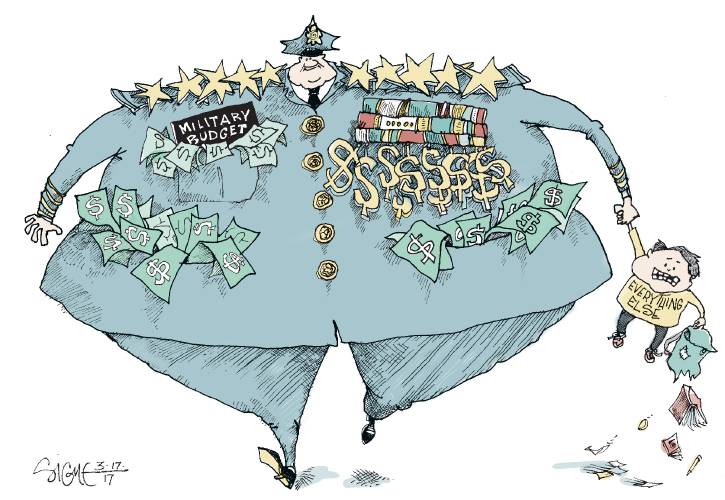
$850 Billion Chicken Comes Home to Roost.

War Reveals U.S. Military’s Longtime Disinterest in War.

Signe’s second toon du jour SIGN17e Military

By Andrew Cockburn

Source: Spoils of War

Watching a recent video of Ukrainian troops scrambling out of a U.S.-supplied Bradley armored fighting vehicle just after it hit a mine, I remembered how hard the U.S. Army bureaucrats and contractors who developed the weapon had fought to keep this vehicle a death trap for anyone riding inside. As originally designed, Bradleys promptly burst into flame when hit with anything much more powerful than a BB pellet, incinerating anyone riding inside. The armor bureaucrats were well aware of this defect, but pausing development for a redesign might have hurt their budget, so they delayed and cheated on tests to keep the program on track. Prior to one test, they covertly substituted water-tanks for the ammunition that would otherwise explode. Only when Jim Burton, a courageous air force lieutenant colonel from the Pentagon’s testing office, enlisted Congress to mandate a proper live fire test were the army’s malign subterfuges exposed and corrected. His principled stand cost him his career, but the Bradley was redesigned, rendering it less potentially lethal for passengers. Hence, forty years on, the survival of those lucky Ukrainians.

This largely forgotten episode serves as a vivid example of an essential truth about our military machine: it is not interested in war.

How else to understand the lack of concern for the lives of troops, or producing a functioning weapon system? As Burton observed in his instructive 1993 memoir Pentagon Wars, the U.S. defense system is “a corrupt business — ethically and morally corrupt from top to bottom.”

Nothing has happened in the intervening years to contradict this assessment, with potentially grim consequences for men and women on the front line. Today, for example, the U.S. Air Force is abandoning its traditional role of protecting and coordinating with troops on the ground, otherwise known as Close Air Support, or CAS. Given its time-honored record of bombing campaigns that had little or no effect on the course of wars, CAS has probably been the only useful function (grudgingly) performed by the service.

The Air Force has always resented the close support mission, accepting the role only because handing it to the Army would entail losing budget share. Thus the A-10 “Warthog” aircraft, specifically dedicated to CAS, was developed by the air force only to ward off a threat from the Army to steal the mission with a new helicopter. As it turned out, the A-10, thanks to the dedicated genius of its creators, notably the late Pierre Sprey, was supremely suited to the mission. But its successful record cuts no ice with the air force, which has worked with might and main to get rid of the A-10 ever since the threat of an army competitor in the eternal battle for budget share had been eliminated.

That campaign is now entering its final stages. The air force is not only getting rid of its remaining fleet of A-10s, it is also eliminating the capability to perform the close air support mission by phasing out the training for pilots and ground controllers essential for this highly specialized task. True, the service claims that the infamously deficient F-35 “fighter” can and will undertake the mission, but that is a laughable notion for many reasons, including the fact that the plane’s 25 mm cannon cannot shoot straight. The consequences for American troops on the ground in future wars will be dire, but their fate apparently carries little weight when set against the unquenchable urge of the air force to assert its independence from the messy realities of ground combat, where wars are won or lost. Thus its hopes and budget plans are focussed on costly systems of dubious relevance to warfare such as the new B-21 bomber, the new Sentinel ICBM, and the Next Generation Air Dominance fighter, none of which will fly for years to come, except in the form of cash out of our pockets.

Pentagon spending this year is projected to nudge $850 billion. (The total national security bill is already way past a trillion, but that’s another story.) Yet, even when endowed with such a gigantic pile of cash, the system is apparently incapable of furnishing the wherewithal for even a limited war, such as the one currently underway in Ukraine. The conflict has been marked by successive announcements that progressively more potent weapon systems are being shipped to the Ukrainians -Javelins anti-tank missiles, 155 mm Howitzers, HIMARS precision long range missiles, Patriots air defense missiles, Abrams tanks, with F-16 fighters in the offing. A U.S. military intelligence officer pointed out to me recently the actual basis on which these systems are selected: “when we run out of the last system we were sending.”

Now Biden has generated global outrage by promising to send cluster bombs, known for their ability to kill and maim children fifty years after the relevant war has ended, as any Laotian farmer could tell you. The military rationale for their use is their supposed utility against “soft” targets such as dismounted infantry, radars, and wheeled vehicles. However, a former armor officer and veteran of the 1991 Gulf war recalled to me that “we disliked them intensely and pleaded with the artillery and Air Force not to employ them. They simply damaged support elements and wheels that followed us into action. After the war we treated numerous people wounded by them including our own soldiers, as well as civilians (children).”

Biden has admitted that these devices are being sent only because the U.S. is running out of the artillery ammunition that the Ukrainians actually require. “This is a war relating to munitions. And they’re running out of that ammunition, and we’re low on it,” he told a TV interviewer. So off go the cluster bombs, their passage lubricated by crocodile tears from administration officials: “I’m not going to stand up here and say it was easy…It’s a decision that required a real hard look at the potential harm to civilians” National Security Adviser Jake Sullivan told reporters. (Back when it was reported that the Russians were using cluster bombs in Ukraine, then-White House Press Secretary Jen Psaki denounced such action as “a war crime.”)

So, the richest war machine in history, having scraped its cupboard bare, is now reduced to fielding a device of dubious military utility deemed illegal by over a hundred countries. That’s what we get for our $850 billion.

A Bonfire of the Vanities

By Alastair Crooke

Source: Strategic Culture Foundation

Hubris consists in believing that a contrived narrative can, in and of itself, bring victory. It is a fantasy that has swept through the West – most emphatically since the 17th century. Recently, the Daily Telegraph published a ridiculous nine minute video purporting to show that ‘narratives win wars’, and that set-backs in the battlespace are incidentals: What matters is to have a thread of unitary narrative articulated, both vertically and horizontally, throughout the spectrum – from the special forces’ soldier in the field through to the pinnacle of the political apex.

The gist of it is that ‘we’ (the West) have compelling a narrative, whilst Russia’s is ‘clunky’ – ‘Us winning therefore, is inevitable’.

It is easy to scoff, but nonetheless we can recognise in it a certain substance (even if that substance is an invention). Narrative is now how western élites imagine the world. Whether it is the pandemic emergency, the climate or Ukraine ‘emergencies’ – all are re-defined as ‘wars’. All are ‘wars’ that are to be fought with a unitary imposed narrative of ‘winning’, against which all contrarian opinion is forbidden.

The obvious flaw to this hubris is that it requires you to be at war with reality. At first, the public are confused, but as the lies proliferate, and lie is layered upon lie, the narrative separates further and further from touched reality, even as mists of dishonesty continue to swathe themselves loosely around it. Public scepticism sets in. Narratives about the ‘why’ of inflation; whether the economy be healthy or not; or why we must go to war with Russia, begin to fray.

Western élites have ‘bet their shirts’ on maximum control of ‘media platforms’, absolute messaging conformity and ruthless repression of protest as their blueprint for a continued hold in power.

Yet, against the odds, the MSM is losing its hold over the U.S. audience. Polls show growing distrust of the U.S. MSM. When Tucker Carlson’s first ‘anti-message’ Twitter show appeared, the noise of tectonic plates grinding against each other was unmissable, as more than 100 million (one in three) Americans listened to iconoclasm.

The weakness to this new ‘liberal’ authoritarianism is that its key narrative myths can get busted. One just has; slowly, people begin to speak reality.

Ukraine: How do you win an unwinnable war? Well, the élite answer has been through narrative. By insisting against reality that Ukraine is winning, and Russia is ‘cracking’. But such hubris eventually is busted by facts on the ground. Even the western ruling classes can see their demand for a successful Ukrainian offensive has flopped. At the end, military facts are more powerful than political waffle: One side is destroyed, its many dead become the tragic ‘agency’ to upending dogma.

“We will be in a position to extend an invitation to Ukraine to join the Alliance when Allies agree and conditions are met … [however] unless Ukraine wins this war, there’s no membership issue to be discussed at all” – Jens Stoltenberg’s statement at Vilnius. Thus, after urging Kiev to throw more (hundreds of thousands) of its men into the jaws of death to justify NATO membership, the latter turns its back on its protégé. It was, after all, an unwinnable war from the beginning.

The hubris, at one level, lay in NATO’s pitting of its alleged ‘superior’ military doctrine and weapons versus that of a deprecated, Soviet-style, hide-bound, Russian military rigidity – and ‘incompetence’.

But military facts on the ground have exposed the western doctrine as hubris – with Ukrainian forces decimated, and its NATO weaponry lying in smoking ruins. It was NATO that insisted on re-enacting the Battle of 73 Easting (from the Iraqi desert, but now translated into Ukraine).

In Iraq, the ‘armoured fist’ punched easily into Iraqi tank formations: It was indeed a thrusting ‘fist’ that knocked the Iraqi opposition ‘for six’. But, as the U.S. commander at that tank battle (Colonel Macgregor), frankly admits, its outcome against a de-motivated opposition largely was fortuitous.

Nonetheless ‘73 Easting’ is a NATO myth, turned into the general doctrine for the Ukrainian forces – a doctrine structured around Iraq’s unique circumstance.

The hubris – in line with the Daily Telegraph video – however, ascends vertically to impose the unitary narrative of a coming western ‘win’ onto the Russian political sphere too. It is an old, old story that Russia is military weak, politically fragile, and prone to fissure. Conor Gallagher has shown with ample quotes that it was exactly the same story in World War 2, reflecting a similar western underestimation of Russia – combined with a gross overestimation of their own capabilities.

The fundamental problem with ‘delusion’ is that the exit from it (if it occurs at all) moves at a much slower pace than events. The mismatch can define future outcomes.

It may be in the Team Biden interest now to oversee an orderly NATO withdrawal from Ukraine – such that it avoids becoming another Kabul debacle.

For that to happen, Team Biden needs Russia to accept a ceasefire. And here lies the (the largely overlooked) flaw to that strategy: It simply is not in the Russian interest to ‘freeze’ the situation. Again, the assumption that Putin would ‘jump’ at the western offer of a ceasefire is hubristic thinking: The two adversaries are not frozen in the basic meaning of the term – as in a conflict in which neither side has been able to prevail over the other, and are stuck.

Put simply, whereas Ukraine structurally hovers at the brink of implosion, Russia, by contrast, is fully plenipotent: It has large, fresh forces; it dominates the airspace; and has near domination of the electromagnetic airspace. But the more fundamental objection to a ceasefire is that Moscow wants the present Kiev collective gone, and NATO’s weapons off the battle field.

So, here is the rub: Biden has an election, and so it would suit the Democratic campaign needs to have an ‘orderly wind-down’. The Ukraine war has exposed too many wider American logistic deficiencies. But Russia has its’ interests, too.

Europe is the party most trapped by ‘delusion’ – starting from the point at which they threw themselves unreservedly into the Biden ‘camp’. The Ukraine narrative broke at Vilnius. But the amour propre of certain EU leaders puts them at war with reality. They want to continue to feed Ukraine into the grinder – to persist in the fantasy of ‘total win’: “There is no other way than a total win – and to get rid of Putin … We have to take all risks for that. No compromise is possible, no compromise”.

The EU Political Class have made so many disastrous decisions in deference to U.S. strategy – decisions that go directly against Europeans’ own economic and security interests – that they are very afraid.

If the reaction of some of these leaders seems disproportionate and unrealistic (“There is no other way than a total win – and to get rid of Putin”) – it is because this ‘war’ touches on a deeper motivations. It reflects existential fears of an unravelling of the western meta-narrative that will take down both its hegemony, and the western financial structure with it.

The western meta-narrative “from Plato to NATO, is one of superior ideas and practices whose origins lie in ancient Greece, and have since been refined, extended, and transmitted down the ages (through the Renaissance, the scientific revolution and other supposedly uniquely western developments), so that we in the west today are the lucky inheritors of a superior cultural DNA”.

This is what the narrators of the Daily Telegraph video probably had at the back of their minds when they insist that ‘Our narrative wins wars’. Their hubris resides in the implicit presumption: that the West somehow always wins – is destined to prevail – because it is the recipient of this privileged genealogy.

Of course, outside of general understanding, it is accepted that notions of ‘a coherent West’ has been invented, repurposed and put to use in different times and places. In her new book, The West, classical archaeologist Naoíse Mac Sweeney takes issue with the ‘master myth’ by pointing out that it was only “with the expansion of European overseas imperialism over the seventeenth century, that a more coherent idea of the West began to emerge – one being deployed as a conceptual tool to draw the distinction between the type of people who could legitimately be colonised, and those who could legitimately be colonizers”.

With the invention of the West came the invention of Western history – an elevated and exclusive lineage that provided an historical justification for the Western domination. According to the English jurist and philosopher Francis Bacon, there were only three periods of learning and civilization in human history: “one among the Greeks, the second among the Romans, and the last among us, that is to say, the nations of Western Europe”.

The deeper fear of western political leaders therefore – complicit in the knowledge that the ‘Narrative’ is a fiction that we tell ourselves, despite knowing that it is factually false – is that our era has been made increasingly and dangerously contingent on this meta-myth.

They quake, not just at a ‘Russia empowered’, but rather at the prospect the new multi-polar order led by Putin and Xi that is sweeping the globe will tear down the myth of Western Civilisation.