After the Crash

Dispatches From a Long Recovery (Est. 10/2024)

After the Crash

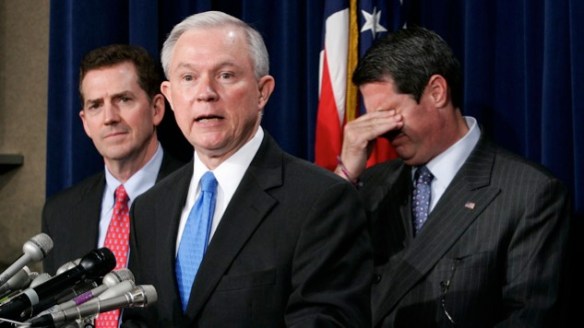
Jeff Sessions Reminds Everyone Why He’s the Worst Attorney General in Modern History

“He was a racist when appointed, a racist while serving, and a racist to the very end.”

By Jessica Corbett

Source: CommonDreams

In his last “evil” act as head of the Justice Department under President Donald Trump, Jeff Sessions reminded “everyone yet again why he’s been the worst attorney general in modern history” and drastically limited the ability of federal officials to use court-enforced deals to require reforms at police departments that are found systematically violating people’s civil rights.

Shortly before Trump forced Sessions to resign on Wednesday—and appointed a temporary replacement who is hostile toward Special Counsel Robert Mueller’s investigation—Sessions signed a memorandum (pdf), as the New York Times reports, “sharply curtailing the use of so-called consent decrees, court-approved deals between the Justice Department and local governments that create a road map of changes for law enforcement and other institutions,” by imposing “three stringent requirements for the agreements.”

The decrees were, as the Times noted, “used aggressively by Obama-era Justice Department officials to fight police abuses,” but soon after Sessions took office, he had signaled he would scale back their use and “ordered a review of the existing agreements, including with police departments in Baltimore, Chicago, and Ferguson, Mo., enacted amid a national outcry over the deaths of black men at the hands of officers.”

Sessions’ last-minute final act was met with widespread outrage, but not surprise—rather, as many critics quickly pointed out, it fit with the patterns of Sessions’ moves throughout his tenure as attorney general.

“From day one, former Attorney General Jeff Sessions expressed open and naked hostility to the use of consent decrees, especially in the civil rights context,” said Kristen Clarke of the Lawyers’ Committee for Civil Rights Under Law. “This action by Sessions, on his way out the door, seals his legacy as an obstructionist when it comes to advancing justice and protecting rights in our country.”

I would never expect Sessions to be anything other than an unrepentant civil rights foe until the very last minute,” tweeted Sherrilyn Ifill, president and director-counsel of the NAACP Legal Defense Fund.

“He was a racist when appointed, a racist while serving, and a racist to the very end,” Josh Moon of the Alabama Reporter said of his state’s former senator. “There is no redeeming quality to Jeff Sessions. He’s a horrible racist at his core.”

The New Republic‘s Matt Ford concluded simply, “He is who we thought he was.”

Although Sessions, much to Trump’s frustration, recused himself from the Mueller probe, while serving as attorney general, he made several moves—including canceling Deferred Action for Childhood Arrivals (DACA) and implementing the “zero-tolerance” policy that tore migrant children away from their parents—that had civil and human rights advocates constantly raising alarm about “the Trump/Sessions white supremacist agenda.”

Even before news broke about his memo to curb the use of consent decrees, social justice advocates began to document Sessions’ record as he departed.

“Jeff Sessions was the worst attorney general in modern American history. Period,” the ACLU charged in a series of tweets on Wednesday that, among other things, noted his discrimination against trans people, enthusiastic enforcement of racist drug laws, and use of religion to attack women’s reproductive rights.

One of the most prominent parts of Sessions’ legacy is the immigration crisis he leaves behind, as Julia Preston outlined for The Marshall Project on Wednesday. Acknowledging Preston’s report, the Lawyers’ Committee for Civil Rights Under Law summarized on Twitter, “On President Trump’s favorite issue, the departing attorney general leaves behind record-breaking backlogs of cases, onerous constraints on judges, and a bulwark of punitive attitudes toward families seeking asylum.”


Democrats rally to defend fired Attorney General Sessions, Special Counsel Mueller

By Tom Eley

Source: WSWS.org

The Democrats and their fake “left” allies held war-mongering demonstrations in a number of cities on Thursday in defense of the fired far-right attorney general, Jeff Sessions, and the anti-Russia investigation being conducted by Special Counsel Robert Mueller.

Wednesday’s ouster of Sessions and his replacement by Trump ally Matthew G. Whitaker has brought forth a wave of condemnation from Democratic Party figures and their media allies, including the New York Times and Washington Post, asserting that the move is the prelude to Trump’s closing down of the Justice Department probe into allegations of Russian “meddling” in the 2016 elections and possible collusion by the Trump campaign.

Trump had repeatedly denounced Sessions for having recused himself from the Russia investigation in March of 2017, leaving Deputy Attorney General Rod Rosenstein, a defender of the investigation, in overall charge of its conduct. Whitaker, a former US attorney and now acting attorney general and therefore responsible for overseeing the Mueller probe, is on record criticizing Mueller and suggesting that the Justice Department could cut off funding for his office.

Mueller’s investigation has been at the center of a McCarthyite-style campaign against Russia spearheaded by the intelligence agencies and the Democratic Party, based on fabricated claims that Russian President Vladimir Putin interfered in the presidential election to undermine the candidacy of Democrat Hillary Clinton and boost Trump. It has been used as a weapon in the drive by the Democrats and sections of the military/intelligence establishment to force Trump to adopt a more aggressive posture against Moscow and in the war for regime-change in Syria.

To the extent that the Democrats oppose the right-wing Trump administration, it is on this entirely reactionary basis. In the lead-up to Tuesday’s midterm elections, they not only called no demonstrations, they were entirely silent on Trump’s fascistic attacks on immigrants, his deployment of troops to the border against the caravan of Central American asylum seekers, and his pledge to overturn the 14th Amendment guarantee of birthright citizenship—a cornerstone of the Bill of Rights.

Following the election, in which the Democrats won control of the House of Representatives, the party leadership called repeatedly for bipartisan unity and collaboration with Trump, underscoring their essential agreement with his policies of war, austerity and repression. It was only when Trump fired Sessions, a right-wing anti-immigrant zealot, that they swung into action, reviving their denunciations of Trump as a stooge of Putin.

The aim of shifting the Trump administration to a war footing against Russia has been achieved to the extent that there is now a substantial risk of nuclear conflict between the US and the second-leading nuclear power. War could quickly erupt in a number of flash points, especially Syria, where Russian soldiers, sailors and airmen carry out combat operations within miles of their American counterparts, as well as US-allied Islamist proxies armed by Saudi Arabia.

Though promoted in the media and sponsored by over 50 Democratic Party-linked organizations, including MoveOn.org, the rallies on Tuesday were small, reflecting the lack of support in the general population for the anti-Russia crusade. The protests were notable primarily for their unvarnished right-wing and neo-McCarthyite character.

Two of the largest were in Washington DC and New York City, which each drew roughly 1,000 demonstrators, many of whom held hammer and cycle posters with Putin’s image. Sessions began his career as a segregationist in Jim Crow Alabama and went on to become a right-wing Republican senator from the state. Mueller, for his part, was director of the FBI from 2001 to 2013, during which time he helped institute mass domestic surveillance and other sweeping attacks on democratic rights linked to the so-called “war on terror.”

At the Washington demonstration, Democratic Congressman Jamie Raskin led those in attendance in a round of applause for Sessions. Randi Weingarten, president of the American Federation of Teachers, appealed to the military against Trump, declaring, “You are the defenders of our democracy,” and led a chant of “protect Mueller.”

In defending Sessions, the Democrats and their allies are rallying around the most rightwing attorney general in American history, who, prior to joining the Trump cabinet, had won a well-earned reputation as a bitter opponent of civil rights. As attorney general, Sessions will primarily be remembered for the persecution of immigrants, most notably the separation of immigrant children from their parents and their imprisonment in detention camps built in the desert.

The task of spearheading the attack on immigrants and democratic rights will now fall, pending the installation of a permanent attorney general, to Whitaker, who has boasted that he interprets the Constitution from a biblical standpoint. His very first act as head of the Department of Justice was to issue, in conjunction with the Department of Homeland Security, a directive stripping the right to asylum from anyone who enters the US over the Mexican border and has not first gained legal status—a move that is tantamount to abolishing the right to asylum, which is guaranteed under international and US law.

This move, a new landmark in the attack on immigrants, due process and basic democratic rights, has been virtually ignored by the media and the Democratic Party. It was not mentioned in the press release calling Thursday’s demonstration, nor by speakers at the demonstrations in Washington and New York.

Moon-Strzok No More, Lisa Page Spills the Beans

The meaning of a crucial text message between two FBI officials appears to have been finally explained, and it’s not good news for the Russia-gate faithful, as Ray McGovern explains.

By Ray McGovern

Source: Consortium News

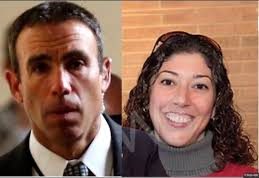
Former FBI attorney Lisa Page has reportedly told a joint committee of the House of Representatives that when FBI counterintelligence official Peter Strzok texted her on May 19, 2017 saying there was “no big there there,” he meant there was no evidence of collusion between the Trump campaign and Russia.

It was clearly a bad-luck day for Strzok, when on Friday the 13th this month Page gave her explanation of the text to the House Judiciary and Oversight/Government Reform Committees and in effect threw her lover, Strzok, under the bus.

Strzok’s apparent admission to Page about there being “no big there there” was reported on Friday by John Solomon in the Opinion section of The Hill based on multiple sources who he said were present during Page’s closed door interview.

Strzok’s text did not come out of the blue. For the previous ten months he and his FBI subordinates had been trying every-which-way to ferret out some “there” — preferably a big “there” — but had failed miserably. If Solomon’s sources are accurate, it is appearing more and more likely that there was nothing left for them to do but to make it up out of whole cloth, with the baton then passed to special counsel Robert Mueller.

The “no there there” text came just two days after former FBI Director James Comey succeeded in getting his friend Mueller appointed to investigate the alleged collusion that Strzok was all but certain wasn’t there.

Robert Parry, the late founder and editor of Consortium News whom Solomon described to me last year as his model for journalistic courage and professionalism, was already able to discern as early as March 2017 the outlines of what is now Deep State-gate, and, typically, was the first to dare report on its implications.

Parry’s article, written two and a half months before Strzok texted the self-incriminating comment to Page on there being “no big there there,” is a case study in professional journalism. His very first sentence entirely anticipated Strzok’s text: “The hysteria over ‘Russia-gate’ continues to grow … but at its core there may be no there there.”(Emphasis added.)

As for “witch-hunts,” Bob and others at Consortiumnews.com, who didn’t succumb to the virulent HWHW (Hillary Would Have Won) virus, and refused to slurp the Kool-Aid offered at the deep Deep State trough, have come close to being burned at the stake — virtually. Typically, Bob stuck to his guns: he ran an organ (now vestigial in most Establishment publications) that sifted through and digested actual evidence and expelled drivel out the other end.

Those of us following the example set by Bob Parry are still taking a lot of incoming fire — including from folks on formerly serious — even progressive — websites. Nor do we expect a cease-fire now, even with Page’s statement (about which, ten days after her interview, the Establishment media keep a timorous silence). Far too much is at stake.

As Mark Twain put it, “It is easier to fool people than to convince them that they have been fooled.” And, as we have seen over the past couple of years, that goes in spades for “Russia-gate.” For many of us who have looked into it objectively and written about it dispassionately, we are aware, that on this issue, we are looked upon as being in sync with President Donald Trump.

Blind hatred for the man seems to thwart any acknowledgment that he could ever be right about something—anything. This brings considerable awkwardness. Chalk it up to the price of pursuing the truth, no matter what bedfellows you end up with.

Courage at The Hill 

Solomon’s article merits a careful read, in toto. Here are the most germane paragraphs:

“It turns out that what Strzok and Lisa Page were really doing that day [May 19, 2017] was debating whether they should stay with the FBI and try to rise through the ranks to the level of an assistant director (AD) or join Mueller’s special counsel team. [Page has since left the FBI.]

“‘Who gives a f*ck, one more AD [Assistant Director] like [redacted] or whoever?’” Strzok wrote, weighing the merits of promotion, before apparently suggesting what would be a more attractive role: ‘An investigation leading to impeachment?’ …

“A few minutes later Strzok texted his own handicap of the Russia evidence: ‘You and I both know the odds are nothing. If I thought it was likely, I’d be there no question. I hesitate in part because of my gut sense and concern there’s no big there there.’

“So the FBI agents who helped drive the Russia collusion narrative — as well as Rosenstein’s decision to appoint Mueller — apparently knew all along that the evidence was going to lead to ‘nothing’ and, yet, they proceeded because they thought there was still a possibility of impeachment.”

Solomon adds: “How concerned you are by this conduct is almost certainly affected by your love or hatred for Trump. But put yourself for a second in the hot seat of an investigation by the same FBI cast of characters: You are under investigation for a crime the agents don’t think occurred, but the investigation still advances because the desired outcome is to get you fired from your job. Is that an FBI you can live with?”

The Timing

As noted, Strzok’s text was written two days after Mueller was appointed on May 17, 2017. The day before, on May 16,The New York Times published a story that Comey leaked to it through an intermediary that was expressly designed (as Comey admitted in Congressional testimony three weeks later) to lead to the appointment of a special prosecutor to investigate collusion between the Trump campaign and Russia. Hmmmmm.

Had Strzok forgotten to tell his boss that after ten months of his best investigative efforts — legal and other—he could find no “there there”?

Comey’s leak, by the way, was about alleged pressure from Trump on Comey to go easy on Gen. Michael Flynn for lying at an impromptu interrogation led by — you guessed it — the ubiquitous, indispensable Peter Strzok.

In any event, the operation worked like a charm — at least at first. And — absent revelation of the Strzok-Page texts — it might well have continued to succeed. After Deputy Attorney General Rod Rosenstein named Mueller, one of Comey’s best buddies, to be special counsel, Mueller, in turn, picked Strzok to lead the Russia-gate team, until the summer, when the Department of Justice Inspector General was given the Strzok-Page texts and refused to sit on them.

A Timeline

Here’s a timeline, which might be helpful:

2017

May 16: Comey leak to NY Times to get a special counsel appointed

May 17: Special counsel appointed — namely, Robert Mueller.

May 19: Strzok confides to girlfriend Page, “No big there there.”

July: Mueller appoints Strzok lead FBI Agent on collusion investigation.

August: Mueller removes Strzok after learning of his anti-Trump texts to Page.

Dec. 12: DOJ IG releases some, but by no means all, relevant Strzok-Page texts to Congress and the media, which firstreports on Strzok’s removal in August.

2018

June 14: DOJ IG Report Published.

June 15; Strzok escorted out of FBI Headquarters.

June 21: Attorney General Jeff Sessions announces Strzok has lost his security clearances.

July 12: Strzok testifies to House committees. Solomon reports he refused to answer question about the “there there” text.

July 13: Lisa Page interviewed by same committees. Answers the question.

Earlier: Bob Parry in Action

On December 12, 2017, as soon as first news broke of the Strzok-Page texts, Bob Parry and I compared notes by phone. We agreed that this was quite big and that, clearly, Russia-gate had begun to morph into something like FBI-gate. It was rare for Bob to call me before he wrote; in retrospect, it seemed to have been merely a sanity check.

The piece Bob posted early the following morning was typical Bob. Many of those who click on the link will be surprised that, last December, he already had pieced together most of the story. Sadly, it turned out to be Bob’s last substantive piece before he fell seriously ill. Earlier last year he had successfully shot downother Russia-gate-related canards on which he found Establishment media sorely lacking — “Facebook-gate,” for example.

Remarkably, it has taken another half-year for Congress and the media to address — haltingly — the significance of Deep State-gate — however easy it has become to dissect the plot, and identify the main plotters. With Bob having prepared the way with his Dec.13 article, I followed up a few weeks later with “The FBI Hand Behind Russia-gate,” in the process winning no friends among those still suffering from the highly resistant HWHW virus.

VIPS

Parry also deserves credit for his recognition and appreciation of the unique expertise and analytical integrity among Veteran Intelligence Professionals for Sanity (VIPS) and giving us a secure, well respected home at Consortium News.

It is almost exactly a year since Bob took a whole lot of flak for publishing what quickly became VIPS’ most controversial, and at the same time perhaps most important, Memorandum For the President; namely, “Intelligence Veterans Challenge ‘Russia Hack’ Evidence.”

Critics have landed no serious blows on the key judgments of that Memorandum, which rely largely on the type of forensic evidence that Comey failed to ensure was done by his FBI because the Bureau never seized the DNC server. Still more forensic evidence has become available over recent months soon to be revealed on Consortium News, confirming our conclusions.

Freedom Is a Myth: We Are All Prisoners of the Police State’s Panopticon Village

“We’re run by the Pentagon, we’re run by Madison Avenue, we’re run by television, and as long as we accept those things and don’t revolt we’ll have to go along with the stream to the eventual avalanche…. As long as we go out and buy stuff, we’re at their mercy… We all live in a little Village. Your Village may be different from other people’s Villages, but we are all prisoners.”— Patrick McGoohan

By John W. Whitehead

Source: The Rutherford Institute

First broadcast in Great Britain 50 years ago, The Prisoner—a dystopian television series described as “James Bond meets George Orwell filtered through Franz Kafka”—confronted societal themes that are still relevant today: the rise of a police state, the freedom of the individual, round-the-clock surveillance, the corruption of government, totalitarianism, weaponization, group think, mass marketing, and the tendency of humankind to meekly accept their lot in life as a prisoner in a prison of their own making.

Perhaps the best visual debate ever on individuality and freedom, The Prisoner (17 episodes in all) centers around a British secret agent who abruptly resigns only to find himself imprisoned, monitored by militarized drones, and interrogated in a mysterious, self-contained, cosmopolitan, seemingly tranquil retirement community known only as the Village. The Village is an idyllic setting with parks and green fields, recreational activities and even a butler.

While luxurious and resort-like, the Village is a virtual prison disguised as a seaside paradise: its inhabitants have no true freedom, they cannot leave the Village, they are under constant surveillance, their movements are tracked by surveillance drones, and they are stripped of their individuality and identified only by numbers.

The series’ protagonist, played by Patrick McGoohan, is Number Six.

Number Two, the Village administrator, acts as an agent for the unseen and all-powerful Number One, whose identity is not revealed until the final episode.

“I am not a number. I am a free man,” was the mantra chanted on each episode of The Prisoner, which was largely written and directed by McGoohan.

In the opening episode (“The Arrival”), Number Six meets Number Two, who explains to him that he is in The Village because information stored “inside” his head has made him too valuable to be allowed to roam free “outside.”

Throughout the series, Number Six is subjected to interrogation tactics, torture, hallucinogenic drugs, identity theft, mind control, dream manipulation, and various forms of social indoctrination and physical coercion in order to “persuade” him to comply, give up, give in and subjugate himself to the will of the powers-that-be.

Number Six refuses to comply.

In every episode, Number Six resists the Village’s indoctrination methods, struggles to maintain his own identity, and attempts to escape his captors. “I will not make any deals with you,” he pointedly remarks to Number Two. “I’ve resigned. I will not be pushed, filed, stamped, indexed, debriefed or numbered. My life is my own.”

Yet no matter how far Number Six manages to get in his efforts to escape, it’s never far enough.

Watched by surveillance cameras and other devices, Number Six’s getaways are continuously thwarted by ominous white balloon-like spheres known as “rovers.” Still, he refuses to give up. “Unlike me,” he says to his fellow prisoners, “many of you have accepted the situation of your imprisonment, and will die here like rotten cabbages.”

Number Six’s escapes become a surreal exercise in futility, each episode an unfunny, unsettling Groundhog’s Day that builds to the same frustrating denouement: there is no escape.

As journalist Scott Thill concludes for Wired, “Rebellion always comes at a price. During the acclaimed run of The Prisoner, Number Six is tortured, battered and even body-snatched: In the episode ‘Do Not Forsake Me Oh My Darling,’ his mind is transplanted to another man’s body. Number Six repeatedly escapes The Village only to be returned to it in the end, trapped like an animal, overcome by a restless energy he cannot expend, and betrayed by nearly everyone around him.”

The series is a chilling lesson about how difficult it is to gain one’s freedom in a society in which prison walls are disguised within the trappings of technological and scientific progress, national security and so-called democracy.

As Thill noted when McGoohan died in 2009, “The Prisoner was an allegory of the individual, aiming to find peace and freedom in a dystopia masquerading as a utopia.”

The Prisoner’s Village is also an apt allegory for the American Police State: it gives the illusion of freedom while functioning all the while like a prison: controlled, watchful, inflexible, punitive, deadly and inescapable.

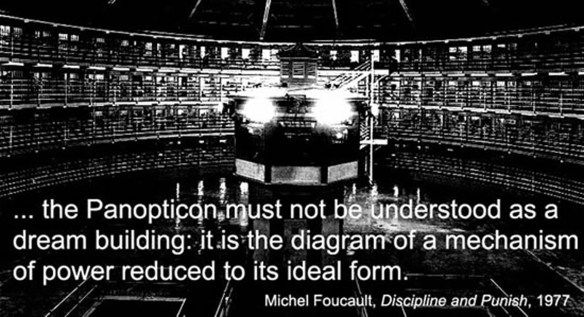
The American Police State, much like The Prisoner’s Village, is a metaphorical panopticon, a circular prison in which the inmates are monitored by a single watchman situated in a central tower. Because the inmates cannot see the watchman, they are unable to tell whether or not they are being watched at any given time and must proceed under the assumption that they are always being watched.

Eighteenth century social theorist Jeremy Bentham envisioned the panopticon prison to be a cheaper and more effective means of “obtaining power of mind over mind, in a quantity hitherto without example.”

Bentham’s panopticon, in which the prisoners are used as a source of cheap, menial labor, has become a model for the modern surveillance state in which the populace is constantly being watched, controlled and managed by the powers-that-be and funding its existence.

Nowhere to run and nowhere to hide: this is the new mantra of the architects of the police state and their corporate collaborators (Facebook, Amazon, Netflix, Google, Instagram, etc.).

Government eyes are watching you.

They see your every move: what you read, how much you spend, where you go, with whom you interact, when you wake up in the morning, what you’re watching on television and reading on the internet.

Every move you make is being monitored, mined for data, crunched, and tabulated in order to form a picture of who you are, what makes you tick, and how best to control you when and if it becomes necessary to bring you in line.

When the government sees all and knows all and has an abundance of laws to render even the most seemingly upstanding citizen a criminal and lawbreaker, then the old adage that you’ve got nothing to worry about if you’ve got nothing to hide no longer applies.

Apart from the obvious dangers posed by a government that feels justified and empowered to spy on its people and use its ever-expanding arsenal of weapons and technology to monitor and control them, we’re approaching a time in which we will be forced to choose between obeying the dictates of the government—i.e., the law, or whatever a government official deems the law to be—and maintaining our individuality, integrity and independence.

When people talk about privacy, they mistakenly assume it protects only that which is hidden behind a wall or under one’s clothing. The courts have fostered this misunderstanding with their constantly shifting delineation of what constitutes an “expectation of privacy.” And technology has furthered muddied the waters.

However, privacy is so much more than what you do or say behind locked doors. It is a way of living one’s life firm in the belief that you are the master of your life, and barring any immediate danger to another person (which is far different from the carefully crafted threats to national security the government uses to justify its actions), it’s no one’s business what you read, what you say, where you go, whom you spend your time with, and how you spend your money.

Unfortunately, George Orwell’s 1984—where “you had to live—did live, from habit that became instinct—in the assumption that every sound you made was overheard, and, except in darkness, every movement scrutinized”—has now become our reality.

We now find ourselves in the unenviable position of being monitored, managed and controlled by our technology, which answers not to us but to our government and corporate rulers.

Consider that on any given day, the average American going about his daily business will be monitored, surveilled, spied on and tracked in more than 20 different ways, by both government and corporate eyes and ears.

A byproduct of this new age in which we live, whether you’re walking through a store, driving your car, checking email, or talking to friends and family on the phone, you can be sure that some government agency, whether the NSA or some other entity, is listening in and tracking your behavior.

This doesn’t even begin to touch on the corporate trackers that monitor your purchases, web browsing, Facebook posts and other activities taking place in the cyber sphere.

Stingray devices mounted on police cars to warrantlessly track cell phones, Doppler radar devices that can detect human breathing and movement within in a home, license plate readers that can record up to 1800 license plates per minute, sidewalk and “public space” cameras coupled with facial recognition and behavior-sensing technology that lay the groundwork for police “pre-crime” programs, police body cameras that turn police officers into roving surveillance cameras, the internet of things: all of these technologies add up to a society in which there’s little room for indiscretions, imperfections, or acts of independence—especially not when the government can listen in on your phone calls, monitor your driving habits, track your movements, scrutinize your purchases and peer through the walls of your home.

As French philosopher Michel Foucault concluded in his 1975 book Discipline and Punish, “Visibility is a trap.”

This is the electronic concentration camp—the panopticon prison—the Village—in which we are now caged.

It is a prison from which there will be no escape if the government gets it way.

As Glenn Greenwald notes:

“The way things are supposed to work is that we’re supposed to know virtually everything about what [government officials] do: that’s why they’re called public servants. They’re supposed to know virtually nothing about what we do: that’s why we’re called private individuals. This dynamic – the hallmark of a healthy and free society – has been radically reversed. Now, they know everything about what we do, and are constantly building systems to know more. Meanwhile, we know less and less about what they do, as they build walls of secrecy behind which they function. That’s the imbalance that needs to come to an end. No democracy can be healthy and functional if the most consequential acts of those who wield political power are completely unknown to those to whom they are supposed to be accountable.”

Even now, the Trump Administration is working to make some of the National Security Agency’s vast spying powers permanent.

In fact, Attorney General Jeff Sessions is pushing for Congress to permanently renew Section 702 of the Foreign Intelligence Surveillance Act, which allows government snoops to warrantlessly comb through and harvest vast quantities of our communications.

And just like that, we’re back in the Village, our escape plans foiled, our future bleak.

Except this is no surprise ending: for those who haven’t been taking the escapist blue pill, who haven’t fallen for the Deep State’s phony rhetoric, who haven’t been lured in by the promise of a political savior, we never stopped being prisoners.

So how do we break out?

For starters, wake up. Resist the urge to comply.

The struggle to remain “oneself in a society increasingly obsessed with conformity to mass consumerism,” writes Steven Paul Davies, means that superficiality and image trump truth and the individual. The result is the group mind and the tyranny of mob-think.

Think for yourself. Be an individual. As McGoohan commented in 1968, “At this moment individuals are being drained of their personalities and being brainwashed into slaves… As long as people feel something, that’s the great thing. It’s when they are walking around not thinking and not feeling, that’s tough. When you get a mob like that, you can turn them into the sort of gang that Hitler had.”

In a media-dominated age in which the lines between entertainment, politics and news reporting are blurred, it is extremely difficult to distinguish fact from fiction. We are so bombarded with images, dictates, rules and punishments and stamped with numbers from the day we are born that it is a wonder we ever ponder a concept such as freedom. As McGoohan declared, “Freedom is a myth.”

In the end, as I make clear in my book Battlefield America: The War on the American People, we are all prisoners of our own mind.

In fact, it is in the mind that prisons are created for us. And in the lockdown of political correctness, it becomes extremely difficult to speak or act individually without being ostracized. Thus, so often we are forced to retreat inwardly into our minds, a prison without bars from which we cannot escape, and into the world of video games and television and the Internet.

We have come full circle from Bentham’s Panopticon to McGoohan’s Village to Huxley’s Brave New World.

As cultural theorist Neil Postman observed:

What Orwell feared were those who would ban books. What Huxley feared was that there would be no reason to ban a book, for there would be no one who wanted to read one. Orwell feared those who would deprive us of information. Huxley feared those who would give us so much that we would be reduced to passivity and egoism. Orwell feared we would become a captive audience. Huxley feared the truth would be drowned in a sea of irrelevance. Orwell feared that we would become a captive culture. Huxley feared we would become a trivial culture, preoccupied with some equivalent of the feelies, the orgy porgy, and the centrifugal bumblepuppy. As Huxley remarked in Brave New World Revisited, the civil libertarians and rationalists who are ever on the alert to oppose tyranny “failed to take into account man’s almost infinite appetite for distractions.” In Brave New World, they are controlled by inflicting pleasure. In short, Orwell feared that what we hate would ruin us. Huxley feared that what we love will ruin us.

You want to be free? Break out of the circle.

A Tale of Two Americas: Where the Rich Get Richer and the Poor Go to Jail

By John W. Whitehead

Source: The Rutherford Institute

“It is said that no one truly knows a nation until one has been inside its jails. A nation should not be judged by how it treats its highest citizens, but its lowest ones.” ― Nelson Mandela

This is the tale of two Americas, where the rich get richer and the poor go to jail.

Aided and abetted by the likes of Attorney General Jeff Sessions—a man who wouldn’t recognize the Constitution if it smacked him in the face—the American dream has become the American scheme: the rich are getting richer and more powerful, while anyone who doesn’t belong to the power elite gets poorer and more powerless to do anything about the nation’s steady slide towards fascism, authoritarianism and a profit-driven police state.

Not content to merely pander to law enforcement and add to its military largesse with weaponry and equipment designed for war, Sessions has made a concerted effort to expand the police state’s power to search, strip, seize, raid, steal from, arrest and jail Americans for any infraction, no matter how insignificant.

Now Sessions has given state courts the green light to resume their practice of jailing individuals who are unable to pay the hefty fines imposed by the American police state. In doing so, Sessions has once again shown himself to be not only a shill for the Deep State but an enemy of the people.

First, some background on debtors’ prisons, which jail people who cannot afford to pay the exorbitant fines imposed on them by courts and other government agencies.

Congress banned debtors’ prisons in 1833.

In 1983, the U.S. Supreme Court ruled the practice to be unconstitutional under the Fourteenth Amendment’s Equal Protection clause.

“Despite prior attempts on the federal level and across the country to prevent the profound injustice of locking people in cages because they are too poor to pay a debt,” concludes The Atlantic, “the practice persists every day.”

Where things began to change, according to The Marshall Project, was with the rise of “mass incarceration.” As attorney Alec Karakatsanis stated, “In the 1970s and 1980s, we started to imprison more people for lesser crimes. In the process, we were lowering our standards for what constituted an offense deserving of imprisonment, and, more broadly, we were losing our sense of how serious, how truly serious, it is to incarcerate. If we can imprison for possession of marijuana, why can’t we imprison for not paying back a loan?”

By the late 1980s and early 90s, “there was a dramatic increase in the number of statutes listing a prison term as a possible sentence for failure to repay criminal-justice debt.” During the 2000s, the courts started cashing in big-time “by using the threat of jail time – established in those statutes – to squeeze cash out of small-time debtors.”

Fast-forward to the present day which finds us saddled with not only profit-driven private prisons and a prison-industrial complex but also, as investigative reporter Eli Hager notes, “the birth of a new brand of ‘offender-funded’ justice [which] has created a market for private probation companies. Purporting to save taxpayer dollars, these outfits force the offenders themselves to foot the bill for parole, reentry, drug rehab, electronic monitoring, and other services (some of which are not even assigned by a judge). When the offenders can’t pay for all of this, they may be jailed – even if they have already served their time for the offense.”

Follow the money trail. It always points the way.

Whether you’re talking about the government’s war on terrorism, the war on drugs, or some other phantom danger dreamed up by enterprising bureaucrats, there is always a profit-incentive involved.

The same goes for the war on crime.

At one time, the American penal system operated under the idea that dangerous criminals needed to be put under lock and key in order to protect society. Today, the flawed yet retributive American “system of justice” is being replaced by an even more flawed and insidious form of mass punishment based upon profit and expediency.

Sessions’ latest gambit plays right into the hands of those who make a profit by jailing Americans.

Sharnalle Mitchell was one such victim of a system for whom the plight of the average American is measured in dollars and cents. As the Harvard Law Review recounts:

On January 26, 2014, Sharnalle Mitchell was with her children in Montgomery, Alabama when police showed up at her home to arrest her. Mitchell was not accused of a crime. Instead, the police came to her home because she had not fully paid a traffic ticket from 2010. The single mother was handcuffed in front of her children (aged one and four) and taken to jail. She was ordered to either pay $2,800 or sit her debt out in jail at a rate of fifty dollars a day for fifty-nine days. Unable to pay, Mitchell wrote out the numbers one to fifty-eight on the back of her court documents and began counting days.

This is not justice.

This is yet another example of how greed and profit-incentives have not only perverted policing in America but have corrupted the entire criminal justice system.

As the Harvard Law Review concludes:

[A]s policing becomes a way to generate revenue, police start to “see the people they’re supposed to be serving not as citizens with rights, but as potential sources of revenue, as lawbreakers to be caught.” This approach creates a fugitive underclass on the run from police not to hide illicit activity but to avoid arrest for debt or seizure of their purportedly suspicious assets… In turn, communities … begin to see police not as trusted partners but as an occupying army constantly harassing them to raise money to pay their salaries and buy new weapons. This needs to end.

Unfortunately, the criminal justice system has been operating as a for-profit enterprise for years now, covertly padding its pockets through penalty-riddled programs aimed at maximizing revenue rather than ensuring public safety.

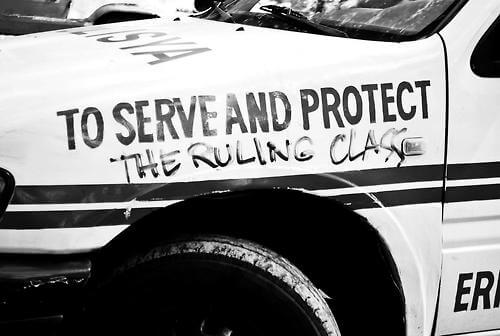
All of those seemingly hard-working police officers and code-enforcement officers and truancy officers and traffic cops handing out ticket after ticket after ticket: they’re not working to make your communities safer—they’ve got quotas to fill.

Same goes for the courts, which have come to rely on fines, fees and exorbitant late penalties as a means of increased revenue. The power of these courts, magnified in recent years through the introduction of specialty courts beyond your run-of-the-mill traffic court (drug court, homeless court, veterans court, mental health court, criminal court, teen court, gambling court, prostitution court, community court, domestic violence court, truancy court), is “reshaping the American legal system—with little oversight,” concludes the Boston Globe.

And for those who can’t afford to pay the court fines heaped on top of the penalties ($302 for jaywalking, $531 for an overgrown yard, or $120 for arriving a few minutes late to court), there’s probation (managed by profit-run companies that tack on their own fees, which are often more than double the original fine) or jail time (run by profit-run companies that charge inmates for everything from food and housing to phone calls at outrageous markups), which only adds to the financial burdens of those already unable to navigate a costly carceral state.

“When bail is set unreasonably high, people are behind bars only because they are poor,” stated former Attorney General Loretta Lynch. “Not because they’re a danger or a flight risk — only because they are poor. They don’t have money to get out of jail, and they certainly don’t have money to flee anywhere. Other people who do have the means can avoid the system, setting inequality in place from the beginning.”

In “Policing and Profit,” the Harvard Law Review documents in chilling detail the criminal justice system’s efforts to turn a profit at the expense of those who can least afford to pay, thereby entrapping them in a cycle of debt that starts with one minor infraction:

In the late 1980s, Missouri became one of the first states to let private companies purchase the probation systems of local governments. In these arrangements, municipalities impose debt on individuals through criminal proceedings and then sell this debt to private businesses, which pad the debt with fees and interest. This debt can stem from fines for offenses as minor as rolling through a stop sign or failing to enroll in the right trash collection service. In Ferguson, residents who fall behind on fines and don’t appear in court after a warrant is issued for their arrest (or arrive in court after the courtroom doors close, which often happens just five minutes after the session is set to start for the day) are charged an additional $120 to $130 fine, along with a $50 fee for a new arrest warrant and 56 cents for each mile that police drive to serve it. Once arrested, everyone who can’t pay their fines or post bail (which is usually set to equal the amount of their total debt) is imprisoned until the next court session (which happens three days a month). Anyone who is imprisoned is charged $30 to $60 a night by the jail. If an arrestee owes fines in more than one of St. Louis County’s eighty-one municipal courts, they are passed from one jail to another to await hearings in each town.

Ask yourself this: at a time when crime rates across the country remain at historic lows (despite Sessions’ inaccurate claims to the contrary), why does the prison population continue to grow?

The prison population continues to grow because of a glut of laws that criminalize activities that should certainly not be outlawed, let alone result in jail time. Overcriminalization continues to plague the country because of legislators who work hand-in-hand with corporations to adopt laws that favor the corporate balance sheet. And when it comes to incarceration, the corporate balance sheet weighs heavily in favor of locking up more individuals in government-run and private prisons.

As Time reports, “The companies that build and run private prisons have a financial interest in the continued growth of mass incarceration. That is why the two major players in this game—the Corrections Corporation of America and the GEO Group—invest heavily in lobbying for punitive criminal justice policies and make hefty contributions to political campaigns that will increase reliance on prisons.”

It’s a vicious cycle that grows more vicious by the day.

According to The Atlantic, “America spends $80 billion a year incarcerating 2.4 million people.” But the costs don’t end there. “When someone goes to prison, nearly 65 percent of families are suddenly unable to pay for basic needs such as food and housing… About 70 percent of those families are caring for children under the age of 18.”

Then there are the marked-up costs levied against the inmate by private companies that provide services and products to government prisons. Cereal and soup for five times the market price. $15 for a short phone call.

The Center for Public Integrity found that “prison bankers collect tens of millions of dollars every year from inmates’ families in fees for basic financial services. To make payments, some forego medical care, skip utility bills and limit contact with their imprisoned relatives… Inmates earn as little as 12 cents per hour in many places, wages that have not increased for decades. The prices they pay for goods to meet their basic needs continue to increase.”

Worse, as human rights attorney Jessica Jackson points out, “the fines and fees system has turned local governments into the equivalent of predatory lenders.” For instance, Jackson cites:

Washington state charges a 12% interest rate on all its criminal debt. Florida adds a 40% fee that goes into the pockets of a private collections agency. In California, penalties can raise a $100 fine to $490, or $815 if the initial deadline is missed. A $500 traffic ticket can actually cost $1,953, even if it is paid on time. And so we are left with countless tales of lives ruined—people living paycheck to paycheck who cannot afford a minor fine, and so face ballooning penalties, increasing amounts owed, a suspended license, jail time, and being fired from their jobs or unable to find work.

This isn’t the American Dream I grew up believing in.

This certainly isn’t the American Dream my parents and grandparents and those before them worked and fought and sacrificed to achieve.

This is a cold, calculated system of profit and losses.

Now you can shrug all of this away as a consequence of committing a crime, but that just doesn’t cut it. Especially not when average Americans are being jailed for such so-called crimes as eating SpaghettiOs (police mistook them for methamphetamine), not wearing a seatbelt, littering, jaywalking, having homemade soap (police mistook the soap for cocaine), profanity, spitting on the ground, farting, loitering and twerking.

There is no room in the American police state for self-righteousness. Not when we are all guilty until proven innocent.

As I make clear in my book Battlefield America: The War on the American People, this is no longer a government “of the people, by the people, for the people.”

It is fast becoming a government “of the rich, by the elite, for the corporations,” and its rise to power is predicated on shackling the American taxpayer to a debtors’ prison guarded by a phalanx of politicians, bureaucrats and militarized police with no hope of parole and no chance for escape.

Policing for Profit: Jeff Sessions & Co.’s Thinly Veiled Plot to Rob Us Blind

By John W. Whitehead

Source: The Rutherford Institute

“Laws are no longer made by a rational process of public discussion; they are made by a process of blackmail and intimidation, and they are executed in the same manner. The typical lawmaker of today is a man wholly devoid of principle — a mere counter in a grotesque and knavish game. If the right pressure could be applied to him, he would be cheerfully in favor of polygamy, astrology or cannibalism. It is the aim of the Bill of Rights, if it has any remaining aim at all, to curb such prehensile gentry. Its function is to set a limitation upon their power to harry and oppress us to their own private profit.”— H.L. Mencken

Let’s not mince words.

Jeff Sessions, the nation’s top law enforcement official, would not recognize the Constitution if he ran right smack into it.

Whether the head of the Trump Administration’s Justice Department enjoys being the architect of a police state or is just painfully, criminally clueless, Sessions has done a great job thus far of sidestepping the Constitution at every turn.

Most recently, under the guise of “fighting crime,” Sessions gave police the green light to rob, pilfer, steal, thieve, swipe, purloin, filch and liberate American taxpayers of even more of their hard-earned valuables (especially if it happens to be significant amounts of cash) using any means, fair or foul.

In this case, the foul method favored by Sessions & Co. is civil asset forfeiture, which allows police and prosecutors to “seize your car or other property, sell it and use the proceeds to fund agency budgets—all without so much as charging you with a crime.”

Under a federal equitable sharing program, police turn asset forfeiture cases over to federal agents who process seizures and then return 80% of the proceeds to the police. (In Michigan, police actually get to keep up to 100% of forfeited property.)

This incentive-driven excuse for stealing from the citizenry is more accurately referred to as “policing for profit” or “theft by cop.”

Despite the fact that 80 percent of these asset forfeiture cases result in no charge against the property owner, challenging these “takings” in court can cost the owner more than the value of the confiscated property itself. As a result, most property owners either give up the fight or chalk the confiscation up to government corruption, leaving the police and other government officials to reap the benefits.

And boy, do they reap the benefits.

Police agencies have used their ill-gotten gains “to buy guns, armored cars and electronic surveillance gear,” reports The Washington Post. “They have also spent money on luxury vehicles, travel and a clown named Sparkles.”

Incredibly, these asset forfeiture scams have become so profitable for the government that, according to The Washington Post, “in 2014, law enforcement took more stuff from people than burglars did.” As the Post notes, “the Treasury and Justice departments deposited more than $5 billion into their respective asset forfeiture funds. That same year, the FBI reports that burglary losses topped out at $3.5 billion.”

In 2015, the federal government seized nearly $2.6 billion worth of airplanes, houses, cash, jewelry, cars and other items under the guise of civil asset forfeiture.

According to USA Today, “Anecdotal evidence suggests that allowing departments to keep forfeiture proceeds may tempt them to use the funds unwisely. For example, consider a 2015 scandal in Romulus, Michigan, where police officers used funds forfeited from illicit drug and prostitution stings to pay for …  illicit drugs and prostitutes.”

Memo to the rest of my fellow indentured servants who are living through this dark era of government corruption, incompetence and general ineptitude: this is not how justice in America is supposed to work.

We are now ruled by a government so consumed with squeezing every last penny out of the population that they are completely unconcerned if essential freedoms are trampled in the process.

Our freedoms aren’t just being trampled, however. They’re being eviscerated.

At every turn, “We the People” are getting swindled, cheated, conned, robbed, raided, pickpocketed, mugged, deceived, defrauded, double-crossed and fleeced by governmental and corporate shareholders of the American police state out to make a profit at taxpayer expense.

Americans no longer have to be guilty to be stripped of their property, rights and liberties. All you have to be is in possession of something the government wants. And if you happen to have something the government wants badly enough, trust me, their agents will go to any lengths to get it.

If the government can arbitrarily freeze, seize or lay claim to your property (money, land or possessions) under government asset forfeiture schemes, you have no true rights.

Here’s how the whole ugly business works in a nutshell.

First, government agents (usually the police) use a broad array of tactics to profile, identify, target and arrange to encounter (in a traffic stop, on a train, in an airport, in public, or on private property) those  individuals who might be traveling with a significant amount of cash or possess property of value. Second, these government agents—empowered by the courts and the legislatures—seize private property (cash, jewelry, cars, homes and other valuables) they “suspect” may be connected to criminal activity.

Then—and here’s the kicker—whether or not any crime is actually proven to have taken place, without any charges being levied against the property owner, or any real due process afforded the unlucky victim, the property is seized by the government, which often divvies it up with the local police who helped with the initial seizure.

In a Kafkaesque turn of the screw, the burden of proof falls on the unfortunate citizenry who must mount a long, complicated, expensive legal campaign to prove their innocence in order to persuade the government that it should return the funds they stole. Not surprisingly, very few funds ever get returned.

It’s a new, twisted form of guilt by association, only it’s not the citizenry being accused of wrongdoing, just their money.

Motorists have been particularly vulnerable to this modern-day form of highway robbery.

For instance, police stole $201,000 in cash from Lisa Leonard because the money—which Leonard planned to use to buy a house for her son—was being transported on a public highway also used by drug traffickers. Despite the fact that Leonard was innocent of wrongdoing, the U.S. Supreme Court upheld the theft on a technicality.

Police stole $50,000 in cash from Amanee Busbee—which she planned to use to complete the purchase of a restaurant—and threatened to hand her child over to CPS if she resisted. She’s one of the few to win most of her money back in court.

Police stole $22,000 in cash from Jerome Chennault—which he planned to use as the down payment on a home—simply because a drug dog had alerted police to its presence in his car. After challenging the seizure in court, Chennault eventually succeeded in having most of his money returned, although the state refused to compensate him for his legal and travel expenses.

Police stole $8,500 in cash and jewelry from Roderick Daniels—which he planned to use to purchase a new car—and threatened him with jail and money-laundering charges if he didn’t sign a waiver forfeiting his property.

Police stole $6,000 in cash from Jennifer Boatright and Ron Henderson and threatened to turn their young children over to Child Protective Services if they resisted.

Tenaha, Texas, is a particular hotbed of highway forfeiture activity, so much so that police officers keep pre-signed, pre-notarized documents on hand so they can fill in what property they are seizing.

As the Huffington Post explains, these police forfeiture operations have become little more than criminal shakedowns:

Police in some jurisdictions have run forfeiture operations that would be difficult to distinguish from criminal shakedowns. Police can pull motorists over, find some amount of cash or other property of value, claim some vague connection to illegal drug activity and then present the motorists with a choice: If they hand over the property, they can be on their way. Otherwise, they face arrest, seizure of property, a drug charge, a probable night in jail, the hassle of multiple return trips to the state or city where they were pulled over, and the cost of hiring a lawyer to fight both the seizure and the criminal charge. It isn’t hard to see why even an innocent motorist would opt to simply hand over the cash and move on.

Unsurprisingly, these asset forfeiture scams have become so profitable for the government that they have expanded their reach beyond the nation’s highways.

According to USA Today, the U.S. Department of Justice received $2.01 billion in forfeited items in 2013, and since 2008 local and state law enforcement nationwide has raked in some $3 billion in forfeitures through the federal “equitable sharing” program.

So now it’s not just drivers who have to worry about getting the shakedown.

Any American unwise enough to travel with cash is fair game for the government pickpockets.

In fact, the Drug Enforcement Administration (DEA) has been colluding with the Transportation Security Administration (TSA) and local police departments to seize a small fortune in cash from American travelers using the very tools—scanners, spies and surveillance devices—they claimed were necessary to catch terrorists.

Mind you, TSA agents already have a reputation for stealing from travelers, but clearly the government is not concerned about protecting the citizenry from its own wolfish tendencies.

No, the government bureaucrats aren’t looking to catch criminals. (If so, they should be arresting themselves.)

They’re just out to rob you of your cold, hard cash.

Think about it for a moment. You pay a hefty fee just to be able to walk free. It’s called income tax. As former presidential candidate Ron Paul recognizes, “The Founding Fathers never intended a nation where citizens would pay nearly half of everything they earn to the government.” And if you refuse to pay any of that so-called income tax, you’ll be severely fined and/or arrested and put in jail.

One more thing: you don’t really own your property. That is, your house or your land. Even when you pay off the mortgage, if you fail to pay your property taxes, government agents will evict you and take your home.

This is not freedom.

There was a time in our history when our forebears said “enough is enough” and stopped paying taxes (a pittance compared to what we are forced to shell out in taxes today) to what they considered an illegitimate government. They stood their ground and refused to support a system that was slowly choking out any attempts at self-governance, and which refused to be held accountable for its crimes against the people. Their resistance sowed the seeds for the revolution that would follow.

Unfortunately, in the 200-plus years since we established our own government, we’ve let the corporate elite and number-crunching bureaucrats pilfer our bank accounts to such an extent that we’re back where we started.

Once again, we’ve got a despotic regime with an imperial ruler doing as it pleases.

But what if we didn’t just pull out our pocketbooks and pony up to the federal government’s outrageous demands for more money? What if we didn’t just line up to drop our hard-earned dollars into the corporate collection bucket, no questions asked about how it will be spent? What if, instead of meekly tolerating the government’s ongoing efforts to rob us blind, we did something about it?

As I make clear in my book Battlefield America: The War on the American People, if the government can just take from you what they want, when they want, and then use it however they want, you can’t claim to be anything more than a serf in a land they think of as theirs.

It’s up to “We the People” to demand reform.

These injustices will continue as long as we remain silent.

As American journalist H.L. Mencken observed:

The American of today, in fact, probably enjoys less personal liberty than any other man of Christendom, and even his political liberty is fast succumbing to the new dogma that certain theories of government are virtuous and lawful, and others abhorrent and felonious. Laws limiting the radius of his free activity multiply year by year: It is now practically impossible for him to exhibit anything describable as genuine individuality, either in action or in thought, without running afoul of some harsh and unintelligible penalty. It would surprise no impartial observer if … the goddess of liberty were taken off the silver dollars to make room for a bas-relief of a policeman in a spiked helmet. Moreover, this gradual (and, of late, rapidly progressive) decay of freedom goes almost without challenge; the American has grown so accustomed to the denial of his constitutional rights and to the minute regulation of his conduct by swarms of spies, letter-openers, informers and agents provocateurs that he no longer makes any serious protest.

In other words, make them hear you.

And if they won’t listen, then I suggest it’s time for what Martin Luther King Jr. called for when government doesn’t listen: “militant nonviolent resistance.”

Another Unsolvable Issue for Americans

Mass Incarceration, Prison Labor in the United States

By John Stanton

Source: Dissident Voice

The Federal Prison Industries (FPI) under the brand UNICOR operates approximately 52 factories (prisons) across the United States. Prisoners manufacture or assemble a number of products for the US military, homeland security, and federal agencies according to the UNICOR/FPI website.  They produce furniture, clothing and circuit boards in addition to providing computer aided design services and call center support for private companies.

UNICOR/FPI makes its pitch for employing call center support personnel to firms thinking about off-shoring their call center functions. The logic is that, hey!, they may be prisoners, but it’s keeping the jobs in the USA that matters. Fair enough. That approach cuts out the middleman though, those Americans desperate for any kind of work but, through no fault of their own, are not behind prison bars and employable by UNICOR/FPI.

Sure, it seems a heartless statement and there are any number of angles to take on why the USA is the world’s number one incarcerator: Capitalism, racism, social and political injustice, a pay-as-you-go legal system, bone-headed policy makers, prison lobbyists, the death penalty, employment/unemployment, drugs, gangs, costs/prices and a host of behavioral, psychological and environmental issues that I have missed.

Inevitably the black hole that is money eventually sucks in and corrupts everyone from those in local communities desperate for the work a prison facility provides to those investors who profit from the prison industry. They earn their livelihoods and take their profits from the misery and labor squeezed from their human property — those prisoners who self-destructed and others who are serving terms way too long for the crime committed.

For the Love of Money

From October 2016 through March 2017, UNICOR/FPI sold $252,414,987 million worth of goods and services.

The prison labor industry is very keen on promoting its role in assembling the US military’s widely used Single Channel Ground and Airborne Radio System (SINCGARS). In January defense contractor Harris Corp. was awarded a $403 million contract by the US Defense Logistics Agency for spare parts supporting tactical radio systems, which includes SINCGARS.

UNICOR/FPI is a major supplier of SINCGARS radios, mounts, antennas, and installation and repair kits and when hard-mounted, our SINCGARS equipment meets rigorous military standards for shock and vibration in aircraft and tactical vehicles, such as Bradley’s and Humvees. Through our nationwide network of factories and trained technicians, we have successfully met aggressive production and distribution needs for this crucial communication equipment in Middle East military operations.

Some of the purchases by the US Department of Defense include $14.8 million for electronic components, $887 thousand for communications equipment, $26.7 million for office furniture, $27.1 million for special purpose clothing and $7.5 million for body armor. The Department of Homeland Security spent $372,255 on administrative support. The Executive Office of the US President spent $389 for signs and identification plates.

Fight Fire with Inmates

According to a Mother Jones article in 2015 somewhere between 30 and 40 percent of California’s forest firefighters are state prison inmates with some 4,000 working at any one time on fire lines. So dependent on the inmates was California that prison reforms that would see the release of some of the incarcerated firefighters were put on hold for fear of losing the manpower to fight California blazes. Then California attorney general Kamala Harris, now a US Senator, was behind the effort to keep the “cheap” firefighters behind bars,

Prison reform advocates have raised concerns that the state is so reliant on the cheap labor of inmate firefighters that policymakers may be slow to adopt prison reforms as a result. The concern was magnified last fall, when lawyers for state Attorney General Kamala Harris argued that extending an early prison-release program to “all minimum custody inmates at this time would severely impact fire camp participation—a dangerous outcome while California is in the middle of a difficult fire season and severe drought.” Harris has since said she was “troubled” by the argument, and the state has ruled that minimum custody inmates, including firefighters, are eligible for the program so long as it proves not to deplete the numbers of inmate firefighters.

US Immigration and Customs Enforcement detains women, men, children, and LGBTQI individuals in over 200 county jails and for-profit prisons, according to the grass roots group CIVIC. Some of these individuals include legal permanent residents with longstanding family and community ties, asylum-seekers, and victims of human trafficking.

It was former President Bill Clinton (Democrat) who started to load up detention centers and jails with immigrants, CIVIC noted.

In 1996, President Bill Clinton signed the Antiterrorism and Effective Death Penalty Act (AEDPA) and the Illegal Immigration Reform and Immigrant Responsibility Act (IIRIRA), which doubled the number of people in immigration detention from 8,500 each day in 1996 to 16,000 in 1998. Today, the detention population has increased fourfold to approximately 34,000 individuals each day, due in part to a congressionally mandated lock-up quota.

President Donald Trump’s (Republican) animosity to immigrants is well known. He and his aptly named attorney general Jefferson Beauregard Sessions will make sure detention centers and prisons are overfilled with men, women and children from Mexico, Central and South America. Trump and Session’s maniacal quest wage war on crime, drugs and terrorism will likely ensure that many thousands more will find themselves locked away and working for UNICOR/FPI or lining the pockets of private prison company owners.

Immigrants Too

The non-profit group Towards Justice reported that a lawsuit is moving forward pitting private prison corporation against immigrants who were forced into labor while in detention.

For the first time in history, a federal court allowed a class of immigrant detainees to jointly proceed with forced labor claims against the country’s second-largest private prison provider. Judge Kane in the District of Colorado certified a class of between 50,000 and 60,000 current and former immigrant detainees held at GEO’s Aurora, Colorado detention facility since 2004. These individuals, some of whom were found to legally reside in this country after months in detention, allege that they were forced to clean the detention center without pay and under threat of solitary confinement. This practice allowed GEO to reduce labor costs at the Aurora facility, where it employs just one custodian to maintain a detention center that houses up to 1,500 people at a time.

Everyone Has Their Hands in the Pie

In January 2017, the Prison Policy Initiative (prisonpolicy.org) worked up a study titled Following the Money of Mass Incarceration. It shines the light on some of the unsettling reasons why the USA will never be able to reduce its reliance on mass incarceration. Those who depend on money that the prison industry provides will never give it up. It’s not just private companies but local communities, bondsmen, unions all the way up to the US Department of Defense who collect fees or purchase UNICOR/FPI products and services at dirt cheap prices.

Bail bond companies that collect $1.4 billion in nonrefundable fees from defendants and their families actively work to block reforms that threaten its profits, even if reforms could prevent people from being detained in jail because of their poverty. Specialized phone companies win monopoly contracts and charge families up to $24.95 for a 15-minute phone call. Commissary vendors that sell goods to incarcerated people — who rely largely on money sent by loved ones — is an even larger industry that brings in $1.6 billion a year. 38 towns and cities in the U.S., more than 10% of all revenue is collected from court fines and fees. In St. Louis County, five towns generated more than 40% of their annual revenue from court fines and fees in 2013.

The over-incarceration of Americans is just one more vexing issue, piled on many—Afghanistan, Syria, education, Trump/Clinton’s health care, taxes–in which US citizens find themselves trapped and unable to reach across the pro/con divide and cause change.

Lara Trace Hentz

INDIAN COUNTRY NEWS

In Saner Thought

"It is the duty of every man, as far as his ability extends, to detect and expose delusion and error"..Thomas Paine

ZEDJournAI

Human in Algorithms

Rooster Crows

From the Roof Top

Aisle C

I See This

The Free

blog of the post capitalist transition.. Read or download the novel here + latest relevant posts

अध्ययन-अनुसन्धान(Essential Knowledge of the Overall Subject)

अध्ययन-अनुसन्धानको सार