The Richest Sociopath in the World

By John Rachel

Source: Dissident Voice

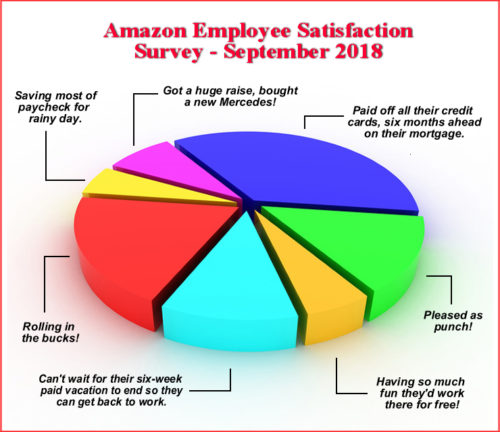
Obviously the above pie chart is a put-on. It is well-documented that working conditions for most employees of Amazon are  abysmaldehumanizing, bordering on abuse we normally associate with slavery.

Moreover, the median employee’s salary under Jeff Bezos’ imperial lordship is $28,446. No one working as a regular there has paid off their credit cards and is driving to work in a Mercedes. 

Jeff Bezos is referred to as The Richest Man in the World and his personal fortune, while growing by $191,000 each minute, is currently estimated at $168 billion.

So …

$28,446 vs. $168,000,000,000? While I can acknowledge the simple math, I find the contrast of such numbers on a gut level difficult to grasp.

To get a handle on such inequality, let’s try approaching it from different angles.

One way to put the disparity into perspective is to recognize it takes Bezos just under 9 seconds to earn what Amazon’s median worker does in an entire year.

Another is to recognize that for a worker to go through Jeff Bezos’ current personal fortune — and, of course, it continues mounting at accelerating levels as I write this — at his/her current median annual income of $28,446 per year, WOULD TAKE 5,905,927 YEARS! That’s close to 6 million years!

For Jeff Bezos himself to go through his current $168 billion, assuming his earnings stopped dead this very moment — which as you and I know they won’t — SPENDING $1,000,000 A DAY, would take NEARLY 460 years. Yes, even spending $1 million a day, in the year 2475 he’d still have plenty of cash, tens of million of dollars mad money. We can feel confident that he wouldn’t be foraging through the dumpster behind 7-11. 

Now, further consider that while the $28,446 median salary is above the national poverty line for a single individual if that person is the sole breadwinner for a family of four, it is marginally above it, which is why many Amazon employees must rely on government assistance to keep from starving.

As well as calculation, I did some speculation — a simple exercise in imagination.

Apparently Bezos’ wealth generating machine is raking it in so fast, he’s currently making $11.5 million per hour … every hour … 24 hours a day … seven days a week. $11,500,000 per hour! 

So here’s what I was picturing in my mind’s eye … 

If for 40 hours of the 168 hours in a week, Bezos were willing to scrape by on a mere $5,840,000 per hour, he could give every one of his 566,000 Amazon employees a $10 per hour raise. Of course, the remaining 128 hours in each week, Bezos could continue earning his normal $11.5 million per hour, not having to share any of it with the pathetic slobs who work for him.

Rhetorical question: Does Jeff Bezos have any concept of what that $10 per hour increase would mean to his employees? 

I’m not going to even suggest here I’m offering this for Bezos to entertain. There are so many advantages to him both as a putative member of the human race and the employer of over a half million workers — advantages that are so OBVIOUS — if they haven’t occurred to him up until now, then his brain functions in ways beyond my understanding. For one thing, he could point to his new fig leaf of “generosity” and ask people to stop calling him a selfish prick. Second, Amazon employees I’m sure would respond to his largesse with greater company loyalty and increased tolerance for his onerous working conditions. He’d still be the richest SOB on the block and could mock the pauperish Bill Gates and Warren Buffett as pitiable wannabees.

Consider …

The most poorly paid Amazon employee now makes $12 per hour. The $10 per hour raise I proposed would boost those $12 per hour workers right up there with Costco employees, who make an average of $21 per hour. And with the across-the-board $10 per hour increase, Bezos’ higher paid employees would be earning among the finest wages in the world provided by a major corporation. 

And by golly, there’s a plus side to the plus side …

Bezos’s bold and gracious gesture would result in a public relations coup of cosmic proportions! Amazon would no longer be demonized — well, not quite as much — by us bleeding-heart lefties as a capitalistic scourge and one-way ticket to Hell for the future of mankind, even if its environmental record is appalling and its business model generally the stuff of steroid-laced neo-feudalism.

Granted, Bezos would have to do some belt-tightening. He’d have to watch his pennies but could probably manage it, eh? Maybe he could skip a couple meals and do some of his own weeding at his estate. After all, after lavishing the $10 per hour raise on all of his employees, he’d only be pulling in $1,705,600,000 per week. I know I know! Like me you’re probably getting all teary-eyed for the poor guy.

Let me get to the extremely anti-climactic conclusion of this lament qua analysis.

Since nothing will change until the system itself changes, meaning the one in place now that creates, incentivizes, and lionizes the obscenely wealthy — reference current holder of the Office of President of the United States of America — I can only recommend this …

We have been labeling Jeff Bezos as ‘The Richest Man in the World’. Yet, quite honestly I don’t personally know any human, man or woman, who behaves like this gluttonous chunk of self-indulgent meat. It actually makes me nauseous to think we’re members of the same species.

Thus, from now on let’s use the correct terminology. Let’s call Jeff Bezos what he really is: the Richest Sociopath in the World.

We could probably order bumper stickers to help correct the record … from Amazon, of course.

Jeff Bezos’ Paper Tells You Not to Worry About Those Billionaires

By Dean Baker

Source: FAIR

Just when you thought economic commentary in the Washington Post couldn’t get any more insipid, Roger Lowenstein proves otherwise. In a business section “perspective” (7/20/18), he tells readers:

But what if inequality is the wrong metric. Herewith a modest proposition: economic inequality is not the best yardstick. What we should be paying attention to is social mobility.

Wow, what a novel idea, as though right-wingers have not been pushing this line since the dawn of time: “Don’t worry that your standard of living is awful, the important thing is that your kids will be able to get rich.” (It doesn’t help his story that his poster child for the rich being good is Lloyd Blankfein, who made his fortune shuffling financial assets at Goldman Sachs, and benefited from a massive government bailout.)

But let’s be generous, and try to take Lowenstein’s story seriously. He goes on: “Rising inequality, although a fact, is also very hard to find a culprit for. Not that economists haven’t tried.”

Really? There are plenty of really good explanations for rising inequality, many of which are in my (free) book Rigged. I suppose in the Age of Trump, it is appropriate that the Post has a business columnist determined to flaunt his ignorance.

But then we get the real payday:

It’s also far from proved—to me, it’s not even intuitive—that high incomes on Wall Street and elsewhere are the reason for, say, flatter wages in manufacturing. The fact that Mark Zuckerberg is so rich is annoying, and his separateness from Main Street may not be a great thing socially, but in an economic sense, his fortune did not “come from” the paychecks of ordinary workers.

OK, let’s explain this one so that even someone profoundly ignorant of economics can understand. Suppose that someone, we’ll call them Jeff Bezos or Mark Zuckerberg, were really good at printing counterfeit bills. Imagine that they printed up trillions of these counterfeit bills. This would make them incredibly rich, if they could get away with it. But, as Lowenstein says, how does this make anyone else worse off?

While Lowenstein doesn’t see any problem with our incredibly rich counterfeiters, in the real world, we have the problem that they are creating demand for goods and services with their consumption. If the economy is below full employment, this would be good news, since any source of demand will generate more output and jobs. However, if we are near full employment, or the Federal Reserve Board thinks we are near full employment, then this demand comes at the expense of the paychecks of ordinary workers.

Prices like house prices and rents are driven up by our counterfeiters and the demand created by their servants. The Fed raises interest rates to slow growth and employment, and lessen the ability of ordinary workers to get pay increases, since the labor market will be weaker.

Now, folks may object that Bezos and Zuckerberg are not like counterfeiters; they actually generate value for the economy. While this undoubtedly partly true, it is also the case that much of Bezos’ wealth came from avoiding the requirement that retailers collect state and local sales taxes. Zuckerberg’s wealth came from control of a monopoly platform, and Blankfein’s wealth came from running a too-big-to-fail institution with friends in high places.

Insofar as people get incredibly wealthy from being successful in earning rents at the expense of others in the economy, rather than generating wealth, they are very much like counterfeiters. Furthermore, since productivity has been growing at an incredibly slow rate for the last dozen years (just over 1.0 percent annually), it seems in aggregate that these incredibly rich folks are much better at generating wealth for themselves than for the economy as a whole. This makes the rent-seeker story look very plausible.

While Lowenstein’s plea for greater mobility is about as old as capitalism and has been incredibly unsuccessful, let me propose something considerably more original that you probably won’t see in the Washington Post. Since we have so completely bombed at providing anything like equal opportunity, and no serious person can think this is about to change in the decades ahead, how about we structure our economy so that it makes less difference whether someone ends up at the top end, like Jeff Bezos, or at the bottom, earning the minimum wage?

That one is almost certainly far too simple for the great minds to ever consider.

25 Families Own $1.1 Trillion Between Them as the Global Wealth Inequality Gap Grows

Using data from their list Forbes has produced a list of the top 25 richest families in the world. Together they are worth over $1.1 trillion, or the entire GDP of Indonesia.

By  Rosa Tressell and Dr. Leon Tressell

Source: SouthFront

Once a family-owned business Forbes is well known for producing their annual list of the world’s richest billionaires. Launched in 1982 the original list ranked the top 400 Americans by net worth. Only 13 billionaires were included in that list, and their combined worth was the equivalent of 2.8% of GDP. In an era where “Greed is Good”, the list became wildly popular, by 2000 the combined net worth of the top 400 equated to 12.2% of US GDP. So prestigious became the list that an ex-employee of Forbes has claimed that Donald J Trump inflated his personal wealth to be included.

This year more than 2,200 billionaires made the Forbes list with a combined value of $9.1 trillion, or half the GDP of the US. Amazon CEO, Jeff Bezos, topped the list this year as his fortune rose to £112 billion making him the first centi-billionaire. His wealth is now equal to that of 2.3 million Americans. This has allowed him to dethrone Bill Gates, founder of Microsoft, worth just $90 billion.

Using data from their list Forbes has produced a list of the top 25 richest families in the world. Together they are worth over $1.1 trillion, or the entire GDP of Indonesia. The richest clan is the Walton family who own the ubiquitous Walmart chain in America. They have a total family wealth of £152 billion and several family members are on the list of billionaires as individuals. The Koch Brothers, of Koch Industries, are ranked second with £98.7 billion. The third spot, with $90 billion to their name, is taken by another American family, the Mars family, known for their various sweet treats.

In comparison to the billionaires list this list is a measure of families who have inherited and grown their wealth over generations. The billionaires list is dominated by Americans in certain fields; technology, finance, entertainment and sport. It lauds entrepreneurism and promotes the self-made man (and small handful of women). The family fortunes list on the other hand reveals a more historical route for making money. Whilst Jeff Bezos has shot to the top of the list based largely on the astonishingly over valued share price of Amazon stock, the family fortunes are centered on the production and purveyance of goods.

Many of the families on the list started making their fortunes in the late nineteenth century. These are: Cargill Industries (agricultural conglomerate); Boehringer Ingelhelm (pharmaceuticals); Cox Enterprises (communications); Hyatt Hotels (hotels); SC Johnson (household goods); Roche (pharmaceuticals); and the Hearst Corporation (media). Meanwhile the Van Damme/De Spoelberch/De Mevius family (ranked fourth with a fortune of $54.1 billion) have been brewing quality Belgian beer, like Stella Artois, dating back centuries.

The production and purveyance of quality high end goods as a means to fortune is evident as BMW (the Quandt family), Chanel (the Wertheimer family) and Hermes (the Dumas family) find these families all ranked in the top ten.

Reliance Industries is the fist non-Western entry. A Mumbai-based energy conglomerate, it was founded by Dhirubhai Ambani in 1957 and is now worth $43.4 billion. It was his ambition to be the world’s richest man. However, following his untimely death there was a very public and acrimonious dispute between his two sons revolving around the inheritance. The widow eventually brokered a settlement and the family fortune goes on, but it does show how easily a family fortune can be dissipated.

In addition to Walmart there are two other families that have made their fortunes in retail. The Albrecht Brothers who founded Aldi are ranked 11th with a $38.8 billion fortune followed at twelfth by the Mulliez family who founded Auchan, France’s equivalent of Walmart. At thirteenth spot, with a fortune of £34 billion, is the Kwok family. They started in business as a grocery wholesaler but they really made their money when they moved into Hong Kong real estate in the 1970s. Similarly the Lee family from South Korea began as grocery exporters but have made their fortune as the worlds largest producers of smart phones with their company Samsung.

There is some methodology to the list that requires explanation. Bloomberg’s categorisation of family wealth is based on reliable, sourced documentation. They add up family members assets, including stakes in public and private companies, real estate, art and cash, and takes into account debts. It excludes first-generation fortunes and those in the hands of a single heir. It also excludes those who have derived their fortune from the state. This explains why there are no Chinese families on the list and only three from the Asian region. As newly found wealth is handed down this looks set to change.

The Forbes list also excludes members of royal families and dictators who derive their fortunes entirely as a result of their position of power. Nor do they value those holding fortunes in trust for their nations. So, despite being worth untold billions, families like the royal family of Brunei or the British monarchs are absent. Quantifying this wealth is difficult. For example, Buckingham Palace alone would be valued in excess of $5 billion, however there would certainly be conflict with Parliament if the Queen wanted to sell it!

Many billionaires positively don’t want to be on the list. They don’t want the publicity for their families with the increased risk of kidnapping, being hit up for money, questions from the tax man or even from law enforcement. Kenichi Shinoda, current Kingpin of the Yakuza, is rumoured to be worth billions but is known to keep a low financial profile. There is also plenty of Western media speculation that the President of Russia, Vladimir Putin, is actually the world’s richest man. The Bush family have amassed a vast fortune, and there are allegations that much of it has been amassed behind the political scenes in various CIA backed gun and drug running operations.

Calculations of wealth, for individuals or families, can be obfuscated by the numerous off shore arrangements that exist today. Historically, many of the world’s largest landowners are not officially registered as a result of having held title to the land for centuries. In addition trusts, foundations and “charities” allows for the ownership and management of assets in a more private manner. Wealthy families pay professionals a healthy wage to minimise their exposure to the taxman – especially avoidance of inheritance tax.

Absent from the list are the giant banking families, the Rockefellers, the Morgans and the Rothschilds; famed for being on every conspiracy theory list as powers behind the scene. The report says that their fortunes are too diffuse and diversified to correctly value. Other families suspected of wielding their riches for their own political and social agendas include the DuPonts, the Astors, the Bundys and the Freemans, to name a few. Families that like to keep their immense fortunes and their activities confidential.

To have such wealth is naturally to have much power. Certain families, like the Bushes and the Kennedys used their cash to enter politics. The Koch Brothers have already pledged $400 million to the Republicans for the 2018 mid-term elections and their support was seen as instrumental in securing Donald J Trump’s election victory. The Walmart Family Foundation is one of America’s largest political donors, and is described as a “heavy hitter” from the Centre of Responsive Politics. Economic advantage is translated into legislative favours via lobbying and campaign donations. For example, one Arkansas Congresswoman who supported the repeal of an estate tax received $83,650 from the Walton Family Foundation and  now works for them as a lobbyist. This exemplifies the corrupt relationship between economic and democratic inequality and is indicative of a system where the majority feel their voice is irrelevant.

Capitalism is built on an idea that a rising tide lifts all ships. We are supposed to look up to these rich families as examples of our betters. Underlying the lists that Forbes assembles is a worshiping of the rich. Underpinning the American dream is that its possible for anyone or any family to make it (onto the list). However, even Scrooge McDuck must be envious of the enormous fortunes of these families. As the wealth inequality gap grows within countries, especially the Western nations, there is the risk that the social fabric is coming apart at the seams. When 40% of Americans have less then $500 in savings the material basis for living the Dream is seriously compromised. Indeed, this could all turn just as easily into anger as people see that the six individual Walmart heirs alone have more wealth than the bottom 30% of the US population, and they ask themselves is this fair?

This report confirms accelerating trends towards further wealth disparity. Reports by Oxfam have shown a gaping chasm of global inequality. In 2017 3.7 billion people saw no increase in their wealth, whilst 82% of the wealth created went to the top 1%.

According to the World Inequality Report 2018:

If established trends in wealth inequality were to continue, the top 0.1% alone will own more wealth than the global middle class by 2050.

Donald Trump’s ambition to be included on the list displays his naked ambition for money, power and success. In his school of market economics, of dog eat dog, this trend is only the logic of the market. It is seen as aspirational by those at the top and by magazines like Forbes. However, even the 1% at Davos earlier this year had wealth inequality on the agenda. As the social fabric tears, political and social instability will increase. The Brexit vote, driven by the anger of the dispossessed English working class, for example, has turned the UK’s traditional stability on its head.  Anger is brewing below the surface everywhere and the probability of social and political uprisings throughout the globe are increasing.


The Singular Pursuit of Comrade Bezos

By Malcolm Harris

Source: Medium

It was explicitly and deliberately a ratchet, designed to effect a one-way passage from scarcity to plenty by way of stepping up output each year, every year, year after year. Nothing else mattered: not profit, not the rate of industrial accidents, not the effect of the factories on the land or the air. The planned economy measured its success in terms of the amount of physical things it produced.

— Francis Spufford, Red Plenty

But isn’t a business’s goal to turn a profit? Not at Amazon, at least in the traditional sense. Jeff Bezos knows that operating cash flow gives the company the money it needs to invest in all the things that keep it ahead of its competitors, and recover from flops like the Fire Phone. Up and to the right.

— Recode, “Amazon’s Epic 20-Year Run as a Public Company, Explained in Five Charts


From a financial point of view, Amazon doesn’t behave much like a successful 21st-century company. Amazon has not bought back its own stock since 2012. Amazon has never offered its shareholders a dividend. Unlike its peers Google, Apple, and Facebook, Amazon does not hoard cash. It has only recently started to record small, predictable profits. Instead, whenever it has resources, Amazon invests in capacity, which results in growth at a ridiculous clip. When the company found itself with $13.8 billion lying around, it bought a grocery chain for $13.7 billion. As the Recode story referenced above summarizes in one of the graphs: “It took Amazon 18 years as a public company to catch Walmart in market cap, but only two more years to double it.” More than a profit-seeking corporation, Amazon is behaving like a planned economy.

If there is one story on Americans who grew up after the fall of the Berlin Wall know about planned economies, I’d wager it’s the one about Boris Yeltsin in a Texas supermarket.

In 1989, recently elected to the Supreme Soviet, Yeltsin came to America, in part to see Johnson Space Center in Houston. On an unscheduled jaunt, the Soviet delegation visited a local supermarket. Photos from the Houston Chronicle capture the day: Yeltsin, overcome by a display of Jell-O Pudding Pops; Yeltsin inspecting the onions; Yeltsin staring down a full display of shiny produce like a line of enemy soldiers. Planning could never master the countless variables that capitalism calculated using the tireless machine of self-interest. According to the story, the overflowing shelves filled Yeltsin with despair for the Soviet system, turned him into an economic reformer, and spelled the end for state socialism as a global force. We’re taught this lesson in public schools, along with Animal Farm: Planned economies do not work.

It’s almost 30 years later, but if Comrade Yeltsin had visited today’s most-advanced American grocery stores, he might not have felt so bad. Journalist Hayley Peterson summarized her findings in the title of her investigative piece, “‘Seeing Someone Cry at Work Is Becoming Normal’: Employees Say Whole Foods Is Using ‘Scorecards’ to Punish Them.” The scorecard in question measures compliance with the (Amazon subsidiary) Whole Foods OTS, or “on-the-shelf” inventory management. OTS is exhaustive, replacing a previously decentralized system with inch-by-inch centralized standards. Those standards include delivering food from trucks straight to the shelves, skipping the expense of stockrooms. This has resulted in produce displays that couldn’t bring down North Korea. Has Bezos stumbled into the problems with planning?

Although OTS was in play before Amazon purchased Whole Foods last August, stories about enforcement to tears fit with the Bezos ethos and reputation. Amazon is famous for pursuing growth and large-scale efficiencies, even when workers find the experiments torturous and when they don’t make a lot of sense to customers, either. If you receive a tiny item in a giant Amazon box, don’t worry. Your order is just one small piece in an efficiency jigsaw that’s too big and fast for any individual human to comprehend. If we view Amazon as a planned economy rather than just another market player, it all starts to make more sense: We’ll thank Jeff later, when the plan works. And indeed, with our dollars, we have.

In fact, to think of Amazon as a “market player” is a mischaracterization. The world’s biggest store doesn’t use suggested retail pricing; it sets its own. Book authors (to use a personal example) receive a distinctly lower royalty for Amazon sales because the site has the power to demand lower prices from publishers, who in turn pass on the tighter margins to writers. But for consumers, it works! Not only are books significantly cheaper on Amazon, the site also features a giant stock that can be shipped to you within two days, for free with Amazon Prime citizensh…er, membership. All 10 or so bookstores I frequented as a high school and college student have closed, yet our access to books has improved — at least as far as we seem to be able to measure. It’s hard to expect consumers to feel bad enough about that to change our behavior.


Although they attempt to grow in a single direction, planned economies always destroy as well as build. In the 1930s, the Soviet Union compelled the collectivization of kulaks, or prosperous peasants. Small farms were incorporated into a larger collective agricultural system. Depending on who you ask, dekulakization was literal genocide, comparable to the Holocaust, and/or it catapulted what had been a continent-sized expanse of peasants into a modern superpower. Amazon’s decimation of small businesses (bookstores in particular) is a similar sort of collectivization, purging small proprietors or driving them onto Amazon platforms. The process is decentralized and executed by the market rather than the state, but don’t get confused: Whether or not Bezos is banging on his desk, demanding the extermination of independent booksellers — though he probably is — these are top-down decisions to eliminate particular ways of life.

Now, with the purchase of Whole Foods, Bezos and Co. seem likely to apply the same pattern to food. Responding to reports that Amazon will begin offering free two-hour Whole Foods delivery for Prime customers, BuzzFeed’s Tom Gara tweeted, “Stuff like this suggests Amazon is going to remove every cent of profit from the grocery industry.” Free two-hour grocery delivery is ludicrously convenient, perhaps the most convenient thing Amazon has come up with yet. And why should we consumers pay for huge dividends to Kroger shareholders? Fuck ’em; if Bezos has the discipline to stick to the growth plan instead of stuffing shareholder pockets every quarter, then let him eat their lunch. Despite a business model based on eliminating competition, Amazon has avoided attention from antitrust authorities because prices are down. If consumers are better off, who cares if it’s a monopoly? American antitrust law doesn’t exist to protect kulaks, whether they’re selling books or groceries.

Amazon has succeeded in large part because of the company’s uncommon drive to invest in growth. And today, not only are other companies slow to spend, so are governments. Austerity politics and decades of privatization put Amazon in a place to take over state functions. If localities can’t or won’t invest in jobs, then Bezos can get them to forgo tax dollars (and dignity) to host HQ2. There’s no reason governments couldn’t offer on-demand cloud computing services as a public utility, but instead the feds pay Amazon Web Services to host their sites. And if the government outsources health care for its population to insurers who insist on making profits, well, stay tuned. There’s no near-term natural end to Amazon’s growth, and by next year the company’s annual revenue should surpass the GDP of Vietnam. I don’t see any reason why Amazon won’t start building its own cities in the near future.

America never had to find out whether capitalism could compete with the Soviets plus 21st-century technology. Regardless, the idea that market competition can better set prices than algorithms and planning is now passé. Our economists used to scoff at the Soviets’ market-distorting subsidies; now Uber subsidizes every ride. Compared to the capitalists who are making their money by stripping the copper wiring from the American economy, the Bezos plan is efficient. So, with the exception of small business owners and managers, why wouldn’t we want to turn an increasing amount of our life-world over to Amazon? I have little doubt the company could, from a consumer perspective, improve upon the current public-private mess that is Obamacare, for example. Between the patchwork quilt of public- and private-sector scammers that run America today and “up and to the right,” life in the Amazon with Lex Luthor doesn’t look so bad. At least he has a plan, unlike some people.

From the perspective of the average consumer, it’s hard to beat Amazon. The single-minded focus on efficiency and growth has worked, and delivery convenience is perhaps the one area of American life that has kept up with our past expectations for the future. However, we do not make the passage from cradle to grave as mere average consumers. Take a look at package delivery, for example: Amazon’s latest disruptive announcement is “Shipping with Amazon,” a challenge to the USPS, from which Amazon has been conniving preferential rates. As a government agency bound to serve everyone, the Postal Service has had to accept all sorts of inefficiencies, like free delivery for rural customers or subsidized media distribution to realize freedom of the press. Amazon, on the other hand, is a private company that doesn’t really have to do anything it doesn’t want to do. In aggregate, as average consumers, we should be cheering. Maybe we are. But as members of a national community, I hope we stop to ask if efficiency is all we want from our delivery infrastructure. Lowering costs as far as possible sounds good until you remember that one of those costs is labor. One of those costs is us.

Earlier this month, Amazon was awarded two patents for a wristband system that would track the movement of warehouse employees’ hands in real time. It’s easy to see how this is a gain in efficiency: If the company can optimize employee movements, everything can be done faster and cheaper. It’s also easy to see how, for those workers, this is a significant step down the path into a dystopian hellworld. Amazon is a notoriously brutal, draining place to work, even at the executive levels. The fear used to be that if Amazon could elbow out all its competitors with low prices, it would then jack them up, Martin Shkreli style. That’s not what happened. Instead, Amazon and other monopsonists have used their power to drive wages and the labor share of production down. If you follow the Bezos strategy all the way, it doesn’t end in fully automated luxury communism or even Wall-E. It ends in The Matrix, with workers swaddled in a pod of perfect convenience and perfect exploitation. Central planning in its capitalist form turns people into another cost to be reduced as low as possible.

Just because a plan is efficient doesn’t mean it’s good. Postal Service employees are unionized; they have higher wages, paths for advancement, job stability, negotiated grievance procedures, health benefits, vacation time, etc. Amazon delivery drivers are not and do not. That difference counts as efficiency when we measure by price, and that is, to my mind, a very good argument for not handing the world over to the king of efficiency. The question that remains is whether we have already been too far reduced, whether after being treated as consumers and costs, we might still have it in us to be more, because that’s what it will take to wrench society away from Bezos and from the people who have made him look like a reasonable alternative.

Freedom Rider: Oligarch Jeff Bezos

By Margaret Kimberley

Source: Intrepid Report

Amazon CEO Jeff Bezos has a net worth of $105 billion and is the richest man in the world. But he is not just the richest man at this moment in history. He is the richest person who has ever lived. As of 2017 he and seven other billionaires had a collective net worth equal to that of the poorest 3.6 billion people on earth.

These figures have been in the news of late but without much useful analysis. The corporate media refuse to state what is obvious. Namely that inequality is worse around the world precisely because these super rich people demand it.

While pundits and politicians go on breathlessly about oligarchs in Russia, they seldom take a look at the wealthiest in their own backyard and the control they exert over the lives of millions of people. When Amazon announced it would choose a site for its new headquarters, cities across the country began a furious race to the bottom. Amazon is not alone in the thievery department. Major corporations like Walmart always request and receive public property and public funds in order to do business.

Some 235 cities have put themselves in the running for this dubious venture. Chicago is willing to give Amazon $1.3 billion in payroll taxes that prospective employees would ordinarily pay that city. If Chicago wins this booby prize, Amazon employees would pay taxes to their employer and not to the government. This is truly cutting out the middle man and makes real the rule of, by, and for the wealthiest.

The potential for public outrage isn’t lost on unprincipled politicians. Some cities now refuse to reveal how much they plan to give away. But the news to date is disheartening with Boston offering $75 million while Houston is willing to part with $268 million. Amazon says it will hire 50,000 people but their business model already pays employees so little that many of them qualify for public assistance, despite being employed.

The United States is as much of an oligarchy as countries it usually disparages but it is far more dishonest about its true nature. All talk of democracy is a lie as the rich get richer, by an additional $1 trillion in 2017, and wield more and more power over the lives of everyone else.

The Bezos juggernaut is not restricted to theft of public money. He is also the sole owner of the Washington Post, one of the most influential newspapers in the country. Bezos owns a newspaper that is an organ of the ruling elite and he also has a $600 million contract to provide the Central Intelligence Agency with cloud computing services.

The Washington Post was the force behind Propaganda or Not, an effort to destroy left wing voices like those at Black Agenda Report. Under the guise of fighting Russia and so-called fake news, the Bezos owned Post began the censorship campaign that has put the left’s presence on the Internet in such jeopardy.

Politicians outdo one another giving away public resources to the richest man on the planet who also owns a major newspaper and services the surveillance state. If it can be said that any one person rules the world, Bezos would be obvious choice. No one in Chicago, Boston, Houston or any of the other cities giving away the store ever voted for Jeff Bezos. All talk of democracy is a sham as long as the richest people take from the rest of humanity.

The effort to make government an irrelevance is thoroughly bipartisan. Republicans and Democrats alike are willing to turn over government coffers to Bezos and his ilk and the rights of the people be damned.

Whoever wins this tarnished brass ring ought to be consigned to political defeat. The mayor, aldermen, city council members or whoever else brings disaster to their locality should be punished for aiding and abetting the theft. If these cities can give to the richest man who ever lived, they can surely use public money to help their residents right now. But they will never do that because they are all bought off and compromised. They are either cynical or afraid to go against the real rulers of the country.

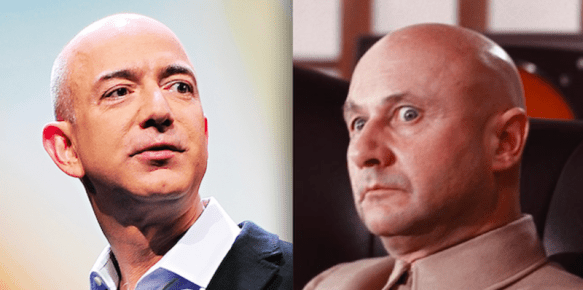
Bezos may look like the villain in a James Bond movie but there is nothing funny about him. He is deadly serious and so are his intentions. In a Bezos run world, every worker will be impoverished, every level of government will subsidize corporations, and anyone who speaks out will be discredited and under surveillance.

The last thing any city needs is a new Amazon headquarters. We need an end to billionaire rule in this country and around the world. That will be the salvation of the people, not more sweatshops run by wealthy people who steal from everyone else.


Margaret Kimberley’s Freedom Rider column appears weekly in BAR, and is widely reprinted elsewhere. She maintains a frequently updated blog as well as at freedomrider.blogspot.com. Ms. Kimberley lives in New York City, and can be reached via e-Mail at Margaret.Kimberley(at)BlackAgendaReport.com.

Zucktown, USA

Facebook, Amazon, and Google are reviving the ill-fated “company towns” of the Gilded Age

By Julianne Tveten

Source: The Baffler

EARLIER THIS YEAR IN SILICON VALLEY, a phalanx of six-figure-earning Facebook engineers confronted Mark Zuckerberg about subsidizing their extortionate rents. Meanwhile, the contract laborers who serve them bacon kimchi dogs and duck confit found themselves cordoned off from the affordable housing market—where salaries approaching $74,000 qualify—and began converting their garages into homes. Still, if these events point to a dire situation, they’re but the latest stirrings of the hulking leviathan that is the region’s housing crisis—an issue that has peppered the headlines of news outlets great and small for nearly a decade.

Thanks in part to this accretion of bad press, Zuckerberg and his fellow cyborgian billionaires have sprung into action as property developers. In July, Facebook announced plans to create “Willow Campus,” an aggressively rectilinear, Rem Koolhaas-designed rebrand of a Menlo Park office complex it purchased in 2015. The expansion of its headquarters will boast fifteen hundred units of housing, 15 percent of which it claims will be “offered at below-market rates.” If that isn’t sufficiently microcosmic, the company promises to dedicate 125,000 square feet to commercial space, promising a grocery store, pharmacy, and the cryptically worded “additional community-facing retail.”

Equally if not more responsible for crafting California’s bloodsucking geometric crapscape is Google, whose newfangled parent company Alphabet has vowed to provide temporary housing, in the form of modular dwellings, for three hundred of its employees in its home city of Mountain View. For years, Google has been seeking to wrest control of the city from its government; last year, it gained over 370,000 square feet of office space along with the right to develop 1.4 million square feet in the North Bayshore neighborhood after vying with LinkedIn to furnish the territory with a new police station, road improvements, and college scholarships. (The modular homes will be constructed on a former NASA air base, which the company signed an agreement to lease for sixty years.)


We’re witnessing, in these schemes, a revival of the company town. An oft-recurring feature of the Western capitalist imaginary, the company town’s American variety dates back to the nineteenth century; railroad industrialist George Pullman’s eponymous city in Illinois provides one of the more illustrative examples. Pullman characterized his town, completed in 1884, as a lucrative, pro-business utopia filled with satisfied participants, employee and investor alike. Its veneer was indeed shiny: the amenities it promised—yards, indoor plumbing, gas, trash removal—were rare for industrial workers of the time, and its ultra-formal gardens and shopping center, which equipped them with a barbershop, dentist’s offices, a bank, and a slew of overpriced retail, offered a vanguard capitalist’s dabbling in luxury.

There was a catch: paternalistic and omnipresent capitalism. Immaculately manicured trees were merely curtains obscuring a panopticon, one that kept workers behaviorally economized. (White workers, that is—the town expressly excluded black people.) “[Pullman] wanted to create a company town where everybody would be . . . content with their place in the capitalist system,” Jane Eva Baxter explained to Paleofuture. Workers were forced to rent—with no option to buy—the uniform row houses that corralled them, and from which they worried over persistent inspection and imminent eviction. Their employers likewise controlled which books filled their libraries and which performances took place in their theaters, and a ban precluded them from congregating at saloons or holding town meetings unless sanctioned by the Pullman Company, lest they entertain the notion of unionizing.

The forced exchange not just of labor, but of personal autonomy, for the tenuous ability to buy bread or light one’s stove is, in a word, inhumane, and in three, cause for revolt. Pullman workers had organized several strikes throughout the 1880s, but none were so monumental as the one in 1894. In response to the prior year’s economic depression, Pullman opted to slash workers’ wages; rents, however, remained steadfastly fixed, enriching the company’s reported worth of $62 million while leaving workers with as little as two cents (after paying for housing costs). In partnership with the American Railway Union, four thousand Pullman workers, galvanized and desperate, withheld their labor, and legions of workers throughout the nation would soon join them. Yet the strike collapsed when the Cleveland administration, in a violent display of authoritarianism, deployed federal troops and imprisoned labor leaders. Not long after, by Illinois Supreme Court order, the town was forced to sell everything not used expressly for “industry.”

Still, Pullman’s fiasco didn’t discourage other magnates. In 1900, chocolatier Milton Hershey began construction on a factory complex near a collection of dairy farms in rural Pennsylvania, where he declared there’d be “no poverty, no nuisances, no evil”—a Delphic precursor to Google’s now infamous and defunct slogan, “Don’t be evil.” To attract workers, Hershey reclaimed many of Pullman’s gilded comforts: indoor plumbing, pristine lawns, central heating, garbage pickup, and eventually, the theaters and sports venues any company town worth its salt would host.

What was designed as a wholesome advertisement for the company quickly morphed into a miserly surveillance state. Hershey, who served as the town’s mayor, constable, and fire chief, patrolled neighborhoods to survey the maintenance of houses and hired private detectives to monitor employees’ after-hours alcohol consumption. While the town managed to stage a sort of idyllic capitalist performance for onlookers, by the 1930s its employees resented their binding environs and the Depression-era layoffs they endured from a company earning ten times its annual payroll in after-tax profits. A crippled attempt to unionize with the Congress of Industrial Organizations (CIO) bred a 1937 sit-down strike; days later, farmers and company cheerleaders armed with rocks and pitchforks bloodied and ejected the dissidents, destabilizing for good another corporate-civic lark. Hershey’s vast estate, however, remains unscathed to this day.


If Facebook and Google have begun to revive the company town, Amazon has already given it a futuristic luster. California’s inchoate company towns pale in comparison to their northern counterpart, which occupies 19 percent of Seattle’s office space and a farcical 8.1 million square feet. (Its CEO and founder, Jeff Bezos, has vowed to acquire four million more over the next five years, a muscular move meant to complement his midlife-crisis physique.) Touting its sponsorship of local engineering and sustainability programs, Amazon crows about such “investments” as its dog park, playing fields, art installations, and Buckyball-reminiscent domical gardens. Of course, with Bezos’s colonizing aspirations comes yet another bellicose rental market—the very conditions Facebook and Google claim to be combatting. When considered alongside its recent purchase of Whole Foods, Amazon’s dream of tethering its employees to their jobs—by way of homogenized cubes for rent and lightly discounted quinoa chips—is fast becoming a reality.

Like George Pullman and Milton Hershey, the tech industry’s elites take all prisoners in their respective campaigns to expand, absorb, and dominate. The tech company town, that most contemporary of neofeudalist wangles, is the next step in West Coast corporate behemoths’ quest to lure employees into a twenty-four-hour working existence—the totalizing successor to bottomless Indian food spreads, on-site bike-repair shops, and Frank Gehrized habitats. Its premise deviates not at all from that of its antecedents: a genial, painstakingly aestheticized service to workers, where beneficent corporate hands take the reins of the public good  for the well-being of the community. This time around, though, that community will be bridled with unionbusting and data-harvesting apparatuses sure to make even the most paranoid techno-tyrant salivate.

Certainly, the megalomaniacs who aim to populate municipal fixtures with registered-trademark logos will expect cities to genuflect at every turn. Bezos has exemplified this in Seattle, whose recent measure to “tax the rich” drove him to seek another location in which to build Amazon’s second headquarters. While residents of its hometown grapple with a commandeering leech that “suck[s] up our resources and refus[es] to participate in daily upkeep,” Amazon will soon attempt to prime another city to be sapped. Meanwhile, the smooth-faced metallic vampires of California have just begun to cosplay as frontiersmen, raring to follow Bezos’s lead. Drunk on glib TED Talk propagandizing, and accustomed to dismissing the civic inconveniences of corporate regulations and poor neighborhoods, our technosettlers feel little need to heed the lessons of the past when their chief interest is to monopolize the future. Taxing the techie billionaires is a start, but only when cities refuse to be their hosts will they cease to be their parasites.


Julianne Tveten writes about the technology industry’s relationship with socioeconomics and culture. Her work has appeared in Current Affairs, Hazlitt, In These Times, The Outline, and elsewhere.

Now Just Five Men Own Almost as Much Wealth as Half the World’s Population

By Paul Buchheit

Source: CommonDreams

Last year it was 8 men, then down to 6, and now almost 5.

While Americans fixate on Trump, the super-rich are absconding with our wealth, and the plague of inequality continues to grow. An analysis of 2016 data found that the poorest five deciles of the world population own about $410 billion in total wealth. As of 06/08/17, the world’s richest five men owned over $400 billion in wealth. Thus, on average, each man owns nearly as much as 750 million people.

Why Do We Let a Few People Shift Great Portions of the World’s Wealth to Themselves? 

Most of the super-super-rich are Americans. We the American people created the Internet, developed and funded Artificial Intelligence, and built a massive transportation infrastructure, yet we let just a few individuals take almost all the credit, along with hundreds of billions of dollars.

Defenders of the out-of-control wealth gap insist that all is OK, because, after all, America is a ‘meritocracy’ in which the super-wealthy have ‘earned’ all they have. They heed the words of Warren Buffett: “The genius of the American economy, our emphasis on a meritocracy and a market system and a rule of law has enabled generation after generation to live better than their parents did.”

But it’s not a meritocracy. Children are no longer living better than their parents did. In the eight years since the recession the Wilshire Total Market valuation has more than TRIPLED, rising from a little over $8 trillion to nearly $25 trillion. The great majority of it has gone to the very richest Americans. In 2016 alone, the richest 1% effectively shifted nearly $4 trillion in wealth away from the rest of the nation to themselves, with nearly half of the wealth transfer ($1.94 trillion) coming from the nation’s poorest 90%—the middle and lower classes. That’s over $17,000 in housing and savings per lower-to-middle-class household lost to the super-rich.

A meritocracy? Bill Gates, Mark Zuckerberg, and Jeff Bezos have done little that wouldn’t have happened anyway. ALL modern U.S. technology started with—and to a great extent continues with—our tax dollars and our research institutes and our subsidies to corporations.

Why Do We Let Unqualified Rich People Tell Us How To Live? Especially Bill Gates! 

In 1975, at the age of 20, Bill Gates founded Microsoft with high school buddy Paul Allen. At the time Gary Kildall’s CP/M operating system was the industry standard. Even Gates’ company used it. But Kildall was an innovator, not a businessman, and when IBM came calling for an OS for the new IBM PC, his delays drove the big mainframe company to Gates. Even though the newly established Microsoft company couldn’t fill IBM’s needs, Gates and Allen saw an opportunity, and so they hurriedly bought the rights to another local company’s OS — which was based on Kildall’s CP/M system. Kildall wanted to sue, but intellectual property law for software had not yet been established. Kildall was a maker who got taken.

So Bill Gates took from others to become the richest man in the world. And now, because of his great wealth and the meritocracy myth, MANY PEOPLE LOOK TO HIM FOR SOLUTIONS IN VITAL AREAS OF HUMAN NEED, such as education and global food production.

—Gates on Education: He has promoted galvanic skin response monitors to measure the biological reactions of students, and the videotaping of teachers to evaluate their performances. About schools he said, “The best results have come in cities where the mayor is in charge of the school system. So you have one executive, and the school board isn’t as powerful.”

—Gates on Africa: With investments in or deals with MonsantoCargill, and Merck, Gates has demonstrated his preference for corporate control over poor countries deemed unable to help themselves. But no problem—according to Gates, “By 2035, there will be almost no poor countries left in the world.”

Warren Buffett: Demanding To Be Taxed at a Higher Rate (As Long As His Own Company Doesn’t Have To Pay) 

Warren Buffett has advocated for higher taxes on the rich and a reasonable estate tax. But his company Berkshire Hathaway has used “hypothetical amounts” to ‘pay’ its taxes while actually deferring $77 billion in real taxes.

Jeff Bezos: $50 Billion in Less Than Two Years, and Fighting Taxes All the Way 

Since the end of 2015 Jeff Bezos has accumulated enough wealth to cover the entire $50 billion U.S. housing budget, which serves five million Americans. Bezos, who has profited greatly from the Internet and the infrastructure built up over many years by many people with many of our tax dollars, has used tax havens and high-priced lobbyists to avoid the taxes owed by his company.

Mark Zuckerberg (6th Richest in World, 4th Richest in America) 

While Zuckerberg was developing his version of social networking at Harvard, Columbia University students Adam Goldberg and Wayne Ting built a system called Campus Network, which was much more sophisticated than the early versions of Facebook. But Zuckerberg had the Harvard name and better financial support. It was also alleged that Zuckerberg hacked into competitors’ computers to compromise user data.

Now with his billions he has created a ‘charitable’ foundation, which in reality is a tax-exempt limited liability company, leaving him free to make political donations or sell his holdings, all without paying taxes.

Everything has fallen into place for young Zuckerberg. Nothing left to do but run for president.

The False Promise of Philanthropy 

Many super-rich individuals have pledged the majority of their fortunes to philanthropic causes. That’s very generous, if they keep their promises. But that’s not really the point.

American billionaires all made their money because of the research and innovation and infrastructure that make up the foundation of our modern technologies. They have taken credit, along with their massive fortunes, for successes that derive from society rather than from a few individuals. It should not be any one person’s decision about the proper use of that wealth. Instead a significant portion of annual national wealth gains should be promised to education, housing, health research, and infrastructure. That is what Americans and their parents and grandparents have earned after a half-century of hard work and productivity.

Godzilla Amazon: The Amount of Power in Jeff Bezos’ Hands Should Frighten All Americans

Amazon very effectively uses technology and data to sidestep traditional restrictions on monopoly power.

By Matt Stoller

Source: AlterNet

To understand the depth and breadth of Jeff Bezos’ ambitions for the company he built, type www.relentless.com into your browser. The domain Bezos registered in 1994 will redirect to Amazon, the company aptly, and ambitiously, nicknamed The Everything Store. He tells his shareholders that the company will act like an aggressive startup — that at Amazon, it is always Day One.

Like Google and Facebook, Amazon uses technology and data to sidestep traditional restrictions on monopoly power. Our lives are increasingly organized by the platforms these companies run, platforms which now mediate the way we communicate and engage in commerce with each other. We are living in a world organized by tech monopolists, a change in power relationships that no one voted for but has been imposed upon us nonetheless.

Now, Bezos is attempting to add more power to his empire with the surprise announcement that the company will pay $13.7 billion for Whole Foods Market. Amazon will now have a store footprint in neighborhoods across America.

Our communities and the way we engage in commerce will change. Imagine walking into a Whole Foods store and seeing different prices depending on whether you are a member of Amazon Prime — or seeing different prices depending on any other way that you interact with Amazon.

This isn’t implausible. It is what the company does when it opens up stores. For instance, Amazon is creating a chain of physical book stores to take the place of the book stores the company destroyed. In these stores, there are no price tags at all: You scan the items with your phone and have a price delivered to you, personalized by Amazon. Why wouldn’t Amazon extend this to Whole Foods? “Our goal with Amazon Prime, make no mistake,” says Amazon CEO Jeff Bezos, “is to make sure that if you are not a Prime member, you are being irresponsible.”

This statement and the amount of power in Bezos’ hands should frighten all Americans. Bezos meant that Amazon will soon be so good for consumers that it would just be folly not to be a member. But what he unwittingly implied is that as a citizen, you will have no choice but to interact with his institution to buy and sell key goods that everyone needs — on his terms.

Jeff Bezos, in other words, has a vision. To be everywhere, to be the platform for everything for every consumer. So when Bezos calls you irresponsible for not tithing to Amazon, America has a big political problem.

Amazon’s takeover of Whole Foods means that it can target and eliminate regional competitors one by one as it did with its online competitors. When Diapers.com emerged as a competitor to Amazon, Amazon simply sold diapers below cost until the company capitulated and sold itself to Bezos. There’s no reason to assume Amazon wouldn’t bring the same predatory pricing strategy to bear in every city in America. Why wouldn’t it? Even though predatory pricing is illegal, the government hasn’t enforced those laws for decades. Whole Foods tends to source from local farms as part of a commitment to localism; these farms will now be negotiating with a much bigger entity that is committed to a ruthless model of efficiency.

There are so many ways that Amazon can use its power that it’s simply impossible to figure out what it will do. Amazon probably doesn’t even know yet; it will discover and test them, relentlessly. Maybe you will get first in line, or last in line, for the most popular toy during the Christmas period, or maybe the restaurant you own will get access to the freshest yet limited batch strawberries you need based on whether you are giving better deals to Prime members.

Or here’s a more creative possibility. Amazon is excluding Amazon Prime video from Apple TV so that Prime members will buy its streaming device instead of Apple’s. As the smartphone market commodifies and transforms, Bezos could simply use his combined physical and online footprint to keep you from even seeing prices at his stores unless you are using Amazon-approved electronic devices. If Amazon were just one of many stores that would be one thing. But Amazon is quickly becoming the dominant way to buy and sell.

And this, make no mistake, is what is happening. Upon the announcement of the acquisition, Target’s stock price dropped by 10 percent and Walmart’s by 5 percent. Amazon’s rose by more than the price it is paying for Whole Foods. Wall Street sees the writing on the wall. There is only one force that can stop Amazon from organizing and regulating basically all American retail commerce — our democratic institutions and our political system. We the people.

Bezos knows Amazon is a political enterprise at this point. The day before he announced his company’s attempt to buy this supermarket chain, he released a request on Twitter to have people offer ideas for where he can direct charity money. That is the kind of public relations undertaken by political leaders. And Amazon put out an ad for a Ph.D. economist-cum-lobbyist “to educate regulators and policy makers about the fundamentally procompetitive focus of Amazon’s businesses.” And he has put political fixers, like Ivanka Trump’s lawyer and ex-Clinton administration officer Jamie Gorelick, on his board of directors. He also bought The Washington Post.

The public should speak out in opposition to this merger. More than that, the government should take this opportunity to reject the entire pro-finance pro-concentration philosophy that has taken hold in this country since the Reagan era. It is no accident that Whole Foods founder John Mackey was forced to surrender his life’s work because financiers looking for a quick buck bought up a large bloc of shares in his company and pressured him to sell the company to Amazon. The day before the announcement of the sale, he called these hedge funds “Ringwraiths,” after the evil characters in “Lord of the Rings.” Bezos might be the most powerful empire-builder in the land, but he had help.

This merger should frighten all of us. But it should also embolden anyone who believes that America should not be in thrall to monopolists like Bezos. For them, today, as Jeff Bezos might put it, is Day One.

Matt Stoller is fellow at the Open Markets program, where he is researching the history of the relationship between concentrated financial power and the Democratic party in the 20th century.