The Four Horsemen of Gaza’s Apocalypse

Joe Biden relies on advisors who view the world through the prism of the West’s civilizing mission to the “lesser breeds” of the earth to formulate his policies towards Israel and the Middle East.

By Chris Hedges

Source: ScheerPost

Joe Biden’s inner circle of strategists for the Middle East — Antony Blinken, Jake Sullivan and Brett McGurk — have little understanding of the Muslim world and a deep animus towards Islamic resistance movements. They see Europe, the United States and Israel as involved in a clash of civilizations between the enlightened West and a barbaric Middle East. They believe that violence can bend Palestinians and other Arabs to their will. They champion the overwhelming firepower of the U.S. and Israeli military as the key to regional stability — an illusion that fuels the flames of regional war and perpetuates the genocide in Gaza.

In short, these four men are grossly incompetent. They join the club of other clueless leaders, such as those who waltzed into the suicidal slaughter of World War One, waded into the quagmire of Vietnam or who orchestrated the series of recent military debacles in Iraq, Libya, Syria and Ukraine. They are endowed with the presumptive power vested in the Executive Branch to bypass Congress, to provide weapons to Israel and carry out military strikes in Yemen and Iraq. This inner circle of true believers dismiss the more nuanced and informed counsels in the State Department and the intelligence communities, who view the refusal of the Biden administration to pressure Israel to halt the ongoing genocide as ill-advised and dangerous. 

Biden has always been an ardent militarist — he was calling for war with Iraq five years before the U.S. invaded. He built his political career by catering to the distaste of the white middle class for the popular movements, including the anti-war and civil rights movements, that convulsed the country in the 1960s and 1970s. He is a Republican masquerading as a Democrat. He joined Southern segregationists to oppose bringing Black students into Whites-only schools. He opposed federal funding for abortions and supported a constitutional amendment allowing states to restrict abortions. He attacked President George H. W. Bush in 1989 for being too soft in the “war on drugs.” He was one of the architects of the 1994 crime bill and a raft of other draconian laws that more than doubled the U.S. prison population, militarized the police and pushed through drug laws that saw people incarcerated for life without parole. He supported the North American Free Trade Agreement, the greatest betrayal of the working class since the 1947 Taft-Hartley Act. He has always been a strident defender of Israel, bragging that he did more fundraisers for the American Israel Public Affairs Committee (AIPAC) than any other Senator. 

“As many of you heard me say before, were there no Israel, America would have to invent one.  We’d have to invent one because… you protect our interests like we protect yours,” Biden said in 2015, to an audience that included the Israeli ambassador, at the 67th Annual Israeli Independence Day Celebration in Washington D.C. During the same speech he said, “The truth of the matter is we need you.  The world needs you. Imagine what it would say about humanity and the future of the 21st century if Israel were not sustained, vibrant and free.”

The year before Biden gave a gushing eulogy for Ariel Sharon, the former Israeli prime minister and general who was implicated in massacres of Palestinians, Lebanese and others in Palestine, Jordan and Lebanon — as well as Egyptian prisoners of war — going back to the 1950s. He described Sharon as “part of one of the most remarkable founding generations in the history not of this nation, but of any nation.”

While repudiating Donald Trump and his administration, Biden has not reversed Trump’s abrogation of the Iran nuclear deal negotiated by Barack Obama, or Trump’s sanctions against Iran. He has embraced Trump’s close ties with Saudi Arabia, including the rehabilitation of Crown Prince and Prime Minister Mohammed bin Salman, following the assassination of the Saudi journalist Jamal Khashoggi in 2017 in the consulate of Saudi Arabia in Istanbul. He has not intervened to curb Israeli attacks on Palestinians and settlement expansion in the West Bank. He did not reverse Trump’s moving of the U.S. Embassy to Jerusalem, although the embassy includes land Israel illegally colonized after invading the West Bank and Gaza in 1967. 

As a seven-term senator of Delaware, Biden received more financial support from pro-Israel donors than any other senator, since 1990. Biden retains this record despite the fact that his senatorial career ended in 2009, when he became Obama’s vice president. Biden explains his commitment to Israel as “personal” and “political.” 

He has parroted back Israeli propaganda — including fabrications about beheaded babies and widespread rape of Israeli women by Hamas fighters — and asked Congress to provide $14 billion in additional aid to Israel since the Oct. 7 attack. He has twice bypassed Congress to supply Israel with thousands of bombs and munitions, including at least 100 2,000-pound bombs, used in the scorched earth campaign in Gaza. 

Israel has killed or seriously wounded close to 90,000 Palestinians in Gaza, almost one in every 20 inhabitants. It has destroyed or damaged over 60 percent of the housing. The “safe areas,” to which some 2 million Gazans were instructed to flee in southern Gaza, have been bombed, with thousands of casualties. Palestinians in Gaza now make up 80 percent of all the people facing famine or catastrophic hunger worldwide, according to the U.N. Every person in Gaza is hungry. A quarter of the population are starving and struggling to find food and drinkable water. Famine is imminent. The 335,000 children under the age of five are at high risk of malnutrition. Some 50,000 pregnant women lack healthcare and adequate nutrition.

And it could all end if the U.S. chose to intervene.

“All of our missiles, the ammunition, the precision-guided bombs, all the airplanes and bombs, it’s all from the U.S.,” retired Israeli Major General Yitzhak Brick told the Jewish News Syndicate. “The minute they turn off the tap, you can’t keep fighting. You have no capability… Everyone understands that we can’t fight this war without the United States. Period.”

Blinken was Biden’s principal foreign policy adviser when Biden was the ranking Democrat on the Foreign Relations Committee. He, along with Biden, lobbied for the invasion of Iraq. When he was Obama’s deputy national security advisor, he advocated the 2011 overthrow of Muammar Gaddafi in Libya. He opposed withdrawing U.S. forces from Syria. He worked on the disastrous Biden Plan to partition Iraq along ethnic lines.

“Within the Obama White House, Blinken played an influential role in the imposition of sanctions against Russia over the 2014 invasion of Crimea and eastern Ukraine, and subsequently led ultimately unsuccessful calls for the U.S. to arm Ukraine,” according to the Atlantic Council, NATO’s unofficial think tank. 

When Blinken landed in Israel following the attacks by Hamas and other resistance groups on Oct. 7, he announced at a press conference with Prime Minister Benjamin Netanyahu: “I come before you not only as the United States Secretary of State, but also as a Jew.”

He attempted, on Israel’s behalf, to lobby Arab leaders to accept the 2.3 million Palestinian refugees Israel intends to ethnically cleanse from Gaza, a request that evoked outrage among Arab leaders.

Sullivan, Biden’s national security advisor, and McGurk, are consummate opportunists, Machiavellian bureaucrats who cater to the reigning centers of power, including the Israel lobby.  

Sullivan was the chief architect of Hillary Clinton’s Asia pivot. He backed the corporate and investor rights Trans-Pacific Partnership Agreement, which was sold as helping the U.S. contain China. Trump ultimately killed the trade agreement in the face of mass opposition from the U.S. public. His focus is thwarting a rising China, including through the expansion of the U.S. military. 

While not focused on the Middle East, Sullivan is a foreign policy hawk who has a knee jerk embrace of force to shape the world to U.S. demands. He embraces military Keynesianism, arguing that massive government spending on the weapons industry benefits the domestic economy.

In a 7,000-word essay for Foreign Affairs magazine published five days before the Oct. 7 attacks, which left some 1,200 Israelis dead, Sullivan exposed his lack of understanding of the dynamics of the Middle East.

“Although the Middle East remains beset with perennial challenges,” he writes in the original version of the essay, “the region is quieter than it has been for decades,” adding that in the face of “serious” frictions, “we have de-escalated crises in Gaza.”

Sullivan ignores Palestinian aspirations and Washington’s rhetorical backing for a two-state solution in the article, hastily rewritten in the online version after the Oct. 7 attacks. He writes in his original piece:

At a meeting in Jeddah, Saudi Arabia, last year, the president set forth his policy for the Middle East in an address to the leaders of members of the Gulf Cooperation Council, Egypt, Iraq, and Jordan. His approach returns discipline to US policy. It emphasizes deterring aggression, de-escalating conflicts, and integrating the region through joint infrastructure projects and new partnerships, including between Israel and its Arab neighbors.

McGurk, the deputy assistant to President Biden and the coordinator for the Middle East and North Africa at the White House National Security Council, was a chief architect of Bush’s “surge” in Iraq, which accelerated the bloodletting. He worked as a legal advisor to the Coalition Provisional Authority and the U.S. ambassador in Baghdad. He then became Trump’s anti-ISIS czar.

He does not speak Arabic — none of the four men does — and came to Iraq with no knowledge of its history, peoples or culture. Nevertheless, he helped draft Iraq’s interim constitution and oversaw the legal transition from the Coalition Provisional Authority to an Interim Iraqi Government led by Prime Minister Ayad Allawi. McGurk was an early backer of Nouri al-Maliki, who was Iraq’s prime minister between 2006 and 2014. Al-Maliki built a Shi’ite-controlled sectarian state that deeply alienated Sunni Arabs and Kurds. In 2005, McGurk transferred to the National Security Council (NSC), where he served as director for Iraq, and later as special assistant to the president and senior director for Iraq and Afghanistan. He served on the NSC staff from 2005 to 2009. In 2015, he was appointed as Obama’s Special Presidential Envoy for the Global Coalition to Counter ISIL. He was retained by Trump until his resignation in Dec. 2018. 

An article in April 2021 titled “Brett McGurk: A Hero of Our Times,” in New Lines Magazine by former BBC foreign correspondent Paul Wood, paints a scathing portrait of McGurk. Wood writes:

A senior Western diplomat who served in Baghdad told me that McGurk had been an absolute disaster for Iraq. “He is a consummate operator in Washington, but I saw no sign that he was interested in Iraqis or Iraq as a place full of real people. It was simply a bureaucratic and political challenge for him.” One critic who was in Baghdad with McGurk called him Machiavelli reincarnated. “It’s intellect plus ambition plus the utter ruthlessness to rise no matter the cost.”

[….]

A U.S. diplomat who was in the embassy when McGurk arrived found his steady advance astonishing. “Brett only meets people who speak English. … There are like four people in the government who speak English. And somehow he’s now the person who should decide the fate of Iraq? How did this happen?”

Even those who didn’t like McGurk had to admit that he had a formidable intellect — and was a hard worker. He was also a gifted writer, no surprise as he had clerked for Supreme Court Chief Justice William Rehnquist. His rise mirrored that of an Iraqi politician named Nouri al-Maliki, one careerist helping the other. That is McGurk’s tragedy — and Iraq’s.

[….]

McGurk’s critics say his lack of Arabic meant he missed the vicious, sectarian undertones of what al-Maliki was saying in meetings right from the start. Translators censored or failed to keep up. Like many Americans in Iraq, McGurk was deaf to what was happening around him.

Al-Maliki was the consequence of two mistakes by the U.S. How much McGurk had to do with them remains in dispute. The first mistake was the “80 Percent Solution” for ruling Iraq. The Sunni Arabs were mounting a bloody insurgency, but they were just 20% of the population. The theory was that you could run Iraq with the Kurds and the Shiites. The second error was to identify the Shiites with hardline, religious parties backed by Iran. Al-Maliki, a member of the religious Da’wa Party, was the beneficiary of this.

In a piece in HuffPost in May 2022 by Akbar Shahid Ahmed, titled “Biden’s Top Middle East Advisor ‘Torched the House and Showed Up With a Firehose,’” McGurk is described by a colleague, who asked not to be named, as “the most talented bureaucrat they’ve ever seen, with the worst foreign policy judgment they’ve ever seen.”

McGurk, like others in the Biden administration, is bizarrely focused on what comes after Israel’s genocidal campaign, rather than trying to halt it. McGurk proposed denying humanitarian aid and refusing to implement a pause in the fighting in Gaza until all the Israeli hostages were freed. Biden and his three closest policy advisors have called for the Palestinian Authority —  an Israeli puppet regime that is reviled by most Palestinians — to take control of Gaza once Israel finishes leveling it. They have called on Israel — since Oct. 7 — to take steps towards a two-state solution, a plan rejected in an humiliating public rebuke to the the Biden White House by Netanyahu. 

The Biden White House spends more time talking to the Israelis and Saudis, who are being lobbied to normalize relations with Israel and help rebuild Gaza, than the Palestinians, who are at best, an afterthought. It believes the key to ending Palestinian resistance is found in Riyadh, summed up in a top-secret document peddled by McGurk called the “Jerusalem-Jeddah Pact,” the HuffPost reported. It is unable or unwilling to curb Israel’s bloodlust, which included missile strikes in a residential neighborhood in Damascus, Syria, on Saturday that killed five military advisors from Iran’s Islamic Revolutionary Guard Corps, and a drone attack in South Lebanon on Sunday, which killed two senior members of Hezbollah. These Israeli provocations will not go unanswered, evidenced by the ballistic missiles and rockets launched on Sunday by militants in western Iraq that targeted U.S. personnel stationed at the al-Assad Airbase.

The Alice-in-Wonderland idea that once the slaughter in Gaza ends a diplomatic pact between Israel and Saudi Arabia will be the key to regional stability is stupefying. Israel’s genocide, and Washington’s complicity, is shredding U.S. credibility and influence, especially in the Global South and the Muslim world. It ensures another generation of enraged Palestinians — whose families have been obliterated and whose homes have been destroyed — seeking vengeance.  

The policies embraced by the Biden administration not only blithely ignore the realities in the Arab world, but the realities of an extremist Israeli state that, with Congress bought and paid for by the Israel lobby, couldn’t care less what the Biden White House dreams up. Israel has no intention of creating a viable Palestinian state. Its goal is the ethnic cleansing of the 2.3 million Palestinians from Gaza and the annexation of Gaza by Israel. And when Israel is done with Gaza, it will turn on the West Bank, where Israeli raids now occur on an almost nightly basis and where thousands have been arrested and detained without charge since Oct. 7. 

Those running the show in the Biden White House are chasing after rainbows. The march of folly led by these four blind mice perpetuates the cataclysmic suffering of the Palestinians, stokes a regional war and presages another tragic and self-defeating chapter in the two decades of U.S. military fiascos in the Middle East.
Summer of the Hawks

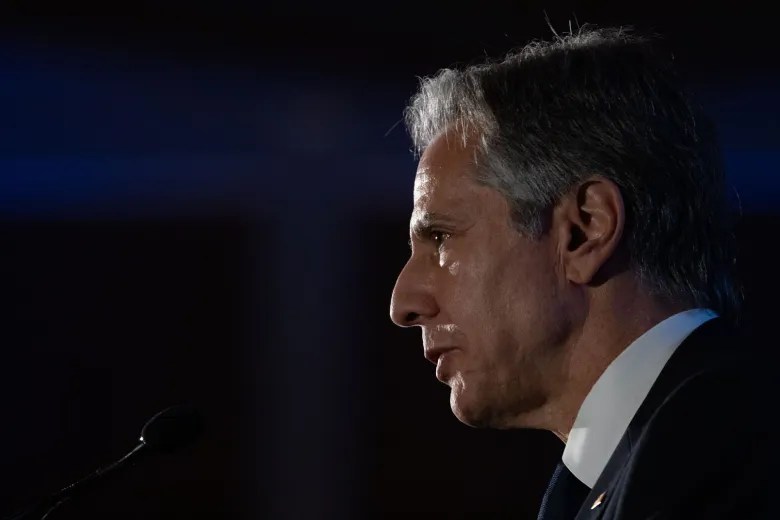
Secretary of State Antony Blinken speaks during the Mandela Washington Fellowship Summit for Young African Leaders in Washington, DC, August 2, 2023. (Official State Department photo by Chuck Kennedy)

By Seymour Hersh

Source: Rise Up Times

It’s been weeks since we looked into the adventures of the Biden administration’s foreign policy cluster, led by Tony Blinken, Jake Sullivan, and Victoria Nuland. How has the trio of war hawks spent the summer?

Sullivan, the national security adviser, recently brought an American delegation to the second international peace summit earlier this month at Jeddah in Saudi Arabia. The summit was led by Crown Prince Mohammed bin Salman, known as MBS, who in June announced a merger between his state-backed golf tour and the PGA. Four years earlier MBS was accused of ordering the assassination and dismemberment of the journalist Jamal Khashoggi at the Saudi consulate in Istanbul, for perceived disloyalty to the state.

As unlikely as it sounds, there was such a peace summit and its stars did include MBS, Sullivan, and President Volodymyr Zelensky of Ukraine. What was missing was a representative of Russia, which was not invited to the summit. It included just a handful of heads of state from the fewer than fifty nations that sent delegates. The conference lasted two days, and attracted what could only be described as little international attention.

Reuters reported that Zelensky’s goal was to get international support for “the principles” that that he will consider as a basis for the settlement of the war, including “the withdrawal of all Russian troops and the return of all Ukrainian territory.” Russia’s formal response to the non-event came not from President Vladimir Putin but from Deputy Minister of Foreign Affairs Sergei Ryabkov. He called the summit “a reflection of the West’s attempt to continue futile, doomed efforts” to mobilize the Global South behind Zelensky.

India and China both sent delegations to the session, perhaps drawn to Saudi Arabia for its immense oil reserves. One Indian academic observer dismissed the event as achieving little more than “good advertising for MBS’s convening power within the Global South; the kingdom’s positioning in the same; and perhaps more narrowly, aiding American efforts to build consensus by making sure China attends the meeting with . . . Jake Sullivan in the same room.”

Meanwhile, far away on the battlefield in Ukraine, Russia continued to thwart Zelensky’s ongoing counteroffensive. I asked an American intelligence official why it was Sullivan who emerged from the Biden administration’s foreign policy circle to preside over the inconsequential conference in Saudi Arabia.

“Jeddah was Sullivan’s baby,” the official said. “He planned it to be Biden’s equivalent of [President Woodrow] Wilson’s Versailles. The grand alliance of the free world meeting in a victory celebration after the humiliating defeat of the hated foe to determine the shape of nations for the next generation. Fame and Glory. Promotion and re-election. The jewel in the crown was to be Zelensky’s achievement of Putin’s unconditional surrender after the lightning spring offensive. They were even planning a Nuremberg type trial at the world court, with Jake as our representative. Just one more fuck-up, but who is counting? Forty nations showed up, all but six looking for free food after the Odessa shutdown”—a reference to Putin’s curtailing of Ukrainian wheat shipments in response to Zelensky’s renewed attacks on the bridge linking Crimea to the Russian mainland.

Enough about Sullivan. Let us now turn to Victoria Nuland, an architect of the 2014 overthrow of the pro-Russian government in Ukraine, one of the American moves that led us to where we are, though it was Putin who initiated the horrid current war. The ultra-hawkish Nuland was promoted early this summer by Biden, over the heated objections of many in the State Department, to be the acting deputy secretary of state. She has not been formally nominated as the deputy for fear that her nomination would lead to a hellish fight in the Senate.

It was Nuland who was sent last week to see what could be salvaged after a coup led to the overthrow of a pro-Western government in Niger, one of a group of former French colonies in West Africa that have remained in the French sphere of influence. President Mohamed Bazoum, who was democratically elected, was tossed out of office by a junta led by the head of his presidential guard, General Abdourahmane Tchiani. The general suspended the constitution and jailed potential political opponents. Five other military officers were named to his cabinet. All of this generated enormous public support on the streets in Niamey, Niger’s capital—enough support to discourage outside Western intervention.

There were grim reports in the Western press that initially viewed the upheaval in East-West terms: some of the supporters of the coup were carrying Russian flags as they marched in the streets. The New York Times saw the coup as a blow to the main US ally in the region, Nigerian President Bola Ahmed Tinubu, who controls vast oil and gas reserves. Tinubu threatened the new government in Niger with military action unless they returned power to Bazoum. He set a deadline that passed without any outside intervention.

The revolution in Niger was not seen by those living in the region in east-west terms but as a long needed rejection of long-standing French economic and political control. It is a scenario that may be repeated again and again throughout the French-dominated Sahel nations in sub-Saharan Africa.

There are distinctions that do not bode well for the new government in Niger. The nation is blessed, or perhaps cursed, by having a significant amount of the remaining natural uranium deposits in the world. As the world warms up, a return to nuclear generated power is seen as inevitable, with obvious implications for the value of the stuff underground in Niger. The raw uranium ore, when separated, filtered and processed is known worldwide as yellowcake.

The corruption so often “talked about in Niger is not about petty bribes by government officials, but about an entire structure—developed during French colonial rule—that prevents Niger from establishing sovereignty over its raw materials and over its development,” according to a recent analysis published by Baltimore’s Real News Network. Three out of four laptops in France are powered by nuclear energy, much of which is derived from uranium mines in Niger effectively controlled by its former colonial overlord.

Niger is also the home of three American drone bases targeting Islamic radicals throughout the region. There  are also undeclared Special Forces outposts in the region, whose soldiers receive double pay while on their risky combat assignments. The American official told me that “the 1,500 US troops now in Niger are exactly the number of American troops who were in South Vietnam at the time John F. Kennedy took over the presidency in 1961.”

Into this scene came Victoria Nuland, who must have drawn the short straw inside the Biden Administration. She was sent to negotiate with the new regime and to arrange a meeting with the ousted President Bazoum, whose life remains under constant threat from the governing junta. The New York Times reported that she got nowhere after talks she described as “extremely frank and at times quite difficult.” The intelligence official put her remarks to the Times in American military lingo: “Victoria set out to save the Niger uranium owners from the barbaric Russians and got a huge single-finger salute.”

Quieter in recent weeks than Sullivan and Nuland has been Secretary of State Tony Blinken. Where was he? I asked that question of the official, who said that Blinken “has figured out that the United States”—that is, our ally Ukraine—“will not win the war” against Russia. “The word was getting to him through the Agency [CIA] that the Ukrainian offense was not going to work. It was a show by Zelensky and there were some in the administration who believed his bullshit.

“Blinken wanted to broker a peace deal between Russia and Ukraine as Kissinger did in Paris to end the Vietnam war.” Instead, the official said, “it was going to be a big lose and Blinken found himself way over his skis. But he does not want to go down as the court jester.”

It was at this moment of doubt, the official said, that Bill Burns, the CIA director, “made his move to join the sinking ship.” He was referring to Burns’s speech earlier this summer at the annual Ditchley conference near London. He appeared to put aside his earlier doubts about expanding NATO to the east and affirmed his support at least five times for Biden’s program.

“Burns does not lack self-confidence and ambition,” the intelligence official said, especially when Blinken, the ardent war hawk, was suddenly having doubts. Burns served in a prior administration as deputy secretary of state and running the CIA was hardly a just reward.

Burns would not replace a disillusioned Blinken, but only get a token promotion: an appointment to Biden’s cabinet. The cabinet meets no more than once a month and, as recorded by C-SPAN, the meetings tend to be tightly scripted affairs and to begin with the president reading from a prepared text.

Tony Blinken, who publicly vowed just a few months ago that there would be no immediate ceasefire in Ukraine, is still in office and, if asked, would certainly dispute any notion of discontent with Zelensky or the administration’s murderous and failing war policy in Ukraine.

So the White House’s wishful approach to the war, when it comes to realistic talk to the American people, will continue apace. But the end is nearing, even if the assessments supplied by Biden to the public are out of a comic strip.

This piece is from Seymour Hersh’s Substack, you may subscribe to it here.

$850 Billion Chicken Comes Home to Roost.

War Reveals U.S. Military’s Longtime Disinterest in War.

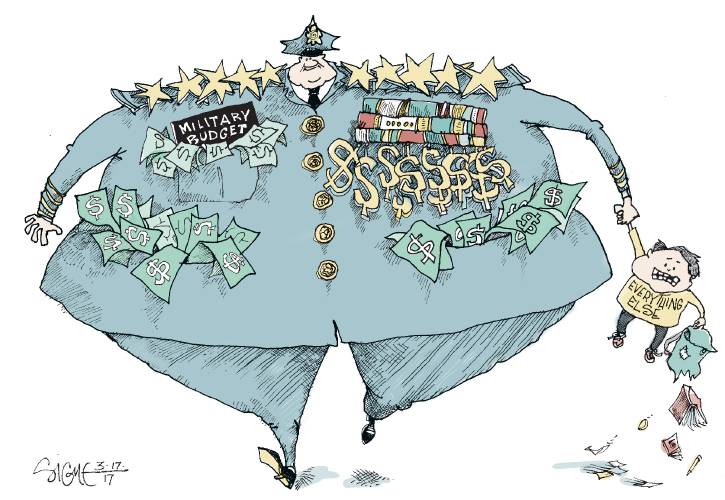
Signe’s second toon du jour SIGN17e Military

By Andrew Cockburn

Source: Spoils of War

Watching a recent video of Ukrainian troops scrambling out of a U.S.-supplied Bradley armored fighting vehicle just after it hit a mine, I remembered how hard the U.S. Army bureaucrats and contractors who developed the weapon had fought to keep this vehicle a death trap for anyone riding inside. As originally designed, Bradleys promptly burst into flame when hit with anything much more powerful than a BB pellet, incinerating anyone riding inside. The armor bureaucrats were well aware of this defect, but pausing development for a redesign might have hurt their budget, so they delayed and cheated on tests to keep the program on track. Prior to one test, they covertly substituted water-tanks for the ammunition that would otherwise explode. Only when Jim Burton, a courageous air force lieutenant colonel from the Pentagon’s testing office, enlisted Congress to mandate a proper live fire test were the army’s malign subterfuges exposed and corrected. His principled stand cost him his career, but the Bradley was redesigned, rendering it less potentially lethal for passengers. Hence, forty years on, the survival of those lucky Ukrainians.

This largely forgotten episode serves as a vivid example of an essential truth about our military machine: it is not interested in war.

How else to understand the lack of concern for the lives of troops, or producing a functioning weapon system? As Burton observed in his instructive 1993 memoir Pentagon Wars, the U.S. defense system is “a corrupt business — ethically and morally corrupt from top to bottom.”

Nothing has happened in the intervening years to contradict this assessment, with potentially grim consequences for men and women on the front line. Today, for example, the U.S. Air Force is abandoning its traditional role of protecting and coordinating with troops on the ground, otherwise known as Close Air Support, or CAS. Given its time-honored record of bombing campaigns that had little or no effect on the course of wars, CAS has probably been the only useful function (grudgingly) performed by the service.

The Air Force has always resented the close support mission, accepting the role only because handing it to the Army would entail losing budget share. Thus the A-10 “Warthog” aircraft, specifically dedicated to CAS, was developed by the air force only to ward off a threat from the Army to steal the mission with a new helicopter. As it turned out, the A-10, thanks to the dedicated genius of its creators, notably the late Pierre Sprey, was supremely suited to the mission. But its successful record cuts no ice with the air force, which has worked with might and main to get rid of the A-10 ever since the threat of an army competitor in the eternal battle for budget share had been eliminated.

That campaign is now entering its final stages. The air force is not only getting rid of its remaining fleet of A-10s, it is also eliminating the capability to perform the close air support mission by phasing out the training for pilots and ground controllers essential for this highly specialized task. True, the service claims that the infamously deficient F-35 “fighter” can and will undertake the mission, but that is a laughable notion for many reasons, including the fact that the plane’s 25 mm cannon cannot shoot straight. The consequences for American troops on the ground in future wars will be dire, but their fate apparently carries little weight when set against the unquenchable urge of the air force to assert its independence from the messy realities of ground combat, where wars are won or lost. Thus its hopes and budget plans are focussed on costly systems of dubious relevance to warfare such as the new B-21 bomber, the new Sentinel ICBM, and the Next Generation Air Dominance fighter, none of which will fly for years to come, except in the form of cash out of our pockets.

Pentagon spending this year is projected to nudge $850 billion. (The total national security bill is already way past a trillion, but that’s another story.) Yet, even when endowed with such a gigantic pile of cash, the system is apparently incapable of furnishing the wherewithal for even a limited war, such as the one currently underway in Ukraine. The conflict has been marked by successive announcements that progressively more potent weapon systems are being shipped to the Ukrainians -Javelins anti-tank missiles, 155 mm Howitzers, HIMARS precision long range missiles, Patriots air defense missiles, Abrams tanks, with F-16 fighters in the offing. A U.S. military intelligence officer pointed out to me recently the actual basis on which these systems are selected: “when we run out of the last system we were sending.”

Now Biden has generated global outrage by promising to send cluster bombs, known for their ability to kill and maim children fifty years after the relevant war has ended, as any Laotian farmer could tell you. The military rationale for their use is their supposed utility against “soft” targets such as dismounted infantry, radars, and wheeled vehicles. However, a former armor officer and veteran of the 1991 Gulf war recalled to me that “we disliked them intensely and pleaded with the artillery and Air Force not to employ them. They simply damaged support elements and wheels that followed us into action. After the war we treated numerous people wounded by them including our own soldiers, as well as civilians (children).”

Biden has admitted that these devices are being sent only because the U.S. is running out of the artillery ammunition that the Ukrainians actually require. “This is a war relating to munitions. And they’re running out of that ammunition, and we’re low on it,” he told a TV interviewer. So off go the cluster bombs, their passage lubricated by crocodile tears from administration officials: “I’m not going to stand up here and say it was easy…It’s a decision that required a real hard look at the potential harm to civilians” National Security Adviser Jake Sullivan told reporters. (Back when it was reported that the Russians were using cluster bombs in Ukraine, then-White House Press Secretary Jen Psaki denounced such action as “a war crime.”)

So, the richest war machine in history, having scraped its cupboard bare, is now reduced to fielding a device of dubious military utility deemed illegal by over a hundred countries. That’s what we get for our $850 billion.

Seymour Hersh: the CIA Knows Ukrainian Officials Are Skimming US Aid

Hersh says the CIA estimates at least $400 million was embezzled last year in funds earmarked for diesel payments

By Dave DeCamp

Source: Antiwar.com

On Wednesday, Investigative journalist Seymour Hersh published a report on Substack that alleged the CIA was aware of widespread corruption in Ukraine and the embezzlement of US aid.

The report said the Ukrainian government has been using US taxpayer money to purchase diesel from Russia to fuel its military. Hersh said Zelensky “has been buying the fuel from Russia, the country with which it, and Washington, are at war, and the Ukrainian president and many in his entourage have been skimming untold millions from the American dollars earmarked for diesel fuel payments.”

Hersh said according to one estimate by CIA analysts, at least $400 million in funds were embezzled last year. Sources told Hersh that Ukrainian officials are also “competing” to set up front companies for export contracts to private arms dealers around the world.

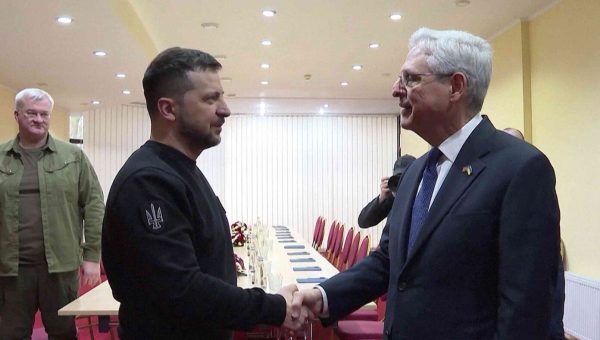
The issue of corruption was raised during a meeting between CIA Director William Burns and Zelensky in January. An intelligence official with direct knowledge of the meeting told Hersh that Burns delivered a stunning message to Zelensky.

Hersh wrote: “The senior generals and government officials in Kiev were angry at what they saw as Zelensky’s greed, so Burns told the Ukrainian president, because ‘he was taking a larger share of the skim money than was going to the generals.’”

During the meeting, Burns presented Zelensky with a list of 35 generals and senior government officials whose corruption was known to the CIA. Zelensky responded by dismissing 10 officials who were engaged in flagrant corruption. “The ten he got rid of were brazenly bragging about the money they had—driving around Kiev in their new Mercedes,” the intelligence official said.

Hersh said Zelensky’s “half-hearted response” and the “lack of concern” in the White House angered some US intelligence officials. The intelligence official speaking to Hersh criticized President Biden’s two main foreign policy advisors, Secretary of State Antony Blinken and National Security Advisor Jake Sullivan.

“They have no experience, judgment, and moral integrity. They just tell lies, make up stories. Diplomatic deniability is something else,” the official said. The official said there was a “total breakdown between the White House leadership and the intelligence community.”

The report said the rift started in the fall when the Nord Stream natural gas pipelines were blown up. According to Hersh’s earlier reporting, President Biden ordered the operation that took out the pipelines. “Destroying the Nord Stream pipelines was never discussed, or even known in advance, by the community,” the official said.

The official said there is “no strategy for ending the war” within the Biden administration and offered more scathing criticism of Blinken and Sullivan.

“Burns is not the problem,” the official said. “The problem is Biden and his principal lieutenants—Blinken and Sullivan and their court of worshippers—who see those who criticize Zelensky as being pro-Putin. ‘We are against evil. Ukraine will fight ’til the last military shell is gone, and still fight.’ And here’s Biden who is telling America that we’re going to fight as long as it takes.”

Hersh’s story comes after a series of leaked top-secret documents from the Pentagon and other government agencies surfaced online. Some of the documents show US war planning for Ukraine and reveal the US doubts Kyiv’s ability to launch a successful counter-offensive, offering a starkly different view of Ukraine’s abilities than what Biden officials have been saying publicly.

How America Took Out The Nord Stream Pipeline

The New York Times called it a “mystery,” but the United States executed a covert sea operation that was kept secret—until now

By Seymour Hersh

Source: Seymour Hersh Substack

The U.S. Navy’s Diving and Salvage Center can be found in a location as obscure as its name—down what was once a country lane in rural Panama City, a now-booming resort city in the southwestern panhandle of Florida, 70 miles south of the Alabama border. The center’s complex is as nondescript as its location—a drab concrete post-World War II structure that has the look of a vocational high school on the west side of Chicago. A coin-operated laundromat and a dance school are across what is now a four-lane road.

The center has been training highly skilled deep-water divers for decades who, once assigned to American military units worldwide, are capable of technical diving to do the good—using C4 explosives to clear harbors and beaches of debris and unexploded ordinance—as well as the bad, like blowing up foreign oil rigs, fouling intake valves for undersea power plants, destroying locks on crucial shipping canals. The Panama City center, which boasts the second largest indoor pool in America, was the perfect place to recruit the best, and most taciturn, graduates of the diving school who successfully did last summer what they had been authorized to do 260 feet under the surface of the Baltic Sea.

Last June, the Navy divers, operating under the cover of a widely publicized mid-summer NATO exercise known as BALTOPS 22, planted the remotely triggered explosives that, three months later, destroyed three of the four Nord Stream pipelines, according to a source with direct knowledge of the operational planning.

Two of the pipelines, which were known collectively as Nord Stream 1, had been providing Germany and much of Western Europe with cheap Russian natural gas for more than a decade. A second pair of pipelines, called Nord Stream 2, had been built but were not yet operational. Now, with Russian troops massing on the Ukrainian border and the bloodiest war in Europe since 1945 looming, President Joseph Biden saw the pipelines as a vehicle for Vladimir Putin to weaponize natural gas for his political and territorial ambitions.

Asked for comment, Adrienne Watson, a White House spokesperson, said in an email, “This is false and complete fiction.” Tammy Thorp, a spokesperson for the Central Intelligence Agency, similarly wrote: “This claim is completely and utterly false.”

Biden’s decision to sabotage the pipelines came after more than nine months of highly secret back and forth debate inside Washington’s national security community about how to best achieve that goal. For much of that time, the issue was not whether to do the mission, but how to get it done with no overt clue as to who was responsible.

There was a vital bureaucratic reason for relying on the graduates of the center’s hardcore diving school in Panama City. The divers were Navy only, and not members of America’s Special Operations Command, whose covert operations must be reported to Congress and briefed in advance to the Senate and House leadership—the so-called Gang of Eight. The Biden Administration was doing everything possible to avoid leaks as the planning took place late in 2021 and into the first months of 2022.

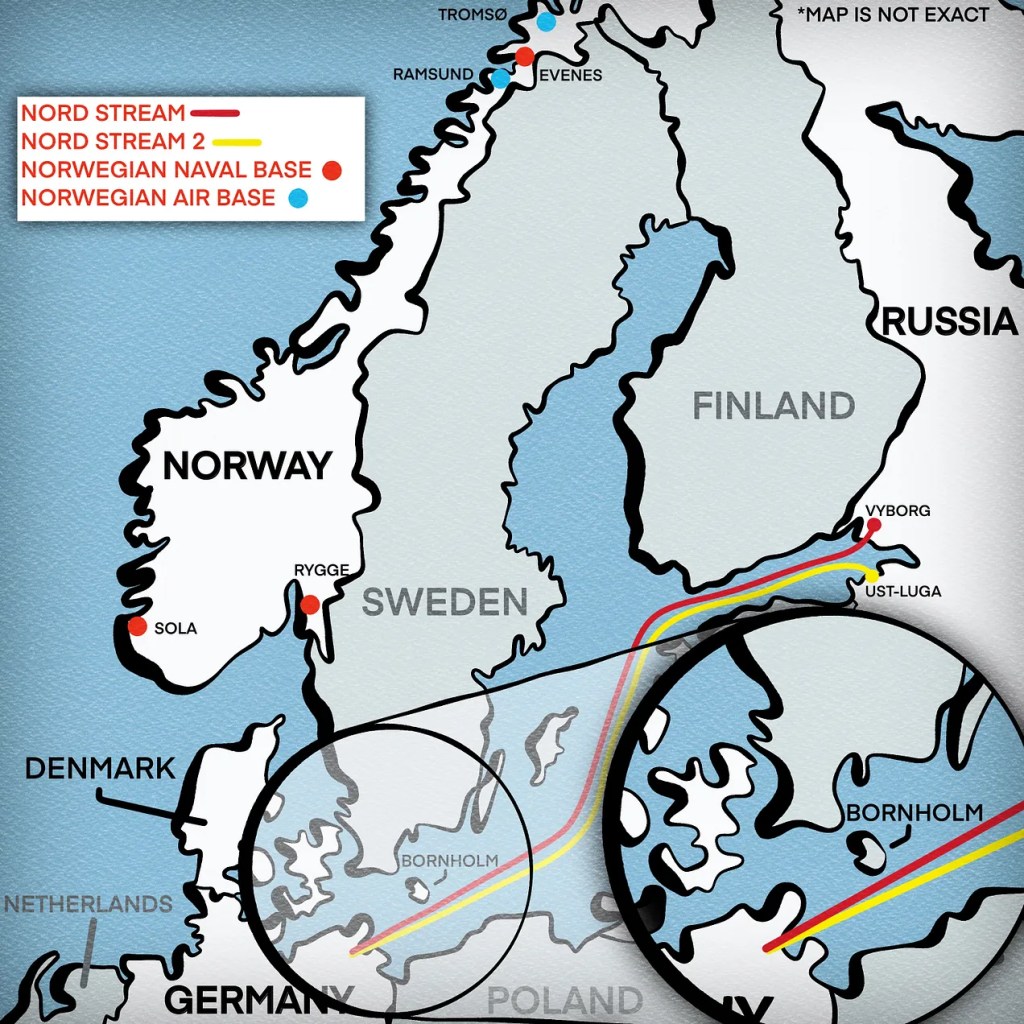
President Biden and his foreign policy team—National Security Adviser Jake Sullivan, Secretary of State Tony Blinken, and Victoria Nuland, the Undersecretary of State for Policy—had been vocal and consistent in their hostility to the two pipelines, which ran side by side for 750 miles under the Baltic Sea from two different ports in northeastern Russia near the Estonian border, passing close to the Danish island of Bornholm before ending in northern Germany.

The direct route, which bypassed any need to transit Ukraine, had been a boon for the German economy, which enjoyed an abundance of cheap Russian natural gas—enough to run its factories and heat its homes while enabling German distributors to sell excess gas, at a profit, throughout Western Europe. Action that could be traced to the administration would violate US promises to minimize direct conflict with Russia. Secrecy was essential.

From its earliest days, Nord Stream 1 was seen by Washington and its anti-Russian NATO partners as a threat to western dominance. The holding company behind it, Nord Stream AG, was incorporated in Switzerland in 2005 in partnership with Gazprom, a publicly traded Russian company producing enormous profits for shareholders which is dominated by oligarchs known to be in the thrall of Putin. Gazprom controlled 51 percent of the company, with four European energy firms—one in France, one in the Netherlands and two in Germany—sharing the remaining 49 percent of stock, and having the right to control downstream sales of the inexpensive natural gas to local distributors in Germany and Western Europe. Gazprom’s profits were shared with the Russian government, and state gas and oil revenues were estimated in some years to amount to as much as 45 percent of Russia’s annual budget.

America’s political fears were real: Putin would now have an additional and much-needed major source of income, and Germany and the rest of Western Europe would become addicted to low-cost natural gas supplied by Russia—while diminishing European reliance on America. In fact, that’s exactly what happened. Many Germans saw Nord Stream 1 as part of the deliverance of former Chancellor Willy Brandt’s famed Ostpolitik theory, which would enable postwar Germany to rehabilitate itself and other European nations destroyed in World War II by, among other initiatives, utilizing cheap Russian gas to fuel a prosperous Western European market and trading economy.

Nord Stream 1 was dangerous enough, in the view of NATO and Washington, but Nord Stream 2, whose construction was completed in September of 2021, would, if approved by German regulators, double the amount of cheap gas that would be available to Germany and Western Europe. The second pipeline also would provide enough gas for more than 50 percent of Germany’s annual consumption. Tensions were constantly escalating between Russia and NATO, backed by the aggressive foreign policy of the Biden Administration.

Opposition to Nord Stream 2 flared on the eve of the Biden inauguration in January 2021, when Senate Republicans, led by Ted Cruz of Texas, repeatedly raised the political threat of cheap Russian natural gas during the confirmation hearing of Blinken as Secretary of State. By then a unified Senate had successfully passed a law that, as Cruz told Blinken, “halted [the pipeline] in its tracks.” There would be enormous political and economic pressure from the German government, then headed by Angela Merkel, to get the second pipeline online.

Would Biden stand up to the Germans? Blinken said yes, but added that he had not discussed the specifics of the incoming President’s views. “I know his strong conviction that this is a bad idea, the Nord Stream 2,” he said. “I know that he would have us use every persuasive tool that we have to convince our friends and partners, including Germany, not to move forward with it.”

A few months later, as the construction of the second pipeline neared completion, Biden blinked. That May, in a stunning turnaround, the administration waived sanctions against Nord Stream AG, with a State Department official conceding that trying to stop the pipeline through sanctions and diplomacy had “always been a long shot.” Behind the scenes, administration officials reportedly urged Ukrainian President Volodymyr Zelensky, by then facing a threat of Russian invasion, not to criticize the move.

There were immediate consequences. Senate Republicans, led by Cruz, announced an immediate blockade of all of Biden’s foreign policy nominees and delayed passage of the annual defense bill for months, deep into the fall. Politico later depicted Biden’s turnabout on the second Russian pipeline as “the one decision, arguably more than the chaotic military withdrawal from Afghanistan, that has imperiled Biden’s agenda.” 

The administration was floundering, despite getting a reprieve on the crisis in mid-November, when Germany’s energy regulators suspended approval of the second Nord Stream pipeline. Natural gas prices surged 8% within days, amid growing fears in Germany and Europe that the pipeline suspension and the growing possibility of a war between Russia and Ukraine would lead to a very much unwanted cold winter. It was not clear to Washington just where Olaf Scholz, Germany’s newly appointed chancellor, stood. Months earlier, after the fall of Afghanistan, Scholtz had publicly endorsed French President Emmanuel Macron’s call for a more autonomous European foreign policy in a speech in Prague—clearly suggesting less reliance on Washington and its mercurial actions.

Throughout all of this, Russian troops had been steadily and ominously building up on the borders of Ukraine, and by the end of December more than 100,000 soldiers were in position to strike from Belarus and Crimea. Alarm was growing in Washington, including an assessment from Blinken that those troop numbers could be “doubled in short order.”

The administration’s attention once again was focused on Nord Stream. As long as Europe remained dependent on the pipelines for cheap natural gas, Washington was afraid that countries like Germany would be reluctant to supply Ukraine with the money and weapons it needed to defeat Russia.

It was at this unsettled moment that Biden authorized Jake Sullivan to bring together an interagency group to come up with a plan. 

All options were to be on the table. But only one would emerge.

PLANNING

In December of 2021, two months before the first Russian tanks rolled into Ukraine, Jake Sullivan convened a meeting of a newly formed task force—men and women from the Joint Chiefs of Staff, the CIA, and the State and Treasury Departments—and asked for recommendations about how to respond to Putin’s impending invasion.

It would be the first of a series of top-secret meetings, in a secure room on a top floor of the Old Executive Office Building, adjacent to the White House, that was also the home of the President’s Foreign Intelligence Advisory Board (PFIAB). There was the usual back and forth chatter that eventually led to a crucial preliminary question: Would the recommendation forwarded by the group to the President be reversible—such as another layer of sanctions and currency restrictions—or irreversible—that is, kinetic actions, which could not be undone?

What became clear to participants, according to the source with direct knowledge of the process, is that Sullivan intended for the group to come up with a plan for the destruction of the two Nord Stream pipelines—and that he was delivering on the desires of the President.

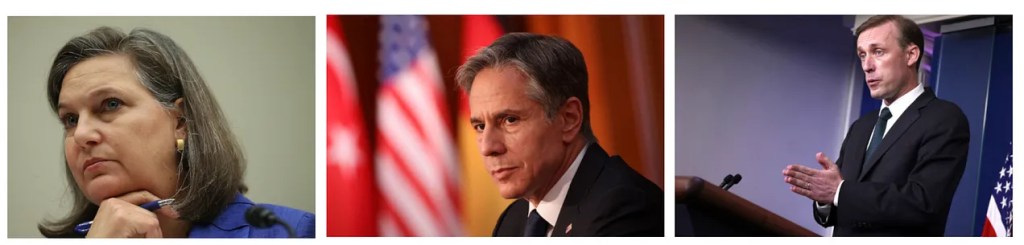
THE PLAYERS Left to right: Victoria Nuland, Anthony Blinken, and Jake Sullivan.

Over the next several meetings, the participants debated options for an attack. The Navy proposed using a newly commissioned submarine to assault the pipeline directly. The Air Force discussed dropping bombs with delayed fuses that could be set off remotely. The CIA argued that whatever was done, it would have to be covert. Everyone involved understood the stakes. “This is not kiddie stuff,” the source said. If the attack were traceable to the United States, “It’s an act of war.”

At the time, the CIA was directed by William Burns, a mild-mannered former ambassador to Russia who had served as deputy secretary of state in the Obama Administration. Burns quickly authorized an Agency working group whose ad hoc members included—by chance—someone who was familiar with the capabilities of the Navy’s deep-sea divers in Panama City. Over the next few weeks, members of the CIA’s working group began to craft a plan for a covert operation that would use deep-sea divers to trigger an explosion along the pipeline.

Something like this had been done before. In 1971, the American intelligence community learned from still undisclosed sources that two important units of the Russian Navy were communicating via an undersea cable buried in the Sea of Okhotsk, on Russia’s Far East Coast. The cable linked a regional Navy command to the mainland headquarters at Vladivostok.

A hand-picked team of Central Intelligence Agency and National Security Agency operatives was assembled somewhere in the Washington area, under deep cover, and worked out a plan, using Navy divers, modified submarines and a deep-submarine rescue vehicle, that succeeded, after much trial and error, in locating the Russian cable. The divers planted a sophisticated listening device on the cable that successfully intercepted the Russian traffic and recorded it on a taping system.

The NSA learned that senior Russian navy officers, convinced of the security of their communication link, chatted away with their peers without encryption. The recording device and its tape had to be replaced monthly and the project rolled on merrily for a decade until it was compromised by a forty-four-year-old civilian NSA technician named Ronald Pelton who was fluent in Russian. Pelton was betrayed by a Russian defector in 1985 and sentenced to prison. He was paid just $5,000 by the Russians for his revelations about the operation, along with $35,000 for other Russian operational data he provided that was never made public.

That underwater success, codenamed Ivy Bells, was innovative and risky, and produced invaluable intelligence about the Russian Navy’s intentions and planning.

Still, the interagency group was initially skeptical of the CIA’s enthusiasm for a covert deep-sea attack. There were too many unanswered questions. The waters of the Baltic Sea were heavily patrolled by the Russian navy, and there were no oil rigs that could be used as cover for a diving operation. Would the divers have to go to Estonia, right across the border from Russia’s natural gas loading docks, to train for the mission? “It would be a goat fuck,” the Agency was told.

Throughout “all of this scheming,” the source said, “some working guys in the CIA and the State Department were saying, ‘Don’t do this. It’s stupid and will be a political nightmare if it comes out.’”

Nevertheless, in early 2022, the CIA working group reported back to Sullivan’s interagency group: “We have a way to blow up the pipelines.”

What came next was stunning. On February 7, less than three weeks before the seemingly inevitable Russian invasion of Ukraine, Biden met in his White House office with German Chancellor Olaf Scholz, who, after some wobbling, was now firmly on the American team. At the press briefing that followed, Biden defiantly said, “If Russia invades . . . there will be no longer a Nord Stream 2. We will bring an end to it.”

Twenty days earlier, Undersecretary Nuland had delivered essentially the same message at a State Department briefing, with little press coverage. “I want to be very clear to you today,” she said in response to a question. “If Russia invades Ukraine, one way or another Nord Stream 2 will not move forward.”

Several of those involved in planning the pipeline mission were dismayed by what they viewed as indirect references to the attack.

“It was like putting an atomic bomb on the ground in Tokyo and telling the Japanese that we are going to detonate it,” the source said. “The plan was for the options to be executed post invasion and not advertised publicly. Biden simply didn’t get it or ignored it.”

Biden’s and Nuland’s indiscretion, if that is what it was, might have frustrated some of the planners. But it also created an opportunity. According to the source, some of the senior officials of the CIA determined that blowing up the pipeline “no longer could be considered a covert option because the President just announced that we knew how to do it.”

The plan to blow up Nord Stream 1 and 2 was suddenly downgraded from a covert operation requiring that Congress be informed to one that was deemed as a highly classified intelligence operation with U.S. military support. Under the law, the source explained, “There was no longer a legal requirement to report the operation to Congress. All they had to do now is just do it—but it still had to be secret. The Russians have superlative surveillance of the Baltic Sea.”

The Agency working group members had no direct contact with the White House, and were eager to find out if the President meant what he’d said—that is, if the mission was now a go. The source recalled, “Bill Burns comes back and says, ‘Do it.’”

THE OPERATION 

Norway was the perfect place to base the mission.

In the past few years of East-West crisis, the U.S. military has vastly expanded its presence inside Norway, whose western border runs 1,400 miles along the north Atlantic Ocean and merges above the Arctic Circle with Russia. The Pentagon has created high paying jobs and contracts, amid some local controversy, by investing hundreds of millions of dollars to upgrade and expand American Navy and Air Force facilities in Norway. The new works included, most importantly, an advanced synthetic aperture radar far up north that was capable of penetrating deep into Russia and came online just as the American intelligence community lost access to a series of long-range listening sites inside China.

A newly refurbished American submarine base, which had been under construction for years, had become operational and more American submarines were now able to work closely with their Norwegian colleagues to monitor and spy on a major Russian nuclear redoubt 250 miles to the east, on the Kola Peninsula. America also has vastly expanded a Norwegian air base in the north and delivered to the Norwegian air force a fleet of Boeing-built P8 Poseidon patrol planes to bolster its long-range spying on all things Russia.

In return, the Norwegian government angered liberals and some moderates in its parliament last November by passing the Supplementary Defense Cooperation Agreement (SDCA). Under the new deal, the U.S. legal system would have jurisdiction in certain “agreed areas” in the North over American soldiers accused of crimes off base, as well as over those Norwegian citizens accused or suspected of interfering with the work at the base.

Norway was one of the original signatories of the NATO Treaty in 1949, in the early days of the Cold War. Today, the supreme commander of NATO is Jens Stoltenberg, a committed anti-communist, who served as Norway’s prime minister for eight years before moving to his high NATO post, with American backing, in 2014. He was a hardliner on all things Putin and Russia who had cooperated with the American intelligence community since the Vietnam War. He has been trusted completely since. “He is the glove that fits the American hand,” the source said.

Back in Washington, planners knew they had to go to Norway. “They hated the Russians, and the Norwegian navy was full of superb sailors and divers who had generations of experience in highly profitable deep-sea oil and gas exploration,” the source said. They also could be trusted to keep the mission secret. (The Norwegians may have had other interests as well. The destruction of Nord Stream—if the Americans could pull it off—would allow Norway to sell vastly more of its own natural gas to Europe.)

Sometime in March, a few members of the team flew to Norway to meet with the Norwegian Secret Service and Navy. One of the key questions was where exactly in the Baltic Sea was the best place to plant the explosives. Nord Stream 1 and 2, each with two sets of pipelines, were separated much of the way by little more than a mile as they made their run to the port of Greifswald in the far northeast of Germany.

The Norwegian navy was quick to find the right spot, in the shallow waters of the Baltic sea a few miles off Denmark’s Bornholm Island. The pipelines ran more than a mile apart along a seafloor that was only 260 feet deep. That would be well within the range of the divers, who, operating from a Norwegian Alta class mine hunter, would dive with a mixture of oxygen, nitrogen and helium streaming from their tanks, and plant shaped C4 charges on the four pipelines with concrete protective covers. It would be tedious, time consuming and dangerous work, but the waters off Bornholm had another advantage: there were no major tidal currents, which would have made the task of diving much more difficult.

After a bit of research, the Americans were all in.

At this point, the Navy’s obscure deep-diving group in Panama City once again came into play. The deep-sea schools at Panama City, whose trainees participated in Ivy Bells, are seen as an unwanted backwater by the elite graduates of the Naval Academy in Annapolis, who typically seek the glory of being assigned as a Seal, fighter pilot, or submariner. If one must become a “Black Shoe”—that is, a member of the less desirable surface ship command—there is always at least duty on a destroyer, cruiser or amphibious ship. The least glamorous of all is mine warfare. Its divers never appear in Hollywood movies, or on the cover of popular magazines.

“The best divers with deep diving qualifications are a tight community, and only the very best are recruited for the operation and told to be prepared to be summoned to the CIA in Washington,” the source said.

The Norwegians and Americans had a location and the operatives, but there was another concern: any unusual underwater activity in the waters off Bornholm might draw the attention of the Swedish or Danish navies, which could report it.  

Denmark had also been one of the original NATO signatories and was known in the intelligence community for its special ties to the United Kingdom. Sweden had applied for membership into NATO, and had demonstrated its great skill in managing its underwater sound and magnetic sensor systems that successfully tracked Russian submarines that would occasionally show up in remote waters of the Swedish archipelago and be forced to the surface.

The Norwegians joined the Americans in insisting that some senior officials in Denmark and Sweden had to be briefed in general terms about possible diving activity in the area. In that way, someone higher up could intervene and keep a report out of the chain of command, thus insulating the pipeline operation. “What they were told and what they knew were purposely different,” the source told me. (The Norwegian embassy, asked to comment on this story, did not respond.)

The Norwegians were key to solving other hurdles. The Russian navy was known to possess surveillance technology capable of spotting, and triggering, underwater mines. The American explosive devices needed to be camouflaged in a way that would make them appear to the Russian system as part of the natural background—something that required adapting to the specific salinity of the water. The Norwegians had a fix.

The Norwegians also had a solution to the crucial question of when the operation should take place. Every June, for the past 21 years, the American Sixth Fleet, whose flagship is based in Gaeta, Italy, south of Rome, has sponsored a major NATO exercise in the Baltic Sea involving scores of allied ships throughout the region. The current exercise, held in June, would be known as Baltic Operations 22, or BALTOPS 22. The Norwegians proposed this would be the ideal cover to plant the mines.

The Americans provided one vital element: they convinced the Sixth Fleet planners to add a research and development exercise to the program. The exercise, as made public by the Navy, involved the Sixth Fleet in collaboration with the Navy’s “research and warfare centers.” The at-sea event would be held off the coast of Bornholm Island and involve NATO teams of divers planting mines, with competing teams using the latest underwater technology to find and destroy them.

It was both a useful exercise and ingenious cover. The Panama City boys would do their thing and the C4 explosives would be in place by the end of BALTOPS22, with a 48-hour timer attached. All of the Americans and Norwegians would be long gone by the first explosion. 

The days were counting down. “The clock was ticking, and we were nearing mission accomplished,” the source said.

And then: Washington had second thoughts. The bombs would still be planted during BALTOPS, but the White House worried that a two-day window for their detonation would be too close to the end of the exercise, and it would be obvious that America had been involved.

Instead, the White House had a new request: “Can the guys in the field come up with some way to blow the pipelines later on command?”

Some members of the planning team were angered and frustrated by the President’s seeming indecision. The Panama City divers had repeatedly practiced planting the C4 on pipelines, as they would during BALTOPS, but now the team in Norway had to come up with a way to give Biden what he wanted—the ability to issue a successful execution order at a time of his choosing.  

Being tasked with an arbitrary, last-minute change was something the CIA was accustomed to managing. But it also renewed the concerns some shared over the necessity, and legality, of the entire operation.

The President’s secret orders also evoked the CIA’s dilemma in the Vietnam War days, when President Johnson, confronted by growing anti-Vietnam War sentiment, ordered the Agency to violate its charter—which specifically barred it from operating inside America—by spying on antiwar leaders to determine whether they were being controlled by Communist Russia.

The agency ultimately acquiesced, and throughout the 1970s it became clear just how far it had been willing to go. There were subsequent newspaper revelations in the aftermath of the Watergate scandals about the Agency’s spying on American citizens, its involvement in the assassination of foreign leaders and its undermining of the socialist government of Salvador Allende.

Those revelations led to a dramatic series of hearings in the mid-1970s in the Senate, led by Frank Church of Idaho, that made it clear that Richard Helms, the Agency director at the time, accepted that he had an obligation to do what the President wanted, even if it meant violating the law.

In unpublished, closed-door testimony, Helms ruefully explained that “you almost have an Immaculate Conception when you do something” under secret orders from a President. “Whether it’s right that you should have it, or wrong that you shall have it, [the CIA] works under different rules and ground rules than any other part of the government.” He was essentially telling the Senators that he, as head of the CIA, understood that he had been working for the Crown, and not the Constitution.

The Americans at work in Norway operated under the same dynamic, and dutifully began working on the new problem—how to remotely detonate the C4 explosives on Biden’s order. It was a much more demanding assignment than those in Washington understood. There was no way for the team in Norway to know when the President might push the button. Would it be in a few weeks, in many months or in half a year or longer?

The C4 attached to the pipelines would be triggered by a sonar buoy dropped by a plane on short notice, but the procedure involved the most advanced signal processing technology. Once in place, the delayed timing devices attached to any of the four pipelines could be accidentally triggered by the complex mix of ocean background noises throughout the heavily trafficked Baltic Sea—from near and distant ships, underwater drilling, seismic events, waves and even sea creatures. To avoid this, the sonar buoy, once in place, would emit a sequence of unique low frequency tonal sounds—much like those emitted by a flute or a piano—that would be recognized by the timing device and, after a pre-set hours of delay, trigger the explosives. (“You want a signal that is robust enough so that no other signal could accidentally send a pulse that detonated the explosives,” I was told by Dr. Theodore Postol, professor emeritus of science, technology and national security policy at MIT. Postol, who has served as the science adviser to the Pentagon’s Chief of Naval Operations, said the issue facing the group in Norway because of Biden’s delay was one of chance: “The longer the explosives are in the water the greater risk there would be of a random signal that would launch the bombs.”)

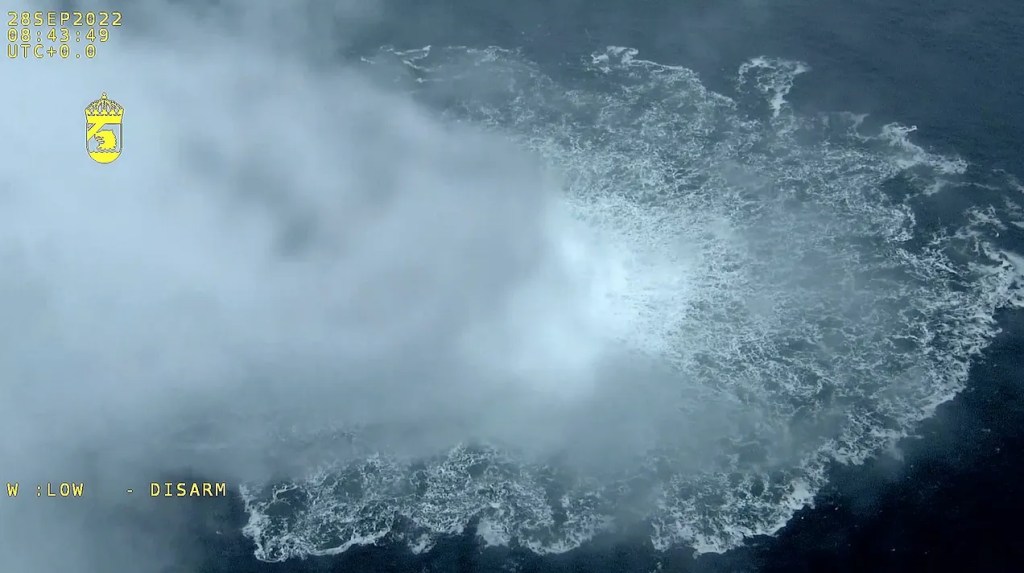
On September 26, 2022, a Norwegian Navy P8 surveillance plane made a seemingly routine flight and dropped a sonar buoy. The signal spread underwater, initially to Nord Stream 2 and then on to Nord Stream 1. A few hours later, the high-powered C4 explosives were triggered and three of the four pipelines were put out of commission. Within a few minutes, pools of methane gas that remained in the shuttered pipelines could be seen spreading on the water’s surface and the world learned that something irreversible had taken place.

FALLOUT

In the immediate aftermath of the pipeline bombing, the American media treated it like an unsolved mystery. Russia was repeatedly cited as a likely culprit, spurred on by calculated leaks from the White House—but without ever establishing a clear motive for such an act of self-sabotage, beyond simple retribution. A few months later, when it emerged that Russian authorities had been quietly getting estimates for the cost to repair the pipelines, the New York Times described the news as “complicating theories about who was behind” the attack. No major American newspaper dug into the earlier threats to the pipelines made by Biden and Undersecretary of State Nuland.

While it was never clear why Russia would seek to destroy its own lucrative pipeline, a more telling rationale for the President’s action came from Secretary of State Blinken.

Asked at a press conference last September about the consequences of the worsening energy crisis in Western Europe, Blinken described the moment as a potentially good one:

“It’s a tremendous opportunity to once and for all remove the dependence on Russian energy and thus to take away from Vladimir Putin the weaponization of energy as a means of advancing his imperial designs. That’s very significant and that offers tremendous strategic opportunity for the years to come, but meanwhile we’re determined to do everything we possibly can to make sure the consequences of all of this are not borne by citizens in our countries or, for that matter, around the world.”

More recently, Victoria Nuland expressed satisfaction at the demise of the newest of the pipelines. Testifying at a Senate Foreign Relations Committee hearing in late January she told Senator Ted Cruz, “​Like you, I am, and I think the Administration is, very gratified to know that Nord Stream 2 is now, as you like to say, a hunk of metal at the bottom of the sea.”

The source had a much more streetwise view of Biden’s decision to sabotage more than 1500 miles of Gazprom pipeline as winter approached. “Well,” he said, speaking of the President, “I gotta admit the guy has a pair of balls.  He said he was going to do it, and he did.”

Asked why he thought the Russians failed to respond, he said cynically, “Maybe they want the capability to do the same things the U.S. did.

“It was a beautiful cover story,” he went on. “Behind it was a covert operation that placed experts in the field and equipment that operated on a covert signal.

“The only flaw was the decision to do it.”

Brainwashed for War With Russia

By Ray McGovern

Source: AntiWar.com

Thanks to Establishment media, the sorcerer apprentices advising President Joe Biden – I refer to Secretary of State Antony Blinken, national security adviser Jacob Sullivan, and China specialist Kurt Campbell – will have no trouble rallying Americans for the widest war in 77 years, starting in Ukraine, and maybe spreading to China. And, shockingly, under false pretenses.

Most Americans are oblivious to the reality that Western media are owned and operated by the same corporations that make massive profits by helping to stoke small wars and then peddling the necessary weapons. Corporate leaders, and Ivy-mantled elites, educated to believe in U.S. “exceptionalism,” find the lucre and the luster too lucrative to be able to think straight. They deceive themselves into thinking that (a) the US cannot lose a war; (b) escalation can be calibrated and wider war can be limited to Europe; and (c) China can be expected to just sit on the sidelines. The attitude, consciously or unconsciously, “Not to worry. And, in any case, the lucre and luster are worth the risk.”

The media also know they can always trot out died-in-the-wool Russophobes to “explain,” for example, why the Russians are “almost genetically driven” to do evil (James Clapper, former National Intelligence Director and now hired savant on CNN); or Fiona Hill (former National Intelligence Officer for Russia), who insists “Putin wants to evict the United States from Europe … As he might put it: “Goodbye, America. Don’t let the door hit you on the way out.”

Absent a miraculous appearance of clearer heads with a less benighted attitude toward the core interests of Russia in Ukraine, and China in Taiwan, historians who survive to record the war now on our doorstep will describe it as the result of hubris and stupidity run amok. Objective historians may even note that one of their colleagues – Professor John Mearsheimer – got it right from the start, when he explained in the autumn 2014 issue of Foreign Affairs “Why the Ukraine Crisis is the West’s Fault.”

Historian Barbara Tuchman addressed the kind of situation the world faces in Ukraine in her book “The March of Folly: From Troy to Vietnam.” (Had she lived, she surely would have updated it to take Iraq, Afghanistan, Syria, and Ukraine into account). Tuchman wrote:

“Wooden-headedness…plays a remarkably large role in government. It consists in assessing a situation in terms of preconceived fixed notions while ignoring or rejecting any contrary signs. It is acting according to wish while not allowing oneself to be deflected by the facts.”

Six Years (and Counting) of Brainwashing

Thanks to US media, a very small percentage of Americans know that:

  • 14 years ago, then US Ambassador to Russia (current CIA Director) William Burns was warned by Russian Foreign Minister Sergei Lavrov that Russia might have to intervene in Ukraine, if it were made a member of NATO. The Subject Line of Burns’s Feb. 1, 2008 Embassy Moscow cable (#182) to Washington makes it clear that Amb. Burns did not mince Lavrov’s words; the subject line stated: “Nyet means nyet: Russia’s NATO enlargement redlines.”Thus, Washington policymakers were given forewarning, in very specific terms, of Russia’s redline regarding membership for Ukraine in NATO. Nevertheless, on April 3, 2008, a NATO summit in Bucharest asserted: “NATO welcomes Ukraine’s and Georgia’s Euro-Atlantic aspirations for membership in NATO. We agreed today that these countries will become members of NATO.”
  • 8 years ago, on Feb. 22, 2014, the US orchestrated a coup in Kiev – rightly labeled “the most blatant coup in history’, insofar as it had already been blown on YouTube 18 days prior. Kiev’s spanking new leaders, handpicked and identified by name by US Assistant Secretary of State Victoria Nuland in the YouTube-publicized conversation with the U.S. ambassador in Kiev, immediately called for Ukraine to join NATO.
  • 6 years ago, in June 2016, Russian President Vladimir Putin told Western reporters of his concern that so-called antiballistic missiles sites in Romania and Poland could be converted overnight to accommodate offensive strike missiles posing a threat to Russia’s own nuclear forces. (See this unique video, with English subtitles, from minute 37 to 49.) There is a direct analogy with the 1962 Cuban missile crisis when Moscow put offensive strike missiles in Cuba and President John Kennedy reacted strongly to the existential threat that posed to the US.
  • On December 21, 2021, President Putin told his most senior military leaders:“It is extremely alarming that elements of the US global defense system are being deployed near Russia. The Mk 41 launchers, which are located in Romania and are to be deployed in Poland, are adapted for launching the Tomahawk strike missiles. If this infrastructure continues to move forward, and if US and NATO missile systems are deployed in Ukraine, their flight time to Moscow will be only 7–10 minutes, or even five minutes for hypersonic systems. This is a huge challenge for us, for our security.” [Emphasis added.]
  • On December 30, 2021, Biden and Putin talked by phone at Putin’s urgent request. The Kremlin readout stated:
  • On February 12, 2022, Ushakov briefed the media on the telephone conversation between Putin and Biden earlier that day.
  • On February 24, 2022, Russia invaded Ukraine.

Unprovoked?

The US insists that Russia’s invasion was “unprovoked”. Establishment media dutifully regurgitate that line, while keeping Americans in the dark about such facts (not opinion) as are outlined (and sourced) above. Most Americans are just as taken in by the media as they were 20 years ago, when they were told there were weapons of mass destruction in Iraq. They simply took it on faith. Nor did the guilty media express remorse – or a modicum of embarrassment.

The late Fred Hiatt, who was op-ed editor at the Washington Post, is a case in point. In an interview with the Columbia Journalism Review [CJR, March/April 2004] he commented:

“If you look at the editorials we wrote running up [to the war], we state as flat fact that he [Saddam Hussein] has weapons of mass destruction.” “If that’s not true, it would have been better not to say it.”

(My journalism mentor, Robert Parry, had this to say about Hiatt’s remark. “Yes, that is a common principle of journalism, that if something isn’t real, we’re not supposed to confidently declare that it is.”)

It’s worse now. Russia is not Iraq. And Putin has been so demonized over the past six years that people are inclined to believe the likes of James Clapper to the effect there’s something genetic that makes Russians evil. “Russia-gate” was a big con (and, now, demonstrably so), but Americans don’t know that either. The consequences of prolonged demonization are extremely dangerous – and will become even more so in the next several weeks as politicians vie to be the strongest in opposing and countering Russia’s “unprovoked” attack on Ukraine.

THE Problem

Humorist Will Rogers had it right:

“The problem ain’t what people know. It’s what people know that ain’t so; that’s the problem.”

NATO prolongs the Ukraine proxy war, and global havoc

With diplomacy thwarted, the US and its allies plan for “open-ended” military and economic warfare against Russia, no matter the costs at home and abroad.

(US Dept. of Defense)

By Aaron Maté

Source: Aaron Mate Substack

Russia has announced plans to mobilize an additional 300,000 troops for the war in Ukraine. In his speech unveiling the expanded war effort, Vladimir Putin vowed to achieve his main goal of the “liberation of Donbas,” and issued a thinly veiled nuclear threat in the process. The move comes days ahead of planned referendums in breakaway Ukrainian areas to formalize Russian annexation.

Russia’s escalation ensures that the fighting is entering an even more dangerous phase. While Russia bears legal and moral responsibility for its invasion, recent developments underscore that NATO leaders have shunned opportunities to prevent further catastrophe and chosen instead to fuel it.

Putin’s announcement comes just after the Ukrainian military’s routing of Russian forces from Kharkiv, which relied extensively on US planning, weaponry and intelligence, sparked triumphant declarations that the tide has turned.

According to The Atlantic’s Anne Applebaum, “Americans and Europeans need to prepare for a Ukrainian victory,” one so overwhelming that it may well bring “about the end of Putin’s regime.”

Beyond the chorus of emboldened neoconservatives, Western officials are less sanguine.

“Certainly it’s a military setback” for Russia, a US official said of the Kharkiv retreat to the Washington Post. “I don’t know if I could call it a major strategic loss at this point.” Germany’s defense chief, General Eberhard Zorn, said that while Ukraine “can win back places or individual areas of the frontlines,” overall, its forces can “not push Russia back over a broad front.”

Whether or not it marked a major strategic loss for Russia, the battle in Kharkiv is already a major victory for NATO leaders seeking to prolong their proxy war in Ukraine and economic warfare next door.

Ukraine’s expulsion of Russian forces in the northeast, the New York Times reports, has “amplified voices in the West demanding that more weapons be sent to Ukraine so that it could win.”

“Despite Ukrainian forces’ startling gains in the war against Russia,” the Washington Post adds, “the Biden administration anticipates months of intense fighting with wins and losses for each side, spurring U.S. plans for an open-ended campaign with no prospect for a negotiated end in sight.”

As has been apparent since the Ukraine crisis erupted, US planning for open-ended proxy warfare against Russia has led it to sabotage any prospect of a negotiated end.

The US rejection of diplomacy around Ukraine has been newly substantiated by former White House Russia expert Fiona Hill. Citing “multiple former senior U.S. officials,” Hill reports that in April of this year “Russian and Ukrainian negotiators appeared to have tentatively agreed on the outlines of a negotiated interim settlement.” Under this framework, Russia would withdraw to its pre-invasion position, while Ukraine would pledge not to join NATO “and instead receive security guarantees from a number of countries.”

In confirming that US officials were aware of this tentative agreement, Hill bolsters previous news that Washington’s junior partner in London was enlisted to thwart it. As Ukrainian media reported, citing sources close to Ukrainian President Volodymyr Zelensky, UK Prime Minister Boris Johnson traveled to Kiev in April and relayed the message that Russia “should be pressured, not negotiated with.” Johnson also informed Zelensky that “even if Ukraine is ready to sign some agreements on [security] guarantees with Putin,” his Western patrons “are not.” The talks promptly collapsed.

In his speech announcing the expanded war effort, Putin invoked this episode. After the invasion began, he said, Ukrainian officials “reacted very positively to our proposals… After certain compromises were reached, Kyiv was actually given a direct order to disrupt all agreements.”

Having undermined the prospect of a negotiated peace in the war’s early weeks, proxy warriors in Washington are openly celebrating their success.

“I like the structural path we’re on here,” Republican Senator Lindsey Graham recently declared. “As long as we help Ukraine with the weapons they need and the economic support, they will fight to the last person.”

Graham’s avowed willingness to expend every “last person” in Ukraine to fight Russia is in line with a broader US strategy that views the entire world as subordinate to its war aims. As the Washington Post reported in June, the White House is willing to “countenance even a global recession and mounting hunger” in order to hand Russia a costly defeat. In Ukraine, this now means also countenancing the threat of nuclear disaster, as the crisis surrounding the Zaporizhzhia nuclear power plant has laid bare.

The prevailing willingness to sacrifice civilian well-being extends to the US public, as National Security Advisor Jake Sullivan has newly made clear. Appearing at the Aspen Security Conference, Sullivan was asked if he is worried about the “American people’s staying power” on the Ukraine proxy war, amid “criticism that we’re spending billions and billions to support Ukraine, and not spending it here.”

 “Fundamentally not,” Sullivan responded. “It’s very important for Putin to understand what exactly he’s up against from the point of view of the United States’ staying power.” That staying power, Sullivan explained, was cemented in the $40 billion war funding measure overwhelmingly approved by Congress (including every self-identified progressive Democrat) in May.

“That can go on, just on the basis of what we have already had allocated to us and resources for a considerable period of time,” Sullivan vowed. “And then, I strongly believe that there will be bipartisan support in the Congress to re-up those resources should it become necessary.”

To policymakers like Sullivan, there is not only an endless pool of money to “re-up” the war, but a “fundamentally” indifferent posture toward the taxpayers footing the bill.

Despite Biden’s reported scolding of Defense Secretary Lloyd Austin for admitting that the US goal in Ukraine is to leave Russia “weakened,” Sullivan – speaking before a friendly Beltway crowd — also forgot to stick to the script.

The US “strategic objective” in Ukraine, Sullivan explained, is to “ensure that Russia’s invasion of Ukraine… is a strategic failure for Putin,” and that “Russia pay a longer-term price in terms of the elements of its national power.” This would teach a “lesson,” he added, “to would-be aggressors elsewhere.”

By “would-be aggressors elsewhere”, Sullivan naturally precludes the US and its allies, whose aggression is not only permitted but promoted under the US-led “rules-based international order.”

President Biden has made that clear by abandoning his pledge to make Saudi Arabia a “pariah” state, notwithstanding its murderous (US-backed) aggression in Yemen. The regular aggression by US ally Israel against Gaza and Syria also continues unabated. The United Nations just reported that an Israeli strike on the Damascus international airport in June – one of hundreds of Israeli bombings on Syria that go largely ignored — “led to considerable damage to infrastructure” and “meant the suspension of U.N. deliveries of humanitarian assistance” to Syrians in need for nearly two weeks. As of this writing, the latest Israeli strike killed five Syrian soldiers, eliciting no Western media and political protest. It is more accurate to describe Israeli aggression on Syria as a joint Israeli-US effort, given that the US reviews and approves the strikes.

Allied NATO leaders are also vocally countenancing the Ukraine proxy war’s costs on their domestic populations. In response to the European sanctions, Russia has now halted gas deliveries to the EU via the key Nord Stream 1 pipeline. Having previously relied on Russia for close to 40 percent of its gas needs, European industries are facing layoffs, factory closures, and higher energy bills that “are pushing consumers to near poverty,” the Financial Times reports.

“People want to end the war because they cannot bear the consequences, the costs,” the EU’s Josep Borell observed this month. While ending the war might appeal to some, it does not interest the EU’s top diplomat. “This mentality must be overcome,” Borell declared. “The offensive on the northeastern front helps with that.”

Europe, NATO chief Jens Stoltenberg recently wrote, may even face “civil unrest,” as economies contract and temperatures drop, but “for Ukraine’s future and for ours, we must prepare for the winter war and stay the course.”

“No matter what my German voters think, I want to deliver to the people of Ukraine,” Germany’s Foreign Minister Annalena Baerbock told a conference in Prague last month. During the upcoming winter, Baerbock acknowledged, “we will be challenged as democratic politicians. People will go in the street and say ‘We cannot pay our energy prices’.” While pledging to help people “with social measures,” Baerbock insisted that the European Union’s sanctions on Russia will remain. “The sanctions will stay also in wintertime, even if it gets really tough for politicians,” she said.

Whereas Western leaders appear confident they can manage civil unrest at home, they face additional resistance abroad. In Africa, a leaked report from the European Union’s envoy to the continent warns that African nations are blaming the EU’s Russia sanctions for food shortages. The report also cautions that “the EU is seen as fueling the conflict,” in Ukraine, “not as a peace facilitator.”

Rather than address these African concerns, the envoy’s office proposes a “more transactional… approach” in which the EU makes “clear” that its “willingness” to “maintain higher levels” of foreign aid “will depend on working based on common values and a joint vision,” – in short, on Africa falling in line.

That is undoubtedly the US policy, as UN Ambassador Linda Thomas-Greenfield made clear last month. After promising a “listening tour,” Thomas-Greenfield instead came to Africa with a dictate and an outright threat. “Countries can buy Russian agricultural products, including fertilizer and wheat,” she decreed. But “if a country decides to engage with Russia” and break US sanctions, “they stand the chance of having actions taken against them.” That Africa faces a food security crisis, with hundreds of millions going hungry, is apparently of lower importance.

While Western sanctions on Russia wreak havoc worldwide, the architects in Washington seem only perturbed by their failure, so far, to inflict the intended levels of suffering on Russian civilians. “We were expecting” that US sanctions “would totally crater the Russian economy” by now, a disappointed senior US official told CNN.

Other US officials are leaving room for hope. “There’s going to be long-term damage done to the Russian economy and to generations of Russians as a result of this,” CIA Director William Burns told a cybersecurity conference this month. Burns’ long-term forecast of harming “generations of Russians” is based on extensive planning. As one US official explained it to CNN, when the sanctions were designed, Biden officials not only “wanted to keep pressure on Russia over the long term as it waged war on Ukraine,” but also “wanted to degrade Russia’s economic and industrial capabilities.” Accordingly, “we’ve always seen this as a long-term game.”

The “long-term game” of trying to destroy Russia’s economy and immiserate “generations” of its citizens is accompanied by increasing plans for a long-term fight. The Biden administration plans to formally name the US military mission in Ukraine – such as in prior campaigns like Operation Desert Storm — while also appointing a general to oversee the effort. The naming, the Wall Street Journal observes, is “significant bureaucratically, as it typically entails long-term, dedicated funding.”

The US plan for a long-term military and economic campaign against Russia is being implemented despite the awareness that Ukraine could face far worse.

“Some American officials express concern that the most dangerous moments are yet to come,” the New York Times reports. To date, “Putin has avoided escalating the war in ways that have, at times, baffled Western officials.” Unlike US military campaigns in Iraq, Russia “has made only limited attempts to destroy critical infrastructure or to target Ukrainian government buildings.”

“The current moment draws attention to a tension that underlies America’s strategy for the war,” the Washington Post observes, “as officials channel massive military support to Ukraine, fueling a war with global consequences, while attempting to remain agnostic about when and how Kyiv might strike a deal to end it.”

These rare admissions not only contradict the typical portrayal of a genocidal Russia that is used to justify the proxy war, but capture the underlying policy driving it. More than six months in, US officials are aware that Russia has “avoided escalating the war” and targeting “critical infrastructure,” – to the point where these same officials are “baffled” by Russian restraint. Despite this, their policy centers on “fueling” this same war, while remaining “agnostic” about ending it.

War being fluid – and US-led military support for Ukraine ever-expanding – it is of course possible that Ukraine will continue to defy expectations and drive out the invading Russian forces.

What the latest developments on and off the battlefield make undoubtedly clear is that NATO states are willing to use Ukraine for as long as it takes to achieve the stated aim of leaving Russia “weakened” or even achieving regime change, no matter the damage knowingly inflicted on Ukrainians, Russians, the Global South, and their own citizens.

AS WAR DRUMS BEAT FOR UKRAINE, REMEMBER, LIES AND PROPAGANDA STARTED NEARLY EVERY WAR IN US HISTORY

By Don Via Jr,

Source: Waking Times

War is one of the most primitive and senseless manifestations of the human experience, so naturally, most sane people with families, ambitions and kind hearts want nothing to do with such things. Unfortunately, as we are seeing with the Ukraine / Russia escalation, governments thrive on war, as it gives them a pressing excuse to grab more power and take extrajudicial measures—both at home and abroad.

To get around the obstacle of public opinion, governments have an extensive history of lying their way into war. This is hard to believe for people who think that government has their best interest in mind, but it is something that rulers have been doing since the beginning of time. In the modern United States, people are led to believe that the establishment accidentally flounders its way into war with the good intentions of protecting the country from harm or liberating an ally in distress.

This strategy of deception was illustrated by the Nazi propagandist Herman Goering, who famously said:

“Of course the people don’t want war. Why should some poor slob on a farm want to risk his life in a war when the best he can get out of it is to come back to his farm in one piece? Naturally, the common people don’t want war neither in Russia, nor in England, nor for that matter in Germany. That is understood. But, after all, it is the leaders of the country who determine the policy and it is always a simple matter to drag the people along, whether it is a democracy, or a fascist dictatorship, or a parliament, or a communist dictatorship. Voice or no voice, the people can always be brought to the bidding of the leaders. That is easy. All you have to do is tell them they are being attacked, and denounce the peacemakers for lack of patriotism and exposing the country to danger. It works the same in any country.

Of course, the Nazi regime is notorious for their brutality and deceit, so this admission is not as stunning as it would be from an American general, but make no mistake that these are the types of thoughts that American generals and politicians have—they are just not brazen enough to say it out loud.

Believe it or not, using deceptive tactics to sway public opinion in favor of war is actually an official part of the US military’s playbook. According to Wikileaks, the U.S. Army’s publication “Special Forces Foreign Internal Defense Tactics Techniques and Procedures for Special Forces” recommends funding terrorists for regime change operations and using false flag attacks to destabilize regimes that were unfriendly to western interests.

This is nothing new though, this is a part of American history, as nearly every war that the U.S. has ever been involved in was built upon lies. Below are some of the most well-documented examples of wars that were started because of lies and government propaganda.

Spanish-American War – 1898

In January 1898, President William McKinley ordered the USS Maine to port in Havana, Cuba, despite years of conflict between Cuban rebels and the Spanish government. The move was intended to be a show of force against the Spanish government, in line with the Monroe doctrine, to establish U.S. dominance in the Western hemisphere.

At 9:40 p.m., on February 15, 1898, The USS Maine exploded with a crew of 354 men on board, killing 266. While the Spanish government insisted the explosion was caused by a fire in a coal bunker that ignited the forward magazines, politicians in the U.S. were quick to blame Spain because they wanted an excuse to wage a war of conquest for territory in Mexico, the Caribbean, and the Pacific.

Although President McKinley had previously voiced his opposition to a military conflict, on April 25, the U.S. declared war on Spain.

The “Ten-Week War” resulted in not only the defeat of the last remnants of the Spanish empire but in a new era of U.S. “expansionism” as the United States took control of Puerto Rico, Guam, and the Philippine islands.

In 1976, a team of naval explosive experts examined the evidence and corroborated Spanish claims that the USS Maine’s sinking was caused by an internal explosion from ammunition being stored on board.

World War 1 – 1915

The first world war was opposed by most Americans from the start, as they rightly saw it as a power struggle between European aristocrats that they had no business in. This was a problem for the British military, led by Winston Churchill, as they were desperate to get the United States behind them in the war.

The U.S. did finally enter the war in 1915, when a U.S. ship called the Lusitania was sent through hostile waters as bait, filled with more than a thousand civilians and an unusually large amount of ammunition. The ship was hit by a German torpedo and exploded instantly due to all of the ammunition onboard, killing more than half of the passengers and crew.

A week before the sinking of Lusitania, Churchill wrote to Walter Runciman, the President of the Board of Trade, stating that it is “most important to attract neutral shipping to our shores, in the hope especially of embroiling the United States with Germany.”

After investigating the tragedy, former British naval intelligence officer Patrick Beesly said, “unless and until fresh information comes to light, I am reluctantly driven to the conclusion that there was a conspiracy deliberately to put Lusitania at risk in the hope that even an abortive attack on her would bring the United States into the war. Such a conspiracy could not have been put into effect without Winston Churchill’s express permission and approval.”

In addition to this treacherous military maneuver, there was a relentless campaign in the U.S. to dehumanize Germans and to paint them as monsters. In some propaganda that was peddled to U.S. citizens, German soldiers were depicted killing babies and sometimes eating them. There were even false reports of crucifixions.

World War 2 – 1941

The history books suggest that Pearl Harbor was an unprovoked attack, killing thousands of Americans and “forcing” the government to enter a war that was extremely unpopular at the time. However, the U.S. government was enacting strict sanctions on both Japan and Germany, hoping that either country would make the first move and give them an excuse to enter the war. Not only was the attack provoked, but President Roosevelt and the U.S. military knew the attack was coming and moved their most expensive aircraft to other locations while leaving thousands of people as sacrificial pawns.

The history books also sell the war against the Nazis as a humanitarian war to save people from the Holocaust, but the U.S. denied safe passage to Jewish refugees, and UK intelligence even planned to blow up refugee ships, in a plot called Operation Embarrass.

Many American businesses and politicians worked very closely with the Nazis even after the two countries were at war with each other. The Holocaust had already claimed the lives of millions of German people by that point, and a police state had long since been established, so whoever was doing business with the Nazis knew exactly who they were getting involved with.

Prior to the Americans getting involved in the war, there were corners of the political arena that were actually big supporters of the Nazi party—both for business purposes and common interests such as eugenics.

The most prominent American politician to work with the Nazis was actually George W. Bush’s grandfather, Prescott Bush. There is no doubt that he was funding and working with the Nazis because his company’s assets were seized in 1942 by the United States government under the “trading with the enemy” act. He worked at the head of a financial firm called Brown Brothers Harriman, which acted as a U.S. base for the Nazi business interests.

Brown Brothers Harriman was one of the biggest international investment firms in the 1930s and they sent millions of dollars in gold overseas to rebuild the German army and fund the Nazi party. This racket was finally exposed on July 30, 1942, when the New York Herald Tribune posted an article titled, “Hitler’s Angel Has three million dollars in US Bank.” This article raised suspicion about the bank being a “secret nest” for Nazi elites and eventually sparked the investigation that took down the operation.

Korean War – 1950

The propaganda of war has led many to believe that the North Korean government launched an unprovoked attack on South Korea, on behalf of the larger communist powers of Russia and China. Yet, once again, this was another case where the U.S. was propping up one dictator to fight another, in an attempt to gain control of an entire continent—all the while, lying to the people back home about the true motivations for war.

As historian Mark E. Caprio, professor of history at Rikkyo University in Tokyo points out:

“On February 8, 1949, the South Korean president met with Ambassador John Muccio and Secretary of the Army Kenneth C. Royall in Seoul. Here the Korean president listed the following as justifications for initiating a war with the North: the South Korean military could easily be increased by 100,000 if it drew from the 150,000 to 200,000 Koreans who had recently fought with the Japanese or the Nationalist Chinese. Moreover, the morale of the South Korean military was greater than that of the North Koreans. If war broke out he expected mass defections from the enemy. Finally, the United Nations’ recognition of South Korea legitimized its rule over the entire peninsula (as stipulated in its constitution). Thus, he concluded, there was “nothing [to be] gained by waiting.”

Vietnam War – 1964

Information released in 2005 by the National Security Agency showed that the Gulf of Tonkin incident on August 1964 was deliberately falsified to make it appear that North Vietnamese gunboats attacked an American destroyer patrolling in international waters when in reality, they did not. This was the event that the U.S. military used as an excuse to go to war in Vietnam and it was surrounded by mystery and controversy until decades later when the official facts were released.

It has now been 49 years since the U.S. withdrew the last of its combat troops from Vietnam and the last prisoners of war that were held in North Vietnam returned to U.S. soil. According to estimates, more than 2 million civilians, 1.1 million North Vietnamese and Viet Cong fighters, 250,000 South Vietnamese fighters, and nearly 58,000 U.S. military members were killed in Vietnam during the war—all because of lies that were used to create propaganda that made American fear for their safety.

Libya – 1984 (then 2015)

Former Mossad agent Victor Ostrovsky admitted that the Mossad planted a radio transmitter in Libyan Prime Minister Muammar Gaddafi’s compound in Tripoli, which broadcast fake terrorist transmissions that were recorded by Mossad and used to frame Gaddafi as a terrorist supporter. President Reagan bombed Libya immediately after the false reports, but this was not the first or last time the U.S. would involve itself in Libya.

As The Free Thought Project has reported, 3,000 emails from former Secretary of State Hillary Clinton released by the State Department contained damning evidence of Western nations using NATO as a tool to overthrow Gaddafi.

The NATO overthrow was not for the protection of the people, but instead, it was to thwart Gaddafi’s attempt to create a gold-backed African currency to compete with the Western central banking monopoly. As per usual, the U.S. and its Western counterparts left the country to its own devices after slashing the once-thriving nation to the ground.

“Today there is no government of Libya. It’s simply mobs that patrol the streets and kill one another,” Virginia State Senator Richard Black told RT of the mess left behind.

Despite certain issues in Libya before the coup, “Libyans had an incredibly high standard of living, the highest in Africa,” international lawyer Francis Boyle told RT. “When I first went to Libya in 1986, I was amazed by the empowerment of women. What I saw in Libya was that women could do anything they wanted to do.”

Iraq – 1990

At the onset of Operation Desert Storm in 1990, a public relations firm by the name of Hill and Knowlton spent millions of dollars on the U.S. government’s behalf, constructing news pieces that would sell the war to the American public. One of the most moving hoaxes to come from this push to war was the testimony of a 15-year-old Kuwaiti girl, known only by her first name of Nayirah.

In a videotaped testimony that was later distributed to the media, she claimed that Iraqi soldiers killed babies in incubators at a hospital.

I volunteered at the al-Addan hospital, While I was there, I saw the Iraqi soldiers come into the hospital with guns, and go into the room where… babies were in incubators,” Nayirah said. “They took the babies out of the incubators, took the incubators, and left the babies on the cold floor to die.”

Sounds horrible, right? Well, luckily it never happened. This was a fabricated event designed to dehumanize the Iraqi people in the eyes of the American public. The whole thing was exposed when journalists discovered that the witness, Nayirah was actually the daughter of a U.S. ambassador, who was being coaxed by military psychological operations specialists.

In addition to this false testimony, the U.S. government also showed Saudi Arabia fake satellite images that depicted Iraqi troops massing on their border.

Iraq – 2003-Present

Emails that were declassified in 2015 paint a much different picture of the Bush administration’s invasion of Iraq than they led the public to believe. A memo drafted by the U.S. embassy in London revealed how the Bush administration used “spies” in the British Labor Party to help shape British public opinion in favor of the war, prior to U.S. invasion.

In the weeks leading up to the invasion of Iraq, the Bush administration inundated American airwaves with assertions ranging from Saddam Hussein’s connections to Al-Qaeda, to Colin Powell’s ‘badly flawed’ claims that Iraq had weapons of mass destruction.

After invading a sovereign foreign nation, President George W. Bush blatantly lied to the American public and when news came to light that there were, in fact, no weapons of mass destruction, he simply accused anyone who criticized him of attempting to “revise history.” 

During his presidency, while giving a speech about that very issue, Bush saidThis nation acted to a threat from the dictator of Iraq. Now there are some who would like to rewrite history—revisionist historians is what I like to call them.

War on Terror – 2001-Present

Now the United States military and its allies are exporting their wars of terror across the globe, in the name of fighting terrorism, and most of these wars are also justified with propaganda and lies.

In the early days of the “War on Terror,” the Macedonian government was caught staging a fake terror attack in an attempt to get funding from western forces. Six innocent Pakistani immigrants were accused of being terrorists and killed in the incident.

In 2001, U.S. media spent weeks circulating the idea that anthrax attacks were being carried out by Arabs connected with Afghanistan, when in reality it was a government scientist behind the attacks.

In 2005, former Department of Justice lawyer John Yoo suggested that the U.S. should create a false terrorist organization to give the military an excuse to attack places where they believed real terrorists might be hiding:

“Our intelligence agencies create a false terrorist organization,” Yoo said. “It could have its own websites, recruitment centers, training camps, and fundraising operations. It could launch fake terrorist operations and claim credit for real terrorist strikes, helping to sow confusion within al-Qaeda’s ranks, causing operatives to doubt others’ identities and to question the validity of communications.”

In 2005, Israeli soldiers admitted to throwing stones at other Israeli soldiers so they could blame it on Palestinians to justify using violent force against protesters. Israel also has a deep history of using lies and false attacks to justify military action.

In an incident that came to be known as The Lavon Affair in 1954, undercover Israeli agents set off bombs against U.S. and Brittish targets, hoping that the attack would be blamed on local rebels. Luckily, they were caught and the plot was exposed.

This long track record of deception is important to consider as the U.S. military is beating the war drum again, this time in Iran, where there has also been a long list of false attacks at the hands of western powers.

Starting all the way back in 1957, politicians in the U.S. and UK developed a plot to train Islamic extremists to carry out false flag attacks to push for regime change in Iran. Now, decades later, history is repeating itself in the same part of the world, as regime change in Iran is back on the agenda, and the western powers are following the same playbook.

Current Push For A Proxy War Against Russia In Ukraine — 2022

As this report has demonstrated, the use of falsified evidence, propaganda, disinformation, and even outright false flag attacks, has been common practice within the military industrial complex handbook of expanding US imperialism and the neo-liberal world order.

This latest push to essentially turn the Ukraine into Syria 2.0, a convoluted dirty war among proxy States/ groups to maintain American hegemony — and potentially bring the world to the brink of annihilation in the process — is no different.

While it is of course pertinent to recognize that the reality for the Ukrainian people on the ground is a complex one rooted in nearly a century of culture and history weaving its own tensions among the local populations;  A number of facts clearly demonstrate the reality of the driving forces behind today’s conflict.

In 2010, diplomatic cables released by WikiLeaks show correspondence between American and French officials that paint plainly the intentions of Western policymakers to absorb Ukraine into NATO. Being in direct violation of the agreements made between the United States and former Soviet leader Mikhail Gorbachev in 1990.

Fast forward four years and we see the beginning stages US/ NATO’s aggressive expansionism eastward come to fruition.

Following Ukrainian President Viktor Yanukovych’s rejection of joining NATO, small anti-corruption protests that had already been ongoing were co-opted by Western agent provocateurs and shifted into a regime change color revolution.

What was touted in the western media as an organic people’s uprising to overthrow their communist leader, was really a carefully crafted coup d’état.

We know this due to a leaked phone call from then US Assistant Secretary of State Victoria Nuland. In it, she can be heard discussing with U.S. Ambassador to Ukraine Geoffrey Pyatt the key figures which should be installed in a post-Yanukovych government.

Showing that not only were the protests not organic, but the US was directly involved in the government overthrow.

In 2022, Victoria Nuland is now acting as the Under Secretary of State. The call also acknowledged the cooperation of then-and-current National Security Advisor Jake Sullivan, and Vice President at the time now President Joe Biden. It’s no wonder things are developing the way they are when these figures have been maneuvered into such crucial positions.

But to make matters worse, in 2014 as the coup was in full swing, the United States took to facilitating the most repugnant of individuals to install their new puppet regime. Providing armaments, funding, and training to openly admitted Neo-Nazi paramilitary forces.

Years later, it seems maintaining a fascist state in Ukraine has essentially become an openly accepted part of America’s policy in the region. In December of 2021, the United Nations brought forth its annual resolution to condemn Nazism, urging nations to work together to prevent the spread of ultra-nationalist and racist ideologies. It should have been a common sense resolution for everyone to agree on.

Yet out of all members of the United Nations, the United States and Ukraine were the only two to vote against it. Sadly, this has become tradition. Both Nations have regularly voted against the resolution since 2014.

In line with this, Western media is still permeated with propaganda distorting the facts driving the conflict. As elaborated in this brilliant piece by Mintpress News’ Alan Macleod, the US has spent upwards of 22 million dollars sowing the seeds of discontent to favor an anti-russian, pro-US and NATO expansionist agenda.

No one here is claiming that Vladimir Putin or Russia is a saint. As is the case with all governments they are surely just as vile and corrupt in their own ways. But the facts contradict the narrative. The idea that Russia is acting as the aggressor “threatening freedom and democracy” and “endangering the innocent” is a farce.

Even on international corporate media, the true attitudes and intentions for the crisis are openly admitted.

On the February 20th, 2022, episode of Al jazeera’s Inside Story hosting a panel of three experts regarding the Minsk agreements; Ukrainian Associate Professor of Sociology, National University of Kyiv-Mohyla Academy, Mychailo Wynnyckyj, while first claiming that Ukrainians are interested in de-escalation, closed the segment by stating brazenly —

“Looking at peaceful solutions, of course. But at the end of the day I think Ukrainians understand today that the existential threat that Russia presents to Ukraine is long-term, and we will have to deal with that long-term. It’s not something that’s going to go away tomorrow, or as long as the Putin regime remains in the Kremlin.

Openly admitting the desire for regime change. This is the prevailing attitude of elitist powers. And as mentioned earlier while it may also in part be fostered by generations of uneasy ongoings, it is also certainly augmented and exacerbated by the west’s geostrategic activities.

If the Russians were to have an organization similar to NATO, aligning themselves with China, North Korea, Iran, Venezuela, and any of the other nations America considers its adversaries; and proceeded to push its military up to our borders of Canada and Mexico. Bullying, threatening, and cajoling other nations into compliance. Openly demanding a chamge in our government. You can be damn certain we wouldn’t stand for it.

Why should any less be expected when the shoe is on the other foot, and the globalist power that is the American Empire and its allies — having a demonstrable history of flagrant war crimes and abuse — saunter its way up to Russian borders after expressing it’s desire for regime-change?