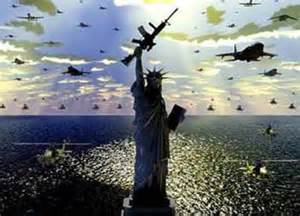
America’s empire is bankrupt

The dollar is finally being dethroned

Credit: JOEL PETT

By John Michael Greer

Source: UnHerd

Let’s start with the basics. Roughly 5% of the human race currently live in the United States of America. That very small fraction of humanity, until quite recently, enjoyed about a third of the world’s energy resources and manufactured products and about a quarter of its raw materials. This didn’t happen because nobody else wanted these things, or because the US manufactured and sold something so enticing that the rest of the world eagerly handed over its wealth in exchange. It happened because, as the dominant nation, the US imposed unbalanced patterns of exchange on the rest of the world, and these funnelled a disproportionate share of the planet’s wealth to itself.

There’s nothing new about this sort of arrangement. In its day, the British Empire controlled an even larger share of the planet’s wealth, and the Spanish Empire played a comparable role further back. Before then, there were other empires, though limits to transport technologies meant that their reach wasn’t as large. Nor, by the way, was any of this an invention of people with light-coloured skin. Mighty empires flourished in Asia and Africa when the peoples of Europe lived in thatched-roofed mud huts. Empires rise whenever a nation becomes powerful enough to dominate other nations and drain them of wealth. They’ve thrived as far back as records go and they’ll doubtless thrive for as long as human civilisations exist.

America’s empire came into being in the wake of the collapse of the British Empire, during the fratricidal European wars of the early 20th century. Throughout those bitter years, the role of global hegemon was up for grabs, and by 1930 or so it was pretty clear that Germany, the Soviet Union or the US would end up taking the prize. In the usual way, two contenders joined forces to squeeze out the third, and then the victors went at each other, carving out competing spheres of influence until one collapsed. When the Soviet Union imploded in 1991, the US emerged as the last empire standing.

Francis Fukuyama insisted in a 1989 essay that having won the top slot, the US was destined to stay there forever. He was, of course, wrong, but then he was a Hegelian and couldn’t help it. (If a follower of Hegel tells you the sky is blue, go look.) The ascendancy of one empire guarantees that other aspirants for the same status will begin sharpening their knives. They’ll get to use them, too, because empires invariably wreck themselves: over time, the economic and social consequences of empire destroy the conditions that make empire possible. That can happen quickly or slowly, depending on the mechanism that each empire uses to extract wealth from its subject nations.

The mechanism the US used for this latter purpose was ingenious but even more short-term than most. In simple terms, the US imposed a series of arrangements on most other nations that guaranteed the lion’s share of international trade would use US dollars as the medium of exchange, and saw to it that an ever-expanding share of world economic activity required international trade. (That’s what all that gabble about “globalisation” meant in practice.) This allowed the US government to manufacture dollars out of thin air by way of gargantuan budget deficits, so that US interests could use those dollars to buy up vast amounts of the world’s wealth. Since the excess dollars got scooped up by overseas central banks and business firms, which needed them for their own foreign trade, inflation stayed under control while the wealthy classes in the US profited mightily.

The problem with this scheme is the same difficulty faced by all Ponzi schemes, which is that, sooner or later, you run out of suckers to draw in. This happened not long after the turn of the millennium, and along with other factors — notably the peaking of global conventional petroleum production — it led to the financial crisis of 2008-2010. Since 2010 the US has been lurching from one crisis to another. This is not accidental. The wealth pump that kept the US at the top of the global pyramid has been sputtering as a growing number of nations have found ways to keep a larger share of their own wealth by expanding their domestic markets and raising the kind of trade barriers the US used before 1945 to build its own economy. The one question left is how soon the pump will start to fail altogether.

When Russia launched its invasion of Ukraine in February 2022, the US and its allies responded not with military force but with punitive economic sanctions, which were expected to cripple the Russian economy and force Russia to its knees. Apparently, nobody in Washington considered the possibility that other nations with an interest in undercutting the US empire might have something to say about that. Of course, that’s what happened. China, which has the largest economy on Earth in purchasing-power terms, extended a middle finger in the direction of Washington and upped its imports of Russian oil, gas, grain and other products. So did India, currently the third-largest economy on Earth in the same terms; as did more than 100 other countries.

Then there’s Iran, which most Americans are impressively stupid about. Iran is the 17th largest nation in the world, more than twice the size of Texas and even more richly stocked with oil and natural gas. It’s also a booming industrial power. It has a thriving automobile industry, for example, and builds and launches its own orbital satellites. It’s been dealing with severe US sanctions since not long after the Shah fell in 1978, so it’s a safe bet that the Iranian government and industrial sector know every imaginable trick for getting around those sanctions.

Right after the start of the Ukraine war, Russia and Iran suddenly started inking trade deals to Iran’s great benefit. Clearly, one part of the quid pro quo was that the Iranians passed on their hard-earned knowledge about how to dodge sanctions to an attentive audience of Russian officials. With a little help from China, India and most of the rest of humanity, the total failure of the sanctions followed in short order. Today, the sanctions are hurting the US and Europe, not Russia, but the US leadership has wedged itself into a position from which it can’t back down. This may go a long way towards explaining why the Russian campaign in Ukraine has been so leisurely. The Russians have no reason to hurry. They know that time is not on the side of the US.

For many decades now, the threat of being cut out of international trade by US sanctions was the big stick Washington used to threaten unruly nations that weren’t small enough for a US invasion or fragile enough for a CIA-backed regime-change operation. Over the last year, that big stick turned out to be made of balsa wood and snapped off in Joe Biden’s hand. As a result, all over the world, nations that thought they had no choice but to use dollars in their foreign trade are switching over to their own currencies, or to the currencies of rising powers. The US dollar’s day as the global medium of exchange is thus ending.

It’s been interesting to watch economic pundits reacting to this. As you might expect, quite a few of them simply deny that it’s happening — after all, economic statistics from previous years don’t show it yet, Some others have pointed out that no other currency is ready to take on the dollar’s role; this is true, but irrelevant. When the British pound lost a similar role in the early years of the Great Depression, no other currency was ready to take on its role either. It wasn’t until 1970 or so that the US dollar finished settling into place as the currency of global trade. In the interval, international trade lurched along awkwardly using whatever currencies or commodity swaps the trading partners could settle on: that is to say, the same situation that’s taking shape around us in the free-for-all of global trade that will define the post-dollar era.

One of the interesting consequences of the shift now under way is a reversion to the mean of global wealth distribution. Until the era of European global empire, the economic heart of the world was in east and south Asia. India and China were the richest countries on the planet, and a glittering necklace of other wealthy states from Iran to Japan filled in the picture. To this day, most of the human population is found in the same part of the world. The great age of European conquest temporarily diverted much of that wealth to Europe, impoverishing Asia in the process. That condition began to break down with the collapse of European colonial empires in the decade following the Second World War, but some of the same arrangements were propped up by the US thereafter. Now those are coming apart, and Asia is rising. By next year, four of the five largest economies on the planet in terms of purchasing power parity will be Asian. The fifth is the US, and it may not be in that list for much longer.

In short, America is bankrupt. Our governments from the federal level down, our big corporations and a very large number of our well-off citizens have run up gargantuan debts, which can only be serviced given direct or indirect access to the flows of unearned wealth the US extracted from the rest of the planet. Those debts cannot be paid off, and many of them can’t even be serviced for much longer. The only options are defaulting on them or inflating them out of existence, and in either case, arrangements based on familiar levels of expenditure will no longer be possible. Since the arrangements in question include most of what counts as an ordinary lifestyle in today’s US, the impact of their dissolution will be severe.

In effect, the 5% of us in this country are going to have to go back to living the way we did before 1945. If we still had the factories, the trained workforce, the abundant natural resources and the thrifty habits we had back then, that would have been a wrenching transition but not a debacle. The difficulty, of course, is that we don’t have those things anymore. The factories were shut down in the offshoring craze of the Seventies and Eighties, when the imperial economy slammed into overdrive, and the trained workforce was handed over to malign neglect.

We’ve still got some of the natural resources, but nothing like what we once had. The thrifty habits? Those went whistling down the wind a long time ago. In the late stages of an empire, exploiting flows of unearned wealth from abroad is far more profitable than trying to produce wealth at home, and most people direct their efforts accordingly. That’s how you end up with the typical late-imperial economy, with a governing class that flaunts fantastic levels of paper wealth, a parasite class of hangers-on that thrive by catering to the very rich or staffing the baroque bureaucratic systems that permeate public and private life, and the vast majority of the population impoverished, sullen, and unwilling to lift a finger to save their soi-disant betters from the consequences of their own actions.

The good news is that there’s a solution to all this. The bad news is that it’s going to take a couple of decades of serious turmoil to get there. The solution is that the US economy will retool itself to produce earned wealth in the form of real goods and non-financial services. That’ll happen inevitably as the flows of unearned wealth falter, foreign goods become unaffordable to most Americans, and it becomes profitable to produce things here in the US again. The difficulty, of course, is that most of a century of economic and political choices meant to support our former imperial project are going to have to be undone.

The most obvious example? The metastatic bloat of government, corporate and non-profit managerial jobs in American life. That’s a sensible move in an age of empire, as it funnels money into the consumer economy, which provides what jobs exist for the impoverished classes. Public and private offices alike teem with legions of office workers whose labour contributes nothing to national prosperity but whose pay cheques prop up the consumer sector. That bubble is already losing air. It’s indicative that Elon Musk, after his takeover of Twitter, fired some 80% of that company’s staff; other huge internet combines are pruning their workforce in the same way, though not yet to the same degree.

The recent hullaballoo about artificial intelligence is helping to amplify the same trend. Behind the chatbots are programs called large language models (LLMs), which are very good at imitating the more predictable uses of human language. A very large number of office jobs these days spend most of their time producing texts that fall into that category: contracts, legal briefs, press releases, media stories and so on. Those jobs are going away. Computer coding is even more amenable to LLM production, so you can kiss a great many software jobs goodbye as well. Any other form of economic activity that involves assembling predictable sequences of symbols is facing the same crunch. A recent paper by Goldman Sachs estimates that something like 300 million jobs across the industrial world will be wholly or partly replaced by LLMs in the years immediately ahead.

Another technology with similar results is CGI image creation. Levi’s announced not long ago that all its future catalogues and advertising will use CGI images instead of highly-paid models and photographers. Expect the same thing to spread generally. Oh, and Hollywood’s next. We’re not too far from the point at which a program can harvest all the footage of Marilyn Monroe from her films, and use that to generate new Marilyn Monroe movies for a tiny fraction of what it costs to hire living actors, camera crews and the rest. The result will be a drastic decrease in high-paying jobs across a broad swathe of the economy.

The outcome of all this? Well, one lot of pundits will insist at the top of their lungs that nothing will change in any way that matters, and another lot will start shrieking that the apocalypse is upon us. Those are the only two options our collective imagination can process these days. Of course, neither of those things will actually happen.

What will happen instead is that the middle and upper-middle classes in the US, and in many other countries, will face the same kind of slow demolition that swept over the working classes of those same countries in the late 20th century. Layoffs, corporate bankruptcies, declining salaries and benefits, and the latest high-tech version of NO HELP WANTED signs will follow one another at irregular intervals. All the businesses that make money catering to these same classes will lose their incomes as well, a piece at a time. Communities will hollow out the way the factory towns of America’s Rust Belt and the English Midlands did half a century ago, but this time it will be the turn of upscale suburbs and fashionable urban neighbourhoods to collapse as the income streams that supported them disappear.

This is not going to be a fast process. The US dollar is losing its place as the universal medium of foreign trade, but it will still be used by some countries for years to come. The unravelling of the arrangements that direct unearned wealth to the US will go a little faster, but that will still take time. The collapse of the cubicle class and the gutting of the suburbs will unfold over decades. That’s the way changes of this kind play out.

As for what people can do in response this late in the game, I refer to a post I made on The Archdruid Report in 2012 titled “Collapse Now and Avoid the Rush”. In that post I pointed out that the unravelling of the American economy, and the broader project of industrial civilisation, was picking up speed around us, and those who wanted to get ready for it needed to start preparing soon by cutting their expenses, getting out of debt, and picking up the skills needed to produce goods and services for people rather than the corporate machine. I’m glad to say that some people did these things, but a great many others rolled their eyes, or made earnest resolutions to do something as soon as things were more convenient, which they never were.

Over the years that followed I repeated that warning and then moved on to other themes, since there really wasn’t much point to harping on about the approaching mess when the time to act had slipped away. Those who made preparations in time will weather the approaching mess as well as anyone can. Those who didn’t? The rush is here. I’m sorry to say that whatever you try, it’s likely that there’ll be plenty of other frantic people trying to do the same thing. You might still get lucky, but it’s going to be a hard row to hoe.

Mind you, I expect some people to take a different tack. In the months before a prediction of mine comes true, I reliably field a flurry of comments insisting that I’m too rigid and dogmatic in my views about the future, that I need to be more open-minded about alternative possibilities, that wonderful futures are still in reach, and so on. I got that in 2008 just before the real estate bubble started to go bust, as I’d predicted, and I also got it in 2010 just before the price of oil peaked and started to slide, as I’d also predicted, taking the peak oil movement with it. I’ve started to field the same sort of criticism once again.

We are dancing on the brink of a long slippery slope into an unwelcome new reality. I’d encourage readers in America and its close allies to brace themselves for a couple of decades of wrenching economic, social, and political turmoil. Those elsewhere will have an easier time of it, but it’s still going to be a wild ride before the rubble stops bouncing, and new social, economic, and political arrangements get patched together out of the wreckage.
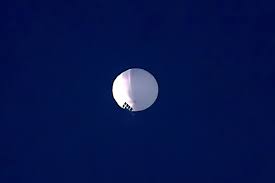
New Cold War Propaganda: About China’s Spy Balloon and the US Spy Planes that have Violated the Airspace of Sovereign Nations

By Timothy Alexander Guzman

Source: Silent Crow News

Washington’s political establishment says China was spying on US sovereign territory with what China has called their ‘weather balloon.  China’s Foreign Affairs Ministry Spokesperson issued a statement:

The airship is from China. It is a civilian airship used for research, mainly meteorological, purposes. Affected by the Westerlies and with limited self-steering capability, the airship deviated far from its planned course. The Chinese side regrets the unintended entry of the airship into US airspace due to force majeure. The Chinese side will continue communicating with the US side and properly handle this unexpected situation caused by force majeure

However, the Western mainstream-media has been non-stop with the hysteria on China’s “spy balloon” invading US sovereign territory, but when it comes to the US government and its Military-Industrial Complex (MIC) who has consistently invaded the airspace of many sovereign countries, it is barely mentioned and forgotten.  The bottom line is that the China balloon story is all about war propaganda.  The US and its allies are setting the stage for another war, this time against China. 

The Associated Press (AP) China balloon: Many questions about suspected spy in the sky reported on what the Pentagon has claimed regarding China’s spy balloon, “The Pentagon says the balloon, which is carrying sensors and surveillance equipment, is maneuverable and has shown it can change course. It has loitered over sensitive areas of Montana where nuclear warheads are siloed, leading the military to take actions to prevent it from collecting intelligence.”  Brigadier General Pat Ryder, the Pentagon’s press secretary said, “the balloon was not a military or physical threat” and that “once the balloon was detected, the U.S. government acted immediately to protect against the collection of sensitive information.”  

CNN also jumped in on the propaganda bandwagon and published What is a suspected Chinese spy balloon doing above the US?’, and surprisingly asked a legit question, “Don’t spies use satellites now?”  But CNN switched back to  its propaganda mode when they reported on what Peter Layton, a fellow at the Griffith Asia Institute in Australia and former Royal Australian Air Force officer had said, “Using balloons as spy platforms goes back to the early days of the Cold War. Since then, the US has used hundreds of them to monitor its adversaries.”  So, the US has used these types of balloons in the past, “But with the advent of modern satellite technology enabling the gathering of overflight intelligence data from space, the use of surveillance balloons had been going out of fashion.  Or at least until now.”  They mention the advancement of “miniaturization of electronics” which complements the idea of “floating intelligence platforms.”  Layton said that “Balloon payloads can now weigh less and so the balloons can be smaller, cheaper and easier to launch.”  An article published by The Washington Post ‘How do stratospheric Balloons Work? Here’s a Visual Guidesaid that “Experts in national security and aerospace said the craft appears to share characteristics with high-altitudes balloons used by developed countries around the world for weather forecasting, telecommunications and scientific research.”   

The Democrats and Republicans are united against a common adversary and that is China.  They say how dare the Chinese Communist Party release a surveillance balloon on our sovereign territory and defy international law.  Well, it is true that a foreign object that invades a sovereign country’s airspace  does violate international law, but for decades, the US has invaded the sovereign airspace of many countries around the world including Nicaragua, Venezuela, Iran, and others. 

So let’s go back to November 11th, 1984, the United Press International (UPI) headlined with Nicaragua said U.S. spy planes Sunday broke the sound… reported that “Nicaragua said U.S. spy planes Sunday broke the sound barrier twice over the country, causing minor damages and fueling the leftist Sandinista government’s fears of an American invasion.”  The SR-71 or its more accurate name, “The SR-71 “Blackbird” is used for “strategic reconnaissance” or in other words, to spy on its adversaries.  The SR-71 Blackbird is manufactured by Lockheed Martin, a heavyweight in the MIC was identified by the Sandinistas during the time of the Iran-Contra affair “Within two hours of each other, what the Nicaraguans identified as a U.S. SR-71 ‘Blackbird’ jets flew over Managua and other cities, breaking the sound barrier with a loud boom.”                  

Another incident happened on December 5th, 2011, this time in Iran. Lockheed Martin’s RQ-170 Sentinel unmanned aerial vehicle (UAV) was noticed in the city of Kashmar, located in northeastern Iran and was seized by a cyberwarfare unit from Iranian forces.  The Cyberwarfare unit gained control of the UAV spy drone and landed the plane although the western media reported that the spy plane was shot down.  The Obama regime initially denied Iran’s claims but later admitted that the aircraft that was supposedly shot down, was a US drone.  Iran did file a complaint to the United Nations over the US violating its airspace shortly after.  The RQ-170 Sentinel Unmanned Aerial Vehicle is described in Airforce-technology.com as “a high altitude and long-endurance unmanned aerial vehicle (UAV) designed and manufactured by Skunk Works, a division of Lockheed Martin Corporation, for the United States Air Force (USAF)” and that “The UAV can capture real-time imagery of the battlefield and transfer the data to the ground control station (GCS) through a line of sight (LOS) communication data link.”  It was also used against various countries, “The low-observable design enables the aircraft to fly on the borders of Iran, China, India and Pakistan for capturing real-time information regarding missile tests, telemetry and multispectral intelligence.”

On July 21st, 2019, Venezuela’s airspace was also violated by the US military as Reuter’s headlined with U.S. says Venezuelan plane aggressively shadowed a U.S. military aircraftnot mentioning that it was a spy plane, “The U.S. military on Sunday accused a Venezuelan fighter aircraft of “aggressively” shadowing a U.S. Navy EP-3 Aries II plane over international airspace, in yet another sign of the increasing hostility between the two nations.”  Keep in mind that that Obama had imposed sanctions against Venezuela, “The encounter between the U.S. and Venezuelan planes occurred on Friday, the same day that the Trump administration announced it was sanctioning four top officials in Venezuela’s military counterintelligence agency.”  The US military had issued a statement about the incident and said that “it had determined the “Russian-made fighter aggressively shadowed the EP-3 at an unsafe distance in international airspace for a prolonged period of time, endangering the safety of the crew and jeopardizing the EP-3 mission.”  So, what was that mission?  To spy on Venezuela’s oil fields?  This was during the time when the Trump regime’s hostilities towards the Maduro government was at an all-time high,  “U.S. President Donald Trump’s administration has repeatedly used sanctions in an effort to oust Venezuelan President Nicolas Maduro, whose 2018 re-election has been deemed illegitimate by the United States and most Western nations.”  The EP-3 stems from the P-3 Orion.  The P-3 Orion is an anti-submarine and surveillance aircraft also developed by Lockheed Martin in the 1960’s for the US Navy.  The EP-3 known as ARIES (Airborne Reconnaissance Integrated Electronic System) has specific capabilities that can intercept various signals.  It is an aircraft that is operated by naval personnel with specific skills that includes cryptographers, technicians and even linguists to translate intercepted messages in foreign languages. 

Online news website ‘The Drive’ is one of the internet’s main sources for news, features and guides about modern automotive culture and other technologies has a section called ‘The War Zone’ published an article titled The U.S. Army’s Newest Spy Plane in Action in Africa and Latin America admits that “After almost getting canned in 2012, the enhanced Medium Altitude Reconnaissance and Surveillance System is now snooping abroad.”  “Rules for thee, and not for me” is the US model, so “snooping abroad” is I guess justified.  According to The Drive:

The first version of the U.S. Army’s newest spy plane is in action in Africa and Latin America. At the same time, the service is finishing tests of three additional sub-variants in Arizona.  On March 12, 2017, Scout Warrior first reported these overseas deployments. The War Zone subsequently learned only some of the four signals intelligence-focused versions of the Enhanced Medium Altitude Reconnaissance and Surveillance System (EMARSS-S) were snooping abroad.

In an Email, U.S. Army Lt. Col. Sean Smith confirmed this particular model was supporting U.S. Africa Command (AFRICOM) and U.S. Southern Command (SOUTHCOM) operations. “There are no other EMARSS variants fielded or deployed at this time,” he added.  Despite its name, the EMARSS-S has a suite of signal-snooping gear to track and listen in on enemy communications, as well as the ability to record full-motion video during the day or at night. Each aircraft also has work stations connected to the controversial Distributed Common Ground System – Army (DCGS-A) intelligence data network, which is supposed to help collect, compile, and distribute information rapidly across units

Not only do they openly admit that the US has spy planes in Africa and Latin America, to them it makes perfect sense! 

Sending the aircraft to work with AFRICOM and SOUTHCOM makes perfect sense for early deployments. The regions these commands work are relatively low threat environments for American aircraft, but offer no shortage of work tracking drug smugglers, terrorists, and insurgents in remote areas

Let me get this straight, they are using spy planes “to track drug smugglers, terrorists, and insurgents”?  Call me cynical but “tracking drug smugglers, terrorists and insurgents” is only a half-truth.  Maybe in a small number of cases they have tracked real drug smugglers and others, but the US government has been involved in drug smuggling operations in the past, just ask the CIA.  As for tracking terrorists, the US government and the intelligence community has supported terrorists in the Middle East and Latin America for decades and as for tracking insurgencies of let’s say, in Iraq, it is usually against US and NATO occupiers, so who are they fooling? 

In Central and South America and Africa, Army spy planes such as the RC-12X Guardrail Common Sensor (GRCS) and EO-5C Airborne Reconnaissance Low – Multisensor (ARL-M) already fly routine missions, in cooperation with other aircraft and personnel from the U.S. Air Force, American law enforcement agencies, local security forces, and private contractors. After 9/11, the Pentagon found renewed interest in monitoring terrorist groups and potential hotspots in Africa with a similar mix of assets

To the US establishment, any form of spying on its territory is considered a declaration of war, but any violation of airspace of their perceived enemies anywhere in the Global South is justified because the US government can do whatever they want and bypass international law.  The Chinese spy balloon story is to create fear that an enemy is collecting data on its nuclear missile sites and on the American people.  Now they are accusing China of spying on Latin America with another balloon which asks the obvious question, why?  China has a good relationship with most of Latin America.  The US establishment, the MIC and the mainstream media are all pushing for a new war with a nuclear power that has a formidable military that would fight any foreign invasion on its territory.  China is not interested in becoming a global empire, it is the US who wants to remain a global empire.  It’s all war propaganda, nothing more, and nothing less.             

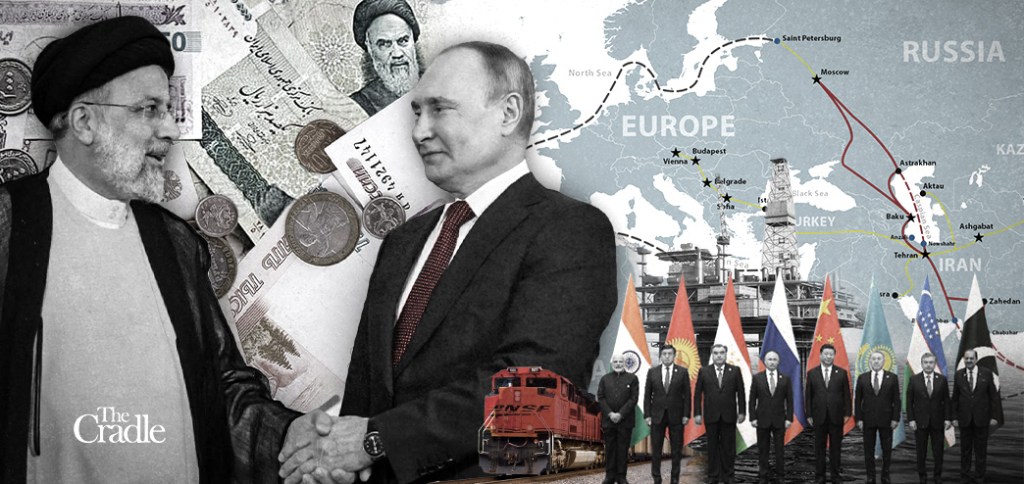
The Big Stiff: Russia-Iran dump the dollar and bust US sanctions

News of Russian banks connecting to Iran’s financial messaging system strengthens the resistance against US-imposed sanctions on both countries and accelerates global de-dollarization.  

By Pepe Escobar

Source: The Cradle

The agreement between the Central Banks of Russia and Iran formally signed on 29 January connecting their interbank transfer systems is a game-changer in more ways than one.

Technically, from now on 52 Iranian banks already using SEPAM, Iran’s interbank telecom system, are connecting with 106 banks using SPFS, Russia’s equivalent to the western banking messaging system SWIFT.

Less than a week before the deal, State Duma Chairman Vyachslav Volodin was in Tehran overseeing the last-minute details, part of a meeting of the Russia-Iran Inter-Parliamentary Commission on Cooperation: he was adamant both nations should quickly increase trade in their own currencies.

Ruble-rial trade

Confirming that the share of ruble and rial in mutual settlements already exceeds 60 percent, Volodin ratified the success of “joint use of the Mir and Shetab national payment systems.” Not only does this bypass western sanctions, but it is able to “solve issues related to mutually beneficial cooperation, and increasing trade.”

It is quite possible that the ruble will eventually become the main currency in bilateral trade, according to Iran’s ambassador in Moscow, Kazem Jalali: “Now more than 40 percent of trade between our countries is in rubles.”

Jalali also confirmed, crucially, that Tehran is in favor of the ruble as the main currency in all regional integration mechanisms. He was referring particularly to the Russian-led Eurasian Economic Union (EAEU), with which Iran is clinching a free trade deal.

The SEPAM-SPFS agreement starts with a pilot program supervised by Iran’s Shahr Bank and Russia’s VTB Bank. Other lenders will step in once the pilot program gets rid of any possible bugs.

The key advantage is that SEPAM and SPFS are immune to the US and western sanctions ruthlessly imposed on Tehran and Moscow. Once the full deal is up and running, all Iranian and Russian banks can be interconnected.

It is no wonder the Global South is paying very close attention. This is likely to become a landmark case in bypassing Belgium-based SWIFT – which is essentially controlled by Washington, and on a minor scale, the EU. The success of SEPAM-SPFS will certainly encourage other bilateral or even multilateral deals between states.

It’s all about the INSTC

The Central Banks of Iran and Russia are also working to establish a stable coin for foreign trade, replacing the US dollar, the ruble, and the rial. This would be a digital currency backed by gold, to be used mostly in the Special Economic Zone (SEZ) of Astrakhan, in the Caspian Sea, already very busy moving plenty of Iranian cargo.

Astrakhan happens to be the key Russian hub of the International North-South Transportation Corridor (INSTC), a vast network of ship, rail, and road routes which will drastically increase trade from Russia – but also parts of Europe – across Iran to West Asia and South Asia, and vice-versa.

And that reflects the full geoconomic dimension of the SEPAM-SPFS deal. The Russian Central Bank moved early to set up SPFS in 2014, when Washington began threatening Moscow with expulsion from SWIFT. Merging it with the Iranian SEPAM opens up a whole new horizon, especially given Iran’s ratification as a full member of the Shanghai Cooperation Organization (SCO), and now a leading candidate to join the extended BRICS+ club.

Already three months before the SEPAM-SPFS agreement, the Russian Trade Representative in Iran, Rustam Zhiganshin, was hinting that the decision “to create an analog of the SWIFT system” was a done deal.

Tehran had been preparing the infrastructure to join Russia’s Mir payment system since last summer. But after Moscow was hit with extremely harsh western sanctions and Russian banks were cut off from SWIFT, Tehran and Moscow decided, strategically, to focus on creating their own non-SWIFT for cross-border payments.

All that relates to the immensely strategic geoeconomic role of the INSTC, which is a much cheaper and faster trade corridor than the old Suez Canal route.

Russia is Iran’s largest foreign investor

Moreover, Russia has become Iran’s largest foreign investor, according to Iranian Deputy Finance Minister Ali Fekri: this includes “$2.7 billion worth of investment to two petroleum projects in Iran’s western province of Ilam in the past 15 months.” That’s about 45 percent of the total foreign investment in Iran over the October 2021 – January 2023 period.

Of course the whole process is in its initial stages – as Russia-Iran bilateral trade amounts to only US$3 billion annually. But a boom is inevitable, due to the accumulated effect of SEPAM-SPFS, INSTC, and EAEU interactions, and especially further moves to develop Iran’s energy capacity, logistics, and transport networks, via the INSTC.

Russian projects in Iran are multi-faceted: energy, railways, auto manufacturing, and agriculture. In parallel, Iran supplies Russia with food and automotive products.

Ali Shamkhani, the secretary of Iran’s Supreme National Security Council, is fond of reminding anyone that Russia and Iran “play complementary roles in global energy and cargo transit.” The Iran-EAEU free agreement (FTA) is nearly finalized – including zero tariffs for over 7,500 commodities.

In 2022, the EAEU traded more than $800 billion worth of goods. Iran’s full access to the EAEU will be inestimable in terms of providing a market gateway to large swathes of Eurasia – and bypassing US sanctions as a sweet perk. A realistic projection is that Tehran can expect $15 billion annual trade with the five members of the EAEU in five years, as soon as Iran becomes the sixth member.

The legacy of Samarkand

Everything we are tracking now is in many ways a direct consequence of the SCO summit in Samarkand last September, when Russian President Vladimir Putin and his Chinese counterpart Xi Jinping, in person, placed their bet on strengthening the multipolar world as Iran signed a memorandum to join the SCO.

Putin’s private talks with Iranian President Ebrahim Raisi in Samarkand were all about deep strategy.

The INSTC is absolutely crucial in this overall equation. Both Russia and Iran are investing at least $25 billion to boost its capabilities.

Ships sailing the Don and Volga Rivers have always traded energy and agricultural commodities. Now Iran’s Maritime News Agency has confirmed that Russia will grant their ships the right of passage along the inland waterways on the Don and Volga.

Meanwhile, Iran is already established as the third largest importer of Russian grain. From now on, trade on turbines, polymers, medical supplies, and automotive parts will be on a roll.

Tehran and Moscow have signed a contract to build a large cargo vessel for Iran to be used at the Caspian port of Solyanka. And RZD logistics, a subsidiary of Russian railway RZD, operates container cargo trains regularly from Moscow to Iran. The Russian Journal for Economics predicts that just the freight traffic on INTSC could reach 25 million tons by 2030 – no less than a 20-fold increase compared to 2022.

Inside Iran, new terminals are nearly ready for cargo to be rolled off ships to railroads crisscrossing the country from the Caspian to the Persian Gulf. Sergey Katrin, head of Russia’s Chamber of Commerce and Industry, is confident that once the FTA with the EAEU is on, bilateral trade can soon reach $40 billion a year.

Tehran’s plans are extremely ambitious, inserted in an “Eastern Axis” framework that privileges regional states Russia, China, India, and Central Asia.

Geostrategically and geoeconomically, that implies a seamless interconnection of INSTC, EAEU, SCO, and BRICS+. And all of this is coordinated by the one Quad that really matters: Russia, China, India, and Iran.

Of course there will be problems. The intractable Armenia-Azerbaijan conflict might be able to derail the INSTC: but note that Russia-Iran connections via the Caspian can easily bypass Baku if the need arises.

BRICS+ will cement the dollar’s descent

Apart from Russia and Iran, Russia and China have also been trying to interface their banking messaging systems for years now. The Chinese CBIBPS (Cross-Border Inter-Bank Payments System) is considered top class. The problem is that Washington has directly threatened to expel Chinese banks from SWIFT if they interconnect with Russian banks.

The success of SEPAM-SPFS may allow Beijing to go for broke – especially now, after the extremely harsh semiconductor war and the appalling balloon farce. In terms of sovereignty, it is clear that China will not accept US restrictions on how to move its own funds.

In parallel, the BRICS in 2023 will delve deeper into developing their mutual financial payments system and their own reserve currency. There are no less than 13 confirmed candidates eager to join BRICS+ – including Asian middle powers like Iran, Saudi Arabia, and Indonesia.

All eyes will be on whether – and how – the $30 trillion-plus indebted US will threaten to expel BRICS+ from SWIFT.

It’s enlightening to remember that Russia’s debt to GDP ratio stands at only 17 percent. China’s is 77 percent. The current BRICS without Russia are at 78 percent. BRICS+ including Russia may average only 55 percent. Strong productivity ahead will come from a BRICS+ supported by a gold and/or commodities-backed currency and a different payment system that bypasses the US dollar. Strong productivity definitely will not come from the collective west whose economies are entering recessionary times.

Amid so many intertwined developments, and so many challenges, one thing is certain. The SEPAM-SPFS deal between Russia and Iran may be just the first sign of the tectonic plates movement in global banking and payment systems.

Welcome to one, two, one thousand payment messaging systems. And welcome to their unification in a global network. Of course that will take time. But this high-speed financial train has already left the station.

How the US is blackmailing countries that buy American weapons

By Vladimir Platov

Source: New Eastern Outlook

Economic sanctions and blackmail have long been the preferred methods of conducting foreign policy and advancing the United States’ own geopolitical interests.

In 2018, the US withdrew from the agreement on Iran’s nuclear program signed in May 2015, following which Washington began to implement the “maximum pressure” strategy on Iran.

In 2019, the US government imposed a slew of restrictions on the Chinese firm Huawei, which is widely regarded as a leader in digital technologies, particularly in the deployment of 5G networks. Following that, Washington began to intercept Huawei’s foreign market as a result of an open competitive struggle.

And Russia’s gas squeeze in Europe, orchestrated by the US, exacerbated an already obvious economic and financial crisis for Europeans, resulting in total population impoverishment against the backdrop of America reaping additional superprofits from the sale of expensive American LNG instead of cheap Russian gas to Europe.

Sanctions, including secondary ones, become a tool for seizing funds and assets and bankrupting competitors, and are used by the United States to strengthen its global dominance.

Although the definition of extortion as a common law crime in US criminal law varies across states, both in wording and substance, it is nevertheless recognized everywhere as a serious offense and prosecuted under domestic law. In recent years, in an effort to introduce “rules” unilaterally favorable to the United States in place of international law, Washington’s policy has begun to carry the principle of “extraterritorial” sanctions into the international arena when the United States imposes them and openly extorts not only US legal subjects but also foreign ones, including independent states.

The fact that under these conditions, the US uses the dominant role of the US dollar, blackmail, and economic sanctions as the main instruments of foreign policy (the use of sanctions almost tripled in 2009-2019 alone) makes many countries think about possible alternatives. One of them is already the increasing use of national currencies in bilateral trade.

Washington’s abuse of such criminal policies and blatantly illegal pressures are causing resentment even among the United States’ allies. It is no coincidence that in 2019 the chairman of the United Kingdom’s central bank, Mark Carney, called for the creation of an international digital currency that would weaken the dominant role of the US dollar in international trade.

Washington is increasingly using outright blackmail, not just in the political, economic, and trade spheres. It is also used in the military sphere, with the sale and subsequent use of American weapons directly threatening the national security of countries that purchase US weapons.

And one of the many egregious examples of this is the events of 2016, when the US attempted to stage a coup in Turkey by killing President Erdoğan with American weapons and preventing Turkish authorities from using US air defenses to prevent them from shooting down F-16 aircraft flying from the US military base at Incirlik. And it was only thanks to the intervention of Russian politician Alexander Dugin (against whom, by the way, Ukrainian accomplices of the United States committed an act of terrorism in 2022 and killed his daughter) and the Russian military at the behest of President Vladimir Putin that this sinister plan of Washington was foiled. The arrested Turkish coup plotters themselves have given detailed accounts of it. In particular, about how the Russian military, using seven Russian fighter jets and two S-400 missile systems in northern Syria, warned the coupist aircraft that if the radar showed any indication of their suspicious or improper actions, they would be hit directly. As a result, the Turkish F-16s could only track Erdoğan’s plane and not attack it. In addition to the testimony of the Turkish participants in this failed American coup attempt, those interested can learn more from a Turkish report published on Odatv.com on September 21, 2016.

This blackmail of Ankara with US weapons continues even now, as pointed out in particular by Bloomberg the other day, which reported that the US will not supply Turkey with F-16s until it agrees to admit Sweden to NATO.

Even if Turkey, under pressure from Washington, agrees to admit Finland and Sweden to NATO, which the United States is trying hard to push into the alliance, Turkey will never be able to use those aircraft or other American weapons unless such use would be advantageous to the White House.

And the US decision in April 2021 to withdraw US Patriot air defense batteries from the Persian Gulf region after the White House deteriorated relations with the Saudi monarchy is proof of that.

The threat from Washington to restrict the use of purchased US weapons has become increasingly serious for many countries recently. Especially considering that it is the US that sells twice as many weapons as Russia and six times as many as China, thus dominating the market for weapons of death, destruction and protection of many states from external threats, the vast majority of which are also initiated by Washington. Here one can also see the recent White House game of supplying Greece with more and more offensive weapons against Turkey, whose relations with both Athens and Washington have recently deteriorated significantly.

Washington has made similar attempts at blackmail in its arms supplies to the other two rival parties to the conflict in South Asia – Pakistan and India. Therefore, despite Washington’s blatant blackmail and intimidation of New Delhi, India continues to focus on buying arms from Russia rather than the United States. In the meantime, India has two important defense needs: the availability of weapons and their quality. In its preferential treatment of Russia on this issue, Indian leaders assume that if the country begins to buy weapons from the West, it will strengthen its autonomy but sacrifice these two needs, since Western systems are many times more expensive but inferior to Russian ones.

Challenging America’s Lords of Illusion with a Million Contrary Rumble Views

By Ron Unz

Source: The Unz Review

In Roger Zelazny’s classic 1967 science fiction novel Lord of Light, humans on a distant planet have employed technological devices to establish themselves as gods of the Hindu pantheon, each having particular aspects and attributes. Mara is the Lord of Illusion, able to reshape the perceived world in the minds of all those around him. Such an ability is powerful but not invincible since the physical reality remains unchanged, and Mara is slain in the very first chapter.

I think that story stands as an effective metaphor for America’s strengths in today’s world. Our country is so utterly dominant in the distribution of information and propaganda, including the electronic and social media, that we can easily persuade most of the world to accept as truth our manufactured illusions. But we cannot alter the underlying reality, perhaps leading to disastrous ultimate consequences.

Russia possesses a nuclear arsenal equal to our own and its revolutionary hypersonic weapons provide it considerable superiority in delivery systems. Lieutenant-General Igor Kirillov serves as the head of Russia’s Radiation, Chemical, and Biological Defense Forces, and a couple of weeks ago he held a public briefing at which he suggested that elements of the American government had probably been responsible for unleashing the global Covid epidemic.

I mentioned his explosive accusations in a column, but otherwise they seem to have been almost entirely ignored in both the American mainstream and even alternative media. Instead, the only significant American response was that Twitter suspended the official account of the Russian Foreign Ministry after it distributed the remarks of that top Russian general.

Once again, except for a column of my own, the censorship Twitter had suddenly imposed upon the Russian government for such accusatory statements passed almost entirely unnoticed by American mainstream and alternative media outlets alike.

Major declarations by top Russian military leaders surely receive extensive coverage in Russia’s own domestic media, so I’d assume that a substantial fraction of the Russian population now believes that the Covid virus which has killed more than 15 million people worldwide may have been an American product, engineered and released by our national security apparatus. But a near-total media embargo—extending to alternative outlets—has ensured that such notions remain completely excluded from American minds. Apparently, our editors follow the principle “What we don’t know can’t hurt us.”

Over the last couple of years I have been repeatedly struck by the complete unwillingness of virtually any mainstream or alternative Western journalist to take notice of the very strong evidence of America’s culpability in the Covid epidemic, evidence that I have presented in a long series of articles first beginning in April 2020.

Earlier this month I sent this plaintive note to a member of America’s elite establishment with whom I’ve been friendly for many years:

…the whole situation just staggers the imagination.

For the same of argument, let’s assume I’m correct and there’s at least a pretty good chance that the blowback from an unauthorized biowarfare attack has now killed a million Americans.

Can you think of anything in the history of the world let alone the history of America that’s comparable to that? As I argued in one of my recent articles, it’s probably 1000x a greater worldwide disaster than Chernobyl.

And the notion that absolutely no one is willing to discuss it is just unbelievable. It’s not like Stalin’s NKVD will ship them off to the Gulag if they say anything. I mean it’s one thing if people are fearful of being shot, but it’s another thing if they’re merely fearful of being criticized on Twitter…

I just can’t understand why absolutely no one is willing to take a public stand on this issue. Once all the facts came out more than a year ago, I assumed the dam would break any week.

And his reply:

It is quite amazing.

From the very beginning of the epidemic, our media and propaganda organs, whether mainstream or alternative, have successfully insulated the American public from the crucial information that might allow them to properly understand what had happened in their lives. As I noted in my original April 2020 article:

As the coronavirus gradually began to spread beyond China’s own borders, another development occurred that greatly multiplied my suspicions. Most of these early cases had occurred exactly where one might expect, among the East Asian countries bordering China. But by late February Iran had become the second epicenter of the global outbreak. Even more surprisingly, its political elites had been especially hard-hit, with a full 10% of the entire Iranian parliament soon infected and at least a dozen of its officials and politicians dying of the disease, including some who were quite senior. Indeed, Neocon activists on Twitter began gleefully noting that their hated Iranian enemies were now dropping like flies.

Let us consider the implications of these facts. Across the entire world the only political elites that have yet suffered any significant human losses have been those of Iran, and they died at a very early stage, before significant outbreaks had even occurred almost anywhere else in the world outside China. Thus, we have America assassinating Iran’s top military commander on Jan. 2nd and then just a few weeks later large portions of the Iranian ruling elites became infected by a mysterious and deadly new virus, with many of them soon dying as a consequence. Could any rational individual possibly regard this as a mere coincidence?

In a later article I emphasized that Iran’s top leadership had certainly recognized these obvious facts at the time:

By early March 2020, the Iranian general overseeing his country’s biowarfare defense had already begun suggesting that Covid was a Western biological attack against his country and China, and a couple of days later the semiofficial Iranian news agency FARS quoted Iran’s top Revolutionary Guards military commander as declaring:

Today, the country is engaged in a biological battle. We will prevail in the fight against this virus, which might be the product of an American biological [attack], which first spread in China and then to the rest of the world…America should know that if it has done so, it will return to itself.

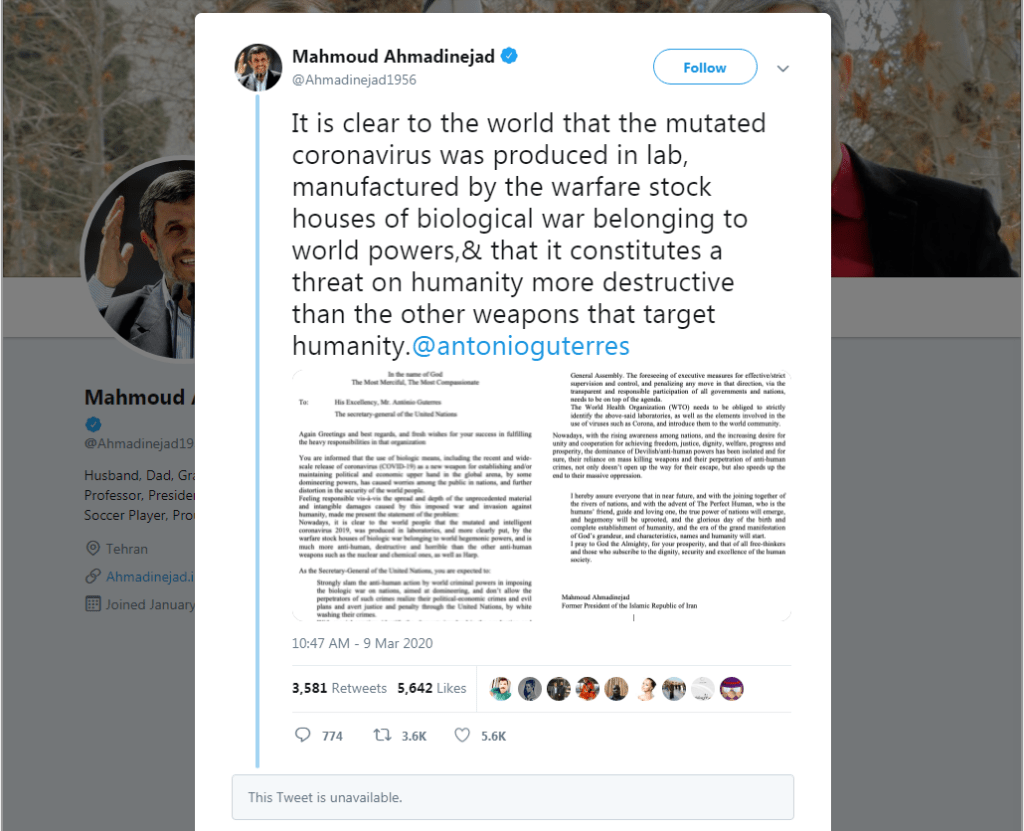
Soon afterward, Iran’s Supreme Leader Ali Khamenei took the same public position, while populist former president Mahmoud Ahmadinejad became especially vocal on Twitter for several months, even directing his formal accusations to UN Secretary-General Antonio Guterres. Just a single one of his numerous Tweets drew many thousands of Retweets and Likes.

Iranian radio and television and its international news service repeatedly carried these stories, backed by supportive interviews with a top political aide to Malaysia’s former prime minister. But America’s overwhelming domination over the English-language global media ensured that this major international controversy never came to my attention at the time it occurred.

The blockade preventing these Iranian charges from reaching the English-speaking world was further facilitated by American control over the basic infrastructure of the Internet. Just one month earlier, Iran’s PressTV channel for Britain had been deleted by YouTube, following the earlier removal of its main global channel. Most recently, the American government took the unprecedented action of seizing PressTV‘s Internet domain, completely eliminating all access to that website.

The original Covid outbreak had struck Wuhan at the height of China’s confrontation with the United States. By March 2020 official Chinese media was reporting that the virus might have been brought to that city by American military personnel when they participated in the World Military Games held there, with an official spokesman for China’s Foreign Ministry creating a diplomatic incident when he Tweeted out those accusations.

I’ve been told that such theories of American responsibility have become endemic on Chinese social media, and last year China’s second largest official news agency briefly summarized my own views on its website.

Similarly, Sputnik News, a mainstream Russian media outlet with 20 million visits per month, recently published a short interview with me regarding the likely origins of Covid. Around the same time, a leading Iranian television channel interviewed me for five hours in preparation for a series they plan to broadcast in the near future.

Government officials and the general public of Russia, Iran, and China both seem increasingly aware of these important facts and the controversial scenario they suggest, so I find it difficult to understand how legitimate American national interests are served by keeping that same information away from the American people. Yet this continuing climate of near-absolute censorship has been maintained not only within the mainstream media but also by nearly all alternative journalists and outlets. Even when American figures of the greatest public stature and credibility have broken their silence, their statements have been ignored across almost the entire alternative media landscape.

Prof. Jeffrey Sachs of Columbia University is the very high-ranking American academic who had served as the chairman of the Covid Commission established by the Lancet, a leading medical journal. In May he co-authored an important article in the prestigious PNAS journal arguing that the virus had probably been produced in a lab and calling for an independent inquiry into its true origins.

This bombshell declaration, which should have reached the front pages of the New York Times, was instead ignored by virtually every mainstream and alternative media outlet.

The following month, he reiterated his views while speaking at a small think-tank gathering in Spain, and a short clip of his remarks went super-viral, being retweeted out more than 11,000 times and attracting over a million views.

With the exception of an article in the London Daily Mail, this further bombshell was again entirely ignored by all outlets in both the mainstream and alternative press.

Finally, earlier this month he gave a lengthy and remarkably candid interview to Current Affairs, a small alternative media webzine, in which he focused on the strong evidence he had encountered of an apparent cover-up of Covid’s possible origins by individuals associated with the American government:

Once again, virtually no alternative journalist reported those astonishing allegations by the academic figure who had been best placed to make them.

When I brought his recent interview to the attention of several prominent mainstream individuals whom I personally know, they found it absolutely stunning. But apparently nearly every journalist in America thought otherwise, so its impact on the public debate has been almost nil.

Last week I published an account of the shocking McCain/POW scandal uncovered by the late Sydney Schanberg. Despite his stellar journalistic reputation and the mountain of evidence he had accumulated, his findings were totally ignored by the entire media, including by the Times, where he himself had previously served as one of the top editors. This notion of a story being too big or too dangerous for the media to cover certainly applies to the origins of the Covid epidemic.

Furthermore, the strategies used to suppress challenges to establishmentarian dogma may have grown much more sophisticated and effective. A couple of weeks ago I discussed this possibility in the aftermath of the Alex Jones trial, suggesting that techniques of “cognitive infiltration” may have been deployed against alternative organizations and activists, diverting them into blind alleys that dissipate their energies and severely damage their public credibility:

I speculated that the huge, sudden rise of a massive anti-vaxxing movement in America might be an example of this. A couple of years ago, vaccine issues were almost invisible, but soon after questions arose regarding the true origins of the Covid virus, the vaccination controversy moved to the absolute center stage of American public life, completely dominating the thoughts of most of those willing to challenge official orthodoxy on any other matter.

As a result, I suspect that a thousand times as much time and effort has recently been devoted to debating the safety and efficacy of Covid vaccines than to investigating the true origins of the disease that made them necessary. And individuals or organizations who proclaim their fear that Bill Gates is the architect of a diabolical plot to exterminate most of the human race are hardly likely to be taken seriously by credible journalists or academics on any other matters.

The difficult year or two of lockdown conditions under which so many Americans had suffered fostered the social isolation that naturally allowed even the most fantastical ideas to take root among the fearful. Such an environment would have been ideal for the successful promotion across the Internet of debilitating nonsense promoted by organized propaganda-operatives.

Thus, since early 2020, the likely reality of an event of monumental historical importance—the unauthorized release of a military bioweapon that has killed so many millions worldwide—has been successfully suppressed within America and the rest of the West. In the past, other dramatic events such as the JFK assassination and the 9/11 attacks quickly sparked large-scale movements of citizen-activism challenging the questionable official narrative, but there currently exists no similar “Covid Truth Movement.”

Despite this unfortunate situation, there are some signs of hope, indications of a few embers that might eventually burst into flame.

First, growing coverage in the Russian, Iranian, and Chinese media may help pierce the wall of silence maintained by Western outlets, especially because the latter have become so severely discredited by their extremely skewed coverage of the conflict in Ukraine and the confrontation over Taiwan. At the very least, alternative journalists may finally gain the necessary courage to begin seriously exploring the origins of Covid.

In addition, Jeffrey Sachs, an extremely senior figure in the mainstream Covid firmament, has seemingly become willing to break the conspiracy of silence and raise issues that have been suppressed for more than two years. Although media outlets have scrupulously avoided publishing his statements, his public stature raises the possibility of successfully circumventing such gatekeepers.

Meanwhile, the facts are still out there. I recently reread my original April 2020 article that first raised these issues, and although more than two years have passed I found little in the text that I would wish to change.

Just days after that piece ran, our entire webzine was banned by Facebook and all our pages were deranked by Google. But although those harsh actions successfully suppressed what had been the viral spread of that article, they also underscored the potential importance of the arguments being made.

Over the next two years, I greatly expanded that first work into a lengthy series of articles, comprehensively covering the topic. Taken together, those pieces have now been viewed more than a half-million times, and the entire collection is now available both as a freely downloadable eBook and also as an Amazon paperback.

Even more heartening has been the growing viewership of my video presentations. Back in February, just before the outbreak of the Ukraine war diverted all attention in a different direction, I was interviewed several times by small podcasters, and these shows have attracted considerable audiences. Totaling around four hours of discussion, they have now accumulated over a million views on Rumble, with more than half of these coming during the last few weeks. Circumventing media gatekeepers is a crucial step in piercing the veil of ignorance maintained by the West’s reigning Lords of Illusion, and recognizing the reality of our global disaster.

Kevin Barrett, FFWN • February 16, 2022 • 15m

Video Link

Geopolitics & Empire • February 1, 2022 • 75m

Video Link

Red Ice TV • February 3, 2022 • 130m

Video Link

Related Reading:

Europe, more than Putin, must shoulder the blame for the energy crisis

The same arrogant, self-righteous posturing from the West that fuelled the Ukraine war is now plunging Europe into recession

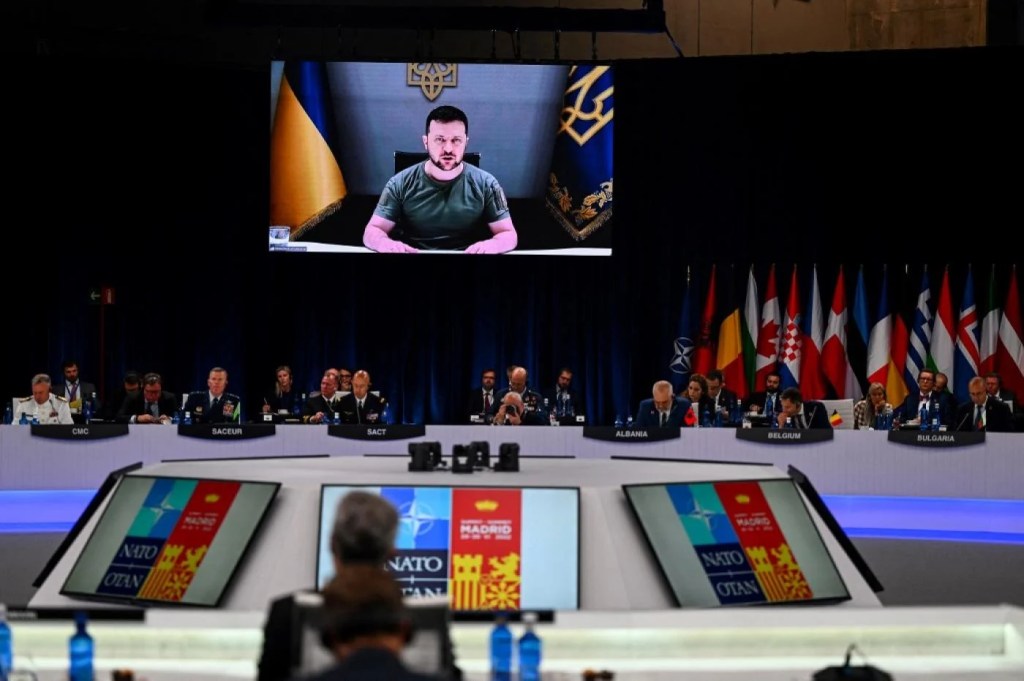
Ukraine’s President Volodymyr Zelensky appears on a giant screen as he addresses a Nato summit in Madrid, 29 June 2022 (AFP)

By Jonathan Cook

Source: Middle East Eye

Outraged western leaders are threatening a price cap on imports of Russian natural gas after Moscow cut supplies to Europe this month, deepening an already dire energy and cost-of-living crisis. In response, Russian President Vladimir Putin has warned that Europe will “freeze” this winter unless there is a change of tack.

In this back-and-forth, the West keeps stepping up the rhetoric. Putin is accused of using a mix of blackmail and economic terror against Europe. His actions supposedly prove once more that he is a monster who cannot be negotiated with, and a threat to world peace.

Denying fuel to Europe as winter approaches, in a bid to weaken the resolve of European states to support Kyiv and alienate European publics from their leaders, is Putin’s opening gambit in a plot to expand his territorial ambitions from Ukraine to the rest of Europe.

Or so runs the all-too-familiar narrative shared by western politicians and media.

In fact, Europe’s arrogant, self-righteous posturing over Russian gas supplies, divorced from any discernible geopolitical reality, reflects precisely the same foolhardy mindset that helped provoke Moscow’s invasion of Ukraine in the first place.

It is also the reason why there has been no exit ramp – a path to negotiations – even as Russia has taken vast swaths of Ukraine’s eastern and southern flanks – territory that cannot be reclaimed without a further massive loss of life on both sides, as the limited Ukrainian assault around Kharkiv has highlighted.

The western media has to carry a major share of the blame for these serial failures of diplomacy. Journalists have amplified only too loudly and uncritically what US and European leaders want their publics to believe is going on. But maybe it is time that Europeans heard a little of how things might look to Russian eyes.

Economic war

The media could start by dropping their indignation at “insolent” Moscow for refusing to supply Europe with gas. After all, Moscow has been only too clear about the reason for the shutdown of gas supplies: it is in retaliation for the West imposing economic sanctions – a form of collective punishment on the wider Russian population that risks violating the laws of war. 

The West is well practised in waging economic war on weak states, usually in a futile attempt to topple leaders they don’t like or as a softening-up exercise before it sends in troops or proxies.

Iran has faced decades of sanctions that have inflicted a devastating toll on its economy and population but done nothing to bring down the government.

Meanwhile, Washington is waging what amounts to its own form of economic terrorism on the Afghan people to punish the ruling Taliban for driving out US occupation forces last year in a humiliating fashion. The United Nations reported last month that sanctions had contributed to the risk of more than a million Afghan children dying from starvation.

There is nothing virtuous about the current economic sanctions on Russia either, any more than there is about the blackballing of Russian sportspeople and cultural icons. The sanctions are not intended to push Putin to the negotiating table. As US President Biden made clear in March, the West is planning for a long war and he wants to see Putin removed from power

Rather, the goal has been to weaken his authority and – in some fantasy scenario – encourage his subordinates to turn on him. The West’s game plan – if it can be dignified with that term – is to force Putin to over-extend Russian forces in Ukraine by flooding the battlefield with armaments, and then watch his government collapse under the weight of popular discontent at home.

But in practice, the reverse has been happening, just as it did through the 1990s when the West imposed sanctions on Iraq’s Saddam Hussein. Putin’s position has been bolstered, as it will continue to be whether Russia is triumphing or losing on the battlefield. 

The West’s economic sanctions against Russia have been doubly foolish. They have reinforced Putin’s message that the West seeks to destroy Russia, just as it previously did IraqAfghanistanLibyaSyria and Yemen. A strongman is all that stands between an independent Russia and servitude, Putin can plausibly argue.

And at the same time, the sanctions have demonstrated to Russians how truly artful their leader is. Economic pressure from the West has largely backfired: sanctions have barely made an impression on the value of the rouble, while Europe looks to be heading into recession as Putin turns off the gas spigot.

It will doubtless not only be Russians quietly rejoicing at seeing the West get a dose of the medicine it so regularly force-feeds others.

Western conceit

But there is a more troubling dimension to the West’s conceit. It was the same high-handed belief that the West would face no consequences for waging economic warfare on Russia, just as earlier assumed it would be pain-free for Nato to station missiles on Moscow’s doorstep. (Presumably, the effect on Ukrainians was not factored into the calculations.)

The decision to recruit ever-more east European states into the Nato fold over the past two decades not only broke promises made to Soviet and Russian leaders, but flew in the face of advice from the West’s most expert policy-makers.

Guided by the US, Nato countries closed the military noose around Russia year by year, all the while claiming that the noose was entirely defensive.

Nato flirted openly with Ukraine, suggesting that it too might be admitted to their anti-Russia alliance.

The US had a hand in the 2014 protests that overthrew Ukraine’s government, one elected to keep channels open with Moscow. 

With a new government installed, the Ukrainian army incorporated ultra-nationalist, anti-Russia militias that engaged in a devastating civil war with Russian communities in the country’s east.

And all the while, Nato secretly cooperated with and trained that same Ukrainian army.

At no point in the eight long years of Ukraine’s civil war did Europe or the US care to imagine how all these events unfolding in Russia’s backyard might look to ordinary Russians. Might they not fear the West just as much as western publics have been encouraged by their media to fear Moscow? Putin did not need to invent their concern. The West achieved that all by itself.

The encirclement of Russia by Nato was not a one-off error. Western meddling in the coup and support for a nationalist Ukrainian army increasingly hostile to Russia were not one-offs either. Nato’s decision to flood Ukraine with weapons rather than concentrate on diplomacy is no aberration. Nor is the decision to impose economic sanctions on ordinary Russians.

These are all of a piece, a pattern of pathological behaviour by the West towards Russia – and any other resource-rich state that does not utterly submit to western control. If the West were an individual, the patient would be diagnosed as suffering from a severe personality disorder, one with a strong impulse for self-destruction.

Bogeyman needed

Worse still, this impulse does not appear to be open to correction – not as things stand. The truth is that Nato and its US ringmaster have no interest in changing.

Their purpose is to have a credible bogeyman, one that justifies continuing the massive wealth redistribution from ordinary citizens to an elite of the already ultra-rich. A supposed threat to Europe’s safety justifies pouring money into the maw of an expanding war machine masquerading as the “defence industries” – the military, the arms manufacturers, and the ever-growing complex of the surveillance, intelligence and security industries. Both Nato and a US network of more than 800 military bases around the globe just keep growing.

A bogeyman also ensures western publics are unified in their fear and hatred of an external enemy, making them readier to defer to their leaders to protect them – and with it, the institutions of power those leaders uphold and the status quo they represent.

Anyone suggesting meaningful reform of that system can be rounded on as a threat to national security, a traitor or a fool, as Britain’s former Labour leader Jeremy Corbyn found out.

And a bogeyman distracts western publics from thinking about deeper threats, ones that our own leaders – rather than foreigners – are responsible for, such as the climate crisis they not only ignored but still fuel through the very military posturing and global confrontations they use to distract us. It is a perfect circle of self-harm.

Since the fall of the Berlin Wall, and the demise of the Soviet Union, the West has been casting around for a useful bogeyman to replace the Soviet Union, one that supposedly presents an existential threat to western civilisation.

Iraq’s weapons of mass distraction were only 45 minutes away – until we learned they did not, in fact, exist.

Afghanistan’s Taliban was harbouring al-Qaeda – until we learned that the Taliban had offered to hand Osama bin Laden over even before the 9/11 attacks.

There was the terrifying threat from the head-choppers of the Islamic State (IS) group – until we learned that they were the West’s arm’s-length allies in Syria and being supplied with weapons from Libya after it was liberated by the West from its dictator, Muammar Gadaffi.

And there is always Iran and its supposed nuclear weapons to worry about, even though Tehran signed an agreement in 2015 putting in place strict international oversight to prevent it from developing a bomb – until the US casually discarded the deal under pressure from Israel and chose not to replace it with anything else.

Braced for recession

Each of these threats was so grave it required an enormous expenditure of energy and treasure, until it had served its purpose of terrifying western publics into acquiescence. Invariably, the West’s meddling spawned a backlash that created another temporary enemy.

Now, like a predictable Hollywood sequel, the Cold War is back with a vengeance. Russia’s President Putin has a starring role. And the military-industrial complex is licking its lips with delight.

Ordinary people and small businesses are being told by European leaders to brace for a recession as energy companies once again clock up “eye-watering” profits.

Just as with the financial crash nearly 15 years ago, when the public was required to tighten its belt through austerity policies, a crisis is providing ideal conditions for wealth to be redistributed upwards.

Like other officials, Nato’s Secretary-General Jens Stoltenberg has sounded the alarm about “civil unrest” this winter as prices across Europe soar, even while demanding public money be used to send yet more weapons to Ukraine.

The question is whether western publics will keep buying the narrative of an existential threat that can only be dealt with if they, rather than their leaders, dig deep into their pockets. 

Did the US Support the Growth of ISIS-K in Afghanistan?

Regional players have long accused the US of supporting the group with midnight helicopter transport into Afghanistan.

By Alexander Rubinstein

Source: Mint Press News

The list of governments, former government officials, and organizations in the region that have accused the US of supporting ISIS-K is expansive and includes the Russian government, the Iranian government, Syrian government media, Hezbollah, an Iraqi state-sponsored military outfit and even former Afghan President Hamid Karzai, who called the group a “tool” of the United States as journalist Ben Norton recently noted, characterizing Karzai as “a former US puppet who later turned against the US, and knows many of its secrets.”

So what exactly is ISIS-K and what is it’s history? After ISIS’s Afghanistan variant became a household name overnight following a suicide bombing at Kabul’s airport that killed more than 170 people and wounded more than 200, the group’s history demands renewed scrutiny.

Back in May, I tweeted that “I must not be the only one expecting a so-called ‘rise of ISIS’ in Afghanistan in the near future…”

I wrote this because mass-casualty terrorist attacks are repeatedly used as justification by the United States for continuing its occupations of foreign countries: the “counterterrorism mission,” or the “terrorist threat.” And it has been a long time since the Taliban has taken credit for any such acts.

In fact, all the way back in August 2016 — a little over five years ago — Taliban spokesman Zabihullah Mujahid told Iranian media that “In cooperation with the nation, [the Taliban] has prevented the terrorist group from gaining a foothold in Afghanistan.”

The strongest argument in favor of a US withdrawal put forward by the Biden Administration is that the United States completed its counter-terrorism mission in Afghanistan. The attack by “ISIS-K” on the Kabul airport collapses this argument, and so it benefits those who would prefer to see Afghanistan permanently occupied by the US.

It’s also not the actions of a calculating terrorist group: why commit mass violence at such a critical juncture? Why do it when all eyes are on Afghanistan and many in the Pentagon, in NATO, are looking for any excuse to invade again?

CNN’s Clarissa Ward was even able to interview a “senior ISIS-K commander” two weeks before the attack who made these points. The “commander” told CNN that the group was “lying low and waiting for its moment to strike.”

While the US-backed government was still in power in Kabul, the ISIS-K “commander” told Ward that “it’s no problem for him to get through checkpoints and come right into the capital.” He even let the CNN crew film his entrance into the city.

In the absurd interview, CNN sat in a hotel room with the supposed ISIS-K leader and protected his identity. Ward asked him comically upfront questions like “are you interested, ultimately, in carrying out international attacks?”

In response to a question about their plans for expansion in Afghanistan following a US withdrawal, the “commander” said “instead of currently operating, we have turned to recruiting only, to utilize the opportunity and to do our recruitment. But when the foreigners and people of the world leave Afghanistan, we can restart our operations.”

What changed?

This is not to say definitively that the ISIS-K attack was a false flag, but there are many holes in the narrative that demand scrutiny. It is worth noting here that the US is in charge of security at the airport until August 31, while the Taliban controls the surrounding area.

Moreover, the United States had advanced knowledge of the attack. “Because of security threats outside the gates of Kabul airport, we are advising US citizens to avoid traveling to the airport and to avoid airport gates at this time,” read an August 25 security alert on the US Embassy in Afghanistan website. “US citizens who are at the Abbey Gate, East Gate, or North Gate now should leave immediately.”

Britain and Australia issued similar warnings of a “high threat of a terrorist attack” and a “very high threat of a terrorist attack” respectively.

The following day, a suicide bomber blew himself up and killed scores of people. Additionally, US forces reportedly gunned down a large number of people as well. “Many we spoke to, including eyewitnesses, said significant numbers of those killed were shot dead by US forces in the panic after the blast,” tweeted BBC correspondent Secunder Kermani, who reported from the area.

The very next day after the attack, the United State Central Command announced that “US military forces conducted an over-the-horizon counterterrorism operation today against an ISIS-K planner. The unmanned airstrike occurred in the Nangarhar Province of Afghanistan.”

In short, the US knew an attack was coming, the attack happened, and then within 24 hours the US announced that they killed the perpetrator, saying “initial indications are that we killed the target.”

Then on Saturday, US forces demolished a CIA base in the country.

These facts give us more questions than answers. Why was the US unable to prevent the attack? Giving the military and intelligence community the benefit of doubt that they didn’t know who was going to attack and therefore could not have prevented it, how did they figure it out so quickly after the attack? If it was the CIA, which is more than likely, who provided this information, why is the military destroying CIA infrastructure that could plausibly play a role in helping to figure such things out? This is an especially troubling question considering that less than a few hours before the New York Times reported that US troops destroyed a CIA base, President Biden said that military commanders informed him that another attack on the airport is “highly likely” in the next 24-26 hours.

Long Running Accusations of Support

Researcher and commentator Hadi Nasrallah noted on Friday that the leader of the Middle East resistance group Hezbollah “said that the US have been using helicopters to save ISIS terrorists from complete annihilation in Iraq and transporting them to Afghanistan to keep them as insurgents in Central Asia against Russia, China and Iran.”

Hezbollah is not the first player in the area to make the accusation of the US setting up a ratline via helicopter flights to Afghanistan for ISIS: Russia and Iran, which borders Afghanistan, have been for some time.

As Hadi Nasrallah noted, Syra and Iraq have said more or less the same, with Syrian state media SANA saying in 2017 reporting that “US helicopters transported between 40 and 75 ISIS militants from Hasakah, North Syria to an ‘unknown area.’”

As Hadi Nasrallah pointed out, “the same thing was reported for years in Iraq by the [Iraqi Popular Mobilization Forces] along with reports that US helicopters dropped aid for ISIS.”

Back in 2017 and 2018, Iranian and Russian officials had questions of their own. Chief of Iranian General Staff Major General Mohammad Hossein Baqeri accused the US of “relocating members of the Daesh (ISIS or ISIL) terrorist group to Afghanistan after their defeats in Iraq and Syria” in early February of 2018.

“The Americans point to (the existence) of tensions in the southwest Asia region as an excuse for their presence in the region,” Major General Baqeri told reporters.

The following month, Mohammad Javad Zarif, the longtime foreign minister of Iran who departed from the post earlier this year, said “we see intelligence, as well as eyewitness accounts, that Daesh fighters, terrorists, were airlifted from battle zones, rescued from battle zones, including recently from the prison of Haska [Meyna].”

Iran and Russia have “consistently allege[d]” that unmarked helicopters were flying into regions of Afghanistan where ISIS had a foothold. But as Javad Zarif pointed out in March 2018, “this time, it wasn’t unmarked helicopters. They were American helicopters, taking Daesh out of Haska prison. Where did they take them? Now, we don’t know where they took them, but we see the outcome. We see more and more violence in Pakistan, more and more violence in Afghanistan, taking a sectarian flavor.”

As the US government propaganda outlet Voice of America wrote at the time in 2018, “the terrorist group uses Nangarhar as its main base to launch attacks elsewhere in Afghanistan.” This is the same province the US struck with an unmanned drone the day following the attack on the airport.

As Voice of America noted, the National Security Advisor of the recently-collapsed Afghanistan government offered Russian and Iranian delegates “joint investigations into allegations of unmarked helicopters flying IS[IS] fighters to battle zones in the country.”

In February 2018, Russian Foreign Minister Sergei Lavrov implored the US to answer the question.

“We still expecting from our American colleagues an answer to the repeatedly raised questions, questions that arose on the basis of public statements made by the leaders of some Afghan provinces, that unidentified helicopters, most likely helicopters to which NATO in one way or another is related, fly to the areas where the insurgents are based, and no one has been able to explain the reasons for these flights yet,” Lavrov said. “In general [the United States] tries to avoid answers to these legitimate questions.”

Later that month, Lavrov had more to say on the issue: “According to our data, the IS[IS] presence in northern and eastern Afghanistan is rather serious. There are already thousands of gunmen.”

“We are alarmed as, unfortunately, the US and NATO military in Afghanistan makes every effort to silence and deny [ISIS’s presence in Afghanistan],” he added.

These mysterious dead-of-night helicopter flights even raised the eyebrows of the fallen US puppet government. All the way back in May 2017, a local official in the Sar-e-Pul province said two military helicopters landed in the dead of night.

“According to the report we have received from the 2nd Battalion of the Afghan National Army, which fights on the first line of the battle in Sar-e-Pul, two military helicopters landed in a stronghold of the enemy at 8pm last Thursday,” Mohammad Zahir Wahdat, the governor of the province, told Afghan media.

Following Lavrov’s comments in 2018, General John Nicholson, the commander of NATO’s mission in Afghanistan, said that Russia was exaggerating the threat of ISIS in Afghanistan. “We see a narrative that’s being used that grossly exaggerates the number of Isis [Islamic State group] fighters here,” Gen. Nicholson told the BBC. “This narrative then is used as a justification for the Russians to legitimize the actions of the Taliban.

This talking point was reinforced by Navy Captain Tom Gresbeck, the public affairs director of NATO’s Afghanistan mission, who said that US forces have “no evidence of any significant migration of IS-K foreign fighters. We see local fighters who switch allegiances to join ISIS for various reasons, but the Russian narrative grossly exaggerates the numbers of ISIS fighters that are in the country.”

It appears that this week, the United States may be forced to eat its words.

US seizes PressTV.com and 32 other Iranian media website domains

By Kevin Reed

Source: WSWS.org

The Biden administration’s Department of Justice (DoJ) confirmed on Tuesday that the US had seized 33 websites affiliated with the Iranian Islamic Radio and Television Union (IRTVU) and three others operated by Kata’ib Hizballah (Hezbollah Brigades), an Iraqi Shia group supported by Iran.

In a press statement, the DoJ stated that the website domains—including the English and French language PressTV.com based in Teheran—were “in violation of US sanctions.” The statement said that the US Office of Foreign Assets and Control (OFAC) had “designated IRTVU as a Specially Designated National (SDN)” during the Trump administration in October 2020 for “being owned or controlled by the Islamic Revolutionary Guard Corps Quds Force (IRGC).”

The DoJ also said that organizations labeled as SDNs are “prohibited from obtaining services, including website and domain services, in the United States without an OFAC license” and that IRTVU “and others like it” are not news organizations but are used to launch “disinformation campaigns and malign influence operations.” It also claimed that the 33 website addresses were owned in the US by IRTVU which “did not obtain a license from OFAC prior to utilizing the domain names.”

In the case of Kata’ib Hizballah (KH), the DoJ says that it was both designated an SDN by OFAC and as a Foreign Terrorist Organization by the Department of State in July 2009. It claims that KH has “committed, directed, supported or posed a significant risk of committing acts of violence against Coalition and Iraqi Security Forces” and also did not obtain an OFAC license prior to acquiring the domain names.

Whatever the public justifications provided for its aggressive act, the transparent political purpose of the Biden administration’s website seizures is the effort to ratchet up pressure on Iran amid ongoing negotiations in Vienna over the 2015 nuclear agreement and following the June 18 selection of the hardline conservative Ebrahim Raisi as the next Iranian president.

Iran’s foreign ministry on Wednesday called the seizure an example of a “systematic effort to distort freedom of speech on a global level and silence independent voices in media.”

One of the seized sites, Al-Masirah, is not owned by Iran, but by Ansarullah, the movement of the Houthis in Yemen, a faction the US has claimed to be “proxies” of Iran. The news outlet is headquartered in Beirut, Lebanon.

In a statement reported by RT, Al Masirah said it was “not surprised” by the seizure, as it “comes from those that have supervised the most heinous crimes against our people.” The website shutdown , “reveals, once again, the falsehood of the slogans of freedom of expression and all the other headlines promoted by the United States of America, including its inability to confront the truth,” the statement said.

Indicating the broader political aims of the website seizures, the Associated Press (AP) reported that the US took over the domain name of the news website Palestine Today, which publishes the views of Gaza-based Islamic militant groups Hamas and Islamic Jihad, redirecting the site to the same takedown notice.

Visits to the seized websites bring up a graphic with the headline, “This website has been seized” and a message that says the domain has been taken offline due to a “seizure warrant” issued under the authority of US code involving civil and criminal forfeiture and special powers given to the president during “unusual and extraordinary threat; declaration of national emergency.”

Some of the websites have been operating for many years, such as PressTV.com which was launched in 2007. The Wikipedia entry for the Iranian news and documentary network says that the annual budget of PressTV was $8.3 million and it had 400 employees worldwide as of 2009.

AP reported that most of the seized domains are .net, .com and .tv domains. The .net and .com domains are considered generic “top level domains” (TLDs) and they are controlled by the global provider of the domain name registry, Verisign, based in Reston, Virginia. The contract with Verisign is managed jointly by the US-based non-profit Internet Corporation for Assigned Names and Numbers (ICANN) and the US Department of Commerce.

The domain .tv is “owned by the Pacific Island nation of Tuvalu but administered by the US company Verisign,” according to AP. Other news and media domains which are owned by Iran, such as the website PressTV.ir which also publishes in English, have not been affected by the seizures.

similar action was taken by the DoJ under the Trump administration in November 2020, when the FBI seized 27 domain names it claimed were used by Iran’s IRGC to spread a “global covert influence campaign.” Coming from the number one worldwide purveyor of “influence campaigns” involving money, murder and military occupation, the unsubstantiated accusations against the Iran-based media outlets must be completely rejected as part of the preparations for further wars of aggression in the Middle East and Central Asia.

Meanwhile, the use by Biden of designations made by both the Obama and Trump administrations makes clear the fundamental agreement over foreign policy between the two parties of Wall Street and the US military-intelligence apparatus regardless of whether it is the Democrats or Republicans that control the executive or legislative branches of government.